Bush Visits Afghanistan
And I Thought Little League Was Bad
Supreme Court Not Sympathetic To Campaign Finance Limits
False Notes On Civil War Fears
Sooner Suicide Later Turns Out To Be Botched Attack
Talk About Triangulation
Asleep On The Job
Katrina Tape Half-Story
Europe Puts On Its Blinders
Katrina Tape Transcripts Show Media Hack Job
Able Danger, The Lawsuit
The Message Behind The India Deal
Domestic Terrorists Find Out Times Have Changed
...And Generalissimo Franco Valiantly Remains Dead
Just How Long Is This Eleventh Hour Anyway?
Visiting TortureWorld
Kurtz On Katrina
Live Chat With CQ
Other Than That, He Seemed All Right
Brault Capitulates
If They Can't Make It There ...
AP Plays Emily Litella
Great Moments In Advertising
The Gray Lady Gets It (Mostly) Right
Eight For The Duke
Do The Gitmo Detainees Have A Case?
Iraq: No Timetable
Glass Houses Who Need Stones Are The Luckiest Glass Houses
Challenging The Gitmo Study
Iran Plays EU For Suckers ... Film At 11
Adam Cohen Tries Humor
God Bless Virginia Postrel
Are We Leaving Iraq?
Press Finds Petards Most Uncomfortable, Once Hoisted
Gitmo Study Project Under Way
Academy Awards Live Blog
Islam, Islam Uber Alles
To Boldly Stop Going?
Going To Yale Instead Of To Jail
EU: Oslo A Singular Commitment -- For Israelis Only
Turan: Hollywood Isn't Liberal Enough
Gitmo Project Still Under Way
The Return Of Dialyblogging
Iran Gives US A Casus Belli, If We Want It
Kirby Puckett, RIP
Emily Litella Also Works At The Post
Taliban and AQ Taking A Beating In Pakistan
GOP Conservatives Take A Stand
Can We Call This Terrorism Yet?
A Direct Assault On Judicial Activism
Salon Sells Out Troops To Boost Subscriptions
DeLay Wins Primary
Are The Democrats Coming Apart?
Iranians Unhappy About Nuclear Standoff
Why We Spy
Libertarian Forum Steps Out From The Pack
Dujail's Precedent
Congratulations, Mark
A Spoonful Of Panic Helps The Majority Go Down
Update On The Gitmo Study
North Korea Wants Attention
Poles, Apart
Iranian Plutonium Development Started In 1990s
Thou Shalt Not Eat With Thine Lobbyists
The Memoirs Of The Inscrutable
Murder Indictment Of FBI Agent Could Jeopardize Mob Convictions
From Dafydd: Captain Ed's Gitmo Project, Tribunal Set 28
The Smart Move For Everyone
A Dreadful Interlude For All Involved
Madrid Bombings Not Al-Qaeda Operation
A Final Round With The Family
Gray Lady Pushes Guilt By Indirection, Ignores Corruption
Why Has McCain Become A Bush Cheerleader?
Milosevic Dead
Father Of The Year
Romney Stuns In Straw Poll
Insurgent Split Into Gang Warfare In Anbar
Iran Turns Down Russian Enrichment
Going To War With New Hampshire
Family Reunion
Harper Hangs Around In Afghanistan
De Villepin's Dance Goes Badly
Rice: India 'Unique'
Yale's Response To Alumni Critics: 'Retarded'?
Feingold Goes Off The Reservation
Twin Cities Needs A New Publisher
Ask No Questions Of Your Superstar Journalists
Chef Gets Huffy, Leaves South Park
AQ #2 Seen In Lodi Before 9/11
Armitage The Plame Leaker? Maybe ...
GOP Weakening On Spending Cuts
Feingold Isolated By Angry Caucus
The End Of The Culpepper Era
When Reform Just Means Changing Names
Saddam's Standup Routine Slays 'Em
The Vanishing Democrat
Western Firmness Undermining Ahmadinejad?
It's An Honor To Be Nominated
Misleading AP Headline A Political Attack?
Did Pakistan Buy The 9/11 Commission?
Iraq Papers: Al-Qaeda In Iraq In 2002 In Recruitment Drive
Hillary Benefactor Tied To Korean Slush-Fund Scandal
Russ Feingold -- Karl Rove's Secret Weapon
Not Another Independent Commission ...
Ken Mehlman Visit - The Live Blog
Unlocking History At Leavenworth
Death To Protestors In Belarus
Feingold Jumps The Shark (Updated)
How Bad Is The Bush Slide Anyway?
Minnesota DFL Leader Lied About Conversation With State Supreme Court
Charity Begins At Home
Hamas Double-Talks As Fatah Takes A Powder
Lá Fhéile Phádraig Sona Dhaoibh!
Gitmo Study Nears Completion
We Club Seals Because We Hate America?
The Great Blogger Degaussing Of 2006 (Updated)
Is Becky Lourey The Last Minnesota Voice For Free Speech?
Operation Swarmer Not Intended As 'Torch II'
Russia Says 'Nyet' To Quick Action On Iran
All The News That Fits Our Mindset
More Connections Between Saddam And Al-Qaeda
NARN On The Air Today
Returning To Camp Nama And Abu Ghraib, Again And Again
The Karni Crossroads
All (Corruption) In The Family
The Sopranos: Whack-A-Poll, Episode 2 (Bumped and Updated)
My Psycho Sons
How Innocuous Were Those Tapes, Anyway?
American Death Rate In Iraq Lowest In Two Years
The New Martyrs
Why, He's Almost As Popular As Saddam Hussein!
Saddam Personally Ordered Chemical Attack On Kurds
Canadian Liberals Support Afghan Mission
Were You At The Coup?
CQ Media Links For Today
Minnesota DFL Endorses Lying
The EU Never Learns, And Neither Does The BBC
South Park's Cooking Revenge For Chef
What Happens When One Picks The Losing Horse
Vanishing Species: Rockefeller Republicans and Jackson Democrats
Business As Usual Is No Excuse
Belarus Teeters On The Edge
A Blogger Gets His Due
Strawmen Sure Do Get Around
WaPo's Positive Review
Afghan Christian Gets Official US Protest
Are Belarus Protests Winding Down?
Britain Hardening Its Line On Iran
Gallup Dumps CNN
Moonbat, Jr.
That Wall May Come In Handy After All
Harper Intervenes On Behalf Of Abdul Rahman
Uh ... Chef? It's Going ... Bad
Spanish Insurgency Hangs It Up
Hillary: Immigration Enforcement Would Criminalize Jesus
All The News That Fits Our Mindset, Volume II
Quick Links
The Boss Likes Me
Media Complicit In Saddam's Trial Strategy
More Evidence Of Connections
No Wonder Cell Phones Cause Car Accidents
A Saad Day
The Revenge Of The Easter Bunny
Lukashenko Busts Up The Demonstrations
An Appropriate Denouement (Updated)
Russia, Unmasked
The Media As Semaphore
Now Putin's Really Done It!
The FEC Listened
Reports Of Their Demise May Have Been Exaggerated
Stealing Steele Sinks Schumer's Staffer
Will Blogs Eat Themselves?
Northern Alliance Radio Network Today
Incoherence In Belarus
Feingold Campaigns For Retreat From Iraq -- In Iraq
The Orange Devolution?
Marching For Lawbreaking
Rahman Unbound
Live By The Sword ...
Answering RedState On Phelps
Telling Us What We Already Knew
Yushchenko Fades
Hamas Wants Dictation, Not Talks
Strib: Let's Ignore The Constitution
A DQ For Scalia? (Updated)
The Scarlet Letters
Moussaoui: I Would Have Hit The White House
Quick Links
The Fukuyama Two-Step
Honoring 1979
The Untrue Always Disappoint, E.J.
This Should Keep The Beltway Press In A Dither
Israelis Vote For Sharon's Strategy
Democrats Finally Agree On National-Security Message: Invade Pakistan
A Virtual Wall Brings Virtual Amnesty
Guess Who's Back In Business With The Thugocracy?
Palestinians Celebrate Likud Collapse
Illegals To Americans: We Hate America
Senate Ends Anonymous Holds, Holds Off On Other Reform
CQ On The Air Tonight
New Democratic Image On Security A Hit!
UN Gives Iran 30 Days, But Then What?
Trent's Tone-Deaf MYOB On Pork
Gray Lady Misrepresents FISA Testimony
Canada First To Cut Off Hamas
Jill Carroll Released By Captors
Color The LA Times Unimpressed
Gallup Throws Doubt On Political Polling
George Will: Ich Bin Ein Ost-Berliner?
The Background On Reconquista
Swann Leads Rendell
Don't Say We Didn't Warn You
Dems Try To Starve NSA As First Act Of Their New Security Plan
Ending The 527 End-Around
Was He Looking For Applicants?
McKinney: Guard Molested Me Because I'm Black
Iranians Celebrate MIRV Or A Suicidal Tendency, Take Your Pick
Good Enough Explanation For Me
About
Ed Morrissey has blogged at Captain's Quarters since 2003, and has a daily radio show at BlogTalkRadio, where he serves as Political Director. Called "Captain Ed" by his readers, Ed is a father and grandfather living in the Twin Cities area of Minnesota, a native Californian who moved to the North Star State because of the weather.
My Other Blog

The Crows Nest
Good Enough Explanation For Me
After the extraordinary release of Jill Carroll, many people wondered what she would say about her time in captivity. When she started issuing statements about how well she had been treated by her captors, seemingly forgetful about the murder of her translator, many reacted in understandable dismay and anger. That criticism crescendoed when her kidnappers released a video of Carroll giving what looked to be her opinions about the war, George Bush, and the American military.
However, her editors explain that the statement and the video were preconditions for saving her own life:
The night before journalist Jill Carroll's release, her captors said they had one final demand as the price of her freedom: She would have to make a video praising her captors and attacking the United States, according to Jim Carroll.In a long phone conversation with his daughter on Friday, Mr. Carroll says that Jill was "under her captor's control."
Ms. Carroll had been their captive for three months and even the smallest details of her life - what she ate and when, what she wore, when she could speak - were at her captors' whim. They had murdered her friend and colleague Allan Enwiya, "she had been taught to fear them," he says. And before making one last video the day before her release, she was told that they had already killed another American hostage.
That video appeared Thursday on a jihadist website that carries videos of beheadings and attacks on American forces. In it, Carroll told her father she felt compelled to make statements strongly critical of President Bush and his policy in Iraq.
Her remarks are now making the rounds of the Internet, attracting heavy criticism from conservative bloggers and commentators.
In fact, Carroll did what many hostage experts and past captives would have urged her to do: Give the men who held the power of life and death over her what they wanted.
I too wondered about Carroll's initial statements after terrorists dumped her in a Sunni neighborhood close to the Green Zone. Most of us have listened to similar opinions from reporters and pundits about the US effort in Iraq, and perhaps that's why many believed her statements to reflect her true opinions. Certainly the press has not built a reservoir of goodwill among their readers or the military.
It's good to remember than anytime a hostage gets released by their captors instead of escaping or being freed by authorities, it's usually to send a message. Having been a captive for three months, fighting to stay alive and relatively unharmed every moment of the time, the promise of release for a few minutes of meaningless babble in a video and an initial statement would sound like a terrific bargain to any civilian.
Not long ago, the US acknowledged that even its POWs had to make these kinds of bargains with captors to avoid torture and murder. Many brave men died at the hands of the North Vietnamese trying valiantly to remain defiant through years of captivity because of the prevailing orders at the time that forbade American servicemen from acting in their own defense, losses that inspire us to acts of courage but also in the end did nothing to prevent the enemy from using POWs as propaganda tools. By the time of the Gulf War, the American public had developed the sophistication to understand that programmatic answers videotaped by agents of tyranny meant nothing.
I wonder why we forgot it in this instance. Jill Carroll will have plenty of time to tell us her story, but I think we would all benefit by taking a deep breath and holding our fire until she's safely home and in a clearer mental state. The Christian Science Monitor's explanation makes sense; if it's untrue, we'll know soon enough, but for the moment I think we can all give Carroll the benefit of the doubt.
UPDATE: Jim Geraghty at TKS agrees, and has more thoughts on the subject.
Iranians Celebrate MIRV Or A Suicidal Tendency, Take Your Pick
The Iranian government announced today that it had successfully test-fired a missile capable of both evading radar and hitting multiple, independent targets, suggesting for the first time that the Islamic Republic has developed a MIRV system capable of delivering multiple nuclear warheads throughout the region:
Iran's military said Friday it successfully test-fired a missile not detectable by radar that can use multiple warheads to hit several targets simultaneously, a development that raised concerns in the United States and Israel.The Fajr-3, which means "victory" in Farsi, can reach Israel and U.S. bases in the Middle East, Iranian state media indicated. The announcement of the test-firing is likely to stoke regional tensions and feed suspicion about Tehran's military intentions and nuclear ambitions. ...
Andy Oppenheimer, a weapons expert at Jane's Information Group, said the missile test could be an indication that Iran has MIRV capability. MIRV refers to multiple independently targetable re-entry vehicles, which are intercontinental ballistic missiles with several warheads, each of which could be directed to a different target.
"From the description, it could be a MIRV. If you are saying that from a single missile, separate warheads can be independently targeted then yes, this is significant," he said.
The question is how true this news actually is, and whether it means that the Iranians have a nuclear device to sit atop the missile. Most analysts think that the Iranians may be as far as five years away from a nuclear warhead, and that the Shahab-3 might be a more likely delivery system, at least initially. No one has a clear idea whether the Iranians truly have a radar-evading missile as they claim, as their footage of the tests did not show much about the missile or its launch.
If the Iranians have told the truth about the missile, it represents a dangerous escalation of the standoff over its nuclear program. The ability to pierce the missile defenses of Israel will mean that stopping Iran's nuclear program takes on an even more urgent cast. It almost guarantees that Israel and the US will have to take pre-emptive action to destroy or at least cripple the nuclear program in Iran.
The Iranians had better be careful. If this is gamesmanship and bluff, they may have pushed it too far. If it isn't, it would appear that the nuclear warheads that the Fajr-3 will carry are closer than anyone has guessed thus far. In either case, the missile announcement brings us closer to military action to stop the mullahs.
McKinney: Guard Molested Me Because I'm Black
Cynthia McKinney may cause a security crisis all on her own in the nation's capital before she gets done with her moment of infamy. Instead of apologizing for failing to wear proper identification, violating a security checkpoint, ignoring a security officer when he asked her to stop, and then assaulting him when he attempted to detain her, McKinney claims that she has been victimized -- by the racist and sexist molesters who guard the government offices in DC:
Rep. Cynthia McKinney, the Georgia congresswoman who had an altercation with a Capitol Police officer, said Friday a Capitol police officer started the incident by "inappropriately touching and stopping" her after she walked past a security checkpoint.McKinney, speaking at a news conference, declared she will be exonerated.
"Let me be clear. This whole incident was instigated by the inappropriate touching and stopping of me, a female black congresswoman," McKinney said, surrounded by supporters at predominantly black Howard University. ...
Her lawyer, James W. Myart Jr., said, "Congresswoman Cynthia McKinney, like thousands of average Americans across this country, is, too, a victim of the excessive use of force by law enforcement officials because of how she looks and the color of her skin."
"Ms. McKinney is just a victim of being in Congress while black," Myart said. "Congresswoman McKinney will be exonerated."
Apparently Rep. McKinney has some sort of defect which keeps her from following the standard security practices with which her colleagues manage to comply every day. As someone who has entered into Congressional office buildings on occasion, I can assure CQ readers that they do not present insurmountable obstacles to one's day. If you've traveled in an airport since 9/11, you've experienced more inconvenience than you would find at these checkpoints. Further, members of Congress can bypass the checkpoints altogether if they wear a special pin identifying themselves as such -- which McKinney, for some reason, refuses to do.
Rest assured, what started off as a stupid and narcissistic incident has already grown into an embarrassment for the entire party. According to WSB-TV in Atlanta, the ranking member of the House Administration Committee, Juanita Millender-McDonald, personally intervened with the House sergeant-at-arms to keep McKinney from being arrested for assault:
Channel 2 Action News has learned that Rep. Juanita Millender-McDonald (D-CA.) intervened when word got out Wednesday night that McKinney might be arrested.She says she approached the House sergeant-at-arms to discuss the situation.
Millender-McDonald sits on the House committee that oversees the Capitol Hill police and the sergeant-at-arms' office.
Millender-McDonald does not believe what she did constitutes “intervention”, said spokeswoman Denise Mixon. “She simply wanted some questions answered,” Mixon said.
Unfortunately for Millender-McDonald, if she pressured the sergeant-at-arms to leave McKinney alone, that constitutes obstruction of justice, as that office is responsible for law enforcement and security oversight for Congress and its offices:
The Sergeant at Arms is an officer of the House with law enforcement, protocol, and administrative responsibilities (House Rule II). The Sergeant at Arms is elected at the beginning of each Congress by the membership of the chamber. The duties of the Sergeant at Arms are mandated in law, House rules, custom, and policies determined by the House Committee on Appropriations and the Committee on House Administration in the exercise of their oversight roles. ...As the chief law enforcement officer of the House, the Sergeant at Arms is responsible for security in the House wing of the Capitol, the House office buildings, and on adjacent grounds. Under the direction of the Speaker of the House or other presiding officer, the Sergeant at Arms plays an integral role in maintaining order and decorum in the House chamber. The Sergeant at Arms is authorized to hold up the mace, the symbol of the Sergeant at Arms’ authority, before unruly Members, and to carry the mace down the aisles of the House chamber to subdue disorderly conduct. The Sergeant at Arms may be directed to compel absent Members to attend House sessions in order to achieve the necessary quorum by escorting them to the chamber (House Rule XX). Both practices have been rare, particularlyin recent years. The Sergeant at Arms or his assistant attends all floor sessions.
The Sergeant at Arms is also responsible for ensuring the safety and security of Members of Congress, congressional staff, visiting national and foreign dignitaries, and tourists. Toward this mission, the Sergeant at Arms works in concert with the Senate Sergeant at Arms, and the Architect of the Capitol. These three officials comprise the Capitol Police Board.
Rounding out the circus was the appearance of fringe lunatics Danny Glover and Harry Belafonte issuing statements of their own, despite the fact that (a) they weren't witnesses to the incident, and (b) they have no particular expertise in security or law enforcement. It didn't stop Glover from supporting McKinney's claim to be a victim of racial profiling and "inappropriate touching", a term used in molestation cases. In the meantime, McKinney's embarrassed colleagues tried the let's-move-along, nothing-to-see-here approach that McKinney's outrageous claims completely negated. Nancy Pelosi's suggestion that hitting a security guard constituted no "big deal" prompted a reply from Speaker Denny Hastert's spokesman -- "How many officers would have to be punched before it becomes a big deal?"
Meanwhile, Fox News reports that a witness to the altercation has essentially corroborated the security officer's report. A female aide to Rep. Thaddeus McCotter (R-MI) has given a statement to Capitol Police; Fox says that the staffer did not realize who the woman was until the story broke later in the day.
Will the Democrats continue to abide this embarrassment? Will we find that Rep. Millender-McDonald interfered with law enforcement on McKinney's behalf? One fact is for certain: now we know what the Democrats think of security in general. To quote Nancy Pelosi, it's no big deal.
UPDATE: Danny Glover says that he has no comment on the specific charges, but that he appeared with McKinney in order to support "our sister". And just to set the record straight, we're not talking about this Danny Glover, although he assures us that he often gets confused with the Lethal Weapon star...
UPDATE II: John Aravosis at Americablog tries to get his fellow "lefties" to see the difference between Jim Crow and legitimate security procedure:
I'm sorry, but what a pitiful excuse for a Democrat. Yes, let's cry racism and sexism and Democratism, I guess you'd call it, because a cop didn't recognize you and you decided to not even wear your member of Congress pin, or turn around when the cop called out to you while we're at war. Next time, it'll be better if the cop lets strangers without their pins just barge into the halls of Congress, bypass security, and oh blow the hell out of the entire building because they're afraid the person they stop might be - what? - a Democrat?Like I said, the only thing more pathetic than McKinney is that NOW and the NAACP would lower themselves to attend this ridiculous farce of a press conference. Have they nothing better to do than pander to someone who belittles legitimate concerns about race and gender and political bias?
Pathetic liberal groups, and pathetic Democratic members of Congress. Their funders should cut them all off until they prove the worth of their continued existence.
Some of you wondered why I wrote about my respect for John; now you know why. We may not agree on much, but he's as willing to hold his side accountable for their stupidity as I am mine.
Was He Looking For Applicants?
Today's USA Today headline: "Bush stumps for 'guest worker' program in Cancun"
He might find it more effective to stump for the program while in the United States. Do we really need an advertising campaign in Mexico calling for even more border crossing?
In the meantime, here are the images that the Mexica Movement want to promote from the anti-border enforcement rallies held earlier this week:
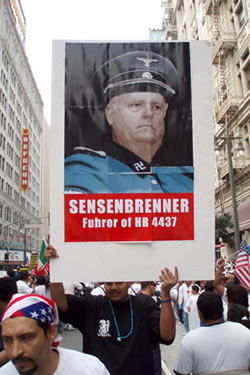
Yes, American legislators as Nazis. Nice. Of course, the anti-Semitism of their own movements wouldn't be germane, would it?
Here's another sign they proudly display at their site showing how much the reconquitas love the United States:

That matches up with a description provided with another image that shows American flags held by marchers. Do they point to this to show their love of their adopted country? Not exactly:
One of the more negative parts of the march was when American flags were passed out to make sure the marchers were looked on as part of "America".
Being part of "America" -- note the scare quotes -- is negative. And in case you really miss the point, we have this:

It's the "Europeans" who are the illegals and should be driven out. At least no one can say they didn't tell us exactly what they want -- and it sure isn't assimilation and a desire to become part of the American dream.
Ending The 527 End-Around
The Republicans in Congress have decided to tackle the end-around to campaign-finance reform that the 2004 election produced in the form of tax-exempt 527 organizations. While Congress and the White House signed into law the most profound curbs on political speech in a century in order to supposedly rid the political process of money, organizations like MoveOn took in millions from benefactors like George Soros with no oversight whatsoever. After having been caught unaware in 2004, the GOP wants to close that loophole for 2006 and 2008. The New York Times reports that the effort may come too late, as money has found other holes in the system to exploit:
To many Republicans, the liberal activist organization MoveOn.org is a political boogeyman that they hope to chase off with new restrictions on so-called 527 groups.But the pursuit may turn out to be fruitless. Like other major groups planning to inject themselves aggressively into the midterm elections through advertisements, voter drives and issue fights, MoveOn.org has already figured out what it thinks is a better, and less controversial, way to spend its millions. Its 527 — named for a section of the tax code — is being put on ice.
"Our 527 is dormant," said Eli Pariser, executive director of MoveOn.org. He said his group would predominantly operate as a conventional political action committee, allowing it to more freely mix explicit political support and issue advocacy in a way that Mr. Pariser described as "squeaky clean."
MoveOn.org might be moving on from its 527, but Congress is not. Two years after 527's burst onto the political scene, gaining notoriety by raising unlimited amounts from private donors, Congressional Republicans are moving to rein in the groups — just in time for the November midterm elections. Leading Democrats are threatening a fight.
Instead of 527s, the new buzz number is 501(c). That's the tax designation for a brand of non-profit that can legally campaign for the election of specific candidates, and whose contributions fall outside of campaign regulation. While Congress plays whack-a-mole with 527s, the truth is that most people have abandoned that format due to existing restrictions on direct support for candidates. MoveOn had to split itself into two entities in 2004 to get around that problem, and this time around won't even bother with the 527 effort. In effect, the Republicans are thus far solving a problem that no longer substantially exists.
Once again, we can thank decades of Congressional action for this nonsense. Repeated attempts to "reform" the electoral process has resulted in a Byzantine labyrinth of legislation that creates so many artificial categories for the good old US greenback that even the lawyers have trouble keeping up with it. Instead of removing big money from the political process, they have guaranteed its further insinuation while drastically reducing the responsibility of candidates and political parties for its use. These independent 501(c)s can campaign with no boundaries of taste or accountability, and the causes and people they support can have no effect on their activities -- in fact, they must not be able to affect them, lest that prove illegal coordination. Donors with big checkbooks will send their money to these front organizations instead of the political campaigns but get the same benefit regardless.
If this sounds a lot like money laundering to you, it only proves you're paying attention.
Once again, and before we lose even more of our right to free political speech, Congress needs to abandon these ridiculous attempts to build a stick dam in the middle of a flood. All these laws do is employ lawyers by the hundreds or thousands, turn inexperienced candidates into criminals, and allow big-money donors to escape responsibility. We need to forego artificial contribution categories and allow unlimited contributions with full and immediate disclosure. The money will still be in play, but it will force candidates to assume responsibility for their existence and application. Voters will then have a true picture of the political arrangements between donors and their favored candidates.
It's far past time that we abandon our fantasy that money can be removed from the political process, or that it even should be divorced from it. Money only provides a tool for communicating messages. The money itself is not an evil, but the darkness and confusion of its application in our current system makes it so. Bring it into the sunlight; it's time to quit fearing it and treat it responsibly/
Dems Try To Starve NSA As First Act Of Their New Security Plan
The Democrats announced their new platform on national security earlier this week, promising to reverse decades of image problems on national defense and foreign policy with a policy statement long on sloganeering but dreadfully short on specifics. Yesterday they underscored their new commitment to securing America by attempting to starve the National Security Agency in a fit of pique over the work performed by the agency in terrorist surveillance. The Los Angeles Times soft-pedals this while reporting some serious pushback to the monster created by the 9/11 Commission in the intelligence community:
Republicans on the House panel defeated a Democratic push to suspend hundreds of millions of dollars in spy agency funding until the Bush administration provided more information about a controversial domestic espionage program being conducted by the National Security Agency. ...Republicans on the committee defeated a Democratic amendment that sought to force the Bush administration to reveal the budget for the controversial NSA espionage program.
The Democratic measure would have withheld 20% of the NSA's budget unless the White House agreed to disclose how much was being spent on the domestic eavesdropping program.
This encapsulates the Democratic strategy on the overall war on terror quite splendidly: ignore our national defense in order to play partisan politics. Only a moron would seriously propose cutting funds to a key component of our defense strategy during a time of war. This once again proves that the Democrats care less about keeping us safe than in winning elections, and appear willing to strip us of our defenses in order to score cheap political points.
If the Democrats really wanted to rein in a purported abuse of executive power, they could take the administration to court on the issue of conducting wartime intelligence surveillance without warrants. However, they know full well that the courts will almost certainly rule against them, especially after the testimony given by five former FISA judges at the Senate Judiciary Committee this week. If they sue and lose, it will demonstrate that Bush had it right all along and was working fully within his powers to protect the country from further attack -- an effort that has resulted in over four years of safety.
Instead, now they clamor for censure and worse for supposedly breaking laws that Democrats won't enforce through normal channels and to which they didn't object while being regularly briefed on the program for all four years. As if that wasn't foolish and self-centered enough, now they want to leave us without a vital means of finding and tracking potential Islamofascist terror cells within and outside the US just to extort information from the White House, information they know to be classified as are all line items for intelligence agencies.
This is what I mean when I say that the new Democratic plan for national security is the same as the old plan: a cynical strategy for political exploitation that puts the defense of our nation a distant second to their grab for power.
NOTE: This is part 1 of the look at actions at the Intelligence Committee yesterday; part II follows rather than precedes this post.
Don't Say We Didn't Warn You
When the 9/11 Commission's final report came out in the middle of the presidential election, the reaction was predictable. Both sides used the conclusions and recommendations for political point-scoring, but none more than the John Kerry campaign. Kerry and his allies, and even some Republicans, pressed the White House and Congress to immediately adopt all of the board's recommendations for revamping the American intelligence community. The Democrats accused George Bush of ignoring the commission's efforts when he suggested that the government consider the recommendations before immediately writing them into law, and the political momentum forced Congress and the administration into precipitous action instead of rational debate.
As the second part of CQ's review on the Los Angeles Times article on action in the House Intelligence Committee hearing yesterday, our biggest effort is to keep from saying "I told you so" in every paragraph. A bipartisan vote yesterday finally showed that Washington now realizes that adding two layers of bureaucracy to intelligence agencies has damaged our capabilities instead of enhancing them:
The House Intelligence Committee voted Thursday to withhold funding from the nation's intelligence director over concerns that his office, which was created to streamline operations in the nation's spy community, is instead becoming bloated and bureaucratic. ...The move to withhold funding still must be approved by the full House as well as the Senate. But it reflects rising frustration among House lawmakers with an office that was created less than two years ago to solve communication breakdowns and other problems that plagued the intelligence community leading up to the Sept. 11 terrorist attacks and the war in Iraq.
The bill would require the nation's intelligence director, John D. Negroponte, to present a detailed rationale for any additional increases to his staff or risk losing a portion of his budget. The measure was endorsed by Republicans and Democrats.
"We're concerned about some of the steps that are going on" at Negroponte's office, said Rep. Peter Hoekstra (R-Mich.), chairman of the House Intelligence Committee. Hoekstra said Negroponte needed to demonstrate that any further expansion would improve coordination among intelligence agencies, and would not amount to "putting in more lawyers and slowing down the process."
Rep. Jane Harman (DVenice), the ranking Democrat on the committee, cited similar concerns.
"We don't want more billets, more bureaucracy, more buildings," Harman said. "We want more leadership."
More leadership may be what Congress wants, but what they implemented was more billets, more buildings, and lots of additional bureaucracy. The 9/11 Commission took the demonstrated problems in coordination that existed pre-9/11 among the alphabet soup of intelligence agencies and developed the one solution guaranteed to make it worse. Instead of eliminating the needless duplication and artificial divisions between the different groups by merging them into two agencies, one for domestic intelligence and the other for foreign/military intelligence, the panel decided to create two extra layers of bureaucracy as a means of providing better communication. Congress and the White House agreed to create the office of the Director of National Intelligence, who by law would have the president's ear on all intelligence matters.
Of course, the results were utterly predictable. The expanded bureaucracy did not result in better communication, but instead has guaranteed that two more levels of bureaucrats will tie up any operational intelligence before it gets to the decision-makers. Instead of streamlining the progression of intelligence to the President, it creates extra hurdles for any information to reach his desk.
Now, comically, Congress has realized almost two years later that the collection of bureaucrats on the 9/11 Commission prescribed the hair of the dog that bit us to the bone in the years leading up to 9/11. The ONI has expanded far faster than anyone (in DC) imagined, and now boasts 700 people -- hundreds of extra bureaucrats that do nothing to collect intelligence but exist only to push it around Beltway offices.
In fairness, who could have predicted that outcome? Well, here's where I break my vow:
07/22/04: Executive Summary Balanced And Disappointing
08/02/04: Bush Adopts The Expanded Bureaucracy Approach
08/23/04: New Intelligence Reorganization Proposal Not Much Better
12/02/04: Tenet Joins Fight Against 9/11 Intelligence Reform
12/08/04: Does Anyone Like This Intelligence Reform Bill?
03/31/05: When Bureaucracies Grow, They Tend To Collide
06/07/05: I Love Hate To Say I Told You So ...
11/27/05: Intelligence Agencies Multiplying Out Of Control
All of this nonsense can be traced back to the formation of a supposedly independent panel while timing their efforts so that their report would get published in the middle of an election. We can also thank the John Kerry campaign for transforming a set of recommendations into the 347 Commandments that somehow garnered immunity from the process of rational debate and scrutiny. Anyone who looked at this document with any careful scrutiny could see that the solution promised more bureaucracy and never addressed the real issues in communication and coordination. We had ten people on this panel who represented bureaucracies their entire lives; when one only owns a hammer, every problem looks like a nail, and this is a perfect example of that wise proverb.
And just for the record ... well, you know.
Swann Leads Rendell
NFL Hall-of-Famer Lynn Swann's campaign for governor in Pennsylvania has generated more than its share of skepticism. Some questioned whether the former Pittsburgh Steeler could translate his home-state popularity into real political support, especially against an experienced and wily pol like Ed Rendell. The skeptics appear to have miscalculated in this case, however:
Pro Football Hall of Famer Lynn Swann held a slight lead over Gov. Ed Rendell in a statewide poll released Thursday, but more than a third of registered voters indicated they hadn't settled on either candidate.Thirty-five percent of those surveyed in the IssuesPA/Pew Poll said they were likely to vote for Swann, a retired Pittsburgh Steelers star and Republican campaigning to become the state's first black governor.
Twenty-nine percent said they would probably support Rendell, a Democrat and former Philadelphia mayor who is running for a second four-year term.
Among the rest, 34 percent were considered up for grabs and 2 percent didn't support either candidate. Neither Swann nor Rendell faces a primary challenge.
For a political novice taking on an incumbent of national stature like former DNC chair Ed Rendell, Lynn Swann has made his presence felt early. Even with so many voters undecided, taking a six-point lead over the sitting governor has to have not just Rendell's campaign worried, but also Robert Casey's campaign to unseat Rick Santorum in the one Senate seat considered most vulnerable for the GOP. The Democrats wanted to use Rendell to help push Casey over the top against Santorum. Now it looks like Rendell will be kept busy fighting for his own survival, and if Swann generates enough momentum, he may wind up rescuing Santorum as well.
This means more than just a lost opportunity in the Senate for the Democrats. Pennsylvania barely went to Kerry in 2004 even with the war and Rendell running the state. Without having Bush Derangement Syndrome as an issue in 2008, the Democrats will have a tough enough time keeping the Keystone State in their column. If Swann pushes Rendell out in 2006, the GOP will gain the upper hand in 2008 in one of the most significant states in the Electoral College.
Swann has a long ways to go, but he has already shown that he cannot be dismissed.
The Background On Reconquista
I'm in the middle of another e-mail meltdown, so I'm going to send you over to Brant at Strange Women Lying In Ponds, who reports what Southwesterners have known about the reconquista movement for years. It hardly argues for assimilation but instead demands a separatism that makes any effort on our part to enable it self-defeating. And as Brant notes, it has a healthy streak of anti-Semitism -- as if we need any more of that than we already have.
Back when the e-mail works ....
George Will: Ich Bin Ein Ost-Berliner?
George Will makes his conservative case for the moderate approach to immigration reform, giving enough room for hard-line enforcement while arguing for eventual absorption of the illegals already inside the US. However, he starts out with an almost unforgivable analogy that will have border-enforcement readers seeing red before they ever get to the rest of his arguments:
America, the only developed nation that shares a long -- 2,000-mile -- border with a Third World nation, could seal that border. East Germany showed how: walls, barbed wire, machine gun-toting border guards in towers, mine fields, large, irritable dogs. And we have modern technologies that East Germany never had: sophisticated sensors, unmanned surveillance drones, etc.
East Berlin? Perhaps George doesn't quite recall the purpose of the Berlin Wall, but I guarantee you it wasn't to keep West Berliners out of East Berlin. The East German government and its Soviet masters built that wall to keep people from fleeing the despair and poverty imposed on the unfortunate half of the city and killed anyone they caught trying to cross it. It wasn't part of an overall interdiction effort that promised to stop illegal immigration, drug traffickers, and terrorists from entering Communist territory; it formed the prison wall for the Gulag State and its inmates.
Israel's border with the West Bank and Gaza provide a much clearer analogy. First and foremost, it's built to keep people out, not create a nation of prisoners. It also provides deterrence from illegal crossings, forcing Palestinians towards well-manned checkpoints where security reaches maximum efficiency. The idea is not to kill Palestinian crossers, but to keep them from trying to enter Israel illegally at all. And, by the way, it works; it has been the single most important tool the Israelis had in ending the intifadas. (And by the way, it's hard to argue that Israel isn't a developed nation, that the Palestinian territories aren't a Third World area, or that their border is less significant to Israel's national defense than our southern border.)
The rest of Will's column fares better, although I disagree with his emphasis on what will be an amnesty program in practice, if not in name. Will writes that security must come first, no matter what plan one has for the aftermath. No immigration reform will do anything to stem the flood of illegals coming across the border without effective and robust barriers to entry. Failing to provide such a system only encourages local landowners to protect their property themselves, an impulse which will lead to tragic outcomes.
Will favors the approach taken by the Senate on the rest of its bill on transforming 11 million illegals into citizens by forcing them to pay fines and back taxes, learn English, and register with the government. Had the Senate taken the border issue seriously, that may have been a reasonable follow-up. However, until we secure the border, all of this is smoke and nonsense. No illegal will enter a program that costs him significant fines and back taxes when all he has to do is stay quiet and keep crossing the border in both directions as he sees fit. As for learning English, that would certainly be a novel approach; we don't even make our legal immigrants do that any more, as evidenced by ballots in a plethora of languages and government-sponsored translators at all level of public services.
At least Will sounds a reasonable note in the immigration debate, and his column is well worth a read -- once you get past the implied analogy of America transforming itself into a prison state.
UPDATE: Fixed the title of the post. As Xrlq noted in the comments, it initially translated to "I leg an East Berliner." I try to avoid doing that, actually. Xrlq thinks that Will just wanted to demonstrate that walls can be effective, but Bithead sees it more along the same lines as I do.
Gallup Throws Doubt On Political Polling
Editor & Publisher noted yesterday that Gallup reported a shift in party identification in the US; Democrats outpoll Republicans in party identification -- by a single point:
In a (perhaps) historic shift, more Americans now consider themselves Democrats than Republicans, the Gallup organization revealed today.Republicans had gained the upper hand in recent years, but 33% of Americans, in the latest Gallup poll, now call themselves Democrats, with those favoring the GOP one point behind. But Gallup says this widens a bit more "once the leanings of Independents are taken into account."
However, that's not exactly how Gallup itself headlines its results:
Americans are about as likely to identify as Republicans as they are Democrats according to a review of recent Gallup polls. However, once the leanings of independents are taken into account, the Democrats gain an advantage. Democrats have been on par with, or ahead of, Republicans in party identification since the second quarter of 2005.
A one-point difference, especially in a poll of 1,000 adults, falls within the margin of error in any case. It's interesting and revealing to see E&P cast this as a "historic shift" when Gallup reports that this has been unchanged for almost a year. Either E&P has a strong case of analytical illiteracy or they want to put a spin worthy of John McEnroe on what amounts to a lob.
But one issue does arise from this fresh polling, one that undermines practically every political survey published in the past couple of years. If party identification is so close as to be a dead heat, why do polling services routinely underrepresent Republicans? CBS polls routinely overpoll Democrats so badly that their results are hardly worth the effort of analyzing. Their last major poll had a disparity between Democrats and Republicans of thirteen points -- which they corrected to a nine-point difference. Surprise! It found that Bush's approval numbers had dropped!
Here's another that CQ noted earlier this year. Despite undersampling Republicans by 5 points, the NSA terrorist surveillance program managed to garner majority support, with or without warrants. CBS actually had their raw numbers correct in this poll, but "corrected" them through weighting to give Democrats a five-point edge. Again, it should surprise no one that this allowed CBS to report that Bush had suffered another drop in support in May of last year.
Now we have a benchmark against which to measure these polls. Any poll purporting to take the political temperature of the American electorate that doesn't reflect these rather steady numbers should receive the scorn it deserves. The polls that we have seen thus far in 2006 all fail the sampling test, and most of what we saw last year fares no better. Too bad Editor & Publisher didn't think to actually review media reporting on polls based on this information.
Color The LA Times Unimpressed
One media outlet on which Democrats could rely for sympathetic treatment for their new "plan" on national security would be the Los Angeles Times. Its political analyst, Ron Brownstein, is not known for pandering to conservatives either. The combination should have provided the best opportunity for the Democratic plan to resonate with the national media.
Unfortunately, the Democrats developed a "plan" that not even the LA Times could like, and Brownstein tells why:
Sharpening their election-year message, leading Democrats on Wednesday released a plan that promised to strengthen America's security but offered few details about how they would achieve their sweeping goals. ...Though Democrats were spirited in their denunciations of Bush's record on national security, they offered limited insights into the actual policies they would pursue if returned to power.
The party document said Democrats would double the size of the military's special forces, pass legislation improving veterans' medical care and press to screen all cargo bound for the United States "in ships or airplanes at the point of origin."
On many other fronts, though, the Democratic plan emphasized aspiration over direction.
For instance, party leaders said they would make "the needed investments in equipment and manpower so that we can project power to protect America wherever and whenever necessary." But aides said the proposal did not commit Democrats to any specific increase in defense spending.
Along with its vow to eliminate Bin Laden, the plan said Democrats would "destroy terrorist networks like Al Qaeda, finish the job in Afghanistan and end the threat posed by the Taliban." But other than adding more special forces and improving America's intelligence capacity, the document offered no hints of what strategies the party might employ toward those ends.
The plan is a collection of slogans and mission statements with almost no specifics about legislation, financing, strategies, tactics, or military efforts to achieve them. Even on those topics where their report gets specific, it fails to address the consequences of the action involved. For instance, on its insistence that the Democrats would eliminate Osama through greater numbers of special forces (doubling them), it does not say how or where they will find the men to fill those slots or the funding necessary for the expansion. It does not address how exactly they will manage to invade Pakistan against the will of our precariously-seated ally Pervez Musharraf without touching off another war.
The most humorous moment comes when the Democrats accuse George Bush of "subcontracting" the Iranian nuclear talks to the British, French, and Germans. After listening to their complaints over the last four years about Bush's supposed "unilateral" approach to foreign affairs -- while he garnered the support of dozens of nations for the invasion of Iraq, including troops from 15 other countries -- having them screech about allowing the three European nations that appear to be at the highest risk of a nuclear-tipped Shahab-3 rocket only solidifies the hyperpartisan nature of their approach. The Democrats have no consistency on national security, no credibility, and this passage is a perfect example of why. Instead of actually developing a comprehensive, consistent, and thorough strategy for foreign policy, they've reduced themselves to nothing more than gainsaying whatever the GOP does and hope that the voters don't notice the difference.
The point of the document, as Brownstein hints but never outright states, isn't to redirect American policy much at all, except to make our exit from Iraq a full-blown retreat reminiscent of our exits in Somalia and Beirut. This effort is just a superficial talking-points memo designed to make Democrats sound tough without having to make any of the hard decisions already faced by this administration. It's the perfect "eat your cake and have it too" document, but it is so baldly superficial that it can't even convince Democratic allies to support it.
Dafydd ab Hugh at Big Lizards and Jim Geraghty at TKS have done an excellent job in dissecting this piece of meringue. Start at the links at keep moving through the rest of their posts on the subject.
Jill Carroll Released By Captors
After three months as a hostage, AP reporter Jill Carroll has been released to American forces in the Green Zone, the news service reports (via Stop the ACLU):
Kidnapped U.S. reporter Jill Carroll has been released after nearly three months in captivity, Iraq police and the leader of the Islamic Party said Thursday. She was reported in good condition.Carroll, a freelance reporter for The Christian Science Monitor, was kidnapped on Jan. 7, in Baghdad's western Adil neighborhood while going to interview Sunni Arab politician Adnan al-Dulaimi. Her translator was killed in the attack about 300 yards from al-Dulaimi's office.
"She was released this morning, she's talked to her father and she's fine," said David Cook, Washington bureau chief of The Christian Science Monitor.
Police Lt. Col. Falah al-Mohammedawi said was handed over to the Iraqi Islamic Party office in Amiriya, western Baghdad, by an unknown group. She was later turned over to the Americans and was believed to be in the heavily fortified Green Zone, he said.
Carroll's kidnappers had demanded the release of all female prisoners from US custody as a condition of her release. Five eventually were released by US forces in late January as part of an overall release of 424 detainees, a move that Centcom denied having any connection to the Carroll kidnapping, but it only resulted in a repeat of the overall demand in any event. The deadline for the ransom came and went over a month ago, and no one had heard anything significant about her status since then.
The AP does not report when Carroll will return to the US, or whether she intends to do so immediately or not. Undoubtedly, we will await her own report on her captivity, treatment, and observations about the nature of the enemy that kept her in bondage for so long.
Canada First To Cut Off Hamas
The Canadians became the first nation besides Israel to formally cut off funds to the Palestinian Authority after its Hamas-controlled government officially took power yesterday. The nation's Foreign Affairs Minister, Peter MacKay, announced that Canada would not support terrorists regardless of whether they win elections or not:
Canada has become the first country after Israel to cut funding and diplomatic ties to the Palestinian Authority over the new Hamas government’s refusal to renounce violence. ...“As you know, Hamas is a terrorist organization — listed in this country — and we cannot send any direct aid to an organization that refuses to renounce terrorist activity, refuses to renounce violence.”
The news shocked pro-Palestine groups who fear aid will be cut to those living in squalid refugee camps. ...
“The stated platform of this government has not addressed the concerns raised by Canada and others concerning non-violence, the recognition of Israel, and acceptance of previous agreements and obligations, including the Roadmap for Peace.
“As a result, Canada will have no contact with the members of the Hamas cabinet and is suspending assistance to the Palestinian Authority.”
The new policy and the speed in which Stephen Harper implemented it may have truly caught the Palestinians by surprise. They surely expect a similar reaction from the US, but they had hoped that Europe and Canada would offer more moderation, more talks, and more money as an incentive to keep Hamas at the bargaining table. Hamas tried to keep that gambit alive in Ismail Haniyeh's double-talk prior to the Israeli election, hinting that Hamas might negotiate with the Israelis but refusing to change its stated goal of the destruction of Israel.
This development strikes a significant blow to those hopes. No one pretends that the EU has much interest in unity with the US on foreign policy, but Canada has been a reliable partner for the past few years for Europe. Having Canada leap out ahead of even the US to isolate Hamas and disengage from the Palestinian Authority places much more pressure on the EU to follow suit. Even with the Tories in power in Ottawa, it will be impossible for Europe to characterize the Canadian government action as a radical right-wing move.
Harper really has cast a gauntlet down to all parties. He has challenged the Palestinians to acknowledge that choices have consequences, especially in elections, and Europe to follow through on its own policies of non-negotiation with terrorists. Harper's action also prods Washington to join him soon; if we delay, we may wind up leaving Harper twisting in the political wind.
Gray Lady Misrepresents FISA Testimony
The New York Times has panicked into a serious misrepresentation of the testimony given to the Senate Judiciary Committee by five former FISA judges. Power Line looks at the transcript of the committee hearing and discovers that reporter Eric Lichtblau, who predicated his new book on the supposed illegality of the secret NSA terrorist surveillance program, wrote dishonestly about their appearance in yesterday's hearing.
Here's what Lichtblau wrote:
In a rare glimpse into the inner workings of the secretive court, known as the Foreign Intelligence Surveillance Court, several former judges who served on the panel also voiced skepticism at a Senate hearing about the president's constitutional authority to order wiretapping on Americans without a court order. They also suggested that the program could imperil criminal prosecutions that grew out of the wiretaps.Judge Harold A. Baker, a sitting federal judge in Illinois who served on the intelligence court until last year, said the president was bound by the law "like everyone else." If a law like the Foreign Intelligence Surveillance Act is duly enacted by Congress and considered constitutional, Judge Baker said, "the president ignores it at the president's peril."
After buying the transcript and reading it for themselves, Power Line reveals what the judges really said:
Judge Kornblum: Presidential authority to conduct wireless [Sic. Presumably Judge Kornblum meant "warrantless."] surveillance in the United States I believe exists, but it is not the President's job to determine what that authority is. It is the job of the judiciary. *** The President's intelligence authorities come from three brief elements in Article II....As you know, in Article I, Section 8, Congress has enumerated powers as well as the power to legislate all enactments necessary and proper to their specific authorities, and I believe that is what the President has, similar authority to take executive action necessary and proper to carry out his enumerated responsibilities of which today we are only talking about surveillance of Americans. ***Senator Feinstein: Now I want to clear something up. Judge Kornblum spoke about Congress's power to pass laws to allow the President to carry out domestic electronic surveillance, and we know that FISA is the exclusive means of so doing. Is such a law, that provides both the authority and the rules for carrying out that authority, are those rules then binding on the President?
Judge Kornblum: No President has ever agreed to that. ***
Senator Feinstein: What do you think as a Judge?
Judge Kornblum: I think--as a Magistrate Judge, not a District Judge, that a President would be remiss in exercising his Constitutional authority to say that, "I surrender all of my power to a statute," and, frankly, I doubt that Congress, in a statute, can take away the President's authority, not his inherent authority, but his necessary and proper authority.
Senator Feinstein: I would like to go down the line if I could. *** Judge Baker?
Judge Baker: No, I do not believe that a President would say that.
Senator Feinstein: No. I am talking about FISA, and is a President bound by the rules and regulations of FISA?
Judge Baker: If it is held constitutional and it is passed, I suppose, just like everyone else, he is under the law too. ***
Senator Feinstein: Judge?
Judge Stafford: Everyone is bound by the law, but I do not believe, with all due respect, that even an act of Congress can limit the President's power under the Necessary and Proper Clause under the Constitution. ***
Chairman Specter: I think the thrust of what you are saying is the President is bound by statute like everyone else unless it impinges on his constitutional authority, and a statute cannot take away the President's constitutional authority. Anybody disagree with that?
[No response.]
Chairman Specter: Everybody agrees with that.
Instead of expressing skepticism, the judges confirm that the matter is far from settled, and in fact told Congress that they don't have the jurisdiction to make the judgment. What they did tell the Judiciary members is that President Bush's arguments have a strong element of validity and probably are correct. Unfortunately for Lichtblau, that undermines the whole premise of his book -- and apparently that can't be tolerated.
UPDATE: Er, Gray Lady. I wasn't suggesting some sort of transgenderism when I first wrote "Gary Lady".
Archives
blog advertising
Blogroll
Captain's Quarters features an authoritative blogroll, listing many websites that feature the top political thinking on the Internet. In order to make the list easier to navigate, it has been divided into a number of sections.
Click on the section title to expand the list.
Northern Alliance
Hugh HewittCaptain's Quarters
Fraters Libertas
Lileks
Power Line
SCSU Scholars
Shot In The Dark
Northern Alliance Radio Network
101st Fighting Keyboardist
Blogs for Bush
Sister Ships
Recent Comments
- Carol Herman on Heading Right Radio: Kenneth Timmerman, Shadow Warriors
- Frank on Can We Afford To Engage Sadr? Can We Afford Not To?
- Scrapiron on Can We Afford To Engage Sadr? Can We Afford Not To?
- danny on Can We Afford To Engage Sadr? Can We Afford Not To?
- Ron Hellesvig on New Comment System
- unclesmrgol on New Comment System
- Loren on New Comment System
- Dennis Lawler on US Navy Protects All Shipping From Piracy, Even Our Enemies'
- Jeremy on Another Step Towards Reconciliation?
- Qwinn on Another Puzzling Endorsement