June 9, 2004
Classic CQ: The Midnight Blog-Court
While the First Mate recovers from her surgery, posting may be a bit light, depending on how much Internet access and time I have. In the meantime, I thought I'd repost a few older items from my blog that some of you may have missed. This post was written on orders from Hugh Hewitt in order to join the Society of the Master of the Horse ... and I had a blast with it. Hope you do, too! As part of my trial for acceptance into the Society of the Minnesota Master of the Horse, the second task given by Hugh Hewitt was to write an epic poem, mentioning at least ten blogs, including that of the Lord High Commissioner himself, as well as taking swipes at FratersLibertas and the Elder, and one at James Lileks, too. I decided to proceed, despite the inherent dangers of taking on so many...
October 31, 2004
CQ Flashback: Kerry's Analysis Paralysis (7/14/04)
The proverb, "Too many cooks spoil the broth" comes to mind while reading the Washington Post article on the Kerry campaign's policy structure. While intending on casting a broad net to display inclusiveness, the nominee instead teeters on the edge of an unmanageable mess: From a tightknit group of experienced advisers, John F. Kerry's presidential campaign has grown exponentially in recent months to include a cast literally of thousands, making it difficult to manage an increasingly unwieldy policy apparatus. The campaign now includes 37 separate domestic policy councils and 27 foreign policy groups, each with scores of members. The justice policy task force alone includes 195 members. The environmental group is roughly the same size, as is the agriculture and rural development council. Kerry counts more than 200 economists as his advisers. In contrast, President Bush's campaign policy shop is a no-frills affair. Policy director Tim Adams directs about a...
CQ Flashback: Kerry's Dukakis Moment? (6/23/04)
The Kerry campaign will scramble this afternoon with this AP report that one of their critical support groups has hired convicted felons -- in some cases, sex offenders -- to conduct door-to-door voter registration drives: A Democratic group crucial to John Kerry's presidential campaign has paid felons — some convicted of sex offenses, assault and burglary — to conduct door-to-door voter registration drives in at least three election swing states. America Coming Together, contending that convicted criminals deserve a second chance in society, employs felons as voter canvassers in major metropolitan areas in Missouri, Florida, Ohio and perhaps in other states among the 17 it is targeting in its drive. Some of the felons lived in halfway houses, and at least four returned to prison. ... Although it works against the re-election of President Bush, ACT is an independent group not affiliated with the Kerry campaign — federal law forbids...
CQ Flashback: Kerry Obstructed POW/MIA Investigation -- Village Voice (5/22/04)
John Kerry released new advertisements this month designed to shore up his credentials on foreign policy and veterans' affairs. Among the statements made in the advertisements made in his support promoted Kerry's efforts in investigating the POW/MIA issue, along with John McCain, whose partnership Kerry's ads also promote. As Kerry says on his campaign blog: John Kerry and Senator John McCain chaired the country's most thorough investigation into the fate of POW/MIAs in Southeast Asia. Kerry has personally pressed Vietnamese officials to cooperate in ongoing efforts to get answers for families. And he also sponsored POW/MIA Recognition Day. Kerry's Senate committee pressed for unparalleled declassification of documents, increased excavation work in Vietnam, and gathering of testimony from 144 witnesses. According to the Boston Globe, "the effort produced real answers for the some 120 families who had lived for decades without knowing whether a loved one was still alive in Southeast...
CQ Flashback: A Great Example Of The Left's Hypocrisy On Race (5/15/04)
The Left tosses another double standard at the Republicans today in an op-ed piece in today's Los Angeles Times. Lawrence Weschler, author and academic, writes a smirking, breathless piece on the audacity of George Bush to include pictures of black people on his website. Oh, the scandal! Of course, the lack of minorities in John Kerry's inner circle never quite comes up: Quick. Before they take it down. Go to your computer, log on to http://www.georgewbush.com — the official Bush/Cheney '04 reelection website. ... Nice big picture of Bush merrily shooting the breeze with two black teenage girls. Scroll down to the bottom of the page and you'll find a quadrant labeled Compassion Photos, with the invitation, "Click here for the Compassion Photo Album." Do so. And let's see, what have we got? First one up: short-sleeved Bush, holding a black kid in his arms, a bleacher full of black...
November 1, 2004
CQ Flashback: Convention Interview With Sen. Alan Simpson
Former Wyoming Senator Alan Simpson came by Bloggers Corner just a few minutes ago and spoke to the group about liberal Republicanism, the electoral college, the current campaign and its tone, and John Kerry's Senate career. As you might imagine from his press conferences during his tenure in Congress, Senator Simpson spoke directly and even bluntly in responding to our questions. My audio of the interview turned out poorly as Sean Hannity's show insists on blaring out their program over speakers pointed directly at our area, but I can rebuild the important parts. In response to questions regarding the Electoral College, Simpson strongly defended the current structure and explained that any attempt to eliminate it would never pass muster with enough states. Too many smaller states would lose their impact on presidential contests, and as Simpson said, no one would ever see a campaign outside of New York, Chicago, and...
CQ Flasback: Convention Interview With Tommy Franks
General Tommy Franks announced today that he will support George Bush for president at our blog conference at the Republican National Convention. Q: General, do you support George Bush for President? A: Yes. Q: With regards to consistency, did George Bush hurt himself with his remarks on Matt Lauer that maybe we can't win a war on terror? A: Absolutely not. We won a Cold War, didn't we? And we didn't do that in 15 minutes. Q: Did Ronald Reagan show that kind of doubt in his effort to win the Cold War? A: I don't know that there was any doubt shown at all. I think that we're talking about consistency, and persistency, and anybody who looks at this thing over the last three and a half years is going to have a heck of a hard time trying to point out when he was not consistent or persistent....
CQ Flashback: Kerry Admits Attendance During Assassination Planning Meeting (3/19/04)
John Kerry's campaign has backed off their earlier denials that Kerry was not present for the VVAW meeting in Kansas City, November 1971, where the "Phoenix Project" was brought to debate and a vote: Senator Kerry of Massachusetts yesterday retreated from his earlier steadfast denials that he attended a meeting of Vietnam Veterans Against the War at which a plan to assassinate U.S. Senators was debated. The reversal came as new evidence, including reports from FBI informants, emerged that contradicted Mr. Kerry’s previous statements about the gathering, which was held in Kansas City, Mo. in November 1971. “John Kerry had no personal recollection of this meeting 33 years ago,” a Kerry campaign spokesman, David Wade, said in a statement e-mailed last night from Idaho, where Mr. Kerry is on vacation. The historian Gerald Nicosia, who happens to be a Kerry supporter, released the minutes of the VVAW meeting, as well...
CQ Flashback: Kerry Said Terrorist Had "Legitimate Voice"
John Kerry continues his quest towards self-destruction today in an NPR interview this morning, as he described a radical Islamist currently attacking American troops in Iraq as a "legitimate voice" who shouldn't necessarily be arrested if encountered: In an interview broadcast Wednesday morning, Democratic presidential candidate John Kerry defended terrorist Shiite imam Moqtada al-Sadr as a "legitimate voice" in Iraq, despite that fact that he's led an uprising that has killed nearly 20 American GIs in the last two days. Speaking of al-Sadr's newspaper, which was shut down by coalition forces last week after it urged violence against U.S. troops, Kerry complained to National Public Radio, "They shut a newspaper that belongs to a legitimate voice in Iraq." Never mind that this "legitimate voice" used that newspaper to call for an armed revolt against the Coalition and the Iraqi provisional government. John Kerry isn't concerned with that. John Kerry sounds...
CQ Flashback: Kerry Would Have Waited For Saddam To Attack (1-27-04)
Senator John Kerry continues to make odd statements about the Iraq war, trying to reconcile his vote authorizing it with his current anti-war platform: Kerry said that the administration had promised to go through the United Nations first, and then didn't do it, but he added that at the time Saddam Hussein constituted a threat. “From 1991 to 1998, we had inspectors in Iraq blowing up weapons of mass destruction,� Kerry said. “A lot of people seem to have forgotten that. We destroyed plenty of weapons of mass destruction in those 7½ years. We found more weapons than we thought Saddam had, and evidence of a nuclear program. " Kerry is either lying or being deliberately obtuse. Bush went to the UN twice. In December, he pushed through UNSC resolution 1441, demanding immediate and full compliance from Saddam Hussein with the previous 16 UNSC resolutions. Inspectors were supposed to report...
CQ Flashback: Give UN Command Over US Forces
John Kerry, when he first ran for elective office in 1970, told the Harvard Crimson that he was an "internationalist" who felt that the UN should retain command of the US military: "I'm an internationalist," Kerry told The Crimson in 1970. "I'd like to see our troops dispersed through the world only at the directive of the United Nations." Kerry said he wanted "to almost eliminate CIA activity. The CIA is fighting its own war in Laos and nobody seems to care." The Kerry campaign, celebrating primary victories in Virginia and Tennessee last night, declined to comment on the senator's remarks. As a candidate for president, Kerry has said he supports the autonomy of the U.S. military and has never called for a scale-back of CIA operations. When a candidate takes elective office, they swear to uphold and defend the Constitution of the United States. Nowhere in that document does...
CQ Flashback: Kerry -- Bush/Cheney "Most Crooked ... Lying Group" (3/10/04)
Senator John Kerry revealed an ugly and poorly controlled side of himself when he thought he was off-mike this afternoon while speaking with AFL-CIO union workers in Chicago: Sen. John Kerry, all but officially the Democratic presidential nominee, called Republicans he is battling "crooked" Wednesday. ... "Keep smiling," one man said to him. Kerry responded, "Oh yeah, don't worry man. We're going to keep pounding, let me tell you -- we're just beginning to fight here. These guys are the most crooked, you know, lying group of people I've ever seen." Simply appalling. In the picture above, you can see a Kerry aide hurriedly trying to disconnect the microphone, to no avail, which leads me to wonder what else John Kerry says when he thinks the mikes are off. Does he speculate on Roswell? Discussing alien abductions? Kerry's campaign immediately retreated into damage control, saying that Kerry was referring to...
CQ Flashback: Kerry -- Democracy Not Important (5/29/04)
In words that echo his 1971 Senate testimony on the Vietnam war, John Kerry told the Washington Post that establishing democracy would not be a priority of a Kerry administration, preferring to work on more pressing issues other than liberty and freedom: Sen. John F. Kerry indicated that as president he would play down the promotion of democracy as a leading goal in dealing with Pakistan, Saudi Arabia, Egypt, China and Russia, instead focusing on other objectives that he said are more central to the United States' security. ... In many ways, Kerry laid out a foreign-policy agenda that appeared less idealistic about U.S. aims than President Bush or even fellow Democrat former president Bill Clinton. While Kerry said it was important to sell democracy and "market it" around the world, he demurred when questioned about a number of important countries that suppress human rights and freedoms. He said securing...
CQ Flashback: A Moment To Acknowledge Our Humanity (5/6/04)
Hindrocket at Power Line directs our attention to a story, with accompanying photograph, from the Cincinatti Enquirer about a moment on the campaign trail where we can remember that despite all of the partisan vitriol and rhetoric, we are all Americans. George Bush, making a campaign appearance in Lebanon, OH, shook hands with the crowd who had gathered to enthusiastically greet him. As he did, the following incident briefly made everyone forget about campaigns and speeches: Lynn Faulkner, his daughter, Ashley, and their neighbor, Linda Prince, eagerly waited to shake the president's hand Tuesday at the Golden Lamb Inn. He worked the line at a steady campaign pace, smiling, nodding and signing autographs until Prince spoke: "This girl lost her mom in the World Trade Center on 9-11." Bush stopped and turned back. "He changed from being the leader of the free world to being a father, a husband and...
CQ Flashback: Kerry Still Sacrificing The Freedom Of The Vietnamese (8/25/04)
John Kerry has taken to pleading for a return to debate on current issues and more relevant qualifications for the presidency in a bid to bury the debate on his Viet Nam record, which at one time was all Kerry would discuss on the stump. Speaking in New York, Kerry told a crowd that all the Bush campaign had was fear, while he wanted to talk about how he could outperform Bush in areas such as foreign policy. So let's talk foreign policy, as practiced right here at home, by Senator Kerry. Earlier this evening, I had the pleasure of speaking with Bradley Clanton of the law firm Baker, Donelson, Bearman, Caldwell & Berkowitz, PC, in Jackson, MS and Washington, DC. Brad represents several Vietnamese-Americans who came to the US as refugees of the Communists in their native land. Some of his clients have names that students of the era...
CQ Flashback: Kerry Flip-Flops On Education (4/5/04)
Who wrote these words about education reform? "It bothers me," the reformer wrote, "that some Democrats have resisted the idea of making educational outcomes — the skills and knowledge our kids obtain from the educational system — as important as educational inputs — the adequate funding, the good facilities and the higher teacher pay we all want." The answer? John Kerry, in his campaign book he published just last year. However, Kerry the Candidate has reversed course and now campaigns against No Child Left Behind because of its "punitive" provisions for schools that fail to raise educational outcomes. The Los Angeles Times' Ronald Brownstein -- who usually acts as a reliable spin doctor for the Democrats -- unspins Kerry on this issue: After voting for President Bush's No Child Left Behind Act in 2001, Kerry, during his race to the nomination, joined the mob of Democrats condemning the education reform...
CQ Flashback: John Kerry -- Not A Black Man After All (3/8/04)
A few days ago, John Kerry tried on the Bill Clinton approach to civil rights, noting that Clinton had sometimes been called the nation's "first black President" for his humble Southern beginnings as well as his affinity to African-American leadership, and said that he wouldn't mind being known as the second black President. Oddly enough, having a rich, white, power-born politician describe himself as black didn't sit to well with those who actually are black -- and they're not just giving Kerry disapproving glances: The head of a civil rights and legal services advocacy group wants Democratic presidential candidate John Kerry to apologize for saying he wouldn't be upset if he could be known as the second black president. "John Kerry is not a black man — he is a privileged white man who has no idea what it is in this country to be a poor white in this...
November 2, 2004
CQ Flashback: Senator Flip-Flop Lectures Bush On Values? (7/10/04)
I guess it didn't take me too long to find my post for the day -- in today's New York Times, Jodi Wilgoren and Richard Stevenson report on the "full-throated battle" between the major party nominees after Thursday evening's Democratic fundraiser: A day after a $7.5 million Democratic fund-raiser in New York at which an array of stars harshly ridiculed President Bush, the Bush campaign criticized Senator John Kerry for what it called a "star-studded hate fest." Mr. Bush's campaign manager, Ken Mehlman, demanded that the Kerry campaign release a videotape of the event at Radio City Music Hall, which featured performers including Chevy Chase, Whoopi Goldberg and Jessica Lange. Although Mr. Kerry had told the crowd at the New York fund-raiser that "every single performer" on the bill had "conveyed to you the heart and soul of our country," his campaign on Friday sought to distance Mr. Kerry and...
CQ Flashback: A Distinction Without A Difference
John Kerry continued his attempt to differentiate himself from George Bush on Iraq policy yesterday in a speech at Westminster College in Fulton, Missouri, following Dick Cheney's widely-criticized political speech last week at the same venue. The Los Angeles Times reports that Kerry continues to expound on "international cooperation" without explaining how that differs from what the US is doing now: Sen. John F. Kerry challenged President Bush on Friday to engage in personal diplomacy to try to repair relationships with other influential nations and gain their support for an international mission in Iraq. During a 30-minute address at Westminster College here, the presumed Democratic presidential nominee pledged to support his rival's policy in Iraq if Bush pursued that effort. ... He urged the president to form a political coalition with the United Kingdom, France, Russia, China and other nations to endorse the effort to stabilize Iraq and back the...
CQ Flashback: Looking Backward On Security (5/28/04)
John Kerry talks about strengthening security and fighting terrorists, saying earlier this week that those who plan to attack us should understand that he would hunt them down and kill them, if he became president. However, The New York Times reports today that the foreign policy/national security team he has assembled for his campaign represents a flashback to eight years of the so-called "law-enforcement approach" that culminated in the 9/11 attack: Seated in leather swivel chairs in the glass-walled conference room at Senator John Kerry's Washington campaign headquarters two Fridays ago was a veritable reunion of President Bill Clinton's national security team: Madeleine K. Albright, Samuel R. Berger, William J. Perry and Gen. John M. Shalikashvili. Richard C. Holbrooke joined his former colleagues via conference call from Tokyo. ... Besides the Clintonites and Mr. Biden, those in the loop or on its fringe include former Senator Gary Hart, who ran...
CQ Flashback: For Small Businesses, Kerry's Help Has Never Been On The Way (9/8/04)
CQ reader Mike Maerten noticed this analysis from the Small Business Survival Committee over at Townhall.com regarding John Kerry's voting record on small-business issues over the past 10 years. Bear in mind my earlier analysis of National Journal's ratings of John Kerry during the Clinton Administration, where his votes skewed more conservative when Bill Clinton occupied the White House than when Republicans held executive power. Even during this more conservative period, John Kerry's voting record displays a remarkable hostility to small businesses: • Of the 101 votes in the U.S. Senate that SBSC has rated since the 103rd Congress Senator Kerry’s record is unsettling. He has voted on the side of small business a mere 13 times out of the 101 votes that SBSC rated during the past decade – giving him a weak 13 percent rating on key small business issues. • Senator Kerry voted against small business 94...
CQ Flashback: Kerry Flip-Flops On Life (7/5/04)
Despite having a more consistent record on abortion than any other issue in his career, John Kerry yesterday tried to have it both ways again, flip-flopping on the definition of human life. Kerry tried to pander to Catholics and strict Christians but instead raised far more questions than he answered: But even as he tried to avoid making news Sunday, Kerry broke new ground in an interview that ran in the Dubuque, Iowa, Telegraph Herald. A Catholic who supports abortion rights and has taken heat from some in the church hierarchy for his stance, Kerry told the paper, "I oppose abortion, personally. I don't like abortion. I believe life does begin at conception." Spokeswoman Stephanie Cutter said that although Kerry has often said abortion should be "safe, legal and rare," and that his religion shapes that view, she could not recall him ever publicly discussing when life begins. "I can't...
CQ Flashback: Kerry Calls McCain A Liar, Erases History (9/7/04)
Two days ago, I wrote that John Kerry called John McCain (and just about everyone else at the Republican Convention) a liar, based on a press release at his website. A number of you wrote to tell me that the page had disappeared from Kerry's website, but it had mysteriously reappeared by the time I checked on it. Well, it has disappeared once more, as the Kerry campaign tries to keep its candidate from infuriating the one man who has tempered the criticism from the right in this electoral cycle. McCain, who constantly refers to his friendship with Kerry, might take the gloves off if Kerry impugns his character as he did with the Viet Nam veterans who have campaigned against Kerry. The campaign made a smart move taking down that list, especially since they never bothered to factually refute even one of the 143 statements they listed as lies,...
CQ Flashback: Kerry Calls GOP Racists, Promotes Urban Legends (9/11/04)
John Kerry told the Congressional Black Caucus that the Republicans want to suppress the black vote in November, repeating the canard that a million black votes went uncounted in 2000: "We are not going to stand by and allow another million African American votes to go uncounted in this election," the Democratic presidential nominee told the Congressional Black Caucus. "We are not going to stand by and allow acts of voter suppression, and we're hearing those things again in this election." Kerry has a team of lawyers to examine possible voting problems to try to prevent a repeat of the 2000 election disputes. He also has said he has thousands of lawyers around the country prepared to monitor the polls on election day. "What they did in Florida in 2000, some say they may be planning to do this year in battleground states all across this country," Kerry said. "Well,...
CQ Flashback: Voting In Bizarro World (1/26/04)
On the eve of the New Hampshire primary, John Kerry's inconsistencies seem to be catching up to him on the stump, if not quite yet in the polls. Facing a challenge from Howard Dean on his votes in 1991 against military action in Kuwait and in 2002 to authorize military action in Iraq, Kerry has come up with a novel explanation -- his votes meant the exact opposite of what they were: Kerry said Sunday that he supported the Iraq resolution 15 months ago because he believed President Bush would use force only as a "last resort." "The vote I cast was not a vote to go to war immediately," he said. ... Although Kerry said he "believed we ought to kick Saddam Hussein out of Kuwait," uppermost on his mind in 1991, he said, was public ambivalence about sending U.S. troops to the Persian Gulf. "I said we ought...
CQ Flashback: Champion Against Special Interests? (2/4/04)
The AP reports an "exclusive" on an apparent conflict of interest involving Senator John Kerry from four years ago, when he blocked legislation and later received cash from a beneficiary of his action: A Senate colleague was trying to close a loophole that allowed a major insurer to divert millions of federal dollars from the nation's most expensive construction project. John Kerry stepped in and blocked the legislation. Over the next two years, the insurer, American International Group, paid Kerry's way on a trip to Vermont and donated at least $30,000 to a tax-exempt group Kerry used to set up his presidential campaign. Company executives donated $18,000 to his Senate and presidential campaigns. The colleague was John McCain and the project involved was the Big Dig, a highway project often cited as an example of cost overruns and government inefficiency. McCain wanted some government funding of the Big Dig stopped...
CQ Flashback: The Man Who Can't Say No
For a man who claims not to be beholden to special interests, John Kerry certainly appears to enjoy thir fruits as often as possible. The Los Angeles Times -- not exactly big boosters of the Right -- reports today that Kerry wrote 28 letters on behalf of a defense firm that filled his coffers with illegal campaign contributions: Sen. John F. Kerry sent 28 letters in behalf of a San Diego defense contractor who pleaded guilty last week to illegally funneling campaign contributions to the Massachusetts senator and four other congressmen. ... Between 1996 and 1999, Kerry participated in a letter-writing campaign to free up federal funds for a guided missile system that defense contractor Parthasarathi "Bob" Majumder was trying to build for U.S. warplanes. ... Kerry's letters were sent to fellow members of Congress — and to the Pentagon — while Majumder and his employees were donating money to...
CQ Flashback: Why I Support George Bush (3/1/04)
Mark asked me a direct question yesterday in response to my post about the laughably transparent Iranian attempt to influence the election Friday: And what do you have against Kerry? Or has Bush really fought to improve your way of life? I wrote later that his question was valid, and rather than point to a collection of earlier posts on various incidents, I think it would be more honest for me to put together a comprehensive argument for my position on this election. I will address this in two parts, just as Mark asked: why I oppose John Kerry, and why I support George Bush. Primarily, I don't trust John Kerry, and I never have. He's spent most of his Senate career carrying Ted Kennedy's water and regularly competes with Kennedy for the most liberal voting record -- a contest he won last year, according to the National Journal. He...
About
Ed Morrissey has blogged at Captain's Quarters since 2003, and has a daily radio show at BlogTalkRadio, where he serves as Political Director. Called "Captain Ed" by his readers, Ed is a father and grandfather living in the Twin Cities area of Minnesota, a native Californian who moved to the North Star State because of the weather.
My Other Blog

The Crows Nest
CQ Flashback: Why I Support George Bush (3/1/04)
Mark asked me a direct question yesterday in response to my post about the laughably transparent Iranian attempt to influence the election Friday:
And what do you have against Kerry? Or has Bush really fought to improve your way of life?
I wrote later that his question was valid, and rather than point to a collection of earlier posts on various incidents, I think it would be more honest for me to put together a comprehensive argument for my position on this election. I will address this in two parts, just as Mark asked: why I oppose John Kerry, and why I support George Bush.
Primarily, I don't trust John Kerry, and I never have. He's spent most of his Senate career carrying Ted Kennedy's water and regularly competes with Kennedy for the most liberal voting record -- a contest he won last year, according to the National Journal. He rarely writes legislation, preferring to follow rather than to lead. He's been mostly a non-entity for the past 19 years.
His sudden aspiration for the Presidency hasn't brought out any coherent philosophy of governing, either, except to continually state over and over that he would be the Anti-Bush. For example, he's continually carped over and over that Bush "lied" to him when Kerry voted for military action in Iraq, and derided Bush's attempts to gather UN support for an ultimatum to Saddam Hussein (which he spent five months negotiating before finally giving up on France and Russia). However, as soon as Haiti popped up, Kerry derides Bush for taking five days to get a UN resolution creating the multinational force that Kerry insisted Bush should have waited for in Iraq!
Kerry (D-Mass.) said he would have sent troops to Haiti even without international support to quell the revolt against President Jean-Bertrand Aristide. "President Kerry would never have allowed that to get where it is," Kerry said, though he added he's not "a big Aristide fan." (via Tim Blair)
This is part of a pattern of equivocations by a completely reactive Kerry, who keeps playing both sides of every argument. He voted against action to expel Iraq in 1991 and later claimed he supported it in concept but felt the timing wasn't right. In 2002 he voted for military action, and spent all of the latter half of 2003 claiming he opposed the war. He has made a great deal out of his support for the troops in Iraq and his determination to keep America secure, but was one of only 14 Senators to vote against the spending appropriation to keep the troops supplied.
During the campaign, he has repeatedly thundered about his staunch opposition to "special interests", famously saying in Iowa that he was coming, they were going, and don't let the door hit them on the way out. But Kerry's own record demonstrates his hypocrisy, as he has gone way out of his way to use his influence to benefit his contributors. In one instance, he personally wrote 28 letters on behalf of a company that made several thousand dollars in illegal contributions to his 1996 re-election campaign. In another, he used his influence on the SEC to arrange a meeting for a contributor's friend -- who turned out to be a Chinese spy. Kerry's raged about Benedict Arnold CEOs who move their corporations offshore for tax shelters and send jobs overseas, but then has received more than half a million dollars from the same CEOs he excoriates. That's not counting his wife's fortune, which relies on a company that locates most of their manufacturing facilities overseas.
In short, Kerry is Clinton without the charm. He doesn't just attempt to triangulate his opponents -- he triangulates himself. Someone who twists himself into these kinds of pretzels isn't the kind of man who will stand up to the challenges that face this country. Not to say that he's a coward, but that he won't lead; instead, he'll take polls and follow the political winds of the moment, which is what leaders without vision do.
Which brings me to why I support George Bush. He's not the most accomplished politician, and in 2000 I was a McCain supporter. I've been a Republican for most of my life, except a short period when I registered Libertarian. My social philosophy doesn't match up well with Bush; I'm a laissez-faire man for both economics and social issues. I think that the government which governs and spends least governs best, and we got precious little of that philosophy so far in the Bush Administration. However, on the most pressing issue not of this time, not of the past couple of years, but over the past three decades, Bush grasps the issue completely: the rise of Islamofascistic terror and its targeting of America and Americans.
Starting in 1979 with the sacking of our embassy in Teheran, Islamofascism has pressed its attack against the "Great Satan" in a number of ways -- and successive American administrations have retreated in the face of it, both Republican and Democrat. Starting with Carter's paralysis in the face of a clear act of war, proceeding through our retreat from Beirut, negotiating for hostages in Lebanon, the shameful bug-out in Somalia, and our complete failure to respond in any meaningful way to the attacks on our African embassies and the USS Cole, American Presidents have continually communicated that we were less interested in protecting our assets than in covering our ass. For instance, shortly after taking office, Clinton discovered an Iraqi plot to assassinate former President G.H.W. Bush. That is an act of war, and Saddam only held power due to a cease-fire that he already was continually violating. Instead of taking decisive action, Clinton followed his polls and tossed a few missiles at Baghdad, solving and resolving absolutely nothing. The lesson we taught our enemies -- and that is what they are -- was that we would not risk anything to protect ourselves and our interests, that we were paper tigers who would not risk open war in case an American got hurt.
After 9/11, the rest of the country realized we were at war, but I don't think it's really settled in that we've been at war for 25 years against Islamist terror. But George Bush got it. He understood that we weren't dealing with a law-enforcement problem. Serious people wanted to kill Americans by the thousands, by the millions if possible, and they were being funded and sheltered by hostile governments. Bush also understood that in order to beat those dictatorships and kleptocracies, America would have to create a new reality on the ground in Islamofascism's breeding ground. That's why Phase I was Afghanistan -- to specifically go after al-Qaeda -- but Phase II had to be Iraq. A good portion of our military in the area was already pinned down there, enforcing a sanctions regime that had already become riddled with holes, and provided yet another example of American and UN vacillation in the face of provocation.
The Democrats, with the notable and honorable exceptions of Joe Lieberman and Dick Gephardt, fail to understand the lessons of the last 25 years, and in John Kerry's words, continue to see terrorism as a law-enforcement issue. Ironically, even the one law-enforcement approach all of them supported, the Patriot Act (which passed in the Senate 95-1, with Kerry and Edwards voting yes), they have spent the last year vilifying when even Joe Biden, Ed Koch, and Dianne Feinstein called such criticism unwarranted. The problem with using a law-enforcement model is that law enforcement takes place after a crime has been committed. We arrested a dozen or so people after the World Trade Center bombing in 1993 even though we had intelligence that other governments and terror networks were involved, got our convictions, and stuck them in prison. How effective was that? Take a look at the New York skyline and see for yourself.
Finally, instead of campaigning on issues and his record, Kerry has missed no chance to make this campaign personal. He started by explaining his law-and-order philosophy as "John Ashcroft won't be the Attorney General" and explicitly equating Bush's Guard service with draft dodging and implying it was morally inferior to it, egged on by his party's national chairman. Every time his voting record in the Senate comes up for discussion, he hides behind Max Cleland and cries about attacks on his patriotism. He throws his fine service record around on the campaign trail but insists that discussing his politics on his return -- which he played out on a national stage -- is nothing but "dirty politics".
George Bush has his flaws, no doubt; everyone does, including (and especially) me. John Kerry has his virtues. But when it comes to securing the United States and creating a better world, I'm going to vote with the man who liberated 50 million people in the Middle East and got Moammar Gaddafi to knuckle under. I'm going to vote for the man who finally resolved the 12-year quagmire of Iraq and the multibillion-dollar drain it represented on our military. I'm going to vote for the man who woke up on 9/11 and saw the danger that our country and the Western world faces, and who has remained consistent in his determination to fight and beat that danger regardless of the polls and the calls for appeasement from weak and corrupt allies.
That's my answer, Mark. You may not agree, and that's why we have elections. But you asked me an honest question, and you deserved an honest answer. Thank you for reading, and thank you for asking.
CQ Flashback: The Man Who Can't Say No
For a man who claims not to be beholden to special interests, John Kerry certainly appears to enjoy thir fruits as often as possible. The Los Angeles Times -- not exactly big boosters of the Right -- reports today that Kerry wrote 28 letters on behalf of a defense firm that filled his coffers with illegal campaign contributions:
Sen. John F. Kerry sent 28 letters in behalf of a San Diego defense contractor who pleaded guilty last week to illegally funneling campaign contributions to the Massachusetts senator and four other congressmen. ... Between 1996 and 1999, Kerry participated in a letter-writing campaign to free up federal funds for a guided missile system that defense contractor Parthasarathi "Bob" Majumder was trying to build for U.S. warplanes. ...Kerry's letters were sent to fellow members of Congress — and to the Pentagon — while Majumder and his employees were donating money to the senator, court records show. During the three-year period, Kerry received about $25,000 from Majumder and his employees, according to Dwight L. Morris & Associates, which tracks campaign donations.
Court documents say the contractor told his employees they needed to make political contributions in order for him to gain influence with members of Congress. He then reimbursed them with proceeds from government contracts.
As in the Liu Chaoying case, which is mentioned in this article but curiously doesn't mention Liu or her status as a spy, there is no indication that Kerry was aware of DR. Majumder's illegal activities. However, this clearly demonstrates the extent to which Kerry can be bought. After Majumder began sending contributions to Kerry's campaigns, Kerry clearly wanted to keep that funding channel open and spent an enormous amount of time throwing his weight around to make sure Majumder stayed in business.
It worked. Majumder managed to wring $150 million in government contracts over the past several years, helped along by his friend in high places, the man who can't be bought but is available for lease, and the man who wants to be President, John Kerry. Read the entire article. Clearly, if the Democrats nominate Kerry, they will have to forfeit their normal "holier than thou" approach, and unfortunately for the Dems, Kerry has none of Bill Clinton's warmth and charm.
CQ Flashback: Champion Against Special Interests? (2/4/04)
The AP reports an "exclusive" on an apparent conflict of interest involving Senator John Kerry from four years ago, when he blocked legislation and later received cash from a beneficiary of his action:
A Senate colleague was trying to close a loophole that allowed a major insurer to divert millions of federal dollars from the nation's most expensive construction project. John Kerry stepped in and blocked the legislation. Over the next two years, the insurer, American International Group, paid Kerry's way on a trip to Vermont and donated at least $30,000 to a tax-exempt group Kerry used to set up his presidential campaign. Company executives donated $18,000 to his Senate and presidential campaigns.
The colleague was John McCain and the project involved was the Big Dig, a highway project often cited as an example of cost overruns and government inefficiency. McCain wanted some government funding of the Big Dig stopped in order to put an end to American Insurance Group's overbilling on the project, which eventually totalled over $125 million, as well as create legislation to prohibit the abuse from occuring again. Instead, Kerry convinced McCain to hold hearings instead, and the legislation was never submitted. As a result, AIG continued to collect government funds, and Kerry collected thousands of dollars in contributions from AIG and its management.
Is this Kerry's idea of fighting special interests?
A few months later in December 2001, several AIG executives gave maximum $1,000 donations to Kerry's Senate campaign on the same day. The donations totaled $9,700 and were followed by several thousand dollars more over the next two years.The next spring, AIG donated $10,000 to a new tax-exempt group Kerry formed, the Citizen Soldier Fund, to lay groundwork for his presidential campaign. Later in 2002, AIG gave two more donations of $10,000 each to the same group, making it one of the largest corporate donors to Kerry's group.
The insurer wasn't the only company connected to the Big Dig to donate to Kerry's new group. Two construction companies on the project — Modern Continental Group and Jay Cashman Construction — each donated $25,000, IRS records show.
The Big Dig sounds exactly like what you need when Kerry starts talking about how he fights special interests when election records show that he's taken more special-interest money that anyone in the Senate in the past 15 years. As this boondoggle's history shows, Kerry's contributors get their money's worth.
CQ Flashback: Voting In Bizarro World (1/26/04)
On the eve of the New Hampshire primary, John Kerry's inconsistencies seem to be catching up to him on the stump, if not quite yet in the polls. Facing a challenge from Howard Dean on his votes in 1991 against military action in Kuwait and in 2002 to authorize military action in Iraq, Kerry has come up with a novel explanation -- his votes meant the exact opposite of what they were:
Kerry said Sunday that he supported the Iraq resolution 15 months ago because he believed President Bush would use force only as a "last resort.""The vote I cast was not a vote to go to war immediately," he said. ...
Although Kerry said he "believed we ought to kick Saddam Hussein out of Kuwait," uppermost on his mind in 1991, he said, was public ambivalence about sending U.S. troops to the Persian Gulf. "I said we ought to draw a line in the sand, [I] couldn't have been more clear. But we had a very divided nation," he said. "That was actually a vote to go at that time, and I thought we ought to take a couple more months to build the support of the nation." ...
To recap: Kerry voted against military action in 1991 because he believed we should have used military force, and he voted for it in 2002 because he thought we should wait.
And Democrats wonder why we don't trust them with national-security and defense issues ...
Why doesn't he just tell the truth -- that he was against military action in 1991 but favored it in 2002? Because those positions aren't popular with the Democratic base. Instead of running on his convictions, he's running on his focus groups. Of course, Bill Clinton got elected and governed that way, but Clinton didn't have a long Senate record full of inconsistencies like this, either. Expect more Orwellian doublespeak from Kerry in the months ahead.
CQ Flashback: Kerry Calls GOP Racists, Promotes Urban Legends (9/11/04)
John Kerry told the Congressional Black Caucus that the Republicans want to suppress the black vote in November, repeating the canard that a million black votes went uncounted in 2000:
"We are not going to stand by and allow another million African American votes to go uncounted in this election," the Democratic presidential nominee told the Congressional Black Caucus. "We are not going to stand by and allow acts of voter suppression, and we're hearing those things again in this election."Kerry has a team of lawyers to examine possible voting problems to try to prevent a repeat of the 2000 election disputes. He also has said he has thousands of lawyers around the country prepared to monitor the polls on election day.
"What they did in Florida in 2000, some say they may be planning to do this year in battleground states all across this country," Kerry said. "Well, we are here to let them know that we will fight tooth and nail to make sure that this time, every vote is counted and every vote counts."
The fact that Kerry has hired "thousands" of lawyers to do anything about the election should tell you exactly what a Kerry presidency would look like: a sellout to the trial-lawyer lobby, where lawyers go to court to create Kerry's brand of radical legislation that Congress would never approve. Even worse than Kerry's threat to follow Al Gore's precedent of attempting to sue his way to the Oval Office, though, is Kerry's despicable use of the race card and his painting of the GOP as racist. As a member of the GOP, I take that accusation personally, as I believe it was meant.
The Civil Rights Commission reported that African-American voters in Florida were more likely to have spoiled ballots or be denied a vote than other voters, but never quantified the number of voters. It claimed that 14.4% of African-American voters could not successfully vote in the 2000 general election. The total number of African-Americans in Florida for 2000 was 2.3 million. If half were adults, that would make a potential electorate of 1.15 million. Registration rates for African-Americans in 2000 were about 75%, one of the highest rates for all ethnic groups. Voter turnout for this group in 2000 was 61% of this 75%, or about 526,000 votes. If 14.4% of these voters were unsuccessful, that represents just under 76,000 votes -- nothing to sneeze at, to be sure, but a far, far cry from one million votes.
But let's take a look at where these voters were disenfranchised, according to the USCCR. As the nation painfully learned in the aftermath of the 2000 election debacle in Florida, the counties control the ballot preparation and voting procedures in the Sunshine State. In the executive summary of the report, the commission specifically mentions Miami-Dade, Broward, and Palm Beach counties -- all controlled by the same party: Democrats. In fact, 24 of the 25 counties that had the highest ballot-spoilage rates were run by Democrats, not Republicans.
The only state-level function specifically pointed out by the commission was the felon purge list, which has only been confirmed to have kept three eligible voters from casting ballots on Election Day in 2000. In fact, as USCCR member Peter Kirsanow put it in his minority report:
Whites were actually twice as likely as blacks to be erroneously placed on the list. In fact, an exhaustive study by the Miami Herald concluded that "the biggest problem with the felon list was not that it prevented eligible voters from casting ballots, but that it ended up allowing ineligible voters to cast a ballot."* According to the Palm Beach Post, more than 6,500 ineligible felons voted.
Put simply, the "million black voters disenfranchised in Florida" meme is a fraud, an easily debunked one at that if anyone looks at the Census Bureau reports for Florida in 2000. Kerry has decided to cast his lot with the conspiracy theorists and the race-baiters. His use of a hoary urban legend does not speak well of his intelligence, his ethics, or his judgement. Kerry should be ashamed of himself.
CQ Flashback: Kerry Calls McCain A Liar, Erases History (9/7/04)
Two days ago, I wrote that John Kerry called John McCain (and just about everyone else at the Republican Convention) a liar, based on a press release at his website. A number of you wrote to tell me that the page had disappeared from Kerry's website, but it had mysteriously reappeared by the time I checked on it.
Well, it has disappeared once more, as the Kerry campaign tries to keep its candidate from infuriating the one man who has tempered the criticism from the right in this electoral cycle. McCain, who constantly refers to his friendship with Kerry, might take the gloves off if Kerry impugns his character as he did with the Viet Nam veterans who have campaigned against Kerry. The campaign made a smart move taking down that list, especially since they never bothered to factually refute even one of the 143 statements they listed as lies, half-truths, and/or distortions.
Too bad I cached it here.
UPDATE: While we're at it, let's look at another "lie" that Kerry helpfully points out -- this one at #143, right at the bottom:
Bush Lies About Kerry’s View of Coalition.143. Bush: “In the midst of war, he has called America's allies, quote, a "coalition of the coerced and the bribed." That would be nations like Great Britain, Poland, Italy, Japan, the Netherlands, Denmark, El Salvador, Australia, and others allies that deserve the respect of all Americans, not the scorn of a politician. I respect every soldier, from every country, who serves beside us in the hard work of history. America is grateful, and America will not forget.”
Bush lied, Kerry cried? Not quite. Here's John Kerry from March of this year, as reported by the Des Moines Register:
Kerry said during the speech at the downtown Marriott Hotel that Bush has been impatient, which has cost the U.S. support from its allies. "The greatest position of strength is by exercising the best judgement in the pursuit of diplomacy," he said, "not in some trumped-up, so-called coalition of the bribed, the coerced, the bought and the extorted, but in a genuine coalition."
It seems to me that the only one who's telling lies, half-truths, and mischaracterizations is the Kerry campaign. Their only defense these days is to be offensive, and calling everyone a liar not only is offensive but smacks of desperation as well.
CQ Flashback: Kerry Flip-Flops On Life (7/5/04)
Despite having a more consistent record on abortion than any other issue in his career, John Kerry yesterday tried to have it both ways again, flip-flopping on the definition of human life. Kerry tried to pander to Catholics and strict Christians but instead raised far more questions than he answered:
But even as he tried to avoid making news Sunday, Kerry broke new ground in an interview that ran in the Dubuque, Iowa, Telegraph Herald. A Catholic who supports abortion rights and has taken heat from some in the church hierarchy for his stance, Kerry told the paper, "I oppose abortion, personally. I don't like abortion. I believe life does begin at conception."Spokeswoman Stephanie Cutter said that although Kerry has often said abortion should be "safe, legal and rare," and that his religion shapes that view, she could not recall him ever publicly discussing when life begins.
"I can't take my Catholic belief, my article of faith, and legislate it on a Protestant or a Jew or an atheist," he continued in the interview. "We have separation of church and state in the United States of America." The comments came on the final day of a three-state Midwest swing, during which Kerry has repeatedly sought to dispel stereotypes that could play negatively among voters there.
Not only does this completely belie every vote Kerry has ever taken on the subject of abortion, including his support of the late-term abortion procedure sometimes called partial-birth abortion, but it demonstrates the intellectual and philosophical bankruptcy of the Democratic nominee. It is true that Catholics and a large segment of Christians overall believe that life begins at conception, which is why these groups oppose all abortion altogether. Other people believe that life begins at "viability", the moving target of when a baby can survive outside the mother's womb. Others still believe that life cannot be defined until birth itself and separation from the mother.
These beliefs and definitions lead to one purpose: to define life so as to protect it. After all, only the lunatic fringe wouldn't try to defend innocent life, once established. Catholics wish to protect life from conception forward, and others seek to protect it from their definition of its inception. John Kerry, in his remarks to the Iowa newspaper, comes up with a completely different raison d'etre -- he seeks to define life so as to protect his political career. Kerry now admits he practices hypocrisy on a scale so monstrous, it boggles the mind.
If life begins at conception, why then does John Kerry not only agree to allow abortion, but campaigns on its behalf? Does he care so little for human life and the souls of the unborn that he cheerfully sells them out for political gain? John Kerry was one of only 14 Senators who voted to continue the practice of partial-birth abortions, which take a fetus past the point of viability into the birth canal and kills it by sucking out its brain. How does that match up with a belief in life at conception?
No. Unlike those who define life differently, and who therefore have a consistent philosophical argument to support abortion, Kerry's actions do not equate with these professed beliefs. Either Kerry has trotted out a new lie in order to shore up his Catholic support, or he has opened the window into his heartless, calculating political soul. Not only that, but even those who support abortion must be scratching their heads, wondering if Candidate Kerry will toss them under a bus with as much alacrity as he has his principles.
And that really gets us to the crux of this statement. Kerry not only has voted to support abortion, he openly campaigned for it, up to the point that he found himself running for national office. Now he says he personally opposes abortion but felt as though he could not impose his "beliefs" on others. If true, Kerry also never felt the need to argue for his beliefs, to try to convince others of the truth of his own beliefs. Many others, including George Bush and a whole Party of politicians, have managed to stand up for what they believe is right and still be successful. What other beliefs will Kerry find as easy to sell out for political expediency?
CQ Flashback: For Small Businesses, Kerry's Help Has Never Been On The Way (9/8/04)
CQ reader Mike Maerten noticed this analysis from the Small Business Survival Committee over at Townhall.com regarding John Kerry's voting record on small-business issues over the past 10 years. Bear in mind my earlier analysis of National Journal's ratings of John Kerry during the Clinton Administration, where his votes skewed more conservative when Bill Clinton occupied the White House than when Republicans held executive power.
Even during this more conservative period, John Kerry's voting record displays a remarkable hostility to small businesses:
• Of the 101 votes in the U.S. Senate that SBSC has rated since the 103rd Congress Senator Kerry’s record is unsettling. He has voted on the side of small business a mere 13 times out of the 101 votes that SBSC rated during the past decade – giving him a weak 13 percent rating on key small business issues.• Senator Kerry voted against small business 94 percent of the time on tax-related legislation rated by SBSC. Given 34 different opportunities to support small business on tax issues, Kerry chose to do so on only two occasions.
• Given 30 different opportunities to vote on the side of small business on regulatory initiatives, Kerry chose to vote against small business 25 times.
• SBSC has rated four votes concerning the starting wage, and on every single occasion Kerry voted in favor of the wage hikes and in opposition to small business. ...
• SBSC rated eight votes on health coverage reform issues. These ranged from votes supporting the passage of health savings accounts (HSAs) to allowing self-employed small business owners to deduct their health insurance expenses to help make health coverage more
affordable. Senator Kerry voted against the interest of small business 100 percent of the time.• Of ten votes rated by SBSC in the area of legal reform, Kerry voted in opposition to small business 90 percent of the time.
In fact, the SBSC could only find one category in which Kerry supported small businesses, and that was voting against corporate welfare programs that put small businesses at competitive disadvantage against larger firms. Otherwise, Kerry voted almost down the line to make life tougher on small-business owners.
Why is this important? Small businesses provide the engine for the economy, and widespread failures of these entrepeneurships will cause the American economy to stumble badly. Small businesses still provide the leading number of jobs for Americans (99%, according to the SBSC), especially new jobs (75%). They generate more than 50% of the GDP of the US. Perhaps even more significantly, the symbolism of small businesses resonates with middle America, which still believes in the American dream of hanging your own shingle out of the door and being your own boss.
For a man who intends to run against George Bush on the economy, Kerry's dismal record of supporting the main component of American dynamism should not go unnoticed by the electorate. Be sure to read the entire SBSC report to learn how a Kerry/Edwards administration would unleash its hostility towards small business. John Kerry not only is wrong on the war, he's bad for the economy as well.
CQ Flashback: Looking Backward On Security (5/28/04)
John Kerry talks about strengthening security and fighting terrorists, saying earlier this week that those who plan to attack us should understand that he would hunt them down and kill them, if he became president. However, The New York Times reports today that the foreign policy/national security team he has assembled for his campaign represents a flashback to eight years of the so-called "law-enforcement approach" that culminated in the 9/11 attack:
Seated in leather swivel chairs in the glass-walled conference room at Senator John Kerry's Washington campaign headquarters two Fridays ago was a veritable reunion of President Bill Clinton's national security team: Madeleine K. Albright, Samuel R. Berger, William J. Perry and Gen. John M. Shalikashvili. Richard C. Holbrooke joined his former colleagues via conference call from Tokyo. ...Besides the Clintonites and Mr. Biden, those in the loop or on its fringe include former Senator Gary Hart, who ran for president largely on a foreign policy platform in 1984 and 1988; Leslie Gelb, president emeritus of the Council on Foreign Relations; and James P. Rubin, Ms. Albright's former aide, who just moved from London to join Mr. Kerry's staff and is traveling with him this week.
These deans of the Democratic foreign policy establishment have been corralled into a coordinated chorus of television appearances in recent days to speak in Mr. Kerry's stead about President Bush's prosecution of the war in Iraq.
The Times focuses on the involvement of Senator Joe Biden, a crank of the first order who uses his glasses to make him look professorial while on television, and uses the speeches of British politicians to make him sound intelligent. Biden's involvement indicates that Kerry would be likely to tap the Delaware senator for an important post, probably Secretary of Defense. John McCain has been mentioned (and mentioned and mentioned and mentioned) for this post in a Kerry administration, but I don't see John McCain mentioned as a member of this brain trust. All indications are that Kerry will bring in the crew from the last administration for his national-security team.
What does that mean for American foreign policy? Take a look back over the past decade, where the US sent a consistent message of cluelessness and lack of resolve. First and foremost, our response to numerous terrorist provocations showed that we refused to take them seriously, starting with the initial World Trade Center attack in 1993. A string of terrorist attacks on US assets followed during the Clinton administration -- Khobar Towers, which killed 19; the African embassy bombings, which killed over 200 people, mostly native Muslims; and finally the October 2000 USS Cole attack, which killed 17 sailors and to which this team never bothered to respond. (Laughably, the 9/11 Commission blamed the Bush administration for this lack of response, even though it took office more than three months after the attack.)
The cumulative response for these declarations of war were a series of arrests and four missile strikes, two in Afghanistan and two in North Africa to take out a pharmaceutical factory that supposedly produced chemical-weapons precursors. No strategic plan was ever implemented to kill those who had declared war on the US; the only plan was a tepid tit-for-tat response to individual attacks.
Nor did the Clinton team impress anyone with its foreign policy achievements. While the twelve-year Iraq quagmire started with the first President Bush's refusal to march on Baghdad while the road was open, the Clinton team ignored provocation after provocation, again demonstrating a lack of American will. Iraq regularly fixed targeting radar on our fighters enforcing the no-fly zone and on several occasions fired missiles at them, which not only violated the cease-fire agreements but on its own constituted an act of war. Saddam sent a team of Iraqis to assassinate former President Bush during Clinton's first term by Clinton's own admission, another act of war, and what response did we give? We dropped a few bombs on Baghdad, which did nothing to free the Iraqi people from Saddam's grip and only demonstrated (again) that we had no stomach to respond to acts of war. Clinton pushed for, and got, a Congressional act that made regime change our national policy, and promptly did nothing about it. The only other action he ever took against Iraq was another few nights of bombing suspected WMD sites in Baghdad when Saddam kicked out the weapons inspectors in 1998, again a violation of the cease-fire agreement as well as a dozen UNSC resolutions.
What did this team actually do? They allowed Jimmy Carter to eat their lunch on North Korea, for one, which gave Kim Jong-Il enough time to actually develop a handful of nukes when they could have stopped him in 1994. The Clinton team also managed to involve us in the centuries-old civil war in the Balkans by dropping bombs on Yugoslavia, despite the lack of any American interest in the conflict, and without the UN approval that they scream about regarding Iraq. They talk about the supposed "quagmire" of Iraq while ignoring the upcoming ten-year anniversary of our continued involvement in the Balkans, where we remain to this day without any idea how to remove ourselves, and where people continue to kill each other over ethnic and religious differences.
Of course, Slobodan Milosevic engaged in genocidal "ethnic cleansing" -- but so did the Rwandans, and we didn't lift a finger to stop that, and a whole lot more Rwandans were being slaughtered than Bosnians or Kosovars. For that matter, so did Saddam Hussein. He put at least 300,000 Iraqis, mostly Shi'a, in mass graves, used chemical weapons to kill and terrify the Kurds, and drained the marshes of the Euphrates in order to wipe out the Marsh Arabs. Why didn't these people deserve protection like the Europeans in the Balkans? Don't "brown" people deserve protection from genocide, as long as that's the excuse we're using in the Balkans?
Kerry promises a forward-looking foreign policy, but he's signed up with the people who demonstrate nothing except the fecklessness of the past. This is one reunion show that we don't need in prime time.
CQ Flashback: A Distinction Without A Difference
John Kerry continued his attempt to differentiate himself from George Bush on Iraq policy yesterday in a speech at Westminster College in Fulton, Missouri, following Dick Cheney's widely-criticized political speech last week at the same venue. The Los Angeles Times reports that Kerry continues to expound on "international cooperation" without explaining how that differs from what the US is doing now:
Sen. John F. Kerry challenged President Bush on Friday to engage in personal diplomacy to try to repair relationships with other influential nations and gain their support for an international mission in Iraq.During a 30-minute address at Westminster College here, the presumed Democratic presidential nominee pledged to support his rival's policy in Iraq if Bush pursued that effort. ... He urged the president to form a political coalition with the United Kingdom, France, Russia, China and other nations to endorse the effort to stabilize Iraq and back the plan for an interim Iraqi government proposed by U.N. envoy Lakhdar Brahimi.
In other words, Kerry wants a new United Nations Security Council resolution, but he now takes care not to mention the UN. After all, a "political coalition" between the US, UK, France, Russia, and China comprises all of the veto-holding members of the UNSC. Kerry's campaign must realize now that the electorate won't buy any more rhetoric about coughing up control to the war on terror to the UN or even the UNSC, given the elaborate scam into which the UN Oil-For-Food program dissolved. And the primary beneficiaries of the OFF Program happened to be French, Russian, and Chinese to a smaller extent.
On the question of international participation, though, the Coalition comprises more than 30 nations already, although not the three that Kerry likes best:
The Bush campaign dismissed the speech as a rehash of steps the administration was already taking, arguing that many U.N. and NATO members were already involved in the stabilization and reconstruction of Iraq."Sen. Kerry has constantly disparaged the coalition of over 30 nations that are making the contribution and sharing the sacrifice in Iraq," said Bush spokesman Steve Schmidt. "The president is constantly in communication with those nations, so Kerry's criticism has no basis in fact."
Kerry says, repeatedly, that he will use "personal diplomacy" in order to bring the Recalcitrant Three into a new, broader coalition that will "end the sense of American occupation" in Iraq. However, he does not address exactly what he will give up in order to buy their participation; France and Russia in particular are not suddenly going to send troops to Iraq just because Kerry has a lucky face. Both countries made billions off of Saddam's monopoly grip on oil production in Iraq before the war, both legitimately and illegitimately. The Iraqis have not shown an inclination to do preferential business with Saddam's enablers of their oppression, post-liberation. Since their commercial interests in Iraq have been seriously curtailed, they don't have much to gain by risking the ire of the electorate that they have deliberately kept against Iraq's liberation, to the extent in France that people were openly rooting for Saddam to win.
Kerry's proposal, such as it is, means one of two things. Either Kerry intends on forcing the new Iraqi government to honor contractual agreements that existed under the Saddam regime with France and Russia, thus undermining their sovereignty while forcing them to do business with the same people who cheerfully called for their continuing oppression, or he simply wants meaningless statements of support in order to claim France, Russia, and China for partners in Iraq. Either way, will this change the number of American troops in Iraq? No, since none of these countries will send significant numbers of troops either way. What it will do will be to remove Anglo-American control on the effort and instead turn Iraq into the Balkans all over again, where we have been for nine years with no end in sight.
Kerry may have dialed down the political rhetoric at Westminster, but he continues to keep substance even lower. Twenty years ago, Walter Mondale tormented Gary Hart (and everyone else) by asking him, "Where's the beef?" every time the Senator tried to get by on mere platitudes. It seems that question has only become more applicable to this Democratic campaign.
CQ Flashback: Senator Flip-Flop Lectures Bush On Values? (7/10/04)
I guess it didn't take me too long to find my post for the day -- in today's New York Times, Jodi Wilgoren and Richard Stevenson report on the "full-throated battle" between the major party nominees after Thursday evening's Democratic fundraiser:
A day after a $7.5 million Democratic fund-raiser in New York at which an array of stars harshly ridiculed President Bush, the Bush campaign criticized Senator John Kerry for what it called a "star-studded hate fest." Mr. Bush's campaign manager, Ken Mehlman, demanded that the Kerry campaign release a videotape of the event at Radio City Music Hall, which featured performers including Chevy Chase, Whoopi Goldberg and Jessica Lange.Although Mr. Kerry had told the crowd at the New York fund-raiser that "every single performer" on the bill had "conveyed to you the heart and soul of our country," his campaign on Friday sought to distance Mr. Kerry and his running mate, Senator John Edwards, from the anti-Bush jokes, lyrics and statements of some of the entertainers.
But it declined to release a videotape of the performance at which Ms. Goldberg, a bottle of wine in hand, made an extended sexual pun out of the president's surname.
In other words, Kerry and Edwards laughed at the jokes before they frowned at them. Even Howard Dean had the good sense to state at a similar event for his campaign his dissatisfaction with the tone of the evening, and to do so immediately. Events like this fundraiser actually do quite a bit of public good; they separate Hollywood fools from their money and puts in the hands of working people, like ad agencies and so on. Even better, these public displays demonstrate just how out of touch, tacky, and downright gross Hollywood celebrities have become and dilutes their political impact.
Their refusal to make the performances available on videotape is also telling. They know that outside of the true believers gathered in New York for that hatefest, the material would tend to disgust the centrists they desperately need. All of this played well enough in 2000, when many people thought choosing a president to be somewhat irrelevant to their daily lives. In 2004, that's changed. People have become serious while Hollywood wants to convince people it's still just one big party.
Mary Beth Cahill, Mr. Kerry's campaign manager, said that the candidates "do not approve of some of the remarks" but that "the performers had a perfect right to say what they said."
Thank you for the complete non-sequitur. No one disputes they have a right to say what they did; what people question is their judgment. Why is it that every time the Left is critized for what they say, they wrap themselves in the First Amendment, as if it gave them some protection from the folly of their lips and pens? Whoopi had the right to stand up and compare Bush's name to female genitalia. We have the right to call her a bloody idiot for wasting time on such puerile and obvious "jokes", and to question the character and bearing of Kerry and Edwards for countenancing it at an official event for their Party.
Mr. Kerry and Mr. Edwards in turn intensified their own attacks on Mr. Bush, saying that his "values" on issues like Iraq, how much vacation time he takes and the Justice Department's prosecution of Kenneth L. Lay, Enron's former chairman and a former top Bush fund-raiser, showed him to be out of step with the American people.
Oho, this is just too rich. The two Senators who have missed the most votes over the past two years -- Kerry has missed 90% of the votes in the Senate during that period -- are critizing Bush for taking four weeks' vacation? Working vacations, at that, as Presidents are on the job 24x7? This has to be a Karl Rove plant, right? Bush has initiated more legislation (through proxies) in three years than Kerry has in his entire 19-year Senate career. As far as Lay's prosecution goes, it demonstrates that Bush will prosecute anyone who breaks the law, instead of issuing pardons for big-time contributors like Marc Rich. Too bad the Democrats don't have that kind of track record.
If Kerry and Edwards want to take Bush on over values ... well, you know the three words we're thinking.
CQ Flashback: John Kerry -- Not A Black Man After All (3/8/04)
A few days ago, John Kerry tried on the Bill Clinton approach to civil rights, noting that Clinton had sometimes been called the nation's "first black President" for his humble Southern beginnings as well as his affinity to African-American leadership, and said that he wouldn't mind being known as the second black President. Oddly enough, having a rich, white, power-born politician describe himself as black didn't sit to well with those who actually are black -- and they're not just giving Kerry disapproving glances:
The head of a civil rights and legal services advocacy group wants Democratic presidential candidate John Kerry to apologize for saying he wouldn't be upset if he could be known as the second black president."John Kerry is not a black man — he is a privileged white man who has no idea what it is in this country to be a poor white in this country, let alone a black man," said Paula Diane Harris, founder of the Andrew Young National Center for Social Change.
John Kerry seems to think that he can simply mimic Bill Clinton and and all Clinton's constuencies will magically become his own. However, Clinton had charm and wit (and a much different background than Kerry), qualities sorely lacking in the presumptive nominee. Presuming to represent people who are quite capable of representing themselves is the height of condescension, as Ms. Harris reminded Kerry this evening. Not a particularly adept way of winning friends and support among this community, considering the long history of Democrats taking them for granted.
CQ Flashback: Kerry Flip-Flops On Education (4/5/04)
Who wrote these words about education reform?
"It bothers me," the reformer wrote, "that some Democrats have resisted the idea of making educational outcomes — the skills and knowledge our kids obtain from the educational system — as important as educational inputs — the adequate funding, the good facilities and the higher teacher pay we all want."
The answer? John Kerry, in his campaign book he published just last year. However, Kerry the Candidate has reversed course and now campaigns against No Child Left Behind because of its "punitive" provisions for schools that fail to raise educational outcomes. The Los Angeles Times' Ronald Brownstein -- who usually acts as a reliable spin doctor for the Democrats -- unspins Kerry on this issue:
After voting for President Bush's No Child Left Behind Act in 2001, Kerry, during his race to the nomination, joined the mob of Democrats condemning the education reform law. ... [H]e reversed himself to insist that schools be judged not only on outputs — their success in improving student performance — but inputs as well, such as whether teachers and students show up regularly.Kerry and other skeptics point to some legitimate problems in No Child Left Behind. But many education reformers worry that the changes he's demanding will do more to hide problems in the schools than to fix them. Put another way: His proposed revisions mostly favor the adults working in the school system over students and their parents.
Various denunciations of the NCLB Act have filled the campaign trail; it's vilified almost as often as the Patriot Act -- both of which Kerry voted to support while in the Senate. As Brownstein notes, Kerry's attitude on education reform changed when Howard Dean vaulted to the front of the pack during the run-up to the primaries and threatened to take all the union endorsements with him. Suddenly, Kerry had a lot less to say about "outputs" and ever since has criticized the act for the potential consequences for failing schools.
Calling the measure "punitive", though, certainly mischaracterizes the act, as Brownstein points out:
Kerry's clear intent is to loosen the standard so that fewer schools are identified as needing improvement, even if student test scores fail to rise. It's easy to see why teachers and administrators worried about their public image like that idea. It's more difficult to see how it helps parents or children.The demand for loosening the accountability standard is based largely on the myth, now embraced by Kerry, that the law punishes schools designated as needing improvement.
In fact, schools face no changes until they have failed to raise student performance for at least two consecutive years. Even then, they are only required to develop an improvement plan and, more important, to allow parents to transfer their children to other public schools. If the school fails to improve student performance for three consecutive years, it must provide low-income parents stipends to obtain extra tutoring for their kids, often from respected providers like Sylvan Learning Center.
How exactly can this be construed as "punitive"? It focuses sanctions specifically on providing more options for parents and students for the first three years a school continues to fail to generate age-appropriate test results. Over a hundred thousand students in the nation's largest school districts get extra tutoring, thanks to those requirements. Now Kerry proposes to water down the evaluation standards by including silly measurements like teacher attendance, which would have eliminated the tutoring opportunity for most of those students. Aren't the teachers getting paid to show up for work? And who exactly is Kerry trying to help here?
Kerry has built a record of flip-flops that the Bush campaign has exploited very skillfully in the first month of the head-to-head campaign. When formerly reliable Democratic voices like Brownstein pull a fisking like this pointing out these inconsistencies, you know that Kerry's gone off the rails.
CQ Flashback: Kerry Still Sacrificing The Freedom Of The Vietnamese (8/25/04)
John Kerry has taken to pleading for a return to debate on current issues and more relevant qualifications for the presidency in a bid to bury the debate on his Viet Nam record, which at one time was all Kerry would discuss on the stump. Speaking in New York, Kerry told a crowd that all the Bush campaign had was fear, while he wanted to talk about how he could outperform Bush in areas such as foreign policy.
So let's talk foreign policy, as practiced right here at home, by Senator Kerry.
Earlier this evening, I had the pleasure of speaking with Bradley Clanton of the law firm Baker, Donelson, Bearman, Caldwell & Berkowitz, PC, in Jackson, MS and Washington, DC. Brad represents several Vietnamese-Americans who came to the US as refugees of the Communists in their native land. Some of his clients have names that students of the era would recognize, such as Bui Diem, former ambassador to the US from the Saigon government. This group of Vietnamese refugees filed a lawsuit against the University of Massachussetts (Boston) and the William Joiner Center, one of its research centers, due to irregularities in its awarding of fellowships for researching the Vietnamese disapora.
Their case -- and I stress it has not been concluded -- is that the Joiner Center failed to follow the protocols outlined in its research grant when selecting candidates for the Rockefeller Foundation fellowships offered for the grant. Among other actions, the Joiner Center allegedly failed to publish notices of the grant's availability until just before the deadline for applications expired, failed to advertise in any of the required scholarly journals which targeted the American Vietnamese community, and in general made it almost impossible for the scholars of that community to know about the paying jobs in time. The effect of this failure is to keep Vietnamese who emigrated to the US as adults in the Diaspora from taking part in the program, as younger members of academia already had some access to the grant information up front.
Why? Because the Joiner Center and UMass already had scholars in mind to study the forced migration of the South Vietnamese people. And half of those scholars came from the People's Republic of Viet Nam -- the same Communists who tortured and massacred the refugees into fleeing Viet Nam in the first place, after the fall of Saigon. (The other two fellows are an American-born, 25-year-old person of Vietnamese ancestry and a Caucasian listed in the complaint as "under 40".)
This is akin to hiring Khmer Rouge officials to study the Cambodian killing fields. It's intellectually indefensible, on several grounds. First off, the "scholars" that one gets from a totalitarian government are hardly free thinkers; the Vietnamese would not approve researchers who weren't prepared to toe the Party line. Furthermore, if any of them suddenly got a bad case of truthtelling, their families would certainly suffer the consequences, and in Viet Nam, that means the re-education camps that killed hundreds of thousands of people over the past 30 years. The biggest problem is that the current government in Hanoi has a great deal of interest in ensuring that any such research points away from their atrocities in the final product. They would only approve those researchers who understand that need, which renders the entire exercise unreliable.
So Vietnamese-Americans over 40 got passed over by UMass-Boston and the Joiner Center on behalf of two Vietnamese Communists with an axe to grind. They started protesting the university's management of the research grant in June 2000 and throughout the summer and fall, finally filing suit on several grounds on October 27, 2000. When the protest hit the local press, it provoked a negative reaction in Boston. The controversy made Joiner Center management uncomfortable, and they decide they need political cover from as high up as they can get it.
This is where Senator John Kerry makes his appearance in this case.
Kerry wrote a letter to Kevin Bowen, director of the Joiner Center, dated September 27, 2000, in order to praise both his research and his selection of scholars for fellowships. This is the final paragraph in Kerry's letter to Bowen supporting the hiring of Communist nationals from Viet Nam over hiring Americans who escaped and survived the persecution of the government which these two 'scholars' represent:
I commend and extend my welcome and congratulations to the initial group of fellows selected. Choosing two established and accomplished scholars from Vietnam and two emerging scholars from the United States assures a diversity of views and combines fresh perspectives with time-tested observation. It is essential and critical that a project of this magnitude regarding a phenomenon as sweeping as the Vietnamese diaspora consider candidates from all countries, political backgrounds and cultural orientations to achieve free and unencumbered inquiry. Only through such a free and thorough inquiry and a generous sharing of findings will the cause of the Vietnamese people be advanced.
It may be impossible to find more fatuous thinking in such a short paragraph anywhere else. Before dissecting Kerry's intellectual failings, let's be clear about his intent. He made it clear that he understood that half of the fellowships went to Communist nationals in a study that purported to research a refugee catastrophe their government initiated. Implicit in this letter is Kerry's contention that any dissent erupting from this choice would be invalid. This letter is no mere boiler-plate salutation for a constituent; Kerry knew the situation and gave his blessing to Bowen's handling of it.
Now, looking at the actual reasoning behind this letter, one can safely state that John Kerry has no concept of totalitarianism; the intervening years between 1971 and 2000 taught him nothing. He presumes that Communist 'scholars' have academic freedom. Kerry lauds the diversity of views they bring to the research but fails to recognize the lock-step mentality of a single-party system, and one that caused the deaths of as many as 750,000 of its men, women, and children in concentration camps or on the run from its oppression. He repeats the same tired moral relativism he did in his radical days of 1971 when he presumes that the diversity of "political backgrounds and cultural orientations" will ensure that truth results from the inquiry, even though by 2000 the world understood that totalitarian regimes and truth coexist on rare and usually coincidental occasions.
Kerry's reasoning reveals much more about his philosophy, and this isn't just the radical youth that Kerry uses to excuse his activities at the end of the war. This letter was written less than four years ago. Kerry defended Communist nationals in the Senate in 1971, and 29 years later continued to do so (not to mention defending Bowen's outsourcing of jobs to a country known for its sweatshops). This uncomprehending naivete does not befit the office of President even in times of peace and prosperity, and recalls the more ludicrous exploits of the Carter presidency. In a time of war against Islamofascist aggression, such unseriousness will get us killed.
CQ Flashback: A Moment To Acknowledge Our Humanity (5/6/04)
Hindrocket at Power Line directs our attention to a story, with accompanying photograph, from the Cincinatti Enquirer 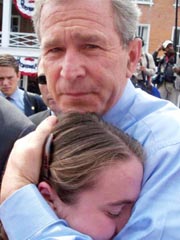 about a moment on the campaign trail where we can remember that despite all of the partisan vitriol and rhetoric, we are all Americans. George Bush, making a campaign appearance in Lebanon, OH, shook hands with the crowd who had gathered to enthusiastically greet him. As he did, the following incident briefly made everyone forget about campaigns and speeches:
Lynn Faulkner, his daughter, Ashley, and their neighbor, Linda Prince, eagerly waited to shake the president's hand Tuesday at the Golden Lamb Inn. He worked the line at a steady campaign pace, smiling, nodding and signing autographs until Prince spoke:"This girl lost her mom in the World Trade Center on 9-11."
Bush stopped and turned back.
"He changed from being the leader of the free world to being a father, a husband and a man," Faulkner said. "He looked right at her and said, 'How are you doing?' He reached out with his hand and pulled her into his chest."
Faulkner snapped one frame with his camera.
"I could hear her say, 'I'm OK,' " he said. "That's more emotion than she has shown in 21/2 years. Then he said, 'I can see you have a father who loves you very much.' "
"And I said, 'I do, Mr. President, but I miss her mother every day.' It was a special moment."
I don't include this story to try to convince readers to vote for George Bush because he took a moment to acknowledge a young girl's grief and loss by reaching out to her; John Kerry will have similar moments on the campaign trail, I am sure. I include it to remind us all that despite all of our policy differences, we are all still human beings ... even the politicians. We do well to remember that in our current political climate.
Archives
blog advertising
Blogroll
Captain's Quarters features an authoritative blogroll, listing many websites that feature the top political thinking on the Internet. In order to make the list easier to navigate, it has been divided into a number of sections.
Click on the section title to expand the list.
Northern Alliance
Hugh HewittCaptain's Quarters
Fraters Libertas
Lileks
Power Line
SCSU Scholars
Shot In The Dark
Northern Alliance Radio Network
101st Fighting Keyboardist
Blogs for Bush
Sister Ships
MS-NBC/CapQ Partnership
Recent Comments
- Carol Herman on Heading Right Radio: Kenneth Timmerman, Shadow Warriors
- Frank on Can We Afford To Engage Sadr? Can We Afford Not To?
- Scrapiron on Can We Afford To Engage Sadr? Can We Afford Not To?
- danny on Can We Afford To Engage Sadr? Can We Afford Not To?
- Ron Hellesvig on New Comment System
- unclesmrgol on New Comment System
- Loren on New Comment System
- Dennis Lawler on US Navy Protects All Shipping From Piracy, Even Our Enemies'
- Jeremy on Another Step Towards Reconciliation?
- Qwinn on Another Puzzling Endorsement