




March 12, 2005
Italy Retreats Further On Sgrena
The Times of London reports in tomorrow's edition that the Italians have agreed to stop paying ransoms to kidnapers in Iraq, a policy change that brings Rome into line with other Western nations. In further developments, an Italian parliamentarian indicated that despite earlier assertions that the Americans had been alerted to Sgrena's release and Calipari's itinerary, the Italians never got clearance for their vehicle:
THE Italian prime minister, Silvio Berlusconi, has promised President George W Bush that he will not pay more ransoms to free hostages in Iraq.The Italian government has denied newspaper reports that $6m (£3.1m) was paid for the release of Giuliana Sgrena, who worked for the Communist daily Il Manifesto. But senior officials and intelligence sources have confirmed that money did change hands. ...
Last year Italy paid a reported $5m (£2.6m) for the freedom of two aid workers, Simona Pari and Simona Torretta. Hours after Sgrena was seized, Berlusconi announced that “negotiations” had begun.
The reports of ransom payments have infuriated American officials, who say they fund violence and encourage more kidnappings. Mel Sembler, the American ambassador in Rome, told Berlusconi last week that the money bankrolled “the war being waged by Sunnis in Iraq”.
Western nations had mostly agreed not to negotiate with terrorists in general decades ago, which is why our negotiations in Beirut with the Iranian-backed hostage takers during Reagan's term rightly generated so much outrage. Since 9/11, we have adamantly opposed cutting deals of any kind with bombthrowers and decapitaters, especially those which reward their activities with millions of dollars in cash. The Italians have insisted on paying ransoms, and as they now see, all that does is create a market for Italian hostages rather than convince serial killers to love Italy.
The Times strongly suggests that Berlusconi paid this price to have his representation on our investigation into the death of Nicola Calipari. If true, that demonstrates that the Bush administration does not feel especially worried that an open probe will find anything amiss. It looks more like that Bush got furious with his Italian ally for the payoff and demanded an end to it before he allowed Berlusconi the face-saving seat at the table.
It may not matter much, anyway. As John Follain reports, Italians have admitted that they didn't coordinate any part of Calipari's mission with the Americans anyway:
Selva claimed that the attack on the Toyota Corolla carrying Sgrena and Nicola Calipari, the intelligence officer, to Baghdad airport had been prompted by a satellite monitoring system. This detected that their vehicle did not have clearance from US military authorities. A signal alerted a mobile checkpoint near the airport and its soldiers opened fire.“The Italian team should have known what to expect, but it appears they didn’t realise how sophisticated the American military are,” said Selva.
In other words, it wasn't the Americans playing Cowboy in Iraq. It seems more and more apparent that the Italians wanted the Americans kept in the dark about Calipari's mission and hoped to get him and Sgrena to the airport before we found out what got her released. After two newspapers reported that the Italian military didn't bother to inform us, and one even reported that the Italian military had been kept in the dark by their intelligence services, this shows the price they paid for their ineptitude and their underestimation of American security protocol. Now we unfortunately know more than we should about how the US protects its forces on that dangerous road to the Baghdad airport, but at least the Italians admit they didn't do anything to inform us about Calipari's car or its intended route. That information gets confirmed in this report, which quotes the highest-ranking Italian general in Iraq:
Mario Marioli, a deputy commander of the US-led coalition troops in Iraq, was quoted by the Italian newspaper La Repubblica as saying: "I asked Calipari if I should inform our American allies of the hostage-freeing operation, but his reply was that under no circumstances was the ally to be informed."US authorities say the vehicle had failed to respond to signals to stop.
La Repubblica quoted statements by Marioli to Italian investigating magistrates probing the incident. He said he had twice been warned by Calipari not to disclose the operation to the Americans.
On the second occasion, with the hostage already free but the operation not yet complete, the general had asked whether he should warn the Americans that the Italians were driving to the airport with Sgrena.
"I was told no, although I warned that this might mean a quarter of an hour's wait at the checkpoint at the airport entrance," Marioli was quoted as saying.
Why did Italian intelligence want to keep the US in the dark? Because it didn't want to reveal the ransom payment, and figured our advance knowledge might quash the deal to free Sgrena from her captors. The Italian outrage may have been fueled by Sgrena, but at its core, it is simply a defense mechanism for the guilt of their intelligence service and its officer who gambled that he could outmanuever the US Army instead of just working with us. (via Michelle Malkin)
Digital Age Debate Hits And Misses
Thomas Lipscomb and Alex Jones debated the blogosphere and the mass media on James Goodale's PBS show on Digital Age in a taped show streamed over the Internet. Lipscomb, a reporter for the Chicago Sun-Times (and, for full disclosure, he reads CQ and appeared twice on the Northern Alliance radio show) has long been a friend of the blogosphere, while Jones, who heads the Shorenstein Center for the Press at Harvard, has been more of a gentleman-skeptic. Goodale worked in executive management at the New York Times prior to his Digital Age show. I looked forward to a lively but professional and collegial debate, and they did not disappoint.
I felt that both men understand the blogosphere, which made me wonder when Jones claimed that he didn't read blogs as a rule. Jones did make the best point when he said that the blogosphere harnesses the disparate knowledge of millions of people and makes it instantly available, and Lipscomb underscored it perfectly when he clarified that it amounts to massively parallel processing. What would have taken weeks to research and develop into a coherent report now takes hours, sometimes less, with greater accuracy when performed correctly. Lipscomb didn't exactly draw this line overtly, but the failure of mainstream reporters to access and harness this power shows a failure to understand it, which results in a poorer product.
Jones insisted that bloggers don't report -- we commentate, we "kibitz", we criticize, and point out "stupidities", all of which is true but insufficient. This is where I think Jones' insulation fails him. Most of what we write is that, but we also act as journalists. Two of the big stories discussed, Rathergate and Eason's Fables, demonstrated this, although none of the three really had enough of the facts at hand to debate the point. And since I had some involvement in the first and a larger role in the second, I can explain why.
First off, what is journalism? It is going out and getting data for a story that will find interest for readers, researching the topic, communicating with the people involved, and then writing cogent and coherent articles explaining the facts for those readers. In both cases, bloggers performed that function, although in Rathergate the initial impetus was a published article. I watched as Powerline and Little Green Footballs gathered information from a series of well-informed readers with specific expertise in documents, typography, and military procedures and history, and then reported these findings to their readers in real time. INDC Journal and LGF hired independent document examiners to test their hypotheses and found that the documents were fake, for a number of reasons -- a finding that the Thornburgh-Boccardi panel's document examiner later echoed even as the panel report backed away from the conclusion. Others of us chimed in with links, commentary, and further clarifications from our own experience and expertise and made sure that the story stayed alive.
That process qualifies as journalism, at least on the part of the lead bloggers I mentioned.
For Eason's Fables, the journalism of one blogger, Rony Arbovitz, turned out to be the only such open publication of Jordan's remarks at Davos, besides a subscription-only e-mail to a small subset of Wall Street Journal readers and a blurb mention on Fox News. After I heard this story on Hugh Hewitt, I started researching Eason Jordan and posting my findings on this blog. Other bloggers, notably Slublog, joined me and discovered that Jordan had made similar remarks. Using Google and later Nexis, I discovered that Jordan had made similar allegations about the Israelis and substantially misrepresented what had happened to a CNN reporter in October 2000. I also found speeches where Jordan had used more subtle innuendo regarding journalists being targeted. Slublog found a direct quote from a conference three months earlier where Jordan had not only accused American soldiers of deliberate murder of journalists but torture as well. I also noted that Chris Cramer, who runs CNN International, has made similar statements but with less specificity, in similar forums, and always abroad.
I wrote articles which delivered this information to readers. Where my information was inaccurate regarding a WSJ editor, I published a retraction. Take a look through those posts in this category and decide for yourself whether I performed a journalistic function or simply "kibitzed".
Besides, don't sell kibitzing short. Bloggers aren't aliens from another planet, a point that all involved missed. We're the media's best customers! We read and view their product voraciously, we care about its quality, we get to know the people who provide it, and we direct people to those sources and stories we find credible and interesting. Why the executives of these sources fail to recognize this eludes me.
Getting back to the debate, the only part I found frustrating was how little of the details on Eason's Fables came out. Jones insisted over and over again that Jordan said something stupid one time, although he allowed that it may have been stupid enough to justify getting fired for it. For a man who should have his pulse on a story with the impact it had, he appears to lack any understanding of its nature. Lipscomb didn't provide any context for it either, but during this period of the debate, Goodale kept cutting both men off of discussing the details to instead ask for the lessons of the episode.
Other than that, I enjoyed the debate very much and found both men credible, engaging, and very insightful. Both men reached similar conclusions: mainstream media has to improve its performance to survive, and the blogosphere will force them to do that. Lipscomb makes that connection plain -- unless reporters start doing their job objectively and abandon "lazy sleepwalking", the mainstream media will never regain their credibility. If you missed this, I believe it can still be seen on their stream. I highly recommend it to all, if for no other reason than to see how issues should be debated between professionals and gentlemen.
Media Notes And NARN Update
Tomorrow we celebrate the first anniversary of the Northern Alliance Radio Network with a special broadcast that looks back on the first year of regularly scheduled blogger radio. We expect many guests to join us to help us celebrate, including the man who got us the gig in the first place, Hugh Hewitt. Expect the unexpected, as the Fraters Libertas gang have made most of the arrangements! If you're not in the Twin Cities, you can pick up our new Internet stream from AM 1280 The Patriot.
Later in the evening, Chicago Sun-Times reporter Thomas Lipscomb -- the man who broke the story about the VVAW's assassination plans against eight US Senators and John Kerry's involvement in the meetings -- will appear on PBS tomorrow night at 7:30 PM in the New York area on WNYE-TV. If you aren't in that area, Digital Age will carry the live Internet stream. Be sure to catch his discussion with Alex Jones of the Shorenstein Center on the Press and Public Policy at Harvard on the topic, "Will The Mainstream Media Survive The Bloggers?" I plan on making sure I see it.
BUMP: To the top for the show. Don't forget to call us at 651-289-4488 to be part of the fun today -- and use your cell phone to avoid the long-distance charges!
UPDATE: We had a blast with all of our guests, which if you missed you can catch on the stream Sunday night starting at 9 PM CT. I'd especially like to thank Michelle Malkin, who appeared with us on about the shortest possible notice. Her segment was definitely a highlight!
Rice Tempers Presidential Fever For GOP
Condoleezza Rice gave an extended interview to the Washington Times editorial board yesterday, and Bill Sammon reports that while Rice didn't specifically rule out a presidential run in 2008, she certainly didn't endorse the notion either. However, the Republican base may have second thoughts about Rice at the top of a ticket after hearing her center-right views on abortion that can best be described as somewhere between Rudy Giuliani and the Vatican:
"I have enormous respect for people who do run for office. It's really hard for me to imagine myself in that role."She was then pressed on whether she would rule out a White House bid by reprising Gen. William T. Sherman's 1884 declaration: "If nominated, I will not run; if elected, I will not serve."
"Well, that's not fair," she protested with a chuckle. "The last thing I can — I really can't imagine it."
I don't think that Rice suffers from a lack of imagination. As Secretary of State, she hews to the traditional nonpartisanship that the nation's primary foreign diplomat usually uses, in order to present American policy abroad with as much clout as possible. Colin Powell did the same thing, which is why some people didn't really believe him when he said he had no political aspirations -- until he retired in January and still refused to run, either for Senate of Governor. It's entirely possible that Rice has no desire for electoral battles, or equally possible that a front-runner status would attract her to the GOP ticket in 2008.
If the latter develops, she will wind up having to work overtime to bring out the Republican base with her more laissez-faire approach to abortion. Rice sounds out a position that comes close to where Hillary Clinton wants to claim, the Clintonian construct that says abortions should be safe but rare:
Miss Rice said abortion should be "as rare a circumstance as possible," although without excessive government intervention. "We should not have the federal government in a position where it is forcing its views on one side or the other."So, for instance, I've tended to agree with those who do not favor federal funding for abortion, because I believe that those who hold a strong moral view on the other side should not be forced to fund it."
Describing pro-lifers as "the other side" is one of the ways Miss Rice articulates her position as a "mildly pro-choice" Republican. She explained that she is "in effect kind of libertarian on this issue," adding: "I have been concerned about a government role.
"I am a strong proponent of parental notification. I am a strong proponent of a ban on late-term abortion. These are all things that I think unite people and I think that that's where we should be.
"We ought to have a culture that says, 'Who wants to have an abortion? Who wants to see a daughter or a friend or a sibling go through something like that?' "
Bear in mind that this position will fly much better with mainstream Republicanism than Hillary's will with mainstream Democrats. The tent on abortion has always been larger for GOP politicians, mostly due to the reliance of Democrats on large-scale funding from rabidly pro-abortion lobbies. The Republicans operate more on individual contributions -- one of the reasons the BCRA hurt Democrats more than Republicans -- and this allows for a greater range of legitimate national candidates. Still, in a close election, failing to energize the significant segment of the party base for whom abortion is a single-issue determinant of their votes could lose the White House for the GOP.
The question, if Rice does run and manage to win the nomination, is whether that will be the case. Presuming that Hillary wins the Democratic nomination, the gender gap should be neutralized, which would favor the GOP, at least slightly. It might energize women and African-Americans on the center politically, which would devastate the Democrats. If she can withstand the brutal primary and general election process, she could force Hillary so far to the right that the International ANSWER/MoveOn faction splits off from the Democrats and goes Green instead.
The question will be whether Rice can win in the primaries. Normally, I'd bet against someone who never ran for office before. However, after the concerted political fire she took for her confirmation vote in the Senate, I'd say she has the toughness to do it. If she wants it, it's probably hers to take.
UN: Syrian Agreement, Timetable On Complete Pullout
The UN envoy sent to Damascus to enforce the UNSC resolution calling for a complete Syrian withdrawal from Lebanon told reporters that he has an agreement to take back to Turtle Bay, implying that Syrian dictator Bashar Assad has agreed to a timetable for complete withdrawal:
President Bashar Assad reiterated his commitment to withdrawing all Syrian troops and intelligence agents from Lebanon, a U.N. envoy said Saturday, indicating that he had received a timetable for the pullout. Meanwhile, a convoy of Syrian troops returning home received a rousing welcome. ..."I will present U.N. Secretary General Kofi Annanwith further details of the timetable for a complete Syrian pullout from Lebanon upon arrival in New York early next week," Roed-Larsen said in a statement read to The Associated Press by Roed-Larsen's spokesman Najib Friji.
Roed-Larsen also told reporters that the agreement complies with Resolution 1559 and that Assad has agreed to withdraw intelligence services as well as Army troops, a good portion of which have already evacuated Lebanon. Yesterday the Lebanese Army took control over Northern Lebanon for the first time in decades as the Syrians left for home, and Syrian units all over Lebanon are on the march eastward. With the exception of a few outposts outside of Beirut, the entire Syrian force in Lebanon has transferred itself to the Bekaa, three weeks ahead of schedule.
This week, Assad told Time Magazine to deliver the message that he was not Saddam Hussein, and that he intends to cooperate. This demonstrates the power of the new American credibility in the Middle East, thanks to the actions of George Bush in toppling Hussein and creating a protodemocracy in Iraq, delivering on his promise. So far, thanks to shortsighted politicians here in the US, that credibility remains mostly with Bush and the GOP. As freedom spreads and Bush gets the credit he deserves, that may start to change as the rabid International ANSWER/MoveOn crowd gets more discredited. Let's hope so.
Egypt Springs Ayman Nour
Egypt has released the democracy activist whose arrest caused Condoleezza Rice to publicly snub Hosni Mubarak and stirred up pro-democracy demonstrations on the streets of Cairo. Ayman Nour walked out of prison today on bail:
Egyptian opposition leader Ayman Nur, seen by some as a symbol of the movement for democratic reform, was freed on bail after six weeks in detention, Attorney General Maher Abdel Wahed told reporters.Nur, who heads the Ghad (Tomorrow) party, was detained on January 29 on charges of "falsifying official documents".
He was freed after paying 10,000 Egyptian pounds (1,400 dollars) along with five supporters who had been detained for the same reasons.
"The release was ordered because there is no longer any reason for his preventive detention," Abdel Wahed said. "The preventive detention had been ordered in order to allow for an investigation to be carried out in the utmost secrecy and ensure that no evidence was concealed."
It sounds as if the Egyptian government has decided to allow the story to die out quietly. If their investigation had generated any evidence of wrongdoing on Nour's part -- or at least ginned up enough of an excuse to make his detention appear justified -- Mubarak would have taken advantage of it. The arrest of Nour turned into such an embarassment for Mubarak that he had to promise a liberalized multiparty election for his next run at the presidency, and no doubt the international community expects Nour to be part of it.
Rice and the West need to keep Mubarak's feet to the fire regarding those elections. Egypt produces many of the philosophical leaders of radical Islamist as well as its operatives, thanks to the political repression and the anti-Western demonization of the Mubarak regime that only now appears to be fading. Genuine multiparty democracy will allow all sides to vent their spleen peacefully and will slowly undo the intellectual damage that Mubarak's reign has wrought on the Egyptians.
The Never Ending Story Changes ... Again
Giuliana Sgrena has changed her story yet again, proving if nothing else that the Il Manifesto reporter understands the news cycle. The Independent (UK) reports that Sgrena now says she doesn't think the Americans were trying to kill her:
The Italian journalist Giuliana Sgrena, who was wounded by American fire last Friday soon after being released by kidnappers in Baghdad, has said that she does not think that the Americans were trying to kill her. "I never said that they wanted to kill me," she said on a television talk show, "but the mechanics of what happened were those of an attack."In an interview with The Independent, her partner, Pier Scolari, said: "None of us is so stupid as to think the Americans did it on purpose. But the dynamic was that of an ambush and we want a convincing explanation of what happened, because the first American explanation was totally false." ...
Ms Sgrena was widely quoted as saying that the Americans may have wanted to kill her "because they dislike the Italian policy of negotiating with the hostage-takers". But this week she rejected the idea.
After the shooting, she said: "A soldier opened the door on the right-hand side. When he saw us, I had the impression that he was upset. I seem to remember him saying, 'Oh shit!' And when more turned up in an armoured car, I had the sensation that they were unhappy about what had happened."
One of the papers that "widely quoted" Sgrena was the Independent - in fact, the same Peter Popham, who also wrote this article and who probably regrets ever dealing with Sgrena and Scolari. Of course, Popham hardly stands alone as a mouthpiece for the string of nonsense coming from both Sgrena and Scolari regarding the shooting. Most of the American media have treated Sgrena as an objective and unbiased source despite her association with the Communist and strongly anti-American Il Manifesto and used the story to attempt a rehabilitation of the same kinds of slander that resulted in Eason Jordan's ouster at CNN. American media wrote companion pieces about trigger-happy American soldiers at checkpoints by the score while car bombs and roadside IEDs continued to kill almost as many Iraqis and US troops as the number of these backbiting and speculative "analyses".
Let's review how the Sgrena/Scolari story has evolved:
Pier Scolari, Sgrena's partner who flew to Baghdad to collect her, put an even more sinister construction on the events, suggesting in a television interview that Sgrena was the victim of a deliberate ambush. 'Giuliana may have received information which led to the soldiers not wanting her to leave Iraq alive,' he claimed. [Guardian, March 6]The shooting late Friday was witnessed by Prime Minister Silvio Berlusconi's office which was on the phone with one of the secret service agents, said Scolari. "Then the US military silenced the cellphones," he charged.
"Giuliana had information, and the US military did not want her to survive," he added. [Turkish Press, March 5]
Now, of course, Scolari (Sgrena's "life partner") calls such speculation "stupid". I couldn't agree more. Too bad their stupidity seems to have revealed a sympathetic stupidty that runs through the entire global media, including in the US.
March 11, 2005
Saddam's Bribery
The London Telegraph reports that former UN weapons inspector Rolf Ekeus received and turned down a $2 million bribe offer from Saddam Hussein in the mid-1990s. Ekeus told Reuters that the bribe came through Tariq Aziz, who now sits in US and Iraqi custody awaiting trial for selling Iraqis out in a similar manner:
Saddam Hussein's regime offered a $2 million (£1.4 million) bribe to the United Nations' chief weapons inspector to doctor his reports on the search for weapons of mass destruction. ...Mr Ekeus told Reuters news agency that he had passed the information to the Volcker Commission. "I told the Volcker people that Tariq [Aziz] said a couple of million was there if we report right. My answer was, 'That is not the way we do business in Sweden.' "
A clean report from Mr Ekeus's inspectors would have been vital in lifting sanctions against Saddam's regime. But the inspectors never established what had happened to the regime's illicit weapons and never gave Iraq a clean bill of health.
This, of course, represented the tip of the iceberg, as Nile Gardiner of the Heritage Foundation notes. Saddam's entire reign rested on bribes and kickbacks, especially during the sanctions years. Even if the Swedes didn't do business that way, the French, Germans, Russians, and many others stood ready to conduct business Saddam-style, as the Oil-For-Food program proved. Coincidentally or not, that corruption started in earnest after Ekeus' departure from the scene.
This brings up another, more serious question. If Saddam didn't have the WMD ... why did Tariq Aziz offer Ekeus $2 million for a clean bill of health? Wouldn't just have been easier to produce the documentation demonstrating his innocence or allow for complete inspections, as the UN demanded?
Italy To Sgrena: You Can Shut Up Any Time Now
After having listened to the reporter from the Communist newspaper Il Manifesto spout contradictory stories and hysterical conspiracy-mongering, even the Italian government has had enough of Giuliana Sgrena. In their first direct criticism of the former hostage, the justice minister publicly scolded Sgrena for her ever-changing accusations:
Italy's justice minister urged former hostage Giuliana Sgrena on Friday to stop making "careless" accusations after being shot by US forces in Baghdad, saying she had already caused enough grief.Sgrena has repeatedly suggesting US soldiers shot her on purpose and said on Friday she had little faith in a joint investigation by Italy and the United States into the "friendly fire" incident.
"She has created enormous problems for the government and also caused grief that perhaps was better avoided," Justice Minister Roberto Castelli told reporters in Bologna.
Italian intelligence agent Nicola Calipari was shot dead by U.S. forces as he shielded the newly freed hostage while taking her to the airport.
Sgrena herself said in interviews this week that had she been more cautious in Baghdad, she perhaps would not have been kidnapped in the first place.
This marks the first time that Sgrena has suffered any criticism in the press covering the supposed assassination attempt. After earlier revelations of miscommunication by the Italians, deep skepticism about Sgrena's account after the pictures of her car were published, and the daily changes to her story, even the Italians have lost patience. Or perhaps their support had been overblown from the beginning:
Many Italians have been irked by her descriptions of her kidnappers. She said they were not killers and that she may have over-dramatised her videotaped appeal from captivity for Italy to withdraw its 3,000 troops from Iraq.She sobbed in the video and begged her family and the government to do something to save her life.
"Sgrena, I think, should perhaps be more careful. She has said a load of nonsense, speaks somewhat carelessly and makes careless comments," Castelli said. ...
"I feel like I'm being accused for being kidnapped and then saved," Sgrena said, speaking from a Rome hospital, where she is undergoing treatment for her injuries.
It doesn't exactly sound like a lovefest going on in Rome for Sgrena, a dynamic missed by the American and world media thus far. Perhaps the Italians knew better than to treat Sgrena with much credibility in the first place. (via CQ reader ERNurse)
Ryan Sager Follows The Money
Ryan Sager writes a powerful column in today's Tech Central Station that exposes the big money behind campaign-finance reform and the BCRA. Sager spots a report by Political Money Line which traces an astronomical amount of money that got spent by just a handful of sources to push the BCRA, and all of them from the Left:
Consider a report just out from the folks over at Political Money Line, "Campaign Finance Reform Lobby: 1994 to 2004." Ignored by the media to date, it details how the supposedly grass-roots campaign-finance reform movement has been funded over the last decade to the tune of $140 million. Of that $140 million, the vast majority ($123 million) came not from retirees scraping together their last nickels for the cause of democracy, nor from schoolchildren collecting deposits on cans plucked from dilapidated playgrounds.No, the money came from just eight ultra-liberal foundations (including the Ford Foundation and George Soros' Open Society Institute), the same folks who fund: the Earth Action Network, the NOW Legal Defense and Education Fund, People for the American Way, Planned Parenthood, the Naderite Public Citizen Foundation and the Feminist Majority Foundation. ...
Payments to the media found by Political Money Line include: the $132,000 to the Prospect, $69,000 to Public Radio International, $935,000 to the Radio and Television News Directors Foundation and more than $1.2 million to National Public Radio for items such as, in the words of the official disclosure statements, "news coverage of financial influence in political decision making."
No wonder McCain-Feingold contained a "media exemption." The media -- on top of having their voices amplified when private citizens, labor unions and corporations are barred from speaking -- are relatively easy to write some checks to. (Millions of bloggers, on the other hand, might be a little harder to corral -- hence the calls for a crackdown.)
In fact, some of the same people can be found through the donors page of John McCain's Reform Institute, a fact that Sager misses although he savages McCain's connections to RI. As I blogged on Wednesday evening, the RI appears not only to float key McCain election aides between campaigns (which Sager notes), but it does so using foundation grants from some of the most left-wing organizations in the US. George Soros' OSI has been one of RI's biggest donors, as has Teresa Heinz Kerry's Tides Foundation and Tides Center, The Proteus Fund, and the Educational Foundation of America.
Politics make strange bedfellows, but it looks like the media also likes to hop into the same bed despite all protestations of purity. Now we know why the BCRA gave the old-line media its exemption but its sponsors sued the FEC to strip the Internet of theirs. More than ever, we need to repeal the BCRA and eliminate the Byzantine campaign-finance laws and IRS exemptions that create these backchannel corruptions. The only reform we need is direct contributions, directly and immediately disclosed. (via Tapscott's Copy Desk)
Danny Rather Boy
I have mostly avoided the Dan Rather retirement, as I wanted to give him as much recognition as I think he deserves -- ie, none. However, my good friend and CQ reader Kia has written a valediction to Rather intended to be sung to the tune of Danny Boy, one of my favorites. Since Kia beautifully sings Irish tunes by trade, perhaps I could get an MP3 of her personal rendition later, but for now I'll just post the lyrics for your enjoyment:
Danny Rather Boy
Oh Danny boy, the blogosphere is calling,
From comp to comp across the countryside.
They call to say, “Old Media is falling”,
‘Tis you, ‘tis you must go and we must bide,
But come ye back when you can check your sources,
Or when it is the truth you want to know.
You might want to take some journalism courses,
Oh Danny boy, oh Danny boy we’ll miss you so.
And when you come and find that something’s dying,
The Old Media’s dead – as dead it well should be.
You’ll find that there’s no longer so much lying,
As the blogosphere is looking out for me
I shall recall your arrogance and bias
Years of much reporting; fake, but true.
You can rest easy knowing that the media’s
Authentically re-created just for you.
Courage, and all that.
Media Notes Covers FEC Showdown With Bloggers
I have given Howard Kurtz some harsh criticism over his lack of coverage in the Eason Jordan controversy, but today he does an excellent job of covering the wide-ranging debate over the FEC and its new charge to strip the Internet of its exemption from the BCRA. Kurtz notes that with the media exempted from the BCRA, the strategy at the moment is to get the FEC to explicitly define bloggers as journalists to work under the same exemption -- a notion for which he sympathizes:
I'm not one of these people who thinks you need a graduate degree, an ID card or an official stamp of approval to call yourself a journalist. Anyone with an idea and a computer can now play the role of reporter, commentator or social critic. People can tell the difference between a New York Times correspondent and BozoBlogger.com, and both have something to contribute.But this is starting to matter for legal reasons. Time magazine's Matt Cooper and Judith Miller of the New York Times may wind up going to jail for protecting their sources in the Valerie Plame case, but at least they have the standing as journalists to challenge the prosecutor who wants to imprison them. Would a blogger have the same standing?
What about the heavy hand of government regulation? The Federal Election Commission, as you may have heard, is considering slapping some restrictions on political bloggers following a federal judge's ruling on some McCain-Feingold litigation.
Kurtz covers and links to the Shays-Meehan v. FEC decision, the Apple v. Does court case, and Russ Feingold's blog post on MyDD to set the table. He also extensively excerpts from a number of other bloggers, specifically CQ and LaShawn Barber, and reports what I think are the most pertinent arguments to the Post's readers. Be sure to read the entire article.
Sgrena Sets Tinfoil-Hat Brigade Loose
The allegations of deliberate assassination by Giuliana Sgrena against the US military have provoked the lunatics of the International Tinfoil Hat Brigade, which unfortunately has to come up with increasingly ridiculous explanations of how American soldiers filled a car with bullets but left only two or three holes in the car, killed one person but left two people alive, including the one who was the supposed target of the attempted assassination, and covered it up while letting the eyewitnesses go.
The latest to attempt this is Uruknet, a bizarre website that appears to dedicate itself to substantiating every loopy hypothesis about the US presence in Iraq. Normally, I just ignore these people, but the explanation at Uruknet simply provides too many laughs to pass up. Here's what Uruknet wants you to believe:
By combining photo evidence and eyewitness accounts of the Baghdad airport shooting in which Giuliana Sgrena was wounded and Nicola Calipari killed, a compelling picture of a precision ambush emerges.This analysis is sharpened by also considering the operational constraints upon any planned assassination of the troublesome Italian reporter. Such a killing would have to be palusibly [sic] deniable as a "mishap" and would have to avoid the slaughter of three intelligence agents in the vehicle.
That partly explains why Sgrena is still alive. A full-on salvo for a heavy calibre weapon would have left nobody alive in the vehicle. But, while slaying a political journalist is one thing -murdering three intelligence officers of a friendly nation in the process was never going to be an option.
Er, doesn't the fact that Sgrena is still alive demonstrate that she couldn't have been the target? After all, who pulled her out of the car? But let's go on:
But, the alternative was eminently feasible. It would be possible to selectively target Sgrena inside the vehicle, because the planners would know exactly where she would be seated. Assuming any half-competency in intelligence gathering, it was known the occupants would be an Iraqi driver, three intelligence agents and the target: Giuliana Sgrena.Unfortunately for them, their seating arrangements inside the car were entirely predictable. Operational protocol dictated that one agent would be in the front with the driver, and Sgrena would be seated in the center of the rear -between the two other agents. In the hostile zone of Baghdad this seating was a virtual certainty.
Except that by all accounts, there were only three people in the car. I know, I know ... details.
An account of events by Peter Popham in the UK Independent shows American authorities at Baghdad airport knew that the Italian intelligence team would likely be returning late Friday with Sgrena. They surely knew the model and number of the car Calipari had hired at the airport just before 4pm on Friday.
Today we found out from the Italians that not only did they neglect to tell us anything about Sgrena's release, even the Italian military brass may not have known anything about it. It's a good thing that Uruknet hired all these experts to get their facts straight, isn't it?
Uruknet then talks about how the Americans would have used a tank to block the road, even though Sgrena has since recanted the part about the tank and said they encountered only an American patrol, to bring the car to a complete stop. Assassins then flaked the vehicle from the front, even though Sgrena now says the shots came from the rear, and took out the front tires as the car came to a stop. Then the real work began:
If the driver is known to be Iraqi, then there is little downside to using the other aspect of full immobilization procedure: take out the driver as well.That's three marksmen at a minimum. One in front to take care of the driver and possibly have sight of the target in the rear. Two more marksmen, positioned one either side of the car just slightly ahead. They could take care of the tyres and then switch to the interior for the target shot.
Was three marksmen enough? Even though the interior light was reported < http://washingtontimes.com/world/20050308-114454-6752r.htm > to have been on, target aquisition inside a vehicle must take at least three seconds plus one second to shift aim from the tyres. But after four seconds, the rear occupants may be already moving --so the head shot on Sgrena was likely intercepted by Calipari's cranium.
The marksman must have known at that moment there was a 50-50 chance he had taken out the team leader in the back seat. Who knows how he responded. But in any event Calipari had slumped against Sgrena and rendered further clear shots unlikely.
Why? If the assassination attempt had "become a disaster", as Uruknet alleges, why leave anyone alive to dispute the American cover story? According to this scenario, everyone should have been killed. Uruknet alleges that the plan was to kill Sgrena but leave the Italian intelligence officer alive, so as not to make them mad. Excuse me? We kill a hostage that they just paid millions of dollars to free, and they'll just go away irritated if we assassinate her but leave Calipari alive to tell the tale.
Riiiiiiiiiiight. It's hard to imagine getting this much so spectacularly and lunatically wrong in such a short space, but you really have to read the entire thing to believe it. It almost sounds like a spoof of Air America or ... well, Sgrena herself.
Blog Notes
I noticed earlier today that Captain's Quarters achieved a significant milestone this week. Technorati now ranks CQ in its Top 100 blogs, a group that is extraordinarily difficult to crack. The rank changes during the day, but at this moment, we're at #89. Thanks to everyone who continues to link to CQ and participate in our community.
To celebrate, I've added a new search feature from Technorati on the left sidebar. It allows anyone to search CQ or the Web through Technorati's system using CQ as a launch point. It's a beta feature, which means you may experience some bugs, but give it a try and have some fun with it. (My regular search for my archives will remain on the right sidebar.)
One last note: Young America's Foundation/National Journalism Center has named CQ its Blog of the Day. Please drop by their site for a visit to thank them for the recognition!

Italian Story Continues To Fall Apart
The AP reports that the Italian story of Giuliana Sgrena's release and later wounding at an American checkpoint, which also resulted in the death of intelligence agent Nicola Calipari, continues to fall apart. Two Italian newspapers now say that the general in charge of the Sgrena operation did not inform the US that Calipari's mission was to free Sgrena, and one of them reports that General Mario Maroli didn't even know it himself:
U.S. forces in Iraq were only partially informed about last week's Italian intelligence mission to release a hostage, which ended with a shooting on the road to Baghdad airport and the death of secret service agent Nicola Calipari, Italian newspapers said Friday. ...Both newspapers cited a report by Gen. Mario Marioli, an Italian who is the coalition forces' second-in-command. The report has been given to Rome prosecutors investigating the killing.
According to the newspapers, Marioli informed U.S. officials that Calipari and the other Italian officer were there, but not that the mission was aimed at releasing Sgrena.
The papers had conflicting versions over how much Marioli knew: Corriere said he knew the Calipari was working to have the hostage released, La Repubblica said he didn't.
Either way, the Italians clearly did not want the US to know that they had ongoing negotiations aimed at releasing Sgrena. Why? Perhaps the reports of a multi-million dollar ransom answers that question rather effectively. The US clearly would have objected to the negotiations, especially since putting that much money in the hands of Islamofascist terrorists would likely get more of our soldiers killed, as well as the Iraqis. (Could the rash of bombings this week have any connection to a sudden influx of cash to the terrorist network? Maybe, maybe not.) If the US went public with its complaint, the deal would have fallen apart and the Italians humiliated, and it looks like they decided to keep us in the dark instead.
Sgrena also changed her story, subtly but significantly today:
In a statement released after the shooting, the U.S. Army's 3rd Infantry Division, which controls Baghdad, said the vehicle was speeding and refused to stop. The statement also said a U.S. patrol tried to warn a driver with hand and arm signals, by flashing white lights and firing shots in front of the car into the engine block.In interviews published Friday, Sgrena said that no light was flashed at the vehicle and that the shots were not fired in front of the car.
"It's not true that they shot into the engine," she told Corriere della Sera, adding that the shooting came "from the right and from behind."
That qualification changes the entire tenor of the story. Either one would have to believe that the checkpoint soldiers stopped the car and then shot it out -- from behind! -- or that the car never stopped at the checkpoint and traveled so fast that the soldiers could only catch up to it as it passed through. Think about the options for a moment. If a checkpoint successfully stops a suspicious vehicle, why would soldiers walk around behind it to open fire? They'd risk hitting their unit at the front of the car. Tactically, little gain would come from getting behind a potential VBIED in open space when one could get at least some partial protection from a potential explosion by the checkpoint barricades.
This story gets fishier and fishier on every retelling. First we have a "rain of bullets" and Sgrena scooping them up by the handful off the seats, and then we see a car with two bullet holes in it, one of which went through the right front tire. Next the Italians tell us that the US had full operational knowledge of the mission when it turns out their own military leadership was possibly kept in the dark. Now Sgrena tells us that the Americans fired from behind the vehicle when they stopped at the checkpoint, the only position where US soldiers would risk hitting their own troops.
I call "shenanigans" on the Italians.
DNA Confirms Suicide As Lefkow Killer
The bigot didn't do it after all:
A DNA match from a cigarette butt convinced police that a Chicago electrician was the killer of a federal judge's husband and mother, authorities said.The cigarette butt found in Judge Joan Humphrey Lefkow's house was matched to the electrician, Bart Ross, who killed himself during a traffic stop in Wisconsin this week, and the evidence points to him as the lone killer, police spokesman David Bayless said.
Ross, whose rambling lawsuit over his cancer treatment was dismissed by Lefkow, had claimed responsibility for the killings in a suicide note found in his minivan.
"The DNA match, with all the other evidence, certainly convinces us that Ross is the offender in the Lefkow family homicide," Bayless said Thursday night.
Like many others, I thought Matthew Hale or his supporters to be the likeliest suspects in this heinous and brutal murder. They fit all of our hotbuttons: racist, violent, ignorant, and generally as unpleasant as human beings get. I'm certain that they've perpetrated many other crimes, both petty and felonious. But they didn't commit this one.
The resolution on this case was so bizarre and anticlimatic that any book publisher would have tossed a manuscript out a window had it been submitted as fiction. But it should remind us that while logic has its place in police investigations, it doesn't always lead us to the right conclusions, especially when dealing with essentially irrational people. Ross would eventually have been discovered, I'm sure, as the police worked their way through the threats Lefkow received as a result of her work. Ross himself may have thought that the traffic stop at which he killed himself was the product of that investigation. But in the meantime, we should consider ourselves fortunate that we found the real killer and remember to be careful about reaching conclusions ahead of the evidence.
Another Example Of The Clueless MSM Filter (Updated)
Please read the update at the bottom...
Michelle Malkin points out an interview of Washington Post Managing Editor Phillip Bennett in the People's Daily, the official news outlet of the Communist government in mainland China. Like Michelle, I wonder how much of this interview got properly transcribed and translated into English, and how much the censors cut out. If it is accurate, then Bennett provides another example of the clueless media filters that effectively regulated news content until the advent of the blogosphere.
For instance, Bennett gets asked about democracy and manages to come out sounding like John Kerry:
Democracy means many things. How do you define democracy? As a Chinese journalist, you may have your own definition of democracy which corresponds to your history and your way of seeing the world. I may have another definition. Someone else may have their own definitions. Democracy means a lot of different things.Let me give an example. Democracy in one sense means the majority decides, but it also means the rights of the minority are protected. As UK late Prime Minister Winston Churchill said, democracy is the least bad system that we have ever thught of. So democracy is never perfect. It always has problems. Our democracy here in the US has many contradictions, problems and challenges. So democracy is not a cure that could turn everything bad into good. It has its own advantages and its disadvantages.
Bennett appears unable to come up with an objective definition of democracy, claiming that democracy is relative and implying that mainland China could be considered democratic. It certainly could -- if one is inclined to believe that Saddam Hussein was the most popular leader in modern times because he kept getting re-elected with 99% or better of the vote. Never mind, of course, that the options presented to the electorate were "Saddam Hussein" and "The gulag behind Door #2 for you and your family". Democracies may have differing styles, but a common starting point is that they have multiparty elections with secret balloting and some freedom of organized dissent. Pointing that out to People's Daily might have been instructive to Chinese readers, since mainland China offers none of those conditions to its subjects.
For another example, Bennett gives a very distorted history of the Bush administration's foreign policy regarding the run-up to the Iraq invasion in his very first response:
Another source of the resentment is the perception that Bush administration wants to act unilaterally in the world, outside of alliance that traditionally governed the ways Bush made foreign policy decisions. In some ways the core of perception problems is centered on 911 terrorist attacks in 2001 in which the US government and Bush administration reacted by deciding that the country would make decisions in foreign affairs that respond only to US interests. They were not going to consult very widely, and not to compromise in making those decisions. That caused rift even among the US allies. So it is natural to see that the image of America is the lowest in public opinion.
Didn't the Washington Post cover the Bush administration's attempts to build a consensus for action against Saddam Hussein for five months at the UN? We not only consulted, we cajoled, we bargained, we took France at its word that it would support us and continued working with them even when they stabbed us in the back. We endangered the mission by waiting until almost the last possible moment for action in the season to try to get the UN to back up its own threats after twelve years of inaction. Later, we found out that the same "allies" that Bennett accuses us of abandoning to a new unilateralism were, in fact, stuffing billions of cash into Saddam's pockets and millions into their own by undermining the sanctions regime they claimed made our invasion unnecessary.
Bennett also proved he can't count, either. Unilateral means "alone". The US went into Iraq accompanied by the United Kingdom, Australia, Poland, Italy, Spain, Ukraine, South Korea, and supported by dozens of other nations. Perhaps the Post doesn't have a math requirement for its editors.
Bennett also accuses the Bush administration lied about WMDs, despite using the same intelligence presented to Congress by the Clinton administration, which matched the intelligence of almost all the Western nations at the time:
As you said, we are not aggressive enough in challenging and testing the statements the government is making. For me, this episode [the administration's claims that there were weapons of mass destructions in Iraq] is a good example of how difficult it is to independently verify the government's claims when the government is lying to you.
Of course, no interview with a Post editor could go without a mention of their purpose of holding the government's feet to the fire. Bennett here again proves that he probably doesn't read his own paper on a daily basis, as he seems to have missed the news from January 30th:
I think the role the Washington Post should play is to hold the government accountable for decisions made by it.This goes to foreign policy as well. For example, the Washington Post has a correspondent bureau in Baghdad. One of the jobs of our correspondents in Baghdad is to tell our readers what the Bush administration is trying to hide. Bush says democracy is advancing in Iraq, but our correspondents say the situation there is much more complex than that. Our job is to put that in the public domain and challenge the government and hold them accountable. We do that by having independent reporting about events, by telling our readers what the actual situation is, with as much independence, fairness and accuracy as we can.
This goes back to Bennett's inability to recognize the term "democracy". The managing editor of the Post seems to have missed that big election that drew a higher percentage of voters in Iraq than most presidential elections do here in the United States. This week alone, the factions that used to attack each other with guns and bombs, the Shi'a and the Kurds, reached an agreement to form a parliamentary government among the duly-elected representatives in their Parliament. Bennett's minimization of this historic development plays a bit of hell with his contention that the Post remains politically neutral and an objective observer of events.
Michelle has more to say about this eye-rolling interview. I don't think that Bennett qualifies as an Eason Jordan, given that he doesn't vent any slanderous or unsubstantiated allegations of criminal conspiracies within the government or military, except for the hoary hoax of "lying" about WMD. It does prove that Bennett likes kissing up to official media mouthpieces of dictatorships by telling them what they want to hear, in an Eason Jordan-like way of toadying for better access later on. If nothing else, it proves that the Post has yet to learn about transparency and objectivity.
UPDATED 3/15: Bennett responded to Hugh Hewitt, claiming that he was misquoted -- which certainly is a reasonable explanation, given the journalistic integrity of the Peoples Daily:
"Mr. Hewitt,You wrote to me about comments attributed to me in an interview with the People’s Daily of China. I am responding to set the record straight.
The version published in the People’s Daily includes numerous and important inaccuracies. In many places words and sentences were removed to change the meaning of what I said. In some places words or sentences were invented that I did not say. In one typical example, where I said “China is not a democracy” the People’s Daily version quoted me as saying “China is not a democracy either by American standards.” At the same time, comments critical of China were deleted.
In several key places, my words were rearranged to express a different view than I had clearly intended. This is true of the sentence that produced the headline for the article, “I don’t think US should be the leader of the world.” Below you can compare the way that sentence appeared in People’s Daily with a transcript based on the actual tape recording.
People’s Daily version:
Yong Tang: In such sense, do you think America should be the leader of the world?
Bennett: No, I don't think US should be the leader of the world. My job is helping my readers trying to understand what is happening now. What is happening now is very difficult to understand. The world is very complex. There are various complex forces occurring in it. I don't think you can imagine a world where one country or one group of people could lead everybody else. I can't imagine that could happen. I also think it is unhealthy to have one country as the leader of the world. People in other countries don't want to be led by foreign countries. They may want to have good relations with it or they may want to share with what is good in that country. That is also a sort of colonial question. The world has gone through colonialism and imperialism. We have seen the danger and shortcomings of those systems. If we are heading into another period of imperialism where the US thinks itself as the leader of the area and its interest should prevail over all other interests of its neighbors and others, then I think the world will be in an unhappy period.
What was really said:
Yong Tang: Another question is that since the Washington Post is mainstream media in American how does the newspaper deal with the relations between America and the rest of the world? Do you think America should be the leader of the world?
Bennett: You know I don't ask myself that question. Again that would be to express a political view, an editorial view, and I ...
Yong Tang: How about personal opinion.
Bennett:You know, I don't...
Yong Tang:First of all I think that America should be the leader.
Bennett: I don't think in those terms. And I'm not trying to dodge the question. It's just that my job is to help people try to understand what's happening now. And what's happening now is very hard to understand. The world is very complex, there are very complex forces occurring in it. I don't think you can imagine a world - given where we are with technology , culture, with economics - I don't think you could imagine a world where one country, where one group of people, lead everybody else. I just can't imagine that happening. And I think it would be unhealthy if one country - whether or not it was this country or China or France or Great Britain - would describe itself as the leader of the world. People in other countries do not want to be led by a foreign country. They may want to have good relations with them and they may want to share in what's good about that other country. But that's almost sort of a colonial question. I feel like we've been through an era of colonialism, of imperialism, and we've seen the dangers and the shortcomings of those systems. If we are headed into another period of imperialism where either the United States or China, for example, thinks of itself as the leader of its area and where it's interests should prevail over all others interests of its neighbor or others then I think we are headed for an unhappy period. So I guess that's how I would answer that question. Maybe the answer is then no I don't think the United States should be the world leader. But what I really mean to say that I don't think we are headed into a period of history where one country or one set of ideas is going to dominate all others."
Rendition Policy Works: CIA Dissenter
Michael Scheuer, the former CIA agent who wrote the book Imperial Hubris which attacked the Bush war strategy last year, writes in today's New York Times that not only has rendition been a US policy for two administrations, but it keeps America secure. He should know; he reveals that he ran the program for over three years:
AS Congress and the news media wail about the Central Intelligence Agency's "rendition" program - its practice of turning suspected terrorists over for detainment and questioning in third countries - it is time to focus on the real issue at hand. A good starting place is Page 127 of the tablets on which are inscribed the scripture handed down by the 9/11 commission.Here we find a description of a 1998 conversation between National Security Director Samuel Berger and his counterterrorism chief, Richard Clarke, about the capture of Abu Hajer al Iraqi, the "most important bin Laden lieutenant captured thus far." According to the report, Mr. Clarke commented to Mr. Berger "with satisfaction that August and September had brought the 'greatest number of terrorist arrests in a short period of time that we have ever arranged or facilitated.' " Part and parcel of this success, the men make clear, were the renditions of captured Qaeda terrorists.
Neither Mr. Clarke nor Mr. Berger were C.I.A. officers. They were senior White House officials who - in consultation with President Bill Clinton - set America's Al Qaeda policy from 1993 to 2001. They told the C.I.A. what to do, and decided how it should pursue, capture and detain terrorists. They knew that Abu Hajer al Iraqi was being brought to the United States for trial, and they knew - and approved - of the rendition of his compatriots to Egypt and elsewhere. Having failed to find a legal means to keep all the detainees in American custody, they preferred to let other countries do our dirty work.
Rendition did not spring from the minds of Dick Cheney, George Bush, or Donald Rumsfeld, and the notion that it did shows an ignorance in the public mind of the 9/11 Commission report, which granted is rather overwhelming on narrative if short on critical thinking. Moreover, as Scheuer points out, because the White House ran program instead of the CIA, it passed through the hands of many attorneys to ensure complete legality, which he calls both a blessing and a curse with which to operate.
Scheuer faults both administrations for not having the courage to work with Congress to broaden the acceptable conditions for detaining terrorists, but that would have required suspending habeas corpus for some of them, a move that even Congress would have had a hard time pushing through the federal courts. Even after 9/11, when the presumption should be that terrorists captured on a battlefield do not get treated like American crime suspects, the courts have remained antagonistic to detaining them here and abroad in places such as Gitmo. Habeas corpus keeps getting applied to these terrorists instead of a recognition of the state of war and the deference to military processes traditional to wartime in the courts, and working with Congress would probably do little to stop it.
Outside of this criticism, Scheuer writes that the renditions have made America safer:
In my mind, these men and women made the right decision - America is better protected because of renditions ...[T]he rendition program has been a tremendous success. Dozens of senior Qaeda fighters are today behind bars, no longer able to plot or participate in attacks. Detainee operations also netted an untold number of computers and documents that increased our knowledge of Al Qaeda's makeup and plans.
Scheuer's fear is that the executive branch will abandon those who implemented its policies for two administrations in order to distance itself from a program that works. Let's hope not. Bush has fought this war to win it thus far, not to pander to the politics of the moment. He needs to continue that strong example of leadership in ensuring that the CIA operates rendition legally and effectively, and not allowing the voices of political correctness ensure that we weaken ourselves by abandoning effective strategies. This is war, and it's a war of survival. We need to ensure we win it.
March 10, 2005
No Wonder Randy Moss Was Such A Handful
The Minnesota Vikings traded their star receiver, Randy Moss, to the Oakland Raiders last month in what even Moss-scoffers acknowledge equates to the ludicrous Lou Brock for Ernie Broglio trade in 1964. The bad feelings about Moss came less from his on-field antics, although those were plentiful enough, than from his off-field problems, such as deliberately hitting a police officer with his car two years ago. They applauded the Vikings for moving Moss out of the Twin Cities even if they scratched their heads about only getting Napoleon Harris and a couple of draft choices for him. Moss-scoffers felt like the message had been sent that chronic misbehavior would no longer be tolerated.
Unfortunately, now it looks like the Vikings got rid of the wrong person if that was their intent. Sports Illustrated reports tonight that Mike Tice has admitted to scalping his Super Bowl tickets for profit the past several years, and at least one former player has indicated that Tice ran a scalping ring during his entire tenure with the Vikings. He initially denied the claims and blamed it on a disgruntled former player, but now has recanted:
"I probably shouldn't have sold my tickets,'' Tice told SI.com on Thursday. "I made a mistake. I regret it. I'll never do it again. I'm going to be in trouble. I'll probably get slapped with a big fine."The revelation that Tice admitted scalping some of his own Super Bowl tickets comes two days after SI.com first reported that he is being investigated by the NFL for allegedly heading and profiting from a Super Bowl ticket-scalping operation within the Vikings organization.
Two investigators from the league's security staff were in the Twin Cities on Tuesday to question Tice and Vikings running backs coach Dean Dalton about the alleged ticket scalping. In a reported five-hour meeting with the investigators in Tice's office, the head coach admitted he scalped some of the Super Bowl tickets he obtained this year, but denied approaching any Vikings players about scalping their tickets. A Vikings source said Tice maintains that Dalton was the intermediary who dealt directly with the players and the person who purchased their tickets for a California ticket agency.
However, SI notes that Tice carefully qualifies his admission when it comes to brokering player tickets:
"I sold some of my tickets this year,'' Tice said. "I did. I told the league that and I told [team owner] Red McCombs that. I'm not going to lie. But if I'm going to be thrown out this year for selling tickets, then I'm a scapegoat. If I'm guilty of anything, I'm guilty of selling some of my tickets. I am not guilty of buying any player tickets since I've been made the head coach [in January 2002].''Tice has also acknowledged that he scalped Super Bowl tickets as a Vikings assistant coach from 1996-2001, and that he told his assistants this year it was all right for them to sell their Super Bowl tickets to a California ticket agency that he has long dealt with.
What this means is that Tice spent the last several years violating league policy in order to profit just off his own allotment (estimates vary, but probably it would amount to $15,000 per year). Not only that, but his qualification on the player tickets indicates that he had a conspiracy to profit off of their tickets as well in earlier years. According to Tice, he stopped doing the latter when he was named head coach, but at least one former player disputes that:
"Dean is going to be the one taking the fall,'' said a former Vikings player from the 2003 team. "Tice was running it all, but he worked it through Dean so it didn't get traced directly to him.''
Tice receives one of the lowest salaries in the NFL among head coaches, but he still makes a high-six-figure salary. Instead of working to boost that by improving as a coach, he decided instead to run a little criminal conspiracy with his players and his coaches. Even if that stopped when he became head coach, the inappropriate nature of his lockerroom racket should disqualify him from any leadership position (as if his on-field performance doesn't already fill that ticket). Small wonder, then, that Randy Moss seemed to present such intractable discipline problems with the coaching staff setting this kind of example. They not only set the tone for the players, they may have exploited them to maximize their own profits.
Sheer idiotic greed. This is what the Vikings want us to buy with a publicly-financed stadium?
UPDATE: One of the draft choices was the seventh overall, not seventh round, as several CQ readers have pointed out. I've edited the post to say "a couple of draft choices". I still think it was a lousy trade, and I don't even like Moss.
Chris Nolan: Regulate Me Before I Lose Control
With the pending FEC regulations on Internet politicking percolating through the blogosphere, the prevailing wisdom goes two different directions. Either the decision by Judge Kottar-Kotelly to strip the Internet of its BCRA exemption portends even more encroachment on political speech by regulating bloggers to death, or the threat has been overblown and the FEC wouldn't dare to try it. No one in the blogosphere has argued on behalf of greater regulation.
That is, no one until Chris Nolan wrote this piece for eWeek. Nolan argues that bloggers have become so influential in politics that regulating us should be a high priority for the FEC, in order to prevent our interference with campaign finance reform:
It's silly to think Smith's warnings will all come to pass and that the FEC will attempt to figure out, for instance, the actual monetary "value" to a campaign of a hyperlink from a blogger or anyone else for that matter.And the FEC is unlikely to craft brand spanking new regulations for online advertising, completely different from those that already cover hardcopy counterparts.
But it is looking into how bloggers are compensated by campaigns as part of an exploration into how campaigns coordinate their messages with blogs or other outside organizations.
At this point, a bit of disclosure on my side is in order. Since I run a political Web site, these rules could affect how I run my business.
And many of the people I have spoken to for this column about the FEC, its efforts and the efforts to amend the commission's rules have purchased ads on my site or provided the site with the very kind of support the commission may be looking at: hyperlinks and referrals.
Nolan appears mostly concerned with bloggers who are compensated by political campaigns, such as Markos Moulitsas and Jason Van Der Beek, but the two are not related. First, one would have to establish whether the blogging was what initiated the compensation or other services separate from the blogging. Moulitsas, for instance, raises funds as an activity outside of his blogging, although many campaigns bought ads on his site. Essentially, that puts money in Moulitsas' pocket, not the campaign; after all, campaigns don't have specific spending limits per resource, only contribution limits. The FEC would have to judge what Moulitsas did on his blog as to whether he wrote it out of conviction or meant it as a campaign contribution, and then would have to determine a scale to judge its value as an in-kind contribution.
It's thought-policing of the worst order, and the BCRA inevitably pushes towards that end. The FEC will have the power to determine whether or not bloggers, especially those who are politically active, engage in speech or cashless contributions. Moreover, the language in Shays-Meehan v. FEC ominously portends that the burden of proof will rest with the blogger, not with the FEC, to prove the negative: that he or she did not intend their speech to be a campaign contribution.
As I wrote earlier, that opens the doors for tremendous pressure on bloggers to simply stop writing. The FEC will have to react to complaints, which would be easily influenced by swarms targeted at political opponents. My friends at Power Line have faced numerous accusations, even in our local newspaper, of receiving secret funding from the Republican Party and GOP activists -- all untrue. One of them, John, has had a campaign of scurrilous lies and crank phone calls to his family and his office intended on intimidating him into silence. If these people had an opportunity to file complaints against bloggers they target, can anyone doubt that people like John or myself would find ourselves overwhelmed with the efforts of defending ourselves and producing financial records to prove the negative?
Nolan attempts to excuse her retreat from free speech by using her political website to establish her blog bona fides. However, Nolan also has a column in eWeek, which gives her the mass-media exemption written into the BCRA. When she wants, she can use her eWeek column to promote her political views as she sees fit, without any restrictions, regardless of whether she works on a campaign or not. Why does she want to restrict that right for the rest of us?
Getting The Story Right, Even Here At CQ
The main currency of a blogger -- perhaps the only currency -- is credibility. If we expect to be taken seriously, then we need to make sure we get our facts straight, and if we make a mistake, to acknowledge it. Of course, none of us like to admit we missed something important (heck, who does?), but when we do we need to correct the record.
Last night I posted about Dutch euthanasia and the Groningen Protocol. In doing so, I used my original source material, an AP wire report that first brought the practice to my attention. The blog PBS Watch and CQ reader Superhawk both pointed out to me that the AP report contained a substantial error -- that the protocol could be used to override a parental objection. But that isn't what Groningen proposed, as PBS Watch noted (emphasis mine):
The Groningen Protocol has five criteria: the suffering must be so severe that the newborn has no prospects of a future; there is no possibility of a cure or alleviation with medication or surgery; the parents must always give their consent; a second opinion must be provided by an independent doctor who has not been involved with the child’s treatment; and the deliberate ending of life must be meticulously carried out with the emphasis on aftercare.
Whether or not the Dutch actually follow that protocol now may be open to dispute, but in any case, the Dutch medical establishment has not called for the state to override the decision of both parents.
I still think that the Protocol is a ghastly concept, one that cheapens human life to a mere convenience and ignores the sacred nature of humanity. If any evidence of this is needed, just take a look at the percentage of Dutch and especially French physicians who have euthanized newborns during their career. However, it would be dishonest for me to say that the originally reported issue of disregarding parental wishes did not amplify the ghoulishness of the Protocol, and so something more than a mere update is required to correct it. My apologies for not re-checking the story against further developments go out to y'all, and thanks for PBS Watch and Superhawk for bringing it to my attention.
More Media Voices For The Blogosphere
Two more columnists today use their platforms to argue for the blogosphere and the equal treatment of bloggers as part of the national media. Both use the Apple case as an example of the differing treatment given to self-publishing citizen journalists/pundits. Jacob Weisberg of Slate writes today that a journalist doesn't get made by an HR department or a university program, but by the quality of the writer:
[M]any old-line journalists have tried to define their work in a ways that exclude the new aspirants. Insitutionalized journalists argue that bloggers don't do conventional reporting, aren't accurate, aren't responsible, or aren't paid—and hence are not genuine reporters. They fret that the current influx of amateurs will undermine professional standards or that seasoned professionals will be unfairly brought down by an electronic lynch mob, as some posit that Dan Rather of CBS and Eason Jordan of CNN were.Disregard all such self-interested whining. The breakdown of what once were formidable barriers to entry in the field of journalism is good news for democracy as a whole and for the press itself. The great cacophony of voices in the blogosphere means that more views are being represented, that more subjects are being examined in detail, and that more sunlight shines into institutions of all kinds. Thousands of bloggers ranting from their soapboxes mean that our political culture encompasses bracing debate about everything people disagree about. If you don't like this raucous clamor emanating from cyberspace, you're not really comfortable with democracy. ...
[T]hose who advocate a special legal privilege for journalists must accept that anyone who thinks he's a journalist is a journalist, and figure out how to protect the activity rather than a defined group of people. Properly understood, journalism has never been simply a trade or a profession. In a democracy like ours, it's a basic right.
Weisberg has it exactly correct. Journalism is a craft, one learned through experience rather than in lectures. While a college degree in any field certainly gives one a well-earned boost, it hardly should pass as a certification or exclusion from a craft. One cannot argue, for example, that self-published authors are something other than authors, despite the lack of affiliation of a mainstream publishing house. That issue might go to credibility, marketability, or a presumption of quality, but it has no bearing on the activity itself. In the case of Apple v. Does, for instance, the existing state shield law should recognize the nature of blogging as a journalistic enterprise that serves a common good -- the dissemination of information to the public.
Does that mean the blogosphere can't get one or more wrong now and again? Of course not; pundits get it wrong all the time, even those working professionally in the mainstream media, and they manage to survive it. So will bloggers, explains Jon Carroll in today's San Francisco Chronicle, in writing about Apple's lawsuit and the court's odd decision that left bloggers outside California's shield law:
Bloggers are just columnists without newspapers. Some bloggers, like Josh Marshall at Talking Points Memo, are more like reporters with newspapers. The idea that there should be a different legal standard for them is ludicrous. This is all free speech, and this is all journalism. There are fewer newspapers, but there are more blogs. There is a net gain in information. This is a good thing. ...The stand-alone journalists are here, and they are digging out facts and leading crusades. They are also printing gossip and distorting facts -- but hey, so are we. It is about time that all the media folks began working together for the common good, defending reporters and bloggers in trouble and, by the way, outing our own when they mess up.
Carroll, who owns up to his early-adopter days of online reporting, hits the nail on the head. It would be difficult to describe anything more democratic for mass media than the blogosphere movement, and that should be encouraged, not attacked. Carroll and Weisberg offer a refreshing breath of support to the bloggers who they could just as easily have seen as competitors or enemies. In an environment where the First Amendment appears to be under attack as never before, their principled commitment to free speech and equal treatment is particularly noteworthy.
NOTE: I've created a new category, First Amendment, to cover these issues. Given the hostility of Congress to free speech as exampled by the BCRA, I expect to be writing quite a bit in this category.
PC Madness Doubles In On Itself
Only in a world where sticks and stones break no bones but words hurt like hell can a story this stupid arise. IKEA, the Swedish furniture behemoth, has been targeted for allegations of gender bias because the manuals for their furniture show no women assembling them. IKEA defends itself by claiming it wants to protect Muslim sensibilities by avoiding showing women at work.
No, I'm not kidding:
Swedish home furnishings giant IKEA is guilty of sex discrimination by showing only men putting together furniture in its instruction manuals, Norway's prime minister says.IKEA, which has more than 200 stores in 32 nations, fears it might offend Muslims by depicting women assembling everything from cupboards to beds. Its manuals show only men or cartoon figures whose sex is unclear.
The madness of political correctness has, at least in this case, victimized itself. Does anyone truly care that the drawings in a furniture assembly manual depict only men, other than the ever-unhappy scolds that only seek publicity for themselves? I'm more interested in the actual instructions than in the pretty pictures provided by IKEA and other such manufacturers. However, IKEA manages to out-stupid the scolds by admitting to an overwrought concern over Muslim customers.
What a collection of idiots. If I ever needed a reason to avoid IKEA, this would be it.
UPDATE: Michelle Malkin explains why IKEA doesn't include women in their instructions ... apparently, women are too smart to buy IKEA products in the first place.
Iran Got Centrifuges From AQ Khan
Pakistan finally admitted today that the Iranian nuclear program got a big boost from the father of the Pakistani atomic-weapons program, AQ Khan. Up to now, Pakistan has not given any specifics about the work of Khan in spreading nuclear technology across the Asian continent, but atomic-energy watchdogs believe that his work enabled North Korea and Libya to develop their own programs far faster than analysts predicted. Libya, in fact, confirmed this when they abandoned their WMD programs in January 2004.
This time, Pakistan did get specific about the support Khan gave the Iranian mullahcracy:
Pakistan has admitted in the past that Khan, dubbed the father of Pakistan's atomic bomb, smuggled nuclear secrets to North Korea, Iran and Libya, but has not given specifics as to what he supplied."He has given centrifuges to Iran, but the government was in no way involved in this," Pakistani Information Minister Sheikh Rashid Ahmed told Reuters. ...
A.Q. Khan, revered in Pakistan as the man who secured for Pakistan the nuclear arms capability to balance that of nuclear armed neighbor and rival India, admitted to proliferating nuclear materials last year and made a televised apology to the nation.
The Klaus Fuchs of Pakistan will not face any international tribunal; the Pakistanis have far too much gratitude for his development of weapons to match the Indian nuclear arsenal to cough him up. They have even refused to make him available for questioning, however, which creates suspicion that Khan didn't exactly go out on his own to assist the Axis of Evil tyrants. Musharraf may fear that Khan will say a little too much about previous Pakistani alliances and official policies of proliferation to Islamic regimes in the region.
Kevin McCullough: Church Report To Vindicate Pentagon
Kevin McCullough has a source within the Pentagon which claims that the report from the Admiral Church investigation into torture and detainee abuse will vindicate the Pentagon's actions and administration. The report will find the following, according to Kevin:
1. There was no policy that condoned torture.
2. There was no policy that encouraged abuse.
3. There was a lot of inconsistency across interrogation techniques. Many of those techniques were developed in the combat theater and migrated to other areas.
4. There was a general lack of military command guidance in dealing with the CIA. He found 30 ghost detainees. One such detainee was in that status for 45 days.
5. There were missed interrogation opportunities in part because the military failed to take account of lessons from prior conflicts.
6. There was no guidance to CENTCOM or by CENTCOM on interrogations.
The New York Times has a preliminary look at the Church findings as well. Instead of leading with the overall findings, though, the Gray Lady chose to highlight one case of failure as its lead and wait until the eleventh paragraph to cover in the most superficial way the actual results of the inquiry:
Admiral Church's report faults senior American officials for failing to establish clear interrogation policies for Iraq and Afghanistan, leaving commanders there to develop some practices that were unauthorized, according to the report summary. But the inquiry found that Pentagon officials and senior commanders were not directly responsible for the detainee abuses, and that there was no policy that approved mistreatment of detainees at prisons in Afghanistan, Iraq and Guantánamo Bay, Cuba.
The Paper of Record buries the lead, once again, in favor of supporting its continuing narrative of assuming the very worst about the military and its management of the war.
Lefkow Case Solved?
In a strange twist to a tragic story, a suicide on a Milwaukee street may explain why a federal judge's family was brutally murdered -- a reason that has no apparent connection to white supremacists, as first feared:
A suicide note claiming responsibility for the killings of a federal judge's husband and mother was found with the body of a Chicago man who shot himself to death after being pulled over for a traffic violation in a Milwaukee suburb Wednesday night, Chicago's police superintendent said this morning.Supt. Phil Cline identified the North Side man as Bart Ross, 58.
In his note, Ross said he killed U.S. District Judge Joan Lefkow's husband and mother at the family's North Side home because the judge had ruled against him in a medical-malpractice case, authorities said.
Ross has no known ties to white-supremacist groups, Cline said. Authorities had been pursuing possible white-supremacist links to the killings because the judge had ruled against jailed white supremacist Matthew Hale in a trademark-infringement case involving the name of his World Church of the Creator. Hale is to be sentenced next month for soliciting an FBI informant to kill the judge after she ordered him to stop using the name World Church of the Creator for his group.
Investigators found more than just the suicide note to connect Ross to the slayings of Lefkow's husband and elderly mother. Ross' vehicle had a number of .22 shell casings inside of it, even though he shot himself with 9mm handgun. The Lefkow murders were committed with a .22 weapon, although the weapon itself has yet to be recovered. The crime scene had a clear fingerprint on a pane of glass that couldn't be matched to any of the known residents or any criminal records within the national crime base NCIC. If Ross had no criminal record, it would explain the miss on NCIC.
Hale may find himself off the hook for this case, but he still needs to answer for the attempt to smuggle out coded messages to his drooling toadies followers. I doubt Hale just wanted to exchange season's greetings with his gang of racists. (via CQ reader Jim)
US Quits The Consular Notification Provisions Of Vienna Convention
In a surprise move, the Bush administration withdrew Monday from the portion of the Vienna Convention that requires consular notification and assistance to foreigners detained by its signatories. The Washington Post reports that Condoleezza Rice sent Kofi Annan the news on March 7th, presumably in response to the World Court's insistence on assuming jurisdiction on American death-penalty cases:
The Bush administration has decided to pull out of an international agreement that opponents of the death penalty have used to fight the sentences of foreigners on death row in the United States, officials said yesterday.In a two-paragraph letter dated March 7, Secretary of State Condoleezza Rice informed U.N. Secretary General Kofi Annan that the United States "hereby withdraws" from the Optional Protocol to the Vienna Convention on Consular Relations. The United States proposed the protocol in 1963 and ratified it -- along with the rest of the Vienna Convention -- in 1969.
The protocol requires signatories to let the International Court of Justice (ICJ) make the final decision when their citizens say they have been illegally denied the right to see a home-country diplomat when jailed abroad.
Before we see the outrage boil over from the left on this issue over Bush and his unilateralism, it's important to see the bigger picture. In the first place, the protocol only applies to those who signed onto that specific clause in the Vienna Convention, which constitute less than 30% of the overall signatories to Vienna. Brazil, Spain, and the multilateralists scolds in Canada never did sign onto the consular notification clause, as the Post notes. Second, the first time anyone attempted to apply it was in 1979, when the Iranian government took our embassy and held our staff hostage for 444 days. The World Court sided with us in 1979, and look how effective that was to getting the situation resolved.
That doesn't mean that the move is without risk, especially to Americans traveling abroad. However, the risk was always more real before this than we imagined, perhaps because of our lack of understanding about how little support this clause received internationally all along. Putting that up against the loss of sovereignty for our state courts, which must answer to the World Court where even the federal court cannot impose itself, makes this a qualified good trade. The internationalization of our court system, which got an unfortunate boost this month from our Supreme Court in a death-penalty case, means that the system that Americans run to govern Americans would increasingly be taken from our control and managed by the United Nations, at least in terms of death-penalty cases. I oppose capital punishment, but that doesn't mean I want the UN to dictate our laws and run our court system.
Bush has sent a message to the world that we will brook no further interference in our sovereign government, especially with the independent judiciary. The method in which the World Court implemented this clause required the executive branch to interfere with the judiciary in an inappropriate manner, or for the judiciary to start separate foreign-policy contacts, neither of which passes Constitutional muster. Those separations of power have served us well for over two centuries, and they shouldn't be sacrified on the altar of multilateralism.
Palestinian Democrats In Action
For those who believed that the fraudulent presidential elections in the West Bank and Gaza Strip signaled a turn towards peace and stability in Israeli-Palestinian relations, be prepared for more disappointment. Not only has President Mahmoud Abbas failed to control the Hamas and Islamic Jihad militants in the territories, allowing them to continue attacks in Israel, but now it at least appears he can't even control the terrorists in his own political faction:
More than 20 Palestinian gunmen burst into a large gathering of the ruling Fatah party on Thursday, ordering people out of the building and firing shots into the air.Roughly 1,200 Fatah activists had gathered in a Ramallah hotel to discuss upcoming parliamentary elections when the gunmen burst into the building, said Dimitri Diliani, a party activist from Jerusalem.
The gunmen broke chairs, ordered everyone out of the building and fired shots into the air outside the building, he said. No one was injured, but the meeting did not resume.
The gunmen were part of the Al Aqsa Martyrs' Brigades, a violent group loosely affiliated with Fatah.
They aren't "loosely affiliated"; they take their orders from Fatah leadership, which formed the terrorist group to compete with Hamas and IJ for street cred. Two possibilities exist for this attack by their own brand of thugs: either Abbas is such a weak sister that he cannot keep even them from disrupting the peace, or Abbas is deliberately using these tactics to set himself up as Arafat Lite, a dictator with a better public-relations persona. Neither possibility lends itself to much optimism about progress in Israeli-Palestinian relations or a settlement of the West Bank and Gaza.
I suspect that Abbas did this deliberately, shaken after the local council elections that showed Palestinians preferred the radical terrorist approach of Hamas 2-1 over so-called Fatah reform. I warned that this would happen in January after Fatah's humiliation at the polls. Abbas does not have a mandate for a compromise peace solution and any attempt to impose one will likely get him killed and certainly strip him of power. Until the Palestinians themselves choose peace and form a new political party that champions it, terrorists of similar stripe will continue to do what they do best: terrorize instead of govern.
CQ On TV
I had not known about this beforehand, but CNN put together a short piece on bloggers and the FEC for last night's broadcast. Hosted by Howard Kurtz and lasting about two minutes, it covered the framework of the threat the BCRA and the recent stripping of the Internet exemption holds for bloggers. Howard Kurtz hosted it, and quoted from CQ (using my full name) and La Shawn Barber. Trey Jackson has the video.
UPDATE: For a short segment, Kurtz did a good job, I thought. Let me know what you think about it. BTW, I must have a face built for radio; while I see many of my fellow bloggers getting talking-head time on cable debate shows, my cherubic visage has yet to grace the small screens of America. You can consider this a good example of Adam Smith's Invisible Hand of market wisdom, I suppose ...
March 9, 2005
Dutch Babies Euthanized At Higher Rate Than Reported: CNN
Last November, the Netherlands medical community reported that doctors occasionally practiced euthanasia on children and babies and wanted the government to codify rules and practices for doctors to use. The proposal, called the Groningen Protocol, sought to allow doctors the final choice as to when to end a child's life, even if the parents objected (from the original AP story):
Under the Groningen protocol, if doctors at the hospital think a child is suffering unbearably from a terminal condition, they have the authority to end the child's life. The protocol is likely to be used primarily for newborns, but it covers any child up to age 12.The hospital, beyond confirming the protocol in general terms, refused to discuss its details.
"It is for very sad cases," said a hospital spokesman, who declined to be identified. "After years of discussions, we made our own protocol to cover the small number of infants born with such severe disabilities that doctors can see they have extreme pain and no hope for life. Our estimate is that it will not be used but 10 to 15 times a year."
A parent's role is limited under the protocol. While experts and critics familiar with the policy said a parent's wishes to let a child live or die naturally most likely would be considered, they note that the decision must be professional, so rests with doctors.
At the time, the Netherlands claimed that less than ten children had been put to death as a result of the practice, but the effect of their statement was more outrage. The international outcry over killing babies, rather than attempting to save lives or even allowing them to die compassionately, surprised the Dutch medical community and forced the government to postpone codifying the acceptable terms for killing children.
Now it turns out that the Dutch government didn't tell the whole truth last year when the Groningen Protocol first came to light. The AP reports now that as many as five times the number of children killed that the Dutch initially acknowledged have been euthanized:
Euthanizing terminally ill newborns, while still very rare, is more common in the Netherlands than was believed when the startling practice was reported a few months ago -- and experts say it also occurs, quietly, in other countries.Dutch doctors estimate that at least five newborn mercy killings occur for every one reported in that country, which has allowed euthanasia for competent adults since 1985. ...
Two pediatricians at the hospital, Drs. Pieter J.J. Sauer and Eduard Verhagen, report in Thursday's New England Journal of Medicine that 22 mercy killings of newborns who otherwise would have lingered in intensive care for years were reported to authorities from 1997 to 2004, about three each year. But national surveys of Dutch doctors have found 15 to 20 such cases a year, out of about 200,000 births.
The problem, according to the AP, isn't limited to the Netherlands. In fact, the French may be the worst offenders, with a whopping 73% of all physicians surveyed have euthanized at least one infant with drug overdoses, the preferred method. That's 30 points higher than the Dutch, which still reports almost half of all physicians have killed newborns. Other countries in Europe report much smaller percentages, between 2-4%.
How can almost three-quarters of French physicians have run across that many instances of infants requiring death? Do they have a high percentage of birth defects in France? We worried about the Netherlands, but even the Dutch might be shocked at the French figures.
What this demonstrates is a shocking disregard for the sacred nature of human life and the devolution of a physician's status from health provider to human mechanic. The soulessness of such physicians that view their patients on this materialistic basis should frighten every French patient with a chronic, debilitating illness. Certainly expectant mothers who value their unborn children's lives might think twice about using French or Dutch obstetrician.
If this is the advanced civilization that Europe uses as an example of their prized secularization, they can have it. It seems to me that European ethics keep sliding back towards their lowest common denominator, that ghastly period of time when jackbooted thugs killed the infirm for being a drain on society. They started with the children and the chronically ill in Germany during the 1930s, too. That's not where they stopped.
Inside McCain's Reform Institute
When CQ first covered the Bradley Smith interview that started the blogswarm on the FEC and the BCRA this week, I noted several unusual relationships between the donors and the institute, all hinging on Richard Davis, RI's president and John McCain's campaign manager. Since Davis also acts as McCain's chief political advisor, I found it odd that the RI -- which pays Davis a $110,000 "consulting fee" annually instead of a salary as its president -- received money from donors such as the sources that follow below.
Bear in mind, please, that foundations don't just line up to hand out cash. Rick Davis has to apply and then campaign for these funds, as budgets are limited even for the richest foundations. They carefully select their grantees to ensure that they support the overall mission of the foundation. Why would a close political advisor to John McCain go to these sources almost exclusively for the major funding of the non-profit that seeks to support McCain, a supposedly conservative Republican?
* The Tides Foundation, which heavily promotes "reproductive justice", giving over $500,000 to pro-abortion efforts. They also actively oppose the death penalty (so do I, FYI). John McCain opposes abortion and supports the death penalty, so why is his chief political advisor getting so much support from those who ostensibly oppose him?
* Educational Foundation Of America, which also supports abortion. EFA also opposes drilling in ANWR, an issue on which McCain has an ambivalent record. It also supports euthanasia and assisted suicide through the Death With Dignity National Center, a group which it gave $45,000. It gave $100,000 to the Alliance for Nuclear Accountability, which opposed the Yucca Mountain nuclear depository (McCain supported it), and opposes development of low-yield nuclear "bunker buster" bombs, which McCain supports.
In fact, EFA appears to contribute to just about every left-wing cause imaginable, as well as a number of noncontriversial charities and outreach efforts.
* The Proteus Fund, which also opposed the Yucca Mountain repository, spending $75K to stop it. That pales in comparison to the $935K they spent on supporting gay marriage initiatives, which McCain strongly opposes. They have also spent over $800,000 funding nuclear-disarmament and antiwar causes in each of the last two years. Their Security Policy Working Group contains nothing but left-of-center groups like Project on Defense Alternatives, which calls the Iraqi elections "faulty" and predicted disaster for the Bush administration's "program of coercive transformation throughout the region."
* OSI (Open Society Institute), founded and funded by George Soros. Among a litany of left-wing causes supported by OSI are People For The American Way, to support their Supreme Court Project. (Hint: It isn't intended on assisting Bush get his nominees confirmed.) They also gave $150,000 to the Campaign Legal Center, which will be important shortly.
* David Geffen Foundation also shows up on the list, although not in the top tier. David Geffen is an entertainment-industry mogul who supports Democrats and left-wing causes. They do not have a website I could find, but Activistcash.com notes that in 2002, most of the grants Geffen gave went to environmental activists and the Tides Foundation and Tides Center.
But the oddities don't end at the donors page for Reform Institute. We've already detailed how McCain's chief political advisor earns a six-figure income from the nonprofit which heavily promotes McCain and the BCRA. As the New York Times noted yesterday, RI provides a back-channel method of keeping his campaign staff employed without McCain having to do any fundraising for his political campaigns -- and avoiding the donation caps that come into play for his donors. And Davis isn't the only beneficiary of this loophole.
Trevor Potter works as General Counsel to the Reform Institute. Coincidentally or not, Potter also worked as general counsel to McCain during his 2000 run for the presidency. Potter also is employed as President and General Counsel to the Campaign Legal Center, making him a direct beneficiary of the George Soros donation to this non-profit group as well as at RI. Potter also released a "don't worry, be happy" statement about the FEC's decision not to appeal the Shays-Meehan lawsuit judgment overturning the Internet exemption to the BCRA which failed to disclose Potter's connections to RI, Soros, or McCain.
John McCain, who has long campaigned on a promise to rid politics of big money, not only has built himself a lucrative third-party solution for fundraising but also a shelter to keep two of his top campaign operatives employed between elections. These top strategists also have an odd taste for funding sources, considering McCain's public positions on key issues for his base. That money pays their salaries and indicates a certain amount of influence among McCain's political staff. It demonstrates better than anything else could the corrosive nature of hidden money and back-channel dealings, which the BCRA not only doesn't resolve but almost requires for campaign fundraising.
This shows the futility of the BCRA just as much as it does the hypocrisy of John McCain in creating it and expanding it. The only solution for corruption is direct contributions that get immediate and full disclosure, not limitations on political speech. I can't think of a better example than the Byzantine mess I've described above to make that point.
McCain, Feingold, & Co: Trust Us
John McCain and Russ Feingold issued a joint statement yesterday in response to the outrage from the blogosphere over the failure of the FEC to appeal the legal ruling ending the Internet exemption of the BCRA. After FEC Commissioner Bradley Smith detailed the range of options open to the FEC for regulating political speech, especially regarding blogs, CQ and a whole range of other bloggers across the political spectrum protested the decision by the three Democratic appointees to the FEC to block the appeal.
The joint statement, in its entirety:
As the primary Senate authors of the Bipartisan Campaign Reform Act of 2002, we have spent years fighting to clean up elections and ensure that powerful monied interests do not drown out the voices of everyday Americans in our political system. Those interests don't want to give up any of their power, and their main tactic has been to try to whip up fears, however unfounded and unrealistic, about reform.The latest misinformation from the anti-reform crowd is the suggestion that our bill will require regulation of blogs and other Internet communications. A recent federal court decision requires the Federal Election Commission to open a new rulemaking on Internet communications. The FEC will be looking at whether and how paid advertising on the Internet should be treated, i.e., should it be treated differently than paid advertising on television or radio. This is an important issue -- since BCRA outlawed soft money, we need to make sure that the FEC doesn't try once again to subvert the law by creating loopholes. So far, the FEC has not even proposed new regulations. When it does so, there will be ample opportunity for comment and debate about whatever proposal the FEC makes.
This issue has nothing to with private citizens communicating on the Internet. There is simply no reason - none - to think that the FEC should or intends to regulate blogs or other Internet communications by private citizens. Suggestions to the contrary are simply the latest attempt by opponents of reform to whip up baseless fears. BCRA was intended to empower ordinary citizens, and it has been successful in doing so. We will continue to fight for that goal.
McCain and Feingold want us to believe that only paid advertising falls under the FEC's scope and the BCRA regulations. However, either they failed to read their own lawsuit or they are being deliberately deceptive. In the decision by Judge Colleen Kollar-Kotelly in Shays-Meehan v. FEC, buried deep within its lengthy text on page 153, this argument is effectively destroyed by the charge given to the FEC. Directly disputing their statement, the judge notes that the plaintiffs (in this case the Congressmen who wrote the companion bill for the House) want unpaid communications regulated by the FEC as well -- and the judge agrees:
b. Exclusion of Unpaid Broadcast Communications from Definition of “Electioneering Communications”The Commission’s “electioneering communication” regulations require that to constitute an “electioneering communication” the communication must be “publicly distributed.” C.F.R. § 100.29(a)(2). The Commission has defined “publicly distributed” to mean “aired,
broadcast, cablecast or otherwise disseminated for a fee through the facilities of a television station, radio station, cable television system, or satellite system.” Id. § 100.29(b)(3)(i) (emphasis added). Plaintiffs object to the “for a fee” requirement, contending that itexclude[s] any pre-election reference to a candidate that is aired without charge, such as public service announcements, any program run on a public access cable channel or any other ad that a local broadcaster chooses for whatever reason to air without charge (e.g., friendship, ideological reasons, desire to curry favor with a powerful incumbent, etc.).
Now doesn't that last part sound pretty close to what bloggers do? We often publish candidates' positions without charge, either to support it or contradict it, primarily for ideological reasons. It's also sometimes called "free speech", in this case, literally free. Now here's what the judge tells the FEC about regulating it:
BCRA does not discuss the financing of “electioneering communications.” Def.’s Mem. at 63; see also 2 U.S.C. § 434(f)(3). Defendant therefore contends that Congress has not spoken directly on “the precise question at issue.” Id. (quoting Chevron, 467 U.S. 842-44). The Court cannot agree. As noted supra, Congress in enacting BCRA provided that certain communications were not to be considered “electioneering communications.” 2 U.S.C. § 434(f)(3)(B)(i)-(iii). It also included a provision delegating authority to the FEC to create exemptions for communications, but limited the Commission’s authority by expressly prohibiting from exemption “public communications” “that promote[] or support[] a candidate for [federal] office, or attacks or opposes a candidate for [federal] office.” Id. § 434(f)(3)(B)(iv), 431(20)(A)(iii). While it is not clear whether Congress had a view on whether payment for broadcasts should affect whether or not a communication should be considered an “electioneering communication,”115 it is clear that Congress intended to create certain exceptions to the “electioneering communication” provision and permit the FEC to create exemptions.However, those exemptions were not to exclude from regulation “public communications” that promote or oppose a candidate for office. Here the FEC has exempted from regulation all communications, regardless of their content, provided that a fee is not paid for their broadcast. This cannot be squared with the plain meaning of BCRA’s text.117 Accordingly, the Court finds that the Commission’s “for a fee” requirement violates Chevron step one.
While McCain and Feingold protest that their lawsuit only targets paid advertising, their action and the decision points out that they are being dishonest about it. The decision forces the FEC to regulate unpaid communications, including the Internet. How exactly do they propose on doing that? By going after those sites which repeat the candidates' positions -- or link back to them -- and declaring them in-kind contributions, the only way possible to regulate it.
Now they want us to trust them not to go after bloggers with this power which they wanted to hide from people by issuing this misleading statement. Do you trust them? Have they been honest with you so far?
Rocky Mountain News: To The Barricades!
The Rocky Mountain News apparently won't drink the old-line media Kool-Aid regarding McCain-Feingold and the media exemption. The RMN appears to have an editorial board that remains old-fashioned enough to protect the First Amendment, even when the BCRA gives them a political advantage:
Little wonder, since the immediate victims of such a scheme would be the proliferating number of bloggers who devote themselves to online political commentary. Current FEC rules count any Web link to a candidate's Web site as "coordination" with that candidate's campaign. If applied to the Internet, that could make individual bloggers subject to the much more restrictive rules that now govern the activity of special-interest groups.As "Captain Ed" Morrissey of the political blog Captain's Quarters said in an open letter to Sens. McCain and Feingold, during the presidential campaign he linked to Kerry's Web site four times as often as to Bush's, "which would have meant to the FEC that I was a major contributor to his campaign." In fact, he was a Bush supporter.
This proves yet again that McCain-Feingold was misbegotten. It's bad enough the law unconstitutionally restricts the right of citizens to contribute their time and money to the candidates of their choice. But it also restricts the right of some groups even to talk about candidates - for or against - within 60 days of an election.
The exception to that rule exempts the mainstream media and the political candidates themselves. Others, such as unions and corporations but also independent people purchasing advertising, must remain muzzled in the final days of any election. That puts tremendous power in the hands of a few media conglomerates to disseminate the information they deem important -- and to bury that which might not reflect well on their causes or candidates. McCain-Feingold essentially tells people that two classes of citizenry exists when it comes to politics: those free to speak their minds at any time, and the rest of us unwashed heathen who need to be told when to speak and when to shut up.
The RMN wants none of the advantage that the BCRA gives the media as a bribe to forget the First Amendment. Good for them. Let's remember to support the Rocky Mountain News as we fight to repeal the BCRA.
Day By Day On McCain And Cablevision Payoff
As usual, Chris Muir nails the issue in real time:
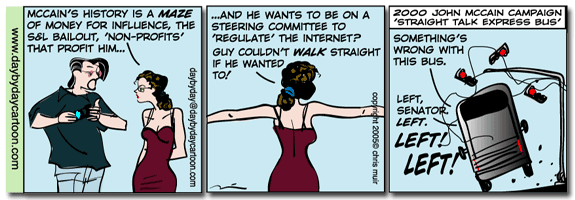
I'll have more on John McCain and the Reform Institute later today. In the meantime, if you don't read Day by Day on a regular basis, you should start today. Eventually a syndicate is going to wise up and hire Muir -- and then we'll have to subscribe to a newspaper or the syndicate to get our fix...
No Echoes Of Lynne Stewart Here
Matthew Hale, the imprisoned white supremacist who the FBI believes may have had some role in ordering the murder of a federal judge's family, attempted to pass coded messages to his followers, according to his attorney:
An attorney for jailed white supremacist Matthew Hale said he was asked to give an encoded message to one of Hale's supporters, according to a published report. Hale has been a focus of the investigation into the shooting deaths of a federal judge's husband and mother.Lawyer Glenn Greenwald said Hale's mother asked him a few months ago to pass the message to a Hale supporter.
"She said she didn't know what the message meant, but she was going to read it to me verbatim because Matt made her write it down when she visited him," Greenwald told The New York Times in Wednesday's editions. "It was two or three sentences that were very cryptic and impossible to understand in terms of what they were intended to convey."
Hale has been convicted of conspiracy to kill Judge Joan Humphrey Lefkow after she ruled against him in a trademark case and enjoined him from using the name World Church of the Creator. He awaits sentencing without bail, which means that Hale would have to have communicated some way with his followers to encourage them to murder Lefkow's family. (Sources indicate that they are investigating several possibilities, including this one.) However, Hale had only been seen by family members until yesterday, when the FBI suddenly isolated him and refused anyone access to Hale. Now we know why.
Unlike Lynne Stewart, who passed coded messages to the followers of the Islamist terror leader Sheikh Omar Abdel Rahman, Greenwald didn't cooperate with the terrorists. The AP report on ABC makes it unclear whether Greenwald came forward himself or whether the FBI found out about the attempt and had to ask him about it, but in either case, Greenwald shows why Stewart got convicted for her efforts. Greenwald's actions show how an attorney can separate himself from defending unsavory clients and involving himself in their crimes.
I would guess that the Hale connection to the Lefkow murders looks somewhat stronger for the FBI after this revelation. The mother should be next for the FBI and the US District Attorney to charge with conspiracy.
The Stupidity Of Terror (Western Version)
Sometimes, people act so stupidly that one has to marvel that they remember to breathe. In the case of the IRA and Sinn Féin, that has almost reached the level of parody.
The IRA managed to get itself involved in what started off as a simple bar fight, which of course is stupid enough for a supposedly experienced underground paramilitary force. During this bar fight, at least three and maybe more of these geniuses decide to stab one of the combatants and wind up killing the man who tried to stop the fight. Because the men involved were well-known in their Northern Ireland community, the family of the victim, Robert McCartney, has called for the IRA to cough up the men involved in this senseless, brutal, and needlessly provocative murder. The IRA refuses, of course, as it's not really an experienced underground paramilitary force but a terrorist group run more akin to a crime family.
(Don't send me e-mails arguing about Irish politics and history; I have my fill of both. I know there are terrorists on both sides, and that doesn't excuse any of them.)
After an enormous public outcry over the murder, the geniuses leading the IRA decide to meet with the family to try to work things out short of turning over their members to the Ulster police. During this meeting, they make the McCartneys an offer that they feel sure will make them happy: the IRA will simply murder the men who took part in the brawl. Aghast yet again, the McCartneys relate this message to the media, which produces yet even more outrage over the mob-style "justice" that the IRA imposes not just in this case but usually does as a rule anyway when their terrorists get out of line.
One would expect that the IRA's political wing, Sinn Féin, would take this fabulous opportunity to have what we Americans call a Sister Souljah moment, denouncing the IRA's heavy-handed tactics in order to rebuild its credibility after the McCartney murder and the £22 million robbery in January that the IRA engineered. However, never one to pass up an opportunity for self-destruction, SF managed to make matters even worse this morning by defending the idea of atoning for murder with even more murder:
Sinn Fein's Martin McGuinness has refused to condemn the IRA's offer last night to the family of a murdered Belfast man to shoot the culprits. The party's chief negotiator admitted the Provos would have made an error if they had carried out the shootings over the murder of Robert McCartney. But he would not go so far as to condemn the IRA's proposal. ...He added: "I totally and absolutely disagree with any punishment shootings whatsoever.
"But I think we shouldn't lose sight of the other messages that are clearly in this because I think it dispels absolutely any notion whatsoever that the IRA would cover up for or protect the perpetrators of the murder of Robert McCartney."
So Sinn Féin wants to go on record supporting the notion of judgement without trial and execution on demand? These tactics have been used by terrorists on both sides of the NI impasse for decades (and centuries before that), but Sinn Féin wants to sell itself as a purely political group committed to the rule of law. The fact that the IRA refuses to turn over the killers to the police is prima facie evidence that they want to cover up for McCartney's murderers, at least some of them. SF wants people to believe that a crude execution of murderers at the hands of other murderers and thieves represents justice, when it all it does is perpetuate the criminal-syndicate environment which allowed the IRA thugs to feel that they could stab McCartney to death with impunity in the first place.
The fact that Sinn Féin cannot grasp the ramifications of its excusemaking almost guarantees its future marginalization on both sides of the Ulster border, as disgust and revulsion continue to escalate from both the murder and the robbery and SF's ongoing rationalizations. It provides an object lesson why civilized people should pass on negotiating with terrorists for peace. Not only does it rarely if ever work, but quite frankly, most of them are too stupid to trust.
Lebanon Backsliding?
After a massive pro-Syrian rally sponsored by Hezbollah and possibly bolstered by Damascus, Lebanese president Emile Lahoud has decided to reinstate Omar Karami as Prime Minister -- the same PM that the pro-democracy rallies chased from office:
Lebanon's president looked set to ask the outgoing pro-Syrian prime minister to form a government on Wednesday, a step sure to anger the anti-Syrian opposition who pressured him to resign in the first place.President Emile Lahoud, buoyed by a mass rally in support of his Syrian backers, began consultations with MPs that were likely to preserve Syria's political grip on its much smaller neighbor.
Speaker Nabih Berri's bloc named Omar Karami as prime minister, as did the deputies of guerrilla group Hizbollah. Karami resigned as prime minister last week after huge anti-Syrian protests in Beirut but stayed on as caretaker.
Other pro-Syrian MPs were expected to follow, making it all but certain Karami would be reinstated.
This could tear Lebanon apart, as it likely heralds a return to the streets for the pro-democracy forces and would just as likely set the stage for a more immediate Hezbollah reaction. What most of the Lebanese will see is a return of the same government that may have been complicit in Rafik Hariri's murder, if not primarily guilty of it, working on behalf of their Syrian masters.
Clearly the rally yesterday gave the collaborators and oppressors some enthusiasm for pressing forward as though nothing had changed. I suspect that new pro-democracy rallies will be attempted after this slap in the face. The question will be whether they are tolerated as before by the Lahoud/Karami coalition and the guns of Hezbollah, and what the Lebanese Army decides to do about supporting either.
March 8, 2005
The Southern Sieve
FBI Director Robert Mueller testified before Congress today that illegal aliens from countries with significant al-Qaeda ties have crossed the Mexican border into the US, while terrorists have now begun assuming Hispanic last names to blend into the flood of immigrants:
"We are concerned, Homeland Security is concerned about special interest aliens entering the United States," Mueller said, using a term for people from countries where al-Qaida is known to be active.Under persistent questioning from Rep. John Culberson, R-Texas, Mueller said he was aware of one route that takes people to Brazil, where they assume false identities, and then to Mexico before crossing the U.S. border.
He also said that in some instances people with Middle Eastern names have adopted Hispanic last names before trying to get into the United States.
Our inability to secure our Southern border amounts to the single most embarassing and preventable security lapse since 9/11. This has little to do with the FBI but with an administration and Congress that believes it needs a comprehensive solution to illegal immigration before it can act to secure the border. This thinking flies in the face of our other post-9/11 strategies, where we have avoided attacking everyone at once in favor of tactically playing out our strategy in one hot theater at a time.
We need to come up with a grand strategy for dealing with the immigrants already here, but we must act immediately to secure the border. The rest can wait until later. The analysis paralysis we have accepted for the past decade or more will eventually kill us. In fact, it may already have, and we have yet to discover it.
The Sgrena Vehicle Exposed
Giuliana Sgrena described the American "assassination" attempt on her life as a "rain of bullets" that still somehow managed to leave her alive. We have asked to see the car that the Italians used to transport her and the deceased negotiator, Nicola Calipari, to the Baghdad airport to see whether the damage matches her description of the incident. Now La Repubblica has a slideshow of photographs that pretty much demolished the notion that the American soldiers at the checkpoint fired indiscriminately at Sgrena's vehicle:

This clearly shows that the vehicle did not come under heavy fire but probably got shot by handheld weapon trying to disable the vehicle. This picture is last in the slideshow; others show bullet holes on the fringe of the front windshield, which otherwise remains intact.
Whatever else happened, this vehicle did not come under heavy-weapons fire or indiscriminate automatic-arms fire. The fact that it's still got all of its fenders and its hood intact tells us that. One tire got shot out and one front-windshield bullet, possibly two, are all that La Repubblica can point out.
Sgrena lied.
UPDATE: More at Michelle Malkin and LGF. The other photos are in my extended entry.


Revisiting The Keating 5
In order to understand John McCain's present circumstances, it may be helpful to recall his entry into the Senate, tarnished with scandal over the savings and loan system collapse in the late 1980s. John McCain had been a recipient of over $100,000 in donations from Charles Keating, the owner of Lincoln Savings and Loan and American Continental Corporation. Keating used the S&L to float out bad bonds in ACC, resulting in a $2 billion loss and bailout from the FSLIC and the loss of millions of dollars to ordinary shareholders in ACC.
McCain ran interference for Keating, as the Arizona Republic's Bill Muller wrote:
In 1982, during McCain's first run for the House, Keating held a fund-raiser for him, collecting more than $11,000 from 40 employees of American Continental Corp. McCain would spend more than $550,000 to win the primary and the general election.In 1983, during McCain's second House race, Keating hosted a $1,000-a-plate dinner for McCain, though he had no serious competition and coasted into his second term. When McCain pushed for the Senate in 1986, Keating was there with more than $50,000.
By 1987, McCain had received about $112,000 in political contributions from Keating and his associates. ...
The first meeting, on April 2 in DeConcini's office, included Ed Gray, chairman of the Federal Home Loan Bank Board, as well as four senators: DeConcini, McCain, Alan Cranston, D-Calif., and John Glenn, D-Ohio. ... The second meeting was on April 9. The same four senators attended, along with Sen. Don Riegle, D-Mich. Also at the meeting were William Black, then deputy director of the Federal Savings and Loan Insurance Corp., James Cirona, president of the Federal Home Loan Bank of San Francisco, and Michael Patriarca, director of agency functions at the FSLIC.
In a recent interview with The Republic, Black said the meeting was a show of force by Keating, who wanted the senators to pressure the regulators into dropping their case against Lincoln. The thrift was in trouble for violating ''direct investment'' rules, which prohibited S&Ls from taking large ownership positions in various ventures.
''The Senate is a really small club, like the cliche goes,'' Black said. ''And you really did have one-twentieth of the Senate in one room, called by one guy, who was the biggest crook in the S&L debacle.'' ... ''They presented themselves as a group,'' Black said, ''and DeConcini is the dad, who's going to take the primary speaking role. Both meetings are in his office, and in both cases it's 'we' want this, with no one going, 'What do you mean we, kemo sabe?' ''
And in both meetings, the message from one-twentieth of the Senate was clear: Keating needed to get special treatment. McCain would later argue that he was just looking out for his constituent, but the five Senators made it plain that they wanted the investigation to end immediately if Lincoln could not be charged with any violations at the time. John Glenn in particular made it plain that regulators needed to act or pack it up, and DeConcini insisted that their intervention on behalf of Lincoln was proper to protect an employer who had promised to clean up if left alone.
These meetings eventually became public as federal regulators, two years later and an untold millions of dollars lost to investors and the FSLIC, finally closed down Lincoln Savings and charged Charles Keating with fraud. The damage done to the five varied; Cranston never ran again for public office, while McCain managed to reinvent himself as a crusader -- but some forget that it wasn't just the campaign contributions that Keating made which tied him so closely to the "maverick" Arizona Senator:
On Oct. 8, 1989, The Republic revealed that McCain's wife and her father had invested $359,100 in a Keating shopping center in April 1986, a year before McCain met with the regulators.The paper also reported that the McCains, sometimes accompanied by their daughter and baby-sitter, had made at least nine trips at Keating's expense, sometimes aboard the American Continental jet. Three of trips were made during vacations to Keating's opulent Bahamas retreat at Cat Cay.
McCain also did not pay Keating for the trips until years after they were taken, when he learned that Keating was in trouble over Lincoln. Total cost: $13,433.
And when the Arizona Republic made these connections public, McCain erupted in one of his characteristic outbursts that earned him the sobriquet Senator Hothead:
''You're a liar,''' McCain snapped Sept. 29 when a Republic reporter asked him about business ties between his wife and Keating. ''That's the spouse's involvement, you idiot,'' McCain said later in the same conversation. ''You do understand English, don't you?''He also belittled the reporters when they asked about his wife's ties to Keating. ''It's up to you to find that out, kids.''
And then he played the POW card. ''Even the Vietnamese didn't question my ethics,'' McCain said.
Eventually, the Senate Ethics Committee wound up giving McCain and Glenn the least of the censures it handed down to the Keating 5, rebuking them for "poor judgment" while inflicting no punishment. The Keating collapse wound up costing taxpayers and investors a total of $3.4 billion, a number that could have been mitigated substantially had the five not interfered with the regulatory agency's investigation of Keating.
Now, what exactly has changed? McCain has intervened on behalf of a contributor -- an indirect contributor, to be sure, but one solicited by and benefitting his chief political advisor for a group that closely allies itself to McCain and his agenda and heavily promotes the Senator. Within weeks this intervention, the contributor cut a six-figure check solicited by Rick Davis. The only changes to the Keating scenarios are that McCain learned to put a buffer or two between the money and himself and that he acted alone to intervene with a regulatory agency on their behalf.
This activity is what McCain promised he'd correct, first when he apologized for his role in the S&L scandal, and later when he assaulted the First Amendment and limited political speech during election campaigns. In other words, nothing has changed except McCain's pomposity and hypocrisy.
Screaming Hypocrisy: NYT
The New York Times has signaled that Senator John McCain can expect no media blackout of his apparent conflict between his reformer persona and the coordination involving his action on behalf of Cablevision and their $200K donations to the Reform Institute. In an article that manages to almost completely miss the Cablevision connection, McCain still comes across as a hypocrite, raising big money for his pet causes through the supposedly independent 501(c)3 that employs his chief political advisor, Rick Davis:
In a small office a few miles from Capitol Hill, a handful of top advisers to Senator John McCain run a quiet campaign. They promote his crusade against special interest money in politics. They send out news releases promoting his initiatives. And they raise money - hundreds of thousands of dollars, tapping some McCain backers for more than $50,000 each.This may look like the headquarters of a nascent McCain presidential bid in 2008. But instead, it is the Reform Institute, a nonprofit organization devoted to overhauling campaign finance laws and one whose work has the added benefit of keeping the senator in the spotlight.
The institute has drawn little notice, but it offers a telling glimpse into how Mr. McCain operates. In the four years since its creation, it has accelerated its fund-raising, collecting about $1.3 million last year, double what it raised in 2003, a sizable sum for a group that exists to curb the influence of money in politics. ...
"It's screaming hypocrisy, isn't it?" said Roy Schotland, a professor at the Georgetown University Law Center and a critic of Mr. McCain's campaign finance legislation. "What he's doing is what he and his side are always screaming about, violating at least the spirit of the campaign finance laws."
As chairman of the Reform Institute's advisory committee, Mr. McCain is often praised in its news releases and featured in its fund-raising letters, a useful boost for any potential presidential candidate.
It's not just the hypocrisy, either. As the Times notes, the Reform Institute helps keep McCain's staff gainfully employed between campaigns, allowing McCain to do less fundraising while retaining the best of the available talent. For instance, Carl Hulse and Ann Kornblut note that Rick Davis managed McCain's presidential campaign in 2000 before founding Reform Institute. Now its president, he gets over $100,000 a year from RI for "consulting services". That money allows Davis to remain available for McCain's future campaigns, and the funding he raises for RI gives him inroads for building support.
However, with Cablevision, Davis and McCain got sloppy. In an eerily reminiscent action which hearkens back to the Keating 5 scandal, McCain essentially attempted to intervene on Cablevision's behalf by writing a letter to the FCC supporting Cablevision's regulatory agenda of a la carte cable services. Less than a fortnight before, Cablevision made a six-figure donation to RI through a subsidiary, CSC Holdings, directly as a result of Davis' solicitation. Nor is that the only conflict that McCain has had with the communications industry through Davis and RI:
One donation in that category came from an elected Republican official who insisted on remaining anonymous, even to Mr. McCain, Mr. Davis said. Some donors, though, are communications industry giants who had business before the Commerce Committee when Mr. McCain was its chairman. Echosphere, a communications company started by Charles Ergen, a founder of EchoStar Communications and the DISH Network, gave $50,000 or more to the institute. So did CSC Holdings, a subsidiary of the Cablevisions Systems Corporation, headed by Charles F. Dolan, and the Chartwell Foundation, the charitable group funded by A. Jerrold Perenchio, the Univision billionaire.
The stink gets worse with each new revelation. Based on my research yesterday, Davis already has many strange bedfellows for a man who is the closest political advisor to a supposedly conservative Republican. Now it appears that McCain has a track record of using RI to allow donors a roundabout way to buy influence: keeping his staff employed and this bootlicking "independent" policy group afloat.
So this is campaign finance reform? This is what we traded our First Amendment rights of unfettered political speech to get?
Mr. Clean?
CQ reader TR points me to a breaking news item from the AP that alleges a conflict of interest for Senator John McCain. After a non-profit group closely associated with McCain and which pays a six-figure salary to one of his aides received $200,000 in donations from Cablevision, McCain wrote a letter of support to the FCC pushing Cablevision's regulatory positions:
Sen. John McCain pressed a cable company's case for pricing changes with regulators at the same time a tax-exempt group that he has worked with since its founding solicited $200,000 in contributions from the company.Help from McCain, who argues for ridding politics of big money, included giving the CEO of Cablevision Systems Corp. the opportunity to testify before his Senate committee, writing a letter of support to the Federal Communication Commission and asking other cable companies to support so-called a la carte pricing.
McCain had expressed interest in exploring the a la carte option for years before Cablevision advocated it, but did not take a formal position with regulators until after the company's first donation came in. Cablevision is the eighth largest cable provider, serving about 3 million customers in the New York area.
Cablevision made two $100,000 donations to The Reform Institute in 2003 and 2004. The Reform Institute employs Rick Davis, who also works on McCain's staff as his chief political advisor, and they pay him $110,000 per year. The Reform Institute has often supported McCain, paid for events highlighting him and his agenda, presumably including campaign finance reform.
McCain told the AP that he sees nothing wrong with this arrangement:
"If it was a PAC (political action committee) or if it was somehow connected to any campaign of mine, I would say to you, that's a legitimate appearance of conflict of interest. But it's not," McCain told The Associated Press."There's not a conflict of interest when you're involved in an organization that is nonpartisan, nonprofit, nonpolitical."
Quite frankly, this stinks. Here we have a man who has done more harm to the First Amendment as anyone in the past generation, all the while scolding us on coordination of electoral efforts, and he's playing a shell game with Cablevision in order to gin up indirect payments to his staff. Davis claims that McCain didn't solicit the donations, but Davis did; according to his own account, he sought out the donation from Cablevision after hearing that they might be interested in funding The Reform Institute. Coincidentally, McCain starts writing letters and making phone calls on behalf of Cablevision shortly after the first installment gets cashed by Davis and the Reform Institute. Under the BCRA, this kind of activity would easily qualify as coordination if they had pulled off this stunt during an election. It may still qualify as a conflict of interest under federal law, and possibly an illegal campaign contribution.
John McCain sold out to Charles Keating fourteen years ago in the S&L scandals, and rebranded himself as an outsider and a reformer, blaming the system rather than himself for his actions. It now appears that McCain isn't the Mr. Clean he's sold to Arizona voters.
UPDATE: Corrected Reform Institute's name in several points.
UPDATE II: Why doesn't Cablevision appear on this list of donors? Perhaps because Cablevision hid the donations in its subsidiary, CSC Holdings. Notice that the Tides Foundation also donates to the RI, to the tune of over $50,000. Tides, of course, received millions of dollars from Teresa Heinz Kerry, meaning that Rick Davis -- McCain's chief political advisor -- benefits financially from the wife of the erstwhile Democratic nominee. No wonder McCain played footsie with Kerry about the VP slot for a while. (h/t: CQ reader JR Pascucci)
Front Page Magazine has more on Tides:
Teresa Heinz Kerry has financed the secretive Tides Foundation to the tune of more than $4 million over the years. The Tides Foundation, a “charity” established in 1976 by antiwar leftist activist Drummond Pike, distributes millions of dollars in grants every year to political organizations advocating far-Left causes. The Tides Foundation and its closely allied Tides Center, which was spun off from the Foundation in 1996 but run by Drummond Pike, distributed nearly $66 million in grants in 2002 alone. In all, Tides has distributed more than $300 million for the Left. These funds went to rabid antiwar demonstrators, anti-trade demonstrators, domestic Islamist organizations, pro-terrorists legal groups, environmentalists, abortion partisans, extremist homosexual activists and open borders advocates.
And now we find out that they fund McCain's chief political advisor, too. How coincidental.
UPDATE III: The Chartwell Charitable Foundation also has donated over $50,000, but a Google on this shows them much more interested in promoting the arts. Why the interest in McCain's reform politics? And here's the Educational Foundation of America making a mid-five-figure or more donation, too. The site describes their interests:
Areas of interest include, but are not limited to, the environment, the crisis of human overpopulation and reproductive freedom, Native Americans, arts, education, medicine, and human services.
That makes two of its major financial backers who support abortion, an unusual position for a group that employs the chief political advisor of a pro-life Senator.
UPDATE IV: Speaking of EFA, here's what they have to say about their efforts to promote Peace and Security in 2003:
In this issue area of increasing national and global importance, EFA is firmly committed to reducing irresponsible military spending, avoiding unnecessary violent conflict, and preventing the use of deadly (nuclear/chemical/biological) weapons. By joining and respecting the terms of international conventions, maintaining pathways of meaningful dialogue, and recognizing the role for a balanced military presence, the United States can work towards a peaceful, safe, and fair world community.
And on reproductive rights, where NARAL makes a prominent appearance ($220,000 over 2 years):
It is EFA’s goal in the area of Population to fund programs that ensure reproductive health services are available to all, regardless of race, religion, or economic status. EFA’s funding in 2003 assisted programs that work to: promote abortion training and build a new corps of abortion providers; address legal challenges to abortion access; provide reproductive health services to uninsured/underinsured women; train new pro-choice activists, particularly through campus organizing; organize physicians that favor reproductive choice; mobilize pro-choice voters; and provide essential reproductive education and services to teens.
And yet, they've funded the pet non-profit of a supposedly pro-life Republican and helped pay the salary of his chief political advisor. Hmmmm. I note that The Reform Institute doesn't appear in its 2001-3 annual reports, which leaves 2004 for their donation.
UPDATE V: Another major donor to Rick Davis' salary is the Proteus Fund. Proteus also supports gay-marriage initiatives around the US to the tune of $935,000. They gave $75,000 to stopping the Yucca Mountain nuclear fuel storage initiative, a legislative priority of the Bush administration.
UPDATE VI: OSI and its Constitution and Legal Policy Program also gives big bucks to Rick Davis and the RI. Guess who funds OSI? George Soros.
UPDATE VII and BUMP, 3/8: Some of McCain's allies in finance reform have reservations about McCain's explanation about how the money doesn't connect to him, in an update to the original AP story:
"I think there is an appearance issue any time you have a company or an interest giving large donations to any organization associated with a member (of Congress)," said Larry Noble, the former chief lawyer for federal election enforcement who now heads the Center for Responsive Politics.Kent Cooper, head of the Political Money Line that tracks political donations, agreed.
"Senator McCain derives a clear benefit by using The Reform Institute to help the debate on campaign finance reform. His McCain-Feingold bill helped break the connection between members of Congress and large contributions. Here is an example of a large contribution going to the foundation connected with a member of Congress. I don't see a difference," Cooper said.
There is no difference, just a more sophisticated way of reaching out to elected officials via their staff. RI's employment of McCain's chief political advisor with a six-figure salary and that advisor's actions in soliciting donations from Cablevision just before his other employer takes political action on their behalf has all the same earmarks of a payoff, just as if that money had dropped into McCain's political campaign directly. As the article notes, RI supported McCain's last presidential bid, and before this floated to the top, they certainly would have worked closely with him on his next one, too.
Gulf News Channels Eason Jordan
To no one's great surprise, Gulf News has taken the Sgrena incident and used it to bolster Eason Jordan's allegations of deliberate assassinations of journalists by American forces in Iraq. Tom Bevan at RealClearPolitics points readers to this one-sided editorial by Linda Heard, which takes the ultra-leftist Sgrena's self-contradictory narrative as gospel to smear the American military:
CNN's chief news executive Eason Jordan was forced to resign last month to quell the furore over his suggestion that US troops had "targetted" journalists.He was later to backtrack and apologise in an effort to keep his job but the damage had already been done.
The knives came out from all sides of the political spectrum with Jordan branded as being un-American and unpatriotic.
Now, just weeks later, the left-wing, anti-war Italian reporter Giuliana Sgrena who was shot at and wounded by American forces in Iraq shortly after being released by her kidnappers, is echoing Jordan's assertion.
Look, even the Italian press isn't buying into Sgrena's story, although they understandably want an investigation into Nicola Calipari's death. Heard fails to explain, as does Sgrena, how an assassination attempt on a car with a "rain of bullets" managed to leave two of the three people inside alive, especially the target of their attempt -- and why the same people supposedly trying to silence her wound up getting her medical aid.
Just as with Eason Jordan, Heard makes baseless accusations with no supporting evidence -- except, in this case, a warning by the same people who kidnapped and held Sgrena hostage that the Americans didn't want her released. Perhaps Heard and Sgrena can get this brave terrorist to come forward and explain why. Oh, wait! He can't come forward, because he's too busy beheading Western civilians who came to Iraq to help rebuild the country. I can see why Sgrena and Heard consider him such a reliable source of information.
No one wanted to see Sgrena or Calipari injured or killed, except for the terrorists who would have gladly hacked her neck to pieces and danced in her blood had Italy not given them a fortune in ransom money to get her back. All of us want the Army to investigate the incident to ensure that if mistakes were made, they don't get made again. But at the same time, we're going to quit supporting any such investigation if baseless smears don't stop coming from Italian officals, their press, and they admit the possibility -- in fact, the probability -- that the Italians had more than a little responsibility for this incident themselves, and if they don't demand a parallel investigation of the decision that put millions of dollars into the hands of terrorists to free Sgrena in the first place.
Syria: Withdrawal Includes Intelligence Services
Syria clarified its position on the withdrawal of its forces from Lebanon this morning, assuring the international community that their withdrawal will include their espionage agents as well as military personnel:
Syria's promised troop pullout from Lebanon will include intelligence and security personnel, a Syrian official source said Tuesday.The source gave no timetable for the second phase of the pullout announced Monday, but said: "This doesn't mean it won't be soon."
"The fact that security forces were not mentioned in the statement is merely because they move along with the armed forces. It is a given. The withdrawal is of all Syrian forces," the source told Reuters. ...
A statement after the talks did not mention Syrian security services. The United States, which has demanded that intelligence agents leave along with the troops, has dismissed the plan for failing to set a deadline for a full pullout.
That may take some doing. By some accounts, the security presence in Lebanon may comprise hundreds of thousands of outright spies, bureaucrats, functionaries, and Lebanese collaborators. Just as in other tightly-controlled societies with omnipresent state police -- think Gestapo -- the lines blur between the agency itself and all the secondary players that allow it to function with such ruthless efficiency. Pulling the official mukhabarat out of Lebanon may wind up having only a small impact on Lebanese life, at least at first. Of course, the flip side comes if the Lebanese gain control of the intelligence files, an unlikely event if the Syrians manage an orderly retreat back home. If the Lebanese saw the files, the recriminations and the revenge could destabilize the entire country.
No one, so far, has mentioned the role of Hezbollah. Given their now-overt efforts to keep Syria in Lebanon, the armed auxiliary to Syria's occupation should either be disarmed or sent off to Damascus with the rest of the occupiers. That may also prove rather tricky, as the terrorists don't show any inclination to do either. However, they've undeniably acted as agents of both the military and the mukhabarat, and the Lebanese will have to do something to neutralize the terrorists if they want to achieve true sovereignty.
Hezbollah Sponsors Counterprotests In Beirut
True to their word, pro-Syrian Hezbollah leadership staged a protest in Beirut to counter the people power demonstrations creating so much pressure for a complete Syrian withdrawal from Lebanon. In the AP report, however, no mention is given on how many people Hezbollah attracted for their paean to foreign domination:
Pro-Syrian protesters gathered in a central Beirut square Tuesday, answering a nationwide call by the militant Shiite Muslim Hezbollah group for a demonstration to counter weeks of massive rallies demanding Syrian forces leave Lebanon.Loudspeakers blared songs of resistance and organizers handed out Lebanese flags and directed the men and women to separate sections of the square. Black-clad Hezbollah guards handled security, lining the perimeter of the square and taking position on rooftops. Trained dogs sniffed for bombs.
Large cranes hoisted two giant white and red flags bearing Lebanon's cedar tree. On one, the words "Thank you Syria" were written in English; on the other, "No to foreign interference."
The latter message refers, of course, to international demands for a full withdrawal by Bashar Assad from Lebanon. Hezbollah characterizes it as American interference, but even Egypt and Saudi Arabia want Assad to completely withdraw, as does Russia, its primary arms provider. However, that message could just as easily refer to the Syrians themselves, an irony apparently lost on the Hezbollah organizers of the event.
One could possibly excuse them for their cluelessness, as they had other issues to face, such as attendance. The AP reports unconfirmed sources that Hezbollah had to bus in Syrians in order to boost the numbers, and democracy activists reported that the terror group had pressured local government officials and public schools to send people to the demonstration. Hezbollah denies it, but the AP's silence on the attendance appears to show a small turnout for cheering dictatorship and continued Syrian oppression.
Do you suppose this might worry Hezbollah even more than before?
UPDATE: The BBC now reports that the counterprotests have drawn "tens of thousands" to Beirut to proclaim their love of Syrian rule in Lebanon. The Beeb captions a tight-frame photograph of the demonstration with this:
Many Lebanese believe they share Syria's interests
Many Lebanese probably do. Hezbollah, collaborators, bureaucrats, Islamists ...
Walter Cronkite Damns Rather With Faint Defense
Walter Cronkite had an opportunity to defend Dan Rather on CNN last night in an interview with Wolf Blitzer, and mostly took a pass. While Uncle Walter made some unenthusiastic attempts at excusemaking, but declined the laughable assertion that the Killian memos still hadn't been established as forgeries, and made his distaste for Dan Rather clear.
Here's Walter on Memogate:
BLITZER: Well, he's leaving under a cloud, as you well know, the circumstances surrounding that "60 Minutes" report. It's unfortunate for him, given his career. But, looking back, there were lots of sloppy mistakes that were made.CRONKITE: Well, you're speaking of this particular episode, of course.
And that was most unfortunate. He hung on too long [with the story due] to his faith in his staff. They had provided this material. And he trusted them implicitly in all things and insisted that the information was correct for a whole week, when evidence was beginning to pile up that it wasn't.
And on the notion that the memos themselves might prove genuine in the future, Cronkite indicates that he isn't buying it:
BLITZER: He told David Letterman in an interview a couple days ago, he said this: "We were not able to authenticate the documents as thoroughly as I think we should have. Given a little more time, perhaps we could have." He's still laying out the possibility that those documents were real, as opposed to forgeries.CRONKITE: Well, of course, we don't have any evidence of that. That turned out to be more his hope, as he got deeper into the story, than the actuality would have indicated.
But it wasn't until Blitzer asked Cronkite about Rather's replacement that the latter's distaste for Rather became clear:
BLITZER: Bob Schieffer, as you know, is going to be the interim anchor of "The CBS Evening News," a good friend of all of ours, an outstanding journalist. Who do you think should emerge as the next anchor, the main anchor of CBS, after Bob Schieffer's interim period?CRONKITE: Well, I think it's going to be hard to find anybody who is going to be as much liked and appreciated and does such a job as Bob Schieffer. I think he's one of the great television journalists of our time. And he was a good journalist when he came to television from Fort Worth [Texas].
He is, to my mind, the man who, quite frankly -- although Dan did a fine job -- I would like to have seen him there a long time ago. He would have given the others a real run for their money. ...
BLITZER: So, you would have been happier if Bob Schieffer would have replaced Dan Rather a while ago?
CRONKITE: I would have thought so, certainly -- if not Bob, someone else.
But the best moment came when Cronkite noted that whoever CBS brought in as permanent anchor would have some mighty big shoes to fill. However, those zapatos wouldn't be Dan's:
They're going to find it's going to be tough not to follow Dan so much as to follow Schieffer.
And this is what Walter Cronkite says about Dan Rather when he's retiring, at least from the anchor position. It would be like having the chairman of the board and former CEO get up at a retirement party for his replacement and talk about what a great guy the next replacement will be and how difficult it will be to follow him, while explaning that the man retiring hung on too long. Imagine what Cronkite must have thought about Rather during his long run at CBS.
So long, Dan. You'll be missed ... presumably ... by some one.
March 7, 2005
Demick Raises Questions By Her Answers
Barbara Demick generated tremendous criticism for herself and the Los Angeles Times for a front-page apologia of the Kim regime in an article Demick wrote and the Times headlined, "North Korea: Without The Rancor." I didn't comment about it at the time because I hadn't read the article before I heard the controversy, and by the time I had an opportunity to dig into it, my perspective had been well covered by Hugh Hewitt and many others.
Hugh attempted to get Ms. Demick to appear on his show, and while it seems as though she's willing, the LAT editors apparently balked at Hugh's offer. However, she did agree to answer questions put to her by e-mail as long as Hugh reproduced them unedited, which he did this morning. Her answers raise new questions about her original article and the editorial judgement of the Times.
For instance, Hugh asks Demick this straight question, and gets a strange half answer, half dodge in return:
Q: Do you think Kim Jong Il is an evil man?A: We reported last summer that Kim Jong Il spent millions importing
gourmet foods, cookbooks and chefs for himself while his countrymen
were starving. One can judge from there.
"One can judge," most certainly, but that doesn't answer the question, and a sharp attorney like Hugh doesn't ask questions just for their face value. Demick deliberately evades answering with her personal judgment about good and evil, explaining why the Times engaged in such moral relativism in the first place. Hugh asked this question first for a reason; it's the single most important issue. If Demick refuses to take a stand on whether Kim Jong-Il is evil, despite admitting that he caused a famine that killed 2 million people (10% of the population) and forces pregnant refugees to abort their babies if they get caught, then it explains why she can allow her byline to get hijacked for the purposes of allowing an admitted North Korean government agent to broadcast pro-Kim propaganda on the pages of the West Coast's biggest newspaper.
The same sickness of moral relativism infects the editorial staff of the LAT, at least those who green-lighted Demick's original article. If "one" cannot admit that Kim Jong-Il is evil, then evil exists only as an abstraction with little or no application in reality. That truly gives the only justification for the Durantyism displayed by the LAT in publishing such a piece with no context whatsoever -- not a single mention of any of the issues Hugh raises in his Q&A with Demick today.
It is chilling to see people who should know better being too afraid or too benighted to explicitly call a man who has starved two million people evil, a ruler who literally decimated his country while pocketing millions and perhaps billions of dollars for himself and the pursuit of WMD. The readers of the Los Angeles Times deserve better, and they should demand better.
Cooler Italian Heads May Yet Prevail
After the outpouring of understandable grief at the loss of Italian intelligence agent Nicola Calipari, some members of the Italian press want to cool the rhetoric spawned by the far-left Communist mouthpiece Il Manifesto, in which Giuliana Sgrena has accused the US of attempting to assassinate her after the Italians ransomed her from her Iraqi captors. The publication Italian Life (Corriere Della Sera IT) calls for a bit of common sense from Italians when dealing with Sgrena's outburst:
[I]s it true, as the self-styled “Communist Daily” headline puts it, that the death of Nicola Calipari was a “preemptive” and therefore premeditated, homicide? Is it true, as Rossana Rossanda writes, that the Americans were shooting “to kill,” and that Calipari’s death was “an assassination?” Can we really subscribe to the picture painted by Ms Rossanda of arrogant Yankee roughnecks, beardless and/or whisky-soused, complying with the “American maxim, ‘shoot first, ask questions later?,’ and obeying without objection the order ‘when those Italians arrive, eliminate them’?” ...[W]hat might be the “information” in Ms Sgrena’s possession that, according to her life partner Pier Scolari, could justify an assassination by the Americans determined not to see it published? Finally, are we really to believe that the Italians’ car was hit by “400 bullets, a storm of projectiles” (Mr Scolari)? Are we really to believe Giuliana Sgrena when she says that she personally picked “handfuls of bullets” off the seat, but that, in this premeditated rain of fire from an armored vehicle against an automobile with no armor plating, only one passenger actually died?
To us, at least, these look like reasonable questions. It seems to us equally reasonable to wonder in conclusion that if Washington had been determined that the Italian journalist should die, why - for her and our good fortune - did she survive? What caused the plot to abort? And why were two Italians actually left alive to bear witness to the attack?
To further translate -- Sgrena makes no sense whatsoever. The same people who supposedly obeyed orders to assassinate her left her alive to talk after the attack. The car in which she rode had two out of three people left alive, which makes the "rain of bullets" sound more than just an exaggeration or poetic license. Sgrena provides no motive for her supposed assassination, nor explains why the Americans didn't simply finish the job.
A thorough investigation has been ordered and we should know more of the answers in a few days. What we do know doesn't jibe at all with Sgrena's account, and even the Italians have begun to notice it. With any luck, the American media might even begin to report it. (via CQ reader Rachel F; page is slow to load)
Addendum: To provide some context for the Italians and the American media, the AP reports that 31 people died today in terrorist attacks. How did the terrorists kill so many?
The Baqouba assaults included a car bomb, three roadside bombs and small arms attacks three checkpoints, one of them just south of Baqouba in Muradiyah, said police Col. Mudhafar al-Jubbori.U.S. Maj. Ed House said a suicide car bombing outside a police station there killed nine people and wounded 17. The dead included the bomber, two police, three soldiers and three civilians.
In another attack near the city, a group of about 20 insurgents in five vehicles attacked an army checkpoint with assault rifles and rocket-propelled grenades, killing five Iraqi soldiers. The troops fought back, killing one of the attackers. Nine people were wounded, House said. ...
Another car bomb exploded outside the home of Iraqi army Lt. Col. Mohammed Abdul Mutaled in Balad, 50 miles north of Baghdad, killing 12 people and injuring 21 others, said the city's police chief, Ayad Ahmed. Hospital officials said most of the casualties were bystanders. Iraqi security forces are frequently targeted by insurgents. ...
Two civilians were killed when a roadside bomb targeting a joint U.S.-Iraqi military convoy exploded in the west Baghdad neighborhood of Amiriyah. The blast missed the convoy, damaging two passing cars and wounding four people, including two girls, said 1st Lt. Ali Hussein Hamdani. Another roadside bomb exploded in a southeastern Baghdad suburb, wounding several people on a bus.
Meanwhile, saboteurs blasted a pipeline near Samarra, 60 miles northwest of the capital, that carries oil to a Baghdad refinery, said police Maj. Mohsin Mahmoud.
A Polish soldier was wounded in the hand Monday when a bomb blew up next to his convoy north of Hillah in central Iraqi, said Lt. Col. Zbigniew Staszkow, spokesman for the Polish military.
That's the context in which Americans serve in Iraq, especially on the road that Sgrena and Calipari used to get to the airport. Thanks to the Italian ransom delivery, we can expect to have many more days such as these, with plenty of Iraqi casualties and continued American vigilance to unresponsive drivers approaching military checkpoints.
When Political Correctness Kills, Part II
MS-NBC has a breaking story from the AP regarding the screening of 9/11 mastermind Mohammed Atta, the last chance to stop him, and why it slipped through our fingers. The airport security agent at Logan Airport remembers Atta well from that day:
Michael Tuohey of Scarborough said he was suspicious of Atta and Abdulaziz Alomari when they rushed through the Portland International Jetport to make their flight to Boston that day.Atta’s demeanor and the pair’s first-class, one-way tickets to Los Angeles made Tuohey think twice about them.
“I said to myself, ’If this guy doesn’t look like an Arab terrorist, then nothing does.’ Then I gave myself a mental slap, because in this day and age, it’s not nice to say things like this,” Tuohey told the Maine Sunday Telegram. “You’ve checked in hundreds of Arabs and Hindus and Sikhs, and you’ve never done that. I felt kind of embarrassed.”
In Boston, Atta and Alomari joined three other hijackers on American Airlines Flight 11, which they crashed into one of the World Trade Center’s twin towers in New York. Five other hijackers left Boston on another flight, which they crashed into the other tower.
Tuohey's account didn't get declassified in time to make it into the 9/11 Commission report, but it calls into question the entire screening process both before and after 9/11. Airlines and airports had been warned at an increased but non-specific risk of Arab terrorists and the possibility of hijackings. Here we have a security agent whose instincts clearly warned him that the Arab in front of him (a) was behaving oddly and aggressively, (b) had first-class, one-way tickets on a transcontinental flight, and (c) objected to security screening procedures. Instead of acting on those instincts and red flags, Tuohey passed Atta through unchallenged.
Why? Did Tuohey recheck Atta to his satisfaction? No. He scolded himself for not being politically correct in his job function. Despite having "chills" when looking into Atta's eyes, being politically correct and displaying the right attitude towards diversity took precedence over security and the lives of the passengers -- and as it turns out, the lives of tbousands of people in the World Trade Center.
Have we learned any better since that time? Inasmuch as airport security continues to limit the number of passengers that can be screened based on ethnicity, it appears not. TSA, the successor to the private security agencies that used to perform airport screening, appears to prioritize diversity and PC just as highly as Tuohey did that day. I'm not blaming Tuohey as an individual, either -- I'm certain that the PC lessons had been drilled into him over a long period of time. You know, those decades where the only political hijackings were being carried out by Arab terrorists.
This is an awful lesson to learn once. Will we have to learn it twice?
In Sgrena's Own Words
CNN has a translation of Giuliana Sgrena's account of the incident with American troops that left her wounded and her negotiator dead. Stripped of the dramatics with which she surrounds the narrative, this is Sgrena's recollection of the friendly-fire incident, as published in Il Manifesto:
The car kept on the road, going under an underpass full of puddles and almost losing control to avoid them. We all incredibly laughed. It was liberating. Losing control of the car in a street full of water in Baghdad and maybe wind up in a bad car accident after all I had been through would really be a tale I would not be able to tell. Nicola Calipari sat next to me. The driver twice called the embassy and in Italy that we were heading towards the airport that I knew was heavily patrolled by U.S. troops. They told me that we were less than a kilometer away...when...I only remember fire. At that point, a rain of fire and bullets hit us, shutting up forever the cheerful voices of a few minutes earlier.The driver started yelling that we were Italians. "We are Italians, we are Italians." Nicola Calipari threw himself on me to protect me and immediately, I repeat, immediately I heard his last breath as he was dying on me. I must have felt physical pain.
So they drove through Baghdad fast enough to almost lose control of the car, never slowed down as they approached a checkpoint they knew to be ahead, and the "rain of gunfire and bullets" apparently only hit two of the three people in the car -- hardly likely if the intent was to assassinate everyone in the vehicle. In fact, it sounds very close to the American version of the incident, in which the Italians failed to coordinate their movements with the military command protecting the single most dangerous road in Iraq, one on which numerous car-bomb attacks have been launched, and failed to approach a military checkpoint in a battle zone with caution and common sense.
The fact that anyone survived should be considered somewhat fortunate under these circumstances. It also points out that American soldiers act with caution and discrimination, not hysterical free-fire as Sgrena and the Italian press alleges.
Now let's talk about that ransom the Italians paid for Sgrena's release ...
Council On Foreign Relations, Coming To A Theater Near You
The Council on Foreign Relations, a think tank with an impressive name if not necessarily an equally impressive track record, has decided to choose celebrity over cerebra. According to Al Kamen at the Washington Post, the CFR welcomes the following distinguished thinkers into their policy-wonk chambers:
The venerable Council on Foreign Relations' list of new members, in addition to the usual diplomats, academics, Hill folk and media suspects, includes Michael Douglas, Richard Dreyfuss, Warren Beatty and Mike Medavoy.
The most surprising aspect of those links showing political donations are how cheap most Hollywood celebrities are. Richard Dreyfuss made no donations at all during the 2004 cycle despite his rhetoric about George Bush and the evil of Republicanism, and only Michael Douglas spent more than a few grand. If the CFR expected the Hollywood crowd to pick up a few dinner tabs with their new memberships, they will be sorely disappointed. In the meantime, we can see where the CFR goes for in-depth analysis of foreign policy -- La-La Land. It explains a lot about their positions.
Reality Check For Italian Conspiracy Theorists
The death of an Italian commando and the wounding of Giuliana Sgrena has led to hysterical charges of assassination attempts and war crimes, all of which approach the ridiculous. Michelle Malkin has the best round-up of the media coverage today, including multiple reports that the Italians paid millions of dollars in ransom to free Sgrena -- money that will undoubtedly go towards murdering Iraqis and American soldiers, and certainly a reason to play a little misdirection with an accidental shooting.
The Washington Post provides a look at why Sgrena's car likely got shot in an otherwise rather hostile article by Jeffrey Smith and Ann Tyson:
The automobile was traversing onto a route -- the road to the airport -- where soldiers have been killed in shootings and by roadside bombs. U.S. soldiers had established an impromptu evening checkpoint at the entrance to the road about 90 minutes earlier and had stopped other vehicles. They knew a high-level embassy official would be moving to the airport on that road, and their aim was to support this movement.But no specific coordination occurred between those involved in Sgrena's rescue and the military unit responsible for the checkpoint, according to the source, who said he cannot be named because the military's investigation into the incident is continuing.
Soldiers at the checkpoint have told U.S. military officers that they flashed lights, used hand signals and fired warning shots in an effort to stop the car, which they believed was traveling at more than 50 mph, a typical speed for that road. But Sgrena, who had just been released by Iraqi captors, recalled later that the car was not traveling very fast and that soldiers started firing "right after lighting" a spotlight -- a decision she said was not justified. Sgrena was wounded by shrapnel in the U.S. barrage.
The absence of advance communication between the Italians and the U.S. soldiers at the checkpoint appears to have put the occupants of the car in grave jeopardy, given what many U.S. officials describe as the military's standard practice of firing at onrushing cars from their checkpoints in Iraq.
"In my view, the main contributing factor was a lack of prior coordination with the ground unit," the source said. "If requested, we would have resourced and supported this mission very differently."
Besides, as a commenter to CQ, ERNurse, noted on an earlier post, the damage done to Sgrena hardly matches up with the kind of ordnance she claims they took from the fire. This describes the kind of damage one would expect to see from armored-vehicle fire:
I was a squad machine gunner many moons ago, and I was issued the trusty dusty M-60.Let me tell you, that was a kick-*ss weapon. Standard ammo was the 7.62 ball round. No frills, but it was reliable, portable, and powerful.
I have seen what just one M-60 can do to a car with just a couple of ten-round bursts using ball rounds. And the car in question was some old beat-up Chrysler from a local junkyard procured for the purpose by Uncle Sugar, and NOT one of the crappy old K-cars from the Iacocca era. My target was some serious tailfin-sporting by-gawd American steel.
I fired from 50 meters, and I tore that sucker up. I mean I just shredded it. And I used two belts- a couple of hundred rounds. Now, my assistant gunner with his pea-shooter M-16 also put some holes in the car, but they were teensy-weensy, maybe just big enough to stick a pencil through. But still pretty effective. And an M-16's high-velocity round tumbles once it hits something. So while my rounds punched big holes but went on through the other side of the car, the M-16 rounds just flew all around the inside of the car and tore up the interior. It was crazy.
I don't know the specs on the new weapon that our soldiers have, but I will say this: if those troopers had fired half of what that [woman] claims, and at close range at that, she would have wound up looking like bloody hamburger spread all over the rear compartment.
I have yet to see a picture of the actual car, but that really doesn't matter. If only one person in that car was killed, and the [woman] in question is still walking- let alone still equipped with two arms- then there is no way she could be telling the truth, because a squad's worth of firepower would have shredded the El Cheapo tin cans that pass for cars over there.
It appears, so far, that what happened is that the Italians came up to a checkpoint that they hadn't anticipated on a road that is the most dangerous in Iraq. Not sure of who the people were waving for them to stop -- remember, they were still a ways off -- they intended to drive straight through it to get to the checkpoint they knew. The Americans tried warning the car and when it failed to stop, shot out the engine with a few rounds from an M-16 or similar weapon. The rounds bounced through to the interior or missed their intended target and went straight into the cab.
Long-time readers of CQ will probably find some similarity between this incident and one described by a friend of mine, a Special Forces veteran of three decades who worked checkpoints in Iraq last year. In his letter to his group of friends, he describes an encounter at his checkpoint that thankfully resulted in no fatalities:
A Taxi from Baghdad approached our front gate. Unknown to the gate guards, he was carrying one of our translators. He was ordered to slow down. When he didn’t comply he was forcefully ordered to stop and get out of his vehicle. In panic he floored his accelerator pedal thinking it was the brake causing his vehicle to lurch forward toward the gate. Appropriately, the gate guards fired eight 5.56 caliber rounds into the taxi.The vehicle veered off into a field and came to a stop. Miraculously, no one inside was seriously injured by the gunfire. After the vehicle and both Iraqis were searched it was determined that the driver made a near fatal mistake but it was not deliberate.
If the guards were blood thirsty, they could have continued to fire their weapons until they were sure that both Iraqis were dead. But they are professionals and they followed their current ROEs until the car was not a threat and then safely reassessed the situation.
The Italians understandably grieve at the loss of their serviceman in the kind of accidents that occur when communication fails between units. It doesn't give them license to accuse Americans of having an assassination policy, one by the way that would never have allowed Sgrena to leave the shooting site alive, and it definitely should not overshadow the fact that the Italians have started caving in to ransom demands from terrorists. That only guarantees that more hostages will follow and that the terrorists continue to receive funds to commit mass murder on Iraqis.
Unions Choose Politics Over Membership
The AFL-CIO has decided to double its budget for electoral politics instead of investing $35 million into organizing efforts, despite a precipitous drop in membership rolls that goes back decades, the Washington Post reports this morning. The decision comes after a bitter debate between two factions of leadership which threatens the unity of the fifty-year-old organization:
AFL-CIO President John J. Sweeney last week won the latest round in a bitter internal clash over the future of the labor movement by insisting that more money go for future campaigns to unseat Republicans than for trying to shore up the federation's sagging membership.That showdown pitted Sweeney, AFSCME's Gerald McEntee and the Steelworkers' Leo Gerard against such powerhouse dissidents as the Teamsters' James P. Hoffa, the Service Employees' Andrew L. Stern and the Laborers' Terence M. O'Sullivan. ...
By a 2 to 1 margin, the AFL-CIO's executive committee last week rejected the dissidents' proposal to boost spending on union organizing and membership drives by roughly $35 million. Instead, it adopted the Sweeney plan to nearly double spending on political and legislative mobilization, raising the AFL-CIO's annual commitment to these activities to $45 million.
The fifty-year history of the united AFL-CIO corresponds with a fifty-year decline in union membership, a decline that has seen the percentage of organized private-sector jobs drop from 36% to 8%. The unions blame this on Republican control of Congress and the White House, but in truth it has been apparent since the early 1970s. Republicans have controlled the White House slightly more often than the Democrats in the past 50 years, but Republican control of Congress has only been a recent phenomenon. Most of the ground lost by the unions came when Democrats controlled Congress.
Why is that important? Sweeney and his allies believe that only through political action can the stage be set for membership growth. However, it is the very nature of their political spending -- relentlessly Democrat and relentlessly partisan -- that disenchants so much of their membership. With dues going towards causes that members do not support and resources that should be used to improve their work environment going into the pockets of politicians, members see little need for closed shops and union fees. Those conditions lead to right-to-work legislation that outlaws or restricts the closed-shop rules that force union membership (and the requirement to pay dues) onto unwilling workers.
In short, the unions soil their own bed by involving themselves ever deeper into Democratic politics. Most of the workplace protections for which unions fought fifty years ago -- minimum wages, safe workplaces, antidiscriminatory hiring and termination practices, and the like -- have become law or have such lengthy civil precedents that all employers have become bound by them. Corporations offer better pensions and savings accounts without charging dues, and thanks to a number of corrupt union officials, usually have safer pension funds to boot. Why should private-sector employees choose to organize in such an environment, self-selecting a separate tax that doesn't benefit themselves but the politicians Sweeney likes best?
Both factions in this dispute seek political power over the needs of their membership, as Thomas Edsall makes clear. The dissidents wanted to increase membership as a means of gaining electoral power, not as a means to better representation for the working men and women of America. That should be the first clue as to why the AFL-CIO appeals to fewer and fewer workers each year.
March 6, 2005
Ayman Nour: Did I Take Democracy Too Seriously?
When Egyptian democracy activist Ayman Nour was imprisoned by the Mubarak regime, it resulted in an unusually harsh rebuke from Secretary of State Condi Rice, who cancelled a planned meeting with Hosni Mubarak. In response, Mubarak surprisingly announced that Egypt would allow multiparty elections for president, promising free and open elections for the first time in decades, if ever.
And yet, Ayman Nour remains in prison, ostensibly for forgery but really for the crime of forming a liberal political party of the type Mubarak promises to allow in the next election. Nour wonders if he gambled on democracy without a good reason, and he sent a missive out from prison to plead his case to the world. Newsweek publishes it in tomorrow's edition:
On Jan. 29, Egyptian security forces snatched me as I was leaving my seat in Parliament amid the cries of my political allies and the suspicious indifference of my opponents. I was dragged away and assigned to a new seat, at Tora prison south of Cairo. Now I sit writing by candlelight, trying to make sense of what is happening to me, my country and the Middle East.Only 89 days before my arrest, I had celebrated the birth of my "liberal" dream: the Tomorrow Party. This project to form a new opposition group in Egypt had suffered governmental rejection for three years, and we won our license to operate only after four legal battles in court. It was a momentous achievement: ours was the first liberal party to be licensed in Egypt since the military coup of 1952.
Now a white, rectangular placard is posted at Tora prison carrying my photo and the number 1387. It says I am accused of forging the necessary legal documents to found the Tomorrow Party. Most Egyptians seem aware that this is an outrageous fabrication. But no one, including myself, is sure why precisely I've been jailed. Many pointed to a brief meeting I had with Madeleine Albright a few hours before my arrest. Am I counted as a U.S. agent for brushing shoulders with a foreign dignitary who is out of office? Some sarcastically say that the Egyptian government "fired" me for being too ambitious. Could the government not bear my calls for constitutional reforms? [It was only after Nour was imprisoned that Mubarak himself called for vague reforms.] Yet another line of speculation ties my arrest to an interview I gave to Al Horra TV, in which I declared that my party would run in parliamentary elections in 2005; I also called for a constitutional amendment to allow any Egyptian to run for president. Did I take democracy too seriously?
If Hosnu Mubarak truly means what he says, then Ayman Nour should not be sitting in an Egyptian prison. Mubarak cannot have it both ways; either people like Nour must be allowed to form political parties, or his promise of liberalization means nothing except a veneer of political cover for his next 90% "election" mandate. Rice and President Bush must insist on Nour's immediate release before we return to Egypt to do business with Mubarak.
Nour is an insulin-dependent diabetic, but in his letter he promises to conduct a hunger strike to protest his detention and the oppression of the Egyptian people. He will not last long on a hunger strike. We need to make sure that the world does not forget Nour before Mubarak beats him by default.
300-400 Bullets Hit This Car? (Updated!)
The British newspaper The Guardian reports that freed Italian hostage Giuliani Sgrena claims that Americans fired between 300 and 400 rounds from an armored vehicle after the car had already stopped and Americans had looked inside with a flashlight:
The US Army claimed the Italians' vehicle had been seen as a threat because it was travelling at speed and failed to stop at the checkpoint despite warning shots being fired by the soldiers. A State Department official in Washington said the Italians had failed to inform the military of Sgrena's release.Italian reconstruction of the incident is significantly different. Sgrena told colleagues the vehicle was not travelling fast and had already passed several checkpoints on its way to the airport. The Americans shone a flashlight at the car and then fired between 300 and 400 bullets at if from an armoured vehicle. Rather than calling immediately for assistance for the wounded Italians, the soldiers' first move was to confiscate their weapons and mobile phones and they were prevented from resuming contact with Rome for more than an hour.
This is the car that supposedly took between 300 and 400 rounds of incoming fire from an American armoured vehicle, presumably at close range:

So far, all I can see are two bullet holes in the right front fender, an unmolested set of windows almost all the way around, and a stove-in front end that looks like it crashed after someone lost control of the vehicle. That appears to support the American version of the incident, in which the soldiers saw an approaching car that refused to stop despite signals to do so, and the soldiers fired into the engine block to disable the vehicle.
That's not what the Italian leftists at Il Manifesto, the Communist newspaper for which Sgrena writes, want people to believe:
Pier Scolari, Sgrena's partner who flew to Baghdad to collect her, put an even more sinister construction on the events, suggesting in a television interview that Sgrena was the victim of a deliberate ambush. 'Giuliana may have received information which led to the soldiers not wanting her to leave Iraq alive,' he claimed.
Perhaps Il Manifesto recently hired Eason Jordan; they certainly appear to make the same groundless accusations in the face of evidence completely to the contrary. Ms. Sgrena obviously lied about the hail of bullets, and that makes the rest of her tale equally suspect. One wonders if the entire episode wasn't designed to discredit the Americans in the first place.
If the Americans can't hit a stopped vehicle more times than 2 out of 400, then the Iraqi Army would have beaten us in the desert. And if that car could be driven with the front end bashed in for more than a few blocks, I'd buy it myself and consider me lucky for having such a reliable vehicle. The evidence points to shots hitting a vehicle in motion, which crashed front-end first as a result. (via LGF)
UPDATE: That's not the right car, even though the AP used in their video report for the story. It turns out that they used stock footage of another Iraqi car that had to get stopped by US fire at a checkpoint. So far, the AP hasn't acknowledged their sloppy journalism. (Where were the editors that supposedly give the MSM such a journalistic advantage?)
Spiderhole Nightmares, Part II
For those who still doubt that the invasion of Iraq has anything to do with the wave of democratization sweeping across the Middle East and the thus-far impotence of the dictatorships to stop it, the Commissar at the Politburo Diktat noticed this comment from Bashar Assad in an interview with the Turkish press:
Syrian President Bashar al-Assad, under pressure to withdraw troops from Lebanon, insisted he should not be compared to Saddam Hussein and that he wanted to cooperate with international demands, according to an interview released Sunday. ...At the end of the interview, which was conducted last week, Assad said: "Please send this message: I am not Saddam Hussein. I want to cooperate."
Watching Saddam get pulled out of that spider hole by American soldiers has generated an entirely new calculus in the cesspool of tyranny and corruption throughout the Muslim world. When Moammar Gaddafi and Bashar Assad want to assure the West that they aren't anything like Saddam Hussein, their aim isn't to convince their people to love them. They want the US to understand that they've learned the important lesson that George Bush means exactly what he says.
Assad wants the Turkish press to send that message. Assad could send it himself by getting all the way out of Lebanon and ceasing all support of terrorists. We'll see if he has learned the lesson well enough.
War On Terror Bolstering Moderates, Not Radicals
One of the arguments from the Left after 9/11, and especially in the build-up to the Iraq invasion, was that George Bush and Tony Blair's prosecution of the war on terror would only result in further extremism. Many argued that Bush became al-Qaeda's best recruiter, and that the US had blundered into following Osama bin Laden's playbook. Predictions of massive shifts towards radical Islamism in previously moderate populations abounded, complete with allusions to a global uprising of Islam against Western civilization -- Armageddon.
Unfortunately for the Chicken Littles, those predictions have suffered the same fate as those proclaiming disasters in the Iraqi desert or Afghani mountains for American military forces. The New York Times reports that the forward engagement of Islamofascists have empowered Muslim moderates and liberals to marginalize the radicals as never before, even within the mosques themselves:
Inayat Bunglawala had just finished his talk on "Islamophobia and the Media" at the London Muslim Center when a man stood and berated him. "Where is your beard and your thobe?" Mr. Bunglawala said the man shouted, referring to the long garment worn by some Muslim men. "How dare you come to the mosque without them. How dare you preach about the new Koran."Then something unusual happened on that day in January, said Mr. Bunglawala and others who were there. The several Islamic militants in the room were chased outside by the crowd, and a fistfight broke out. The militants, followers of Abu Abdullah, a firebrand imam, quickly retreated. "These jihadis are like schoolhouse bullies," said Mr. Bunglawala, the communications director for the Muslim Council of Britain, the country's largest Muslim organization. "We sense a feeling of enough is enough now."
If the Sept. 11, 2001, attacks plunged the Islamic population in Britain and elsewhere into a state of alarm and dread, then the Iraq war and its aftermath have had an unforeseen consequence here: they have helped galvanize and embolden a core group of mainstream British Muslims to find its voice and make demands.
Mainstream Muslims have lined up against the war and Prime Minister Tony Blair, opposed new restrictive antiterror laws and warned of the dangers of Islamophobia. But they are also speaking out with uncharacteristic fervor against Islamic militants, making sharp moves to isolate them, and working to strengthen ties between moderates and the British establishment.
Prior to the outbreak of World War II, two extreme and related forms of government appeared to be ascendant: fascism and communism, with Western democracies appearing decadent and failing. After all, the democracies hadn't had the energy or the inclination to stop Italy from invading Ethiopia, issuing worthless declarations in the League of Nations but taking no action to stop Mussolini or force him to withdraw. They stood by while Germany rearmed, and even worse, carved up one of their own allies without their consultation (Czechoslovakia) to appease Hitler and his Nazi government. Stalin used communism to commit bloody purges and to acquire border nations by the handful. Even within the democracies, people looked to these "new" forms of tyranny as historical inevitabilities.
For all their faults as free-market democrats, Franklin Roosevelt and Winston Churchill refused to surrender to the forces of tyranny, even when they appeared to have momentum within the democracies themselves. They fought the bloodiest war in history to end fascism and then touched off a forty-year Cold War to contain communism until another visionary and forward-engaging world leader, Ronald Reagan, seized the chance to kick the last rotting struts out from under communism. In all of these cases, ankle-biters abounded to predict our defeat if we fought for freedom and liberty as well as our own security, and that we should learn to live with the ascendancy of tyranny. In its way, this pattern reminds one of Jimmy Carter's infamous and embarassing "malaise" speech, an ingrained defeatism that pretends to hold out a promise of a brighter day as long as we accept our defeat as inevitable and accept second-tier status for ourselves.
Once again, those who would defend freedom and fight for liberty have been proven right, as has been the case for almost a century now. One wonders how many times this has to happen until the defeatists learn and understand the lesson.
Hezbollah Endorses The Occupation
Hezbollah had mostly remained silent in the face of the Cedar Revolution, presumably to avoid drawing attention to its special status and relationship to the Syrian occupiers. Now it has decided to fight for the occupation to continue rather than face a free Lebanon, calling for counterdemonstrations to support continued Syrian administration of the country:
Hizbollah, Lebanon's most powerful party, threw its weight against Syria's opponents on Sunday, calling for a peaceful mass rally in central Beirut on Tuesday in support of Damascus and against Western meddling.The Shi'ite Muslim group, which has the largest following in the country and is the only one with weapons, has in the past steered clear of plunging into internal Lebanese politics or flexing its political muscles against domestic rivals. ...
In the name of loyalist parties, he called for a mass rally Tuesday at a square in central Beirut close to another square where opposition protesters have been demanding Syria quit Lebanon for the past three weeks.
"I call on all Lebanese to this peaceful popular gathering to reject foreign intervention that is contrary to our independence, sovereignty and freedom," he said.
I somehow doubt that the Lebanese, who have flocked to Beirut to demand Syrian withdrawal, would describe their country as independent, sovereign, or free as long as Syrian troops and Syrian intelligence control Lebanon. Hezbollah apparently thinks that its status as defenders of the southern border and its pledged numbers give it a political status that somehow trumps widespread Lebanese demands for complete independence from their eastern neighbor. However, Hezbollah doesn't count on the reflexive nature of tyrannical support; when given no other option, people will include themselves as supporters of the status quo, which Hezbollah certainly represented during the Syrian occupation.
Hezbollah probably made a fatal mistake by publicly supporting Syrian occupation instead of just transforming itself into a political force working towards the same ends. History proves that after a liberation, the collaborators endure a painful -- usually fatal -- reconciliation with the liberated. As part of the armed services that Syria used to keep the Lebanese in line, their status with their soon-freed countrymen will be worse than normal collaborators. I predict that many of those on whom Hezbollah relies for political power will have denied their membership or any connection whatsoever to the terrorist group, and will actively work against them to prove their bona fides.
Hezbollah's protests will only serve to identify the flat-earthers who refuse to recognize reality. Even worse, the Lebanese will see these people as Assad's attempt to work around the pullout or even start using violence to justify a Syrian reoccupation. Hezbollah will find itself incredibly isolated as a result of this mistake. They would have been smarter to get in front of the movement and transform themselves into a potent political force by endorsing their country's sovereignty, but then again, they never did have loyalty to Lebanon in the first place.
The Second Front In The War On Bloggers
Michelle Malkin has been covering what looks to be a second front in a semi-coordinated war on bloggers and online speech -- launched by Apple Computers, of all people, the same company who twenty-one years ago advertised itself as a bulwark against Big Brother. In another attempt to strip blogs of any identity as journalism and to suppress the speech within, Apple has sued three bloggers in an effort to reveal their sources regarding the unauthorized release of information about an upcoming product. The court on Friday ruled that Apple must be told who gave the information or the bloggers can be held in contempt of court:
In a case with implications for the freedom to blog, a San Jose judge tentatively ruled Thursday that Apple Computer can force three online publishers to surrender the names of confidential sources who disclosed information about the company's upcoming products.Santa Clara County Superior Court Judge James Kleinberg refused to extend to the Web sites a protection that shields journalists from revealing the names of unidentified sources or turning over unpublished material. ...
The case raises issues about whether those who write for online publications are entitled to the same constitutional protections as their counterparts in more traditional print and broadcast news organizations.
Apple sought subpoenas in December against two online news sites that focus exclusively on its products: PowerPage (www.power page.org) and Apple Insider (www.appleinsider.com). The company filed a separate suit against Think Secret (www.thinksecret.com) on Jan. 4.
Let's skip, for the moment, the fact that suing your own fans and customers -- for that's who runs these sites -- doesn't exactly make for a sound customer service policy. What has happened here isn't a high crime or a misdemeanor, and it's unlikely to be considered industrial espionage since the information immediately went public. It didn't contain trade secrets, such as programming code; the information released would be the same used for a product launch. Apple just didn't want it released at the time. That is a civil issue regarding non-disclosure agreements between itself and its employees, which hardly creates a situation that rises to the level of a compelling interest on behalf of the state that allows it to infringe on anyone's speech, let alone established online publication. Besides, as the AP notes, Apple hasn't yet launched a decent internal investigation; it hasn't even attempted to depose its own employees with access to the information to determine who squealed.
This makes it more similar to the Valerie Plame case as it stands now than it did when it started. It has become clear that no laws were actually broken in the Plame case, as the outing of Plame did not fall under the language of the statute. Under those circumstances, pursuing the case against Judith Miller and Matthew Cooper for not revealing their sources is an injustice and should be halted. Had such a serious law actually been breached -- had national security actually been at stake -- then prosecuting Miller and Cooper would make sense. The same applies to the Apple bloggers here.
Apple has been plagued by leaks on its products for decades, and probably in their struggling days, launched a few on purpose to get buzz going in the marketplace. So why are they so exercised over "Asteroid" (and who was the genius that gave a development product the same name as an ancient arcade game, anyway?) and its mention to the public? Because, unlike their persona as the anti-Orwellian upstart, they fear the loss of control over information to the blogosphere, where their customers increasingly go to await updates on their products.
In this case, unlike the FEC, the situation drips with irony. Essentially, as I mentioned at first, these sites truly represent Apple's best customers -- the ones who buy all their products and have such brand loyalty that they hang out in the blogosphere to acquire any sniff of new information. The bloggers themselves represent the cream of that crop, as they not only love and purchase the product but aggregate the customers to what becomes massive word-of-mouth advertising sites. In the clichéd phrase, you just can't buy advertising like that. With all of that benefit comes power, power outside the control of the corporate grasp, and Apple has decided that it wants to be a Big Brother corporation after all, instead of understanding and promoting the new dynamic.
Unfortunately for us bloggers, the courts want to throw in with the corporations. Like the FEC, they want to distinguish between old-line media and on-line media by denying that we provide the same function and the same practices, but that we do it for reasons other than profit. If the BCRA as managed by the FEC intends on being the Incumbency Protection Act, then Apple v. Does represents the Corporate Protection Act -- and both serve to protect the franchise of old-line media. Both protections come at the expense of free speech, and at the expense of bloggers.
I don't buy Apple products in any case. I've always been in the PC world. I'll tell you this, however: in the face of this attack, I would rethink my entire network architecture had I been an Apple user. Perhaps others in the blogosphere should start moving away from Apple, and explain why.
UPDATE: The excellent blog Shape of Days vehemently disagrees with me on this one. Be sure to read why. I would challenge his overall argument by saying that if Apple can't even bother to depose its own employees before chasing after the bloggers -- who didn't actually break any agreement with Apple, after all -- it certainly points to a different motivation than simply protecting the stock price. However, he is correct that Apple needs to protect its shareholders. Perhaps it should do that by pursuing those who violated their agreements rather than the bloggers who reported it.
UPDATE II: It's worth noting, too, that while Jeff makes good points about Apple's beef with Nick Ciarelli, this ruling doesn't apply to the case against Ciarelli. That case is a separate lawsuit. Ciarelli has nothing to do with the other sites involved, although the Does are named in all three lawsuits.

captain*at*captainsquartersblog.com


My Other Blog!
E-Mail/Comment/Trackback Policy
Comment Moderation Policy - Please Read!
Skin The Site







Hugh Hewitt
Captain's Quarters
Fraters Libertas
Lileks
Power Line
SCSU Scholars
Shot In The Dark
Northern Alliance Radio Network
Northern Alliance Live Streaming!






Des Moines Register
International Herald Tribune
The Weekly Standard
Drudge Report
Reason
The New Republic
AP News (Yahoo! Headlines)
Washington Post
Guardian Unlimited (UK)
New York Times
Los Angeles Times
OpinionJournal
Pioneer Press
Minneapolis Star-Tribune
MS-NBC
Fox News
CNN

Design & Skinning by:
m2 web studios
blog advertising

- dave on Another National Health Care System Horror Story
- brooklyn on Hillary Not Hsu Happy
- rbj on Hillary Not Hsu Happy
- Robin S on Requiem For A Betrayed Hero
- Ken on Hillary Not Hsu Happy
- Robin S. on Requiem For A Betrayed Hero
- RBMN on Hillary Not Hsu Happy
- NoDonkey on Another National Health Care System Horror Story
- Robin Munn on Fred Thompson Interview Transcript
- filistro on When Exactly Did Art Die?