




July 9, 2005
Reid To Bush: Pick An Activist, Any Activist
Senator Harry Reid proved himself completely tone deaf when it comes to the issue of nominations to the Supreme Court. While his fellow Democrats plan on going to war over the opening created by Sandra Day O'Connor's retirement, Reid offers a way to avoid partisan battle -- by having the White House completely capitulate:
Contending that President Bush's far-right allies are pushing him to appoint an extreme conservative to the Supreme Court, Senate Democratic leader Harry Reid pointed to liberal icon Earl Warren as a model.
Earl Warren? The Godfather of judicial activism?
In his party's weekly radio address, Reid, D-Nev., noted that Saturday marked the anniversary of the 1974 death of Warren, a Republican whose court established a liberal tradition with its 1954 school desegregation ruling and other decisions. Reid said Warren had been able to forge a consensus on the court that would become the national consensus."Mr. President, that's the kind of justice we hope you'll nominate," Reid said in Saturday's broadcast. "Someone who will bring us together. A mainstream justice who won't use their judicial robe as a cloak to impose their political ideology on the country."
At least Brown v. Board of Education rested on true Constitutional grounds, unlike some of the rest of the excesses of the Warren court. Even during his time, when the idea of a politicized judiciary had much less broad acknowledgement, an "Impeach Earl Warren" movement erupted during his tenure. Writers who remain sympathetic to Warren have to acknowledge that he turned the Supreme Court into a force for legislative change, arrogating power unto itself unlike any court before it:
Many people, during the tenure of Earl Warren, viewed the Court as being so radically liberal that signs to “Impeach Earl Warren” showed up everywhere. There are those that believe the policies and doctrines the Warren Court made were not theirs to make. The judicial revolution that took place during those fifteen years, to this day, gets people fired up for a counter-revolution. The progressiveness of the Warren court seems to fuel anger in our partisan society. Some still view the court’s precedents and doctrines as unconstitutional and believe they will one day be over-ruled. There are people, today in 2003, fifty years after Warren’s Court, that believe the “separate but equal doctrine” of race relations laid down in 1896 is all right as long as equal facilities are given to each race. There are those that believe the “restraintist” approach to judicial ruling will one day dismantle what Warren and the Supreme Court Justices of 1953-1969 laid down.Whether Court justices are from the left or from the right, the evolution of its doctrines seems to be in constant change. Republican Earl Warren came to his senses, used some good reasoning, and shifted over to the left after becoming Chief Justice which paved the way for many civil rights to be granted to the people. Earl Warren helped move the evolution of the Court doctrines along a bit faster than others would have in his position. He used his own opinions, his morals, and his values and his own interpretations of the Constitution when offering opinions of the court. Some say this is not what the framer’s intended the Court Justices to do. However by doing this, Warren helped motivate America to become more like what the framer’s intended in terms of privacy and civil rights Americans hold priceless. The Warren Judicial Revolution made our country better than it was before his tenure.
That's what Harry Reid wants Republicans and the majority of Americans that voted them into office to do -- come to their senses and become Leftists, content to have their laws dictated to them by nine robed and unaccountable justices. Obviously, Reid and the Democrats have suffered a hearing loss during the last three election cycles.
A Big Thank You To Michelle And Jesse
The First Mate and I have had a wonderful vacation here in the nation's capital this past week. We've seen amazing sights, such as the Pentagon tour we took, the Mount Vernon tour, visiting the founding documents of our nation at the National Archive -- really, so many that I can't name them all at the moment. I've taken almost 500 pictures on my digital camera so far. Plus, we've met with bloggers from here and elsewhere, and the speaking engagement at the Heritage Foundation was a tremendous honor. It's really been a great week.
One of the highlights for Marcia and I was our evening last night as the guests of Michelle and Jesse Malkin and their two beautiful children. Even though we have corresponded numerous times over the past months, we haven't had a chance to meet until last night. They invited us over for dinner and we kept them up late, talking blogs and politics. Hopefully, we'll have a chance at some point to return the favor if they come through Minneapolis.
Spielberg To Exploit Black September In Iraqi War Protest Film?
The Telegraph reports that Steven Spielberg has started filming a new movie about the terrorist attack on the 1972 Olympics in Munich, in which Palestinian terrorists murdered eleven Israeli athletes. Spielberg has shrouded the project in secrecy. However, Hugh Davies reports that one of the consultants for the project has tipped off the Israelis that the film will concentrate on the Mossad's actions in going after the terrorist planners in the attack's aftermath rather than the attacks themselves:
The material is so delicate that the project, which is being filmed in Malta, is shrouded in secrecy.For while movies like 1977's Raid on Entebbe, starring Peter Finch and Horst Buchholz, portray Israel in a heroic stance, the new picture is about the misgivings of Golda Meir, the then Israeli prime minister, as agents from Mossad tracked down the perpetrators. ...
The climax will show how the Israeli operatives, tired after months of undercover work, killed Ahmed Bouchike, a Moroccan waiter they mistook for a Palestinian leader. Israel has never claimed responsibility for the team, which included Ehud Barak, the future prime minister, who dressed as a woman to surprise three PLO leaders in Beirut.
One of the actors, Daniel Craig, gave the game away in an interview when he claimed that Spielberg intended to have his film send a message that "vengeance doesn't work". This apparently bothered Spielberg's consultant, Bill Clinton's Middle East envoy Dennis Ross, to such an extent that he felt it necessary to warn the Israelis about the direction of the project.
Craig also said that Spielberg "wants to get it right" as a founder of the Shoah Foundation and as a Jew, but the Israelis may beg to differ. Spielberg has yet to do any research with the Mossad, nor has he contacted agents involved in key intelligence posts at the time. It appears that Spielberg has decided to simply work from rumor and innuendo -- much more in the Oliver Stone mode than in the cinema verité of Schindler's List.
Why would Spielberg decide to focus so heavily on Israel's response instead of the terrorist attacks that initiated their actions? Exactly for the reasons given by Craig, only Spielberg doesn't intend on passing judgment merely on Israel for going after the terrorists that targeted its civilians. If these reports are accurate, he intends on passing judgment on America for going after the terrorists that targeted our civilians on 9/11. Spielberg has long opposed the Iraq War and the Bush administration for its efforts to eliminate the threat of Islamofascist terror and tyranny.
Make no mistake -- if Ross and Craig are correct, then Spielberg wants to use the murders of eleven Israeli athletes to issue an anti-Bush polemic. The film will be used as an argument for inaction and introspection instead of fighting the bloodthirsty lunatics that deliberately target and kill civilians. It will provide the ultimate in moral-relativist thinking and terrorist apologetics.
Spielberg gets at least one thing right in his equation. I remember 1972 and the deaths of those Israelis who only wanted to compete in sports with their fellow athletes from around the world. They weren't in Munich to make a political point. The animals in black masks who took their lives, as well as the animals who planned that disgusting mass murder, needed to be hunted down and killed to ensure that they couldn't do it again. The Israelis understood that terrorism from outside groups isn't a crime, it's an act of war. It's a lesson that most of us learned after 9/11, ending a decade of treating it as an "international crime" and issuing empty indictments.
Too bad Spielberg can't grasp that basic fact, being clouded by his partisanship from grasping the lessons of history. I'll skip this next Spielberg outing, and probably all that follow, under the circumstances.
UPDATE: Speaking of Oliver Stone ...
Three-time Oscar winner Oliver Stone will direct superstar Nicholas Cage in the first major Hollywood movie about the September 11, 2001 terror attacks, producers announced.Oscar-winning star Cage will take the lead role of New York Port Authority policeman Sergeant John McLoughlin, who was trapped along with one of his fellow officers in the mangled wreckage of one of the twin towers that crumbled after being hit by hijacked passenger jets.
"I feel someone had to tell the story of the people who were in the Trade Center before and after it collapsed," said McLoughlin of the plans to make his story into a major movie.
"The people involved in putting this movie together are truly making an extraordinary attempt to tell those stories and the stories of those who are no longer with us," he said.
The movie will focus on the two men as well as on their rescuers and families as they battle to find out what happened to their missing loved ones in the aftermath of the attacks that left a total of around 3,000 people dead in New York, Washington and Pennsylvania.
Joe Gandelman asks for an ecumenical plea for holy intervention. (via Michelle Malkin)
UPDATE II: Tony Kushner is writing the screenplay for this movie (hat tip: Ripclawe). For those unfamiliar with Kushner, he wrote the play "Angels In America: A Gay Fantasia On National Themes", which spawned the HBO miniseries "Angels In America". One of the angels according to Kushner was Ethel Rosenberg, who haunts Roy Cohn as he lay dying in Reagan's America in 1985. Got the picture?
Bombings Boomerang On Islamofascists
If the Islamist lunatics who bombed London two days ago expected the Brits to react as the Spaniards did after Madrid, their mission has failed utterly. The London Telegraph has a new poll taken in the aftermath of the bombings that show increased support for Tony Blair, the fight against Islamofascism, and the battle to establish democracy in Iraq (via USS Neverdock):
The response of Tony Blair and his ministers to the attacks has clearly boosted the standing of both. Early this year, twice as many people said they were dissatisfied with Mr Blair as Prime Minister as said the opposite. In the aftermath of Thursday's bombings, Mr Blair's approval rating has flipped from negative to positive for the first time in five years.Moreover, the bombings have failed - despite Mr George Galloway's best efforts - to undermine support for the British presence in Iraq. The proportion wanting British troops brought home quickly has fallen and the proportion who now want Britain to retain its close ties with the US has risen.
Anthony King points out in his report that Britons now may rethink the balance between civil liberties and increased security. Blair's push for national ID cards, which seemed doomed to failure, now suddenly has a large boost of support. Eighty percent think that police and intelligence services should take action against those suspected of terrorist activities even when no crimes have been committed by the suspects.
The reason? A fourteen-point increase in the number of Britons who now believe that Islamofascism poses an existential threat to Western civilization, now at 46% from the 32% that understood it after 9/11.
If the bombers expected the British people to slink away and to follow the Spaniards in retreat, they made a big mistake. Whether the numbers stay high as the weeks go on remains to be seen, of course. The clarity one has in seeing a problem immediately after a catastrophe like this vicious attack often gets clouded by the details of how one acts to prevent it from happening again. We've seen that in spades here in the United States, of course. The British have had more experience in handling attacks of this nature, however, and I believe that they will see their choices as fighting for survival or retreating and fantasizing that the threat doesn't exist. Given those options, the British have never chosen the latter, and I don't expect them to start now.
Dafydd: Come One, Come All, and Have a Ball!
Bear Flag League Conference coming up soon!
(The primary category for this post should be Log Rolling, but the Captain inexplicably failed to set that one up.)
Where: CalTech (that's in Pasadena, California -- hence the "bear flag" reference)
When: 17 July 2005
How much: $50 if you're a schlemiel who pays full price; $40 if you contact Patterico (see link) and pretend that you listen to Hugh Hewitt or that you read Captain's Quarters. Oh, wait, if you're reading this, I guess you qualify legitimately!
Link: Bear Flag League Conference
Why: I dunno... good conversation, rubber chicken, who could ask for anything more? Speeches by Ted Costa (conservative activist and one of the originators of the recall petition that booted Gray Davis back into the Outer Darkness); Daniel Weintraub (Sacramento Bee columnist who operates the SacBee corporate blog California Insider); and Bob Hertzberg (unsuccessful mayoral candidate in the recent Los Angeles elections, likely would have been better than either the clod who won the runoff, Antonio Villaraigosa, or the incrumbent who was crushed in the runoff, James K. Hahn).
Come to the party, and you'll get to harass Patterico mercilessly! He promises to help every one of you out for free on all of your petty, personal legal problems. Just call him anytime; ask him for his home phone number.
July 8, 2005
Dafydd: Hip Deep in the Big Muddy of SDP
I have my flak jacket, my helmet, and my concrete bunker. I'm going to need them... because I'm about to be in flagrante delicto of committing the act of controversy.
I am about to make a case for a very selective version of substantive due process.
I'm not talking about the trivial case that only argues for incorporation of some or all of the Bill of Rights to the states. I mean a full-throated argument in favor of so-called "fundamental rights," rights not explicitly enunciated in the Constitution, being used by judges to strike down some laws.
Yep, the same judicial philosophy that was used -- misused, in my opinion -- to bring us the abominations of Dred Scott, Griswold, and Roe, along with many, many others. I hope to show that these were errors of execution, but that the principle is not necessarily wrong per se. And I even argue that selective substantive due process (SSDP) can be used in accordance with the judicial philosophy of "original understanding," which I also support: the idea that what is important is the actual text, read as plainly as possible using the original defintion of the words at the time they were written. Original understanding is not fundamentally inconsistent with SSDP (though it is inconsistent with the way substantive due process is often misused by activist judges).
If this sort of argument turns your crank, read on.
I expect every conservative lawyer who reads this will respond with furious denunciations and counter-arguments; at least I hope so, because I am anxious to test my ideas in the crucible of the marketplace of ideas, an enumerated right of the First Amdendment. Patterico, Xrlq, Clam, Hugh Hewitt, Deacon, Hindrocket, Big Trunk -- I'm pretty sure that every one of them would violently disagree with me and will consider me an idiot, an ignoramus, or both. But I absolutely believe that discussions of judicial philosophy are not the exclusive province of lawyers, nor that lawyers necessarily are better equipped to debate such issues than anyone else. We all live in this society and under the laws it enacts, as interpreted by judges -- who have judicial philosophies; it's as much my business as it is anyone else's. So bring it on.
(If anyone responds to this post in his own blog, please put a link in the comments. I'll try to read as many as I can.)
I'm not a lawyer, I have never been to law school, but I have a significantly greater interest in legal ideas than the typical layman. So rather than start by poring over legal opinions, I start from a historical observation: when the colonists in the late 1700s complained about the tyranny of England, they were not claiming that Parliament had not properly voted on these laws. Nor were they claiming that individual members of Parliament were not properly elected by their constituents. And there was no talk that George III was not the rightful king.
The colonists were flatly asserting that there are fundamental rights that predate the Constitution (which did not of course exist yet), and that government was obliged to protect and recognize those rights, or it was not legitimate. (The most well-known slogan from those days is surely "no taxation without representation," which means governance by the consent of the governed, one of those fundamental rights.)
The architects of the Revolution made this explicit in the Declaration of Independence, as much a foundational document of the United States as the Constitution: "We hold these truths to be self-evident, that all men are created equal, that they are endowed by their Creator with certain unalienable Rights, that among these are Life, Liberty and the pursuit of Happiness."
This is an unequivocal endorsement of the idea of eternal fundamental rights that exist apart from whether any particular nation recognizes them.
Turn to the Constitution. It was written (following the failure of the Confederation) to create a government that would respect these fundamental rights. The Framers did not write federal judicial review into the Constitution; but I would argue it's a natural consequence of it, deriving from the requirements of Article IV, sec. 4 and of Article VI, clause 2. John Marshall was right, at least in essence.
His critics are also right: the courts have carried judicial review way too far. And their primary means of doing so, ever since the dreadful Dred Scott decision in 1857, has been a misapplication of the idea of unwritten fundamental rights that any legitimate government must protect. Today, that idea -- whether used rightly or wrongly -- is typically said to derive from the "due process" clause of the 14th Amendment, which guarantees that "no state shall... deprive any person of life, liberty, or property, without due process of law." They may use other justifications, but it all boils down to the idea that some laws intrinsically violate "due process," even if the correct political process was used to enact them, because they violate one or more fundamental rights.
For example, if a state were to enact a law making self-defense using any kind of weapon illegal in all cases, I believe that would be unconstitutional, even though there is no explicit right to self defense: the 2nd Amendment guarantees only the right to "keep and bear" arms... not to use them; and it has never even been formally incorporated to the states anyway. But the original understanding of that amendment clearly included the right to use the damned things, else why bother protecting the right to bear them? There lies a fundamental right that emanates from the penumbra of the 2nd Amendment that I think even a conservative jurist would be hard-pressed to dispute.
That is the argument on a nutshell: whether "due process of law" is satisfied if the state or the feds properly enact the law via an elected legislature, and if the law is not directly and explicitly forbidden by the Constitution, as those who oppose substantive due process believe... or whether the law's substance must also conform to fundamental rights, even those unnamed in the Constitution, for the law to be constitutional. If I have it wrong, you lawyers, please correct me.
Bork, Scalia, and to a lesser extent Thomas all take the first position. They are all clever men, and they are all honorable men; you won't catch them out in any obvious contradictions. Clearly, this absolutist position is consistent with original understanding. But that does not mean that a different approach would therefore be inconsistent with original understanding.
I believe that it is perfectly legitimate to strike down laws, even if they are not explicitly forbidden by the Constitution, when they violate the original meaning of the text of our other foundational documents -- excepting only when the Constitution or some Treaty explicitly allows that law, overriding the original meaning of the eighteenth century, thus amending not only the Constitution itself but simultaneously our current understanding of legitimacy.
So I believe there are fundamental rights that were explicitly referred to in the text of our foundational documents. And I believe that the Framers explicitly wrote that governments that do not respect those fundamental rights are illegitimate. I believe (as the Constitution states in the 9th Amendment) that some of these rights may not have been explicitly written into the Constitution, either the body or the amendments. Yet I believe that the Court is nevertheless obliged to ensure that those unenumerated rights are respected, even if they have not yet been formally recognized by amendment.
Necessarily, then, I believe that it is sometime the duty of the Court to "find" rights, even when they emanate from the penumbra... so long as it's from the penumbra of the foundational documents, and not from the penumbra of Earl Warren.
I absolutely agree with Scalia that the Constitution is not a "living organism." It's a documentation of a finite series of ideas. And I definitely understand the danger of (unrestricted) substantive due process: that "rights" will endlessly multiply as different judges "find" (create) them ad hoc to flog their personal political beliefs and enshrine them as constitutional law... which of course has already happened many times, alas.
But the solution is not to throw out the very idea and claim that a right is only a right if it has explicitly been written into the Constitution by amendment. There is a point where absurdity really does become a factor: Bork argues in the Tempting of America that the Court could properly have struck down state-enacted racial segregation based upon the 14th Amendment... but not racial segregation enacted by Congress, since the equal-protection clause explicitly refers to states.
While this is factually true, it's manifestly risible that only state laws must apply equally to every person, but that the federal government can enact unequal laws whenever it wants. Virtually every American understands perfectly well today that "equal protection of the laws" is a fundamental requirement of every legitimate government; and it is manifestly absurd to argue that the federal government can blithely violate this fundamental right unless we pass yet another amendment "excorporating" the 14th Amendment to the feds!
The same is true of basic liberty, which was explicitly referenced -- in the sense of a fundamental right that every legitimate government must protect -- in the Declaration many years before the Constitution was written, and was certainly not explicitly proscribed by the later document. Taney's great error in Dred Scott was that, while he correctly understood that there was a fundamental right to property, he willfully ignored the fact that there was an even more fundamental right to liberty: liberty and equality for "all men," including black slaves, which trumped their so-called owners' right to keep their "property."
Here is another basic point. Many of the signers of the Declaration of Independence did not believe that "all men are created equal" applied to black slaves; but the plain meaning of the words "all men," even in 1776, was the same as it is now: it means every person, without exception. That some folks 224 years ago -- or later, in 1857 -- refused to accept the consequences of that meaning does not change the fact that that was, in fact, the meaning of those words, even back then. I believe Bork explicitly agrees with this point.
Thus, Chief Justice Taney misused the concept of unenumerated fundamental rights exactly the same way that the Berger Court did in Roe v. Wade: if the foetus is a person, then the fundamental right to life of that person would trump the liberty right of the mother (I see a very natural heirarchy in that phrase from the Declaration: you have the right to pursue happiness, but only if it does not infringe the right to liberty; and you have a right to liberty, but only if it doesn't infringe the right to life.) However, the Court has no jurisdiction to decide at what point during a pregnancy that occurs.
This is what I mean by selective substantive due-process: before "finding" a right to abortion, the Court must first have clear and unambiguous guidance on when, in the course of a pregnancy, from zygote to birth, the entity becomes, not a "human being," but a legal person. This guidance can come from Congress, from a constitutional amendment, or perhaps from a state legislature; but it cannot come from the Court, because there simply is no clear concensus in society, and the definition is likely to change from time to time.
Yet even in 1857, if pressed, nearly everyone in America would have agreed (reluctantly in some cases) that a black man was a "person;" the plain understanding of that word would certainly include him... while it would not necessarily have included a zygote in 1973. That is the distinction: the Court should illuminate, not manufacture, fundamental understandings. It can find them, but it cannot simply create them.
What is needed for this judicial philosophy to work is a serious effort to identify the broad categories of rights that would have been understood by the Framers of the foundational documents and the citizens for whom they wrote. What rights would they have believed were covered by the phrases they used (such as "liberty" or "habeas corpus"), even if they would not have agreed with the current understanding of the consequences of those rights?
Would the men who wrote the Declaration, the Constitution, and the 1st and 4th Amendment have understood that liberty included a realm of privacy within which no legitimate government should intrude, even if they did not agree on what, exactly, was inside that realm? Would the men who routinely used arms to defend their lives, their property, and their sacred honor and who wrote the 2nd Amendment have believed that liberty and freedom necessarily implied a fundamental right of self defense, even though they never wrote any such thing into the Constitution itself?
When these questions and this list of fundamental rights can be adequately and publicly answered by an individual jurist; when his list clearly derives from the foundational documents and not ex-post facto to justify his politics; when he applies the list consistently; and when his actual decisions make clear sense anent that list; then and only then can he legitimately use substantive due process as a part of his judicial philosophy and still adhere to the necessary requirement of ruling by original understanding, without simply legislating from the bench. This is what I support: SSDP, selective substantive due process.
That is my position today; but it is entirely rebuttable if someone offers an argument that makes sense to me, that comports with the whole point of the Revolution without necessarily leading to absurdist results. I await your slings and arrows.
Another Democratic Cornerstone Goes Shopping
While the Democrats have watched the Republicans start to make inroads into the African-American demographic recently, trying to undermine their last lock-step traditional base, another key constituency has its leaders talking about looking outside the Democratic box as well. The president of the SEIU, the union that represents millions of government workers, warned the AFL-CIO that supporting Democrats exclusively will not benefit labor in the long run:
Organized labor should help politicians who will advance labor's cause rather than simply supporting Democrats, says a union leader pushing for changes in the AFL-CIO."We can't just elect Democratic politicians and try to take back the House and take back the Senate and think that's going to change workers' lives," said Andrew Stern, president of the Service Employees International Union.
During a briefing Thursday, Stern said politics is only part of labor's strategy. He said "electing Democrats and taking back the House or getting rid of (House Majority Leader) Tom Delay" are not enough to answer workers' problems. "It certainly would help, but we don't think it's the answer," Stern said.
Not only did Stern attack the parent council's knee-jerk support for Democrats, he proposes that the AFL-CIO stop taking so much cash from member unions on politics and allow them to use it instead for organizing activities. Stern and four other leaders of major unions, representing five million of the 13 million workers in the AFL-CIO, have threatened to leave the federation in order to return control of their funds to themselves.
The AFL-CIO faces a major problem in this nascent insurrection. Having their bargaining power sheared by over a third will make it that much more difficult to coordinate work stoppages, turning an already difficult negotiating environment that much more treacherous. However, the Democrats must feel a panic with this threatened split. Not only will it mean less money going into sympathetic political campaigning, but it creates an opportunity for Republicans to poach further into their neighborhood. With Ken Mehlman applying pressure expertly on their stranglehold on the black vote, they cannot afford to see another constituency go wobbly now.
It appears that while Dean rages and foams at the mouth, ostensibly trying to rally the troops, what their interest groups have seen is the face of a long, long time in the minority. Their current leadership may well preside over the steepest decline in recent American political history, and unless the Democrats take steps to change them for responsible voices of loyal opposition soon, they will find themselves not just threatened with generational minority status but possibly with the fate of the Whigs.
Heritage Foundation Event Recap
As many of you already know, I went to DC this week for both vacation and work, having scheduled an appearance at the Heritage Foundation to speak on blogging, journalism, and the intersection between the two. While I have regaled you with various adventures of our vacation, including my sudden lack of geographical comprehension, this event has remained my central focus this week.
Mark Tapscott set up the panel discussion, with Jim Hill, the managing editor of the Washington Post Writers Group, and Daniel Glover from the National Journal, who now edits their Beltway Blogroll column. We had a lively presentation, I believe, on the issues facing journalists and bloggers in this new market for information dissemination, followed by a thoroughly enjoyable Q&A session afterwards. Post columnist E.J. Dionne joined us in person and tossed out a couple of tough and interesting questions. Mary Katherine Ham from Townhall blogged the event.
A number of bloggers also came for the presentation. Matt Sheffield from Ratherbiased gets in the photo with me, while Mike Marshall and Michael Calderon got some good questions to the panel. We got together the night before with a few of the bloggers, including Daniel Glover and Mike Marshall:
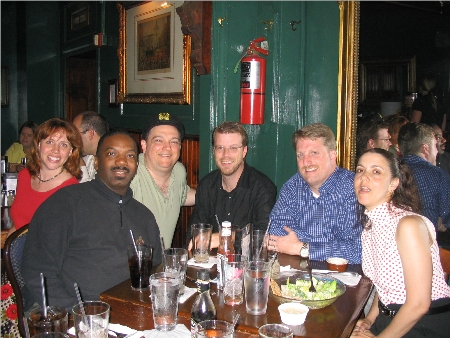
From left to right: Emily from Rantburg, Mike Marshall, some doofus in a captain's hat, Mike Krempansky from Redstate, Daniel Glover, and Debra Weiss from Blogs for Bush.
Many thanks to all those who came last night and/or today to meet me and take in the panel discussion, and especially to Mark Tapscott and my co-panelists for making this happen. If you watched it on the Heritage Foundation's live-stream video, I'd love to get your comments. If you missed it, I'm told it will be posted by tomorrow. I will post the link when it goes live.
More Progress In Afghanistan You're Likely To Have Missed
The Army News Service reports that eighteen top Taliban commanders have turned themselves over to the Karzai government for its amnesty program. The commanders come from the splinter Taliban group Hezb-i Islami, which often found itself at odds with Mullah Omar:
Eighteen of Gulbiddin Hekmatyar’s Hezb-e Islami commanders turned themselves over to government officials in the Paktia Province June 12.Under the terms of the Afghan government’s reconciliation program, Pakhm-e Sohl, the former commanders returned home after years of living in Pakistan. ...
The loyalty statement to the Afghan government includes an agreement not to possess heavy weapons or take up arms against the Afghan government or Coalition forces. The commanders received new reconciliation identification cards and were embraced by Taniwal who welcomed them back to Afghan society.
Talking through an interpreter, Taniwal said today is another important step toward bringing complete peace to the province.
“By working together and talking about our differences, we have found the means to bring some of our fellow Afghans home to Paktia to become important members of the community,” he said. “They will help build our quality of life and peace that we all seek.”
ARNews published this on July 6th, a day before the attacks in London, but it has yet to receive much notice from the Exempt Media. While the newspapers understandably continue to follow the story of the missing American SEALs shot down in the country, it still fails to provide any context for the conflict in that region. The capitulation of Hezb-i Islami helps to uncomplicate the military situation in Afghanistan and undermine fundamentalist support for the Taliban's continued attacks on the elected Aghani government. It shows that the allure of al-Qaeda has faded even for its most fervent allies in the area where AQ made its home.
Why doesn't the media cover this progress?
London's Muslims Feel The Pressure
In contrast to the reaction of American Muslims after 9/11, when organizations like CAIR spent far more time declaring themselves as victims rather than working constructively to fight terrorism, London's Muslims wasted no time yesterday decrying the bloody attacks on Britain's civilian transportation systems:
Muslim leaders in Britain yesterday were swift to condemn a series of deadly bomb blasts in London and they appealed to Britons not to single out their community for reprisals.The leaders also made an unprecedented appeal to the estimated 1.7 million Muslims living in Britain to tip off the police about who had carried out the bombings.
"These evil deeds makes victims of us all," the Muslim Council of Britain said.
"The evil people who planned and carried out these series of explosions in London want to demoralize us as a nation and divide us as a people.
"All of us must unite in helping the police to capture these murderers."
That same appeal was made by the leadership of Europe's largest mosque and cultural center.
"We call on the Muslim community to be fully cooperative in this situation, so we may all live in peace and harmony and continue to make London the vibrant, tolerant and peaceful city it is," concluded a statement from the London Central Mosque, whose golden dome rises above one of London's major landmarks, Regent's Park.
The British Muslims may sing a different tune for a couple of reasons. First, London has always welcomed Muslims due to its extensive colonial experience with them, and their numbers give them a significant role in British politics. Four Member of Parliament are Muslims from London. Also, one of the stations attacked yesterday (Aldgate) serves a primarily Muslim community. The al-Qaeda attack either didn't take that into account or it simply didn't matter to the terrorists, a revelation that some Muslims might take to heart.
However, many Muslims in Britain will now look for an inevitable "backlash" against Muslims. Some in the Washington Times article get quoted as warning people of it already. They want to head that reaction off before it picks up steam and forces Britain to start massive deportation efforts for those Muslims that have not established legal residency in the UK. In the aftermath of the 7/7 attacks, one can be certain that Parliament will entertain that as a security solution, and they want to pre-emptively act against it.
The key here is the call to cooperate with law enforcement by supplying tips pointing to the bombers. That message never clearly came out from Muslim groups in America, which seemed much more concerned about fighting law-enforcement and intelligence agencies and loudly proclaiming every perceived slight to their rights after 9/11. It sounds as if their British cousins have a better grasp on how to act as citizens in the aftermath of terrorist attacks.
Strib Still Not Quite Getting It Again
The Minneapolis Star Tribune demonstrates in its lead editorial today that it still doesn't quite understand the terror war, even after the London bombings yesterday. The editorial board knows enough not to engage in its usual Bush-bashing, so it hasn't succumbed to its usual tone deafness. Yet they still use the occasion to not only argue against the war in Iraq, but also to argue contradictorily that the war on terror mainly amounts to a law-enforcement problem:
[T]here are ways to fight it. Some are better than others. Just days ago, Bush said again that Iraq is the central front in the war on terror. He asserted that the United States fights terrorists there so it won't have to fight them at home. The London bombings illustrate the fallacy at the heart of that argument: Terrorists aren't a finite army that you can defeat on a battlefield and achieve victory. Ivo Daalder, international security expert at the Brookings Institution, said it well: "Today's terrorists are independent operators, beyond the control of any state. They roam relatively freely around an interconnected world -- striking when they are ready and we least expect it." ...As Daalder also said, invading countries isn't the answer and often makes matters worse. What's needed is increased cooperation between nations in law enforcement, intelligence, security, financial tracking and other forms of aggressive counterterrorism. Perhaps it was fortuitous that this attack came as the G-8 leaders are meeting; this could possibly put more urgency into the international counterterrorism agenda.
Fighting terrorism is going to be a long, hard slog, more like fighting crime than anything else. Sometimes it will indeed involve military action. But more often than not, it will involve quiet, determined law enforcement and intelligence work -- to discover the nooks and crannies where terrorists hide as they plot their next outrage -- and then destroy them before they act.
Daalder misses a big part of the entire problem in this glib pronouncement. Sure, terrorists don't wear the insignia of a particular country, at least not since we squashed the Taliban; that's why we don't give them POW status at Gitmo, a point that the Strib also misses on a regular basis. What Daalder misses is that these groups would not present an existential danger to the West if not for the support they get from states such as Iran, Syria, and Saddam's Iraq.
Another fact that Daalder neglects is that while the terrorists don't have their own country, they have physical form that takes up space, and these countries allow them to build camps and conduct training within their borders. The Bush Doctrine speaks directly to that for a reason: it removes the rationalization that such states bear no responsibility for acts of war committed by their "guests". We deliberately tie their behavior to the state involved to provide the incentive for that state to eject its terrorists before they have a chance to do any further harm.
Another problem facing the West and fueling Islamofascist aggression was that the West would not take action to defend itself due to an inability to suffer casualties. This, as Osama said, was the lesson of Somalia. This is one of the reasons that finally resolving the twelve-year quagmire of Iraq had to be one of the first steps in the war. Militarily, the enforcement of the "box" kept significant military assets in Saudi Arabia on essentially the defensive, which as we saw in Lebanon in 1983, only invites attacks by terrorist lunatics. Politically, the issuance of resolution after resolution demanding compliance with the terms of the original cease-fire in 1991 that met with nothing but scorn from Saddam made the UNSC and the West look impotent and vulnerable. And while the intelligence on WMD from every major Western nation may have been outdated or flat-out incorrect, the data linking Saddam to terrorists was correct, and furthermore, the corruption of Oil-For-Food shows that the sanctions regime and its "box" were already rotting and close to full collapse.
Finally, all anyone has to do to understand why Iraq made a good front on the GWOT is to take a look at a map. It sits right in the transit corridor between Iran, Afghanistan, Syria, Lebanon, and on to North Africa, the perfect terrorist conduit. Cutting off that line of communication will make it that much more difficult for personnel and funding to reach those who want to kill us.
Moving away from Daalder's hopelessly simplistic arguments, the Strib still wants to argue for a law-enforcement approach, especially in its last paragraph. However, it then completely misdescribes how that approach works. Law enforcement doesn't "destroy them before they act"; it specifically exists as a reactionary approach that investigates crimes primarily after they've taken place. Gitmo has hundreds of people that the US scooped up, mostly before they had a chance to act on their plans to kill American citizens. Yet the Strib doesn't want them "destroyed", but given civil trials in American courts -- a violation of the Geneva Conventions, by the way.
Finding one's enemy through intelligence and detective work does not mean law enforcement. Military units do that work all the time. In fact, they have a decided advantage over police officers in that they don't have to establish probable cause to act, wait for grand juries to deliver indictments, and deal with lawyers afterwards. They can -- and do -- "destroy them before they can act," in other words, whenever and wherever they find the terrorists. The option that the Strib endorses leads to the American policy in the 1990s, when we failed to grab Osama bin Laden when offered to us by the Sudan because we didn't feel we could indict him.
The Strib still doesn't understand any of this, even after yesterday's bombing. They do appear to have toned down their rhetoric; perhaps greater understanding will come now that they've temporarily suspended the Bush-hatred.
July 7, 2005
Newsweek Does Not Protect Its Sources, Either
With all of the current debate on the responsibility and rights of the American press to protect its anonymous sources, one would think that media organizations would have a clear understanding about what constitutes confidentiality. However, a CQ reader has recently found out first-hand that not all media outlets take care to keep their confidential sources anonymous. Michael Sanders, the director of Expeditions and Research at the Ancient Cultures Research Foundation, sent an e-mail to Jon Meacham at Newsweek giving him a tip on research that supports the idea that the ancient Hebrew temple in Jerusalem was not built on the Temple Mount, but elsewhere in the city:
In the recent issue of the Biblical Archaeological Review and in private correspondence, David Ussishkin, the doyen of Israel archaeologists is quite adamant in his conclusion that the Jerusalem of King Solomon did NOT extend further than the central portion of the City of David.That has profound confirmation of my thesis that the Temple could NEVER have been on the Temple Mount but rather it and later versions were built in the City of David in their more logical position over the Gihon Spring.
We now have the two leading Biblical scholars of the last 50 years, he and David Noel Freedman supporting my thesis which as you know has profound implications for the Peace Process.
My Peace plan is in the briefing papers of Jim Wolfensohn and is being widely discussed in Europe and is receiving more and more attention by players in the region including Hamas as it appears that “The Road Map” is going the same way as “Oslo” and for the same reason.
May I suggest that someone at Newsweek review the Temple thesis on BIbleMysteries.com and I would be please to send you the copy of “The Plan” for your information.
Obviously, this has tremendous political and foreign-policy implications, as the identification of Temple Mount as the location of the Solomonic temple impacts Israeli insistence on maintaining its sovereignty over that part of Jerusalem. Because of the sensitive nature of the issue, Sanders sent the e-mail to Meacham with the subject header stating clearly, "Background Only: Temples of Jerusalem and the Peace Process". He did not want his name used in order to keep out of the political debate, at least until he was ready to address it.
So how does Newsweek handle "background only" tips from informed sources? According to Sanders, Newsweek journalists use the tips to out the sources to their colleagues. Sanders discovered this when Juliet Chung used Sanders' name as a reference to one of the people named in his essay. Sanders got a copy of the e-mail from David Ussishkin from Ms. Chung that let Ussishkin know that Sanders had spoken with Newsweek as a source:
Professor Ussishkin,Hello, my name is Juliet Chung and I'm the reporter with Newsweek who wanted to chat with you. (Kathleen Miller over at the Biblical Archaeological Review passed along your e-mail address.) Wondering: are you familiar with the amateur archaeologist Michael Sanders, by any chance? He's advancing the thesis that the Second Temple was likely not located at Temple Mount, but was perhaps located instead at Gihon Spring. He mentioned that you support this thesis and that, additionally, there's a growing body of credible scholarship in support of this argument. I wanted to check in with you to see if you do indeed believe this may have been the case? And to see whether there is a growing sentiment that this is so within the scholarly community?
I look forward to hearing from you. Thank you so much for your time.
Best,
Juliet Chung
It isn't clear whether Ms. Chung ever saw the original e-mail with the subject header clearly noting that this was off the record. Also unclear is how many hands this passed through at Newsweek between Jon Meacham and Juliet Chung. The reason why this is unclear is that Newsweek has not responded to repeated complaints from Professor Sanders about his outing. I contacted Newsweek myself, e-mailing both Jon Meacham and Juliet Chung about the issue. I spoke briefly with Ms. Chung this morning, who promised to look into this and have some response back to me. I received the following e-mail this afternoon from Newsweek's media relations manager:
Mr. Sanders is not a Newsweek source. He sent an unsolicited email to the magazine about theories he holds which are publicly detailed on his own website. Because we had no relationship with him, his use of the word "Background" in the subject line of his email was not read in the way it would have been had Mr. Sanders been a source. A Newsweek staffer did use his name in following up on his theories, which are publicly available at www.biblemysteries.com.
This response seems wholly inadequate to me. Perhaps other journalists should weigh in on this, but it seems to me that a reporter should understand what the phrase "Background Only" means. Most bloggers certainly do. Juliet Chung's e-mail to Professor Ussishkin says that Sanders mentioned him, clearly revealing that Newsweek did not use the website information but Sanders' e-mail as its impetus. That makes him a source, regardless of what Newsweek says now, and they owed him some discretion until they asked for and received permission from him to use his name to contact his colleagues. Even unsolicited tipsters requesting anonymity should receive that basic discretion. I think Newsweek owes Sanders an apology.
Given the hue and cry they have generated over the treatment of Judith Miller and Matt Cooper, perhaps they should start building their case by giving consistent treatment to sources wishing to remain anonymous. At any rate, those wishing to go on background with Newsweek should be aware that their anonymity may not remain guaranteed, even outside of court orders. In other words, unless you want to get famous or notorious really quickly, don't send unsolicited tips to Newsweek reporters.
Gomery Financial Analysis: Corruption Includes The RCMP And Privy Office
The Fraser Institute has performed a financial analysis of the financial analysis of the Sponsorship Program, which shows that the corruption and graft runs far deeper than previously thought. The amounts of money and the scale of its laundering dwarf earlier estimates:
The numbers of people and amounts of money involved in the Gomery inquiry are larger than previously known. Problems with federal government sponsorship and advertising programs can be understood using an economic theory of incentives and institutional structure.This study finds that at least 565 organizations and individuals are identified in reports and testimony related to the Gomery inquiry. The original 2003 Auditor General sponsorship and advertising report cited only 71 organizations. The activities under investigation are therefore quite widespread.
The people identified in these reports and testimony are politicians and bureaucrats (government insiders), and political party members and business people(government outsiders). This paper finds that almost all of them have an exclusive financial link to the Liberal Party of Canada (hereafter referred to as the Liberal party). They donated at least 40 times more to the Liberal party than to all of the other main political parties combined from 1993 to 2003.
This paper finds that these individuals privately donated at least $3.9 million to the Liberal party and received at least $7.4 million in private payments from the Liberal party from 1993 to 2003. The Gomery inquiry forensic report found only $2.5 million in Liberal party donations.
Fraser found that those participating in Adscam by paying the entry fee of a Liberal Party donation wound up getting a hell of good ROI for their effort. The "economic rent" of those donations -- unearned financial benefits -- amounted to a whopping 50 times their initial donation, on average. Furthermore, Fraser found that Liberal government insiders took advanatge of their access to the $120 million in public funding. Liberal cronies did much better than that, however. They had access to $1.2 billion in contracts, almost all of that given to those with Liberal connections, which generated $190 million in "private benefits".
But that will not be the biggest blockbuster of the report. In its full report (PDF file here), FI flatly states that the Liberal Party co-opted the RCMP and the Privy Office by demanding money for access to the Prime Minister:
First, the Royal Canadian Mounted Police (RCMP) and the Privy Council Office (PCO) were charged $112,000 and $44,000, respectively, for seats accompanying the prime minister during the 2000 election campaign. These revenues were not recorded for the 1997 campaign, a notable omission.It is an apparent conflict of interest for government agencies, especially those engaged in law enforcement, to pay a governing political party for services rendered during an election. This financial entanglement can impair perceptions of independence and due process that are essential to the proper functioning of those agencies.
At the time when the Liberal Party used the Sponsorship Program to launder money back into its own campaigns, they charged the RCMP and the Privy Council Office for their services, putting them in an extraordinary position. The RCMP should have remained independent of the Liberals as the only check on their power and potential for corruption. Just when Canada needed a strong law-enforcement agency to detect the theft that took place, the RCMP had entered into a financial relationship with the Liberals instead. Neither organization paid any money to any other Canadian political party.
I wonder why that was. A lot of Canadians might wonder at that as well.
Dafydd: The Battle of London
One reason I have such faith in the British is that I remember my history.
Great Britain did not simply endure the Battle of Britain, the attempt by Nazi Germany to subjugate the British people. They fought back. The RAF was in the air every damned day and hellish night, fighting, killing, and defying the enemy.
In 1940, while America still slumbered in splendid isolationism and Stalin was still allied with Hitler, Great Britain became the very first country to refuse to join the Nazis, to refuse to surrender to the Nazis, and actually to defeat the Nazis and drive them off.
Adolf Hitler was dumbfounded. After Dunkirk, he made the same mistake the terrorists make today: he thought Great Britain was defeated and would quickly offer her surrender. But instead, the British dug in and fought back, despite staggering losses -- more than 20,000 dead and 30,000 wounded -- and the Brits shot down literally hundreds of Luftwaffe bombers and escort fighters. In the end, "Operation Sealion" was a catastrophic defeat for Hitler, the first time the Nazis had ever been thrown back. The first but not the last; Britain led the way.
History tells me that the British will continue to lead the way, right alongside us, just has they have since 9/11. I have faith today's generation will live up to yesterday's, just as they have here in America.
Dafydd: Calling London
When a people are attacked, brutally and without warning, there are two possible responses: they can get up, scamper for safety, and there cower; or they can get up, stand on their own two feet, and hit back with everything they have.
When a people are attacked in their own homes, they can't run anywhere else, so the only alternative is crawling and begging for mercy, doing what they're told, and hoping to be spared. Or they can fight.
We will find out in a few days which path the Britons will take: that of Spain under Zapatero -- or that of Great Briton under Winston Churchill. The terrorists bet on the first, just as they bet in 2001 that we were the America of Vietnam, Beirut, and Somalia.
But I'm betting on the second. Once again, the butchers have misunderestimated their expected victims. Of all people in the world, the British are most like us, deep down. Yes, they have been hampered by such close propinquity with Europe and Europeanism. But when it comes down to it, the British are not Europeans.
They are Brits.
I am positive that George Bush will offer anything they need -- but I'm equally sure that Tony Blair will say no, they're perfectly capable of taking care of these swine themselves... and they will. This will serve to galvanize the British public like nothing has since, as the Captain said, the blitz.
First will come the grief, then the inchoate rage, then the smouldering fury that leads to a renewed interest, almost obsession, with stamping out this craven, new threat once and for all. We know. We've been there.
The militant Islamists miscalculated in America, they miscalculated in Australia, and now they have miscalculated in Great Britain. We, Brit and American, will finish the job. There is a reason that English-speaking people have dominated the world for centuries: there is something noble in our culture that will not allow us to give up or give in, an idealistic fever to "let justice be done, though Heaven should fall."
Toby Keith wrote, "this big dog will bite if you rattle its cage." It's a clear statement, but I actually prefer a pithier version, an older version, one we flew on our Navy ships in 1775 and have recently begun to fly again: the original Navy Jack of the fledgling United States, with its thirteen stripes alternating red and white, a superimposed rattlesnake with thirteen rattles, and the perfect motto for the civilized world in this age of the death-cult of militant Islamism: Don't Tread On Me. The same symbol was painted onto the drums of the first American Marines, superimposed on a yellow background instead of the stripes and later made into the Gadsden flag.
The rattler was once a symbol of defiance against the British themselves, when they were a tyranny. But they have long since thrown off their own chains and now stand as one of the great bulwarks of liberty throughout the world, just as we do. They have been our closest allies since the Treaty of Ghent ended the War of 1812, probably the oldest alliance in the world today. Here is an anonymous description, possibly by Benjamin Franklin, of the meaning of the rattlesnake:
She never begins an attack, nor, when once engaged, ever surrenders: She is therefore an emblem of magnanimity and true courage. ... she never wounds 'till she has generously given notice, even to her enemy, and cautioned him against the danger of treading on her.
And of course, if you ignore the warning and do tread on her, she is deadly.
Rule, Britannia; we've got your back.
AQ Executes Egyptian Hostage
As if the bombings in London didn't demonstrate their brutality clearly enough, al-Qaeda terrorists in Iraq have executed their Egyptian hostage. They released a video of the diplomat identifying himself for the camera before apparently killing him immediately afterwards:
Al-Qaida in Iraq said in a Web statement Thursday that it has killed Egypt's top envoy in Iraq, posting a video of the blindfolded diplomat identifying himself."We announce in the al-Qaida in Iraq that the verdict of God against the ambassador of the infidels, the ambassador of Egypt, has been carried out. Thank God," a written statement in the Web posting said.
The video does not show the envoy, Ihab al-Sherif, being killed.
Al-Qaida in Iraq, headed by Jordanian militant Abu Musab al-Zarqawi, said a day earlier that it had sentenced al-Sherif to death as an "apostate" for his country's support of the United States and the Iraqi government. The group has previously beheaded several foreign hostages, including three Americans.
For those who want to blame America and Britain for AQ terrorism, even on a day like today, answer this question: what did Egypt do to deserve this? All they did was to send a diplomat for normal relations with a freely-elected democratic government representing the will of the Iraqi people. For that, AQ had no compunction about kidnapping and murdering a fellow Arab and Muslim.
AQ does not exist because of Bush or Blair. AQ has attacked Western interests since at least 1993 because of who we are and what we represent. They have no ideology except that of hatred for freedom and the imposition of Taliban-like tyranny across Southwest Asia and eventually the world. Everywhere they have ruled, such as Afghanistan, Fallujah, Ramadi, Qaim, and other areas, they have brutally suppressed freedom of expression and civil rights.
Ignoring them does not work. Sympathizing with them encourages their bloody attacks. Disarming ourselves in the face of their attacks only confirms our weakness and stokes their apocalyptic dreams. Just as with other lunatic vanguards of fascism, the only option that will put an end to their deadly efforts is to crush them and to spread freedom and democracy to completely discredit their despotic philosophies.
Saddam's Lawyers Quits, Supports Terrorists
The AP reports this morning, between updates on the London terrorist attack by al-Qaeda, that Saddam Hussein's Iraqi lawyer has quit his defense team. Ziad al-Khasawneh complained that the American contingent of Saddam's legal team tried to tone down Khasawneh's support of the insurgency that has killed so many Iraqis, what the AP calls a "resistance":
Ziad al-Khasawneh told The Associated Press he tendered his resignation in a telephone call Tuesday to Saddam's wife, Sajida, who is believed to be in Yemen."I told her I was resigning because some American lawyers in the defense team want to take control of it and isolate their Arab counterparts," said al-Khasawneh, an Arab nationalist who has often expressed support for Iraqi resistance. Among the Americans on the team are former U.S. attorney general Ramsey Clark.
Al-Khasawneh said Clark and Curtis Doebbler, another American lawyer helping defend Saddam, were "upset with my statements and have often asked me to refrain from criticizing the American occupation of Iraq and the U.S.-backed Iraqi government."
Al-Khasawneh said Saddam's eldest daughter, Raghad, allegedly removed all files related to Saddam's defense from his office. "I was away in Libya when she did all that without my knowledge," he said.
Raghad favors the Americans and non-Arabs on the team "because she thinks they will win the case and free her father," he said.
It sounds to me like the other members of Saddam's defense team have a much better sense for the prevailing mood of the Iraqis that will try Saddam for his decades of genocidal crimes. Associating Saddam with the insurgents that continue to victimize the same population that Saddam ruled with an iron fist until March 2003 would appear to almost anyone as a loser for a trial strategy. One would presume that his lawyers will attempt to shove the responsibility for the undeniable atrocities of his regime onto lower-level functionaries and claim that Saddam knew nothing of his underlings' murders and tortures.
Instead, Khasawneh chose to celebrate the terrorists operating within Iraq as a "resistance" to a freely-elected government. Perhaps that will generate sympathy among the tiny minority of Iraqis that benefitted from Saddam's rule, but it doesn't take a legal genius to figure out that they will have little or no role in judging Saddam for his crimes. Khasawneh appears to have used the Saddam case to legitimize the terrorists, and Hussein's family have finally tired of his antics.
Coming as it does on this black day in London, the resignation of Khasawneh exposes him as the dangerous joke that he is.
We Are All Britons Today
On July 7, 2005, let it be known that the world united behind our British brothers and sisters as fellow members of Western Civilization under attack by the forces of tyranny and oppression. We stand with our friends who have suffered a terrible act of war on their civilian population, a cowardly and shameful act that amply demonstrates the depths of depravity of the enemies of freedom and liberty.
We are all Britons today.
When we say that, we don't mean it to imply that this is conditional on Britain engaging in self-flagellation to maintain our sympathy. We don't mean that we expect our friends to simply remain victims to retain our friendship and support. We don't mean that the people who have been attacked should withdraw into a corner in order to somehow earn our tears.
We mean that we support our friends -- and that support means that we plan on standing shoulder to shoulder with them when they decide to take the necessary action to ensure that our enemies can never do something like this again. In other words, we are all Britons in the sense that Britons stood with America after 9/11.

Thanks to Jeff at Shape of Days for this idea.
UPDATE: CQ reader Michael R. sends the lyrics to "Rule Britannia", which seem especially relevant today:
When Britain first at Heaven's command,
Arose from out the azure main,
This was the charter, the charter of the land,
And guardian Angels sung this strain,
Chorus
Rule, Britannia, Britannia rule the waves,
Britons never will be slaves!
The Nations (not so blest as thee)
Must in their turns to Tyrants fall,
While thou shalt flourish great and free,
The dread and envy of them all.
Chorus
Still more majestick shalt thou rise,
More dreadful from each foreign stroke;
As the loud blast that tears the skies,
Serves but to root thy native oak.
Chorus
Thee, haughty Tyrants ne'er shall tame:
All their attempts to bend thee down,
Will but arouze thy gen'rous flame,
But work their woe, and thy renown.
Chorus
To thee belongs the rural reign,
Thy cities shall with commerce shine;
All thine shall be the subject Main,
And ev'ry shore it circles thine.
Chorus
The Muses still with Freedom found,
Shall to thy happy coasts repair; Blest Isle!
With matchless beauty crown'd,
And manly hearts to guide the Fair.
Chorus
Al Qaeda Bombs London
London suffered a series of coordinated bombing attacks this morning on the cusp of the G-8 conference in Gleneagles, Scotland, targeting its transportation systems just as in Madrid last year. Al Qaeda has claimed responsibility for these attacks, which has caused an unknown number of deaths and injuries:
Two people have been killed and scores have been injured after three blasts on the Underground network and another on a double-decker bus in London.UK Prime Minister Tony Blair said it was "reasonably clear" there had been a series of terrorist attacks.
He said it was "particularly barbaric" that it was timed to coincide with the G8 summit. He is returning to London.
An Islamist website has posted a statement - purportedly from al-Qaeda - claiming it was behind the attacks.
London's police chief Sir Ian Blair said there had been "many casualties" but it was too early to put a figure to those killed or injured.
Expect the number of dead to rise significantly. Terrorists chose these targets, just as in Madrid, for the height of traffic in order to cause as many civilian deaths as possible. The transportation jam that this will cause London also will hamper relief efforts, creating nightmare jams on the streets as people rush to get out of the way and emergency workers rush to the afflicted areas. No one yet knows if it's over, either -- more attacks may be on their way.
If AQ thinks that they can frighten Blair and the British out of the war on terror by bombing London, I believe they are quite mistaken. Another lunatic used terror on Londoners on a much more massive scale for years at a stretch, thinking that the same kind of attacks would panic the British into surrendering, or at least into withdrawing from the conflict. The Blitz did neither. It hardened British resolve to stamp out the cancerous philosophy of fascism and to destroy the governments that used it to oppress their own people, commit genocide on ghastly scales, and attack peaceful civilian populations to further their political goals.
Hitler didn't succeed at his campaign of intimidation. Osama bin Laden won't either. Put simply, the British are not Spaniards. They will arise in fury and a renewed sense of mission to stamp out the bloodthirsty terrorists who have committed this heinous act -- and we will stand with them to do so, just as they have stood with us these long years since 9/11.
Keep an eye on Instapundit and Michelle Malkin for updates during the day, and keep praying for the British victims of Islamofascist insanity.
UPDATE: The statement from world leaders at the G-8 conference, read by Tony Blair, sums it up:
"We will not allow violence to change our societies or our values nor will we allow it to stop the work of this summit," Blair said in a statement on behalf of the Group of Eight leaders and the heads of other nations meeting here. "We will continue our deliberations in the interest of a better world."Earlier, Blair termed the blasts terrorist attacks and said it was reasonably clear they were "designed and aimed to coincide" with the meeting.
"We are united in our resolve to confront and defeat this terrorism that is not an attack on one nation but on all nations and on civilized people everywhere," the world leaders said. ...
"Today's bombings will not weaken in any way our resolve to uphold the most deeply held principles of our societies and to defeat those who would impose their fanaticism and extremism on all of us," the world leaders said in the statement read by Blair. "We shall prevail, and they shall not."
Damned right. This is a renewed call for clarity and resolve in this conflict, and those who have spent the last four years carping from the sidelines had better get a clue now.
The Secret Life Of Gray Lady Editors
Sometimes watching the Corrections section of the newspaper can give readers the best instruction on the inner workings of the media. Normally, of course, one would expect that the kinds of corrections run by management fall into the category of poor fact-checking, which in this age of Internet and Nexis searches is inexcusable. The New York Times offers one today, however, that should raise eyebrows for everyone who reads it (emphasis mine):
The Op-Ed page in some copies yesterday carried an incorrect version of an article about military recruitment. The writer, an Army reserve officer, did not say, "Imagine my surprise the other day when I received orders to report to Fort Campbell, Ky., next Sunday," nor did he characterize his recent call-up to active duty as the precursor to a "surprise tour of Iraq." That language was added by an editor and was to have been removed before the article was published. Because of a production error, it was not. The Times regrets the error.
The Times acknowledges here that their editors make a habit of rewriting op-ed contributions, not just for clarity, but apparently to significantly change the meaning of the article. Take a look at the phrases that an editor added onto someone else's work, without having the benefit of experiencing the event himself. Both phrases indicate events that "surprise" the author, an assumption of a state of mind. Both of them, not coincidentally, make the military look bad. What a coincidence that the Paper of Record makes two "mistakes" that just happen to put the Army in a bad light.
Go figure.
This also explains why the media always makes a point in their journalism vs. blogger debating to point out its layers of editors as a quality control check. Apparently, they need one level for making stuff up, and another level to stop the first level from getting caught at it, at least at the New York Times. And this is on the Op-Ed page, where the only function of an editor should be to correct spelling and grammar and to cut out text for article length, not to make things up to pad it out.
Just imagine what all those editors do to their news articles!
Dafydd: Future Shock & Awe
Extree, extree, getcha red-hot future combat today!
As has been the case for, oh, a few thousand years, the violent tendencies of human beings are leading the way to tomorrow's technology. War is not only good for business, it's good for science. Here are just a few of the goodies that await us in future battlefields.
Warning! This is a very long post, nearly all of which is tucked into the extended-entry section. Forwarned is forlorned!
Future Shock & Awe, continued.
Exoskeletons for Human Performance Augmentation
The weak link in the combat chain is often the human body. We run slower than horses; we carry less cargo than a camel; our skin is more fragile than a rhinoceros; we can't even jump like a gazelle.
But all that is going to change, if DARPA has any say in it. Joe Pappalardo of National Defense Magazine writes that the Defence Advanced Research Projects Agency, or DARPA, has been hard at work for several years now on the Exoskeletons for Human Performance Augmentation (EHPA) program. The idea is to create a tough and powerful exoskeleton that would surround the soldier's body and augment his own native abilities.
At the moment, political correctness rules. Ever since the public-relations fiasco of the Terrorism Information Awareness futures market, DARPA has been almost paranoid about bad publicity... which can lead to investigations, budget cuts, and in a pinch, mass firings. So all they will admit at this point is the utility of exoskeletons for loading and unloading cargo:
“This is a fairly boring transportation program,” [DARPA project manager John] Main said, with a small grin. “We’re not jumping over buildings. We’re getting into rough terrain that is denied to Humvees.”
But the combat implications are obvious: a man who can carry 200 lbs of fuel or MREs can also carry 200 lbs of body armor or a 200 lb weapon (or a mix: a hundred devoted to armor, and the other hundred to weaponry). Although they're not really willing to speculate, it's hard to see, once you have the basic idea of exoskeletal augmentation, how you can fail to think of putting jets in the boots, heavy weapons that can be fired by merely pointing the hand, or all the other accoutrements of Robert Heinlein's 1959 novel Starship Troopers.
Stepping way, way out on a limb, the head of the UC Berkeley robotics engineering lab, which is working on a DARPA grant, Homi Kazerooni, reluctantly admitted the possibility:
Kazerooni conceded that robotic enhancements worthy of combat were feasible, given a system design that could keep up with soldiers’ reflexes. “Can the machine shadow our reflexes? These are not voluntary, and sometimes 200 microseconds is not fast enough.”
The first key is acceleration: no matter how well a soldier is armored, a fall from 100 feet is a fall from 100 feet, with the same sudden stop at the end. But if DARPA can control the acceleration -- for example, by using boot-mounted, gyro-controlled attitude jets -- the soldier can "leap" high into the air, then "land" safely.
The second key is psychological: will the American people accept Starship Troopers style "Mobile Infantry?" Or will the princes of the Senate strangle the technology in its cradle? As the song says, only time will tell.
Brain Machine Interface
But perhaps we don't need anybody in those suits at all -- if the human can stay safe several miles away, controlling the empty suit by a direct brain-machine interface.
Thoughts are not ghostly apparitions made out of ectoplasm, it turns out; they are electrocolloidal impulses that travel from neuron to neuron across the synaptic gap. And that slight spark is readable... if you have the code.
That, not coincidentally, is exactly what another DARPA project aims to do: crack that neural code, so that machines -- or weapons -- can be controlled by thought alone.
Some research projects funded by DARPA have already achieved significant success, according to a 2003 article in the National Journal, written by Bruce Falconer. Duke University neurobiologist Miguel Nicolelis headed a team that planted "100 hair-like sensors" in a South American owl monkey (coincidentally, the same owl monkey that has been directing the recent reactionary political reaponses by the Democratic Party). As the monkey used a joystick, the scientists could monitor its neural activity and program the impulses into a computer-readable code.
The monkey repeated the motion - only this time, two robotic arms (one in an adjacent room and another 600 miles away in a Boston laboratory) also moved in response to the wireless signals sent straight from the monkey's brain.In a similar, more recent experiment, the same scientists taught a macaque to direct a cursor to illuminated targets on a computer monitor. When scientists disabled the joystick, the monkey gradually stopped moving its arm altogether and learned to do the experiment just by thinking.
The article in the National Journal notes some of the uses. Right now, the biggest limitation on military aviation is the inability of the human body to take stresses much greater than about nine Gs, nine times the force of gravity. A typical 185-lb pilot in a 9-G turn feels as if he tops the scales at a cool 1,665 lbs. At that force, it's so difficult even to raise his hand that modern jets use fly-by-wire systems that require only slight finger movements for the pilot to guide the craft. Grayouts and blackouts are commonplace -- and can lead to death.
But if a pilot could sit on the ground and control the plane by his thoughts, then the rest of the airplane could withstand far greater stresses; this means an aircraft that could outmaneuver any plane in the sky that carried human cargo, such as a pilot and flight officer.
The same is true with a tank. Rather than relying upon a true "ogre" tank, which is completely artificially intelligent (a daunting computational task, considering that we cannot even design an AI car), a gigantic, solid tank can be controlled by a full crew... who sit safely back behind the lines in a simulator, their thoughts controlling the tank via a satellite uplink. With the absence of the most vulnerable part of the weapon, the human crew, the tank itself would be virtually unstoppable, short of dropping a tactical nuclear weapon on top of it.
There are civilian uses too, of course, notably in the area of prostheses for amputees and paraplegics. But the subject of civilian spinoffs from military research is big enough to warrant its own post. Or article. Or multi-floor library.
Smart Bullets
We have smart missiles that find their targets by several methods. Some are literally connected to a wire that trails out behind them, allowing the missileer to guide the bomb to its target. Others home in on a laser dot "painted" on the target by a forward spotter. Cruise missiles actually have topographic maps programmed into their brains, so they can swoop and swerve through gullies and across mountains to find a target by its GPS coordinates.
So why can't we do the same with rifle and pistol ammunition? Imagine bullets that can literally chase the target, racing around corners and over obstacles to hit the poor terrorist in his own trench, as in the 1984 Tom Selleck movie Runaway.
Well, it turns out that United States Air Force (and likely other branches of the service -- and I wouldn't rule out DARPA) has not only been imagining such a thing, it has been actively trying to develop them for more than eight years, according to the 1997 article "You Can Run, But You Can't Hide...", by Justin Mullins, published in New Scientist (reproduced here by snipercountry.com).
The Air Force calls the program Barrel Launched Adaptive Munitions, or BLAM, in an unusual display of wit. The researchers agree that the guidance technology is the easy part; it's already available for missile systems and only needs to be made smaller. The difficult part is designing a bullet that can turn in mid air and can become aerodynamic to prevent falling towards the ground as it moves towards the target, in accordance with our ancient enemy, gravity.
Some programs have experimented with tiny attitude jets on the bullet to steer it. But BLAM uses a more exotic, science-fictiony method: the front of the bullet actually flexes to create lift in various directions. Lift on the bottom keeps the bullet flying at the same altitude it was fired, without dropping; lift on the right steers the bullet left, and so forth.
The mechanism is simple. The nose is connected to the body by a ball-and-socket joint, and held in place by a number of piezoceramic rods, or tendons, which change length when a voltage is applied to them. Increasing the length of a rod on one side of the bullet while shortening its opposite number changes the angle of the nose (see Diagram). The nose can move by up to 0.1° in any direction.
Snipers are the ideal persons to use smart bullets; slithering into enemy territory on their bellies, becoming invisible via ghillie suits, then drawing a bead on the target enemy personnel are pretty much the same skills needed to paint a target with a laser dot (which can be invisible to the naked eye, preventing premature target panic). The invisible dot would guide a smart bullet for a targetted assassination from an astonishing distance -- several kilometers, for example. Unless every bad guy spends all day, every day, in a room with no windows (or wears American power armor), he will be vulnerable to just such a "bolt from the blue."
In another arena, the New Scientist article notes that airplanes fitted with smart bullets can bring down bogies with just one or two well-directed shots, rather than the hundreds typically used to destroy a target. This can lead to cost savings, even though smart bullets would not be cheap:
Aircraft bullets cost more than $30 each. [Ron] Barrett [who tested the BLAM system] says the piezoceramic materials would add $10 to this while the microelectronics would cost another $100. But he argues that the increased strike rate would lead to cost savings. "You'd only fire one when otherwise you'd fire hundreds."
Smart bullets would also lead to less collateral damage, because there would be less lead (or depleted Uranium) flying around.
But I'm still holding out for small, man-portable and firable rail guns!
Heat Rays
Finally, bringing us up to today's technology, we have a "phaser" -- American style, not that touchy-feelie stuff you see on Star Trek, where the target just falls over unconscious. This version is actually more of a heat ray, manufacturing fake feelings of searing agony, like "touching a hot frying pan or the intense radiant heat from a fire," except it does no actual damage. The pain is all in the target's neurons.
In "US aims Star Trek ray guns at nuclear sites" on Vnunet.com, Robert Jaques writes that the Department of Energy has teamed with the Department of Defense to create a milimeter-wave directed-energy weapon system with the catchy title of Active Denial Technology (ADT). The first use will be to protect critical sites, such as nuclear power plants, from terrorist (or protester) intrusion.
ADT emits a 95GHz non-ionizing electromagnetic beam of energy that penetrates approximately 1/64 of an inch into human skin tissue, where nerve receptors are concentrated.Within seconds, the beam will heat the exposed skin tissue to a level where intolerable pain is experienced and natural defence mechanisms take over....
The sensation caused by the system has been described by test subjects as feeling like touching a hot frying pan or the intense radiant heat from a fire. Burn injury is prevented by limiting the beam's intensity and duration.
Sandia labs have already tested a prototype, and they believe a smaller model will be ready to deploy by 2008. Perhaps it can be used in the White House briefing room whenever an MSM feeding frenzy erupts during the next presidential campaign.
So there you have it -- the three of you who managed to make it all the way to the end of this excruciating post: four windows into the brave new world of continued American military dominance over the rest of the world. And if you think that is a bad thing, well I suspect you're reading the wrong blog!
July 6, 2005
DC Blogger Get-Together Tonight!
To celebrate my DC adventures, we have decided to get together tonight (Thursday) at the Phoenix Park Hotel in the heart of Washington DC. Mike from PajamaHadin has graciously volunteered to do the honors as the point person for this celebration. We're going to try to find a place for dinner and/or drinks and meet at the lobby of the Phoenix Park Hotel at 7 PM.
I apologize for the lack of notice on this event. I have been busy almost every waking moment during my trip here, and quite simply have not been able to make sense of my schedule until very recently. I just got back from Gettysburg this evening and had a late dinner, after which I've had to catch up on posting and e-mail. Thank goodness Mike has a central point at which we can congregate; I don't think Gaithersburg would have great appeal to most of the folks who want to get together.
Please RSVP in my comments or by dropping Mike an e-mail. We look forward to getting together with as many bloggers and readers as we can!
ACLU Still Wants To Define Warfare As Criminal Investigations
The capture of five American citizens in Iraq who allegedly have plotted attacks against the Iraqi government and American troops has caught the attention of the ACLU. The civil-rights group now insists that those Americans captured in a theater of war must have due process through civilian courts and have filed habeas briefs for their release:
The U.S. military in Iraq has detained five Americans for suspected insurgent activity, Pentagon officials said Wednesday. The five have not been charged or had access to a lawyer, and face an uncertain legal future.Pentagon spokesman Bryan Whitman declined to identify any of them, citing the military's policy of not providing the names of detainees. They are in custody at one of the three U.S.-run prisons in Iraq.
One was identified by his family and U.S. law enforcement officials as Cyrus Kar, an Iranian-American filmmaker and U.S. Navy veteran.
Saying Kar is being held unjustly, the American Civil Liberties Union sued the government on Wednesday in an effort to secure his release. ... "He just had the misfortune to get into the wrong cab," said Steven R. Shapiro, the ACLU's legal director. "Our position is that if the government has any evidence against him, bring him home and charge in a court and then proceed accordingly."
The ACLU has two problems in this approach to the detention of Kar. First, the alleged crime occurred in Iraq, not the US, so the law that applies here is Iraqi law, not American law. Second, if the American military has detained Kar, it is because they suspect him of acting on behalf of the insurgency, which has attacked American military personnel in war zones throughout the area. That isn't a civil crime -- it's an act of war. For that matter, if Kar conducted his actions in support of these attacks without wearing a uniform representing a legitimate state, impossible since the terrorists don't have that kind of open endorsement, then Kar could be held as either a spy or a saboteur, neither of which gives him access to American courts.
One would think that lawyers at the ACLU would have studied law and understand the concept of jurisdiction. American courts have given civilian courts jurisdiction over those who have been captured outside of battle zones, and only under limited circumstances. Even in those cases, the decisions were incorrect and probably will eventually be reversed, but clearly does not apply here. Iraq has a functioning government and judicial system which can handle its own civil criminal cases. The only way Kar can claim to get American jurisdiction is if the Americans insist on trying him for treason, a death-penalty charge.
This continues the ACLU's effort to push the Bush administration back to the failed criminal-justice approach to terrorism, the same indictment-based counterterrorism strategy that led the Clinton admnistration to balk at a deal to capture Osama bin Laden in the mid-90s. Using the courts to deal with global terrorism means that American troops mst read all captured prisoners their rights and provide them lawyers. Can you imagine doing that in a war zone? It also means that the arresting servicemen would then have to be available to testify in the thousands of cases that would clog our court calendars instead of acting in defense of our country.
The ACLU knows exactly what it is doing. It has long since crossed from a responsible voice on civil rights to a partisan advocate of extremist left-wing politics, and the war on terror is just another example of this antipathy to America and its security.
Democrats: We Get To Define 'Consultation'
The Democrats ratcheted up the tension over the new opening on the Supreme Court, declaring today that the gestures from the Bush administration today to key Senate Democrats do not amount to their definition of consultation. Ted Kennedy and Dick Durbin want a list of potential candidates from the White House that will allow the minority party to declare which are acceptable instead:
Democratic Whip Dick Durbin of Illinois got a call Wednesday from White House chief of staff Andrew Card, who is with Bush in Europe for the Group of Eight summit.Card also has called Democratic Sens. Ben Nelson of Nebraska, Charles Schumer of New York and Edward Kennedy of Massachusetts, but no names of possible nominees were mentioned, according to the lawmakers' aides.
The Democrats said they want to know more — specifically, whom the president is considering — before Bush sends his first Supreme Court nomination to the Republican-controlled Senate for confirmation.
"To be meaningful, consultation should include who the president is really considering so we can give responsive and useful advice," Kennedy said.
Durbin said he "stressed the importance of finding a nominee in the political mainstream." In a statement, the senator said he welcomed the White House effort "to reach out in a bipartisan manner and actively consult" with lawmakers from both parties.
I recall a scene from a minor Alan Alda movie from twenty years ago, Sweet Liberty, in which Alda played a writer of American history whose book got bought by a movie studio. The studio planned major changes in the book (a non-fiction look at one Revolutionary War battle in Alda's town) in order to make it sexier and more hip to the younger generation. In fact, the director wanted to make it a comedy in which the Americans acted like Keystone Kops instead of actually winning the battle as they did in the book. When Alda protested that he had a right of consultation in his contract, the director stopped everything and asked him, "You don't think this works?"
"Absolutely not," Alda says. "It's wrong, and I won't stand for it."
"All right," the director says, nodding his head. "You've had your consultation." And the director went on to do exactly what he wanted.
Bush should learn from this exchange. The Democrats insisted on consultation, a term chosen for its reasonableness. Consultation, however, does not imply the power of approval; it only means that a discussion will take place. It doesn't even mean that the consultation will include names of nominees from the President, not even in the sense given in the Gang of 14's MOU. It only means that the Gang recommended that the President discuss his intentions with the opposition party before submitting a nomination, which could have the equally reasonable interpretation of allowing the Democrats to offer names of judges they thought might work for the President.
In fact, in light of the rules clearly outlined in the Constitution, the confirmation process begins with a nomination, after which the Senate provides advice and consent. That shows that the founders intended that the Executive should make the nominations based on his own conscience, not that of the party which the voters put out of the majority. Demanding prior approval on Bush's short list puts an unconstitutional threshold for confirmations that amounts to Senatorial extortion, and an abuse of power that if reversed would have every newspaper in America screaming about how the Bush White House wanted to impose autocracy on the US.
If this AP report is correct, then Bush has given the Democrats the consultation they requested. Just like the director in Sweet Liberty, Bush should show them that he understands the English language better than they do and, having met their literal request, he is now free to follow his own conscience. Next time, the Democrats may get a little less cute and covert about their requirements -- and in the process start behaving more openly and honestly.
Schumer: Go To The Mattresses No Matter Who It Is
Matt Drudge reports today that Senator Chuck Schumer has no intention on preserving the comity of the upper chamber when George Bush nominates a replacement for Sandra Day O'Connor. Instead, he has joined his colleagues in the obstructionist camp to paint whomever Bush selects as a radical, regardless of their identity:
Senate Judiciary Committee member Chuck Schumer got busy plotting away on the cellphone aboard a Washington, DC-New York Amtrak -- plotting Democrat strategy for the upcoming Supreme Court battle.Schumer promised a fight over whoever the President’s nominee was: “It's not about an individual judge… It's about how it affects the overall makeup of the court.”
The chairman of the Democratic Senatorial Campaign Committee was overheard on a long cellphone conversation with an unknown political ally, and the DRUDGE REPORT was there!
Schumer proudly declared: “We are contemplating how we are going to go to war over this.”
For those who spent the last few weeks thinking that the Gang of 14 had cleared the way for Supreme Court nominations, think again. As I predicted, no one in Harry Reid's caucus will let Bush simply select a nominee before ratcheting up the rhetoric. What's more, none of them ever intended to let the system work they way it should. They have always wanted to ensure that they can exert as much control as possible over any SCOTUS openings, regardless of whether they have to pervert the Constitution to do it.
Why? Put simply, their agenda will not sell to the American electorate. To use one example -- one to which, oddly, I don't have any particular opposition -- let's take gender-neutral marriage. The public overwhelmingly opposes the legalization of GNM, as eleven separate referendums in 2004 amply demonstrated. Instead of allowing the people to speak on this issue, however, the Left has taken the fight to the courts, trying to find activist judges who will impose GNM on a populace that rejects it even across partisan lines. The courts are only way that GNM activists can achieve their goals, and only if enough judges get appointed that legislate from the bench rather than just apply the laws as written.
If legislatures passed GNM, I would accept it; in fact, as I stated before and on other occasions on this blog, I don't oppose it now. But that remains an issue for legislatures, as the representatives of the people in the government, to determine. The Left doesn't trust representative government, and therefore has spent the last fifty years doing end runs around it and abusing the power of the judiciary.
This has politicized the judicial process to such a degree that we now have these circuses whenever appellate and SCOTUS jurists retire. If all sides would live by the Constitution and expect justices to do the same, the only issues germane to a confirmation process would be legal qualifications and judicial temperament, not political stances on public issues that belong in the realm of legislation. It's the ACLU, PFAW, and the Leftist activists that have created this environment of overwhelming partisanship for SCOTUS openings. Schumer and his colleagues in the Democratic caucus act as enablers and co-conspirators in ensuring that the judiciary remains adequately staffed with judges that abuse their power to impose laws as the robed high priests of the Republic, a role that the founders would have found abhorrent.
Perhaps instead of planning his march to the mattresses, Schumer should consider his pledge to defend the Constitution and the powers that rightly belong to the branch of the people -- the Legislature to which Schumer belongs.
Heritage Foundation Event Coming Up!
As many of you already know, I will appear at the Heritage Foundation on July 8th to speak at a symposium on bloggers, journalism, and the convergence of the old and new media. Mark Tapscott, the Director for Heritage's Center for Media and Public Policy, has titled the presentation as "Are Bloggers and Journalists Friends Or Enemies"? Originally, Mark had lined up Jim Hill, the managing editor for the Washington Post Writers Group, as my counterbalance for the presentation. Mark has now added Daniel Glover, the managing editor for National Journal's Technology Daily. Daniel also runs the NJ's Beltway Blogroll blog.
Here's the description from the Heritage Foundation invitation:
American blogger Ed Morrissey has broken story after sordid story on Canada's multi-million dollar Adscam scandal. But are bloggers "real" journalists? Are bloggers and journalists natural enemies or allies in reporting the news? Or are bloggers a completely new kind of media force that defies all traditional classification?Morrissey has built a blog with enormous public policy influence in less than two years. Hill's career spans The Arizona Republic, The Los Angeles Times and The Washington Post. Glover is an editorial leader of one of America's most venerated publications. Come hear how three savvy voices of the Old and New Media answer these and many related issues.
The forum will start at 10:30 AM EDT on Friday, July 8th. If you can't watch it in person, the event will be televised through Heritage's web site. I'm looking forward to not just speaking at such a prestigious venue, but meeting Jim and Daniel and the people who will attend both the symposium and the lunch afterwards. (Fortunately for bloggers everywhere, I don't believe they'll be televising me eating lunch.) If you catch the speech, I hope to hear from you to get your feedback.
I understand that Heritage has already received many RSVPs for the event. We should have a great time on Friday, and hopefully I'll get the chance to meet a lot of DC readers.
Bernard Goldberg Interview, Part II: Not Just The Famous
I continue my converasation with Bernard Goldberg in this installment of the interview. Goldberg talks about his experiences with the blogosphere, the connection of sports to culture, and the New York Times. You can find Part I here.
CQ: Did you follow some of the speculation in the blogosphere and the media as to who was going to be in your Top 10, Top 25?
BG: [Laughs] A little bit. You know, I’m laughing because I’ve geared myself up to hear people say, “What? How come you didn’t put Hillary on the list?” Things like that. Of course, it goes without saying that the people on the Left will say to me, “How come Bush isn’t on the list? How come Rush isn’t on the list?” So I’m going to let people have fun with the list. I give them the opportunity on the very last page to tell me who they thing should be on the list. Maybe there’ll be an update at some point, and their entries will make it into the next book.
CQ: Are you going to put a blog site up, or a web site up, where people can send their entries?
BG: Well, Ed, I will tell you – and I tell you this with a great deal of embarrassment – that I’m not great at the Web, you know what I mean? I’m still finding my way, but I do have a website. There’s a place for people to post their opinions about things, including this. I will tell you flat out, it’s not Captain’s Quarters, but I’m new at this, Ed! You gotta cut me some slack!
CQ: [Laughs] Absolutely! I’ll make sure we post a link to that. Bloggers are going to be interested to find out that Markos Moulitsas made it to #52. What blogs do you read? What blogs do you follow?
BG: As I say, I‘ve got several jobs that keep me busy. I go to yours, I go to Power Line, I go to Free Republic … You know, I don’t want to offend the people I don’t mention. It’s just that I’m not as hip to this stuff as I know I ought to be.
CQ: Maybe you have more of a life. Some of us could probably use more of a life and less of the blogs.
BG: [Laughs] I’m not saying that! I know that will offend too many people.
CQ: [Laughs] Well, I’ll say it and let them be offended at me instead. Now, you’ve worked on HBO Sports [Real Sports] for years and I’m a big fan of your work there.
BG: Thank you.
CQ: I noticed that not too many sports figures made this list. Do you find them less consequential in terms of their ability to screw up America?
BG: No. I’ll tell you why. When you have a hundred names, on one hand it’s not easy finding the right 100. On the other hand, you could come up with a thousand names. I figured that the ones really doing harm to our culture are the big cultural figures, the ones I mention in the book. Sports and religion are the two things in America that we really get passionate about. I think we get more passionate about those two things than we do about politics, frankly. So I knew I had to mention somebody in sports, and I mention somebody who, frankly, I like as a player. I like his work ethic; I like a lot about him. He was an example of somebody I wrote about with mixed feelings. I didn’t sit down and write this saying, “Oh, great! I’m going to make this guy look bad.”
A lot of times, I had mixed feelings about the people I wrote about. In this case, when a guy’s worried about how he’s going to make it on seven million a year, I think he represents something bigger than himself. I think almost everybody in the book represents something bigger than themselves. What the sports reference represents, bigger than just the person I mention, is that a greediness has entered sports. Once upon a time, sports is where we went to escape, to have a good time, where we went to get away from all the crap we have in the culture. Now you find it there. You have a huge fight, and what happens when the fan gets caught? He says, “Well, I’m the victim here. Why should I get thrown out unless all the players are thrown out?” You get fans yelling all kinds of stuff in arenas. If you take your kids, you have to listen to people saying, “He dropped the f***ing football!” What have we become? Sports had to be mentioned, but I didn’t want to overdo it.
As a matter of fact, here’s the real point. I could have come up with this guy, I could have come up with somebody on steroids, I could have come up with somebody who’s violent, I could have come up with five or six or ten guys from the world of sports. I used the one I picked to represent the biggest problem in sports, and that’s there’s a disconnect between the athlete and the fan in a way that there wasn’t not too many years ago. Not too many years ago, players had off-season jobs. Now they make so much money that they don’t need it – which is fine with me, I’m a capitalist – but then they complain that they’re only making seven million dollars? Come on.
CQ: I was looking at your top 10 and I found it really interesting. First off, one of the entries – at least a couple of the entries, people won’t be terribly familiar with.
BG: Exactly.
CQ: Jonathan Kozol, being one of them, I thought was a tremendous teaching moment in the book, ironically. And Pinch Sulzberger. I don’t want to give away too much of the Top 10 here, I want people to read the book, but it speaks to the fact that you took this very seriously. This isn’t a just some glib, Late Night Top 10 kind of list.
BG: Thanks for noticing that. That’s a very important point, one which I can’t make, but I hope you will. A lot of the names on the list, the readers will recognize, but there are quite a few who they don’t know, or I think most of them won’t know. These are people who work behind the curtain, they’re not in the limelight, but they’re pulling all kinds of strings and doing lots of harm to the culture. I think one of the more interesting things about the book is how people will be introduced to these culprits who they didn’t even know existed. I think that’s a really important point, and I thank you, they way you said that, that it’s not just some Late Night Top 10 List. Yeah, there are famous people on the list, because they are screwing up the country, but there are people the reader will not know who are causing a great deal of harm to our culture. We need to tell the truth, and I think that’s what this book does.
CQ: Given that two of your top ten involve the New York Times, what kind of review do you expect to get from the Gray Lady?
BG: None! I guarantee you, I guarantee you. Guarantee. Remember you’re never supposed to say ‘never’? I am telling you, they will never, ever, ever, never review this book.
CQ: That’s interesting. You think they’ll be able to get away without –
BG: I don’t have a doubt in the world about this. And you know what? I don’t want this to come off as smug or self-centered or anything, but this is a serious book. This is an important book. It’s a funny book, in a lot of parts – I hope you think it’s funny – but it’s an important book. And the New York Times won’t touch it, for two reasons. One is the obvious reason, because their publisher is way up there on the list, but also because I find that even though they treated Bias very well, I think that the book review section is probably the most biased part of the New York Times. They’ve done stuff over the years like giving books to people they know will trash them, things like that. So they won’t review it, and you know what, Ed? I’m not going to lose a lot of sleep over that.
CQ: So what projects are coming up next for you? As you said, you’re a very busy man, but what are you going to take on next?
BG: I’m not an author by temperament. I’m a TV news reporter by temperament. So I’m going to keep busy with HBO, and I’m going to keep busy with what people send me on this book to see if I need to put it all together someplace and have a readers edition. But I’m always keeping an eye out for things I find interesting in the culture, and maybe I’ll write an op-ed here and there, but another book is not on my to-do list right now. [Laughs]
CQ: Mr. Goldberg, I can’t thank you enough –
BG: Bernie, please.
CQ: Bernie, I can’t thank you enough for your time today. I really appreciate it.
I’m sure you see from this transcript that I enjoyed talking with Bernard Goldberg about the book and the issues surrounding it. He is a very pleasant but passionate man; both qualities come across in his book. The one message that underscores our conversation is that he intends this book to be taken seriously as a cultural critique. I would certainly recommend it to everyone interested in the topic. It’s a fast read, but it definitely takes on the most serious issues. You can find my complete review here.
Bernard Goldberg Interview, Part I: Liberalism's Damage
Here is the first part of the transcript for my interview with Bernard Goldberg. In this part of the conversation, Goldberg talks at length about his disenchantment with liberalism and his frustration at the revolution in the liberal approach since the days of John Kennedy and Hubert Humphrey.
CQ: Thank you for being here. I’m a big fan of your previous book, Bias --
BG: Thank you.
CQ: One of my inspirations for becoming a blogger was the work you did in Bias, and I think that’s true of half the blogosphere, at least. That resonated, as you know, not just with the blogosphere but with a large portion of America that felt disenfranchised by the media at large. It seems that your new book speaks to that same constituency, but maybe on a broader basis. Is that your goal in writing this book?
BG: That’s exactly right. What Bias did, Ed, was to talk about a very specific part of our culture, a very specific institution that I felt was doing a lot of harm, and that was the big-time news media. This takes on a much bigger subject, and that’s the culture at large. Look, I think whether somebody is a Democrat or a Republican, or a liberal or a conservative, I think we can agree – I hope we can agree – that we’ve become a nastier, less civil, more selfish America than we ought to be. And there’s a tendency to believe that, “Well, these things just happen, it’s the natural evolution of the culture, nobody’s really at fault, it just happens.”
Well, that’s not true. People really are at fault. There are real people with real names, and what this book is about is those real people who, in my view, are doing real harm to our country, in various parts of the culture. I touch on the media; that’s only one very small part of this book, a very small part. We talk about the Hollywood blowhards –
CQ: Right.
BG: I’ll go into each of these specifically, but let me just get the overview. Hollywood blowhards, which is a liberal institution out there. Intellectual thugs – nobody will disagree that colleges are run by the left, and these are people who impose speech codes. What’s liberal about that?
CQ: Right, exactly.
BG: The TV people who put on shows in prime time who put on shows that – at eight o’clock at night, I don’t want to have sit in front of the TV with my kids … You know, I say kids, but my son is older now, but people don’t want to sit there with there kids and watch one cheap sex joke after another. I will tell you, Ed, that I’m not the Church Lady. I don’t care at all how people talk or what people do in their private lives. What this book is about is the public arena, the public square and what’s going on in that area of our lives. In terms of private stuff, people can say and do whatever they want, I don’t care. But this is the public arena, and I care very much about that, and I think a lot of Americans are just fed up with what’s going on.
CQ: One of the things you touch on, you mentioned about not making judgments, and right in your introduction you write about that tolerance has turned into an indiscriminate tolerance. People must tolerate everything or be considered, like you said, a prude.
BG: Or a square.
CQ: Right.
BG: I think that may be the single most important sentence in the book, to be honest with you. Over the years, we grew tolerant of all the right things. We grew tolerant of civil rights, we became more tolerant of women’s rights. We became tolerant of various kinds of rights, and it was a good thing that we did. But over the years, we became indiscriminately tolerant. We became tolerant of crap! To tell somebody, to make a comment about this crap is to be judgmental somehow. And somehow, being judgmental of crap has become a bad thing.
Let’s talk about the TV stuff in particular. As I said, this used to be called the Family Hour. Now, it’s one cheap sex joke after another. But if you complain about that, you’re a prude, or you’re a square. You know what? This is why I come down harder on liberals than I do on conservatives, because the Left has decided to look the other way. They don’t want to complain about this, because if they do, now they’re on the side of the morality police. Oh, they couldn’t possibly want to be on that side.
So they make believe this isn’t a big deal, but you know what? The very people who care the most about the environment, as they rightly should, suddenly believe that what we put out in the cultural environment doesn’t mean anything. Air pollution means something; it affects how we live. What we put out into the culture means something, too, because that affects how we live. It affects the kind of America we live in.
CQ: In the past, you’ve called yourself classically liberal in talking about liberals versus conservatives. Would you consider yourself more of a conservative now, in this political climate?
BG: Yeah, that’s a good question. The answer is yes, because liberals have made it really difficult for a lot of us to be liberals. What I said was that I was a liberal in the old-fashioned sense. I was a liberal the way Hubert Humphrey and John Kennedy were liberals. But I am not -- underline not -- a liberal the way Al Franken and Michael Moore are liberals. They have made it more and more difficult. I’ll tell you, I think most liberals in this country are decent people. They go to jobs, they work hard, they support their families, they care about their mother, their kids, their wives, their husbands – that’s not the issue.
The issue is the people who speak loudest for the liberals, the voice of Liberal America. They are the ones doing a lot of harm to this culture. They’re the ones who put out these shows in Hollywood that are so cutting edge and daring and all that, that offend – well, I don’t want to say who they offend. They do get an audience. The liberal community is the one putting out all these shows in Hollywood. Liberals are the ones running the college campuses where they have speech codes. Can you imagine if George Bush imposed speech codes, or if Congress imposed speech codes? Liberals rightly would be screaming bloody murder. But only a few brave souls on the Left have complained about speech codes on campus.
Liberals look the other way when it comes to gangster rap. Gangster rap – if you wanted to come up with something that would make young black men look like buffoons, you’d come up with gangster rap. You’d think the Ku Klux Klan came up with this stuff. And yet feminist liberals, or liberal feminists, are silent – and their liberal friends are by and large silent. Why? Because it’s a black art form. Because it’s a black art form, it’s off limits to criticism. This is a world in which women are “bitches” and “hos”, and feminists have gone deaf, dumb, and blind about it.
So the answer to your question is yeah, I’ve become more conservative. I consider myself more conservative than I do liberal, and it’s because liberals are betraying liberalism. I’ll tell you what, and this is really important. Even when I agree with liberals on this issue or that issue, I no longer want to be associated with them, because they’re elitist snobs. Again, these are the ones who speak for liberalism in America, the ones who speak the loudest. They’re liberal snobs, and I’m with Tom Wolfe, who recently said, “I want it registered that I’m not one of them.” I’m telling you, even when I agree with them on a particular issue, I don’t like being seen in that group any more. They’ve done that to me; I haven’t done that to them.
CQ: You mentioned gangster rap. One of the things I found remarkable about your book, and pretty courageous, is that you tackle race issues, not once, but several times, and really in very clear terms. Now, being that you’re a “rich white guy”, do you find that a bit dangerous? Did you worry about how that was going to be received?
BG: Race, as you know, is the one area where if you open your mouth, you take a chance. I don’t think you should open your mouth unless you have enough time to explain yourself. If you read the stuff I write about Jesse Jackson, Al Sharpton, and Julian Bond – let’s take those three – I write that stuff with sadness. I grew up during the height of the Civil Rights Movement. I grew up during that time. That was the most important moral issue of my lifetime. It was more important than Viet Nam – in term of domestic [politics], it’s the most important issue. With terrorism, it’s taken on a whole new light. But civil rights, equality, was the most important moral issue certainly of the 20th century. Martin Luther King was one of the great Americans in the history of our Republic. And who took over after that? Jesse Jackson, Al Sharpton, even my old friend from when I was a reporter in Atlanta with CBS, Julian Bond. And what did they turn this movement into, this great moral movement? They turned it into cheap partisan politics. I write about race with sadness.
CQ: One of the other things I found remarkable about your book is that the first fifty-four pages is the heart of your book, I think. I mean, that’s where you’ve built that. The list is almost like dessert –
BG: The list is fun, but the essays, I think, are pretty damned good.
CQ: Yes –
BG: If I do say so myself. [Laughter]
CQ: The essays are terrific. Would you agree that the essays are really the heart of the book?
BG: I think you summed it up very well. The essays talk about how this country has become nastier, less civil, and more selfish than it ought to be, and it takes on some awfully big areas of the culture. It takes on America bashers, it takes on TV, it takes on universities, it takes on feminists gone wild, it takes on race – it takes on all the big issues. The list is fun. As I say, there aren’t two people in America who are going to agree with every name on the list. I think that will provide a brief, fun read for the audience, but the essays – the first fifty-something pages – really, really come from the heart and talk about where this great country of ours has gone in recent years. It’s not a good thing, in many cases, not a good thing.
Later today -- Part II of the interview.
July 5, 2005
Bernard Goldberg Interview Summary
I had the opportunity to interview Bernard Goldberg this morning as we drove around Washington DC, as he kicked off the publicity campaign for his new book, The 100 People Who Are Screwing Up America (And Al Franken Is #37). Unfortunately, my very full schedule today kept me from posting about the interview until now -- and that's too bad, because Goldberg has definitely declared himself on a mission with this book.
Most of the people who frequent the blogosphere have read his seminal book on media bias, prosaically titled Bias. When I mentioned the fact that the book inspired me and many others to take action to combat the pervasive cultural bias in the media, he told me that the problem is much wider than that. "This takes on a much bigger subject, and this is the culture at large," he said. "Whether we are Democrats or Republicans, liberals or conservatives, I think we can agree -- I hope we can agree -- that we've become a nastier, less civil, more selfish America than we ought to be."
Goldberg talked extensively about the other portions of the culture that he sees eroding standards in the public arena, apart from the news media, and he makes clear that he believes it to be a critical issue for American culture. He allowed that a list book tends to make the book more fun, but he spent a lot of time researching the people on his list.
When he wrote Bias, he described himself as an old-fashioned liberal, the way Hubert Humphrey and John Kennedy promoted liberal values. Now he has openly declared himself as a conservative, because as he puts it, the liberals make it impossible for him to stay with that association. "I am not -- underline not -- a liberal the way Al Franken and Michael Moore are liberals. ... Look, I think most liberals in America are decent people. The issue is that the people speaking loudest for liberals, the voice of liberal America, they are the ones doing the harm to this culture."
One other issue popped up in our talk. A source informed me that CNN scheduled Aaron Brown to interview Bernard Goldberg tonight on its prime-time broadcast, but Aaron Brown personally refused to do the interview. CNN later rescheduled Goldberg for an interview tomorrow morning. When I asked Goldberg for confirmation, he did tell me that CNN had canceled the prime-time interview. "I have no Constitutional right to appear on CNN, and Aaron Brown has every right to refuse me," Goldberg replied. "However, I think we can all agree that this is an important subject. Brown has no trouble interviewing Al Franken ... I think this says something about Aaron Brown."
Our interview was supposed to run fifteen minutes, but Goldberg graciously allowed me to keep him going for over 30 minutes this morning. I will start posting the transcripts of this interview after dinner, where you can hear his thoughts on debating race, his next projects, and how you can help him rethink his top 100. Keep checking for updates, as Goldberg does not hold back at all during our conversation, as you can certainly see from this taste of it.
Dafydd: It Ain't Even the Quarter
A few days ago, when July was fresh and new, I argued in That Ain't the Half of It that it really doesn't matter whether Iran's new president, Mahmoud Ahmadinejad, was or was not a leader of the 1979 seizure of the U.S. embassy in Teheran, because the enormity of his undisputed post-revolutionary career as an assassin for the Revolutionary Guard -- during which he murdered hundreds of Iranian dissidents living abroad -- simply overwhelmed the question of whether he was also a student radical.
The only objection that could reasonably be raised (apart from dredging up some evidence to contradict the biography at GlobalSecurity.org) is that Ahmadinejad's homidical vocation, as horrific as it was, was not directed at us, and that we should only be concerned with attacks on America -- which moves the embassy-seizure question back to front and center.
Now I argue that if that is your standard, then again, there are far more serious attacks that Iran has committed against the United States... including the murder of 2,985 people on American soil (mostly Americans) in the World Trade Centers, the Pentagon, and in Pennsylvania.
Wait -- hold on -- don't turn into a mob! Yes, of course I know that the attacks were carried out by al-Qaeda, which is primarily a Sunni organization, not Shi'ite, like Iran. But I thoroughly support the judgment of the president himself when he said:
And we will pursue nations that provide aid or safe haven to terrorism. Every nation, in every region, now has a decision to make. Either you are with us, or you are with the terrorists.
Evidence has begun to emerge that the violent and secretive regime in the Islamic Republic of Iran not only applauded the 9/11 attacks, not only gave safe haven to terrorists, but actively collaborated with al-Qaeda on the attacks themselves.
Granted, none of this implicates Mr. Ahmadinejad; but his new boss, Supreme Leader Ayatollah Ali Khamenei, is involved right up to his turbin.
Some of this evidence is detailed in the new book by Kenneth Timmerman, Countdown to Crisis: the Coming Nuclear Showdown With Iran, which I have just begun reading.
Fair warning: If you are one of those -- and I know you're out there -- who reject anything written by Timmerman or any other "right wing" author, then gird yourself; I'm going to be discussing several things from this book in future posts as well. Forwarned is four-armed!
Timmerman begins the bombshells in the very first chapter, in which he discusses the testimony from an Iranian defector, Hamid Reza Zakeri, who says he gave (or tried to give) critical information to the CIA, back in July of 2001, of an impending terrorist attack on the United States in September... an attack in which Iran had been closely involved with al-Qaeda in the planning phase. Timmerman says that the CIA refused to listen and did not pass the intel up the chain.
Now of course, much of this is he-said, she-said; you are either with Timmerman, or you are with the CIA. But given the track record of the latter, as thoroughly deconstructed by the 9/11 Commission Report on the intelligence failures that led up to 9/11, I know where I'm placing my flutter.
Bear one important note in mind: this entire chapter derives from several interviews that Timmerman conducted with Zakeri. Wherever possible, when Zakeri gave specific information -- such as the descriptions of various top-secret facilities in Iran, the presence of certain personnel in Iran at specific times, and specific documents that Zakeri claimed to have smuggled out of Iran -- Timmerman tested the claims against all publicly available and classified information he was able to obtain, including with American and foreign intelligence agents, with other Iranian defectors, with document examiners, and with prosecutors in Germany who evaluated Zakeri for a terrorism case in which they called him as witness. In each case that Timmerman checked up on Zakeri's specific claims, they were borne out; not a single claim made to Timmerman by Zakeri was contradicted by any specific counter-evidence.
The central claim of this chapter is, in Timmerman's words:
The 9/11 hijackers and al-Qaeda planners had been in constant contact with senior Iranian officials and intelligence officers before September 11. It was not a casual relationship or a chance encounter here and there, but a steady stream of contacts.
These "contacts" began in January 2001, when Dr. Ayman al-Zawahiri, who is the founder of Egyptian Islamic Jihad, Osama bin Laden's personal physician, and widely regarded as the number-two man in al-Qaeda, journeyed from Afghanistan to Iran with several other al-Qaeda capos. Zakeri's connection was that he was in charge of the security detail protecting the visitors; he picked them up at the airport and conveyed them to the meeting at a "mountain guesthouse near the town of Varamin, just sough of Tehran", which normally was used by senior officials of Iran.
According to what an Iranian official present at the meeting told his friend Zakeri, Zawahiri was in Iran to seek equipment, forged travel documents, and help in laundering money. I am presuming this meant money collected by various Islamic charities, then laundered to al-Qaeda, a practice we have established, through many successful prosecutions, was the normal way that AQ was funded.
One of Zawahiri's men present was Saif al-Adel, who had worked in the past with Lebanese-born Imad Fayez Mugniyeh. Mugniyeh was a high-ranking official with the Revolutionary Guard's Qods Force, which controlled foreign terrorist operations... and a man well-known personally to Zakeri. Al-Adel and eleven other AQ members stayed on after the meeting to continue working with the Iranians.
The Iranians present were not low-level flunkies, either. The Iranian delegation to this conference included Hojjat-ol eslam Ali Akbar Nateq-Nouri, the chief inspector of the Ministry of Information and Security (MOIS), a clandestine intelligence organization that reports directly to the Supreme Leader of Iran, who was at the time (and still is) Ayatollah Ali Khamenei, the successor of Ayatollah Ruhollah Khomeini.
Also present, Ali Akbar Parvaresh, one of the top officers in Section 43 of MOIS; Section 43 is in charge of terrorist operations outside the Middle East and also runs the Varamin safe house. Parvaresh was wanted by the Argentinian government for a bombing in 1994 that killed eighty-six people. Mugniyeh was also in attendance, which is how Zakeri found out what was discussed.
A few months later, in May 2001, another delegation arrived from al-Qaeda... this one led by none other than Osama bin Laden's eldest son, Saad. Saad bin Laden met with all of the members of the Iranian leadership, including Supreme Leader Khamenei, Hashemi Rafsanjani (head of the Expediency Council), Mohammed Yazdi (head of the Guardians Council), Mahmoud Hashemi Shahroudi (chief of Judiciary), and Ali Meshkini (head of the Assembly of Experts).
Zakeri believes it was at this meeting, on May 4, 2001, that Iran's leaders learned the specifics of bon Laden's plans for the September 11 attack and decided to provide operational assistance. "Everything changed after this," he told me.
Nateq-Nouri subsequently sent a memo to Mustafa Pourghanad, the director of Section 43, conveying Khamenei's orders for "joint operations" with al-Qaeda; this is one of the memos that Zakeri carried with him from Iran when he defected.
Timmerman closes the chapter with the CIA's reaction to all this information from Zakeri:
A female intelligence officer returned my call with a shaking voice. "This man is a serial fabricator," she said, more nervous than indignant. "I have to warn you off of this story."A few hours later, I received another call, this one from a higher-ranking official. When I asked him to comment on the veracity of Zakeri's warning, he replied angrily, "We have no record that he made any such claim. And he is a fabricator of monumental proportions." But when I asked him whether Zaker was lying about meeting with U.S. officials in Baku on July 26, 2001, this senior official pointedly refused to answer.
Now of course, I can certainly understand the CIA refusing to comment upon the specifics of CIA meetings with defectors from hostile powers. But on the other hand, they repeatedly characterized Zakeri as a "fabricator," yet never once pointed Timmerman to any sources, even public sources, that would tend to discredit Zakeri. So take it for what you will.
But at the very least, the Iranian connection to al-Qaeda and the 9/11 attack -- and whether the CIA dropped this particular ball in 2001 -- deserves at least as much exploration as that other well-known ball they dropped: the extent of Saddam Hussein's own interaction with al-Qaeda, which the CIA refused to admit for literally years, but which is now thoroughly documented in the Senate Select Committee on Intelligence's report on the intelligence failures in Iraq, as well as by recent revelations from Jordan about another high-level Zawahiri meeting, this one in Baghdad.
Book Review: 100 People Who Are Screwing Up America
Like a great many people in the blogosphere, Bernard Goldberg's book Bias resonated deeply with me. His honesty about the institutional biases of the mainstream media outlets, especially at his former home at CBS, confirmed what many of us argued for years: that the liberal mindset of the editorial filters at these institutions directly impacted what we read and saw in their output. Goldberg described himself in that book as "classically liberal," arguing that liberalism in America had taken a sharp left turn and left him and many others behind, allowing him to see the bias closely from the inside out.
That self-categorization may not apply any longer after the publication of 100 People Who Are Screwing Up America (And Al Franken Is #37. In this effort, Goldberg effectively outs himself as a conservative-libertarian as his roster of American embarrassments overwhelmingly takes on the Left. From its first pages, Goldberg assails the loss of civility and rational discourse that used to exist in the public debate and the screamfest and obscenity-laced dialogue that has replaced it. Goldberg, in his introduction, predicts that people will complain that his bias affects the list, which he freely acknowledges in his traditional blunt style:
And it won't take you long to notice that there are a lot of liberals on the list, which, of course, is just how it ought to be. If I were compiling the list years ago, say, when I was in college, there'd be a lot of conservatives on it. But this isn't years ago, and besides, I'm smarter now than I was back then.
Goldberg goes after the pillars of liberalism, not just in its spokespeople, but in its central tenets. He attacks non-judgmentalism, not surprising for a book of this nature, but points out the intellectual stupidity of taking the concept to its extremes. Instead of promoting tolerance of the "right things", we have promoted what Goldberg calls "indiscriminate tolerance" -- where we not only have to tolerate the offensive (such as Chris Ofili and Britney/Madonna liplocks), but get castigated if we don't celebrate it as well. (Not that conservatives escape scot-free; the tiresome Michael Savage makes an appearance, as do a handful of other extremists from the right.)
While this is a list book, and Americans love list books, it's fair to say that the meat of Goldberg's intent can be found before page 55, when readers get to Rick and Kathy Hilton, hilariously occupying the final slot at #100. A series of essays sets up Goldberg's selections ends at page 54, but in that brief overture, Goldberg writes mightily against the prevailing idiocies of modern discourse. He takes on America-bashers and the purveyors of "Punitive Liberalism", those people who feel America must suffer punishment for its past and exacts it on American policy today. Hollywood celebrity idiots come in for a roasting; in fact, he makes room for many of them in his list, and on top of that includes three generic slots for the Dumb Celebrity, The Vicious Celebrity, and the Dumb and Vicious Celebrity. He takes on television, especially television news, gangsta rap, lawyers promoting the culture of litigiousness, white-collar criminals, sex warriors, and literary radicals.
Most interestingly, Goldberg takes on race relations. As a rich white man -- and arguably a conservative voice, now -- conventional wisdom suggests he should remain silent on this issue. But he not only brings it up, he debates it numerous times in his book, even hauling out the 'N' word as a point in the debate. It provides a measure of his courage that he willingly ventures into this territory, and it shows that Goldberg means to have this work taken as seriously as Bias.
In essence, the book serves its main course in that first 54 pages, and offers the reader 100 servings of dessert afterwards. It might be easy for people to gin up a list of 100 Americans they'd like to see on a slow boat to anywhere else, but Goldberg writes meaningfully about each one of them in explanation -- except for three celebrities, where he uses brevity for wit and who really need no explanation anyway. He also goes past the obvious to get to the real driving forces behind the cultural changes that made this book necessary. The top 10 will surprise you; most readers will not be familiar with all 10. I found the inclusion of Jonathan Kozol highly illuminative, and perhaps the best teaching moment of the entire book. I will not reveal where Kozol falls within the top 10 (or any other specific positions on the list), but I can guarantee you that the New York Times will not enjoy this book. I can't wait to read their review.
For those of us who openly speculated on the book, I can report that the wait was worth it. Goldberg has delivered a new volume in his cultural reporting that may not have all the impact of Bias but will certainly capture the imagination. I highly recommend it for all readers -- and not just because Markos Moulitsas is #52.
Coming later today: an interview with Bernard Goldberg.
Al-Qaeda Diplomacy
The Arabic world has now gotten a taste of al-Qaeda diplomacy over the past week, as Iraq-AQ ringleader Abu Musab al-Zarqawi has changed tactics. Instead of just blowing up Iraqis in an attempt to demoralize the populace -- a strategy that clearly has backfired -- he has now turned his guns and bombs on diplomats posted to Iraq from neighboring Middle East countries:
Gunmen fired on a convoy carrying Pakistan's envoy to Iraq on Tuesday in the third attack on a senior diplomat in three days, police sources said.The sources said two cars of gunmen fired at the convoy in the wealthy Mansour district of Baghdad but sped off after guards returned fire. Nobody was reported hurt, they said.
Earlier in the day, Islamist terrorists wounded the envoy from Bahrain in another spray of gunfire. This follows the kidnapping of the Egyptian ambassador on Saturday, demonstrating that Zarqawi has not just declared war on democracy in Iraq, but on the entire Arabic world. The lunatics intend on destabilizing Iraq, and if it can't terrorize the Iraqis themselves -- hardened by Saddam's decades of torture, rape, and murder -- then it will try cutting off the new democratic government from the global community.
It's difficult to devise a dumber strategy than this, and it reeks of desperation. Some of these countries have significant sympathy in their population for AQ's goals in the region. However, these attacks not only risk alienating their less-lunatic enables in the Middle East, they threaten to turn Arabic governments from positions of benign neglect to active and deadly opposition to AQ and its supporters. No government will blithely allow its envoys to become targets for Islamists, no matter how sympathetic they might be.
Zarqawi must know this -- he's crazy, but so far we've seen no evidence that he's stupid. To go out of his way to antagonize countries like Egypt and Bahrain, he must realize that all other options have run their course and have failed. He risks accomplishing what George Bush has tried for years: uniting Arabs in the Middle East to fight terrorism and to support democracy, specifically in Iraq.
Pelosi Still Has More Trips To Disclose
After making Tom DeLay and his travel arrangements a major political issue this session, Nancy Pelosi has inadvertently created an embarrassment for dozens of Democratic lawmakers who found themselves in the same position as DeLay -- having outside funding for travel expenses go unreported and covered by lobbying groups in apparent violation of the House ethics rules. Now Pelosi herself has come under closer scrutiny as she revealed several questionable trips for herself:
House Minority Leader Nancy Pelosi (D-Calif.) filed delinquent reports Friday for three trips she accepted from outside sponsors that were worth $8,580 and occurred as long as seven years ago, according to copies of the documents. ...The most expensive trip was not reported on Pelosi's annual financial disclosure statement or on the travel disclosure form that is required within 30 days of a trip. ...
The unreported trip was a week-long 1999 visit to Taiwan, paid for by the Chinese National Association of Industry and Commerce, for "meetings with government, military and business officials," according to a filing Pelosi signed June 30. The flights cost $3,400 each for Pelosi and her husband. The hotel cost was $940. The sponsor, which has picked up trips for leaders of both parties, paid $300 for meals.
Anyone know the difference between the CNAIC and a lobbyist? Perhaps the former might have tax-exempt status, but clearly they have an interest in greasing the skids for Pelosi and others to remain friendly to their economic interests. Not to pile on, but the sponsors also paid for Pelosi's husband. Why? Does Pelosi employ her husband as a consultant? If that seems harsh, remember that the Democrats have claimed that DeLay's hiring of family as paid staff violates ethical standards, even though DeLay has openly done so and reported their incomes as legitimate campaign and operational expenses. If Pelosi has the same arrangement for her husband, then she should reveal that. If not, lobbyists shouldn't be giving him free flights to exotic locations that supposedly related to official government business.
Pelosi has created a catastrophe for the Democrats, now including herself, by kicking over the travel-expenses rock. She may have aimed at DeLay, but her choice of weapons could not have been worse. It amounts to poetic justice that the misfire has specifically hit her as well as her fellow caucus members, who may soon decide that her leadership costs them more than it's worth.
End The One Party State: National Post
James Allan wrote yesterday on the occasion of America's Independence Day to urge his fellow Canadians to reconsider their political choices. Now an ex-oatriate living in Australia, Allan finds that he can no longer comprehend Canadian politics, where the Conservatives sound like liberals in his adopted homeland -- and yet the electorate consistently mistrusts them and elects a single-party government on a consistent basis:
When I raised this point during my time back in Canada -- that any well-functioning democracy needs the voters to kick parties out of power on a fairly regular basis -- I was met every time with this reply: "But Harper and the Tories are so right wing. We agree in theory, but really, no one could vote for them."The same sort of message could be heard implicitly on CBC radio and in most of the mainstream media.
But here's the odd thing. In global terms, it's simply not true. Take today's Tories and Stephen Harper out of Canada and plunk them in New Zealand and they would be to the left of Helen Clark's Labour government. Down in New Zealand, there is a two-tier health system; there are civil unions but no gay marriage; the economy is far less heavily regulated in terms of labour laws, tax policy and tariffs than anything Harper is proposing.
The same goes for Australia. Compare the policies of the left-wing Labour Party there (on defence, immigration, the environment, health, education, you name it) to Canadian Tories' policies and Harper consistently stands to the left of Australian Labour, not the right.
Allan's point might be a good reminder for North Americans, not just Canadians alone, that the Tory/Grit split in Canada does not easily equate to political debate elsewhere. As a number of CQ readers have consistently reminded us, the political center in Canada exists much more to the Left than in other Anglosphere democracies, resembling French politics more so than anything else. While Harper and the Tories represent themselves as Conservatives -- an apt description for their relative position in Canada -- much of the time, one would have trouble distinguishing them from Democrats here in the US, or Labour in Australia or Britain, as Allen points out.
That may explain the Canadian electorate's lack of enthusiasm for Tories, however, a point Allen misses. What he bemoans is a lack of real choice in politics. Just as in France, a man like Ronald Reagan who stands for limited central government, strong foreign policy, and a laissez-faire economic system would get pilloried as a racist and dangerous idealogue. Not that Reagan didn't suffer those same slings and arrows, but Reagan had a broad base of support for those ideals in the US, and those insults never stuck to him. Either those concepts have little appeal north of the border, or the electorate has not organized effectively enough to legitimize that point of view -- which may be why the Tories have the issues that Allan describes.
The problem might not lie with the voters, but the fact that the real political battle appears to have already been lost by conservatism in Canada.
July 4, 2005
An Independence Day To Remember, Part I
When I first announced my trip to Washington, DC, I received many kind offers from local readers for assistance and pointers. One of the kindest offers came from a CQ reader, who wishes to remain anonymous, who gave me and my family a chance to tour the Pentagon on July 4th. Needless to say, we gratefully accepted this offer, and early this morning we started out our celebration of Independence Day by meeting him for the tour.
 He started us off in the west wing, the portion of the building that terrorists attacked on 9/11. We could not take pictures of the outside, but remarkably, we had no trouble taking pictures of the interior. The Pentagon has a beautiful memorial at Ground Zero for the victims of 9/11. (More pictures of the memorial and other experiences will be found in the extended entry.)
 Our friend also showed us the direction that the plane took in hitting the Pentagon, from the window just below the entry point. It came in just over the Sheraton hotel in the background, clipping a light pole, bounced off the freeway, killing a cab driver, and hit just short of the Pentagon. This time sequence explains why the Pentagon took less damage than one might expect; the bounce took off some of the momentum and fuel before the plane hit the building, meaning that the impact did not travel as deeply and the fire did not burn as hot.
Notice the foreground construction work. The Pentagon is building a memorial for 9/11 which will be completed soon, and will sit directly in front of the impact spot. Funding comes from private sources, and if you want to contribute, please go to this website.
We spent time in other areas of the Pentagon as well. For those of us who have worked in the defense industry, a visit to the Pentagon comes as quite an eye-opener. First, the renovations to the interior make the place quite pleasant -- nothing like the function-only military that us old-timers would expect. The military and civilian staffers have a mall-style food court, numerous business such as banks and health clinics, and much more inside the world's largest office building for their convenience. The newer areas are especially well designed, and some of the many hallways have decor themes that teach history and give the place a distinctive flavor.
Being a military facility, of course, it didn't take long for us to find something that struck fear into our very hearts. For instance, while everyone else was on holiday, look who got left in charge of press relations:

Be afraid. Be very afraid.
All kidding aside, this tour deeply impressed our entire family. Not only did the Pentagon remind us of the sacrifice of our fellow citizens, both military and civilian, but it also demonstrated the kind of country in which we live. Number the countries that allow their citizens to walk around taking pictures of their most central military planning facility for their enjoyment and remembrances, and I'll bet you have fingers left over. This lesson came on the perfect day, and I will be forever grateful to the gentleman who gave up his holiday morning to escort us through the Pentagon. He will remain anonymous to my readers at his very understandable request, but rest assured he will be long remembered by us.
Later this week, I'll post more on what turned out to be the best Independence Day we've ever celebrated.



A Fourth For Remembrance
Yesterday, our family toured the DC area by bus, which allowed us to see most of the sites we intended to visit on our trip. We made it to the Vietnam War memorial, where the First Mate found the name of a family friend, William Rowland (picture in extended entry), who gave his life for his country in June 1968. The tour took us through other inspiring and thought-provoking monuments, such as the World War II memorial, the FDR monument, and Arlington Cemetery, where we visited John Kennedy's gravesite and thousands of others.
We found all of these exhibits and remembrances remarkable. However, we found one particular display to resonate most with all of us, one that moved us the most. At the Smithsonian American History Museum, one of the newest exhibits greets visitors almost immediately upon entry. That is a three-story-long American flag -- a star-spangled banner with a story.

After the attack on the Pentagon on 9/11, the building had a huge, gaping hole in its side, a wound that matched the one our nation felt after the terrorist slaughter. The next day, a group of rescue workers and military personnel at the Pentagon got a garrison flag and draped it from the top of the building right over the cavernous maw. This flag told the terrorists that we would not allow them to scare us -- that America would not cut and run from this unthinkable attack. The flag remained in place for a month, reminding us and the world that we would rebuild, and then we would make sure that the people who thought they could cow us with senseless attacks would soon learn differently. A year after it made its appearance over the Pentagon, the flag came to the Smithsonian, with the dirt and grease of its exposure to the damage still part of it.
When we celebrate the Fourth today in our nation's capital, we will remember men like William Rowland, who gave a small gift to a little girl thirty-eight years ago, and gave the ultimate gift to his country shortly thereafter. We celebrate leaders like FDR, Abraham Lincoln, Thomas Jefferson, John Kennedy, and the thousands buried with him at Arlington who died to make men free. But mostly I will remember that flag that hung at the Pentagon on September 12th as the perfect encapsulation of American tenacity and fierce protectiveness of its liberty and freedom, and the defiance towards those who seek to make men slaves to tyranny and oppression.
Happy Independence Day to all of my wonderful friends at Captain's Quarters.
Red On Red In Iraq
The London Telegraph reports this morning that Iraqis have increasingly become so disenchanted with the insurgents -- both foreign and domestic -- that the tribal leaders have organized their own counterinsurgencies in areas like Qaim. These clan-based factions have turned on those who attempted to impose their own Taliban-like rules on communities:
Tribal leaders in Husaybah are attacking followers of Abu Musab Zarqawi, the Jordanian-born terrorist who established the town as an entry point for al-Qa'eda jihadists being smuggled into the country.The reason, the US military believes, is frustration at the heavy-handed approach of the foreigners, who have kidnapped and assassinated local leaders and imposed a strict Islamic code. ...
Captain Thomas Sibley, intelligence officer of 3rd battalion, 2nd Marine Regiment, based in Qaim, said: "People here were committed supporters of the insurgency but you cannot now even get a marriage licence." ...
The trigger was the assassination of a tribal sheikh, from the Sulaiman tribe, ordered by Zarqawi for inviting senior US marines for lunch. American troops gained an insight into the measures the jihadists had imposed during recent house-to-house searches in nearby towns and villages.
The insurgents once had the sympathy of the locals, who presumably didn't like seeing foreign troops in their country. However, they soon found out that as bad as Saddam had been, the new so-called "insurgents" were just as malevolent. The satellite dishes got pulled down from roofs, music shops got shut down, women went under the burkha and men wearing western clothes got beaten. Because the Americans were the only people attempting to fix the water, sewage, and electrical systems, the enforced ban on assisting foreigners meant that all of those systems went into complete collapse.
Assassinating the tribal chiefs may have triggered their reaction, but the outcome was inevitable. The locals quickly discovered that they had a choice between two foreign forces -- an infidel force that wanted to rebuild their community and leave them to their own devices, or a foreign Islamic force that used murder and brutality to impose a second tyranny. It should surprise few that the tribal chiefs chose the former over the latter, and have decided to fight for themselves to rid the area of the Zarqawi lunatics.
People may remain skeptical of the Iraqi desire for freedom, saying that the region has never known democracy and the divisions run too deep for representative government to work. Iraqis may not know democracy, but they certainly know oppression -- and they have consistently rejected it since their liberation. They fought their way to the polls in January, and they fight against the enemies of liberty in the streets of Qaim and elsewhere.
On the celebration of our own demand for freedom and liberty, we should not forget that those impulses live in every human heart.
July 3, 2005
Guardian Shifts The Live-8 Goalposts
Someone needs to give Sir Bob Geldof a call. The Guardian (UK) has shifted the goalposts on Live-8, now claiming that the effort to rescue Africa from poverty now includes a Kyoto-style global-warming plan to force drastic energy reductions on the United States. In an article on Bush on the eve of the G8 summit, the Guardian conflates the two issues into one push:
George Bush sounds a warning today to those hoping for a significant deal on Africa and climate change at Wednesday's G8 summit, making clear that when he arrives at Gleneagles he will dedicate his efforts to putting America's interests first.The president will adopt a stance starkly at odds with the idealism professed by the performers at Saturday's Live 8 concerts around the world and their television audience of 2 billion.
"I go to the G8 not really trying to make [Tony Blair] look bad or good; but I go to the G8 with an agenda that I think is best for our country."
I have written rather extensively on the Live-8 effort, and support its goals while questioning whether its plan can get aid past the dictators and kleptocrats of Africa. However, that support comes to a screeching halt if it means imposing Kyoto controls on the US. I suspect that many of my fellow bloggers on the right would feel exactly the same, especially since we've still not seen specifics on Live-8 plans to force reform as a prerequisite for aid.
Fortunately, however, Geldof doesn't connect the two issues. In fact, nowhere on their site does global warming get a mention, let alone an argument. The Guardian doesn't want to acknowledge what Geldof and Bono have already stated -- that Bush has done more for Africa than any preceding US president. Instead, they want to tie his Kyoto position falsely to African aid (using that debunked 0.16%-of-GDP argument again) to paint Bush's protection of American interests as a slap in the face of the Live-8 concerts and enthusiasm.
The Guardian indulges in intellectual and political dishonesty, and uses the Live-8 effort to do so. Geldof and Bono should give their Guardian friends a call and tell them to sod off.
The Leftist View Of SCOTUS: More Politicians, Please
Democrats have apparently decided to be helpful in the upcoming judicial nomination process. Instead of caterwauling at the mere mention of the SCOTUS opening, they now have people floating suggestions in the media for "acceptable" choices. Norm Orenstein advises Bush to look outside the judiciary altogether and select a politician instead:
Choosing judges, especially at the Supreme Court level, has taken on a heightened importance -- and presidents and their partisans want to make sure they know what they are getting. A track record at the federal appeals court level is a much safer predictor of behavior at the next level up than service in the U.S. Senate, or as a governor or in other political office.But having a court that consists largely or only of nonpoliticians has serious costs for the public. Not only are judges less inclined to think broadly of the country and its social and political divide, they are more likely to look at decisions with tunnel vision, not thinking through the problems of maintaining the court's standing with the public and of implementing difficult and divisive decisions.
Orenstein actually describes the entire problem with the Leftist viewpoint perfectly in this paragraph. Justices aren't supposed to think broadly on our "social and political divide". Their job is to apply the law and determine if Constitutional violations have occurred. The Legislature exists to deal with social and political dissent, and to pass laws that take all of that into account. The people elect their representatives to represent them in Congress, allowing the social debate to take place within the confines of the Constitutional framework and to reach a political resolution.
When the judiciary starts thinking about anything outside of Constitutional law, it intrudes on the legislative power that the Constitution specifically invested in the people. It creates a dynamic where a handful of unelected and unaccountable academics start making up rules that cannot be counteracted by the action of the people without doing damage to our underlying Constitution. And as we have seen with abortion, it doesn't assuage the social and political divide at all, but merely deepens and extends it until it warps everything it touches, including the judiciary and the process we use to staff it.
The last thing we need is more politicians on the Supreme Court. I'd argue that we need to get rid of the ones, like David Souter, Stephen Breyer, and Ruth Bader Ginsburg, that we already have.
A Soldier Says Farewell To His Family
I received this in e-mail today from The Mahaka Surf Report, a blog that I had not yet read. While I'm pausing from my busy day seeing the sights of Washington DC, the capital of freedom and liberty, perhaps this can serve as a reminder of the brave men and women who have made it that. I pray Caelestis makes it back home, safe and sound, at the end of his tour of duty. I also pray that we Americans remember how fortunate we are to have someone like him defending and representing us. I hope Mahaka doesn't mind my reproducing this in full.
Today I leave for the war
Well it's time to go and do what I have been called to do. Today I head for to the war for the third time and I have some things to say. To me this is a blessing, a calling from God to do what I can to help our brave men and women in uniform. Also this post is for my family as some of them still don't understand why I am on my third trip to Iraq. First of all:
K, you have been the best sister a brother could ever have, you and I had some good fights when we were kids, but you were always there if I truly needed you. We don't see eye to eye on anything political, and you are one of those people calling for our troops to come home now. I love you, but you are wrong in this count, you have three boys and if we don't do this right, it will have to be done again and it could be your boys next time. When I'm in Iraq, I think about my three nephews and how I don't want to see them in DCU's in the next decade, I want to fight our enemies in their country until they either surrender or become so ineffective they aren't a threat to any of us. I don't want my nephews fighing a fight that I couldn't finish, I want them to go to college or play professional soccer, or be beach bums. However,if they choose to become soldiers I would be proud to be in the same chain that links all military personnel past present and future, the chain that holds America together. That being said I would prefer they not have to fight the war I have seen, I would prefer they not lose any friends like I have and I wish that they would never lose their innocence by having to kill another human being. War takes so much out of a person, it changes us in ways that are almost never positive and I would not want your boys to have to go through what I have. I hope one day you understand, that I don't do this for the money, that Bush is not Hitler, and that the people of Iraq deserve as much a chance at a better life as we were given. You and G and the boys will be on my mind the entire time I am in Kirkuk.
Mom, I was the baby of the family and I know you still view me as that little boy that wouldn't eat his green beans and only wanted peanut butter. I am still that little boy inside, but I am so much more now, I am a husband and a veteran, and now a successful man with my own family. I chose to go back to Iraq this time, because I believe in a better world. At 30 I am more of an idealist now than I was at 20, I believe one person can make a difference. I know you will worry about me the entire time I am gone, but you won't tell me how scared you are. I just wanted to say it's ok, I am on the path that brings me the greatest happiness. No matter what happens to me, I am doing what I believe is my destiny, I come from a family of warriors, your family and Dad's were all warriors, it's what they knew. I am a product of their collective service to nation, this isn't about adventure or money or some deathwish, it's about doing the right thing. The men and women and especially the children of Iraq are worth fighting for, when I see them I know that any sacrifice I can make is worth it. What kind of man would I be if I refused to help someone in need? How could I live my life knowing that someone was being tortured and I stood by and sipped my latte and refused to get off my ass? I don't know if you will ever understand what drives me Mom, just being able to help one Iraqi is worth my life. People on this planet are so hell bent on persecuting others, they are so concerned with appearing strong that they prey on the weak and the helpless. Mom, the people of Iraq were helpless and being crushed by a petty clone of Adolf Hitler, now they have hope where before they had none. Iraq is a mess, but it is a mess because freedom is messy, we had to fight a Civil War that nearly killed 500,000 of us just to make all men and women free. Iraq is already having to fight a soul searing conflict with itself to find itself. How could we abandon these people to this chaos? I will continue to support this cause until we win, we lose, or I am knocked out of commission. I cannot call myself a man and abandon the men, women and children of Iraq to brutal butchers, I've made my choice. You'll be in my heart everyday.
Dad, you are my hero, I don't know if I've ever told you that, but you are. You served in Vietnam and came back and made a life for yourself and your family. You did everything you could to provide for K and I, you worked extra hours to make sure we never went without. You never took sick time even though you were out in the elements everyday, you are the definition of what a man is, I hope one day I am half the man that you are. I think you understand what drives me and why I have to keep doing this job. When you were here in Hawaii to visit me and you told me you were proud of me was a moment I'll never forget. I can't let the people of Iraq suffer without doing something, I know I am only one person, but you were only one person and you did so many things in your life. I want to be like you, but I want to do so much more, I know I'm not going to "save the world", but everyday I can do a good deed, whether in Iraq or in Hawaii is a day that I feel like I have done my job as a man and an American. I know you understand!
Jan, my wife, my love, my life, this has got to be the hardest on you. This is the third time I have asked you to take a leap of faith and believe that no harm will come to me in Iraq. Three times I have left you and our puppies behind to pursue some quixotic belief that I can make the world a slightly better place. Three times I have left you behind to pay the bills, and manage the house and so many other things that no one should be forced to do by themselves. I have not been with you for 3 of our seven anniversary's because of my commitment to this. All I can say to you is thank you! I will always love you for your patience and your support of me and my ideals. I know that I make your life hard with these deployments, and for that I am sorry, I wish that it were easier to be away from you,but it's not. In fact, each deployment it gets harder and harder for me to say goodbye, I've lost friends now and had a few close calls myself, but I can't quit doing this. You know why, you more than anyone else understand why. You and I both believe it is our destiny to do whatever we can to make the world better. We are two tiny fish in the enormous universal ocean, but we both know one person can make a difference. When I am in Iraq I know you are in my heart at every moment and that our faith and love protects me. I firmly believe God has a plan for both of us, we are his instruments to do what we can to make the world better. So don't worry about me this time, I am doing what I was meant to do, and I have never been happier. So go and find my molly-molly and give her a scratch behind the ears.
For anyone that reads this; yes I am a 30 year old idealist, at 20 I was a cynic, but now I have a mission in life and a purpose. I found God, but I am far from a religious fanatic, I found a God that inspired me to do good deeds just for the sake of doing good. I can feel his prescence in everything around me, the sunset, the waves crashing on a Hawaiian beach and even in the evening breeze that is laced with plumeria. I would call myself a soldier of God, but not in any way that says he favors me or my cause. I am a soldier of our lord because I choose to serve the side of good, good is opening a door for a stranger, or helping your neighbor empty his trashcan, or going to Iraq because you want to help a people find their voice and feel what we feel when we think of our freedoms. The most fundamental question I ask myself everday is: If I have the chance to do good, even if there is a terrible price to pay, why wouldn't I? I wish more Americans would ask themselves this question, if you can do good, what on earth would stop you from following through?
Finally I just wanted to state one more time, Iraq is the whole bag of marbles, if our ideas win there, then militant islam will wither on the vine and eventually die. If we lose in Iraq, the world will become a much darker place where the evils of the past such as slavery and holy wars will become the norm. I ask the people of America this question; We are the last hope for this planet to realize its potential, the europeans are too weak to do it, what kind of world do we want for our children to live in? I made my choice, and now I leave to do what I believe is my duty. God bless my family, God bless our brave men and women in uniform, God bless all Americans and God bless America.
Caelestis
P.S. Love you my hummingbird
Gray Lady Of Two Minds On Africa
The New York Times takes on Africa in its op-ed pages today, offering not only a house editorial but an opposing opinion piece that dashes a bit of cold water on the Times' idealistic approach. The unsigned editorial offers praise for the work already done by the Bush administration on Africa, but insists that more money and effort needs to be forthcoming from the G-8 in order to rescue the continent:
An unusual and mutually reinforcing set of possibilities is converging around this week's summit meeting of the world's richest countries in Scotland. If Mr. Bush is truly the compassionate conservative he says he is, he will not let the moment pass with the United States continuing to contribute far less than its share to the international effort to include Africa in the prosperity of the 21st century. ...But so far there has been a discouraging gap between Mr. Bush's generous declarations and the money Washington has actually made available to Africa. The White House has failed to push the Republican-controlled Congress to fully finance Mr. Bush's aid programs and failed to spur its own aid appointees to get the money flowing to where it is most urgently needed.
At this point, America's total worldwide spending on all forms of foreign aid still amounts to only a relatively stingy 0.16 percent of this country's gross national income, one of the lowest proportions in the developed world. Most European countries represented at this week's summit meeting are already giving substantially higher percentages of their smaller national incomes. Many have promised to double those percentages between now and 2010. Mr. Bush needs to commit Washington to a substantially faster rate of increase to make America once again a leader in global development.
The Times uses the official government aid figures without noting the substantial private contributions towards African relief raised by NGOs. Other nations tax their citizens at much higher rates and eat up the disposable income which Americans use for purposes such as private donations. That reflects the American preference for self-directed use of funds, while Europeans prefer to use government as the conduit.
As Larry Elder demomstrated ably in Capitalism magazine in January, Americans contributed 35% of all foreign aid in 2004, once private donations get factored into the equation. Private donations to foreign aid equal 2.2% of our GDP -- and that doesn't count the volunteer hours served, nor does it include our infrastructure assistance to relief efforts, such as the use of our military to deliver the aid to the needy. The 0.16% figure is so incorrect as to be deliberately misleading, especially when admitting -- as the Times does -- that the Bush administration has steadily increased the amount going towards Africa.
However, money isn't really the problem, nor is more of it the primary solution, as William Easterly writes opposite the editorial:
It's great that so many are finally noticing the tragedy of Africa. But sadly, historical evidence says that the solutions offered by big plans are not so easy. From 1960 to 2003, we spent $568 billion (in today's dollars) to end poverty in Africa. Yet these efforts still did not lift Africa from misery and stagnation.Why don't big plans work? Because they miss the critical elements of feedback and accountability. If consumers like a product, its maker prospers; if they don't, the company goes out of business. If voters complain about public services to their local politician, the politician either fixes the problem or gets voted out of office. It doesn't always work, but it works well enough for rich people to get potato chips and paved roads.
For the poor, Professor Sachs and the United Nations Millennium Project propose everything from nitrogen-fixing leguminous trees to replenish the soil, to rainwater harvesting, to battery-charging stations, for, by my count, 449 interventions. Poor Africans have no market or democratic mechanisms to let planners in New York know which of the 449 interventions they need, whether they are satisfied with the results, or whether the goods ever arrived at all.
After $568 billion has gone down the tubes in Africa -- an mind-boggling amount -- clearly that solution has been tried and found wanting. Money may be needed, but very obviously the conditions on the ground keep it from the uses that would rescue the continent from itself. Pushing more money into the existing political systems there only serves to keep despots in power and criminals in control of the aid we send. It is Oil-For-Food, only on a much grander scale.
That's one of the reasons that Sir Bob Geldof's Live 8 approach seemed different. Yes, they want more money and debt forgiveness, but for the first time, a populist group seemed to understand the need to condition the aid on political reform. The G8 will have to force Africa to reform itself, and unfortunately, there are only two ways to leverage that: money or force. Therefore, we have to prepare to spend some money in order to get the political reform African nations need to bootstrap themselves into self-sufficiency and out of the abject poverty into which their strongmen have consigned them.
Instead of looking at this as aid, perhaps it's better to look at it as financial incentives -- and we need to be tough about releasing the funds for it. No democracy, no money. Let those nations who truly reform benefit, and the pressure on others from the example will work its magic on their more recalcitrant neighbors. We may find that much less money will actually be needed to make that work, in the long run.
Would A Little More Hate Make Things Right?
The Minneapolis Star Tribune runs an opinion piece by Mark Fitzgerald today bemoaning the loss of confidence for the media in today's market. He notes the recent Pew polling that shows that less than half of Americans believe that the press protects American democracy. Fitzgerald also laments the case of Diana Griego Erwin, the latest example of Exempt Media columnists that simply made up sources to create stories which matched her preconceived notions of how the world should work -- in this case, dozens of times -- with all those editorial layers about which we hear endlessly allowing it to continue for years.
Fitzgerald wonders how the press can recover from these debacles to once again capture the confidence of the American public. His answer -- to bash Bush even more:
How did we in the press fall from defender of democracy to an institution the public sees as either too arrogant or too accommodating, too much a scold or too silly to be taken seriously?Part of it is a national mood beyond the media's control. In some ways this is the nation divided Blue and Red that Fox News or Air America portray. But Americans have also taken an unexpected turn away from news of politics and terrorism in the years since 9/11 and the invasion of Iraq. In its place is an intense, almost hysterical, focus these days on celebrity -- think Brangelina or TomKat -- and even on curious non-stories like the Runaway Bride.
But the press itself bears the largest responsibility for its present low estate. With their audiences shrinking, the news media are desperately chasing after readers and viewers with the light news they think will sell -- and abdicating the central mission of a free press to hold authority accountable.
First off, you have to love this effort. It's the public's fault, because after 9/11 suddenly we all became less interested in the news. Was that your experience? Did you spend the weeks after 9/11 desperately trying to turn off Fox News, MS-NBC, and other news channels?
But more than that, Fitzgerald points to the central problem with the press, the reason why people have learned to mistrust it. The central mission of a free press isn't to "hold authority accountable" -- it's to report the truth. If the truth holds authority accountable, then so be it, but to say that the press should automatically take opposition to all authority reveals a bias and a desire for foregone conclusions, the same impulse that got the best of Erwin. Fitzgerald makes clear where that bias should lead:
"It is a newspaper's duty to print news, and raise hell," Wilburt Storey thundered when he ran the Chicago Tribune during the Civil War. A century and a half later, there's another war under another Republican administration, but there hasn't been much hell raised by the press lately -- and Americans are disturbed by it.In the Pew survey, 40 percent of the respondents said the news media were "too critical" of America -- but 38 percent also opined that the media were "too easy" on President Bush. Americans outside the Beltway see how this White House sets a daily news agenda, and how few journalists seem to have the courage or the enterprise to defy it.
Fitzgerald leaves a bit more out of this Pew poll than he includes. The people claiming that the press is too easy on Bush are primarily Democrats -- which should come as no surprise. 47% of all respondents, though, say that press criticism of the military weakens the country's defenses, a statistic that Fitzgerald conveniently leaves out. 72% believe that the press consistently favors one political party over the other. And three-quarters of all respondents think that the press is much more concerned about pandering to its audience rather than keeping them informed.
Fitzgerald hearkens back to Watergate and My Lai in his call for greater press efforts to get the Bush administration:
For instance, this administration came to Washington determined to conduct the public's business behind closed doors with unprecedented levels of secrecy -- and it has pulled it off without much challenge from the media. It is striking how a press that so cherishes the mythology of Woodward and Bernstein uncovering the mysteries of Watergate rarely mentions that the White House 30 years later is a far more secretive place. ...Small voices can still have an outsize impact. While big media have deployed an army of reporters and cameramen covering Iraq from the ground and from Washington, it was a journalist working alone and outside the pack, Seymour Hersh, who uncovered the abuses at Abu Ghraib military prison.
No, it was the Army that uncovered the abuses at Abu Ghraib, not Hersh. Hersh sensationalized them, but the Army had already begun its investigation long before Hersh wrote about the scandal. What Hersh did was to claim that a night shift of undisciplined idiots somehow indicted the entire American military effort, and a willing press that has decided its primary mission is to embarrass and torpedo the Bush administration followed suit.
Mostly, however, the appearance of this column in the Strib makes for amusing reading. No major daily in the US has a better track record of hysterical anti-Bush rhetoric from its editorial board than the Twin Cities' primary daily. Whether it reverses itself on issues like filibusters, or gives its blessing to Gitmo-Nazi analogies, the Strib has served at the vanguard of Bush hatred. As a result, not only have people lost confidence in the newspaper, they're cancelling it in droves. In the past month, the Strib has started to deliver papers to homes that don't subscribe in an attempt to bolster its readership numbers for advertisers. I used to see a freebie once every couple of months, usually a Sunday paper, which served as a reminder of the value of home delivery. In the last month, I have received delivery at least three times a week; last week, it was almost every day.
Do you sense desperation? I certainly do.
Fitzgerald may simply be arguing for the hair of the dog that bit the press in order to alleviate its hangover, but it's bad advice. If the media wants to win our confidence, it needs to stop advocating for its own politics and start reporting the truth. Quit using single anonymous sourcing to spread rumors and gossip, do complete research, and treat all sides fairly. That will go a long way to creating the trust that the press has abused in the 30 years since Watergate.

captain*at*captainsquartersblog.com


My Other Blog!
E-Mail/Comment/Trackback Policy
Comment Moderation Policy - Please Read!
Skin The Site







Hugh Hewitt
Captain's Quarters
Fraters Libertas
Lileks
Power Line
SCSU Scholars
Shot In The Dark
Northern Alliance Radio Network
Northern Alliance Live Streaming!






Des Moines Register
International Herald Tribune
The Weekly Standard
Drudge Report
Reason
The New Republic
AP News (Yahoo! Headlines)
Washington Post
Guardian Unlimited (UK)
New York Times
Los Angeles Times
OpinionJournal
Pioneer Press
Minneapolis Star-Tribune
MS-NBC
Fox News
CNN

Design & Skinning by:
m2 web studios
blog advertising

- dave on Another National Health Care System Horror Story
- brooklyn on Hillary Not Hsu Happy
- rbj on Hillary Not Hsu Happy
- Robin S on Requiem For A Betrayed Hero
- Ken on Hillary Not Hsu Happy
- Robin S. on Requiem For A Betrayed Hero
- RBMN on Hillary Not Hsu Happy
- NoDonkey on Another National Health Care System Horror Story
- Robin Munn on Fred Thompson Interview Transcript
- filistro on When Exactly Did Art Die?