




October 22, 2005
Was Snell Gorelick's Staffer?
Newsmax has an accusation from Rep. Curt Weldon that the 9/11 Commission staffer that ignored Captain Scott Philpott in June 2004 and his information on Able Danger was Dietrich Dieter Snell, one of the Commission's senior staffers. However, Weldon also asserts that Snell worked for Gorelick, presumably at the Department of Justice:
An aide to former Clinton Justice Department official Jamie Gorelick blocked the 9/11 Commission from hearing bombshell testimony about the findings of the elite Able Danger military intelligence team, Rep. Curt Weldon said late Friday."The person who debriefed [Able Danger analyst] Scott Philpot was, in fact, the lead staffer for Jamie Gorelick," Weldon told the Fox News Channel's "Hannity & Colmes." "His name was Dieter Snell."
Weldon contended: "It was Dieter Snell who did not brief the 9/11 Commission. The 9/11 Commissioners were never briefed on Able Danger."
The implication, of course, is that Snell blocked the information to help keep Gorelick from getting blamed over the inability of Able Danger's team to share its information with the FBI. The only problem with this scenario is that no one seems to know when Snell worked for Gorelick. Snell participated in the prosecution of Ramzi Yousef for WTC I in the Southern District of New York. As such, he would have worked with Mary Jo White -- who so strenuously objected to Gorelick's rules that one of her memoranda remains classified.
The fact that Snell interviewed Philpott isn't a revelation; I noted it in this post on August 13. If Snell has a long relationship with Gorelick, it might prove interesting; if he helped Gorelick with implementing the "wall", then his presence on the staff would create a great deal of suspicion about his meeting with Philpott. However, after two hours of Googling, I find nothing that shows Snell worked for Gorelick at DoJ as anything but a prosecutor.
Readers? (h/t: several CQ readers and Big Lizards)
On The Nature Of Criticism
One of the themes that I see repeated in the blogosphere and in comments here on Miers, Abbas, and other threads here at CQ is that criticism of specific points of policy equates to a threat against the Administration. I can understand why people feel like this, especially on the Right; we have advanced our agenda by remaining remarkably united since 1994. That kind of unity has allowed us to make great electoral strides, gaining control of both houses of Congress and two terms in the White House, not easily done in during the times we have faced over the last decade.
George Bush, in my opinion, has performed magnificently on a broad range of issues, including the judiciary. He has prosecuted the war on terror using the forward strategy of military engagement on the home turf of the terrorists rather than the United States. He has used that as a means to introduce democratization to the Middle East in order to effect the long-term solutions necessary to deradicalize the Arab world. Democracies in Afghanistan and Iraq will lead the momentum of freedom in a part of the world that desperately needs it, and we have seen fruit from that in Lebanon, and to a lesser extent in Egypt and Libya.
That doesn't make Bush perfect, nor should it make him immune from criticism when he gets something wrong. For instance, not every single one of his nominees have been faultless. Bernard Kerik originally got nominated for Secretary of Homeland Security. Unfortunately, due to a poor job of vetting by the White House, Kerik's past came out to haunt Bush and make him look rather foolish. Presidential prerogative wasn't enough to justify us keeping our mouths shut and simply nodding our heads when the President made his decision -- nor should it be.
Many people have worked hard for years, harder than I have certainly, to create those GOP majorities so that we could turn the Supreme Court around. We want to use the few opportunities that arise to ensure that we can remake it from a superlegislature back into a court that focuses on its limited role in determining whether actions meet Constitutional requirements and no more, certainly not creating new law in any direction. Most conservatives do not want a Supreme Court that decrees all abortions illegal, for instance, any more than they want one that decrees all of them legal. They want a court which leaves those decisions to the Legislature.
When one of those rare opportunities arise -- remember that Bush didn't get a single one in his first term -- we want them used well. Harriet Miers doesn't meet that threshold, and given the critical nature of this appointment, expecting people to remain silent and nod their heads simply to support a GOP president asks too much.
Those of us criticising the President don't do so to declare that we're suddenly wistful for a Kerry administration. We do so because we genuinely believe the President has made a serious mistake. Of course he has the right and the prerogative to appoint whomever he wishes to the Supreme Court -- and we have the right and prerogative to either support or oppose the selection without it turning into a loyalty oath.
Criticism is essential to keeping the various factions of the GOP and the conservative movement in touch with one another. One fact that cannot be denied from the Miers debacle is that the White House never understood the level of interest the Right had in this nomination, nor did it understand the extent to which potential Supreme Court nominations held together the various factions on the Right. That may have been a result of a lack of open and honest dialogue on the Right in the name of unity, a state that no longer exists in the aftermath of Miers.
A good brouhaha can help clear the air and clarify the interests of the people involved. Speaking for myself, I continue to support George Bush wholeheartedly -- and I will continue to point out where he has gone off the tracks, in my opinion, as well as point out his victories.
Northern Alliance Radio Today
I'll be on the air with the Northern Alliance Radio Network this afternoon, noon to 3 pm CT. We'll be discussing the Miers nomination, the Coburn amendment, and many many more topics. Join us on the stream if you're outside of the Twin Cities at AM 1280 The Patriot, and get into the conversation at 651-289-4488.
We'll be waiting for you!
Captain's Caption Contest: The Saddam Special (Update And Bump!)
It's been a long time since we've had a Captain's Caption Contest -- I got focused on more serious work, and had a heck of a time finding guest judges. However, we have a special occasion to celebrate at this time. It's a coming-out party of sorts, a kind of Genocidal Madman Debutante Ball. In fact, for those lucky enough to catch the trial of Saddam Hussein live this morning, we even got to see Uncle Saddy dancing with his guards for a moment, before he gave them a go-hither stare.
Thanks to a suggestion from long-time loyal reader Peyton Randolph, we're going to have a blast from the past and do a Caption Contest just like in the old days. Here to explain the rules is Uncle Saddy himself:
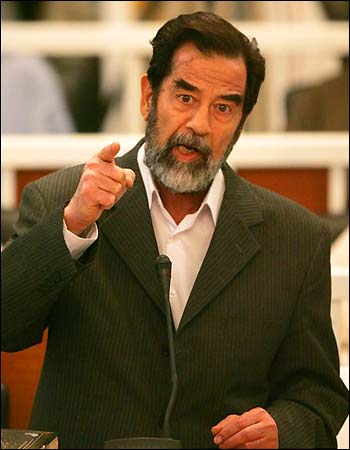
Enter your caption in the Comments section only. If you e-mail it ... then I kill you.
Enter as often as you like. If you don't enter ... then I kill you.
Only add comments pertaining to this contest. If you troll ... then I kill you.
Ooooo-kay, Uncle Saddy, I think I'll take over from here. Since Peyton sent in this entry, we'll let him judge the contest. (And if he refuses ... I'll kill him.) I'll come up with an inexpensive but appropriate award for the overall winner of the contest. Bribes and flattery are always welcome at CQ -- they won't help you win, but they're welcome nonetheless. I'll keep the contest open through Sunday noon, and we'll announce the winners later that evening. That gives contestants four days to get their entries in, which is three more than the length of Uncle Saddy's trial.
Cry "Havoc!" and let slip the dogs of, er, caption contests!
UPDATE and BUMP: Hey, we're having a great response to this contest! Be sure to get your entry in the comments before it closes at noon tomorrow. Peyton's got his eye on the progress here and has already said it will be a tough call ...
COMMENTS CLOSED: Peyton will now make his decision -- and a tough one it will be, I guarantee you. The winners will get announced in a new post later today!
Abu Mazen, The Man Of Peace?
President Bush offered a strange endorsement to the beleaguered Palestinian president, Mahmoud Abbas, in a little-noticed Rose Garden address this week. Two who did notice are Scott Johnson at Power Line and Bret Stephens at the Wall Street Journal, and both take exception to the characterization. Bush's assertion that the terrorist formerly known as Abu Mazen -- the man behind such atrocities as Black September, the kidnapping and murder of Israeli Olympic athletes in 1972 -- is a "man devoted to peace" in the same week that gunmen from his own Fatah faction are believed to have murdered two PA policemen responding to a coffeeshop argument sounds seriously out of touch with reality.
As Stephens explains, the culture of violence has helped to create the Palestinian Authority as we know it, and Abbas' leadership of the autocracy in the West Bank and Gaza Strip (such as it is, under the pressure of Hamas and Islamic Jihad) depends on the continuation of violence for its survival. The Palestinians have long taught their children that death and violence provide the only honorable long-term solutions in their struggle against the Jews and the West. Peaceful coexistence under those conditions has no value; they want total victory after total war, and their continuing support of Hamas in elections demonstrates that.
In truth, the entire enterprise in what Scott acerbically refers to as Arafatistan resembles a turf war between competing crime families more than a nascent state worthy of its own sovereignty. A true state would have central control over the means of statutory enforcement, for one thing; as Stephens points out, Abbas hasn't even bothered to try to achieve that. His "government" likely can't even outgun Hamas, let alone all of the disparate interests of the Palestinians, across ideological, clan, and community lines.
When the nations of the world negotiate with terrorists, this is the inevitable result -- a territory just itching to create a civil war between armed factions instead of a stable society able to govern itself. For all of the violence in Iraq, one can easily see that the central authority has grown stronger and has the ability to enforce its laws. The terrorists there have grown more and more marginalized while the rebirth of a democratic Iraq has proceeded at a reasonable pace. With security assistance and political support, Iraq's central government will have the ability to keep Zarqawi and his lunatics on the fringe or even annihilated in the near future. Hamas, on the other hand, will likely win a majority in the Palestinian assembly and will continue to have better weaponry and troop strength than the government it purports to join.
Terrorists will rule Arafatistan, including Abu Mazen, because the world rewarded their terrorism with official recognition in 1993. The conference at Oslo should have demanded civilian representation unmarked by terrorist operatives before opening talks on statehood. Now all we have for choices in Arafatistan are differing flavors of terrorism with which to negotiate, and even the world's staunchest fighter against terrorism cannot bring himself to recognize the error. It dooms the Palestinians to yet another generation of violence, most of it self-inflicted, and all of it unproductive.
Is Miers A Quota Queen, Or Just Misquoted?
Today's Washington Post alleges that Harriet Miers pushed for racial and gender set-asides in her role as president of the Texas State Bar, complete with the kind of specific numerical goals to which conservatives object as quota systems. Coming so soon after the unfortunate and sloppy choice of phrasing in her Senate questionnaire, it makes it sound as if Miers might be closer to Lani Guinier than Sandra Day O'Connor on the question of affirmative action -- and neither would make the GOP base happy at all.
However, the White House quickly pointed out that Miers did not generate this policy of the Texas Bar, nor did this have any implication of a government mandate. As such, the White House implies that it represents the kind of private-enterprise, voluntary approach to improving diversity it supports.
So which should we believe -- Quota Queen, or just misquoted?
Miers, the first female president of the Texas bar, vowed in her first interview with the Texas Law Journal as president to "be inclusive of women and minorities."During her tenure, she championed the cause of increasing the number of female and minority lawyers in the bar's own leadership ranks and in law firms across the state, writing that "we are strongest capitalizing on the benefits of our diversity."
Miers was a believer in mentoring programs, but during her tenure she and the board of directors went further, passing a resolution urging Texas law firms to set a goal of hiring one qualified minority lawyer for every 10 new associates. The directors also reiterated support for a policy of setting aside a specific number of seats on the board for women and minorities.
Although Miers was not the author of either policy, she never objected to them, according to tapes of the meetings, and numerous board members who served with her said she fully supported both efforts.
As the first female litigator at her law firm and the first female president of both the Dallas and Texas bars, Miers had an understanding of the barriers faced by those who are not white males, said former board member James Parsons III, who served on the board with Miers when she was named president-elect in 1991.
"When you come up hard like she did, you either pull the ladder up behind you or you leave the ladder down and reach back and pull people up," he said. "Harriet reached back -- that's who she is."
Others see it differently.
"Those are quotas," said Roger Clegg, the general counsel for the Center for Equal Opportunity, a conservative group opposed to affirmative action. The fact that Miers "did not create the quota systems but only perpetuated and endorsed it doesn't make it less disturbing," he said.
As a society struggling to move past the blighted century between the end of slavery and the end of Jim Crow -- an apartheid which touched the lives of people still in the economic marketplace to this day -- we will face this question for at least another generation. It is not enough to say, "All people should get equal opportunity," when in some areas at least, some people have borne artificial handicaps imposed on them by a racist system of laws. Some have defied the odds and risen above them, but no one can deny that Jim Crow made it more difficult for African-Americans to get the education and access to the political system that helps to create success in private and public sectors.
Diversity in hiring and education remain, then, admirable goals. The sticky question comes in trying to achieve that without penalizing those who had nothing to do with creating Jim Crow in the first place. Set-asides do just that in a competitive environment, and it ensures that in some instances, better qualified candidates get left out -- a bad result for everyone in a market-based system.
That's where programs like mentoring, private scholarships, school vouchers, and the encouragement of small-business startups through enterprise zones do so much better at building business diversity rather than quotas. They ensure that rather than artificially arbitrating a numerical quota regardless of talent or qualifications, which is what set-asides presume, we actually produce competitive talent by overcoming the handicaps of the vestiges of Jim Crow and other discriminatory societal elements. That would be the "compassionate conservative" policy on diversity. Had we started pursuing these policies forty years ago instead of the head-counting in which we engaged, or at least in conjunction with that, we could have put these issues behind us long ago.
Now, in the case of Harriet Miers, she pursued a worthy goal but through methods which conservatives largely find objectionable. I'd say that asking the largest law firms to have one position out of ten get special consideration towards minority candidates doesn't sound like too heavy of a burden, especially since at the time -- according to the Post -- these firms found themselves comprised of 95% Caucasians ... in Texas, where Hispanics make up 32% of the population (in 2000).
However, the White House has it incorrect when they claim this as a private enterprise issue. No one can practice law in Texas or anywhere else without membership in the Bar. That doesn't mean that firms have to remain active in the association, but it doesn't exactly make the Texas State Bar a voluntary association, either. The government in every state relies heavily on bar associations to license attorneys. That lends an official tenor to the actions of these groups that the Kiwanis or the Elks do not get.
Coming as this does with Miers' use of the term "proportional representation" in her Senate questionnaire, I'd say that conservatives should be concerned about Miers' approach to affirmative action. She appears quite amenable to de facto quota systems as a matter of policy, making it highly unlikely that she would find anything unconstitutional about them when ruling on the issue on the Supreme Court -- even though the plain text of the 14th Amendment makes it clear that race-based solutions in law should be barred.
I don't think Miers is a Quota Queen, but she's not even an O'Connor on this issue. It's yet another red flag on a nomination that seems to have sprouted a number of them recently.
ADDENDUM: The Post also goes back to the questionnaire and finds more evidence of sloppy work. Miers was asked to list the legal work she performed for "any political party, election committee, or transition team" (page 23-24), but she managed to forget the one that landed her firm a huge payday:
Senators are asking Supreme Court nominee Harriet Miers to provide more information about her role as a lawyer for President Bush's 1998 Texas gubernatorial campaign, for which her firm was paid $140,000.In answering a Judiciary Committee questionnaire this week, Miers mentioned her legal roles in Bush's first gubernatorial campaign, in 1994, and in his 2000 campaign for president. But she did not mention the 1998 gubernatorial reelection campaign, for which her firm was paid far more than the $7,000 it received in 1994, according to a review of campaign records by the Associated Press. ...
According to the AP, records at the Texas Ethics Commission show that Bush's 1998 gubernatorial campaign committee paid $140,000 to Miers's Dallas law firm, Locke Purnell Rain Harrell. The 1994 Bush campaign paid the firm $7,000, and it received $16,000 between March and December 1999, a year in which the newly reelected governor was preparing his presidential bid.
That amount of money represents too many billable hours for a managing partner to have simply forgotten. At best -- at best -- this represents yet more sloppy, imprecise work from both Miers and the White House. No wonder the answers irritated the Senate Judiciary Committee.
UPDATE: Yes, the Texas State Bar is a governmental agency:
The State Bar of Texas is an administrative agency of the judicial branch in Texas. Every licensed attorney is a member of the State Bar, which provides a wide array of services to its members and the public.
This makes the set-asides quite a bit closer to the Michigan case and not an effort by a private enterprise to achieve diversity goals. (Via The Corner)
How Keeping $50 Could Save Your Sanity
God bless the New York Times Editorial Board and their new $50 Firewall of Sanity. The new paid service called Times Select keeps compulsive readers like me from accidentally reading Maureen Dowd, Frank Rich, Paul Krugman, Bob Herbert, and other nonsense routinely featured in the Paper of Record. Whenever I read the RSS headers from the locked-out articles from these "stars" of punditry, it gladdens my heart to know that the Times has found it necessary to give us a $50 excuse not to pay attention to them.
Today's Dowd column provides an excellent example of this dynamic. Her column, titled "Woman of Mass Destruction", gets this one-line summary:
Sorely in need of a tight editorial leash, Judy Miller was kept on no leash at all, and that has hurt this paper and its trust with readers.
Excuse me, but Maureen Dowd wrote this about Judy Miller? With Dowd's deliberate and chronic quote-mangling and irrelevancies, it hardly stretches the imagination that a reader could easily substitute Dowd for Miller in that sentence -- and probably improve its accuracy. Ditto for Krugman, whose editors had to go public with his outright lies in order to get a half-assed retraction.
Times Select. It's there for your protection.
October 21, 2005
Coming Unhinged On A Friday Night
 After a stressful week at work and on the blog, I came home this evening to a pleasant surprise. My copy of Michelle Malkin's new book, Unhinged: Exposing Liberals Gone Wild, arrived in the mail today. I'd normally take a quick read through the book and write a review for the blog, but I've already had the privilege of reading it ahead of time during one of Michelle's final draft stages. She has put together quite a list of nutcase eruptions from the far Left, and sometimes even the nearer Left as well. (I read the book and offered a scant few suggestions for edits, none of them particularly momentous, and Michelle very graciously thanks me in the Acknowledgments section.)
Those who enjoy Michelle's blog and her efforts during the past election to ensure that the excesses of the lunatic fringe of Air America, Howard Dean, MoveOn, International ANSWER, and the assorted unhinged activists that have hijacked the party of Scoop Jackson and Harry Truman will definitely find a lot of fun with Unhinged. She details many of the stories she only had time to mention in passing on the blog, plus many more instances of political insanity and foolishness from the last election season.
One of the highlights -- or lowlights -- comes when Michelle opens her e-mail Inbox and shares the hatred and vitriol that she gets from some readers. In fact, hers is the first book I've seen where the back cover doesn't include testimonials to the book, but a sample of hate mail directed at the author: "an ugly, obnoxious, and semi-literate gook", "a fetid heap of parrot droppings", and who could forget "ought to be shot between those Viet Cong eyes"? Michelle refers to this as "Unhinged Liberal Praise".
I'd encourage people to get a jump on the release and place your orders now, online at the above link. Everyone (except the Liberal Avenger) will have a great time with this read.
Bad News Turns Into Flood On Miers
This morning's news has administration aides choking on their morning coffee regarding the Harriet Miers nomination. While the Wall Street Journal comes out in opposition to her confirmation and urges withdrawal, the New York Sun reports that a senior Republican Senator has already passed that same message to the White House, which angrily dismissed the feedback. Meanwhile, John Fund reports that Miers' work at the Texas Lottery Commission will bring up several uncomfortable details about a sweetheart golden parachute for Ben Barnes after his firm lost a TLC contract under questionable circumstances -- and new reports have come out showing that George Bush paid a hell of a lot of money for Miers' services at about that same time.
First, Brian McGuire at the Sun reports that the Senate GOP caucus may already be balking at proceeding with the Miers nomination:
The Supreme Court nomination of White House counsel Harriet Miers faced new and urgent troubles yesterday, with speculation mounting throughout the day that at least one conservative Republican senator had made an unsuccessful attempt at getting the White House to withdraw Ms. Miers's name altogether. ...The complaints have become serious enough that at least one conservative senator is said to have asked White House officials yesterday to withdraw the nominee's name because of a growing lack of enthusiasm for Ms. Miers among Republicans in the Senate.
"I don't know exactly what was asked, but displeasure was expressed," a source familiar with the White House strategy on judicial nominees said. "The White House responded that it would do no such thing."
Remember Ben Barnes? He provided some supposedly eyewitness testimony about George Bush's use of the Texas Air National Guard to avoid the draft, an urban legend he promoted and CBS exploited until it blew up in their faces. Barnes, it turns out, lobbied for a firm called GTECH which had a contract for the Lottery Commission.
After Miers took over the commission, she fired its executive director, Lawrence Littwin, who then sued for wrongful termination. His lawsuit turned up some fascinating information, including Barnes' salary for GTECH -- $3M a year -- and his severance package, which came in at $23M. Littwin argued at the time that the only reason he got fired was to keep Barnes and GTECH employed at the TLC. Littwin argued that the TLC wanted to keep Barnes close to keep him from going public with his allegations about the TexANG and Bush:
The Littwin controversy has spawned feverish conspiracy theories, many stemming from a 1997 anonymous note sent to then-U.S. Attorney Dan Mills. The note, excerpts from which were published in the weekly Dallas Observer this week, claimed that "Bashur was sent to talk to Barnes who agreed never to confirm the story" about the Texas Air National Guard and that "the Governor talked to the Chair of the Lottery [Ms. Miers] two days later and she then agreed to support letting Gtech keep the contract without a bid." Mr. Bashur said the note stirred up a lot of controversy back then but was "nonsense" and has never been substantiated. But that note may be making a comeback now that Democrats are exploring Ms. Miers's career before she went to the Bush White House.Mr. Barnes, however, is urging Democratic senators not to take their questioning there. In 1997, the Providence Journal-Bulletin reported that after the conviction of GTECH national sales director David Smith, "in a sentencing memo that was posted briefly on the Internet, a federal prosecutor accused Smith of engineering kickback schemes in four states, including Texas, where he allegedly received $508,945 in illegal payments from former Lt. Gov. Ben Barnes." The prosecutor's office later apologized for making the memo public but never retracted it.
And if that wasn't bad enough, the AP reports this morning that a check of financial records shows that the Bush gubernatorial campaign paid Miers' firm an eye-popping amount of money during this same period, almost as much as he paid for all the attorneys working on the 2004 Presidential election, when the campaign staffed up for potential electoral challenges in several states:
Reports filed with the Texas Ethics Commission show that two payments of $70,000 were made to Miers' Locke, Purnell, Rain and Harrell firm in Dallas within a month of each other during the 1998 campaign. Another $16,000 in payments were made between March and December 1999.The 1998 totals dwarfed the $7,000 Bush paid Miers' firm during his first run for governor in 1994, and are extremely large for campaign legal work in Texas, an expert said.
"I'm baffled," said Randall B. Wood, a partner in the Austin firm of Ray, Wood and Bonilla, and former director of Common Cause of Texas. "I've never seen that kind of money spent on a campaign lawyer. It's unprecedented."
Wood won't be the only one baffled, not least by a White House that once again has failed to think through all of the implications of nominating someone who has all these connections to issues best left quiet. Didn't anyone think to check through all of these points before selecting Miers? I understand that the President makes his own choices and can get rather stubborn about them, but this water torture of daily missteps and revelations make it difficult for all but the most rabid partisans to continue supporting Miers' confirmation, even for the party's sake.
Several people have criticized the conservatives who have questioned the wisdom of this nomination, pointing out that we have argued that Presidential prerogatives apply to executive appointments. We have argued that all nominees who get through committee deserve a fair up or down vote in the Senate. I firmly believe that. However, I also believe that the President has a responsibility to select nominees that meet minimal qualifications for the highest court in America in order to get that benefit of the doubt, and based on Miers' performance in the last couple of days, I highly doubt that Bush met that test in this one instance. If Clinton had named Bruce Lindsay to the Supreme Court with this kind of track record, the Right would have lined up for miles to shred both of them -- and we would have been correct to do so.
We've already had one request for a do-over from the White House PR team, and another from the Senate afterwards on Miers' questionnaire, the first time that has ever happened, apparently. How many Mulligans should it take to get past that benefit of the doubt?
UPDATE: Read Paul Mirengoff's post at Power Line in which he addresses my points about consistency -- he makes a very powerful argument (plus he calls me "smart" while disagreeing with me, twice.)
In response, let me say that I have supported Miers' confirmation up to now, almost exclusively on two bases: presidential prerogative and an assumption of basic competence, both on her part and the White House. The questionnaire has my confidence in the second basis badly shaken. The slapdash manner of its preparation tells me someone isn't taking this seriously, and since Miers has her name on it, that's her responsibility. The way she managed to antagonize Specter adds to that impression. She's striking me as an imprecise and sloppy nominee for a position that requires absolute clarity and precision.
Given that, my reliance on presidential prerogative remains ... but it doesn't outweigh my objection to getting a substandard jurist on the Supreme Court. Waiting until the hearings for her to get exposed as that will prove a political disaster for the President and the GOP. For those reasons, I'd strongly suggest that the White House look for a way out of this, and fast.
Syria Knew About Hariri Assassination Plan: UN
The UN report into the assassination of Rafik Hariri accuses Syria's Assad dictatorship of knowledge of the plot before its execution, and also points a finger at long-time Syrian stooge Emile Lahoud, the current president of Lebanon. Lebanese officials expect the findings to cause some uproar in Beirut and have already deployed security forces to keep the peace:
Former Lebanese Prime Minister Rafik Hariri was assassinated with the full knowledge of Syrian security officials and their Lebanese allies, according to a U.N. report that also casts suspicion on Lebanese President Emile Lahoud. ...Syrian President Bashar Assad earlier this week denied that Damascus had any connection to the assassination. But the report paints a detailed portrait of involvement by senior members of Syria's security and political apparatus and will give weight to efforts by Washington, Paris and London to sanction Syria in the U.N. Security Council.
The U.N. investigation notes that shortly before the fatal blast, Islamic militant Ahmad Abdel-Al, who is described as having ties to the Syrian authorities, telephoned Mr. Lahoud, among others. The international investigation notes that the crime had been prepared for several months by a well-connected group and that Mr. Hariri's movements were carefully monitored. His telephones had been tapped and his schedule scrutinized.
More figures get named than just Lahoud. The report notes the significance of a face-to-face meeting between Hariri and Bashar Assad, in which the latter tells the soon-to-be-deceased that he must comply with Syria's wishes to extend Lahoud's term in office or that Assad would "break Lebanon over your head". Immediately afterwards, Hariri told a Syrian deputy foreign minister that Syria would no longer rule Lebanon, whereupon the Syrian replied that Syrian intelligence had him under close surveillance and not to take them too "lightly".
Two weeks later, Hariri died in the car explosion.
It appears from the UN report that a number of high-level officials in both countries took part in this assassination:
The report listed several officials who witnesses alleged knew about or played an advance role in the assassination. They included Gen. Jamil Sayyed, Gen. Mustapha Hamdan, Gen. Raymond Azar -- senior Lebanese officials who have been arrested -- and Gen. Rustum Ghazali, Syria's most recent intelligence chief in Lebanon. The day before the assassination, the report said, witnesses allege that Ghazali met with the head of Hariri's protection detail, emerging "badly shaken."Another witness said Hamdan had accused Hariri of being pro-Israeli and had said, "We are going to send him on a trip, bye, bye Hariri." After Hariri's assassination, the witness was "strongly reminded not to discuss the conversation with anyone," the report said.
The report also cited an allegation by one witness against Assad's brother-in-law, Maj. Gen. Asef Shawkat. The unidentified witness told the commission that Shawkat forced an Islamic militant, Abu Adass, to record a tape claiming responsibility for the bombing two weeks before it occurred, to create the misimpression that the attack was the act of a lone suicide bomber.
The heavy involvement of Lebanese officials will make this even more explosive in Beirut. The newly-minted independent democracy will face tough challenges in bringing these people to justice. Syria still exercises a great deal of political influence in Lebanon behind the scenes, and some of the people involved will hardly feel it necessary to leave quietly. If they remain, however, the crowds that brought democracy back to Beirut after thirty years of war might just take to the streets again to demand blood.
This UN report does make it almost impossible for the UN Security Council to dither any longer on this issue. The US-French effort to push devastating sanctions onto Assad's narrow shoulders should continue apace, and perhaps the report might even convince Russia and China to step aside and withhold their vetoes and protection from Assad. Dictatorships can't act this stupidly and still expect their allies to unquestionably endorse them forever.
Wisconsin Governor Faces Bipartisan Probe On Contract Award
A travel-services contract awarded to a hefty financial contributor to Wisconsin Governor Jim Doyle has triggered a joint state/federal investigation into potential bribery charges, the Milwaukee Journal-Sentinel reports this morning:
Federal, state and Dane County authorities have launched a joint investigation into a travel contract given to the company of a major contributor to Gov. Jim Doyle, officials said Thursday. ...In March, Adelman Travel was awarded a three-year contract with the state worth up to $250,000 a year. Before and after bids were solicited and the contract awarded, the firm's owner, Craig B. Adelman, gave the $10,000 maximum allowed to Doyle's re-election campaign.
A competing company, Omega World Travel of Fairfax, Va., led the bidding at one point in the process. But state officials said both bids were so close that they asked for head-to-head final prices - and Adelman won that competition.
Also, a member of Adelman Travel's board, Mitchell Fromstein, gave Doyle's campaign the maximum $10,000 allowed at about the time the contract became effective, campaign finance records show.
One key piece that will interest investigators will be a look to see how close that first round of bidding got. If they find that the numbers for Adelman came in higher than Omega by any significant margin, the entire second round might have been unnecessary -- and could indicate that the state gave Adelman a second chance. They will also look for any inappropriate contacts between Doyle and Adelman among lower-level staff members, such as e-mail, telephone logs, and such. Many of these kinds of cases get unraveled by finding contacts like that and doing some arm-twisting to get testimony about how people like Doyle, Adelman, and Fromstein could have directed a contract award behind the scenes, if in fact that happened at all.
Wisconsin has a bit of a problem with public corruption. In addition to the electoral case discussed below, several Wisconsin elected officials have either faced or been convicted of serious charges of abuse of their offices. US District Attorney Steven Biskupic, a Bush appointee, has kept busy with indictments and convictions for a prominent legislator and a former Democratic Party chairman. He has several leading Republicans under indictment for what the MJS calls "tainted donations". Doyle had hoped to be the first Democratic governor to win a second term, but Biskupic's new investigation might put a serious dent in his plans.
Wisconsin Voter Fraud Gets Congressional Attention
The widespread allegations of voter fraud in Wisconsin from last year's presidential election, the level of which may have fraudulently pushed the state into John Kerry's Electoral College column, will finally receive some attention from Congress. Greg Borowski reported on Wednesday that the House Administration Committee would come to Milwaukee to hear from witnesses. However, one member of the delegation has some eyebrows raised (h/t: CQ reader A Guy In Wisconsin):
The meeting of the House Administration Committee, which oversees election issues, will put the state's election system under a potentially powerful microscope.But the visit was criticized Tuesday amid questions about whether any Democratic members would attend. There also were questions about the witness list, heavy with Republicans and - for now - without Milwaukee representation.
The committee chairman, Rep. Bob Ney (R-Ohio), said Tuesday that he was told Rep. Gwen Moore, a Milwaukee Democrat, would be sitting in.
Moore is not on the committee, but Ney said she would be able to testify and join the committee in questioning witnesses. The three Democrats on the nine-member committee all have conflicts and will not attend. Apparently, they had not submitted any witnesses they wanted called.
Rep. Mark Green made the request to get more attention on the case, which has languished since Mayor Tom Barrett appointed an investigatory board of city, state, and federal officials to look into the allegations. (My case archive on this can be found here.) The state Democratic Party Chairman, Joe Weineke, takes a dim view of the proceedings, claiming that they amount to nothing more than a political stunt and "road show" for Green, a Republican. Weineke wants to know why the witness list doesn't include more Democrats. Perhaps he should consider himself lucky at not having to explain why more of them won't be subpoenaed.
The inclusion of Rep. Gwen Moore has some people scratching their heads. After all, the Democratic Congresswoman has a significant connection to these allegations. Her son Sowande Omokunde, also known by the memorable name of Supreme Solar Allah, got charged with felonious vandalism in an Election Day tire-slashing incident meant to keep Republicans from going to the polls:
The investigation into the Great Tire-Slashing Caper will end Monday with felony charges against the adult sons of two prominent Milwaukee politicians - U.S. Rep. Gwen Moore and former Acting Mayor Marvin Pratt.Sources close to the 83-day-old probe said Sowande Omokunde, Michael Pratt and three other paid Democratic activists will each be charged with a single felony count of criminal damage to property, legalese for vandalism.
Omokunde, also known as Supreme Solar Allah, is the 25-year-old son of the rookie congresswoman. Pratt, 32, worked on Kerry's local campaign, which was chaired by his father.
Pratt, Omokunde and the other staffers will be accused of cutting the tires of some 20 vans and cars rented by the state Republican Party to usher the party faithful to and from the polls on election day. The charges will state that the damage to the vehicles was well in excess of $2,500 - the minimum required to merit a felony.
With that in mind, having Moore taking part as an investigator instead of a witness reminds me of having Jamie Gorelick serve on the 9/11 Commission. In fact, it might be worse. Supreme faces trial next year, and given her personal and professional connections to him, Moore could wind up as a witness or even as a possible accessory in the case. She refuses to answer questions about the case, so why should she be in a position to ask questions about other voter-fraud incidents in Wisconsin?
It appears that the Democrats want the cheesewash to continue.
October 20, 2005
An Insider's Look At The DIA
After the DIA has decided to run a smear campaign on LTC Tony Shaffer and to destroy his credibility, apparently for his revelations about Able Danger, the credibility of the agency itself has come under serious question. A CQ reader wishing to remain anonymous but with personal knowledge of the situation the Defense Intelligence Agency sends this description of the senior leadership at the agency:
Deputy Director of DIA is Mark Ewing. He won't be in that position for very long, seeing as how he recently put in his paperwork to resign. This action comes after he had a spat with the outgoing director, Admiral Lowell Jacoby, the subject of which is not clear ... there is the recent revelation that Ewing may very well have pulled a three-monkeys trick (see/hear/speak no evil) when presented with the findings of Able Danger. As the senior leadership exodus at DIA continues (see below) Ewing would have been the last one standing and facing the music. He would like to flee the intelligence community completely but that is apparently not possible: through a curious set of administrative circumstances he has ample government service time under his belt, but cannot retire and collect his pension (details require a long explanation). If anyone needs to panic it is Ewing.Vice Admiral Lowell Jacoby is the outgoing director of DIA. His previous assignment, in the late 2001 time-frame, was the J2 (the DOD's top officer for warning). Not many outside the business know this but his retirement timetable seemed to accelerate about the time ABLE DANGER hit the fan. This is a guy who never met a mission that he didn't want to kill or ignore if there was any chance that it would prevent him from achieving that next star on his collar. Jacoby is a naval officer but not a "ship-driver". If he were, you tell me, would you want serve on the ship being captained by a guy would didn't think it would be prudent to put the vessel in the water due to the risks involved in actually sailing? When he does go sailing he likes to make sure that there are plenty of familiar hands to help man the sails. Once he was firmly in the director's chair, he began a purge of the old executive corps at DIA, replacing most of them with friends from the office of naval intelligence. When he couldn't easily force incumbents out of their seats, he simply created new executive positions to put his pals into.
The head of HUMINT at DIA is a guy named Bill Huntington (he spoke during the DOD briefing on Able Danger). Technically he's the vice deputy director for HUMINT, but in all of these jobs the civilian deputy is the long-term head of office, while the military officer who is named the head of the office is the short-timer. Huntington is in the process of attempting to flee DIA for the DNI.
The deputy director of intelligence (head of the analysis office) is Earl Sheck. Sheck was one of the first cronies Jacoby brought over from ONI. As the keeper of the analytical resources at DIA, the odds that Sheck also knew something about Able Danger are pretty good. Able Danger was a SOCOM/LIWA show, but if they were using tools from Orion (also have contracts at DIA) and working CT issues, inevitably they would have talked to relevant offices in DIA, if nothing else than to bounce ideas off of each other or to request additional intel support. DIA's CT mission is run by the J2, but to think that Sheck would not be aware to some extent is inconceivable. Sheck is also rumored to have one foot out the door.
An intelligence agency, full of cronies who all botched their respective roles during the decades preceding and years after September 11th, thought they could handily weather the Able Danger storm. When it became clear that the ship was about to capsize, they all couldn't move fast enough for the life rafts. Not like they would have much to worry about given the tendency to not punish intelligence officers for negligence, but then the DIA isn't the CIA, and military officers (like Jacoby) have the UCMJ to worry about.
It sounds like a whole host of people want out of the DIA. Just as with the weird allegations used against Shaffer, this portrait -- if accurate -- begs the question of what the DIA dreads so much. Exposure and embarrassment? Or something worse?
Vi Adkins has a transcript of Curt Weldon's latest media appearance, an interview with Sean Hannity, at QTMonster.
The Final Act Of Miers Nomination Begins
CQ reader Tom Holsinger notes a key development in the Harriet Miers nomination to the Supreme Court, one that probably will signal a merciful end to the conservative split over the controversial selection. Two key Republican Senators, the conservative Sam Brownback and the more moderate Lindsay Graham, have "requested" privileged material from Miers' work with George Bush for their review as a condition of their desired support of Miers' confirmation -- a request that amounts to a polite triple-dog dare:
Sens. Lindsey Graham (R-S.C.) and Sam Brownback (R-Kan.) are calling for the White House to turn over internal documents related to Supreme Court nominee Harriet Miers’s service as White House counsel, breaking with Republican colleagues who say the boundaries of executive privilege must not be pushed. ...Graham’s and Brownback’s push for greater disclosure will give Democrats political leverage should they ask for memos and other documents shedding light on Miers’s work within the Bush administration’s inner circle. It would take only two Republicans to defeat Miers in committee, although that would not prevent the nomination’s automatic discharge to a floor vote.
Whether or not the White House recognizes it as such, the pair used this demand to send a shot across the bow of the administration. The White House has long defended the right of the executive to retain attorney-client privilege when nominating a counsel to another post, even to the federal bench, a position well worth defending. Both Senators understand this and have long backed that position. They would not issue demands that abandon this important precedent lightly -- well, perhaps Graham would, but not Brownback.
They want to tell the White House that Bush has sent an insufficient candidate to the bench, and that the only possible way the Judiciary Committee could justify a vote to confirm her is to find significant work that just doesn't appear in her public record. That message can be boiled down further: under the current circumstances, they are not prepared to support her, and in fact do not see themselves moving off that position.
All it takes is two Republicans to torpedo her chance for approval by the Committee. At one time, I felt sure that the Democrats would fight to keep her nomination alive, given the options that would follow if Miers failed. However, a chaotic and foolish PR campaign by the White House that promoted Miers' evangelicalism and her 1989 written commitment to a Constitutional amendment banning abortion has left the Democrats little choice but to oppose Miers. Even with a brilliant and canny candidate in Roberts who avoided discussion of either religion or his personal views on abortion, only three Judiciary Democrats crossed party lines to support his recommendation to the full Senate. Even if Miers gets defeated in committee, a previous agreement on Supreme Court nominees will send Miers to the Senate floor. However, if Brownback and Graham defect, the pair will give Republicans enough cover to reject Miers on the floor.
In truth, Brownback and Graham give George Bush cover of a different sort. Their demand makes it possible for Bush to withdraw Miers for an important principle, rather than as a failure and an embarrassment. It will kill for all time the idea of nominating one's personal attorney for the Supreme Court and still might damage the protection of privilege for administration counsel, but it beats having to retreat after all the effort made in promoting Miers and touching off a conservative food fight. Either Miers could withdraw herself to protect the attorney-client privilege, or Bush could announce that he wants to protect future administrations from unwarranted incursions of one branch into the privileges and protections of the other.
The Senate GOP wants to protect George Bush and the White House by giving him a face-saving way out of the mess he made. At this point, this is one life-saver the President should seriously consider grasping with both hands.
UPDATE: Again via Tom H in the comments, Charles Krauthammer agrees:
For a nominee who, unlike John Roberts, has practically no record on constitutional issues, such documentation is essential for the Senate to judge her thinking and legal acumen. But there is no way that any president would release this kind of information -- "policy documents" and "legal analysis" -- from such a close confidante. It would forever undermine the ability of any president to get unguarded advice.That creates a classic conflict, not of personality, not of competence, not of ideology, but of simple constitutional prerogatives: The Senate cannot confirm her unless it has this information. And the White House cannot allow release of this information lest it jeopardize executive privilege.
Hence the perfectly honorable way to solve the conundrum: Miers withdraws out of respect for both the Senate and the executive's prerogatives, the Senate expresses appreciation for this gracious acknowledgment of its needs and responsibilities, and the White House accepts her decision with the deepest regret and with gratitude for Miers's putting preservation of executive prerogative above personal ambition.
Faces saved. And we start again.
It even allows the President to work up a little righteous anger over the treatment that Miers received by critics and call for more decorum and patience the next time around. And the next time around, the president can pick someone who gets vetted by someone other than his or her employee, if he wants to avoid this kind of experience in the future.
Zarqawi's Moneyman Gets Pinched In Baghdad (Updated!)
Fox News reports this morning that Iraqi security forces have arrested a nephew of Saddam Hussein in Baghdad, Yasir Sabawi Ibrahim, after the Syrians kicked him out of their country earlier this month. The Iraqis say that Ibrahim ran the money end of the Iraqi insurgency as well as contributed to the Zarqawi network's funding, and served as a chief liaison between the two organizations:
Yasir Sabhawi Ibrahim (search), son of Saddam's half brother Sabhawi Ibrahim Hasan al-Tikriti, was arrested in a Baghdad apartment, several days after Syrian authorities forced him to return to Iraq, the officials told The Associated Press in a telephone interview from Cairo. They spoke on condition of anonymity because they weren't authorized to deal with the media.One of the officials, who works as a coordinator between Iraqi authorities and U.S. military intelligence, described the purported financier as the most dangerous man in the urgency. The other official, who is a senior member of the Iraqi Defense Ministry, said the arrest was a serious blow to terrorist networks.
Syria did not bother to deport Ibrahim to any specific authority; the Americans say that Syria "pushed" him across the border. However, it appears that the Syrians kept tabs on him afterwards and then tipped off Coalition officials on his location. That's how the Iraqis made what they called a "fast, easy" capture of Ibrahim.
Let's think about that for a moment. The Syrians rarely do anything outside of their self-interest, which usually relates to the self-interest of the Assad on the throne at the time. With the US threatening sanctions at the UN and the Iraqi democracy presenting such a threat to their stability and their entire eastern border, why make things easier on both? Appeasement? Possible but doubtful.
With Ibrahim controlling Ba'ath funding in Syria, Yemen, and Jordan, he represented a possible threat to the leadership of Bashar Assad as well as that of the Iraqis. I think in Assad's weakening political position and diplomatic isolation, he may want to get rid of people that could stage a coup. Ibrahim had the funding and the contacts to do so, and could have either led such a putsch or funded one he liked to do it for him.
We may see an exodus of the more important terrorist enablers from Syria over the next few weeks as Assad cleans house and checks his six. For those "insurgents" who have based their efforts across the Syrian frontier to keep the US off their back, they will shortly find themselves cut off from their power base and probably most of their funding. (via Power Line)
UPDATE AND BUMP: Ibrahim wasn't the only insurgent leader to get neutralized this week. Al-Qaeda lost another field commander during the recent operations to clear out terrorist nests before the constitutional plebescite:
U.S. forces killed 12 militants in western Iraq including an al Qaeda leader responsible for attacks around Ramadi, a focus of the Sunni Arab insurgency, the U.S. military said on Thursday.A statement said Sa'ad Ali Firas Muntar al-Dulaimi, also known as Abu Abdullah, was among 12 people killed in a series of October 15 raids on suspected insurgents in Ramadi, about 68 miles west of Baghdad.
The statement said Dulaimi was "highly regarded" by top al Qaeda leaders in Iraq including the group's chief, Jordanian Abu Musab al-Zarqawi.
"(Dulaimi) was chiefly responsible for planning and executing all terrorist attacks on Iraqi and Coalition forces in the Ramadi and Falluja areas," the statement said.
Sounds like more good news to me, although some in the comments section might disagree.
Care Bear Slippers?
Happy birthday to Michelle Malkin from the First Mate and I! I'm worried about her, though. If she starts blogging in those slippers, she might start being too nice to people like Al Franken, Hillary Clinton, Howard Dean ...
Naaahhhh.
Still Stumbling Towards SCOTUS (Proportionally Updated!)
The Harriet Miers nomination and political support campaign continued its clumsy path yesterday, with her questionnaire responses receiving failing grades from Judiciary Committee members of both parties. Chair Arlen Specter and ranking Democrat Pat Leahy held a press conference yesterday to castigate the effort as at best incomplete, and at worst an insult to their intelligence:
The top two members of the Senate Judiciary Committee yesterday complained about the written responses they received from Supreme Court nominee Harriet Miers this week, and warned her to expect tough questions from Republicans and Democrats alike when her confirmation hearing begins Nov. 7.Barely concealing their irritation during a 35-minute news conference at the Capitol, Chairman Arlen Specter (R-Pa.) and ranking Democrat Patrick J. Leahy (Vt.) called the lobbying on Miers's behalf "chaotic," and said the answers she provided Monday to a lengthy questionnaire were inadequate. "The comments I have heard range from incomplete to insulting," Leahy said.
Specter clarified "chaotic" as an adjective applied to the lobbying coming from sources other than the White House, presumably the more grass-roots efforts coming from the blogs and political action groups. That reflects the nature of the opposition and support of this particular nominee, I would think. The conservatives have fractured on Miers, and that means people who would normally have united and tried speaking with one voice have instead resorted to trying to shout each other down.
It isn't the entire story, however, as Specter once again insisted that he didn't misinterpret what Miers said to him about Griswold, while the Post thinks that Miers misinterprets other important court precedents:
Specter said he remained perplexed by a disagreement Monday stemming from his meeting with Miers in his office, after which their accounts differed on what the nominee had said about Supreme Court rulings that preceded Roe .In dealing with 11 Supreme Court nominees, Specter said, "I've never walked out of a room and had a disagreement as to what was said." He smiled politely as Leahy said, "I've never known him to make a mistake on what he heard."
Meanwhile, several constitutional law scholars said they were surprised and puzzled by Miers's response to the committee's request for information on cases she has handled dealing with constitutional issues. In describing one matter on the Dallas City Council, Miers referred to "the proportional representation requirement of the Equal Protection Clause" as it relates to the Voting Rights Act.
"There is no proportional representation requirement in the Equal Protection Clause," said Cass R. Sunstein, a constitutional law professor at the University of Chicago. He and several other scholars said it appeared that Miers was confusing proportional representation -- which typically deals with ethnic groups having members on elected bodies -- with the one-man, one-vote Supreme Court ruling that requires, for example, legislative districts to have equal populations.
If true, that hardly instills confidence in Miers' ability to debate this case and others in front of the Judiciary Committee.
UPDATE: Let me explain a bit further, adn explain why Patterico's on a ledge waiting to jump. Anyone who thinks that the Constitution has a requirement for proportional representation has spent little time in its study. Proportional representation is a results-based notion, similar to comparable worth, that guarantees an end result to elections. For instance, if a population has a polka-dotted demographic of 25%, it would reserve 25% of the seats on a city council or state legislature for pollka-dotted people, regardless of the actual vote counts.
Proportional representation comes up once every ten years as a way to right the wrongs of discrimination, either race-based or gender-based -- and in fact, it echoed through this particular Supreme Court nomination in the general insistence that Sandra Day O'Connor's replacement had to be a woman. Local communities tend to consider this more often than anyone proposes it for a state or national solution. It's not unconstitutional in theory, but it certainly has no constitutional mandate.
For Harriet Miers to make that kind of mistake when talking about her work on Constitutional theory is a jaw-dropping mistake. CQ commenter Corrie asks why I'm holding Miers to a super-Roberts standard, but anyone who has paid attention to politics over the past twenty years should know the difference, let alone an attorney who claims to have worked on constitutional issues. Only two possibilities exist for this kind of error: sloppiness, which for this document should be inexcusable, or flat-out ignorance, which should scare the hell out of everyone coming from a Supreme Court nominee. I'd sure like someone to give me a third option that will make me feel better. Beldar?
Meanwhile, I'm finding myself climbing out on the ledge with Patterico. Move over, pal, and pass the coffee.
UPDATE II: Mike at Presto Agitato wants to talk Patterico and I off the ledge. Perhaps we're talking about two different issues with remarkably similar names, but I'm still not quite convinced. I'd like to see a link to a description of what Mike means so I can read it myself.
UPDATE III: Here's Mt. Holyoke on proportional representation:
Proportional representation -- sometimes also called "full representation" -- is the voting system used in most Western democracies and is widely considered to be fairer and more democratic than the current U.S. system. In the United States, interest in this electoral reform has been growing rapidly, fueled by Americans' frustration with our traditional winner-take-all elections.
Or here:
The basic approach of proportional representation is simple: legislators are elected in multimember districts instead of single-member districts, and the number of seats that a party wins in an election is proportional to the amount of its support among voters. So if you have a 10-member district and the Republicans win 50% of the vote, they receive five of the ten seats. If the Democrats win 30% of the vote, they get three seats; and if a third party gets 20% of the vote, they win two seats. Electoral system designers have devised several ways to achieve these proportional results, and so there are three basic kinds of PR described below: party list, mixed-member, and single-transferable vote (also called choice voting).These PR systems were devised to solve the many problems caused by plurality-majority voting systems. As a rule, PR voting systems provide more accurate representation of parties, better representation for political and racial minorities, fewer wasted votes, higher levels of voter turnout, better representation of women, greater likelihood of majority rule, and little opportunity for gerrymandering.
Think Iraq, for instance. This also has been advanced as a way to demolish the American two-party system.
UPDATE IV: John at Power Line talks everyone in off the ledge:
But I now realize that I was reading too much into Miers's sentence. Left-wing law professor Cass Sunstein is, for once, right. All Miers meant was that the City Council, in trying to draw districts in compliance with the Voting Rights Act, had to take into account the one-man-one-vote rule that has been held to be mandated by the Equal Protection Clause. In other words, the districts had to be of roughly equal size so that each voter's ballot counted about the same.Thus understood, the criticism of Miers is (not for the first time) far out of proportion to the offense. The meaning she gives to the phrase "proportional representation" isn't the usual one, but it is perfectly logical. Read in this way, there is nothing at all wrong with what Miers wrote. The Equal Protection Clause has indeed been held to require that voters be "proportionally represented," i.e., that some citizens' votes not be diluted by being part of a disproportionately large district.
All of which suggests, I think, two things: first, people shouldn't be so quick to jump to the conclusion that Miers is an idiot. Let's let her speak for herself at her confirmation hearing. And, second: Patterico, you can come in off that ledge.
Does that mean we rushed to judgment with Lani Guinier, too? I still think this falls into the inexcusably inarticulate category. A significant part of being a Supreme Court justice is the ability to clearly write one's opinions. Using the phrase "proportional representation" leaves one with two options for interpretation, and one of them has a much more recent and negative application. Why would we have assumed she meant the other?
It's sloppy writing for what was essentially an application for a position which requires precision and clarity. It doesn't bode well for her confirmation hearing. However, I'll climb off the ledge, while keeping the window open.
Mark Zaid Confirms Weldon
In an e-mailed response to a couple of quick questions I sent last night, Mark Zaid confirmed what Rep. Curt Weldon alleged in a floor speech and multiple media appearances last night about the DIA's treatment of LTC Tony Shaffer. Zaid, who has represented Shaffer during the Able Danger controversy, wrote the following (emphases mine):
CQ: Have you heard that the DIA intends on firing Col. Shaffer?
MZ: Of course Ed, I'm handling his security clearance issues. They have moved for his indefinite suspension without pay even before we have concluded his appeal. I have had other DIA clients facing the same appeal circumstances but DIA did not suspend them without pay, at least to the best of my recollection.
CQ: Did they [DIA] send him classified documents mixed in with his personal effects?
MZ: They did send him classified documents and govt property. In fact, they sent the boxes to my office!
CQ: Have they accused him of adultery with a staff member of Weldon's?
MZ: Early on DoD (or possibly DIA, we don't know) was spreading unfounded gossip about an alleged romance. That died fast.
Zaid didn't elaborate further, but I think we can expect more fireworks soon from the Able Danger issue. Hopefully, the focus will return to the more substantive issues about what the program found and who kept it buried. Based on the desperate and incompetent manner in which the DIA has attempted to smear and discredit Tony Shaffer, there seems to be quite a story that the American people should know.
Richard Cohen For SCOTUS?
In a column that will surely generate much ire among his usual readers, Richard Cohen makes an almost-perfect argument for the reversal of Roe v Wade and the support of originalism in Supreme Court deliberations, showing that originalism does not limit its utility or its attractiveness to just conservatives. Cohen, while stating his pro-choice position clearly, writes that the 1973 decision has a "musty" feel about it, having its scientific reasoning frozen in amber and the conclusions which follow from it lacking intellectual support:
If a Supreme Court ruling is going to affect so many people then it ought to rest on perfectly clear logic and up-to-date science. Roe , with its reliance on trimesters and viability, has a musty feel to it, and its argument about privacy raises more questions than it answers. For instance, if the right to an abortion is a matter of privacy then why, asked Princeton professor Robert P. George in the New York Times, is recreational drug use not? You may think you ought to have the right to get high any way you want, but it's hard to find that right in the Constitution. George asks the same question about prostitution. Legalize it, if you want -- two consenting adults, after all -- but keep Jefferson, Madison and the rest of the boys out of it.Conservatives -- and some liberals -- have long argued that the right to an abortion ought to be regulated by states. They have a point. My guess is that the more populous states would legalize it, the smaller ones would not, and most women would be protected. The prospect of some women traveling long distances to secure an abortion does not cheer me -- I'm pro-choice, I repeat -- but it would relieve us all from having to defend a Supreme Court decision whose reasoning has not held up. It seems more fiat than argument.
In the final analysis, Cohen writes that legalized abortion can exist outside of Roe, and that the only argument for defending it appears to be that the ends justify the means, a position he strongly rejects. In the midst of the Harriet Miers pas de deux, and even the John Roberts confirmation dance, Cohen's column begs the question: if a liberal columnist like Cohen can easily kick out the rotting intellectual struts of Roe in the opinion pages of the Washington Post, why can't a Republican President nominate a Supreme Court justice who can do the same thing for a Republican Senate?
Originalism could hardly get a better explanation these days, especially in this media environment. Originalism limits the Court's ability to proclaim policy by "fiat", as Cohen rightly calls it. It protects against ends-justifying-means rationalizations, and it requires the Legislature to do its job instead. The judicial restraint in originalism keeps the courts from having to revisit questions about its self-created right to privacy with silly questions about the constitutionality of barring prostitution. The debate on whether laws banning prostitution or drug use are good public policy belongs in Congress and the state legislatures, not in the courts.
If the present administration had the courage that Cohen had when he wrote this article, then we could have had this debate starting on November 7th in the Senate Judiciary Committee hearings. We could have seen just how mainstream originalism is when explained to the American people in plain language and how it benefits people across the entire political spectrum, not just conservatives on one particular legal issue. We would have had the chance to turn around decades of judicial hijacking of our political system had a Janice Rogers Brown or Michael Luttig been the nominee.
Instead, we will have Harriet Miers avoiding any expression of her politics and dodging and weaving through yet another meaningless exercise. She may give an impassioned expression to originalism, but more likely will follow Roberts' example and give paeans to stare decisis and relegate originalism back to its corner once more. It seems a shame that the current administration cannot, with all its advantages, muster up more courage than Richard Cohen when the opportunity arises.
October 19, 2005
A Vendetta Against Tony Shaffer?
Michelle Malkin noticed a speech by Rep. Curt Weldon, the Congressman who helped uncover Able Danger by finding team members brave enough to go public with their recollections of the program and its identification of the 9/11 hijackers over a year before the attacks. Now Weldon has gone on the rhetorical attack himself, angry at a DIA vendetta that he claims has been waged against Shaffer and the delay in public hearings on the Able Danger program:
A vocal House Republican is calling for a new probe into what he says is a "witch-hunt" by defense officials against a Sept. 11 intelligence whistleblower.Rep. Curt Weldon, R-Penn., told United Press International that officials at the Defense Intelligence Agency, or DIA, had "conducted a deliberate campaign of character assassination" against the whistleblower, retired U.S. Army Lt. Col. Anthony Shaffer.
How inept has the DIA been in its campaign against Shaffer? They have hung up his clearance over a series of offenses that go back to his teenage years, events that had to have already been reviewed for clearance renewals over and over again. The DIA now suddenly thinks that the supposed theft of a few pens and a notepad from a meeting when Shaffer was 15 years old makes him a security risk for the nation -- but their own staff shows them to have less sense than teenagers:
Weldon told UPI he had written to the Department of Defense inspector general to ask for "an immediate formal inquiry, with people testifying under oath," into what he called "a clear witch-hunt" against Shaffer, who has been on administrative leave while minor allegations about some expenses are investigated.Weldon's move comes after Shaffer said that boxes of his personal effects, returned to him by the DIA earlier this month, contained both government property and classified documents.
"Sending classified material through the mail is a felony, and much more serious than any of these minor, trumped up charges against (Shaffer)," he said, adding that "I want the appropriate persons held accountable."
Weldon says that the DIA wants to fire Shaffer. That has him enraged and ready to resign from Congress if necessary to pursue the case against the DIA. Michelle reports that Weldon says the smears are about to get a lot more personal:
You can't let a Lt. Col.'s career be ruined because of a bureaucrat in the DIA...We're seeing lying. Distortion. Wolf Blitzer told me that a Defense Department official told [Blitzer] that Shaffer was having an affair with a member of my staff...he doesn't even know my staff! What do we stand for if not the truth? I'll leave my post, but not until I get justice for this man and the American people....scum at the Pentagon are spreading malicious lies.
More on this as it develops. If the DIA really has resorted to these tactics, then it only demonstrates even more that they fear Shaffer and the rest of the Able Danger revelations. What has them so afraid?
Temples Of Our Times
My weekly column in the Daily Standard reviews the connection between the Minnesota Vikings' Love Boat cruise last week and the ongoing worship of self-obsession in American society:
What temples do secular societies build? Lately in America, cities and states have increasingly found themselves funding and building vast offerings to professional athletes and the games they play, even though the owners and participants of these games make enough money to house themselves quite handsomely. Why do communities foot the bill for this, and what does it say about the people who support the practice?That question moved from a vague philosophical debate to practical and uncomfortable introspection for many in Minnesota last week. The Minnesota Vikings have long demanded a new venue in which to play their games--one funded by taxpayers and from which the proceeds almost exclusively support the privately-owned team. ...
ACCORDING TO allegations aired in the local news media and confirmed in the main through player interviews, team members flew in high-priced prostitutes from Atlanta and strippers to accompany them on a two-boat cruise on Lake Minnetonka. The partying quickly got out of hand, with players having sex with the prostitutes while the cruise boat personnel had to stand by and continue serving the athletes. The cruise ship personnel alleged that some of the players harassed female staffers and others forced their way behind the bars to ensure that the booze flowed freely. Forty minutes into what was supposed to be a two-and-a-half hour cruise, the two captains compared notes about the activities on both boats, and then informed the cruise company--which ordered them to return immediately to shore.
I also discuss the connection between this incident and that from Kellenberg High School and their canceled prom. Hopefully, CQ readers will find the column an interesting perspective on the issues.
One final note -- I will be interviewed by Mara Liasson early this morning for NPR about the conservative debate on Miers and spending, but I do not know when the interview will air or whether she will use it for a column instead.
UPDATE: The interview will get aired on Friday morning on NPR. Mara Liasson couldn't have possibly been more gracious during our brief period together. She does a fine job as an interviewer, and I think that many in the audience will get pleasantly surprised.
US, France To Isolate Syria Over Hariri Assassination
The alliance of France and the US against Bashar Assad and the Syrian government continues at the UN, where the unlikely partnership will press the Security Council to force Syria to account for its role in the murder of Rafik Hariri:
The United States and France are planning to introduce two U.N. resolutions next week aimed at holding Syria to account for meddling in Lebanon and for its alleged links to the assassination of former Lebanese prime minister Rafiq Hariri, according to several sources close to the diplomacy.The moves would be the toughest international action ever taken against Syria and would be designed to further isolate President Bashar Assad, who for the first time is getting the cold shoulder from key Arab governments such as those in Egypt and Saudi Arabia, Western envoys said.
The impending actions will be "the perfect storm for Damascus," said a Western diplomat at the United Nations, speaking on the condition of anonymity because planning is still underway. "It's pretty clear the Syrians don't have any friends left."
No doubt that Syrians face a low ebb on international relations at the moment. While the Israelis have made the rounds of Arab nations this week, establishing diplomatic ties with most governments in the region, Assad got an earful from Mubarak about his lack of cooperation in the assassination investigation. Even the Palestinians have issued scolding press releases against the Syrians for arming refugee camps, which wind up in the control of Hamas.
The clumsy and incompetent rule of Bashar Assad seems ripe for plucking. If the sanctions that wind up coming out of the Security Council create any real economic damage or diplomatic embarrassment, the dictatorship will not last very much longer. The various powers behind the throne will eject Assad and look for another leader who will better keep those powers safe. Assad's fall, however, may open an opportunity for a popular uprising that could sweep through Syria and put a truly democratic republic in place in Damascus.
As Michael Ledeen would say, "Faster, please."
Anti-Abortion Stance Clarifies Miers Politics
A questionnaire filled out by Harriet Miers sixteen years ago show that her political approach to abortion supported the typical conservative position of opposition in most cases. The questionnaire, which Miers voluntarily provided to the Senate Judiciary Committee, came from a pro-life group in Texas interested in her run for the Dallas City Council:
Harriet E. Miers, the Supreme Court nominee, disclosed on Tuesday a 1989 survey in which she supported banning abortion except to protect the life of the pregnant woman. The disclosure alarmed abortion rights supporters but failed to assuage the concerns of some conservative Republicans. ...The 1989 survey, which Ms. Miers filled out for the anti-abortion group Texans United for Life when she was a candidate for the Dallas City Council, constituted the clearest indication yet of her personal views on abortion. It did not ask whether she believed that the Constitution protected a right to abortion.
"If Congress passes a Human Life Amendment to the Constitution that would prohibit abortion except when it was necessary to prohibit the death of the mother, would you actively support its ratification by the Texas Legislature?" the survey asked.
Ms. Miers answered yes. She told the group she would support a state ban on abortion, oppose public financing for abortions, participate in "pro-life" events and use her "influence as an elected official" to "promote the pro-life cause."
This shouldn't surprise anyone, nor should it unduly alarm anyone either. First of all, it's sixteen years old, and it represents Miers' state of mind from quite a while ago. The chances of it representing her current state of mind is good -- after all, Miers continues to work for George Bush -- but her opinion may well have moderated from this position. Even Ted Kennedy once publicly claimed to oppose abortion as public policy, although he did so thirty-five years ago, pre-Roe.
More to the point, it represents a political position from someone running for office, not necessarily a statement of judicial intent. One can oppose abortion and yet decide not to overturn judicial precedent through an overriding concern over stare decisis, just as one can believe that women should have access to abortion and yet vote to overturn Roe based on the judgment that the Supreme Court decided the case in error. The questionnaire only provides another small piece of the Miers puzzle, one that hardly shocks anyone considering the nature of her mentor, President Bush.
As a result, we know more about Miers' politics, but not much more about her potential judicial temperament or philosophy. Other parts of the questionnaire given to her by the Senate addressed this. She responded by claiming respect for stare decisis, but with considerably less enthusiasm than John Roberts did in his testimony to the committee. The most interesting application of this came in her testimony that she reconsidered her original decision not to allow her name to come up as a potential replacement for O'Connor when the resignation first became known to the White House. She didn't explain why she overruled her own personal stare decisis to put her name back in contention after the death of William Rehnquist, but the Judiciary Committee will certainly want to know why.
Will the abortion question help her win approval with conservatives? Probably, even after the shock of the Bork broadside this morning. The fear among some who objected to her nomination was that she would be a "squish" on abortion, but it was unlikely that Bush would have selected someone with that viewpoint. The question will be whether she has the constitutional erudition to dismantle a precedent like Roe, if she is even so inclined to do so. We'll find out in the hearings.
Saddam On Trial
The first Arab leader ever to face a tribunal of the people he once led -- or, more accurately, oppressed -- began this morning with Saddam Hussein querulously demanding to make a statement and a reading from the Qu'ran. He refused to identify himself and defied the court's authority, claiming that the tribunal and the mechanism which empowered it is illegitimate. "Any Iraqi would know me," Saddam finally said, declaring himself the President of Iraq.
His trial will likely feature many such outbursts, but the judge's patient scolding of Saddam for not following the rules shows that the tribunal has expected just such a strategy of obstruction and have prepared for it. The Iraqis has set the table for this trial very carefully, selecting a little-known but more easily presented case of mass murder as its first case against Saddam Hussein. The massacre of Dujail gives a wide scope to the tribunal, as it involves not just Saddam on a personal basis -- an important point for the first presentation -- but also other elements of Saddam's regime: the army, the judiciary, and security forces.
This gives the Arab world a chance to see that even someone as powerful as Saddam Hussein can be brought to justice by their own people if they have the courage to seize the opportunity to rule themselves. Of course, not everyone thinks that this is a good development. Take, for instance, the New York Times editorial board, which somehow wants the Iraqis to wait to stage one trial for all of Saddam's myriad crimes at once, calling the tribunal a "collective vendetta" even before the first gavel fell:
... this prosecution would have been conducted differently if it were a serious attempt to uncover the murky lines of authority and responsibility within the Baathist regime and establish Mr. Hussein's clear personal responsibility for at least some of the roughly 300,000 murders committed in his name. It would have built up its case methodically, from the field operatives carrying out the killings to the officials who gave them their orders and on up the chain of command to Mr. Hussein himself.Instead, today's trial will begin with what prosecutors and politicians decided was the easiest case to prove, a mass execution in a Shiite town that followed a failed 1982 assassination attempt against Mr. Hussein. These killings ought to be prosecuted. But if the aim is to uncover the broader criminal conspiracy in order to punish the truly guilty and absolve those guilty only by association, other trials should have come first.
What we have is a narrow sectarian government, still struggling to come up with a nationally inclusive constitution, that is conducting what looks like a show trial, borrowing noxious elements of Baathist law to speed the way toward an early and politically popular execution.
No, what we have is a bitter set of editorialists who have watched as the Iraqi people they continually underestimate put their new democracy together while the Gray Lady continually carps about their priorities from the sidelines. The Paper of Record continues to marginalize itself, now issuing whining complaints about the order of charges against a mass murderer. What difference does it make which crimes get tried first? Shouldn't the easiest charges to present get the first airing, or does the New York Times suddenly endorse the notion that Saddam and his henchmen sit in prison indefinitely without ever facing any kind of trial?
The Times fails to grasp the historical and cultural impact of Saddam's trial, bitching about the details while missing the big picture. At least they're consistent.
October 18, 2005
Now Arguing On Behalf Of The Rebel Alliance ...
... is Judge Robert Bork, famed jurist, constitutional scholar, and the man whose mistreatment at the hands of Senate Democrats two decades ago spawned an eponymous political verb. Bork writes a scathing denunciation of the Bush administration and its approach to Supreme Court nominations in tomorrow's Opinion Journal, arguing that Bush could hardly have damaged the conservative movement more with the Miers nomination than if he intended to do so -- and Bork more than implies that Bush may well have had just that in mind:
With a single stroke--the nomination of Harriet Miers--the president has damaged the prospects for reform of a left-leaning and imperialistic Supreme Court, taken the heart out of a rising generation of constitutional scholars, and widened the fissures within the conservative movement. That's not a bad day's work--for liberals. ...Some moderate (i.e., lukewarm) conservatives admonish the rest of us to hold our fire until Ms. Miers's performance at her hearing tells us more about her outlook on law, but any significant revelations are highly unlikely. She cannot be expected to endorse originalism; that would alienate the bloc of senators who think constitutional philosophy is about arriving at pleasing political results. What, then, can she say? Probably that she cannot discuss any issue likely to come before the court. Given the adventurousness of this court, that's just about every issue imaginable. What we can expect in all probability is platitudes about not "legislating from the bench." The Senate is asked, then, to confirm a nominee with no visible judicial philosophy who lacks the basic skills of persuasive argument and clear writing.
But that is only part of the damage Mr. Bush has done. For the past 20 years conservatives have been articulating the philosophy of originalism, the only approach that can make judicial review democratically legitimate. Originalism simply means that the judge must discern from the relevant materials--debates at the Constitutional Convention, the Federalist Papers and Anti-Federalist Papers, newspaper accounts of the time, debates in the state ratifying conventions, and the like--the principles the ratifiers understood themselves to be enacting. The remainder of the task is to apply those principles to unforeseen circumstances, a task that law performs all the time. Any philosophy that does not confine judges to the original understanding inevitably makes the Constitution the plaything of willful judges.
By passing over the many clearly qualified persons, male and female, to pick a stealth candidate, George W. Bush has sent a message to aspiring young originalists that it is better not to say anything remotely controversial, a sort of "Don't ask, don't tell" admonition to would-be judges.
Bork, not known for rhetorical half-measures at any time, takes the gloves off in this piece. His essay drips with derision and anger at the way the Bush administration hung the Federalist Society out to dry during the Roberts nomination, and as the group's co-chair, he offers a rousing defense of its purity from partisan politics and its mainstream legal thinking. I wrote at the time that the White House made a mistake in its reaction to the "allegation" of Roberts' supposed membership in the pro-originalist group, but Judge Bork now believes that the slight was deliberate and intended to marginalize judicial originalism in favor of outcome-based activism.
For years, conservatives have tried to reverse the politicization of the Supreme Court by pushing originalism as a mainstream manner of getting the Court back into its Constitutional box. We know that a fair reading of the Constitution does not wind up producing a right to artificially abort unborn children for the sake of convenience, nor does it forbid the display of a cross during Christmas on city-owned property. It does not allow judges to create laws from emanations of penumbras; it requires the Legislature to create laws, and the Executive to enforce them.
That effort would have eliminated the need for overly politicized judicial confirmation processes such as the one that unfairly smeared Judge Bork in 1987, and all that have followed since. It would also have eliminated the need for so-called "stealth" candidates like the one that has gotten under Bork's skin in this article. That's the opportunity that George Bush let slip away with the Miers nomination, and that's why conservatives like Judge Bork have lost patience with him.
Chalk It Up To A Costly Rehearsal
The city of Baltimore found itself in the same predicament that New York faced a few weeks ago -- a thinly-sourced but unsettlingly specific terrorist threat forced the city to decide whether to disrupt a major urban area and risk looking foolish, or ignore it and risk the deaths of hundreds of people, perhaps thousands. New York found out after snarling its subway system and causing perhaps millions of dollars in economic disruption that the threat turned out to be a hoax. Baltimore hasn't reached that conclusion yet, but the action they took turned out to either be completely effective or unnecessary:
Federal agents were questioning "a couple" of people Tuesday in connection with a terror threat that prompted Baltimore authorities to temporarily close one of two downtown tunnels under Baltimore Harbor and restrict traffic through the other, U.S. officials said.The restrictions were put in place out of what a state police official called "an abundance of caution," although the FBI said it had not been able to corroborate the reported threat. ...
A federal government official said the source of the threat intelligence has provided some useful information in the past. But Perkins said agents were interviewing "certain individuals in an effort to determine the credibility of the information."
According to multiple U.S. officials, the Baltimore alert was triggered by a report that a shipment of explosives was heading into the city's harbor disguised as cocoa. The explosives then would have been used to build a truck bomb to be detonated inside the tunnel, the officials said.
The latest threat came nearly two weeks after a similar warning prompted a security alert on New York's subway system -- and the warning later was determined to have been a hoax, government sources said.
It turns out that the threat came two weeks ago, and that city, state, and federal agencies have worked during that time to sharpen their intelligence on the matter. They managed to keep it quiet -- a feat at which federal investigators failed during the New York threat -- and pulled out all stops today in an effort to catch any potential terrorists planting bombs in Baltimore tunnels.
The nature of terrorism will always place civilians in harm's way, and so when threats arise, they will almost always involve places with the highest concentration of civilian traffic. In this case, that literally meant road traffic, which the authorities snarled for hours as they tried to trap the potential attackers. For two hours, gridlock allowed the feds to capture all possible suspects on the roads before they had a chance to plant their weapons.
Fortunately for Baltimore but perhaps to the detriment of the investigators, they found nothing.
And yet, what else could Baltimore do? Too often, we have demanded that investigators do the improbable and connect dots that seem obvious in hindsight but bear little resemblance prior to any overt act. For those who missed appointments, got sick in their cars, or just suffered enormous inconvenience on Baltimore's roads today, the experience might enrage them into thinking that the people who protect us show nothing but incompetence at that task. However, in this kind of war, we must prepare ourselves not just for attack but also for inevitable false alarms. We should rejoice that no attack materialized, and consider this an excellent opportunity to conduct an unscheduled exercise.
However, the two incidents coming so close together sounds like more than two hoaxes or misunderstandings, if Baltimore's turns out to be no more substantial than New York's. When clandestine networks want to shake out their informants, they create misinformation and spread it in specific manners to see where and how that faulty data gets used. Thanks to the largely disruptive nature of the measures used to respond to these threats, the terrorists can easily trace which people may have transmitted this information to American authorities, if this does turn out to be a disinformation campaign.
In both cases, the federal agents initially insisted that the sources had come up with good information on other occasions. Now those sources will not get that kind of access any longer, if they survive at all. If they do manage to keep from having their heads chopped off, no one will trust them in the future.
The protectors in both cities made the right decision. However, if we had these kind of measures in place as more of a routine, the sudden and notable reactions might provide less of a giveaway.
Chewing On Straw In The Plame Case
One CQ reader, Maestro, wonders in another thread why I have not written very extensively about the Plame case over the past couple of weeks. My last post came on October 3rd, and I didn't bother even linking to the Judith Miller release and article last week. One reason for the lack of follow-up is simply practical; my schedule has grown increasingly difficult and my blogging time more limited. This past weekend went to Marriage Encounter, and work and family issues have created less of a window for blogging.
However, I have to say that apart from reading Tom Maguire's excellent coverage of the rampant speculation about the case, I find very little there there about the Plame case right now. Most of the data out in the open has been there for weeks and months, and the only real news has been how little real news has come out lately. I found even Miller's article (and the rest of the Times' coverage) unremarkable for any real revelations. That comes from the grand jury process; the testimony stays secret, and right now if anything is happening, it's happening in front of the grand jury.
The secrecy has generated lots of rumors, of course. The latest rumor has Dick Cheney resigning and being replaced by Secretary of State Condoleezza Rice, a rumor that has been recycled so often for so many reasons that it should have its own title for quick reference: The Old Man And The C. No one has even established that a crime got committed at all, and so far, the grand jury has yet to issue a single indictment -- and that supposedly extrapolates into a resignation from Cheney, an experienced and intelligent government leader for decades? When I see Cheney's name on an indictment, I'll consider believing it, but for now I'll put that notion in the same category I did at the GOP convention where I first heard it: wishful thinking, and not particularly helpful.
It's human nature to chew on the straw and speculate about the minutiae of behavior, but it helps when more data gets uncovered about a topic. So far, the only developments in this case appear more like tea leaves to me. When Fitzgerald closes down the grand jury and we see an indictment, then we'll know whether any evidence exists to support the notion of lawbreaking on behalf of Karl Rove, Lewis Libby, or anyone else. In the meantime, the nature of Wilson's credibility leads me to believe that neither Rove nor Libby will face much danger of having to spend much more time on this non-issue in the future.
Has The Conservative Movement Started To Crack?
One reads about the coming civil war among conservatives everywhere in the media these days -- how the Miers nomination has started an internecine squabble on the right that threatens to split the GOP, usually along secular/evangelical lines. Both the New York Times and Washington Post run feature articles on this topic today -- and both get the story essentially incorrect.
The Times reports on the dismissal of an important conservative voice from a think-tank position in Dallas as a harbinger of civil war:
In the latest sign of the deepening split among conservatives over how far to go in challenging President Bush, Bruce Bartlett, a Republican commentator who has been increasingly critical of the White House, was dismissed on Monday as a senior fellow at the National Center for Policy Analysis, a conservative research group based in Dallas.In a statement, the organization said the decision was made after Mr. Bartlett supplied its president, John C. Goodman, with the manuscript of his forthcoming book, "The Impostor: How George W. Bush Bankrupted America and Betrayed the Reagan Legacy."
Mr. Bartlett, who was a domestic policy aide at the White House in the Reagan administration and a deputy assistant Treasury secretary under the first President Bush, confirmed that he had been dismissed after 10 years with the center but declined to make any further comment.
Bartlett has his followers, and his book will get deserved attention; his is an important voice from the Reagan era especially. However, it hardly qualifies as news that Bush 43 differs significantly from both Reagan and his own father in economic approaches. Bush 41 spent and taxed; Reagan cut taxes and watched as a Democratic Congress spent money anyway. Bush 43 cut taxes and allows a Republican Congress to spend without once pulling out the veto pen. Despite the Gray Lady's apparent surprise at Bartlett's criticisms, this approach has not gone unnoticed during Bush's term of office, nor have conservatives failed to remark about it. Until a series of missteps by Bush and Tom DeLay after Hurricane Katrina pushed budgetary issues to the fore, the conservative criticisms didn't get much play.
No one has ever thought that Bush represented the conservative wing of the GOP. He didn't even run for election as a conservative in 2000; that was McCain's role. Bush selected Dick Cheney in main part to get conservative backing for his candidacy. The fiscal conservatives especially mistrusted Bush because of his father's weak performance, and apart from the tax cuts, have found little to cheer in this presidency.
The Washington Post gets even more vague, but comes a bit closer to why the issue seems so extant now:
The apparatus constructed largely by Bush strategist Karl Rove and deployed effectively on behalf of recently confirmed Chief Justice John G. Roberts Jr. has splintered over Miers and broken free from its commander. Conservative organizations that generated millions of e-mail messages on behalf of Roberts have silenced their servers. Airwaves that sizzled with commercials demanding a Senate vote just weeks ago carry no such ads into living rooms now. The followers of these groups are not flooding their senators with supportive telephone calls and letters.The split seems to be evolving into one of the most profound schisms in years within a conservative movement whose unity has buoyed Bush through his most difficult moments and earned the envy of the political left. While conservative groups have disagreed over policies in the past, rarely have they turned against a president so normally aligned with them on such a central, legacy-building priority.
"I don't know of anybody that is right now planning to go all out, whereas I know that had a different kind of nominee been selected, that people were prepared to go full tilt," said Paul M. Weyrich, founder of the Free Congress Foundation, who so far has declined to support Miers.
The conservative movement has many different constituencies -- fiscal and deficit, foreign-policy, faith-based, and libertarian. Two issues largely unite all of these major groups: the war on terror and the judiciary, especially the Supreme Court. Bush has performed well on the first issue and will likely retain support of conservatives simply on that basis. He has even built a good record on the second, until he nominated the increasingly hapless Harriet Miers to the Supreme Court. That and the announcement of a $200 billion rebuilding effort for New Orleans has conservatives unhappy about the direction of federal efforts and wanting to ensure that their voices get heard in policymaking as well as the President's natural inclination towards the moderates.
The so-called "civil war", then, amounts to nothing more substantial than a constituency simply flexing its muscle and making its displeasure known. Most politicians understand that, and work to keep friends close. The Bush administration has always had a thin skin and usually reacts poorly to criticism, and that worsens in direct proportion to the closeness of the critique. But conservatives also know that the Bush administration will have little pull in the coming years -- no one significant from the administration appears ready to lead the party after 2008, and that will eventually reduce Bush's influence over party politics to a large degree.
This jostling for position will only increase through the next presidential election, and will start becoming acute next year for the mid-terms. It won't be a civil war, no more than the Deaniacs marched away from the Democrats last year. The Right understands two-party politics and zero-sum electoral challenges perfectly well. If the hysterics in the media see that as a civil war, then they only reveal their own inexperience with conservatives.
UPDATE: Corrected '41' to '43' (thanks to CQ reader Liberal Avenger , in comments).
Miers 2.0: Same Bugs, Less Features
The effort to roll out a new campaign in support of Harriet Miers' nomination to the Supreme Court fell far short of what the White House needs to get conservatives on its side. Instead of focusing on the nominee's credentials, the White House counsel wound up in a controversy over inconsistently discussing specific cases with specific senators and getting caught out by a presumably sympathetic Judiciary Committee member, while both left and right found new issues on which to base their criticism.
According to Charles Schumer, Miers would not talk about specific cases like
President Bush's nominee for the Supreme Court, Harriet Miers, won't be ready for a confirmation hearing November 7 because she "needs some time to learn" about landmark constitutional cases, Senator Schumer said yesterday.Mr. Schumer, a Democrat of New York who sits on the Judiciary Committee that will grill Ms. Miers, met with her yesterday and emerged to tell reporters that she claimed she had never discussed the Supreme Court case that struck down anti-abortion laws, Roe v. Wade, with anyone in a three-decade legal career. He said she told him that she will have to think about whether she supports Griswold v. Connecticut, a 1965 privacy case that established the legal groundwork for the later abortion ruling.
But later on yesterday, GOP Judiciary chair Arlen Specter claimed that he and Miers had a much different chat about Griswold:
After their meeting, Specter told reporters that Miers told him she believed the 1965 case of Griswold v. Connecticut -- a landmark ruling establishing the right to privacy -- was "rightly decided."But when the White House took exception to Specter's comments, the Pennsylvania Republican released a statement saying Miers later called him to tell him that he had "misunderstood" her answer.
Specter said she told him she had not taken a position on either Griswold or the right to privacy, the legal underpinning for the 1973 Roe v. Wade decision legalizing abortion.
Specter's statement did not withdraw his comments about Miers discussing Griswold with him, nor did it offer a correction. But the statement said the chairman accepted Miers contention "that he misunderstood what she said."
Griswold provided one stumbling block, one that will probably keep Specter chagrined; he wants a candidate that will respect stare decisis enough to keep Roe in place, but has also pledged to support any well-qualified candidate Bush nominates. Schumer has plenty of reason to make mischief on Miers, but Specter has less to gain from deliberately twisting her words for public consumption. It appears that Miers has had some problems communicating her understanding of an important and potentially troublesome precedent -- a development which bodes poorly for her upcoming Judiciary Committee hearings.
In the meantime, John Fund apparently thinks that the hearings will wind up involving an old bete noir of George Bush, thanks to the White House's touting of Miers' efforts in cleaning up the Texas Lottery Commission. He hinted that Ben Barnes might wind up on the witness list, courtesy of Miers' work for Bush in Texas on the Hugh Hewitt show (guest-hosted by former Undersecretary of Defense Jed Babbin):
JF: Oh, the Texas Lotter Commission is coming, of course. The Texas Lottery Commission is going to be very important, because it involves a Democratic lobbyist, Ben Barnes. It involves an executive director of the Texas Lottery Commission who was fired by Harriet Miers, who sued over his firing, got a $300,000 settlement, files were sealed. This fellow lives in New York right now. His name is (Lawrence) Litwin, he's a former control data executive, and he says the following: I can't talk about this, because of the confidentiality agreement. But if the Senate subpoenas me, I want to come, and I want to testify. And that opens a whole can of worms about President Bush, and scandals in Texas.JB: President Bush tied personally to this scandal?
JF: His aides tied personally to this scandal, regarding the Texas Lottery Commission. And, out of concern that certain things regarding Mr. Bush's service in the Air National Guard. Remember that story?
JB: Oh, good grief. Is that again?
JF: Look, again, I don't think there's much there. But the point is the Harriet Miers nomination give the Democrats and the media another bite at the apple, because they weren't finished with the 60 Minutes fake memos. They want another bite at the apple.
John Fund has not exactly been an enthusiast of the Miers nomination up to now; he previously wrote that at least a half-dozen bombshells await this nomination in committee hearings. One would suspect that the White House has already prepared itself for the less-savory aspects of Texas politics to arise during testimony, especially given the close relationship Miers had to Bush during those years. However, the administration staff still shows signs that they simply are not up to effectively promoting this candidate, as Dana Milbank rather gleefully points out in today's Washington Post:
The White House took a different view. After Bush met with six former justices from the Texas Supreme Court, brought to town to stump for Miers, they were dispatched to the north driveway of the White House to dispense superlatives: "Top-notch legal ability." "Excellent lawyer." "A lawyer's lawyer." ...If the Texas judges were trying to reassure antsy conservatives, they didn't accomplish much. "I know this," [former Chief Justice John L.] Hill said. "Whatever her personal view might be on any subject, it will not influence her decision making on that court." That would seem to discredit the argument, encouraged by the White House last week, that her born-again Christian beliefs made her an opponent of the Roe v. Wade decision.
Carl Cameron of Fox News tossed aside the credentials and asked the judges to describe something Miers did that "led to a demonstrable outcome of a conservative judicial philosophy." They could not.
"Well, I --I -- I will answer it this way," Hill said, citing an instance in which Miers opposed mandatory pro bono work for lawyers in favor of voluntary pro bono work. Cameron pushed again, fruitlessly, for specifics. Moments later, a White House spokeswoman declared the session over, and when a couple of the judges lingered, a handler cut them off with a call of "Gotta go to lunch, Judge."
So we still have a very good attorney, one who has had a single client for much of the last ten years -- George Bush -- and not much more evidence on which to rely. Even when the White House arranges promotional events, it still cannot get a clear message that goes beyond those qualifications. Conservatives will continue to wonder what makes her better qualified as an originalist, or even a demonstrable conservative, than many others with either judicial or philosophical public works of conservatism, many of whom are at least equally adept attorneys -- and all of whom could probably have handled interviews better than Miers did yesterday, with a sympathetic Senator. Liberals, thanks to a number of anonymously sourced assertions intended to bolster conservative confidence in Miers, have plenty about which to complain, and now they can add inexperience, as Schumer easily did yesterday.
Is this supposed to be an improvement over the past two weeks?
Two possibilities present themselves at this point, more than three weeks after the announcement of Harriet Miers as the nominee to the Supreme Court. Either this White House simply isn't competent to properly promote a marginal candidate to the highest bench, or the candidate herself makes it impossible to promote the nomination in any convincing way. In either case, the Miers nomination promises to become an albatross on the presidency, a nine-day blunder that could easily blossom either into a legacy, such as Clarence Thomas, or a nightmare, such as David Souter. The only constant is that every time the White House starts touting Miers, it only makes matters worse.
The administration needs to stop talking about her altogether, or withdraw her nomination. And if she can't handle Arlen Specter better in a one-on-one session than she did yesterday, God help her and the Bush administration in her Judiciary Committee hearings.
October 17, 2005
Huh?
The AP tries its hand at political analysis tonight, looking ahead three years to the Democratic primaries and the impact that the Iraq War will have on potential candidates. Despite the anti-war zealots taking John Kerry on their shoulders after his 'yea' vote on the Iraq resolution -- and despite the continued good news from the Iraqis -- Liz Sidoti thinks that supporting votes for the war resolution may torpedo presidential campaigns in 2008:
Potential Democratic presidential candidates who voted to give President Bush the authority to use force in Iraq could face a political problem — they supported a war that their party's rank-and-file now strongly view as a mistake.Their pro-war votes — cast three years ago — could haunt them as they seek early support among die-hard Democrats and gauge whether to launch formal candidacies for the party's 2008 presidential nomination.
"For a lot of activists, this could be a threshold issue. They may be looking for somebody without any taint for prior support for the war," said John J. Pitney, a political science professor at Claremont McKenna College in California.
While no one would lose money underestimating the sophistication of antiwar voters in Democratic primaries, this argument has already been largely disproven in 2004, when Bush Derangement Syndrome ran at its highest. When Howard Dean flamed out in Iowa and Kerry took command of the Democratic primaries, the antiwar activists showed little compunction about supporting the former antiwar activist for President. Kerry couldn't even give a straight answer as to whether he would still have voted for the resolution in the summer of 2004, and that came before the Iraqis held two elections, both of which featured better turnout than most American national elections.
Now that the Iraqis have held those two elections and will hold a third under their new constitution in two more months, Sidoti expects a vote authorizing the war and its liberation of 24 million Iraqis to present a hurdle that even Hillary Clinton may not overcome for the nomination. If the authorization presented little resistance for Kerry while the issue remained in doubt, then Clinton could -- and should -- run on her prescience in voting for the military action.
Sidoti may correctly predict that these Democrats will not rush to raise the subject in the primaries. However, if the Democrats make an issue of a war that liberated the millions of Iraqis who walked proudly purple-fingered from polling stations all over their country this weekend, establishing a beachhead of democracy in the middle of Southwest Asia with a loss of less than 2,000 American soldiers, then it will only prove to Americans how out of touch that party has become on foreign policy.
Conservative Ire May Provoke Spending Cuts
 In a development that will certainly please conservatives who look at the growth in federal government and wonder which party has won the past few elections, the House has begun to turn towards budget reductions and the reduction in federal growth that has long been the GOP standard. In fact, Operation Offset, launched by Rep. Mike Pence, has stirred interest largely due to Tom DeLay's contention that no further fat could be found in a federal budget that eats up a higher percentage of the nation's GDP than it ever did during WWII:
Beginning this week, the House GOP lawmakers will take steps to cut as much as $50 billion from the fiscal 2006 budget for health care for the poor, food stamps and farm supports, as well as considering across-the-board cuts in other programs. Only last month, then-House Majority Leader Tom DeLay (Tex.) and other GOP leaders quashed demands within their party for budget cuts to pay for the soaring cost of hurricane relief.DeLay told a packed room of reporters on Sept. 13 that 11 years of Republican rule had already pared down the federal budget "pretty good." If lawmakers had suggestions for cuts, DeLay said he would listen, but he was not offering anything up.
But faced with a revolt among many conservatives sharply critical of him for resisting spending cuts, DeLay three weeks later told a closed meeting of the House Republican Conference, "I failed you," according to a number of House members and GOP aides. Then, in a nod to the most hard-core conservatives, DeLay volunteered, "You guys filled a void in the leadership."
The abrupt shift reflects a changed political dynamic in the House in which a faction of fiscal conservatives -- known as the Republican Study Committee, or RSC -- has gained the upper hand because of DeLay's criminal indictment in Texas, widespread criticism of the Republicans' handling of Hurricane Katrina, and uncertainty over the future of the leadership, according to lawmakers and aides.
DeLay's comments stirred a conservative movement that had laid dormant for several years. Most conservatives seemed willing to remain patient with the President as long as he needed to fight the war on terror and to fill empty appellate court seats. Grumblings among deficit hawks had been heard going back to the first couple of years of Bush's tenure in office but quickly silenced in the attacks on 9/11.
Now, however, a series of missteps by the executive branch has made the RSC indispensable once again. First came Katrina, in the midst of an economic expansion triggered by tax cuts. The apparent abandonment of the cuts, as well as the odd choice of Harriet Miers to the Supreme Court, has re-energized the conservative movement within the GOP. Tom DeLay got far more humbled by Pence than anything Ronnie Earle filed against him, and while he's temporarily sidelined, he can't afford to be outspent or outgunned by other, more palatable conservatives. DeLay needs to re-establish some spending hawk credibility all over again when he comes back if he wants his old position back.
George Bush and Tom DeLay have given the conservatives a dual shot in the arm. Operation Offset also has the benefit of working quite well with the Porkbusters operation in the blogosphere -- in fact, they appeared made for one another. Expect this to become a a larger factor in national politics from this point forward.
Gaza Pullout Gets More Diplomatic Interest
Ariel Sharon's surprise initiative to unilaterally withdraw from the Gaza Strip continues to pay dividends in Muslim political circles. The latest nation to indicate its eventual full diplomatic recognition of Israel is Afghanistan, where Hamid Karzai speaks openly about eventual recognition for the Jewish state:
IN A further sign of Israel's peace dividend following the withdrawal from settlements in the Gaza Strip, the Afghan president, Hamed Karzai, said yesterday that his country would follow Pakistan's example of establishing formal contacts with the Jewish state. ...He added he would like to meet with Mr Sharon, saying there was no reason why he should not. In another sign of the withdrawal's positive effect on Arab-Israeli relations, Israel's foreign minister, Silvan Shalom, will travel to Tunisia next month, becoming the highest-ranking official from his country to visit the North African nation.
The Scotsman thinks that the red-carpet welcome given Israeli ambassadors from Muslim nations these days may have less to do with Gaza and more to do with Washington DC in Muslim nations. There may well be some truth to that. Just as Sharon built credibility for his efforts to seek an end to the Palestinian conflict with his strategic withdrawal from an otherwise untenable military and political position in Gaza, the United States has built its own credibility in the region by finally taking action after numerous provocations by terrorists and dictators like Saddam Hussein alike. For the first time in decades, we have refused to flinch or retreat after taking casualties. Both of these developments now lead Muslim nations to rethink their approaches to regional politics and to avoid further provocations of American might, and to recognize Israeli overtures instead of opting for unrealistic all-or-nothing approaches.
The Palestinians have gotten the message as well. Fatah shot and killed three Israelis in a West Bank settlement last night, hoping for an Israeli retaliation which could stall diplomatic progress in the region. It has been several months now since the last official al-Aqsa Martyrs Brigade terrorist attack, and Mahmoud Abbas must believe that Israel threatens the PA's political standing in the region for its victimhood status. It also helps to make Fatah "relevant' to the Palestinian electorate, which maintained its preference for bloody wars of annihilation rather than a constructive government engaged in cleaning up corruption and disarming terrorists, such as Hamas.
Sharon's gamble has paid off. We now see the pretenders in stark relief to those serious about ending violence.
BBC Reluctantly Reports On Chechen Islamists
Last week, I pointed out that the American media seemed intent on keeping their readers in the dark about the nature of the conflict in the Caucasus. Not one of the newspapers or broadcasters noting the attack on Nalchik ever mentioned the fact that the so-called Chechen "rebels" did not represent a nationalistic group of freedom-loving Chechens, but instead are Islamist terrorists at least loosely associated with al-Qaeda.
The BBC reports today that the leader of this band of terrorists, Shamil Basayev, makes it pretty plain what kind of organization he runs in his statement of responsibility for the attack on Nalchik:
In his statement on the Kavkaz Center website, which was couched in Islamic terms, Shamil Basayev said that 217 "mujahideen" had attacked Nalchik, targeting police stations and military installations as well as the airport. ..."Our losses were high because five days before the operation there was a serious leak of information and the infidels brought in an extra 1,000 special forces troops," Basayev said.
Among the militants killed was an Ingush commander called Ilyas Gorchkhanov, he added.
Basayev, who claimed the attack on the Beslan school last year as well as a string of other deadly raids, said the Nalchik operation had been a "great success because our dead are in Paradise and theirs in Hell".
The Chechnyan conflict has widely-known ties to al-Qaeda -- in fact, so widely known that even the relatively clueless 9/11 Commission makes 31 references to them in their final report, more than seven times as many references to Chechnya as to American military intelligence. Page 58 of the report makes the connection explicit:
Bin Ladin’s impressive array of offices covertly provided financial and other support for terrorist activities.The network included a major business enterprise in Cyprus; a “services” branch in Zagreb; an office of the Benevolence International Foundation in Sarajevo, which supported the Bosnian Muslims in their conflict with Serbia and Croatia; and an NGO in Baku, Azerbaijan, that was employed as well by Egyptian Islamic Jihad both as a source and conduit for finances and as a support center for the Muslim rebels in Chechnya.
Yet even with the evidence clear, the American media report on Chechen attacks such as Nalchik as part of a separatist movement, as if this consisted of a secular independence movement for an oppressed ethnic minority devoted to democracy. In doing so, they deliberately distort both the nature of the conflict and the nature of the attacks -- at least until the attacks themselves turn so grotesque as to defy the spin. That happened with the notorious Beslan attack on a grade school that left over 300 people dead, including a large number of children taken hostage by the Islamists.
The attacks in the Caucasus represent Islamist terrorism just like the bombings in Iraq, the weakening efforts of the Taliban in Afghanistan, and the subway bombings in London. All of these attacks have direct links back to AQ and Osama bin Laden. The American press needs to report this honestly to its consumers, instead of keeping them as misinformed as necessary for the electorate to bend towards political positions they endorse.
October 16, 2005
Brother Hoagland Takes A Stand
Brother Kenneth Hoagland, the Marianist monk who serves as principal of the Catholic Kellenberg Memorial High School, has decided to cancel this year's prom rather than give passive acceptance to the debauchery that attends the dance of late. He defied parents who appeared more interested in enabling their children's exploration of sex, booze, and drugs than in teaching them how to conduct themselves ethically:
Brother Kenneth M. Hoagland had heard all the stories about prom-night debauchery at his Long Island high school:Students putting down $10,000 to rent a party house in the Hamptons.
Pre-prom cocktail parties followed by a trip to the dance in a liquor-loaded limo.
Fathers chartering a boat for their children's late-night "booze cruise."
Enough was enough, Hoagland said. So the principal of Kellenberg Memorial High School canceled the spring prom in a 2,000-word letter to parents this fall.
"It is not primarily the sex/booze/drugs that surround this event, as problematic as they might be; it is rather the flaunting of affluence, assuming exaggerated expenses, a pursuit of vanity for vanity's sake -- in a word, financial decadence," Hoagland said, fed up with what he called the "bacchanalian aspects."
The students have protested the decision, calling it unfair and judgmental, but the cancellation came after an initial warning that Hoagland meant business. After he found out about the $20K rental in the Hamptons, he forced the seniors who made the arrangements to cancel the party house in order for the prom to stay on the schedule. Once he confirmed that the rental was canceled, he put the prom on the schedule.
So what happened?
The parents decided to rent the Hamptons party house for the seniors instead.
Does anyone remember when parents used to stand up to their children and insist on responsible behavior? I went to two proms, in 1979 and 1980. I spent around $50 for a tuxedo rental, drove my parent's car on both occasions, bought dinner for about the same price as the tux, and paid about $20 for the tickets to the dance. We went to elegant venues for these dances: the Golden Sails Restaurant in Belmont Shore and the Airporter in Newport Beach. After both, we went to the houses of friends for the rest of the night.
Total cost: somewhere south of $500 for two proms. Parents willing to let their kids get juiced up and endorse an evening of sexually exploiting each other: zero.
Hoagland remembers that Catholic high schools exist to endorse the moral teachings of the Church, and that a night of Golden Calf-like bacchanalia seems a bit out of place, even if the average student's allowance exceeds my monthly salary. Brother Hoagland deserves credit for insisting on sticking to those moral standards, even when the parents seem to think that surrender is their only option.
Iraqis Appear To Approve Constitution -- With Some Sunni Support
The Iraqis appear to have delivered a huge statement to the Zarqawi-led insurgency and naysayers around the world, convinced that the Iraqis would not accept democracy "imposed" on them. Even in areas where the AP describes turnout as lower than expected, it reported it in the high 50s, a showing that would receive favorable reviews for an American presidential election:
Iraq's landmark constitution seemed assured of passage Sunday after initial results showed minority Sunni Arabs had fallen short in an effort to veto it at the polls. The apparent acceptance was a major step in the attempt to establish a democratic government that could lead to the withdrawal of U.S. troops.Opponents failed to secure the necessary two-thirds "no" vote in any three of Iraqi's 18 provinces, according to counts that local officials provided to The Associated Press. In the crucial central provinces with mixed ethnic and religious populations, enough Shiites and Kurds voted to stymie the Sunni bid to reject the constitution.
The last-minute deal to clarify the amendment process and make it easier to initiate apparently mollified much of the Sunni opposition to the plebescite, as predicted. Anbar and Salahuddin both voted against the constitution with a 90% turnout getting an apparent two-thirds majority "no" vote, the threshold needed for rejection. However, in two other majority-Sunni provinces, the constitution actually passed with slim majorities, and it looks sure to sail towards approval all around the rest of the country.
The turnout, according to the New York Times today, appears to have topped 10 million -- adding 1.5 million voters to the total turnout of the successful January elections which created the National Assembly. That raised the turnout from 58% to 65%, an indication of the passion that the prospect of constitutional rule evinces among the once-oppressed Iraqis as well as the disagreement over the best way to implement it. Unlike the January elections, there seems to be little dispute about the methodology used to reach a conclusion for the disagreements. All sides have adopted the ballot over the bullet -- a major development regardless of how the vote itself turned out.
With the new constitution in place, Iraq can finally hold elections under its own, self-developed code of government and establish itself as a citadel of popular self-government in a region dominated by minority strongmen and kleptocratic families of emirs. That will create a strong example of the ability of Arabs to turn their backs on constipated conspiarcy theories designed to keep them radicalized and impotent and to empower themselves to build and maintain their own government.
That's how the Bush administration will win the war against terror. One by one, the nations of the region which produces the terrorists will instead start producing voters rather than radicals. The tinpot dictators will flee, and the kleptocratic families will either retreat into constitutional monarchies or suffer the same fate.
White House Wants A Do-Over On Miers
Time Magazine reports today that the White House recognizes that they have muffed the Harriet Miers nomination, and want a second chance to make a first impression. After having argued almost everything except a track record that would settle questions about why President Bush selected her over more obviously qualified candidates, the administration admits it screwed up and plans a new public argument for her confirmation:
Get ready for a whole new Harriet. After a disastrous two weeks, White House officials say they hope to relaunch the nomination of Harriet Miers for the Supreme Court by moving from what they call a "biographical phase" to an "accomplishment phase." In other words, stop debating her religion and personality and start focusing on her résumé as a pioneering female lawyer of the Southwest. "We got a little wrapped around the axle," an exhausted White House official said. "As the focus becomes less on who she's not and more on who she is, that's a better place to be."So, as the White House counsel begins her formal prep sessions this week for a confirmation hearing that's likely to start in early November, President Bush will hold a photo op with former chief justices of the Texas Supreme Court who will testify to Miers' qualifications and legal mind. The White House's 20-person "confirmation team" will line up news conferences, opinion pieces and letters to the editor by professors and former colleagues who can talk about Miers' experience dealing with such real-world issues as the Voting Rights Act when she was a Dallas city council member and Native American tribal sovereignty when she was chairwoman of the Texas Lottery Commission.
Well, I'm still open to any convincing argument from the White House. They might serve themselves better by simply allowing Hugh Hewitt and Beldar to run their campaign, because they have provided the only coherent defenses of the Miers nomination that I have read. The challenge for the White House will be to show why Miers presents such a remarkable and unique opportunity for George Bush to shore up conservative values and originalist philosophy on the court, especially given the choices open to the President with this selection.
That will still be a tough sell. If Miers has any sort of remarkable and unique contribution to conservative efforts, not too much evidence of it came forward in the first two weeks of the nomination. My prediction will be that the administration will talk more about some of the work she did for her clients, a list of big corporations such as Microsoft, defending them against predatory litigation and that type of work. Again, that would speak well of her as a litigator and an attorney, but conservatives will expect something more significant than just client work. After all, during the Roberts hearing, we heard over and over again -- for good reason -- that client work does not tell anyone about the judicial philosophy of the attorney in question.
At least the administration staff has realized that they flunked the first two weeks. Perhaps we'll see something we can support in the next two weeks.
UPDATE: I missed this earlier -- it appears that the new PR offensive will use high-profile administration officials, especially women. And who best to represent high-profile administration women than Condoleezza Rice?
Criticism of Harriet Miers as an unqualified crony of the president is unfounded, Secretary of State Condoleezza Rice said Sunday, praising the Supreme Court nominee for a "probing intellect" that will make her a great justice. ...Rice said she has worked closely with Miers, the White House counsel and a former deputy chief of staff, on international legal issues such as a president's wartime powers.
"She's got a very probing mind and a probing intellect," Rice said on "Fox News Sunday."
"She is the kind of person who is — if there have been four arguments given, Harriet's going to look for the fifth," said Rice, who was interviewed from London at the end of a diplomatic trip.
Referring to Miers' critics, Rice said, "I think that when they get to know her in the hearings, in the confirmation hearings, that they're going to see a woman of extraordinary talent, extraordinary integrity and somebody who would be an extraordinary Supreme Court justice."
Now this might well turn out more effective than anything else the White House has yet tried. Conservatives have tried wooing Rice for a run at the presidency in 2008, as she provides the one national conservative figure with enough of a following (at least for the moment) to take on Hillary Clinton. If Rice goes on the offense for Miers, it will take some of the steam out of the anti-Miers momentum.
At least it's a sign that the White House got a bit smarter over the weekend.

captain*at*captainsquartersblog.com


My Other Blog!
E-Mail/Comment/Trackback Policy
Comment Moderation Policy - Please Read!
Skin The Site







Hugh Hewitt
Captain's Quarters
Fraters Libertas
Lileks
Power Line
SCSU Scholars
Shot In The Dark
Northern Alliance Radio Network
Northern Alliance Live Streaming!






Des Moines Register
International Herald Tribune
The Weekly Standard
Drudge Report
Reason
The New Republic
AP News (Yahoo! Headlines)
Washington Post
Guardian Unlimited (UK)
New York Times
Los Angeles Times
OpinionJournal
Pioneer Press
Minneapolis Star-Tribune
MS-NBC
Fox News
CNN

Design & Skinning by:
m2 web studios
blog advertising

- dave on Another National Health Care System Horror Story
- brooklyn on Hillary Not Hsu Happy
- rbj on Hillary Not Hsu Happy
- Robin S on Requiem For A Betrayed Hero
- Ken on Hillary Not Hsu Happy
- Robin S. on Requiem For A Betrayed Hero
- RBMN on Hillary Not Hsu Happy
- NoDonkey on Another National Health Care System Horror Story
- Robin Munn on Fred Thompson Interview Transcript
- filistro on When Exactly Did Art Die?