




February 26, 2005
Palestinians Shocked, Shocked! To Find Terrorists Among Them
The AP reports tonight that ordinary Palestinians are outraged by the Tel Aviv bombing that killed four Israelis yesterday. Instead of the usual ululations and street celebrations, Mohammed Ballas reports that Palestinians voiced complaints instead:
Palestinians expressed anger Saturday at an overnight suicide bombing in Tel Aviv that killed four Israelis and threatened a fragile truce, a departure from former times when they welcomed attacks on their Israeli foes.Official condemnations and denials were followed by public anger toward the perpetrators as Israeli blamed Syria and the Palestinian militant group Islamic Jihad, which claimed responsibility for the attack. The Palestinians pointed fingers at the Lebanese guerrilla group Hezbollah. Syria denied the allegations. ...
In contrast to the dozens of previous suicide bombings, no celebrations were held in the West Bank on Saturday and militant groups didn't hang the customary posters of congratulations at the bomber's home.
What a blow that must have been. No $25,000 check from Saddam and now the family doesn't even get its posters. What a crackdown!
And let's take this report with a huge, Lot's-Wife-sized grain of salt. This is the same Palestinian population that elected Hamas to two-thirds of the Gaza council seats in the last election, double the number that Abbas' Fatah faction got on their peace platform. Now we're supposed to believe that they elected Hamas to push the peace process along? Perhaps the AP wants to win the coveted Captain Louis award for feigning shock at the ridiculously obvious, or more accurately, trying to get us to buy into it.
UPDATE: My RNC colleague (and all-around good guy) Roger L. Simon notes my skepticism and counters with the argument that there isn't much difference between Hezbollah and Islamic Jihad except a franchise label:
Ed Morrissey seems to believe that Hezbollah and Islamic Jihad can actually be differentiated in an ultimate sense. I respectfully disagree. I believe they share personnel, goals, information, everything, and take credit in the most elusive way possible. What is Al Qaeda, after all, but the fungible name of the old Muslim Brotherhood?
Actually, what I argue is that Palestinian IJ cannot be differentiated in an ultimate sense from Hamas and al-Aqsa Martyrs Brigade, if not Fatah itself, for the same reasons Roger gives. That's what makes this Palestinian triangle offense so powerful. Hamas and the PLO may oppose each other for political purposes, but their goals are exactly the same: the annihilation of the Jewish state. Hamas speaks more openly about it. PIJ serves as a handy subset of the two in order to provide yet another voice in the mix. And if no one considered that before, the reports of the arrest certainly bear it out; the men arrested had ties to AAMB while PIJ took credit for the operation.
That's why I am so skeptical of both the Abbas "election", a product of widespread electoral fraud, and the Palestinian desire for a negotiated peace that leaves Israel in place. When Palestinians quit electing terrorists over moderates (if Fatah can even be called that), then I'll re-evaluate my skepticism.
Father And Son Day At The Iraqi Genocide Tribunal
The Iraqi Special Tribunal for genocide during Saddam Hussein's bloody reign of terror has two new defendants to consider. US forces turned over a father-son partnership reportedly responsible for the murders of over 140 murders in a retaliation for a Dawa assassination attempt on Saddam in 1982:
U.S. forces have arrested an Iraqi father and son accused of participating in a 1982 massacre in the predominantly Shiite Muslim village of Dujail in retaliation for an assassination attempt on then-President Saddam Hussein.Senior U.S. officials said in interviews that Abdulla Rwayid and Muzhir Abdulla Rwayid were arrested Monday and charged with crimes against humanity for their alleged role in the killing of hundreds of people associated with the Dawa party, a Shiite group that carried out the attempt on Hussein's life on July 8, 1982.
Charges against the two detained men were referred to the Iraqi Special Tribunal, the entity responsible for trying those accused of crimes against humanity, war crimes and genocide in Iraq between 1968 and 2003, when Hussein's Baath Party ruled the country.
The attempt came after the Iran-Iraq war provoked by Saddam began to slog into a stalemate in its second year and Saddam's popularity plummeted. Dawa, the banned political opposition group whose leader is likely to be Iraq's next Prime Minister, schemed an ambush to murder Saddam. Saddam outsmarted the ambushers by changing cars in the convoy, a move that saved his life. However, it still took the Iraqi Army two hours to extricate him from the ambush, and the experience affected Saddam deeply. He curtailed his travel in Iraq and started relying on blood relations, concentrating power into his family and the Tikrit syndicate whose loyalty could be counted on.
That wasn't all that Saddam did. In an age-old response of tyrants, Saddam punished the town for the acts of a handful of its residents. Like the Czech village of Lidice after the assassination of Reinhard "Hangman" Heydrich in WWII, the Ba'athists rounded up hundreds, deported the rest and destroyed the town of Dujail. Some of the detained endured months of torture before being released, but at least 147 were killed, on the orders of the Rwayids.
Now they will face the music, along with the rest of the Ba'athist enablers that the Iraqis and the Americans can grab. Like the Nazis that came before Saddam, the Ba'athist regime resembled a crime family more than a government. Humiliation before a tribunal of free Iraqis will be a fitting end for the monsters of Iraq.
As this shows, the Ba'athist remnants and foreign terrorists targeting Iraqis for even more murder and mayhem didn't get pushed into their latest atrocities by the American invasion. With their pool of helpless victims now severely restricted, they have to resort to suicide bombings and remotely-detonated car bombs to satiate their thirst for blood. That change has not gone unnoticed by ordinary Iraqis, as the Washington Post reports at the end:
The Marines have captured 155 suspected insurgents and seized several weapons caches during a six-day security operation in Ramadi and neighboring towns, according to the U.S. military. Of those detained, 51 were arrested Friday, the military said in a statement.Hamoudi Hadib, 45, a grocer in Ramadi, said he hopes the U.S. forces kill all of the insurgents.
"They prevent us from working," he said. "If Islam and religion become like this, we don't need it. They hurt us so much. We don't blame the Americans because they insisted on continuing their mission, but we blame those Arabs who do not want to leave our country. They should leave."
It appears that they have little patience left for their former oppressors and their lunatic supporters. After hearing about the Rwayids, one can't blame them a bit.
Michelle Bachman And The NARN
One of the pleasures of participating in local radio is meeting the people who shape our community in many different ways. Today on the Northern Alliance, we had the pleasure of spending an hour with Michelle Bachmann, our state Senator from District 52 who just announced her candidacy for Mark Kennedy's Congressional seat. Kennedy plans on running for the Senate seat that Brave Sir Mark Dayton will vacate in 2006.
Michelle took to live radio like a seasoned professional, making the rest of us juuuuuuust a little envious of her performance. She promises to come back for one of our upcoming live remotes at White Bear Lake Superstore, where I think Paul Rubin will be delighted to have her presence to light up the showroom. We'll let you know when that happens.
In the meantime, we captured the moment for posterity (courtesy of Fraters Libertas and Michelle's friend Barbara, who came from Ukiah, CA for a visit).

CQ In The News
I received a few e-mails from CQ readers informing me that NBC Nightly News showed a couple of screen shots of my blog tonight. In a story called "Blog Power," Jonathan Alter notes that blogs have developed substantial power to change and shape the political and media environment. He pointed to three people who have lost their jobs due to blogs -- Trent Lott (showing Eschaton), Dan Rather (showing Power Line), and Eason Jordan, with Captain's Quarters in the background.
If you're watching the news on the West Coast, you'll see this at 6 pm PT. If you've missed it like I did, you can watch the segment at The Political Teen, who captured it and now hosts the clip. (In fact, check out his entire blog.) It's not a bad segment, even if it contains the ubiquitous hands-typing-on-keyboard shot. Since they show my URL as the entry, I won't gripe about that too much this time. (hat tip: CQ readers Gregory and Beege)
Islamic Jihad Claims Credit For Tel Aviv Bombing
Islamic Jihad has claimed credit for the suicide bombing in Tel Aviv, blowing holes in the theory promoted by both Palestinian and Israeli officials that Hezbollah did it to undermine the peace process. Now Mahmoud Abbas has to either crack down on IJ leadership or surrender his credibility as a peace partner:
Islamic Jihad carried out a suicide bomb attack in the Israeli city of Tel Aviv that killed four people on Friday, a Beirut-based official from the organization said on Saturday."We confirm that we carried out the operation," the official, who declined to be named, told Reuters.
Friday's bombing at a Tel Aviv nightclub dealt a heavy blow to peace hopes that had brightened since Palestinian President Mahmoud Abbas and Israeli Prime Minister Ariel Sharon agreed to a ceasefire at a Feb. 8 summit.
Now we know how successful Abbas has been in convincing the militants to observe the cease-fire. This announcement appears to confirm a de facto triangle offense, whether or not Abbas wants it. If Islamic Jihad insists on carrying out terrorist activities in Israel and Abbas cannot stop them from doing so, Israel will have to respond. That will effectively destroy the delicate negotiations, and the Palestinians -- who support the terrorists when given the chance -- will blame Israel for their own bloodthirsty nature.
Color me surprised only in the rapid and rather overt development of the strategy. When the Palestinians tire of war, they'll cast votes for peacemakers instead of terrorists. Only when that happens will a Palestinian government arise that can effectively stop the terrorists. Until that happens, Israel should consider themselves under attack and take appropriate measures to defend themselves, and ignore further calls for cease-fires that only seem to apply to the Jews.
UPDATE: The news report has been changed to include a confirmation from a Gaza-based IJ source:
Its Gaza-based leadership, who had earlier denied knowledge of the bombing and said it remained committed to a de facto truce called by Abbas, confirmed the claim. ...A video left by the bomber, Abdullah Badran, 21, showed him flanked by Islamic Jihad flags calling Israelis "enemies of God" and vowing to avenge the killings of Palestinians.
Abbas sure does look effective now, doesn't he? He still wants people to believe that Hezbollah conducted the operation even while his IJ cohorts publicly claim responsibility. Yeah, that makes for effective diplomatic partnership.
Democracy's New March On Cairo, Led By ... Mubarak?
One day after Condoleezza Rice snubbed Hosni Mubarak by cancelling a long-planned trip to Cairo in protest of the arrest of a leading activist for democracy, Hosni Mubarak has unexpectedly reversed course. He proclaimed his support today for the first multi-party elections for president since he took over for Anwar Sadat after the latter's assassination in 1981:
Egyptian President Hosni Mubarak on Saturday ordered a revision of the country's election laws and said multiple candidates could run in the nation's presidential elections, a scenario Mubarak hasn't faced since taking power in 1981.The surprise announcement, a response to critics' calls for political reform, comes shortly after historic elections in Iraq and the Palestinian territories, balloting that brought a taste of democracy to the region. It also comes amid a sharp dispute with the United States over Egypt's arrest of one of the strongest proponents of multi-candidate elections.
"The election of a president will be through direct, secret balloting, giving the chance for political parties to run for the presidential elections and providing guarantees that allow more than one candidate for the people to choose among them with their own will," Mubarak said in an address broadcast live on Egyptian television.
Mubarak — who has never faced an opponent since becoming president after the 1981 assassination of Anwar Sadat — said his initiative came "out of my full conviction of the need to consolidate efforts for more freedom and democracy."
The audience before him at Menoufia University broke into applause and calls of support, some shouting, "Long live Mubarak, mentor of freedom and democracy!" Others spontaneously recited verses of poetry praising the government.
Once again, we see the transformative power of democracy and the fulfillment of the so-called "neocon" philosophy of security through democratization. Egypt has produced some of the most radical -- and dangerously Westernized -- terrorists of the past generation, including Ayman al-Zwahiri, al-Qaeda's number two under Osama bin Laden. With the ability to express political dissent through the ballot box instead of the bomb, Egypt's moves hold the promise of defusing one of the main intellectual producers of terror in the region,
Some will credit Mubarak himself, who defended and promoted the Palestinian elections of last month as a means to peace in Southwest Asia. However, without the pressure that the free elections of Iraq and Afghanistan provided, the peoples of the region would not have organized for their own opportunity for self-determination. Mubarak is smart enough to get ahead of the curve, while Bashar Assad and the Iranian mullahs sit uneasily in Damascus and Teheran hoping that the entire movement dies down before toppling them from power.
Even American critics in the area recognize who started the momentum:
Activist Aida Seif el-Dawla was tentative in her praise."This concession is made to the United States of America. It is better for him (Mubarak) if this decision came as a result of the national dialogue with the opposition parties and in response to the protests against the law," she said. "Let us wait and see, because a free campaign of more than one candidate requires more than a statement from the president."
Perhaps in a perfect world, el-Dawla may have a point. However, without knocking down the first few dominoes, the rest of the string remains upright, and so it is with tyrannies. A wave of democratization appears ready to roll across Southwest Asia as a result of American action in Iraq and Afghanistan, which promises a freer and more rational world than the one Saddam and his henchmen had planned.
The question will be how the American media can cover this without having to credit American policy in the region. Can CNN and the New York Times ignore free Egyptian elections? We'll see.
Is Gaeilgeoir Mé ... ach Clint Eastwood?
It isn't every day that I see the Irish language mentioned in the pages of the New York Times, and today's op-ed article by Wes Davis, an assistant professor of English at Yale, marks the very first time I've seen it form the basis of an opinion piece anywhere outside of Ireland. I've studied Irish for almost four years now, although I've cut back my scholarship (such as it was) while I've been blogging. I read and write Irish passably well for a first-grader, I suppose, and speak it less well than that, but I take pride in that bilingualism.
Davis makes the same point in his review of the language's use in the new Clint Eastwood film, Million Dollar Baby, a use of which I had no knowledge until now. MDB has attracted rave reviews and tremendous controversy over its somewhat-concealed treatment -- some say endorsement -- of assisted suicide. I have not yet seen the film but plan on doing so, either in the theaters or on DVD. Davis avoids that controversy to focus on the Irish language and how it speaks to the other themes of the film:
Before the bell has sounded at the start of her first title fight in Clint Eastwood's Oscar-nominated film "Million Dollar Baby," the scrappy, big-hearted boxer Maggie Fitzgerald, played by Hilary Swank, finds herself cheered into the ring by shouts of "Mo Cuishle," the Irish Gaelic moniker she's been given by her manager, Frankie Dunn, played by Mr. Eastwood.The name is a shortened form of the phrase "A chuisle mo chroí," "O, pulse of my heart," or as Frankie will put it more concisely, "My darling." But Ms. Swank's character doesn't know that yet and neither do we. All we know is that the words emblazoned - and some argue misspelled - on the back of her robe are important to a lot of people.
If Davis reports this correctly, it's certainly misspelled. It should be Mo chuisle and the pronunciation changes as well, as the hard C changes to the guttural ch that people may find more familiar in German, such as Bach. That's hardly important to the film, of course, but it does demonstrate Hollywood's lack of effort in ensuring the accuracy of plot devices.
Davis goes on to explain how the language supports the film thematically, which of course is the larger point:
That sort of popular reaction makes sense. In the shorthand of the film, the Irish, scattered by hardship in their home country but strangely united by the trials that threw them apart, stand for a culture of underdogs, and the language that was once the common idiom in Ireland becomes the watchword of the movie's romantic idea of the hero.As Maggie's boxing career builds to its climax, Mr. Eastwood hinges the movie's emotional peaks on the longing held in the Irish language. The most moving of these moments occurs when Mr. Eastwood's character finally reveals the meaning of "Mo Cuishle," and when he translates W. B. Yeats's "Lake Isle of Innisfree" from the little Irish-language book he carries like a talisman throughout the movie.
Many of us who study the language are drawn to its nature as a long-held secret, a victim and ultimately a survivor of oppression and well-intentioned neglect. In truth, Irish has begun to thrive again in small measure, with a surfeit of websites devoted to its promotion and education, a native language radio service in Ireland that streams to the Internet, and a global network of Irish language support groups that work tirelessly to push for a full revival of Gaeilge (pronounced gyail-gyuh). I belong to one such organization, Gaeltacht Minnesota, which has given free weekly instruction in Irish for over twenty-two years in the Twin Cities area.
If what I have read about the ending of Million Dollar Baby is true, then perhaps Eastwood made a mistake in using Irish for his theme. It's true that the language will ever be associated with underdogs and the oppressed, but especially in the last century, it also stands for tenacity and overcoming apparently insurmountable odds to survive and thrive. Despite having every excuse to allow Gaeilge to commit suicide through apathy, it has refused to die -- and now it has a worldwide following, albeit still tiny. If anything, the history of the Irish language provides a metaphor for the unique value of each life, not any deliberate mercy killing, no matter how justified it might be.
UPDATE: For those interested in learning Irish, here are a few links to get you started. Tá mé ag foghlaim Gaeilge le ceathair bhliain anois, agus is breá liomsa an teanga beo -- tá súil 'am gurb mbreá libhse freisin! (I've studied Irish for four years now and I love the language [lit., the living language] -- I hope you will love it too!)
Gaeilge ar an Ghréasán - Motherlode of links
Beo! - Irish-language magazine geared to learners
Daltaí na Gaeilge - Well-organized site with lots of links and educational material
Irish Books and Media - the best place to buy Irish-language learning materials in the US
Gaeltacht Minnesota - More links and great tips on the language
Gaeltacht Minnesota will have its annual all-day Irish language workshop on April 23rd, at least tentatively. Due to work commitments that day I will not attend, but if you can make your way to the Twin Cities area that day, I heartily recommend it as an easy introduction to the language. The price is reasonable and the relaxed atmosphere guarantees everyone has a good time.
Euro Islamofascists Linked To Iraq: Spain
According to a Spanish investigative judge, Islamic radicals operating in Europe and North Africa have direct connections to Ansar al-Islam, the terrorist network in Iraq headed by Abu Musab al-Zarqawi. Baltasar Garzon's allegations put new light on Europe's stance regarding Iraq and the fight on terror:
Armed Islamist militants that operate in Europe are also helping support the armed insurgency in Iraq, one of Europe's foremost experts on such groups told Reuters.Spanish High Court Judge Baltasar Garzon, who has been investigating Islamist militants in Spain since 1991, warned that groups such as the Algerian Salafist movement and the Moroccan Islamic Combatant Group were particularly dangerous for Europe.
"They are groups that have membership inside and outside Europe and in any case we have to keep close watch on the relationship these groups have with others like Ansar al-Islam," Garzon told Reuters in an interview late on Friday.
"It's obvious that this type of terror groups are perfectly operative ... The threat from this type of terrorism is real, it's constant, it's current and it will continue to be."
I doubt that this will see much exposure in Europe's media, and for good reason; the notion that all of these groups connect back to al-Qaeda, through Iraq, demonstrates that the US had it right all along. Ansar al-Islam established itself in Iraq well before the invasion, with its leader Zarqawi traveling through Baghdad on a number of occasions to conduct business with the IIS. In his book The Connection: How Al-Qaeda's Collaboration With Saddam Hussein Endangered America, Stephen Hayes dissects the connections between Iraq's intelligence services, Ansar al-Islam, and al-Qaeda (pages 162-3):
The first detailed reports about Ansar al-Islam came not from US intelligence but from a groundbreaking report in The New Yorker magazine, the same story that established Zarqawi's 1992 trip to Baghdad. Jeffrey Goldberg, in northern Iraq to report a story about the Iraqi regime's repression of the Kurds, was given access to several prisoners at a Kurdish jail in Sulaimaniyah. The Kurds had been trying for months to convince the CIA to visit the facility and interrogate the detainees, who were being held for their role in attacks against the Kurdish interests. According to the Kurds, the CIA had been unresponsive.
Goldberg's article contained the explosive testimony that connected the dots, in the phrase used by the 9/11 Commission over and over again, more than two years ago:
The allegations include charges that Ansar al-Islam has received funds directly from Al Qaeda; that the intelligence service of Saddam Hussein has joint control, with Al Qaeda operatives, over Ansar al-Islam; that Saddam Hussein hosted a senior leader of Al Qaeda in Baghdad in 1992; that a number of Al Qaeda members fleeing Afghanistan have been secretly brought into territory controlled by Ansar al-Islam; and that Iraqi intelligence agents smuggled conventional weapons, and possibly even chemical and biological weapons, into Afghanistan. If these charges are true, it would mean that the relationship between Saddam's regime and Al Qaeda is far closer than previously thought.When I asked the director of the twenty-four-hundred-man Patriotic Union intelligence service why he was allowing me to interview his prisoners, he told me that he hoped I would carry this information to American intelligence officials. "The F.B.I. and the C.I.A. haven't come out yet," he told me. His deputy added, "Americans are going to Somalia, the Philippines, I don't know where else, to look for terrorists. But this is the field, here."
That article demonstrated an odd absence of curiosity about a connection between Saddam and AQ, almost as if the CIA wanted to avoid finding one. Now, however, even the Europeans have noticed a connection between their terrorist threat and Iraq, one that existed prior to 2003 or even 9/11, nullifying the notion that the American invasion is what created the new security problems for Europe. If Garzon has the evidence he claims, then Saddam Hussein himself at least abetted the terror threat against the Continent as well as the United States.
Will Europe act in its own defense? Western Europe, save the British and the pre-Zapatero Spaniards, certainly showed no inclination to do so. They sat on their hands and decried American militarism. Garzon's findings give them a second opportunity to defend themselves by going on the offensive against Zarqawi and Ansar al-Islam. At the very least, they could acknowledge the connection and stop ankle-biting George Bush and Tony Blair while the two of them save Western Europe's collective bacon. If they fail to recognize Garzon's work and continue to wring their hands about supposedly false intelligence linking Saddam's Iraq to al-Qaeda and Ansar al-Islam, then we will confirm (again!) that the leaders of Western Europe have descended from the lesser lights of Neville Chamberlain and Eduoard Daladier instead of Winston Churchill.
Israel And Palestinians Quick To Blame Hezbollah
Both Israeli and Palestinian security forces have made arrests this morning from the Tel Aviv suicide bombing yesterday that killed four and injured dozens. The BBC reports that both sides blame Hezbollah, the Iranian-backed terror group with a vested interest in disrupting the peace process, but the details buried in the report appear to dispute that notion:
Israeli troops and Palestinian police have arrested seven people in connection with Friday's suicide bombing outside a Tel Aviv nightclub.Israeli soldiers detained five people near the West Bank town of Tulkarem, including two brothers of the man identified as the suicide bomber.
Palestinian police separately arrested two people over the blast, which killed four people and injured about 30. ...
Mr Abbas blamed a "third party" but went no further.
Other Palestinian officials have blamed Hezbollah, the Lebanese militant organisation. All the Palestinian militant groups have denied responsibility.
As the BBC notes, blaming Hezbollah would solve a lot of problems for both sides. It has become obvious that Ariel Sharon wants to get out of the occupation and the endless war it has provided, and he has grasped at the first person outside of Yasser Arafat to rise to the top of the Palestinian food chain in order to do that. Abbas wants to retain international credibility for as long as possible, either because he sincerely wants peace or to run the usual Palestinian triangle offense a bit longer and ensure that condemnation falls on the Israelis for the failure of diplomacy. Hezbollah makes a very convenient patsy for all concerned.
However, that may not square up with the facts on the ground. The Palestinians identified the bomber as Abdullah Badran -- who happened to belong to the al-Aqsa Martyrs Brigade, which reports Abbas' own Fatah faction. The Palestinians claim that he and his brothers, two of the five whom the Israelis arrested, had been co-opted by Hezbollah, which Hezbollah denies. The two men the Palestinians caught have been described by one source to the BBC as members of Islamic Jihad.
It could be possible that Hezbollah conducted this suicide bombing to undermine Abbas, but with its position increasingly under threat in Beirut by a sweeping wave of nationalism, one has to question whether Hezbollah really has Abbas high up on its list of priorities at the moment. Hezbollah had always been more interested in keeping Israel out of Lebanon and fighting border skirmishes rather than conducting suicide operations in Tel Aviv. Picking this fight could have the strategy of attempting to draw Israeli retaliation in Lebanon in order to strengthen the Syrian claim that they need to remain in Lebanon for the latter's protection, but again, suicide bombings haven't usually been Hezbollah's style. If they conducted this attack, it would have to be to undermine Abbas and maybe also Sharon, and that's a far stretch for anyone.
It appears much more likely to me that Abbas does not have the loyalty of his own security forces, let alone much juice with the terrorist groups that the Palestinians so enthusiastically supported in local elections last month. Whether Abbas truly wants peace or not, apparently his fellow Palestinians do not.
February 25, 2005
Palestinian Triangle Offense Begins
A Palestinian suicide bomber killed four people in Tel Aviv today, shattering the cease-fire that Palestinian President Mahmoud Abbas claimed had support from the terror groups in the occupied territories. Abbas decried the attack as sabotage on the Palestinians by isolated radicals as several groups claimed credit for the attack, while their leadership issued denials to the press:
Police said the bomber detonated his device in a crowd of young people waiting to enter the Stage nightclub on the city's popular Mediterranean beachfront promenade, about 600 yards south of the U.S. Embassy. More than 50 people were injured in the explosion, many seriously, police said. ...There were several conflicting claims of responsibility by Palestinian groups, but none was definitive and all were subsequently denied by senior members of the organizations. An Islamic Jihad cell initially asserted responsibility for the attack, but a top official of the group in the Gaza Strip denied the claim and said his organization was continuing to honor an agreement with the Palestinian Authority to observe an informal truce with Israel. ...
Saeb Erekat, the Palestinians' chief negotiator with Israel, condemned the attack "in the strongest possible terms."
"Whoever was behind this attack," Erekat said, "has one aim in mind: sabotage the peace process, undermine Palestinian national interests and undermine the democratic Palestinian process which the world has witnessed" since the death of Yasser Arafat three months ago and the subsequent election of Abbas as his successor.
Well, maybe. However, this looks remarkably similar to past Palestinian pledges to stop attacks on Israeli citizens that always collapsed as one of the three main power players in the occupied territories have always found justification to kick-start the war while Israel relaxed. The method of the bombing looks familiar as well, as the Post notes. It almost mirrors an earlier Palestinian suicide mission that took 21 lives in 2001 at the Dolphinarium. The similarity cannot have been accidental, nor do I believe it was meant to go unnoticed.
Abbas can scream "sabotage!" all he wants, but this three-step has been seen before. Unless Abbas offers up the perpetrators on a stick to the Israelis, and quickly, the Israelis will know that the power in the territories is not Fatah and Abbas but Hamas and Islamic Jihad. Neither group would sign onto the cease-fire, although both announced that they would informally follow it. Neither wants to allow Israel to survive in any form, and the local elections held last month show that Hamas and its agenda of murder and destruction has twice as much support as Fatah does.
Watch carefully for the tired responses decrying this brutal attack, blah blah blah. If the Israelis make an arrest, expect to see another attack, or perhaps a cluster of them, until they press Israel into retaliation. That will give Abbas the excuse he needs to go back to war, and back to his decades-long quest to exterminate the Israelis, getting Fatah at the head of the intifada once more - if it ever left it at all.
I give it until the end of March before this completely collapses, and I think I'm being far too generous.
Colin Powell, Unbound
Colin Powell has given one of his most extensive interviews after his resignation last month as Secretary of State, and the London Telegraph publishes it in tomorrow's edition. While Powell talks about several of the controversial moments of his term at State, he pointedly refused to discuss his thoughts about President George Bush, out of loyalty and a sense that his proximity still is too close to comment.
The most controversial part of the interview comes in Powell's response to the WMD question. Powell leaves no doubt that he feels personally stained by the failure to find WMD, but he insists the administration's belief was genuine:
And now Colin Powell becomes more direct: "I'm very sore. I'm the one who made the television moment. I was mightily disappointed when the sourcing of it all became very suspect and everything started to fall apart."The problem was stockpiles. None have been found. I don't think any will be found. There may not have been any at the time. It was the best judgment of the intelligence community, not something I made up. Clinton had been told the same thing."
Matter-of-factly, he adds: "I will forever be known as the one who made the case."
With five days' notice from the President, Powell worked it up: "Every single word in that presentation was screened and approved by the intelligence community." He cites the case of the aluminium tubes, which he presented to the world as being, probably, for centrifuges intended for nuclear weapons: "We sat down with a roomful, of analysts. The Director of Central Intelligence [George Tenet] - he's essentially the referee on these occasions - sits down and says: 'We have concluded that they're not rocket bodies: it's our judgment that these are for centrifuges'.
"So that's what I said, though I mentioned signs of differences of opinion. To this day, the CIA has not said that they aren't for centrifuges."
Perhaps because everyone believes that Powell opposed the war in the first place, people think he will reverse course on the war now that he has no connection to the Bush administration except personal loyalty. However, Powell instead insists that he supported the war itself and still does, even if he disagreed with post-war planning:
Which brings us to Iraq. Here, Powell agrees, that "the tensions between America and Europe have been fantastic - it's a source of dismay to me."But he doesn't apologise for most of what happened. "In less than two years, we have got rid of a dictator, introduced a basic law, leading to an election that people really came out for - except for the Sunnis, who did not come out as we'd hoped."
He delicately indicates that he's pleased with the choice of Ibrahim Jaafari as prospective prime minister rather than his chief rival Ahmed Chalabi, and confidently predicts that the constitution will be ratified and a new election held by the end of the year. The Iraqi people are finally making their own choices.
What went wrong for Iraq was not the military campaign, which was "brilliantly fought", but the transition to "nation-building" that followed. In Powell's view, there were "enough troops for war but not for peace, for establishing order. My own preference would have been for more forces after the conflict."
Another meme in the marketplace has Colin Powell serving as the reluctant diplomat, unhappily working the UN while he supposedly knew George Bush was undermining his efforts to reach an international consensus. He acknowledges that happened regarding some Middle Est issues, but emphatically declares himself to be one of the architects of the Iraq war. He also told the Telegraph that he never stewed silently about his reservations regarding the postwar challenges:
It is time to take Colin Powell back a little. Everyone knows, I say, that you had your doubts about the war in Iraq, but it seems you never fully expressed them. Don't you regret not being more upfront?Powell comes back hard: "I was upfront with the President, who is the person I'm paid to be upfront with." In early August 2002, the two men had dinner together, and Powell sounded his warning: "My caution was that you need to understand that the difficult bit will come afterwards - the military piece will be easy. This place [Iraq] will crack like a crystal goblet, and it'll be a problem to pick up the bits. It was on this basis that he decided to let me see if we can find a UN solution to this."
They were all in it together, Powell emphasises. "Everyone agreed - Don [Rumsfeld], Dick [Vice-President Cheney] and Condi [Rice, at that time National Security Adviser, now Powell's successor at State]. I had to take the brunt of the criticism. I had no love for that regime: I'd been hearing for more than 10 years how we should have gone on to Baghdad in the first Gulf War - even though we'd never discussed going on to Baghdad."
He knew, he says, that if the UN route failed, this would produce war. "When you get to the branch in the road which is either diplomacy or war, I'm not going to walk away from either one of those. I fully dispatched my obligations to the President."
Powell also had his issues with the Europeans, especially the French. Powell responds diplomatically when asked about this, but the frustration is evident in his wistful responses. He mentions nothing about the widely reported stab in the back the French gave him when they refused to support the 17th resolution, but he does note his disappointment with de Villepin in how the alliance fell apart:
The diplomatic deal-maker still ruminates on the might-have-beens at the Security Council: "I could maybe have got that last vote. I was doing better than de Villepin [the then French foreign minister], believe it or not. I'd got the three Africans... But, at that point, it became moot because of the French veto. Therefore, I talked to the President and said: "This is tough and it's going to fail anyway, so we shouldn't force our friends to vote on it. They all breathed a huge sigh of relief."What did he feel about the French? "Disappointed. Not a good time in our relationship. But since then, I've been able to work with them to get troops late on a February evening to go to Haiti. I don't have the luxury of saying, `I'm not going to work with you.'"
I expect this interview to get cherry-picked in the blogosphere, but all in all, it matches up with everything we've heard about Powell's tenure at State. In fact, it comes up to significantly less than we'd imagined, especially when it comes to purported rifts with Donald Rumsfeld. He admits that he thought Rumsfeld's "Old Europe" terminology bothered him, but other than that, Powell doesn't discuss any policy differences between the two. He also discourages speculation about a return to public service, especially in the near term -- and as expected, flat-out declines any interest in electoral politics. Whatever the office, Powell won't run for it.
The interview provides an interesting, if guarded, look at one of the more intriguing and impressive personalities in American politics. It's worth reading the entire lengthy article. This interview practically asks aloud why Powell gave his first post-office interview to a British conservative broadsheet instead of any American media outlet. Perhaps Powell, ever the diplomat, intended on sending yet another subtle message.
Chait Picks Wrong Example For Argument
Jonathan Chait takes on the Bush Administration by claiming that it turns its former associates-cum-critics into Stepford Wives, zombie-like creatures who follow set patterns of behavior after renouncing their heresies and slowly lurching into the sunset. Unfortunately for Chait's rather silly analysis, he relies on Doug Wead as a fulcrum for his point, which causes it to collapse rather quickly:
Earlier this week, Wead was proclaiming that he made his tapes of Bush public for the sake of "history." Perhaps the large pile of money he stood to gain from his forthcoming book also factored into his decision. But within a couple days he was desperately backpedaling. On Wednesday, he announced that "I have come to realize that personal relationships are more important than history." He pledged to direct all book profits to charity and to hand the tapes over to Bush.Most presidents have to face betrayal sooner or later. (See John Dean revealing Nixon's cover-up, or David Stockman revealing the underside of Reagan's fiscal policies.) What's uncanny about the Bush administration is that its dissidents invariably recant, usually in zombie-like fashion.
What's uncanny about Chait is that he doesn't bother to do his research before writing the article. Wead has never been a "dissident" in the Bush administration -- he's never even held a job with Bush, either in a campaign or in the administration. Wead supposedly befriended Bush in 1998, although as the New York Times reported after listening to the tapes, he certainly tried his best to get a position with him. (Wead served in Bush 41's administration.) Wead also didn't criticize President Bush; he wrote a book about his upbringing, one that almost entirely escaped notice.
All of this makes Chait's argument rather pointless, as does his inclusion of John Weaver, John McCain's chief strategist. Weaver may have dissented from the Bush administration -- Lord knows McCain does at the first faint whirr of a camera -- but he's hardly been an outspoken critic of Bush. He's a behind-the-scenes guy who had a beef with Karl Rove more than George Bush, and that hardly makes him the kind of person that requires a Stepford treatment. Ignoring him is much simpler, except during election cycles when Bush needs his help ... and I suspect that the dynamics involved in getting that assistance are directly opposite of what Chait implies in this strange piece.
Besides, unless Chait wants to argue for the moral virtue of wiretapping friends for personal financial gain, the reaction of Wead to the criticism he faced makes perfect sense. Wead received widespread revulsion over his betrayal from the entire political spectrum; in fact, it was one of the few times the Daily Kos and CQ have ever agreed on anything. Chait provides no evidence that the White House ever even approached Wead after the release of the tapes, which also tends to undermine his assertion that the Bush White House has transformed into Zombieland. All Chait does is morph Wead's understandably humiliated apology into a Halloween fantasy entirely sprung from Chait's strange imagination.
I'll grant Chait one passing resemblance between Doug Wead and a Stepford wife. Wead spent the better part of two years screwing someone who trusted him, transforming himself into what he thought Bush wanted in order to please him -- and keep him talking. For that, more than a bit of backpedaling and renunciation seems completely appropriate.
Another Zarqawi Aide Plucked
The Iraqi government announced today that it has captured another key figure in the Ansar al-Islam terror network headed by Abu Musab al-Zarqawi. Abu Qutaybah had been considered one of the high-value targets in the network due to his extensive contacts throughout western Iraq, and sure enough, Iraqi forces arrested him within miles of the Syrian border:
Iraq's government said on Friday it had captured a key lieutenant of Abu Musab al-Zarqawi, the Jordanian militant who is al Qaeda's leader in Iraq and has been behind some of the country's worst attacks.It said Talib Mikhlif Arsan Walman al-Dulaymi, also known as Abu Qutaybah, was captured on Feb. 20 in Anah, a town northwest of Baghdad, about 35 miles from the Syrian border.
"Abu Qutaybah was responsible for determining who, when and how terrorist network leaders would meet with Zarqawi," the government said in a statement.
"Abu Qutaybah filled the role of key lieutenant for the Zarqawi network arranging safe houses and transportation as well as passing packages and funds to Zarqawi."
This will put a huge dent in cross-border operations for Zarqawi and the terrorist network. It may not mean too much in terms of further captures; the immediate announcement gives the impression that the Iraqis don't have much hope in getting information out of Qutaybah. The continuing damage to the network underscores the intelligence edge that the Iraqis have, however, and Qutaybah represents a major loss, both operationally and strategically as well as politically for Zarqawi. If the Iraqis see a continuous progression of captures like these, the recruitment of foot soldiers for their ranks will inevitably dry up.
A Watershed Moment For The UN?
In a report that likely will garner little attention after the Islamist attacks today in Iraq, the BBC has a flash report that several UN peacekeepers died in an ambush in the Ituri region of Congo. The report just came through and is light on details:
Several UN peacekeepers have been killed during an armed ambush in the Democratic Republic of Congo, according to the country's UN mission. The attack happened on Friday morning in the north-eastern Ituri region, where 4,800 peacekeepers are deployed.A UN spokesman said there were no further details yet on the exact number or nationality of the men killed.
He said they were ambushed by "unidentified armed elements" while they were on patrol.
Ituri sits at the northeast tip of Congo, just south of Sudan and the Darfur region where Islamists have conducted a massive genocide campaign, one which the UN still refuses to officially acknowledge. While the Congolese mission started six years ago to halt a civil war -- and doesn't that sound a bit familiar? -- the attack on UN peacekeepers in that area sounds more like an attempt to inflame the Congo to keep the heat off Sudan.
In either case, whether the ambushers came from Congo rebels or Janjaweed Islamists, the UN has an opportunity to respond to this provocation. In the past, notably in Srebrenica and Iraq, the UN has set land-speed records in retreating after getting a bloody nose. In doing so, they demonstrated a complete lack of will and intestinal fortitude and signaled to the terrorists of the world that the UN has zero credibility in any war on terror, or even in peacekeeping. Kofi Annan has an opportunity to reverse that impression by increasing troop strength and going after the terrorists rather than turning tail.
Nothing in Annan's track record indicates he will take the opportunity, but nonetheless it remains for him to choose. Will the UN just act like crossing guards with pretty helmets for easy targeting, or will they start to take their role as peacekeepers seriously? It won't take long to find out.
UPDATE: Reuters reports that the nine peacekeepers killed were Bangladeshi. The UN announced that the nine were missing and "possibly killed". Attack helicopters have been dispatched to the region, but no word yet on what action they will take once there.
Was Larry Summers Right After All?
Harvard University president Larry Summers recently found himself in the boiling waters of political incorrectness after a speech in which he postulated that the gender disparity of tenure in engineering and physics disciplines might have its roots in differences between male and female brain use and structure. The firestorm of criticism has continued to this day, although Summers himself has retreated back into political correctness since being pilloried for his hypothesis (which he used as an argument for corrective action, not as an excuse for the status quo, something most of his critics missed).
Now it looks like the academic world and the screeching feminists who found themselves swooning over the implication that women are different than men owe Summers a big apology. According to a new study by researchers at UC Irvine and the University of New Mexico, women and men use their brains in far different manners, and the differences have significant application to mathematics (hat tip: CQ reader Wolff):
There is a reason why many women (not all! but many) have trouble reading maps. The brains of men and women function in markedly different ways, which means they really do think differently, according to researchers from the University of California, Irvine and the University of New Mexico. ...The human brain--male or female--is composed of about 40 percent gray matter and 60 percent white matter. When given intelligence tests, men used 6.5 times more gray matter than women, while women used nine times as much white matter.
What is the difference between gray matter and white matter? Gray is central to processing information and plays a vital role in aiding skills such as mathematics, map-reading, and intellectual thought. White matter connects the brain's processing centers and is central to emotional thinking, use of language, and the ability to do more than one thing at once. Because women use less gray matter--critical to map-reading--they tend to have more difficulty with this skill than men.
"This may help explain why men tend to excel in tasks requiring more local processing, like mathematics and map-reading, while women tend to excel at integrating information from various brain regions, such as is required for language skills," co-study author and neuropsychologist Rex Jung of the University of New Mexico told the Daily Telegraph. "These two very different pathways and activity centers, however, result in equivalent overall performance on broad measures of cognitive ability, such as those found on intelligence tests."
As the article says in preface to these remarks, the study doesn't say that women can't do math; in fact, the study concludes that "human evolution has created two different types of brains designed for equally intelligent behavior." It does indicate that men have a more natural ability to perform in this area. People tend to migrate towards disciplines in which their natural talents allow them to flourish, and so a gender gap in the sciences -- especially engineering and physics, which rely so heavily on mathematics -- should not come as a surprise. Summers pointed out the gap and wondered if the reason might not be organic so that a solution could be found to overcome it. It appears that the relevant research has been found to affirm his suspicions, and that a lot of people owe Summers an apology.
Just last Friday, Alan Dershowitz squared off against Feminist Majority Foundation activist Eleanor Smeal about Larry Summers on Scarborough Country. While Dershowitz isn't usually my favorite commentator, he stood his ground with Smeal and set her up for this new revelation about the science behind the gap. In fact, Smeal makes Dershowitz look like a prophet of old:
DERSHOWITZ: This is a factual assertion. It‘s like Galileo saying that the Earth goes around the sun. It‘s either right or wrong.What if it were to turn out that he is fired, God forbid—I think that would be wrong—and 20 years from now, the genetic research proves he is right and that we really have to...
SMEAL: Oh, come on, Alan.
DERSHOWITZ: No, no, no, no. Listen... Nobody is saying inferior, superior. That word didn‘t exist.
What he says is, look, we know women are better at certain things, verbal skills. There‘s no doubt about that. The tests show it. We—there is hypothesis about women in math. I think it‘s wrong. I have never seen it. But it can turn out to be right. It is a factual scientific inquiry. This is like the trial of Galileo.
SMEAL: There‘s been a lot of science on this.
DERSHOWITZ: You will look like an absolute fool if he gets fired and it turns out to be right.
E pur si muove, Eleanor. And it only took a week. (Links to earlier articles via Power Line)
Slovakia PM: Media Bias Causes Bush Hatred In Europe
President Bush got a public vote of confidence and the European media a slap from Slovakian PM Mikulas Dzurinda during Bush's so-called "charm offensive" barnstorming trip to Europe this week. The Washington Times reports that Dzurinda scolded the European media for their biased reporting on Bush that succeeded in poisoning Continental opinion against the American president:
"President Bush told me in Brussels: 'I am so unhappy that media creates the picture that Bush wants war in Iran. This is crazy,' " Mr. Dzurinda told a small group of reporters over lunch.The prime minister was reminded that while the governments of Central and Eastern Europe supported Operation Iraqi Freedom, the populace was much more skeptical, according to polls.
Mr. Dzurinda responded by telling the journalists, including one from CNN, that he was "shocked" to see media outlets like CNN and the British Broadcasting Corp. (BBC) showing "only American soldiers killing people. But nobody was able to show Saddam Hussein, who killed many, many thousands of Iraqi people."
"It was impossible to see a real picture of this regime," he lamented. "And the result is the public is one day strongly against Bush. 'Bush loves war,' he's 'new terrorist,' and so on and so on."
The prime minister predicted that it is "only a question of time when people in Slovakia, in Germany, in European countries, will understand more that this activity were necessary. And the world, without Saddam Hussein, is much more democratic than before."
Slovakia remains one of the members of the multinational coalition providing security and assistance in Iraq. Despite the skepticism that the media reports, Bush got an overwhelming reception from Slovakians after extolling the benefits of democracy. He greeted the crowds directly for the first time during his trip, clearly delighted with the popular reception he received from the former Soviet province. Dzurinda reminded the media of this history of oppression in remarks intended on tweaking other European leaders who preferred continuing appeasement and black-market trade with Saddam instead of liberation and democracy:
"I spent many years under tyranny," he said. "So I completely understand what it means to fight for democracy -- don't take this for granted."Maybe this is why I understand better than Chirac or Schroeder," he added, referring to French President Jacques Chirac and German Chancellor Gerhard Schroeder, both of whom opposed the Iraq war.
Mr. Dzurinda also faulted Mr. Chirac and Mr. Schroeder for not understanding Mr. Bush's decision to abandon diplomacy and invade Iraq.
"I understand, [with] the president of the United States, that this is impossible to wait forever," he said. "I hope that the German chancellor and French president understand more today than yesterday."
I rather doubt they would acknowledge it even if they do understand it. CNN and the BBC apparently won't acknowledge it, either. As if to affirm Dzurinda's words, neither service carries a single mention of his press conference and his criticism of the media. According to this Google on Dzurinda and Bush, not too many American media outlets have reported it either. The Boston Globe reports on Bush's reception but ignores Dzurinda's blunt words supporting Bush's policies and deriding the media. Most papers ran with an AP wire story that mentions neither Dzurinda's scolding or Bush's Slovakian reception -- but finds room to report on a handful of protestors instead of the thousands cheering Bush in Slovakia yesterday.
Mr. Dzurinda was more correct than he knows.
Dean Visits Kansas, Gets Snubbed By Dem Governor
Howard Dean fulfilled a pledge made during his campaign for the DNC chair by visiting and rallying Democrats in a Midwestern red state. Dean went to Kansas yesterday, a state that has supported GOP presidential candidates since Goldwater in 1964, and railed against Social Security reforms and budget deficits. He also urged Democrats to "show up", inadvertently highlighting an embarassing snub:
The former presidential candidate and Vermont governor criticized President Bush's budget record and plans for Social Security while urging people to get involved in politics no matter what their philosophy. ...Before his selection as DNC chairman this month, Dean said he would bolster local and state party organizations even in the nation's most conservative areas.
"How do we expect those places to vote Democratic when we don't even show up?" Dean said during Thursday's speech.
Democratic Gov. Kathleen Sebelius, who was elected in a 2002 race marked by tensions between moderate and conservative Republicans, hadn't planned to attend any of Dean's events.
So the highest-ranking Democrat in Kansas has no plans to be seen in public with the leader of her party? That certainly sends a message, and not the one Dean intended when he embarked on his red-state tour. Sebelius knows that any indication of support for Dean and his MoveOn-sponsored agenda would be the kiss of death for her political career in Kansas and wants to stay far away from Mad How.
If the Democrats seriously want to engage the moderates, they picked the wrong man to lead them. No one doubts that leftists and radicals live in places like Kansas, but no one except Howard Dean thinks they can win elections for the Democrats. Sebelius obviously has better political instincts for the heartland than the DNC, and she's using them to avoid Dean. Democrats hanging onto office in other red states will follow the lead of Sebelius and wind up making a mockery of Dean's tour throughout red-state America.
Dean has it wrong: it isn't enough to simply show up. You have to have a platform that appeals to moderates, and Dean and MoveOn don't have it. Sebelius knows this and knows that sometimes, showing up is too much to ask.
February 24, 2005
Annan To Assad: Get Out (Updated!)
UN Secretary-General Kofi Annan issued a remarkably stern and uncompromising message to Syrian dictator Bashar Assad tonight, joining the White House in calling for a complete withdrawal of Syrian troops and intelligence agents from Lebanon. Dismissing Syrian murmurings of returning to the long-dead, phased-withdrawal Taif Accord, Annan demanded that Syria completely retreat by April:
Kofi Annan, the United Nations secretary-general, added his voice yesterday to American calls for Syria to pull out of Lebanon.He warned the Syrians in an Arabic television interview that they would face "measures" - presumably some form of sanctions - if they did not pull their army out of Lebanon completely by April.
With pressure growing every day, Waleed al-Mualem, the Syrian deputy foreign minister, committed his country to further withdrawals, but failed to make a clear commitment to complete evacuation.
The new demand by Annan, who almost never operates independent of a consensus, comes as a shock to me and I suspect also to Bashar Assad. The UN hardly stands as a bastion of radical change, but the undeniable momentum of popular revolt in Beirut has grown too large to be ignored any longer. The American alliance with France on the Lebanese question must have emboldened the oft-shy Annan into attempting to get in front of history for the first time in his career.
And that is Assad's problem in a nutshell. While the entire world has decried the American occupation of Iraq, we have shown our clear intention on getting the Iraqi people back on their own feet, and quickly. The Syrians have occupied Lebanon under similar rationales but have obviously meant none of it. They blew off the Taif agreement in favor of a long occupation in order to support their proxy terror network, Hezbollah, in continuing operations against their primary enemy Israel.
When you're a dictator, especially one with a seat on the Secuity Council, having Annan square off against you is almost exactly analogous to Barry Goldwater telling Richard Nixon that no one's buying the burglar story. Assad would do well to listen and retire quietly, and quickly, before the next shoe drops.
UPDATE: Don't credit Annan with a spine just yet. According to the AFP, Annan is denying the Telegraph report (hat tip: CQ reader apb):
UN Secretary General Kofi Annan's spokesman denied an Al-Arabiya television report that Annan had demanded a Syrian withdrawal from Lebanon by April or sanctions if they do not comply."The secretary general never set an April deadline for a withdrawal nor did he support sanctions if the pullout didn't happen by then," spokesman Fred Eckhard said, providing a partial transcript of the network's Annan interview.
In the unofficial transcript of the interview, to be broadcast on Friday, Annan said he would next report to the Security Council by April on Syria's compliance with a council resolution demanding the Syrian withdrawal.
"If it's partial withdrawal, I will have to report. If it's total withdrawal, I will have to report," Annan said, adding that it would be up to the council to impose any sanctions.
"I would urge them to do everything possible to comply so that I can report to the council that they have satisfactorily performed and therefore we wouldn't need to go for additional measures," Annan said.
"But of course, if they do not perform, the council may wish to take additional measures," the UN chief said.
This makes a little more sense, but it may just be a difference without a distinction. After all, Annan has no power to impose sanctions on his own; that would have to come from the UNSC. It isn't certain that the UNSC would act anyway, as Russia wants to sell arms to Syria and would likely veto global sanctions against Assad.
However, Annan definitely wanted to deliver a warning to Assad either way one reads the transcript. Perhaps the warning sharpened a bit too much in the translation, but either way Annan gave the Syrians a deadline (that already existed) and warned them to fully comply in order to avoid diplomatic and economic sanctions. That goes farther than Annan usually dares in public, and while it may not be the blunt Amityville Horror-type message of "Geeeeet ooooouuuut", Annan's thinly-veiled ultimatum via al-Arabiya should still unnerve the Assad regime.
Does Assad Hear Warning Sirens?
Kevin McCullough has a good rundown on the current events in Syria this morning, but he adds a warning from an inside source at the Pentagon that Bashar Assad should heed:
Warning: These articles and others like them are building momentum for a credible military confrontation should President Assad refuse to back down. I don't expect him to change his clandestine approach until he sees meaningful force at his doorstep.One can bet that Israel is working doubletime behind the scenes to encourage American action. I would expect the next steps to be taken by surrogates like Hezbollah.
Likely, Syria's meddling in Iraq and the upcoming Lebanese elections will provide sufficient trigger for some "coalition" action. That action may well have an "Iraqi" face.
It remains to be seen if Assad is paying the right amount of attention, but I suspect he's getting the message.
Swann Running Toward New Goal: Penn Governor
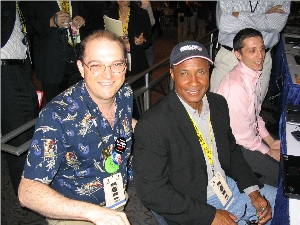 Former Pittsburgh Steeler receiver and Hall of Famer Lynn Swann has decided to enter politics, and as typical of Swann, he isn't aiming low. Swann announced the formation of a campaign committee for the Pennsylvania governorship in 2006, hoping to unseat incumbent Democrat Ed Rendell:
Former Pittsburgh Steelers star Lynn Swann has formed a campaign committee to raise money for a potential run for governor in 2006.Swann named his committee Team 88, the number he wore as a wide receiver for the Steelers from 1974 to 1982, when the team won four Super Bowls.
"I will spend time introducing myself to communities across the commonwealth," the NFL Hall of Famer said in a statement Wednesday. "We will also explore the potential political and financial support for my candidacy."
Swann hardly needs an introduction to Pennsylvanians. As a member of the Steelers dynasty, Swann helped Pittsburgh win an unprecedented four Super Bowl championships in six years, a feat only the current New England Patriots threaten to match. However, most Pennsylvanians may not realize that Swann has an interest in politics, nor of his Republican affiliation. While I don't live in Pennsylvania, I have been a huge fan of Swann and the Steelers since I was a small boy, and Swann surprised me when he showed up at the Republican National Convention. Swann was gracious enough to pose for two pictures with me, as I wanted to make sure I got at least one good one for posterity.
While I still have no clear idea of Swann's politics, his affiliation with the GOP has me very excited about his ability to connect with Pennsylvania voters. Right now Quinnipiac has him down 16 points to Rendell, who ekes out a bare 50% against a man who most people would consider a political cipher at this point. Swann has an opening in which to define himself to voters who will already be predisposed to liking him, and his entry may help attract black voters who want a change from decades of the handouts and hearing loss the Democrats give them.
Best of all, Hugh Hewitt will have to learn to love the Pittsburgh Steelers. A perfect world will truly have arrived!
The Spectre Of Specter Rises Again, And Again
Ruth Marcus in today's Washington Post notes that Senator Arlen Specter has hardly mellowed after the compromise that left him in his Judiciary Committee chairmanship or with the recent diagnosis of Hodgkin's Disease. In a visit with the Post's editorial board yesterday, Specter appears to have backtracked significantly on his agreement with the GOP on President Bush's judicial nominations, in spirit if not in fact:
If you thought that his brush with losing the committee chairmanship had chastened the legendarily contrarian Specter, if you thought his recent diagnosis of Hodgkin's disease might have tempered his approach -- well, that wasn't the Specter on display in a visit with The Post editorial board yesterday. Instead, the discussion featured Specter Unbound: the Specter who voted against Robert H. Bork rather than the one who rallied to the defense of Clarence Thomas.Specter had some cautionary words for Democrats as well -- chiding them for opposing qualified nominees such as Miguel Estrada, urging them to allow votes and avoid an ugly showdown, and placing blame -- properly so -- on both sides for inflaming and escalating the judicial nomination wars. For two decades, he said, Democrats and Republicans have been blocking the other side's judges, using increasingly unappetizing tactics. "Now," he said, "it's a situation where nobody wants to back down." Still, he reserved his toughest words for the extremists of his own party, pressed for accommodations from his own side and made clear that his cooperation with the administration would have its limits. All he had promised the president, Specter said, was a "prompt airing" for his nominees and a vote out of committee. "Those are the extent of my commitments," he said flatly.
Marcus leaves little doubt that she likes this Specter persona much better than the one who capitulated to the White House to save the assignment he cherished late last year. She lauds his independence as what "the country needs," and speaks approvingly of his insistence on having his aides pop the little tab on his coffee cup so he doesn't have to be bothered with such proletarian tasks. In fact, in the same breath, she calls him "serious", while that little detail about the way he treats his subordinates as butlers and maids sounds as though he has a serious case of self-love.
Apparently, Specter felt in his element with the Post's editors, as Marcus quotes him attacking the "far right" by deriding their Christianity:
His post-election comments that a Supreme Court nominee who opposed abortion rights was not likely to win Senate confirmation was reported as a warning to the president, and the groups that had hoped to unseat the moderate Specter in favor of a more conservative Republican then mobilized in an effort to deny him the chairmanship. Or, as Specter not so diplomatically put it, "the far right was ready to pounce on me if I'd done nothing but said the Lord's Prayer, and that was a crevice and they went after it."
And just to complete the picture of Specter sucking up to the center-left at the expense of the GOP, Specter let the Post know that he has no enthusiasm for the so-called "nuclear option" eliminating filibusters when dealing with executive-branch confirmations, including the judiciary:
But yesterday, though he said he had not yet taken a position on the nuclear option, Specter made clear his serious reservations about infringing on the traditional rights of the minority. "Once you plant the seed, that has enormous flourishing power in the Congress," he said. And when asked whether filibustering a nominee is ever justifiable, Specter paused for several seconds before delivering a lengthy answer that boiled down to yes: "It ought to be reserved for a truly extraordinary case and not to make it an everyday practice as the Democrats have."
So this is what Bill Frist won for the GOP -- a Judiciary Committee chair that openly derides the party base and refuses to support Frist on dismantling the unconstitutional roadblocks Democrats erected to block judicial nominations? Obviously Specter learned nothing from his hot-water episode last year and goes out of his way to make sure everyone knows it. Marcus practically laughs out loud with delight throughout her entire piece, clearly thrilled that Specter wants to buck Republican leadership and feels strong enough politically to do so in an on-the-record meeting with the Post.
So what to do next? Bill Frist needs to get his butt out of his chair and hie thee hither to Specter's office forthwith. The GOP leadership needs to make a decision, along with the White House, as to what their legislative priorities are this session. For many of us, judicial nominations are the first and most pressing priority, especially with the certainty of one Supreme Court nomination this year and possible three in this session. If the GOP also believes this to be a pressing issue, then they obviously have the wrong man as Judiciary chair, and they need to determine how best to correct that situation.
Marcus praises Specter's intelligence and independence, but Specter wasn't above getting Bush to campaign for him during his tough primary fight against a true conservative. That doesn't mean Specter should simply rubber-stamp whoever Bush nominates, but these comments go far beyond retaining his moral privelege. They demonstrate a particular contempt for the people who helped elect him as well as the people who continued to support him. While I argued earlier that the GOP should reach some sort of accommodation with Specter, it appears that Specter isn't the kind of man who honors such agreements.
It's time to exercise the nuclear option with Specter.
Syria Begins Backpedaling, Hoping To Retain Influence In Lebanon
Syria has reacted with surprise to the eruption of criticism and scorn towards their occupation of Lebanon following the assassination of Rafik Hariri, and now wants to follow a 16-year-old plan for phased withdrawal of its troops. Reuters reports that Syria's defense ministry is now expressing "keen interest" in complying with UN resolutions calling for the end of the Syrian occupation:
Tens of thousands of Lebanese have taken to the streets to protest against Syria's military and political grip on its tiny neighbor since a huge bomb killed Lebanon's former prime minister Rafik al-Hariri in Beirut last week."Syria expresses its keen interest in cooperating with the envoy of the secretary-general of the United Nations to accomplish his mission in the best formula possible," Mualem told reporters, reading from a statement.
"The important withdrawals that have been carried out so far and will be carried out later will be done in agreement with Lebanon against the backdrop of the Taif Accord and the mechanisms it entails," he said.
The Taif Accord has largely been forgotten by both the Syrians and the UN as Syria stubbornly hung onto its vassal state in order to prop up Hezbollah in its proxy war against the Israelis. Now, however, Syria faces massive demonstrations on the streets of Beirut and a coordinated effort from France and America in accounting for its extended oppression of the Lebanese. Even the deputy defense minister expressed his surprise that these calls for Lebanon's independence have come outside the framework of the UN -- another indication that despots count on Turtle Bay for their political cover:
Mualem said both officials and ordinary Syrians were surprised by the "media and political escalation that came before the completion of the mission of the U.N. envoy."
Jim Geraghty at TKS has more on the assassination which might explain the impulse to finally bypass the UN to resolve Lebanon's status:
Last night I spoke to a very smart guy who follows Lebanon-Syria issues closely about the Rafik Hariri assassination and various Middle Eastern issues.First, a couple of details about the bomb that killed him. It used something in the neighborhood of 650 pounds of TNT – not the kind of bomb that a bunch of amateurs can easily assemble in a basement.
The crater was centered in the middle of the road, indicating the bomb was likely placed under the street and not in a parked car.
The bomb was placed at curve, where the motorcade would have had to slow down. The assassins obviously had to know Hariri’s schedule and the route he would be traveling. The Syrian-backed Lebanese government security forces were ‘responsible’ for Hariri’s safetly, and would have that information.
Hariri’s motorcade included jammers designed to disrupt signals that could detonate a bomb, gadgets that usually interfered with cellular phone reception in the surrounding area. Somehow, the bombers either used a wire-triggered bomb or had gotten their hands on a counter-device placed in a nearby vehicle.
All of this and more add up to state sponsorship, and since Syria had tactical and political responsibility for Hariri's security, it looks like Syria knocked him off, for whatever reasons. Apparently the Lebanese people agree; the notoriously fractious and diverse populations have united to call for a complete withdrawal of both Syrian military and intelligence personnel as well as the resignation of the current pro-Syrian government in Beirut. Syria and the current Lebanese government both question Lebanon's ability to secure its own borders, but Hariri's assassination shows that having Syria and Hezbollah as security agents only put Lebanon under the terrorists' thumb.
France and the US needs to keep the heat on Syria and force the immediate withdrawal as well as the disarming of Hezbollah, although the latter will likely leave with their Syrian sponsors. When tyrannies fall, their collaborators almost always wind up against the wall in their wake. The Syrian offer to take up a withdrawal agreement sixteen years dead demonstrates the desperation of the Assad regime to hang onto a toehold in Lebanon, a desperation that belies a fundamental insecurity about the future of their own regime in Damascus should Lebanon escape their clutches.
Further Thoughts On Schiavo
After reading your comments and e-mails from last night and this morning, I want to make a couple of points more clear. One, the reason I don't get into the details of the Schiavo case is because, as you can see from the comments section here and the e-mail I've been getting, most of them are hotly disputed and not easily reconcilable. I'm taking a more philosophical approach because that's where I'm most comfortable. Again, what this boils down to is a family dispute over both Terri's condition now and her state of mind before she became comatose. Both sides have legitimate and valid points on these issues, and they're further complicated by the lack of clear instructions from Terri herself.
Under these circumstances, where the parents have essentially agreed to take over primary care of Terri, I tend to sympathize more with them and on the side of life than I do with the husband and its termination. However, as a married man, I understand that spouses share intimite information such as quality-of-life decisions that they wouldn't necessarily share with their parents. If what her husband says about Terri's philosophy is true, bailing now and leaving her in a PVS state (if that's truly what it is) would be a betrayal.
And so on, and so on. This is a family dispute with societal implications, but at its heart it is a family dispute with no clear resolution. I'll pray for God's will to be done, either way, and that he peace and justice to Terri's family.
Second, most of the critical e-mails I have received have not been as rude as to imply that I personally was killing Terri with my silence. However, most of them asked me why I didn't post about this topic while the past two weeks it's been Eason Jordan Express at CQ ("Get yer fresh Eason's Fables! Red-hot Jordans heah! Fresh posts, 24-7!"). That's a fairer question, and it has to do with a couple of reasons why I blog in the first place.
The Schiavo case has received tremendous publicity and coverage from all media outlets, and most of that coverage has been fair and balanced, at least from my point of view. Both sides have gotten their stories told, and Terri's parents have been able to exert enough media pressure to get the Florida legislature and government to pass legislation specifically on Terri's behalf. While the details have been hotly disputed, at least they've made it into the mainstream media.
Now compare that with Eason Jordan. Here we have the chief of CNN, one of just a handful of media conglomerates who deliver that information to you, making allegations of American soldiers deliberately assassinating and torturing journalists not once, but repeatedly, and always out of earshot of Americans. The other few national/global media outlets refuse to report the story, not even when it involves two prominent American politicians. For two weeks, the only way the American public got any news (let alone details) of Jordan's slander was through bloggers, and not just me.
Jordan's comments not only damaged the reputation of our men and women fighting overseas, they made their jobs more dangerous, thanks to Jordan's inflammatory rhetoric. He made these McCarthyite charges without any evidence of truth, and as the leader of CNN, that makes one wonder (especially after the Tailwind fiasco and Jordan's own admission of selling out CNN to Saddam for access to Baghdad) whether CNN reports truthfully at any time, including on the Schiavo case.
Nor was Jordan the only issue. Where was the rest of the media while Jordan engaged in rumormongering overseas? After all, if what Jordan said was true and CNN wasn't going to report it, why not NBC, or CBS? Don't they exist to report news, especially when it impacts Americans? Apparently not when it comes to media management and their biases and anti-American posing for overseas dollars.
I'm more interested in stories and perspectives that don't get the kind of exposure their competing perspectives do in the media. I don't intend on writing much about the Michael Jackson trial, either, but that doesn't make me insensitive to child molestation. I didn't write a single word (that I can recall) about Scott Peterson's trial, either, but killing a pregnant mother and an unborn child has more moral clarity and implications than either the Jackson or Schiavo cases -- but all of the relevant information has already been reported, and was being repeated ad nauseam.
In the end, I write about that which both interests me and inspires me to comment, and I try to limit that to intelligent commentary with some depth, rather than simply point to a story and say, "Go read this." In the case of Terri Schiavo, that story has not only gotten plenty of attention already, but it revolves around an almost unresolvable dispute between family members. So again, I will pray for God's will to be done and for peace to all involved when it is fulfilled. Hopefully, this will make my position a little easier to understand.
Wead Slinks Off-Stage
Doug Wead, who surreptitiously taped phone conversations with George W. Bush over a period of two years and began selectively releasing them this week, has had a sudden change of heart after receiving overwhelming, and justified, criticism. Wead now says he'll give the tapes to the White House and has begun cancelling media appearances, according to the New York Times:
"My thanks to those who have let me share my heart and regrets about recent events," Mr. Wead wrote in the statement, posted on his Web site Wednesday. "Contrary to a statement that I made to The New York Times, I know very well that personal relationships are more important than history."Mr. Wead, an author who drew on the tapes obliquely for one page in his recently published book, "The Raising of a President: The Mothers and Fathers of Our Nation's Leaders," said, "I am asking my attorney to direct any future proceeds from the book to charity and to find the best way to vet these tapes and get them back to the president to whom they belong."
Some had noted that the tapes revealed by Wead to two Times reporters revealed little that damaged Bush, and indeed may have affirmed his sincerity as a politician and a Christian. A few thought that the entire exercise may have been engineered to send a warning to the Bushes, however, that Wead had more salacious information that he was withholding. The Times notes towards the end of the article that in the excerpts they heard, Wead pressed Bush for a place on his campaign staff but was repeatedly rebuffed. However one wishes to spin Wead's actions, though, one fact comes through very clearly: just the act of recording these conversations surreptitiously demonstrates a perverted sense of ethics and certainly shows that Wead, despite his protestations above, values his own pocketbook more than personal relationships.
This is best demonstrated by his interview with the Times regarding the withdrawal of the tapes, in which he expresses his exasperation that people just don't believe him:
In a telephone interview Wednesday, Mr. Wead, sounding noticeably fatigued, said he decided to change course because of "the perception that I have tried to exploit the tapes and make money off of it and hurt the president and had all kinds of agendas.""This seems like the best thing to show that isn't the case," he said.
"Nobody believes my story that I saw him as a figure of history," Mr. Wead said with exasperation. "I guess I have got a story that is unbelievable to people."
He guesses? Gee, I wonder why no one believes poor Doug Wead? It's not like he has a track record of pretending to be someone's friend just so he can parasitically make money off of him later...
Wead cancelled a planned appearance on Hardball for tonight, writing Chris Matthews that he had become a distraction to Bush and wished to stop drawing attention to himself. Matthews, as usual, gets it completely wrong:
"This is a live debate among people who have served high-level people like presidents at close range, whether your duty is to your personal relationship or to history," Mr. Matthews said. "It is a question of loyalty versus truth."
In the first place, Wead did not "serve" Bush; he posed as a friend to get access to Bush, which is completely different. Second, Wead did not express any desire to write Bush's biography or memoirs, nor did he establish his relationship with Bush on any kind of journalistic principle. Bush befriended him based on familiarity with his father's administration and their shared interest in Christianity. Third and most importantly, Wead didn't serve truth by wiretapping Bush in the two years prior to his election as President. Wead served his own interests and his own pocketbook.
While Wead may have mitigated the outcome somewhat by turning over the tapes to Bush, it doesn't change the fact that taping their conversations in the first place reveals Wead to have a low character, and his continued rationalizations confirm that he's a lot sorrier that we don't appreciate his genius than a realization he did something wrong.
February 23, 2005
Schiavo Case Points Out Spiritual Death Of Modern Society
I have received a ton of e-mail the past two days, mostly from people I don't know, scolding me as one of the "big guns" of the blogosphere for not posting on Terri Schiavo and the plight of her family. Some have even gone so far as to imply that if she dies, her death would be my fault for not having posted about the case. I cannot tell you how rude and wrong that is, for in the first place, I am not a member of the Terri Schiavo family, and that's where this decision belongs. Second, I blog -- I am not God, and neither are the rest of you. Some people need to get a grip, for goodness' sake.
As a Catholic, I believe in the sanctity of life, which means I naturally sympathize with the parents of Schiavo, who want nothing more than to keep their daughter alive. Under the law, however, her husband is the next of kin and has the presumption of speaking for Terri when she is unable to speak for herself. He has insisted that she doesn't want to be kept alive while living in a persistent vegetative state (PVS). Unfortunately, he has other reasons for insisting on this besides anything his wife might have told him -- a bunch of money in a trust fund, for one thing, and a girlfriend as well.
Who can really know the will of Terri Schiavo? The three people closest to her tell diametrically opposed stories, and the rest of us have no clue. If it was an issue for her, she could have written a Living Will or left some sort of written instruction for the courts. I suspect that like most of us who have not been hospitalized, she simply never gave it much thought -- which is another reason I tend to sympathize with the parents and on the side of life.
But that's not really the issue, nor is Terri specifically. The issue is a society that treats its infirm and inconvenient as unnecessary burdens, weights that can simply be tossed in the trash as easily as fast-food wrappers. We abort babies by the truckload because they complicate our lives. Some of them get tossed into dumpsters after having reached birth. We execute prisoners because it's supposedly more cost-effective to do so, even though they inevitably eat up years and years of courtroom time on almost-endless appeals. The suicidal get heroic treatment in movies and real life, with ghouls like Jack Kevorkian lauded and feted and, after getting locked up, becoming a minor celebrity cause.
When did life get so cheap? When were humans reduced to commodities?
If people want to save Terri Schiavo and others like her, that's where we should start. We need to get a definition of life that makes sense and honors its sacred nature. If we cheapen life to simply its utilitarian value, we run the risk of losing not just one Terri but all of the Terris who struggle for life and the tender touch of their families.
Until that happens, the laws of Florida will wind up applying to Terri's case. I suspect that the courts will honor the wishes of her legal next of kin, Michael, rather than the more reasonable position of her parents. The Florida legislature and Governor Jeb Bush have done what they could to influence that decision, but in the end it wasn't enough.
I'm praying for Terri Schiavo and her parents. I'd encourage all of the bloggers and blogreaders to do the same, and to get people to take another look at the Groninger Protocol society we seem to be creating.
For more in-depth reporting on this, please check out Blogs for Terri (hat tip: Michelle Malkin).
Does Tony Blair Want To Be The British Putin?
The Telegraph reports tonight that Tony Blair has pushed through a new bill granting extraordinary emergency powers to the Home Secretary that allows the executive branch to hold terrorist suspects for weeks without any due process or judicial review. Conservatives howled and Labour MPs began to defect as Blair argued that civil liberties would have to take a back seat to security:
Protecting Britain against a terrorist attack must take priority over civil liberties, Tony Blair states today.Writing in The Telegraph, he mounts a strong defence of the Government's decision to take powers unprecedented in peacetime to curtail the activities of British citizens and foreign nationals suspected of terrorist activities.
During last night's Commons debate on the Prevention of Terrorism Bill, Charles Clarke, the Home Secretary, disclosed that the Government was braced for an attack during the election campaign.
Emphasising that it needed the ability to "move rapidly" against terrorists, he said: "The Madrid atrocity took place during the Spanish election campaign and it may be that such things can also be possibilities here too."
The Home Secretary didn't do a great job of convincing MPs of the necessity of suspending civil liberties, regardless of the high level of threat the UK believes it faces in its upcoming election. Labour lost over half of its gap over the Tories in Parliament. His own party made references to apartheid in speaking about the bill, while others noted that the government already had the power to detain terror suspects for fourteen days without a judge. Blair argued in his editorial that the new bill only allows for seven days before an arrest gets forwarded to a High Court judge.
Without seeing the bill, it's difficult to know exactly how much this impacts on British civil liberties. However, I am struck by the rhetoric coming from Labour's leader on the issue of civil liberties. Can you imagine the outcry from Democrats or Republicans here if the head of state tried to sell a new criminal process by telling Congress that America should put safety ahead of civil liberties? We still have people crying about the Patriot Act, and all that did was to allow intelligence gatherers and law-enforcement agents to share information and for investigators to use the same processes four counterterrorism that are alreay allowed for child-pornography and Mafia cases.
The British don't sound particularly enthusiastic about Blair's newest anti-terror initiative. While I am usually a supporter of strong enforcement of our laws governing terrorists, I don't much care for the elimination of habeas corpus.
Putin May Have More Problems On Horizon
One of the closely-watched aspects of George Bush's European diplomacy has been his relationship with Russian president Vladimir Putin. Prior to his latest trip to the continent, critics wondered if Bush would press Putin to return democracy to Russian politics, and were surprised when Bush publicly and pointedly did so. However, the London Telegraph reports tonight that Bush's advice may have come too late, as Putin faces new pressures at home that threaten to undermine his increasingly autocratic rule:
Once known as the Teflon president for his deft handling of public opinion, he is increasingly seen as a ham-fisted leader who is out of touch with the needs of ordinary Russians.In the past two months hundreds of thousands have demonstrated throughout Russia to denounce the president's policies, the largest protests in the country for more than five years.
His popularity in the army and police - formerly mainstays of his support - are reputed to be falling. In a panicked attempt to plug his leaking support, the president ordered army salaries to be increased by 20 per cent and police pay by up to 50 per cent.
But such measures will hurt an economy that has already lost some shine and could further fuel demands by millions of other Russians for a greater slice of the pie.
We have heard little about Russia's internal tensions as opposed to Putin's slow slide into authoritarianism, but the Russians have not stood by silently. Putin has not completed his transformation into a dictator, and before the window of opportunity closes, it looks as though some Russian politicians intend on stopping the process. One former Putin protege and the leader of Russia's largest political party called Putin a "tsar" and asked why anyone should keep pretending that Putin is doing any good.
Under these circumstances, one might understand better the recent diplomatic record of Putin. He can't afford to eschew the Iranian mullahs' moolah; he needs their money to pump up his sagging economy and pay off the army and police to keep supporting him. If that means arming a bunch of lunatic Islamists with nuclear weapons, well ... as long as Putin keeps the chuck wagon on time, I guess that's just fine.
Pressure Builds On Syria
President Bush kept the heat on Syria, Reuters reports, and he had plenty of help as well. Protests have continued in Beirut, calling for the withdrawal of Syrian troops from the Mediterranean country, and France joined the chorus. Even Hosni Mubarak in Cairo gets the message:
President Bush demanded Wednesday that Syria pull its security services as well as its army out of Lebanon, echoing France's remarks that Syrian intelligence controlled the country. ...In Beirut opposition deputies, riding high on mass protests against Hariri's killing over the past week, piled on the pressure, saying they would try to topple the Syrian-backed government in parliament and calling for a one-day national strike next week.
"Opposition MPs confirm that they will seek a no-confidence vote in the government during (the Feb. 28) general assembly meeting" called to discuss the assassination, they said in a statement after a meeting of 38 MPs.
The Lebanese sense something in the air in Beirut, and it has the aroma of collapse. The UN had demanded action from Syria but did nothing to ensure it, and Syria has long felt reasonably safe by claiming it needed to secure Lebanon as a bulwark against Israel and to keep a lid on the civil war. Those excuses were good enough for the Arabs, and no one else particularly cared about the Lebanese enough before now to make a bigger issue of it.
Now, however, two events have given the momentum to the democrats and nationalists in Lebanon. The first was the liberation of Iraq and their successful election, which showed the Lebanese that we meant business about transforming the region through democracy. The second was the insane assassination of pro-liberation and beloved statesman Rafik Hariri, who had planned on running for office on the issue of Syrian withdrawal.
Whether or not Bashar Assad had anything to do with that murder -- and it's hard to see how he couldn't -- the effect has been devastating. It eliminated the notion that Syria provides security for the Lebanese government to operate independently, and it gave all of the factions in Lebanon except Hezbollah (Syria's proxy terrorists) a martyr to Lebanese nationalism. That has driven Mubarak to send his most trusted "fixer" to Beirut to find a way out of Lebanon for Assad:
"Something has to happen because the situation is difficult now and (Syria) won't be able to stand against the pressures of the international community," Mubarak told reporters in Egypt's Red Sea resort of Sharm el-Sheikh."But we must find solutions."
That message was meant for Assad, and translated it means -- your time is up. We'll do what we can to make it look good, but you're going to leave Lebanon one way or another, and PDQ.
First Mate Update, Day 3
I've received a number of requests for an update on the First Mate, now that she's home and recovering from the surgery. She's had her share of difficulties, most of them minor. She got motion sickness on the way home and her stomach still hasn't fully recovered from that. She's taking Compazine for the nausea, which does help some with maintaining her fluid intake, but she has little appetite, which the doctors say is normal. When she does eat, her digestion is erratic and we've tended to overcorrect for it, which we need to take care not to do.
However, she's very upbeat even when she's low on energy, which still is almost all day. The biggest story -- note how I buried the lead? -- is that the FM hasn't had to get an injection of insulin since Sunday. Her pre-meal blood sugars have not gone above 150, and only above 110 once since she's been home. Her diabetes seems to have disappeared nicely, although we haven't seen what a decent-sized meal might do to her profile. She sprinkled a little powdered sugar on a piece of French toast and added a couple of sausages for her breakfast this morning, which she finished, and for lunch her BGL was 93. Perfect!
Again, Marcia wants to thank all of you who keep writing and praying for her during her recovery. Don't forget to add Kevin McCullough's mother-in-law to your prayer list while you're at it, too.
Success Is When All The Right People Hate You
My good friend Jon Henke at QandO (the essential libertarian blog, BTW) tips me that my blogging career has reached new heights. First I reached five million hits this week, CNN and C-SPAN mentioned my blog on the air, and now I have truly achieved success -- I have annoyed Ted Rall:
Bloggers want you to know that there's a new sheriff in town. Edward Morrissey, writer of the right-wing blog Captain's Quarters, boasts to the New York Times: "The media can't just cover up the truth and expect to get away with it--and journalists can't just toss around allegations without substantiation and expect people to believe them anymore." And what are Morrissey's qualifications to police the media? When he's not harassing old-school journos like Dan Rather and CNN's Eason Jordan out of their jobs, Morrissey manages a call center near Minneapolis.
What qualifications does Rall have to write opinion columns for Universal Press Syndicate? He draws cartoons -- badly -- and expresses opinions similarly. I don't pay much attention to him as a rule, as he generally makes almost no sense whatsoever, and this column is a perfect example. For instance, he excoriates "gay GOP blogger" Andrew Sullivan without apparently knowing that Sullivan blogs as a sideline to his job as a syndicated columnist, not unlike Rall himself. He claims to have been libeled by Sullivan but lacked the funds to sue him:
My jaw dropped when gay GOP blogger Andrew Sullivan accused me in 2003 of "urging the murder of American troops in defense of Islamist terrorists." Of course I'd done no such thing, and he knew it. If I had had the ready cash I would have slapped the lying bastard with a richly-deserved libel suit. Incredibly, Time magazine hired Sullivan to write a column.
Uh-huh. If Rall had a case, he wouldn't have needed much cash to go after Sullivan; almost any lawyer would have taken Rall as a client on a contingency basis. I also see that he has no clue about the most central blogger, Glenn Reynolds, whom he labels as a right-winger even though Glenn only really supports Bush on foreign policy. Then again, anyone to the right of Dennis Kucinich qualifies as a reactionary fascist to Rall.
When Rall first heard about blogs, he recounts, he rejoiced for the free speech it encourages. However, when people like me exercise speech he dislikes, suddenly he fears and loathes the blogosphere:
As a free speech fan, my initial reaction to the blog explosion--there's a new one born every 7.4 seconds--was delight. If you've been interviewed for a newspaper article you've probably had the experience of being misquoted or taken out of context, or at least had your name misspelled. If reporters get these basics wrong, how can we trust them when they tackle the big stuff? Moreover, the mainstream media is an ivory tower. Anyone who has tried to call a paper to complain has suffered through phone-tree hell before possibly wrangling out the limited satisfaction of a two-line correction on page 83 beneath the obituaries. But now anyone with access to a computer can, with the proper string of ideological comrades in cyberspace, call the mainstream media to account."I think the relation is more symbiotic than parasitic," writes Glenn Reynolds of the right-wing blog Instapundit. "Bloggers are more like the fish that protect sharks from parasites." Bloggers, fierce new watchdogs of the fourth estate, claim they're democratizing American journalism.
It all sounds great--until you read them. Once you spend some time surfing this ocean of likeminded righties, however, you realize the awful truth: the "populist" blogosphere is cowing the mainstream media even further into submission to the powers that be.
So his problem is that he expected bloggers to exist only to agree with his radical beliefs. Of course, that's Rall's idea of free speech. He can criticize anyone he likes, including me, but when people criticize Eason Jordan for making unsubtantiated allegations of assassination strategies about our military, all of a sudden it's McCarthyism. (I notice that Rall does the same thing, but Rall doesn't run one of the largest news organizations in the world.)
Rall, as usual, rants incoherently about how we're ideologically disinclined to hold journalistic "conglomerates" accountable right after we've done exactly that with CBS (Viacom) and CNN (Time Warner). Unfortunately, Rall appears ideologically unable to coexist with the truth, but as anyone who has had the unpleasant experience of reading Rall in the past knows, that condition appears incurable in his case. Rall doesn't really even have enough of a connection to reality to enrage; he just provides amusement, like a crazy old uncle locked in his rec room, typing and muttering about all of the people out to get him. Too bad he's not important enough for it, and that he doesn't even know it.
UPDATE AND BUMP, 2/23: Welcome, Instapundit readers -- and big thanks to Chris Muir, who gave me a better taste of immortality than Ted Rall. Be sure to read Day by Day, every day!
UPDATE II: Thanks to Michelle Malkin, a good friend who has been tremendously supportive. Thanks also to another good friend, Salem Radio host Kevin McCullough, who posts:
Does Rall realize that when he says such things that he sets up enmity between himself and thousands of "working class" in doing so? Does he realize that it is ok for the "working class" to have opinions? Does he know that it is legal, and ethical, and a constitutionally protected right for the "working class" to express those opinions - be they on blogs or otherwise?If Rall is trying to be an elitist who portrays himself as being bigger and more self-important than the people he draws his sad cartoons for - then he is keeping a brisk pace in getting on his way.
Kevin's mother-in-law, by the way, is recovering from brain surgery and could use your prayers. Drop him a note of support while you're there. (Updated update: It wasn't a stroke, as I had written earlier, and it's his mother-in-law.)
Tranformative Power Of Democracy, Part III
Jim Geraghty of TKS notes this auspicious quote in today's David Ignacius column in the Washington Post:
The leader of this Lebanese intifada [for independence from Syria] is Walid Jumblatt, the patriarch of the Druze Muslim community and, until recently, a man who accommodated Syria's occupation. But something snapped for Jumblatt last year, when the Syrians overruled the Lebanese constitution and forced the reelection of their front man in Lebanon, President Emile Lahoud. The old slogans about Arab nationalism turned to ashes in Jumblatt's mouth, and he and Hariri openly began to defy Damascus...
"It's strange for me to say it, but this process of change has started because of the American invasion of Iraq," explains Jumblatt. "I was cynical about Iraq. But when I saw the Iraqi people voting three weeks ago, 8 million of them, it was the start of a new Arab world." Jumblatt says this spark of democratic revolt is spreading. "The Syrian people, the Egyptian people, all say that something is changing. The Berlin Wall has fallen. We can see it."
I keep talking about the transformative power of democracy as the one strategy that will topple the tyrants of the Middle East and allow for true peace, rather than temporary stalemates. The neocons have it right; the only way to achieve victory over terrorists is to deprive them of state sponsorship from the kleptocracts and mullahcrats in Southwest Asia and North Africa. The only way to get that is to topple the tyrants and push for self-determination and freely elected governments, and it only takes one or two examples in the region before everyone there starts wondering when their turn will come.
Lebanon may soon stop wondering, and that will be a day of rejoicing.
Virginia Jihadi Plotted To Kill President
In what should be considered an act of treason, an American citizen has been charged with several counts of conspiring to assist al-Qaeda in terrorism. If that wasn't bad enough, the indictment also alleges that Ahmed Omar Abu Ali planned to assassinate the US president by using a car bomb or sniping him on the street:
Federal prosecutors unveiled broad terrorism charges yesterday against a Northern Virginia man who had been detained in Saudi Arabia for nearly two years, accusing him of plotting to assassinate President Bush and trying to establish an al Qaeda cell in the United States.Ahmed Omar Abu Ali, 23, conspired with confederates in Saudi Arabia to shoot Bush on the street or kill him with a car bomb, according to a six-count indictment unsealed yesterday. The indictment said Abu Ali sought to become "a planner of terrorist operations" and compared him to leading al Qaeda figures associated with the Sept. 11, 2001, attacks.
Ali and his family allege that the evidence of Ali's involvement in AQ all stem from Saudi torturers, and yesterday Ali offered to show the judge his scars to prove their torture. The judge declined, although it will certainly be an issue in his trial, as his attorneys promised. The family had tried for almost two years to get Ali out of Saudi hands, claiming that the US wanted the Saudis to interrogate him there instead of American interrogators here so that physical coercion could be freely used. However, as the Post points out, Ali's arrest in Saudi Arabia came as a result of terrorist attacks there:
Abu Ali was studying at the University of Medina when Saudi authorities arrested him and 18 or 19 other men suspected of having connections to people involved in the May 12, 2003, bombing of three Western residential compounds in Riyadh. The bombing killed 23 people. The men were believed to be a jihadist cell in training, U.S. officials have said.
The US probably had no problem with the Saudis pressing their own case against Ali in Riyadh. The Riyadh bombing killed Westerners, including Americans, but the attack took place in Saudi Arabia, after all. The May 12th attacks forced the Wahhabist kingdom to re-evaluate its relationship with radical Islamism after, as the saying goes, the chickens came home to roost. Unfortunately, the case stalled, and American officials decided to press its own case against Ali instead.
A few of the news reports on the case have mentioned that Ali was a stellar student in America, and had even been valedictorian of his class. The Post also mentions this, although they get a bit more specific:
Abu Ali was born in Houston and moved to Northern Virginia at age 4. He attended the private Islamic Saudi Academy in the Alexandria section of Fairfax County, a school for grades K-12. He graduated as valedictorian and briefly attended the University of Maryland before going to Saudi Arabia to pursue religious studies.
CQ reader and frequent contributor Blank:NoOne sent along his perspective about the Islamic Saudi Academy:
I have read innumerable articles about the 'valedictorian' who is accused of planning to kill the President. I mentioned the story to some in-laws in the DC area....and they exclaimed (much to my surprise) that, "Yeah, valedictorian of Terrorist High" He wasn't valedictorian of Pleasantville High School, he was valedictorian of 'The Islamic Saudi Academy" of which there is lots of dirt including their former comptroller being tied to terrorists while taking footage of area bridges and outrage at the hate spewed in their textbooks.
That prompted me to do a quick Google search on the school, and I didn't come up empty. The Washington Times wrote in August 2004 about problems with the academy's curriculum, noting that both CAIR and the Free Muslim Coalition Against Terrorism (not exactly normal allies) called for the removal of textbooks designed to foster Islamic hatred against outsiders:
Two Islamic groups say a private Saudi school in Alexandria is teaching first-graders an extreme version of Islam that fosters contempt for other religions, a charge denied by the Saudi government, which creates curriculum for such schools.The Council on American-Islamic Relations (CAIR), a District-based Islamic civil rights and advocacy group, has joined with the Free Muslim Coalition Against Terrorism in calling for an Arabic textbook to be removed from classes at the Islamic Saudi Academy.
One page in the manual for the first-grade textbook instructs teachers to tell students that any religion other than Islam is false.
At JihadWatch, the school is well-known for its radical politics. It points to a Washington Post article from 2002 (scroll down) that outlines how the academy lost accreditation with an association of private schools:
The Saudi Islamic Academy has withdrawn its membership from a respected association of private schools in Virginia and has lost its accreditation with the group after the organization asked questions about how the academy is funded and governed, sources close to the decision said. ...Sources familiar with the decision said the Virginia accrediting agency became concerned that the school was not adhering to its standards on funding and governance and asked questions earlier this year. The association's standards require that the governing board be independent, that the administration be stable and that funding not come primarily from a single source.
The Saudi academy has in recent years had significant turnover in administration and teaching staff. It has a governing board that is headed by the Saudi ambassador to the United States and says much of its funding comes from the Saudi government. The ambassador, Prince Bandar Bin Sultan, used to send his children to the school but withdrew them a few years ago. ...
The sources also said that some board members were concerned about aspects of the school's curriculum. The Washington Post in January reported that some Islamic studies classes at the school use Saudi Arabian textbooks that promote hatred of other religions. However, the curricular concerns were not part of the questioning that led to the withdrawal, sources said.
The Weekly Standard notes the specifics of one issue with curricula at ISA:
The Saudi embassy in Washington was instrumental in creating an American model program for schoolchildren in the Islamic Saudi Academy (ISA, www.saudiacademy.net), located in Fairfax County and Alexandria, Virginia. ISA withdrew from the Virginia Association of Independent Schools in 2002 after an inquiry into its funding and administration, as well as publicity in the Washington Post about the harshness of its Wahhabi curriculum. A February 25, 2002, story in the Post quoted an 11th-grade textbook, for example, to the effect that on the Day of Judgment, the trees will say, "Oh Muslim, Oh servant of God, here is a Jew hiding behind me. Come here and kill him."The same article reported that "several students of different ages . . . said that in Islamic studies, they are taught that it is better to shun and even to dislike Christians, Jews, and Shiite Muslims." One teenager told the Post, some teachers "'teach students that whoever is kuffar [non-Muslim], it is okay for you' to hurt or steal from that person." But the embarrassment apparently was fleeting: Early in 2003, ISA received clearance from Loudoun County, Va., to construct an $80 million complex on 100 acres. ISA spent $27 million in the decade 1984-94, and reported a student body of 1,300 in 1999.
Small wonder, then, that the valedictorian of such a school wound up associating himself with Islamist terror and taking part in conspiracies to murder outsiders. Do you think that after May 2003, the Saudis may have regretted the funding and curriculum choices it made with ISA? It also points to the credibility of Ali's family -- the ones who sent their son to Hatred High in the first place.
Remember these small details when the press regurgitates the valedictorian factoid stripped of its context. Being valedictorian of ISA puts one on the same moral and intellectual level as the junior commandant of the Hitler Youth.
UPDATE: Rusty has much, much more at My Pet Jawa.
Kristof Gets Genocide Right, Cure Wrong
Nicholas Kristof writes powerfully on the genocide that the UN refuses to recognize underway in Darfur. He accurately depicts the intentional slaughter of tribal Africans by the Arab-dominated Sudanese government and their Janjaweed terrorist militia and rightly calls the world to action. Unfortunately, Kristof calls for the same kind of pointless actions that allowed Saddam Hussein to continue his genocides against the Marsh Arabs and Shi'a for a dozen years before the West acted to stop it.
Let's start with what Kristof does right. He bucks the UN and Kofi Annan's miserable cowardice in playing word games in avoiding the term "genocide" by playing word games right back:
The [African Union] archive also includes an extraordinary document seized from a janjaweed official that apparently outlines genocidal policies. Dated last August, the document calls for the "execution of all directives from the president of the republic" and is directed to regional commanders and security officials."Change the demography of Darfur and make it void of African tribes," the document urges. It encourages "killing, burning villages and farms, terrorizing people, confiscating property from members of African tribes and forcing them from Darfur." ...
Certainly there's no doubt about the slaughter, although the numbers are fuzzy. A figure of 70,000 is sometimes stated as an estimated death toll, but that is simply a U.N. estimate for the deaths in one seven-month period from nonviolent causes. It's hard to know the total mortality over two years of genocide, partly because the Sudanese government is blocking a U.N. team from going to Darfur and making such an estimate. But independent estimates exceed 220,000 - and the number is rising by about 10,000 per month.
The document Kristof cites gives direct evidence of deliberate "ethnic cleansing", to use the bloodless term for genocide made popular in the Balkans last decade. If this had floated out of Serbian archives, the world would have demanded immediate action to recuse the (white European) innocents victimized by such a strategy of annihilation. Kristof acknowledges that the document has not been fully authenticated, but does the best he can do. The bigger question isn't whether Kristof can authenticate it, but why the UN hasn't even tried to do so?
Kofi Annan has sat on his hands during the Darfur genocide, in part to mollify the Arab nations that oppose any action against Islamists anywhere in the world, but also in part to avoid giving the United States an excuse to target the Janjaweed. We have our hands full at the moment, but we also know that the Europeans do not. They may not have a lot of military capability, but they have plenty to stack against the Sudanese. The Europeans, who also have deafened the world with their relative silence on Darfur, simply don't want to get involved in military operations against Islamists, regardless of whether that pertains to Iraq, Afghanistan (where they went very reluctantly) or in North Africa.
Unfortunately, neither does Nicholas Kristof. Instead of calling for direct action to save lives immediately, Kristof argues for the same, tire, and discredited methods of showing Western disapproval:
So what can stop this genocide? At one level the answer is technical: sanctions against Sudan, a no-fly zone, a freeze of Sudanese officials' assets, prosecution of the killers by the International Criminal Court, a team effort by African and Arab countries to pressure Sudan, and an international force of African troops with financing and logistical support from the West.But that's the narrow answer. What will really stop this genocide is indignation. Senator Paul Simon, who died in 2003, said after the Rwandan genocide, "If every member of the House and Senate had received 100 letters from people back home saying we have to do something about Rwanda, when the crisis was first developing, then I think the response would have been different."
A no-fly zone? Do the Janjaweed castrate men and rape girls by flying jets above them? I didn't realize that the Sudan had such an advanced Air Force. Sanctions have been in place against the Sudan, which has the added genocidal benefit of denying food and medicine to the same people the government allows to be slaughtered by the Janjaweed. We can freeze the Sudan's assets as best we can in the West, but they have likely already transferred their funds to Eastern banks, especially in Arab nations, that remain friendly and open to Sudan's policies in Darfur.
The only option mentioned by Kristof that even begins to approach a direct solution -- one that actually stops the genocide rather than act as a fine for misbehavior -- is his last, a multinational armed force invading the Sudan and killing off the Janjaweed. Perhaps that can even comprise African armies, instead of the West. However, the UN's recent experience in marshaling armies in the Congo show that introducing them into Darfur will probably just create the same problem going in the opposite direction, or even worse, create even more trouble for tribal Africans in the region. The UN's leadership of peacekeeping forces show both cowardice under fire and systematic rape and plunder during peacetime, especially in Africa.
The only solution to an ongoing genocide is direct, disciplined military intervention conducted by people who have the will to succeed at it. The world waited until Rwanda's genocide was almost complete before even addressing the issue. The UN stood by its sanctions regime for a dozen years while Saddam systematically slaughtered hundreds of thousands of Shi'a (National Geographic estimated millions) and drained the wetlands to kill or disperse the Marsh Arabs that had lived there for centuries, if not millenia. Only direct military action removing Saddam from power stopped the genocide.
Kristof wants us to get indignant, and we should, but indignation by itself solves nothing. Our indignation should lead to deadly resolve to take on Islamofascist genocide and terror against the Sudanese in Darfur. If we can't muster the will to fight terrorists where they slaughter innocents by the thousands as Kristof so rightly points out, then all that indignation is just a cowardly and petty way to feel good about one's self without the messiness of actually doing something to fight the evil it underscores.
Eurocorps Transform Into Vanity Publishers For Dictator
European corporations seeking to do business in Turkmenistan, run for decades by the iron fist of Saparmurad Niyazov, have now taken to vanity publishing to nuzzle up to the man who calls himself Turkmenbashi the Great. Several companies that sell products to the tightly-controlled tyranny have translated Niyazov's "Book of Spirit", the Bible of Niyazov's regime and the book that has replaced almost all others in this Central Asian cult of personality:
The various releases this month of the two-volume "Book of Spirit" -- "Ruhnama" in Turkmen -- are part of an international drive to boost the book's circulation as well as what the government-controlled Turkmen media call a "victorious march around the world" by the author-president, 65, also known in his country as Turkmenbashi the Great.The book contains Niyazov's moral code as well as his philosophical and historical musings. Its translation into 30 languages and publication outside Turkmenistan have been underwritten by international firms doing business in the natural gas-rich Central Asian republic, according to Turkmen media reports, exiled opposition groups and a number of the companies involved that were contacted by The Washington Post.
Human rights groups say the book is at the center of Niyazov's cult of personality and is ravaging educational and cultural life in his country. Almost everyone in Turkmenistan is compelled to study the book and pass exams about it, and the country's libraries have largely been emptied to leave little but the Ruhnama and Niyazov's collections of poetry. This month, Niyazov ordered most libraries in Turkmenistan closed, according to Russian news reports.
"If the Ruhnama were a benign text, like the memoirs of a U.S. president, this would be harmless, but the Ruhnama is the principal instrument for indoctrination and brainwashing in Turkmenistan," said Erika Dailey, a specialist on the country at the Open Society Institute in Budapest. "Companies cannot ignore that and they have to be called to account."
Think of it as "Mein Kampf" without the genocidal implications, another dictator's tome forced on its subjects, and you get some idea of the oppression this "Book of Spirit" represents. As twisted and bizarre as Niyazov's regime has become, the only excuse for publishing anything by Turkmenbashi would be to expose him for the intellectual fraud that he is. However, that obviously is not the point of the various corporations, as the Washington Post reports:
"We sponsored it for inter-cultural understanding," said Arantxa Doerrie, a spokeswoman for Zeppelin Baumaschinen, a German machinery company that translated the second volume of the book and presented it to Niyazov this month. The company plans to distribute the book in Germany, she said."In principle, yes, it is a dictatorship," Doerrie said, "but simultaneously we see that very much is being done to help the people there -- for the infrastructure with the building of streets, for example. That is what we understand. We sell building equipment, so yes, there is a market for us there, but we see our contribution as a way to help the people there."
It sounds as though we're hearing echoes of seventy years ago. Yes, [dictator] certainly has his problems. But the trains run on time and the people don't starve, and besides, he allows businesses to operate freely. Too bad the Germans can't learn from their own history, and apparently neither can the Finnish, the Italians, the Irish, and corporations from a number of other companies that seem content to pursue this rather unsubtle form of brown-nosing.
They're not just shrugging at fascism, which one could argue that a policy of engagement could correct; they're feeding into the personality cult that keeps Niyazov's fascism alive. These corporations have become active enablers of the oppression of the Turkmen people, a sorry state of affairs of which most Europeans probably remain unaware. Unfortunately, the Turkmen people hear about every book launch in great detail, thanks to the Turkmenbashi-controlled media, which plays it up for all it's worth. Niyazov wants every Turkmen to know just how powerful and highly regarded Turkembashi has become, and despair at his inevitability.
Shameless.
February 22, 2005
Sick Hoax Artist Targets Military Families
CNN reports tonight that a sicko has targeted military families in a cruel hoax. An unidentified man has dressed up as an Army officer on at least one occasion to notify a military wife of her husband's death in Iraq, but she was smart enough to see through the ruse:
Military police are investigating a cruel hoax in which a man wearing an Army dress uniform falsely told the wife of a soldier that her husband had been killed in Iraq.Investigators are trying to determine why the man delivered the false death notice and whether he was a soldier or a civilian wearing a military uniform. ...
"Right off the bat, she noticed some things were not right," Whetstone said. "The individual's uniform wasn't correct -- there were no markings or name tags. Plus, the person was alone, and she knew one person does not make (death) notifications."
Whetstone said no similar hoaxes have been reported.
This hoax reminds us, and CNN, of the series of phone calls received by Fort Stewart families from unidentified callers doing much the same thing. Since then, the military briefs the families of those who get posted overseas to make sure they can distinguish the hoaxers. That briefing allowed the unidentified family to realize the man was a phony.
It's hard to imagine the depravity that could cause people to perpetrate such a disgusting fraud. Those who get some sort of thrill from causing grief and misery of those who serve our nation through a spouse or child stationed overseas represent the lowest of the low, a moral devolution so profound that decent people simply cannot grasp the boundaries of its stench. We certainly hope that this incident represents the soullessness of a single deranged individual and not the concerted effort of radical leftists dedicated to undermining the morale of the American military.
Profiles In Canadian Courage
Canada has always been a good friend to the US, and at times have been among the most stalwart of our allies. I for one will never forget the intrepidity and bravery of the Canadian embassy workers in Teheran that rescued six Americans who escaped the Islamist kidnappers in the 1979 hostage crisis. Those Canadians risked death at the hands of the madding Khomeini radicals by smuggling the Americans out of Iran by giving them falsified passports.
Unfortunately, today's version of Canadians seem less than up to the intestinal fortitude of the past generation. Canadian leadership almost qualifies as an oxymoron as the current government plays word games regarding their common-defense policy with the US, trying to play aloof while acknowledging their support for missile defense:
The man chosen by Prime Minister Paul Martin to be Canada's next ambassador to the U.S. has sparked a political firestorm, saying participation in the controversial continental missile defence system is a done deal.It was a day of surprising frankness and dizzying denials Tuesday as Frank McKenna clarified the government's long-standing ambiguity on participation in the missile shield.
McKenna, the former New Brunswick premier, said Canada is already effectively on board and he's not sure what else the U.S. wants.
The answer came almost immediately from an American official: "Outright political support."
And that's the one thing Martin's minority Liberals appear terrified of providing.
So let me get this straight. The government has provided all the technical support necessary for the missile-defense system to work. The Americans acknowledge it. Even the Canadian government acknowledges it. The only action they haven't yet taken is to sign a memorandum acknowledging what everyone already knows.
And they're shaking in their boots about signing a piece of paper that says nothing more than that.
1979 seems like a lifetime ago, doesn't it?
UPDATE: Fresh on the heels of that story comes a new development. The Canadian government has even less courage than previously thought; now it has decided to withdraw its cooperation, in what even the Canada Press calls a "retreat":
Prime Minister Paul Martin will deliver a firm 'no' to Canadian participation in the U.S. missile-defence plan and break a lengthy silence that fomented confusion on both sides of the border.The announcement will come in the House of Commons and end a streak of obfuscation where Martin refused to state Canada's position, a report suggests. The end of that silence - scheduled for Thursday - will also come as an about-face for a prime minister who had repeatedly stated his support for missile defence when he was a Liberal leadership candidate barely a year ago.
In an era where the Islamist state of Iran has decided to build ICBMs that can reach London, forgoing cooperation on missile defense not only leaves the US in the lurch but places Canadian citizens at the tender mercies of the Islamists radicals -- as well as in the direct missile path of a polar shot at America.
The US had warned Canada that a refusal would set back diplomatic efforts at strengthening the North American alliance, and Paul Martin had encouraged us to believe that he would support the missile-defense umbrella. However, Martin's promises could not withstand the ankle-biting within his own party. He has apparently caved in, and we are left wondering exactly how worthwhile any of the rest of Martin's promises are.
At the very least, the Canadians appear very confused and somewhat clueless today. Martin may want to send out a couple of memos explaining what he imagines Canadian policy to be, as his ministers all seem to have different notions of it.
Jaafari In, Chalabi Out
The AP reports that Ahmed Chalabi has withdrawn his name from the Iraqi Prime Minister contest and endorsed Ibrahim Jaafari as the new leader of a free Iraq. Chalabi, whose candidacy had always been considered a long shot, took three days of convincing before agreeing to back the candidate of the top vote-getting slate in the National Assembly elections last month:
Pressure from within the ranks of the United Iraqi Alliance, which won Iraq's landmark Jan. 30 election, forced the withdrawal of Chalabi, a one-time Pentagon favorite, said Hussein al-Moussawi from the Shiite Political Council, an umbrella group for 38 Shiite parties."They wanted him to withdraw. They didn't want to push the vote to a secret ballot," al-Moussawi said.
The 140 members were to put the decision between Chalabi and al-Jaafari to a secret ballot by Tuesday's end.
The decision came after three days of round-the-clock negotiations by senior members of the clergy-backed alliance, which emerged from the election with a 140-seat majority in the 275-member National Assembly, or parliament.
Jaafari still needs to get two-thirds support from the assembly, but that is widely expected as the Kurds have already arranged to take the mostly-ceremonial presidency in recognition of their second-place finish. Ayad Allawi, currently the interim PM but with only 40 seats in the 275-member body, will see an end to his term at the helm of Iraq, although certainly he will receive due appreciation for his excellent work in bringing a unified Iraq through its first free elections.
The big question now is what to do with the Sunnis. Several deputy positions remain for appointments, and while Allawi will surely get one of the choice openings, the Sunnis should also land one in order to keep them integrated into the process. Current president Ghazi al-Yawer would be a good candidate; he's been supportive of democracy and will eventually be a figure who can reach out credibly to his constituency. Without some access to the higher levels of power, the Sunnis will resist whatever permanent constitution the Assembly creates, leaving the integration of the central provinces up in the air.
Tax-Dodging Hypocrisy At The Gray Lady?
Allen Sloan notes in today's Washington Post that the New York Times, which regularly inveighs against inordinate tax breaks for corporations, doesn't practice what it preaches. Sloan explains that the recent, odd purchase of Primedia's About.com subsidiary at somewhere around $800,000 per blog holds a large tax benefit for Pinch Sulzberger & Co, one that his editorial board would screech at if any other corporation took advantage of it:
The New York Times editorial page is unsparing when it comes to flogging tax-dodging corporations. Corporate tax avoidance, it intoned in a typical piece last April, is "both a straightforward fiscal problem" and "a broader threat to our civic culture." Indeed.Last week, the New York Times Co. didn't exactly practice what the New York Times editorial page preaches. The Times Co.'s $410 million cash purchase of Primedia's About.com subsidiary, announced on Thursday, is set up to maximize tax benefits. For those of you who adore complicated details, the Times Co. is using the portion of Section 338 of the tax code that lets the buyer of the stock of a second company's subsidiary act as if it had bought the subsidiary's assets. It can then put a value on the assets for tax purposes and take depreciation deductions on some or all of them.
This has become conventional tax-avoidance strategy -- but it's giggle-making, considering the newspaper's editorial stance about corporate taxes.
No, what induces the giggles is the response Sloan got from the Times when he asked about the apparent contradiction:
"The editorial policy of the paper is not dictated by the business side and business-side policy is not dictated by the editorial side," says spokesman Catherine Mathis.
Doesn't Pinch Sulzberger and his family own a controlling interest, and doesn't Sulzberger direct the editorial content of the newspaper as publisher? News organizations claim that unbreachable walls exist between news and editorial departments at papers like the Times, but Sulzberger both owns and publishes the Times, which makes the notion of a wall between editorial and business operations rather suspect.
That's the problem with newspapers and businessmen in general who rail against tax cuts and investment protections in the tax code. Most of them operate or contribute to corporations that exploit these legal structures without hesitation -- as they should, if legal -- to benefit themselves and their shareholders. And yet they castigate others who do so, accusing them of threatening our "civic culture" and other hyperbolic rants about the evils of corporations. It's hypocrisy at its most base and ludicrous level.
Sulzberger owes his readers an explanation, even if the Times thinks it can justify the absurd price of About.com to its shareholders. Explanations that contain silly statements about how its editors somehow have nothing to do with its business should be met with the contempt they deserve and considered a confirmation of the hypocrisy and cluelessness we have come to expect from the ownership of the Paper of Record.
The UN's Unfinished Business
Former Defense Secretary Frank Carlucci reminds us at the New York Times why we eschewed United Nations leadership in Afghanistan and Iraq. Carlucci warns that Kosovo, a UN protectorate for six years now and no closer to a final resolution on its status than when the West first intervened, may soon explode into violence again:
The world reacted in horror six years ago when the Serbian regime of Slobodan Milosevic embarked on an ethnic cleansing operation against Kosovo's Albanians, forcing 700,000 people, nearly half the population, to flee the province. Reports of massacres and images of mileslong lines of refugees fleeing into neighboring Albania and Macedonia compelled the world to act. The NATO air campaign against Serbia that followed convinced Belgrade to give up its brutal assault, and Kosovo was put under United Nations administration.And so it remains to this day: an international protectorate, legally part of Serbia, but with a 90 percent ethnic Albanian population that would sooner go to war than submit to Belgrade's rule. Kosovars seek an independent state, and the seemingly endless delays over final-status talks are only causing deep frustration and resentment.
Their discontent is not simply a matter of hurt pride over national sovereignty; Kosovo's unsettled international status has serious repercussions for daily life. Because it is under United Nations administration, Kosovo is in economic limbo: it cannot be part of the international bank transfer system, it is ineligible for sovereign lending from development banks, and it can attract few foreign investors. With 70 percent unemployment, the province is being starved of the commerce it badly needs.
Perhaps most important, the continuing uncertainty creates widespread insecurity among Kosovo's ethnic Albanians, who live with a constant sense of dread that they could return to Serb rule. It is essentially a siege mentality, and it could explode into violence at any time.
Carlucci notes politely in his conclusion that he finds it "understandable" that Kosovo has dropped off of the international diplomatic radar over the past four years, a reference to 9/11 and the war on terror. I completely disagree, and I would hope that Carlucci just means to avoid finger-pointing in order to get his message heard. However, that approach, which seeks to engage the UN, will find itself victim to the same forces of ennui that have so far doomed Kosovo to limbo.
The Europeans and the Clinton Administration handed the Kosovars over to UN control out of the same impulse that drove the Left nuts about Afghanistan and Iraq; they want every nation to reach a consensus on the province's status. While that Utopianism might sound reasonable, the problem is that not every nation has the same goals in mind. The UN is filled with dictatorships and oppressive governments, and even excepting these, some of the free nations don't exactly care for the idea of self-determination on the basis of ethnicity, even in (or especially in) the Balkans. More than a couple have their own ethnic minority agitators (the Basques come to mind), and don't want to see an uncomfortable precedent being set.
The result has been the stagnation and the stalemate we've seen for the past six years, and that has been the direct result of turning he matter over to Turtle Bay. Contrast that result with the Afghanistan and Iraq conflicts. Instead of waiting for a consensus that will never be reached, the Americans and British set up elections and allowed ethnic rivalries to play out in the formation of political parties under a federal structure -- and then held elections for their expression. We started off both conflicts with a plan for the postwar political phases, unlike Kosovo and the rest of the Balkans, where the West and the UN have mostly just sat around and waited for events to play themselves out in any direction.
People used to claim that Bush had no plan to win the peace in either Afghanistan or Iraq, but that simply was never the case. He envisioned political processes replacing sectarian violence, not on a single day but as an evolution in the thinking for the populations of both countries. It may have been bloody at first, especially in Iraq, but it will eventually get bloody in Kosovo as well. The Serbs will not give up Kosovo willingly, not after six years or sixty, and Carlucci's solution will result in violence. Like Iraq, it will be predictable, containable, and as long as the West remains vigilant, short-lived until free elections help establish legitimate self-rule instead of imposed independence for the Kosovars.
Had we had this objective in mind from the first and stuck to it, we could have been out of Kosovo three or four years ago. Instead, all we have done is postpone the inevitable while holding the Kosovars and the entire region hostage to UN Utopianism. If anyone wants to know why we don't put Turtle Bay in charge, Kosovo provides the most direct example.
February 21, 2005
Taliban Giving Up In Afghanistan?
The Taliban, who once embodied the ideal of Islamofascism in their brutal tyranny over the Afghan people, have all but stopped their terrorist war against the Hamid Karzai democracy. In fact, thanks to a high-ranking and popular defector from the previous regime, the Taliban remnants have surrendered in order to join an amnesty program that promises to end the civil war and secure the Afghani democracy:
One of the Taliban's most senior and charismatic commanders has become a key negotiator as more and more members of the Islamic militia in Afghanistan give up the fight against the Americans.The commander, Abdul Salam, earned the nickname Mullah Rockety because he was so accurate with rocket propelled grenades against Russian troops. ...
After the Taliban's three-year struggle against a superior US force, there is growing optimism among the Americans and Afghan government that the end is close.
More than 1,000 people have died in violence in the past 18 months, but attacks have tailed off since the guerrillas failed to make good their vow to disrupt the presidential election in October, which saw a huge turnout and was won by Mr Karzai.
Zalmay Khalilzad, the US ambassador to Afghanistan, said yesterday that a group of Taliban militia including senior officials will soon join the Afghan government's peace initiative.
"They are in Kabul seeking peace and to boost the reconciliation process," he said, adding that he was hopeful that the Taliban surrender would take place before the parliamentary elections, expected in the summer.
Will anyone report that the war is over when the Taliban come out of the hills and join the free Afghan people? Doubtful. The American media have all fled the success of Afghanistan and only one or two reporters remain to document Karzai's bold and effective initiative to entice lower-level Taliban to come in from the cold. Only Mullah Omar and around 150 or so terrorist leaders have no eligibility for the amnesty program, and former officials held in high regard such as Salam have campaigned to draw the eligible into it.
Omar, for his part, scoffs at the notion that any of his followers would lose faith in his leadership and vision. Omar insists that the lull is due only to bad weather, and plans a major spring offensive against US and Karzai-loyal troops. In that sense, he is a figure reminiscent of Adolf Hitler in his last bunker days, giving orders for grand strategies to non-existent armies while his lackeys plan their escape.
The Afghans have taken well to democracy, another example of a region long shortchanged by the bigotry of the West, where people insisted that Afghans could not be trusted with self-determination. Bush proved that democracy transforms, and now even a good portion of the Taliban have seen it for themselves.
Raining On Bush's European Parade
Javier Solana refused to play along with the EU's enforced lovefest with George Bush this week, telling the International Herald-Tribune that the Iraqi elections meant little in terms of vindication for Bush's policies in the Middle East:
The EU's foreign policy chief cast public doubt on the health of the transatlantic partnership yesterday, puncturing the euphoric claims by European and American officials that President George W Bush had opened a new era in relations.Javier Solana disputed the American view that last month's elections in Iraq had vindicated the US decision to invade and questioned whether the Bush administration's promises of a new era in relations with Europe meant anything. ...
Mr Solana made his deeply pessimistic remarks in an interview with the International Herald Tribune. He disputed the American view that the Iraq elections vindicated the decision to invade.
"Is this a vindication when you count how many billions of dollars have been spent, how many people have been killed, how many soldiers have died? It is a little too early to say."
It didn't appear too early for the Iraqi people, who waited for decades to embrace democracy and self-determination, human rights that Europeans told us that Arabs neither wanted nor respected. They walked for miles to exercise their franchise, braving bullets and bombs to do so. How much is freedom worth to Solana? Does he have a dollar threshold per person liberated and democratized? How much would Solana pay for the freedom of one man, let alone 26 million?
Solana also appears somewhat clueless about the entire Bush strategy of democratization. He told the IHT that the Iraqi elections have unnerved Arab dictators -- as if he considers that a bad development:
He also said that the leaders of Egypt and Jordan were "in panic" over what was happening in Iraq."They wonder what kind of Iraq will emerge. Will it be a government of theologians or engineers?"
They're not in panic over the idea that Iraq will elect theologians, although theologians tend to be academics, not radical clerics. They're panicking because a successful Arab democracy will put pressure on other Arab nations to modernize, and likely Egypt and Jordan will be among the first to feel it. Egypt already has faced calls from Bush to end its government by emergency decree and allow parliamentary democracy back in Cairo.
Solana wants to rain on Bush's European parade, but his general cluelessness winds up embarassing no one but himself and those Europeans that gave him his position.
Five Million Reasons I Love To Blog
Earlier today, my Sitemeter hit counter passed the 5 million mark, another headspinning milestone that has me humbled and grateful for all of your support. The past month or so, CQ has averaged around 23,000 unique visits a day (per Sitemeter), with peaks above 35,000 on occasion. The TTLB Ecosystem currently lists our site as #9 for inbound unique links, and #15 for average daily traffic. Technorati has us ranked at #120 out of more than 7 million sites.
For the truly bored, here are a few more stats:
Total posts: 3,879
Total comments: 27,609
Days blogging: 508 (October 2, 2003)
I want to thank everyone who has read, linked, pushed, assisted, or otherwise just encouraged CQ to get to this level. It's a pleasure writing for and interacting with the terrific CQ community.
CQ Says Hello To Inside Politics
I found out from a family member who happened to catch CNN's Inside Politics this afternoon, who watched as Judy Woodruff, Jackie Schechner, and Abbi Tatton discussed the news from the blogosphere -- apparently a new development on the show. My phone rang when she heard Schechner start discussing the Douglas Wead tapes and CNN turned to CQ for a reaction:
SCHECHNER: Something that we all seem to agree on at this point. Again, talking about President Bush. He's in Europe on his trip, meeting with world leaders. And that seems to be the top story in the mainstream media. Also talking about the tapes. But the tapes, more interesting on the blogs today, or at least it seems.We went over to captainsquartersblog.com. I'm going to try to pull it up. There we go. We're lucky. A couple of minutes ago it wouldn't come up. [My logs show a short interruption in service, probably a problem with my web host ... sorry! -- CE] A conservative site, talking about Doug Wead, the family friend of President Bush who went ahead and recorded these tapes and is now releasing him. Talking about -- he calls him Judas Preacher, because I guess Wead was a one-time preacher. It doesn't have anything favorable to say about him. And the quote was, "He's a disgusting piece of human slime." The blogs seem to agree that what Doug Wead did was pretty scummy.
That was unexpected -- I had also heard that C-SPAN mentioned a couple of my posts earlier this week in relation to the Eason Jordan story, which didn't surprise me as much as this did. That wasn't the end of Inside Politics' references, either. I got a phone call after Tatton mentioned hospiblogging, a word I made up last year during the First Mate's kidney problems and I discovered ways to poach Internet access with my laptop. (Later on, I started dialyblogging at her dialysis center, too.) I didn't mean to start a trend, and CNN also notes that we could do without the necessity of it in the blogosphere:
TATTON: Hospiblogging. We saw this last week. A couple of the big profile sites out there, Instapundit and also Captain's Quarters. They have people in their family who are sick. And they've been blogging from the hospital.SCHECHNER: So Judy, a term we hope we don't hear more of. But hospiblogging, something we wanted to share with our viewers. And we hope everyone is OK.
WOODRUFF: Tell us again, Jacki, what exactly that is. That's a term that's new to most of us.
SCHECHNER: Yes, we wanted to give you the opportunity to learn what that was. Hospiblogging. We've got Instanpundit Glenn Reynolds, whose wife is sick. So he is doing his blogging from the hospital. Also over at Captain's Quarters, Captain Ed, who calls his wife the first mate, he's hospiblogging. And it's a sad trend that we don't want to see any more of. And we're hearing that everyone's OK and we're happy to hear that and we'd like to wish them well. But hospiblogging -- one of the terms that is coming out of this new blogosphere explosion.
Nothing like the media using a word one jokingly coined to add a little unreality to one's day! But we'd certainly like to welcome Woodruff, Schechner, Tatton, and the Inside Politics crew to CQ and hope we provide them with plenty of material for their viewers. Big thanks to all three for their kind words and support of the First Mate, who was thrilled by the mention.
CLARIFICATION: I didn't take any of the above to be demeaning in the least. I'm touched that they mentioned the FM, and I've often expressed the hope that hospiblogging doesn't catch on as the next fad. CNN was very kind to me, and I hope they do come back and make CQ one of their regular stops. I just wanted to give it a light touch for this post, but I think some might think I was offended when I wasn't. Sorry for any confusion!
ANOTHER CLARIFICATION: To make this absolutely clear ... I'm hoping everyone stays well and never have to go to a hospital. If you or a family member happen to be there, bring your laptop. It helps keep you sane. Trust me.
Hospiblogging, Day 8: Breakout, Part 2
I'm finally home with the First Mate, and she's resting somewhat uncomfortably in bed for the first time in over a week. She's trying to relax, but the ride home made her sick and she has to keep some fluid down in the next couple of hours. She should get over the motion sickness -- it's a common reaction for her -- and have a more restful evening. She was really feeling much better in the hospital earlier today, and I'm sure she'll feel better tonight or tomorrow.
So many people have written to express their best wishes and prayers, and I want to thank you again for the both of us. Marcia had a marvelously easy time, comparatively speaking, than we anticipated. We firmly believe all your thoughts and prayers directly relates to that, and we appreciate it all so much.
Some of you have asked what happens now. Well, we have to keep a very close eye on Marcia to ensure that she doesn't have an extended rejection episode, so we'll take her temperature and blood pressure every day. For the next four weeks, we have to get bloodwork done, so a home health nurse will do a blood draw here at the house. That will help the transplant physicians calculate the levels of her antirejection medication as well as check for any signs of rejection or infection. The second four weeks that drops down to twice a week, and after that, I'll take her once a week for several months.
The big question: does a pancreas transplant cure diabetes?
It certainly can, but it takes some time to tell. We will continue to do pre-meal blood tests to make sure her pancreas continues to perform and to take on more of the glucose-maintenance tasks, but it's not unusual to have to continue small doses of insulin for the next few weeks while that settles in. Even if the net result is not quite a cure -- which we have confidence will be the case -- the new pancreas will result in much better control for Marcia and a greatly lowered insulin intake. We'll know more in the next four to six weeks.
Right now, she needs to keep eating small meals until her stomach can handle more food, and we'll keep an eye on her digestion and circulation. The family has pitched in for a part-time housekeeper and that will be a huge help for all of us. Our roommate, Andy, has given us a big hand with the chores, and of course our son and daughter-in-law live right around the corner, too. We're blessed with an excellent support structure and consider ourselves very lucky indeed.
More later, including (in my next post) a media recognition of "hospiblogging" that took me by complete surprise today.
Hugo Chavez Applying For CNN Chief?
Who knew that chief executives bandying unsubstantiated allegations of assassination strategies about would turn into a growth industry? The BBC reports that Venezuelan dictator Hugo Chavez accused the Bush administration of planning his murder, echoing the same charge leveled by his friend Fidel Castro in the previous week:
Venezuelan President Hugo Chavez has said he believes the US government is planning to assassinate him."If they kill me, the name of the person responsible is [President] George Bush," Mr Chavez said.
Mr Chavez - who offered no evidence to back his claim - said any attempt on his life would backfire and threatened to cut off oil supplies to America.
Perhaps Chavez has hired Eason Jordan as a political consultant these days. It certainly appears that leveling accusations of assassinations has become the New Black of diplomacy and international debate. Oddly, however, the only people getting assassinated these days are opponents of leftist totalitarian states, such as Rafik Hariri of Lebanon, and politicians opposed to Islamofascist terror, like a number of Iraqis killed by Abu Musab al-Zarqawi.
Chavez may have other reasons to sleep uneasily than George Bush, and one suspects those reasons live a lot closer to home and have much more of a desire to kill Chavez than Bush does. The hysterical ranting of Chavez has some political intent: to focus attention on the Yanqui Menace as a means of uniting Venezuelans behind Chavez. It might work, but Chavez has played this card before, and I doubt that the Venezuelan opposition could possibly give Chavez this much benefit of the doubt.
However, the Bush administration could arrange for Chavez' peaceful abdication from power in Venezuela by offering him cash and a prestigious position here in the United States. Why, I hear a major Atlanta media corporation is looking for a new chief of operations, and based on Chavez' public relations experience, he seems like a perfect fit. Fidel could even arrange the introductions with its former owner to grease the skids ...
How Bush Stands With Those Who Stand For Freedom
In his expansive vision of democratization voiced in his inaugural speech, George Bush promised to stand with those who stand for freedom and liberty. The world got a taste of his sincerity today at the first event of his European trip, as he echoed the protestors in the streets of Beirut in demanding an end to the Syrian occupation of Lebanon after the murder of Rafik Hariri:
He also had direct words for Syria, calling on leaders in Damascus to withdraw its forces from Lebanon. As Bush spoke, thousands of opposition supporters in Beirut shouted insults at Syria and demanded the resignation of Lebanon's pro-Syrian government, marking a week since the assassination of Rafik Hariri, Lebanon's most prominent politician."The Lebanese people have the right to be free, and the United States and Europe share an interest in an independent, democratic Lebanon," he said, adding that if Syrians stay out of Lebanon's parliamentary elections in the spring, the vote "can be another milestone of liberty."
Nor did Bush stop there. He also scolded Russian president Vladimir Putin for his retreat on democratization in Russia, and told him that democracy would occupy a central position in US-Russian diplomacy:
The president has been pushing Russian President Vladimir Putin — some say not strongly enough — to work toward, not away from, democratic reforms and transparency in government."We recognize that reform will not happen overnight," Bush said, just three days before he meets with Putin in Slovakia. "We must always remind Russia that our alliance stands for a free press, a vital opposition, the sharing of power and the rule of law. The United States should place democratic reform at the heart of their dialogue with Russia."
Many thought that Bush would go easy on Putin in public but privately press him for better progress on democracy. Instead, Bush spoke to strengthen his ties to the democracies of Europe -- he used the word "alliance" twelve times and spoke of an unending friendship based on shared values -- while making clear that the US had serious concerns about the direction of Russia under Putin's leadership. While Bush defended Russian membership in WTO and indirectly in G-8 as necessary for continuing engagement, he also demonstrated that his patience is not as endless as our friendship with the European democracies.
Russia was not the only "friend" to experience Bush's emphasis on liberty. He told Saudi Arabia and Egypt that they had to start expanding the right of their citizens to determine their own political leadership, a message that certainly will not warm hearts in Riyadh and Cairo:
"The government of Saudi Arabia can demonstrate its leadership in the region by expanding the role of its people in determining their future," Bush said, urging greater move toward giving Saudi more political freedom."The great and proud nation of Egypt, which showed the way toward peace in the Middle East, can now show the way toward democracy in the Middle East," Bush said.
People have always underestimated George Bush, both in terms of his boldness and his ability. After shrewdly leading his party to three straight electoral-cycle wins and delivering on his promise to hold successful elections in Afghanistan and Iraq, some will still find themselves surprised that he acted on the beliefs stated so eloquently in his inaugural address. Bush intends on expanding the reach of democracy during his term and setting the stage for an eventual democratic revolution in Southwest Asia in order to eliminate the root cause of terrorism. For those who doubt his will to pursue this strategy, be prepared for continual surprise during his second term.
Hospiblogging, Day 8: Breakout
I heard from the First Mate this morning, who tells me that after meeting with her doctors, we look good for discharge later this afternoon. She's stabilized on almost all counts except digestion, and apparently the doctors feel comfortable with us managing that on an out-patient basis. We've already seen her medication schedule, and it looks almost the same as before her transplant, with just a few adjustments to dosages.
She's looking forward to sleeping in her own bed tonight, and I'm looking forward to having her home. I'll post more this evening when she's actually home and resting comfortably.
Best wishes to Glenn Reynolds and his wife, who underwent surgery this morning. Glenn reports that it went well, and we're keeping the two of them in our prayers today.
John Edwards Won't Defer To Kerry In 2008
Showing that he learned a lesson from Al Gore's backstab of Joe Lieberman in the last election cycle, John Edwards told ABC that while he and John Kerry remained close, he would not defer to his former running mate in 2008 if Kerry decided to run again for the presidency:
Former Democratic vice presidential candidate John Edwards will not talk about whether he plans to run for the White House in 2008, but he is not pledging to stand aside if former running mate Sen. John F. Kerry tries again. ..."Not only are John Kerry and I friends, our families are close," Edwards said. "I have enormous respect for him. But I'll decide what's the right thing to do based on what's going on with my own family."
Last time, Lieberman held off announcing his candidacy while Gore sat around growing his beard and transforming himself into a radical leftist while deciding whether or not to run. Lieberman had made a pledge to support Gore if he came back for another run against George Bush, and having made that pledge, felt duty-bound to honor it. After it became clear that Gore would not toss his hat into the ring, Lieberman finally did, but at a significant disadvantage, as several others got a big head start that he never was able to make up.
As a reward for that loyalty, Gore sucker-punched his former running mate by endorsing Howard Dean on the eve of the Vermont governor's Iowa meltdown -- without even having the courtesy of calling Lieberman to inform him. It made Lieberman look foolish and Gore look like a snake.
Edwards has no intention, apparently, of allowing either to happen in 2008. This may be the clearest indication yet that the Democrats have accepted the fact that Kerry will run again in 2008 and intend on showing no deference to their also-ran. Edwards and the Democrats may have sent a message back to Kerry with this statement, informing him of their desire to see him retire from the fray and be satisfied with the Senate career instead. I doubt that Kerry will accept that message.
On a more personal note, Edwards tells viewers that his wife Elizabeth continues to progress well with her fight against breast cancer. That's good news, and we hope she has a speedy recovery.
Gray Lady Incoherent On Public Broadcasting
The New York Times wrote an editorial on the slow demise of PBS that has to be read to be disbelieved. It argues that Bill Moyers is a centrist and that the problem with this government-financed program is too much accountability and not enough financing:
Since its beginnings more than three decades ago, public television has served its audience best as an independent, creative medium, and its goal has been to avoid political and commercial taint. Now, the Public Broadcasting Service, that loose network of 349 public stations, is under assault politically and economically. The need for money to pay for expensive shows has driven it to sell commercial time, and as a result, each year offers less relief from the noisy commercialism on other channels.
How can a government program ever be called "independent"? By that measure, Armstrong Williams is an independent voice among the punditry, having been freed of the need to find a commercial market for his voice. The problem with PBS isn't a loss of its independence -- it's a loss of its dependence on government bailouts. PBS wants to eat its cake and have it too -- they want government financing without government accountability. And now that Congress has passed from liberal to conservative control, PBS and the Gray Lady don't care for the new management's priorities on the money it sends to PBS.
The simple rule for artists who accept patronage is that he who pays the piper calls the tune. PBS can stop accepting public financing if it doesn't like politics, but it can't pretend its apolitical when it comes hat in hand to Congress year after year for its operating budget.
And as ultraconservatives and bottom liners circle, PBS appears to be too accommodating in response. When conservatives attacked the respected Bill Moyers, labeling him a dangerous liberal, PBS offered Tucker Carlson and Paul Gigot. Whatever slight liberal flavor might be dug out of the Moyers broadcasts, those are openly ideological conservative editorialists. Will they do investigations like Mr. Moyers? Will they dig beneath the large, loud surface of TV punditry? If not, how, please, is PBS different from MSNBC?
Perhaps they will display better investigative technique than Moyers, who slandered James Watt by claiming that Watt commenting approvingly on the destruction of the forests so that Jesus would return sooner rather than later. He later apologized for not doing his research, but that kind of knee-jerk leftist tripe has been a hallmark of Moyers for the decades since he left LBJ's employ in 1968. If the NYT truly thinks that Moyers only provides a "slight liberal flavor", then the NYT doesn't watch PBS either, or its own politics have skewed so far to the left that it has surrendered all relevancy.
The Times argues that politicians should not be able to trim PBS to its liking. Balderdash. PBS gets taxpayer money, and the taxpayers' representatives should have a direct say in how it's spent. Would the Times argue equally for simply turning over the entire defense budget to the Pentagon and allow Defense to spend the money without oversight from Congress? They'd scream from the rooftops of Manhattan if anyone proposed anything that stupid, and they'd be right to do so. Why should PBS get government funds without similar oversight?
The crux of the issue lies in the government's role in producing news and entertainment for its citizens. In a free society that protects speech and maintains a wide variety of sources for information, PBS is an anachronism, if it ever was relevant at all. The best solution would be for the government to withdraw all support, financial and regulatory, for PBS and force them to exist on their own. That would give PBS the independence that the NYT treasures and that never existed except in their own minds.
WaPo Editorial On Campaign Finance: Hair Of The Dog
Today's Washington Post editorial on campaign finance starts out promising, acknowledging that the current system has broken down so badly that -- like a car -- one wonders whether to fix it or junk it altogether. Unfortunately, as with cars, the Post allows its sentimental attachment to thirty years of disastrous post-Watergate government meddling that it opts for more repairs instead of junking the Edsel.
Take, for example, their penultimate paragraph and their favorite proposal for "overhauling" campaign-finance rules. And don't forget to bring a map to follow along:
The most powerful argument in favor of the current system, or some version of it, is helping less well-funded candidates compete for attention. Two members of the Federal Election Commission, Republican Michael Toner and Democrat Scott Thomas, have proposed raising the primary spending ceiling to as high as $200 million and letting candidates receive as much as $100 million in matching funds; they deserve credit for trying to jump-start the discussion with a plan that would address a number of flaws in the current setup. Still, there may be more effective, less expensive ways of achieving that goal. The Campaign Finance Institute has proposed giving candidates a 3 to 1 match for the first $100 of every donation, for a total potential grant of $20 million per candidate, an approach it estimates would have cost about $115 million in 2004. Candidates who accept federal funds would agree to a spending ceiling, but if a competitor opted out of the system, the limits would be raised to let them keep up. The emergence of the Internet as a fundraising tool -- one that can help propel lesser known candidates, as Howard Dean demonstrated last year -- also needs to be taken into account.
If anything this Byzantine can call itself "reform", we know the system is on the verge of collapse. How can anyone read this paragraph, let alone write it, and think this sort of regulation will actually make it easier to conduct money-free campaigns? One would have to hire a battery of lawyers and accountants just to keep up with the regulations, let alone spend the money.
As the Post notes earlier, the original impetus of campaign-finance reform came from the Watergate scandals and a desire to wash politics of money, but the reformers keep running into two realities that they refuse to accept. The first is that money will always find a way to get into the system, and the second is the First Amendment, which doesn't allow restrictions on political speech beyond that of public safety or slander. The only effect regulations like our current system or the above system have on money is where it goes and who controls it, not whether it enters the system at all. As we saw in the last election cycle, if the campaigns cannot control it, people will form outside groups to get their messages out -- and these people have little accountability for those messages. The candidates themselves get shielded from any responsibility for them at all, as they cannot coordinate with these various support groups to either promote or suppress the outside groups from the often-ridiculous allegations they espouse.
The only way to truly reform campaign financing is to quit pretending that money is the root of all political evil. Thirty years of Utopianism on campaign reform has produced nothing but successively more bitter and expensive campaigns under less control and accountability back to the candidates themselves. Junk all of the campaign reforms in favor of instant accountability and no limits on fundraising or spending. With the limits removed, 527s and PACs will fade away, bringing the cash back to the candidates, along with the accountability for the message.
It's not just that we need to fix the Edsel -- we should never have bought it in the first place.
February 20, 2005
Iraqi Leader Urges Allies To Stay The Course
The leader of the winning Islamic party in last month's Iraq elections urged Tony Blair to keep his troops in Iraq while the nascent indigenous security forces grow and train enough to keep its people safe, the London Telegraph reports tonight:
Ibrahim al-Jaafari, who would be the first Shia to be in charge of the Iraqi government, confounded his critics by saying that his country could not maintain order without the help of foreign soldiers."Iraq's security services need more personnel, training and equipment," he said yesterday. "We need their presence for a certain time till we can depend on ourselves 100 per cent.
"There are many people still working for Saddam Hussein, terrorists from outside, and there is still the 'mafia'. Blood is spilled. How would it be if the troops left?"
That represents quite a shift for Dr. Jaafari, who ran on a platform that indicated a willingness to push for withdrawal of the occupation forces in Iraq. Nor is that the only shift in the Da'wa leader's politics since the election, as he appears to aim at following outgoing interim PM Ayad Allawi's policies in constructing the first legitimate elected government in Iraq:
The physician, who lived in London for the past 20 years, heads the Da'wa Party, the oldest Islamic political party in Iraq, with close ties to Iran. It was founded with the goal of turning Iraq into a religious state based on Islamic law. In 2003 Dr Jaafari was insisting all foreign troops had to leave Iraq within a year.But yesterday he said that if elected premier he would be guided by pragmatism not ideology.
"Not all Iraqis are Muslim, not all Muslims are Shia and not all Shia are Islamic," he said. "You have to take into consideration the characteristics of a country and we are very different from Iran."
Again, the pragmatism that democracy requires shows itself in the compromises that Jaafari has put on the table. Jaafari understands that the original Da'wa platform simply will not pass in the new parliament. To win the executive position, he will need to work with both Kurds and Sunnis, neither of which will bite on a Shi'a theocracy, even if Iraqi Shi'ites wanted such a thing, which they emphatically do not.
The main lesson is that Jaafari now has a stake in the future of Iraq and responsibility to his constituency. The dangers that Iraq faces cannot be avoided without relying on the Coalition forces, at least for the foreseeable future. Timetables and ultimata serve no purpose except to give hope to the dead-enders and foreign terrorists who wage war against all but the most radical of Iraq's Muslims. It's good to see that Jaafari understands this, even if many in Britain and America do not.
Did An Arab Senior Bureaucrat Disrupt A Transatlantic Flight?
The London Telegraph reports that a "senior foreign bureaucrat" got drunk on a Virgin Airlines flight from Washington DC to London tonight, fondled women, and exposed himself to the crew and passengers:
A senior foreign bureaucrat has been arrested for drunkenness and suspicion of sexual assault on a flight to London. The man was questioned by police after allegedly attempting to grope a female passenger and exposing himself to cabin crew.Other passengers claimed he had consumed "vast quantities" of duty-free alcohol.
One female passenger had to be moved from her seat and upgraded to business class after she claimed the man attempted to fondle her.
Passengers on the Virgin Atlantic flight, including a party of schoolchildren, watched as cabin crew were forced to grapple with the 55-year-old and escort him to the lavatory, where he is then alleged to have exposed himself.
The Telegraph gets no more specific about the diplomat's identity than that, but it does include one tantalizing quote from an eyewitness:
Cabin crew admonished the man for his behaviour, with one allegedly telling him that he was a "naughty man and Allah would be cross".
"Allah would be cross"? Isn't that somewhat sacrilegious, mixing Islam with Christianity? If the bureaucrat comes from an Islamic nation, he may have a lot of epxlaining to do as to why he drank alcohol at all, let alone to excess.
Ireland Names Names -- Big Ones
The Republic of Ireland has had enough of the IRA after its apparent involvement in a multimillion-pound armed robbery. Long averse to involving itself in the affairs of the IRA in Northern Ireland and undermining Sinn Fein's political power in the British-held Ulster province, the Republic's Justice Minister suddenly reversed decades of tradition and publicly named the leaders of the IRA. The leaders consist of the most powerful names in Northern Irish politics and the revelations will seriously damage Sinn Fein credibility in the peace process:
Gerry Adams and Martin McGuinness, the Sinn Fein leaders, were publicly named as members of the IRA's Army Council in an unprecedented move by the Irish government yesterday.The public naming will heap even greater damage on republicans after a week of allegations over IRA involvement in crime. ...
Michael McDowell, the Irish justice minister, named Mr Adams, Mr McGuinness and Martin Ferris, the Kerry MP, as members of the seven man ruling IRA Army Council during a radio interview at the weekend.
The body gives the orders for all major IRA tactical actions, including sanctioning robberies, purchase of weapons and targeting.
McDowell has a history of taking tough stances against the storied rebel organization, which had a key role in freeing the Republic from centuries of English oppression. However, its modern descendant has decayed into little more than a Communist terror group, blowing up shopping malls in Omagh and London instead of conducting anything approaching a legitimate war against occupation. It openly associated itself with the PLO and other radical terrorist darlings of the Left while its political arm, Sinn Fein, insisted its skirts remained clean of the blood of the IRA's victims.
McDowell's charges will change the face of Irish politics, both in the Republic and in Northern Ireland. In the first place, such charges may keep Gerry Adams once again from traveling to the US for financial and political support, a welcome development as even we Irish descendants have learned that terrorism makes no sense for any cause. It may also wake the US and Irish governments to the folly of forcing Sinn Fein's disingenuous assertions of innocence into the power-sharing arrangement of the Good Friday accords. Those agreements now look dead, as the robbery obviously demonstrates a severe lack of commitment to any peace process that leads to self-determination by the people of Northern Ireland. Legitimate political movements don't require armed robbery for fund raising.
Eventually, the people of Northern Ireland need to come together on their own to decide what they want for a government. The nations of Great Britain and the Republic of Ireland can play key supporting roles in helping them reach agreement, as can the US if invited. What we should not do is force the people of Northern Ireland to do what we refuse to do -- negotiate with terrorists for their freedom.
Hospiblogging, Day 7: Looking Good
Just wanted to update everyone on the First Mate's progress. She has been switched to a liquid diet instead of strictly IV intake, and that has proven to be a success. When she had her first broth-and-Jello meal, her blood sugar shot up to 205, but with her last one it went to 140. The pancreas appears to be adjusting itself for its new role, and that adjustment will continue over the next few weeks. The doctors expect Marcia to require small insulin supplements for a couple of weeks after she's released, but that will taper off quickly.
She won't come home for at least a couple of days, it appears. They want to see better reaction from her digestive system for one thing, and they also want to continue tracking her labs on an in-patient basis for a while longer. I'm hoping for tomorrow, but it may be Tuesday before she's ready to go. Or, more accurately, before the doctors are ready to let her go. I can assure you she's ready to go now.
I'm heading back up to the hospital in a few minutes for a short second visit before going to dinner with Vayapaso to my son's in-laws, who always have their house open to us. We're pretty lucky to have the extended family support that we have in Minnesota, and believe me, we count the McDonalds as some of our most prominent blessings. And they're making chili! On a snowy day like today, it doesn't get much better than that.
More later!
Judas Preacher
The New York Times ran an article today based on conversations surreptitiously taped by a one-time preacher for the Assembly of God (according to a Fox News report) between himself and George W. Bush while the latter served as Governor of Texas. Douglas Wead used the tapes to write a book about his one-time friend and also to corroborate a passage that had come under criticism. Wead allowed the Times to listen to selected passages from these tapes, of which according to the Times the President remained unaware until the Times contacted the White House.
Now, with no elections in Bush's future, nothing in the tapes released appear to damage him, and in fact show that Bush truly had concerns with the conservative urge to attack gays:
Early on, though, Mr. Bush appeared most worried that Christian conservatives would object to his determination not to criticize gay people. "I think he wants me to attack homosexuals," Mr. Bush said after meeting James Robison, a prominent evangelical minister in Texas.But Mr. Bush said he did not intend to change his position. He said he told Mr. Robison: "Look, James, I got to tell you two things right off the bat. One, I'm not going to kick gays, because I'm a sinner. How can I differentiate sin?"
Later, he read aloud an aide's report from a convention of the Christian Coalition, a conservative political group: "This crowd uses gays as the enemy. It's hard to distinguish between fear of the homosexual political agenda and fear of homosexuality, however."
"This is an issue I have been trying to downplay," Mr. Bush said. "I think it is bad for Republicans to be kicking gays."
Told that one conservative supporter was saying Mr. Bush had pledged not to hire gay people, Mr. Bush said sharply: "No, what I said was, I wouldn't fire gays."
But that, of course, takes a back seat to the titillating nature of Bush's comments about drug use. The Times quotes Bush as working around the notion of a direct answer to questions about his earlier drug use, attacking Al Gore's admission of marijuana use by saying that baby boomers had to "grow up" and stay on message that drug use was bad, instead of using the press as confessionals. He also noted that he had never denied using marijuana and cocaine in a context that indicated he had done so in his youth.
Perhaps some of this has historical significance. However, it pales in relation to the act of a preacher and personal friend surreptitiously taping conversations for their "historic" value and publishing them without the friend's knowledge or authorization. It's appalling, even if it does no damage to Bush, and Wead ought to have known better. These conversations had no content which could have had a higher purpose for recording, such as evidence of wrongdoing or protection of one's own safety or reputation, which would justify such betrayal. Wead says he simply would tape anyone he thinks will be famous later so he can cash in on it when his prediction turns out to be correct.
He's a disgusting piece of human slime. I suspect that Wead will get considerably fewer phone calls in the future, except from reporters who want to hear more of Wead's spying tapes. Hopefully he enjoys their friendship, as they will be the only friends he will have left.
UPDATE: Gerry from Daly Thoughts reminds me that I knew of Wead from his Arizona days, running as a Goldwater Republican, until Goldwater -- who detested Wead -- endorsed his Democratic opponent, who easily beat Wead. I lived in Phoenix when that happened.
Why Howard Dean Will Cost The Democrats More Elections
The rationale for the DNC's selection of Howard Dean as party chair has been that he "energized their base," driving many new voters into electoral politics and creating a juggernaut for his campaign. Despite his eventual humbling during the primary, the Democrats still want to harness that effort and star quality of Howard Dean to provide energy and momentum for their attempt to reverse three straight election-cycle setbacks. However, as Dan Balz points out in today's Washington Post, the Democrats appear clueless as to how Dean's leadership will affect the party's direction:
The bloggers have been busy on the Democratic National Committee Web site since Howard Dean was elected party chairman a week ago."Paul in OC" and "Steviemo in MN" wrote that they had made their first-ever contributions to the national committee. Someone identified as "J" pleaded with Dean to come to Florida, "home of Baby Bush," to "heal the irritating red and help us become a cool blue state again." "Donna in Evanston" wrote, "It's sad, but it is up to the grassroots to set the example for our representatives in Washington. Howard gets it. Maybe some day the beltway bunch will get it too." ...
But the rising of this grass-roots force also signals a shift in the balance of power within the party, one that raises questions about its ultimate impact on a Democratic Party searching for direction and identity after losses in 2002 and 2004.
At a minimum, say party strategists, the shift will mean a more confrontational Democratic Party in battles with President Bush and the Republicans. But some strategists worry that the influence of grass-roots activists could push the party even further to the left, particularly on national security, reinforcing a weakness that Bush exploited in his reelection campaign.
It only takes a bit of short-term memory to remind people how an obscure Vermont governor vaulted John Kerry and a slate of nationally-known Democrats to a huge fundraising and popularity lead early in the electoral cycle. He calculated that the energy of the opposition primarily came from the coterie of leftist groups opposing Bush on the war on terror, a faction that DLC adherents and Clintonites had kept at arms' length, for good reason. Dean became the first credible candidate to give patronage to the radical elements of MoveOn and International ANSWER, the latter an openly unreconstructed neo-Stalinist group. In doing so, he radicalized the election and eventually forced Kerry to appropriate Dean's message when Dean wilted under the pressure in Iowa.
The pressure to continue that change into the highest ranks of the Democratic Party comes from these same groups and their financial backers, people like George Soros, last seen funding the defense of Lynne Stewart, who eventually got convicted of abetting Islamofascist terrorism. The head of the MoveOn PAC, Eli Pariser, wants that kind of demarcation between the two parties, demanding the kind of ideological purity that has lost the center over the past four years:
"I think it's pretty clear that the era of triangulation is over," he said. "The reason for that is that if you step halfway between Republicans and Democrats, you get your head cut off by Republicans. There's no compromise and no mercy, so I think it's pretty clear that Democrats need to be an opposition that can explain why we believe the current administration is corrupt and misleading the country. It's not something you can do easily by putting yourself somewhere between the poles."
In other words, the people that the DNC hope to energize by bringing Dean on as chair do not want to attract the centrists back to the party, and are openly disdainful of those who put themselves somewhere between the poles. These Democrats want their party to be the Super-Greens, Democrats in name only in the space of a generation removed from Scoop Jackson and Daniel Patrick Moynihan.
It's their party now, as has been said; Soros bought it and he apparently runs it. Dean proved to be both strategically and tactically clueless when the heat got applied in January 2004, and his ideology and attraction threatens much the same result when he takes the reins for next year's midterm elections. When Hillary Clinton -- the woman who tried to nationalize the American health-care system -- represents the center-right of any party, then that party has marginalized itself into oblivion. They may truly find themselves facing the same fate as the Whigs of two centuries ago.
Kerry Refuses To Leave The Party After It's Over
Anyone who holds dinner parties on a regular basis has experienced the phenomenon of the Guest Who Would Not Leave at least once. Long after all the other attendees have gone home, they continue to pontificate despite the hosts' desire to simply go to bed and start again fresh the next day. Hints don't help, and neither does feigning illness. Only a demonstration of direct will to remove the guest from the defunct event gets the hosts off the hook.
So it goes with John Kerry, the final guest to leave the 2004 election party, and the Democrats may have to gather the intestinal fortitude to explain to the Massachusetts Senator that he has to go:
Since losing in November, the Massachusetts Democrat has delivered a series of speeches on healthcare, electoral reform and military preparedness. He helped lead the unsuccessful opposition to Condoleezza Rice, President Bush's pick for secretary of State, and Alberto R. Gonzales, Bush's choice for attorney general.Kerry has given more than $2 million in leftover campaign funds to various Democratic candidates and causes, and continues to tap his nationwide donor base to raise money for the party.
In short, the 61-year-old senator seems a lot more like a candidate preparing to seek the White House than one who just failed in his bid — though he insists "it's too early to even be thinking about talking about those things."
It's no secret by now that Kerry thinks he can run again and win the presidency in 2008, although he won't discuss how he comes to that conclusion. He has taken a more active interest in legislation the past two months than he has in the previous 20 years, trying to negate a major problem for him this past campaign. Kerry has jumped in front of political battles such as the Rice and Gonzalez nominations, losing both and especially with the Rice nomination, looking again like a marginal extremist. He's actively building an e-mail list of supporters and forming new political-action groups.
All of this, as the Los Angeles Times points out, delights Republicans as much as it worries Democrats:
"They won't be able to get out of the wilderness until they move beyond the Dean and Kerry party," scoffed Matt Dowd, a senior strategist for Bush's reelection campaign, referring to newly elected Democratic National Committee Chairman Howard Dean. "I guess they have to get to the final stages of being sick before they get better." ..."The question for Sen. Kerry that he has to answer is: Why would he win this time in 2008 when he wasn't able to pull it off in 2004?" said Gordon Fischer, the recently departed head of the Iowa Democratic Party, who is reserving judgment on a possible comeback try by Kerry.
Dick Harpootlian, a longtime party leader in South Carolina, was more blunt. "I think John Kerry is a decent, thoughtful, heroic American," Harpootlian said. "I do not think he can win the presidency."
That isn't going to be good enough to get the GWWNL out the door. It's not subtle enough to say, "I don't think you want to stay around for another cup of coffee" or "I'm sorry, but we're fresh out of dessert." Despite stirring up enormous amounts of hatred and vitriol for almost a full year against Kerry's opponent, the Democrats could not unseat George Bush with Kerry as their nominee, a testament to Kerry's unsuitability for the office more than any strategy or tactic the Democrats used for the campaign.
In the next campaign, Kerry will still be hounded by his past as an anti-war activist and by new pledges to sign off on his Form 180 to release all of his military records. Despite the supposed conventional wisdom espoused across the port side of the blogosphere, Kerry never did address any substance of the allegations made by his fellow Swift Boat veterans, and his and the DNC's aspersions on George Bush's record early in the campaign still makes that fair game for any new run. He will have the same record of standing on all sides of all issues. Kerry also will have his poor reaction to the Iraqi elections, now widely acknowledged as a huge success and a major step forward against Middle East oppression, as testimony to his lack of commitment to support of democracy as a policy.
Democrats who believe that Kerry will come to this conclusion himself and leave on his own underestimate the depths of his self-delusion and narcissism. Kerry will hang on until the dawn of the new election, and the Democratic Party will find itself with yet another major post-election hangover from the Guest Who Would Not Leave, this time by forcing a costly and divisive primary battle between the radical leftist elements that have cost them three elections so far and the DLC elements that want a return to centrism.
Hariri Assassin Traveled Through Syria For Murder: Lebanon
The self-proclaimed suicide bomber of Lebanese statesman Rafik Hariri traveled through Syria from Iraq to get to Lebanon, an investigative judge announced today, providing further circumstantial evidence tying the Assad regime to the political assassination. The London Telegraph also reports that the assassin had open al-Qaeda ties, pointing to an even bigger problem for Damascus:
Rachid Mezher, the senior investigator for the Lebanese military tribunal, said that the organisers had been recruited from Islamist groups linked to Syria and operating against the US-led coalition in Iraq. ...Investigators believe that a suicide bomber drove a car laden with explosives into the 60-year-old billionaire's convoy last Monday, killing him and 14 others. Judge Mezher said that a video in which a fanatic called Ahmed Abu Adas said the attack was the work of "Victory and Jihad in Greater Syria", an unknown group, was a genuine claim of responsibility.
Abu Adas, 23, a Palestinian Lebanese believed to have fled the country, attended two Beirut mosques known to be recruiting grounds for the Ansar al-Islam group, linked to the Jordanian extremist Abu Musab al-Zarqawi. Investigators suspect that the mosques have ties to Sheikh Abderrazak, a Damascus cleric who has helped fighters travel through Syria to Iraq. The Beirut attack bore similarities to suicide bombings carried out in Iraq by al-Zarqawi, who has increasingly strong ties to al-Qaeda.
Bashar Assad has a big problem on his hands if this gets corroborated. The Bush Doctrine against terror proclaims any state that engages in or supports terrorism against American or Western targets, and specifically al-Qaeda's organization, makes itself a fair target for our war efforts. Syria has already been singled out by Bush himself during the SOTU speech, an unusual step intended to warn Assad against this very kind of action. The Pentagon already believes that Syria has surreptitiously supported the Zarqawi terrorists in Iraq that attempt to hijack freedom for the Iraqi people and target US military forces. This clumsy and transparent move on Assad's part will remove all doubt as to his involvement in terror.
Forget the Lebanese unity and their demands for Syrian withdrawal for the moment. Damascus now has to look eastward first, to the 150,000 American troops in Iraq that threaten to swamp Syria and pluck Assad like an overripe grape off a diseased vine. The same force humbled the region's largest and most battle-tested army in three weeks, and Syria knows that it has no chance at all of resisting it. Assad just painted a big "Kick Me" sign to Damascus' back. Prior to this discovery, any operation against Syria would have been seen as an overreach by the US against Syria. Now, however, Adas' connections to Zarqawi and Syria, once corroborated, will demonstrate that the Syrians have played an active role in supporting the terror in Iraq and that action against Assad would in fact help cripple Zarqawi.
The only argument against all of this is one that claims that Bashar Assad cannot possibly be this stupid. However, the evidence has begun to mount that he may well be. It provides yet another reason for Arabs to embrace democracy as opposed to strong-man rule. The leadership tends to improve as they face more and more accountability for their actions and policies. The US should prepare to act against Syria if they determine with solid evidence that Assad has indeed been dumb enough to violate the Bush Doctrine, and Adas appears to go a long way toward that conclusion.
Marines To Retake Ramadi
Reuters reports this morning that Marines intend on clearing out Ramadi, one of the last cities still controlled by Islamofascist terrorists in Iraq and presumed to be a source of the latest round of terror attacks:
U.S. forces launched a major security operation around Ramadi on Sunday, saying they hoped to restore order to a western Iraqi city which has been in rebel hands for much of the past year.Troops from the 1st Marine expeditionary force, backed up by Iraqi security forces, imposed an 8 p.m. to 6 a.m. curfew in and around the city, 110 km (70 miles) west of Baghdad, as part of what has been dubbed Operation River Blitz.
The operation "is designed to target insurgents and terrorists who have attempted to destabilize the Anbar province by terrorizing the populace through wanton acts of violence and intimidation," the U.S. military said in a statement.
So far, from the data in this report, the operation appears preliminary. The Marines have imposed a curfew and have sealed off the town, but still are allowing inspected traffic to flow in and out of the town. The Marines will conduct recon-in-force patrols throughout the city and conduct some hard searches where intelligence directs them, and since the terrorists up until yesterday walked around openly with their weapons, they shouldn't be all that difficult to find, at least at first.
The operation name implies, however, that the US sees the mission as similar to the one which pacified Fallujah and crushed the network of terrorists in the so-called City of Mosques, the one that Abu Musab al-Zarqawi had bragged would never fall to the US. The operation also has a wider scope than Ramadi. It centers on the well-known hub of terror operations but includes a number of towns on the Euphrates, casting a wide net and preventing any easy avenues of escape.
Either way, the delay in dealing with Ramadi has been unfortunate, although understandable. In November, the decision had to be made between Fallujah and Ramadi, as the American forces in the area and the Iraqi security troops did not have time to do both properly. Fallujah was the right choice, strategically if not tactically, as it sent them message that the joint US/Iraqi forces had no fear of taking on the most redoubtable of the terrorist strongholds, and could reduce them to oblivion within hours if we so chose. It established for the first time some measure of credibility for the Iraqi forces, after a debacle of desertions during the Najaf operation, and demonstrated to the Iraqis that they did not have to live under the thumb of Zarqawi and his band of bloodthirsty lunatics.
Reuters and others will focus on the role of the Marine Corps at first, but expect to hear more about the Iraqi security forces as this operation continues. I predict that a significant portion of the fighting will come from their special-ops groups under close support from the Marines. Success in Ramadi will breed confidence for the Iraqi forces and more success for the Iraqi people in throwing off the yoke of oppression in these hotbeds of Islamofascist terror.

captain*at*captainsquartersblog.com


My Other Blog!
E-Mail/Comment/Trackback Policy
Comment Moderation Policy - Please Read!
Skin The Site







Hugh Hewitt
Captain's Quarters
Fraters Libertas
Lileks
Power Line
SCSU Scholars
Shot In The Dark
Northern Alliance Radio Network
Northern Alliance Live Streaming!






Des Moines Register
International Herald Tribune
The Weekly Standard
Drudge Report
Reason
The New Republic
AP News (Yahoo! Headlines)
Washington Post
Guardian Unlimited (UK)
New York Times
Los Angeles Times
OpinionJournal
Pioneer Press
Minneapolis Star-Tribune
MS-NBC
Fox News
CNN

Design & Skinning by:
m2 web studios
blog advertising

- dave on Another National Health Care System Horror Story
- brooklyn on Hillary Not Hsu Happy
- rbj on Hillary Not Hsu Happy
- Robin S on Requiem For A Betrayed Hero
- Ken on Hillary Not Hsu Happy
- Robin S. on Requiem For A Betrayed Hero
- RBMN on Hillary Not Hsu Happy
- NoDonkey on Another National Health Care System Horror Story
- Robin Munn on Fred Thompson Interview Transcript
- filistro on When Exactly Did Art Die?