




August 12, 2006
Calame: Times Lied About Timing Of NSA Article
The New York Times' public editor, Byron Calame, publishes a startling admision from Bill Keller regarding the publication delay of the most explosive story in his short reign as managing editor. Earlier, when Keller told people that the NSA surveillance story got delayed from December 2004 based on requests from the White House, speculation circulated that the story had actually gotten shelved before the presidential election. Now Calame confirms that Keller lied about the publication history of the Lichtblau/Risen effort:
THE NEW YORK TIMES’S Dec. 16 article that disclosed the Bush administration’s warrantless eavesdropping has led to an important public debate about the once-secret program. And the decision to write about the program in the face of White House pressure deserved even more praise than I gave it in a January column, which focused on the paper’s inadequate explanation of why it had “delayed publication for a year.”The article, written by James Risen and Eric Lichtblau, has been honored with a Pulitzer and other journalistic prizes. But contradictory post-publication comments by Times editors and others about just how long the article was held have left me increasingly concerned about one key question: Did The Times mislead readers by stating that any delay in publication came after the Nov. 2, 2004, presidential election?
In my January column, in which I refused to rely on anonymous sources, I noted that I was left “puzzled” by the election question. But I have now learned from Bill Keller, the executive editor, that The Times delayed publication of drafts of the eavesdropping article before the 2004 election. This revelation confirms what anonymous sources had told other publications such as The Los Angeles Times and The New York Observer in December.
In fact, the Keller/Calame interview seems very strange indeed. Keller refused to answer this question in January, and in fact refused to answer any of Calame's questions regarding the timing of the publication. Calame followed up this week, and despite Keller's insistence that the story was now "old news", agreed to sit down with his public editor -- and then confessed he had lied all along.
Left-wing pundits and bloggers have insisted that Keller spiked the story to keep George Bush in office. Keller, however, has a different take on his decision. He insists that the news would have likely helped Bush rather than hurt him, and the public support for this program after its delayed revelation last December supports that analysis. John Kerry and the Democrats had castigated Bush for the lack of visible effort to find and track terrorists, and the program's exposure would have forced Kerry to recant and suddenly argue that Bush had been too enthusiastic about fighting terrorism, a tough pirouette to execute in a grueling presidential campaign.
In the end, the final version of the story got prepared just days before the election, and Keller argues that a release at that point would have been "unfair" to all parties. It took several weeks for all of the political dust to settle once the article did come out. He may have a point, but then two related events took place: he delayed the release for over a year, and then Keller lied about the timing when he published it.
Calame asked Keller why he lied, although Calame didn't quite put it that way. Keller says he used "inelegant" wording in his description, but clearly Keller wanted to keep that information secret. Besides, Keller's job as editor depends on his use of words and the judgement of what and how to communicate. It's clear that Keller wanted to keep people from learning that he had the chance to publish this before the election, and he deliberately did not. Why lie? He depends on the Left for his readership, and his reluctance to publish the article when Bush was vulnerable will likely lose his readership.
Keller has destroyed what's left of his paper's credibility. He lied to everyone about the timing of this publication, baldly and publicly. It also damages the credibility of everyone associated with this story. After all, James Risen and Eric Lichtblau certainly knew that the story was ready before the November 2nd election -- and yet they chose to play along with Keller's lies that the decision to spike it was in December 2004 rather than October and November.
The Paper of Record managed to utterly destroy the trust it still had left with readers across the political spectrum with this story.
UPDATE: Welcome, Instapundit readers! And you may want to ask yourself this, as one CQ commenter did -- what else has the Times lied about?
The Pakistan Problem, And The Return Of FISA
The revelation of the massive terrorist plot on British airlines shows that Islamofascist terror has once again centered in Pakistan, and that the Pakistani government may or may not be up to the task of confronting it. The ISI cooperated in this instance, but Western intelligence has little faith that they will remain consistent in this effort:
U.S. and European officials described Pakistan yesterday as the hub of a plot to down transatlantic flights, saying the young British men allegedly behind the planned attacks drew financial and logistical support from sponsors operating in Karachi and Lahore.At least 17 suspects in British custody for the aviation plot have family ties to Pakistan, and several had traveled there in recent months to seek instructions and confer with unknown conspirators, intelligence officials said yesterday, discussing several elements of the investigation on the condition of anonymity.
Pakistan's government, portraying itself as a reliable ally against terrorism, said it had made at least seven arrests connected to the plot but insisted that the conspiracy was centered in neighboring Afghanistan. Two of the men in custody there were British citizens. ...
U.S. intelligence analysts say they believe that the principal remaining leadership of al-Qaeda is hiding in Pakistan. Despite increased cooperation between the Islamabad government and Western powers since the attacks of Sept. 11, 2001, they say, the number of extremists inside the country may be on the rise and elements of Pakistan's intelligence services remain sympathetic to their cause.
On Friday, the British government portrayed Pakistan's cooperation as vital in undoing the alleged bombing conspiracy, but some U.S. officials said that five years after the Sept. 11 attacks, they are far from countering, or even understanding, the level of threat emanating from Pakistan's lawless regions and bustling cities.
Two intelligence sources suggested that Pakistan had replaced Afghanistan as a center for terrorist activities and expressed frustration with the attempts of Pakistan's president, Gen. Pervez Musharraf, to exert control over huge swaths of territory.
The diplomatic dance between George Bush and Pervez Musharraf has always had its share of controversy. Musharraf provided almost the only diplomatic recognition to the Taliban during their years of oppressive rule in Afghanistan. He carefully dealt with radical Islamists until Osama bin Laden twice tried to assassinate him, but the coordination between Pakistan and the terrorists groups -- especially in their mutual efforts in the Kashmir -- left the ISI compromised.
This case shows that Pakistan can provide key assistance in the effort against terrorism, at least when it doesn't threaten the ISI's friends. As the Post's intelligence source tells them, the region has cleared considerably of the Islamofascist impulse, even in Pakistan, but Musharraf's failure to control the north and east of his country makes it hard to trust Pakistan for consistent efforts to defeat terrorism.
One other unrelated point comes up in this Post report. Dafna Linzer describes the frantic efforts of the British and American intelligence agencies to run down a number of leads just before the UK arrested the conspirators. The efforts led to a run on FISA warrants:
In the days before the alleged airliner bombing plot was exposed, more than 200 FBI agents followed up leads inside the United States looking for potential connections to British and Pakistani suspects. The investigation was so large, officials said, that it brought a significant surge in warrants for searches and surveillance from the Foreign Intelligence Surveillance Court, the secret panel that oversees most clandestine surveillance.One official estimated that scores of secret U.S. warrants were dedicated solely to the London plot. The government usually averages a few dozen a week for all counterintelligence investigations, according to federal statistics.
The purpose of the recent warrants included monitoring telephone calls that some of the London suspects made to the United States, two sources said.
Earlier, I warned about making assumptions about the nature of the surveillance that caught these terrorists. This clearly sounds as though the NSA program that caused so much controversy did not play a part in this investigation. If Linzer has this correct, it instead showed that the FISA court provided a high level of cooperation to intelligence services, and that the sudden and rather overwhelming demand for warrants did not fatally compromise the efforts to stop the attack.
Does this mean the expedited process used by the Bush administration under its interpretation of Article II of the Constitution is never needed? No, but it does suggest that getting a FISA warrant may not be all that difficult now. It also indicates that terrorists cannot keep themselves from using systems that they know we have penetrated rather thoroughly.
Most of all, though, it shows that we need robust systems of surveillance to protect us from these lunatics. We succeeded in this case and saved thousands of lives, quite literally. Whatever we did right, we need to keep doing it in the future.
Northern Alliance Radio At The County Fair
Mitch and I will be broadcasting from the Dakota County Fair today in our return to the 1-3 pm CT time slot on the Northern Alliance Radio Network. Brian, Chad, and John will be broadcasting from the air-conditioned bunker at their normal time of 11 am - 1 pm CT, but then again, they won't get food on sticks! King, meanwhile, is taking today off to cook up his new show which starts next week at 3 pm, when Michael Broadkorb joins him for NARN 3 - The Revenge Of The Sith. (Did I get that title right?)
Be sure to come out to the fair to see us today, and bring plenty of food on sticks. Mitch can never get enough.
UPDATE: We had a great time at the fair. It's much more relaxed than the state fair, which we will do on both weekends, four shows in all. In our last segment, we got surprised by two Marine sergeants who came to our booth on a tram to tell us about their pull-up contest. We found out that the two will also be at the state fair, as the Marine Corps will sponsor the NARN, and they plan to have a pull-up contest there as well. They were great fun in the last segment, and we'll get them to do some air time with us at the state fair.
Best line: when we asked them what happens to the losers in the contest, one replied, "We send them to the Navy." I suspect SwabJockey will have something to say abou that ...
As the FM and I checked out the fair after the show, we went by the booth and watched as they tried to encourage teenagers to get up and try some pullups, and their enthusiasm drew a pretty decent crowd. We walked on after a few minutes, but one of the men we interviewed chased me down and gave me a cap and t-shirt as a gift. He gave me a set for Mitch, too, but I'll let you know if I remember to give them up.
Nasrallah Endorses Cease Fire ... Sort Of
Hassan Nasrallah has made a less-than-enthusiastic endorsement of the UN Security Council cease-fire resolution, promising to argue for modifications in the Lebanese Cabinet meeting taking place in hours to formulate an answer to Turtle Bay. Nasrallah objects to the arms embargo placed on Hezbollah, and vows to continue his "jihadic" responsibilities towards Israel:
Hizbullah Leader Sheikh Hassan Nasrallah said on Saturday that if a UN-endorsed agreement were reached that would end the hostilities, then his organization would abide by it.In a televised speech on Hizbullah-run al-Manar television, he said that he would allow for the deployment of the Lebanese army, augmented by UNIFIL forces, to deploy in southern Lebanon.
Still, he said he had some reservations against the resolution, but noted he would bring those up at the Lebanese cabinet meeting that would be convened on Saturday evening. His strongest reservation was against the arms embargo that the cease-fire agreement called for. ...
He warned that his organization would continue to "exercise its right" to defend the country from "Israeli aggression." He noted that the Israeli military activity continued, under American approval, in order to gain territorial accomplishments before the cease-fire would go into effect.
In such a case, Nasrallah said, Hizbullah would not cease its actions against "the Zionist enemy." We will continue to "fulfill our national and jihadic obligations."
I think the mousetrap has been set. The UNSC will not agree to modifications by either party, and if Hezbollah continues to attack Israel as Nasrallah promises, the next efforts will not end at the Litani. Further, if anyone breaks the arms embargo, then the game is back on.
We'll see.
Does Chafee Equal Lieberman For The GOP?
Now that the left wing of the Democratic Party has kneecapped Joe Lieberman, a staunch liberal but a hawk on Iraq, some have accused the conservatives of the GOP of committing a similar mistake with Lincoln Chafee, the liberal Senator from Rhode Island. The fiscal conservatives at the Club for Growth have supported Chafee's primary opponent Steven Laffey in a bit to unseat the incumbent, and it appears that Chafee may be in danger of losing his re-election bid before November:
Fresh off their first victory over a Republican incumbent, GOP conservatives seeking party purity on taxes and spending are focused on ousting moderate Republican Sen. Lincoln Chafee of Rhode Island.The Club for Growth and its 36,000 members spent around $1 million to help challenger Tim Walberg unseat first-term Rep. Joe Schwarz in Michigan's Republican primary on Tuesday. The win came despite Schwarz's support from President Bush and the National Rifle Association. ...
This year, the group's top priority is defeating Chafee, who angered many Republicans by voting against President Bush's tax cuts and then casting a write-in vote for the president's father in the last election. The Club has helped Cranston, R.I., Mayor Stephen Laffey raise hundreds of thousands of dollars to unseat Chafee, and polls show the two Republicans running even a month before the Sept. 12 primary.
The prospect of a Laffey win worries national Republicans, who consider Chafee the party's best bet for holding the seat in a heavily Democratic state. Polls show Laffey trailing far behind the leading Democratic candidate, former Attorney General Sheldon Whitehouse.
The Club's Web site says that's fine: "It wouldn't be much of a loss if a new Democrat senator were elected, as he would vote much the same as Chafee does now."
Centrist Joe Gandelman at the always-interesting The Moderate Voice says the Republicans are about to go over the same cliff as the Democrats did in Connecticut:
The Lieberman loss and the Chafee battle are likely to mean politicos of both parties are going to be far more careful in the future about adhering to strictly party lines. Some will argue this would be a welcome development for American politics — that party choices would be clearly delineated. Others will argue that it will mean less give and take — less political horse-trading — since politicos of both parties wouldn't want to be seen as partisan turncoats.
It's a good point, and one that the GOP and conservatives should keep in mind whenever attempting a primary fight against an established Republican incumbent. This weapon cuts both ways, and losing a seat in the Senate or House has some serious implications for policy and national security. We should remember to make sure that we do not make the perfect the enemy of the good. I'd rather have a Republican who votes with me 70% of the time than a Democrat who votes with me 30% of the time, all other things being equal.
In this case, however, the comparison between Connecticut and Rhode Island races does not wash. Lieberman';s voting record showed that he solidly supported his party on its agenda and policy. He consistenly voted in the middle of his Senate caucus. In the Poole reports for the last three sessions, at least 15 Democrats voted more conservatively than Lieberman in each. The notion that a politician whose voting record remained almost dead center of his caucus could be out of touch with the Democratic mainstream is laughable on its face.
Chafee presents a much different picture. In the last three sessions that comprises his entire last term of office, Chafee has consistently been the outlier of the GOP caucus. In two sessions, he managed to vote less with his caucus than a Democrat (Ben Nelson this session, Zell Miller in the 107th). Chafee can be described very reasonably as outside the mainstream of Republican thought.
Does that make it a good idea to target Chafee and potentially lose the seat to the Democrats? Chafee has up to now caucused with the Republicans to ensure GOP control of the Senate. He could have pulled a Jim Jeffords in the 107th but declined. That being said, Chafee has consistently created friction within the caucus, first by refusing to support George Bush's re-election campaign (when Chafee was not running for office and risked little), and then by joining the Gang of 14 to undermine presidential prerogative in judicial nominations. He has set the table for Republican activist opposition and seems to have almost invited it.
I'm supporting Laffey and even sent a contribution to his campaign. I hope he wins the primary. If he doesn't, it's hard to imagine a Democrat that would vote with the Republicans much less than Chafee. In this case, the primary challenge is warranted and the risk is small.
Of course, we also won't see blackface and DDOS attacks in this election, either.
UPDATE: FreePA takes issue with the 70-30 argument above and makes the point that one should always vote one's principles. I agree with that, but one also has to keep in mind the risks and rewards of changing horses because of one particular issue. I would certainly agree that Pat Toomey made a better candidate than Arlen Specter, especially given Specter's efforts to prove FreePA's argument over the past two years.
New Security Plan Gets First Big Win
American troops captured 60 suspect al-Qaeda terrorists in Baghdad today in the first big test of the new security plan for the Iraqi capital. The cell specialized in bomb-making and had planned attacks in the near future, according to CENTCOM:
A statement by the U.S. military said the arrests in Baghdad were made Friday in Arab Jabour, a southern neighborhood of the capital and a stronghold of Sunni insurgents. The 60 detained men are believed associated with a senior Iraqi al-Qaida leader in a cell that "specializes in bomb making," the statement said."The group has been reported to be planning and conducting training for future attacks," it said. "Multiple forms of credible intelligence led the assault force to the location, later determined to be a funeral gathering, where the suspects were detained."
Women and children at the funeral were separated from the men and the arrests were made without incident, the statement said without giving any details.
It's good news, and sorely needed. The rise in violence in the capital and its environs had created an intolerable sectarian tension that would result in an all-out civil war, if not effectively addressed. The US and the Maliki government finally recognized this and implemented a new force-heavy plan to disarm and capture renegade militias and assorted terrorists, especially the remnants of the Zarqawi network.
Will it be enough? Hopefully, yes. The US cannot allow Iraq to descend into Somali-style street fighting, turning the center of the Middle East into a failed state ripe for terrorist control. The danger of that comes from a lack of aggressive confrontation of the Moqtada al-Sadrs of the region, who have continually tested American resolve since the early days of liberation. When we stopped responding to Sadr's provocations and those of other sectarian gang lords, they grew increasingly bold. The proper response, an escalation of troop strength and more liberal rules of engagement, did not have the political support necessary here in the US -- and the Bush administration's insistence on showing drawdowns initially kept them from pursuing it.
Now with the Iraqis taking control of the quieter provinces, the departing troops can get deployed into Baghdad to quell the violence there. It had better work, or the Iraqi government will find itself hard-pressed to remain in business.
Where's -- And Who's -- Raul-do, Day 12
The continuing disappearance of the Castro Boys would have put them on milk cartons in any other region, but Cuba continues to insist that all is well and that we stop looking behind the green curtain. Granma, the regime's media mouthpiece, even reports that Fidel has returned to work on a part-time basis from his hospital room, walking and talking and recovering nicely, even though Cuba has yet to show any footage of its Commandante and his little brother still hasn't made a public appearance since having presidential powers transferred to him almost two weeks ago.
So what kind of man is Raul, anyway, besides apparently suffering from almost-terminal shyness? CQ reader Matt C refers us to an explanation and history of Dear Placeholder in The Week Magazine. The leader of Cuban's armed forces comes across as a complete creation of his brother, a man who learned cruelty at the feet of the master -- but who has learned to embrace it since. He may have better connections to the Cuban military than Fidel, which means that a coup would be very unlikely while Raul is still alive.
Here are a few excerpts of The Week's profile:
[W]hile he lacks Fidel’s ability to inspire, he very much shares his belief in Cuba’s communist revolution, and has spent his life loyally managing his brother’s regime from behind the scenes. “If the Cuban Revolution can be considered an ongoing drama,” an exiled Cuban intelligence officer told author Brian Latell in his 2005 book After Fidel, “then Fidel must be thought of as its director and Raúl its producer.” ...Raúl was very instrumental in turning Cuba into the Western hemisphere’s first Marxist state. It was Raúl who first befriended the guerrilla leader Ernesto “Che” Guevara in 1955 and brought him into Cuba’s revolutionary camp. He also enlisted the support of Soviet KGB agent Nikolai Leonov, whom he had met during his Eastern Bloc travels. After the revolution of 1959, Raúl was able to use this contact to arrange crucial Soviet economic and military support. When he visited Moscow in July 1962, he personally secured the deployment of medium-range ballistic missiles—an action that precipitated the Cuban Missile Crisis three months later and brought the world to the brink of nuclear war. ...
Raúl has a lot of blood on his hands. In November 1956, Fidel tested him by demanding that he murder a fellow rebel whose loyalty was in question; Raúl did so without hesitating. After Batista fell, Raúl presided over the execution of 100 of Batista’s military officers, personally participating in some of the firing squads. Over the years, he has played a major role in the regime’s ruthless persecution of dissidents and homosexuals. But in 1989, when Fidel ordered him to kill his best friend, Gen. Arnaldo Ochoa, Raúl broke down and wept. Their sister Juanita (who had a falling out with Fidel and went into exile) blames Fidel for turning Raúl from a mild and generous boy into a “hard, even grim” strongman.
Read the entire primer. If Raul still lives, he is more than capable of continuing the current regime while his brother recuperates. Even if Fidel dies, his strong alliances within the Cuban military would likely keep him from facing the firing squads of a new revolutionary government. In fact, the Castro grip on power may have more of Raul's hand than Fidel's even under normal circumstances, from this profile's perspective. If Raul is gone, however, all bets are off.
A Response To Paul
Paul Mirengoff, a true gentleman and a friend, responds to my criticism that he unfairly criticized George Bush for agreeing to the Security Council resolution, rightly noting that I did not explain myself in much detail. Paul politely restates his case and attempts to interpret my thin line of argument. In fairness, I'll provide a better explanation and hope that makes for a better argument.
The overriding question of how to end the Israeli-Hezbollah conflict is to understand Israel's goals and realistic expectations of military action in Lebanon. Many argue that Israel should destroy Hezbollah and kill all the terrorists in Lebanon, and that the military effort should not cease short of this goal.. Anything less would be a defeat for Israel and a victory for the terrorists, who will use this to celebrate a triumph over the IDF. That argument serves as a satifactory emotional position, but it ignores reality, and it's this unrealistic expectation that leads people to blame Bush for the American efforts at the UN.
Could Israel actually have destroyed Hezbollah? The answer is almost certainly no. Hezbollah enjoys some limited popular support among the Shi'ite minority in Lebanon, which gives it support and recruits. They are not limited to just the sub-Litani area of Lebanon, however, and they can travel and live anywhere within Lebanon they wish. In fact, all anyone has to recall to recognize the futulity of such a goal is that Israel occupied half of Lebanon for eighteen years, and Hezbollah followed them all the way to the border when Israel finally withdrew. Even with a generational occupation, Israel could not dislodge or destroy Hezbollah.
Hezbollah gets support from other sources, much more critical support which Israel's military offensive only tangentially touched. If one wants to destroy Hezbollah or at least render them toothless, attacking Lebanon is a waste of time. The real target for that mission would be Damascus, not Beirut. Syria runs Hezbollah in partnership with Iran, and Syria provides all their lines of communication for resupply and political support, and after the end of the Saddam Hussein regime in Iraq, provide the only direct land link to Arab aid. Israel did not want to engage Syria, for a variety of reasons, and so the idea that they intended to destroy Hezbollah from the outset seems suspect at best.
In fact, Israel made clear what they wanted from their war from its beginning. It wanted their soldiers returned and the Lebanese government to disarm Hezbollah and move them out of the sub-Litani region. The Israelis want an end to Hezbollah's capability to shower rockets down on their cities. Those goals fit within Israeli political reality, which will abolutely reject another long occupation of Lebanon, considered by many as their Viet Nam. These limited goals may have made some of their international supporters despair, but the Olmert government does not want to fight the combined armies of Arabia again unless absolutely necessary, and that time has not yet come.
In this context, George Bush delivered the best deal he could to meet those goals. He fought the UN to a stalemate while allowing Israel a free hand to conduct military missions against Hezbollah positions and leadership, creating some diplomatic backlash against the US as a result. When France tried to weasel its way into the good graces of the Arab states supporting Hezbollah, Bush made sure they did so by themselves, and then forced them back. In the end, the resolution calls for the solution that Israel wanted all along, and it commits the UN to provide enough forces to at least have a chance of successful implementation. Bush also made sure that the Israelis did not have to leave Lebanon until that force replaced them despite loud calls for immediate withdrawal, allowing Israel to protect its retreat.
My point, therefore, was that George Bush could hardly be blamed for delivering almost everything Israel wanted out of this war, and doing so with unanimous UN Security Council approval. In fact, the result should be seen as something of a diplomatic accomplishment. Israel set the goals, and we delivered. If the result is unsatisfactory, then I believe it is unfair to blame George Bush for demanding a war that Israel did not want to wage.
Now It's Time To Play Beat The Clock
Neither Israel nor Lebanon acted urgently to ratify the UN Security Council cease-fire resolution, putting off consideration from both Cabinets until Sunday. Israel used the time to push forward on its military goals, trying to accomplish as much as possible before the cease-fire comes into effect:
Israel staged wide-ranging airstrikes and sent commandos into the Hezbollah heartland Saturday while the U.N. raced to begin enforcing its new cease-fire blueprint and stop combat. Airstrikes killed at least 19 people, including 15 in one Lebanese village.Israel also blasted a highway near Lebanon's last open border crossing to Syria as it kept up its full-scale campaign against Hezbollah militants. Long columns of Israeli tanks, troops and armored personnel carriers streamed over the border.
Some people may ask why Israel bothers to do this, considering it has already agreed to the cease-fire, at least provisionally until its Cabinet meets. The answer is found in the terms of the resolution, which allows Israel to withdraw in parallel to the deployment of the Lebanese Army and the bolstered UNIFIL forces. Israel wants to place the IDF in position to meet these forces and withdraw as a coordinated effort. If that did not happen, the vacuum left behind would almost certainly create opportunities for Hezbollah to mobilize and strike at the Israeli forces.
The more obvious answer, though, is that Israel has a short window of time to degrade Hezbollah capabilities while in theater, and they want to take advantage of it. It could be argued that they had plenty of time to do this before, and that criticism is valid indeed. They still have time left, though, and the Israelis apparently intend to make the most of it. Now that they know the terms of the cease-fire, they need to ensure that their position at the end of the conflict allows for the greatest possible chance of success for the Lebanese Army to control the buffer zone.
All of this assumes that the cease-fire even gets implemented, an open question given Hassan Nasrallah's influence on Beirut. The third strategic issue is the ground position if the resolution never gets implemented. The IDF needs to make sure that they control strategic points within southern Lebanon in order to roll out their massive offensive if it becomes necessary. That's why the IDF attacked communication lines going in and out of Lebanon this morning; they want to make sure that resupply is blocked until the very last moment.
The Israelis have fought an almost diffident war until now. This last burst will remind Lebanon of the true capabilities of the IDF, in case they're tempted to allow Hezbollah to continue its war.
August 11, 2006
At Least It Wasn't Blackface
The saga of Ned Lamont and his clueless campaign continues this evening, as his top aide prepares an apology to a town that voted heavily for Joe Lieberman. After the election results came into campaign headquarters, Tom Swan referred to Waterbury in particularly unpleasant terms:
Democrat Ned Lamont's campaign manager said he would apologize to the mayor of Waterbury for describing the city that backed his opponent, Sen. Joe Lieberman, as a place "where the forces of slime meet the forces of evil."Tom Swan said the comment made Tuesday, after the city voted heavily for Lieberman in the Democratic Senate primary, was in the context of a broader discussion of state politics in which former Mayor Philip A. Giordano was the "slime" and former Gov. John G. Rowland was the "evil."
Doesn't this sound like a Lamont excuse? After all, Swan's boss was the one who said that he didn't know anything about blogs and bloggers after Jane Hamsher -- the woman who had directed Ned in one of his Internet video ads -- posted a photoshopped picture of Joe Lieberman in blackface at the Huffington Post. Now Swan wants Waterbury residents to know that his comment about them serving as a juncture between slime and evil had nothing to do with their support for Lieberman. Oh, no -- he thinks that way about Waterbury regardless of how residents voted on Tuesday.
Somehow, I don't think they're going to feel much better about Lamont after that explanation.
Rasmussen will report that Lieberman has a five-point lead over Lamont in the upcoming three-way race, as I noted earlier. Even more telling, Lamont's positives have dropped down to just 50%, well below Lieberman's, perhaps in part because of his late campaign stumbles. I'd guess that his positives might be in the single digits in Waterbury at this point.
UPDATE: I'm thinking that the residents of Waterbury may be recalling Bill Murray's line from Ghostbusters: "Hey, I'm a voter. Aren't you supposed to lie to me and kiss my butt?"
UPDATE II: Thanks to Mojo in the comments for the correct quote; I'd left off the "lie to me" part.
You're Kind And Good Looking, Too ... Boss
Southern California has a population density almost unrivalled in America. It serves as the home of the entertainment industry, which has far-reaching cultural and political influence. Immigration issues have brought local activists on both sides to national prominence. The region produces power brokers that have global impact. It makes sense, then, that the Los Angeles Times would produce a list of the area's most powerful people for its West Magazine publication.
And perhaps considering the fragile economic conditions at Southern California's biggest newspaper, a little sucking up to the brass comes as no surprise. Listed third in the "Other 90" section (sorted alphabetically) is Dean Baquet, the new boss of the writers who drafted the list:
Yeah, we know what some will say: How self-serving to put your boss on the list. But Baquet, who won a Pulitzer Prize in Chicago and served as the New York Times' national editor before coming to L.A. in 2000, sets the agenda for the most powerful media voice in the region. With resources shrinking, how well Baquet weathers budget pressures from long-distance owner Tribune Co. will go a long way toward determining how robust that voice remains.
Since when is the Los Angeles Times the "most powerful media voice in the region"? Their circulation figures alone belie that description. The LAT has lost subscribers steadily over the last several years, and the reason Baquet works there at all is because the Tribune Company needed someone to stop the bleeding. Local television news reaches more people than the Times, and its own poor journalistic performance has assured the paper of has-been status. Baquet has his work cut out for him just in rescuing this shell of a media voice, let alone have time to broker power in the region or anywhere else.
The writers may have understood that, because they hedged their bets. Two entries above Baquet, they listed the man to whom their resumes will go when the Times goes belly-up:
N. Christian Anderson III Publisher and CEO, Orange County Register; 56, Coto de CazaIt's tough to admit it, but Anderson, a virtual lifer at Orange County's leading newspaper, first as editor and then as publisher, waged a block-by-block newspaper war with the L.A. Times on its home front until Tribune Co. bought The Times and all but waved the white flag. It's impossible to "out-local the locals," Anderson said then. In proving his point, he has solidified O.C.'s separate identity in Southern California.
As a long-time subscriber to the Register when I lived in Orange County -- where we never called it "The OC" -- I have an abiding fondness for the Randian libertarian publication. I read it as a kid when it was the Santa Ana Register, and it has developed into a well-respected broadsheet over the years. However, with all due respect to Mr. Anderson, he's hardly in the top 100 either.
He does run a better newspaper than the one Baquet got saddled with, though, and I suspect they may start hiring sooner than the Times. This lip-lock on the posteriors of both men look much more like an effort at career security than journalism.
The Mixed Bag Cease Fire
It appears that Ehud Olmert has accepted in principle the cease-fire proposal offered by the US and France, who apparently recovered somewhat from the swoon it experienced over Arab criticism of the original proposal. The UN Security Council meets shortly to debate the offer and vote on its adoption, and it is expected to pass without opposition. Some have hailed this as a breakthrough, while others see it as an unmitigated disaster. The truth is that the proposal gives both sides something while attempting to find what everyone understands will be the eventual outcome of any protracted war, given the reluctance of Israel to attempt another twenty-year occupation of Lebanon.
And it holds an ace in the hole for Israel, which many seem to have missed.
Let's look at the resolution itself, covered in detail by the Jerusalem Post and also by The Corner. The points adopted in this proposal say nothing of an immediate withdrawal by Israel, nor does it link the war to the issue of Lebanese criminals in Israeli prisons, the motivation for starting the war in the first place. Nasrallah got skunked on the one action he hoped to accomplish, and the resulting prisoner swaps will likey involve only those captured during the war. It also explicitly puts the blame for the war on Hezbollah -- and excludes it from any other legitimation in the document.
In fact, the resolution requires Hezbollah to cease all hostilities, while it only requires Israel to cease offensive operations. Until Hezbollah stops launching rockets at Israel, the IDF has a free hand to take responsive action to stop them and take out their launch capabilities. In effect, it says that Israel can continue the fight until Hezbollah stops attacking them.
The resolution also demands the end of military support for Hezbollah and the exercise of sovereignty over southern Lebanon by the Lebanese government. That demand is not new, and had the Lebanese complied with it last year, this war would never have taken place. The Siniora government will have to control the territory south of the Litani, and according to this agreement, everywhere else in Lebanon, too.
There's plenty to dislike here, too. The agreement makes several flattering references to the seven-point plan put forth by Fuad Siniora, a list of grievances and goals he could easily have copied from a Hezbollah web site. Most egregiously, it continues the UNIFIL force as the conductor for the Lebanese Army, despite its decades-long record of incompetence and outright collaboration with Hezbollah. The UN will deploy a much larger UNIFIL force than in the past, up to 15,000 troops, matching the Lebanese Army contingent. It will also have a mandate for force in order to ensure compliance, although given the lack of will shown in UNIFIL and other UN forces in the past, one has to chuckle inwardly at the suggestion.
Some hoped for a crushing defeat of Hezbollah, especially its command structure, starting with Hassan Nasrallah. Unfortunately, the Israelis dithered too much in its military strategy. In retrospect, the air campaign was a mistake, and the IDF should have been allowed to adopt a massive incursion strategy instead. The threat of such an incursion gained Israel plenty of concessions in this document, but Olmert could have won most of his objectives had he not paid so much attention to the diplomatic tut-tutting adopted towards Israel but not the terrorists it faced.
In any event, an outright victory was very unlikely. Hezbollah remains very popular among the Shi'ite Muslims in Lebanon, a significant portion of the nation. At worst they would have melted into the towns and villages and simply returned later. The best Israel could achieve was to have the Lebanese government take responsibility for the south and hold it militarily to keep terrorists from conducting unfettered attacks on the border. If this agreement gets properly implemented -- a very large If -- then Israel will have achieved those goals without having to conduct another generational occupation of Lebanon.
Lastly, by agreeing to this cease-fire, Olmert puts pressure on Siniora to do the same and to put Hezbollah in a box. If Siniora refuses, then Olmert orders the incursion. If Nasrallah refuses to accede to Siniora's demand to disarm and withdraw as required by this proposal, Olmert can claim that the Lebanese government is hostage to Nasrallah and act to liberate it. Olmert will have worked the appeasers into a position where they will have endorsed further military action by the collapse of their own peace plan.
Everything hinges on Nasrallah. If he accepts the terms and allows Siniora to dislodge them from southern Lebanon, Hezbollah is finished regardless of their public claims. Their raison d'etre is the defense of the southern border against Israel -- and if the Lebanese Army takes that responsibility, then their militia serves no purpose in the middle of Lebanon. If Nasrallah balks, then Israel will have a green light and a wide window to finish the job, and they will have lost very little in the hours it will take for the gambit to play to its conclusion.
UPDATE: John Podhoretz and I agree. Power Line does not. And I predict that Nasrallah will make the entire debate moot by continuing his attacks after Israel adopts it on Sunday.
UPDATE II: Rick Moran is thoroughly dejected. Hot Air's Allahpundit is rounding up news, and probably blog reactions soon. Keep an eye on TMV, which has been almost unanimous in its support for Israel from conservative and liberal co-bloggers alike.
One other point is worth mentioning. The Power Line post suggests that the Bush administration didn't want to take the heat for more fighting in Lebanon, which I think is an unfair shot at the White House. Bush and his team made sure that they would not allow the UN to win the war for Hezbollah, and this document at least shows that effort, regardless of its implementation. It's really not our job to hold umbrellas for Israel, and they certainly didn't show too much enthusiasm for fighting the kind of war the post suggests in any case.
UPDATE III: The UN Security Council passed it unanimously a few minutes ago.
UPDATE IV: Paul Mirengoff responds to my criticism, and I respond back here.
Lamont Support Dropping
If the netroots plan on riding Ned Lamont all the way to the Senate floor, the independent campaign of Joe Lieberman has an unpleasant surprise waiting for them. According to a new Rasmussen poll, Lieberman has a lead over Lamont in a three-way race. Lieberman also has better favorability ratings than Lamont by a significant margin. Their previous survey, taken shortly before the election, showed the two men tied in a three-way race. Rasmussen will have the specific numbers out shortly (at this link), but the trends have reversed themselves in the last days of the primaries -- and Connecticut voters have changed their minds about Lamont.
We saw this in the close finish between the two men. Polling had indicated that Lamont had opened a substantial gap on Lieberman; in the end, it came to less than four points. The Lamont campaign stumbled badly in the last hours on the blackface photograph used by one of its key Internet supporters and their response ("I know nothing of these blogs"), as well as Lamont's purchase of Wal-Mart stock before his finger-wagging at the corporate giant for their business practices.
Keep an eye on Rasmussen, especially the internals. It's still early, but it looks like Lamont has lost the momentum in Connecticut.
Washington Editorials On Bombing Plot: The Serious And The Silly
Two editorials in Washington newspapers show the difference between serious thinking and silly whining in the aftermath of the bombing plot discovery in Britain yesterday. While the Washington Examiner argues that some profiling should be considered along with the massive inconvenience to all travelers with the new security rules placed in effect yesterday, the Washington Post complains about first-class passengers paying for expedited service.
The Examiner wonders when American airports will get serious regarding the specific threats we face:
A key to their ability to crack the conspiracy was the ability to sneak and peek — that is, to enter suspected plotters’ homes covertly to gather information. U.S. law enforcement officials are not permitted to carry out such operations, except as provided under Section 213 of the Patriot Act. The ACLU is doing everything in its power to hamper or otherwise force the repeal of part or all of that law.Second, scan the many news photos of the long lines of frustrated travelers Thursday, and it is impossible not to notice how few match the typical terrorist profile — natives of or descended from families that came from or still live in Pakistan, Saudi Arabia, Egypt or another Middle Eastern, Asian or African nation with a Muslim majority or significant Muslim minority.
We recognize that the vast majority of Muslims do not share the Jihadist obsessions with killing Americans, Brits and other Westerners. But there is one undeniable fact about the 1993 World Trace Center bombers, the Sept. 11 murderers, the Madrid bombers, the London subway bombers and the present liquid bomb plotters — all are clearly identifiable as being from Muslim nations. We’ve yet to see bombers who look even remotely like a gray-haired governess from Southampton, a harried middle-aged U.S. sales executive from Los Angeles or a haggard dad and mom with kids in tow returning home to Atlanta.
There is no room left for the blind politically correct procedures that ignore this reality — our enemy is nearly always a young to middle-aged man from a Muslim nation or culture, and it is madness not to focus mainly on those who most readily match the known profile. If preventing another Sept. 11 horror means delaying all travelers from such nations, well, then so be it.
One interesting facet of terrorism recently has been the rise of the home-grown jihadi. In Canada's Toronto cell and in yesterday's bombing plot, the majority of the suspects had domestic nationality and citizenship. Terrorist organizations have plotted to grow these cells from within for two purposes. First, they want to stymie security procedures they assumed would target Arabs and Muslims, perhaps not realizing the allergic reaction some would have to even the hint of such restrictions. Second, they want to force Western governments to slowly reject Muslims, so that more of them can be radicalized into opposition with the West and recruited into the ranks of the terrorists. We haven't seen much to suggest they have succeeded in any measure on either goal.
However, the Examiner has a point about foreign nationals and heightened security. Currently, the TSA operates under a bizarre rule that restricts them from conducting random searches of more than two passengers on any flight with Arabic surnames. The screeners appear to go out of their way to ensure that a broad spectrum of people get attention for these routine spot-checks, infamously shaking down an octagenarian Medal of Honor winner in one incident. These efforts waste time and resources. We have seen enough of these plots to understand that the consistent profile is that of young Muslim men, and if the authorities would finally acknowledge this as reality and start providing tougher screening for those who meet the profile, the rest of us would complain much less about the security restrictions on everyone else.
In contrast, the Post wastes ink and pixels complaining about the unfairness of the free market in its editorial today:
Most air travelers took the beefed-up security -- and the occasionally interminable waits that followed -- in stride. First- and business-class passengers in most airports, on the other hand, didn't have to. As usual, higher-class passengers skipped most of the security queues at hubs such as Dulles and Los Angeles international airports. That's hardly fair.We understand why travelers in first class and business get preferential treatment in airline baggage lines; it's one of the perks they pay for. Checked baggage handling is a service that airlines elect to provide, and they can administer it however they see fit. But does the same logic extend to an official public service? When security alerts like yesterday's bring hassle and delay, it shouldn't be only the travelers with coach seats who have to sacrifice their time to ensure the safety of American aviation.
This complaint is so silly it beggars belief. First-class passengers pay a lot more money that other travelers, and they do so to get better and faster service. Anyone who wants to pay first-class fares can get the same level of service. The pricing determines the value of the service. If the only expedited service provided for high-cost fares was a chance to check bags a little more quickly than others, it's doubtful anyone would pay for them. If the Post expects "fairness" in flights, then they may as well complain about premium-rate flyers boarding first, having more legroom, or getting better food.
Customers with first-class tickets still have to pass through the same security procedures as the rest of us. No one gets a pass from the rules and regulations. They get a preferred spot in line because they paid for it. And that's all it is -- not a Get Out Of Jail Free card, not a pass on the metal detector, or anything else.
The exposure of this massive plot and its use of hard-to-detect technology and tactics provides us with critical information about the terrorist threat, and we have lessons to learn from it. Bitching about the privileges of first class doesn't advance airport security, but it does provide an outlet for a little class-warfare impulse among newspaper editorial boards.
A US Connection To British Airline Plot?
A British Muslim's concern about an acquaintance in the aftermath of the 7/7 bombings in London led authorities to uncover the massive plot against the UK's airline industry, the Washington Post reports this morning. The tip led investigators to Pakistan and back, and perhaps to the US:
It all began with a tip: In the aftermath of the July 7, 2005, suicide bombings on London's transit system, British authorities received a call from a worried member of the Muslim community, reporting general suspicions about an acquaintance.From that vague but vital piece of information, according to a senior European intelligence official, British authorities opened the investigation into what they said turned out to be a well-coordinated and long-planned plot to bomb multiple transatlantic flights heading toward the United States -- an assault designed to rival the scope and lethality of the Sept. 11, 2001, hijackings. ...
A law enforcement bulletin issued Thursday by the Department of Homeland Security and the FBI described the conspiracy as "international in scope" but said there was no evidence that the plotters or any accomplices had set foot in the United States. "This plot appears to have been well planned and well advanced and in the final stages of preparation," the bulletin stated.
One U.S. intelligence source, however, said some of the British suspects arrested had made calls to the United States.
This last bit of information sounds intriguing. The question of American ties did come up yesterday, but the parameters of the plot appeared to indicate against it. The plan obviously intended to destroy the airplanes rather than use them as guided missiles, such as was done on 9/11. The flights involved mostly American carriers and American destinations, but it seems more likely that the terrorists would have detonated their explosives over the Atlantic rather than inside American borders, in order to cover the evidence that would reveal their tactics.
The terrorists would not have needed assistance from America in order to accomplish this. In fact, extraneous communication into the US would have increased the chances of exposure, and would have been avoided under rational leadership -- which I admit is a stretch. For those reasons, the initial statement of DHS and the FBI made sense. If Craig Whitlock and Dafna Linzer's source is correct, however, it points to a wider scope for this plot.
If the terrorists needed to make several calls into the US, then that points to some coordination, either logistically or operationally. It's hard to see what kind of logistical support they would have needed from the US. They got their money from Karachi, and if they needed assistance with the technology of the explosives, one assumes their Pakistani connections would have supplied it. Operational coordination strongly suggests that the plot had an American phase that has not yet been explained.
People have forgotten, or perhaps never knew, that the 9/11 attacks had a second phase overseas that never launched. Almost exactly a year ago, I wrote about the case of Mohammed Afroze, who received a seven-year sentence for his plot to kill Indians on 9/11. He led a cell of terrorists who planned to board several international flights and attack the Indian Parliament, Rialto Towers in Melbourne, and the House of Commons and Tower Bridge in London. The plot only failed after Afroze and his fellow terrorists lost their nerve at Heathrow and fled.
Al-Qaeda has tried making a global statement before. Perhaps they were trying to do so again.
Yesterday's quick response to the threat from the British plot won rare praise for the Department of Homeland Security. Their quick implementation of new security restrictions showed efficiency and flexibility, and at the moment was assumed to support the British in their efforts to secure international travel. If the Post is correct, DHS may have had more motivation in its efforts than reciprocity with the British.
When The Only Defense Is A Good Offense
In a morose column in today's Jerusalem Post, Doron Almong gives his analysis of the situation along the Blue Line and in Gaza and deduces that only ground forces will create security for Israel. The destabilizing nature of the missile capacities of Hezbollah and Hamas and their refusal to recognize Israel's right to exist makes it impossible to protect Israeli citizens any other way:
At first, in June 2006, Sderot became hostage to the dozens of Kassam rockets fired at it from Gaza, making the lives of its people intolerable. Then, from July 12, the North fell hostage to the thousands of Katyusha and other rockets being fired at it. The North has become a war zone.Hizbullah was and remains the inspiration for the Palestinian organizations, their role model and hero. More than anything else, the Palestinian terror organizations would like an upgrade of their rocket capability to bring it up to par in quality and quantity with that of Hizbullah. For the terror organizations in Judea, Samaria and Gaza, Hizbullah is the victor, and Nasrallah's is the path they want to follow.
The rockets fired by the enemy are terrorizing the country. Looking forward 10 years or so, an improvement in their range and precision could create a situation in which the entire country is in danger, with every home and building a target. Combined with cellular and GPS technologies, it could create a lethal arsenal of rockets capable of paralyzing the entire State of Israel, turning it into a ghost state. ...
If Israel currently had arms capable of intercepting 90% of the rockets, and with the IAF attacking Hizbullah as it has been doing until now, there would be no need to send in ground forces and the entire debate we have witnessed over the offensive in South Lebanon would be irrelevant. In such a situation, Hizbullah would understand the ineffectiveness of its missile arsenal and would likely be reluctant to use it.
But in the absence of this type of weapons system, Israel has no choice but to gain deterrence and a decisive outcome through a combination of massive ground forces in south Lebanon supported by the air force and navy, and a more massive attack on Lebanon's infrastructures.
This points to a couple of important points about the nature of conflict and the folly of opposing defensive technology. Nations achieve security when they make it clear to potential aggressors that they stand to lose everything once a war has been provoked. The US did not create the world's most powerful military as a social experiment. We built it to deter other nations from conducting another Pearl Harbor-type attack on us in the future. Our nuclear race against the Soviets may have played out for MAD strategy, but it had the salutary effect of ensuring that other nations with lower-tier military forces didn't attack either one of us.
Over the last couple of years, Israel has decided to suffer no more without some defensive technology. They started building a wall to allow for more efficient security along their frontier with the Palestinian Authority. Israel, due to international pressure, could not apply enough deterrent force to keep the Palestinians from crossing over and murdering Israeli civilians, and so they intended to produce a defensive system instead -- and it worked very well. In fact, it worked too well, and so Israel came under diplomatic fire for assuming a non-lethal method of defense, even winding up in The Hague as a defendant in a legal action over it.
Now Israel faces the same dynamic, and the same reaction from the world. The UN would not provide a sufficient defensive effort to keep Hezbollah from attacking them. UNIFIL supposedly would act as a shield for both sides, but instead just sat back and watched as Hezbollah continued to add to its war preparations in their area. The Israelis have no defense, then, for the rockets and missiles Hezbollah has been able to launch at their cities and their civilians. The only defense left for the Israelis is a good offense.
Had the UN and Lebanon been serious about terrorism in general and Hezbollah and Hamas in particular, this may never have been necessary. Neither provide even the least deterrent to terrorist organizations, and in their failure comes the necessity for Israel to provide it instead. The remarks of Kofi Annan these last few weeks in barely acknowledging the inherent and deliberate atrocities of terrorism while giving full vent to his antagonism towards Israel make deterrence even more difficult, and therefore more painful, to achieve.
The proverb teaches that the best defense is a good offense. Sometimes it's the only defense.
Espionage Act Covers Everyone
The government can prosecute anyone connected with the release of classified information, even if the suspects hold no clearance, a federal judge ruled in the AIPAC case. While the ruling primarily affects the lobbyists involved in the espionage investigation, it has far-reaching implications for others, particularly reporters:
In a momentous expansion of the government's authority to regulate public disclosure of national security information, a federal court ruled that even private citizens who do not hold security clearances can be prosecuted for unauthorized receipt and disclosure of classified information.The ruling (pdf) by Judge T.S. Ellis, III, denied a motion to dismiss the case of two former employees of the American Israel Public Affairs Committee (AIPAC) who were charged under the Espionage Act with illegally receiving and transmitting classified information. ...
The Judge ruled that any First Amendment concerns regarding freedom of speech involving national defense information can be superseded by national security considerations.
"Although the question whether the government's interest in preserving its national defense secrets is sufficient to trump the First Amendment rights of those not in a position of trust with the government [i.e. not holding security clearances] is a more difficult question, and although the authority addressing this issue is sparse, both common sense and the relevant precedent point persuasively to the conclusion that the government can punish those outside of the government for the unauthorized receipt and deliberate retransmission of information relating to the national defense," Judge Ellis wrote (p. 53).
The provisions of the Espionage Act are not impermissibly overbroad or unconstitutional, the Judge ruled, because they are limited by the requirements that the prohibited behavior be both knowing and willful.
As Bruce Kesler notes, the applicability of this ruling to the national-security disclosures of the New York Times must have Bill Keller a little sweaty. Judge Ellis even uses the argument of a cleared agent disclosing information to the media in order to demonstrate that the nature of the recipient does not change the nature of the crime for the defendant. Using his logic, the same can be said for the reporter who knowingly discloses classified information to the public.
This does not address the political problems such a prosecution would create. Even the Bush administration would not be likely to attempt a criminal prosecution of reporters under the Espionage Act. Convincing a jury of newspaper readers and television-news consumers to convict reporters such as James Risen and Eric Lichtblau would probably be impossible. This ruling does give the government more of a legal basis to pursue testimony under subpoena to find their sources and prosecute the original violators under the Act.
That extra leverage will force reporters to act with a little more caution before revealing the nation's security programs to our enemies. Perhaps the next administration, unburdened by the excessive partisanship that both sides have exhibited, can press a prosecution to at least get the point across to an almost completely irresponsible media community.
Remember The Geography
In the initial reaction to the successful investigation that prevented a massive terrorist attack on the United Kingdom's air industry, people have begun to search for some favored hobby horses. Some point to a Time Magazine article describing the takedown of the terrorist plot , which includes the nature of the assistance America lent to the counterterrorist effort:
Britain's MI-5 intelligence service and Scotland Yard had been tracking the plot for several months, but only in the past two weeks had the plotters' planning begun to crystallize, senior U.S. officials tell TIME. In the two or three days before the arrests, the cell was going operational, and authorities were pressed into action. MI5 and Scotland Yard agents tracked the plotters from the ground, while a knowledgeable American official says U.S. intelligence provided London authorities with intercepts of the group's communications. Most of the suspects are second or third generation British citizens of Pakistani descent whose families hailed from war-torn Kashmir. U.S. officials believe the 29 members were divided into multiple cells and planned to break into small groups to board the nine planes.
This seems significant to those who followed the casual unmasking of the NSA intercept program in December of last year. I have received a number of e-mails from CQ readers (and some people who just spam bloggers indiscriminately) that this shows why we needed the terrorist surveillance program that Bush ordered in the wake of 9/11, and which caused a firestorm of controversy last year when the New York Times blew its operational security. These correspondents point to the success of these intercepts and argue that the NSA program is too vital to modify or shut down now.
I agree, but this is not the best example. Remember that the terrorist group resided in the UK and its communications went between there and Pakistan. None of these intercepts would have involved American locations -- and therefore the NSA would not have to ask for any warrants to conduct its surveillance. No one questioned the need for NSA to listen to terrorist communications overseas without interference; the issue was whether the NSA needed a warrant to listen to international communications when one end of that communication was located in the United States. Obviously, this isn't the case in this plot.
One could certainly argue that this shows the need for such programs when dealing with terrorists within the US. Most people would agree with that assessment, but the specific issue with the NSA surveillance was whether they needed a warrant before conducting the intercepts. Would the terrorists beat our system if the NSA had to wait for warrants before tracking hot intel? It would be helpful to know how difficult it proved to follow the terrorists in the UK in this investigation in order to figure that out. In my opinion, the NSA should have the flexibility in wartime to intercept any communication across national borders where reasonable cause exists to believe it may involve terrorists or their supporters. However, that scenario does not appear to apply here.
Another murky detail seized by some comes from ABC News' blog, The Blotter. Brian Ross reported that part of the success of the investigation came from the discovery of a wire transfer:
Intelligence officials tell ABC News the plot's trail leads to Pakistan's largest city, Karachi, where money for the plot was wired to London.Officials say two of those arrested in London came here in the last few months for explosives training with known al Qaeda commanders.
Again, e-mailers have been active pointing to this as a supporting argument for the SWIFT surveillance program, also blown by Eric Lichtblau and James Risen at the New York Times. This may have a more solid basis, although it's difficult to tell from the limited description given here. Not all wire transfers reach the level of SWIFT documentation, and some avoid the banking system altogether. The Karachi end of the conspiracy may have used other means, such as Western Union, although its earlier exposure to Palestinians as a cooperator in terror investigations put an end to Islamist uses of the service.
If indeed the money came through SWIFT and our intelligence work uncovered it, then we can say that it saved thousands of lives. We know that one al-Qaeda figure already owes his detention to that program. Until we know for sure, though, the supposition seems rather weak.
We have plenty of time to review the details and push for better policies to make us even more successful in future counterterrorism operations. Until more is known, we run the risk of undermining our own arguments with potentially faulty assumptions.
August 10, 2006
Lebanon Getting Choosy
Efforts to reach a compromise in the Israeli-Hezbollah conflict hit a snag tonight when Lebanon rejected French forces as a component of any peacekeeping contingent in the south. Even with the French backpedaling furiously to placate the Arab League, the Siniora government refused to allow France to exercise its mandate:
A new obstacle was raised in the approval of the proposed cease-fire agreement between Israel and Lebanon on Thursday night, when the latter was refusing to allow French forces to enforce its mandate by force, if necessary, as allowed by the UN's chapter VII regulations.Israel Radio reported that attempts were being made to convince Lebanon to agree to the proposal.
If both Lebanon and Israel agree to the proposal, it is expected to brought before the UN Security Council for ratification within 24 hours.
The irony comes in layers with this development. The Arab League wanted an immediate cease-fire and pressed France to shift its position on its own proposal. The French did so in order to placate the Arabs, but now Lebanon won't allow France into its territory. France originally insisted on the creation of a peacekeeping force in southern Lebanon and offered 5,000 troops -- the largest such commitment -- and now they may not want to go at all.
As the Jerusalem Post notes, Chirac has seen the difficulty Israel has had with the terrorists and now has second thoughts about getting between the two. France sees the mission of disarming Hezbollah and keeping them out of the DMZ as increasingly impossible. They could have just asked Israel about this from the beginning; they have understood that all along, which is why they have resisted the idea of pulling out without a robust military force in place.
Meanwhile, Siniora appears to have revealed himself as somewhat dishonest in his tearful pleas for rescue from the Israelis. While his reluctance to have the troops of Lebanon's one-time colonial masters in his country, the alternative appears to be more war. Siniora may worry that the French would really take its new mandate to disarm Hezbollah seriously, although he may well be the only one worried that they would be effective. In any event, Siniora's sudden pickiness about his protectors shows that he hardly sees an Israeli offensive against Hezbollah as his worst possible scenario.
France and Lebanon have both achieved incoherence.
Why Don't We All Consider A Little STFU?
One of the benefits of spending most of the day unable to post -- besides actually getting work done at the office -- is that I can spend a little time gaining perspective on the events of the day. Today that means reviewing the coverage of the foiled plot by Islamists in the UK to bomb a series of commercial flights, an operation that could have killed almost as many people as al-Qaeda did on 9/11. The discovery of the plot and the arrests of the terrorists should have been a cause for celebration -- but instead, people decided to spend the day taking partisan swipes at each other.
Almost no one appeared immune from this impulse. George Bush gave a short and to-the-point statement regarding the necessity of fighting terrorism and managed to avoid partisanship, instead focusing on working together to achieve security. Even before that, though, it seemed like politicos could not wait to use the event to score political points. Joe Lieberman used it to attack Ned Lamont. Harry Reid, John Kerry, and Ted Kennedy all leaped at the chance to bash the Bush administration for diverting efforts against terrorism into Iraq -- and bear in mind that the UK and US stopped the terrorist attack.
And don't even get me started on the media, which couldn't even wait for Heathrow to reopen before trying to figure all the political angles.
Do you want to know what the big story of the day really was? We beat the terrorists -- again -- and saved lives. Perhaps we could have spent the day reflecting on that and the need for continuing vigilance. The politics could have, and should have, waited for another day.
Where's Raul-do, Day 11
Val Prieto reviews the developments and the talk around the campfire in the Cuban expatriate community as Dear Placeholder still has not made a public appearance on behalf of his ailing brother. Rumors of continuing oppression continue to come from Cuba, and the notion of a transfer of power to Raul Castro appears increasingly unlikely. He's staying on top of this story, so be sure to keep checking back at Babalublog.
Did Pork Push Out Counter-Intelligence Officials?
Two officials from a new counterintelligence agency whose budget included earmarks from corrupt Congressman Randy "Duke" Cunningham have abruptly resigned, the Washington Post reports this morning. David Burtt and Joseph Hefferon suddenly resigned from Counterintelligence Field Activity while investigations into pork progressed at the Pentagon and Department of Justice:
David A. Burtt II, director of the Counterintelligence Field Activity, the Defense Department's newest intelligence agency whose contracts based on congressional earmarks are under investigation by the Pentagon and federal prosecutors, told his staff yesterday that he and his deputy director will resign at the end of the month. ...Joseph Hefferon "has also decided to retire, after over 31 years of federal service," according to Burtt's message. A Pentagon spokesman yesterday confirmed they were leaving and said it was "a personal decision that they both made together." ...
Last March, as a result of the continuing federal investigations arising out of charges against former congressman Randy "Duke" Cunningham (R-Calif.), prosecutors said they were reviewing CIFA contracts that went to MZM Inc., a company run by Mitchell J. Wade, who had pleaded guilty in February to conspiring to bribe Cunningham.
Cunningham, now serving an eight-year prison term, in January 2004 sought about $16.5 million to be added to the defense authorization bill for a CIFA "collaboration center." A month later, he wrote Burtt a thank-you note about the center, adding, according to prosecutors' documents: "I wish to endorse and support MZM, Inc.'s work."
Burtt actually developed the concept for CIFA while serving as deputy assistant secretary of defense in the year following 9/11. CIFA coordinates counterintelligence efforts in each branch of the military as well as at the Pentagon, in what looks like a miniature model of the National Intelligence Directorate that the 9/11 Commission recommended and the US created in 2004. Like the Directorate, CIFA has grown substantially since its inception, and also has grown into its own mini-empire, with 400 full-time employees and over 800 contractors employed.
The creation of a new bureaucracy lends itself to this kind of expansion, and also to the temptation to use this as a lever for legislative favors. As we noted last month, Cunningham exploited secret budgets to pay off his contributors, especially those who made special, personal contributions to Cunningham. Burtt used a retired general employed by one of the firms implicated in the Cunningham case, MZM, as a consultant -- and MZM wound up with millions of dollars in CIFA contracts.
The simultaneous departures of Burtt and Hefferon should raise eyebrows in Congress. If the description of this agency is correct, CIFA's funding and budding empire should also get some attention. How many of these umbrella agencies do we need in our intelligence community? And why are we building these expensive bureaucracies instead of spending the money on field operations?
British Shut Down Heathrow As Terror Attack Thwarted
British officials of MI-6 have taken twenty-one suspects into custody and have closed Heathrow Airport to inbound traffic as part of a sweep that stopped a massive terrorist attack. The UK went to its highest terror alert as they unraveled what appears to be a home-grown plot:
A plot to blow up planes in flight from the UK to the US and commit "mass murder on an unimaginable scale" has been disrupted, Scotland Yard has said. It is thought the plan was to detonate explosive devices smuggled in hand luggage on to as many as 10 aircraft.Police were searching premises with 21 people in custody after arrests in the London area and West Midlands. ...
According to BBC sources the "principal characters" suspected of being involved in the plot were British-born. BBC home affairs correspondent Andy Tighe said police sources had told him they had found "interesting items" which were being examined.
He said police acted when "something happened".
The reports are still sketchy, but the operation looks to have come to MI-5's attention some time ago, and that they waited until it went active to pull the trigger. The British had coordinated with American security officials, and the US raised the threat level for British inbound flights to our highest level, the first time international flights have received that threat indicator. MI-5 believes that the terrorists targeted flights to the US.
Authorities in Britain have not taken any chances. Knowing that al-Qaeda has employed back-up schemes, they have imposed tight restrictions on travel. Since this plot involved terrorists taking explosives onto planes using carry-on luggage, they have essentially banned them from flights for the near future. The restrictions are so tight that passengers will not be allowed to take liquids, in case they try masking explosives as bottled drinks.
So far, the BBC is reporting that security officials consider this to involve British citizens, and not foreigners. However, the profile certainly suggests al-Qaeda involvement. AQ has specialized in hand-carried suicide bombs on transportation systems in the last few years; 9/11 was maybe the only major AQ operation that did not use that modus operandi, and that was because the terrorists used the planes themselves as the explosives. The BBC report mentions that British officials were communicating with a number of "community leaders" to keep them apprised of the situation, which sounds as if they may have been tipped by these people to the plot and/or the plotters.
This will be the story of the day. Be sure to check with Michelle Malkin, who will update this as it develops. Hot Air's Allahpundit will also keep up with the late-breaking details.
UPDATE: It Shines For All points to a disturbing discrepancy in the numbers coming from the AP's security sources:
Police arrested 21 people in London, its suburbs and in Birmingham as part of a major covert counterterrorism operation that had lasted several months, Deputy Commissioner Paul Stephenson said. Searches continued in a number of locations ...A senior U.S. counterterrorism official said authorities believe dozens of people -- possibly as many as 50 -- were involved in the plot, which "had a footprint to al-Qaida back to it." The official spoke on condition of anonymity because of the sensitivity of the situation.
It means that less than half of the suspected plotters have been detained, at least by AP's report.
UPDATE II: Does this bring back any memories? How about Operation Bojinka, al-Qaeda's first attempt to exploit commercial aircraft for a coordinated terrorist attack? (h/t: CQ reader Sam Pender)
When Nazi Photoshops Just Aren't Enough
The John Kline campaign here in MN-02 cried foul as a volunteer for opponent Coleen Rowley attempted to make an illegal cash donation at the Congressman's district office. David Bailey claimed he just wanted to get on Kline's mailing list to keep abreast of his record, but that hardly requires a wad of cash ... at least not for Republicans:
Rep. John Kline, R-Minn., accused Democratic challenger Coleen Rowley Wednesday of using a "double-agent" to attempt to make an illegal campaign contribution and infiltrate his re-election campaign.Rowley's campaign denied the allegations of wrongdoing, which were contained in new campaign literature as well as a letter addressed to Rowley. ...
The new complaint was made in a letter to Rowley from Kline volunteer Diana Bratlie, who charges that a would-be Kline campaign donor on Feb. 27 was David Bailey, now Rowley's director of "earned" (news) media.
According to Bratlie, Bailey was initially rebuffed when he showed up at Kline's district office in Burnsville asking to make a cash contribution. Bailey was reportedly directed to Kline's campaign office in the same building, where he met with Bratlie.
In her letter, Bratlie said Bailey "was clearly trying to hide his identity" and then "began to withdraw cash to make a campaign donation."
Bratlie says she told Bailey that Kline's campaign does not accept cash donations, and he left.
At the time, Bailey was a Rowley volunteer and blogger who posted an Internet blog critical of Kline. Rogers noted that at the time of the alleged incident, Bailey was not on Rowley's campaign.
Bear in mind that this happened on February 27th of this year. Bailey insists that all he wanted was to get added to Kline's mailing list in order to be informed of his activities on behalf of his Eagan constituents (of which I am one also). That seems very difficult to believe -- especially since Bailey at the time ran a blog called The Kline Record, which he updated from October 2005 to May 2006, when he joined the Rowley campaign.
Interestingly, Bailey failed to mention this attempt to donate money to Kline's campaign on this blog. It would seem to be a bloggable event, having met with Kline staffers in both his district office and his campaign headquarters. However, the man now serving as Rowley's director of "earned media" did report his visit on March 4th, while withholding his attempt to drop cash on the staff:
I recently visited Kline's campaign and congressional offices in Minnesota, and asked them both for any literature, fact sheets, pamphlets, etc. they might have explaining Kline's views on various issues. The campaign office had nothing --- apparently they had just completed a big mailing in advance of party caucuses, and sent everything out. The congressional office similarly had nothing. They told me that I could leave specific questions with them and they would get back to me. That seems to be their stock answer.
Now, of course, Bailey has changed his story somewhat after the Kline offices figured out who he is. The Star Tribune reports that Bailey acknowledges that his visit was something more than a fact-finding tour:
Bailey, a 38-year-old software developer from Eagan, acknowledged trying to make a campaign contribution to get on Kline's mailing list, but merely as a constituent and political activist who wanted to learn about Kline's stands on issues such as the Iraq war and the Bush administration's domestic surveillance program.
The Rowley campaign has tried to smear Kline before. As we reported about a month before Bailey's clumsy attempt at entrapment, Rowley's campaign photoshopped a picture of John Kline to put him in a Nazi uniform. They thought it was a funny play on his name, associating him with "Hogan's Heroes" character Commandant Klink, but for the decorated Marine, it represented a deep insult to his honor and service.
Apparently the Rowley campaign hasn't learned anything about honor in the time since then. How many more smear jobs will Rowley's staff try before she takes responsibility for her trashy campaign?
UPDATE: Corrected the district number, thanks to Jeff in the comments. Power Liberal tries to spin this using Bailey's original explanation, which he has already conceded was incomplete at best. Kline doesn't hire people to represent his campaign who spend their time trying to conduct crude entrapment missions as Bailey did in February under the cover of being an "interested constituent". Bailey did that while volunteering for the Rowley campaign, and now Rowley's his employer and has to answer for her staffing decisions.
UPDATE II: My radio partner Mitch notes that this appears to have some precedent among DFL operatives.
Ms. Me Blames Everyone Else For Loss
You know, we're going to miss Cynthia McKinney when she finally leaves the national stage. Her self-absorption and paranoid conspiracy theories entertained us as often as they appalled us. Fortunately, the soon-to-be former Congresswoman has generously bestowed large measures of both after her constituents firmly gave her the boot in a runoff election on Tuesday. For a woman who regularly makes herself the center of attention, she certainly knows how to spread blame everywhere else:
Ms. McKinney and her supporters contend that Republicans mounted a campaign to vote her out of office, as they did four years ago when crossover voting helped elect her Democratic challenger, Denise Majette.“We aren’t going to tolerate any more stolen elections,” Ms. McKinney said in her concession speech, though crossover voting is legal in Georgia.
“This is just like 2002,” said Nina Winfrey, 62, a resident of Rockdale County and a “die-hard Cynthia fan” who has been volunteering for Ms. McKinney’s campaign for 15 years. “We don’t need anybody down here telling us what to do who don’t live in south DeKalb County.”
Several Republican strategists acknowledged that widespread crossover voting was organized and encouraged on Tuesday.
So what? Republicans who don't vote in their own primary have eligibility to vote in the Democratic primary, and since this district has as much potential to elect a GOP candidate as one has to win the Powerball, the primary usually functions as the general election. Georgia law allows for this, and if this surprised McKinney, then she has even less connection to reality than previously thought. No one stole the election -- no one but McKinney herself.
Conspiracy theories often arise as a means to provide a rationalization to slough responsibility onto others. This is exactly the dynamic at work here with McKinney. She has embarrassed her constituents on a number of occasions, reaching her nadir for assaulting a police officer assigned to protect her and other members of Congress. Instead of accepting responsibility for the disenchantment with her representation, she refuses to acknowledge her faults at all.
The truth that McKinney cannot face is that she has turned into a strange, twisted person ready to feed on and amplify rumors, gossip, and hearsay in order to inflate her public image. When that doesn't work, she attempts to martyr herself over the silliest issues. The constituents of her district, including the Republicans she has represented, have tired of her neurotic behavior and opted for a candidate they can respect. The voters have rendered their judgment, and her inability to accept it shows that they made the correct decision.
Will Lieberman's Independent Run Strengthen CT Republicans?
The New York Times reports that some Democrats fear they will lose the chance to unseat three House Republicans in Connecticut if Lieberman insists on his independent bid for re-election. The internecine war breaking out among Nutmeg State Democrats may bring out enough moderates to keep the seats in the hands of the GOP:
Senator Joseph I. Lieberman’s defeat on Tuesday in the Connecticut Democratic primary quickly spilled over into the battle for the House on Wednesday. Leaders of both parties said the Senate fight could influence three races in Connecticut considered crucial in controlling the House.Republicans said a general election matchup in which Mr. Lieberman ran as an independent against Ned Lamont, the winner of the primary, could hinder Democrats in their efforts to unseat three incumbent representatives who are top Democratic targets.
Democrats disputed that and said the high-intensity Senate fight could help the Democratic challengers for the House seats by drawing Democratic voters to the polls.
The new focus on the Connecticut races developed as each party lost a House incumbent in primaries elsewhere. Those results reinforced recent polls and other analyses that found a level of deep voter unrest that spells trouble for officeholders of both parties but may be a particular problem for Republicans, who control the House and the Senate.
Democratic strategy for reclaiming the House depended on this voter disaffection in November, a not unusual impulse especially in second-term midterms. The Republicans occupying the three seats are not doctrinaire conservatives by any means; Christopher Shays not only sponsored the House version of McCain-Feingold (called Shays-Meehan in the House), he sued the Federal Elections Commission to get the legislation applied to the Internet.
Nevertheless, the Democrats saw them as highly vulnerable, given George Bush's low approval numbers and the even lower numbers for Congress. A two-way election between Ned Lamont and Alan Schlesinger would probably not entice moderates to the polls, the same moderates responsible for putting the three Republicans in office earlier. However, now that Lieberman has declared himself for his independent run, moderates who want his presence and seniority in the Senate know they cannot expect to achieve that unless they turn out in droves.
There is also another dynamic in play, one tha guaranteed Lieberman's continuance as well as a potential problem for the Connecticut Democratic Party. In the primary campaign's final weeks, the Lamont contingent made the race very ugly. Offering such epithets as "rape gurney Joe" and picturing Lieberman in blackface and in suggestive homosexual poses in doctored photographs gave the incumbent plenty of personal motivation to defeat these forces, regardless of any other considerations. They turned this election into a crusade for Lieberman, an opportunity to beat extremism.
That same dynamic may help Lieberman as well as the Republican candidates with the voters. No one who saw the end result of this race will go out of their way to endorse the campaign that generated the hatefulness. Lamont's sudden drop in support started too late to lose him an election that he appeared to have sewed up by a wide margin just days before may demonstrate the disgust of Connecticut voters with the Lamont campaign. That will play against Democratic challengers in the districts that have Republican incumbents, and if the Lieberman race generates a high turnout, then the extra voters will be more likely to support other moderates as well.
I wrote yesterday that the primary result gave Democrats their worst possible scenario. If this analysis proves correct, the netroots may have won a Senate primary but cost themselves the House.
August 9, 2006
Russian Fingerprints On Iranian Nuclear Program
Der Spiegel reports on the assistance given to Iran by the Russians in developing a uranium-enrichment program despite Moscow's public opposition to its development. The introduction of Russian laser technology allows the Iranians to enrich uranium more efficiently and with less energy, moving them that much closer to production of weapons-grade material:
Despite claims to the contrary, leaders in Tehran are apparently still pushing forward with research into uranium enrichment with the aid of laser technology. A Russian engineer recently told SPIEGEL that Iran has received help from his countrymen with a program that uses a laser system to divide heavy isotopes. The engineer, who works for an institute near Moscow and helps develop nucleaar reactors, claims that Iranians have since 2004 sought and secured technical aid from Russia for their domestic "laser system for the division of heavy isotopes" program.The laser technique would have important advantages for Iran. Uranium is often enriched using gas centrifuges, but the laser technique uses less energy, requires less space and yields more of the crucial materials -- Uranium 235 and Plutonium 239. Until now, though, the technology has been elusive for Iran.
Supposedly Iran stopped working on this technology three years ago. At least that's what Teheran told the IAEA and Mohammed ElBaradei in August 2003, three years after first requesting technological assistance from the Russians. The expatriate group National Council of Resistance, which has provided critical intelligence on Iranian nuclear research in the past, has claimed that the demurral was nothing more than a ruse, and that the Iranians have never stopped their efforts on laser technology. Der Spiegel's Russian source now corroborates that claim.
The increasingly unstable behavior of the Iranian government has made them a great danger. If the Russians and Chinese continue to provide them technological assistance and diplomatic cover, then the West will have some decisions to make about their commitment to the international institutions that these three nations leverage to stymie the West. We cannot pretend any longer that our diplomatic engagement with Russia and China over Iran will ever result in the steps necessary to rein in the mullahcracy before it does something very, very crazy.
Iranian Soldiers Among Hezbollah Dead
Israeli television reports that ten Iranian Revolutionary Guard soldiers were among Hezbollah's dead in fighting today, identified as such by documents on the corpses. If confirmed, the deployment of Iranian military forces would allow Israel to treat Iran as a combatant in the war (hat tip: CQ readers Thomas and Marcie):
Members of Iran's Revolutionary Guard have been found among Hizbollah guerrillas slain by Israeli forces in southern Lebanon, Israel's Channel 10 television reported on Wednesday citing diplomatic sources.It said the Iranians were identified by documents found on their bodies, but gave no further details on how many were discovered or when. Neither the Israeli military nor Hizbollah representatives in Beirut had immediate comment on the report.
Iran, like fellow Hizbollah patron Syria, insists its support for the Shi'ite guerrilla group is purely moral.
This will complicate the global communiy's efforts to appease Teheran on the various peace proposals. It will make clear that the war in southern Lebanon is not a heroic native resistance but a cowardly proxy attack on Israel ordered by the Iranians. France will once again have to eat Foreign Minister Phillipe Douste-Blazy's description of Iran as a "stabilizing force" in the region.
Of course, it really changes little on the ground. Douste-Blazy may have tried blowing sunshine up Teheran's burka and Kofi Annan can pretend that Israel is the only obstacle to peace in the region, but everyone knows that Iran authors terrorism throughout the region, especially Hezbollah. Hassan Nasrallah wouldn't blow his nose without a green light fron his sponsors in the mullahcracy, and apparently not without some Iranians on hand to ensure that Nasrallah doesn't screw up.
Will Israel escalate against Iran? Probably not. This would have more leverage on the diplomatic front. For one thing, Israel has no good way to directly attack Iran, even if it wanted to do so. They can use this development as an argument for continuing operations against Hezbollah, including a drive to the Bekaa to clear out the terrorist group's liaison area with Syria and Iran.
A Democratic 'Disaster'? Not Quite
Joe Lieberman filed his paperwork for an independent run at re-election after losing the primary last night, as expected. Predictably, his colleagues in the Democratic Party have endorsed the winner, Ned Lamont, as they have little choice but to support the party process. Many pundits have argued that this augurs a 1972-style collapse for the Democrats -- but that may overstate the situation more than just a little:
Top Democrats on Capitol Hill abandoned Sen. Joe Lieberman one by one Wednesday and threw their support to Ned Lamont, the anti-war challenger who defeated him in the primary. But Lieberman said his conscience demands that he run as an independent in November."I think it would be irresponsible and inconsistent with my principles if I were to just walk off the field," Lieberman said in an interview with The Associated Press a day after his loss to the political newcomer in a race that was considered an early referendum on the Iraq war.
Top Senate Democrats, including John Kerry and Edward Kennedy of Massachusetts, Harry Reid of Nevada, Frank Lautenberg of New Jersey and Chuck Schumer of New York, said they supported Lamont as the duly elected choice of Connecticut's Democratic voters.
Reid and Schumer — the party's Senate leader, and the head of the Democratic Senate campaign committee — said: "The perception was that (Lieberman) was too close to George Bush and this was, in many respects, a referendum on the president more than anything else. The results bode well for Democratic victories in November and our efforts to take the country in a new direction."
The Democrats have tried to sell this Bush-referendum nonsense all day, and it just doesn't fly. Connecticut spanked Bush twice in presidential elections, by ten points in 2004. No one figures that Bush would win any popularity contests there in the best of circumstances. The state remains as reliably liberal as ever, ensconced in the most liberal regions of the nation, the Northeast. The Bushes may summer in Kennebunkport, but they don't win elections within sight of Connecticut under any circumstances. Even the Republicans who win seats in Congress get regularly criticized by GOP stalwarts as RINOs.
No, the election served as a referendum among strong liberals on the virtues of bipartisanship and the war on terror, and both lost. Jacob Weisberg makes this point in Slate, arguing that the Democrats have turned the clock back to 1972 and have positioned themselves for another generation out of power:
Political analysts tend to overinterpret the results of isolated elections. But you can hardly read too much into Ned Lamont's defeat of Joe Lieberman in Connecticut's Aug. 8 primary. This is a signal event that will have a huge and lasting negative impact on the Democratic Party. ...The problem for the Democrats is that the anti-Lieberman insurgents go far beyond simply opposing Bush's faulty rationale for the war, his dishonest argumentation for it, and his incompetent execution of it. Many of them appear not to take the wider, global battle against Islamic fanaticism seriously. They see Iraq purely as a symptom of a cynical and politicized right-wing response to Sept. 11, as opposed to a tragic misstep in a bigger conflict. Substantively, this view indicates a fundamental misapprehension of the problem of terrorism. Politically, it points the way to perpetual Democratic defeat.
We know this because we have been here before. The Lamont-Lieberman battle was filled with echoes and parallels from the Vietnam era. Democratic reformers and anti-establishment insurgents weren't wrong about that conflict, either. Vietnam was a terrible mistake for the United States. But like Iraq, Vietnam was a badly chosen battlefield in a larger conflict with totalitarianism that America had no choice but to pursue. In turning viciously on stalwarts of the Cold War era like Lyndon B. Johnson, Hubert Humphrey, and Scoop Jackson, anti-war insurgents called into question the Democratic Party's underlying commitment to challenging Communist expansion. The party's Vietnam-era drift away from issues of security and defense—and its association with a radical left hostile to the military and neutral in the fight between liberalism and communism—helped push a lot of Americans who didn't much like the Vietnam War into the arms of Richard Nixon.
Weisberg has certainly identified the problem and its potential destructiveness if it continues. The Left wants people to believe that they have served notice on Democrats that they will brook no dissent from pacifism and will tolerate no compromise on their platform, regardless of bipartisanship. The combination would create a toxic brew for anyone to drink -- but will that really resonate nationwide?
I rather doubt it. I think the Left has done the party a disservice and has viciously attacked a man who supported most of their goals for a lot longer than many of them have been eligible to vote. That's stupid and shortsighted. Moreoever, the vitriolic manner of their campaign and the hate-dripped arguments that they have used against Lieberman have made moderates in and out of both parties mistrust their motives.
Alll of that being said, this has played out in one of the most liberal areas of the country. No one has targeted Ben Nelson of Nebraska, and for good reason: they'd lose the seat to the Republicans. Lieberman represented an easy target, one with no risk and plenty of reward -- or so they thought, until Lieberman went independent. The Republican challenger for this seat didn't stand much of a chance in any case, and changing stories on the gambling collection efforts from casinos he frequented shot even those modest hopes down in flames.
The spectacle in Connecticut was ugly and mean-spirited, and in the end the progressives tried to oust a poltician with a solidly liberal voting record for a rich novice who bought himself an election, something that not even Karl Rove could have cooked up. However, they're not trying it in Florida, Nebraska, or West Virginia. The Left isn't even trying it in New York. When they try to take this show on the road, then we can talk about 1972. Until then, Democrats should be embarrassed enough by this debacle.
The Pork Database Has To Include Contracts
Robert Bate writes about his experiences when federal spending practices come to light in today's Washington Post. Bate recalls his experiences with USAID on a malaria-eradication program that had seen 93% -- almost 19 out of every 20 dollars in the program -- dissipate in administrative and consultinf fees. As I posted today at the Heritage Foundation Policy Blog, this not only demonstrates the need for the kind of easily-accessible website that can provide the kind of oversight that cured USAID of pork overload, but it also shows why federal contracts have to be included in the data. Be sure to read the entire post and Bate's excellent article.
The Worker's Paradise
The uncertainty in Cuba has once again put the 47-year dictatorship of Fidel Castro under the microscope. While no one has yet to hear directly from either the Commandante or his brother Raul, other voices from Cuba have begun to emerge, putting lie to the fantasy that Castro has created a worker's paradise. Today's Examiner tells the story of "Eduardo", who spent years in prison deliberately exposed to toxins because he expressed a desire to leave Cuba:
One of the jobs at the camp was to put parathion on crops. I knew parathion, an insecticide, entered the bloodstream through the skin, mouth and nose causing poisoning, blackouts, and death. We were made to spread the parathion with our bare hands, breathing in the powder as we worked.Every day the guards pointed guns in my face, hit me and shouted “traitor,” “vermin” and “parasite.” They told me I would not be released until I renounced my desire to leave Cuba but that if I did I might get my old job back.
I told them they would have to let me go or kill me.
Read Eduardo's story, as told by Robert Cox, and remember that this is just one victim of Fidel's vision of Utopia -- a paradise for himself and those fortunate enough to be close to power, but a long nightmare for the Cuban people.
Haste Makes Waste, Especially In Congress
The lack of progress on appropriations in Congress before the summer break portends a tough fall for porkbusters. The Senate will have to combine appropriations into a single omnibus bill, which will invite amendments and earmarks galore:
Fiscal conservatives in Congress fear the Senate's failure to get a handle on appropriation bills will lead to a pork-barrel spending spree this fall, undermining repeated promises for fiscal reform.The Senate left for summer recess after completing one of 12 spending bills needed to keep government agencies operating next year, all but assuring the need for an omnibus package, which are typically laden with pet projects never discussed or voted on.
"When you have senators ... who have traditionally used these bills to bring home more than their fair share of the bacon -- and are used to doing that -- without some action by the Senate leadership, this omnibus is sure to be loaded," said Tom Schatz, executive director of Citizens Against Government Waste, a watchdog group.
Rep. Jeb Hensarling, Texas Republican, described that scenario as "our worst nightmare" for the more than 90 House members of the Republican Study Committee, the fiscal conservative block bent on controlling spending.
"If for some reason, we can't take this in the regular order, meaning we review each bill individually, House conservatives would ask for a continuing resolution as opposed to an omnibus which are usually a smorgasbord-buffet of pork," Mr. Hensarling said.
The pork equation is well known on omnibus bills. The more funding that gets tied together, the more leverage it produces for passage. Because the government has to get this passed quiuckly in order to continue funding its operations, the legislature doesn't have the time to pick off the amendments and earmarks before bringing it to a vote, and at any rate that task would be gargantuan in an omnibus bill. Realizing this, porksters lard up the bill with as many earmarks as they can, knowing they will get no better opportunity for success.
Hensarling has the right idea. Instead of approving a pork-laden vehicle like an omnibus bill, Congress should instead fund only the most necessary programs on an ongoing basis until a proper appropriations process has concluded. Failing that, the White House should veto it and force Congress to do its job properly.
People wonder about the necessity of a line-item veto process, and question whether it disturbs the balance of power between the two elective branches. This shows why the legislature has earned a greater check against its excesses from the executive, and why the people should insist on its implementation and use. Until Congress takes a more responsible approach to its duties, the executive should protect the system from the corruption, fraud, and waste that pork-barrel spending feeds.
Don't Start Wars You Can't Finish
Lebanese Prime Minister Fuad Siniora takes to the pages of the Washington Post to convince Americans of the evil that Israel commits in the current war. It is a remarkable document, utterly free of any hint of Hezbollah's responsibility for committing an act of war against Israel, their consistent and deliberate targeting of Israeli citizens from Lebanese territory, or Siniora's failure to disarm Hezbollah or to even bother to attempt it. Instead, Siniora wants us to conclude that Lebanon's harboring of Hezbollah has no bearing on the current conflict:
A military solution to Israel's savage war on Lebanon and the Lebanese people is both morally unacceptable and totally unrealistic. We in Lebanon call upon the international community and citizens everywhere to support my country's sovereignty and end this folly now. We also insist that Israel be made to respect international humanitarian law, including the provisions of the Geneva Conventions, which it has repeatedly and willfully violated.As the world watches, Israel has besieged and ravaged our country, created a humanitarian and environmental disaster, and shattered our infrastructure and economy, putting an intolerable strain on our social and economic systems. Fuel, food and medical equipment are in short supply; homes, factories and warehouses have been destroyed; roads severed, bridges smashed and airports disabled.
The damage to infrastructure alone is running into the billions of dollars, as are the losses to owners of private property, and the long-term direct and indirect costs due to lost revenue in tourism, agriculture and industrial sectors are expected to be many more billions. Lebanon's well-known achievements in 15 years of postwar development have been wiped out in a matter of days by Israel's deadly military might.
For all this carnage and death, and on behalf of all Lebanese, we demand an international inquiry into Israel's criminal actions in Lebanon and insist that Israel pay compensation for its wanton destruction.
What upsets Siniora most is that Lebanon and the Hezbollah terrorists violated the first law of military strategy: don't pick fights you don't have a chance of winning. The war resulted from a terrorist operation that included rocket fire on Israel as a diversion, the deaths of several IDF soldiers, and the abduction of two more. Further, the leader of Hezbollah has publicly admitted that Siniora's government knew of the operation and did nothing to stop it; indeed, they encouraged it in the hope of swapping the Israelis for Lebanese criminals held in Israeli prisons.
Siniora mentions none of this in his propaganda piece, which the Post dutifully publishes on his behalf. Siniora repeats his seven points for a peaceful resolution to the conflict, none of which involve the disarming of Hezbollah nor recompense for Israeli civilians, who have been deliberately targeted by every one of the rockets Hezbollah launched from Siniora's territory. Siniora claimed that his nation had been unable to implement UNSC Resolution 1559 prior to the war, but now he wants us to believe that he can deploy the Lebanese Army to southern Lebanon without co-option by the terrorists Lebanon has harbored south of the Litani for the six years since occupation.
The death of civilians in southern Lebanon is tragic, of course, but Siniora wants to help terrorists validate their strategy by blaming their victims. Under the rules of war, combatants have to clearly identify themselves and refrain from conducting offensive operations within civilian population centers. They also have to avoid deliberately targeting civilians and conduct those offensive operations against military or government assets. Hezbollah has violated all of these rules, and they have done so deliberately from the opening moments of this war. Israel has the right to defend itself by attacking these launching positions; the responsibility for civilian deaths under the rules of war apply to Hezbollah and Lebanon, not Israel. Considering Hezbollah's tactics in this conflict, it's a wonder that more Lebanese civilians have not been killed as collateral damage.
And bear in mind that since Hezbollah refuses to wear uniforms and insignia and to base their operations in civilian areas, Israel has no good way to determine who the civilians are -- and that is also Hezbollah's fault under the rules of war.
Siniora doesn't advance the cause of peace with this effort: he advances the use of terrorism. He wants the world to grant Hezbollah all of the goals it failed to achieve with its act of war against Israel. Siniora also wants us to feel anger that Israel defends itself rather than give in to extortion and acquiesce to a double standard that would render it unable to ever respond to Hezbollah's attacks. Siniora wants to endorse the tactics of using civilians as human shields and hostages to terrorist operations. After 9/11, we're just not that naive any more.
Israel Unites In Defending Nation
The attack and abduction by Hezbollah that triggered the current war has united the Israeli Right and Left, resulting in an unprecedented mandate for the government to press forward with massive military action. Criticism of the government has mostly focused on getting the government to commit more resources to the fight, not for an end to action:
As Israel’s war with Hezbollah finishes a fourth difficult week, domestic criticism of its prosecution is growing. Yet there is a paradoxical effect as well: the harder the war has been, the more the public wants it to proceed.The criticism is not that the war is going on, but that it is going poorly. The public wants the army to hit Hezbollah harder, so it will not threaten Israel again.
And while Israelis are upset with how Prime Minister Ehud Olmert has run the war, they seem to agree with what he told aides this week — that given the weaponry and competence of Hezbollah and the damage already done to Israel, “I thank God the confrontation came now, because with every year their arsenal would have grown.”
Abroad, Israel is criticized for having overreacted and for causing disproportionate damage to Lebanon and its civilian population and even for indiscriminate bombing. But within Israel, the sense is nearly universal that unlike its invasion of Lebanon in 1982, this war is a matter of survival, not choice, and its legitimacy is unquestioned.
The arguments of overreaction and disproportionate response ring hollow from critics who refuse to recognize the basic illegality of Hezbollah's existence and their responsibility for deliberately targeting Israeli civilians. The Israelis cannot afford such illusions. The rockets flying over the northern border do not get aimed at IDF assets, but at civilians, and the Katyushas do not distinguish between liberals and conservatives.
That has a tendency to sharpen one's sense of reality. And in this case, Israelis from across the political spectrum understand that Hezbollah has spent the last six years preparing for this war, and it isn't a war over a disputed border position. Hezbollah wants to drive the Israelis into the sea, as does its sponsors Syria and Iran. Mahmoud Ahmadinejad made that clear last week when he said that the long-term solution for the region could only be found in Israel's destruction.
Israel is engaged in an existential battle, one it cannot afford to lose. It has tried to use diplomacy in the past, and it asked the UN Security Council to disarm Hezbollah, which the UNSC demanded in Resolution 1559. Nothing changed, and Israelis from all political perspectives have discovered what Saddam Hussein learned in the twelve-year quagmire prior to the American invasion: the UN will do nothing against terrorists and rogue states.
The UN will not defend Israel. Kofi Annan has made that perfectly clear in his pronouncements about purported Israeli war crimes on civilians without even the barest acknowledgement that Israel's enemy attacks almost nothing but its cvilians. France will not defend Israel. The Arab League certainly won't protect them from the lunatic nihilists of the region. America will help Israel defend itself, but even then Israel knows it has to do the job for itself.
Moments of clarity bring unity of purpose. Israel has rediscovered this.
NBC Newsman Says Don't Believe War Reporting
Many of us in the blogosphere have argued that the coverage of the Israel-Hezbollah conflict has shown bias, and in the case of Reuters, outright fraud. The media has not defended itself much in the wake of the wire-service scandal, and now a veteran correspondent from NBC tells Florida residents that the media has indeed stopped providing rational coverage:
As a veteran journalist who has been in countless war zones around the world (especially the Middle East) as an NBC network correspondent, it pains me to see what passes for accurate coverage in the early stages of a conflict like the one between Israel and Hezbollah.Because almost none of the American television networks have a vast stable of experienced reporters any longer who understand the region, they employ the old "parachute them in" philosophy, i.e. dispatching perfectly good -- and frequently very young -- journalists, few of whom have any experience in covering this story and don’t stand a snowball's chance in Gaza of getting it right initially. They engage in what I call "nerve end journalism." reporting what they think they see in one of the most confusing places on earth, with very little context. Their movements are also very restricted by both sides.
In the case of Beirut and other parts of Lebanon under the control of terrorists, Hezbollah usually runs daily press tours, making sure reporters and photographers see the worse that Israel has inflicted -- killing civilians, etc. -- in order to slate the coverage, but never reveals that Hezbollah uses private homes, mosques, schools, hospitals and other public buildings for their headquarters or to launch their lethal missiles.
As Ike Seamans explains, the bald propaganda efforts hardly provide the worst-case scenario with Hezbollah. The terrorists keep copis of the passports of all journalists in the area, making them very nervous about reporting anything remotely critical of Hezbollah. Michael Totten had the same problem during a period of relative peace in Beirut, and one can deduce that Hezbollah takes message discipline much more seriously lately.
Seamans points out a problem that has afflicted news organizations for decades: turnover and financial performance. Seamans, who has the experience and context necessary to even hope for an objective assessment on the ground, sits in Florida. Meanwhile, brave but inexperienced journalists get thrown into a conflict that they do not understand well enough to report correctly, and have too little context to read between the lines Hezbollah hands them -- even if they want to defy the terrorists to report honestly from Lebanon.
Meanwhile, news services increasingly rely on stringers for their reports, and usually this means publishing pictures or reports from people who may have other loyalties. As the meltdown of Reuters shows, when media outlets rely on people like Adnan Hajj with little or no editorial control, they turn themselves into propaganda providers, not news organizations. One would think that an editor would understand the pitfalls of relying on locals in a war for objective reporting, but not only do they fail to consider it, the editors pass along their product without any serious review.
This results in a distorted and dangerously biased view of the situation. In one day, we heard that an Israeli strike killed 40 civilians, which then got corrected to one. The editors love sensational headlines, and the Hezbollah terrorists and their apologists deliver them in spades. Reporters in Israel get less handling and have freedom of movement in the civilian centers of Israel, but the more accurate reporting originating in Israel's north doesn't have the "grab" of Fuad Saniora's sobs.
Seamans gives interesting advice to news customers who want the truth:
Reporting has been so inconsistent, if you really want to know what is going on, check out all the networks -- broadcast and cable -- as well as print sources and the Internet. Otherwise, you will never know if you are getting the straight scoop on the confusing Israeli-Hezbolla imbroglio.
It's good advice. Check out all the links, and make up your mind about credibility. Most importantly, don't rely on sources that are all but held hostage to terrorists to give you any truthful information at all. (via Democracy Project)
Smoking Is Good For Your Legal Health?
The latest folly of defense lawyers in appealing a conviction comes to us via the New York Times. The attorneys for convicted murderer Phillip Elmore argue that a Columbus, Ohio jury rushed to convict him because the judge did not allow them to take cigarette breaks while deliberating:
Lawyers for a man convicted of beating a former girlfriend to death with a lead pipe argued before the Ohio Supreme Court on Tuesday that their client should be spared the death penalty, partly because jurors were not allowed to smoke while deliberating.“A capital trial is supposed to be a considered process,” said Keith A. Yeazel, one of the lawyers. “Jurors shouldn’t be trying to speed up the process so they can go outside and smoke a Kool cigarette.”
Of course, the appeal ignores the strong evidence that led to Elmore's conviction on the more serious of the charges jurors selected. That strong evidence came from ... Phillip Elmore:
The defendant, Phillip E. Elmore, 43, admitted his guilt during his trial in October 2003. While on the stand, Mr. Elmore said, “I feel I deserve the worst punishment that there is,” according to the court transcript.
The judge accused the attorneys of trying to create a new privileged class for protection against discrimination in their unique appeal. The appeal appears to do just that, in forcing a retrial on the basis of oppression of nicotine junkies by The Man.
The attorneys say they expect their appeal to get rejected. It shouldn't get rejected; it should get copied and distributed to law schools all over the nation to explain to students why people dislike lawyers so much. The court should order the motion to be read aloud on the Tonight Show as part of Jay Leno's comedy routine. A simple rejection would be a waste of resources.
August 8, 2006
Lieberman Vows To Run In November
As I predicted, the close race has encouraged Joe Lieberman to go for the rematch against Ned Lamont. He conceded defeat in the primary, but vowed to run as an independent in the November general election:
Connecticut Sen. Joseph Lieberman (news, bio, voting record) conceded defeat on Tuesday in the Democrat primary to a challenger who attacked the former vice presidential nominee's support for the Iraq war and accused him of being too close to President George W. Bush.In a speech to supporters, the three-term senator also said he will file to run as an independent candidate in the autumn election.
Had Lamont beaten Lieberman decisively tonight, Lieberman may have concluded that an independent run would waste time and money. As late as a week ago, Lamont looked to be cruising to such a victory. However, a botched response to a grotesque blackface picture of Lieberman by a prominent volunteer and charges of hypocrisy over the purchase of Wal-Mart stock produced a late-race stumble.
Is that momentum? It could be. The race finished much closer than anyone expected. Lieberman certainly didn't get his votes from the Left, and a general election promises a more moderate electorate for a re-election bid. In fact, it would not surprise me at all if the tenor of the campaign over the last few days didn't convince Lieberman to fight Lamont all the way to November, regardless of the outcome of this race.
As I posted earlier, this is the nightmare scenario for the Democrats. An outright Lieberman victory or a real butt-kicking by Lamont would have settled Connecticut, allowing the party and the media to focus on other, more important races. No one seriously thinks that Alan Schlesinger will win Lieberman's seat for the GOP in November, after all, and Democratic energy will get wasted in a three-way race. Yet that's exactly what Democrats face, and the media will be only too happy to follow this race and the split it will generate in the ranks of party leadership and big-money donors.
A Tale Of Two Primaries (Update: Joementum!)
I'll be keeping an eye on both spotlighted primaries, in Connecticut and Georgia, as the evening rolls along. It won't be a live-blog as much as an occasionally updated post on how the evening progresses.
7:45 - The first result that one can actually access comes from Georgia. Hank Johnson, who has advertised on my blog in the last few weeks, appears to have opened up a wide lead on Cynthia McKinney. With 10% of precincts reporting, he's leading 75%-25%. This looks like the laugher I predicted, although that gap appears closer to a Robin Williams-scale laugher.
Joe Lieberman trails Ned Lamont in Connecticut 60%-40% with 4% of precincts reporting, according to some sources, but it's hard to tell. The CT Secretary of State didn't buy enough bandwidth to keep the site running. Sounds like what happened to Lieberman's campaign site.
7:53 - Lieberman narrows the gap! ... to 13 points. The state has about 11% of its precincts reporting now, and while Joementum may be developing, it would need to get a head of steam very, very quickly.
7:58 - The Lieberman site has been deep-sixed by a flood of traffic apparently generated by Lamont sympathizers, according to MS-NBC. Kos claims it was because Lieberman's staffers bought cheap service at MyHostCamp, but MS-NBC makes clear that the site to which Kos refers is the emergency back-up site for Joe's campaign. Sounds familiar to me; after all, it's just a high-tech version of slashing tires on GOTV vans. Which party did that again? ...
8:07 - Lieberman gained another point with another 10% of precincts reporting. At this rate, he'll pass Lamont at arund the time that 140% of precincts report. He trails 56-44 at the moment.
8:16 - Okay, so now he's ten points back with 25% of precincts reporting, 55-45. If Joe winds up losing by less than this spread, it seems very possible that he could win a general election in a three-way race. Will he withdraw? The closer this race gets, the less likely it seems.
8:23 - With 38% reporting, Lamont's lead is down to 7.5% -- pretty substantial, but narrowing a bit. Georgia hasn't updated its totals in at least thirty minutes.
8:27 - Alan Dershowitz takes on James Zogby on Larry King. If you get a chance to see it, Dershowitz has taken Zogby apart on his moral equivalency between Hezbollah and the IDF. Oh, yeah, I got bored with Fox and Alan Colmes's squabbling with Mary Matalin.
8:37 - Well, this didn't take long. Paranoid conspiracy theory freak Cynthia McKinney now claims that voting irregularities have targeted her for defeat:
Shortly after the polls opened on Tuesday, allegations of voting irregularities began appearing on U.S. Rep. Cynthia McKinney’s campaign Web site.At 8:14 a.m., the first complaint appeared: “Less than an hour into voting, McKinney’s name is not on ballot, opponent’s is,” read an item on her blog.
Other similar allegations would follow throughout the day as 4th Congressional District voters decided whether to send McKinney back to Congress, or give the Democratic nomination to runoff opponent, Hank Johnson, a lawyer and former DeKalb County commissioner.
The McKinney Web site noted voting machines not working or mysteriously casting incorrect ballots, “insecure” voting equipment, police harassment, and poll workers refusing to hand out Democratic ballots.
Oddly enough, the only complaints that reached the Secretary of State's office came from ... Cynthia McKinney's staff. Imagine that -- as she apparently has!
8:43 - Drumwaster's also live-blogging the election. Meanwhile, Lieberman's making it very interesting. With 56% of precincts reporting, he's pulled within four points, 52-48. That's closer than the Quinnipiac poll, and it's starting to look like a horse race.
8:50 - This is starting to get serious. With 65% of precincts reporting, Lieberman only trails by three points.
8:56 - Still a three-point gap with 71% of precincts reporting. Roughly speaking, that gives about 80,000 votes to count in which Lieberman would have to gain about 6300 votes, or about a 55-45 ratio. Possible, yes, but not terribly likely. With the race this close, though, Lieberman certainly can claim a mandate to run independently.
9:01 - They're back from the mint julep break in Georgia, and the Johnson juggernaut continues. With 35% of precincts reporting, he's leading 61-39.
9:04 - About to go on air with Rob Breckinridge, so tune in ...
9:16 - Lamont still leads by 3.5% with 81% of precincts reporting, and the numbers now look insurmountable. Unless we're missing some very strong Lieberman precincts, he probably can't catch up. However, this is now the nightmare scenario for the Democrats. He's finished strongly, allowing him to argue that he has momentum and a mandate to keep running. If this finishes with this spread, Lieberman could easily win a general election, and the effort would keep this internecine battle front and center all through the midterms.
9:27 - Hope you tuned in to Rob's show. Had a blast. The Johnson-McKinney race continues to show a strong Johnson win, although McKinney has cut into his lead. She now trails by 16 points with 51% of precincts reporting, and doesn't appear to be gaining ground fast enough to avoid a blowout.
9:45 - It looks like Lamont has this sewn up. With 88% of precincts reporting, he still has a lead of 9,000 votes and a 3.5% gap. That's much closer than any pre-election polling, and we can bet that Lieberman will be back in the fall.
Also, Georgia just added a bunch of new precincts to the runoff, but the results are more of the same. Johnson still leads 58-42 with 68% reporting. Stick a fork in McKinney; she's done.
10:00 - Wrapping this up; more tomorrow. At this point, Lamont has a 3.5% gap and a 9,000 vote lead over Lieberman with 95% of the precincts reporting. Johnson actually extended his lead to 18 points and 11,000 votes with 87% of the precincts reporting. McKinney's political career has come to an end, it appears.
CQ On The Air Tonight
I'll be a guest on Rob Breckenridge's The World Tonight, airing on CHQR in Calgary, at 9 pm CT this evening. Rob and I will talk about the Israeli-Hezbollah conflict as well as the primaries in Connecticut and Georgia. If you're in Calgary, tune us in at 770 AM, but listeners can also catch the Internet stream at the radio station.
Rob has a lively but respectful show, and it's always a delight to get an invitation. Be sure to tune in!
The Other Primary Battle
While the nation focuses its attention on the Connecticut primary, another key election will take place in Georgia, although it apparently caught the Los Angeles Times by surprise. Calling the race an "unforeseen struggle", the Times recounts the efforts of Cynthia McKinney to overcome a huge popularity deficit and her own paranoid conspiracy theories to retain her Congressional seat. The article by Jennie Jarvie wants to blame white people for McKinney's woes, but if readers get far enough into the article, we find that black people have had enough of McKinney as well:
Indeed, the outspoken McKinney, an African American Democrat whose campaign slogan is "Backbone in politics," is struggling to be reelected to the House after a significant number of voters in the northern, predominantly white areas of her suburban Atlanta district voted against her in last month's primary.McKinney, 51, who had earlier been expected to win a seventh term in Georgia's 4th Congressional District, won only 47% of the vote — just 3 percentage points more than her main opponent, Hank Johnson — forcing a runoff today. ...
Acclaimed in many African American neighborhoods as a tough advocate for the downtrodden, McKinney has long rankled some white constituents with her combative style.
It's amazing how the Times can turn a race between two African-American liberals in a district dominated by African-American liberals into a conflict between blacks and whites. Even Jarvie can't sustain this narrative, as she has to explain why McKinney's constituents of all colors have tired of her antics. If anything, the conflict comes between economic strata, and Jarvie acknowledges that an influx of black middle-class voters into DeKalb County has presented McKinney with her biggest political problems.
McKinney creates her own problems, and she has lost before because of them. She lost her seat in the 2002 primaries when the Democrats ran another, more moderate Democrat in her district. Denise Majette served one term and then lost a bid for the Senate, giving McKinney a chance to get her seat back in 2004. Since Majette is, like Hank Johnson, an African-American, race did not play a role in her earlier loss either.
McKinney has a history of irrational behavior, and her district had tired of it before. It looks like they have tired of it for good. They want reasonable and rational representation, not a nutcase who slugs police officers and insists that George Bush helped plot the 9/11 attacks. At the very least, they'd like to have a representative who actually shows up for votes.
The Connecticut race is too close to call, but expect the Georgia election to be a laugher -- and the object of that well=earned derision will be Cynthia McKinney.
Does This Sound Familiar?
Stop me if you've heard this one before. Eleven foreign students from a Muslim nation get off a plane in New York, walk down the street, and turn into a national security problem (via Flopping Aces):
U.S. authorities are searching for 11 Egyptian men who arrived in the United States last month but failed to turn up at Montana State University for a scheduled academic program.According to the FBI and U.S. Immigration and Customs Enforcement officials, the men were among a larger group of students who arrived at John F. Kennedy International Airport in New York from Cairo on July 29 with valid visas.
FBI Special Agent Richard Kolko said there is no threat associated with the men.
A law enforcement official who spoke on condition of anonymity said the men are between 18 and 22 years old.
Now we have eleven young Muslims from a country known for producing radical Islamists walking unattended in the US, obviously uninterested in higher education goals. The Muslim Brotherhood, the forerunner to violent groups such as al-Qaeda, bases its operations in Egypt, and among their alumni are luminaries such as AQ #2 Ayman al-Zawahiri.
The FBI wants to assure us that none of them represent a threat, but this sounds rather disconcerting to me. All of them disappeared at the same time, and all of them listed as their school of choice ... Montana State University? None of the eleven bother to show for their class -- not just one or two who may have gotten themselves caught up in partying or sightseeing, but all eleven.
It sounds like a joke with a very bad punchline. Considering how many of the 9/11 plotters got into the US from Saudi Arabia on student visas, it sounds like a very old and tiresome joke. Instead of trying to blow smoke about the lack of a threat, perhaps the FBI should publish the names and photos of the missing talib and let us help them find the little truants.
Will Moderates Survive In The Democratic Party?
Today, Connecticut voters go to the polls to for their primary, an election that has received national attention due to Ned Lamont's challenge to incumbent Joe Lieberman. Lieberman, who has a solidly Democratic voting record in his long tenure, got targeted by anti-war activists due to his friendly relationship with George Bush and his ongoing support of the war in Iraq. E.J. Dionne casts this as a preview for the midterm elections, but then argues that Democrats really aren't targeting moderates:
Republican supporters of Bush and the war are claiming that a Lamont victory would signal a dovish takeover of the Democratic Party by activists organized by anti-Bush bloggers -- and would show that there is no room left in Democratic ranks for moderates.The most over-the-top version of this argument came from William Kristol, editor of the Weekly Standard. "What drives so many Democrats crazy about Lieberman is not simply his support for the Iraq war," Kristol wrote. "It's that he's unashamedly pro-American."
This charge of extremism enrages Democrats, including many Lieberman supporters.
In this case, Dionne seems almost incoherent. I agree with Dionne that we can discard the "pro-American" argument, which might describe the segment of the Left driving the energy of Lamont's campaign but doesn't describe Lamont himself or the majority of his support. The entire point of Lamont's campaign was to give a voice to the anti-war Left in the Senate, and they chose a solid-voting Democrat as their target, for two reasons: the war and his willingness to work with the White House.
Now, to me, that indicates that the Democrats want to accomplish two goals with the Lamont campaign. One, they want to impose a dovish policy stance on the party, and two, they want to discourage Democrats from working with the White House. One cannot eat his cake and have it too; if those are the issues driving the Left to support Lamont, then they're not kneecapping a senior Democrat merely to replace him with himself.
Dionne appears to get his cause and effect somewhat confused as well:
The embattled incumbent received a modest piece of good news yesterday when the Quinnipiac University poll, whose survey four days earlier showed him trailing Lamont by 13 percentage points, found the margin cut to 6 points. Although Lieberman's own friends were pessimistic (and, truthfully, polling for a summer primary is notoriously difficult), it's at least conceivable that Lieberman's closing declaration of independence might be just enough to push him over the top.
Unfortunately for Dionne's analysis, his closing declaration took place long after Quinnipiac took the polling sample. It seems to reflect more the meltdown that occurred at the end of the polling effort, when Lamont supporter Jane Hamsher published a photo of Lieberman in blackface, and Lamont attempted to plead ignorance of blogs in general and Hamsher in particular. When Hamsher's close relationship to Lamont's campaign became known -- she personally shot a campaign video with Lamont -- his dishonesty seemed to strike a much different tone than what he had managed to produce so far.
Another issue arose in the last couple of weeks that may have reminded people of the nature of the war against Islamist terrorism. When Hezbollah attacked Israel, Lieberman's efforts to support Israel contrasted with Lamont's platitudes about using incentive diplomacy as a response to terrorist-sponsoring states such as Iran and Syria, which use Hezbollah as a proxy. Whatever Connecticut voters think about the Iraq war, they understand that appeasing terrorism only produces more terrorism, and that September 10th thinkers such as Ned Lamont are anachronisms, and potentially dangerous anachronisms at that. They're not un-American; they're just wrong, and if they push American policy in that direction, they're going to get us killed.
We will see what Connecticut voters decide today, but if the race is close, we can expect a rematch in November. If Lamont does manage to win, the only possible interpretation is that the activist Left wants to cow the moderates in the Democratic party to support a pacifist policy and to end cooperation across the aisle. Anyone thinking that this is merely a referendum on George Bush is quite mistaken.
Ney Says Nay
Embattled Ohio Republican Bob Ney has withdrawn from his re-election bid even after easily winning the primary nomination. His ties to Jack Abramoff effectively torpedoed his chances, and with two weeks to go before a filing deadline would have closed off any chance to replace him on the ballot, Ney decided to retire instead:
Representative Bob Ney, an Ohio Republican entangled in the corruption scandal centered on the former lobbyist Jack Abramoff, announced Monday that he would abandon his bid for re-election.The Justice Department has signaled for months that criminal charges against Mr. Ney, and possibly other Republican members of Congress and aides who were close to Mr. Abramoff, were only a matter of time.
“Ultimately this decision came down to my family,” Mr. Ney said in a statement announcing his decision not to seek a seventh term. “I must think of them first, and I can no longer put them through this ordeal.”
The Justice Department’s investigation of Mr. Abramoff’s lobbying operation has left Republicans on the defensive in a year in which the control of the House could come down to a relative handful of races. In withdrawing two weeks before the deadline for replacing him on the ballot, Mr. Ney gave his party a better shot at hanging on to his seat, political strategists said.
One has to wonder what took Ney so long. While he retains the legal presumption of innocence, his legislative record provided enough suspicion to forfeit a political assumption of innocence. Even more, his close association with the disgraced lobbyist -- whom Ney accuses of "duping" him -- guaranteed a tough race in what should have been an easy hold for the GOP. The scandal outweighed the rather paltry amount he received from Indian gaming interests in his last race (less than $3500).
Will Ney's withdrawal help Republicans hold the seat? The district has traditionally been a GOP stronghold. Ney won the district in 2004 by a 2-1 margin over his challenger Brian Thomas, a machine operator trying to win his first political office. Ney probably still would have won the seat against Zack Space, but as the New York Times reports, it had no longer been a sure thing. The GOP wanted Ney to retire before the primary, but he had consistently refused to surrender his seat.
Something obviously changed this week. Just a few days ago, he had assured his supporters that he would continue to fight for his re-election, but this weekend he reached out to Joy Padgett, a Republican state senator, to see if she would run in his place. The looming deadlne for ballot changes must have eroded his determination -- or perhaps the national party redoubled its efforts to avoid the problem they had in Texas with Tom DeLay's withdrawal after his ballot deadline had already passed.
It looks like the right move, not only politically but ethically as well. Those politicians who have operated on Abramoff's behalf should retire from public life if they took part in the crimes to which he confessed. Ney still denies any wrongdoing, but the circumstances strongly suggest behavior that was inappropriate at best. Regardless of whether the Justice Department can make the charges stick, Ney's withdrawal -- and the GOP push for it -- takes another piece of the Abramoff scandal out of the national midterm effort.
In all likelihood, without Ney as a target, Space will have a difficult time gaining traction in this normally safe Republican district. If Padgett does run, she will have a known political track record among Ney's constituents and will have a broader base than Space, who holds a municipal office and was relatively unknown in the district. The Republican leadership ran a smart intervention in OH-18.
Celebrating The Successful Handoff To A Missing Running Back
The propaganda coming out of Cuba seems more suited to a Saturday Night Live skit than a modern nation-state. The Guardian (UK) reports that Cuban authorities have engaged in a bout of self-congratulation over their supposedly successful transition of power to someone who has yet to make a public appearance:
Members of the Cuban government claimed yesterday that a "peaceful succession" had taken place in the wake of Fidel Castro's illness, and predictions of chaos had been proved wrong. The claim came as the US government denied it had any plans for military intervention on the island."A peaceful succession has taken place in Cuba," said Roberto Fernández Retamar, a well-known writer and veteran member of the council of state, at a news conference in Havana, according to Reuters. He was thought to be referring to Raul Castro's temporary assumption of power. Other senior government figures also said the transition had been calm.
The Guardian has to presume that this Castro apologist meant Raul, because Fernandez Retamar neglected to mention whom he meant. Had Raul Castro made an appearance in the last eight days or done anything to demonstrate his hand on the rudder, no one would have to guess what the councillor meant. The younger brother of the Commandante has spent the last eight days as if he had a communicable disease rather than the reins of power.
Cuban authorities might want to keep themselves from straining a muscle in patting themselves on the back. They may need their strength for the moment when the Cubans finally tire of waiting for someone to show themselves as Fidel's placeholder.
More Double Standards At The UN
Kofi Annan continues the Turtle Bay tradition of double standards when it comes to fighting terrorists. Annan, responding to Arab League complaints, said that the bombing in Qana could show a pattern of war crimes by Israelis against civilians -- without mentioning the deliberate targeting of Israeli civilians by Hezbollah rocket launchers:
Israel's air raid on in the Lebanese town of Qana, which killed 28 people, may be part of a larger pattern of violations of international law in the war between Israel and Hezbollah, U.N. Secretary-General Kofi Annan said in a report Monday.In that light, Annan said that the July 30 attack was sufficiently serious to merit a more comprehensive investigation.
The attack should be seen "in the broader context of what could be, based on preliminary information available to the United Nations ... a pattern of violations of international law, including international humanitarian law and international human rights law committed during the course of the current hostilities," Annan wrote. ...
Annan's report said the U.N. peacekeeping mission in southern Lebanon, known by its acronym UNIFIL, could not confirm or deny Israel's contention that Hezbollah was launching attacks from Qana before the July 30 attack.
In a letter to Annan accompanying the report, Israel claimed Qana was Hezbollah's regional headquarters, contained weapons stockpiles, and was the site of 150 missile launches. The letter said Israel had repeatedly warned civilians in the town to clear out before it was bombed.
"Since the start of hostilities, Israelis in 150 population centers have faced unprecedented danger from a barrage of missiles and attacks emanating from areas such as Qana," said the letter, which was unsigned. "Like other operations, the goal of the Qana raid was to defend Israeli citizens."
In other words, the fact that Israel has provided videotape showing rocket launches in the vicinity of the strike and its attempt to minimize civilian casualties despite Hezbollah's exploitation of civilian populations as shields, Annan felt that he could not determine whether Israel should be accused of war crimes. Bear in mind that his report offers no evidence at all to support such a charge; he admits that the UN forces supposedly acting as observers and peacekeepers had no input on the charges by Hezbollah and Lebanon. In the absence of evidence, Annan feels it necessary to issue smears nonetheless.
And please remember that Israel actually comports to the rules of war. They wear uniforms to distinguish themselves and attach their insignia to equipment and outposts to mark the IDF as combatants. They do not launch their attacks from within civilian populations, nor do they hide their command and control in such areas. They have not carpet-bombed Lebanon but attempted to destroy selected targets based on intelligence, which has not proven faultless but at least shows some restraint.
Hezbollah, on the other hand, hides its forces in civilian clothing, They place rocket launchers and anti-aircraft guns next to apartment buildings and houses to shield them from Israeli attack. Instead of targeting Israeli military assets with their rocket barrages, the Hezbollah terrorists have aimed them indiscriminately at civilian population centers. Only because their missiles lack both large-scale explosive power and sophisticated targeting have they proven inefficient at their purpose -- to kill Israeli civilians and terrorize Israel into defeat.
Does Annan castigate Hezbollah or the Lebanese government that allowed them to operate freely in southern Lebanon? No. He instead pillories the one side of the conflict that has attempted to fight within the rules of war. Annan has given such leeway to the terrorists that he even failed to object when they attacked a UNIFIL position and wounded several Chinese peacekeepers, in contrast to his hysterical reaction when Israel hit a UNTSO position after taking fire from an adjacent Hezbollah launching position.
The UN should not even bother investigating Lebanese and Hezbollah complaints until they make an effort to fight within the rules of war. If one wants to end terrorism, then the global community must insist on reciprocity by both sides before taking up the question of violations. Holding Israel to an impossible standard against an enemy determined to use civilians as shields while never noting the grotesque strategy of the terrorists only encourages more terrorism. Annan seems determined to make asymmetrical warfare pay off.
August 7, 2006
Bridge On The River Lie
The Reuters story keeps getting curiouser and curiouser. Take a look at the progression of Adnan Hajj photographs posted by John at Power Line. The images all purport to show the aftermath of attacks on Qasmiya Bridge near the major Lebanese city of Tyre. However, the sequence shows odd states of repair after supposed devastation, and in some cases look like entirely different sites.
What has become apparent that Reuters has no editorial process for reviewing the photographs they get from their photojournalist stringers. The wire service relies on the photographer for the captioning, and it looks like they just act as an uncritical conduit between the photographer and the newspapers Reuters services. After discovering more than one questionable photograph, Reuters has withdrawn all of Hajj's photos -- but they still have not explained how their supposedly professional editorial checks failed to detect these obvious problems with Hajj and his work:
Global Picture Editor Tom Szlukovenyi called the measure precautionary but said the fact that two of the images by photographer Adnan Hajj had been manipulated undermined trust in his entire body of work."There is no graver breach of Reuters standards for our photographers than the deliberate manipulation of an image," Szlukovenyi said in a statement.
All fine and good, but Reuters needs to explain exactly how they provide editorial content over their photographers. They have an editor, but as the Hajjing of the war in Lebanon demonstrates, either he does nothing but oversee indiscriminate publication, or Hajj's photographs fit their editorial bias and they published them for a reason. No other rational choices exist, as John's post confirms.
I tend to believe the former rather than the latter. Unfortunately, this left Reuters open for exploitation by propaganda artists who could operate freely in the war zone. Adnan Hajj has manipulated Reuters for the benefit of Hezbollah terrorists. If Reuters wants to have any credibility in the future, they have to convince us that they will not allow themselves to be used in the same manner.
Hey, We're Open For Business At CQ ...
In case anyone out there wants to invest five million dollars in Captain's Quarters, we'd certainly be open to negotiations:
A group led by venture capital firm Softbank is investing $5 million in the Huffington Post, an online news site and political blog owned by the pundit Arianna Huffington, The Post has learned.The investment comes a little over a year after the launch of the Huffington Post - which then was billed as a celebrity-filled blog but has since evolved in to its own news brand.
An announcement of the investment could come as soon as today.
In addition to Softbank, venture capitalist Alan Patricof is also investing in the site, as well as some of the initial investors. Huffington and former Time Warner executive Ken Lerer founded the site.
CQ's third anniversary is rapidly approaching, and while we don't do quite the traffic at HuffPost, we don't do too badly. We're back up in the Technorati Top 100 and solidly in the TTLB top ten political blogs. I don't have a stable of celebrities writing posts for free here at CQ, but then again, I don't have to worry about contributors posting doctored pictures of American politicians in blackface, either.
Anyone wishing to invest millions of dollars in our venture should have their people call mine. We can do lunch, baby. Ciao for now ...
A Day For Lebanese Reversals
Lebanon's Saniora government reversed itself twice today on the war. First, after accusing Israel of killing 40 Lebanese civilians in an air strike last night, Fuad Saniora had to cut the number down ... by thirty-nine ... and still couldn't get it right:
Late Monday evening IAF fighters struck targets in a Hizbullah-controlled neighborhood of Beirut. Security officials at the scene reported at least five dead and 20 others wounded.Earlier in the day, Lebanese Prime Minister Fuad Saniora said only one person had died in an earlier Israeli air raid on the southern village of Houla, reversing his earlier claim that 40 were killed there.
Saniora reportedly broke into tears during opening remarks appealing to Arab League foreign ministers for help, saying that 40 had died in Houla. A security official later said there were about 30 people trapped and the death toll was not known.
The efforts of the Lebanese government to play for sympathy in this war should really have gone into stripping Hezbollah's ability to provoke a war with its southern neighbor instead. The disinformation coming from the Lebanese side of the border, whether through the Saniora government or through Reuters, has made it impossible to take these allegations seriously any more. Of course people die in war; that is why governments should do their best not to provoke one by allowing armed terrorists haven within their borders.
In another reversal, it appears that Saniora may have finally gotten that message:
The Lebanese government unanimously agreed Monday to send 15,000 soldiers to south Lebanon as soon as Israeli troops withdraw, said Information Minister Ghazi Aridi.Earlier in the day, the Lebanese army called up reserve soldiers in a move linked to the possible deployment on the border if a cease-fire agreement is reach to end more than four weeks of fighting between Hizbullah guerrillas and Israeli forces.
Aridi told reporters after a Cabinet meeting that "the government expresses its readiness to send a 15,000-member Lebanese army force after occupation forces withdraw behind the blue line." He said that the Lebanese army is ready to accept help from the United Nations Interim Force in Lebanon that currently has 2,000 peacekeepers in south Lebanon.
Of course, this development holds great promise in helping to put an end to the current conflict. Hopefully it will form the basis of a peace plan that actually delivers peace and not just a hudna that allows the terrorists to rearm themselves. If Beirut can call these divisions up quickly and work with a muscular NATO-led force, it might have the intended effect.
However, let us please remember that had Saniora given this order last year after the Syrian withdrawal, this war would never have occurred. Saniora could have called on Turkey, France, Germany, and a number of other countries to help them deploy the Lebanese Army into Hezbollah territory to eject the terrorists that had dug themselves into the countryside. In fact, it will be easier to do that now, with the IDF pounding those fortifications and launch sites into oblivion, but even without that the Lebanese could have still made the effort.
Now, with Beirut in flames, they have no choice, at least not if they want to put an end to the war Hezbollah provoked. Saniora and the Lebanese government should have made this move when they had the chance to avoid war. That they did not puts the responsibilty for the conflict on their shoulders as well as on Hezbollah.
Another Reason For Republicans To Vote This November
Republicans have grumbled about the performance of Congress and the White House for the last two years and have threatened to stay home for the mid-terms to deliver a statement about their dissatisfaction. They argue that only a loss of power in Congress will get recalcitrant GOP politicians to listen to their complaints. However, such a move could have far-reaching consequences, as Byron York notes in today's National Review column:
There’s a word you won’t find in the text of Democratic Rep. John Conyers’s new “investigative report” on the Bush administration, “The Constitution in Crisis: The Downing Street Minutes and Deception, Manipulation, Torture, Retribution, and Coverups in the Iraq War, and Illegal Domestic Surveillance.” And the word is…impeachment. Yet the 350-page “Constitution in Crisis,” released last week, is, more than anything else, a detailed road map for the impeachment of George W. Bush, ready for use should Democrats win control of the House of Representatives this November. And Conyers, who would become chairman of the House Judiciary Committee — the panel that would initiate any impeachment proceedings — is the man who could make it happen.While it’s absent in the body of the report, the I-word does appear a few times in Conyers’s 1,401 footnotes, which include citations of authorities ranging from the left-wing conspiracy website rawstory.com to the left-wing antiwar sites democracyrising.us and afterdowningstreet.org to the left-wing British newspaper the Guardian to the left-wing magazines The Nation and Mother Jones to the left-wing blogosphere favorite Murray Waas to the New York Times columnists Paul Krugman, Maureen Dowd, Bob Herbert, and Frank Rich to former Clinton aide Sidney Blumenthal to the New Yorker’s Seymour Hersh. (Sources for “The Constitution in Crisis” even include one story co-written by the disgraced Internet writer Jason Leopold.) Relying on such material, Conyers has created what might be called the definitive left-wing blogger’s history of the Bush administration. “I would like to thank the ‘blogosphere’ for its myriad and invaluable contributions to me and my staff,” Conyers writes in the report’s introduction. “Absent the assistance of ‘blogs’ and other Internet-based media, it would have been impossible to assemble all of the information, sources and other materials necessary to the preparation of this report.”
One might think that anything based on Jason Leopold and Joe Wilson has doomed itself to failure, but if Conyers takes control of the House Judiciary Committee, this is exactly what we will get. Nancy Pelosi has soft-pedaled this since Conyers first threatened impeachment, knowing that it will rally Republicans to the polls, but Conyers has not abandoned his conspiracy-theory project. Read all of York's column to see just how far down the rabbit hole Conyers has gone, and how far he plans to take the rest of us.
Where's Raul-do: Visiting Dignitary Edition
Cubans have had a dizzying week, and now they must feel like schoolchildren with an ever-increasing number of substitute teachers. The Cuban Communist Party assured Cubans that Fidel and Raul are just hunky dory even while refusing to discuss the health of the former or the location of the latter, and instead focused on a visit by Nicaragua's Daniel Ortega and a statement by Elian Gonzales:
Cuba's propaganda mill was in overdrive yesterday, with former Nicaraguan President Daniel Ortega visiting Havana and Elian Gonzalez wishing a speedy recovery to "my dear grandpa Fidel."Communist Party officials were passing the word that President Fidel Castro was out of intensive care and recovering nicely, though there was still no official statement on his condition, which has been called a state secret.
A week after Mr. Castro temporarily ceded power during emergency surgery to his younger brother, Raul Castro still had not appeared in public or made any formal statement.
Reassuring statements were plentiful, however, from figures such as Mr. Ortega, who told Cuban state media, "I am sure that we will soon have Fidel resuming his functions and leading his people."
And Generalissimo Francisco Franco is still valiantly struggling in his fight to remain dead. We've heard Suri Cruise sightings with more credibility than this. Did Raul Castro decide to take a safari vacation in Africa and just forgot to bring the satellite phone with him? When the Cubans promote a statement by a visitor as assurances that their leadership remains intact instead of producing the chosen successor, the Communists have reached desperation.
At first, I thought that Raul might put off a public appearance but instead make a short speech (which would be a refreshing change for the Cubans) to acknowledge the temporary transfer of power. In that way, he would limit speculation that he would take the opportunity to betray his brother and grab the brass ring for himself. That window disappeared a few days ago. This latest development shows that the Cuban government apparently can't produce either Castro brother.
It also begs the question: who exactly is running Cuba now? Daniel Ortega?
Until someone answers that question with more credibility than Ortega and Elian Gonzales, Cubans may decide that the Castro Era has ended and take matters into their own hands. That's why the Cuban military put themselves on full alert this week -- not because of the laughable notion that the US would invade, but because of the real possibility that their soldiers would join the people to overthrow the Communist government. That day may soon come anyway, unless someone can dig up Raul or Fidel -- and at this point, that may be a literal description of the problem.
Return Of McGovernism
Marty Peretz of the New Republic tells OpinionJournal that he's seen the Connecticut political movement before, and it looks a lot like 1972 all over again. The singleminded and simpleminded peace platform has returned to plague the Democrats once again, and this time the party has no Scoop Jacksons left to rescue the party from its radical-Left activists:
I was there, a partisan, as a graduate student at the beginning, in 1962, when the eminent Harvard historian H. Stuart Hughes (grandson of Chief Justice Charles Evans Hughes) ran for the U.S. Senate as an independent against George Cabot Lodge and the victor, Ted Kennedy, a trio of what in the Ivies is, somewhat derisively, called "legacies." Hughes's platform fixed on President John F. Kennedy's belligerent policy towards Cuba, which had been crystallized in the "Bay of Pigs" fiasco. The campaign ended, however, with Hughes winning a dreary 1% of the vote when Krushchev capitulated to JFK just before the election and brought the missile crisis to an end, leaving Fidel Castro in power as an annoyance (which he is still, though maybe not much longer), but not as a threat.Later peace candidates did better. Some were even elected. Vietnam was their card. One was even nominated for president in 1972. George McGovern, a morally imperious isolationist with fellow-traveling habits, never could shake the altogether accurate analogies with Henry Wallace. (Wallace was the slightly dopey vice president, dropped from the ticket by FDR in 1944, who ran for president on the Progressive Party ticket, a creation of Stalin's agents in the U.S.) Mr. McGovern's trouncing by Richard Nixon, a reprobate president if we ever had one, augured the recessional--if not quite the collapse--of such Democratic politics, which insisted our enemy in the Cold War was not the Soviets but us.
It was then that people like Joe Lieberman emerged, muscular on defense, assertive in foreign policy, genuinely liberal on social and economic matters, but not doctrinaire on regulatory issues. He had marched for civil rights and is committed to an equal opportunity agenda with equal opportunity results. He has qualms about affirmative action. But who, in his hearts of hearts, does not? He is appalled by the abysmal standards of our popular culture and our public discourse. Who really loves our popular culture--or, at least, which parent? He is thoroughly a Democrat. But Mr. Lieberman believes that, in an age of communal and global stress, one would do well to speak with the president (even, on rare occasion, speak well of him) and compromise with him on urgent matters of practical law.
Peretz' excellent article shows how the Democratic Left has forgotten lessons of political history and strategy, and appears poised to return their party to national irrelevancy. He drives home the naivete of Ned Lamont in foreign policy, where every crisis appears to Lamont as a failure to provide incentives. For instance, Lamont has stated that the Iranian and Palestinian crises result from a lack of attention by the White House, and that both situations could easily be resolved through incentive packages and multilateral diplomacy. He appears oblivious to the history of both situations, where incentives have been offered through multilateral negotiations (regarding the Palestinians, ad nauseam), to no avail.
Lamont makes the same mistake that plagues his fellow Utopians; he believes that everyone really loves peace and harmony and that disharmony must therefore be the fault of the West. That leads him to keep offering these naive platitudes, unmindful of the efforts already made and the obstinacy of the tyrants and terrorists in charge. This thrills the pacifists, of course, but it leaves us with few options when we face really dangerous people with, as Peretz notes, millenial delusions that drive them towards conflict.
Peretz will win no fresh New Republic subscriptions from the Left with this missive. He eloquently describes the same impulse that led the Democratic Party into a catastrophic loss against Richard Nixon in 1972. One could argue that had Nixon not committed impeachable crimes in office, Democrats may have found themselves on the outside looking in for the next generation. This time the future looks even more bleak, as the Democrats have few national politicians with the credibility on foreign policy and national security to rescue them from disaster -- and the Left is in the middle of pillorying one of them right now in Connecticut.
Iran Threatens To Sanction Themselves Again
With the UN pressing Iran for an answer to its incentive package in return for their surrender of their nuclear-weapons program, Iran threatened to use the "oil weapon" if the world applies sanctions to the Islamic Republic. However, as the London Times points out, that move alone would effectively be a self-imposed sanctions regime:
IRAN yesterday rejected a United Nations demand that it halt uranium enrichment work, vowing instead to expand its controversial nuclear programme and threatening to block oil exports to the West if sanctions are imposed.In a blunt response to international concern about Iran’s nuclear ambitions, Ali Larijani, the chief negotiator on atomic issues, said that Tehran was ready for a showdown with world powers when the matter was taken up by the UN Security Council this month.
“We will expand nuclear technology at whatever stage it may be necessary and all of Iran’s nuclear technology including the [centrifuge] cascades will be expanded,” he said in Tehran. ...
Mr Larijani also served warning that Iran would retaliate if the world imposed sanctions. “We will react in a way that would be painful for them. They should not think that they can hurt us and we would stand still without a reaction.
“We do not want to use the oil weapon. Do not force us to do something that will make people shiver in the cold. We do not want that,” he said.
Iran has threatened this kind of response earlier this year. In February, Mahmoud Ahmadinejad declared that he had cancelled all contracts involving nations whose media had published the Prophet Cartoons. That order would have ended economic ties between the mullahcracy and European powers such as France, Germany, Spain, The Netherlands, Norway -- another oil exporter -- as well as New Zealand and Poland. Nothing came of these threats, apparently, as Iran thought better of cutting off all their influence in the West while the nuclear issue still percolated.
Nothing will come of these threats, either. Iran relies on oil exports for 80% of its international trade. They would starve themselves if they cut off their oil sales to the West, and effect an embargo without any effort at all on the West's part. With their political standing already in question in Iran, this kind of self-imposed economic collapse would likely trigger a massive response from the already-discontented Iranians.
It's a bluff, and a rather obvious one at that. The mullahs will not sign their own death warrants, which is what an economic crisis invites. The UN needs to call Iran on the bluff and demonstrate that not only will no one shiver in the cold, no one will shiver in fear of Islamic nutcases with nuclear weapons, either. If they want peaceful nuclear power, the offer from the West gives them that. If they reject it, they want weapons, and we will do whatever it takes to stop them from acquiring them.
Israel Won't Go To The Litani
Israel has decided not to hold territory in southern Lebanon all the way to the Litani. Instead, the IDF will try to clear a tighter security zone unless diplomatic developments allow for new strategies:
After completing the creation of a security zone in southern Lebanon and with diplomatic pressure mounting, the IDF, senior defense officials revealed Sunday, did not plan to move ground troops northwards towards the Litani River - a line initially named as the IDF's final destination in this current ground incursion. ...While the IDF initially had planned to send troops north to the Litani River - a line from which officials said it would be easier to prevent rocket attacks - high-ranking military sources told The Jerusalem Post on Sunday that due to the mounting diplomatic pressure the plan had been deferred for the time being.
An incursion up to the Litani - some 30 km from Israel - would require, a high-ranking source in the Northern Command said Sunday, the insertion of an entire new division into Lebanon. The IDF already has eight brigades on the ground in Lebanon made up of 10,000 troops. The source said that it would take several days to reach the Litani.
"This is not a simple mission," the source explained. "We cannot move north until we finish clearing out the area currently in the security zone. That will take us another few days."
Israel does not want to overextend its own resources, especially with the unrest in Gaza and the West Bank. An entire division would represent a serious drain on the IDF's flexibility. At any rate, that operation would take weeks to accomplish, and the Israelis still need to consolidate their current position in Lebanon, and that will also take some time.
Besides, the IDF has other more pressing business. They sent commandos back into Tyre again, this time destroying several launchers and several weapons stores. Their teams also targeted Hezbollah leaders in the area, reminding them that Israel intends to kill Hezbollah from the top down. This kind of warfare will probably prove the most effective. Terrorist leaders do not get terribly fazed by the deaths of their followers; they use them as fodder in most cases, trading them for the lives of the civilians they murder in suicide attacks. However, they fully understand the dangers of decapitation for the organization, and specifically for themselves.
Their decision to stop at the Litani will undoubtedly cause some objections in Israel and with their supporters around the world. Holding large chunks of Lebanon won't beat Hezbollah in the long run, however, and they are better served by focusing on nimble thrusts such as those in Tyre to kneecap their enemies.
Hollywood Splits On Schwarzenegger
Arnold Schwarzenegger has managed to split the Hollywood lockstep support for the Democratic Party. According to the Guardian (UK), the Governator has convinced Steven Spielberg and Jeffrey Katzenberg to support his Republican re-election to office:
Arnie, it seems, has friends in high places. Some leading Hollywood liberals - the mythic entity said to prowl the hills of Los Angeles dispensing money and influence - are siding with the Republican governor.While Steven Spielberg and Jeffrey Katzenberg have pledged their support for Mr Schwarzenegger in his bid to be re-elected in November, Democrats are hoping that as long as they can count on Barbra Streisand and Warren Beatty, all may not be lost.
Mr Schwarzenegger has always promised to do away with the partisanship of modern politics. The latest defections from the Democrats suggest he may be succeeding with those of director Spielberg and his DreamWorks studio co-founder, Katzenberg, a significant blow to challenger, Phil Angelides.
The two have long been among the most important, high-profile and generous supporters of Democrat candidates and causes in California and across the US. But in 2004, Spielberg showed he was seduced by Mr Schwarzenegger, donating $100,000 (£52,000) to this political committee. "It starts with a personal relationship. They are friends," a DreamWorks spokesman told the Los Angeles Times.
Conservatives have many problems with Arnold's tenure in California. He tried sticking with a conservative economic program, even calling a special election to get popular support for his efforts. When that failed, Arnold hired a Democratic activist onto his staff and started moving significantly towards the center. In California politics, that is survival, but it hasn't endeared him to the beleaguered Right in the Golden State.
This, however, has worked to strengthen him and to keep California's governorship in Republican hands. Now, with two of Hollywood's most influential power brokers on his side, he has managed to find a fault line between moderates and radicals in Tinseltown. Adding Spielberg and Katzenberg to Jerry Zucker and other movers and shakers shows his power to get serious in an election. In contrast, the Democrats pointed to the celebrity support for Phil Angelides: Barbra Streisand, Warren Beatty, Diane Keaton, Matt Dillon, and Laura Dern.
Well, that may be swell for Angelides, about as dull a candidate as the Democrats could possibly find, but I'd trade all of those and more for a power broker like Steven Spielberg. Those people appear in films; Spielberg makes films. And the important point is the split in the ranks, a good development in any case.
August 6, 2006
Reuters Still Owes Us An Explanation
Reuters took a necessary first step in rectifying the insult they gave their customers by publishing the crassly doctored photos supplied by Adnan Hajj. The wire service terminated his employment earlier today:
Reuters, the global news and information agency, told a freelance Lebanese photographer on Sunday it would not use any more of his pictures after he doctored an image of the aftermath of an Israeli air strike on Beirut.The photograph by Adnan Hajj, which was published on news Web sites on Saturday, showed thick black smoke rising above buildings in the Lebanese capital after an Israeli air raid in the war with the Shi'ite Islamic group Hizbollah, now in its fourth week.
Reuters withdrew the doctored image on Sunday and replaced it with the unaltered photograph after several news blogs said it had been manipulated using Photoshop software to show more smoke. ...
"The photographer has denied deliberately attempting to manipulate the image, saying that he was trying to remove dust marks and that he made mistakes due to the bad lighting conditions he was working under," said Moira Whittle, the head of public relations for Reuters.
Hopefully this absurd explanation contributed to the decision by Reuters to terminate Hajj. That insults the intelligence. If he used film, he only had to produce another print. If he used digital photography, then he should have seen dust on his lens immediately after taking the photograph -- and cleaned his lens and re-shot.
This doesn't end here, either, as Rusty and Dan Riehl have discovered. Adnan "Dusty" Hajj appears to have had a lot of problems with clean pictures and dark environments, as it looks like he became quite adept with Photoshop. Be sure to read through their deconstruction of other Hajj images.
Reuters owes us an explanation -- in fact, a couple of them. First, how did the editors at Reuters manage to miss the crude alterations Hajj made to the image in question? Is it because his doctoring helped bolster their own agenda in covering this war? Second and even more importantly, why has Reuters not pulled all Hajj images from their service? If he was willing to doctor his photos with Photoshop, why would anyone trust him not to stage his other efforts at photojournalism for his own political purposes?
Disability Ends
A few notes on status here at CQ ...
After my back surgery, I have been on medical disability and not able to do much but sit and blog. That may sound like heaven to some -- and it has been fun -- but it gets wearisome when you have few other choices. That comes to an end tomorrow. I will return to my job for the first time in eight weeks, and I'm glad to be getting back to normal. In fact, I got a nice phone call from one of my peers to tell me how much he looked forward to having me back in the office.
Of course, this means my productivity will return to normal levels, somewhere between 4-6 posts a day most days. I've had fun posting 12-15 times a day during the week, but unfortunately I can't match that pace under normal conditions.
It's been a tough summer, but I should mention how well the First Mate is doing and thank you for all your prayers and support. Her anemia has pretty much disappeared and the viral infections have almost all cleared up. Her energy has returned and her stamina has been excellent, especially in the last two or three weeks. She really seems more like herself than she has in months, and it's been wonderful to see that.
She'll have a tough adjustment when I go back to work in having a really empty house without our dogs Cory and Angel. Based on a reader recommendation, I bought the book Dog Heaven and read it to both the FM and Little Admiral this afternoon. Cynthia Rylant wrote and illustrated a wonderful book, and it really was comforting to all three of us. I know it helped our four-year-old granddaughter understand about the death of her furry friends.
I hope all of you have a better summer than we have, and stick around -- there'll be plenty to debate here at CQ.
Lawsuit Fatigue In Politics
US News has an interesting article on the unforeseen political backlash against the gay-rights movement for their pursuit of public policy via lawsuit. It looks like the constant demand for judicial imposition of public policy has finally lost legitimacy with the American public, regardless of the cause:
For advocates of same-sex marriage, the outlook is dark, that early enthusiasm tempered by a wave of anti-gay-marriage voter initiatives and a string of courtroom losses. And more court decisions and initiatives expected this year could result in devastating setbacks. "We may face a reality by the end of this year that is so radically different ... that we may have to completely rethink and rework how we're going to move forward," says Ed Murray, a gay Washington State representative. Jordan Lorence of the conservative Alliance Defense Fund is more blunt: "One side is clearly prevailing, and one is losing."The losses may have been self-inflicted. Despite some early recognition of gay couples' legal rights in Hawaii and Vermont courts, the Massachusetts case seemed to spark a torrent of voter hostility. Today, 44 states have laws restricting marriage to a man and a woman, and voters have written gay-marriage bans into the constitutions of 19 states--16 since 2003. ...
Some activists are putting more emphasis on backing gay-friendly candidates in local and state races and winning more legal rights--but not necessarily marriage--in the legislatures. A group of nearly 250 gay-rights supporters recently urged less focus on marriage, saying it "has left us isolated and vulnerable to a virulent backlash." Legislative victories could avoid that backlash. "The politics is driven by the lawsuits," says Matt Daniels of Alliance for Marriage, which opposes gay marriage. "No more lawsuits, no more state amendments." Matt Foreman of the National Gay and Lesbian Task Force acknowledges, "Our legal strategies got ahead of our political strategies."
Their pursuit of judicial imposition of gay marriage had a rational basis. After all, abortion-rights activists eventually won their battle in Roe v Wade, a decision that has created decades of hostility and controversy. Gay activists sought the same almost-unassailable legal fiat for marriage and other issues, exchewing political processes as too evolutionary for the quick victories they desired.
Unfortunately, this led to an escalation by their opponents in legislative action. Since judges and justices had begun to issue decrees legalizing gay marriage and ruling statutes prohibiting them unconstitutional (within state constitutions), people organized to amend state constitutions to block recognition of gay marriage. This, unfortunately, makes undoing such regulation much more difficult later, when the public might become more accommodating. Judges cannot overrule constitutional amendments, and usually it takes a two-thirds vote to change it back.
This is what happens when people attempt to change public policy through judicial fiat rather than through the legitimate political process. Short-cutting policy formation polarizes the electorate, and in the case of this particular issue which has so little public support, it creates a backlash that seeks to undo the undemocratically-produced policy. It creates opposition from apathy and erodes public support.
The gay-rights movement has to learn that their policy goals have to gain approval from the majority of the electorate to have any political legitimacy. Judges do not bestow this legitimacy; legislatures do. They need to make the long-term investment into building coalitions and promoting candidates who will represent their issues. Until that happens, they will never meet those goals, and their efforts to have them imposed on the public by a handful of judges only creates resentment and prejudice.
The Last Honest Man?
Robert Kagan assesses the Joe Lieberman issue in today's Washington Post as an attack on principles, specifically the courage to refrain from recanting to gain popularity. Lieberman's sin has not been a divergent voting record from his party; he has consistently voted with the mainstream of his caucus. Lieberman simply would not change his mind on the wisdom of deposing Saddam Hussein, despite the rise of the anti-war radical Left:
Lieberman stands condemned today because he didn't recant. He didn't say he was wrong. He didn't turn on his former allies and condemn them. He didn't claim to be the victim of a hoax. He didn't try to pretend that he never supported the war in the first place. He didn't claim to be led into support for the war by a group of writers and intellectuals whom he can now denounce. He didn't go through a public show of agonizing and phony soul-baring and apologizing in the hopes of resuscitating his reputation, as have some noted "public intellectuals."These have been the chosen tactics of self-preservation ever since events in Iraq started to go badly and the war became unpopular. Prominent intellectuals, both liberal and conservative, have turned on their friends and allies in an effort to avoid opprobrium for a war they publicly supported. Journalists have turned on their fellow journalists in an effort to make them scapegoats for the whole profession. Politicians have twisted themselves into pretzels to explain away their support for the war or, better still, to blame someone else for persuading them to support it.
Al Gore, the one-time Clinton administration hawk, airbrushed that history from his record. He turned on all those with whom he once agreed about Iraq and about many other foreign policy questions. And for this astonishing reversal he has been applauded by his fellow Democrats and may even get the party's nomination.
Apparently, amazingly, dispiritingly, it all works. At least in the short run, dishonesty pays. Dissembling pays. Forgetting your past writings and statements pays. Condemning those with whom you once agreed pays. Phony self-flagellation followed by self-righteous self-congratulation pays. The only thing that doesn't pay is honesty.
Al Gore, John Kerry, Ted Kennedy, and a host of Democrats who spent the years between 1998 and 2002 warning of the dire consequences of allowing Saddam Hussein to stay in power have all recanted at different times, and under different rationalizations. They all bailed when the going got tough, and declared that they didn't think a war should either result in American casualties, or cost money, or result in bad feelings. These Democrats want us to believe that they would have waged a war for the first time in history that would have avoided all of these results, and it's completely dishonest.
But what I find interesting is that the other Democratic Senators who supported the Iraq War have not come under attack in the vicious manner that Lieberman has seen -- even those running for office this year. Bill Nelson of Florida had no real primary challenger (and apparently won't have one in the general election the way Katherine Harris' campaign is going). Maria Cantwell didn't have droves of MoveOn supporters flocking to Washington trying to unseat her in the primary election. Ben Nelson seems safe in Nebraska, at least from his fellow Democrats. Most interestingly, Hillary Clinton has had no negative consequences for her support for the Iraq war, consistently repeated through the last two election cycles.
None of the Senators mentioned above have made a point of disassociating themselves with their war vote; in fact, they have embraced it to varying degrees, with the possible exception of Cantwell in Washington. Why? Because they represent red states and can't afford to look soft on terrorism. One would think that these DINOs would come under fire ahead of Lieberman, especially since both Nelsons vote much more conservatively than Lieberman in the Senate.
So why Lieberman? Why doesn't the Connecticut base attack Chris Dodd with the same fervor, who joined Lieberman in supporting the war? One has to look at the evidence and conclude that the Left wants to torpedo the most effective agent for compromise on the Democratic side, and that should give Americans an indication of the goals of the anti-Lieberman movement. They don't want to work together with anyone. They want to rule, and rule outright, and they don't care who they smear to get their way.
I'm no great fan of Lieberman the politician, but I do respect him. I think that if Al Gore hadn't forced Lieberman to wait so long to commit in the 2004 race (Lieberman kept his pledge to wait for Gore's decision on another run) and then stabbed him in the back for his thoughtfulness, Lieberman could have won the party's nomination in 2004 -- and would have beaten George Bush. Now he stands on the edge of political oblivion, one of the party's greatest assets being tossed aside as an anachronism in the modern Left.
Breaking News: Adnan Hajj Spots Raul Castro!
Breaking news -- must credit Adnan Hajj!
The reclusive relief pitcher for Fidel Castro has finally made a public appearance. He's seen in this Adnan Hajj photograph, bravely defying the West and standing with his revolutionary brothers in Beirut:
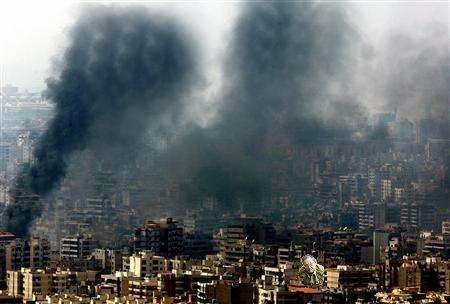
You can see Raul there in the bottom right quadrant, peeking out from behind the buildings of Beirut. The Cuban people will thrill with pride to see Dear Placeholder fighting against the imperialists. He's bigger than they remembered, too ...
What You Need To Know About Diplomacy And Journalism In War
We have been granted a unique opportunity this morning to see the problem with double standards in diplomacy and journalism in war, especially a war that involves Israel and terrorists. Earlier we recounted the utter idiocy of Reuters in allowing a badly-doctored photograph of Beirut to go out over their wires (all hail Charles Johnson). Now USA Today gives us a report on Hezbollah attacks this morning that shows more than one double standard at work:
Hezbollah guerrillas unleashed their deadliest barrage of rockets yet into northern Israel, killing 11 people, while Israeli bombardment killed 17 people in southern Lebanon as fighting only intensified despite a draft U.N. cease-fire resolution. ...Hezbollah fired a volley of 80 rockets at several Israeli towns, with one of them making a direct hit on a crowd of people at the entrance of the communal farm of Kfar Giladi.
USA Today actually avoids a common double standard used by the press in this war. They refer to the dead as "people" on both sides, whereas the media usually calls Lebanese dead "civilians". However, USA Today does not make note that the attacks by Hezbollah came from rockets deliberately aimed at civilian population centers conducting no offensive operations in this conflict. Do you suppose that Hezbollah is investigating the deaths of Israeli citizens, as the Israelis did after Qana, or celebrating them? And why doesn't the media report that difference?
Also, the rocket count has diminished again, falling to 80 from 200 at its peak after the Baalbek raid, when Hezbollah's production had fallen to 10 per day. That's an interesting development, considering that USA Today says that both sides "appeared to be aiming to inflict maximum mutual damage" before the UN approves the cease-fire proposal from France and the US. It looks like Hezbollah has started tapping out, probably a launcher shortage than rockets and missiles.
Here's one that involves both diplomats and the media:
A Hezbollah rocket blast also injured three Chinese peacekeepers on Sunday, the Chinese state media reported, citing a Chinese officer. The report not specify where the attack occurred or whether the peacekeepers had been hospitalized.The attack came hours after China's Foreign Minister Li Zhaoxing told U.N. Secretary-General Kofi Annan in a telephone conversation that the world body should take tangible measures to ensure the security of U.N. peacekeepers, according to the official Xinhua News Agency.
When Israel hit a UNIFIL/UNTSO post a couple of weeks ago, Kofi Annan went on worldwide television to express his anger at the "deliberate targeting" of UN personnel by the IDF. He demanded access to the area for an independent UN investigation. Only when Canada, whose soldier was among the four dead, insisted that Israel had not deliberately targeted the UN position but a Hezbollah launching site that the UN had allowed them to build nearby did Annan finally shut up.
Now Hezbollah has attacked and injured a UNIFIL contingent -- and where is Kofi Annan's outrage? Where is the worldwide media coverage? Where is the global diplomatic condemnation?
Oh, wait a minute -- Hezbollah aren't Jooooooooooos. I forgot.
UPDATE: Stephen Taylor has the Canadian version of the same problem on his site. In this case, Stephen demonstrates the Quote Taken Out Of Context method.
Israel Plays It Cool, Lebanon Plays Into Their Hands
It looks as if Israel has a plan to win the diplomatic war, and Lebanon's Hezbollah-backed politicians are determined to let them do it. After the US and France agreed on a cease-fire proposal for the UN Security Council, many thought that the resolution allowed Hezbollah too much leeway to regroup and rearm. Israel, however, quickly embraced the proposal -- and Hezbollah jumped at the bait:
Senior government officials in Israel expressed satisfaction at the draft of the UN Security Council resolution on Lebanon Saturday night, saying it safeguarded a number of key Israeli interests - foremost that the IDF would remain in south Lebanon until an international force arrives.The US and France agreed on a draft Saturday that calls for a full cessation of the fighting but preserves Israel's right to respond if attacked. The Security Council was scheduled to debate the resolution later Saturday in New York, and it was expected to come to a full vote "in another couple of days."
Israel expressed satisfaction immediately with the terms, and added that they did not expect Hezbollah to stop shooting rockets into Israel. Therefore, they said, the IDF would continue to attack launching positions until Hezbollah halted its attacks on Israeli civilians. Hezbollah, for its part, made sure that everyone knew it had no intention of complying with the UN resolution even if passed:
The Lebanese parliament speaker, who is considered close to Hizbullah, said Sunday that the US-French draft UN cease-fire resolution was not in Lebanon's interests and would be rejected by all Lebanese people unless it included the government's plan for ending the fighting."Lebanon, all of Lebanon, rejects any talks and or any draft resolution that does not include the seven-point government framework" drawn up last week in an emergency Cabinet meeting, Nabih Berri said at a news conference in Beirut. The Lebanese plan calls for an immediate cease-fire and withdrawal of Israeli troops.
"We always spoke about an immediate cease fire. We never spoke about ending military operations because this is in a way like legitimatizing the occupation, as if the war is being legitimatized," Berri said in fiery remarks before opening the floor to questions.
If Berri has that much concern over the legitimization of war, then Lebanon should have disarmed Hezbollah years ago. Beirut allowed the terrorists to remain heavily armed with rockets and missiles, and stood by while Hezbollah conducted attacks on Israel for years. The provocation last month was nothing new, except for the crass and exploitative move of abducting Israeli soldiers to free Lebanese prisoners, some cold-blooded murderers, from Israeli jails. They also killed IDF troops in that action, all of which are acts of war, and since Beirut tolerated Hezbollah's armed presence in southern Lebanon, they have responsibility for that act of war.
More to the point, however, Hezbollah and its political lackeys like Berri fail to grasp the overall diplomatic dynamic. The Israelis want to continue this fight until they have destroyed Hezbollah. The IDF succeeded in ejecting the PLO from Lebanon in the early months of its 1982 invasion, but made the mistake of sticking around afterwards, a mistake they're unlikely to repeat now. They see a similar opportunity here, but the international community will not willingly give them the time they need to do so. The Israelis know that the UN will eventually force them to stop short of their overall goals, and they want to get as much accomplished as possible.
This resolution should have provided the brakes on the Israelis. However, Hezbollah and Lebanon apparently have no comprehension that this UNSC proposal restrains Israel, and so they will reject it out of hand -- giving Israel even more time to continue dismantling Hezbollah in the south. Apparently, Berri and his Hezbollah handlers want a complete and explicit victory, and they still don't realize that they forfeited that when they commited the acts of war on an Israel that had tired of playing tit-for-tat games on their northern border.
Reuters 'Fesses Up
In a refreshing change for a global media outlet, Reuters did not claim to have received the infamously doctored photograph of Beirut from Lucy Ramirez at a Texas rodeo, but instead admitted that the image had been manufactured. They have also started disciplinary procedures against Adnan Hajj, the hack that has generated other questionable war-scene photography:
A Reuters photograph of smoke rising from buildings in Beirut has been withdrawn after coming under attack by American web logs. The blogs accused Reuters of distorting the photograph to include more smoke and damage.The photograph showed two very heavy plumes of black smoke billowing from buildings in Beirut after an Air Force attack on the Lebanese capital. Reuters has since withdrawn the photograph from its website, along a message admitting that the image was distorted, and an apology to editors.
In the message, Reuters said that "photo editing software was improperly used on this image. A corrected version will immediately follow this advisory. We are sorry for any inconvience."
Reuters' head of PR Moira Whittle said in response: "Reuters has suspended a photographer until investigations are completed into changes made to a photograph showing smoke billowing from buildings following an air strike on Beirut. Reuters takes such matters extremely seriously as it is strictly against company editorial policy to alter pictures."
Ynet News credits the blogger who first scored the kill on this photograph: Charles Johnson at Little Green Footballs. Ace o' Spades, Hot Air, and Left & Right get honorable mentions as well. They did a great job picking this one to pieces, and Charles can score a big takedown on this one. Now we would like to hear an explanation from the photography editors at al-Reuters why they didn't catch this prior to publication. After all, as the MSM continuously reminds us, they are the experts and have multiple levels of editorial control, blah blah blah.
Here's an image we'll want to save:

captain*at*captainsquartersblog.com


My Other Blog!
E-Mail/Comment/Trackback Policy
Comment Moderation Policy - Please Read!
Skin The Site






Hugh Hewitt
Captain's Quarters
Fraters Libertas
Lileks
Power Line
SCSU Scholars
Shot In The Dark
Northern Alliance Radio Network
Northern Alliance Live Streaming!





Des Moines Register
International Herald Tribune
The Weekly Standard
Drudge Report
Reason
The New Republic
AP News (Yahoo! Headlines)
Washington Post
Guardian Unlimited (UK)
New York Times
Los Angeles Times
OpinionJournal
Pioneer Press
Minneapolis Star-Tribune
MS-NBC
Fox News
CNN

Design & Skinning by:
m2 web studios
blog advertising

- dave on Another National Health Care System Horror Story
- brooklyn on Hillary Not Hsu Happy
- rbj on Hillary Not Hsu Happy
- Robin S on Requiem For A Betrayed Hero
- Ken on Hillary Not Hsu Happy
- Robin S. on Requiem For A Betrayed Hero
- RBMN on Hillary Not Hsu Happy
- NoDonkey on Another National Health Care System Horror Story
- Robin Munn on Fred Thompson Interview Transcript
- filistro on When Exactly Did Art Die?