




February 3, 2007
Rudy On Judges
Given the more liberal tendencies of Rudy Giuliani on abortion and guns, conservatives have expressed serious misgivings about his run for the nomination. However, the main effect that a President can have on these issues involves his or her outlook on the judiciary. The federal court system has been the main battleground for both issues, with Roe specifically precluding any kind of legislative action. Court nominations have become one of the essential considerations for presidential contenders -- and it may be more important for Giuliani than any other Republican candidate.
Giuliani has hinted that he would nominate jurists in the mold of Antonin Scalia and John Roberts. Today, at a visit with the South Carolina GOP Executive Committee, an audience member pressed him for his position. His campaign office has supplied us with the transcript of his answer:
On the Federal judiciary I would want judges who are strict constructionists because I am. I'm a lawyer. I've argued cases in the Supreme Court. I've argued cases in the Court of Appeals in different parts of the country. I have a very, very strong view that for this country to work, for our freedoms to be protected, judges have to interpret not invent the Constitution. Otherwise you end up, when judges invent the constitution, with your liberties being hurt. Because legislatures get to make those decisions and the legislature in South Carolina might make that decision one way and the legislature in California a different one. And that's part of our freedom and when that's taken away from you that's terrible.President Bush has the great model because I think as the President he did appointed some really good ones and both of them are former colleagues of mine - Chief Justice Roberts and Justice Alito. Justice Scalia is a former colleague of mine. Somebody that … I think Chief Justice Roberts is a great chief justice and he's young and he can have a long career and that's probably the reason the President and Vice President chose him. I think those are the kinds of justices I would appoint – Scalia, Alito and Roberts. If you can find anybody as good as that, you are very, very fortunate.
It sounds as if Rudy has what could be an unbeatable combination. His personal views trend to the center and perhaps even liberal on these issues -- but he wants to nominate jurists that will return these questions to the legislature and stick to the explicit text of the Constitution.
Will that satisfy the Rudy skeptics? I guess we will soon see.
I'll See Your Hyperbole ...
My friend and radio partner Mitch Berg goes off the deep end with his Super Bowl prediction this weekend:
In 1940, everyone - everyone - predicted Sammy Baugh’s Washington Redskins were going to beat the Chicago Bears in the NFL Championship game.Of course, the final result was the Bears dishing out a legendary 73-0 drubbing, a victory that set the stage for the defeat of Naziism. ...
Bears 42
Clots 17.
Of course, one could more easily argue that it set the stage for Pearl Harbor ... but I digress. Historical hysteria aside, the Bears have a strong defense and a good offensive line, but the Colts have Peyton Manning and a re-energized defense that shut down Tom Brady and the Patriots as if they were the Minnesota Vikings in the second half.
If the Rex Grossman that played in the second half against the Saints shows up tomorrow, then the Bears have a chance. If the one that likes to play like a liberal and re-distribute the wealth (and the football) when on offense shows up, then the Colts will cream the Bears.
My prediction: 31-24 Colts.
Oh, and as an answer to Mitch -- this will usher in a new era of peace, understanding, and freedom around the world.
George Soros: America Needs 'De-Nazification'
It's hard to get surprised by Leftist characterizations of conservatives as fascists The epithet flows so freely that even members of the Senate have used it, the last time by an ex-Klansman. The latest version of the insult comes from George Soros, speaking at the Davos Economic Forum last week about the situation in Iraq. Claiming that the US needs to cleanse itself from conservatives, Soros compared the process necessary to that used by the US in Germany:
He went on to say that Turkey and Japan are still hurt by a reluctance to admit to dark parts of their history, and contrasted that reluctance to Germany's rejection of its Nazi-era past. "America needs to follow the policies it has introduced in Germany," Soros said. "We have to go through a certain de-Nazification process."
This is highly inflammatory and, quite frankly, anti-American. We do not purge people from the political process here. We use elections and free speech to determine the policies the nation wants implemented, and we elect our leaders on the basis of a free and unfettered franchise. Equating Republicans to Nazis and then suggesting that the government impose a process to exclude them from public office makes Soros much more of a fascist than anything he decries.
And of course, just like the rest of the private-jet Leftists, Soros didn't have the nerve to say this in the US -- where he would have generated an avalanche of bad publicity for anyone attached to his checkbook.
The New York Post, which reported this yesterday, notes that Soros has given heavily to Barack Obama's campaign after spending $26 million in a futile effort to defeat George Bush in 2004. Will Obama endorse his patron's call to "de-Nazify" the United States? (via McQ at QandO)
UPDATE: Interesting debate in the comments, and in the blogosphere as well. Supposedly those offended by Soros' comments are only attempting to cover our own complicity in the oppressive Bush administration -- you know, the one twice voted into office by the American electorate. The counterargument is that Soros meant that we need some kind of process for national reconciliation.
Well, if so, he chose the wrong example, and Soros knows better than to confuse de-Nazification with the South African Truth Commission. The latter was used to establish a commonly-accepted historical record of the abuses of the apartheid regime, the better to promote healing for the newly liberated South African state. De-Nazification was the systematic removal of Nazi party officials from German public life, the price that they paid for supporting a tyrannical and genocidal regime. Even suggesting that such a process is necessary for the United States is clearly meant as an attack on the Republican Party, even at its most symbolic interpretation.
As far as equating Soros' rhetoric with the accusation that Democrats are all traitors for opposing the war, I tend to agree. However, I don't indulge in that kind of character assassination, and it doesn't excuse it from Soros in any case.
NARN, The Oh-Crap-I-Live-In-Minnesota Edition
The Northern Alliance Radio Network will be on the air today, with our six-hour-long broadcast schedule starting at 11 am CT. The first two hours features Power Line's John Hinderaker and Chad and Brian from Fraters Libertas. Mitch and I hit the airwaves for the second shift from 1-3 pm CT, and King Banaian and Michael Broadkorb have The Final Word from 3-5. If you're in the Twin Cities, you can hear us on AM 1280 The Patriot, or on the station's Internet stream if you're outside of the broadcast area.
This means I will have to leave the house at some point, but I'm not looking forward to it. As I write this, the temperature outside is -9, with a wind chill pushing it to -29. We do the show in the basement of the bunker that is AM 1280 The Patriot, and so if you hear teeth chattering, you will know why.
Be sure to call and join the conversation today at 651-289-4488. Tell us what your wind chill is today, if you're listening on the stream. Gloating will be allowed but derided...
Nasrallah Admits Hezbollah Funded, Run By Iran And Syria
Hezbollah chief Hassan Nasrallah told an Egyptian interviewer that Iran and Syria fund, train, and control his organization as an effort to spread radical Shi'ite Islam throughout the region:
"Iran assists the organization with money, weapons, and training, motivated by a religious fraternity and ethnic solidarity," Nasrallah said. "And the help is funneled through Syria, and everybody knows it."The Hizbullah leader added that his organization is ready to accept assistance from any Arab or Islamic party, like Egypt or Saudi Arabia.
Responding to accusations that his organization acts as "a state within a state," Nasrallah said that the current Lebanese government has yet to fulfill its obligation of securing the release of Lebanese prisoners in Israeli jails, and getting Israeli-occupied land back. Accordingly, Nasrallah said that the people, or part of the people, are free to try and realize those goals by themselves.
This comes as little surprise to anyone, but it does provide explicit confirmation of Iran's use of proxy terrorists in the region to extend its hegemony through violence and intimidation. It also confirms that Syria allows itself to be used as a conduit for the Iranian mullahcracy. The admission makes it clear, despite Nasrallah's insistence that Hezbollah is a Lebanese organization, that Nasrallah leads a group that owes its allegiance to Teheran and not Beirut.
Nasrallah also admitted that he miscalculated the Israeli response to their attack on IDF outposts this summer. Israel's overwhelming use of force came as a surprise, which Nasrallah blamed on an intelligence failure. They expected Israel to respond as it had in the past, on a scale commensurate to the original attack. Instead, the Olmert government decided to respond asymmetrically, a good decision which they inexplicably scratched after launching the invasion of southern Lebanon.
That isn't an intelligence failure, however, unless Nasrallah means to say that he's an idiot. The Israelis at some point were going to stop playing the tit-for-tat game that Hezbollah prefers, because it was getting Israel nowhere. Anyone with half a brain could have predicted it, even if they couldn't necessarily predict which Hezbollah attack would provoke the overwhelming response. To claim "surprise" at this reaction shows exactly how provincial Nasrallah is, and why the Iranians and the Syrians have to run Hezbollah on his behalf.
Rudy's Polling Indicates Strength In Key Races
Yesterday, the Rudy Giuliani campaign promoted the results of polling by several groups last month, surveys which shows that Giuliani has more strength in traditionally blue states than other Republicans, especially the former "maverick" John McCain. Once expected to be the centrist candidate of choice, and even a risk for an independent bid that would capture the center from both parties, McCain seems to have ceded most of that ground to Giuliani, at least at this early stage of the campaign:
State | Mayor Giuliani | Closest Competitor | Source |
| California | 33% | 19% (Gingrich) | ARG - Jan. 11-17 |
| Florida | 30% | 16% (Gingrich) | ARG - Jan. 4-9 |
| Illinois | 33% | 24% (McCain) | ARG - Jan. 11-14 |
| Michigan | 34% | 24% (McCain) | ARG - Jan. 4-7 |
| Nevada | 31% | 25% (McCain) | ARG - Dec. 19-23, ‘06 |
| New Jersey | 39% | 21% (McCain) | Quinnipiac – Jan. 16-22 |
| North Carolina | 34% | 26% (McCain) | ARG - Jan. 11-15 |
| Ohio | 30% | 22% (McCain) | Quinnipiac - Jan. 23-28 |
| Pennsylvania | 35% | 25% (McCain) | ARG Jan. 4-8 |
| Texas | 28% | 26% (McCain) | Baselice Jan. 17-21 |
The Battleground Poll, one of those cited by the Giuliani campaign, makes a less impressive case for Giuliani as the front-runner. The analysis by Ed Goeas shows both men to be neck-and-neck in the race, with almost the same exact favorable/unfavorable ratio (2.5:1) and similar results against the prospective Democratic candidates. Both mean beat Hillary Clinton and Barack Obama by a wide margin, a result that has to worry Hillary. As Goeas notes, she has been such an imposing national figure that she has almost no untapped well of voters to reach; she will have to convince people who already don't like her to change their minds, a difficult task to accomplish.
Of course, Goeas uses national numbers to calculate his predictions. Giuliani's team does a better job at analyzing the race on a state-by-state basis, which is how primaries and general elections for President get conducted. Rudy's strength in places like California and Michigan will not have much impact on either, since they have late primaries and traditionally go Democratic in the general election anyway. Rudy's comparative strength in Florida, New Jersey, Ohio, and Pennsylvania should be taken more seriously, especially Florida. The GOP has to hold that state to have any chance of winning the Presidency, and so far Newt Gingrich comes in second with only 16% in the Sunshine State. He also outpolls McCain in North Carolina, where one might expect the more conservative McCain to have an edge. It makes one wonder who would be the better candidate to hold the South.
Goeas also mentions that Mitt Romney remains a wild card, one that could disrupt the normal process of Republican primaries by becoming a credible third choice in the race at primary time. His favorability ratio is about the same as McCain and Giuliani, but he has a much larger pool of people unfamiliar with him. If he mounts an excellent campaign, he could wind up as the dark horse, able to define himself in a manner tuned to the party at the right time. His big advantage is his ability to raise money and his lower national profile, an interesting (and rare) combination.
This shows pretty clearly that the Republican nomination remains wide open between these three candidates. It also hints that the door may have more or less closed on anyone else, even at this early stage. With two well-regarded candidates and one other with the money to build his own national profile, the prospects of anyone without an established national reputation cracking into the top tier seems rather remote.
The Force Came To Get Him
It's hard out here for a Wookie. First, clone armies supposedly helping you wind up shooting up your home planet. Then you get stuck on the worst-looking hyperspace vehicle in seven systems, piloted by an undisciplined cowboy who inexplicably winds up with a galactic princess, making you a hairy third wheel. Finally, some tour guide accuses you of molesting Japanese tourists and gets you fired from your worst gig ever. Who wouldn't snap?
A man dressed as Chewbacca was arrested after police said the street performer head-butted a tour guide operator in front of Grauman's Chinese Theatre in Hollywood.Frederick Evan Young, 44, of Los Angeles, California, was booked Thursday for investigation of misdemeanor battery, police Lt. Paul Vernon said.
Police said the 6-foot-4 street performer was seen arguing Thursday afternoon with a tour guide who had expressed concern that the Star Wars wookie impersonator was "harassing and touching tourists" in violation of city law.
Maybe now we can get to the bottom of the galaxy's biggest controversy -- did Greedo really shoot first?
NIE: It's A Civil War
The intelligence community released its National Intelligence Estimate on Iraq yesterday, a nine-page document that the Washington Post correctly characterizes as "bleak". It adopts the term "civil war" for the ongoing conflict in Iraq, and at the same time notes that the term doesn't do justice to the myriad of conflicts active in the country at the moment. However, it also warns about the effect a withdrawal would have on the region.
First, though, the bad news:
The U.S. intelligence community yesterday released a starkly pessimistic assessment of the situation in Iraq, warning that even if security improves, deepening sectarian divisions threaten to destroy the government and ultimately could lead to anarchy, partition or the emergence of a new dictatorship.Citing "the current winner-take-all attitude and sectarian animosities infecting the political scene," declassified judgments of a new National Intelligence Estimate predicted that Iraqi leaders will be "hard pressed" to reconcile over the next 18 months.
Despite the stepped-up training and U.S. support for Iraqi security forces -- major parts of the new Iraq strategy President Bush announced last month -- the estimate concluded that the Iraqi military will find it very difficult to carry out any new responsibilities or to operate independently against sectarian militias.
That's a pretty reasonable capsulization of the NIE's assessment. It does contain very pessimistic language about how the political situation will develop in Iraq without some change in strategy that will reverse some deadly trends. The biggest problem remains the Sunni minority's refusal to accept their loss of control over Iraq. They see the situation in very stark terms -- either they rule or Iraq becomes Persian. They see the Shi'a majority as a threat to the Arabic nature of Iraq, and they refuse to compromise with them and allow Iran to essentially make Iraq a vassal state.
The Shi'a, on the other hand, do not trust in their own majorities. Decades of oppression by the Sunni minority has left them "deeply insecure about their hold on power". That keeps them from reaching out to the Sunnis to reach the necessary compromises that would make both groups more secure about their place in the new Iraq. It also creates mistrust of the American efforts to forge those kinds of compromises, and the new American insistence on stopping Shi'ite militias compounds that mistrust.
That has fueled what the NIE now acknowledges is a civil war:
The Intelligence Community judges that the term “civil war” does not adequately capture the complexity of the conflict in Iraq, which includes extensive Shia-on-Shia violence, al-Qa’ida and Sunni insurgent attacks on Coalition forces, and widespread criminally motivated violence. Nonetheless, the term “civil war” accurately describes key elements of the Iraqi conflict, including the hardening of ethno-sectarian identities, a sea change in the character of the violence, ethno-sectarian mobilization, and population displacements.
However, the NIE does not say that the situation is hopeless, only very difficult. It prefaces the entire report by saying "Unless efforts to reverse these conditions show measurable progress during the term of this Estimate, the coming 12 to 18 months, we assess that the overall security situation will continue to deteriorate at rates comparable to the latter part of 2006." The NIE presupposes that the US will try to reverse these conditions with positive effort on the ground in Iraq, especially to try to tamp down violence in the short term in order to give the Iraqi government some breathing room to counter these trends. It also warns of the effects a withdrawal will have:
Coalition capabilities, including force levels, resources, and operations, remain an essential stabilizing element in Iraq. If Coalition forces were withdrawn rapidly during the term of this Estimate, we judge that this almost certainly would lead to a significant increase in the scale and scope of sectarian conflict in Iraq, intensify Sunni resistance to the Iraqi Government, and have adverse consequences for national reconciliation.• If such a rapid withdrawal were to take place, we judge that the ISF would be unlikely to survive as a non-sectarian national institution; neighboring countries—invited by Iraqi factions or unilaterally—might intervene openly in the conflict; massive civilian casualties and forced population displacement would be probable; AQI would attempt to use parts of the country—particularly al-Anbar province—to plan increased attacks in and outside of Iraq; and spiraling violence and political disarray in Iraq, along with Kurdish moves to control Kirkuk and strengthen autonomy, could prompt Turkey to launch a military incursion.
They recommend that we at least keep our deployment at present force levels for the next 12-18 months, while working on new strategies to reverse the trends they describe. Given that advice, it's easy to see why the administration has decided on the surge strategy. They want to create enough room and enough of a reduction of the violence that fuels the split for the Shi'ites and the Sunnis to find some way to compromise on governance. The Shi'ites are a majority and the Sunnis are not, and the Sunnis will have to find their way to accepting that reality, The Shi'ites will have to learn that they cannot ever securely hold power without gaining the cooperation of the Sunnis. Those rational realizations will not take root until we clear the streets of the militias and allow both sides to see how to reach that accommodation.
The NIE is mostly bad news, and no one can doubt that. Those advocating for a bug-out want to take the one option guaranteed by the intelligence community to make Iraq exponentially worse than it is now, in a region where we cannot allow a failed state to serve as a host for parasitic terrorist groups.
UPDATE: Jules Crittenden correctly states the purpose of the NIE: "It is not a strategy. But it is a report that, by design, should be worst-case and pessimistic." That's what you will see when you read the 9-page declassified version of the NIE, but it does have some elements of strategy and optimism as well. They're just not making the headlines.
Warner Opposing His Own Resolution?
John Warner has declared that he will filibuster his own non-binding resolution on the surge to protest the conduct of Harry Reid in limiting votes on alternatives, such as John McCain's proposed language that supports the President's new stratey for Baghdad and Anbar. The GOP says they can organize all 49 Senators in their caucus, which would keep any resolution from proceeding to a vote:
Sen. John W. Warner will join his fellow Republicans in voting Monday to block the resolution he wrote rebuking President Bush's Iraq war policy."Senator Warner supports the Senate Republican leadership's effort to establish a free and open debate on Iraq on the Senate floor, including possible amendments," a spokesman for the Virginia Republican said yesterday afternoon.
Earlier in the day, Mr. Warner told colleagues during a closed-door strategy meeting at the Library of Congress that he opposes the manner in which Senate Majority Leader Harry Reid, Nevada Democrat, is conducting debate on his resolution, which condemns Mr. Bush's plan to send 21,500 more troops to Iraq.
Senate Republicans are opposed to a vote on the Warner resolution unless they also get votes on two other resolutions. One of those alternatives supports Mr. Bush's plan, and the other would prohibit cutting funds for the war. Republicans also want each resolution to require 60 votes to pass.
Mitch McConnell seems to have aroused more opposition to the resolutions than first thought. He appeared on Hugh Hewitt's radio show this week, and McConnell told Hugh that he was aware of the NRSC pledge effort to deny the Senate Republican election committee any funding if they lost their nerve on the war. That message seems to have been heard by the caucus, and the sudden reversal by Warner makes it clear that we have made them nervous about the outcome.
Without Warner's cooperation, none of the resolutions have a chance to make it to a vote. Even with Warner's backing, it was doubtful that Reid could overcome a filibuster; the only swishes on this bill were Warner himself, Susan Collins, Chuck Hagel, and Olympia Snowe, or at least the only Republican Senators who publicly supported the Warner-Levin language. The appearance of the McCain proposal has given the GOP an alternative that allows Congress to have its say in the conduct of the war but does not kneecap the general they unanimously selected to lead the effort in Iraq before he takes full command. That gives the GOP plenty of cover to conduct a filibuster, and now it's clear that it will succeed.
What will Reid do if Warner successfully filibusters his own resolution? It would be a mild embarrassment to Reid, who will have to explain why he didn't want to allow amendments or alternatives to reach the floor for an up-or-down vote. After all his talk about bipartisanship and working across the aisle -- and his constant whining about Republican failures to do so over the past two years -- having a major issue filibustered because of his refusal to meet the GOP halfway will seem just a bit incongruous. Worse, however, will be his inability to deliver some kind of rebuke to the White House after having built up the expectation of it for the past three weeks.
In the end, though, I suspect, a filibuster might work in everyone's interests. The Democrats can claim they tried to pass a useless resolution scolding the White House, the Republicans can claim they protected the effort to win in Iraq, and the White House can get on with its surge strategy for Baghdad. In a weird way, all three had better hope the new strategy works, or the political fallout from these efforts around non-binding resolutions will be harsh indeed.
February 2, 2007
CQ, CPAC, And The Importance Of ... Advertising
Earlier today, I accepted an offer from the organizers of the 2007 Conservative Political Action Conference (CPAC) next month in Washington DC. I'll be one of the bloggers covering the event from Blogger Alley, similar to what I did at the Republican National Convention in 2004. I've not been able to attend CPAC before, and it seems more critical than ever to get involved after the midterm losses and the weakening of resolve on the war.
Even with all of that, I put off the decision for a couple of weeks until we got a clearer picture of the First Mate's prognosis. It turns out that the nephrectomy was successful in eliminating the BK virus from her system. She's had at least one blood test come back completely negative, which means she can now have a transplant. At the same time, her donor -- a very generous friend of ours -- just got done with his tests, and is approved for the operation. We'll be ready for it towards the end of March. It's great news, and we're all very excited about it.
Earlier today, I made a few arrangements. The first was to get the travel and lodging arranged for the convention, and the second was to add a little more advertising here at CQ to increase the revenue stream. For the first time, I added a popunder ad from my sponsoring agency, a move I have resisted for over a year. However, it has been money left on the table, so to speak, and more sponsors are insisting on popunders for their campaigns.
I hope CQ readers will take the time to support the advertisers that support this blog. Click through when you get the chance. It's much appreciated.
Kim's Son: Not Ronery
The producers of South Park hilariously depicted North Korean dictator Kim Jong-Il in their movie Team America: World Police in a musical sequence titled I'm So Ronery. Apparently, that song wouldn't apply to Kim's jet-setting son, whom the London Telegraph noted has the kind of latitude denied the subjects of his father's regime:
The son of Kim Jong-il, North Korea's reclusive dictator, has been living in five-star luxury in the gambling haven of Macau even as his people starve, according to reports in Hong Kong yesterday.Kim Jong-nam, 35, was tracked to the Mandarin Oriental Hotel, where he has been staying on and off for three years.
While the international community alternates sanctions on his father for his nuclear weapons programme with economic aid for his starving subjects, the younger Kim has been spotted gambling in Macau's numerous casinos and eating in local restaurants, according to the South China Morning Post.
Although travel is strictly proscribed for North Korean citizens, Kim Jong-nam has roamed the world.
Apparently, his father isn't amused by Jong-nam's lifestyle. He has replaced Jong-Nam in the succession with his half-brother, which might have happened after Jong-nam got caught with a forged passport in Japan five years ago. He told authorities that he wanted to take his own young son to Tokyo Disneyland.
The proximity to Macau sounds somewhat intriguing, however. Kim Jong-Il used a Macau bank as the center of his massive counterfeiting operation that flooded the globe with high-quality fakes of American $100 bills, an operation which resulted in sanctions that Pyongyang wants ended before any other talks on denuclearization can proceed. Jong-nam might be his father's envoy to the financial world of Macau. It would explain his presence there rather than home in Pyongyang, working in the family business. One would assume that Daddy Kim would cut off his money if he wasn't doing something useful in Macau, even if he has become something of a dissolute embarrassment to the regime.
Maybe It's A Problem In The Translation
The world may soon adopt "Palestinian cease-fire" as a self-evident oxymoron. Hours after announcing the latest cessation of hostilities between Fatah and Hamas, both groups conducted major attacks on the other, leaving a broadcast station in ruins and ambulances dodging bullets across Gaza:
Hamas fighters blew up a pro-Fatah radio station in Gaza, ambulances were caught in the crossfire and gunmen exchanged heavy fire in deserted streets as a new wave of factional fighting raged Friday throughout the chaotic coastal territory.The resurgent violence, which has killed 10 people since Thursday, destroyed a brief truce between Fatah and Hamas and forced thousands of Gazans to huddle in their homes to escape the crossfire.
In a symbol that the two sides had returned to open warfare, their respective radio stations stopped playing songs of national unity and broadcast songs about armed struggle and fighting the enemy.
In this case, for those keeping score, Egypt blamed Hamas for breaking the truce with an attack on an official convoy. It didn't take long for the situation to escalate from there. The presidential guard of Mahmoud Abbas surrounded the Interior Ministry, controlled by Hamas, and started exchanging gunfire on the compound. Hamas started launching mortar shells at a Fatah training base.The fighting has disintegrated into street fighting now, wounding more than a hundred people in Gaza City alone. Hamas blew up a radio station, and no civil authority exists to put an end to the fighting.
It seems that the Palestinians have slipped into open civil war, a development that will surprise no one. Instead of attempting to arm one side over the other, as the West has proposed by sending arms to Abbas, the better solution would be to isolate the territories and let them fight it out amongst themselves. None of the factions involved support democracy or peaceful co-existence, and no faction ever will as long as the West keeps supporting terrorists of any stripe.
Maybe at some point the Palestinian people will tire of this civil war and generate leadership interesting in peace. Until then, any mention of a Palestinian cease-fire will continue to evoke nothing but cynical laughter.
Canadian Office In London Shut Down In Terror Probe
A Canadian mission in London has been evacuated after someone noticed a suspicious package outside:
The Canadian High Commission in central London has been evacuated and surrounding streets closed after a suspect package was found, a police spokesman said."A suspect envelope has been found ... we are checking it out at the moment," a police spokeswoman told AFP Friday, adding: "The roads in the immediate area have been closed off as a precautionary measure."
The lockdown extends to parts of Trafalgar Square, where the commission offices are located. No further details have yet been released. These kinds of discoveries are almost always false alarms. However. the British are doing the right thing by securing the area as they investigate the package.
Has Turner Broadcasting started promoting the Aqua Teen Hunger Force movie in Britain? Just asking ...
Florida Dumps Touch-Screen Voting
Florida has decided to end its use of electronic voting machines, reversing a decision made at the height of the controversy over the 2000 election. The state will opt for the optical-scan technology that retains the paper trail necessary to ensure the ability to conduct recounts when necessary:
Gov. Charlie Crist announced plans on Thursday to abandon the touch-screen voting machines that many of Florida’s counties installed after the disputed 2000 presidential election. The state will instead adopt a system of casting paper ballots counted by scanning machines in time for the 2008 presidential election.Voting experts said Florida’s move, coupled with new federal voting legislation expected to pass this year, could be the death knell for the paperless electronic touch-screen machines. If as expected the Florida Legislature approves the $32.5 million cost of the change, it would be the nation’s biggest repudiation yet of touch-screen voting, which was widely embraced after the 2000 recount as a state-of-the-art means of restoring confidence that every vote would count.
Several counties around the country, including Cuyahoga in Ohio and Sarasota in Florida, are moving toward exchanging touch-screen machines for ones that provide a paper trail. But Florida could become the first state that invested heavily in the recent rush to touch screens to reject them so sweepingly.
“Florida is like a synonym for election problems; it’s the Bermuda Triangle of elections,” said Warren Stewart, policy director of VoteTrust USA, a nonprofit group that says optical scanners are more reliable than touch screens. “For Florida to be clearly contemplating moving away from touch screens to the greatest extent possible is truly significant.”
The move points up the potential for costly errors when decisions are made in haste. After the 2000 election, Florida felt tremendous pressure to upgrade its voting infrastructure after widespread complaints about the punch-card system that had been used there -- and elsewhere -- for decades. Rather than take the time necessary to test the various systems and make rational decisions about the value of the various options on all, Florida and several other jurisdictions lept to the most high-tech solution on the market.
Unfortunately, the new technology had two basic problems that should have warned the governments involved right from the start. First, security on the machines turned out to be questionable. Any time computers get networked on a wide scale, the potential exists for malfeasance, and vulnerability increases with scale. Businesses manage those vulnerabilities by having IT professionals conduct continual maintenance on systems, but elections come only twice a year, requiring redeployment of wide-area networks for a single day 2/365ths of the year.
The security issues could be managed. However, the lack of a direct paper record of the voter's ballot seems like it should have been a showstopper, especially considering the high-profile recount that took place in Florida after the 2000 election. No one apparently thought that recounts would be necessary with the high-tech machines, a rather naive view of both technology and elections. When disputes arose about the counting functions of the machines, officials had no independent method to assure voters that their ballots had been properly counted.
Minnesota and other states have used optical-scan ballots for years, and they make the most sense. It retains the paper ballot that has the direct notation of voter intent, and the machines determine immediately if the ballot is properly executed. The system delivers an immediate count of the balloting after the polls close, but the ballots still exist if any disputes arise. Anyone who has used a Scantron form for a school test knows how to fill out the ballot. It's such an obvious choice that governments, and not just Florida's, couldn't see it.
I'd like to hope that people will remember this experience the next time an irrational panic regarding infrastructure arises. Just as with the Y2K scare, the rush to find solutions to problems that exists only on the fringe costs a lot of money and frustration. Just as with the Y2K scare, I doubt that this wisdom will be remembered in the next instance.
Obama Can't Count On The Black Vote?
The New York Times indulges itself in the latest oddity of racial politics today regarding Barack Obama. The meme that he will struggle to find support in the black community has floated in the media for the past few weeks; I noted an article from Agence France Presse on the topic six weeks ago. At the time, African-American radio host Stanley Crouch had written a column that rejected Obama's inclusion in black America as lacking the shared background and experience of the descendants of slaves. It turns out that he's not alone:
The black author and essayist Debra J. Dickerson recently declared that “Obama isn’t black” in an American racial context. Some polls suggest that Mr. Obama trails one of his rivals for the Democratic nomination, Senator Hillary Rodham Clinton, in the battle for African-American support.And at the Shepherd Park Barber Shop here, where the hair clippers hummed and the television blared, Calvin Lanier summed up the simmering ambivalence. Mr. Lanier pointed to Mr. Obama’s heritage — he is the American-born son of a black father from Kenya and a white mother from Kansas — and the fact that he did not embody the experiences of most African-Americans whose ancestors endured slavery, segregation and the bitter struggle for civil rights.
“When you think of a president, you think of an American,” said Mr. Lanier, a 58-year-old barber who is still considering whether to support Mr. Obama. “We’ve been taught that a president should come from right here, born, raised, bred, fed in America. To go outside and bring somebody in from another nationality, now that doesn’t feel right to some people.”
On Wednesday, the question of race took center stage in the presidential campaign because of remarks that Senator Joseph R. Biden Jr., Democrat of Delaware, made about Mr. Obama. Mr. Biden characterized Mr. Obama as “the first mainstream African-American who is articulate and bright and clean and a nice-looking guy” and then spent the day — his first as an official presidential candidate, explaining and apologizing for his remarks.
On the surface, this is absurd. Obama grew up as a child of an interracial couple, and I'm certain that the bigots he met along the way didn't give him a pass because his father turned out to be African rather than an American. The difference would have been almost purely rhetorical during his formative years. It's the kind of silliness that ensues when people get so wrapped up in identity politics and victimization that they start excluding people naturally inclined and suitably positioned to help them achieve their goals based on a perceived lack of authenticity.
The meme itself seems vapid beyond belief. I'm certain that the African-American community as a whole will look at Obama and see someone who champions their positions far more than the spouse of the nation's "first black President". Hillary may have her support within that voting bloc, but her run to the center will not have built a tremendous store of goodwill there, and Obama has focused on issues such as poverty from the time he worked as a community activist in Chicago. That's the kind of authenticity that wins votes in any electoral bloc.
So far, this particular subplot of Obama's lack of support in the black community appears based mainly on Crouch and Dickerson's objections, and the lack of endorsement from Jesse Jackson and Al Sharpton. That also seems a stretch. Not too many presidential endorsements come a year before the first primary, and no one knows what other candidates may yet run. In 2004, both Sharpton and Carol Mosely Braun ran credible campaigns in the primary, and both may try again -- which would certainly explain Sharptons reluctance.
The story here is that there is no story here.
CQ Notes
It will be a light posting day today, as the hosting service for CQ had its share of problems overnight. Starting around 7:45 or so, Hosting Matters had a complete failure of some sort; the forums have no explanation, but all HM blogs went dark and didn't come back until about an hour ago or so.
Unfortunately, that pretty much killed the traffic to my Blog Talk Radio show last night. It's too bad -- I thought I had a better show this time than the last, but only got a few calls. Sean from The American Mind paid another visit as I mostly focused on the Senate resolutions wending their way through committee hearings. You can listen to the show as a podcast at the CQ Radio home page, and I hope you enjoy it. I'll be back next Thursday for another installment!
Addendum: It was apparently a line cut outside of HM's control. When those things happen, you have to just wait them out until the phone company gets the line fixed. As a call center manager for 15 years, I have an unfortunately long history of having to manage exactly these kinds of problems. My sympathies are with the excellent Hosting Matters team who had to deal with this.
February 1, 2007
McCain Launches His Own Resolution
John McCain has decided to eschew the competing resolutions expressing disfavor with the new White House surge strategy in favor of an open-ended series of benchmarks intended to demonstrate what progress in Iraq will look like. The resolution gives no deadlines but does describe the process by which the Pentagon should measure success. Here is the conclusion on McCain's bill:
Resolved, That it is the sense of the Senate that --(1) Congress should ensure that General David Petraeus, the Commander of Multinational Forces - Iraq, and all United States personnel under his command, have the resources they consider necessary to carry out their mission on behalf of the United States in Iraq; and
(2) that the Government of Iraq must make visible, concrete progress toward meeting the political, economic, and military benchmarks enumerated in the preamble to this Resolution.
McCain obviously wants to offer a way for the Senate to demonstrate its frustration, but directed in such a way that it does not unduly damage the mission. Its benchmarks are reasonable, and open to definition to some extent. They include:
* deploying a "significant number" of Iraqi forces to secure Baghdad
* speeding up the transfer of responsibility for provincial security
* disarmig militias and ensuring the loyalty of the state forces to the Iraqi constitution
* equitable distribution of resources (oil revenues)
* building an effective and independent judiciary
* enforcing the law without regard to sect or ethnicity
* conducting long-overdue provincial elections
* building a process for amending the constitution that is fair to all
* $10 billion in cash for reconstruction
All of these are common sense goals, and the resolution wisely leaves out any timetables. Some would have to get accomplished before others, security most of all. It also stresses the unanimous confirmation of Petraeus as mission commander in a not-so-subtle hint that a resolution torpedoing his strategies before he even arrives to tak command is more than a little hypocritical.
Will it be enough to mollify those who abhor the sight of Congress demanding defeat and withdrawal while making enough of a statement of general impatience to attract support from Republican Senators? It might. Its entry does one more thing -- it gives fence-sitters on Warner-Levin a reason to vote against it in favor of the McCain resolution. That may be enough to ensure a filibuster on the resolution making its way through the Senate committee chain now.
UPDATE: I will definitely review this on my Blog Talk Radio show tonight at 9 pm CT. Be sure to tune in and join the conversation by calling 646-552-4889!

CQ Radio Show Tonight!
I'll be back on my Blog Talk Radio show again tonight at 9 pm CT, ready to take your calls and discuss the issues of the day. Topics usually will be a game-time decision, but I'll be interested in hearing your opinions on the dramatic rise and fall of the Joe Biden campaign, the Senate's attempts to pass a non-binding resolution opposing the troop surge in Baghdad, Al Franken's run at Norm Coleman's seat, and much more. Be sure to tune in, and join the conversation by calling 646-652-4889!
A Crack In The Caucus
One of the key constituencies of the new Democratic majority in the House has started to crumble. The Congressional Hispanic Caucus has split along gender lines, a rebellion against the caucus chair led by my old representative from California:
A firestorm erupted Wednesday within the Congressional Hispanic Caucus when California Rep. Loretta Sanchez quit in protest of Rep. Joe Baca's chairmanship and alleged mistreatment of women.Sanchez, in her fifth term representing California's 47th District, reportedly is furious at fellow California Democrat, Baca, for alleged derogatory remarks. In an interview with Politico.com she accused him of calling her a "whore." ...
Sanchez's protest of Baca's chairmanship of the caucus — which represents 21 Hispanic House Democrats — dates back to November 2006, when she voted against him for the leadership post. Four other women members, including Sanchez's sister, Rep. Linda Sanchez, abstained.
Just a few weeks ago, four female lawmakers requested that Baca repeat the election because the group did not follow it's own rules of using secret ballots. Sanchez's spokesman said they never received a response.
Sanchez told Politico.com that "I'm not going to be a part of the CHC as long as Mr. Baca illegally holds the chair … I told them no. There's a big rift here."
It didn't take long for the first signs of disunity among the Democrats to appear, although it was fairly predictable. This feud has simmered for months, and the lack of response by Democratic leadership has allowed it to explode. At a time when both parties want to do its best to attract the growing Hispanic population, the Democrats have to deal with infighting among its best envoys to that demographic.
This stems from decisions made almost a year ago to support non-federal candidates with the caucus' PAC funds. Baca sent funds to California state candidates, two of whom coincidentally happened to be Baca's sons. I blogged about the controversy last March, noting that the funds that went to Joe Baca Jr. was used to oppose another Hispanic candidate, a decision that made Sanchez and five other members irate enough to go public with their dissatisfaction.
At the time, I figured that the scandal would force Baca from his post, especially given the Democrats' insistence on making ethics the centerpiece of their midterm campaign. Unfortunately, that proved to be a bad prediction. Baca apparently eschewed secret ballots for the CHC leadership election, a move that may have been intended to intimidate caucus members into forcing them to support his re-election. It would be hard to find any other reason to violate caucus rules on leadership elections, and considering the need to control BOLDPAC for Baca family political ambitions, a necessary step indeed.
One has to wonder why Nancy Pelosi has not intervened in this fiasco. Apparently, the need for ethics reform doesn't apply to Democratic politicians misdirecting money to build family political empires.
Hey, Big Spender
With the presidential primary race well under way, the meter has started running on fundraising and spending. Ironically, deficit hawk John McCain has taken the lead on the latter, lapping his competition while doling out over $7 million for his start-up and support for Republicans in the midterms:
Sen. John McCain (R-Ariz.) spent $7.8 million last year to assist other politicians and get his fledgling presidential bid underway, an early sign of the intensity of the spending that is expected to become a fixture of the 2008 campaign.Among those candidates who had filed 2006 year-end reports with the Federal Election Commission late yesterday, none had come close to spending so much so early on the preparations for the presidential election.
Sen. Barack Obama (D-Ill.) spent $3.4 million, ex-New York mayor Rudolph W. Giuliani (R) spent $2.4 million and ex-Massachusetts governor Mitt Romney (R) had spent $2.1 million from his federal leadership committee by the end of November. Sen. Hillary Rodham Clinton (D-N.Y.) doled out $1.7 million through her leadership committee, much of it on presidential groundwork, even as she sought reelection to the Senate.
That's an impressive figure, but it points out the amount of effort it will take McCain to garner mainstream support within his own party. Given McCain's status in the Senate, it doesn't surprise that he could raise that much money. However, it does seem surprising that he had to spend that much more than a year before the first primary contest, and that he didn't bank that for the tough 2007 phase of the campaign.
It does seem a bit unseemly for the man who demanded reform of campaign finance to shell out so much money for his own candidates in the midterms. I'm not exactly complaining, as I'm sure it went to assist Republicans, and Presidential candidates get judged on their ability to help others get elected. Nevertheless, McCain has damaged freedom of political speech with his supposed reform of campaign financing, attempting to rid the process of the damaging effects of cash overdoses. McCain used his own cash to build a constituency of politicians in order to advance his personal and organizational goals. How exactly is that different than what he decries?
Chirac Shrugs At A Nuclear Iran
Jacques Chirac stunned reporters with his nonchalance over the prospect of a nuclear Iran. One or two little bombs didn't make much of an impression on him, he said in an interview with the New York Times and a French newspaper:
President Jacques Chirac said this week that if Iran had one or two nuclear weapons, it would not pose a big danger, and that if Iran were to launch a nuclear weapon against a country like Israel, it would lead to the immediate destruction of Tehran.The remarks, made in an interview on Monday with The New York Times, The International Herald Tribune and Le Nouvel Observateur, a weekly magazine, were vastly different from stated French policy and what Mr. Chirac has often said.
On Tuesday, Mr. Chirac summoned the same journalists back to Élysée Palace to retract many of his remarks.
Mr. Chirac said repeatedly during the second interview that he had spoken casually and quickly the day before because he believed he had been talking about Iran off the record.
The French government obviously felt quite a bit of embarrassment over Chirac's remarks and the effect they could have on EU efforts to hold back the Bush administration on Iran. They released their own version of the session in a transcript that heavily edited Chirac's statements, and even inserted something he didn't say at all. France understood better than its leader that shrugging off a nuclear bomb or two would make for very poor public relations -- even if they privately agree.
This goes a long way towards explaining European hesitancy towards pressing Iran to stop its nuclear program. They seem stuck in the era of mutually-assured destruction, when both sides of the nuclear divide had rational actors at the helm. Neither side figured to win a nuclear exchange, and it only ended when the Reagan administration turned the issue into an economic war that defeated the Soviets without firing a shot. Unfortunately, Iran doesn't have rational actors attached to the fingers on the button; they have a millenial group of theocrats who believe that global chaos will bring the advent of their messiah, and they have paved a road for him to travel to Teheran.
Chirac has a good point about proliferation, too, but one or two nukes is enough to make Iran extremely dangerous. The nuke that destroys Tel Aviv will not go 200 meters into the atmosphere, which Chirac noted would bring a response that would raze Teheran. It will get smuggled into Tel Aviv by Hezbollah or Islamic Jihad, two of Iran's terrorist front groups. Iran will keep its hands as clean as they possibly can to delay an Israeli or American response, one that Europe would no doubt oppose until we could deliver "proof" that Iran backed the attack.
This so clearly shows why the EU and "Old Europe" cannot be trusted on Iran and other matters of security, I'm a little surprised the New York Times reported it.
Air Force To Become Pelosi Air
It didn't take long for Nancy Pelosi to create the imperial Speakership. She has requested that the Pentagon supply her with military aircraft at all times, and not just for herself, but also for her staff, her colleagues, and her family:
The office of House Speaker Nancy Pelosi is pressing the Bush administration for routine access to military aircraft for domestic flights, such as trips back to her San Francisco district, according to sources familiar with the discussions.The sources, who include those in Congress and in the administration, said the Democrat is seeking regular military flights not only for herself and her staff, but also for relatives and for other members of the California delegation. A knowledgeable source called the request "carte blanche for an aircraft any time."
"They are pressing the point of her succession and that the [Department of Defense] needs to play ball with the speaker's needs," one source said. The request originally went to the Pentagon, which then asked the White House to weigh in.
Mrs. Pelosi's request is not new for a speaker, who is second-in-line in presidential succession. A defense source said the speaker's regular access to a military plane began after the September 11, 2001, attacks. Rep. J. Dennis Hastert, Illinois Republican, who was speaker at the time, started using U.S. Air Force planes for domestic travel to and from his district for security reasons. A former Hastert aide said the congressman did not use military planes for political trips or regularly transport his family.
I'm not even sure that the succession is good enough reason to meet the demand for the House Speaker, even if Denny Hastert used that reasoning. The Speaker is second in line for the Presidency in the case of the death of the President and Vice-President, and therefore deserves some special security protocols. It doesn't take a military flight to implement those, especially just to fly home on the weekends.
This request by Pelosi goes far beyond even that questionable consideration. Pelosi's staff doesn't have anything to do with the succession, and neither do her colleagues in the House. The military is not a charter service for politicians who want to avoid using the same airports as the rest of the hoi polloi. The military has other responsibilities, especially in a time of war, and pampering Congressmen shouldn't take precedence over them. That most certainly applies to flying Pelosi's family around, too.
I seem to recall that Pelosi and her party ran on the notion that the Republicans had grown too fat over the perquisites of power. The GOP lost touch with the people of America, they claimed, and let power go to their heads -- and certainly in some cases they were right. It's hard to square that rhetoric with these new demands that the Pentagon start providing free charter flights to Democratic politicians and their staffs and families at a moment's notice.
UPDATE: Think Progress manages to misstate the issue and then proclaim it a non-story. The Sergeant at Arms of the House says that he suggested the air transport and the larger plane for Pelosi based on Hastert's use of the plane since 2001. Nowhere does the Sergeant at Arms address Pelosi's request to use it for the entire Northern California delegation, nor her family or her staff, all of which is unprecedented by Hastert or anyone else. That's the crux of my criticism, and Think Progress doesn't even bother to address it.
Bush The Populist?
George Bush has decided to do some Clintonian triangulating in the last two years of his presidency on issues outside the war, it now seems. He surprised observers by using a well-received speech on the economy to Wall Street executives to scold them on income inequality, which he acknowledged has grown over the last generation. While speaking to cheers when reviewing the booming economy, Bush warned them to mind the executive compensation packages that have grown exponentially:
President Bush acknowledged Wednesday that there is growing income inequality in the United States, addressing for the first time a subject that has long concerned Democrats and liberal economists."The fact is that income inequality is real -- it's been rising for more than 25 years," Bush said in an address on Wall Street. "The reason is clear: We have an economy that increasingly rewards education and skills because of that education."
In some respects, Bush's remarks were an unremarkable statement of what many economists accept as common wisdom. But they appeared to represented the first time Bush has personally addressed an issue on which his administration has found itself under fierce attack from Democrats. The official White House Web site offers no record of Bush uttering the phrase "income inequality" in a speech or remarks, and aides said they could not recollect such an instance.
The comments came during a generally upbeat economic speech outlining Bush's economic agenda and the state of the economy.
Democrats ate this up, and that seems what Bush intended with the effort. Barney Frank seemed especially pleased that the election delivered this particular message to the White House. The administration pointed out that members of the Bush economic team, Treasure Secretary Henry Paulson and chief advisor Edward Lazear, mentioned the issue in speeches last year.
Bush, though, appears to be taking a page from Bill Clinton's playbook. After the devastating midterm elections in 1994, many believed Clinton to be largely irrelevant politically. Instead, Clinton started "triangulating", adopting the most palatable talking points of the Republican opposition in order to make the issues his own and take some steam out of Newt Gingrich and the GOP majorities. The effort allowed welfare reform and balanced budgets to become reality, and Clinton took as much credit as he could for what had been traditionally Republican goals.
On immigration, of course, Bush has always been closer to the Democratic positions and is now expected to finally get his version of comprehensive reform passed. These kinds of economic populism might threaten his earlier work on taxes and economic stimulation, but if he can take the opportunity to offer symbolic paeans like this speech instead of substantive populist positions, then he will certainly do so.
Interestingly, the Washington Post missed one part of the speech that helped create some of the enthusiasm the Post notes. Readers have to go to the Wall Street Journal (subscription required) to know that Bush wants to push back against the Sarbanes-Oxley nightmare that has enriched consultants and auditors but has kneecapped productivity:
In his speech, Mr. Bush repeated his view that the 2002 Sarbanes-Oxley law he signed amid a wave of corporate accounting scandals has been a success. But he gave encouragement to the law's critics, saying that one section in particular "may be discouraging companies from listing on our stock exchanges."He said "we don't need to change the law; we need to change the way the law is implemented," and praised efforts by Treasury Secretary Henry Paulson -- former head of Goldman Sachs Group Inc. -- and Securities and Exchange Commission Chairman Christopher Cox to roll back what they have termed excesses.
Mr. Bush's comments likely will fuel efforts to relax Sarbanes-Oxley, particularly Section 404, which requires companies to assess whether they have adequate controls over their financial reporting. Business groups, especially smaller companies, say the assessments are costly and burdensome, and focus on minor issues such as who has access to office keys, while placing insufficient emphasis on who has access to financial records.
Mr. Cox has already begun watering down the provision, and Mr. Bush's remarks provide him with political cover to go further. Mr. Paulson, chairman of the president's Working Group on Capital Markets, plans to host a conference this spring to examine the competitiveness of U.S. capital markets and may make his own recommendations on some rules.
For those who work for companies that have to undergo Sox auditing, the news comes as hope for blessed relief. The amount of trivial make-work that Sox has created takes weeks out of the year for units of business with no direct responsibility for financial reporting or control. The WSJ's characterization of having more concern for door keys than financial ledgers is, unfortunately, the exact experience of Sox auditing. It costs a fortune and only benefits the companies hires to conduct the outside inspections. It's ISO 9000 without the cool logo for advertisements.
Senate Closer To Anti-Surge Resolution
The Senate moved closer to a non-binding resolution opposing the surge strategy last night when two key members of the chamber reached a compromise on the wording in the bill. John Warner and Carl Levin have agreed to reinforce the resolution with a vow that the Senate will not stop funding the troops:
Democratic and Republican opponents of President Bush's troop-buildup plan joined forces last night behind the nonbinding resolution with the broadest bipartisan backing: a Republican measure from Sen. John W. Warner of Virginia.Senate Majority Leader Harry M. Reid (D-Nev.) announced the shift, hoping to unite a large majority of the Senate and thwart efforts by the White House and GOP leaders to derail any congressional resolution of disapproval of Bush's decision to increase U.S. troop levels in Iraq by 21,500.
Although the original Democratic language was popular within the party, it had little appeal among Republicans. Warner's proposal drew support from both sides, and it was retooled last night to maximize both Democratic and Republican votes.
The revised resolution would express the Senate's opposition to the troop increase but would vow to protect funding for the troops. The resolution does not include the Democratic language saying the Bush plan is against the national interest, but it also drops an earlier provision by Warner suggesting Senate support for some additional troops.
Pervious versions of the resolution will be withdrawn today, which means that the Hagel-Biden language will no longer be under consideration. The earlier language favored by the Democrats garnered little traction with Republicans dissatisfied with the President's new strategy. They wanted something that affirmed their support for the overall war on terror but focused criticism narrowly on the additional troops. Harry Reid figured that any resolution that could beat a filibuster was better than a strident one that couldn't get enough votes to force cloture.
The House plans on drafting its own resolution, and Nancy Pelosi made it clear that she would not settle for compromise. She wants to pass one that demands the retreat of American forces from Iraq, although she has not called for an end to the funding for the deployment. After hearing from Nouri al-Maliki that we could replace 50,000 troops with heavy armament in the hands of the Iraqi Army, she plans to demand that level of withdrawal within six months.
It seems increasingly likely that a significant number of Senate Republicans will wind up supporting the Warner compromise. If they support the war and its aims, why would they vote in favor of this non-binding resolution? It's a hard question to answer, especially considering the unanimous support given General David Petraeus, one of the architects of the surge.
The answer may lie with the Bush administration's handling of the issue in the midterm elections. The GOP lost control of both houses in what everyone now concedes was a referendum on the war. The next day, Bush dumped Donald Rumsfeld in favor of Robert Gates, and it came out that Bush had planned the move since the summer but wouldn't pull the trigger until after the elections.
This infuriated Republicans in Congress, who believe that the decision cost them their majorities, especially in the Senate. The White House maneuvering forced GOP candidates to either defend Rumsfeld or attempt to shrug off questions about his management of the war. Had Bush replaced Rumsfeld in August or even September and made the changes that followed prior to the election, they could have saved one or two seats in the upper chamber, or so some analysts believe.
As a result, it's easy to speculate that Republicans in both chambers (and those who did not return) might feel a bit betrayed and not inclined to support the administration with as much enthusiasm as before. Their decision to mind their own political fortunes and let the Bush administration twist in the wind would be understandable, but it would still be a mistake. That kind of short-term payback has long-term implications, and while this is speculation, those implications for defeat and an Iraqi collapse are absolutely real.
January 31, 2007
Slow Joe Crashes In Record Time
I've commented before that the 2008 Presidential primary campaign seems very accelerated, but even I couldn't have predicted the parabolic trajectory of the Joe Biden campaign on its first official day. Biden has now apologized for his description of primary opponent Barack Obama as the first mainstream clean African-American:
Sen. Joseph Biden has launched his bid for the White House on the issue of Iraq, but Wednesday his campaign was sidetracked over race.Like everybody these days Biden declared online, but it was old media that got him in trouble: Personal comments he made about another White House hopeful, Sen. Barack Obama, recorded by a reporter for the New York Observer.
"I mean, you've got the first sort of mainstream African-American who is articulate and bright and clean and a nice-looking guy. I mean, that's a story-book, man," Biden said. ...
Fearing the political damage of his comments Wednesday night, Biden released a statement saying, "I deeply regret any offense my remark in the New York Observer might have caused anyone. That was not my intent and I expressed that to Sen. Obama."
Biden got knocked out of his last Presidential run for plagiarizing British leftist Neil Kinnock in Biden's campaign speeches. Today, I bet he wishes that he was still lifting material from someone else.
In his apology, he claimed that Obama dismissed the controversy, but Obama didn't sound that way when he spoke with reporters later. He reminded journalists -- and Biden -- that America has been blessed with many clean and well-spoken African-American politicians, such as Shirley Chisolm, Jesse Jackson (who ran for President in 1988), Al Sharpton (who ran himself in 2004), and Carol Mosely Braun. Jackson gave Biden a pass of sorts, saying that Biden didn't mean to insult anyone, but that it certainly could have been understood as such.
Biden's problem is and has always been his big mouth and the love affair he has with the sound of his own voice. It's a bad combination, and for those who have watched him in action during committee hearings, today's events come as no surprise. Both Samuel Alito and John Roberts danced rings around him, with the highlight being Biden's statement of nonplussedness over Alito's refusal to prejudge issues that might come before the court. Biden only gets the silver medal for self-love, as John Kerry won the gold in 2004, but it was a close contest.
He comes in second to no one in political incompetence, though. I don't think I've seen anyone in my lifetime kneecap their presidential bid on the same day it launched.
Fighting Franken Running For Senate
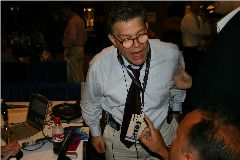 Former Air America radio personality and comedy writer Al Franken has started telling Democratic Party activists and politicians that he will challenge Norm Coleman for his Senate seat in 2008. The widely predicted move comes earlier than most people would have guessed, and Franken apparently will begin fundraising immediately:
On Monday, Franken announced that he was quitting his radio show on Feb. 14, and he told his audience that they'd be the first to know of his decision. But Franken has been working the phones in recent days, telling his political friends he's ready to declare his candidacy.The Star Tribune confirmed today that Franken made calls to at least two members of the Minnesota congressional delegation in Washington to break the news. The sources spoke on the condition of anonymity, not wanting to pre-empt Franken's announcement.
"From his voice to my ears, he's running," said one House member, who relayed the remark via his press secretary.
"I can tell you we got one of those calls," said a top-ranked aide for another House member.
Franken moved back to his native Minnesota last year in order to prepare the ground for this run. He threw himself into fundraising for Minnesota Democrats, a move that not only helped his party nearly sweep the contested races but also made a point about the primary for the Senate race. His largesse has precluded any of the currently serving Democrats in the state from making any noises about challenging for the endorsement of the DFL.
We can expect Franken to continue to bring in big dollars for his campaign. He has strong ties to the Hollywood elite, and people like Barbra Streisand, Phil Donahue, and Norman Lear will put forth the strongest efforts to ensure his election. He may find that at least partially a liability in this state. The Republicans ran a strong conservative in the last election, Mark Kennedy, and he lost by 20 points to Amy Klobuchar. Now the DFL will run a hard-left Franken against the centrist Coleman, and the sources of his contributions will reinforce his extremist tendencies in a state that dislikes lock-step thinkers.
His behavior and temper may be another obstacle. The picture above was taken of Franken at the 2004 Republican Convention, after he tried to pick a fight with Laura Ingraham's producer (seen in the foreground). He also lost his temper with the ever-mild Michael Medved at the same convention, although he managed not to take a swing at Medved. He also tackled a protestor at a Democratic Party event. If he gets into a tough campaign -- and it certainly will get tense -- he may blow a gasket again. We'll be there when it happens, trust me.
Our Mercenaries?
It seems that William Arkin has had enough of supporting the troops, now that a few of them told NBC that they believe that Americans should support the mission as well. In his Washington Post blog, Arkin suddenly feels that the troops should just shut up and retreat:
So, we pay the soldiers a decent wage, take care of their families, provide them with housing and medical care and vast social support systems and ship obscene amenities into the war zone for them, we support them in every possible way, and their attitude is that we should in addition roll over and play dead, defer to the military and the generals and let them fight their war, and give up our rights and responsibilities to speak up because they are above society?I can imagine some post-9/11 moment, when the American people say enough already with the wars against terrorism and those in the national security establishment feel these same frustrations. In my little parable, those in leadership positions shake their heads that the people don't get it, that they don't understand that the threat from terrorism, while difficult to defeat, demands commitment and sacrifice and is very real because it is so shadowy, that the very survival of the United States is at stake. Those Hoover's and Nixon's will use these kids in uniform as their soldiers. If I weren't the United States, I'd say the story end with a military coup where those in the know, and those with fire in their bellies, save the nation from the people.
But it is the United States and instead this NBC report is just an ugly reminder of the price we pay for a mercenary - oops sorry, volunteer - force that thinks it is doing the dirty work.
Mercenary? Wow. Just wow. I suppose they shouldn't paid at all, Mr. Arkin?
Of course, the worst part of this -- besides the incoherent writing style -- is the characterization of the NBC report. Not one of the soldiers in the clip remotely suggested that Americans "give up their rights and responsibilities". They didn't say that George Bush should make everyone who opposes the war shut up, or else. They were asked about their take on people who say they support the troops but oppose the war, and they expressed their views.
Unfortunately, Mr. Arkin can't handle free speech. He incomprehensibly calls them mercenaries because they volunteered for the military, and apparently because they have the audacity to offer their opinions when asked.. (By definition, a mercenary is someone who hires himself out as a soldier for a nation not his own.)
Arkin finishes by suggesting that America rethink what it owes the troops, so I'll oblige. We owe them our support because they risk their lives to ensure that we retain our freedoms. They don't get paid all that well to do it, either, but they do it because they love our country. I'm fine with them expressing their opinions when reporters stick cameras in their faces and ask for them, even if they don't agree with me. I still respect them for what they do, which apparently is the difference between Arkin and myself. (via QandO)
Addendum: I have to add that Arkin also appears to need writing and grammar lessons. Do the Post's editors ever review these entries?
UPDATE: Uncle Jimbo at Blackfive has a response for Arkin, and it's not Howdy Do. Hugh Hewitt is covering it on his show now.
Cult Group Ready For Major Battle
The cult group destroyed by the Iraqi-run offensive on the eve of Ashura may have been obscure, but they had one point in common with the other insurgencies in Iraq -- they were armed to the teeth. Close air support from the US forces backing up the IA units made the difference, as more that 260 cultists died with bags of ammunition surrounding them:
The dead wore the same footwear, imitation leather dress shoes with Velcro flaps. Their mangled bodies filled the trenches. Bags of ammunition, with the names of fighters written on them, sat by their sides.A pulpit made of bamboo stood next to a grassy field, a newspaper filled with rambling and enigmatic religious writing strewn nearby.
An unauthorized hourlong walk Tuesday through the bombed compound of a religious cult called Heaven's Army revealed provocative clues about the group, which was decimated Sunday in a 24-hour U.S. and Iraqi offensive that authorities say left 263 alleged members dead and 210 injured. Nearly 400 members were arrested, an Iraqi defense official said.
Iraqi officials said the obscure messianic group was poised to launch an attack on Shiite clergy and holy sites in Najaf in the belief that it would hasten the dawn of a new age. Iraqi officials said they got wind of the plan and attempted to investigate but were attacked by the group's gunmen in a battle that also killed five Iraqi troops and two U.S. soldiers, who died when their helicopter crashed.
The bulk of the damage to the group's base was inflicted by U.S. airstrikes, which turned the tide of a fierce ground battle that pitted the fighters against Iraqi troops backed by U.S. forces.
The obscurity of the group hid its impressive organization. The Los Angeles Times reports that none of them wore formak uniforms, but they all had identification badges. Their base consisted of 30 concrete buildings and apparently included a press for a newspaper and books. Their intent was to create the chaos necessary to bring the Twelfth Imam out of the wilderness, a millenial obsession shared by Iranian president Mahmoud Ahmadinejad.
The group filled its newspaper with "sightings" of the Mahdi, to the extent it could be read at all. Sources who reviewed the material described it as "religiously-inflected gibberish", perhaps a way to keep its observations from outside scrutiny. The cult formed around Dhyaa Abdul-Zahra, an imam that rejected both Sunni and mainstream Shi'ite teachings, claiming as so many cult leaders do that he had a unique insight into hidden messages that only he could discover.
In other words, this appears to be the Iraqi equivalent to the Branch Davidians and the Jonestown nutcases, only better armed and more aptly led in battle. They presented a serious danger, and their Ashura attack would have brought tremendous death and destruction in Karbala had the Iraqis not fought them first. There certainly would have been no negotiating with a group of this type.
Another Pandora's Box On Political Speech
Charles Schumer and Barack Obama plan to introduce a bill today in the Senate that will impose more regulation on political speech during campaigns in order to end "deceptive" practices. The New York Times editorial board enthusiastically supports this new bill, even though it admits that the one abuse most often associated with this effort can be prosecuted under existing law:
Dirty tricks like these turn up every election season, in large part because they are so rarely punished. But two Democratic senators, Barack Obama of Illinois and Charles Schumer of New York, are introducing a bill today that would make deceiving or intimidating voters a federal crime with substantial penalties.The bill aims at some of the most commonly used deceptive political tactics. It makes it a crime to knowingly tell voters the wrong day for an election. There have been numerous reports of organized efforts to use telephones, leaflets or posters to tell voters, especially in minority areas, not to vote on Election Day because voting has been postponed.
The bill would also criminalize making false claims to voters about who has endorsed a candidate, or wrongly telling people — like immigrants who are registered voters in Orange County — that they cannot vote. ...
The bill is careful to avoid infringing on First Amendment rights, and that is the right course. But in steering clear of regulating speech, it is not clear how effective the measure would be in addressing one of the worst dirty tricks of last fall’s election: a particular kind of deceptive “robocall” that was used against Democratic Congressional candidates. These calls, paid for by the Republicans, sounded as if they had come from the Democrat; when a recipient hung up, the call was repeated over and over. The intent was clearly to annoy the recipients so they would not vote for the Democrat.
While there are already laws that can be used against this sort of deceptive telephone harassment, a more specific bill aimed directly at these calls is needed.
Why? If the law already covers this abuse, then passing another law is not only superfluous, it creates a danger of government regulation of political speech that should be avoided, not embraced. The impulse to pass laws to punish the worst of the deceivers is understandable, but it will open a Pandora's Box of litigation that will get used to initimidate smaller grass-roots organizations into silence.
The bill allows "individuals", according to the NYT, to file lawsuits against anyone promoting what the plaintiff sees as "deceptive" public argument. While Schumer and Obama may have a high-minded opinion of the average American and his/her eschewing of courts for nefarious uses, the rest of us who live in the real world understands exactly what this will mean. Any campaign advertising or position paper will become fair game for all sorts of lawsuits, and more than likely multiple suits in courts all over the country.
And what will be considered "deceptive"? I'm certain that this law would have resulted in an avalanche of lawsuits against the Swift Boat veterans in 2004. They would have had to sink their funds into courtrooms and lawyers across the nation, defending their right to speak out by offering the considerable testimony and documentation they collected -- but that effort would have stopped them from participating in the election. The same can be said for groups like United for Peace and Justice and MoveOn on the Left. The latter briefly featured an ad equating George Bush to Adolf Hitler, which would have prompted an avalanche of lawsuits from the Right.
All of these suits probably would have resulted in dismissals, but that's not the point. A law like this eliminates all but the deepest-pocketed organizations from participating due to the sudden liabilities involved in political speech. It also sets up the government as the arbiter of acceptable and "truthful" political speech, rather than the American electorate -- a dangerous position for everyone.
Like so many reformists, Schumer and Obama want to have federal intervention to protect people from their own naiveté. That's not the proper role of the government, and especially when it comes to political speech. The best defense against deception is education and research, and the responsibility for that lies with the voters themselves.
UPDATE: Glenn Reynolds says that this is about protecting incumbents, as all such legislation is. He's right, but I think this is also about squelching the kind of grassroots organizations like the Swift Vets that can spring up to address one particular issue for a short period of time. Broad, multi-issue organizations can afford to answer mulitiple lawsuits across several jurisdictions, but smaller groups would be forced to fold the tent.
Everybody Must Not Get Stoned
It seems multiculturalism may be on the wane even in a former bastion of the practice. A town in Quebec issued a declaration of "rules" for immigrants that instructed them to hit the road if they didn't want to assimilate into the mainstream culture of the province:
Don't stone women to death, burn them or circumcise them, immigrants wishing to live in the town of Herouxville in Quebec, Canada, have been told.The rules come in a new town council declaration on culture that Muslims have branded shocking and insulting.
Quebec is in the midst of a huge debate on integrating immigrant cultures.
Herouxville has tired of accommodation, as the declaration makes clear. Of late, the nation has had to bend over backwards to keep people from feeling offended, and the natives have obviously gotten restless. A Toronto judge recently removed a Christmas tree from the courtroom to avoid offending non-Christians, and a Montreal gym had to frost its windows after Hasidic Jews complained about the sight of adults exercising from the street.
It's not the only sign of pushback against multiculturalism in Quebec, either. A Montreal police officer finds himself in hot water after writing a popular ditty called "That's Enough Already". The song tells immigrants to either adopt the culture of their new home or take the next flight to anywhere else. The police force will now question the officer about his "motives" for the lyrics.
The Herouxville declaration isn't as irrational as it looks. I haven't heard of any public stonings or immolations by Muslims in Canada, but they have pressed for government recognition of shari'a courts as an option for Muslim communities. Herouxville sees the end result of multiculturalism as a replacement for assimilation and is reacting to a Balkanization that hasn't yet begun by highlighting the worst-case scenarios. That's not irrational, but it is quite a bit hyperbolic.
I wonder if the sudden impulse for assimilation into the mainstream culture will be enough for Quebec to drop its own multicultural demands on the rest of the Canadian Union, regarding language and cultural accommodation for itself. I'm certainly sympathetic to the argument against the multicultural impulse as opposed to assimilation for immigrants, but in this case it comes from an odd source.
Deterrence Works On Europe, At Least
I'm not sure if our military buildup in the Persian Gulf has Iranian mullahs looking over their shoulders, but it certainly seems to have spooked the Europeans. The Guardian reports that European political leaders have become more convinced that the Bush administration will resort to air strikes to stop the Iranian nuclear program:
Senior European policy-makers are increasingly worried that the US administration will resort to air strikes against Iran to try to destroy its suspect nuclear programme.As transatlantic friction over how to deal with the Iranian impasse intensifies, there are fears in European capitals that the nuclear crisis could come to a head this year because of US frustration with Russian stalling tactics at the UN security council. "The clock is ticking," said one European official. "Military action has come back on to the table more seriously than before. The language in the US has changed."
The Americans and Europeans have sought to maintain a common front on the nuclear issue for the past 30 months, with the European troika of Britain, France and Germany running failed negotiations with the Iranians and the Americans tacitly supporting them.
But diplomats in Brussels and those dealing with the dispute in Vienna say a fissure has opened up between the US and western Europe on three crucial aspects - the military option; how and how quickly to hit Iran with economic sanctions already decreed by the UN security council; and how to deal with Russian opposition to action against Iran through the security council.
"There's anxiety everywhere you turn," said a diplomat familiar with the work of the International Atomic Energy Agency in Vienna. "The Europeans are very concerned the shit could hit the fan."
The idea of air strikes is nothing new, but it won't be as easy as Osirak was for the Israelis. The Iranians have prepared for that eventuality and have buried their most sensitive operations. They have also hidden them, playing a shell game with their facilities in order to keep the US guessing about its assets. It will be difficult to take out their entire nuclear operations.
However, that probably wouldn't be necessary. All we need to do is to set it back a few years, and even if we only hit 25-30% of their nuclear-research support structure, we could easily have that effect. Even deeply buried facilities have to move material to the surface for transport, and the destruction of support systems around these laboratories would devastate Iranian nuclear development.
Another consideration will be the political reaction in Iran. Right now, the mullahcracy has generated plenty of unhappiness with the oppressive nature of the theocracy, and Ahmadinejad has done a great job of wrecking the economy on top of that. Put that with the international isolation his approach to nuclearization has caused, and the Iranian people might be ripe for a counter-revolution to throw off the Islamists. That will all dissipate if the US attacks Iran, even in "surgical" strikes designed to cause a minimal amount of collateral damage. It would probably steel public opinion against the US and strengthen the hand of the mullahs, at least in the short term.
Would it be worth it? It might, since popular Iranian dissatisfaction has hardly translated into any kind of massive pushback against the mullahs up to now. Waiting for the counter-revolution will probably ensure that the mullahs get the bomb. Certainly the Russians have made it clear that we cannot rely on the UN Security Council to stare down the Iranians, and Europe won't consider any other strategies. If it's a choice between playing nice while the radical Islamists make themselves some nukes and blowing up a few of their facilities, I'd reluctantly go for the latter.
Just don't tell the Europeans. It sounds like they're already looking to surrender, and our ships haven't even arrived yet.
African Union Fails The Somalia Test
The African Union had an opportunity to demonstrate that they can act independently to stabilize problem areas on the continent, and appear to have blown it. Instead of acting quickly to tamp down anarchy in Somalia by providing peacekeeping troops to replace the Ethiopians, the member nations of the AU could not even provide half of the forces necessary for the mission:
African Union leaders have failed to secure full numbers for a planned peacekeeping force in Somalia, following a two-day summit in Ethiopia.Speaking at the closure, new AU chairman John Kufuor said several nations had pledged troops - but only 4,000 out of a required 8,000.
The force is due to replace withdrawing Ethiopian soldiers, whose intervention swept Islamists from power last month.
The conference even had a head start on troop commitments. Uganda, Nigeria, Ghana, and Malawi all agreed to send the 4,000 troops prior to the start of the meetings. Those nations intended on using those pledges to secure more support from other African nations. Instead, the AU missed an opportunity to end the chaos in which Somalia has existed for the past two decades.
Somalia's transitional government appeared to make better progress on their own. Somalia announced a reconciliation conference that would include various leaders of religious and clan organizations, a necessary step if Mogadishu will find its way to a stable, elected government and an end to vigilantism and retribution. The move will free up millions of aid dollars from Europe and the US, which has pressed Somalian president Abdullahi Yusuf to invite "moderate Islamists" to participate.
Hopefully, the conference will work if the AU cannot get its act together to provide for better security. If the Somalis can agree to put aside past wrongs and forego revenge, the transitional government will have a short window in which to build the infrastructure necessary for elections and credibility. Otherwise, the nation will fall back into warlord rule, allowing radical Islamists to creep back into power and terrorists to once again exploit the anarchy for their own purposes. Europe and the US have to remain engaged to prevent another catastrophic collapse.
Did Iran Attack American Troops In Iraq?
CNN reports that American military investigators believe the January 20th attack on a military compound that killed five US soldiers may have either been conducted by Iran or by Iranian-run insurgents. The level of sophistication in the attack, conducted by terrorists in American military uniforms, showed too much sophistication to have originated from one of the native insurgencies:
The Pentagon is investigating whether a recent attack on a military compound in Karbala was carried out by Iranians or Iranian-trained operatives, two officials from separate U.S. government agencies said."People are looking at it seriously," one of the officials said.
That official added the Iranian connection was a leading theory in the investigation into the January 20 attack that killed five soldiers.
The second official said: "We believe it's possible the executors of the attack were Iranian or Iranian-trained."
Five U.S. soldiers were killed in the sophisticated attack by men wearing U.S.-style uniforms, according to U.S. military reports.
The investigation just started, and the Pentagon will probably look at a number of possibilities for the attack. However, given the description of the attack and its effectiveness, it seems a little over the pay grade of even the Ba'athist remnants. Since this occurred in Karbala, a predominantly Shi'ite area, Sunni insurgents and al-Qaeda also seem unlikely suspects.
Earlier on Tuesday, Time Magazine reported that Iran has a motive to attack Americans in Iraq. The Revolutionary Guard wants some measure of revenge for the capture of five Iranians in Irbil, at least some of whom belong to the IRGC. Time speculates that the IRGC wanted to send a message, and that the number of casualties were specifically selected to make sure that no one misunderstood it.
What happens if the US concludes that Iran did indeed conduct this mission against American servicemen? It would be an act of war, although the presence of Iranian Revolutionary Guard soldiers in support of insurgents also qualifies. The Bush administration might be tempted to retaliate with some air strikes, perhaps selected especially for the nuclear program Iran seems keen to pursue at all costs. However, one can imagine the outcry that would cause, not just among our European allies but also leading Democrats in Congress. It would not take long for at least a few of them -- Maurice Hinchey springs to mind -- to accuse the Bush administration of manufacturing the evidence pointing to Iran in order to justify an attack on that nation.
If the evidence points in that direction, there will be no big rush to respond. It might do some good to make the Iranians sweat for a short period. However, Bush will have to confer with the Democrats and make it clear what happened, and impress upon them the need for serious action to deter the Iranians from attacking Americans in the future. We've let too many of these incidents pass without consequence to the mullahs, and every unanswered insult begets more of the same.
UPDATE: Bill Roggio analyzed this last Friday and came up with the same answer.
January 30, 2007
Has Congress Amended An AUMF In The Past?
Earlier today, Russ Feingold began holding hearings on whether Congress had the authority to rescind or modify an authorization for the use of military force (AUMF), once approved and implemented by the executive. This weekend, I argued that Congress could not simply rescind an AUMF without the executive declaring an end to hostilities, once given command of the war. Feingold plans to use the hearings to demonstrate that Congress can indeed overrule the executive, withdraw their AUMF, and force an end to a deployment.
Does Congress have any precedent for such an action? This was the subject of a friendly set of e-mails between myself and Glenn Greenwald after he posted examples of Republican Senators demanding an end to our deployment in Somalia after the debacle of Mogadishu. These include Jesse Helms, Strom Thurmond, Phil Gramm, and John McCain, who made the case for Senatorial action:
Dates certain, Mr. President, are not the criteria here. What is the criteria and what should be the criteria is our immediate, orderly withdrawal from Somalia. And if we do not do that and other Americans die, other Americans are wounded, other Americans are captured because we stay too long--longer than necessary--then I would say that the responsibilities for that lie with the Congress of the United States who did not exercise their authority under the Constitution of the United States and mandate that they be brought home quickly and safely as possible.
I challenged Glenn about the use of Somalia as an example, as I did not believe that Congress had ever passed an AUMF for action against Somalian warlords -- which then created the opening for Congress to demand the withdrawal of the troops. In the case of Iraq, Congress granted the executive the AUMF to conduct the war and that made this a significantly different situation; the two were not analogous. I could not research the question myself at the time (I was reading Glenn's argument on a break from work), but Glenn offered to check it out and get back to me.
He e-mailed me later this afternoon, and provided this document as background on the question. It summarizes Congressional involvement in military action over the last twenty-five years, prepared by the Congressional Research Service of the Library of Congress. The section on Somalia seems to indicate that some sort of AUMF did indeed get issued -- and was amended several times to set a deadline for the removal of American troops from Somalia (page 10):
S.J.Res. 45 Joint resolution authorizing the use of United States Armed Forces in Somalia pursuant to United Nations Security Council Resolution 794 providing for a secure environment to deliver relief supplies into Somalia. February 4, 1993: Measure passed Senate (voice vote). May 25, 1993: Measure passed House, 243-179 (roll call vote #183). The House reported version authorized U.S. troops under the War Powers Resolution, but terminated such authorization at the earlier of (1) end of one year from date of enactment of the act unless extended by Congress; or (2) expiration of the United Nations-led force in Somalia.
It's of interest to note that the outgoing Bush administration did not go to Congress to authorize the initial deployment, instead choosing to use the UNSC resolution to initiate the mission. Starting in October 1993, though, the mood of Congress changed. Both Democrats and Republicans submitted amendments to the original AUMF to end the authorization on specific dates. The dates ranged from January 31, 1994 to their eventual full withdrawal in March 1995. Strom Thurmond had to beat back a McCain amendment at that time to prohibit all expenditures on the military mission in Somalia except that necessary to bring the troops home. The Byrd amendment passed, which essentially did the same thing but extended the deadline to March 31, 2004, unless the mission was reauthorized by Congress.
This demonstrates more that Congress can use the power of the purse to end a military deployment rather than to withdraw an AUMF, once given. Also, it is unclear whether the AUMF for Somalia actually authorized offensive military action; that mission expansion certainly inspired some of the anger seen in Glenn's post from Senate Republicans at that time. The precedent does exist for Congress to set limits on deployments, though -- that much is clear from the Congressional history of our Somalian mission.
If Congress has the legal authority to make such a move, it still remains an open question whether such action would be wise politically. It puts responsibility on Congress, mostly the Democrats, if a precipitate withdrawal leads to a collapse in Iraq, systematic genocides, and the rise of a terrorist state that would require another American invasion to destroy.
Addendum: The troops don't appear to favorite it much, as this YouTube demonstrates (via McQ at QandO):
They're obviously not buying the "support the troops, oppose the mission" meme.
UPDATE: Deleted the YouTube video, due to some technical glitch; it apparently prevented the entire page from loading. Hat tip to Tom Holsinger in the comments.
(Not) Plugging The Holes In Our Border
In a war on terrorism in which we have already suffered thousands of deaths from infiltrators into the US, one might think that border security might take a leading position among issues faced the federal government. However, the Los Angeles Times reports that sophisticated tunnels literally undermining our southern border still remain in use even after their discovery, thanks to half-hearted efforts to plug the holes created by smugglers:
Seven of the largest tunnels discovered under the U.S.-Mexico border in recent years have yet to be filled in, authorities said, raising concerns because smugglers have tried to reuse such passages before.Among the unfilled tunnels, created to ferry people and drugs, is the longest one yet found — extending nearly half a mile from San Diego to Tijuana. Nearby, another sophisticated passageway once known as the Taj Mahal of tunnels has been sitting unfilled for 13 years, authorities say.
Though concrete plugs usually close off the tunnels where they cross under the border and at main entrance and exit points, the areas in between remain largely intact. Filling the seven tunnels would cost about $2.7 million, according to U.S. Customs and Border Protection officials. Accessing tunnels that run under private property is also a problem, as is a lack of coordination with Mexican authorities.
Mexican authorities have told their U.S. counterparts that they've filled their end of the tunnels. But U.S. officials express doubt, citing the high costs and examples of tunnels being compromised. The Mexican attorney general's office, which handles organized crime, did not respond to numerous requests for interviews.
It's difficult to blame the Mexican government for its lack of action on the tunnels when we haven't done much with them, either. Congress shifted responsibility for the tunnels to Customs and Border Protection when it reorganized the Department of Homeland Security in 2003, but almost four years later, no one appears willing to address the problem effectively. As a result, smugglers -- and others -- simply work around the obstacles placed in the tunnels on the cheap.
Most tunnels require little effort to destroy. They consist of cheap, and probably dangerous, wormholes that can easily be shut down. However, the money flowing into the drug- and alien-smuggling operations have allowed miners with real expertise to create elaborate tunnels, some with telephone service, rails, and video surveillance. CBP and its predecessors have used concrete plugs to block these tunnels, rather than properly fill them with dirt in order to ensure that smugglers simply don't tunnel around the obstructions. And that's exactly what they do, which requires even more enforcement activity to stop the new brances off the same tunnels.
CPB points to issues of private-property ownership and cost when explaining the lack of progress on the tunnels. Some may take as much as $2 million in work to completely fill, and some private-property owners object to the methods used to fill them in any case. However, this isn't a case of water rights-of-way or filling potholes on city streets. These tunnels could be used to transport anything around our border protection, and illegal workers are the least problematic of the potential contraband. While we have Congress demanding 100% inspection of cargo at port facilities, we have allowed these unchecked entry points to continue their usefulness to people who might use them to smuggle any kind of weapons to use against us.
These tunnels need to get shut down immediately. CPB, the White House, and Congress needs to make arrangements to resolve whatever procedural and cost difficulties exist quickly and end the potential for the kinds of mischief we wish to avoid. After we get serious about these tunnels, we can demand that the Mexicans meet their responsibilities.
The COLA-Free Congress, Courtesy Of The GOP
Republicans blocked the normally smooth process towards Congress granting itself its annual cost-of-living increase yesterday, a move that will certainly not sadden taxpayers but will leave Representatives around $2800 lighter. The GOP ended the amicable understanding between the two parties that discouraged any challenges to COLA increases after the Democrats violated an agreement between them not to use the COLAs for the basis of political attacks:
House Democratic leaders Monday abandoned attempts to revive an annual pay raise cherished by rank and file lawmakers, a decision prompted by lingering GOP anger over last year's campaign.Lawmakers' pay will be frozen at $165,200 for this year in a dispute fueled by the Democrats' use of the issue in last year's campaign, violating a yearslong understanding that the competing parties would not attack each other over pay raises.
At issue is the annual congressional cost of living adjustment, or COLA, under which lawmakers automatically get a pay hike unless Congress votes to block it. Democratic and Republican leaders had worked cozily for years to make sure an annual pay-related vote went smoothly.
After the last increase got approved in June for this session of Congress -- a session cannot increase its current wages -- the Democrats used the COLAs in attack ads for the midterms, scolding the Republicans for making adjustments to the cost of living while leaving the federal minimum wage alone. The argument failed to note the participation of Democratic leadership in those agreements, leaving the Republicans holding the bag for the COLAs.
In December, while still in the majority, they pushed back the new COLA, making it impossible for the Democrats to avoid responsibility for the increase. The Democrats wanted to push the COLA back a few more weeks out, in order to get the minimum-wage hike approved before Congress got its raise, but the GOP blocked that effort -- and have announced that they will not support any more increases in the Congressional wage. Without bipartisan support, the Democrats will have to drop the COLA.
None of this makes me unhappy, and I suspect many CQ readers will feel the same way. Our Representatives already make $165,000 a year, and Congressional officers make a little more than that. That's more than double the average wage of the American family, and it doesn't require adjustment to attract plenty of candidates for the jobs. Congress can stand to live within fixed means for a while, and perhaps it will inspire them to impose the same experience on the rest of the federal government.
Bush Orders Political Oversight Of Agency Rulemaking
The Gray Lady gets hysterical this morning over the executive order signed by President Bush requiring oversight of agency rulemaking. Bush's order requires federal agencies to submit impact reports that justifies additional regulation not authorized by Congress as well as an annual report of the cumulative effect of their entire regulatory position, and it creates a White House appointee to conduct the oversight. One might consider this common sense, unless one has a bad case of Bush Derangement Syndrome:
President Bush has signed a directive that gives the White House much greater control over the rules and policy statements that the government develops to protect public health, safety, the environment, civil rights and privacy.In an executive order published last week in the Federal Register, Mr. Bush said that each agency must have a regulatory policy office run by a political appointee, to supervise the development of rules and documents providing guidance to regulated industries. The White House will thus have a gatekeeper in each agency to analyze the costs and the benefits of new rules and to make sure the agencies carry out the president’s priorities.
This strengthens the hand of the White House in shaping rules that have, in the past, often been generated by civil servants and scientific experts. It suggests that the administration still has ways to exert its power after the takeover of Congress by the Democrats. ...
Representative Henry A. Waxman, Democrat of California and chairman of the Committee on Oversight and Government Reform, said: “The executive order allows the political staff at the White House to dictate decisions on health and safety issues, even if the government’s own impartial experts disagree. This is a terrible way to govern, but great news for special interests.”
Hogwash. The order ends the tradition of unchecked authority by federal agencies to set up their own rules and apply them capriciously, outside of the control of either Congress or the executive branch. It makes agencies justify any new rules and brings that process into a little more sunlight and holds the bureaucracy accountable. And the only reason that Bush had to sign this order is that Congresses over the past several decades, Republican and Democratic, have done nothing to rein in the imperial bureaucrats who conduct empire-building.
When an agency wants to add more regulation without any Congressional authorization, they have the requirement to submit the proposals to the Office of Management and Budget for review. Most of them have used a workaround called "guidance documents", which get issued within the bureaucracies and have the force of policy. These documents never get public scrutiny, nor does OMB get a chance to review them before they go into effect. The regulated agencies usually see them, but no appeals process exists to stop them, since they exist outside any mechanisms for oversight.
That is a recipe for the mindless tyranny of petty bureaucrats and explains why regulation has gotten out of hand over the past few years. Even the Democrats used to acknowledge this; Al Gore led a task force for the purpose of undoing the overwhelming and mostly useless red tape within the federal bureaucracy. It went nowhere, and no systemic reforms were even contemplated. The Bush administration has obviously decided to pick up where the Clinton administration left off and actually do something to slow the tide of new regulation.
If Henry Waxman and the rest of Congress don't like this idea, then let them come up with some other way to end the unchecked power of "guidance documents" and the self-perpetuating empire building in the federal bureaucracy. Waxman served in the majority before 1994, and he's back there again. Until the Democrats and their constituent special interests either offer an alternative for controlling the expansion of power by federal agencies or justify the lack of oversight that allows it, then they have nothing at all to offer -- which is the reason why critics like the New York Times have settled for good, old-fashioned paranoia and scare tactics.
With Just A Year To Go ...
Is it too early for polling in the Presidential race? You bet it is. Does that stop anyone from quoting the polls? Absolutely not. So, just for fun and not for serious consideration, take a look at this New Hampshire poll from Boston's CBS television affiliate, via Rich Lowry at The Corner:
Sen. Clinton is the choice of 40 percent, followed by Sen. Barack Obama with 25 percent, and 2004 vice-presidential nominee John Edwards at 23 percent. Only nine percent preferred someone else.That's a strong showing for Obama, a newcomer to a state where Clinton and Edwards have campaigned for years. But the numbers could be a nightmare for him too. ...
Our survey of Republicans shows former New York mayor Rudy Giuliani in a virtual tie with Sen. John McCain, 33 to 32 percent, with former governor Mitt Romney up sharply over recent polling at 21 percent.
For Romney, it's an early sign that his strategy of courting the right on social issues is paying off among GOP conservatives. And it leaves Giuliani and McCain facing the same fate as Edwards and Obama - they split the moderates, and Romney runs right through the hole they create.
In the Granite State, at least, it seems that the Democratic field has narrowed considerably. If Al Gore had been thinking about a return to Presidential politics, he might have missed his chance. Earlier this month, Rasmussen had him beating Mitt Romney in a general election. Good thing we're not having it this month, then.
The Republican race appears more fluid. The top three eat up 86% of respondents, but that won't hold if a big name drops into the race, such as Newt Gingrich. He may not immediately pull 30 points, but he would more than likely pull everyone else into the 20s or lower.
Rasmussen's matchups show some interesting figures. They polled all of the major and minor presumed candidates against each other, and the one Republican who wins against them all is Rudy Giuliani. Romney loses to Obama by 13 points and Hillary by eight; he even loses to Tom Vilsack, although neither of them garner 40% in the poll. Romney still has a lot of time to define himself, of course, but that can't be said of John McCain. He has been in front of a few cameras over the last few years as the leading GOP maverick, at least until Chuck Hagel started speaking up about Iraq. McCain edges Hillary within the margin of error, but loses to John Edwards and Barack Obama by the same margin. Giuliani, on the other hand, beats everyone -- Hillary, Gore, Edwards, and especially Obama, whom he surpasses by eleven points.
It's still way too early to take this seriously, but it's not completely worthless, either.
We'll Just Settle For A Little Extortion
The Libyan government indicated for the first time that the six medical workers sentenced to death for purportedly exposing a family to AIDS and touching off an epidemic would not get executed. Western governments have continuously lobbied Tripoli to stop the execution and release the workers, calling the accusations ludicrous, but until yesterday it appeared that those efforts would fail. Moammar Gaddafi's son told a Bulgarian newspaper that his father opposes the execution -- but that compensation has to be offered:
LIBYA will not execute five Bulgarian nurses and a Palestinian doctor sentenced to death last month, the son of the Libyan leader, Colonel Muammar al-Gaddafi said in a newspaper interview, calling the verdicts unfair.A Libyan court sentenced the six for intentionally infecting hundreds of children with the HIV virus in a case which started eight years ago and that has triggered widespread international concern about its fairness.
Speaking to a Bulgarian daily newspaper 24 Chasa, Col Gaddafi's son, Saif al-Islam, said a solution would be found soon to save the six and satisfy families of the infected children. "There will be no executions. I hope there will be a happy end soon ... My father is also against the executions," said Mr Islam, who is Col Gaddafi's leading envoy.
"The case went in the wrong direction from the very beginning. There were many manipulations in the original files, many errors ... This is why we should seek a compromise," Mr Islam said, adding that Tripoli had already discussed a plan with Germany and France.
Libya accused the Palestinian doctor and the five Bulgarian nurses of negligently infecting a family with AIDS and allowing it to spread throughout the nation. AIDS researchers have repeatedly shown this to be false, and challenged the Libyan government's assertion that AIDS did not exist in the country before their arrival. Despite numerous entreaties, Gaddafi allowed the trial to continue and sentence the six to death. Now Gaddafi has apparently changed his mind, a happy turn of events.
However, Gaddafi wants a little something for his trouble. Claiming that the family still has case, Gaddafi wants the Western nations to pay blood money for the workers' release. Blood money has a long tradition in Islamic culture and is called bloodwit, and is described in Al-Baqarah (The Cow), Section 22, verse 178 as "ransom for manslaughter". It also gets described in An Nisa' (Women), Section 13, verse 92:
It is not befitting for a believer to kill a believer except by accident, and whoever accidently kills a believer, he is commanded to free a believing slave and pay bloodwit to the family of the victim, unless they forgo it as a charity. If the victim is from a hostile nation, then the freeing of a believing slave is enough, but if he belonged to a nation with whom you have a treaty, then bloodwit must be paid to his family along with the freeing of a believing slave. Those who do not have the means (bloodwit and / or a slave) must fast two consecutive months: a method of repentance provided by Allah. Allah is the Knowledgeable, Wise.
The expectation exists with wronged Muslims that any mercy must be purchased from the victims or their kin. However, in this case, it seems less religious and more mercenary on the part of Gaddafi and his government. The Scotsman reports that Gaddafi wants $10 million from Bulgaria to release the women, a rather steep price for bloodwit, which usually amounts to a few thousand dollars, if that. Bulgaria has already set up a foundation to pay for the continuing care of the afflicted, but they have already said that their settlement will not be in the millions.
We shall see whether Gaddafi and his son are in a bargaining mood. At the moment, though, we can hope that the six medical workers will not have to worry about a date with the hangman.
Damning Us For Our Success
Ali Ansari has a strange column in today's Guardian regarding Iran, Mahmoud Ahmadinejad, and US hawks. He wants to argue that Ahmadinejad's presidency is failing and that the economic pressures on the Iranian economy have accelerated his decline. However, he then claims that American hawks may yet save Ahmadinejad and scold us for not propping him up:
Ahmadinejad was elected on a platform of anti-corruption and financial transparency, and few appreciated how rapidly he was intoxicated with the prerogatives of his office. He very soon forgot the real help he had received in ensuring his election, basking in the belief that God and the people had put him in power. Ahmadinejad soon had a view for all seasons: uranium enrichment. Of course Iran would pursue this, and what's more, sell it on the open market at knockdown rates. As for interest rates, they were far too high for the ordinary borrower, so cut them immediately. And then there was the Holocaust.None of this might matter so much, if the president had based his rhetorical flourishes on solid policies. ... [N]ot only has Ahmadinejad singularly failed to consolidate and extend his political base, the recent municipal elections saw his faction defeated throughout the country. Traditional conservatives and reformists reorganised and hit back, ingeniously using technology to work round the various obstacles placed in front of them. Now, over the past weeks, with biting weather, shortages of heating fuel are further raising the political temperature, while his political opponents point to the burgeoning international crisis for which the globetrotting president seems to have no constructive answer. Talk has turned to impeachment.
Ironically, it is this very international crisis that may serve to save Ahmadinejad's presidency, a reality that the president undoubtedly understood all too well. As domestic difficulties mount, the emerging international crisis could at best serve as a rallying point, or at worst persuade Iran's elite that a change of guard would convey weakness to the outside world.
There can be little doubt that US hawks will interpret recent events as proof that pressure works, and that any more pressure will encourage the hawks further. Yet the reality is that while Ahmadinejad has been his own worst enemy, the US hawks are his best friends. Ahmadinejad's demise, if it comes, will have less to do with the international environment and more with his own political incompetence. There is little doubt that it will take more than a cosmetic change to get Washington to listen to Iran. But the real question mark, as the Baker-Hamilton commission found to its cost, is whether Washington is inclined to listen at all.
Exactly what should the US do? Ansari seems to share our distaste for the Iranian "populist" who has busied himself with destroying his nation's economy and lighting diplomatic fires all over the world. One would think that Ansari would hew to the dictum that warns about rescuing one's enemies from their own folly. Instead, he complains that America has not engaged Ahmadinejad and kept him afloat, along with his millenial obsession and his virulent anti-Semitism.
Ansari apparently wants us to hand Ahmadinejad a diplomatic victory, which somehow will result, in Ansari's imagination, in a rejection of Ahmadinejad by the mullahcracy and the Iranian electorate. That makes no sense at all. All of the economic pressure exerted on Iran has come from the tenacity of the Bush administration. As slow as Washington has reacted, the international community would never have backed sanctions on Iran without the US pushing it through the UN Security Council. As it is, the sanctions got weakened anyway by the UNSC, thanks to Russia, or we could have accelerated the economic downturn that Ansari cites as a primary reason for Ahmadinejad's incipient collapse.
Instead, Ansari wants the US to follow the ISG's recommendations to reach accommodation with Iran. How exactly would that hasten Ahmadinejad's exit from power? The lifting of sanctions would allow the Iranian economy to rebound, and Ahmadinejad would use his oil revenues to continue his populist policies. The wealthy would return their money to Iran, and Ahmadinejad would get credit for having faced down the Great Satan. That hardly sounds like a recipe for regime change; it sounds more like a prescription for years of the Iranian Hitler strutting through the Middle East.
Ansari notes that one major source of Iranian dissatisfaction with its current president comes from the isolation of Iran over its belligerence on nuclear weapons and Israel, as well as its support of terrorism. Ansari should look again to find out which nation has pushed hardest for that isolation, and try then to explain how alleviating it would make Ahmadinejad look like a failure. This column certainly doesn't even bother with the attempt.
UPDATE: Jules Crittenden takes a look at the "large pistachio nuts" of Iranian foreign policy.
January 29, 2007
Notes For A Monday Evening
I've been a dilettante this evening, of sorts. Instead of obsessively blogging -- you know, my normal mode -- I decided to take some time to make some infrastructure changes. I have had a lot of frustration with my Linksys wireless router; when I have the WEP encryption enabled, the network drops every few minutes, and then takes around a minute to reconnect. This was a fairly new unit, less than six months old, and upgrading the firmware didn't do anything to fix the problem. Tonight, I bought a D-Link DIR-625 to replace it, and I just finished the install. It's pretty slick, and their Network Magic product gives the user a nice, easy interface with which to manage the entire network.
While I played with the network, the First Mate and I watched Risky Business. She had never seen it, which surprised me, and we caught it on one of the movie channels just as it started. It's a better movie than people think. It poses as a standard rite-of-passage sex romp, but it's much darker and more substantive than most in that genre. It takes a deeply cynical look at capitalism, sexual mores, and the pressures of leaving the nest. The subplot involving the frantic nature of resecuring the crystal "egg" of Joel's mother is a rather engaging piece of symbolism, especially when she discovers that it has a crack deep within it. It's pretty raw, but if that doesn't disturb you, it's worth a look.
Finally, I'd like to point out an interview that Alan Levy conducted at Blog Talk Radio with Congressman and presidential hopeful Duncan Hunter. Be sure to check it out. I'll probably want to discuss it and our own interview with Mitt Romney on my Blog Talk Radio show Thursday night. And if you're looking for more uplifting fare than Risky Business and presidential politics, check out The Anchoress, who has been reposting some of her best work the past few days. Just keep scrolling.
Land Baron Harry
Bumped to top from the weekend.
The Los Angeles Times continues its in-depth look at the remarkable finances of Harry Reid, who came into politics a humble man and who apparently intends on leaving it a land baron. The LAT reports on a transaction that gave Reid a 160-acre parcel of land at one-tenth its value, which coincidentally came from a lubricants distributor who shortly afterwards became the intended beneficiary of a Harry Reid-sponsored piece of legislation (via Hang Right Politics):
It's hard to buy undeveloped land in booming northern Arizona for $166 an acre. But now-Senate Majority Leader Harry Reid effectively did just that when a longtime friend decided to sell property owned by the employee pension fund that he controlled.In 2002, Reid (D-Nev.) paid $10,000 to a pension fund controlled by Clair Haycock, a Las Vegas lubricants distributor and his friend for 50 years. The payment gave the senator full control of a 160-acre parcel in Bullhead City that Reid and the pension fund had jointly owned. Reid's price for the equivalent of 60 acres of undeveloped desert was less than one-tenth of the value the assessor placed on it at the time.
Six months after the deal closed, Reid introduced legislation to address the plight of lubricants dealers who had their supplies disrupted by the decisions of big oil companies. It was an issue the Haycock family had brought to Reid's attention in 1994, according to a source familiar with the events.
If Reid were to sell the property for any of the various estimates of its value, his gain on the $10,000 investment could range from $50,000 to $290,000.
It is a potential violation of congressional ethics standards for a member to accept anything of value — including a real estate discount — from a person with interests before Congress.
The bill that Reid proposed never passed, but the land passed to Reid nevertheless. It would have imposed government restrictions on interruptions of supply from oil suppliers to lubricant distributors, a common problem faced by people like Haycock. Although his repeated attempts to pass the legislation never succeeded, Reid's efforts made it clear to the suppliers that Congress had, in the words of LAT reporters Chuck Neubauer and Tom Hamburger, taken an interest in supply interruptions -- a message that certainly seems intended to intimidate Haycock's suppliers.
In 1982, Haycock and Reid purchased the land in a partnership in which Reid owned a five-eighths share. Haycock spent $1500 an acre for his share of the land. In 1987, Haycock used his portion of the land as a contribution to his employee pension fund. A few years later, a California group bought the entire 160 acres from Reid and Haycock for over $1.3 million, which amounted to $8400 an acre -- a fabulous return on investment over the 10 years that Reid and Haycock held the land. Unfortunately, the California investors ended up defaulting on the sale, and it reverted back to Reid and Haycock.
In 2001, Haycock's firm began liquidating assets of the pension fund, and Haycock found he could not buy it himself. Instead, he offered it to Reid -- for a price that amounted to one-tenth the value of the original purchase, and one-fortieth of the price the parcel fetched on the market ten years earlier.
Reid and his apologists point out that the parcel has topographical challenges, and that a minority share would have been difficult to sell to anyone but the majority partner. However, the LAT researched adjacent parcels and discovered that they commanded a price far above Reid's eventual purchase price -- over $4,000 an acre. Minority sales generally get discounted at around 20%, not 98%, even in the Mojave Desert.
This isn't the first time we've seen shady land deals involving Harry Reid. He also had the singular achievement of getting paid over a million dollars on land for which he never disclosed his ownership, a story the LAT reported in October of last year. Reid stopped talking about the "culture of corruption" during the final weeks of the midterms last year -- probably because it hit too close to home.
This deal certainly has the appearance of a slimy quid pro quo. Will the reformist zealotry of the Democratic majority be brought to bear on Reid? Don't count on it.
DC Police Paint Graffiti As Victory
I'm not in the habit of reporting on demonstrations, simply because I think they're too easy to organize for any purpose. The news that "tens of thousands" of anti-war activists gathered on the National Mall for a rally seemed about as newsworthy as a Democratic campaign speech attacking George Bush. These things happen, and for the most part, their banality renders them meaningless.
However, the reaction of the police in Washington DC to acts of vandalism are worth noting. The police stood by and watched as "anarchists" spray-painted graffiti on the steps of the Capitol -- and then insisted that they had thwarted the protest:
Anti-war protesters were allowed to spray paint on part of thewest front steps of the United States Capitol building after police wereordered to break their security line by their leadership, two sources told The Hill.According to the sources, police officers were livid when theywere told to fall back by U.S. Capitol Police (USCP) Chief Phillip Morse andDeputy Chief Daniel Nichols. "They were the commanders on the scene," one source said,who requested anonymity. "It was disgusting." ...
Morse responded to these claims in an e-mail Sunday afternoon,explaining that the protesters were seeking confrontation with the police.
"While there were minor instances of spray painting ofpavement by a splinter group of Anarchists who were seeking a confrontationwith the police, their attempts to breach into secure areas and rush thedoors of the Capitol were thwarted," Morse said. "The graffiti waseasily removed by the dedicated [Architect of the Capitol] staff, some ofwhom responded on their day off to quickly clean the area."
He added, "It is the USCP's duty and responsibility to protectthe Capitol complex, staff and public while allowing the public to exercisetheir First Amendment rights … at the end of the day, both occurredwithout injury to protestors or officers."
That's ludicrous. The First Amendment does not allow people to deface government property, regardless of their motivation. The police did exactly what they should not do -- made a political decision about enforcing the law instead of holding everyone equally accountable for their actions.
The people have the right to assemble and demonstrate for the widest range of purposes and policies, as long as they do not include incitement to riot, the violent overthrow of the United States, and as long as they obey the law. The police are supposed to maintain order and enforce the law. Having police stand around watching while a crowd deliberately violates the law and damages public property not only allows a mob to offend the community, but also demonstrates a lack of will that only encourages more law-breaking -- if not at this demonstration, then at the next. Regardless of political orientation, the police have to serve as a nonpartisan guard against abuses by unruly mobs, and apparently the Capitol Police are simply not up to the job.
Laughably, the DC police chief tries to paint this as a victory, especially the fact that he roused Capitol Hill workers to clean up the graffiti. A victory would have had the offenders cleaning it up while under arrest. Instead of issuing self-serving rationalizations, Chief Morse ought to issue an apology to Washington DC, and perhaps consider adding his resignation to it.
US Declassifying Intel On Iranian Role
American intelligence officials will declassify data that shows the Iranian efforts to foment disorder and terrorism in Iraq, according to Eli Lake of the New York Sun. The effort comes in response to the publicly-announced skepticism of Democratic leadership in Congress, and may wind up as an Internet site for mass dissemination:
New evidence of Iran's role in Iraq will be made [public] in Baghdad by the chief spokesman for the multinational forces in Iraq, Major General William Caldwell. The Directorate of National Intelligence worked over the weekend to clear new intelligence and information that sources inside the intelligence community said would implicate Iran in deliberately sending particularly lethal improvised explosives to terrorists to kill coalition soldiers.The intelligence community is currently debating whether to make the new evidence, which it plans to declassify, available on the Internet.
The plan to present the evidence will coincide with a presentation this week by Ambassador Khalilzad to the press detailing the charges against Iranian operatives affiliated with the country's Quds Force arrested in the last six weeks in three raids.
The decision to go public with new evidence on Iran's role in fomenting Iraq's civil war and in working with terrorists killing American soldiers marks a change in strategy for the Bush administration, which has until now provided scant evidence to the public about Iran's role in the Iraq conflict. Since the president unveiled his new war strategy on January 10, leading Democrats have challenged claims of Iran's role and intentions in the Iraq war.
Leading the skeptics are Jay Rockefeller and Silvestre Reyes, the new chairs for the Senate and House intel committees. Rockefeller called it "Iraq all over again" after President Bush announced the surge earlier this month, suggesting that the administration either cooked up the evidence or is deliberately overreading it to justify action against Iran. Reyes took a softer tone, but said he wanted to investigate claims that Iran has manufactured IEDs used to attack American forces and kill American troops.
Declassifying and publishing the intel would certainly force both to acknowledge the existence of the data. However, it could also create risk for the people gathering the intel, and not just American sources. Some of the implications of the data make it risky for allies within the Iraqi government, who still have to work with Iran just due to proximity.
What can be declassified should be published, however. Given the failures of the intelligence on Iraq over several years, the American people have become somewhat skeptical of conclusions based on secret information gathered by the same agencies. If the government wants to build a case for tough policies on Iran, they need to provide as much of the data as possible in order to form a consensus that action is needed at all.
Insurgents Lose Battle, Badly
Iraqi forces, backed by American troops, killed 250 insurgents in a bloody battle near Najaf yesterday. The fifteen-hour battle prevented the terrorists from attacking Shi'ite pilgrims on their way to celebrate Ashura, a flashpoint for violence in the past. However, some reports indicate that Shi'ite splinter groups may have been among the forces attacking the Iraqis:
At least 250 militants were killed and an American helicopter was shot down in violent clashes near the southern city of Najaf on Sunday, Iraqi officials said.For 15 hours, Iraqi forces backed by American helicopters and tanks battled hundreds of gunmen hiding in a date palm orchard near the village of Zarqaa, about 120 miles south of Baghdad, by a river and a large grain silo that is surrounded by orchards, the officials said.
It appeared to be one of the deadliest battles in Iraq since the American-led invasion four years ago, and was the first major fight for Iraqi forces in Najaf Province since they took over control of security there from the Americans in December.
That handover was trumpeted by the Iraqi government at the time as a sign of its progress in regaining more control of Iraqi territory.
Casualty figures will almost certainly rise; the battle had finished just hours before the initial reports came out, and dawn will bring more clarity to the assessments. It seems clear that the Iraqis won a major victory against perhaps the most well-organized and resourced attack by insurgents in almost four years of fighting. That may answer critics who have questioned the fighting character of the new Iraqi army, who took the lead in winning the battle.
Reports differ on the composition of the insurgents. Initially, it was thought that the attack was a Sunni plot against Shi'ite civilians, which has happened before on Ashura. The late Stephen Vincent wrote about such an attack in his book In The Red Zone, which happened almost literally in front of him. Ashura is a paroxysm of martyred religious frenzy, with violent and bloody imagery that defines the Shi'a and disgusts the Sunnis. Sunni terrorists usually plan some sort of mischief on Ashura for that reason.
However, Shi'ite clerics in the area claimed that the gunmen came from a Shi'ite splinter group started by Saddam Hussein to counter the popularity of Grand Ayatollah Ali al-Sistani. They called themselves the Mehwadiya in Saddam's time and followed a cleric who had at one time followed Moqtada al-Sadr's father-in-law, but later broke off relations with Sadr. The New York Times reports that the clerics are under pressure not to reveal the divisions within the Shi'ites, but those have been known ever since Moqtada al-Sadr started free-lancing with the Iranians and moved outside of Sistani's control. What may be new is the notion that the various Shi'ite factions might go to war with each other, especially while the Sunnis remain a threat.
Some evidence exists that at least part of the forces were Sunnis. Some of the dead wore clothing that indicated they came from Afghanistan and Pakistan, primarily Sunni nations. That sounds suspiciously like al-Qaeda rather than Shi'ite splinter groups, although it is possible that AQ would align itself with Shi'ite splinter groups if it thought it would help kill more people to make a point.
The post-battle assessments should be interesting. Intelligence forces must be wondering why insurgents would attempt a straight-up fight against the Iraqis, and whether that indicates overconfidence or desperation.
The Cure Is Worse Than The Disease
Earlier, I posted about the pressure on bloggers that the early start to the 2008 Presidential nomination has created, and what I believe the solution to that pressure should be. Does the early start and long campaign constitute a serious problem for the United States? The New York Times believes it does, and its editors believe the federal government should fix it for all of us:
The biggest factors, though, are money and an ever-compressed schedule. California, Illinois, Florida and New Jersey are all maneuvering to move up their primaries to next February. That has candidates rushing to lock up the big donors — and bypassing the public finance system. Senator Clinton has already made clear that she will be opting out for both the primary and the general election. Senator John McCain, a major supporter of campaign finance reform who is no longer sponsoring a big reform bill that once bore his name, seems likely to do the same, with many candidates to follow. The problem with the 23-month campaign is not just the fatigue it will inspire, but the effect on democracy. Bundlers — master fund-raisers who package individual contributions into big ones — will have even more power. There is no way to stop candidates from hurling their hats into the ring so early. But there are things that can, and should, be done.The national parties should stop the states’ mad race to have first-in-the-nation primaries. They should adopt a schedule that reformers have been proposing for years: regional primaries that rotate, so that voters in every state eventually have a turn to be among the first to vote. Congress should fix the broken public financing system, which has not been significantly updated since it was adopted in 1974. Spending limits need to be raised, to keep pace with ever-rising costs. More money needs to be put in the fund, and there should be more flexibility to help candidates who accept public financing compete against big-money candidates who opt out.
This is still the silly season, and the Times' editorial appears to be written in that spirit. The national parties have little control over the states that insist on being first in the nation, Iowa and New Hampshire. Other states have grown tired of the control these two states exert on the system, and several of them have made schedule changes all on their own. Republican and Democratic governors and legislators could attempt to restrain them and to get the states to organize a round-robin of four or five different regional groups, but primary elections are state functions, not federal, and not a matter for the parties themselves. If they want to detach the primary process from state elections and conduct them privately, perhaps the Times might have a point.
The next suggestion is even worse than the first. Increasing the funds for the public-financing system is like raising the minimum wage; it does nothing but reset the buying power of contributions to a new floor. Do we really want $500 million of taxpayer money flowing to these campaigns, which is the new estimate of what the cost will be to the major-party nominees? It doesn't even address the fact that taxpayers will then subsidize the campaigns of candidates that they don't support. My taxes should not go to Hillary Clinton's campaign, or anyone else's either. Matching funds still require massive amounts of fund-raising, so it doesn't even solve the problem that the Times sees in the long season.
What the Times wants would require a federal takeover of the presidential election system. In such a system, the federal government would dictate primary election dates for the presidential candidates, who would all have their financing directly from the federal government rather than from individual contributors. Somehow the feds would have to create a system which limited which candidates could access the financing system, and therefore the primaries -- putting government in a position to deny entry to candidates for whatever reason the election bureaucracy saw fit.
I'm no big fan of the long campaign, either. I think John Kennedy's January 2nd announcement, just weeks before the primaries began, would be a nice example to follow today. However, whether we like it or not, politicians have the right to start talking about their intentions to run for office whenever they see fit, and to form committees to explore those possibilities. That's one of the milder prices we pay for our freedoms, and I'd much prefer that rich people waste more of their money on idiotic bumper stickers and widely ignored political advertising than to grant the government control over the selection of our candidates.
Full disclosure and open access should be the real reform, not government subsidies and control. The latter has been tried for over thirty years, and it continues to fail.
A Delay To Consider A Delay
Earlier this weekend, International Atomic Energy Agency head Mohammed ElBaradei suggested that the Iranians and the UN Security Council both take a time-out in order to consider their positions. Given the long delays granted to the Iranians to consider incentive packages from the West in exchange for an end to the pursuit of the Iranian nuclear cycle, the suggestion seems rather ridiculous and utterly pointless. However, leave it to the Iranians to make it seem responsible in comparison:
The top nuclear negotiator for Iran said Sunday that his country needed time to review a plan proposed by the head of the United Nations nuclear watchdog agency that called for a delay in imposing Security Council sanctions if the Iranians suspended uranium enrichment.The head of the International Atomic Energy Agency, Mohamed ElBaradei, proposed the simultaneous time-out plan during the World Economic Forum in Switzerland in an effort to end the standoff between the West and Iran over Iran’s nuclear program. The Iranians say their uranium enrichment is for peaceful purposes but the West, led by the United States, says the enrichment could also be used for weapons.
“Time should be allocated to see if the plan has the capacity to solve the case,” the Iranian nuclear negotiator, Ali Larijani, told reporters during a news conference with Russia’s national security adviser, Igor Ivanov, who was visiting Tehran.
Let's make sure everyone's on the same page. The Iranians had almost all of 2006 to consider a pretty generous package of concessions and incentives, including a turnkey nuclear-energy production facility using state-of-the-art technology (but without the ability to produce weapons-grade fissile material), in exchange for an end to their nuclear program. Long past the expiration date of that offer, the UNSC finally considered the continuing Iranian defiance of the non-proliferation treaty and the UNSC's own resolution demanding compliance. Eventually they produced a watered-down set of "smart" sanctions to scold Iran for its bad behavior.
Now Ivanov and ElBaradei want not just a delay in the application of these sanctions, but a delay in the delay to allow Iran time to consider a delay. Huh?
The Iranians don't need any more time to consider any more plans. Ari Larijani already knows what the UNSC and the Western nations want: an end to their nuclear development. The little dramas of pushing notes back and forth and asking for time for consideration amount to nothing more than cynical stall attempts -- cynical because everyone involved knows that Iran is using the time for more work on the nuclear cycle. If Iran wants to stop and cut a deal with the West, it doesn't need thinking time to consider it, and the West can lift the sanctions once they've made that agreement.
The Iranians played the West for saps last year. Hopefully, the West will have learned the lesson for 2007. Tell Larijani that the sanctions remain in effect until the Iranians make the right decision. That's why we applied the sanctions in the first place, isn't it?
The Wisdom Of Keeping The Powder Dry
The early start to the 2008 Presidential campaign has presented many bloggers with a challenge, especially the bloggers that identify with the GOP. Based on some reading of blogs, links back to my posts, and a slew of e-mails already hitting the In box, it appears that some people have felt the pressure to start endorsing candidates a full year before the first primary -- a move that I believe to be a mistake, both for independent bloggers and for the blogosphere as a whole.
Center-right and conservative bloggers have not had any experience with a wide-open primary season. In 2000, the blogosphere hardly existed, and by 2004 we knew that George Bush would have no serious competition for his renomination. The 2008 campaign is tabula rasa for Republican bloggers, more so since we have no incumbent Vice-President vying for the nomination. As I wrote over the weekend, that situation is so unusual that it has been 80 years since the last time neither party had an incumbent President or VP in the race.
This is nothing new for the center-left and liberal bloggers, of course. In 2003, no clear front-runner emerged for the 2004 Democratic nomination, which resulted in a chaotic but educational run-up to the first primaries. And even when a front-runner emerged -- with more than a little boost from the blogosphere -- he crashed and burned in Iowa. This year, ironically, they have a more defined race, since Hillary Clinton has groomed herself since before she left the White House to return under her own steam.
My advice, for those who want it, would be for bloggers to refrain from identifying with any one candidate until we get much closer to the primaries. For one thing, we have not necessarily seen all of the candidates yet. More importantly, we have not really seen their campaigning style and effort. 2007 should be considered a test for this wide-open field to make the best case and to hone their craft. Thanks to an early advent of the campaign, we have almost twelve months to consider each candidate, and we should take full advantage of that.
Perhaps the greatest reason for restraint is to make sure that our voices are heard on the issues rather than the candidates. Affiliated blogs will find themselves with less influence among other candidates, and for me, I'm more interested in the policies than I am in the personalities. If I endorse one candidate over all the rest, my opinions will have considerably less impact on other campaigns (for as much impact as I have anyway). I'd rather wait until we have to make choices to decide on my preferred candidate after giving everyone a chance to convince me that they will support my policy preferences.
Until we get to December, I do not plan on issuing any endorsements. I hope that all of the campaigns come to CQ to speak to the community here, and I will gladly invite any of the candidates to do so. In fact, I'd be happy to speak to the Democratic candidates, if they wanted to engage with the CQ community. I'm interested in having our candidates work for us, rather than the other way around, until we know as much about them, their policies, and their skills on the stump as we possibly can garner.
Maybe He Should Have Called Them 'Manufacturers'
Japan's health minister, Hakuo Yanagisawa, had to pull his foot out of his mouth when addressing Japan's population decline in a speech this weekend. In an attempt to encourage families to have more children, Yanagisawa referred to Japanese women as "child-bearing machines", provoking outrage and embarrassing the Shinzo Abe government:
“The number of women aged between 15 and 50 is fixed,” he told the ruling Liberal Democratic Party in the city of Matsue. “Because the number of birth-giving machines and devices is fixed, all we can ask is for them to do their best per head.”Before his speech was over, Mr Yanagisawa seemed to realise that he caused offence. “I’m sorry to call them machines,” he said afterwards.
Eminent women reacted angrily. “His remarks were the worst possible and should not have been made,” said Mizuho Fukushima, the woman head of the opposition Social Democratic Party. “We cannot tolerate a Cabinet with such a minister.” The controversy goes to the heart of the debate about one of Japan’s most intractable social problems — the disinclination of its women to have children.
In 2004 the population peaked at 128 million and began to shrink last year. At current levels of decline, it will have fallen to less than 90 million by 2055, with potentially devastating social and economic consequences.
No doubt, Yanagisawa chose a tacky appelation. It reduces the value of a woman to what sounded like a disturbingly clinical productivity measurement, and Japanese women are right to react angrily. Abe will probably have to find himself another health minister, and Yanagisawa may have to find himself a book on women's liberation.
However, the problem Yanagisawa describes will require correction if the Japanese want to remain a vibrant society -- and it's not just the Japanese. Across the developed world, the rates of reproduction have fallen, and in several countries below the rate of replacement. While this trend has exposed nanny-state welfare societies for the Ponzi schemes they are, it still means that the aging populations in the West will create a harsher burden on the succeeding generations, and that as more people age themselves out of the economy, the worse that economy will get.
What has caused the decline? In industrialized societies, people do not need large families to work as an agricultural unit. The need for children as economic security has lessened, and in its place came two-career families -- mostly out of necessity to keep up with costs. That has disincentivized people from choosing larger families, as those require either a stay-at-home parent or expensive day care for a two-income family. Multiple generations are less likely to live together than in generations past, which means the grandparents can't watch the children while both Mom and Dad work all day.
Even in a country like Japan with such traditional roles for men and women, this phenomenon has had its effect. Yanagisawa may have spoken like an idiot, but he certainly didn't make up the problem out of thin air. The diminshing populations of the industrialized world means trouble for Western civilization in particular, as Europe imports more of its workers and loses more of its Western identity. Japan may face the same choices in the near future as its population ages and fewer people remain to support it.
January 28, 2007
Sinn Fein Backs Northern Ireland Police
At one time, this would have been unthinkable, but pigs may indeed be flying over Belfast tonight. Sinn Fein, the political wing of the Irish Republican Army in Northern Ireland, has endorsed the Northern Irish police force and pledged to cooperate with them in establishing law and order in Ulster:
Sinn Fein members overwhelmingly voted Sunday to begin cooperating with the Northern Ireland police, a long-unthinkable commitment that could spur the return of a Catholic-Protestant administration for the British territory.The result confirmed by a sea of raised hands but no formally recorded vote meant Sinn Fein, once a hard-left party committed to a socialist revolution, has abandoned its decades-old hostility to law and order.
The vote, taken after daylong debate among 2,000 Sinn Fein stalwarts, represented a stunning triumph for Sinn Fein chief Gerry Adams, the former Irish Republican Army commander who has spent 24 years edging his IRA-linked party away from terror and toward compromise.
It strongly improved the chances of reviving power-sharing, the long-elusive goal of the 1998 Good Friday peace pact, by Britain's deadline of March 26.
Adams said that the vote proved that the war was over, and in the absence of war everyone had to try to build the peace. It's not the kind of speech one expects to hear from a former IRA commander while Ulster remains under British rule, but it does reflect reality -- and the Sinn Fein acceptance of that reality inspires real hope for a permanent end to the Troubles.
Peace still has some miles to go before it arrives. Sinn Fein's vote is conditional on the return of home rule and power-sharing, and the transfer of the judicial system to the home-rule government from Britain over the next fifteen months. The Democratic Unionists haven't agreed to that as yet, demanding to see Sinn Fein cooperation before agreeing to either condition. It's a typical standoff that will require more diplomacy and more posturing, but all parties have shown momentum towards a negotiated solution that brings a measure of independence to Northern Ireland.
Tony Blair and Bertie Ahern will emerge the big winners, if Sinn Fein remains in compliance with its pledge. Britain didn't want Northern Ireland back after the Good Friday accords, and the Republic of Ireland wants an end to the Troubles and its interference with their own affairs. If the new accord holds, Blair will have an historic victory for the end of his long term as Prime Minister, and Ahern will have rid himself of his biggest headache.
Deboah Orin-Eilbeck, RIP
I was shocked to hear that Deborah Orin-Eilbeck, the New York Post's Washington DC bureau chief, died yesterday. I once described her as one of my favorites, and linked to several of her columns over the last three years. She did excellent work on national-security issues and general politics. I had no idea she was sick, but apparently she died from cancer:
Deborah Orin-Eilbeck, The Post's longtime D.C. bureau chief whose passion for politics and unrivaled integrity kept Washington on its toes, died yesterday after a battle with cancer."Laura and I were saddened to learn of the death of Deborah Orin-Eilbeck," President Bush said.
"Deb had a distinguished, decades-long career as a journalist, covering every presidential campaign since 1980 and joining the New York Post's Washington bureau in 1988.
"Deb fought a valiant battle against cancer with the same tenacity, devotion, and determination that she brought to her work in the White House briefing room through numerous administrations," the president said. "She'll be missed by all of us at the White House who cared deeply for her."
Michelle Malkin has a nice round-up going. Be sure to visit there for links to other remembrances, including Michelle's own. Our prayers and thoughts go out to her family.
Ginsburg Decries Sexism By Being Sexist
The Washington Post has a short report on a speech given by Ruth Bader Ginsburg at Suffolk's law school in which she complained about her isolation as the Supreme Court's only woman. She then told the students that men lack the sensitivity than women bring to the bench (via Memeorandum):
U.S. Supreme Court Justice Ruth Bader Ginsburg said Friday that she dislikes being "all alone on the court" nearly a year after the retirement of Sandra Day O'Connor.Ginsburg, who spoke to an assembly at Suffolk University Law School, said she sees more women in law school, arguing before the court and sitting as federal judges. ...
Of herself and O'Connor, the court's first female justice, Ginsburg said: "We have very different backgrounds. We divide on a lot of important questions, but we have had the experience of growing up women and we have certain sensitivities that our male colleagues lack."
I see. While decrying the supposed sexism that has left her isolated on the bench, Ginsburg wants law students to understand that one has to have two X chromosomes to understand the sensitivies of the law. In other words, she's not opposed to sexism -- only that sexism that doesn't support her own agenda.
This is unadulterated hogwash. One could make that argument for legislators and even executives, the kind of positions that formulate and enforce policy. Having a significant level of representation of women in Congress is desirable as a concept for that reason, although it doesn't confer any sort of automatic benefit on individual female candidates and officeholders. Voters should select them for their policies and positions, and they do.
However, a jurist's job isn't to formulate or enforce policy; it's to render judgments based on the law. Especially at the level of the Supreme Court, "sensivitivities" shouldn't enter into decisions about the Constitutionality of a law or whether proper procedure was followed by a trial court. "Sensitivities" interfere with the dispassionate evaluation of whether the law was applied properly and whether it passes Constitutional muster.
What Ginsburg says in this statement is that she sees the judiciary as a rightful means in which to impose policy outside the legislature and in a manner that is almost impossible to undo. It's a cri de coeur for judicial activism, and I suspect her actual isolation comes from the receding support for such judicial overreach.
Romney Acknowledges Shift On Abortion
Attempting to defuse a controversy that threatened his claim to Republican conservatism, Governor Mitt Romney acknowledged that his views on abortion had changed during his years of public service. At the National Review's Conservative Summit, he gave his explanation of his transformation:
"On abortion, I wasn't always a Ronald Reagan conservative," Romney told a gathering of conservatives. "Neither was Ronald Reagan, by the way. But like him, I learned from experience."During his 2002 campaign for Massachusetts governor, Romney said that while he personally opposed abortion, he would leave the state's abortion laws intact.
In his speech Saturday, he said he had had a change of heart after a discussion with a stem cell researcher.
Romney had to come up with an explanation for his change of heart on abortion. Pro-life conservatives would not have trusted Romney with the nomination unless they understood the shift in his position as coming from conviction rather than political expediency. He obviously has worked on this answer for a while; invoking Ronald Reagan provided a nice touch, especially at an event such as the National Review summit.
Is it enough? In the field as it currently stands, probably so. Rudy Giuliani has a longer and more defined track record than Romney as a pro-choice politician, and will likely not attempt to change it for the presidential run. His strength comes from his decisiveness, no matter what the New York Times tries to do to that reputation, and he will do more damage than good by attempting to change positions at this point in his career. John McCain has a more solid record as an abortion opponent, but he has a huge credibility gap with conservatives after McCain-Feingold and his attempts to regulate political speech. Other candidates have longer and more reliable records as conservatives, but only Mike Huckabee will have the requisite executive experience to challenge Romney for that position.
In the end, though, this issue generates more heat than light for Presidential campaigns. The White House has little direct effect on abortion politics except as a tone-setter, with the occasional opportunity to approve or veto a bill like the partial-birth abortion ban. The most influence the President will have on abortion is the ability to nominate federal appellate jurists who will roll back Roe v Wade in a larger pushback against judicial activism. Both Romney and Giuliani have pledged to nominate judges in that tradition, while McCain will best be remembered for his Gang of 14 efforts to block several of those judges from reaching the bench.
In that respect, even a change of position for Romney will still make him more trustworthy than McCain, regardless of his narrative, or lack thereof.
What's The Rush?
In a month where everyone and their brother has announced the creation of exploratory presidential committees, one man gets the New York Times' attention for not making a decision on entering the campaign ... even though he formed his committee last month. Rudy Giuliani gets the Gray Lady treatment for not doing what hardly anyone else has done -- explicitly declaring his candidacy (emphasis mine):
Rudolph W. Giuliani, who developed a national reputation for decisive and reassuring leadership after 9/11, now faces the odd challenge of having to reassure some supporters that he can be decisive about a very different issue: running for president.Even as his fellow Republican John McCain and fellow New Yorker Hillary Rodham Clinton have all but formally declared their candidacies, Mr. Giuliani has proceeded more cautiously.
Since last month, he has formed an exploratory committee, more aggressively recruited a campaign staff and moved to divest himself of one of his companies. And he is now visiting New Hampshire, home to the first primary, for the second time in three months. But he has studiously avoided making a public commitment to run.
Oh, come on. Hillary announced that she's in, but hardly anyone else has done so. What everyone except Hillary has done has been to "aggressively recruited a campaign staff" after forming exploratory committees. How is this any different from Mitt Romney, McCain, or Mike Huckabee, who announced today?
This is nothing but a silly attempt by the New York Times to damage Giuliani's well-earned reputation for leadership. They're trying to paint him as vacillating and indecisive, when the entire nation watched Giuliani during the aftermath of 9/11 and saw for themselves his ability to make decisions and take responsibility for them. In doing so, they try to claim that his decision not to run against Hillary Clinton for her Senate seat in 2000 had more to do with political cowardice than with his diagnosis of prostate cancer and the effect that would have on his ability to campaign aggressively against her.
Sam Roberts loses sight of one important fact: it's only January 2007. In years gone by, candidates wouldn't have even begun putting together teams or forming exploratory committees at this stage. It would have waited until the summer, while they spent the winter and spring traveling, making speeches, and taking the temperature of places like Iowa and New Hampshire to see whether a Presidential run had any chance of success.
In fact, Giuliani has been doing all of the above, and he formed his exploratory committee ahead of most other candidates. Was Barack Obama being vacillating and indecisive because he formed his committee in January, after Giuliani did? I don't recall that being part of the Gray Lady's warm reception of Obama's entry into the race.
We know the NYT's editorial board has a long record of detesting Giuliani. It seems obvious that their attitude has infected their news division as well.
Iran Loses Its Bearings
The Observer reports that the Iranian nuclear program has more problems than successes, thanks to the imposition of sanctions on vital technology, and that their posturing consists mainly of propaganda. The disconnect between the public pronouncements of progress by Mahmoud Ahmadinejad and the realities of the failures in the system has the mullahcracy seriously concerned about the effect the international sanctions will have on Iran if they cannot develop the nuclear cycle:
Iran's efforts to produce highly enriched uranium, the material used to make nuclear bombs, are in chaos and the country is still years from mastering the required technology.Iran's uranium enrichment programme has been plagued by constant technical problems, lack of access to outside technology and knowhow, and a failure to master the complex production-engineering processes involved. The country denies developing weapons, saying its pursuit of uranium enrichment is for energy purposes. ...
The detailed descriptions of Iran's problems in enriching more than a few grams of uranium using high-speed centrifuges - 50kg is required for two nuclear devices - comes in stark contrast to the apocalyptic picture being painted of Iran's imminent acquisition of a nuclear weapon with which to attack Israel. Instead, say experts, the break-up of the nuclear smuggling organisation of the Pakistani scientist Abdul Qadheer Khan has massively set back an Iran heavily dependent on his network.
A key case in point is that Tehran originally procured the extremely high-quality bearings required for the centrifuges' carbon-fibre 'top rotors' - spinning dishes within the machines - from foreign companies in Malaysia.
With that source closed down two years ago, Iran is making the bearings itself with only limited success. It is the repeated failure of these crucial bearings, say some sources, that has been one of the programme's biggest setbacks.
This is the conundrum for the West. We cannot allow a terrorist-sponsoring state to develop nuclear weapons, especially one with the millenial lunacy of the Iranian mullahcracy. Kim Jong-Il understands the doctrine of mutually-assured destruction; he's just trying to gin up an ante to play in the MAD sweepstakes. The Iranians, on the other hand, have a significant part of their leadership that would consider mass destruction and chaos their ultimate goal, the kind of situation which could finally produce the Twelfth Imam and secure the world for Islam.
Unfortunately, we simply don't have enough intelligence to know with certainty the state of the Iranian nuclear program. The Iranians themselves have made it clear that they consider themselves on the edge of success, and want to build a 3,000 centrifuge cascade to more rapidly produce the fissile material needed for both nuclear power and nuclear weapons. Eventually, they want to get to a 54,000-centrifuge cascade, or so they claim, in order to massively produce the material. On the other hand, the Observer is not the first to hear that this is a smokescreen intended to keep the Iranian people from pulling down the mullahcracy over what has been a failed program -- and a very expensive failure during a period of economic disaster.
Where does this leave us? In a similar position as in 2002-3, when we could not know with certainty that Saddam Hussein had eliminated his WMD. All of our intel said he still possessed them, and Saddam had refused to cooperate with inspectors even when he allowed them to return just prior to the invasion. Eventually, we had to make a decision based on the information we had, and the knowledge that delay and vacillation would increase the threat, part of the new calculation after 9/11.
The Israelis face that now with Iran. Iran represents a material and existential threat to the existence of Israel, especially with the new Shahab-3 missiles Iran has tested the past few years. Even without the nuclear warheads, those missiles could hit all over Israel. Tipped with nukes, they could wipe out the entire country -- and more than a few of the Palestinians -- in a few minutes. They cannot afford to just sit and watch the Iranians bring nuclear facilities on line without reliable, outside verification of their civilian purposes, nor can they abide Russian deliveries of nuclear materials without verifiable controls on their use.
If these events come to pass, expect the Israelis to act aggressively to protect themselves. And perhaps that's what the mullahs really want: an attack from Israel would unite the nation under their rule for the next twenty years, much more so than a narrowly-targeted American strike. If so, then the billions thrown away on this program will be forgotten as Iran continues its life in darkness for at least another generation. The sensible and cosmopolitan Iranian people will have lost the bearings in more than just the literal sense.
Hagel As The New McCain
The media spent the middle Bush years fawning over the President's former primary rival, John McCain, as a Republican rebel. He garnered so much good press over his disagreements with the administration, as well as his "reform" efforts on campaign finance and political speech, that they often overlooked his hawkishness on the war and his opposition to abortion. They glorified his speeches against the Bush tax cuts and his tough-minded efforts against wasteful government spending -- until it became clear that he would run for President in 2008 and have the unmitigated gall to campaign as a Republican.
Now, however, the media has discovered a new and shiny Republican maverick, and guess what? He's running for President, too!
Chuck Hagel wears pain on his face. The senior senator from Nebraska earned two Purple Hearts in Vietnam, where a mine blew out his eardrums and delivered a sharp burn up the left side of his head. When he is thinking hard, his brow droops low, weighted and weary; when he smiles, his eyes slip into thin slits. His brother Tom calls this Hagel's "running gear"—the thick mask of intensity he shows the world. ...Viewed from afar, the stuff inside Hagel looks like the stuff that makes Republican presidential candidates. He is a third-generation party member who grew up idolizing Teddy Roosevelt and Dwight Eisenhower. He says he was the only student in his Roman Catholic high school to support Richard Nixon over John F. Kennedy in the 1960 presidential election—and when he cast his first vote, an absentee ballot from Vietnam, it was for Nixon's winning ticket in 1968. His conservative credentials are impeccable: according to Congressional Quarterly, he voted with the White House more times in 2006 than any other senator. He is manly, Middle American—and when he talks about military matters, he exudes the cool confidence of a warrior-statesman who knows that war is hell.
But Hagel, who as of late last week was in the final stages of weighing a presidential run, is never mentioned in the top tier of Republican candidates for one, simple reason: since the initial buildup to the war in Iraq, he has assailed the Bush administration's policy—in sharp words, in constant refrain and, most unforgivably, in public. His outburst last week was the culmination of a four-year campaign to raise public outrage about a war he's always considered disastrous. His stance has earned him the enmity of the White House. Asked about Hagel last week in an interview with NEWSWEEK, Vice President Dick Che-ney said: "I believe firmly in Ronald Reagan's 11th Commandment: thou shalt not speak ill of a fellow republican. But it's very hard sometimes to adhere to that where Chuck Hagel is involved."
Ah, yes -- Hagel has been a lifelong Republican of the authentic stripe, only oppressed by the runaway Bush clique, wronged and smeared by the neocons that have taken over the party. Where have I heard that before? Oh, yes, in just about every newspaper and magazine that (formerly) described John McCain's connections to Barry Goldwater.
Hagel makes a more likely media darling than McCain, in any case. Hagel has consistently been a member of the party's more populist wing, not surprising given his home state of Nebraska. In the last two Congresses, Hagel's votes place him on the GOP's liberal flank (109, 13th most liberal, 108 17th). However, he's generally been seen as a supporter of defense initiatives and opposed to abortion, and he also supports opening ANWR for drilling. He gets high marks from the ag industry for his support of subsidies, but spotty marks on Second Amendment issues.
In short, he's an almost perfect replacement for McCain. He's McCain, but against the war -- a candidate on whom the media can shower all of the affection they used to have for McCain.
Can Hagel get elected? Not on your life, and for more reasons than just the war. Hagel, one will remember, initially formed part of McCain's Gang of 14, which kept Bill Frist from pulling the trigger on a rule change that would have wiped out filibusters on judicial nominations. He dropped out at the last minute, along with Arlen Specter. He also gets high marks from supporters of comprehensive immigration reform, a position that will likely win the day in the 110th but will antagonize the voters he needs to reach for primary victories. His only hope would be to win big in Iowa, and then ride that into a big showing in New Hampshire.
I'm actually not a Hagel hater. He has a pretty good record in the Senate over the years, but he has some glaring deficiencies, one of which is a passion to end a war that we can ill afford to lose. Quite frankly, the sudden media love affair makes Hagel look like a grandstander, and given his efforts to form a presidential campaign, somewhat of an opportunist. I've had enough of the meme of McCain as the Republican maverick, and the media attempt to buoy Hagel just looks like a threadbare mechanism for the media to dictate Republican authenticity. Thanks, but I think I'll let the Republicans make that determination.

captain*at*captainsquartersblog.com


My Other Blog!
E-Mail/Comment/Trackback Policy
Comment Moderation Policy - Please Read!
Skin The Site







Hugh Hewitt
Captain's Quarters
Fraters Libertas
Lileks
Power Line
SCSU Scholars
Shot In The Dark
Northern Alliance Radio Network
Northern Alliance Live Streaming!






Des Moines Register
International Herald Tribune
The Weekly Standard
Drudge Report
Reason
The New Republic
AP News (Yahoo! Headlines)
Washington Post
Guardian Unlimited (UK)
New York Times
Los Angeles Times
OpinionJournal
Pioneer Press
Minneapolis Star-Tribune
MS-NBC
Fox News
CNN

Design & Skinning by:
m2 web studios
blog advertising

- dave on Another National Health Care System Horror Story
- brooklyn on Hillary Not Hsu Happy
- rbj on Hillary Not Hsu Happy
- Robin S on Requiem For A Betrayed Hero
- Ken on Hillary Not Hsu Happy
- Robin S. on Requiem For A Betrayed Hero
- RBMN on Hillary Not Hsu Happy
- NoDonkey on Another National Health Care System Horror Story
- Robin Munn on Fred Thompson Interview Transcript
- filistro on When Exactly Did Art Die?