December 8, 2004
John Kerry, Deadbeat (Part Deux)
The revelation that John Kerry still had $15 million left in his campaign treasure chest stunned Democrats, who rightfully asked themselves why the money hadn't been spent more aggressively in Ohio and other close races, or even spent on tight Senate campaigns in the final days of the election. As the Washington Post's Al Kamen reports, a specific set of Democrats had a much more personal interest in the money: There are rumblings that, despite a recent discovery of $15 million in leftover campaign money, some of the Kerry campaign advance team are having trouble getting paid for the last several weeks of the campaign. Worse, many of them have not seen a per diem check since the end of August, we're told, and they do not know when they're going to get paid. Phone calls apparently don't get returned and, if they do, the mantra is "next week" or...
December 9, 2004
Sharpton: Shakedown Or Sellout?
One of the more odd aspects of this presidential campaign was the emergence of Rev. Al Sharpton as a mainstream political candidate. Sharpton first rose to national prominence as an advocate of Tawana Brawley, who hoaxed people into believing that she was raped and mutilated by a gang of white yuppies in New York. Sharpton at one point accused a prominent lawyer of being one member of the gang before a court ruled that Brawley had concocted the whole incident. While such an embarrassment would ruin others, Sharpton instead continued to grow in stature as a representative of the African-American community, albeit from the fringe -- at least until 2003. Thanks to an extremely sympathetic media, Sharpton's candidacy for the presidency received little critical commentary; in fact, his bid was given more credibility than that of Carol Mosely-Braun and Dennis Kucinich, who at least had run and won elections in...
December 13, 2004
Slouching Towards Florida 2000
Slowly and inexorably, John Kerry keeps moving towards mounting a vote challenge like the one in Florida that paralyzed the executive branch in 2000. Last night, the AP reported that the Kerry campaign now wants to inspect ballots cast without a vote for president: Democrat John Kerry is asking county elections officials to allow his witnesses to inspect the 92,000 ballots cast in Ohio in which no vote for president was recorded, a Kerry lawyer said Sunday night. The request is one of 11 the Kerry campaign made in a letter sent over the weekend to Ohio's 88 county boards of election, which will begin recounting presidential ballots this week. "We're trying to increase the transparency of the election process," said Donald McTigue, the lawyer handling the recount for the Kerry campaign. But he added that several requests — such as using independent experts to check election equipment, "are trying...
Oh, Let's Just Hold Another Election So They Can Gripe Some More (Breathless Update!)
Now Democrats want federal election officials to stop the Electoral College from certifying the 2004 presidential election until hand recounts are completed in all 50 states, according to this report from the Arizona Republic. CQ commenter Spectregunner directs our attention to a protest at the Arizona state capitol by 200 people, including a Democratic state representative, who insist that the election results have no credibility: About 200 protesters from around Arizona gathered at the state Capitol on Sunday urging electors to delay the Electoral College vote until each state performs a hand recount of the popular vote. The event was timed to pressure the electors, who are meeting in each state today, to cast electoral votes for president and vice president. President Bush won Arizona's 10 electoral votes with 55 percent of the vote, besting Sen. John Kerry. On Sunday, the protesters' primary aim, as described by one hand-lettered sign,...
Democratic Competence On Display In Minnesota
Either one of the DFL's electors in Minnesota decided to make a political statement, or he or she could not remember the name of the Democratic nominee to write on the Electoral College ballot. Whichever the case, it does not reflect well on the DFL's efforts to project competence and relevance: One of Minnesota's 10 presidential electors broke from the pack and cast a vote Monday for John Edwards, the Democratic vice presidential running mate for John Kerry. ... "I'm sure somebody made a mistake," said elector Michael Meuers of Bemidji. "I'm certainly glad that the Electoral College is not separated by one vote." With all of the uproar from the Democrats about the importance of counting each vote, one would expect to see massive condemnations for the DFL elector who just disenfranchised 10% of the Minnesota vote in the Electoral College. Was it a mistake? In order to believe...
When We Can't Win, We'll Act Like We Did
The Washington Times published a revealing blurb about the strategy Senate Democrats will take in the next session of Congress -- pretending they won the last election: Senate Democrats Monday signaled they would continue to try and unofficially oversee the Bush administration. Sen. Byron L. Dorgan, D-N.D., and Minority Leader Harry Reid, D-Nev., announced several oversight hearings on a range of subjects next hear. The Democratic leadership in the Senate claim that the Republicans in Congress have not exercised their oversight responsibilities, but that's not why they've scheduled these hearings. The GOP has been happy enough with the performance of the Bush administration. The Democrats simply can't handle the fact that they've been sent packing three election cycles in a row. In order to make themselves feel better, they plan on holding circus-atmosphere hearings to air their complaints on TV. They're hoping you tune them in to hear their bitch...
December 15, 2004
In Ohio, The Whining Continues
Micheal Powell and Peter Slevin report on Election Day difficulties in Ohio, using spot reports to extrapolate a massive electoral collapse that their own numbers show didn't happen. As Ohio voted in record numbers, the notion that heavy turnout would bring long lines appears to have surprised Democrats, who interpret them as part of an evil plan to disenfranchise inner-city voters: Tanya Thivener's is a tale of two voting precincts in Franklin County. In her city neighborhood, which is vastly Democratic and majority black, the 38-year-old mortgage broker found a line snaking out of the precinct door. She stood in line for four hours -- one hour in the rain -- and watched dozens of potential voters mutter in disgust and walk away without casting a ballot. Afterward, Thivener hopped in her car and drove to her mother's house, in the vastly Republican and majority white suburb of Harrisburg. How...
Even More Ohio Nonsense
The Democratic myth-building in Ohio continues in Washington DC, where Congressman John Conyers wants to ask the FBI to open a vote-tampering investigation in order to cast doubt on the veracity of the presidential-election results. The New York Times reports that Conyers will complain about "inappropriate and likely illegal election tampering", as if there's any such thing as legal election tampering. Conyers bases his complaint on the testimony of one election worker, Sherole Eaton, who questioned the conduct of a technician for the company whose machines tabulate the vote as he prepared the machines for the recount: Ohio recount rules require that only 3 percent of a county's votes be tallied by hand, and typically one or more whole precincts are selected and combined to get the 3 percent sample. After the hand count, the sample is fed into the tabulator. If there is no discrepancy, the remaining ballots can...
Ohio Rules Punch-Card Ballots Not An Eeevil GOP Conspiracy
At CQ today, it's all Ohio, all the time (notify Hugh Hewitt) ... In a ruling sure to disappoint tinfoil-hat brigade members throughout the nation, a federal court ruled this afternoon that the use of punch-card ballots does not amount to racial discrimination, denying an ACLU lawsuit springing from the 2004 Presidential election: Voting rights are not denied to those who use punch-card ballots, a federal judge ruled in the nation's first trial to challenge the system blamed for woes in Florida in the 2000 presidential election. The American Civil Liberties Union argued that the punch-card system is error-prone and ballots are more likely to go uncounted than votes cast in other ways. The group claimed Ohio violated the voting rights of blacks, who predominantly live in punch-card counties. U.S. District Judge David D. Dowd Jr. disagreed. "All voters in a county, regardless of race, use the same voting system...
December 16, 2004
Ohio -- One Step Forward, One Step Back
The comedy continues in Ohio today, where the ACLU and Jesse Jackson continue their efforts to manufacture a voting controversy in order to claim victimization for the next four years. Hanging chads have returned to the American electorate as recount teams try to divine voter intent from incompetence, while a federal judge tells Jackson to read the law before filing a complaint: In a scene reminiscent of Florida circa 2000, two teams of Republican and Democratic election workers held punch-card ballots up to the light Wednesday and whispered back and forth as they tried to divine the voters' intent from a few hanging chads. ... The scene is being repeated statewide this week in a recount in the state that put Bush over the top in the election last month. We should have learned the lesson four years ago: any process in which ballots get reviewed for "voter intent" is...
December 22, 2004
Obsessed By Polling (Updated)
I used to chastise Bill Clinton for his obsession with polling data before making decisions, but the current crop of Democratic leaders put Bill to shame. John Conyers, the ranking Democrat on the House Judiciary Committee, demanded the raw exit-polling data from the 2004 election, saying that it will prove intentional voter disenfranchisement: Rep. John Conyers Jr. of Michigan said in a letter released Tuesday in Washington that the polling firms that conducted the polls on behalf of the news organizations, Mitofsky International and Edison Media Research, had declined to share the information with the committee. "Without the raw data, the committee will be severely handicapped in its efforts to show the need for serious election reform in the United States," Conyers said in the letter. ... Conyers' letter said the exit poll information could help determine whether there is evidence "of voting irregularities that occurred as a result of...
Ohio Recount Results In Little Change
In a story that most newspapers appear to have left on the wire, Ohio announced that their recounts have almost completed, with both presidential candidates picking up a handful of votes: With recount results reported in 86 of 88 counties Tuesday, President Bush picked up 438 votes and Sen. John Kerry got an extra 680, narrowing Bush's 119,000-vote lead by 242 votes, according to an Associated Press survey of the counties. ... Kerry's concession hasn't deterred critics who feel that alleged voting problems in Ohio called the outcome into question. The Rev. Jesse Jackson and the Massachusetts-based Alliance for Democracy have accused the Bush campaign of "high-tech vote stealing." An AP review of electronic voting found few reports of widespread problems. Elections officials of both parties were confident the election was fair and done properly. Jesse Jackson and the rest of the reactionaries on the Left need to be cut...
December 28, 2004
A Cost Of $5000 Per Vote
Ohio has officially finished the recount demanded by the Green and Libertarian parties and encouraged by the Democrats and the Kerry campaign. The result? President Bush's lead diminished ... by 300 votes: Election officials finished the presidential recount in Ohio on Tuesday, with the final tally shaving about 300 votes off President Bush's six-figure margin of victory in the state that gave him a second term. The recount shows Bush winning Ohio by 118,457 votes over John Kerry, according to unofficial results provided to The Associated Press by the 88 counties. Lucas County, home to Toledo, was the last to finish counting. The state had earlier declared Bush the winner by 118,775 votes and plans to adjust its totals to reflect the recount later this week. That certainly proved a productive use of Ohio's resources. The Secretary of State estimated that Ohio's taxpayers will eat about $1.5 million for the...
December 30, 2004
Smearing All The Way
In their zeal to overturn the 118,000-vote victory for George Bush in Ohio, Democrats apparently don't care what damage they do. Their latest conspiracy-theory victim is Ohio's Chief Justice of the Supreme Court Thomas Moyer, accused by attorneys in the case of having secret knowledge of voter fraud: A group of voters had claimed Chief Justice Thomas Moyer "wittingly or unwittingly acquired knowledge of deliberate national and statewide election fraud" and should step aside. Moyer called the voters' claim "wholly without foundation." He added that he has no reason to remove himself since the challenge doesn't involve his own election and he has nothing to gain by a change in the results. ... Cliff Arnebeck, an attorney representing the voters, said Wednesday said he was reviewing the documents Moyer referred to. As to the chief justice's refusal to remove himself, "the important thing about the judicial process is the concept...
December 31, 2004
Ohio Recount Partisans Want Another Round On The House
After having blown $1.5 million of Ohio taxpayer money on a recount that resulted in a 0.27% adjustment to George Bush's margin of victory, Buckeye State voters might expect that the idiots who pushed for the recount would go away quietly. Unfortunately, idiots by definition notoriously learn lessons the hard way: Two third-party presidential candidates asked a federal court Thursday to force a second recount of the Ohio vote, alleging county election boards altered votes and didn't follow proper procedures in the recount that ended this week. Lawyers for Green Party candidate David Cobb and the Libertarian Party's Michael Badnarik made their request in federal court in Columbus. The two candidates, who received less than 0.3 percent of the Ohio vote, paid $113,600 for a statewide recount after the vote was certified earlier this month by the secretary of state. They have said they don't expect to change the election...
January 2, 2005
Still Clueless After All These Weeks
Two articles on the Internet this afternoon show that the Democrats and their candidate still have no clue why they lost the presidential election, even after eight weeks of soul-searching. Adam Nagourney reports on the analyses promulgated by party leaders about their loss and what it means for their future: With exception of a few Democratic outliers in Ohio, few people dispute that the election for president is done and decided: President Bush won and John Kerry lost. But as the new year begins, no such consensus exists among Democrats about why Mr. Kerry was defeated, and the party is locked in a battle of interpretation over just what went wrong. Was it values? Terrorism and Iraq? A better Republican get-out-the-vote operation or a rush of Hispanics to President Bush? A gawky candidate with little to say? Presidential elections often produce a clear story line, a lesson for winners and...
January 5, 2005
Conyers Launches Challenge To Ohio Electors
In a sign that the Democrats are determined to pursue their scorched-earth policy on elections to its bitter conclusion, the ranking Democrat on the House Judiciary Committee has filed an objection to Ohio's presidential electors. John Conyers of Detroit published a report that claims irregularities in Ohio's election accounts for more than the 118,599 votes that George Bush won over John Kerry: The 102-page report titled "Preserving Democracy: What Went Wrong in Ohio?" lists such problems as unusually long lines, a shortage of voting machines in Democratic-leaning areas, confusion over provisional ballot rules and computer problems. The report also contends there were widespread instances of intimidation and misinformation, improper purging of voter registration lists, a lack of inspection for about 93,000 ballots where no vote was cast for president, and vote totals not matching registration numbers or exit poll data. "In many cases these irregularities were caused by intentional misconduct...
January 6, 2005
Boxer Signs Onto Ignominy
Barbara Boxer signed onto John Conyers' challenge of the Ohio electors this morning, setting up a useless two-hour debate in both chambers on the election won by George Bush two months ago: Sen. Barbara Boxer, D-Calif., signed a challenge mounted by House Democrats to Ohio's 20 electoral votes, which put Bush over the top. By law, a challenge signed by members of the House and Senate requires both chambers to meet separately for up to two hours to consider it. Lawmakers are allowed to speak for no more than five minutes each. While Bush's victory is not in jeopardy, the Democratic challenge will force Congress to interrupt tallying the Electoral College vote, which is scheduled to begin at 1 p.m. EST Thursday. It would be only the second time since 1877 that the House and Senate were forced into separate meetings to consider electoral votes. "I have concluded that objecting...
January 19, 2005
Exit Polling Flawed, Skewed To Kerry
In a development that should embarrass Jesse Jackson and shame Barbara Boxer -- but won't -- the AP reports that both firms conducting media exit polling for the presidential election found flaws that overreported support for John Kerry: Two firms that conducted Election Day exit polls for major news organizations reported Wednesday that they found a number of problems with the way the polls were carried out last year, resulting in estimates that overstated John Kerry's share of the vote. Edison Media Research and Mitofsky International found that the Democratic challenger's supporters were more likely than President Bush's supporters to participate in exit polls interviews. They also found that more errors occurred in exit polls conducted by younger interviewers, and about half of the interviewers were 34 or under. ... They noted that in a number of precincts, interviewers were kept 50 feet or more away from polling places, potentially...
January 20, 2005
Washington Times Notices Wisconsin Voter Fraud, CQ
Large Bill alerted me to a Washington Times editorial from yesterday which shows that the Silence Of The Cheese may start to break out in the national media. The Times reacted to John Kerry's whining about supposed disenfranchisement in Ohio, where he lost by almost 120,000 votes, and his silence on the shenanigans in Milwaukee: At the same time, it's curious that Mr. Kerry should use Ohio as an example to trumpet his forthcoming legislation. Apparently, Mr. Kerry sees no evil in Wisconsin, where his margin of victory was 11,000 votes, and where the watchful bloggers at Captainsquartersblog.com have noticed some disturbing irregularities. Milwaukee County, which broke for Mr. Kerry 62 percent to 37 percent, saw voter turnout increase by just under 49,000 votes, or 10 percent, from 2000. For comparison, the national voter increase was 6.4 percent. A portion of that increase can be attributed to the 83,000 people...
Inaugural Address: Brilliant And Historic
Unfortunately, I am buried in meetings today and could not listen to President Bush's inaugural speech, so I have to be satisfied with reading it from the White House site. I have not yet read any other reviews or commentary, so I have not yet been influenced by friends or opponents; nor have I heard the delivery, so I cannot know how well the words came across. But from reading the speech, I can only say that Bush's words will ring out as a clarion call for America to rise up and accept its mission of freedom for the world once again, for ourselves and the sake of humanity. One element of this speech that sets it apart from other such events is the lack of any mention of programs, bills, or specific ideological issues. The upcoming State of the Union speech will contain all that and more, I'm certain....
February 6, 2005
Good Riddance To Sore Losers
The International Herald-Tribune reports on the continuing efforts of a small number of Democrats to flee the country for the sole reason that their candidate lost. While Iraqis brave bullets and bombs for the privilege to select their leaders by majority vote, thousands of sore losers can't bear the thought that others may have a different opinion than their own: After three months, memories of the election have begun to recede. There has been an inauguration, even a State of the Union address. Yet immigration lawyers say that Americans are not just making inquiries and that more are pursuing a move above the 49th parallel, fed up with a country they see drifting persistently to the right and abandoning the principles of tolerance, compassion and peaceful idealism they felt once defined the nation. America is in no danger of emptying out. But even a small loss of population, many from...
Another John Kerry Flip-Flop
John Kerry did it again. In an interview with the Boston Globe, Kerry insists that his full military records have been made public, and challenges his critics to do the same, and George Bush as well: The furor over military credentials hasn't ended with the campaign. Kerry pledged to sign Form 180, releasing all of his military records, but challenged his critics, including Bush, to do the same. ''I want them to sign it, I want [swift boat veterans] John O'Neill, Roy Hoffmann, and what's their names, the guys on the other boat," Kerry said. ''I want their records out there. They have made specific allegations about my record, I know things about their records, I want them out there. I'm willing to sign it, to put all my records out there. I'm willing to sign it, but I want them to sign it, too." Kerry later confirmed that his...
March 20, 2005
Kerry To Sign The 180?
Mickey Kaus and Instapundit both point to a Philadelphia Inquirer analysis of John Kerry's political activities since his loss in last year's elections, which suggests that the Senator may request the complete release of his military records at last: For Kerry, indignities abound. He trails Hillary Rodham Clinton in every 2008 survey. The other day, he was assailed by Clinton aide Ann Lewis for running "an inconsistent campaign." Indeed, in focus groups conducted this winter by Democratic strategists, he was still seen as indecisive; one participant said, "He's the guy that holds up the line at McDonald's." And he's been dogged by bloggers who want him to authorize the release of all his military records, to clear up questions raised in 2004. He told NBC on Jan. 30 that he would sign military form SF-180 to do so, but he hasn't yet. Most of the heat has come from conservatives,...
March 23, 2005
Democrat Conspiracy To Buy Votes Grows Wider
ABC News reports that five Democrats have been indicted on federal charges of vote-buying in last year's presidential election: Five East St. Louis Democrats were charged in a scheme to buy votes in November's election in a federal indictment unsealed Wednesday. An undetermined number of voters were paid $5 or $10 to cast a Democratic ballot in the Nov. 2 election, court records said. The money allegedly came from the St. Clair County Democratic Committee, though there was no indication the county committee knew how the funds would be used. Federal prosecutors charged four Democratic committeemen and one precinct worker, a day after three other committeemen and a precinct worker pleaded guilty to related vote-buying charges in federal court. It sounds like their co-conspirators cut a deal in order to reduced their jail time, which means they're looking to find bigger fish to fry. The seven committee members fit that...
April 10, 2005
Kerry Still Whining About Stupid Democrats
John Kerry may want to keep his options open for a second run at the White House in 2008, but he seems to have a lot of trouble letting go of his failure in 2004. Today he complained about trickery and intimidation that he claims kept Democrats from voting in the last presidential election, but his descriptions of these sound more like a Keystone Kops view of the rank-and-file of his own party: Many voters in last year’s presidential election were denied access to the polls through trickery and intimidation, former Democratic presidential candidate John Kerry told a voters’ group Sunday. “Last year too many people were denied their right to vote, too many who tried to vote were intimidated,” the Massachusetts senator said at an event sponsored by the state League of Women Voters. ... Kerry supporters have charged that voting irregularities in largely Democratic areas made it difficult...
April 16, 2005
76 Days And Counting
John Kerry promised to sign off on his form SF-180 on Meet the Press 11 weeks ago, and he has yet to do so. CQ reader Drew Johnson whipped up his own political cartoon for his friends explaining Kerry's reticence, and he shared it with me tonight. He gave me permission to share it with my friends: I'd say the position of the nozzle indicates what it holds back ......
May 24, 2005
Kerry Signed The 180?
Joan Vennochi reports in her Boston Globe column today that John Kerry has signed the SF-180 form that will release his entire military record. However, as even the liberal Vennochi acknowledges, with Kerry that means less than one might think (via Michelle Malkin): During an interview yesterday with Globe editorial writers and columnists, the former Democratic presidential nominee was asked if had signed Form SF 180, authorizing the Department of Defense to grant access to all his military records. ''I have signed it," Kerry said. Then, he added that his staff was ''still going through it" and ''very, very shortly, you will have a chance to see it." The devil is usually in the details. With Kerry, it's also in the dodges and digressions. After the interview, Kerry's communications director, David Wade, was asked to clarify when Kerry signed SF 180 and when public access would be granted. Kerry drifted...
June 7, 2005
Did Kerry Turn Over Full File To The Boston Globe?
The Boston Globe claims this morning that John Kerry has finally made his entire service record publicly available, at least to them. Michael Kranish, who wrote unquestioning articles about Kerry's service in Viet Name before and during the presidential campaign, proclaims that the release vindicates Kerry -- but even Kranish can't add up why Kerry kept the file secret: Senator John F. Kerry, ending at least two years of refusal, has waived privacy restrictions and authorized the release of his full military and medical records. The records, which the Navy Personnel Command provided to the Globe, are mostly a duplication of what Kerry released during his 2004 campaign for president, including numerous commendations from commanding officers who later criticized Kerry's Vietnam service. The lack of any substantive new material about Kerry's military career in the documents raises the question of why Kerry refused for so long to waive privacy restrictions....
June 9, 2005
Lipscomb: Kerry Did Not Release All Records
Thomas Lipscomb weighs in on the supposed release of the entire John Kerry military file to the Boston Globe in today's Chicago Sun-Times. Lipscomb reminds his readers that the SF-180 is not a magic bullet, and that the scope of release depends on how the form was filled out: "There is nothing magic about signing a SF 180," said former Naval Judge Advocate General Mark Sullivan. "It is sort of like your checkbook. You can fill out a check for one dollar or a million. It is the same check form." "And the Globe story says Kerry sent it to the Navy Personnel Command, which is only a limited storage location. So it is not surprising that the Globe then notes that what they received was largely 'duplication' of records previously released. The Navy Personnel Command primarily stores a subset of service records rather than a person's full military records....
June 12, 2005
Lipscomb: Boston Globe Stonewalling On SF-180
After the Boston Globe and reporter Michael Kranish reported that they had executed an SF-180 signed by John Kerry and received his full records, Thomas Lipscomb reminded us that the SF-180 had to be executed carefully in order to actually confirm that the records were complete. He went back to the Boston Globe to get a release of the form itself to determine how it was executed -- and the Globe, instead of operating with transparency for its readers, instead opted to stonewall for Kerry instead: Michael Kranish, the Globe reporter who wrote the front page story about receiving Kerry’s “complete medical and military records,” was not happy at being pursued by my questions about how he had made that determination. Kranish finally sent me the following: “The story speaks for itself. Other media have been given access to the same records, and the Kerry office has said it is...
June 20, 2005
The Form 180s
Power Line has the SF-180s signed by John Kerry releasing his military records posted at their site. Each one authorizes the release of Kerry's complete military record to only one entity each -- the AP (Glen Johnson), the LA Times (Steve Braun), and the Boston Globe (Michael Kranish). A Power Line reader got copies of the 180s through a Freedom of Information Act request, which got him the signed forms but not the records themselves. It would appear from these forms that the three news outlets have access to the complete records, if they got them straight from the Navy, as the release form authorizes them to do, one time only. Interestingly, none of the three has released Kerry's records in PDF or any other format -- only written articles reviewing the data that they have found. It would appear that the Globe, Times, and AP have access to the...
June 23, 2005
The Latest Ohio Post-Mortem -- No GOP Fraud Or Suppression
The Democrats' long-awaited study on the presidential election in Ohio produced plenty of complaints of long lines and malfunctioning machines, but did not come close to proving any fraud or suppression by Republicans, despite claims to the contrary by DNC chair Howard Dean: A five-month study for the Democratic National Committee found that more than one in four Ohio voters experienced problems at the polls last fall, , but the study did not find evidence of widespread election fraud that might have contributed to President Bush's narrow victory there. The detailed report, released Wednesday, said that disproportionately high numbers of blacks and young people had complained about long lines, intimidation and malfunctioning machines. But Democratic officials said they could not conclude that Mr. Bush's Democratic challenger, Senator John Kerry of Massachusetts, would have won in Ohio even if voting had gone smoothly. ... But Dr. Dean said the volume of...
August 3, 2005
Report Says Dems Intimidated Voters Far More Than GOP In 2004 (Updates!!)
UPDATE II: I still haven't seen much about where ACVR gets its funding. I have seen plenty about how Mark F. "Thor" Hearne worked on the Bush/Cheney campaign in 2000 and 2004. But the other signatory to the report is Brian A. Lunde, who by this description hardly appears to be a right-wing idealogue:
June 1, 2006
Tinfoil Hats On Parade
Bobby Kennedy Jr has a turgid expose at Rolling Stone which purports to blow the lid off the 2004 presidential election by claiming that 350,000 Ohio voters were prevented from reaching the polling stations. This, unsurprisingly, has excited the entire port side of the blogosphere. However, when one begins to read through the argument, supported by a slew of citations but no evidence at all, it sounds like a very tired rehash of all the conspiracy theories we heard between November 2004 and January 2005, when the Electoral College made the results final. Kennedy's lead argument gives readers enough excuse to stop on the first page. He argues that exit polls are "exquisitely accurate", and therefore since the pollsters are infallible, their early returns must have been the truth: Over the past decades, exit polling has evolved into an exact science. Indeed, among pollsters and statisticians, such surveys are thought...
February 29, 2008
Hillary: I Want My VRWC
What's worse in politics than being attacked? Being ignored -- and Hillary Clinton wants it to stop. She wants back into the national discourse after mostly being overlooked since the debacle of Super Tuesday: There was a time not long ago when Hillary Clinton dominated the discourse in both parties’ presidential contests. Now, she’s struggling to get her message out and remain part of the campaign conversation as the media and her remaining rivals, Barack Obama and John McCain, stampede toward a general election matchup that seems more and more likely. .... Today, though, after a post-Super Tuesday string of wins by Obama, Clinton hardly draws notice from the Republican party. The daily barrage of press releases from the Republican National Committee almost exclusively targets Obama. McCain, the presumptive GOP nominee, makes almost no reference to Clinton in his campaign appearances, instead zeroing in on Obama’s record. Oddly, I had...
About
Ed Morrissey has blogged at Captain's Quarters since 2003, and has a daily radio show at BlogTalkRadio, where he serves as Political Director. Called "Captain Ed" by his readers, Ed is a father and grandfather living in the Twin Cities area of Minnesota, a native Californian who moved to the North Star State because of the weather.
My Other Blog

The Crows Nest
Hillary: I Want My VRWC
What's worse in politics than being attacked? Being ignored -- and Hillary Clinton wants it to stop. She wants back into the national discourse after mostly being overlooked since the debacle of Super Tuesday:
There was a time not long ago when Hillary Clinton dominated the discourse in both parties’ presidential contests.Now, she’s struggling to get her message out and remain part of the campaign conversation as the media and her remaining rivals, Barack Obama and John McCain, stampede toward a general election matchup that seems more and more likely. ....
Today, though, after a post-Super Tuesday string of wins by Obama, Clinton hardly draws notice from the Republican party. The daily barrage of press releases from the Republican National Committee almost exclusively targets Obama. McCain, the presumptive GOP nominee, makes almost no reference to Clinton in his campaign appearances, instead zeroing in on Obama’s record.
Oddly, I had thought to write about this exact phenomenon at some point today. Over the last two weeks, hardly any releases about Hillary Clinton have found their way into my e-mail. The RNC's missives have focused on Obama exclusively, no mean feat considering his thin track record. Even blog readers have stopped sending Hillary material, a sure sign that she represents no real threat to either Obama or John McCain.
That makes Hillary pine for the days of her "vast right-wing conspiracy" fantasy. As Mike Huckabee once said, you know you're over the target when you're taking flak. When the flak aims at someone else entirely, you know you're over. Hillary needs some media oxygen to keep her campaign alive, especially in Texas and Ohio, but Obama has kept the spotlight on himself.
The example given by the Politico amply demonstrates this. Hillary thought she could capture some attention by announcing her February fundraising number -- a very impressive $35 million. It briefly created some buzz about a comeback, but Obama's campaign responded within hours that he had raised close to twice that much. Not only did that take the spotlight away from Hillary, but it reinforced the perception that she keeps falling further behind.
Hillary once complained about media-fueled controversies that surrounded her and Bill. Now she'd put up with a scandal or two if it managed to focus the media and the opposition in both parties back on her campaign. She has discovered that obscurity is worse.
Tinfoil Hats On Parade
Bobby Kennedy Jr has a turgid expose at Rolling Stone which purports to blow the lid off the 2004 presidential election by claiming that 350,000 Ohio voters were prevented from reaching the polling stations. This, unsurprisingly, has excited the entire port side of the blogosphere. However, when one begins to read through the argument, supported by a slew of citations but no evidence at all, it sounds like a very tired rehash of all the conspiracy theories we heard between November 2004 and January 2005, when the Electoral College made the results final.
Kennedy's lead argument gives readers enough excuse to stop on the first page. He argues that exit polls are "exquisitely accurate", and therefore since the pollsters are infallible, their early returns must have been the truth:
Over the past decades, exit polling has evolved into an exact science. Indeed, among pollsters and statisticians, such surveys are thought to be the most reliable. Unlike pre-election polls, in which voters are asked to predict their own behavior at some point in the future, exit polls ask voters leaving the voting booth to report an action they just executed. The results are exquisitely accurate: Exit polls in Germany, for example, have never missed the mark by more than three-tenths of one percent.(17) ''Exit polls are almost never wrong,'' Dick Morris, a political consultant who has worked for both Republicans and Democrats, noted after the 2004 vote. Such surveys are ''so reliable,'' he added, ''that they are used as guides to the relative honesty of elections in Third World countries.''(18) In 2003, vote tampering revealed by exit polling in the Republic of Georgia forced Eduard Shevardnadze to step down.(19) And in November 2004, exit polling in the Ukraine -- paid for by the Bush administration -- exposed election fraud that denied Viktor Yushchenko the presidency.(20)
News flash: mathematics is an exact science. Polling isn't, and for at least one basic reason -- you can't force people to participate. The only people answering exit polls are those inclined to share their opinions. It also relies on the skill, integrity, and execution of the actual polltakers, many of whom are hired with little training. Moreover, reporting results in the middle of the sample almost always guarantees bad conclusions.
And interestingly enough, that's exactly what two research firms looking into the exit poll debacle found:
Edison Media Research and Mitofsky International found that the Democratic challenger's supporters were more likely than President Bush's supporters to participate in exit polls interviews. They also found that more errors occurred in exit polls conducted by younger interviewers, and about half of the interviewers were 34 or under. ...They noted that in a number of precincts, interviewers were kept 50 feet or more away from polling places, potentially skewing results toward people motivated to go out of their way to participate in exit polls. They also found suggestions that interviewers may not have carefully followed rules for selecting voters at random, which may have skewed results.
Kennedy never addresses the ridiculous notion that a sample poll will have exquisite accuracy, while the real vote somehow is unreliable. As we often say, the only poll that really matters is taken behind the curtain and doesn't rely on a pollster to conduct it. And his argument about the US government endorsing exit polling's exquisite reliability is also fallacious. The government uses exit polling to look for massive vote fraud on a scale far outside the margin of error for exit polling, not to determine the accuracy of results to the tenth of a point. Only when exit polls show a remarkably different result than the vote counts do they come into play at all. The Ukrainian fraud did not involve a couple of percentage points, but rather a ten-point swing -- and other obvious polling irregularities had already been documented, such as armed raids on polling centers.
Kennedy flat-out lies at least once, in this assertion:
In its official postmortem report issued two months after the election, Edison/Mitofsky was unable to identify any flaw in its methodology -- so the pollsters, in essence, invented one for the electorate. According to Mitofsky, Bush partisans were simply disinclined to talk to exit pollsters on November 2nd(34) -- displaying a heretofore unknown and undocumented aversion that skewed the polls in Kerry's favor by a margin of 6.5 percent nationwide.(35)
The Edison/Mitofsky report showed several flaws in methodology, as noted above. They identified several factors that contributed to the errors in reporting the results, including reporting interim results on inadequate sample sizes.
Why would Kennedy put on his tinfoil hat in this manner? We find out in his second unsupported pillar of the stolen-election conspiracy theory -- Ken Blackwell, the conservative Republican running for governor:
But in the battle for Ohio, Republicans had a distinct advantage: The man in charge of the counting was Kenneth Blackwell, the co-chair of President Bush's re-election committee.(43) As Ohio's secretary of state, Blackwell had broad powers to interpret and implement state and federal election laws -- setting standards for everything from the processing of voter registration to the conduct of official recounts.(44) And as Bush's re-election chair in Ohio, he had a powerful motivation to rig the rules for his candidate. Blackwell, in fact, served as the ''principal electoral system adviser'' for Bush during the 2000 recount in Florida,(45) where he witnessed firsthand the success of his counterpart Katherine Harris, the Florida secretary of state who co-chaired Bush's campaign there.(46)Blackwell -- now the Republican candidate for governor of Ohio(47) -- is well-known in the state as a fierce partisan eager to rise in the GOP. An outspoken leader of Ohio's right-wing fundamentalists, he opposes abortion even in cases of rape(48) and was the chief cheerleader for the anti-gay-marriage amendment that Republicans employed to spark turnout in rural counties(49). He has openly denounced Kerry as ''an unapologetic liberal Democrat,''(50) and during the 2004 election he used his official powers to disenfranchise hundreds of thousands of Ohio citizens in Democratic strongholds. In a ruling issued two weeks before the election, a federal judge rebuked Blackwell for seeking to ''accomplish the same result in Ohio in 2004 that occurred in Florida in 2000.''(51)
Kennedy's two witnesses for the persecution on this pillar: Dennis Kucinich and John Conyers. And Kennedy excoriates Blackwell as a "fierce partisan"? The Confederate Yankee isn't fooled; he calls this piece an attempt "to smear a black fiscal and socially conservative candidate that has charisma, integrity, and cross-cultural appeal--in short, a real chance of winning."
I note that Kennedy never once mentions Wisconsin, where real election-day dirty tricks and voter fraud occurred and actually resulted in prosecution. Perhaps that's because voter fraud that benefits Democrats fails to interest Kennedy. I look forward to his expose on the 1960 election that made his uncle President.
Report Says Dems Intimidated Voters Far More Than GOP In 2004 (Updates!!)
Please be sure to read the update at the end.
Be sure to read UPDATE II as well. The trolls may have overstated the issues with ACVR as a front.
I missed this when it first came out in yesterday's Arizona Central Bizwire, but an independent report from the new American Center for Voting Rights Legislative Fund identifies far more incidents of voter intimidation and fraud on behalf of Democrats and their candidates than it did on behalf of their opponents. Their report, available here on their website, makes it clear that Democrat complaints about Republican conspiracies consist of little more than a classic case of projection:
While Democrats routinely accuse Republicans of voter intimidation and suppression, neither party has a clean record on the issue. Instead, the evidence shows that Democrats waged aggressive intimidation and suppression campaigns against Republican voters and volunteers in 2004. Republicans have not been exempt from similar criticism in this area, as alleged voter intimidation and suppression activity by GOP operatives led the Republican National Committee to sign a consent decree repudiating such tactics in 1982. However, a careful review of the facts shows that in 2004, paid Democrat operatives were far more involved in voter intimidation and suppression efforts than their Republican counterparts. Examples include:* Paid Democrat operatives charged with slashing tires of 25 Republican get-out-the-vote vans in Milwaukee on the morning of Election Day.
* Misleading telephone calls made by Democrat operatives targeting Republican voters in Ohio with the wrong date for the election and faulty polling place information.
* Intimidating and deceiving mailings and telephone calls paid for by the DNC threatening Republican volunteers in Florida with legal action.
* Union-coordinated intimidation and violence campaign targeting Republican campaign offices and volunteers resulting in a broken arm for a GOP volunteer in Florida.
Most of these incidents have received plenty of attention in the blogosphere, but have received little systematic analysis in the Exempt Media. The complaints of the Democrats have received plenty of media play, and they have formed the basis of some embarrassing grandstanding by leading Democratic politicians, notably Barbara Boxer's efforts to decertify Ohio's electors in January which held up the certification of Bush's victory for two hours. However, the ACVR report shows almost all of their claims to have no merit whatsoever.
Be sure to read through all the details of the report. It takes a comprehensive view of all the so-called "irregularities" of the 2004 election and makes minced meat of Democratic claims of victimhood. It will not change any minds among the True Believers, but the rational moderates will have this much more information with which to judge the vanishing credibility of Democratic leadership.
UPDATE: Joe Gandelman at The Moderate Voice says that the ACVL has some controversial and potentially partisan financing. He's checking into it now. It's worth maintaining some skepticism on this report until more is known about the organization, which came into existence this past February and describes itself as a non-partisan effort to ensure clean elections. I'd consider Joe to be a pretty solid resource on this type of issue. I don't think all the mea culpas he issued on his post were warranted -- after all, we could get most of the information in this report from media accounts -- but he does have a point about ensuring that the group isn't acting as a front.
UPDATE II: I still haven't seen much about where ACVR gets its funding. I have seen plenty about how Mark F. "Thor" Hearne worked on the Bush/Cheney campaign in 2000 and 2004. But the other signatory to the report is Brian A. Lunde, who by this description hardly appears to be a right-wing idealogue:
Brian A. Lunde (1976) served as national field director for Jimmy Carter's presidential campaign, as executive director of the Kentucky Democratic Party and as executive director for the Democratic National Committee before becoming a partner in Lunde & Burger, a political consulting and government relations firm in McLean, Va.
This description also includes Lunde's former DNC board membership as his background. Also here. Here, too. Lunde shows up attached to Helping Americans Vote on this site. His only campaign contribution in the past four years went to Congressman Mike Ross (D-AR). And for those wondering if Lunde went from Ted Kennedy to Pat Buchanan, here's a tidbit from this past May:
Meanwhile, a federal grand jury reportedly has subpoenaed the records of two other lobbyists -- Brian Lunde and George Burger -- hired for $50,000 by Scanlon to win Democratic support for the amendment. Proponents of the amendment had wanted it attached to an election-revision bill that Dodd had sponsored in the Senate.The two Democrats, Brian Lunde and George Burger, in turn are said to have paid $10,000 to a third lobbyist linked to Dodd, Lottie Shackelford, to secure the senator's support for the single-sentence rider that would have unshuttered the casino closed by Texas authorities.
It appears that the report, at least, has some bipartisan credentials, even if the Democrat has some lobbying baggage. (More on Lunde can be found on this Google search.) It doesn't mean that it's completely unbiased, but it doesn't appear to be the fraud that some commenters claim it to be, either. (h/t: John R.)
UPDATE III: Joe Gandelman, ever the gentleman, updated his post to note my findings on Brian Lunde. Joe still maintains that he regrets getting involved in the story and thinks the Arizona Republic did a poor job in its coverage by not mentioning the controversy surrounding the group's status. I agree with that, too; the Republic pulled the story from its website rather than address the issues. My feeling is that the partnership between a Democratic activist and a GOP activist makes this report bipartisan -- but doesn't guarantee anything else other than that. It does negate the allegations of fraud (at least relating to the bipartisanship of this report) made in the comments of his blog and mine.
I encourage people to read the report and then check the sources, and make up their own minds on the report's credibility.
LAST UPDATE: It looks like The Commissar and Pat from Brainster did a better search at Open Secrets (I searched on Occupation) and found an additional couple of donations to George BUsh for 2004, around $4,000 between him and his wife. It looks like Lunde did a Zell in 2004. Again, read the report and check the sources for yourselves. (Thanks to the Commissar and Pat for dropping me an e-mail on the subject.)
The Latest Ohio Post-Mortem -- No GOP Fraud Or Suppression
The Democrats' long-awaited study on the presidential election in Ohio produced plenty of complaints of long lines and malfunctioning machines, but did not come close to proving any fraud or suppression by Republicans, despite claims to the contrary by DNC chair Howard Dean:
A five-month study for the Democratic National Committee found that more than one in four Ohio voters experienced problems at the polls last fall, , but the study did not find evidence of widespread election fraud that might have contributed to President Bush's narrow victory there.The detailed report, released Wednesday, said that disproportionately high numbers of blacks and young people had complained about long lines, intimidation and malfunctioning machines. But Democratic officials said they could not conclude that Mr. Bush's Democratic challenger, Senator John Kerry of Massachusetts, would have won in Ohio even if voting had gone smoothly. ...
But Dr. Dean said the volume of problems reported by blacks and young people suggested that Republicans had tried to suppress the vote in heavily Democratic districts.(NYT)
What the New York Times failed to include in its article is that when Dean made that accusation, the report's author immediately released a statement saying that the study did not support that conclusion and that he would disassociate himself from any such analysis:
"Where the partisan bias came from, where it went, we really have no basis for making any assertion about that and I don't believe the report makes any statements about that," said Cornell University professor of government Walter Mebane Jr.
Dean was forced to backtrack, saying that it at least had the appearance of unfairness for African-Americans in Ohio. Dean blamed the problems for black voters on Republican Secretary of State Kenneth Blackwell, an African-American himself.
The Washington Post curiously also omits the backtrack of Dean and the protest of the study's author. They quote Mebane extensively, however, as stating that the issues could not have changed the outcome in Ohio and that no "large-scale misallocation of vote" occurred to anyone's benefit from the problems encountered. Dan Balz also allows Blackwell's response into its report of the issue:
Blackwell's office in Ohio disputed the claim of voter suppression and said the report contained a number of errors. "The facts do not support their conclusions," said Carlo LoParo, a spokesman for the secretary of state's office.LoParo said census data showed that African American turnout reached record levels last year, increasing by 84,000 from 2000.
He said that the number of provisional ballots issued in 2004 was proportionally about the same as in 2000 and cited an Electionline.org analysis that found Ohio had counted a higher percentage of provisional ballots (78 percent) than either Pennsylvania (49 percent) or Florida (36 percent).
The Washington Times finds its own nuggets of information that the Paper of Record and the Post deem unimportant to its readership. An earlier independent audit of Ohio's vote conducted by election attorneys for the state legislature did find some evidence of fraud. Not surprisingly, given the source, the DNC's audit appears to have missed this:
In a stinging reply to the report, Mr. Mehlman agreed that there were numerous election abuses that took place in Ohio last year, but said they were perpetrated by Democrats or their political allies. In one instance, he said, "Democrat allies attempted to disenfranchise Ohio voters by submitting registration cards for Mary Poppins, Dick Tracy and Michael Jordan."In March, a group of Ohio election law attorneys conducted a review of the state's election for the House Committee on Administration. It found, among other things, that "thousands of false and fraudulent voter-registration cards had been discovered and became the subject of numerous investigations by boards of elections, actions by local law enforcement and many media reports."
"Overwhelmingly," this report said, "these problems were reportedly traced primarily" to four Democratic political allies who supported Mr. Kerry: ACORN, America Coming Together, the AFL-CIO and the NAACP National Voter Fund.
So, yes, Virginia, there was voter fraud in Ohio. What the Exempt Media wants to keep from us is that it occurred on behalf of the Democrats. The race, unlike in Wisconsin and Washington, wasn't close enough for it to make a difference. For that, Ohioans can be grateful.
The Form 180s
Power Line has the SF-180s signed by John Kerry releasing his military records posted at their site. Each one authorizes the release of Kerry's complete military record to only one entity each -- the AP (Glen Johnson), the LA Times (Steve Braun), and the Boston Globe (Michael Kranish). A Power Line reader got copies of the 180s through a Freedom of Information Act request, which got him the signed forms but not the records themselves.
It would appear from these forms that the three news outlets have access to the complete records, if they got them straight from the Navy, as the release form authorizes them to do, one time only. Interestingly, none of the three has released Kerry's records in PDF or any other format -- only written articles reviewing the data that they have found. It would appear that the Globe, Times, and AP have access to the answers for questions that have been left unanswered from Kerry's own dossier of published material, such as his original discharge and the circumstances, the exact dates of his command assignments (re the January 29th action for PCF-94 and whether Tedd Peck commanded the boat or Kerry), and other data related to various questions raised by the Swift Vets.
Their reluctance to supply those records in their unexpurgated form suggests that Kerry reached an agreement with the three organizations regarding how much information could be released and in what form. If so, the three should disclose this agreement, or if not, they should have scanned the material and made it available to the public. Playing cat and mouse with the material, especially more than a year after George Bush released his to all media sources requesting the data, indicates that Kerry still cannot risk total exposure.
Lipscomb: Boston Globe Stonewalling On SF-180
After the Boston Globe and reporter Michael Kranish reported that they had executed an SF-180 signed by John Kerry and received his full records, Thomas Lipscomb reminded us that the SF-180 had to be executed carefully in order to actually confirm that the records were complete. He went back to the Boston Globe to get a release of the form itself to determine how it was executed -- and the Globe, instead of operating with transparency for its readers, instead opted to stonewall for Kerry instead:
Michael Kranish, the Globe reporter who wrote the front page story about receiving Kerry’s “complete medical and military records,” was not happy at being pursued by my questions about how he had made that determination. Kranish finally sent me the following: “The story speaks for itself. Other media have been given access to the same records, and the Kerry office has said it is accepting requests. Your request should go to them. That is our statement.” It sounds more like a response from a lawyer than a reporter.And The Boston Globe made several calls to editors at the Chicago Sun-Times, complaining that I was giving them the kind of unpleasant treatment reporters give sources who stonewall on questions about matters they think are of vital public interest. They were right. I was. And those questions got the Globe to admit they had the SF-180 two days later.
What happened to providing full and complete information to their readers? The Boston Globe (owned by the New York Times) appears to have recast their mission into one of advocacy for John Kerry rather than journalism. If so, then the Globe should explicitly state that rather than hide their efforts behind the rapidly-declining credibility of their News section. The SF-180 and the documents uncovered by the Globe should receive the same kind of release that Kerry gave his other military records in order to determine whether Kranish told the truth about it being a complete release, or whether he's hiding something. Failure to provide the evidence strongly suggests the latter.
Read all of Lipscomb's column in E&P.
Lipscomb: Kerry Did Not Release All Records
Thomas Lipscomb weighs in on the supposed release of the entire John Kerry military file to the Boston Globe in today's Chicago Sun-Times. Lipscomb reminds his readers that the SF-180 is not a magic bullet, and that the scope of release depends on how the form was filled out:
"There is nothing magic about signing a SF 180," said former Naval Judge Advocate General Mark Sullivan. "It is sort of like your checkbook. You can fill out a check for one dollar or a million. It is the same check form.""And the Globe story says Kerry sent it to the Navy Personnel Command, which is only a limited storage location. So it is not surprising that the Globe then notes that what they received was largely 'duplication' of records previously released. The Navy Personnel Command primarily stores a subset of service records rather than a person's full military records. There is no doubt there are a lot of after-action records missing from what Kerry has released," said Sullivan.
Washington Post reporter Michael Dobbs has already found a discrepancy confirmed by the Department of the Navy of "at least a hundred pages" missing from those already disclosed by Kerry.
"If you take a look at my SF 180," O'Neill said, "you will see I have authorized the total release of all my records to anyone requesting to see them. But without seeing how Kerry's SF 180 was filled out, everyone is only guessing about what was released."
As I wrote after the Globe story broke a couple of days ago, Michael Kranish has limited credibility as an impartial journalist in his coverage of Kerry, and the fact that the Globe got the file but won't release the contents in PDF format for everyone to see sounds somewhat suspicious. Many questions remain about Kerry's service, as I also pointed out. Kranish remains silent on several points of controversy that the secrecy of the files helped stoke. Namely, Kranish doesn't mention anything about Kerry's discharge, and why it took him until 1978 to get it, while he quit serving in 1972. He doesn't mention any assignment or attachment to an intelligence unit that would corroborate his later explanations of Christmas In Cambodia or gun-running to the Khmer Rouge. Kranish also doesn't reveal anything about the timeline of events or command assignments that would answer whether he tried to steal part of Tedd Peck's service record in order to provide cover for David Alston to lie about their time together during the political campaign.
When we see the documentation that answers these questions, then we might be convinced that we've seen the entire record. Until then, as Lipscomb notes, we haven't seen anything different than the peek-a-boo that Kerry tried during the presidential campaign.
Did Kerry Turn Over Full File To The Boston Globe?
The Boston Globe claims this morning that John Kerry has finally made his entire service record publicly available, at least to them. Michael Kranish, who wrote unquestioning articles about Kerry's service in Viet Name before and during the presidential campaign, proclaims that the release vindicates Kerry -- but even Kranish can't add up why Kerry kept the file secret:
Senator John F. Kerry, ending at least two years of refusal, has waived privacy restrictions and authorized the release of his full military and medical records.The records, which the Navy Personnel Command provided to the Globe, are mostly a duplication of what Kerry released during his 2004 campaign for president, including numerous commendations from commanding officers who later criticized Kerry's Vietnam service.
The lack of any substantive new material about Kerry's military career in the documents raises the question of why Kerry refused for so long to waive privacy restrictions. An earlier release of the full record might have helped his campaign because it contains a number of reports lauding his service. Indeed, one of the first actions of the group that came to be known as Swift Boat Veterans for Truth was to call on Kerry to sign a privacy waiver and release all of his military and medical records.
But Kerry refused, even though it turned out that the records included commendations from some of the same veterans who were criticizing him.
On May 20, Kerry signed a document called Standard Form 180, authorizing the Navy to send an ''undeleted" copy of his ''complete military service record and medical record" to the Globe. Asked why he delayed signing the form for so long, Kerry said in a written response: ''The call for me to sign a 180 form came from the same partisan operatives who were lying about my record on a daily basis on the Web and in the right-wing media. Even though the media was discrediting them, they continued to lie. I felt strongly that we shouldn't kowtow to them and their attempts to drag their lies out."
Kranish then goes on to describe several commendations and memos of praise. Interestingly, though, Kranish remains silent on several points of controversy that the secrecy of the files helped stoke. Namely, Kranish doesn't mention anything about Kerry's discharge, and why it took him until 1978 to get it, while he quit serving in 1972. He doesn't mention any assignment or attachment to an intelligence unit that would corroborate his later explanations of Christmas In Cambodia or gun-running to the Khmer Rouge. Kranish also doesn't reveal anything about the timeline of events or command assignments that would answer whether he tried to steal part of Tedd Peck's service record in order to provide cover for David Alston to lie about their time together during the political campaign.
It did, however, contain Kerry's academic record from his four years in college. Despite the claims of his supporters, who seemed eager to paint Kerry as a towering intellect while castigating Bush as a moron, the two earned almost identical grades while at Yale:
During last year's presidential campaign, John F. Kerry was the candidate often portrayed as intellectual and complex, while George W. Bush was the populist who mangled his sentences.But newly released records show that Bush and Kerry had a virtually identical grade average at Yale University four decades ago.
In 1999, The New Yorker published a transcript indicating that Bush had received a cumulative score of 77 for his first three years at Yale and a roughly similar average under a non-numerical rating system during his senior year.
Kerry, who graduated two years before Bush, got a cumulative 76 for his four years, according to a transcript that Kerry sent to the Navy when he was applying for officer training school. He received four D's in his freshman year out of 10 courses, but improved his average in later years.
In fact, the two men have so much in common, it's almost uncanny. Their grade points are almost identical, and both struggled through their freshman years before buckling down and working for their education. Both entered military service after graduating, and both went back afterwards for a higher degree (Bush - Harvard, MBA; Kerry - BC, law degree). Both appeared to be somewhat adrift when they did so.
The key difference, of course, is that Bush never pretended to be a great student at college, just as he never pretended to be a war hero. Nothing that Kranish reports relates to those issues. This release by Kerry still doesn't answer key questions about what he's claimed about his service and the conflicts in his narrative first exposed by the Swiftvets. Let Kerry make the entire record public, so we can all see the answers to these questions.
Michelle Malkin has a great roundup of links to this story.
UPDATE: Er, yes, a law degree is a higher degree. Mea stupida culpa. I've changed the post accordingly. Hat tip: Ted V.
Kerry Signed The 180?
Joan Vennochi reports in her Boston Globe column today that John Kerry has signed the SF-180 form that will release his entire military record. However, as even the liberal Vennochi acknowledges, with Kerry that means less than one might think (via Michelle Malkin):
During an interview yesterday with Globe editorial writers and columnists, the former Democratic presidential nominee was asked if had signed Form SF 180, authorizing the Department of Defense to grant access to all his military records.''I have signed it," Kerry said. Then, he added that his staff was ''still going through it" and ''very, very shortly, you will have a chance to see it."
The devil is usually in the details. With Kerry, it's also in the dodges and digressions. After the interview, Kerry's communications director, David Wade, was asked to clarify when Kerry signed SF 180 and when public access would be granted. Kerry drifted over to join the conversation, immediately raising the confusion level. He did not answer the question of when he signed the form or when the entire record will be made public.
Several e-mails later, Wade conveyed the following information: On Friday, May 20, Kerry obtained a copy of Form 180 and signed it. ''The next step is to send it to the Navy, which will happen in the next few days. The Navy will then send out the records," e-mailed Wade.
Now, as Michelle notes, that request will take a few weeks for the Navy to process and provide a response. It may be the end of summer before any records are produced ... and it could be a cold day in Hell before all or any of it gets released to the media. In fact, Kerry could argue that signing it was all he agreed to do. When, he could say, did I commit to sending it to the Navy? You FOOLS! Mwa-HAHAHAHA!
All kidding aside, Kerry only agreed to sign off on the SF-180. He didn't agree to release every document that results from that request. The SF-180 will only release the information to Kerry, who can then cull the material for anything embarrassing before making it public. Vennochi herself appears to think that this may wind up being Kerry's stance after he sees the files:
Kerry insists ''The truth in its entirety will come out . . . the truth will come out."Signing Form 180 is the first step. Releasing his entire military record to the public is the second.
It doesn't get any plainer than that.
We'll see. Somehow, with Kerry's track record, I suspect he'll find a rhetorical loophole he's left to allow him off the hook once the file arrives from the Navy.
UPDATE: Michelle Malkin, in reference to my scenario above, recalls that the SF-180 makes all records public, which doesn't sound correct to me. CQ commenter Lew Clark elaborates:
The form authorizes the release of military records to a specific individual or entity. That individual/entity is designated in Part III of the form. Aditionally, in Part II of the form, the veteran designates whether an edited or unedited record is released. In Part II they can designate whether discharge information is released or not. That would be very important in the Kerry case based on questions about the nature of his discharge.This first came up relative to President Bush based on a Freedom of Information Request (I forget who filed the request, News Organization, ACLU, ?). But, when Bush signed his SF 180 he authorized release of all his records to the organization that made the FOIA request.
I get no indication that Kerry has processed an SF 180 releasing all his military records, unedited to Judicial Watch. It appears, in fact, he has only authorized the release to himself. He/ his staff will then go through the records and re-release what they damn well please.
That was my understanding, based on hazy memories of the debate from last year. If anyone can substantiate or refute that, please e-mail me or comment on this post.
76 Days And Counting
John Kerry promised to sign off on his form SF-180 on Meet the Press 11 weeks ago, and he has yet to do so. CQ reader Drew Johnson whipped up his own political cartoon for his friends explaining Kerry's reticence, and he shared it with me tonight. He gave me permission to share it with my friends:
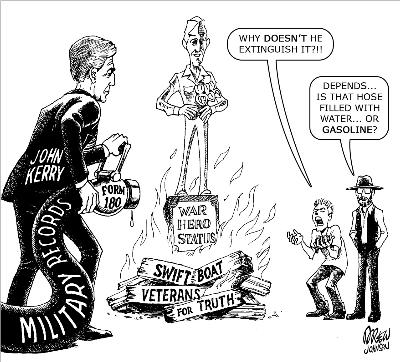
I'd say the position of the nozzle indicates what it holds back ...
Kerry Still Whining About Stupid Democrats
John Kerry may want to keep his options open for a second run at the White House in 2008, but he seems to have a lot of trouble letting go of his failure in 2004. Today he complained about trickery and intimidation that he claims kept Democrats from voting in the last presidential election, but his descriptions of these sound more like a Keystone Kops view of the rank-and-file of his own party:
Many voters in last year’s presidential election were denied access to the polls through trickery and intimidation, former Democratic presidential candidate John Kerry told a voters’ group Sunday.“Last year too many people were denied their right to vote, too many who tried to vote were intimidated,” the Massachusetts senator said at an event sponsored by the state League of Women Voters. ...
Kerry supporters have charged that voting irregularities in largely Democratic areas made it difficult for voters to cast ballots in the November election. A lawsuit in Ohio cited long lines and a shortage of voting machines in predominantly minority neighborhoods, but the Ohio Supreme Court dismissed the suit.
Kerry also cited examples Sunday of how people were duped into not voting.
“Leaflets are handed out saying Democrats vote on Wednesday, Republicans vote on Tuesday. People are told in telephone calls that if you’ve ever had a parking ticket, you’re not allowed to vote,” he said.
Kerry apparently wants to keep rehashing the same old gripes that have been thoroughly disproved over and over again, demonstrating that Kerry's movement relies on little else other than bitterness and urban legends. The "minority neighborhoods" that Kerry claims understaffed its precincts were run by Democrats, not Republicans, an inconvenient fact that Kerry neglects to mention during his whining. One wonders why Kerry simply doesn't call for a housecleaning among Democrats in Cleveland. However, he wouldn't have an excuse for his loss, as opposed to the real reasons of being a lousy candidate who ran a foolish campaign based on his Vietnam War experiences that left him vulnerable for counterattack.
The other complaints are even more laughable. With every newspaper reporting Election Day as Tuesday, with every Democratic precinct calling voters to get the vote out on that day -- with the Constitution making clear that the vote must occur on the Tuesday following the first Monday in November -- Kerry expects us to sympathize with people stupid enough to fall for a joke e-mail telling Democrats that they vote on Wednesday? Perhaps Kerry wants us to ensure that the irretrievably gullible get special treatment when Election Days roll around, but in my opinion, anyone that stupid shouldn't be voting anyway. Phone calls telling people not to vote if they have a parking ticket fall into the same category, if they occurred at all, and no one has ever proved that they did.
At some point, Kerry needs to take some responsibility for losing the election, as does his party. Neither appear ready to embrace reality, preferring instead to wallow in self-pity and a false sense of victimhood based on the silliest of pretenses. In a sane world, Kerry would be little more than a satire of egotistical politicians.
UPDATE: John at Power Line notes the same story, and recalls what intimidation really looked like during the last election.
Democrat Conspiracy To Buy Votes Grows Wider
ABC News reports that five Democrats have been indicted on federal charges of vote-buying in last year's presidential election:
Five East St. Louis Democrats were charged in a scheme to buy votes in November's election in a federal indictment unsealed Wednesday.An undetermined number of voters were paid $5 or $10 to cast a Democratic ballot in the Nov. 2 election, court records said. The money allegedly came from the St. Clair County Democratic Committee, though there was no indication the county committee knew how the funds would be used.
Federal prosecutors charged four Democratic committeemen and one precinct worker, a day after three other committeemen and a precinct worker pleaded guilty to related vote-buying charges in federal court.
It sounds like their co-conspirators cut a deal in order to reduced their jail time, which means they're looking to find bigger fish to fry. The seven committee members fit that bill, but it wouldn't surprise me if the investigation doesn't stop there. Stay tuned.
Kerry To Sign The 180?
Mickey Kaus and Instapundit both point to a Philadelphia Inquirer analysis of John Kerry's political activities since his loss in last year's elections, which suggests that the Senator may request the complete release of his military records at last:
For Kerry, indignities abound. He trails Hillary Rodham Clinton in every 2008 survey. The other day, he was assailed by Clinton aide Ann Lewis for running "an inconsistent campaign." Indeed, in focus groups conducted this winter by Democratic strategists, he was still seen as indecisive; one participant said, "He's the guy that holds up the line at McDonald's."And he's been dogged by bloggers who want him to authorize the release of all his military records, to clear up questions raised in 2004. He told NBC on Jan. 30 that he would sign military form SF-180 to do so, but he hasn't yet. Most of the heat has come from conservatives, but Democratic blogger Mickey Kaus also is on the case, urging party brethren to "remove this increasingly pathetic figure from our national stage." (The word in Washington is that Kerry will sign the form soon.)
Mickey asks what will happen if nothing interesting develops from the release, but that would wind up outraging his supporters even further. Just as his leftover $15 million left them wondering if that money could have made the difference in Ohio, a release of squeaky-clean records will cause Democrats to wonder why Kerry blocked their release throughout his entire campaign and caused such controversy over their contents.
No, this is a smart move by Kerry, one of the few he's made. He will sign off on the release three years ahead of the start of the primary season, plenty of time for whatever bad news in the file to be assimilated and then discounted by the true believers. The problem with releasing them a year ago was the proximity of a release to the primary vote, and then after that to the general election. It wouldn't have been an issue at all, of course, if Terry McAuliffe hadn't made the mistake of accusing George Bush of desertion during his service and continuing to use that smear for months afterward. That made a complete release by Kerry impossible.
My best analysis, furthered by sources which I cannot name, is that Kerry's file contains a less-than-honorable discharge from the 1971-72 period that his later 1978 discharge overrode. With three years between a revelation such as that and any voting, Kerry could eventually sell voters on the idea that the times in which that discharge occurred reflected the deep divisions in America, etc etc. If he runs to Hillary Clinton's left, which appears inevitable unless he changes his name to Joe Lieberman, that could convince the International ANSWER/MoveOn crowd of his viability -- but they'll be the only ones. They might well get him either to the top of the ticket, but if he couldn't beat Bush, there's no way in Hell he could beat any other Republican candidate in 2008.
Assuming, of course, that Kerry really signs the 180 and isn't just trying to blow the issue off again.
Another John Kerry Flip-Flop
John Kerry did it again. In an interview with the Boston Globe, Kerry insists that his full military records have been made public, and challenges his critics to do the same, and George Bush as well:
The furor over military credentials hasn't ended with the campaign. Kerry pledged to sign Form 180, releasing all of his military records, but challenged his critics, including Bush, to do the same.''I want them to sign it, I want [swift boat veterans] John O'Neill, Roy Hoffmann, and what's their names, the guys on the other boat," Kerry said. ''I want their records out there. They have made specific allegations about my record, I know things about their records, I want them out there. I'm willing to sign it, to put all my records out there. I'm willing to sign it, but I want them to sign it, too."
Kerry later confirmed that his decision to sign the form is not conditional on any others signing, but he expressed lingering bitterness over double standards on military service.
''Let me make this clear: My full military record has been made public," Kerry said. ''All of my medical records and all of my fitness reports, every fitness report involving each place I served, is public. Where are George Bush's still? Where are his military records? End of issue."
Er, no. Kerry knows that this isn't true, because he told Tom Brokaw that very thing just before the election. Perhaps John Kerry doesn't want to recall it now, but on October 28th, the week before the election, Brokaw asked him about the IQ tests that he took in the military, which I noted in this post:
Brokaw: Someone has analyzed the President's military aptitude tests and yours, and concluded that he has a higher IQ than you do.Kerry: That's great. More power. I don't know how they've done it, because my record is not public. So I don't know where you're getting that from.
Later on, when NBC aired the interview a second time, they edited that response down to exclude the admission, although the transcript remains on their site. Perhaps John Kerry thought that NBC's historical revisionism had gotten him off the hook.
The fact is that Kerry's full Navy records have never been released, and probably never will, unless someone sues the military for a Freedom of Information Act release. Kerry isn't about to allow that file out, as his discharge papers will show that Kerry got booted out on a bad-conduct discharge due to his post-Viet Nam activities, which Thomas Lipscomb and the New York Sun confirmed two days after the interview. If they are released, his political career is over.
Kerry may well believe that a good offense makes for the best defense. It's likely the only defense he truly has left. (See Beldar for more details.)
Good Riddance To Sore Losers
The International Herald-Tribune reports on the continuing efforts of a small number of Democrats to flee the country for the sole reason that their candidate lost. While Iraqis brave bullets and bombs for the privilege to select their leaders by majority vote, thousands of sore losers can't bear the thought that others may have a different opinion than their own:
After three months, memories of the election have begun to recede. There has been an inauguration, even a State of the Union address.Yet immigration lawyers say that Americans are not just making inquiries and that more are pursuing a move above the 49th parallel, fed up with a country they see drifting persistently to the right and abandoning the principles of tolerance, compassion and peaceful idealism they felt once defined the nation.
America is in no danger of emptying out. But even a small loss of population, many from a deep sense of political despair, is a significant event in the life of a nation that thinks of itself as a place to escape to. Firm numbers on potential immigrants are elusive.
"The number of U.S. citizens who are actually submitting Canadian immigration papers and making concrete plans is about three or four times higher than normal," said Linda Mark, an immigration lawyer in Vancouver.
I suppose I should welcome the exodus of idiots that believe they can't abide living with a GOP majority; after all, the more that leave only helps that majority survive that much longer. Their departure also has the beneficial effect of raising the IQ averages afterwards. However, given the example of Iraq and Afghanistan, watching pampered Americans go weeping across the border to Canada simply because they can't adjust to losing their monopoly on political thought in the US is an embarassment to America and to the very notion of democracy.
Part of the compact of a democracy is a commitment to majority rule. That means accepting the role of minority status when your party/ideology falls out of favor. Like it or not, Republicans committed themselves to working within the system for over 40 years of minority status, eventually adjusting their platform and their priorities while the Left lost favor. The GOP didn't flee to Mexico just because their leaders couldn't win elections.
In the end, the people who flee America because they backed John Kerry are nothing but cowards who have no real commitment to democracy. Good riddance.
Archives
blog advertising
Blogroll
Captain's Quarters features an authoritative blogroll, listing many websites that feature the top political thinking on the Internet. In order to make the list easier to navigate, it has been divided into a number of sections.
Click on the section title to expand the list.
Northern Alliance
Hugh HewittCaptain's Quarters
Fraters Libertas
Lileks
Power Line
SCSU Scholars
Shot In The Dark
Northern Alliance Radio Network
101st Fighting Keyboardist
Blogs for Bush
Sister Ships
MS-NBC/CapQ Partnership
Recent Comments
- Carol Herman on Heading Right Radio: Kenneth Timmerman, Shadow Warriors
- Frank on Can We Afford To Engage Sadr? Can We Afford Not To?
- Scrapiron on Can We Afford To Engage Sadr? Can We Afford Not To?
- danny on Can We Afford To Engage Sadr? Can We Afford Not To?
- Ron Hellesvig on New Comment System
- unclesmrgol on New Comment System
- Loren on New Comment System
- Dennis Lawler on US Navy Protects All Shipping From Piracy, Even Our Enemies'
- Jeremy on Another Step Towards Reconciliation?
- Qwinn on Another Puzzling Endorsement