




December 27, 2003
Dean Explained In A Nutshell
Sunday's Washington Post contains a somewhat brief article titled "Dean Tries to Summon Spirit of the 1960s: Candidate's Recollections Differ From Historians' Views of a Turbulent Decade" that explains a lot about the attraction of Dean's campaign amongst the aging hippie set, academia, and wannabes that make up the most passionate of his following:
Democratic presidential candidate Howard Dean has a vision of where he'd like to take the nation. It turns out to be the 1960s. ... His references to the '60s, Dean makes clear in an interview, are something personal. "We felt the possibilities were unlimited then," he said last week. "We were making such enormous progress. It resonates with a lot of people my age. People my age really felt that way."As history, however, Dean's memories of the era are selective. Rather than the time of great national unity and purpose he describes, the 1960s were a period of great upheaval, and surely rank among the most divisive for America in the 20th century.
Paul Farhi makes it clear that the mainstream media is about to declare 2004 as open season on Howard Dean by perfectly capturing the hypocrisy that turns everyone else off of the Democratic front-runner:
During this period, Dean had no apparent involvement in the emerging causes and issues of the day. After entering Yale University in 1967, he was a popular but unremarkable student who took no role in campus protests against the war, or in a local issue, the trials of members of the Black Panther party in New Haven in early 1970, friends have said. After avoiding military service with a student deferment, he was eligible to serve by 1971, but presented evidence of a bad back and was rejected. He subsequently spent nine months in Aspen, Colo., skiing and working odd jobs, such as washing dishes and pouring concrete. He then became a stockbroker, following his father, a prominent figure on Wall Street, before entering medical school.
The 60s, as Farhi states, were hardly a model of unity. For a model of unity and purpose, Dean would find the 1940s much more applicable, especially since terrorists have attacked the country and made it clear that they are in open war with the United States (and have been for at least two decades; we were just too dense to notice it). Even the 1950s demonstrated national unity and purpose as the Cold War broke out into the open. But these are eras that the aging hippie set eschews; instead, this subset of the boomer generation identifies with social and political conflict as a kind of war, where opponents are evil and cartoonish and Republican, and long-haired socialists who burn draft cards (and burn more than that) are the true heroes.
Dean wants to evoke not a national unity, but a leftist unity. Farhi makes clear that Dean has no business even evoking such a legacy, distorted and rose-tinted as he makes it, as Dean invested none of himself in the original conflict. What Dean is attempting, in Minnesota terms, is to hijack the Wellstone legacy and assume it for himself without paying any of the dues that Wellstone did. I was no fan of Paul Wellstone's politics -- I think that Wellstone stood for socialism and dangerous deconstruction of American security, but Wellstone at least would have legitimate claim to the legacy that Dean is trying to steal.
Dean wants the US to return to an era of unprecedented divisiveness and political violence when he did his level best to avoid every last bit of it the first time around. His supporters routinely yell "Chickenhawk" at supporters of George Bush and the war on terror; perhaps this epithet would be more applicable to their own candidate.
UPDATE: Power Line notes that the New York Times may play Conscientious Objector in the Dean media war ... or perhaps they also have a bad spine, or none at all.
Stiffing the Poles
Poland has long had my admiration. Before France threw in with the colonies, Polish lovers of freedom allied itself with our Founding Fathers -- names like Kosciusko should be as much a part of our national lexicon as Lafayette -- and despite being overrun and torn apart for centuries, Poland has always retained a burning love of freedom and self-determination. Earlier this week, Ralph Peters wrote an excellent column about this aspect of Polish history, and the unfortunate treatment they are receiving from the US after giving us the best of their support:
But the Poles never gave up their belief in their country - or in freedom. During our own revolution, our first allies were Polish freedom fighters such as Casimir Pulaski and Tadeusz Kosciusko. (Paris only joined the fight when it looked like we might win. And France intervened to spite Britain, not to help us.)Throughout the 19th century, Poles fought for freedom wherever the struggle raged, in Latin America, Greece and Italy, and on the Union side in our Civil War. Although their country had been raped by the great powers of Europe, Poles kept her cause alive.
Poland committed ground troops to our effort in Iraq, as well as critical diplomatic support at a time when it may not have been in their best interest, as a new EU member, to stand with us. Jacques Chirac infamously and condescendingly told the Poles, among other Eastern European nations, that they had missed a chance to shut up at the beginning of the year. What have we done to return the favor? Not much, according to Peters:
Their reward? Surely America must recognize such a great contribution from an economically struggling ally - at a time when Polish troops also support peacekeeping missions in Afghanistan and the Balkans? Sorry. Turkey, which stabbed us as deeply in the back as it could on the eve of Operation Iraqi Freedom, will receive a minimum of $2 billion from Washington ... And Poland? Like the Czech Republic, which sent a few medics to the Persian Gulf then withdrew them in panic, Poland will get a standard package of $12 million for NATO-related programs. ... Poland did have one request - a humble one, in the great scheme of things. Warsaw asked for $47 million to modernize six used, American-built C-130 transport aircraft and to purchase American-built HMMWV all-terrain vehicles so elite Polish units could better integrate operations with American forces. Much of the money would go right back to U.S. factories and workers.Our response? We stiffed them.
This is unconscionable. The Poles deserve better from the West in general, who left them under Stalin's thumb at the end of World War II, and from the US in particular. If this is how we repay our allies, is it any wonder that American foreign policy generates little enthusiasm amongst the democracies? Write your Congressman and Senators to let them know that we have to reward the Poles for their loyalty and support of freedom and liberty.
Pots and Kettles
John Kerry published a statement today that shows both a stunning grasp of the obvious and a remarkable lack of self-analysis:
With a month to go before the New Hampshire primary, John Kerry says voters must choose between Democratic front-runner Howard Dean or a more centrist candidate like himself. The Massachusetts senator said he would fare better than Dean against President Bush in November. ... Aides to Kerry note that Dean fares poorly against Bush in head-to-head matchups.
While they're looking, have aides to Kerry noticed that the difference in Bush's lead over both Dean and Kerry falls within the margin of error? Neither of them stand a chance against Bush because neither of them are getting any traction on him now, when Bush isn't even campaigning. Why? Because both men have demonstrated that they will say anything to anybody to get elected. Kerry has spent his entire campaign running against his vote for the war, and Dean's flip-flops are so common now that DeanWatch has become one of my largest categories on this blog. Unfortunately for the Democrats, Dean is sucking up all of the political oxygen in the primary.
Was The Vatican Al-Qaeda's Target?
Italian Prime Minister Silvio Berlusconi told reporters that al-Qaeda's Christmas Eve target was not Los Angeles, but the Vatican:
Terrorists planned to attack the Vatican with a hijacked plane on Christmas Day, Italian Premier Silvio Berlusconi said in a newspaper interview published Saturday. ... "A hijacked plane into the Vatican," Berlusconi is quoted as saying. "An attack from the sky, is that clear? The threat of terrorism is very high in this instant. I passed Christmas Eve in Rome to deal with the situation. Now I feel calm. It will pass."He added, "It isn't fatalism, but the knowledge of having our guard up. If they organized this, they will not pull it off."
Of course, Islamofascists could consider the Vatican as the center of the Crusader world, but if so, it shows a stubborn defiance of history and common sense. The Vatican's direct influence on warmaking has declined considerably since the Renaissance, and has been a nonfactor for almost two centuries. In fact, this particular Pope has no taste for confronting terrorism's evils, as he has made plainly clear over the past two years, despite his participation in freeing Eastern Europe of the scourge of communist totalitarianism. An attack on the Vatican only makes sense if you consider two possible motivations:
1. Its symbolic value to Christendom in general, and to Catholics in particular.
2. The difficulty in defending it, making it a relatively "sure thing" as far as large-scale missions go.
If Berlusconi is correct, it shows that al-Qaeda may be forced to the "low-hanging fruit" options for targets these days. However, since this target would only serve to inflame Europe, bringing them closer to the US and eliminating a voice for appeasement, this may be a further indicator of deliberate misinformation for counter-intelligence purposes. After all, we have now heard that the targets were Los Angeles, Las Vegas, the Vatican, and Tappahannock, VA,or possibly a naval refueler with the same name. If al-Qaeda needed to check for leaks, the easiest way to do that would be to disseminate several false targets to specific people and then see which ones appear in the media and/or get a security response from the West. Berlusconi and others in the US and Europe need to quit divulging intelligence if they want to protect whatever sources they are quoting. (via Instapundit)
LA Times: Applaud the Non-Event
The Los Angeles Times published an editorial today which reminds us that good intelligence and pre-emption can keep terrorist strikes from appearing, and that the lack of hard evidence of a terrorist mission does not mean one did not exist:
Most national security intelligence is elusive, a connecting of dots — intercepted telephone calls, overheard conversations, confessions by people who know fragments of a plan. The result may be an unprovable negative: an event that does not occur.Thus it was when U.S. officials warned French counterparts about hints that an Air France plane would be used to attack Los Angeles on or around Christmas. The French heeded American requests and canceled six flights, and Los Angeles celebrated a peaceful holiday. Some inconvenience resulted, but how could security personnel have failed to act? The use of commercial airliners as bombs to kill thousands of people on 9/11 demands that credible threats be taken seriously.
Of course it is better to be safe than sorry, but my guess is that we will start to hear a hue and cry that we are chasing after our own shadow rather than real terrorist plots. In fact, our partners the French have already made that insinuation in their handling of the same event (via Power Line):
Bush administration officials expressed frustration that al-Qa'eda operatives might have escaped capture after word leaked, early this week, of American concerns about flights from France to the United States over the Christmas period. One official said Washington had been hoping to keep the US-French negotiations confidential, adding that the hope was that "we would be able to lure some of these people in"..However, a French interior ministry spokesman said little evidence of a terrorist plot had been found
One possibility that has not yet been mentioned, at least in published accounts, is that the entire exercise was a counter-intelligence mission by al-Qaeda. This possibility has bothered me since Christmas Eve, when the entire event began. It's no secret that the US has been trying to penetrate al-Qaeda for years, and especially since 9/11. After Saddam's capture, it's clear that American intelligence services have adapted to Arab social structures and have been much more successful in gathering and applying information. Facing that new reality, it would make sense for al-Qaeda to develop strategies to uncover American moles within their organization, or at least the weak points within their communications.
How would this be accomplished? The simplest method would be to disseminate information to their organization, with strategic details changed for specific people or groups. If the information generates a specific reaction from Western security services, Osama and his top lieutenants can easily trace back the details that led to the reaction. Details, for example, such as dates, air carriers, or flight numbers.
Now, this can be a good development, because an terrorist organization obsessed with checking its "six" isn't an organization that can deliver a complicated attack at the same time. However, thanks to the inordinate amount of publicity that the French provided about this investigation and the detailed American response to the media, their intelligence sources are now at extreme risk, and all to come up empty-handed. If indeed this was an al-Qaeda counter-intelligence operation, it was highly successful, and that's nothing to applaud.
December 26, 2003
Dean Switches Positions in the Same Day?
The master of flip-flops impresses everyone this week by issuing conflicting statements in the same day:
Democratic presidential candidate Howard Dean will not pronounce Osama bin Laden guilty before a trial, he said in an interview published Friday. New Hampshire's Concord Monitor reported that Dean said he would not state his preference on a punishment for bin Laden before the al Qaeda leader was captured and put before a jury."I've resisted pronouncing a sentence before guilt is found," Dean said in the interview. "I will have this old-fashioned notion that even with people like Osama, who is very likely to be found guilty, we should do our best not to, in positions of executive power, not to prejudge jury trials." ...
Later, Dean released a statement clarifying, "I share the outrage of all Americans. Osama bin Laden has admitted that he is responsible for killing 3,000 Americans as well as scores of men, women and children around the world. This is the exactly the kind of case that the death penalty is meant for.["]
Was there a trial today that I missed? Did Osama hire a lawyer? No, Dean's campaign just went into damage control after its tone-deaf candidate managed to shoot himself in the foot that was stuck solidly within his mouth. Left unanswered is Dean's difference between his second Osama position of the day and his prior assertion that Osama should be tried by the World Court at the Hague, which has no death penalty. How does he explain that? Perhaps Dean's changed his mind -- again -- and discovered that he now will insist that Osama be tried in the US. Just like the vast majority of Americans, as I'm sure his campaign has also discovered after his disastrous interview on Hardball earlier this month.
Can someone remind me why this guy is running away with the Democratic nomination? Oh, yeah, that's right ... it's because he's so truthful and consistent. (via Blogs for Bush)
UPDATE: Power Line has two excellent posts on this subject, matching Dean's different positions of the day. Plus, Hindrocket notes that Dean has picked up the presitigious Pravda endorsement. Really.
US Among International Donors to Iran Aid
Iran suffered a devastating earthquake yesterday, and the death toll is expected to rise above 10,000:
Most of the historic Iranian city of Bam was destroyed in an early morning earthquake Friday, and government sources said more than 20,000 people were killed.Iran's official Islamic Republic News Agency put the death toll at 5,000-6,000, and officials said they were worried that the number could climb. News service reports quoted government officials as saying more than 20,000 died.
Several blogs have demanded US involvement in emergency aid to Iran in order to support the pro-US younger generation in Iran as well as for humanitarian reasons. Hugh Hewitt and Blog Iran are two amongst many who point out that our assistance will underscore our insistence that we are at war with terrorists and not Muslims. I doubt that our assistance will convince anyone who already thinks that we are at war with Muslims, just like our interventions on Muslims' behalf in the Balkans and in Somalia failed to impress them before. I do think that we need to give as much assistance as possible for humanitarian reasons alone, and that it will help support Iranians who want better relations with the US. Other than that, don't expect much.
Why the Dominoes Fall
The Washington Post explains in more detail why the capture of Saddam Hussein has started to cripple the insurgency, and how American strategy had already impacted the insurgency even before that:
Senior U.S. officers said they were surprised to discover -- clue by clue over six months -- that the upper and middle ranks of the resistance were filled by members of five extended families from a few villages within a 12-mile radius of the volatile city of Tikrit along the Tigris River. Top operatives drawn from these families organized the resistance network, dispatching information to individual cells and supervising financial channels, the officers said. They also protected Hussein and passed information to and from the former president while he was on the run.At the heart of this tightly woven network is Auja, Hussein's birthplace, which U.S. commanders say is the intelligence and communications hub of the insurgency. The village is where many of the former president's key confidants have their most lavish homes and their favorite wives.
When U.S. forces sealed off Auja in late October, they separated the leaders of the insurgency from their guerrilla forces, dealing the anti-occupation campaign a major blow, said Lt. Col. Steve Russell of the Army's 4th Infantry Division, which is responsible for the Tikrit area.
While it is true that American intelligence knew little about the insurgency at the time of the Baghdad collapse, it is also true that the American military and intelligence services learn quickly and adapt rapidly -- one of the historical strengths of the US armed forces. Read the entire article.
Harold Ickes, The Consummate Insider
Hugh Hewitt points out an intriguing profile of the Democrats' Karl Rove, former Clinton Chief of Staff Harold Ickes. Colorful, profane, and driven, Ickes promises to deliver cash -- loads of it -- to the Democratic effort to unseat George Bush through 527 committees.
Now he has emerged as a major power in the Democratic Party, a broker whose media money could make the difference in the 2004 election. When the Supreme Court gave its blessing to the McCain-Feingold law that bans "soft money" — unlimited contributions from corporations, individuals and labor unions — to political parties, Ickes became a player, right up there with his father and namesake, Harold L. Ickes, who served as Franklin D. Roosevelt's Interior secretary — and troubleshooter."The Supreme Court just made him one of the 10 most important people in the Democratic Party," said Mike McCurry, Clinton's former press secretary.
Don't miss this article on Ickes, nor Hugh's take on the situation. Hugh thinks that the majority of the fundraising will never be seen this election cycle, and instead will be banked for 2008, when the Democrats have a more reasonable chance of taking the White House -- with Hillary leading the ticket.
David Fromkin: Be Careful What You Wish For
David Fromkin, who wrote a terrific book on Middle Eastern history over the past century titled "A Peace to End All Peace" (on my book list on the left, and you should buy it), wrote an article for today's Los Angeles Times which intends to warn the US about repeating Britain's mistakes in Iraq:
When the war ended, in 1918, the victorious British found themselves in possession, among other things, of the three Ottoman provinces that were later merged to form a single unitary state that was to be called Iraq.In 1918 and 1919, its hour of triumph, the British Empire garrisoned the Middle East with an army of a million men. No other significant military force in the region could dispute Britain's mastery. Iraq's future seemingly was for Britain to determine. It is from Britain's experience in that respect that Americans entering the year 2004 have so much to learn.
Fromkin's piece reviews the early history of Iraq and Britain's failure to finish the job in Iraq. In a way, this article has something to offer both proponents and opponents of the war, at least on practical grounds. Opponents can argue the futility of building a Western-style nation from fragmented Middle Eastern provinces and a certain inevitability of putative allies in the region to rebel against their sponsors. Proponents can argue for an extended military mission to ensure and protect the development of a friendly government.
However, 2003 is not 1918, and we are not the colonial British of yesteryear -- in fact, the British today aren't the colonial British of yesteryear, either. In reading Fromkin's book and comparing it to his necessarily truncated history today (after all, the Times can't reprint the entire last third of his book in its op-ed section), two major differences between yesterday and today are clear. In 1918, the British attempted to install a monarchy, choosing a military ally with little real attachment to the people of Mesopotamia, for their wider ambitions in Asia Minor. Prince Faisal had little support amongst the strangers in his new land for his rule, and the only way he could establish his authority was to unite the three provinces and the tribes on the one issue that they all supported: the end of British colonial rule. The people in the new nation of Iraq saw that Britain historically had conquered and stayed on to rule, either directly or through a protectorate, and did not want to experience that first-hand.
The second major difference, related to the first, was that Faisal was forced upon Iraq without much input from the Iraqis themselves. This may be somewhat parallel to the Iraqi Governing Council today, but the difference is that the IGC is a temporary executive, and it also reflects a variety of Iraqi voices and viewpoints. The IGC's function is to establish the democratic institutions that will ensure that Iraqis are able to govern themselves, not be straitjacketed by a monarchy. While democracies often will produce leaders who we find less friendly to our interests than we would like -- France being the prime example these days -- the point in 2003 is not to install a puppet government that we can exploit, as it was in 1918. Democracy is an end in itself, in order to eliminate the oppression that breeds extremism and terrorism.
Fromkin raises several good points in this article, especially questioning our commitment to sticking around until the mission is really accomplished. Certainly, we also need to be careful to choose our friends wisely, and studying the history of this region and taking the proper lessons from it. It seems to me that in both Afghanistan and in Iraq, the US and UK have already demonstrated a basic grasp of history by refusing to take the easy route of reinstalling monarchies and attempting the more difficult task of building democracies in areas where none existed before. Will we make mistakes? Certainly, but we are fortunate to have David Fromkin with us to point out the land mines ahead of time, and hopefully we will avoid the most costly of them.
December 25, 2003
How I Got My Christmas Spirit Back
If you can't get Christmas spirit when your granddaughter is playing on a toy you just put together for her, then you are either dead or your last name is Scrooge:

We had our son, daughter-in-law, and the Little Admiral over here from about 3 pm to 9 pm, and the First Mate cooked up a great prime rib dinner for all of us. After we opened gifts and ate, we watched the DVD of our Thanksgiving trip that I made as one of the Christmas gifts I gave to family members. We talked to all of our (immediate) family out West, and we did a video conference with my Dad and his wife.
Was Santa good to you all? Santa was definitely good to me. I got two tickets to a Notre Dame football game next October, when Stanford comes to town. I've always been a huge Fighting Irish fan and going to Notre Dame for a game is something I've wanted to since I moved to Minnesota. The First Mate and I plan on spending a few days around the game at South Bend, checking out the Notre Dame campus. I also got some gift cards (significant shopping ahead! woo-hoo!) and a really nice burgundy shirt. My son and daughter-in-law bought me a calendar of Ireland and the DVD of A Midsummer Night's Dream with Kevin Kline, a movie I always wanted to see but could never catch -- I love Shakespeare, mostly because it's challenging.
But most of all, God was good to me because he gave me such a wonderful family. I hope God showers his blessings on all of you as well.
Ho, Ho, No
Only in New York, or possibly Philadelphia, could a collection of 1,000 Santas spark a partisan riot. Not surprisingly, both cities figure into this story about a hockey promotion gone bad:
The promotion invited fans to dress up as Santa Claus for [the NY Islanders] Tuesday night's game against the Philadelphia Flyers and be admitted to the Nassau Coliseum for free. What's more, they were permitted to parade across the ice between periods.About 1,000 Santa Clauses showed up and as promised, they were invited on the ice after the first period.
This turned out to be not such a good idea. As the Santas milled around, two of them removed their red jackets to reveal jerseys of the rival Rangers — not a good thing to do in the home of the Islanders.
Ignoring the holiday spirit, some of the other St. Nicks turned into Bad Santas, jumping the Ranger fans. The interlopers were knocked to the ice and had the shirts ripped off. Other Santas went sliding across the ice during the melee that took six minutes to settle down.
This tops the nadir of Santa in Philadelphia, where not too long ago Santa was booed during a holiday parade. I'm sure that any children in the stands had to be wondering why 1,000 Santas would commit assault on one another on Christmas Eve. It seems that the adults have a lot of growing up to do, and a lot less alcohol to drink, in their future if they want to move from the real Santa's "naughty" to "nice" list.
Dean's Reversal on Tort Reform
Andrew Sullivan and Overlawyered (a great site) discover another Howard Dean flip-flop, this time on tort reform. In 1988, then-Lt. Governor Dean wrote the following letter to the New York Times:
To the Editor:Randall Bezanson and Gilbert Cranberg detailed a situation that I hope will get far worse. As a physician, I have been frustrated for years by the reluctance of state legislatures and the United States Congress to deal with liability problems of all kinds.
I have long maintained that until the legal profession and the news media are also afflicted with the increasingly severe consequences of a tort system that benefits few people outside the legal profession, there will be no return to a fair and reasonable system of justice.
The trends toward lawyers suing one another for malpractice and toward outrageous-size punitive damages in libel cases give me hope that the crisis in our tort system may finally come to the attention of those who can make this a public issue and improve the situation for all of us who require liability insurance to do business.
HOWARD DEAN, M.D.
Montpelier, Vt., June 17, 1988
His position now is much more opaque. He rails against the Republican proposal for tort reform, even though it delivers exactly what the doctor prescribed in 1988. Instead, he proposes safety-reporting systems and non-binding mediation, which are all well and good, but does nothing about runaway jury awards and will do little to stem lottery-style class-action lawsuits, such as the Dow Corning lawsuit, that bankrupts companies with bad science and emotional manipulation.
Since the latter is one of the key issues in his 1988 letter, it signals a significant retreat on this position and particularly sets him at odds with the majority of his first profession. Why the switch? Is it because he is afraid of antagonizing the trial-lawyer lobby, a powerful fundraising source for Democrats? It's entirely possible that he has modified his views over 15 years of public service, but if that's the explanation, then he needs to say so and tell us what prompted the conversion. Otherwise, it is yet another policy flip-flop that looks suspiciously self-serving and insincere.
Addendum: One other item in Dean's position paper is inconsistent. In his NY Times letter, Dean says
I have been frustrated for years by the reluctance of state legislatures and the United States Congress [emphasis mine] to deal with liability problems of all kinds.
And yet, Dean's position paper concludes that he feels tort reform must be left to individual states:
I oppose the Republican medical malpractice bill now before the U.S. Senate. It represents unwarranted and probably unconstitutional federal interference with state tort laws. It is essentially being used for political purposes and it will never be enacted. I favor real solutions at the state level and federal support and guidance for states to implement those solutions.
Congress does not exist to give "support and guidance," nor is that what Dean's original statement about dealing with liability reform suggests. His anger in 1988 was directed at a Congress -- a Democratic Congress -- that refused or was unable to produce meaningful tort reform. Now he claims it's none of Congress' business. This is another flip-flop that Governor Dean should be pressed to explain.
Merry Christmas to All My Friends
I'll be doing very little blogging today; maybe this evening I will post a couple of thoughts, but I'm going to concentrate on family and friends until then.
Speaking of which, I'd like to send out a very Merry Christmas to all of my blogosphere friends. I'm going to mention a few who made my first few blog-months special (if I don't mention you, it's because I'm under the evil influence of Christmas carols):
* Alicia at Twilight Café started blogging at the same time as I did, left the first comment and linked to me first, and designed my logo. She's a special blog friend, and I hope you all take the time to check out her blog over the holidays.
* Hugh Hewitt gave me a tremendous boost in readership and in confidence in what I've been doing, and I can't express how much I appreciate it. Appearing on his radio show as a guest was one of the highlights of my entire year. Merry Christmas and thanks!
* The guys at Power Line have also been tremendously supportive, frequently linking back to me with glowing descriptions of my writing. (The check's in the mail, gentlemen ...) The Big Trunk has especially been so, going way out of his way to make sure I was ready for that radio appearance.
* The Northern Fleet, my blog-neighbors in the Upper Midwest, have great sites and great insight. The folks at Fraters Libertas have a great sense of humor, and it's been fun skewering them and being skewered in return. (I know that sounds R-rated, but get your minds out of the gutter, it's Christmas.)
* I have three regular correspondents (besides Alicia) both within and outside comments sections: Jon at QandO, Brant at SWLiP, and the Commissar at Politburo Diktat. Merry Christmas, guys, and thanks for all of your encouragement.
Last and foremost, more members of my family and friends are reading my blog these days, so I'd like to wish all of them a Merry Christmas, long-distance, and tell them all that we miss and love them. We wish you were here to have a white Christmas with us, but we'll be sending pictures and posting some here.
December 24, 2003
Twas The Night Before Christmas ...
I've had trouble getting in the Christmas spirit.
It's been a busy month at work, and since we flew out to visit family in California over Thanksgiving, the First Mate and I kind of feel like we've already had our Christmas. We finally got our shopping done, mostly for the Little Admiral, this past weekend. (Nothing like last-minute shopping to kill any Christmas spirit that might be struggling to grow anyway.) I worked today in order to make sure that the office will be okay over the four-day weekend -- my department is a 7x24x365 group -- and when I left, I hoped to get a bit more spirited.
Since my son and daughter-in-law celebrate Christmas Eve with her family (we've always been a Christmas Day family anyway), the First Mate and I always try to go to Mass on Christmas Eve. She's been baking all day long, so I offered to buy her dinner to give her a break. Bad idea. Who knew everything closed up at 5 on Christmas Eve? Even Denny's was closed, for Pete's sake! We wound up at an El Loro Mexican restaurant and ate too much food. It was pretty good Mexican food for Minnesota, too.
We thought we'd have to rush to find a place at Mass, so we chowed down and ran over to the church as fast as possible, to walk into an empty room, except for the practicing choir. Mass was terrific, and when I got home, I finally had to face the task I'd been dreading: gift wrapping. We watched "A Christmas Story" while I wrapped the 1,173 things we bought the Little Admiral and the two things we bought the son and daughter-in-law. How did I do? Well, take a peek at this and see what you think:

BREAKING NEWS: NORAD had been tracking Santa, but the French cancelled his flight due to security concerns. They're claiming Tom Ridge made them do it.
Merry Christmas, to all of my friends in the blogosphere. I'm going to take a healthy swig of Christmas spirit and head off to bed.
Someone Heard Something
In France, there are travelers who are likely highly annoyed to be kept from being home at Christmas -- but may be lucky to be alive:
The French government has canceled three Air France flights to Los Angeles, California, because of fears of a possible terrorist attack, the French Interior Ministry said Wednesday.Air France flights 68 and 70 from Paris to Los Angeles and Flight 382 to Los Angeles via Cincinnati, Ohio, were listed as canceled Wednesday afternoon. The decision came after consultation between U.S. and French authorities, a senior U.S. official said.
News of the cancellations came as U.S. officials said a high volume of good-quality intelligence indicated that the al Qaeda terrorist network wants to attack the United States during the Christmas holiday.
No one will know for sure if these flights had been compromised by terrorists unless authorities were lucky or well-informed enough to capture specific suspects from the airports. It points out that jets are still high-value targets for terror groups, being guided missiles, and that we must remain vigilant about air transportation security.
UPDATE: Now there are six flights that have been cancelled, and frustration may be erupting because of this:
One U.S. official, who spoke on condition of anonymity, said the U.S. government had been trying to keep the negotiations with France confidential, "hoping that we would be able to lure some of these people in."The official said there was some frustration within the Department of Homeland Security that the flights were canceled, thus allowing the word to get out about the security concerns.
Bear in mind that preliminary reports of this nature are often inaccurate, but if the French pulled the trigger too quickly and let the suspects get away, you can bet there will be some heads rolling on Christmas morning. And there should be.
UPDATE 2: Keep checking The Command Post for updates on this story. Daniel Drezner has some analysis as well.
UPDATE 3: More from MS-NBC:
U.S. officials said the information indicated that al-Qaida planned to use foreign airliners as missiles. They said it appeared that Osama bin Laden personally approved the plan at a recent meeting. The officials said U.S. intelligence agencies had learned that al-Qaida operatives would try to fly hijacked foreign airliners into targets in the United States. In some instances, the intelligence is so detailed as to include specific flight numbers, they said.The information was given more credence by U.S. officials because it came from two separate intelligence sources, the officials said. ... Quoting unidentified Bush administration sources, the newspaper said that a small number of crew members had been questioned in recent weeks after their names appeared to be similar to those on the FBI's "watch lists" of suspected terrorists.
The Associated Press reported, however, that the Air France flights were canceled Wednesday because of specific fears that al-Qaida operatives would board the planes as passengers, not as crew members.
UPDATE 4, 8:42 PM CST: Welcome to all Instapundit and Hugh Hewitt readers; wish it were under happier circumstances. CNN has updated its story on the cancellations with more details than before. It looks like at least some of the data came from an informant within al-Qaeda, which is interesting news. As can be expected, the data is chaotic, but better to be safe, as one reader has already commented.
The AP continues to report that several suspicious Tunisian men amongst the passengers prompted the warnings. Lisa Myers at MS-NBC reports that passengers from one of the flights were taken into custody and questioned.
UPDATE 5, 12/25: The Los Angeles Times has more details in today's story:
Details remained cloudy, but U.S. counterterrorism officials said their investigation was focusing on the "informed belief" that about six men on Air France Flight 68, from Paris to Los Angeles, may have been planning to hijack the plane and crash it near Los Angeles, or along the way.That belief, according to several senior U.S. counterterrorism officials, was based on reliable and corroborated information from several sources. Some of the men had the same names as suspected members of Al Qaeda and the Taliban, the officials said.
One of the men is believed to be a trained pilot with a commercial license, a senior U.S. security official said.
There are unconfirmed reports that one or more may have been arrested and being held in France. It also appears that an attack was definitely in the works and that American intelligence was able to stop it from happening, along with French cooperation. Let's hope that they caught all of those who intended to hijack the planes.
UPDATE 6: Reuters is reporting today that no terrorist links were found to any of the passengers detained in France.
Why Not Just Improve Your Food?
Silly lawsuits with astronomical asking figures seem to be more and more the norm than the exception. This, then, should come as no surprise:
The owners of Lucky Cheng's, a cabaret-restaurant with cross-dressing male waiters and entertainers, have filed a $10 million lawsuit accusing the Zagat Survey of libel for giving the restaurant a low rating for its food. The suit said Lucky Cheng's has lost about $30,000 a week since Oct. 14, 2003, when the 2004 Zagat guide was published with the low food rating — 9 out of a possible 30.
Zagat's calculates its ratings by compiling feedback from patrons of the restaurant, and then publishes the results in a popular guide. Low ratings means bad business, no matter how many cross-dressing entertainers and waitstaff you hire, as Lucky Cheng's has found out. Normally, when businesses get low ratings from its patrons, they work to improve the product or the service, but at Lucky Cheng's, they're out to shoot the messenger. Why?
The lawsuit notes that before a rating of 8 for the 2003 guide, Lucky Cheng's consistently received a score of 13 for food quality. The restaurant's owners claim the food quality has rebounded and argue the guide should have checked the low food score to make sure it was accurate.
They could only score a 13 out of 30 on the last survey and they expect people to believe a 9 is ridiculously low? I'm no lawyer, but I think they'd have to be able to prove malicious intent in the low rating in order to have a case, and even then, why $10 million? Are Zagat points worth $2.5 million each? If so, Zagat should just charge per point and skip over the whole feedback-analysis process.
Note to Lucky Cheng's: Quit whining, listen to your customers, and fix your food. Note to Lucky Cheng's customers: Stock up on Pepto-Bismol, because it doesn't look like the food will be improving soon.
Sailing Into Oblivion
According to MS-NBC, our proud ex-Governor will not be returning from his, er, "hiatus":
"I've decided to focus the majority of our resources on Monday-Friday primetime in 2004," the cable news channel's president, Erik Sorenson. said in a memo to his staff Tuesday night. "Consequently, the holiday hiatus for 'Jesse Ventura's America' will continue indefinitely." ... Sorenson said that Ventura will continue to serve as a political commentator for MSNBC during the 2004 campaign season.
Sorenson finally came to the same conclusion that Minnesotans discovered shortly after Jesse took office: he's not terribly bright, nor is he terribly interesting. The combination makes a deadly dull recipe for a talk-show host, as I posted when it first launched. Among the disasters the show visited upon hapless viewers was a recurring segment called "Dork of the Week", which would have been a more apt title for the entire show. As I related in the earlier post, he stuck with the same story for the year it took MS-NBC to develop the show, so that his first installment actually referred to an event that had occurred almost eighteen months earlier.
Fans of dumb-jock commentary will either have to wait until Election Night 2004 or the WWF for their fix. With any luck, Jesse the Mouth will fade into well-deserved obscurity.
Support American Servicepeople!
Tom Bevan at RealClearPolitics has asked the Northern Alliance to promote several ways in which our readers can support American fighting men and women this holiday season. I'll ask you all to read his post, which contains a number of links to sites designed to do just that. If you have any others that RCP left out, please feel free to post them in the Comments section (it's HTML-enabled!), and that way we can spread the joy as widely as possible.
Remember, folks, regardless of your political views, these fine young men and women are putting their lives on the line for us. Let's remind them why.
Libyan Agreement vs The Carter Deal in North Korea
I wanted to write a brilliant column rebutting the buzz that Libya's deal was in essence no better than we had with North Korea in 1994 and would wind up being as large a failure as Carter's "trust us" capitulation proved. Even Frank Gaffney seemed pretty skeptical last night on Hugh Hewitt's show. However, before I had a chance to do my research [IOW, open up a can of Diet Rite Red Raspberry and opine madly], I found this brilliant post by Jon at QandO:
Needless to say, the Agreed Framework was not the success we'd hoped it would be. In the end, it amounted to a deal whereby our side agreed to provide North Korea with sizable concessions, while North Korea agreed to pretend they weren't working on a nuclear weapons program.Fortunately, we appear to have learned from the Agreed Framework. The deal with Libya succeeds in exactly the places where the Agreed Framework proved a failure. I'll list each stipulation, problem, and fix.
Read the whole thing. And then have a Diet Rite Red Raspberry soda -- they're pretty damned good.
A Warning We Also Should Heed
Jonathan Chait, in his TNR blog, wrote on Monday regarding the Dean bubble. Chait, who is no fan of the governor, diagnoses why the Dean campaign will remain parochial and detached from all but the true believers:
One of the most disturbing things about Dean and his hard-core supporters is that they give the impression that they know nothing at all of why President Bush is successful, and therefore what it takes to beat him. Read the pro-Dean blogs, and the you come away with the view that Bush is strong because he's ruthless and has lots of money, and therefore if the Democrats are also ruthless and raise lots of money, they can beat him. This ignorance is compounded by the fact that many Deanies seem to exist in a isolated cultural milieu in which everybody is secular, socially liberal, and antiwar. They can't fathom why those things might hurt Dean in a general election because they don't ever talk to or read anybody who thinks differently. Dean's Internet networking--which has had lots of positive effects on American politics--has probably intensified this cloistering, by creating intellectual ghettos on the web where true believers can interact, undisturbed by those who don't share their faith.
Chait then goes on to use Atrios as a particular example of the cloistering of Deaniacs. Atrios wrote a rebuttal to a TNR story on how Dean's relentless secularism, and that of his supporters, will drive a wedge between his true believers and the swing voters, especially in the Midwest. Atrios' response amounted to a "So what?", arguing that Democrats can't do anything about that anyway and should just stop "playing defense" on the religious issue. At his most tone-deaf, Atrios proclaims that
the moment when I was most embarrassed to actually bother supporting the Democrats was when they all gathered on the steps of the Capitol and belted out the 1954 Knights of Columbus version of the Pledge of Allegiance, screeching "UNDER GOD" at the top of their lungs like they were cheering at a hockey game.
Chait retorts with this comparison to Republican strategists, while subtly -- and I would say unconsciously -- acknowledging the Republican tradition of cleaning one's own house:
You can hear an echo of this sort of thinking in Dean's admonition that his party cease its efforts at damage control and its emphasis on swing voters. This is fantasy masquerading as strategy. Do Republicans say, "Look, we're going to be tarred as racists whatever we do, so we might as well put Trent Lott on the ticket?" No, of course not.
Chait's column created some buzz on the right side of the blogosphere, notably from Blogs for Bush and Matthew Stinson, and the tone has been one of triumphalism:
This is the Liberal Mirage. Sure, you'll get those emotional gay and lesbians who thirst for a candidate to free them of their marriage-less lives, but when the primaries are over, you'll have walk out of that liberal tent and into the moderate world, where everyone will look at you as if you just walked out of the XXX section at the local video rental store.
Harry's Place, on the other hand, gets closer to the point:
Well, yes, which is one reason to avoid those cyber-ghettos. And it's one reason I appreciate the wide range of opinions reflected in the posts and comments at Harry's Place.
Chait warns leftists that they have created their own ghettos, and blogs on the right high-five as if this critique could not possibly apply to us as well, and apparently only Harry sees the issue clearly. I challenge all of us on the right -- myself included -- to look at our own blogroll and through our history files to see where we regularly surf. Are we getting outside of our own box in order to challenge our own assumptions? We see bloggers like Unfogged tracking back to posts on Blogs for Bush, but how many of us go there to find out what Unfogged writes on issues?
Many of you will say, "We read the newspapers, so we know what the leftist meme du jour is," but Atrios and Kos and others also read Fox News, OpinionJournal, et al. It's not about reading, it's about interaction. If we are to win an intellectual battle, we must be prepared to go out, read through other blogs, write comments, and go back and check the responses and comment again if we are not clear. This is not a call for trolling -- this is a call to politely speak out amongst the uncoverted ... and a call to listen as well. Be humble; we are not the font of all wisdom, and we still have to work with others to run our nation and our communities as effectively as we can. If we choose instead to live in Chait's bloghettos, we do ourselves and our country a grave disservice.
So while we're pointing fingers at the Deaniacs, let's take this moment to remove the beam from our own eye, almost literally, and start interacting with our ideological opponents a bit more. If we want to ensure that our candidates win the day, we have to start by opening some minds to their message, and that's a mission I know my fellow bloggers can accomplish.
Oh, Well, As Long As It's Her First Time
Here's a disturbing story from Indiana -- a 13-year-old girl has been arrested for a DUI (via Drudge Report). She managed to hit a utility pole and knock out power to a few hundred houses:
The driver also had a blood-alcohol level of .089, slightly above the legal limit, police said.The girl's older sister said she had never driven before.
It's her first time driving? Well, that's certainly a relief.
December 23, 2003
Ed Koch: I'm Voting Bush
Former New York Mayor and lifelong Democrat Ed Koch recently gave an impromptu speech regarding his support for George Bush for President. Koch apparently wasn't satisfied with the report printed in the Sun about his speech (although he blames himself for the confusion) and wants to set the record straight with this column in NewsMax:
After 9/11, the President announced the Bush Doctrine, which in my opinion rivals in importance the Monroe Doctrine, which barred foreign imperialism in the Western Hemisphere, and the Truman Doctrine, which sought to contain Communism around the world.The Bush Doctrine, simply stated by the President before a joint session of Congress, is “We will make no distinction between the terrorists who committed these acts and those who harbor them.” The President has applied that doctrine in Afghanistan and Iraq and has put other countries on notice that he will do so elsewhere, if necessary.
Of course, there are many other important foreign and domestic issues facing Americans. I do not agree with the President on any major domestic issue, ranging from tax relief to the recently enacted Medicare prescription drug law. But these concerns pale in comparison with the problem of international terrorism.
Koch explains his mildly surprising stance by stating that he doesn't find any of the current Democratic contenders trustworthy on the war on terror, save Lieberman, who he feels has no chance of getting the nomination. He takes the Democrats to task for voting to support the Iraq war last year but then "tacking to the wind" this year by denouncing the war to pander to the leftists. Israel, which the Sun reported was the main issue behind Koch's decision, does not cause problems with most of the candidates:
On the issue of my “concern for embattled Israel,” I believe all of the major Democratic candidates, with the exception of Howard Dean, have records of support for that country as our steadfast ally in the Middle East. They and the presidents from both the Democratic and Republican parties, beginning with Harry Truman, have been staunch supporters of the Jewish state.So my reservation concerning the Democratic candidates is not with respect to their support for Israel, but with regard to their willingness to take on the ongoing battle against international terrorism, which threatens all countries.
Read the entire column. While I concur in Koch's choice, I find it curious that he passed up the opportunity to champion Lieberman with the party elite. And on that thought, I also find it odd that the party elite haven't settled on Lieberman instead of General Wesley Clark as their anti-Dean. Lieberman, after all, stood tall during the 2000 election and also provides, as Koch indicates, solid anti-terror credentials, perhaps the only candidate who can (Gephardt may be the other). Clark was a Republican until September, and spent the better part of the last two years toasting this administration. Gore infamously sold Lieberman out earlier this month, but why has the DLC not promoted him more, as one of the council's charter members? Could it be that the Clintons still resent the scolding Lieberman gave Bill Clinton from the floor of the Senate? Or could it be that they are afraid Lieberman may win against Bush and eliminate Hillary's shot in 2008?
No wonder Koch endorsed Bush. You need a scorecard to figure out all the backstabbing currently in play with the Democrats. (via Blogs for Bush)
I'm Ready For My Close-Up Now

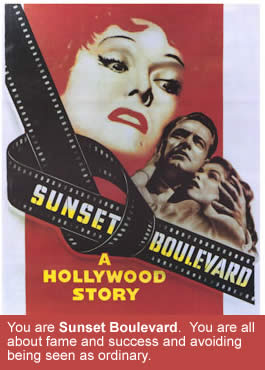
(via The Cheese Stands Alone, whose results I find vaguely frightening)
Russo-American Mission Retrieves Stranded Nuclear Fuel
Remember how a few of the Democrats complained recently about Bush's lack of attention to nuclear material that had not been tracked after the fall of the Soviet Union? Somehow, this story won't make them very happy:
A Russo-American team of nuclear specialists backed by armed security units swooped into a shuttered Bulgarian reactor and seized 37 pounds of highly enriched uranium, in a secret operation intended to forestall nuclear terrorism, U.S. officials said Tuesday. ... It was the third time since last year that U.S. and Russian authorities have teamed up to retrieve highly enriched uranium from Soviet-era facilities.U.S. authorities have begun stepping up such joint operations with the Russians. In August 2002, a team from the two countries retrieved 100 pounds of weapons-grade uranium from an aging reactor in Yugoslavia. The second uranium seizure took place three months ago, when 30 pounds was removed from Romania.
It seems that this statement from Howard Dean is a bit, well, wrong:
Here, incomprehensibly, the Bush Administration stands in the way of what needs to be done. ... We must redouble our efforts through the Cooperative Threat Reduction program to prevent nuclear materials from Russia and other former Soviet Republics from falling into the wrong hands.
Not only is the Bush administration taking this particular threat seriously, they are working with the Russians to recapture these materials, and have been for over a year. When Governor Dean gave this speech, the Yugoslavia retrieval had already occurred. Reasonable minds can conclude that Bush takes this threat seriously, works with allies to retrieve and control the materials, and in fact had been on top of this since the year prior to Dean launching his presidential campaign.
Does Dean have any specifics as to how he would improve the process? No. We must "redouble" our efforts. While this speech was made in February, this article on Dean's website was written last week:
Our new alliance will call upon all nations to work together to identify and control or eliminate unsafeguarded components -- or potential components -- of nuclear, chemical and biological arms around the world. These include the waste products and fuel of nuclear energy and research reactors, the pathogens developed for scientific purposes, and the chemical agents used for commercial ends. Such materials are present in dozens of countries -- and often stored with little if any security or oversight.
You have to wonder just how close to reality the Dean campaign actually gets. So far, it appears that the Bush administration takes this more seriously than the previous administration did, and it also looks like the Dean campaign could use a subscription to a newspaper. I'm sure the Star-Tribune would be happy to comp it for the Governor.
Code Orange: Translation by Zygote Design
Many people express their confusion over the meanings of the Homeland Security Alerts. Like any good blogger, Zygote-Design is here to help with a handy translation of Tom Ridge's text:
Your awareness and vigilance can help tremendously, so please use your common sense and report suspicious packages, vehicles, or activities to local law enforcement.Normal person translation: Enjoy your Christmas holiday but everything you encounter could kill you. Packages of death, vehicles of death and even activities of death. Merry Christmas from all of us here at the Department of Homeland Security who will be whisked away to an impenetrable mountain fortress at the slightest hint of trouble while you die en masse in the streets of your concrete graveyards. Being in the government is cool.
Sheesh ... for a man who just found out that his wife is having a boy, Zygote sure can be cynical! Be sure to read the rest of his translation and congratulate him on the pending addition to his family.
Addendum: In a strange blogosphere coincidence, while I was writing this post, Zygote dropped a comment on my post about the Seinfeld DVD project. Weeeeeeiiiiird....
Life Imitates Art
It looks like the Seinfeld DVD project has hit some snags -- three of them, in fact:
Three of the four leading cast members of the hit television comedy "Seinfeld" are declining to participate in the making of a DVD series of the show because they are unhappy with the related financial deals they have had over the years, people close to the actors and the show said on Monday.These people said that the three actors — Julia Louis-Dreyfus, who played Elaine; Michael Richards, who played Kramer; and Jason Alexander, who played George — made the joint decision not to give on-camera interviews for the DVD or otherwise participate in it.
First, let me make it clear that I am a believer in free-market capitalism. However, it seems to me that the show made everyone a lot of money, not just the owners, although they have raked in the biggest bucks of all. To wit:
The three boycotting actors earn residual payments from the show's reruns, a fee determined by the Screen Actors Guild. A representative for one of the actors estimated the fee at $100,000 a year. ... They famously sought $1 million an episode for the last year of the show, 1998, in part because they said they thought they had been underpaid for many seasons. They ended up with about $600,000 a show, then a whopping sum for television.
Most shows shoot 22 episodes per season, more or less. At $600K per show, each of the three supporting actors grossed $13.2 million in the last season. Plus, they continue to get $100,000 per year just from the residuals. I'm no genius, but it certainly seems to me to be somewhat above yada yada yada cash we're talking here. This contretemps casts an illuminating light on the meaning of the infamous last episode, where the quartet's notorious selfishness lands them a year in a New England jail. Instead of making arrangements to put a classy touch on a classic sitcom, this tempest just proves that life imitates art after all. Shame on all of them. (via Amygdalagf)
Nader Rules Out Green Party Run in '04
Ralph Nader made a curious announcement today on his intentions for next year's Presidential race:
Ralph Nader, the third-party candidate viewed by many Democrats as the spoiler of the 2000 election for taking votes away from Al Gore, has decided not to run on the Green Party ticket next year, a party spokesman said Tuesday. Nader, who garnered nearly 3 percent of the national vote in the last presidential election, has not ruled out running for president as an independent and plans to make a decision by January.
Which begs the question: would he run under an independent banner, or that of another party? Apparently it's not off the table, but something must have happened to disenchant him with the Greens. The Greens, according to the article, are disappointed in this decision. I suspect that Nader may not have wanted to spend money on a primary campaign, and other Greens have announced their intention of running, including Peter Camejo, who ran for governor on the California recall ballot. Nader probably believes that his position as party flagbearer in 2000 should have allowed him to run unopposed. Otherwise, holding open a possibility of a non-Green run makes no sense. The Greens can get a candidate on the ballot in all 50 states, which would be a difficult task for a complete independent.
This is better news for the Democrats that it is bad news for the Republicans, but in the end it will probably matter little. So far, at a stage when challengers are supposed to be sucking up all the political oxygen and outshowing an incumbent President, Bush is beating all of the Democrats badly in the polls, and with the economy picking up steam, that trend should only continue. The possibility of a Nader campaign having an effect in 2004 as in 2000 gets more and more remote. A second Nader run, with or without the Greens, is likely to resemble the second Perot run: tired and pointless.
UPDATE: Professor Bainbridge was kind enough to link back to me. It's a good time to note that I've added Hugh Hewitt's Wine Guy to the blogroll. Don't forget to buy his book. (I always return a plug!)
Dominoes Continue Falling
US forces continued apprehending Iraqi insurgents by the dozens after Saddam Hussein's capture today, including several leadership figures:
U.S. soldiers arrested dozens of rebel suspects Tuesday, including several associates of a former aide to Saddam Hussein who is believed to have a leading role in Iraq's insurgency. A U.S. task force in Baqouba, 30 miles northwest of Baghdad, arrested five Iraqis, including one suspected of recruiting guerrillas, said Maj. Josselyn Aberle of the 4th Infantry Division. ... In an earlier raid in Baqouba, U.S. troops detained a former Iraqi army colonel suspected of recruiting ex-Iraqi soldiers to fight the U.S. military. ... Near Fallujah, to the west of Baghdad, a military statement said troops captured "26 enemy personnel including two former Iraqi generals and an Iraqi Special Forces colonel."
More evidence, I suppose, of how Saddam's capture has not made America any safer.
Le Spin, C'est Nous
The French have discovered that looking in from the outside on the Libya deal makes them appear less than dominant in foreign affairs:
Dominique de Villepin, the foreign minister, took his hat off to London and Washington's "exemplary" diplomatic efforts over the past few months that led to the Libyan leader Col Gaddafi's surprise announcement on Friday, calling it a victory for "the entire international community".But he was forced to admit in Le Figaro that France knew nothing of the nine months of secret negotiations. "We were not kept informed," M de Villepin said. His disclosure underlined the continuing mistrust in relations between the English-speaking powers and France, which made much of its opposition to war in Iraq.
It seems that even the French are starting to see that its obstinacy in opposing all things American may have cost it an inordinate amount of influence on world affairs:
Even the normally pro-government Le Figaro described the Libyan deal as a "semi-failure" for France, which has been against tough action against rogue states. Annick Lepetit, the Socialist party spokesman, said it signified "the isolation of France and French diplomacy in an area where it is traditionally influential".
Bear in mind that if you read the rest of the article, the expression of French disappointment in these setbacks expresses itself mostly through either spinning their isolation as a "victory for an interdependent, multi-polar world," or blaming les Americains for punishing their stance against the war in Iraq. To which I retort: if you can't stand the heat, you should have stayed out of the kitchen in the first place. (via Terrestrial Musings)
Right of First Refusal: Meaning?
As I posted yesterday -- and as it has flown around the blogosphere -- Gen. Wesley Clark made an odd comment to Chris Matthews during an interview two weeks ago, pledging to give Europe a "right of first refusal" on America's national security concerns. That phrase has been interpreted by some, including myself, to mean that Clark was prepared to offer European partners some sort of veto power over actions we would propose in defense of the US. However, two of the blogosphere's better lawyers, Professor Bainbridge and Eugene Volokh, took exception to the general interpretation and issued lengthy discourses on the legal ramifications of rights of first refusal.
I'm just glad I wasn't paying them by the hour.
Professor Bainbridge goes into the more detailed explanation, giving an overview of the legal term in both business and international relations, and ends up stating that Clark's use of the term indicates less than we thought:
I suspect what Clark really meant was that he would consult with our European allies in hopes that we and they would act together ... The "right of first refusal" language probably was a spur-of-the-moment attempt to say "And when I promise to consult with you, I really really mean it." That's a perfectly legitimate position to take, albeit one with which reasonable people can differ (hopefully reasonably). But it's not a right of first refusal. Hence, I find Clark's phrasing inapt, maybe even inept, but surely not unpatriotic.
Eugene Volokh goes through a quicker explanation of this legal concept but is less certain what Clark meant:
But it's not clear what, in a purely legal sense, a "right of first refusal on the security concerns we have" would mean. A promise to "try . . . to work with Europe" on security concerns isn't really a right of first refusal, or even very close to it. It may be a right of consultation, but it's not a right of first refusal. And even taking into account that Clark might have meant this in a figurative sense, it's hard to tell exactly what that sense would have been. ... My tentative sense is that Clark had heard of this cool-sounding legal phrase, and used it for its connotation of cooperation and business amity, without thinking that much about exactly what it would mean. This was on a TV program, after all, and people often talk especially imprecisely in such venues. So I can't really figure out exactly what Clark meant, or whether I should be outraged or not.
However poorly I rate against these legal eagles, I will have to continue to disagree. I'm no lawyer, but neither is Wesley Clark, and I don't for a moment believe that he was talking about a subtle term of art in the legal sense. If you read the entire quote, the context in which he places this offer makes it very clear that he was speaking in a broader conceptual sense:
UNIDENTIFIED MALE: However, if you were in Bush’s shoes right now, what would you be doing differently to rebuild those international bridges you believe have been compromised?CLARK: Well, if I were president right now, I would be doing things that George Bush can’t do right now, because he’s already compromised those international bridges. I would go to Europe and I would build a new Atlantic charter. I would say to the Europeans, you know, we’ve had our differences over the years, but we need you. The real foundation for peace and stability in the world is the transatlantic alliance. And I would say to the Europeans, I pledge to you as the American president that we’ll consult with you first. You get the right of first refusal on the security concerns that we have. We’ll bring you in.
First: Clark was asked what he would do differently than George Bush. Bush took the Iraq issue to the UN Security Council twice before taking military action with a coalition instead of explicit UNSC approval. If you think of "right of first refusal" in Professor Bainbridge's terms, George Bush offered the UN this "right" twice and was rejected both times. This, according to the Professor's excellent analysis, would have made George Bush a free agent and allowed him to shop his action to third parties willing to buy it. This is exactly what happened. If Clark meant this in a legal sense, then he's saying he would do exactly the same thing as Bush, and he obviously isn't saying this at all. While I am excruciatingly aware that the leftist meme is that Bush is a unilateralist that was never sincere about his overtures to the UNSC, it remains a fact that he went there twice for approval, and his predecessor never attempted that in our Balkans efforts, facts with which Clark should be intimately aware.
Second: Clark speaks about creating a new Atlantic charter, presumably eliminating NATO and possibly redefining the UN at the same time, and incorporating this "right of first refusal" for our European allies. It's hard to imagine that a complete replacement of NATO could possibly be less radical than anything in George Bush's dreams in international relationships. We just added several new members of NATO, and simply tossing out this security arrangement to replace it with something new calls into question whether we'd hold the alliance together at all during such a process. Clark cannot be proposing this radical notion just to give Europeans a voice for consultations, as Professor Bainbridge writes. Nothing in NATO's current charter precludes American executives from consulting on such a basis.
Clark did not speak from a basis of business or international law definition of "right of first refusal"; he spoke with the intention of radically altering American sovereignty over its own foreign policy and national security. Clark may be the most dangerous candidate in the field at the moment, and the media and the blogosphere both have been slow to recognize this.
UPDATE: Welcome Power Line readers! Also, I have edited out a reference to Turkey as a "new" member of NATO. They have been a member of NATO for some time, but are attempting to join the EU; I conflated the two. Mark Kleiman's blog has a roundup of opposing viewpoints which focus too closely on the term itself instead of the overall context (at least, IMHO).
UPDATE II: Unfogged continues the debate here, to which I responded in his comments section. The relevancy of Clark's stated position from his previous written statements is that he continues to insist on creating a new "Atlantic charter" where the US would be bound to consult Eurpoean allies first before taking action, as if this never happened before, or even as if it never happened on the Iraq question. If Bush didn't consult European allies first before taking action, then someone needs to explain how UNSC Resolution 1441 came into existence. That was a clear compromise on Bush's part to Europe to provide Iraq a seventeenth chance to comply with UN disarmament demands.
Either Clark's stance on Iraq and the process that led to it is incoherent, a sort of "I'll be Bush without Bush" -- the most likely explanation -- or he really believes that we should subordinate our foreign-policy and national-security concerns to a European consensus that will never be achieved. Neither reflects well on his character nor on his qualifications as president.
California Earthquake Kills Two
As many of you already know, California earthquakes are rarely deadly; construction standards have been so successful that only the strongest earthquakes cause much damage at all. Unfortunately, throughout Central California there are a number of picturesque older communities that have structures that were built well before the newer standards (mostly implemented after the devastating 1933 Long Beach earthquake) were put into place. One of the most quaint of these is Paso Robles, a small town where my mother lived for a short period of time, and where she still has friends, and a community where at least two people have died from yesterday's quake:
A deadly magnitude 6.5 earthquake shuddered through California's Central Coast on Monday morning, crumpling a historic building here and killing two people.The temblor — the strongest in the region's modern history — smashed shop windows, set off house fires and interrupted power service through parts of San Luis Obispo and Santa Barbara counties. Its ripples moved across the state, giving Los Angeles and San Francisco a series of gentle, rolling shakes.
Having spent a little bit of time in Paso Robles, I can tell you that you'd be hard-pressed to find a nicer, friendlier community in all of California. Before yesterday, Paso Robles had slowly been building a reputation for excellent Central Valley wines; in fact, Professor Bainbridge had been extolling some Robert Hall varieties on Hugh Hewitt's show a few nights ago. The region is primarily agricultural, and its "downtown" reminds you of Back to the Future's 1955 version of Hill Valley, but more relaxed, and more effortlessly genuine. It's the one community where I would choose to live in California if I had an independent income and wanted to move back there.
It's a terrible shame that such a beautiful town with lovely old architecture, if unfortunately not earthquake ready, has suffered such a blow. I have not yet heard from my mother if her friends in the area are safe, but I'll be praying for them today, and I hope you all will be as well.
December 22, 2003
Clark: We'll Give Up Our Sovereignty If I'm Elected
I got this from Blogs for Bush, who got it from Andrew Sullivan -- but it is still so shocking that I had to consult the source to see if this was taken out of context. Unfortunately, it's not. General Wesley Clark stated on Hardball two weeks ago that if he were elected President, he would offer Europe a veto over our national security policies:
CLARK: Well, if I were president right now, I would be doing things that George Bush can’t do right now, because he’s already compromised those international bridges. I would go to Europe and I would build a new Atlantic charter. I would say to the Europeans, you know, we’ve had our differences over the years, but we need you. The real foundation for peace and stability in the world is the transatlantic alliance. And I would say to the Europeans, I pledge to you as the American president that we’ll consult with you first. You get the right of first refusal on the security concerns that we have. We’ll bring you in.
Let's just mull that over for a while. America was founded on the principle of self-determination, a concept still held to be valid today. We've fought wars to ensure our self-determination and to ensure that right for other peoples. Wesley Clark led an occupation to ensure that right for Kosovars and Bosnians. But now he proposes to eliminate 200 years of independence from Europe by allowing France, among others, the "right of refusal" over our national security policies. It's simply breathtaking, and it's even more so when you read the transcript and realize that Chris Matthews never followed up on this statement.
I'll put it to you this way: Would you feel secure knowing that our national security was in the hands of France? Germany? Russia? If so, vote Clark. If not, welcome to the real world, where France cannot act to protect its own security, let alone guarantee ours. The last time France guaranteed anyone else's security was Czechoslovakia in the 1930s, and look how well that turned out.
This really seems to indicate that Clark has completely gone off the rails. Too bad the mainstream media hasn't explored the issue in more depth.
Northern Alliance Charity Project Reminder
Just a reminder to all of you about the Northern Alliance charity project at Fraters Libertas, which I posted about last week. The Elder will respond to e-mail inquiries from those who do not have a PayPal account for the donation, so don't let that stop you from participating! Let's do our best to make some children happy at Christmas this year.
Now, Now, Gentlemen, We're Mostly Democrats Here
Apparently, there's been a miscommunication between Howard Dean and General Wesley Clark regarding the potential VP slot on the Democratic ticket:
Speaking in a taped interview on ABC's "This Week," Clark said Dean had asked him to be his running mate should Dean win the Democratic nomination in a conversation before Clark entered the race.
Unfortunately for Clark, Dean's campaign doesn't recall ever having that conversation, and spokesman Joe Trippi said so shortly after Clark's comments were made. This prompted a testy retort from Clark's campaign:
"Joe Trippi may want to check in with his candidate before talking," Matt Bennett said in a statement from Clark headquarters in Little Rock, Arkansas. "Howard Dean did in fact offer Wes Clark a place on the ticket in a one-on-one meeting that Trippi did not attend."
This offer supposedly took place in a meeting over three months ago, when Dean's campaign still looked like a dark horse. As Trippi pointed out, Dean was hardly in a position to start offering VP slots to anyone else in the campaign, especially since conventional wisdom was that Dean would be getting VP consideration in order to bolster leftist credentials for a Kerry-led ticket, or possibly Lieberman, who of course had been on the last Democratic presidential ticket.
However, while we have been busily pointing out all of the inconsistencies and flat-out lies coming from the Dean campaign, this points out a similar problem in the Clark campaign as well. As noted in Power Line, Jeff Jacoby's piece in the Boston Globe, "Clark's Fading Credibility," underscores a number of areas where Clark has twisted reality and his own positions in order to pander to the anti-war leftists currently favoring Dean. For instance, regarding Clark's conceited boast that he would have had bin Laden "two years ago", Clark not only couldn't deliver when he was in charge in the Balkans, but had genocidal nutcases as drinking partners:
But Clark has had extensive experience in the Balkans and ought to know something about capturing international war criminals. After all, the two most-wanted men in the world before Sept. 11, 2001, were Radovan Karadzic, the former president of the Bosnian Serbs, and Ratko Mladic, the head of the Bosnian Serb army. They are widely considered responsible for the worst atrocities in Europe since World War II, including the "ethnic cleansing" of Bosnia and Croatia, the murderous siege of Sarajevo, the slaughter of 7,000 unarmed boys and men in Srebrenica, and the systematic rape of thousands of Bosnian women and girls.Karadzic and Mladic were indicted in 1995 by the UN war-crimes tribunal, but their barbarity was common knowledge well before that. As far back as 1992 they were publicly identified by then-Secretary of State Lawrence Eagleburger as war-crimes suspects. So how did Clark, who claims he would have "had Osama bin Laden dead or alive two years ago," collar the two Serb butchers?
Well, actually -- he didn't. Karadzic and Mladic are still at large.
And yet it probably is fair to say that Clark knows more about dealing with war criminals than the rest of the Democratic field. After all, none of the other candidates has ever horsed around with a mass murderer. Clark has.
On Aug. 27, 1994, when he was a three-star general working for the Joint Chiefs of Staff, Clark paid a visit to Mladic in Bosnia. In so doing, The Washington Post reported, he "ignored State Department warnings not to meet with Serb officials suspected of ordering deaths of civilians." Clark says he wanted to get Mladic's views for a policy paper he was writing and thought he had permission to do so.
Either way, Clark did more than take notes. The two men drank wine and posed for jovial pictures that showed them merrily wearing each other's caps. Mladic plied Clark with other gifts, too -- a bottle of brandy and a pistol inscribed "From General Mladic." It was like "Ike going to Berlin while the Germans were besieging Leningrad," one disgusted commentator wrote, "and having schnapps with Hermann Goering."
This is so bad that it's difficult to imagine how he stays in the race with this record behind him, but there are more inconsistencies than that, including the fact that he was a Republican until he entered the Presidential race, and that he spent the last two years toasting the president he's currently roasting. Then there's his position on post-war Iraq, where he gets even more incoherent, as Jacoby states:
Yet Clark, bowing to the Democratic fetish for multilateralism, insists that the conduct of the war in Iraq be taken out of US hands and turned over to an international organization."I would go to NATO," Clark says, "and I would tell John Abizaid, the [US] commander, `You're now working for NATO.' " And what would that change, exactly? Not much, Clark admits. "When you do NATO, it's the United States, anyway, that's doing it. I mean, NATO doesn't have an intelligence system. It relies almost exclusively on the United States." It is an incoherent position, and the more he tries to clarify it, the more he retreats into windy platitudes. "I think if the United States works in efficient multilateralism through NATO, we can move the world."
Before he became a presidential candidate, Clark strongly supported the Iraq war resolution; since entering the race, he has tied himself into knots insisting that he actually opposed it. Before becoming a candidate, he described Saddam as a menace requiring urgent action -- "the clock is ticking," he said last year. Now Clark labors to explain why Saddam wasn't a burning issue -- "there was no ticking clock," he said last week.
Neither Dean nor Clark are prepared for the hard questions that governance of the US requires. Neither of them can give a straight answer. Neither of them have a position that they can't modify to pander to a target audience. In a way, it's a shame they won't be on the same ticket, so the country can repudiate both of these rank opportunists in one election.
December 21, 2003
Another One Bites the -- er, Congratulations!
Fraters Libertas has a stunning announcement: Atomizer has become engaged to his lovely girlfriend (now fiancee) Atomizerette! You'll have to read his announcement to get the low-down on Atmoizer's devastating technique, but you could say that he displayed a certain amount of horse sense in making hay while the sun shines. However, Atomizer obviously never played trumpet in a marching band, or at least never had to follow the local 4-H in a parade, or else he'd have anticipated the inevitable result of his creativity.
In honor of Atomizer's big announcement, I'd like to relate a story from a while back, when I threw a bachelor party for a friend of mine. The men started discussing the economics of being a married man -- meaning you never ever had cash in your wallet -- and my friend and I both scoffed (I was a single Captain at that time). We did a quick survey of the room ... and every bachelor had cash in his wallet, but every married man had not a cent. This was not a setup; it was completely spontaneous, and my poor friend looked somewhat green at the gills for about an hour afterward.
So congratulations, Atomizer, and give your fiancee our regards! Heh heh heh.
Christmas Hustle & Bustle
In case you couldn't guess, blogging was light today while I did some Christmas shopping and decorating. We went to see our families for Thanksgiving this year, and so the holiday season hasn't had much impact on us; the First Mate and I have both been feeling a lack of Christmas spirit, and so we haven't decorated or shopped at all before now. Due to the expense of traveling to California with our son, daughter-in-law, and the Little Admiral, we had warned our family not to expect too much this year. (And then we promptly spent more than we planned, of course.)
Anyway, we're still working on our house and the gifts, mostly for the Little Admiral, but due to an unexpected Christmas bonus, I was able to purchase a long-desired digital camera. I bought the Canon A70, mostly due to the higher quality and the fact that it uses compact-flash memory, which I already own. In order to justify this expenditure, I'll post evidence that I actually did something to decorate for the holidays:

As you can see, I do a great job of decorating! If you look closely -- and I know the quality isn't that great as I had to save the image in a low-filesize format -- you'll see that I left the bottom third of the tree undecorated. I figure this is the only way to keep the Little Admiral from decorating the room with my tree decorations ... Here's the Little Admiral with the First Mate, last night while we were babysitting:

Dominoes Continue Falling
The capture of Saddam Hussein continues to accrue benefits to the Coalition:
Acting on intelligence gleaned from the capture of Saddam Hussein (news - web sites), U.S. troops rounded up dozens of suspected rebels during two days of raids in towns where loyalty to the deposed president remains strong, officials said Sunday. Two Iraqis were killed.Smashing down doors, troops went house to house in Fallujah, a center of resistance west of Baghdad, early Sunday. Troops of the Army's 3rd Armored Cavalry Regiment blockaded Rawah, near the western border with Syria, for a sweep dubbed Operation Santa Claws, the U.S. Army told Associated Press Television News.
The continuing nature of these operations indicates a snowball effect from intelligence gleaned from the documents captured along with Saddam, if not directly from Saddam himself. His documents clearly gave the Coalition a good idea of the insurgency leadership structure and identification of these agents have led agents to further discoveries. It indicates that captured Iraqis are talking and giving intelligence to the CPA. Saddam's capture was not just a symbolic victory for the Anglo-American-led Coalition -- it may be the key to collapsing the "insurgency" in time to restore Iraqi civil institutions and return sovereignty to the Iraqis by the summer.
For instance, STRATFOR (via Instapundit) indicates its belief that the insurgency has no nationalistic or political basis, but is simply an effort by those who profited from Ba'ath leadership to attempt its return and are chiefly motivated by cash:
The guerrillas did have one major vulnerability: money. The Baathist regime long ago lost its ideological -- and idealistic -- foundations. It was an institution of self-interest in which the leadership systematically enriched itself. It was a culture of money and power, and that culture permeated the entire structure of the Iraqi military, including the guerrilla forces that continued to operate after the conventional force was defeated. Indeed, the guerrillas substituted money for recruitment. In many cases, they would pay people outside their ranks to carry out attacks on U.S. troops as a supplement to attacks by the main guerrilla force.The culture of money made the guerrillas vulnerable in two ways. First, they relied on support from an infrastructure fueled by money. Whatever their ideology, they purchased cooperation with money and intimidation. Second, much of the money the guerrillas had was currency taken from Iraqi banks prior to the fall of Baghdad. A great deal of it was in U.S. dollars, which continued to have value, but most of it was in the currency of the old regime. One of the earliest actions of the U.S. occupation forces was to replace that currency. Over time, therefore, the resources available to the guerrillas contracted.
The main problem with a money-based war is that the Ba'athist insurgents don't have a cash flow, and the Americans do, and have increasingly used it to rebuild the infrastructure in Iraq, employing local contractors, and making contacts, as well as using cash to finance covert intelligence assets, which STRATFOR notes has improved greatly since the summer. The Americans are learning, and the Ba'athists are running out of cash, time, and support. Saddam's capture is terribly demoralizing, not just because he is the natural symbol of Ba'athist supremacy, but also because it shows that the Americans have become very good at gathering the kind of intelligence necessary not just to capture a few pawns, but the major players as well.
Power Line mentions this same phenomenon in a post about the overall effect of Saddam's capture. Deacon quotes an Iraqi Kurd journalist:
Saddam's role in the 'resistance' was both symbolic and practical. His arrest should result in the collapse of the insurgency, even if the impact is not felt immediately. The insurgents may not lay down their weapons. When the head of a snake is cut off, the body twitches for some time. With Saddam sitting in jail -- and soon in a courtroom -- his loyalists will eventually get the message that the head is gone.
With the past week full of successful raids capturing dozens of insurgency members, the Americans have the momentum, and unless we lose our nerve, this insurgency will come to a close in the near future.
I'm Who?
I never take these tests, and now I remember why ...
 | Eowyn If I were a character in The Lord of the Rings, I would be Eowyn, Woman of Rohan, niece of King Theoden and sister of Eomer. In the movie, I am played by Miranda Otto. Who would you be? |
Which Lord of the Rings character are you? (via Dean Esmay)
Washington Post Gets It
It took a couple of days for the Washington Post to write an editorial about Libya's renunciation of WMDs, but it got the final product right. As opposed to the meme sneaking around our liberal colleagues' blogs, the Washington Post makes it clear that the timing and the direction of Libya's offer was no accident:
LIBYAN LEADER Moammar Gaddafi, a model rogue dictator and sponsor of international terrorism in the 1980s, has been trying to rehabilitate himself for the better part of a decade. He dispatched two of his henchmen to be tried at The Hague for the 1988 bombing of a Pan Am airliner, agreed to pay reparations to families and renounced terrorism. Yet it was only last March that Mr. Gaddafi chose to approach Britain and the United States to discuss giving up his weapons of mass destruction. That he did so, and that nine months of secret negotiations with him yielded an agreement, marks a major success in the effort by the United States and its allies to prevent the spread of chemical, biological and nuclear weapons and to make such containment a focus of international affairs. Mr. Gaddafi's timing, just as the invasion of Iraq was beginning, speaks for itself: The Libyan dictator chose to comply as it became clear that Saddam Hussein's pursuit of illegal weapons would no longer be tolerated.
News that Gaddafi's WMD progress was farther advanced than anyone in the international community thought gives the WaPo editorial board second thoughts about international weapons-control "regimes" as well:
But, as in Iraq after the Persian Gulf War and more recently in Iran, inspectors found a more advanced nuclear program than expected. These included facilities to enrich uranium into bomb-grade material. ... The discoveries nevertheless underline the inadequacy of the international regime for controlling nuclear materials, which has failed to stop a series of unstable or aggressive countries from obtaining nuclear weapons or the means to produce them.
The Post does not attempt to analyze why the UN has failed in weapons control, perhaps saving that discussion for a later date. However, the reason is simply that the UN has failed to enforce its own resolutions regarding security for the past twelve years. President Bush's challenge to the UN in January, after it became clear that Saddam Hussein was using the weapons inspectors sent in to verify compliance under Resolution 1441 as part of his cheat and retreat strategy, specifically warned the UN of this very consequence. Bush warned the UN that failure to provide severe consequences for defiance encouraged other rogue states towards defiance, not towards compliance.
In the end, the UN chose the path of the League of Nations and has put an emphatic seal on its own irrelevance. Gaddafi chose Bush and Blair not because he has some love for the Anglo-American alliance, but because he understood that defying them put him in mortal danger. And while it is true that Gaddafi has been trying to rehabilitate his image since Lockerbie, the development of his WMD program -- in conjunction with Iran and North Korea -- demonstrates his intentions of wielding doomsday power over North Africa and the Middle East. Iraq and Saddam Hussein's downfall changed all the equations, and while Gaddafi may be the first to understand it, he will not be the last.
As a side note, Power Line noticed that the WaPo's Dana Milbank, a frequent critic of the Bush administration, managed to goive credit to the Bush Doctrine for the Libya reversal, even painting John Kerry as floundering in his response to the announcement:
Bush's domestic adversaries have had some trouble responding to the administration's diplomatic successes. Sen. John F. Kerry (D-Mass.), a presidential aspirant, portrayed the success with Libya as an exception to the Bush Doctrine. "Ironically, this significant advance represents a complete U-turn in the Bush administration's overall foreign policy," he said in a statement Saturday. "An administration that scorns multilateralism and boasts about a rigid doctrine of military preemption has almost in spite of itself demonstrated the enormous potential for improving our national security through diplomacy."But Bush's supporters say it is precisely his willingness to go it alone and take preemptive action that has encouraged other countries to seek diplomatic solutions before the United States launches a military attack. The Libya and Iran concessions "show the peripheral benefit of preemption," said Kenneth Adelman, a Reagan administration arms control official who now serves on a Pentagon advisory panel. "Most of all it scares the bejesus out of rogue dictators." As for stubborn allies such as Jacques Chirac and Gerhard Schroeder, "they pay more attention when there's a forceful U.S. policy," Adelman said.
It is unlikely, of course, that France or Germany would acknowledge that they are reacting to U.S. strength. Yet it is noteworthy that they were conciliatory on the issue of Iraqi debt forgiveness after Hussein was captured -- even though they were complaining bitterly just a week before about a Bush plan to exclude them from U.S.-funded Iraq reconstruction projects.
This break from reality will doom the Democratic presidential aspirants, who keep claiming that Bush has been an abject failure at diplomacy because he refused to follow the UN and specifically France, Germany, and Russia in appeasing Saddam. Reality shows that Bush and Blair took the right action in demonstrating that the West will use force to protect its interests and will eventually depose brutal tyrants who continue to flout their international agreements. And again, if you don't believe that the Bush Doctrine had anything to do with Libya, you'll need to explain why Gaddafi chose to deal directly with Bush and Blair rather than the UNSC.
UPDATE: Dean Esmay addresses the inconsistency of the left on the Libya announcement. It seems as though they wanted the US to invade Libya instead of accepting a surrender. Odd.

captain*at*captainsquartersblog.com


My Other Blog!
E-Mail/Comment/Trackback Policy
Comment Moderation Policy - Please Read!
Skin The Site






Hugh Hewitt
Captain's Quarters
Fraters Libertas
Lileks
Power Line
SCSU Scholars
Shot In The Dark
Northern Alliance Radio Network
Northern Alliance Live Streaming!






Des Moines Register
International Herald Tribune
The Weekly Standard
Drudge Report
Reason
The New Republic
AP News (Yahoo! Headlines)
Washington Post
Guardian Unlimited (UK)
New York Times
Los Angeles Times
OpinionJournal
Pioneer Press
Minneapolis Star-Tribune
MS-NBC
Fox News
CNN

Design & Skinning by:
m2 web studios
blog advertising

- dave on Another National Health Care System Horror Story
- brooklyn on Hillary Not Hsu Happy
- rbj on Hillary Not Hsu Happy
- Robin S on Requiem For A Betrayed Hero
- Ken on Hillary Not Hsu Happy
- Robin S. on Requiem For A Betrayed Hero
- RBMN on Hillary Not Hsu Happy
- NoDonkey on Another National Health Care System Horror Story
- Robin Munn on Fred Thompson Interview Transcript
- filistro on When Exactly Did Art Die?