




January 15, 2005
Grade Inflation, British Style
Grade inflation has caused concern in the United States, where the issue of giving marginal performances passing grades has had tremendous impact on higher education. However, the British appear to lead the world in grade inflation, with the London Telegraph reporting that scoring as low as 17% on math exams could net British students a B:
Pupils have been awarded a B grade in a maths GCSE exam despite scoring only 17 per cent, The Telegraph can reveal.The pass marks for the new exam, which was taken last summer by 7,500 children from 65 schools and is due to be introduced nationwide next year, were an all-time low.
Pupils sitting GCSE maths last year had to achieve about 40 per cent to get a B grade. But with the new exam, designed by the Cambridge-based exam board OCR, those who got as little as 17 per cent were given a B, while those scoring 45 per cent were awarded an A.
The British government just announced what they claimed were "record" achievements in their educational testing, but examiners and teachers expressed outrage and disgust at the attempt to bolster educational policy through fudged results. Now, I've heard of lowered expectations in education, but granting an above-average mark for getting 83% of an exam wrong makes one wonder what British educational policymakers consider average.
Something tells me that British voters may decide to grade their performance, and I doubt that they'll get a B for effort.
Why Is This Man Smiling?
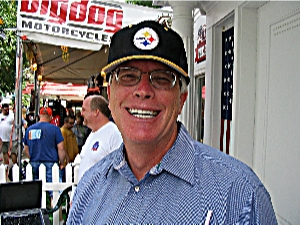 Maybe it's because the Pittsburgh Steelers did everything they could to give away the divisional playoff game to the New York Jets -- but in the end, the New York Jets could not take advantage when it counted. The Steelers beat the Jets, 20-17, in overtime:
Pittsburgh quarterback Ben Roethlisberger overcame two huge mistakes — an interception for a touchdown and another that appeared to doom the Steelers late in the fourth quarter — to lead a decisive drive that began at the Jets 13 and sent Pittsburgh to next Sunday's AFC championship game against New England or Indianapolis.The loss will go down as one of the most excruciating in the Jets' star-crossed history, with kicker Doug Brien missing not one but two makable field-goal tries in the final two minutes of the fourth quarter. The misses were doubly stunning disappointments for a gutty team on the verge of its biggest upset since Broadway Joe's guaranteed win over the Colts in the January 1969 Super Bowl.
Brien's 47-yarder with 1:58 remaining hit the goal post, but Roethlisberger gave the Jets the ball right back when his off-line throw was intercepted by David Barrett — just the kind of mistake rookie quarterbacks are supposed to make in the playoffs, but Big Ben had rarely made during his 13-0 rookie season. The Jets then drove cautiously from the Steelers 37 to the 25, giving Brien a 43-yarder to win it on the final play of regulation.
But the kick sailed far to the left, not even close, and the given-a-reprieve Steelers danced joyously on their sidelines — Roethlisberger right in the middle.
The Steelers gave us an escape worthy of Houdini in pulling this game out. They jumped out to an early 10-0 lead thanks to a Chad Pennington interception, but then stalled offensively until the fourth quarter. The Steelers defense never gave up a touchdown, but special teams and Big Ben Roethlisberger allowed one each.
Big Ben played like a rookie in his first playoff game (which he is), especially in the first half, where he only completed three passes and looked completely ineffective. Ironically, he played much better in the second half but gave up two key interceptions that nearly ended the Steelers' season. The first went back for a TD, and the second allowed the Jets to have a second chance in the final two minutes of the game to kick a game-winning field goal.
Incredibly, the Jets kicker missed both shots at winning, a bitter twist on their miracle finish last week against San Diego. Even though the Jets could not score an offensive touchdown, they appeared to have the momentum throughout the game. Only after Doug Brien's second whiff did the air go out of the Jets, who played their third straight overtime game.
Steeler fans will enjoy this win, but the Steelers will face either the Indianapolis Colts or New England Patriots next week at Heinz Field. They cannot hope to beat either team with the game they brought today. Hopefully, this game can be chalked up to rust (Big Ben hadn't played in three weeks) and the real Steelers offense will show up to match their tough defense.
NOTE: I should have explained the picture. Hugh Hewitt lost a bet with me, and the obligation was to wear my Pittsburgh Steelers hat for his interview with the Northern Alliance at our State Fair last summer (original link here).
Hugh's still a loyal Cleveland Browns fan, the one aspect of his philosophy where his towering intellect fails him. I think the answer to the title question above is that he came pretty darned close to getting his revenge this weekend. Either that, or he found out that Roethlisberger comes from Ohio.
St. Paul Firefighter Union Chief: We're Uncontrollable Drunks
The firefighters in the IAFF Local 21 of St. Paul might want to check the coffee in the firehouse where Pat Flanagan serves. In what was meant as a stinging rebuke to Mayor Randy Kelly, Flanagan specifically e-mailed a warning to Kelly not to attend their annual installation bash, warning Kelly that "alcohol will be served" and implying that would make the party dangerous for the mayor:
Reasons for the snub, Flanagan wrote, are the mayor's budget cuts, his decision to decommission an engine company, and growing tensions at the bargaining table.Flanagan ended his three-paragraph missive, dated Jan. 10, with this salvo: "Alcohol will be served at this event, so we write this letter in the best interest of all parties involved."
On Thursday, Kelly fired back with an e-mail of his own. He defended his record and said he was "perplexed" by the reference to alcohol. Was that meant as a threat? Or simply an omen of embarrassing behavior to come?
"I will, of course, abide by your wishes despite my concern over the content and tone of the e-mail," wrote Kelly, who included the entire union membership in his 10-paragraph response.
Embarrassing behavior to come? I'd say Flanagan embarrassed himself and the union enough as it is. Someone needs to explain how making thinly-veiled threats of violence and rampant drunkenness serves the image and cause of St. Paul firefighters. Do IAFF Local 21's functions routinely turn into debauched riots, or do they save that for their annual installation gala?
At the least, the e-mail represents a childish effort to lash out at the mayor and make him look foolish. Unfortunately for Flanagan, it appears that Kelly is the only grown-up in this story, and Flanagan's threats undermine the enormous goodwill that firefighters enjoy in all communities. IAFF Local 21 members might want to think about recalling the chief of the goon squad forthwith.
Northern Alliance Radio Today
Don't forget to tune in for the Northern Alliance Radio Network this afternoon from noon to 3 pm CT. We'll be discussing lots of different topics, but I think you can be assured that we will focus on the CBS panel and its report on Memogate.
Later on, try giving a listen to another group of bloggers doing their own radio show. Homespun Bloggers may be the next step in the democratization of free speech.
Palestinian Elections Rigged: Workers
In a further confirmation of the corruption and machinations behind the Palestinian elections last weekend, dozens of election workers walked off their jobs protesting Mahmoud Abbas' victory:
Two senior members of the commission, Ammar Dwaik and Baha al-Bakri, resigned early Saturday, and officials later said 44 more members resigned. Six top election officials were among those who resigned.
The resignations raised questions about Sunday's vote giving Abbas an overwhelming victory with 62.3 percent, though the officials who quit said the alleged irregularities did not fundamentally affect the final vote tally.
The resignations didn't raise the questions, or at least the questions shouldn't have waited for them to be raised. Last week, newspapers and broadcasters around the world praised the elections as a major step forward for democracy in the Middle East even as the terrorist group Fatah changed rules in the middle of the day to accommodate a "higher" turnout. Most of them described Abbas' victory as a "landslide" and wrote paeans to the mandate supposedly given to him from the Palestinians. Meanwhile, Fatah allowed people to vote in any precinct without any verification of their eligibility or even if they had already voted. Adding two hours to the vote and changing the rules almost doubled the turnout, a clear indication of fraud to anyone except, apparently, the geniuses in the newsrooms.
Now the workers that Fatah pressured to change those rules midstream have made it impossible to ignore the fraud and coercion at the heart of Abbas' "mandate". These people, who wanted a clean election, were betrayed by a world press that wanted Abbas elected more than a real election. The international press betrayed those who wanted a real poll instead of a coup d'etat.
In fact, the fraud also points out that Palestinians treated this "election" as a non-event, with only 30% bothering to vote at all until Fatah rigged it so that the same 30% could vote again. Again, the world press betrayed those who wanted to believe in a Palestinian commitment to democracy and peace. However, those betrayed in this instance are their readers, the ones who relied on the press to give us honest reporting and consistent analysis. Instead, they aided and abetted voter fraud in order to get the result they desired.
I wrote last week that the Palestinian election was nothing more than farce. I'm not happy to have been proven correct, and I take no satisfaction in pointing out that the mainstream media once again allowed its biases to affect its reporting. Until they take responsibility for giving us honest reporting -- when outfits like CBS fire division presidents and managing editors for shoving false and misleading reports down our throats -- we will continue to see these embarrassments in our media.
The California Earthquake On Rice
The AP reports this morning that the nomination of Condoleezza Rice for Secretary of State has caused a faultline between California's two Democratic senators, Dianne Feinstein and Barbara Boxer. While Feinstein accepted an invitation to introduce Rice to the Senate Foreign Relations Committee for her nomination hearing, Barbara Boxer intends on using character assassination to push her anti-war views:
Rice, Bush's national security adviser, lists California as her residence after having served for six years as provost of Stanford University, Feinstein's alma mater. It's customary for nominees to ask home-state senators to introduce them at confirmation hearings.Feinstein accepted Rice's invitation to introduce her to the committee, and praised her in a statement Friday as "the natural choice to be our country's next secretary of state."
Boxer gave a hint Friday on how she is expected to greet Rice at the Tuesday hearing.
"I personally believe that your loyalty to the mission you were given overwhelmed your respect for the truth," Boxer plans to tell Rice, according to prepared remarks she released Friday.
So why does Barbara Boxer fear Condoleezza Rice? Besides her sobbing partisan performances on any issue she addresses, her concerns are more personal. Once George Bush leaves office, it's no secret that the GOP would love to get the widely-respected Rice to run for major elective office. Having just been re-elected, Boxer's next election for the Senate will come in 2010 -- two years after Rice leaves government service at State. Boxer needs to do as much damage to Rice as she can now in order to kneecap her for 2010.
Rice has given no indication that she will pursue elective office at the end of Bush's term, and even if she does, her ambitions might lead to the California governor's office rather than the Senate. Assuming Schwarzenegger runs again in 2006, that position will open up in the same election. It might be that both women run for Arnold's seat, but it's clear that they are likely to be political opponents at some level in six years.
For a senator who has long decried the pre-emptive strike, Boxer certainly doesn't mind employing them on her own behalf. I find it striking that Feinstein declined to give her any political cover for her actions. It may indicate that even the Democrats have tired of Boxer's antics of late.
Kos, Teachout, Williams, Lauck, Van Beek
Earlier this week, Zephyr Teachout wrote a post for her blog Zonkette, which eventually made it to the Wall Street Journal, disclosing the Howard Dean campaign's payments to the Daily Kos and MyDD bloggers Markos Zuniga and Jerome Armstrong. The accusations of conflicted interest have risen to fever levels in the blogosphere, along with yet another argument about what what ethical standards bloggers owe their readers. I have received e-mails asking why I've remained silent on this issue.
Well, I haven't remained silent. Five weeks ago, when the shoe was on the right foot, I wrote that bloggers accepting payments from political campaigns outside the transparency of fully-displayed advertisements -- which don't even have to be exclusive! -- risk their credibility and reputation. I wrote that after the revelation that the John Thune campaign paid two bloggers several thousand dollars to join the campaign, and neither disclosed their relationship despite the race being the primary focus of their blogs:
In my opinion, bloggers who wish to do serious work should disclose all funding sources that could present a conflict of interest. In the case of DvT, clearly those payments cast a different light on their writing. Had Thune just bought blogads for their site, we would have seen the sponsorship up front and incorporated that information into our estimation of their credibility. The very fact that they chose not to disclose the payments or sponsorship in general now calls their motives and work into serious question.Am I angry about this? Not especially. Neither site pretended to present an unbiased look at the race -- DvT overtly supported John Thune from the start of the blog. (Like Pat, I didn't read SDP.) Now that the payments have been disclosed, the bloggers have to answer to the marketplace, and I suspect they will suffer a marked loss of readership -- which is the only coin of this realm. The free market of ideas works similarly to any other free market; if the supplier can't be trusted, people find a different supplier.
As Jon says, this should be a lesson to all bloggers: fully disclose if you value credibility, especially if your mission is ostensibly to counter the bias of the mainstream media in your market, as was DvT. Otherwise, the mission begins to look somewhat hypocritical.
As I see it, the only differences between the two situations mitigate the damage. Kos disclosed the relationship, and Jerome stopped blogging until the end of the election, being too busy with his consultancy. Some claim that Kos should have disclosed the relationship every day, but as a blogger myself, I know that's impractical at best, and would annoy the regular readers. (I'm not one of them; I still consider Kos despicable after his "screw them" comment about the butchered Americans in Fallujah.) As far as I'm concerned, he at least met the minimum ethical standard applicable, even if that seems to some a bit half-hearted. Besides, Kos is known for his connections to the Democratic Party as a fundraiser, so connections to major campaigns will always exist at Daily Kos. I assume it's part of the attraction.
The difference between Kos and Armstrong Williams is that disclosure, plus the money that Williams got came from the pockets of all taxpayers, not a political campaign. If political campaigns like Dean and Thune want to pay for propaganda sites on the Internet, that's a private matter. However, the US has laws against stealth-propaganda techniques like what the Education Department tried with Williams. What's more, the contract with Williams specifically called for Williams to write glowing reports about NCLB and get others to do the same, all while maintaining a pristine appearance. It's a deliberate deception on the part of government towards its citizenry for purely political purposes -- it's not as if national security was at stake -- and as such, we should all object to it regardless of ideology.
As much as I dislike Kos (and I do), I have no real beef with him on this score. Had I relied on Kos' independence of thought while covering the Dean campaign, the disclosure would have told me to go elsewhere. And if the consultancy for Jerome Armstrong was meant to spread good thoughts about Dean through the blogosphere, that effort spectacularly failed. If their readers feel betrayed, they'll go elsewhere. Probably not here, of course, but elsewhere.
Five weeks ago, we had our own friends caught up in the same kind of scandal with more culpability, and some of us gave them a pass. I find it somewhat hypocritical to hoist Kos on the same petard for disclosing more, rather than less.
Ed Cone has more background on the development of the story.
UPDATE: Hugh Hewitt extends his own commentary today on this issue, and he e-mailed me with a counterpoint:
I have no beef with MyDD, but Kos shouldn't get a pass. It doesn't disclose what he did, and the Dean camapign has admitted they bought him. Much more to the point, Kos admits he has undisclosed clients, which means he may be on the payroll of the people he was raising money for. That would be a very bad thing as you would in essence be raising money for yourself.
I agree with Hugh that Kos' undisclosed clientele presents a huge problem for his credibility, and that this disclosure isn't nearly good enough from an ethical standpoint. However, Kos is known for his attachment to political campaigns, whereas Armstrong Williams, Jon Lauck, and Jason Van Beek all never disclosed any connection to partisan campaigning.
Don't get me wrong; I don't find Kos at all credible, nor do I want to remain in the position of defending Kos. I think all of those political attachments absolutely impacts his credibility, but at least his readers know of these connections and can make that decision for themselves. Lauck and Van Beek were new at blogging and learned a lesson. Armstrong Williams was supposed to be a professional, and the Department of Education violated the law and used stealth propaganda to push its politics. That's completely unacceptable and in my mind not analogous to Kos.
UPDATE II: Hugh still thinks that we need to call Kos out on his non-disclosure disclosure, and I don't necessarily disagree. His readers should have that information if Kos wants to maintain any credibility of independence. But to say that Markos didn't disclose his official connections to Dean's campaign is inaccurate, and the fact remains that the Daily Kos went further than others to make that distinction known. I think we need to call out the Dean campaign more for a stupid decision to spend $3,000 per month for Markos to write what he would have written anyway. And Dean wants to chair the DNC? I'm on board!
January 14, 2005
Graner Convicted
Spc. Charles Graner was convicted in his court martial on all specifications against him, putting him at risk of 15 1/2 years in prison:
Army Spc. Charles Graner Jr., the reputed ringleader of a band of rogue guards at the Abu Ghraib prison, was convicted Friday of abusing Iraqi detainees in a case that sparked international outrage when photographs were released that showed reservists gleefully abusing prisoners. ...The jury of four Army officers and six senior enlisted men rejected the defense argument that Graner and other guards were merely following orders from intelligence agents at Abu Ghraib when they roughed up the detainees.
The so-called "following orders" defense extended its long and failed history from Nuremberg forward to today. It appears that the jury rejected the idea that Graner operateed under any orders when he sexually abused and physically beat Iraqi prisoners, along with other members of his unit who followed his lead. The grand conspiracy notion takes another body blow ...
Did Thornburgh-Boccardi Cave In To Bill Burkett?
CQ reader Ken Stepanek sent a link to a message board for the Yahoo group Texas Democrats with a message purportedly from Bill Burkett's wife Nicki. The message alerted Texas Democrats to the Cory Pein article from the Columbia Journalism Review that turned out to be incorrect on most of the points the panel's report addressed. According to this January 3rd message, the Burketts believed they had frightened the CBS panel into a change of course:
This past week, we may have scared the Devil out of senior folks at CBS and throughout the journalistic World. We are now negotiating with the VIACOM panel for an in-depth interview to explore the facts and documentation of the story; the roles of CBS, ABC, the Associated Press, New York TImes, USA Today and numerous others who actively sought Bill out as a source on the story and their backlash after the story went elsewhere. We have already received open-ended offers from NBC, publishers and lately a Movie producer.This is background information only. But please understand that Bill hasremained quiet while VIACOM conducted it's investigation.
So what contact did the Burketts and their lawyers have with the independent Thornburgh-Boccardi panel? What kind of threats were made against CBS and Viacom? If Nicki Burkett made these claims a week prior to the report's release, perhaps this indicates that the Burketts had prior access to it. It at least calls into question the panel's extraordinary reluctance to draw any definitive conclusions on the authenticity of the documents when even their expert told them conclusively they came from a modern computer. And are the other media outlets taking it easy on the CBS report in order to use Burkett as a source for other stories?
This report smells more every day. CBS and Viacom owe us more answers.
Does This Sound Like It Was Ordered From On High?
The more that one hears of the testimony in Spc. Charles Graner's court-martial over the Abu Ghraib abuses, the less supportable that a high-level conspiracy to commit war crimes were at the heart of them. The New York Times manages to bury the relevant portions of the testimony near the bottom of their report:
Megan Ambuhl, who has been discharged from the military for taking part in the events seen in the photographs, said interrogators had ordered her to humiliate male detainees by pointing and laughing at them as they showered. Interrogators, she said, "encouraged us all the time.""We were all going to save the lives of the soldiers who were outside the wires," she testified. "The detainees had information that the interrogators had to find out."
Questioned by the prosecution, Ms. Ambuhl acknowledged that she had been sexually involved with Specialist Graner for a month before the investigation began, and did not wish to see him convicted. She acknowledged, too, that military intelligence, or M.I., was not present for the photographs that show hooded and naked detainees forced to masturbate, form a pyramid or simulate oral sex.
"M.I. did not direct this, did they?" the lead prosecutor, Maj. Michael Holley asked. "No, sir," she replied.
The second defense witness called on Thursday, Sgt. Kenneth A. Davis, testified that on the night some of the most widely circulated photographs were taken, he discovered military intelligence soldiers and Specialist Graner handcuffing two naked detainees together in an embrace. He said he was told by one of the military intelligence soldiers, "We're M.I., and we know what we're doing." The detainees were told to crawl on the wet ground, Sergeant Davis said. He asked whether these were interrogation techniques, and was told by another military intelligence soldier, "There's different ways to get things done."
"It appeared that M.I. was calling the shots that night, and Graner was following," he said.
But under questioning from the prosecution, Sergeant Davis acknowledged that the military intelligence soldiers ranked below Specialist Graner - he was a corporal at the time - and that the detainees were not interrogated.
As I have stated in the past, the testimony and evidence demonstrate that the Abu Ghraib abuses came from a lack of discipline in the unit assigned to the particular duty at that time, as well as immaturity and inhumanity of the people involved. Every time someone assumes that military intelligence or the military brass conducted or ordered this treatment, the testimony and evidence always shows the opposite.
Why doesn't evidence collapsing the grand conspiracy theories of Abu Ghraib get more attention? After Memogate, I think we all know the answer to that question.
Bring It On ... But Don't
CNN reports that George Bush expressed "regret" over his July 2003 response to assertions that terrorists would attempt to drive American troops out of Iraq:
President Bush says he now sees that tough talk can have an "unintended consequence."During a round-table interview with reporters from 14 newspapers, the president, who not long ago declined to identify any mistakes he'd made during his first term, expressed misgivings for two of his most famous expressions: "Bring 'em on," in reference to Iraqis attacking U.S. troops, and his vow to get Osama bin Laden "dead or alive."
"Sometimes, words have consequences you don't intend them to mean," Bush said Thursday.
"'Bring 'em on' is the classic example, when I was really trying to rally the troops and make it clear to them that I fully understood, you know, what a great job they were doing. And those words had an unintended consequence. It kind of, some interpreted it to be defiance in the face of danger. That certainly wasn't the case."
He also told the reporters that the "dead or alive" comment about Osama bin Laden came off the cuff. Both comments received fierce criticism which continues to this day -- and the critics include Laura Bush, who scolded George for his defiant commentary, according to the President.
For myself, I feel that this is overblown. The "dead or alive" comment was pure W -- he was angry and he vented, a human thing to do, and one which captured the spirit of Americans at the time. As for "bring it on," does anyone think that Abu Musab al-Zarqawi would have conducted himself any differently had Bush not said it? Would he have beheaded one or two fewer people in Iraq? Of course not. Politically, it was a bit tone-deaf, but operationally it's the biggest nothing in the past four years.
Speaking of tone-deaf, I wonder if Kerry will admit to any regret over picking up "bring it on" as his campaign slogan. Always delivered in drawn-out stentorian tones, he intended its use as a tweak of Bush's nose. It worked out dramatically different for the erstwhile candidate, as the Swift Boat Veterans for Truth hammered him for months about the Viet Nam experience he attempted to make the centerpiece of the campaign. By the end of August, he begged George Bush to call them off, making his challenge a satirical caption to the picture of incompetence his campaign became.
At least Bush chose those words in haste. Kerry learned the hard way after deliberately picking them up.
Ever The Gentleman
Hugh Hewitt talks about the first book-signing appearance for his new book, Blog: Understanding the Information Reformation That's Changing Your World, held in the Barnes & Noble bookstore in Orange, CA last night. I alerted my mother, who occasionally posts comments here as Vayapaso, about Hugh's appearance and told her to get a signed copy of the book. Hugh himself talks about meeting the bloggers at the event:
A couple of blogger/authors dropped by my book signing tonight which made it great fun: Bill Whittle of Eject, Eject, Eject (and author of the critically acclaimed Silent America --which may be the first entirely blog-derived book, and which proves, I think, that publishers have a huge gold mine in front of them packaging the best of the blogopshere between covers for easy transport. MarkDRoberts also stopped by to wish Blog well. As did einvolved's Stacey Harp, Kicking Over My Traces, and Dr. Y and the wonderful Sofia. (But I can't find your blog, Doc. Please send me the URL.) And, best of all, Captain Ed's mom!
Meeting Hugh certainly made Mom's night, too. She called me on my cell phone while I had dinner last night with my sister -- who picked the coldest weekend in a year to visit Minneapolis from LA -- to bubble over with delight about the reception Hugh and his staff gave her at the book-signing. They couldn't have been more gracious, and the bloggers and blogfans in line with her made her feel like a celebrity in her own right with their outpouring of friendship. Thanks to everyone who made this a memorable night for Mom, especially Hugh.
Don't forget to buy Hugh's book, either! For Twin City fans, I believe Hugh will have a book-signing event on Saturday, February 12th after his appearance at the Patriot forum on the 10th. Buy one copy now for a gift, and buy another one on the 12th for a signed copy to keep.
UPDATE: Radioblogger has the picture of my mom with Hugh. She called me Eddie when she talked with Hugh, which means an endless stream of grief over my name from the Lord High Commissioner and the Generalissimo ...
President Bush Decries Armstrong Williams Arrangements
In a surprising but welcome slap at the rationalization provided by his own Cabinet officer, President Bush scolded the Department of Education for its surreptitious arrangement with conservative commentator Armstrong Williams. Bush not only denounced the payola, but called for all levels of government to learn from this mistake:
President Bush expressed disapproval Thursday of the Education Department's decision to pay conservative commentator Armstrong Williams to promote the government's education policy. Bush said he wants his Cabinet to prevent a recurrence.“There needs to be a clear distinction between journalism and advocacy,” Bush said in an interview with USA TODAY, which reported last week that Williams had been paid $240,000 to advocate for the No Child Left Behind (NCLB) law. ...
In the interview, Bush said, “I appreciate the way Armstrong Williams has handled this, because he has made it very clear that he made a mistake. All of us, the Cabinet, needs to take a good look and make sure this kind of thing doesn't happen again.”
After both Williams and Education Secretary Rod Paige initially apologized for the scandal, both men retreated in the past few days into denials of wrongdoing. Williams now says the controversy is a "witch hunt" aimed at his minority status and conservative views, while Paige insists that the contract only concerned advertising and not surreptitious advocacy -- propaganda, in other words. However, the contract explicitly states that the payments obligated Williams to "comment regularly on NCLB during the course of his broadcasts" as well as influence his TV producers to promote NCLB.
Neither Paige nor Williams has learned a thing from this experience. Williams has already been fired from just about every job he held as a result of the payoffs; he certainly won't recover his credibility by trying to BS his way out of his new identity as a government shill. Paige still remains as Education Secretary, but only until Bush names his replacement. Right now, I'd advise the President to make that his highest domestic priority.
Arsenio Hall once embarrassed Bush's father by referring to him as the world's biggest pimp after the IRS took over management of the Mustang Ranch, a legal Nevada bordello. Bush 43 needs to distance himself from this episode of prostitution in order to avoid the same comparisons, and he needs to clean house at Education as an object lesson for other policymakers with dumb ideas about promotion.
Fallout For CBS Continues
In a sure sign that the Thornburgh-Boccardi report and Les Moonves' following announcement has backfired, a groundswell of criticism continues to grow against CBS News and Moonves for its half-hearted corrective actions and its refusal to admit to the bias at the heart of the scandal. Yesterday, Van Gordon Sauter slammed CBS for its "unremitting liberal orientation" that makes its news shows "unwatchable." Today, two new front-line essays reject the whitewash. Al Neuharth, founder of USA Today, calls out CBS for its inaction:
Rather absented himself from the newscast Monday evening, the day the independent investigators' report and Moonves' response were made public. Then on Tuesday he was back in his usual role, after issuing a statement to CBS News colleagues that concluded: "I have seen us overcome adversity before. I am convinced we can do it again."No apology. No acknowledgement that the buck stopped with him.
Rather has had many high points in a distinguished career since he succeeded Walter Cronkite on March 9, 1981. But this low point likely will haunt him forever, unless ...
Unless he quits the anchor's chair now, gives up any thought of continuing on 60 Minutes and helps his former co-workers who took the fall for his fumbling the ball find new jobs.
Interestingly and somewhat ironically, the paid advertisement for Neuharth's screed promotes NBC's Nightly News with new anchorman Brian Williams. Williams strikes a skeptical look for the camera, a hilarious counterpoint to Neuharth's scolding. He gazes out from the page as if thinking, "That's all you got?"
USA Today played its part in reporting the Killian memos, too. USA Today got all six Burkett-supplied documents and posted them on their website along with their interview of Bill Burkett on September 21st. This interview was the first time that audiences heard the tortured explanation of the chain of custody of the memos, the one involving "Lucy Ramirez," a livestock show, and burned originals. USA Today's Burkett interview demolished the notion that anyone not predisposed by bias against George Bush could have found Burkett an "unimpeachable" source:
Burkett's emotions varied widely in the interviews. One session ended when Burkett suffered a violent seizure and collapsed in his chair. ...Burkett said he arranged to get the documents during a trip to Houston for a livestock show in March. But instead of being met at the show by Ramirez, he was approached by a man who asked for Burkett, handed him an envelope and quickly left, Burkett recounted.
"I didn't even ask any questions," Burkett said. "Should I have? Yes. Maybe I was duped. I never really even considered that." ...
After he received the documents in Houston, Burkett said, he drove home, stopping on the way at a Kinko's shop in Waco to copy the six memos. In the parking lot outside, he said, he burned the ones he had been given and the envelope they were in. Ramirez was worried about leaving forensic evidence on them that might lead back to her, Burkett said, acknowledging that the story sounded fantastic. "This is going to sound like some damn sci-fi movie," he said.
Now we know, of course, that Burkett even lied while supposedly coming clean to USA Today. Far from the notion of being duped never crossing his mind, we know from the CBS report that Burkett repeatedly insisted that CBS independently authenticate the documents (page 78, among others). In fact, that insistence should have raised immediate red flags for CBS producer Mary Mapes about the validity of the memos. Burkett couldn't tell the truth if he was bleeding to death, apparently.
Neuharth isn't the only one taking CBS to the woodshed today. Charles Krauthammer at the Washington Post also considers their response completely unaccpetable and says so in much stronger terms than Neuharth:
First comes the crime: Dan Rather's late hit on President Bush's Air National Guard service, featuring what were almost immediately revealed to be forged documents.Then comes the coverup: 12 days of CBS stonewalling, with Dan Rather using his evening news platform to (a) call his critics "partisan political operatives," (b) claim falsely that the documents were authenticated by experts, and (c) claim that he had "solid sources," which turned out to be a rabid anti-Bush partisan with a history of, shall we say, prolific storytelling.
Now comes the twist: The independent investigation -- clueless, uncomprehending and in its own innocent way disgraceful -- pretends that this fiasco was in no way politically motivated.
If Les Moonves hoped to bury this scandal by using a supposedly independent panel, he finds himself very much in error. The nation's biggest media outlets have blasted the cowardice of the final report in its refusal to reach any conclusions, calling into question what it saw as its role in the first place. Moonves has compounded the mistake by firing four mid-level employees instead of the two people in charge at CBS News who not only approved the debacle for publication, but also by commission (Rather) and omission (Heyward) allowed the news division to stonewall and attack its critics for partisanship in a classic case of corporate projection.
The four fired employees reportedly will fire wrongful-termination lawsuits against Viacom and CBS, a development we should all support. Not that the four didn't deserve to get fired, or even that their terminations were unfair in light of the escapes of Heyward and Rather; they all clearly deserved termination for incompetence at the least, and Mapes for a breathtaking record of lies and misleading statements connected to the story which should destroy her credibility for all time. No, the depositions and testimony of the lawsuit will finally force CBS and its executives -- including Dan Rather -- to come completely clean about the collapse of the once-dominant broadcast news outlet, and the mainstream media in general.
Now that's a report I'd like to read.
UPDATE: Tapscott's Copy Desk wants to know why CBS is so disinterested in the origin of the forgeries. Good question.
God And The ACLU Forbid Any Mention On The Ministry, However
The San Francisco Chronicle reports on a middle-school Career Day where a guest speaker started extolling the economic benefits of dancing naked in front of strangers to young teen girls. Ryan Kim reports that between the fighter pilot, heart surgeon, and concert pianist, salesman William Fried was allowed to extemporaneously broaden 13-year-old horizons with financial details about bust sizes (via Michelle Malkin):
The hubbub began Tuesday at Jane Lathrop Stanford Middle School's third annual career day when a student asked Foster City salesman William Fried to explain why he listed "exotic dancer" and "stripper" on a handout of potential careers. Fried, who spoke to about 45 eighth-grade students during two separate 55-minute sessions, spent about a minute explaining that the profession is viable and potentially lucrative for those blessed with the physique and talent for the job.According to Fried and students who attended the talk, Fried told one group of about 16 students that strippers can earn as much as $250,000 a year and that a larger bust -- whether natural or augmented -- has a direct relationship to a dancer's salary.
He told the students, "For every two inches up there, it's another $50,000," according to Jason Garcia, 14.
Parents demanded an explanation from the school, who blamed the episode on a substitute teacher not cutting off Fried when he went off on his tangent. Left unanswered is why a 64-year-old man thought that such a topic fit within the confines of a middle-school discussion. He had listed the topic on his handouts, so the subject didn't come from the students in the class. It seems that Fried has a little problem and probably lacks the judgment to be around minors.
He's not the only one, as Michelle points out in her links. Our culture increasingly wants to inculcate the message to our daughters that whoring makes a great career and lifestyle choice, whether literally or figuratively. Paris Hilton becomes a superstar for no other reason than a poorly-recorded sexual romp with a paramour that got out to the Internet. Toy manufacturers produce a series of "Bratz" dolls that bear a strong resemblance to streetwalkers, specifically aimed at preadolescent girls just forming their self-image.
Even the people whose job it is to protect our children don't seem terribly concerned about telling middle-school girls that their greatest value comes from their mammary glands:
Principal Joseph Di Salvo, while insisting the matter had become overblown, agreed that the topic was inappropriate.
I'd praise God that Di Salvo at least considers it inappropriate, except that mixing God and school is about the only boundary which principals like Di Salvo considers worth fighting for. If Fried had instead talked about serving Jesus Christ as a priest or a minister, do you suppose Di Salvo would have called any controversy overblown? We would have the ACLU screaming for the substitute's job and secularists would be screaming about the right-wing takeover of the public school system.
When public schools abandon any mention of God but think that telling middle-school girls that getting a boob job gives them their best chance of success is inappropriate but overblown, it demonstrates the need to give parents a choice to take their money out of the public-school system and put their kids in private education instead.
Moonves Tips His Hand
Dan Rather escaped punishment for the Killian memo fraud he helped foist on CBS' viewing public, as well as his part in the cover-up afterwards -- or at least we thought he did. Now CBS chairman Les Moonves, the man who supposedly saved Rather, reveals that Rather's next safe haven might wind up being nothing more than the exit door:
As much as he would like to recover from the blows his reputation has suffered recently, Dan Rather may not have a chance to work very long on the program that he expected would be his next professional address.The future of CBS's "60 Minutes Wednesday" - the program that broadcast Mr. Rather's report, now discredited, about President Bush's National Guard record - is in doubt, both the top CBS executive and the program's new executive producer acknowledged yesterday.
Leslie Moonves, the chairman of CBS and co-president of the network's parent company, Viacom, said in a telephone interview that Mr. Rather was expected to continue his career at CBS on the Wednesday edition of "60 Minutes" after he steps down as the network's primary anchor in March. But Mr. Moonves added the phrase, "provided the show continues."
The program is guaranteed to be on the air through May, when the current television season ends, Mr. Moonves said, but "they are not exactly tearing it up in the ratings over there."
Even Jeff Fager, the executive producer of Rather's refuge, talks about the damage the Killian memos did to his show, noting "we're stuck with that," hardly words of optimism from the show's leader. Viewership declined 17% from the previous year and against ABC's sci-fi hit Lost, shows little hope of recovering. Of course, it's hardly breaking news that CBS News gets lousy ratings for anything except the original 60 Minutes -- which calls into question why Rather wasn't offered a post on his old show instead.
Moonves could not have been unaware of the struggles at the disgraced show when he pushed Rather into leaving the anchor chair a year earlier than planned. (Reportedly, Rather had wanted to wait until his 25th anniversary in March 2006.) Also, in retrospect, the decision to return Rather to the scene of the crime as his next assignment appears strange, to say the least. Rather and 60 Minutes Wednesday will always be linked together by the scandal, and his regular appearances on the show will constantly remind viewers of the abortive smear job attempted by Rather, CBS, and the show's production team.
But, hey, Dan could always do some work on his old show if this one folds, right? Well ...
Asked last evening if Mr. Rather would simply shift all his future work to the Sunday edition should the Wednesday program be canceled, Mr. Moonves replied, "Dan is under contract to CBS News." He added that Mr. Rather "will be doing assignments on '60 Minutes Wednesday' and other assignments on other magazine shows that come up."One issue with Mr. Rather's moving to Sunday may be how unhappy the staff there is that the "60 Minutes" name was damaged by association with the discredited report. One of the program's top producers said last night that many of the staff members were angry about the report.
Folding the Wednesday show leaves Rather short on options, in other words. As the controversy continues to bubble on the retention of Rather and Andrew Heyward by Moonves, the latter will come under greater pressure to dump the duo. One wonders if Moonves didn't always see a 60 Minutes Wednesday cancellation as a face-saving way to take care of the most public problem.
If I were Fager and the rest of the staff at 60MW, I'd start brushing up the resumés.
January 13, 2005
The History Of The CBS Memogate Scandal
I created a new category for the CBS Memogate scandal and re-categorized by posts on the subject in order to allow readers to easily read through CQ archives. Most of the commentary comes from the first couple of weeks after the September 8 airdate (the rest over this week), and has details which I'd forgotten. I hope you find it helpful.
UPDATE: Charles at LGF and Instapundit note that CBS and the Thornburgh-Boccardi site at Kirkpatrick & Lockhart Nicholson Graham LLP have modified the CBS report file to keep bloggers from copying and pasting from the report. I just tested it myself and found the same thing. All I know is that I copied the first edition, which is how I was able to excerpt so much of it and use it in my blog posts. Now you can too.
CBS Legend Decries Its Lefty Bias
A familiar voice weighs in on the bias that Richard Thornburgh and Louis Boccardi couldn't find at CBS News. Van Gordon Sauter, the onetime chief of the Tiffany Network's news division, writes in today's Los Angeles Times that an "unremitting liberal orientation" at the Unblinking Eye has made its news programs unwatchable:
What's the big problem at CBS News?Well, for one thing, it has no credibility. And no audience, no morale, no long-term emblematic anchorperson and no cohesive management structure. Outside of those annoyances, it shouldn't be that hard to fix.
Personally, I have a great affection for CBS News, even though I was unceremoniously shown to the door there nearly 20 years ago in a tumultuous change of corporate management.
But I stopped watching it some time ago. The unremitting liberal orientation finally became too much for me. I still check in, but less and less frequently. I increasingly drift to NBC News and Fox and MSNBC.
Sauter advises CBS and his successor, Les Moonves, to find its way back to the political center, although he doesn't offer a roadmap for that trip. He compliments Moonves as a man who can and will turn CBS from its leftist biases, even though he describes Moonves as a liberal himself; he thinks Moonves has enough self-awareness to do the job.
Perhaps. However, Moonves did not start auspiciously this week, struggling mightily to maintain his grasp on the fiction that political bias played no role in the Memogate fiasco. He also hung onto Dan Rather, who not only plays a large part in the political orientation of the division, but repeatedly lied during and after the Killian memo story developed. Sauter doesn't address this, nor does he attempt to explain how retaining Andrew Heyward's services will create any opportunity for a fresh look at the newsroom and its lack of philosophical diversity.
Still, while Sauter may have an overdeveloped sense of optimism, at least he recognizes the problem. In that, he has surpassed Moonves, Thornburgh, and Boccardi. Maybe Viacom (the CBS parent) should think about rehiring him and dumping Moonves.
Journalists Can't Be Bloggers?
Wired runs a provocative article today which argues that journalists find it increasingly difficult to maintain blogs along with their reporting. Media outlets have started to actively discourage even their free-lancers from blogging, and analysts question the effect on credibility when reporters opine on line:
For all the press that bloggers have received for revolutionizing journalism by bringing Gutenberg's printing press to the digital masses, when push comes to shove, journalists who operate personal weblogs face an inherent conflict of interest. In the end, it's the blogs that usually get short shrift.And according to some, that's the way it ought to be. As Jason Calacanis, founder of Weblogs and publisher of the defunct Silicon Alley Reporter, put it in an e-mail: "Blogger + reporter = big problem. I wouldn't do that, and I'm sure it will end in tears. I know as an editor of a magazine or newspaper I wouldn't want my paid editors putting scoops out on their blog when those scoops could be driving and growing the print product."
But it's not just about who gets the scoops. A more serious question is how can bloggers, whose success depends largely on sharing unvarnished opinions, also work as so-called objective journalists?
Adam Penenberg asks a tough question, one increasingly asked by editors throughout the industry. CNN, Time, and the Hartford Courant all forced reporters to stop blogging, at least for a while, while the Wall Street Journal and New York Times issued stringent guidelines on outside work. None want the taint of bias -- which has destroyed the credibility of CBS News -- to creep into their newsrooms.
But the industry has it backwards, as Penenberg suggests. No one believes that reporters or newsrooms have any real objectivity any more, just biases that they hide with varying degrees of success. Once in a while, and now more often that before, that veil of chastity slips off and we see the biases we always suspected were there all along. CBS allowed Mary Mapes to run wild on the TexANG story not just because she had a successful track record, but because the story she developed fit within the existing biases of Mapes and the other CBS executives. If any doubt that, ask CBS when their investigative report on John Kerry's six-years-delayed honorable discharge aired.
Like Penenberg, I would encourage reporters to blog, and for their editors to acknowledge the biases at play in their newsrooms. Allow the customers to fully understand from what context the news comes at the various media outlets. The British print media operate with biases in the open, allowing readers to make an informed judgment on the content based on the source. The peekaboo game that the American media plays does little justice for its customers -- and in the long run, for themselves as well.
Panera Blogging
I have a full work schedule today, mostly on the road (locally) and sitting in meetings, so I haven't had much chance to take a look at my e-mail or the news. I decided to stop by Panera for lunch, as all of their Twin Cities outlets offer free wi-fi service.
I know that chain locations like Panera are the epitome of corporate evil and all that, but it's really hard to beat for good food at a low price. They offer a pick-two combo of soup, salads, and sandwiches that allow me to eat healthy food at fast-food prices, or just a few cents more. (Lunch cost me $8.29, and I had a special bottled soft drink instead of the less-expensive fountain drinks, which have free refills.) Combine that with comfortable surroundings and the free wi-fi and Panera has an almost unbeatable combination.
Too bad I have to go back to work; they have a roaring fireplace, a perfect antidote for the 6-degree weather here this afternoon.
News Flash To Terrorists: Saving Lives Is More Attractive Than Blood-Drinking Murder
Australian News reports this morning that the massive tsunami-relief staged by the "stingy" Western nations has had a profound effect on victims. Many in the heavily-Muslim Indonesian areas most affected by the killer waves now see the US, Australia, and other Western nations in a much more positive light. This has caused dismay in predictable circles:
THE spiritual head of Jemaah Islamiah says he is losing the battle for the hearts and minds of Aceh's tsunami survivors because of the humanitarian assistance from Australian and US military forces.A spokesman for Abu Bakar Bashir said the Indonesian cleric, who is on trial for terrorism, regarded the relief operations by Australian and US military personnel as a dangerous development, overshadowing the role of the Indonesian Armed Forces (TNI).
"We are suspicious of the presence of foreign soldiers and their show of force and the minimum publicity given to assistance from Arab states," said Fauzan Al Anshari, a spokesman for Bashir's militant Majelis Mujahidin Indonesia group.
"It's dangerous, this idea by Acehnese that US and Australian forces are their guardian angels - more popular than the TNI."
At the beginning of the tsunami relief efforts, I warned that while the aid should primarily be seen as a humanitarian effort, the implications on the war on terror should not be minimized. Mostly, though, my concern centered on the opening that the disaster gave to Islamofascist organizations to establish themselves in Aceh and surrounding areas if they were allowed to beat us to delivering water, food, and medicine to the region. I didn't believe that any American effort would result in much significant positive impact on the Muslim mindset of Indonesians.
I'm happy to see that I underestimated the impact of the aid. While I still don't think that the gratitude will be permanent, especially at this level, it helps in the short run. It also serves to discredit much of the propaganda of the Islamofascists in the region, a development that Bashir laments in his statement. That also indicates how little of the Islamofascist energy really goes to helping Muslims, as groups like Jemaah Islamiyah and Hamas (and countries like Saudi Arabia) have had slow to non-existent responses to the humanitarian need of their own within in the ummah.
The Indonesians may now understand that these groups offer nothing but human sacrifice and blood-drinking murder to appease their conception of Allah, unrecognizable by any others. And the Islamofascists might now have to confront their own emptiness before ever gaining back any credibility outside of the serial-killer lunatic fringe among them. (via Michelle Malkin)
The Mystery Summons Of The Mullahcracy
In a move that raises fears for her safety, Nobel Peace Prize laureate Shirin Ebadi has been ordered to appear before Iranian judges without any explanation of cause:
Ms Ebadi, a lawyer and human rights activist, told the AFP news agency that she had no idea what the specific reason for the summons was.She said she has not yet decided how to respond to the summons, which she has until Sunday to answer.
The 57-year-old Ms Ebadi received the Nobel Peace Prize in 2003 for her work on women's and children's rights.
"In the summons, it simply says that I must present myself to the court within three days to provide some explanations and that I will be arrested if I refuse," she added.
No one misunderstands the intent of that summons. Ebadi won her Nobel for criticism of the Iranian regime and its oppressive rule. The BBC reports that the Iranian police have provided Ebadi "police protection" due to threats she's received, but in the totalitarian state of Iran, police protection also means constant surveillance and intimidation.
Bloggers and Western media should follow Ebadi's progress carefully over the next few weeks. With unrest growing in the Islamic Republic, the mullahs have grown increasingly repressive, jailing bloggers and shutting down newspapers to stem the bubbling agitation for democracy and freedom. The mullahs would like nothing better than to see Ebadi disappear from view in order to keep the world from knowing how they treat their subjects. The world should expect better and make sure the mullahs know that they will account for Ebadi's treatment.
Living In Denial On The River Jordan
With the election of Mahmoud Abbas, all sides expect the Israelis and Palestinians to return to the negotiating table with new motivation to reach a deal ending the 37-year-old occupation of the West Bank and Gaza Strip. The last such serious negotiations occurred in 2000, when a recalcitrant Yasser Arafat refused to back down from any of his demands, touching off a second intifada and forcing Israel to finally get serious about eliminating terrorist leaders.
Now, with a peaceful transition of leadership accomplished by the Palestinian Authority, Abbas can finally become a legitimate -- and hopefully serious -- negotiating partner with Ariel Sharon. However, Abbas fanned the flames of the most radical planks in the Palestinian platform and raised hopes beyond reason that he would deliver Jerusalem and the so-called "right of return" to Israel. The New York Times reports on the effect Abbas' campaign has had on Palestinian refugees in Jordan:
A ragged banner dangling outside the central bus station of this squalid refugee camp outside Amman underscores the trepidation many Palestinians here feel about the landslide election of Mahmoud Abbas as president of the Palestinian Authority on Sunday."The right of return," the banner says, "is sacred."
For over half a century, Palestinians - especially in refugee camps like this one in Jordan, with 180,000 residents - have said the right of return to their former homes in what is today Israel is nonnegotiable. Israel rejects such a huge immigration, saying it would compromise the Jewish character of its nation.
With the election of Mr. Abbas, a moderate who is expected to negotiate aggressively with the government of Prime Minister Ariel Sharon of Israel, many here fear the loss of this most cherished demand.
In fact, this fear demonstrates a sense of reality that I frankly thought outside the Palestinian oeuvre. Unfortunately, that sense does not extend to an intelligent analysis of their situation. Israel simply cannot accept any notion of a carte-blanche return of Palestinian refugees and their descendants to Israel. On practical grounds alone, that migration would produce a disaster. Such a move would flood Israel with over a million refugees, with little means of support and no place to live. Thousands would die within weeks of arrival for lack of resources.
But far more significant to Israel's survival are the political implications of a flood of Palestinians entering their state. That would not be a repatriation; it would be an invasion of a hostile and probably heavily-armed force into the heartland of their nation. Palestinians do not want to live in Israel, they want to destroy Israel. Why would any Israeli government allow such an action? Why would anyone expect them to do so?
Other points certainly do not have the same weight of extinction and will wind up as bargaining points, difficult but probably resolvable, including the status of Jerusalem. However, if Abbas follows the Palestinian mandate of holding this "right" of return sacred, he damns the region to continuous war, and the US should make clear to the Europeans as well as the Palestinians that such a decision will have dire consequences on the nature of our participation in the process.
We have pressured Israel for more than a decade to trade land for peace, but we had better make everyone involved understand that we are not interested in imposing the peace of Munich on the Israelis. Ariel Sharon is not Edvard Benes, and George Bush is not Neville Chamberlain, even if the EU has begun to resemble Edouard Daladier in their foreign policy.
The Courage Of Iraqi Election Workers
Today's New York Times takes a fair look at the men and women most at risk in Iraq's upcoming elections -- the workers themselves. Christine Hauser paints a portrait of a group literally under fire for trying to bring their dream of self-government to the Iraqi people:
Threatened, attacked, kidnapped and killed, Iraq's election workers are finding that being at the forefront of the electoral process means surviving the frontlines of an insurgency determined to stop it.Things are so bad that one of the officials from the Independent Electoral Commission, Adil al-Lami, compared the workers to a clandestine political movement. "They function like an underground," he said in an interview.
This particular worker says he does it to serve his country. "There are a lot of people around the world who also would fight for what I do," he said after finishing his day recently at the election commission. "I believe in democracy." ...
For about $200 a month, an excellent wage here, thousands of Iraqi men and women in election offices around the country are organizing voting boxes for polling centers, drawing up leaflets about how to vote, distributing posters promoting the elections, working on designs for ballots and sending out registration forms to prepare for the elections on Jan. 30 to choose a national assembly.
Reading this reminds me of Michael Moore's famous assertion that Abu Musab al-Zarqawi and his terrorist minions were Iraq's answer to the American Revolution's Minutemen -- a group of freedom fighters against a colonial presence. Moore couldn't be more wrong if he tried. These poll workers have placed themselves on the front lines of democracy against Zarqawi's forces of fascism, armed with ballots and hope to combat the bloodthirsty sadists who behead women with dull knives.
The terrorists recognize their enemy and have begun to focus their fire on election workers. More have disappeared, presumably kidnapped. Zarqawi promised to execute any that fell into his hands as infidels, as his interpretation of Islam makes it incompatible with democracy; likely these workers have already been killed.
Election workers have resigned out of fear or direct threats to their lives, and it's understandable, if regrettable. However, thousands more have remained and want to see the elections move to fruition. They understand that the only way to defeat the Islamofascists that threaten them with a second genocidal darkness is to create a pluralistic and democratic federal government. In that, they are joined by 85% of their fellow Iraqis, who rely on them to help deliver a new day.
The Iraqis have much cause to fear the terrorists in the run-up to the election. However, unlike many in the US, they don't want to cut and run, leaving the country to the Islamofascists while abandoning the majority of Iraqis that want peaceful self-determination. Perhaps some of our own politicians can be inspired to show a bit more courage in defense of democracy.
Baseball To Squeeze The Juice Out?
The Los Angeles Times reports that major-league baseball will announce a new steroid-testing regime that promises to take a much tougher stance than their previous agreement with the players union. Stung by a federal investigation that has cast doubt on historic performances by its marquee players, it appears that MLB and the players finally agree that public confidence must be restored in the game:
Baseball has hardened its policy against steroids and other performance-enhancing drugs in an agreement reached between the players' union and owners that will be announced today, sources familiar with the negotiations said Wednesday.The amendment to the Collective Bargaining Agreement will mandate more frequent testing, random off-season testing and suspensions for first-time offenders, baseball sources said. ...
In light of growing concerns about steroids because of the Bay Area Laboratory Co-Operative scandal, and fearing an erosion of the public's trust in the game, [MLB commissioner Bud] Selig had requested a program more closely resembling that held in the minor leagues, which are not protected by the CBA.
Jason Giambi of the New York Yankees admitted his involvement in the BALCO scandal and taking steroids for several years. He went from having four straight seasons of above-.300 hitting to .208 in 80 games last year -- and his ballooned physique disappeared. Gary Sheffield also admitted taking steroids as part of the same program and saw his on-field performance decline after stopping, too. MLB's biggest nightmare is Barry Bonds, implicated heavily in BALCO but not conclusively known to be juiced. Bonds owns some marquee batting records, and in the eyes of many fans, those records have a taint that MLB allowed with its lax approach to juicing.
I applaud both the players and the league for finally stepping up and addressing the elephant in the room. Neither side really wanted to address steroid use until BALCO because both profited from their use. Players got to use an edge, and MLB delighted in the home-run derbies that steroids created. Fans, however, saw the difference and knew that these modern titans were little more than juiced-up frauds compared to the Hank Aarons of the past. One cheer to Selig and Fehr for smelling the coffee before it burned up completely.
January 12, 2005
A Big Thank You From Your Captain
I'm about to pack it up for tonight, and my latest look at the World Relief Day fund shows that we have had a tremendously successful day. CQ readers raised over $6,000 in a single day, and we have raised $33,000 overall for tsunami victims. We are the top individual fund-raising effort at justgiving.com as well, something I didn't realize until I happened to click the wrong link earlier today.
Thanks to the multitude of bloggers who pitched in with their links to get the word out. Huge thanks to Hugh Hewitt and Kevin McCullough, both of whom plugged this daily on their blogs and on their radio shows -- this couldn't have been anywhere near the success it was without them. Michelle Malkin also has my deep gratitude, and tonight she's pointing out that some weather-related catastrophe victims closer to home could use our assistance, too.
Mostly, I want to thank all of the people who opened their hearts and wallets for the victims of the tsunami -- from the smallest donations to the largest gifts, they will all be appreciated and all go to good works. I will leave the donation page up so that people can continue to contribute to World Vision fund in the weeks ahead, and I'll put the link on the left sidebar.
Thank you again, and good night.
UPDATE: I can't believe I forgot to thank my Northern Alliance brethren for all their assistance. Ah, well, never write thank-you notes when you're just about to fall asleep.
CQ And World Relief Day On The Air Today
I will appear on Kevin McCullough's radio program today at 1:20 CT to promote World Relief Day. Kevin is giving me his prime spot, the one he usually uses for his most prominent guests. Kevin has been tremendously supportive of CQ and World Relief Day. Be sure to tune him in or listen live on the Internet!
UPDATE 12:42 - We're up over $30,000 already!
UPDATE II, 1:22 CT: On the air now! And this will re-stream several times over the next day from Kevin's site, so if you missed me, you can easily catch me again ...
CQ's World Relief Day Set For January 12 (Today!!)
Today's the day, folks! You've all done a wonderful job getting funds to tsunami survivors and their communities, and we've already blown past the $25,000 goal we set earlier. Let's see if we can't push that past $50,000 by the end of today. Thank you all so much!
CQ readers, fellow bloggers, and friends,
We have before us one of the world's greatest natural disasters in terms of lost human life. Over 120,000 now (12/31) have perished, and unless we get immediate and effective assistance to the survivors, many more will die. (1/2: CNN now reports 141,000 dead, and tens of thousands missing.)
Our friends around the world have given of themselves through their governments, and the US has also risen to the challenge. Our government has pledged $35 million to date, as well as ordering thousands of our military personnel and two US Navy task forces to the Indian Ocean region to provide assistance.
However, many people question the ability of capitalist-based economies to show any generosity. Americans, and other Western people, have been judged by the amount of government assistance provided. We've been called "stingy". It's up to us to show that when people control their own resources, we can put it to the best use through our own decisions -- and in fact, we can put it to better, more direct, and more effective use.
At Captain's Quarters, we're declaring January 12th World Relief Day. I ask that CQ readers donate their take-home pay for January 12th to the tsunami relief effort at World Vision. Obviously, we cannot hope to match the funds raised by governments -- but we can show what a handful of determined private individuals can do to help. If you can't afford to donate all of your take-home pay for that day, please donate what you can.
Let's show our friends in Asia that they can count on us to lift them out of danger and destruction, and show the power of the individual to change the world for the better. On behalf of the First Mate and I, I offer you our deepest gratitude.
Addendum: This post will be the one I update as we approach January 12. I will keep pushing it forward while the date approaches. The donation page is open now and people can donate at any time. The reason I decided to take Jeff's suggestion for the 12th is that it's far enough past when the bills come due for people to have some cash handy for the assistance -- but if people want to donate more often, that would be terrific.
For those bloggers who want to link up and promote this event, I will provide links on this post as well! Let's get the word out as widely as possible ...
Note: I'll post daily updates on our goal in the extended entry.
Media Partners
Michelle Malkin
Kevin McCullough
Hugh Hewitt
Radioblogger
Partner Blogs
Fraters Libertas
Shot In The Dark
SCSU Scholars
The Anchoress
National Ledger
Pajama Hadin
One Stack Mind
Media Lies
Everything I Know Is Wrong
Greg's Truth
Old Patriot
Kim's Thoughts And Observations
Kurt Settles
Flopping Aces
Captain Midnight
Slant Point
Pink Flamingo Bar & Grille
Cathouse Chat
PBS Watch
Small Town Veteran
Ho'okahi Hoku
One Star Blog
Watcher of Weasels
What If?
Brainstorming
Okie On The Lam
Logomachon
In The Bullpen
Weapons of Mass Discussion
Power Pundit
Down Deep In Texas
Carol Platt Liebau
Sunny Blog
As The Top Of The World Turns
LaShawn Barber
Around The World In 80 Days
Slubgob
Tapscott's Copy Desk
Mount Virtus
Shock And Blog
NIF
DGCI
The Key Monk
In My Own Little Corner ...
Hyscience
Hello, Chapter 2!
Crystal Clear
Kowabunga
W.B. Young
The Myopist
Redstate
Cold Spring Shops
Proverbs Daily
Flown To The Roll
UPDATE 1/1/05: Wow -- what a start! We've already raised $2,355 towards our goal. Obviously I've underestimated the generosity of the CQ community!
UPDATE 1/2/05: $4,050 now making its way to tsunami victims -- and we're not even 48 hours into the fundraiser! Way to go!
UPDATE 1/3/05: We've blown past the goal and now stand at $5,675! Let's keep it going!
UPDATE 1/3/05 (2nd): We've done so well, I've reset the goal to $25,000. Let's see if we can hit that by the 12th!
UPDATE 1/5/05: We're over $11,000 now -- what a great turnout! Many thanks to all who have donated!
UPDATE 1/6/05: I'm a little behind in adding links -- I promise to catch up today. So far, we've raised $14,323.00!
UPDATE 1/9/05: We're almost to $22,000, thanks to your generous donations!
UPDATE 1/11/05: We blew past the $25,000 mark last night -- thanks to everyone who's donated! Let's see how far we can push this ...
I'll Never Complain About My E-Mail Again (Updated)
I wanted to thank Michelle Malkin for another kind link to World Relief Day when I read her other posts today. I guess I'm just spoiled by the wonderful CQ community, but I cannot believe the vile nature of the hate-mail Michelle receives. Now that Armstrong Williams has been exposed as a sell-out, she expects to see even more of this coming her way:
As a result of the Williams/Department of Education payoff, the rhetoric against the rest of us will get even nastier. In the name of "minority outreach," the Republican education bureaucrats who cooked up their pathetic scheme with Williams have done more damage to our credibility than all the unhinged liberal cartoonists and race-baiters and grievance-mongers could ever hope to do.Thanks for nothing.
If you get a chance and you like Michelle and the work she does, why don't you drop her a note and tell her? Frankly, the excerpts that she posted before the Williams fallout should make us all cringe with embarassment for the mouthbreathers among us. And I'm not talking about people who disagree with her; Michelle's a grown woman and expects disagreement, even vehement argument. The examples she posted are just sickening.
Keep up the good work, Michelle. You're appreciated by the people who know better.
UPDATE: Surprisingly, Oliver Willis defends the mouthbreathers:
Taking time off from writing about how all the Asians and Arabs should be rounded up and sent to internment camps, Michelle Magalang whines about those poor, misunderstood minoritiy conservatives and how everybody now understands that they're on the take.Here's a tip for Magalang, JC Watts, Armstrong Williams and the rest of you: quit taking money from rich white guys and berating your own people, and we'll quit calling you out for the buckrakers that you are. Deal?
Besides rudely using her maiden name as if he's the keeper of Filipino identity, he seems a bit ... hypocritical to me (and not for the first time). After all, he's the guy who got slightly bent when Bill Ardolino caricatured him as the Kool-Aid Man, implying that Bill's satire had racist motivations.
Or maybe I just don't understand the code. Liberals are allowed to huff about supposedly racist references of the most ridiculously subtle varieties, but they get to use the crudest stereotypes when they lash out at conservatives? I'll keep that in mind, Oliver.
UPDATE II: Ouch.
Like They Need A Hole In The Head
After a three-cycle losing streak for Democrats, one would think that the party might take a look at the more extreme elements of their platform in order to broaden their appeal. However, longtime Senator Ted Kennedy -- from that incubator of political moderation known as Massachusetts -- urged Democrats to go farther in their progressivism:
Democrats must do a better job speaking about the principles they believe in and that have guided the party, said Kennedy, D-Mass., in a speech to the National Press Club."We cannot move our party or our nation forward under pale colors and timid voices," said Kennedy, who has served 42 years in the Senate. "We cannot become Republican clones. If we do, we will lose again, and deserve to lose."
With his protegé John Kerry taking the opposite tack on abortion, Kennedy insisted that the path to winning elections lies not in regrouping towards the center but in taking traditional Democratic policy positions to their logical extremes. For instance, while most Democrats still remember the HillaryCare debacle of 1993-4 (those still in office, anyway), Kennedy prescribes the hair of the dog that bit them. He proposes that the Medicare system that already threatens to collapse under its own weight be expanded to cover all Americans, and that payroll taxes be increased to pay the freight. Nor is that Teddy's only giveaway. Kennedy also proposed that the federal government "guarantee" the full tuition for any student qualifying for college.
Never mind that the Democrats have spent the last eighteen months excoriating George Bush for bloating the deficit. Now they want the American taxpayer to not only nationalize the health-care system but higher education as well. Kennedy demonstrates his tone-deafness with this clarion call towards a level of socialism that even Europe might blanch at implementing. It also shows what a sham the deficit-hawk posturing was during the 2004 election. They don't want to exercise fiscal responsibility, as Kerry and Dean repeatedly told voters -- they just want to get their hands on the rest of our money.
His advice to Democrats should fall on deaf ears. However, the fact that Kennedy provides such a public voice for the Democrats -- and that after almost 40 years, the party still follows his leadership -- means that these will likely be the shadow goals of the Democrats should they return to power. Of course, it also will be the reason they don't.
How Thornburgh-Boccardi Shirked Their Responsibility
In a column appropriately titled "It's Worse Than You Thought," Jonathan Last at the Weekly Standard takes a close look at Appendix 4 of the CBS panel report. The Thornburgh-Boccardi investigation declined to make any firm conclusion on the authenticity of the Killian memos at the heart of the scandal, allowing Mary Mapes and Dan Rather enough cover to claim that their story still had not been repudiated. As Last points out, however, their own expert definitively concluded otherwise:
On September 12, 2004, Newcomer, one of the fathers of modern electronic typesetting, published a 7,000 word essay about the fraudulent documents used by CBS. Newcomer's conclusion was simple and unequivocal. "These documents," he said after much explanation, "are modern forgeries." So why did the Thornburgh-Boccardi panel turn their back on Newcomer and the rest of the body of expert opinion? What caused them to suspect that the documents might indeed be authentic?APPENDIX 4 of the CBS Report details the panel's lone inquiry into the technical aspects of the questionable memos using the services of Peter Tytell. The report gives nearly a full page of Tytell's impressive qualifications, the most charming of which is that he was once referred to as a "famous typewriter detective" by CBS's own Andy Rooney. ...
Now, after careful examination, Tytell has come to three conclusions:
(1) The previously-released Texas Air National Guard documents had been created on an "Olympia manual typewriter."
(2) The four disputed Killian memos "were not produced on an Olympia manual typewriter."
(3) "The Killian documents were produced on a computer in Times New Roman typestyle."
How did the panel fail to miss this when reaching its conclusions? After all, Tytell's analysis appears in their own report. Last finds the explanation in a footnote buried in the report:
Although his reasoning seems credible and persuasive, the Panel does not know for certain whether Tytell has accounted for all alternative typestyles that might have been available on typewriters during that era.
That, my friends, is one of the dumbest cop-outs I have ever read. They hired Tytell for his expertise in document authentication, and Tytell unequivocally stated that the memos were created by a modern computer. If they have reason to doubt that, why not do what they expected of CBS and get a second opinion? This demonstrates a complete lack of courage and colors all of their conclusions as a result.
Kristof Gets Obscene
Rarely does my jaw hit the table with such force as it did today when I read Nicholas Kristof's latest column in the New York Times on infant mortality. Kristof compares a rise in infant mortality rates in the US for 2002 and uses it to compare us to Cuba and, shockingly, China:
In every year since 1958, America's infant mortality rate improved, or at least held steady. But in 2002, it got worse: 7 babies died for each thousand live births, while that rate was 6.8 deaths the year before.Those numbers, buried in a recent report from the Centers for Disease Control and Prevention, didn't get much attention. But they are part of a pattern of recent statistics dribbling out of the federal government suggesting that for those on the bottom in America, life in our new Gilded Age is getting crueler.
Apparently, it got better before it got crueler, because in 1998, the CDC reported an infant-mortality rate of 7.2, putting just behind Cuba for 28th place. (Hong Kong and Sweden were the best two places to be born in 1998.) In 1999 and 2000, the number improved to 7.1 and 7.0, exactly where we are now. So that makes the very next statement Kristof uses somewhat suspect:
"America's children are at greater risk than they've been in for at least a decade," said Dr. Irwin Redlener, associate dean at the Mailman School of Public Health at Columbia University and president of the Children's Health Fund.
Neither Kristof nor Redlener are apparently capable of performing any research on the subject before commenting. In just a few quick keystrokes, I located the applicable table at the CDC and found out that perinatal death rates in the US have declined quickly over the past decade, going from 7.6 in 1995 to 7.0 in 2002 -- which, as Kristof reports, represented an increase from 6.9 (not 6.8) the previous year. In fact, the perinatal death rate was 9.1 in 1990, and 10.7 in 1985, showing tremendous progress over the past generation.
But the false impression given by Kristof on infant mortality in the US only partly accounted for the bruise on my chin at breakfast. The rest of the injury comes from Kristof's assertion that China protects infants better than the US:
As readers know, I complain regularly about the Chinese government's brutality in imprisoning dissidents, Christians and, lately, Zhao Yan, a New York Times colleague in Beijing. Yet for all their ruthlessness, China's dictators have managed to drive down the infant mortality rate in Beijing to 4.6 per thousand; in contrast, New York City's rate is 6.5.
Kristof misleads his readers with that comparison. Using the CIA Factbook entry for China -- a source that Kristof uses for Cuba -- we find out that China has an astronomical infant-mortality rate of 25.28, a rate that has not been seen in the US since the 1960s. Perhaps the rate is better in Beijing, but it hardly matters if the rest of the country has that rate. It qualifies as cherry-picking of the worst order on Kristof's part.
Kristof also leaves out another issue with China and its infants: its forced-abortion policy aimed at population control. These infants don't get counted in China or Beijing as infant deaths, and yet many thousands of them have been slaughtered to please the dictators in the Beijing that Kristof regards so highly. The notion of using China as an example of child care is so noxious that it almost defies description. It equates to using Juan Corona as a poster child for supporting migrant workers, or Richard Speck as a spokesman for a nurse's union.
Normally I disagree with Kristof but manage to still respect his work. This misleading, prevaricating, and morally bankrupt column has certainly changed that perspective for me.
UPDATE: Welcome, Instapundit readers! Dont forget to check out World Relief Day here at CQ for tsunami relief ... We've raised $27,000 so far and hope to push that total to $50K by the end of the day.
UPDATE II: I've received e-mail questioning my use of the word "obscene". Here's the definition of that word:
1. Offensive to accepted standards of decency or modesty.
2. Inciting lustful feelings; lewd.
3. Repulsive; disgusting: “The way he writes about the disease that killed her is simply obscene” (Michael Korda).
4. So large in amount as to be objectionable or outrageous: “local merchants in nearby stores get hammered by stratospheric rents and obscene taxes” (Joe Queenan).
In my opinion, Kristof's unfavorable comparison of US infant mortality to a country that forces women to kill their unborn children qualifies under definitions 1, 3, and 4 as "obscene". YMMV.
The Paranoia At The Top Of CBS News
Howard Kurtz continues his reporting on the CBS scandal and Thornburgh-Boccardi aftermath this morning, to his credit; most of his industry colleagues have busied themselves with other work and pretending that the controversy has passed. In today's lengthy look at the post-report reaction, Kurtz addresses the inconclusiveness of the report on the question of bias:
If there is one line in the 224-page report on CBS News that has set critics aflame, it is that there is no "basis" for concluding that Dan Rather and his colleagues had a "political bias" in pursuing their badly botched story about President Bush's National Guard service.What, they say? No evidence?
"In any fair-minded assessment of how CBS performed and why they so badly butchered their own standards, that has to be part of the explanation," said former New York Times reporter Steve Roberts, now a professor at George Washington University. "It's not just that they wanted to be first, they wanted to be first with a story that was critical of the president."
The investigators hired by CBS "lay out a bunch of evidence of political bias, and very little exculpatory evidence, and then throw their hands in the air," said Weekly Standard writer Jonathan Last. "Rather is sitting here maintaining, despite everything, that the memos don't actually matter, that the story is right."
Kurtz also has panel member Louis Boccardi's explanation, which relies heavily on a legalistic approach to an analytical job:
Louis Boccardi, the former Associated Press chief executive who headed the panel with former attorney general Dick Thornburgh, said they "didn't feel we could say, 'We accuse you, Mary Mapes, of having a political bias and we can prove it.' Instead we said, 'Look, here are the things these folks did, that the program did.' " This, Boccardi acknowledged, "won't satisfy anybody who thinks anything short of outright condemnation, a finding of political bias, was an act of cowardice . . . that we didn't have the nerve, courage, wisdom, insight to say it." But, he added, "bias is a hard thing to prove."
I give Howard Kurtz high marks for continuing to pursue the story in depth while other outlets run away from the stink. However, Kurtz misses an opportunity to make clear what both Last and Roberts assert in their quotes. Kurtz implies that the only people claiming that the report whitewashed the political bias of Mapes, Rather, and CBS are Rather's critics, when a wide swath of independent analysts like Roberts also conclude that from the full report. Nor does Kurtz report more in-depth from that report to give his readers a clearer understanding of the bias issue (except for one brief Mapes quote), or even note Jonathan Last's work in the Weekly Standard in that regard.
In fact, while Kurtz uses all the same careful non-judgmental words that the CBS panel employed, he manages to bury his lead at the bottom of his article. Linda Mason, the new senior VP in charge of Standards -- a position created by Les Moonves on the panel's recommendation -- tells Kurtz that Dan Rather's paranoia appears to govern CBS News division policy:
"We didn't come clean soon enough," Linda Mason said yesterday. But, she added, "Dan does think he's constantly attacked. If we backed off every story that was criticized, we wouldn't be doing any stories."
First, anyone who publishes receives criticism, as my own comments section amply demonstrates. I don't circle the wagons and stonewall fact-checkers when that happens, which is exactly what Rather did. Nor do I consider it an attack, at least not until it gets personal. I also don't get paid to publish, and Rather makes millions, which should be enough for him to grow a thick skin and a hefty pair. If Rather feels he's under constant attack and therefore cannot acknowledge any criticism whatsoever, and if CBS is this comfortable enabling that response, it shows that the Memogate fiasco will happen again and again regardless of who CBS puts in charge of Standards or the division.
Many bloggers have conjectured on the parallels between Rather and Richard Nixon over the past four months. Now we see that even CBS acknowledges Rather's paranoia and its constricting effect on truth at Black Rock.
Rule #1: Don't Blog About Work Unless You Own The Place
Today's Guardian (UK) reports on the first apparent British blogger to lose his job over his online journal. Joe Gordon worked for Waterstone's, a bookstore in Edinburgh, for eleven years and by all accounts was a valued employee -- or at least he was until he nicknamed his manager "Evil Boss" and called the store Bastardstones on his blog:
A bookseller has become the first blogger in Britain to be sacked from his job because he kept an online diary in which he occasionally mentioned bad days at work and satirised his "sandal-wearing" boss. ..."This wasn't a sustained attack," Mr Gordon told the Guardian. "I was not deliberately trying to harm the company. I was venting my spleen. This was moaning about not getting your birthday off or not getting on with your boss. I wasn't libelling anyone or giving away trade secrets." ...
Named after Monty Python's fictional University of Woolloomooloo, the blog contains the typical musings of online diarists across the world, linking to interesting websites and sounding off about current affairs and favourite films. There is much to please Waterstone's: most of the blog is devoted to extolling the virtues of reading and Mr Gordon's favourite science fiction and graphic novels.
In the past two months, the bookseller, who helped set up a branch of Waterstone's, ran bookclubs and appeared on radio and TV for his company, mentioned his work twice.
On one occasion, he ranted about his "sandal-wearing" manager he nicknamed "Evil Boss", which he said was a caricature like the "Pointy Haired Boss" in the Dilbert cartoons. In another posting, Mr Gordon joked about "Bastardstone's".
On his blog, Gordon has written several posts about his termination and his struggle to get Waterstone to change its mind. One of his customers (an author himself, and one of Gordon's readers) analogizes his blog to "private conversation overheard in a pub" (also mentioned in the Guardian story) and claims that his termination is an attack on free speech. While I have some sympathy for Gordon and his plight and think that Waterstone may have overreacted a little, that argument not only doesn't work as an analogy, it shows a fundamental - and common - misunderstanding of free speech.
Free speech means a person is free to say whatever they want without fear of government sanction or prepublication censorship. It does not mean that a person is free from the consequences of his speech, a point that Hollywood stars also seem to miss whenever they feel the financial effects of the political activism that alienates broad swaths of their audience. Gordon has the freedom to call his manager Evil Boss in print and to call Waterstone whatever he wants. However, when his company finds out that he bad-mouths them in print - which, after all, has the added liability of handy proof of his speech - they have the right to terminate him for doing so, as long as they follow the terms of the union contract which governs his employment. That doesn't infringe on his right to speak his mind; it just reinforces Waterstone's right to associate with whom they choose. His speech can reasonably be construed to show disloyalty and an inability to work with his supervisor, as well as defamation and insubordination.
Morgan's analogy doesn't hold up, either. A blog may be many things, but it is hardly a private conversation. Its very nature shows its intent as a public statement. It equates to a newsletter, from which Gordon's blog actually derived originally. Had the comments occurred in an e-mail which got forwarded around without Gordon's permission, that would come much closer to Morgan's argument, and I doubt Waterstone would have fired Gordon over it. But obviously, Gordon intended on offering his opinions to the public, including Waterstone's clientele, indicating some intent to harm, even if only temporary. In fact, having Morgan comment on the situation as an author and a client of Waterstone does more damage to Gordon than assistance, and Gordon should consider that.
Gordon seems like a nice chap and a pretty good writer, and I hope he lands on his feet. But in this case, Gordon was wrong and should admit it rather than hide behind bogus free-speech arguments. Bloggers should understand that publicizing their work environment carries real risk, unless they happen to be the man or woman at the top.
January 11, 2005
World Relief Day Tomorrow!
Tomorrow is the day we picked for the blogosphere to donate one day's take-home pay for World Vision's relief fund for tsunami survivors. I originally set a goal of $5,000. You broke that in about two days. I reset the goal for tomorrow's fundraiser to $25,000. Y'all broke that yesterday, and the total is now $27,145!
So now, thanks to my friend King, we have a new goal for tomorrow:
Our many donors have already raised $25,000; I am hopeful that a concerted push tomorrow can double that number. Sounds absurd? Let's prove 'em wrong, shall we?
That may be quite a stretch, but it's a goal worth shooting for! One of the many who have signed on to help is Chris Lynch from A Large Regular, who writes:
I want to help make your World Relief Day tomorrow a success in my own small way. I have already donated to the relief via my church and via the American Red Cross (and now I need my excess cash for a new car since the transmission on my wife's 98 Grand Cavavan is shot) but I had an idea that I thought I'd run past you.Like many bloggers - I added Google Adsence ads to my site. I've had them up for over 3 months and my account only stands at $66.00. Google doesn't pay you until the account gets to $100.
Here's my idea - I'm going to post asking my visitors to click an ad (to drive up the amount Google pays) but I only average about 200 visitors a day. If you post asking people to visit my site to click the ads - I'll donate the $100 (I doubt we'd be able to drive it to $200) to you to donate or to World Vision directly.
So here's a thought for all of you who have already given all they can. Instead of cash, go to Chris' blog and click a few of his Google ads. (Who knows, you might find something you need!) If we can get Chris to $100, it'll go to a good cause. If we can get him to $200, even better.
I've been remiss at updating the partner list on the proper link, and besides, it's getting kind of crowded there:
Mount Virtus
Shock And Blog
NIF
DGCI
The Key Monk
In My Own Little Corner ...
Hyscience
Hello, Chapter 2!
Crystal Clear
Kowabunga
W.B. Young
The Myopist
Redstate
Cold Spring Shops
Proverbs Daily
More Inconsistencies On Rather
The survival of Dan Rather and Andrew Heyward has become one of the more puzzling and infuriating developments to come out of CBS' response to its internal investigation into the Killian memo scandal. In a USA Today report, CBS staffers also question how four medium-level people got kicked out of Black Rock but the division president and its managing editor kept their jobs. One of the more prominent names at CBS spoke for the record:
"It's a sad day" is all Wallace would say of the fallout from the 60 Minutes "Memogate" story that questioned President Bush's service in the Texas Air National Guard.So it was left to Andy Rooney, the 85-year-old 60 Minutes commentator, to weigh in.
"The people on the front lines got fired while the people most instrumental in getting the broadcast on escaped," Rooney said He was referring to the firing of producer Mary Mapes and the requested resignations of a senior vice president and two 60 Minutes producers while anchor Dan Rather and CBS News chief Andrew Heyward kept their jobs.
The survival of both men came at the hands of Les Moonves, who gave a lengthy statement yesterday in conjunction with the release of the Thornburgh-Boccardi report. In his statement, Moonves says the following about Rather's involvement in the TexANG story:
The Panel found that Dan Rather was pushed to the limit in the week before the September 8th broadcast. He was finishing up the anchoring job at the 2004 Republican Convention and was covering Hurricane Frances in Florida. He asked the right questions initially, but then made the same errors of credulity and over-enthusiasm that beset many of his colleagues in regard to this segment. He was convinced that the documents were authenticated because he was told in no uncertain terms that this was so. He defended the story over-zealously afterwards; again, he believed in a star associate with whom he had worked often, and to award-winning result. The Panel has found that his unwillingness to consider that CBS News and his colleague were in the wrong was a mistake, and that the broadcast would have benefited from a more direct involvement on Rather’s part.
However, that isn't what Heyward told the panel. On page 104 of the full CBS report, Heyward testifies that Rather told him that the story occupied much more of his attention than most:
Heyward recalled speaking to Rather on Monday, September 6, and being told that the story was thoroughly vetted. Heyward also told the Panel that Rather said he had not “been involved in this much checking on a story since Watergate.” Heyward also said that Rather commented, “This isn’t as big as Abu Ghraib, but it’s very big, and you should probably look at it before it goes to air.”
Either Heyward or Rather is lying about Rather's involvement in fact-checking the story. However, nothing in the report indicates any reason why Moonves discredits Heyward's testimony on this point. The report itself remains agnostic on this point, and so Moonves drew his own conclusion on Rather's involvement. If Moonves believes Rather, then what does that say about Heyward's credibility? If Heyward lied and tried to put the blame on Rather unfairly, then Heyward certainly should lose his job immediately. CBS, or any other corporation, cannot abide leaving managers or executives in place who run from responsibility and shift blame onto underlings. Especially in an organization that has had its share of morale-shattering blows, employees need leaders they can respect, not fear.
The more plausible explanation is that Rather lied, either to Heyward about his personal involvement in fact-checking Mapes' story, or to the panel about being too busy to be involved. Rather, on his WCBS interview with Marcia Kramer on September 20th, makes his participation sound somewhat less than Watergate levels:
KRAMER: How could you have been so misled that these documents were put on TV?
RATHER: I made a mistake. I didn't dig hard enough, long enough, didn't ask enough of the right questions. And I trusted a source who changed his story. And it turns out he misled us, lied to us about one thing. But there are no excuses. This is not a day for excuses. I made a mistake; we made a mistake and I'm sorry for it.
If Rather lied, then Moonves' desire to hang onto Heyward becomes a bit more understandable -- but then why allow Rather to stick around? Rather not only lied to Heyward (or the panel, Moonves, and Kramer), but he lied a number of times afterward in his response to the criticism that erupted after the publication of the memos. On page 154, the panel found that Rather had Mapes prepare a talking points list for defending the story. Rather then used these bullet points when addressing the criticism publicly, but expressed them as his own independent opinion:
1. There are an equal number of experts on both sides of the authenticity argument. We showed our documents to our experts and received confirmation that satisfied our news and reporting standards.2. The truth of these documents also lies in the signatures and in the content of the documents, not just typeface and fontstyle, which are inexact science. This is not DNA testing folks… .
3. The Washington Post has taken a couple of shots at us concerning the documents. We have answers to their negative comments…basically, their points being that the address doesn’t match the Bush service timeframe or their points about writing style in the military. Both allegations are wrong.
4. The criticism comes from two main areas: Partisans and the competitive response of other news organizations.
5. Before airing the story we confirmed it on and off the record with people who knew Killian, said he had felt this way about the physical and people who knew the Guard apparatus at the time. BObby [sic] Hodges, who confirmed to us that Killian felt this way then denied it. Confirmed it again to the NY Times in the Saturday or Sunday story.
6. Many people in the GUard [sic] confirmed to us that Staudt had great influence in the Guard long after he left the Guard.
7. August 18, 1973 document the memo written after Staudt left the Guard, clearly differentiates between Austin (the HQ where Staudt had been when he ran the Guard) and Staudt at the time of the memo’s writing. The memo talks about Staudt’s pressure on HOdges [sic] and then says “Austin is not happy either”. Clearly demonstrates the difference between Staudt and Austin.
8. People need to look at the information inside the documents. It rings true with Bush’s service record at the time.
9. What degree of sophistication would be required to fabricate these documents? indepth knowledge of Air force manual from 1971 – Bush’s service record – AF regulations from 1971 – All of the people involved at that time – The attitude of the time (pages 189-90)
Rather used these in his media appearances, not representing them as official CBS positions or the defense of 60 Minutes Wednesday producers, but his own. He also pointedly told the nation that he personally vouched for the authenticity of the documents, allowing the nation to believe that Rather had been closely involved in authenticating the memos.
The panel exploded these talking points in its investigation:
Points 1, 2 and 8. These points suggest that multiple 60 Minutes Wednesday experts had signed off on the authenticity of the documents before the Segment aired. That clearly was false. In addition, there is a further effort by 60 Minutes Wednesday to argue that the “content of the documents” somehow proves that the documents are authentic. That strategy was misguided and already clearly a failure.Points 3 and 4. The talking points reference The Washington Post article but do not address at all most of the points made in the paper. Also, the talking points attempt to deflect the media criticisms by blaming partisanship and competition. This was no answer to the detailed substantive points raised by The Washington Post and others.
Points 6 and 7. The Panel has not been able to identify any person with personal knowledge to confirm that General Staudt had great influence after he left the TexANG. Indeed, the former Guardsmen who did have personal knowledge, including General Staudt himself and Major General Hodges, all stated that he did not. (page 190)
Not only did Rather lie about the story's defense and his own work on the story, he later lied in his apology to CBS viewers. I note above that on September 20th Rather told WCBS, the network's East Coast flagship station, that "I made a mistake and I'm sorry for it." When Rather spoke to the panel, he had a much different take on his WCBS appearance (page 208):
Rather said that he did not want to do the interview or the apology on September 20, but Heyward and Schwartz asked him to do so. Rather said that he made his case as to why an apology was not appropriate and that management did not agree with him. Rather agreed to do the apology on September 20 and the Marcia Kramer interview because he is a “team player.” Rather informed the Panel that he still believes the content of the documents is true because “the facts are right on the money,” and that no one had provided persuasive evidence that the documents were not authentic.It is clear that Rather’s joining in the apology given his role as the correspondent on the Segment and his status as CBS News’ most visible presence was critical to its acceptance. The Panel finds his comments disavowing the apology to be troubling, notwithstanding that he said he regarded himself as carrying out what CBS News felt was in its best interest on September 20.
The panel found this "troubling," because it reveals a basic dishonesty in Rather's approach to his job. He assured Heyward (if Heyward is to be believed) that he took a large, personal role in authenticating the Killian story, and later told everyone the exact opposite. Heyward wanted the story checked carefully before airing and relied on Rather's assurances. After the show, with CBS and Rather suffering a hailstorm of criticism for using false information, he supplied even more of it by again asserting his personal assurance that the documents were authentic, clearly intending to leave the impression that he had worked on that task himself. He used Mapes' talking points as if they were his own opinion without ever informing people that he was speaking on behalf of her or the 60 Minutes Wednesday production team instead. And after the story collapsed completely, he again mouthed CBS' talking points without informing people that he didn't really believe what he was saying.
When seen in context, Rather's performance during this scandal is shockingly dishonest and deliberatly misleading. He seems to have no sense of loyalty to the truth or to his viewers; in fact, his actions appear quite contemptuous of the public. How could Moonves expect to retain any credibility for any story fronted by Rather in any capacity at CBS? Moonves may think that the storm has passed -- but as long as Dan Rather continues to represent CBS, their news organization will have no credibility whatsoever.
The Mainstream Media Whitewash
Twenty-four hours after the other shoe dropped at CBS and their long-awaited independent report was released, the mainstream media and their cousins in the blogosphere have analyzed and debated its meaning. Some bloggers see some small victories in the otherwise tepid and timid conclusions reached by the Thornburgh-Boccardi panel. Others, especially Hugh Hewitt and Jonathan Last, understandably call the entire exercise a whitewash for failing to reach the obvious conclusion that producer Mary Mapes and CBS allowed Memogate to occur because of their deep political biases. Some, oddly, have hardly bothered to comment at all.
The mainstream media has analyzed and opined on the report all morning. Every major news outlet has its own take on the situation, although as Hugh notes, they mostly want to declare the war over and look towards a new era of accountability with a jaundiced eye. Given their proximity to the same pressures and biases evident at CBS, this reaction is understandable, if self-destructive; a refusal to see the truth almost guarantees that another major news outlet will suffer the same debacle.
But what's missing from all the mainstream media analyses, as CQ reader John Holas notes, is any consideration at all of the role that the blogosphere played in bringing accountability to CBS. The panel report itself only mentions the word "blog" 12 times in the entire 234-page report, and only in passing except for the Aftermath section, which acknowledges that the criticism began with Power Line and Little Green Footballs. After that, no mention is made of the critical role that the entire blogosphere played in keeping the story hot and breaking down the stonewalling that Dan Rather and Mary Mapes used to attempt escaping their accountability.
The mainstream media today offers the same myopic analysis for CBS' woes. The Washington Post's Howard Kurtz and Dana Milbank never mention the word "blog in their analysis. Kurtz doesn't mention blogs once in his news story on the CBS report, either, although he does quote a few bloggers in his Media Notes column today. Neither does the New York Times' Bill Carter in the story which I linked earlier, nor does USA Today's coverage of the story. Bloggers get shut out at the Boston Globe, too. The Los Angeles Times article on the CBS report actually manages to mention blogs -- once, in the penultimate paragraph:
Much of the early criticism of the broadcast on Bush came from Web loggers, or "bloggers," and their critiques spread rapidly through the media.
Perhaps you'd assume the Internet news sources would do better -- but you'd be mistaken. CNN also comes up with nothing on bloggers, and in fact their report no longer has a link on CNN's front page. MS-NBC also comes a cropper on bloggers, even though it pays a few bloggers for commentary and hosts its own blog site.
Why all the reluctance? How exactly does the mainstream media fail to report this singular and revolutionary event, where a mainstream news outlet was forced into accountability by a semi-organized movement of its own customers? Without the blogosphere, there would have been no story. The other news agencies hardly poked their nose into the story until Power Line, LGF, InDC Journal, and a number of other bloggers and Internet users had created a firestorm of outrage over the obvious forgeries of the Killian memos. Bloggers, being failed by the media organizations they patronize, hired their own experts to review the CBS memos, notably Bill Ardolino at InDC Journal.
In other words, the blogosphere did the MSM's job for it -- and ate their lunch while doing so. Only after professional-quality reporting burst forth from hundreds of citizen journalists did any of the MSM grab onto the story. Even then, the quality of their reporting was almost uniformly poor, castigating the amateur sleuths in the blogosphere as partisan and unreliable, while they mostly declined to engage CBS on the merits of the argument. (ABC and the New York Post were two notable exceptions.) In their central mission to the American populace -- uncovering and reporting the truth -- the mainstream media failed utterly, and for the same reasons as CBS allowed Memogate to air: political bias.
That's the other part of the whitewash we see in today's coverage of the CBS report. The mainstream media would have us believe now that the corruption of CBS and 60 Minutes Wednesday was self-evident and needed no impetus for discovery. They do not want to come to terms with an activist and energized readership, one that refuses to act like sheep any more. These media leaders cannot face their own biases and their desperate grip on the spigot of information, and so they attempt to simply ignore the critical role that the blogosphere played in bringing this debacle to light.
When we talk about whitewashes, let's remember that history can also be rewritten to hand defeats to the victors and acquittals to the guilty. We can see this process happening before our eyes in the media right now -- and the blogosphere had better react to it.
Weekly Standard: Whitewash
Jonathan Last writes an excellent (and blessedly brief, if you've been reading my posts) on the CBS report. I highly recommend that everyone read "Whitewash", even though it isn't exactly complimentary to my initial analysis. I still think that the CBS report does a lot more damage than Last and Hugh Hewitt think, but they are absolutely correct that the result whitewashes the political-bias angle at CBS.
Keep scrolling down here at CQ for much more detailed analysis on that score.
NOTE: For those of you who think we're still taking this too easily, I did do a rather extensive analysis of the bias evident in the report. It had to wait until I could get home from work and read the panel report in detail. It's very long (4200 words), but I think it captures the pre-publication decision points that clearly demonstrate a political bias from Mapes and from CBS.
WaPo: Thornburgh-Boccardi Findings A Blow To MSM
Howard Kurtz and Dana Milbank collaborate on an analysis of the CBS debacle for the Washington Post, determining that the damage done by Mapes & Co. goes far beyond the gates of Black Rock. They surmise, correctly, that the overall credibility of American mainstream media has taken a body blow, and that their audiences may never give them the authority they once had. Unfortunately, and for Milbank unsurprisingly, the two couch that analysis within a deeply partisan slant:
President Bush was reelected, and Dan Rather wasn't.That, in a nutshell, is the outcome of a bitter four-month struggle between the White House, which insisted there was no basis for the "60 Minutes" report casting doubt on the president's National Guard service, and a major network whose controversial anchor chose to give up his job before the release of the outside panel's report that sharply criticized him yesterday.
Many Republicans couldn't resist crowing that the report, commissioned by CBS, repudiated the network's reporting on so many levels, given the longtime conservative animosity toward Rather as a symbol of liberal bias. And although the panel's report found no political bias by anyone at CBS, it was clearly a setback for the mainstream media against an administration that has often stiff-armed or ignored journalists, whom Bush calls an unreliable "filter" between him and the public.
Instead of looking for opinions supporting this analysis coming from more objective outsiders (such as done by Bill Carter at the NYT), Kurtz and Milbank only question political players, reducing the piece to a typical he said/she said tennis match. Apparently, Kurtz and Milbank reported on the subject but learned nothing from it. Even so, their analysis comes closer to the heart of the CBS scandal -- political bias -- than the Thornburgh-Boccardi report dared:
"I think it is part of a series of things that have gone on in the broader mainstream media that led to a decline in confidence among the public," [RNC chair Ed] Gillespie said in an interview, citing fabrication scandals at the New York Times and USA Today. As for Bush's Vietnam-era record, he added, "The public has made their judgment: They know the president served and was honorably discharged."The impact of the CBS scandal was magnified both by Bush, who often disparages the media, and by Rather, who pugnaciously defended himself as the victim of conservative attacks. Rather drew the battle lines clearly in defending the story, saying the critics included "partisan political operatives," and told the outside panel he still thinks the accusations of Bush receiving favorable treatment are true, whether or not the documents are real.
The only quote from a reasonably disinterested third party comes from Harvard's Alex Jones, also quoted for better effect in Carter's NYT piece this morning. He notes that network-news viewership has declined twenty points over the past 16 years, and that the CBS report will damage that further:
"If you're a Bush person," Alex S. Jones, who runs Harvard's Shorenstein media center, said of yesterday's report, "it confirms in your mind that the press is out to get Bush. If you're a non-Bush person, you'll be dismayed that George Bush will appear to be vindicated and validated by CBS's humiliation."
In other words, neither side will trust CBS for its news sourcing any longer. The networks in general will also take a hit as viewers will migrate towards either the 24-hour news channels -- with which CBS has no affiliation -- or the Internet, where CBS' presence is miniscule at best. Only NBC has managed a strong Internet presence, but its cable news channels are frankly abysmal. All of the broadcast networks will suffer for CBS' sins, especially since they committed their own during this campaign; ABC's Halperin memo directing the news staff to go easy on Kerry at tear after Bush, and NBC's re-edit of Kerry's interview to remove his admission that he had not released all of his military records.
Kurtz and Milbank do give equal time to Democrats, which they could probably do without. They have Joe Lockhart, one of the most blatantly partisan political figures in circulation, complaining about GOP partisanship while desperately flogging the TexANG story:
Democrats chafed at the notion that CBS's failings would put to rest any question about Bush's wartime service. "I understand why the right will whip this up as a vindication, but they're just being partisan," said Joe Lockhart, a former spokesman for President Bill Clinton and for Kerry's presidential campaign.Lockhart said "there was just as much sloppiness, just as much of a rush to judgment and just as many mistakes" during Clinton's impeachment. "I don't think we're certain the president fully fulfilled his National Guard service," he added.
They also include DNC spokesman Jose Cabrera valiantly trying to change the subject to Armstrong Williams, but the effort merely displays the desperation felt by the Democrats at seeing their mouthpieces slowly crumble into ineffectiveness. The mainstream media has long covered the Democrats' flank, and now they have been unmasked, even if the CBS panel couldn't bring itself to explicitly say so in this case.
NY Sun: How Did Heyward And Rather Escape?
While the New York Times writes its moderate critique of CBS News' response to the Thornburgh-Boccardi report, another New York paper presents a devastating look at the network's decision to keep and protect the two people who should have taken responsibility for allowing the Killian memo segment to air. David Blum writes in the New York Sun that both men should have resigned in the wake of the scandal, and specifically their responses to it:
[W]e are supposed to accept Mr. Moonves's contention, in his statement that accompanied the report's release yesterday, that Mr. Heyward deserves to keep his job because "he issued direct instructions to investigate the sourcing of the story" and "pressed for his staff to come up with new and substantive information." But the report itself makes clear that Mr. Heyward (who personally screened the piece in advance of air) wrote his first significant questioning e-mail after watching a "Good Morning America" discussion between George Stephanopoulos and Charles Gibson almost 36 hours after the story aired. Is that supposed to be leadership?
As I have noted earlier, Heyward appears to carry little weight within his own news division. His early warnings to substantiate "evey syllable" of the Killian memos not only went unheeded, but completely ignored by his staff and producer Mary Mapes. Once the story broke, Heyward dithered in the face of its immediate and substantial criticism regarding the authenticity of the memos that formed the core of the story. He allowed the same team that produced the report to dictate the networks' response.
Small wonder that Heyward gets little attention to his directives. A leader, as Blum infers, does not stand around and let events consume him in a crisis. Heyward did just that. Moonves notes that Heyward "asked the right questions," but Heyward wasn't demanding the answers. Instead, he allowed Dan Rather and Mary Mapes to hijack the CBS News division in a destrutive wagon-circling exercise, blaming the criticism of their reporting on political partisanship.
Speaking of Rather, who CBS titled as their "managing editor", it turns out that Rather was nothing more than an empty suit, a mouthpiece in front of the camera. He did nothing to develop this story, and one suspects that this is the rule instead of the exception. However, Blum nails Rather not for the story itself, but his participation in the aftermath:
[H]ow does Mr. Rather, the story's on-air reporter - who, the commission reports, fought pressure to deliver the half-hearted on-air apology he eventually gave for the story on September 20 - avoid culpability for his egregious lack of involvement in the story he presented? According to the commission, Mr. Rather never even saw the story before it aired.
According to the report, Rather now renounces that half-hearted apology. He says he did it only to be a "team player" after CBS got shellacked by the media for the report. Amazingly, he still believes that the Killian memos are genuine, and he supports Mary Mapes' contention that the Thornburgh-Boccardi report actually bolsters that position. Rather will engage in endless spin instead of acknowledging his and CBS' egregious error -- a mindset that has proven dangerous in the newsroom, and one that should get him fired immediately, if for no other reason.
Another reason still exists, however. Rather, as Managing Editor, got in front of a camera after the storm of criticsm broke to do damage control. He told the nation that the documents were genuine, that they had been authenticated by experts, and that they originated from "unimpeachable" sources. Rather had no personal knowledge of any of these assertions, and yet he told his audience that he personally vouched for the truth of these statements. The most charitable explanation possible was that Rather put so much stock in Mapes that he believed her own assertions. It still doesn't change the fact that Rather lied, and Rather misrepresented his own involvement in ensuring the accuracy of the report.
For that reason alone, Rather should have gotten the axe.
The CBS response to the tepid Thornburgh-Boccardi report has proven disappointing. They fired two medium-level managers, one executive, and Mary Mapes, but addressed nothing to the two people who crafted the lies that CBS told in the aftermath of the scandal. Until they do, and until they address the rot that exists within their news division, CBS will never recover their credibility.
Heyward Not Out Of The Woods Yet: NYT
The fallout from the Thornburgh-Boccardi report continues today with a moderately critical analysis from the New York Times' Bill Carter. Carter notes that the once-glorious CBS News division now suffers from a badly-damaged morale, with people questioning why division president Andrew Heyward avoided any disciplinary action whatsoever. Carter notes that staff discontent has caused other executives to make unplanned departures and wonders what the future has in store for Heyward:
What exactly that will mean is still uncertain, though several staff members reported the morale in the department to be devastatingly low. "We are all sad and miserable," said one CBS production staff member, who spoke on the condition of anonymity to protect against criticism from superiors at the network.One lingering question is how much accountability should be laid at the feet of Andrew Heyward, the president of the division. In several of the prominent journalism scandals that have surfaced recently - at USA Today and The New York Times - the top executives were eventually forced out.
The dissatisfaction of the news staffs played a role in both those developments.
Several CBS News staff members continued to question Mr. Heyward's level of responsibility yesterday. One said the feelings of the staff toward him were mixed, with some wondering how everyone under him could be blamed and not him, and others hoping he would survive because the news division could not take any more losses. Mr. Heyward declined to comment.
According to Carter, staffers wonder at their ability to break news in the future with the Mapes debacle hanging over their heads. CBS pulled a second story critical of Bush and the Iraq decision shortly after the scandal broke, and to this date has not aired it. CBS has not commented on its reasoning, but clearly its management won't take the same risks that allowed Mapes' political hackery to air in the middle of a presidential election.
Nor does everyone buy the Thornburgh-Boccardi meme that political bias had no part in the story, at least on the part of Mapes. Alex Jones, a media expert at Harvard University, found the argument "foolish" and counterproductive (my analyis on bias can be found here):
Ms. Mapes, who lives in Texas, was also known inside CBS for her long-time aggressive coverage of President Bush, going back to his days as governor. Though Mr. Moonves and other CBS executives yesterday pointed to the panel's exoneration of the network on charges of political bias against the president, not everyone agreed that it played no role at all."It sounds like you had a star reporter here who fell in love with a story," Mr. Jones said. "Her previous work had given her a reputation sufficient to bowl over everyone else. It seems like it was a combination of competitive pressure, hubris and a little politics. I think it's foolish to separate this entirely from politics, no matter what the report says. All in all that's a witches' brew."
In a strange but compelling explanation, Carter relates a comment from a CBS staffer that they feared Mapes more than Heyward. That certainly would explain the lack of attention that Heyward received when he reportedly told 60 Minutes Wednesday producers to carefully vet the documents associated with the story, as they would have to authenticate "every syllable" once the story hit. Not only did no one at CBS appear to pay attention to him, but they went out of their way to violate his order. If that describes Heyward's influence on the division accurately, then Moonves should have terminated him along with the other four. Executives with no internal respect have little chance of forcing any change, and clearly no one respects Andrew Heyward inside CBS News.
It may not matter anyway, according to despondent CBS staffers. Despite Moonves' cheery memo yesterday promising a return to glory, the CBS News staff sees their day fading quickly into a sunset:
"We have no juice," the staff member said. "We're a dying business, and this didn't help us. Some people feel like CBS News could be out of business in five years."
After the Mapes debacle and CBS' insistence on avoiding the central cause of it, that may be the best analysis I've yet read.
UPDATE: Ace of Trump says the Gray Lady changed this story significantly since its first publication. My, my, my. Don't they ever learn?
Funk? What Funk?
One of the questions asked by many of my friends and relatives, and not just a few from the blogging clique, concerned blog traffic after the presidential election. Everyone expected traffic to cool off, but no one knew how much it would drop, and in the age of blogads, that question was not merely academic or ego-driven. At CQ, I told people that I expected unique visits to drop to about half of what they were in October, and given that such a number would be a dramatic improvement over what we had earlier in the year, I would be thrilled.
As it turns out, my guess wound up being fairly accurate, but no one I know has done much more to analyze post-election blog traffic. Now N.Z. Bear of the TTLB Ecosystem (where I'm currently ranked 12th for links and 23rd for traffic) has written his own detailed analysis for Tech Central Station, titled "A Post-Election Blog Funk?" NZB notes that for most major bloggers, the election provided an overall improvement in traffic numbers:
This result appears to be consistent across many of the top political blogs. Figure 3 shows a more detailed review of Average Daily Visits for ten of the highest traffic political weblogs. Comparing their December Average Daily Visits to their January - June averages shows that all ten are still at or above their traffic levels for the first half of the year, before the pre-election surge began in earnest. The amount varies: from Eschaton, which is essentially down to almost its January-June average (up 5%) to blogs like Captain's Quarters and MyDD, which found their audiences exploding during 2004 and are now up 500% and 929%, respectively.
NZB uses December averages, but my daily traffic has actually rebounded a bit since then to around 15,000. Even so, the 500% traffic increase at CQ also comes from the relative newness of this blog in January of last year, when I had averaged around 1,000 or less a day. Still, other major bloggers have posted extraordinary gains: Kos is up 186%, Hugh Hewitt 178%, and even the indispensable Instapundit increased its visits by 42%. While we haven't recaptured our peak traffic, we've certainly maintained our momentum.
Read Bear's entire analysis.
January 10, 2005
The Perils Of Advocacy Journalism And The Case For CBS' Bias
The Thornburgh-Boccardi report on the CBS debacle avoided casting the Killian memo story as definitively caused by political bias in its conclusions. Some of their reluctance, I think, has resulted from a legalistic mindset that pushed the panel to only state what they felt could be proven in a lawsuit. However, if one reads the entire report, the actions of Mary Mapes leaves little room for any other conclusion, and that CBS tolerated or even encouraged it also seems beyond any doubt.
Mapes denies it, but she quite obviously used her position as a CBS News producer to pursue stories which interested her. No one at CBS assigned Mapes to pursue "intermittently" the TexANG story. As far back as 1999, Mapes was opining on internal e-mails to CBS management and Dan Rather that “in his military career, Bush was truly born on third base.” She believed that Bush had received preferential treatment even though she never found any evidence to support this. In fact, she acknowledged the lack of any objective factual support of this assertion in a strategy e-mail to CBS that proposed working around a lack of evidence:
Significantly, Mapes indicated in the April 1999 e-mail that she had been informed that there was no waiting list for President Bush’s TexANG unit at the time he entered. She posited the “darkest spin” that then-Colonel Walter Staudt, then in charge of the 147th Fighter Interceptor Group, deliberately kept these spots open “to take in the children of privilege . . . while maintaining deniability.” Mapes told the Panel that she never found any proof for this theory. (page 46)
Now, the panel (and apparently CBS) showed no shock about a CBS producer basically saying that they could concoct a story denigrating Bush while the facts indicated the opposite. No one told Mapes to stop, and CBS allowed her to continue pursuing the story.
How can this be explained outside of bias?
Instead of finding preferential treatment, Mapes conducted several interviews with principals from the TexANG that confirmed her information that no waiting list existed for pilots. She heard this from Major General Bobby Hodges, and other confirmations of normal entry from Colonel Rufus Martin and Colonel Buck Staudt. The only balancing information came from Texas state Rep. Jake Johnson, who relayed hearsay from an alleged conversation with Texas adjutant General Rose, who supposedly made the call that Hodges never took. For a while, Mapes thought she could get Ben Barnes, the Democratic speaker of the Texas House, to go on record saying that he asked Rose to get Bush into the TexANG, but he backed off.
Mapes then dropped the story, and CBS should have done the same. She had over a year to develop the story, and the only connection she could make at the time was two men who didn't have any direct connection to Bush's TexANG service. Not only that, but both were Texas legislators and political competitors with Bush.
After that, Mapes doesn't do anything significant with the story until 2004, when Bush began his main re-election campaign. Before going into detail on that effort, this timing begs a serious question, one that the CBS panel doesn't ask. If indeed CBS and Mapes considered this newsworthy outside the framework of political bias, why didn't CBS pursue the story during the first Bush term?
Now the panel turns its attention to 2004, and does a lengthy analysis of Bill Burkett and his reliability. CBS initially gave significant coverage to Burkett's claims that people had scrubbed Bush's TexANG file, sending John Roberts (rumored to be replacing Dan Rather in March) to interview him. Roberts, however, found Burkett to be unstable and unreliable:
Roberts explained to the Panel that he had asked his producer to seek a statement from Allbaugh because he thought Lieutenant Colonel Burkett was “unreliable.” He told the Panel that when he initially contacted Lieutenant Colonel Burkett to question him regarding his allegations, Lieutenant Colonel Burkett launched into an unprovoked “tirade” against him and insisted that he call author Jim Moore to get Moore’s permission before Lieutenant Colonel Burkett would speak further with Roberts. This struck Roberts as highly unusual as Lieutenant Colonel Burkett had already given many interviews to other media outlets. Moore approved the interview and Roberts interviewed Lieutenant Colonel Burkett on February 12. Roberts described the interview as “meandering.” (pages 55-56)
While Mapes had no involvement in that Burkett story, the panel found that Mapes certainly was aware of the story. In fact, Mapes headed CBS's Campaign Desk and would had to have been asleep to miss it. This becomes important when Burkett crosses her path later on, during August 2004.
By that summer, Mapes began working with Michael Smith, a free-lance Texas writer who told Mapes he had a "tasty brisket" of information regarding the story. In June, she wrote the following e-mail to Smith when he asked if she was serious about the story:
I am DEADLY serious about it. I have two other people working with me, looking at various aspects of the story, trying to find an opening. Barnes is on board, as on board as he can be anyway. I expect him to do it. The piece (if I get it) will run in early September. I need all the help I can get. Just tell me what you’ve got. (page 58)
In July, Smith alerts Mapes to a potential development with this e-mail:
I am close to something that the bushies are worried about; it’s a new angle and I have access to a variety of palace alert pilots [i.e., Guardsmen who volunteered for 90-day tours of active duty in Vietnam and elsewhere] that are on the edge of giving us something, but I think that access is closing.
According to the report, Smith wanted a contract with CBS to continue pursuing the story. Mapes' reply: “I desperately want to talk to you. . . . Do NOT underestimate how much I want this story.”
Again, this points up some unusually emphatic passion for a person supposedly free of bias. She had no evidence beyond that of Ben Barnes, a political opponent of George Bush, who only had second-hand information. (Barnes said he asked Rose to intercede on Bush's behalf, but wound up getting some of his facts screwed up and later retreated somewhat, acknowledging that no one asked him to make the call.) Given that she had no evidence and a lousy witness to the supposed crime, why did CBS allow her to spend all these resources on this story?
Mapes then primes the pump with CBS brass, telling exec-producer Josh Howard in two separate e-mails that "there is some very interesting Bush stuff shaking out there right now. I am getting about 4 calls a day from Austin. Re . . . his qualification and refusal of service in Vietnam, etc. Lots of goodies ... there is a strong general feeling that this time, there is blood in the water." (page 58)
Note, however, that no evidence had arisen to support any notion of blood in the water. In fact, Mapes had garnered no new evidence since her first reporting on the subject in 1999 and 2000, and yet she continued to tell CBS that the story was developing into a major item. And CBS never bothered to ask her what she had already developed, instead allowing her to sink resources into the investigation with no oversight whatsoever. Why?
By the 23rd, Mapes had developed nothing, and then suddenly hears that Bill Burkett -- who John Roberts had considered "unreliable" and had reported such to CBS News -- has his hands on TexANG documents. Where does she get this information? Paul Lukasiak and Linda Starr, two highly partisan critics of Bush. Starr and Burkett write for Online Journal, which regularly trashed Bush in its columns. Mapes recognized Burkett's name from the February reports, and instead of pursuing Burkett directly, gets Smith to approach him instead (page 60).
Why? Why did Mapes, who had been hot on the story for weeks and under tremendous "competitive pressure" to beat the other news outlets, let a free-lancer get Burkett first? The Thornburgh-Boccardi panel apparently never asked her, but the best conclusion is that Mapes wanted some distance between herself and Burkett initially. She obviously knew Burkett's reputation, and didn't want to get stung by the unstable and unreliable source.
On page 61, we get the answer with this exchange of e-mail between Smith and Mapes. Smith outlines a "hypothetical" deal for Burkett (emphasis mine):
Today I am going to send the following hypothetical scenario to a reliable, trustable editor friend of mine . . .What if there was a person who might have some information that could possibly change the momentum of an election but we needed to get an ASAP book deal to help get us the information? What kinds of turnaround payment schedules are possible, keeping in mind the book probably could not make it out until after the election . . . . What I am asking is in this best case hypothetical scenario, can we get a decent sized advance payment, and get it turned around quickly.
Mapes' reply? "[T]hat looks good, hypothetically speaking of course."
Thus Mapes agreed to pursue financial rewards with a source that could influence the outcome of the election -- not because that person had evidence of wrongdoing by George Bush or even that he had benefitted from the wrongdoing of others, but simply because Burkett could supply them documents that would influence the election, regardless of their reliability. Mapes knew that Roberts already considered Burkett a crank after working with him, and she didn't care.
How can that not be positive and convincing evidence of bias?
Mapes told the panel that she checked out Burkett through character references. She asked David Van Os, Burkett's attorney, whether Burkett was reliable. A quick Google on his name reveals that not only is Van Os a longtime Democratic activist in Texas (and at the time a Democratic candidate for the state Supreme Court), he harbors his own Bush hatred, as evidenced by his website biography:
The Swift Boat Veterans for Lies is but a tiny piece of a schematic Rove has been carrying in his head since his salad days in Texas. Bush's Brain will die happy the day he achieves his two greatest goals. The first of these is to turn the U.S. into what is fundamentally a one-party system. Secondly, he wants the federal government to have so little money that it can do nothing to get in the way of business interests; nor will it be able to sustain any kind of socially progressive assistance for disadvantaged Americans. (via Power Line)
The other resource that Mapes contacted was author Jim Moore, who wrote the oft-cited attack book on Bush and his political advisor Karl Rove entitled Bush's Brain, a fact not mentioned in the panel's report (page 63). If Mapes had no political bias and that "she did not think of Lieutenant Colonel Burkett in political terms," why are the only two resources she uses to vet Burkett both hardline partisan players?
Later that same week, Mapes and Howard discussed the possibility of reaching out to the Kerry campaign to give them Burkett's number, one of his demands for cooperating with CBS. Rather than tell Burkett that contact between the network and the Democrats would be unprofessional, Mapes instead asked permission. Howard claims he told her no, but Mapes told the panel that he approved it.
In any event, Mapes called Chad Clanton on the Kerry campaign; once according to Mapes, but several times according to Clanton. Clanton says she asked for, and received, senior campaign strategist Joe Lockhart's phone number. If Mapes had no interest in the political campaign, repeated (and inappropriate) contacts tend to cast doubt on that assertion. Journalists don't make these kinds of contacts, as even Josh Howard insisted, because giving them assistance in contacting oppo resources isn't just tantamount to coordination -- that's exactly what it is.
Again, how can anyone reach any other conclusion that this demonstrates a clear political bias on the part of Mary Mapes?
On September 2nd, Mapes and Smith met with Burkett and finally got the first of the documents that Burkett provided. Mapes told CBS that Burkett had received the documents from someone he knew, someone who felt that Burkett would know what to do with the memos better than himself. However, Smith told CBS that Burkett claimed to have received them anonymously through the mail, an assertion backed up by Colonel Charles, whose contemporaneous notes corroborate Smith.
So we have Mapes lying to CBS about the sourcing on the documents in order to use a source that she knows is unstable and unreliable. We also have CBS allowing Mapes to run with the memo story despite CBS management also knowing John Roberts' assessment of the only evidentiary source for her allegations.
Doesn't this also strongly indicate a political bias? Has CBS ever run a non-political investigative report solely sourced by an unreliable and unstable witness, with documents that they cannot authenticate and for which they cannot even establish a chain of custody?
Van Os comes back into the narrative briefly, on September 3. Smith caught up with Burkett's lawyer at a campaign event, after which they met at a restaurant -- where, curiously, they discussed politics more than Van Os' client (page 77). Van Os did tell Smith that Burkett would need "relocation assistance" to protect him from the harrassment of the "Bush machine". Mapes agreed to take up the relocation assistance with CBS and procured a cell phone for Burkett. Van Os also expressed surprise that Burkett had coughed up the documents, negating any leverage he had for negotiations.
How fortunate for Burkett that he had more.
On September 5, Smith met with Burkett again and obtained the additional four documents that completed the set given to CBS. None of these documents, unlike the first two, were provided to the document examiners that Mapes had located to authenticate Burkett's memos. Even so, and with Van Os and others issuing warnings that the Bush campaign could have planted the documents, three of the four memos wound up on the CBS broadcast three days later.
Smith also admits that Burkett changed his story on the source of the documents at this meeting. Smith, you will recall, noted that Burkett claimed to have received the memos in an anonymous mail package. Now, when Smith warned Burkett that CBS might not be able to use anonymously-sourced documents for an exposé, Burkett told Smith that “one of those military guys” had provided him the documents. The panel didn't catch this inconsistency, and so it doesn't note whether Smith told Mapes about the change in sourcing, or whether anyone else at CBS had any awareness of it.
Also on Sunday, September 5th, one of the document experts hired by Mapes had some serious doubts about the documents. According to the panel, Emily Will had noted the following issues with the 24 June 1973 memorandum:
1. Is there suppose [sic] to be a letterhead? Note differences in th in 111th in top line of “letterhead” and note lack of third line in Q2 “letterhead.” 2. Q2 has superscript th 3. Has the general appearance of a proportional spaced and proportional width font 4. Q2 has a comma in the date, which is not found in Q1 or any of the knowns Q2 does NOT look like a military document . . .(page 84)
Instead of stopping the report -- after being repeatedly warned by CBS management and even Bill Burkett about the importance of authentication -- Mapes basically told Will to mind her own business:
Will also recalled that, when she started to discuss concerns regarding the content of the documents, Mapes cut her off. Will’s notes regarding her conversation with Mapes indicate that Mapes told her that this was not something Will “should be worrying about [because] she [had] taken care of that part of it.” Miller also recalled that Mapes had commented that Will was focused on the substance of the memoranda, but that it did not matter for purposes of her analysis what the facts were. Mapes told Miller that she just wanted Will to look at the signature. Will told the Panel she regarded examining content to be part of her job in assessing a document’s authenticity.
That action alone gives the undeniable impression of a woman who had let her years-long desire to "get" George Bush get ahead of whatever journalistic standards and quality processes existed at CBS. Nor, apparently, did any of the CBS brass who supposedly were so concerned about authentication ever take any action based on the examiner's report. If their concern was genuine, why didn't they double-check it before the segment went on air?
This cannot possibly be explained by anything but rank political bias and advocacy journalism on Mapes' part, and the failure of CBS management to step in strongly indicates that they concurred in her aims.
At the same time, Mapes pushed Burkett harder on the source of the documents. Burkett changed his story a third time and gave CWO George Conn as the source. Burkett told Mapes not to call Conn, however, as Conn would deny it to protect himself. Mapes made one attempt to corroborate Burkett's story with Conn, giving up after she failed to contact him.
Does that sound like an objective and unbiased approach to journalism to you?
Mapes continued to display her political bias in further dealings with other CBS staffers. During the Labor Day weekend, she contacted three CBS editors in Washington to get assistance in contacting the White House for the story. The three staffers told the panel that Mapes made the following misrepresentations to them regarding the Killian story:
1) That she had obtained the Killian documents relating to President Bush’s TexANG service; 2) That she had interviewed someone who served in the TexANG at the same time as President Bush who said that the documents seemed accurate to him; 3) That she had asked four experts to review the documents and was satisfied that she had “covered her bases”; 4) That, in response to a question as to whether Democrats had been involved in handing over the documents, Mapes said, “Texas Republicans of a different chromosome” were her source; and 5) When asked why she was rushing the story, Mapes said that USA TODAY had also obtained the documents and planned to publish them on Wednesday. (page 97)
Mapes also apparently deceived people regarding her phone interview with General Bobby Hodges in her "authentication" of the additional Killian memos. She claims that Hodges told her that the memos sounded familiar and that they represented what Hodges recalled of Killian's state of mind -- that Killian was angry with Bush for transferring to Alabama. But Hodges disputes that account:
In addition, while Mapes insists that she read all six documents to Major General Hodges, his notes reflect references to only four of the documents – the four that were ultimately used in the September 8 Segment (the May 4, 1972, May 19, 1972, August 1, 1972 and August 18, 1973 memoranda), and he advised the Panel that “very little of the documents” was read to him. Major General Hodges also did not recall stating that the documents sounded familiar. In fact, Major General Hodges told the Panel that, had the documents been read in their entirety, he believes he would have remembered certain words and phrases, such as “billet” and the phrase “administrative officer,” which were inconsistent with traditional TexANG jargon and certainly would not have been familiar terms. Major General Hodges told the Panel that he and Lieutenant Colonel Killian never disagreed about then-Lieutenant Bush and said that then- Lieutenant Bush had his and Lieutenant Colonel Killian’s permission to go to Alabama and to take his physical when he returned.
Again, while Mapes and Hodges disagree on the content of their call, Hodges' notes corroborates him. Besides, how can Mapes seriously think that reading excerpts of purportedly 30-year-old memos over the phone to a witness could possibly authenticate the documents? And how could CBS accept such a practice when accepting a story for air? That doesn't indicate incompetence; it indicates a burning desire to get the story on the air despite the shortcomings. In other words, the political effect was what mattered to Mapes, certainly, and CBS almost as surely.
It turns out that Emily Will didn't just communicate her misgivings about the documents to Mapes, but also to Yvonne Miller, an associate producer at 60 Minutes Wednesday:
On Tuesday evening, Miller received a call from Emily Will at about 8:25 p.m. Miller told that Panel that Will said that she objected to the use of the documents in the story and expressed [her] concerns.
Miller turned the call over to Mapes, who ignored this second warning from Will. Miller did nothing about the call, even though Will warned her to stop the story, at least in connection with the documents. Miller received a similar phone call from another examiner, Linda James, regarding the typography of the superscript "th". Why didn't Miller speak up? She didn't work for Mapes; in fact, this was the first time they'd worked together, according to Les Moonves. She worked for the show. It says something significant that Miller didn't consider using unauthenticated documents to be a show-stopper.
Mapes didn't keep it all to herself, however:
Mapes called West on Tuesday evening and alerted her to the potential superscript “th” issue. West recalled that Mapes said the examiners had “spooked” her. Mapes explained that one of the examiners was not certain whether a typewriter at the time could have produced a superscript “th.” West told the Panel that this call from Mapes was “highly unusual,” and that she told Mapes that they did not have to go with the document story if they were not able to resolve the issue. ...Shortly after midnight, Mapes told Howard in an e-mail that she was “pretty much over that whole little “th” problem I had. No one can agree on it because no one knows . . . and if [Will] had not brought it up, I wouldn’t have obsessed about it. She is also the woman who started arguing with me about when Bush was in Alabama . . . I think all these people are nuts.” (pages 110-1)
Now, how often does a producer working on a story that depends on authenticated documents call CBS management in the middle of the night to complain that the examiners are all balking -- and CBS management doesn't stop the story from running the next day? West never even looked into it before the story ran. Why? Because Mapes was above the rules, even above common sense? That beggars belief. The story was too important to stop, and CBS would not have dropped it for any reason, apparently:
One or more of the vetters, who included at various times West, Howard, Murphy and Kartiganer, recalled that Mapes was asked the following questions on Tuesday, September 7:1. Does the source have “an axe to grind”?
2. Is there anything “problematic” or “embarrassing” about the source?
3. How did the source obtain the documents?
4. What is the significance of the documents?
5. Are the documents real?Significantly, none of the vetters recalled asking Mapes who the source was and did not recall hearing Lieutenant Colonel Burkett’s name on Tuesday, although they all told the Panel that the name would not have meant anything to them even if Mapes had mentioned it. Several of the vetters explained that, at the time, they did not think that the source was the key to the process. Similarly, they did not ask Mapes whether the document examiners had put any of their
opinions in writing to 60 Minutes Wednesday.
So once again, we have a story that hinges critically on authenticated documents, and no one at CBS management even asked for a written report from the examiners. This despite Andrew Heyward's admonition earlier that CBS would have to defend "every syllable" of the report. Either CBS has no journalistic threshold for verification at all, or the subject of the report so captivated CBS that they all could have cared less.
Needless to say, there are many more instances of carelessness, prevarications, and corner-cutting in this report. But the substantial representation made by the Thornburgh-Boccardi report demonstrates beyond any reasonable doubt that CBS allowed Mapes to run wild with this story, that it followed none of its own internal checks and balances, and that CBS management simply allowed Mapes to put whatever she wanted on the air. It is impossible to imagine that CBS would have done anything like this on a story about John Kerry or anyone else other than George Bush.
Whether the panel wants to state it specifically or not, political bias is at the heart of this scandal. CBS undermines its own rehabilitation by attempting to pretend otherwise.
The Buck Stops ... Back There
One last thought on the CBS response to the Killian memo debacle, prompted by CQ reader Jim in Chicago. After seeing its storied news division humiliated and its credibility destroyed from its false reporting and the subsequent lies and stonewalling that its team produced, what did CBS do to correct the situation? They fired the producer of the segment, demanded the resignations of a senior VP and two executive producers of the news show.
Last I looked, Andrew Heyward runs CBS News and Dan Rather is its managing editor. Neither one took any positive action to contain the damage or to uncover the fraud. Yet Les Moonves left both men employed with CBS News -- Rather in a new, prominent position and Heyward in place as its president. Are we to conclude that both men are empty suits with no real function, and therefore no responsibility? Or is CBS just offering us some lower-level players to mollify the public? Because as long as Heyward still runs CBS News, it appears to me that the same thing could easily happen again, through incompetence if nothing else.
More On The CBS Report (Updated)
I would encourage everyone to make sure they read the entire report coming from the Thornburgh-Boccardi panel on the Killian memos. I have read a number of comments on my earlier post, and most of you see the report as a whitewash. I agree in part with this analysis, mostly on the question of motivation. The report gives way too much credence to the notion that the only motivating factor involved in Mapes' and CBS' decision to run a story without ever checking its central "evidence" was competitive pressure to air their exposé first. CBS and Thornburgh-Boccardi never discuss in any detail Mapes' five-year quest on Bush's National Guard service, nor does competitive pressure explain how so many safeguards and direct orders from management were ignored, both before and after the segment aired. (See also this excellent piece of reporting by Michelle Malkin.)
However, on the question of authentication, the report itself damns Mapes and CBS rather conclusively. Read pages 133 - 150 especially, and appendix 4, where (as I pointed out earlier), the panel's documents expert concludes that the memos came from a computer. In the main report, the panel takes Mapes' assertion that she authenticated the Killian memos via a "meshing" method, meaning that she reviewed the documents in the context of other known-authentic memos from Bush's file. Thornburgh-Boccardi makes hash out of this argument:
The Panel addresses the meshing claim these issues in this Chapter. The Panel observes at the outset, however, that what was at first asserted by Mapes prior to the broadcast of the Segment to be a good meshing without any apparent qualification has now been transformed into an argument that there is nothing in the official Bush records that would rule out the authenticity of the Killian documents. This is similar to statements made by Matley, one of the document examiners, before the airing of the Segment that he could not see anything in the Killian documents that would rule out the possibility that they were authentic. While such an argument may have legitimacy in an advocacy proceeding, the Panel does not find it to be a sufficient standard for journalism, which should not stand on a “nothing to rule it out” foundation. ...The Panel reaches no definitive conclusion as to whether the Killian documents are authentic. Given that the Killian documents are copies and not originals, that the author is deceased, that the Panel has not found any individual who knew about them when they were created, and that there is no clear chain of custody, it may never be possible for anyone to authenticate or discredit the documents. However, based on a comparison to the official Bush records and the other data referred to in this Chapter, the Panel finds many reasons to question
the documents’ authenticity. At a minimum, if the official Bush records had been compared carefully to the Killian documents prior to airing the September 8 Segment, there would likely have been, in the Panel’s view, enough issues raised to prevent a rush to air within days of obtaining them.
In lawyerese, the panel politely told Mapes that she's full of crap. Later, it goes on to say that while one could cherry-pick one or two items and claim they mesh, doing that while ignoring the vast number of other differences is intellectually indefensible.
So far, from what I read, the panel report tells us this:
1. CBS did not follow its own standards and practices in producing the segment.
2. CBS stonewalled and actually flat-out lied in its initial response to criticism on the segment. (page 155)
3. The documents on which Mapes relied for the story most likely were produced by a modern computer. (appendix 4)
4. CBS News management did not follow up on its own doubts about the story, allowing Mapes to continue her desperate cover-up. (page 161)
In other words, we have CBS producers lying, management AWOL, and the entire enterprise embarassing itself. These aren't minor points, and admitting them doesn't make this a whitewash. The executive summary reads like a deposition in some sense, and while it gives a good overview of the conclusions Thornburgh-Boccardi were willing to unequivocally reach, the report itself contains much more meat, and many revelations that CBS will not find particularly complimentary in any journalistic or management sense.
I'll have more later when I can read the entire report and its appendices.
UPDATE: I've read the section of the report (pages 211-216) where it discusses potential political bias. Here I think the panel became way too timid, hamstrung by its legalistic approach to the subject matter rather than its analytical mandate. For instance, it dismisses without any adequate explanation why Mapes' five-year pursuit of the National Guard story had no political connotations:
The Panel does not view the length of Rather and Mapes’ pursuit of this story as persuasive evidence of a political agenda. Mapes did not believe that she was able to gather enough meaningful information for a story in 1999 and 2000. Mapes and Rather pursued the story again in 2004, but only after a significant number of stories had appeared in the national media on the subject beginning in or about February 2004.
What the panel leaves out is that while Mapes didn't develop a story during the first Bush campaign in 1999-2000, several others brought the issue up -- and it was quickly discredited. The story had not changed significantly in the intervening time; the same sources were alleging the same charges. Why, then, pick it up again in 2004? If that question had been asked by the panel, perhaps they would have found the bias.
I find this analysis to be completely laughable:
The Panel reports elsewhere about Mapes’ contacts with the Kerry campaign. Mapes informed the Panel that she did not think that her request to have someone from the Kerry campaign call Lieutenant Colonel Burkett would result in anything that would assist the Kerry campaign.
Well, if Burkett couldn't help the Kerry campaign, then what good was he to CBS? Obviously, if the Killian memos were on the level, they would have seriously damaged Bush's re-election chances. Moreover, the reason given by Mapes for the contact assistance was that she hoped to get more information from Burkett. Doesn't this fall within the lines of paying Burkett off? The appearance and the reality was that putting Burkett in touch with Lockhart allowed the Kerry campaign to coordinate its attack on Bush's service with the 60 Minutes Wednesday report -- a rather obvious conclusion, and one that the panel avoids.
The Thornburgh-Boccardi panel has done some good work here, but they punted on the political-bias issue.
UPDATE: Many thanks to Jonathan Last for the link from his excellent analysis of the report, "Whitewash". However, Last and Hugh Hewitt both misunderstood my intent here. I had to wait until later to do an extensive analysis of the report, which I posted here last night. (Some of us have day jobs, after all.)
This story will have legs for a while. The blogosphere should be allowed a few days in which to absorb the impact of the report. We'll sort it out well enough in the end, as I think you'll see.
CBS Coughs Up The Report
CBS has produced its long-awaited report on the TANG/Killian documents fiasco it started in September last year, when its news program 60 Minutes Wednesday published four memos purporting to document preferential treatment for George Bush. The hammer fell on four CBS employees as well -- three executives and producer Mary Mapes:
Four CBS News employees, including three executives, have been ousted for their role in preparing and reporting a disputed story about President Bush’s National Guard service.The action was prompted by the report of an independent panel that concluded that CBS News failed to follow basic journalistic principles in the preparation and reporting of the piece. The panel also said CBS News had compounded that failure with “rigid and blind” defense of the 60 Minutes Wednesday report.
Asked to resign were Senior Vice President Betsy West, who supervised CBS News primetime programs; 60 Minutes Wednesday Executive Producer Josh Howard; and Howard’s deputy, Senior Broadcast Producer Mary Murphy. The producer of the piece, Mary Mapes, was terminated.
CBS released the findings of the Thornburgh-Boccardi investigation in PDF form here. I plan on doing a more thorough analysis later, but the findings appear fairly detrimental to CBS and its many apologists on this issue. Here is the executive summary of the report:
The stated goal of CBS News is to have a reputation for journalism of the highest quality and unimpeachable integrity. To meet this objective, CBS News expects its personnel to adhere to published internal Standards based on two core principles: accuracy and fairness. The Panel finds that both the September 8 Segment itself and the statements and news reports by CBS News that followed the Segment failed to meet either of these core principles.The Panel has not been able to conclude with absolute certainty whether the Killian documents are authentic or forgeries. However, the Panel has identified a number of issues that raise serious questions about the authenticity of the documents and their content. With better reporting, these questions should have been raised before the September 8 Segment aired.
While the focus of the Panel’s investigation at the outset was on the Killian documents, the investigation quickly identified considerable and fundamental deficiencies relating to the reporting and production of the September 8 Segment and the statements and news reports during the Aftermath. These problems were caused primarily by a myopic zeal to be the first news organization to broadcast what was believed to be a new story about President Bush’s TexANG service, and the rigid and blind defense of the Segment after it aired despite numerous indications of its shortcomings.
Oddly, and perhaps covered in better detail later, the report takes no definite position on the documents themselves. Neither does CBS hold Dan Rather responsible for any of the damage, even though the Thornburgh-Boccardi report points out specifically that one of the major failings of CBS was its "inaccurate press statements issued by CBS News after the broadcast of the Segment that the source of the documents was “unimpeachable” and that experts had vouched for their authenticity" -- statements made by Dan Rather.
It appears that the full report will give the blogosphere material for much rumination and discussion over the next few days. Whatever else, it isn't the whitewash that most of us expected.
UPDATE: QandO notes that Les Moonves has harsher words for his team than the Thornburgh-Boccardi report, at least in the latter's executive summary:
Mary Mapes ... her basic reporting was faulty and her responses when questioned led others who trusted her down the wrong road. Her confidential source was not reliable and her authenticators were unable to authenticate the documents, and yet she maintained the opposite. In addition, the Panel cites a number of instances where Mapes’ accounts radically differ from those of her colleagues and sources. This is truly disquieting. For these reasons and many others outlined in the Panel’s work, Mary Mapes is terminated, effective immediately.Josh Howard ... he participated in rushing this key investigative report onto the air without questioning the producer, Mary Mapes, thoroughly about sources and documentation, and did little to assert his role as the producer ultimately responsible for the broadcast and everything in it. This mistake dealt a tremendous blow to the credibility of 60 Minutes Wednesday and to CBS News in general, one which it was his duty to avert. For his role in the production of the segment, Howard has been relieved of his duties at 60 Minutes Wednesday and asked to resign from CBS News.
Betsy West ... Before the broadcast, it was West’s job to make sure that the vetting of the documents and sources used in this investigation was complete and that the final segment was fair and unbiased. As noted above, the Independent Panel found that the vetting process was not only incomplete but, in the end, utterly ineffectual. After the broadcast, the Panel found that West continued to defend the segment even when it was becoming increasingly apparent that it was flawed, and even when Howard suggested that the time had come to back away from the authenticity of the documents.
Even Dan Rather gets a bit of a slap from Moonves, even if it's damning with faint praise:
He asked the right questions initially, but then made the same errors of credulity and over-enthusiasm that beset many of his colleagues in regard to this segment. He was convinced that the documents were authenticated because he was told in no uncertain terms that this was so. He defended the story over-zealously afterwards; again, he believed in a star associate with whom he had worked often, and to award-winning result. The Panel has found that his unwillingness to consider that CBS News and his colleague were in the wrong was a mistake, and that the broadcast would have benefited from a more direct involvement on Rather’s part.
In other words, we can't blame Dan for being the mouthpiece and the empty suit in front of the camera. He just does what he's told, even if we gave him the title "managing editor" here at CBS News. It's an embarassing admission for the longtime anchorman, and one that provides a humiliating valediction to his career. (Full text of Moonves' statement at The Anchoress.)
UPDATE II: Michelle Malkin notes that the failure to reach a conclusion on the Killian forgeries may just be a smart move from a legal standpoint. The appendices do everything but explicitly call them deliberate frauds:
The Killian Documents Were Likely Produced On A ComputerTytell concluded that the Killian documents were produced in a typestyle that closely resembles Times New Roman, a typestyle that he explained was not available on standard typewriters in the early 1970s.6 Tytell explained to the Panel that although the typestyle of the Killian documents has certain similarities with the "Press Roman" typestyle on the IBM Selectric Composer typewriter that was available in the early 1970s, there are enough significant differences in his opinion to conclude that the Killian documents were not produced by an IBM Selectric Composer. The basis for his conclusion is summarized below.
According to Tytell, the Killian documents are proportionally spaced and therefore could not have been produced by monospaced typewriters, which constituted a substantial majority of the typewriters available in the early 1970s...
If calling them forgeries left the commission at risk for a defamation lawsuit from the ever-litigious Bill Burkett, then this report constitutes the next-best thing. Thornburgh-Boccardi leaves no doubt they're frauds.
Teaching Standards
Today's lesson in upholding standards comes from Principal Jim Bennett of Lemoore Union High School in California, who followed through on a warning to his students to stop simulating sex during school-sponsored dances. When students ignored their principal, he responded by canceling the rest of the school dances for the entire year:
Principal Jim Bennett of Lemoore Union High School said he warned students at a winter formal dance last month to either quit dirty dancing or face the possibility of not dancing at all.But he said the students continued "freak dancing," a form of sexually suggestive dancing that involves grinding the hips and pelvic area.
The ban on dances includes the school's Sadie Hawkins dance in February and the junior and senior proms in the spring, but Bennett said they could be rescheduled if students modify their behavior.
"It's really up to the kids at this point. They have to take some responsibility," Bennett said.
For those who haven't seen this before, "freak dancing" is not just the kind of sexy dancing popularized briefly by the Patrick Swayze movie, Dirty Dancing. It appears more inspired by catwalk strippers and big tippers on The Sopranos' Bada-Bing! "gentlemen's club." Girls turn their backs on their partners and grind their rears into the boys' crotches, or the two twist their legs and give a performance straight out of the Kama Sutra.
It's not new; freak dancing has been going on for a few years. School administrators have tolerated it, declining to put moral judgements on student actions. However, when a school sponsors an event, they expect certain behavior from its students. They certainly don't condone grope sessions off the dance floor, so it's hard to understand why they allow them in front of everyone.
Bennett has the right idea. He clearly articulated the school policy, and the students violated it. They now have to face the consequences. This resulted in a typical teenager response:
"Some students save up all year to buy a dress or rent a tuxedo and buy flowers for the prom," said student body president Zohra Lakhani, a 17-year-old senior. "To crush everyone's dreams, it's not fair."
It sounds like the student leadership needs to learn some lessons about life and responsibility. Bennett has his work cut out for him.
The Apex Of Orange
The Orange Revolution reaches its climax today when Ukraine's Central Election Commission certifies Viktor Yushchenko as its new president. The re-run Ukrainian election has survived all challenges from the outgoing "establishment" candidate and PM, Viktor Yanukovych, and the electorate impatiently awaits the transition to true democracy:
The final certification would end more than two weeks of political limbo during which Yushchenko's Moscow-backed opponent, former Prime Minister Viktor Yanukovich, stalled with repeated, unsuccessful challenges to the outcome.Yushchenko said the challenges were "torturing the nation" and his supporters accused allies of outgoing President Leonid Kuchma of spinning out the transition to buy time to cover the tracks of shady deals. ...
A tent city set up to protest against the election rigging has yet to be dismantled. Those living in it say they will stay until Yushchenko is inaugurated.
Hundreds of thousands of demonstrators have been replaced by throngs of young people attending outdoor rock concerts and families strolling with children bundled into hats and scarves in Yushchenko's orange campaign colors.
We're preparing for our own inauguration celebration later this month, but I suspect that Ukraine will leave ours in the dust this year. Speaking of celebrating, the Bush administration may feel a deserved sense of accomplishment in standing firm for a Ukrainian re-vote. However, that victory will seem short-lived after Yushchenko takes office, as the new Ukrainian president appears to have set a high priority on undermining one of Bush's key goals:
Ukraine's president-elect promised on Monday to make withdrawing his country's troops from Iraq a priority as soon as he takes office, after eight of its soldiers were killed in an explosion. ..."As is well known, the withdrawal of the Ukrainian peacekeeping force is one of our priorities. Yushchenko will address it immediately after he takes the post of president," his Web site said.
This is no surprise to anyone who has followed the Ukrainian crisis. I had wondered if Yushchenko might back away from his earlier statements on withdrawal after the support he received from the Bush administration, but the terrorists scotched that possibility. It's unfortunate; a withdrawal in the face of an attack only encourages the terrorists to continue. However, we want an independent and democratic Ukraine as well as Iraq -- and that means we sometimes get policies we don't like.
The "Landslide" Of Abbas
The election victory of Mahmoud Abbas gets the "landslide" treatment in the world press this morning, despite low turnout and an election commission that changed the voting rules halfway through the day. At least the British newspaper Guardian acknowledges the problems with the election in its coverage:
Mahmoud Abbas last night won a landslide victory in the Palestinian presidential election and was today expected to outline his vision of a post-Yasser Arafat future. ...Mr Barghouti praised the process as a victory for Palestinian democracy, although earlier he had complained that thousands had been unable to vote. The central election commission changed voting procedures midway through the election, keeping polling stations open an additional two hours and allowing voters to cast their ballots at any location, not just in their hometowns,
One election official, speaking on condition of anonymity, said the changes came after heavy pressure from Mr Abbas's Fatah movement, which feared a low turnout could weaken him in victory.
The BBC could not bring itself to actually report the news from the West Bank, instead opting for sheer cheerleading. They also proclaim Abbas as the landslide winner. The Beeb goes even farther, claiming that heavy turnout caused a number of problems for the election commission:
Moderate Palestinian leader Mahmoud Abbas has won a landslide victory in the Palestinian presidential election. Official results said Mr Abbas - also known as Abu Mazen - had won 62.3% of the vote. Turnout was reported to have been at least 66%. ...Voting was reported to have been brisk, but there were problems with registration, heavy turnout and the turning away of hundreds of voters from a big Israeli-run polling station in East Jerusalem.
Some chaotic scenes were reported there.
Voters complained that Israeli officials were not allowing them to vote even though the Palestinian central election commission had properly registered them.
Not a word about changing election rules in the middle of the day, rule changes that seem likely to have generated a significant amount of fraud. Allowing voters to cast ballots at any precinct means that no quality control can be exercised over repeat voting, inelegible voters, and so on. That matters not to Fatah, which needed Abbas to get a lot of votes to maintain their grip on the Palestinian Authority. Fortunately, they have the BBC on their side.
Not that the American media improved much on the independence of their reporting. CNN avoids the use of the word "landslide" but only notes part of the rule change:
Election officials reported about 65 percent turnout among the 1.8 million voters. Earlier they had reported only about 35 percent, and extended the voting by two hours.
Now that sounds pretty suspicious to me. They only got one-third of eligible voters to the polls during the entire legal time that they were open -- but managed to find almost the same amount to vote in the next two hours? Had this happened in Iraq, the American press would be screaming "FRAUD" in 72-point headlines, and everyone knows it.
Meanwhile, the Boston Globe also avoids the use of the L-word, but calls the victory "an overwhelming majority" and "a broad mandate." The Globe never mentions the rule changes. The Los Angeles Times calls his victory "resounding", and described the voting atmosphere in this manner:
Palestinians flocked to the nearly 1,100 voting stations amid a carnival-like atmosphere. Vendors set up shop near polling places, selling juice and candy on a day off from work and school. Little girls traded sweets while their fathers smoked and sipped tiny cups of strong, black coffee, talking endlessly of the day's events.
If the election proceedings provided this much entertainment, then why did voter turnout come up to a disappointing 35% before Fatah extended voting for two hours? The Times doesn't say. It mentions the extended polling but leaves the other rule changes murky, making them sound as if they had been in place all along.
Oddly, among the major American media, only the New York Times puts the pieces together, even if the Gray Lady makes no mention of the fraud risks inherent in the changes:
But there was concern about a turnout that was lower than expected on a chilly but sunny winter's day, and Palestinian election officials decided to keep the polls open two hours longer than originally planned. The election officials first said that Israeli restrictions at checkpoints and confusion at Jerusalem polling stations were the reasons for the extension. But the announcement came after reports of low turnout in some cities, including Ramallah, where election workers at one polling place, Al Qarami School, said that only 30 percent of those registered had voted by 4:30 p.m. The officials then acknowledged that they wanted more people to vote, because only 30 percent of the 1.8 million or so eligible voters had cast their ballots by noon.The officials also declared during the late afternoon that voters who faced travel difficulties because of security restrictions, and so could not make it to their home polling places to cast their ballots, as was originally required, would be able to vote at any polling place by showing an identity card.
All in all, the response of the Western media comes to nothing short of a whitewash. The mid-stream rule changes and the subsequent voting pattern gives a pretty good indication of rampant fraud. The American media climbs all over Ohio for a few long lines at polling stations but misses this altogether. It's a shameful performance by the mainstream media.
UPDATE: That should have been 72-point headlines, not 32-point. 32-point is pretty big for the Web but darned small in a newspaper. (Hat tip: The Wilsons)
UN Report Shows Indifference To Auditors
The New York Times reports on the release of the preliminary Volcker Report on the morass of the UN's Oil-For-Food program. While the Times laughingly describes the Volcker Commission as "independent" when they reported and answered to Kofi Annan, the report makes clear the arrogance of UN management on following accepted standards of management and accounting. Out of 179 key recommendations made by auditors during the life of OFF, only 22 ever got implemented:
The release of the confidential documents shows with new depth the loose financial controls over the sprawling program, which has become a major scandal at the United Nations.While neither the audits nor the accompanying briefing paper from the commission contain allegations of bribery or corruption by United Nations officials, the audits make clear that many of the deficiencies were known in the late 1990's, at a time when indications of corruption of the program by Saddam Hussein and others were also reaching the United Nations.
So the widespread incompetency and corruption that plagued the program didn't surprise anyone once it came out, including Kofi Annan, presumably. Annan is in a tough position; either he claims he knew nothing about these audits -- in which case, his own competency comes into serious question -- or he ignored them, which makes him complicit in the scheme. Quite simply, Annan has no other choices before him.
Even though Volcker found no massive corruption in his limited scope (remember he had no subpoena powers and only received cooperation voluntarily), what he found demonstrates the hopelessness of Turtle Bay. One of the most prominent failures uncovered by Volcker was a collapse of oversight over the OFF program's New York office, which spent 40 percent of the administration fees paid by the Iraqis. This office is in the same city as the UN's headquarters and Annan let them run wild.
Nor does the Volcker Commission do much more than give a laundry list of audit violations. The 9/11 Commission faulted American intelligence services for failing to "connect the dots," and it looks like Volcker failed to do much in that regard as well. For instance, the Swiss group Cotecna managed the contracts for the UN's OFF office, especially for goods shipped into Iraq for relief efforts; in fact, it did the lion's share of the work. If the mismanagement was that bad, then what does it tell us that Kojo Annan worked for Cotecna and continued to get paid off for it for years after he left? Volcker claims not to have found widespread corruption, but paying off the Secretary-General's son while the UN failed to heed its own auditors in managing Cotecna indicates a whole lot of
Small wonder that Jan Egeland yesterday announced that the tsunami-relief efforts being directed by the UN would release financial disclosures on a regular and ongoing basis during its run. The revelations from OFF show that UN management cannot be trusted to run aid programs competently under normal circumstances. For myself, I plan on waiting for the Senate investigation headed by Norm Coleman, which I think will give a much more complete picture.
January 9, 2005
A Notable Lack Of Enthusiasm
The long-awaited elections in the West Bank and Gaza seem to have come a bit of a cropper. Despite the high hopes of many involved in the peace process, the Palestinians themselves have demonstrated a curious and disappointing lack of enthusiasm, with turnout so low that the polls were left open an additional two hours to get more votes:
Mahmoud Abbas, the candidate of Arafat's ruling Fatah movement, was expected to win easily. But he was struggling to capture a clear mandate to push forward with his agenda of resuming peace talks with Israel and reforming the corruption-riddled Palestinian Authority.Palestinians initially said polls were being kept open another two hours because of heavy turnout. Subsequently, however, officials said the polls were being kept open to encourage turnout, which was only about 30 percent of 1.8 million eligible voters by noon local time (5 a.m. EST).
The poll extension came from Fatah, which worried that the low turnout would favor independent challenger Mustafa Barghouti. Fatah aims to ensure that the presidency remains within their control -- an ambition which may explain some of the low turnout. Hamas boycotted these elections, choosing instead to contest local elections.
So far, the low turnout has been accompanied by a promising lack of violence; only one incident has been reported, and that was resolved peacefully. Exit polling will be announced in the next couple of hours by international observers, which includes Jimmy Carter. Most expect Abbas to win election handily.
However, the low turnout does two things, neither of which are particularly positive. Any victory by Abbas now will be robbed of a mandate, with more than two-thirds of his people apathetic to his leadership. This apathy bodes ill for the establishment of a democratic state to live peacefully next to Israel. Compared to the strong Iraqi desire for elections (more than 85% plan on participating), the group shrug given by the Palestinians reveal this election to lack any precedent for their future rule.
Abbas may wind up elected president, but without any democratic urge from his people, he will simply become Arafat II if nothing else changes. The Palestinians appear complacent with corruption and comfortable with dictatorship. The Israelis cannot take much satisfaction in this development.
Live-Blogging The Lord Of The Rings Marathon
11:23 - We're deep into the Fellowship of the Ring now, and the Fellowship of the Marathon are all in rapt attention. One of our number decided to take a pass (my naturally sensible daughter-in-law), but the three true fans still hang in there. Right now we're hearing about the Hobbit habits of second breakfasts and "elevensies", while Frodo makes his way to Weathertop.
The First Mate has wisely avoided coming downstairs to the home theater since the beginning...
11:57 - Intermission, which means that Arwen and Aragorn are speaking Elvish to each other with choruses of sopranos in the background. It's a good thing, too, because I'm noticing some hair growing on the top of my bare feet.
Andy just pointed out that all of the good guys in the movies -- at least the main ones -- have blue eyes. Some of that was accomplished digitally by director Peter Jackson, according to the special features. (It's not consistently applied, however.)
12:34 - We're on the second disk of FotR now. Boromir cares not for the Ring. Neither does the First Mate. We've also discovered that the Captain doesn't know how to use the new DVD player very well, and some in the room want me to give up the remote.
But I will not suffer the remote to be taken from me ... it is precious in my sight ...
2:13 - Just starting The Two Towers, with its replay of the Gandalf/Balrog scene. We've eaten some homemade pizza, courtesy of the First Mate, who continues to avoid the nerd-fest below.
We've noticed that a creature has been tracking us for a while now -- slinking around, watching us, sneaking up on us when it thinks we don't notice it. The First Mate says it's the dog looking for dinner, but I think it might be Gollum ...
4:15 - Now we're on the second half of TT, with the daughter-in-law and the Little Admiral in attendance, finally. Just to clarify for Dafydd, we are watching the extended versions of all three movies.
Why am I blogging now? Well, we just got to another Arwen dream-sequence. Always a good spot to catch up on the reading ...
4:40 - Faramir has Frodo and is taking him to Osgiliath. My son has the Little Admiral and is taking her upstairs to make her eat something. Neither are particularly happy about it. I see that the Vikings jumped out to a 17-point lead, but are in the process of giving it back right now. Can anyone tell me if Randy Moss has walked off the field yet?
5:15 - The Battle of Helm's Deep is about to begin. So far, the Little Admiral has not been terribly scared of the movie, but we may send her upstairs with the First Mate pretty soon ...
6:28 - Now we're about 25 minutes into Return of the King. Smeagol's strangled Deagol, and the First Mate wants to strangle the Captain unless he helps out with dinner. Fortunately, Andy's taking care of it. Andy is now officially the Sam of our fellowship.
The Little Admiral decided that she wanted to watch Veggie Tales instead of Orc Tales, so she's upstairs laughing and singing ...
6:35 - It looks like the Vikes are going to beat the Packers today, much to my surprise! They're up 14 with 2 minutes left to play and driving in Green Bay's red zone. I don't even think Randy Moss could screw that up ...
7:43 - Now we're hanging out (literally) in the Morgul Vale, just having finished dinner. Unlike Frodo and Sam, we had manicotti instead of lembas bread. The Little Admiral completely zonked out at 7 pm and she's asleep in our bed upstairs. The First Mate made us some dessert (more lembas bread?) that we'll eat after a while.
We've kept the lights off in the den the entire time, allowing us to have the theater experience the entire time. The closer they've gone to Mordor, the darker it got in here. Pretty cool.
4:59 AM 1/10 - Sorry that I couldn't complete the live blog, but Hosting Matters got hit with another DDOS attack last night. Suffice it to say that we made it through to the end, our last shreds of sanity intact -- after 12 1/2 hours of LotR.
My Own ... My Verrrrry Long ... My Precious
Today our family will put aside our labors for a long-planned event, one that has my daughter-in-law, her sister and her sister's boyfriend and I giddy with anticipation. Now that we have all three Lord of the Rings director's cut releases, we plan on watching all three in a row today, starting at 10 am today. We think that the day should last around 12 hours of hobbits, Elves, Nazgul, and the One Ring that binds them all.
I plan on live-blogging from time to time to let you know the effects of intense Tolkien on an otherwise sane mind. Keep checking back in!
Oh, by the way -- the First Mate disputes the "already sane mind" part of that last statement, and insists that the Rings marathon provides prima facie proof. I report, you decide ...
California Democrats On The Ropes?
The New York Times reports on the travails of Kevin Shelley, one of the most prominent Democratic officeholders in California, who now faces numerous investigations for corruption and malfeasance. Nor is Shelley the only Democratic leader that finds himself on the defensive on the legal front:
Six months ago, Kevin Shelley, the California secretary of state, was generating national attention for his efforts to ensure the integrity of the voting process and was considered a promising candidate for governor or the Senate.Now Mr. Shelley, from a well-known San Francisco Democratic family, finds his political career in tatters because of scandals involving fund-raising and the way he has spent tens of millions of dollars of federal election money to carry out the voting overhaul he trumpeted. He is facing investigations by the Federal Bureau of Investigation and a federal grand jury, a state personnel board, the California Legislature and the federal agency that provides money to states to upgrade voting systems.
Several California newspapers have called on Mr. Shelley to resign. A Democratic state senator has announced she will challenge him in 2006, and leaders of the state Democratic Party, while publicly supportive for now, quietly say they hope he will quit. His handling of the federal election money will be the subject of a hearing by a joint legislative committee on Monday, but it appeared that he would not be forced to testify.
Apparently, Shelley learned at the feet of disgraced former governor Gray Davis. Davis also used his influence to leverage big contributions and reward them with huge contracts with the state, and Shelley's alleged actions show the same crudity of corruption. That's not where the parallels end, either. Three former staffers, all female, have filed complaints about Shelley for abuse and sexual harassment. And also like Davis, Shelley has a notorious temper that has left him with few friends even within his own party to defend him.
Shelley isn't lonely in his position, either. Democratic heavyweights Don Perata, the state Senate majority leader, and Mayor James Hahn of Los Angeles (the latest in a line of political Hahns) find themselves the subjects of criminal investigations for corruption and favoritism. The long single-party reign of Democrats in the Golden State has resulted in predictable rot, and the people who should have understood best how much the Democrats risked losing are the ones who apparently have thrown it away.
All of this plays perfectly into Arnold Schwarzenegger's reform-minded administration as governor. Repeatedly emphasizing his outsider status, he used his State of the State speech to call for serious reforms, both budgetary and procedural, to alleviate the huge burden of government on Californians. With the tales of corruption flowing from the left side of the aisle, the Democrats may find themselves unable to defend their political turf. Arnold may find the key to freeing California from one-party rule, if Californians can come to their senses and start voting the rascals out of office.
Bush To Get Serious On Curbing Federal Growth
The New York Times and other news outlets report this morning that George Bush has finally heard the outcry from traditional budget hawks in the GOP and will focus on curbing the growth of federal government. Bush plans on building enforceable caps into the next budget, putting a leash on Congress to prevent additions to entitlement spending:
In his budget request to Congress, President Bush will try to impose firm, enforceable limits on the growth of federal benefit programs, and the chairmen of the Senate and House Budget Committees say they strongly supported that effort.Administration officials and Congressional aides said Mr. Bush would also seek cuts in housing assistance for low-income families, freezes or slight increases in most domestic programs, and larger increases for domestic security. The spending plan for 2006, like the appropriations enacted for this year, would give priority to military operations and domestic security over social welfare programs.
In wartime, these should have been the spending priorities all along. However, Bush took the long view on his re-election and tried to build a record of being all things to all people in his first term. As the level of vitriol proved last year, that effort failed spectacularly. Now Bush has no more elections to win and one term left to make the US as secure and solvent as possible, and he appears to have taken that charge seriously after the election.
This effort will coincide nicely with Bush's proposed focus on Social Security reform, a topic that has unnerved Democrats so badly that they have reversed a two-decade course and now argue that Social Security needs no repair whatsoever. Bush has already targeted funding for several programs this year that he sees as non-essential:
National Science Foundation: 2% reduction
Housing vouchers: Proposed reduction in $6800 annual benefit
Termination of Commerce Dept's tech development program ($142M)
These, however, don't add up to much in the way of budget reductions. The GOP now talks about reviewing some of the bigger boondoggles in the federal repetoire, such as farm programs, Medicaid (which has increased a whopping 63% over the past five years), and even the President's own Medicare prescription-drug benefit. His campaign promoted the hell out of the new benefit, only to find out that the GOP base disliked it intensely, considering it an unconscionable expansion on an already bloated entitlement. While it won't disappear, the GOP would like stronger means-testing and more control over costs to keep it from ballooning larger than the original $400B estimate.
It looks like the president from Texas plans a sacred-cow barbecue in his second term. For those of us who stood, jaws agape, at the spending from a supposed conservative for four years, this sounds like a party to which I'd enjoy an invite.

captain*at*captainsquartersblog.com


My Other Blog!
E-Mail/Comment/Trackback Policy
Comment Moderation Policy - Please Read!
Skin The Site







Hugh Hewitt
Captain's Quarters
Fraters Libertas
Lileks
Power Line
SCSU Scholars
Shot In The Dark
Northern Alliance Radio Network
Northern Alliance Live Streaming!






Des Moines Register
International Herald Tribune
The Weekly Standard
Drudge Report
Reason
The New Republic
AP News (Yahoo! Headlines)
Washington Post
Guardian Unlimited (UK)
New York Times
Los Angeles Times
OpinionJournal
Pioneer Press
Minneapolis Star-Tribune
MS-NBC
Fox News
CNN

Design & Skinning by:
m2 web studios
blog advertising

- dave on Another National Health Care System Horror Story
- brooklyn on Hillary Not Hsu Happy
- rbj on Hillary Not Hsu Happy
- Robin S on Requiem For A Betrayed Hero
- Ken on Hillary Not Hsu Happy
- Robin S. on Requiem For A Betrayed Hero
- RBMN on Hillary Not Hsu Happy
- NoDonkey on Another National Health Care System Horror Story
- Robin Munn on Fred Thompson Interview Transcript
- filistro on When Exactly Did Art Die?