




September 10, 2005
Katrina: Incompetence Distilled
The New York Times has a feature story in its Sunday edition that supposedly looks at the frustration of coordinating the local, state, and federal responses to Hurricane Katrina. However, the article by a crew of Times writers instead inadvertently encapsulates the incompetence of Louisiana's governor Kathleen Blanco and New Orleans mayor Ray Nagin, in a single anecdote that also calls into question the ability of the four reporters to properly investigate their subject matter.
The scene: three days after Katrina's landfall, and a day after the levees broke. The place: Baton Rouge. The setting: the state's command center for emergency response.
The governor of Louisiana was "blistering mad." It was the third night after Hurricane Katrina drowned New Orleans, and Gov. Kathleen Babineaux Blanco needed buses to rescue thousands of people from the fetid Superdome and convention center. But only a fraction of the 500 vehicles promised by federal authorities had arrived.Ms. Blanco burst into the state's emergency center in Baton Rouge. "Does anybody in this building know anything about buses?" she recalled crying out.
They were an obvious linchpin for evacuating a city where nearly 100,000 people had no cars. Yet the federal, state and local officials who had failed to round up buses in advance were now in a frantic hunt. It would be two more days before they found enough to empty the shelters.
Why didn't Blanco know about these buses?
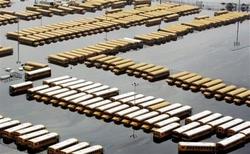
Better yet, why didn't she and Nagin make use of the buses as called for in the New Orleans Emergency Response Plan? Section III-B-V lists the tasks assigned to the various city government offices in the event of a hurricane catastrophe. The Mayor has three tasks: to initiate the evacuation, to retain overall control of the emergency operation, and then to authorize a return to the evacuated areas. The city's Office of Emergency Preparedness (OEP) reports to the mayor and must coordinate with the NOPD, the state OEP, and the regional transit authorities to:
* Supply transportation as needed in accordance with the current Standard Operating Procedures.
* Place special vehicles on alert to be utilized if needed.
* Position supervisors and dispatch evacuation buses.
* If warranted by scope of evacuation, implement additional service.
Instead, three days after landfall and a full day after the massive flooding, Blanco suddenly came to the conclusion that the buses might be useful. Unfortunately, now they sat under water, along with most of New Orleans and a few thousand of its residents. She got incensed by the lack of buses coming in from the outside -- but all of the eastern access roads to the city got destroyed in the hurricane, and the few left functioning on the west side were being used to bring in relief materials -- which she would deny to the people inside the city for days to come.
All of this has been known to bloggers for a week. I wrote about this on September 4th, and I was not the first (the link above takes you to Junkyard Blog's first report on the subject). The Houston Chronicle reported two days ago that "City officials had 550 municipal buses and hundreds of additional school buses at their disposal but made no plans to use them to get people out of New Orleans before the storm..."
So why can't the New York Times do some research at least equal to that of the Houston Chronicle, and perhaps even as well as the bloggers who have easily researched the New Orleans plan and its requirements? Instead, their report includes assertions such as these:
New Orleans had used $18 million in federal funding since 2002 to stage exercises, train for emergencies and build relay towers to improve emergency communications. After years of delay, a new $16 million command center was to be completed by 2007. There was talk of upgrading emergency power and water supplies at the Superdome, the city's emergency shelter of "last resort," as part of a new deal with the tenants, the New Orleans Saints.But the city's plan says that about 100,000 residents "do not have means of personal transportation" to evacuate, and there are few details on how they would be sheltered.
But it does say that the issuance of an evacuation order should prompt the mayor to get buses and other transportation assets into play to get those people out who cannot evacuate on their own. It clearly states that the mayor must position supervisors and dispatch evacuation buses. It's difficult to get any more clear than that. Those buses should have been rolling on Sunday, August 29th, with the initial evacuation order.
Why couldn't the Times reporters read that for themselves?
This anecdote and this report tells us all we need to know. It amply demonstrates the incompetence of the state and local authorities, who had no clue about their own emergency response plans in the days and hours before landfall. And it also demonstrates the incompetence of the Exempt Media in reporting the story that continues to this day. (h/t: Tom Maguire)
Shake Down The Thunder!
The Fighting Irish of Notre Dame have exploded out of the gate to start the 2005 season. First they trounced Pitt on the road 42-21, and today convincingly beat #3 Michigan, 17-10. The Irish never trailed against the highly-regarded Wolverines and led by two touchdowns until the final three minutes:
Charlie Weis' college coaching career is off to a big start.No. 20 Notre Dame stunned No. 3 Michigan on Saturday, making Weis 2-0 as a college coach. The former New England Patriots assistant outfoxed Dave Wannstedt's Pittsburgh Panthers last week and had the Irish well-prepared to face the rival Wolverines.
It was the first time since 1918 that a first-year Notre Dame coach opened with back-to-back road wins.
Brady Quinn ran a ball-control offense, completing 19 of 30 for 147 yards, or 4.7 yards per completion. He spread the wealth, connecting most often with running back Darius Walker, who also ran for over 100 yards, but five different receivers had multiple receptions. The defense stood tall against the Wolverine offense, holding them to only 335 yards and 15 first downs. They stuffed Michigan on third down, only allowing five of eighteen conversions, and they also grabbed an interception and a fumble.
The Irish have gone several years since anyone took them seriously. With Brady Quinn maturing at QB and the defense showing its usual imperviousness, we could have a very good chance at a BCS bid. Michigan State comes to South Bend next...
Egyptians Send No-Confidence Message To Mubarak
In its first multiparty elections, Egypt hoped to secure international legitimacy for the continued reign of Hosni Mubarak, who up to now had never had to campaign for office against any opposition. Mubarak earlier had abruptly ordered an amendment to the Constitution requiring that other parties have access to the ballot, a recognition that democratization in the region will prove ultimately triumphant. Mubarak hoped to ride that wave while working quietly to set the process up to guarantee the endorsement of the electorate.
It's safe to say that he failed in almost every respect. Not only did his banning of international observers make it clear to the world that he had no intention of running a clean and fair election, the remarkably low turnout has left Mubarak with no standing for a mandate at all:
Less than a fifth of the electorate voted for the incumbent Hosni Mubarak in Egypt's presidential poll, curtailing the veteran leader's legitimacy as he kicks off his last mandate.According to the official results of Egypt's first contested presidential election announced by the electoral commission on Friday, Mubarak mustered a whopping 88.5 percent of the vote.
But in the same way that his score exceded most expectations, the turnout rate of 23 percent was lower than predicted by many observers.
And that 23% is the official results of the election, as calculated by the Mubarak regime. Other independent observers operating outside of the reach of Mubarak's election commission put the turnout closer to 18%. That stunningly low turnout demonstrates the lack of confidence in the election and the electoral process under Mubarak. Given the restrictive nature of voter qualifications, it may wind up that less than 10% of the population of Egypt voted in this election.
That gives Mubarak the political support of ... 8.5%. It hardly provides the mandate Mubarak wanted to show to the world in legitimizing his last term of office. Instead, it will increase demands for a clean election, freedom of political speech, and access for international observers to ensure that the vote isn't rigged. As Leonid Kuchma and Viktor Yanukovych discovered in Ukraine, rigging elections can have worse repercussions than not holding them at all.
Egyptians rightly deduced that they could not vote Mubarak out of office. They did the next best thing: they humiliated him and made his office meaningless.
Flight 93 Memorial Intended To Offend
The Pittsburgh Post-Gazette continues its coverage of the Flight 93 memorial in today's edition by noting that a number of people have seen a connection to the Crescent of Embrace at the heart of the memorial and its obvious Islamic symbolism. Paula Reed Ward reports that "online bloggers" started the controversy, which those involved in the design called "disgusting and repellent" (via Michelle Malkin):
There's a growing outcry that one element of the newly chosen Flight 93 National Memorial represents Islam and is a slap in the face to the passengers and crew members who died on the hijacked plane four years ago.The winning design, announced Wednesday in Washington, D.C., includes what is called the "Crescent of Embrace." That element of the project calls for two rows of red maple trees to be planted around a bowl-shaped piece of land adjacent to the crash site. The trees, according to the architects, are there to create a physical edge to the landscape and accentuate the topography.
Almost immediately upon seeing the design, online bloggers suggested that it is inappropriate to use a red crescent in the memorial. ...
But the architects who created the winning design say their design has nothing to do with Islam.
"A crescent is part of architectural vocabulary. It's a generic form used in design," said Paul Murdoch, one of the winning architects. "We don't see any one group having ownership of it."
Murdoch believes it's unfortunate that the design is being interpreted that way.
"You can call it all kinds of things. We can call it an arc. We can call it a circle. We can call it the edge of the bowl. The label doesn't matter to us in terms of intent. We have no objection to calling it something else."
But as Ward reports, the advisory jury which selected the design asked the architects to do just that. They specifically wrote in their recommendation for this design that the name "Crescent of Embrace" be changed to "circle" or "arc" in order to avoid references to "specific religious iconography". That sounds as if the jury, which included victim family members, recognized the potential Islamic references at once.
Why didn't Murdoch heed that request? After all, it came from the victims' families, as the rebuttals have argued in specifying their support for the overall design. Instead, Murdoch kept that nomenclature, which argues that he probably intended for it to evoke that iconography for its controversial nature.
He gets support from Tom Solokowski, who sat on the jury and runs the Andy Warhol Museum. He calls the notion that an Islamic symbol at the memorial could offend people "delusional ... disgusting and repellent," even though his fellow jury members raised the exact same issue. Does that make them delusional as well?
Yesterday's post on this subject generated a heated debate on the nature of the memorial, with a few defenders pointing out the generic shape of the crescent and arguing that its inclusion in the design has no ill intent, and that therefore any objections to it relegate us to lunacy. In response (and I posted this as a comment in the thread), allow me to offer a proposal for a World War II memorial in Pearl Harbor, something new and modern that can be located near the USS Arizona, and see if everyone likes it. Perhaps it could even be a mosaic or a mural on the side of the Arizona Memorial, as an addition.
I think it should symbolize the re-emergence of the US in the Pacific after the devastating attack on our fleet at Pearl. It should represent the national effort to come out of the East to reclaim our position and to establish a beacon of freedom and prosperity.
A rising sun would perfectly symbolize that.
It should also represent how we used thatas a launching point to liberate the many islands in the East Pacific that suffered under the brutal Japanese occupation. Several sunrays could symbolize our efforts across the vast ocean to bring freedom to the oppressed in faraway lands.
And since our national colors are red, white, and blue, I would design it as a red sun on a field of white, emerging over a blue ocean. Now, you may not see much of the blue because of the sea line on the memorial, but the idea would be to have the sun rise above the sea line on the Arizona memorial anyway.
Wouldn't that be a great way to memorialize those who died in a heroic battle for their country?
Oh, wait -- the "wingnuts" are claiming that the Rising Sun looks almost exactly like the battleflag of imperial Japan, the very nation that attacked Pearl Harbor! How silly of the "wingnuts"! Why, the sun belongs to everyone! And it even appears on a state flag -- Arizona's!
Had someone trotted out this idea in 1946, they'd be lucky to ever find work in the US again. It's a measure of the intellectual erosion of the Left that this kind of thinking gets celebrated and defended today.
Gonzalez Charm Offensive Begins
It looks like the White House wants to push Attorney General Alberto Gonzales as the likely replacement for Sandra Day O'Connor on the Supreme Court. Today's Washington Post analysis clearly indicates that a significant effort has begun to support Gonzalez' credentials as a conservative despite the fears of the GOP base, which unexpectedly and firmly rejected Gonzalez:
Supporters of Attorney General Alberto R. Gonzales have launched a campaign to rebut criticism that he is not reliably conservative enough to serve on the Supreme Court, a move likely to intensify a rift within Republican circles over one of President Bush's closest confidants.The group of former Gonzales aides and other Republicans still in the Bush administration -- most of whom are close to top White House officials -- are coordinating with one another, sharpening common lines of argument, then circulating these points on Capitol Hill, in conservative circles and with reporters, according to several people involved. ...
Republican operatives close to the White House have long believed that President Bush would like to nominate Gonzales, not only because of their friendship but also because of the historic opportunity it would afford him to appoint the first Hispanic justice -- a potential major boost in his long-running campaign to build Republican support among the growing Hispanic population.
We all know the arguments for and against Gonzalez, and the Post mentions a couple of them in the article. He voted to uphold a teenager's access to abortion without parental notification while on the Texas Supreme Court, for one thing. Abortion opponents point to that vote and argue that he will prove too deferential to stare decisis on abortion law. However, the Post points out that the case did not rely on an interpretation of Roe v Wade but a specific state law passed by the Texas legislature providing judicial bypasses to parental notification.
In other words, a vote to deny her access under the state law would have been judicial activism, only from the right -- an overruling of duly enacted law by the legislature and signed by the executive. It does give one a sense of being hoist on one's own petard.
Gonzalez' approach to affirmative action will cause more problems for him with the base. He successfully argued for a moderate approach to limiting such programs rather than eliminating them altogether when preparing the administration response to the Supreme Court in the Michigan case. Unlike his vote on the Texas Supreme Court, his argument went to the politics of the case and the direction of administration policy. It also argued against the universal application of the Fourteenth Amendment by the Court, which should have sunk such programs at their launch, regardless of their value. It strongly indicates a less-than-convincing adherence to strict constructionism.
The political aspect of the effort to rehab Gonzalez for the conservative base is more interesting. Take a look at the roster of people coming out publicly for Gonzalez: John Cornyn, David Leitch, Brad Berenson, and more quietly others still attached to the White House, the Post says. John Cornyn will prove an especially daunting supporter, coming from Texas where he saw Gonzalez operating at much closer range than many of his critics. In fact, the people who seem determined to lead the public charm offensive worked closest with Gonzalez over the past couple of years.
On the other hand, the opposition to Gonzalez appears just as daunting. The highly respected William Kristol and others like him who help shape opinion and provide the intellectual foundation of modern conservatism remain firmly opposed. Kristol especially notes that Bush has a unique opportunity to shift the court to the right with the GOP holding both the White House and the Senate and potentially three or four openings in this term. Why risk the opportunity when other, better candidates exist?
Why indeed? I agree with Cornyn that the opposition to Gonzalez may have been, and may continue to be, somewhat hysterical. However, I would rather spend the limited opportunities Bush gets on appointees with known commitments to conservative approaches to Constitutional law -- jurists like Janice Rogers Brown, Edith Hollan Jones, Michael Luttig, Michael McConnell, and others in their mold. The Gonzalez boosters ask us to settle for someone who might pan out, but after the Souter experience, I'd prefer a bit more of a certainty.
Exempt Media Begins To Understand Federalism
The Washington Post has started to ask the same questions as Fox News and ABC did earlier this week in an analysis of the response to Hurricane Katrina. Robert Pierre reports in a piece titled in part, "Assessing Leadership", that Mayor Ray Nagin now faces many questions about his role in the fumbled disaster response -- and that his own underlings say that the answers will expose him as an incompetent:
Mayor C. Ray Nagin created many new friends and probably as many enemies for his decision to pointedly chastise both Louisiana Gov. Kathleen Babineaux Blanco (D) and the Bush administration for talking too much and working too little. Now, however, difficult questions are being directed at the mayor. ...Around the world, particularly in places where Bush is unpopular, Nagin is now recognized for refusing to back down against Bush. But with federal forces providing security in a largely vacant city and attention turning toward what it will take to rebuild, it is Nagin who is getting the tough questions.
Should there have been a better plan to evacuate those without cars? Was his police force up to the task? Why weren't there supplies for the legions of people directed to the Superdome? Why were all those city buses left in low-lying areas? Why did so many of his officers leave their posts as the city descended into a chaos that left many residents afraid that either thugs or the elements would kill them?
On conservative talk radio, especially, Nagin has been characterized as an irrational and incompetent local official who lost control of his city, his police force and, ultimately, his senses when he publicly dressed down the president. Even some of his underlings think the critics may be right.
"He should have evacuated the place earlier," said one city firefighter, echoing a mostly whispered sentiment here as the collection of dead bodies begins in earnest. The firefighter asked not to be identified for fear of retribution.
Unfortunately, the rest of this article lets Nagin off the hook. Pierre never bothers to mention that all of his questions could find answers in the New Orleans hurricane emergency plan -- a plan that Nagin didn't follow at all. Instead, Pierre focuses on the image of a poor city mayor who has tilted quixotically at the Great Windmill of the Bush administration, and that will suffer slings and arrows as a result:
Now his strong criticism of the Federal Emergency Management Agency and other agencies has earned him more than a few enemies, said Robert Hogan, an associate professor of political science at Louisiana State University in Baton Rouge. "In this crisis, some of his comments have done him a huge disservice," Hogan said. "Some of his comments come across as a crackpot. To me, he's just exasperated, but he may not be viewed that way in Washington." ...But Hogan said it would be unwise for any of them, especially Nagin, to keep the fight going.
"The Bush administration has the upper hand because they have the apparatus in place to come up with fingers to point," he said. "They have surrogates. They have a huge network that can help them through talk radio and national radio. They have talking points. State and local governments in Louisiana aren't in the propaganda mode. They don't have the ability to fight back. They are in the rescue and rebuilding mode."
They also have the truth on their side, which is that those in charge of the first responders -- the city and state governments -- failed to follow their own published plans for the emergency, and then failed to cooperate with the federal government when they did arrive. They essentially froze like deer in the headlights when they should have opened up the plans they drew up themselves and started running them like a playbook.
The federal relief, which coordinates with state and local officials based on the emergency planning done earlier, planned their response on the expectation that those tasks would have been handled prior to the storm hitting the city. Instead, what they saw was a city mayor who had done nothing but order an evacuation too late to be effective, fail to expedite it with resources specifically named in the plan, and then run around getting hysterical for the press. Pierre also neglects to mention that the feds cannot simply take over a city or a state without the governor's permission under current law unless they are in a state of rebellion.
Perhaps federalism might be too much for the Post to chew in one attempt, but at least they have begun asking the right questions.
September 9, 2005
Zimmerman Following In Herron's Footsteps? (Update!)
Dean Zimmerman took Brian Herron's spot on the Minneapolis City Council after the arrest and conviction of the latter on federal bribery charges. Now the Strib and the AP confirm that federal agents have their eyes on Zimmerman for the same kind of behavior, apparently having caught him in a sting operation assisted by an anonymous local developer:
A City Council member is being investigated for allegedly accepting bribes from a developer in exchange for help with zoning permits, according to court documents filed Friday.Councilman Dean Zimmermann, a Green Party member seeking his second term, is accused of accepting thousands of dollars from the developer, who was working in cooperation with the FBI.
One payment was to help with attorney fees owed by Zimmermann, according to the document. Other payments were for the councilman's re-election campaign, the document said. The exchanges between Zimmermann and the developer were recorded on audio- and video tapes.
Agents took computers, personal records and a campaign mailing from Zimmermann's home Thursday.
Herron took money from Basim Sabri, one of a family of colorful developers in the Twin Cities area that have heavily invested in the Minneapolis/St. Paul region, especially in Little Somalia. Sabri also got convicted in that case and currently serves his time at Fort Leavenworth. However, that didn't keep the feds from raiding his offices again on Wednesday.
The two actions might just be coincidental, but the timing, as I wrote, looks very strange. At first, I thought that perhaps Sabri's family might have helped the feds sting Zimmerman. After all, his brother Hamoudi is also a developer -- but then why raid Basim's office now, especially when Basim hasn't been there for several months? The feds say they're looking for evidence of forgery of a mysterious letter proclaiming his innocence that surfaced during the penalty phase of his trial, but again, what are the chances that two unrelated federal investigations would result in raids within 24 hours of each other, involving people who have longstanding connections in the community?
The property in question that was apparently used to sting Zimmerman is a condo development on Chicago Avenue. The primary owner of that property is the Chicago Commons Project, run by Gary Carlson. One of its investors associates, though, turns out to be ... Azzam Sabri, Basim's older brother, and his competitor in development, especially in the Somali community. (See update II below.) Both men built strip malls that compete with each other.
It's still pretty early to know what might be happening with this case. However, the Sabris have a history of bad blood between the brothers of the clan, although they have supposedly buried the hatchet a few years ago. Azzam could have helped the feds go after Zimmerman in the hope of reducuing Basim's sentence. He could just as easily have targeted Zimmerman to get even with Basim and Hamoudi.
All I know right now is that it will get interesting soon.
UPDATE: The source for Azzam's involvement in Chicago Commons is Council VP Robert Lilligren, whose ward includes that project:
Gary Carlson of Edina is listed as the CEO of the Chicago Commons Corp., which owns and is developing the site, according to public records. He didn't return a phone message left at his home Thursday evening.The site developer recently sought to bulk up the retail component of the project but was denied by the city's Planning Commission.
Lilligren said Azzam Sabri, a brother of imprisoned Lake Street developer Basim Sabri, has been somewhat involved in the project since the beginning. Azzam Sabri could not be reached Thursday evening for comment.
It's interesting that Lilligren would know this, but not all that suspicious. One would expect Lilligren to involve himself in the details of development in his ward and to promote it for jobs and expansion of the tax base. I find it more interesting that Lilligren wanted to point that out.
UPDATE II: Azzam worked for Chicago Commons as a consultant for a short time, according to one reader, but was never an investor. My apologies for the misunderstanding of Lilligren's quote.
UPDATE III: I poked around Google a bit, and found this interesting little factoid. Azzam Sabri spoke out in support of the Chicago Commons project in a public hearing of the city Planning Commission on June 21, 2004 (page 12). He doesn't disclose any relationship between himself and Chicago Commons, but it's not clear when Lilligren thinks Azzam got involved in the project.
Clueless Memorial Design, Take 2
The designers of the Flight 93 memorial at the impact site unveiled their effort yesterday. In what seems to be a typical case of cluelessness among memorial designers, the site will prominently feature the religious symbol of the attackers themselves (via Michelle Malkin):

Some might argue that the design's most prominent feature is a coincidence, but the title of it argues against that interpretation:
It will serve as a living tribute. With each wind, each breeze, a set of chimes housed in a 93-foot tower will create a different song in memory of the 40 people who sacrificed their lives trying to save the lives of others.Four years after United Airlines Flight 93 crashed into a reclaimed strip mine near Shanksville, Somerset County, on Sept. 11, 2001, the design that will serve as the national memorial was unveiled here yesterday in the U.S. Chamber of Commerce Hall of Flags.
"Crescent of Embrace" will feature a Tower of Voices, containing 40 wind chimes -- one for each passenger and crew member who died -- and two stands of red maple trees that will line a walkway caressing the natural bowl shape of the land. Forty separate groves of red and sugar maples will be planted behind the crescent, and a black slate wall will mark the edge of the crash site, where the remains of those who died now rest.
Quite frankly, we don't need a "Crescent of Embrace". We got enough of an embrace of the Crescent on 9/11. The maple trees and the wind chimes sound beautiful, but the crescent suggests that either the designers had no idea about the event they intended to memorialize, or that they want to turn this memorial into a multicultural scolding for America in the same way that the World Trade Center memorial designers attempted earlier.
Can you imagine the outcry from the multiculturalists and the ACLU had the design incorporated a cross or a Star of David in honor of the victims? Why should we tolerate the Crescent that, inadvertently or deliberately, honors the terrorists?
As long as that crescent remains in the design, I'm not donating a red cent to the memorial. I urge you to tell the National Parks Service and the Secretary of the Interior to rethink their plans.
Taiba Pogrom Part Of Long-Term Persecution
The pogrom at Taiba, where Islamists chased frightened Christians from their homes and burned buildings to the ground two days ago, came as part of a concerted effort by Muslim extremists to drive Christians out of the Holy Land, the Telegraph reports this morning. Christian leaders who expressed frustration over broken promises from Yasser Arafat now say that current Palestinian leader Mahmoud Abbas won't even return their calls:
Christians in the Holy Land have handed a dossier detailing incidents of violence and intimidation by Muslim extremists to Church leaders in Jerusalem, one of whom said it was time for Christians to "raise our voices" against the sectarian violence.The dossier includes 93 alleged incidents of abuse by an "Islamic fundamentalist mafia" against Palestinian Christians, who accused the Palestinian Authority of doing nothing to stop the attacks.
The dossier also includes a list of 140 cases of apparent land theft, in which Christians in the West Bank were allegedly forced off their land by gangs backed by corrupt judicial officials. ...
The alleged attacks on Christians have come despite repeated appeals to the Palestinian Authority to rein in Muslim gangs.
A spokesman for the Apostolic Delegate, the Pope's envoy to Jerusalem, said nothing had been done to tackle the problem. "The Apostolic Delegate presented a list of all the problems to Mr [Yasser] Arafat before he died," he said. "He promised a lot but he did very little."
In the offices of his tiny Christian television station in Bethlehem, Samir Qumsieh said this week that Christian appeals to Mr Arafat's successor as Palestinian President, Mahmoud Abbas, had also gone unheeded.
"At least Arafat responded," he said, "Abbas does not answer our letters."
Some scoffed at the notion that Taiba equated to a pogrom, but that is exactly what the pogroms of eastern Europe were meant to do -- move an ethnic/religious minority off of land desired by nationalists or religious triumphalists, or both in alliance with each other. The same appears true in the Palestinian areas of the West Bank. Islamist terrorist act with impunity against Christians while the Palestinian Authority does nothing to stop it, except issue meaningless appeals.
Why has this not received much coverage? The Christian community has to take part of the responsibility for that themselves. They kept quiet while trying to work through channels, hoping that Yasser Arafat would make good on his promises ... someday. They only gave up when his successor eschewed Arafat's hypocrisy, a rare occurrence in any case.
However, the global media also shoulders some of the load. They regularly report on all sorts of attacks in that area, and yet rarely report on those affecting the Christians. Why? Would a reminder that the Islamist goals of domination don't just apply to Jews and other Muslims? Perhaps the media do not want people to connect the dots between radical Islam and the Palestinian Authority, as that would create a demand to disavow Abbas and Fatah as realistic partners for peace.
The complicity of Abbas and his government in these attacks needs investigation and honest reporting. If Abbas takes a laissez-faire approach to ethnic cleansing or worse, then we will have propped up a Slobodan Milosevic in the making. Given Abu Mazen's rich past of terrorist activity, that passed from possibility to probability a long time ago.
The Syrian Safety Valve
The BBC reports that Syrian forces attacked Islamist militants in the northeastern part of its country, killing one and wounding a number of others, coming on the heels of an earlier battle which killed five Islamist terrorists. The area where the fighting took place appears near to where Iraqi and American forces complain of unfettered border-crossing of terrorists into Iraq, but that apparently did not play into Syria's calculations as much as self-preservation:
Syrian security forces have clashed with Islamist militants in Hasaka, north-eastern Syria, killing one and detaining two others, reports say. ...The incident came days after Syrian forces killed five alleged members of the militant group Jund al-Sham in a gun battle in the north-west.
The authorities accuse the group of planning bomb attacks in Damascus.
The group's activities have been monitored by security forces since it said it had carried out a bomb attack on the Egyptian Sinai resort of Taba in October last year which killed 34 people.
The group was also responsible for a suicide bombing on a theatre in Qatar in March which killed a British teacher, it said.
We need to deconstruct this timeline just a bit, as the Syrians seem to want credit for sitting on their hands. Jund al-Sham took credit for the Taba bombing in October, and again for the suicide bombing of a Qatar theater in March. That puts their last attack six months ago, hardly making this seem like a priority for the Syrians, although they will gladly accept the notion that this proves they intend on cooperating against Islamist aggression. The record more than suggests that Assad had willingly ignored Jund al-Sham while their aggression got directed elsewhere, against its enemies in the region -- only drawing the ire of Syria when its plans to attack Damascus got leaked.
Sorry, but that doesn't qualify as cooperation, but merely defense in the last extreme.
It does point out why Assad refuses to close the border between Iraq and Syria. He wants Jund al-Sham and others like them inside Syria to have easy access to Iraq. It keeps them from getting locked inside his own country, to plot against him and his not-so-firm grip on power. Iraq provides a safety valve for the Islamofascist terror impulse in that region, and if Iraqis and Americans get killed, so much the better. In fact, in Assad's view, each terrorist that doesn't survive to cross back into Syria represents a lessening of the security threat to his rule.
The only way to get Assad to close that border is to ensure that the cost of leaving it open far outweighs the benefits of keeping it open. The US needs to make plain that any further delay in providing border security will draw an appropriate and escalating response from the Americans and Iraqis in that region.
Democrats Use Katrina Criticism For Political Fundraising
Hurricane Katrina has apparently given Democrats, desperate for an electoral victory after three successive cycles of losses at the national level, a new definition of flood aid. The Democratic Senatorial Campaign Committee used an advertisement demanding the firing of the head of FEMA as an opportunity for people to donate to the DSCC in order to provide aid ... to Democratic politicians:
A new Democratic effort to whip up indignation about the Bush administration's handling of Hurricane Katrina also tried to raise money for Democratic candidates.Sen. Charles Schumer, a New York Democrat and the head of the Democratic Senatorial Campaign Committee, issued an appeal Thursday urging people to sign an online petition to fire the Federal Emergency Management Agency's director over his handling of the Katrina response.
After an inquiry from the Associated Press, the DSCC quickly pulled down the page and said they would give the Red Cross any money raised by the anti-FEMA petition.
I don't know why they bothered to take down the link. That provided the most honest presentation of their motivations over the past week to link hurricane-related deaths to George Bush. Their charges have run from the patently silly -- that Bush's "vacation" in neighboring Texas made him, in Nancy Pelosi's word, "oblivious" to the hurricane -- to literally ghoulish, as Randall Robinson started spreading an urban legend about African-Americans having to eat human corpses to stay alive, thanks to a lack of response to New Orleans.
The "vacation" charge has to carry the most irony anyway, coming from members of Congress, who take the entire month off every year and don't come back to work until after Labor Day. Regardless of where the President stays, he remains on the job, and if Congress isn't going to stay in session to send him legislation, modern technology allows him to do his job from almost anywhere. His communications with Governor Blanco show that he not only wasn't "oblivious" but in fact had personally engaged in the effort to get New Orleans evacuated and FEMA involved early in the process. He issued an order declaring the region a disaster area before the hurricane hit. Some oblivion Crawford turns out to be, especially given the Sheehan circus staged there last month! In fact, that myth is based on the perception that people outside of the urban centers remain ignorant and benighted, a laughable assertion in this era of instant communications.
Someone's oblivious, but it's not George Bush. It's the Democrats looking to score a few bucks off Hurricane Katrina and rake in some of the funds that Americans would rather send to its victims.
Able Danger Foxtrot IV: Weldon's Timeline
UPI continued its reporting on Able Danger and the response to it by the Pentagon in a wire report that saw little media replay. Stratasphere and Just One Minute must have their antennae finely tuned to have discovered this at M&C, and while the report does not do much to move the story forward, it provides a couple of interesting details.
First, Rep. Curt Weldon wants to know why the Pentagon destroyed the material relating to Able Danger. Up to last week, we had not determined with any certainty than the material no longer exists but that the Pentagon couldn't find it. The Pentagon finally acknowledged that it had shredded the data as part of a normal process used for classified material that had no further use, but Weldon says he doesn't buy that:
The congressman who first made public claims that a secret Pentagon data mining project linked the Sept. 11 attacks ringleader to al-Qaida more than a year before the attacks took place says he does not believe the military`s account of how the results of the project`s work came to be destroyed.'I seriously have my doubts that it was routine,' Rep. Curt Weldon, R-Penn., told United Press International.
Last week, Pentagon officials told a hastily arranged briefing for reporters that much data generated by the project -- code-named Able Danger -- was destroyed in accordance with standard operating procedure for handling material that might contain the names of Americans.
Weldon said he had asked the Pentagon for the certificates of destruction that military officials must complete when classified data is destroyed.
He said that there had been 'a second elimination of data in 2003,' in addition to the destruction acknowledged last week.
Weldon said that a hearing next week before the Senate Judiciary Committee would hear testimony from the individual who destroyed the data.
'For some reason, the bureaucracy in the Pentagon -- I mean the civilian bureaucracy -- didn`t want this to get out,' he said.
It sounds strange to me that the Pentagon insisted on destroying any data that could help track al-Qaeda cells in the aftermath of 9/11. Typically the data that gets destroyed has lost any value at all to the military or national-security system, but contains or would reveal methodologies that cannot get exposed if declassified. The latter may have been a consideration in deciding to destroy the material, but clearly the information still had an application for intelligence operations work. The Patriot Act made it much easier to coordinate with law-enforcement agencies in order to put this information to good use. So why destroy it?
Also, Col. Tony Shaffer in his GSN interview makes it clear that he had a set of the documentation in his possession as late as February 2004, when the Army accused him of misappropriation over $67 in cellphone charges and temporarily suspended his clearance. By the time he regained his clearance more than a month later, the material had gone missing. That came after his meeting with Zelikow and the Commission, not before.
In another part of the UPI report, Shaffer tells the reporter about his meeting with the Commission staffers in October 2003, and insists that he mentioned Mohammed Atta by name. An anonymous staffer disputes this:
A three-page statement from the commission`s successor body, the 9-11 Public Discourse Project, says that a memorandum for the file prepared at the time by the staff 'does not record any mention of Mohamed Atta or any of the other future hijackers, or any suggestion that their identities were known to anyone at (the Department of Defense) before Sept. 11.'Former commission staffers -- who asked for anonymity citing the sensitive nature of the subject matter or the rules imposed by current employers -- said it was inconceivable that any member of the staff at the Bagram meeting would have heard Atta`s name, or the names of any other hijackers, and not remembered it.
'That was exactly what we were looking for!' said one.
'I told them that we, Able Danger, had identified two of the three cells that carried out the Sept. 11 attacks,' Shaffer said. 'At the end (of the presentation) I mentioned Atta.'
Shaffer says he 'sort of dropped (the name) in' at the end of the meeting, and his account of the difference in recollections is conciliatory, 'If they want to say they didn`t hear it, fair enough. But I know what I said. I said we had two of the three cells.'
Shaffer too has a contemporaneous note of the meeting -- talking points he says he prepared for his presentation, and which he has provided to several committees on Capitol Hill.
He declined to provide UPI with a copy, but he did say that Atta was not named in them.
Tom Maguire says that this response from Shaffer constitutes a climb-down for Shaffer, but I disagree. Shaffer never claimed that his talking points had the name 'Atta' in them, only that he told them the name. In the GSN interview, he said it made quite an impact, while here after the UPI reporter apparently confronted him with the quote from the anonymous staffer -- who the UPI report doesn't clearly indicate even attended the meeting in question -- Shaffer replies that maybe they just didn't hear him, but he knows what he said. That sounds more to me like someone who gets very careful about calling people liars in public than a climb-down.
And perhaps the UPI could get more specific about this anonymous staffer and whether that person attended the meeting in Afghanistan at all. So far, three people attached to the Able Danger project have come forward publicly, two at the risk of ruining their military careers, to tell their story. The Pentagon has found three other sources that corroborate Shaffer, Captain Scott Phillpott, and civilian contractor J. D. Smith. The 9/11 Commission and the names of its staffers are a matter of public record. At this stage, why would they hide behind anonymity?
September 8, 2005
Feds Finding Something Amiss In Minneapolis?
Federal authorities appear to be conducting two different investigations into Twin Cities politics, as they launched raids at a city councilman's home and the offices of a key player in an earlier bribery scandal. However, an alert CQ reader whose name I will withhold for the moment found a connection between the two which may indicate that the FBI has uncovered something larger than a repeat of the Brian Herron case. Local ABC affiliate KSTP has a terse statement:
[Dean] Zimmermann is a member of the Green party and a first-term council member. He wasn't available for comment, but his campaign manager, Lauren Maker, said the agents spent three hours at Zimmermann's home.Maker said the agents told her the affidavit attached to the search warrant was sealed, so she couldn't explain the purpose of the search.
Because of redistricting, Zimmermann is in the same ward as council vice president Robert Lilligren, who is a D-F-L'er. Maker called the search politically motivated because it came five days before the primary election.
On the same day, the FBI also conducted a raid at the offices of Basim Sabri, who now makes his home at Leavenworth federal prison for his role in the bribery of former Minneapolis city councilman Brian Herron in 2004. The Minneapolis Star Tribune carried the story earlier:
While Minneapolis developer Basim Sabri was in the federal prison camp at Fort Leavenworth, Kan., Wednesday, federal agents searched his Lake Street office for evidence of more crimes.The search warrant affidavit said the FBI has probable cause to believe that he and Hanan Sabri, both his secretary and a cousin, engaged "in a scheme to submit a false and fraudulent letter, supposedly from a government witness," to U.S. District Judge Richard Kyle while awaiting sentencing on a bribery conviction.
On Dec. 6, 2004, Basim Sabri was convicted of bribing former Minneapolis City Council Member Brian Herron after a trial over which Kyle presided. In May, Kyle sentenced Basim Sabri to two years and nine months in prison and a $75,000 fine.
On Dec. 22, 2004, an unsigned computer-generated letter arrived at Kyle's office with Herron's name typed at the bottom and no return address, the affidavit said. The letter claimed that Basim Sabri was innocent and "framed by the FBI."
Coincidence? Perhaps. After all, the purpose of the latter raid appears to involve forgery and false testimony. However, the fact that Zimmerman replaced Herron after his arrest and conviction for bribery seems odd, and the Sabris have connections to this councilman as well. Minneapolis Confidential has a Strib story from April of this year involving a third Sabri, Hamoudi, Basim's brother and Hanan's cousin:
Zimmermann Gets Big Money Help From SabriCentral Minneapolis developer Hamoudi Sabri is willing to pay whatever it takes -- possibly $1 million -- to help elect a new City Council.
In Sunday's Star Tribune, he placed an unusual classified ad seeking a "public relations professional/political organizer." The ad read: "Money no object for best candidate. Start immediately. Design media and community campaign re: City of Mpls wards 9,6 & 8 elections..."
In an interview Wednesday, Sabri said, "I'll spend a million dollars. Whatever it takes to do legally." Asked whether he truly has that kind of money to spend, he said, "Of course I do." ...
During an interview, Sabri mentioned several times his property at Cedar Avenue and E. Lake Street. Schiff noted that the Planning Commission, on which he sits, recently unanimously rejected Sabri's proposal for a shopping center.
During a conversation, Sabri mentioned many times the legal troubles that his brother, Basim Sabri, has had. Basim Sabri awaits sentencing for his December federal conviction on three counts of bribery for his dealings with former City Council Member Brian Herron.
MinnConfidential also noted the Sabri connection to Zimmerman in November 2004, in a Strib article that intimated the Sabris had bribed someone else in government to assist in their development efforts. Nothing ever came of that rumor. Perhaps the FBI wants to know why. Having two raids in less than 24 hours sounds less like coincidence and more like a coordinated FBI operation. We will soon know why ...
Salvation Army Confirms Louisiana Gov't Kept Them Out Of New Orleans
Hugh Hewitt and Duane "Generalissimo" Patterson follow up with Fox's Major Garrett this evening on Garrett's blockbuster report last night that the Louisiana DHS ordered the Red Cross not to enter New Orleans. Tonight the story expands, as Garrett now reports that the Salvation Army confirmed that the state officials kept them away from the victims as well:
HH: And what did the Salvation Army tell you?MG: The Salvation Army basically said look. We...first of all, both agencies also want to let people know that they've served the needs of thousands of people who got out, and who got out just a little bit to high ground, north of New Orleans. But they couldn't get in to meet those needs. They asked to get in. They were prepared with their...the Salvation Army has these ever-familiar portable kitchen canteens, is what they call them. They can actually make food, produce food on spot, and distribute it there. People line up. We've seen that at hurricanes and other natural disasters. They were ready. Not allowed in. At first, it was this idea that we don't want to create a magnet at the evacuation site. Secondarily, it became an issue of well, there's lots of water, and we can't assure your safety, so on and so forth. Here's another key point, Hugh. I was very specific with the American Red Cross, president and CEO Marty Evans, and said wait. Tell me clearly. Were you prepared to go in before the levees broke? Before water became an issue of any kind? She said absolutely. Were you denied access before the levees broke? She said we were denied access from minute one.
HH: And did they attempt to renew their request to get in after the levees broke, Major Garrett?
MG: Yes. I am told that the timeline indicates a frequent reasking of this question.
HH: And a frequent denial by Louisiana state Department of Homeland Security?
MG: Right. Because as we discussed last night, their system was this is the shelter of last resort. It is an evacuation site, not a services site. And today, in Louisiana, the Louisiana National Guard said look. Here we were. We had four hundred Louisiana National Guard soldiers at the Superdome. Let's do the math here, Hugh. Four hundred National Guard soldiers coping with thirty thousand evacuees.
HH: Right. Right.
MG: And they said, look. The Mayor told all these people to bring three days worth of food and water. Well, not very many people did. So the National Guard did bring in, on its own, palettes of food, water and things. But clearly, it wasn't enough. Clearly, they were overwhelmed. The numbers were staggering. In the end, it was up to 60,000 people that the National Guard had to supervise, or at least try to supervise at these two places, and eventually move out with the buses. Where did the buses come from? They came from FEMA. 1,100 of them were produced in 72 hours, even though as we all saw, buses were under water all over the city, never used.
Garrett also got the interview with Marty Evans on camera, which Fox has apparently broadcast. Now we have both major aid groups going on the record to state that the feds had them both ready to render aid before the flooding occurred -- and that the state officials would not allow them access to the victims. The combined assets of the Red Cross and the Salvation Army could have assisted the Superdome and the Convention Center easily, as well as most if not all of other shelters within the city.
The suffering and deprivations that caused the revulsion of the nation did not result from a lack of response from FEMA. While FEMA may have struck a few discordant notes, especially its tone-deaf chief Michael Brown, the truth is that they prestaged most of the necessary materials for the relief of New Orleans, counting on the city to follow its own emergency operations plans. When that failed, the key NGOs FEMA uses tried on several occasions to get the aid to the victims, only to have all their efforts blocked by Louisiana. The city failed to provide transportation to those who lacked it for the mandatory evacuation, and the state refused to allow the aid workers to go to the centers where the state and city urged the victims to congregate.
No amount of spin will overcome the heads of the Red Cross and the Salvation Army telling this story.
Dafydd: On the Lighter (Ectoplasmic) Side...
If you want to take a break from the grim news out of the Southeast, try this one from Orlando, Florida: a husband-and-wife pair of restauranteurs, Christopher and Yoko Chung, are trying to break their lease to move into a renovated building because, they claim, the building is "haunted."
Landlord Sues Restaurateurs Over Ghosts AP wire Sep 8, 1:54 PM (ET)Subcontractors who worked there and other people have reported seeing ghosts or other apparitions, said Lynn Franklin, attorney for the restaurant owners.
"It's very serious," Franklin said Thursday. "A lot of people are corroborating having seen incidents in this location."
Would this be shortly after a trip to Walt Disney World's Haunted Mansion? Perhaps the ghost followed them home!
"I asked them if these were good ghosts or bad ghosts, and if they were good ghosts why it was a problem," said David Simmons, an attorney representing the building's owners, who include boy band promoter Lou Pearlman. Simmons is also a member of the state House.
The story does not inform us of the answer to this burning question.
These two idiots are now being sued for $2.6 million... so now they plan to go to court and try to get a judicial imprimateur on the haunting.
The lawsuit also asks a judge to decide whether the building is haunted and, if so, whether the ghosts would interfere with the restaurant's business. Renovations have stopped on the building, and it remains empty. [ectoplasmic italics added]
Say... maybe the ghosts could provide the entertainment! How are fixed for Mariah Carey songs? She's floating pretty high right now.
The name "Chung" sounds either Chinese or Korean to me; but "Yoko" is clearly a Japanese name. Since I don't know anything about Chinese or Korean ghost beliefs, I'll just stick to Japanese from now on. Commenters who know about the similarities and differences between Japanese and other Asian ghost mythology are urged to share their knowledge!
My Japanese wife Sachi tells me that in Japan, whenever a company builds a plant over, say, an old well, a Shinto priest has to be brought in to exorcise the spirits of the well... otherwise, half the employees will refuse to work there, terrified that spirits will haunt the place; but these spirits are different from ghosts... they're more like pantheistic spirit-gods: the god of the well, the god of the river, the god of that tree over there, etc.
To my (thoroughly secular but not atheist) mind, this is very different from a simple benediction: I have never heard of someone over here declining a job offer because a priest did not bless the cornerstone of the corporate headquarters; nor do Christians or Jews as a rule believe that without such a benediction, ghostly apparitions will stalk the premises. For all that there is a substantial minority of Christians constantly seeing Mary's visage on a tortilla, it is still a tiny subset.
But among Asians, belief in the reality (and malevolence) of "ghost" ghosts is much stronger, I suspect. Japanese ghosts (as in spirits of the dearly departed, not the god of the well) seem nearly always to be either lovesick girls who died of passion or quite deadly women who want to take revenge on their murderers or their murders' descendants (most Japanese ghosts are female); you wouldn't typically find a comic-book character like Yoshi the Friendly Ghost. Curiously, Japanese ghosts are not usually tied to a place, like a haunted house; they more often haunt an individual because of some relationship they had... so at the very least, the Chungs' ghost (if Japanese style) seems to be a bit unorthodox (was the building perhaps built over a well?)
According to a Cult Movies article that Sachi wrote, part of her series Everything But the Lizards on Japanese supernatural movies, 19th-century Kabuki plays forever fixed the image of a ghost in Japanese minds:
The typical images and feelings associated with ghosts were developed in the Kabuki plays of this era and continue in movies today. The tumbling of drums and a high pitched bamboo flute were often used as the sound effects for the ghost’s entrance. She is generally depicted as a floating figure with a long, loose kimono, messy and almost wet-looking, long, black hair covering half of a pale face, and her hands dangling limply in front of her chest. These images all come from Kabuki. They are so strongly ingrained in our minds, we cannot disassociate them from ghosts; if we see them on stage or on the screen, we immediately feel a thrill of terror.
(Note how the image of the ghost in the contemporary ghost movie The Ring, remade from a Japanese movie, is clearly derived from this depiction.)
I anticipate getting a lot of very hostile comments on this, but what the heck; I've got my patented Sean Penn Flak Jacket®; I'm ready. People, there are no ghosts. As to whether there is a Holy Ghost, I haven't a firm opinion either way; but it's pretty clear that the worldwide population of ghostly manifestations, ectoplasmic entities, walking remnants of the dead, white-sheeted forms floating about and going "boo!" is approximately zero. Yes, I've seen those photographs. They're kith and kin to photos of UFOs and the Loch Ness monster (and perhaps even grainier).
Humans have an extraordinary capacity to anthropomorphize their fears and anxieties (about, for an example, opening a new business or moving your business to a more expensive, newly renovated building): if they're afraid to do X or go to Y, they can fantasize a ghost or witch or curse to circumvent having to make that scary decision.
But when a person's anxieties land him as a defendant in a multi-million dollar lawsuit, I think it's time to overcome, not succumb.
Maybe they can lay those restless spirits to sleep with one of these.
Girding For Battle
Be sure to read John Hinderaker's excellent column in today's Daily Standard, "Preparing for World War III". When John and I debated the various possibilities for Bush to consider for Chief Justice, neither one of us contemplated the elevation of Roberts to the position. John notes that this changes the dynamic considerably, improving Roberts' confirmation chances to a near-lock while deferring a very ugly battle to the next nominee:
Substituting Roberts for O'Connor would have been a significant upgrade, from a conservative point of view. Replacing Rehnquist with Roberts, on the other hand, is good to the extent that it likely represents another 30 years of conservative service on the court, but it will not effect a short-term change in the balance of power. In that sense, the key appointment has always been O'Connor's successor. And for that appointment, Roberts had turned out to be an inspired choice. The Senate Democrats and their supporters badly wanted to block the rightward shift that would be implicit in the replacement of O'Connor with a conservative. But Roberts proved to be an immensely circumspect figure. In 50 years, he seems to have said or done almost nothing controversial, while nevertheless establishing his reputation as a solid conservative. In personal, professional, and ideological terms, Roberts appears bullet-proof, and Democrats had more or less resigned themselves to being unable to block his succession to O'Connor's prized "swing" seat.Now, the Democrats have been granted a reprieve. They can let Roberts go through with only token opposition, knowing that the philosophical composition of the Court will not change significantly, and concentrate their fire on Bush's second nominee, who will fill the critical seat being vacated by Justice O'Connor. One question, from a conservative point of view, will be whether President Bush can find another nominee who is both as solidly conservative and as non-controversial as John Roberts. Unfortunately, it is not obvious that he can.
As I noted earlier, that calculation has already occurred in the media, which has significantly toned down its rhetoric on Roberts over the past few days. I suspect John has it correct and that Roberts will quickly get a pass, while the Democrats sharpen their knives for the conservative that will officially follow O'Connor's departure.
London Times: Annan Not Fit For UN Leadership
In a scathing editorial after the Volcker Report gained wide dissemination yesterday, the London Times tells its readers that the United Nations would do better under different leadership. Meanwhile, the London Telegraph reports that the current leadership defiantly vows to stay at Turtle Bay:
THE United Nations would be better off without Kofi Annan.That seems an inevitable conclusion from reading the latest, most comprehensive report and most damning report into the corruption of the oil-for-food programme.
The report, by Paul Volcker, the former Chairman of the Federal Reserve, undermines the Secretary-General’s claim to either diplomatic or administrative competence. Before next week’s highly charged summit in New York, the UN’s 60th anniversary, it greatly weakens his position. ...
The report says that Annan’s sins were those of omission not commission. It finds no “smoking gun”. ... But the omissions were enormous, allowing Saddam Hussein to manipulate the programme to try to buy influence, including influence with senior UN officials.
Even by the mild standards of the Volcker inquiry, the report does what the UN can't or won't do with Annan: hold him responsible for his poor performance and the widespread corruption that he has allowed to flourish. The corruption, in this case, reached up to top Annan aides like Benon Sevan and Alexander Yakovlev, but the General Assembly has not lifted a finger to either pressure Annan to resign, or to fire him for mismanagement, at the least.
Of course, it's not clear that the General Assembly could terminate Annan even if so inclined. Annan has the good fortune of leading a corrupt organization that comprises a large number of thoroughly corrupt dictatorships and kleptocracies. None of these appear eager to dispense with one so familiar and comfortable with their own methods of applying power. Annan sees this rather clearly, which is why he informed everyone that he would not soon leave the lucrative confines of Turtle Bay:
Kofi Annan faced savage criticism yesterday but vowed to stay in charge of the United Nations.Mr Annan said that he took responsibility for the "deeply embarrassing" failings outlined in an independent inquiry into the UN's oil-for-food programme in Iraq.
The report, overseen by the former US federal reserve chairman, Paul Volcker, revealed serious shortcomings in its work, Mr Annan admitted. But he suggested that he could not be held personally responsible. ...
Mr Volcker argued that the secretary general had much to answer for.
"His behaviour is certainly not exonerated. There is a litany of deficiencies," he said, adding that the UN was guilty of both maladministration and corruption.
After that kind of report, an honorable man would have offered his resignation to the General Assembly and allowed them to at least consider holding him responsible for the sorry state of the organization. However, honor proves to be an elusive quality at the United Nations, whose staffers in refugee centers routinely exploit the victims under their care for sexual gratification and whose "peacekeepers" generally run at the first sign of violence. All of this, as well as the financial corruption and the propping up of genocidal tyrants, shows the lack of any honor at all in current UN management and in its mass membership.
If Annan does not step down after the Volcker report, perhaps an indictment from the American investigation might do it. My guess is that Annan will continue to demonstrate the lack of accountability and the nonexistence of checks and balances on power at Turtle Bay by his continued and defiant presence there.
Sunnis Join The Political Process
After getting burned by a badly-advised boycott of the first free elections in Iraq for decades, the Sunnis have apparently decided not to repeat their mistake from last January. The Washington Post reports that Sunni voter registration has skyrocketed in Iraq, as the nation debates the current proposition for its new, permanent constitution:
Voter registration soared in some Sunni Arab parts of Iraq as Sunnis mobilized to try to vote down a draft constitution they believe will divide the country, according to figures released Wednesday at the close of registration for the Oct. 15 referendum. ...The surge in voter registration in the heavily Sunni west signaled the minority's belated entry into the country's political process. Most Sunnis stood on the sidelines of the Jan. 30 national elections that seated the transitional government, which was charged with drafting the constitution. As a result, Sunnis were left with diminished political leverage in negotiations over the document.
This time, "we registered to defeat the constitution," said Khalid Jubouri, a guard at a government ministry in Fallujah, a city in the volatile western province of Anbar. "This is considered fighting by word and thought. We are optimistic about the battle, and we will win it eventually."
Registration in Anbar swelled from a tiny percentage of eligible adults in January to nearly 85 percent, said Muhammed Ibrahim, the director of voter registration centers in the province.
Ibrahim said about 600,000 of the province's 715,000 eligible adults registered, despite pledges from al Qaeda in Iraq, an insurgent group led by Abu Musab Zarqawi, a Jordanian, that anyone who took part in the voting would become a target for killing.
The new surge in registrations deals a bigger defeat to the Zarqawi terror network, which has repeatedly warned of their intent to target anyone who participates in democracy. For a while, the Sunnis heeded that threat while believing that the rest of the Iraqis would once again bend to the Sunni will through the childish electoral equivalent of holding its collective breath until they turned blue. The draft constitution produced by the Assembly created from their intransigence has finally shown the Sunnis the error of judgment made by their deloberate underrepresentation.
This marks an important development in the life of the Iraqi democracy. Instead of gathering guns to fight against this proposal, the Sunnis had begun gathering voter registrations. They have opted to participate in the new Iraq and use the ballot box instead of bombs and bullets to influence the direction of their nation. The former privileged class under Saddam Hussein has acknowledged the legitimacy of the other populations of Iraqis in contributing to the governing of their country -- a tremendous political step, and one that further isolates Zarqawi. More and more, he represents no one but himself and his mercenaries from outside Iraq.
With the news focused on Hurrican Katrina, one can understand why this news might not make the front page. However, the Post's placement of this on page A24 calls into question whether the editors have bothered to read the article and understand its implications for the war on terror.
Roberts Too Successful For Post
Richard Cohen at the Washington Post writes a column that should embarrass him to have under his byline at some later date. He tries in a weak way to argue against the confirmation of Roberts by pointing out his many successes -- and then wishes that Bush had nominated someone with a demonstrated track record of incompetence instead. It takes failure, in Cohen's estimation, to really know the people:
I sometimes think the best thing that ever happened to me was, at the time, the worst: I flunked out of college. I did so for the usual reasons -- painfully bored with school and distracted by life itself -- and so I went to work for an insurance company while I plowed ahead at night school. From there I went into the Army, emerging with a storehouse of anecdotes. In retrospect, I learned more by failing than I ever would have by succeeding. I wish that John Roberts had a touch of my incompetence.Instead, the nominee for chief justice of the United States punched every career ticket right on schedule. He was raised in affluence, educated in private schools, dispatched to Harvard and then to Harvard Law School. He clerked for a U.S. appellate judge (the storied Henry J. Friendly) and later for William H. Rehnquist, then an associate justice. Roberts worked in the Justice Department and then in the White House until moving on to Hogan & Hartson, one of Washington's most prestigious law firms; then he was principal deputy solicitor general, before moving to the bench, where he has served for only two years. His record is appallingly free of failure.
Which would present a more qualified candidate for the highest position in the judiciary -- a college dropout or someone who graduated from both Harvard and Harvard Law School with flying colors? As a college dropout myself, with much the same experience as Cohen (except for the military service), I can say unequivocally that I prefer someone with a track record of success. Unlike Cohen, the lesson I learned by dropping out was that it was a stupid thing to do, and I don't think that lesson broadened my perspective on humanity. As for cute anecdotes about military service I can say nothing, but if Cohen wanted to sit down with Roberts for a friendly conversation, I'm sure Roberts has his share of those as well, especially from his days in the Reagan administration.
Cohen tosses in, almost off-handedly, that Roberts lacks political experience, having spent his life arguing law and -- I'm not kidding -- having holidays off. Cohen wants someone, he says, who "worked the beach on Labor Day." Five years ago, the Left screamed about the Court mixing politics into its positions in Bush v. Gore. Now suddenly, having a politician sit on the court is not only okay with Cohen but downright desirable. If it turns out that Roberts had worked the beach on Labor Day stumping on behalf of the GOP, would Cohen find Roberts more or less attractive?
Finally, Cohen deduces that Roberts only thinks of the poor in theoretical terms and then tries to tie Roberts to a glib remark by Barbara Bush, of all people, in what has to be the biggest stretch yet of the Roberts debate:
Failure has its uses. Among other things, it can teach us about the human condition. It took a certain kind of cold arrogance to come up with the evacuation plan that New Orleans devised: Get everyone out of town. But what about those who could not get out of town? What about those with no cars or those already living on the streets? In other words, what about the very poor?The poor? It's as if the idiots up and down the line never heard of them. It's as if no one at the top of the Federal Emergency Management Agency or at the White House knew they existed. Check that. They knew, but it was theoretical: Oh, they'll manage. The thinking was summed up in the sorry remark of Barbara Bush while she was visiting flood evacuees at a Houston relocation site. Since the refugees sent to Houston were poor to start with, she said, "this is working very well for them."
In fact, the person responsible for the response plan for New Orleans and its implementation didn't come from an out-of-touch, wealthy neighborhood but from a poor section of New Orleans. Ray Nagin has built a reputation as a man of the people, one who knows and understands their plight. Yet when he ordered the evacuation of New Orleans, he not only failed to execute his own response plan, but he never bothered to gather any resources at all to get the poor out of town. Neither, for that matter, did Governor Kathleen Blanco, who once taught high school. In fact, she and Nagin still continue to block aid from entering New Orleans for the people who have been left behind. Apparently, modest backgrounds don't guarantee compassion despite what Cohen argues.
It seems that politics and populism doesn't guarantee anyone the compassion that Cohen believes Roberts lacks, with absolutely no evidence to back up his claim. Cohen simply and desperately wants to find something to stop Roberts from his confirmation that he finally wants to claim that Bush's standards are too high. And at the end, Cohen won't even take responsibility for this argument by demanding that Roberts get defeated for his perfection in favor of someone who has a demonstrated record of incompetence. It's hard to discern any point at all in Cohen's rambling incoherence, other than to waste space by damning Roberts with high praise.
At least we know that Cohen would support Ray Nagin and Kathleen Blanco for the Supreme Court. They've certainly demonstrated the incompetence he so desires.
UPDATE: John Podhoretz feels this is an award-winning column in a great snark-shot at The Corner.
September 7, 2005
New Orleans And Louisiana Blocking Aid To Refugees In City
Hugh Hewitt had Fox News reporter Major Garrett on his show tonight (transcript at Radioblogger) to explain his breaking story that Governor Kathleen Blanco and Mayor Ray Nagin have blocked aid from reaching the victims of Hurricane Katrina and the flooding that buried New Orleans. Blanco and Nagin apparently did not want to encourage people to stay in New Orleans, even though neither one did anything to assist them to leave during the mandatory evacuation:
HH: You just broke a pretty big story. I was watching up on the corner television in my studio, and it's headlined that the Red Cross was blocked from delivering supplies to the Superdome, Major Garrett. Tell us what you found out.MG: Well, the Red Cross, Hugh, had pre-positioned a literal vanguard of trucks with water, food, blankets and hygiene items. They're not really big into medical response items, but those are the three biggies that we saw people at the New Orleans Superdom, and the convention center, needing most accutely. And all of us in America, I think, reasonably asked ourselves, geez. You know, I watch hurricanes all the time. And I see correspondents standing among rubble and refugees and evacuaees. But I always either see that Red Cross or Salvation Army truck nearby. Why don't I see that?
HH: And the answer is?
MG: The answer is the Louisiana Department of Homeland Security, that is the state agency responsible for that state's homeland security, told the Red Cross explicitly, you cannot come.
HH: Now Major Garrett, on what day did they block the delivery? Do you know specifically?
MG: I am told by the Red Cross, immediately after the storm passed.
HH: Okay, so that would be on Monday afternoon.
MG: That would have been Monday or Tuesday. The exact time, the hour, I don't have. But clearly, they had an evacuee situation at the Superdome, and of course, people gravitated to the convention center on an ad hoc basis. They sort of invented that as another place to go, because they couldn't stand the conditions at the Superdome. ...
HH: I also have to conclude from what you're telling me, Major Garrett, is that had they been allowed to deliver when they wanted to deliver, which is at least a little bit prior to the levee, or at least prior to the waters rising, the supplies would have been pre-positioned, and the relief...you know, the people in the Superdome, and possibly at the convention center, I want to come back to that, would have been spared the worst of their misery.
MG: They would have been spared the lack of food, water and hygiene. I don't think there's any doubt that they would not have been spared the indignity of having nor workable bathrooms in short order.
The Red Cross confirms this on their own web site. Their FAQ makes clear that they will not move forward with their assistance without approval from the authorities in charge. Note, too, that the Red Cross recognizes that the people in charge of the New Orleans disaster area are state and local officials, not the feds (emphases mine):
Hurricane Katrina: Why is the Red Cross not in New Orleans?* Acess [sic] to New Orleans is controlled by the National Guard and local authorities and while we are in constant contact with them, we simply cannot enter New Orleans against their orders.
* The state Homeland Security Department had requested--and continues to request--that the American Red Cross not come back into New Orleans following the hurricane. Our presence would keep people from evacuating and encourage others to come into the city. ...
* The Red Cross shares the nation’s anguish over the worsening situation inside the city. We will continue to work under the direction of the military, state and local authorities and to focus all our efforts on our lifesaving mission of feeding and sheltering.
* The Red Cross does not conduct search and rescue operations. We are an organization of civilian volunteers and cannot get relief aid into any location until the local authorities say it is safe and provide us with security and access.
It's worth noting that the Red Cross agrees with the decision to make the Superdome available to those residents seeking refuge from the storm, an endorsement of Nagin's decision to open the arena. However, to open the Dome and then refuse to allow the Red Cross to stock it with the supplies necessary to keep the people inside healthy makes no sense whatsoever.
It's also worth noting that the Red Cross gets more access to the detainees at Guantanamo Bay than the people still stuck inside New Orleans.
Once again, we have more evidence that the problems in getting relief to Louisianans stuck inside the New Orleans basin directly relate to decisions made at the state and local level, not federal -- and that the people in charge of the overall effort have been and continue to be Mayor Nagin and Governor Blanco. The meme blaming Bush for Hurricane Katrina continues to fall apart, even without wide coverage of the facts by the Exempt Media.
UPDATE: Video at Ian Schwartz's blog.
UPDATE II: Let's see if we can't paint the picture for Rev. Bobby K in the comments. FEMA positioned their assets in the area prior to the storm hitting, but not inside the impact zone, as that would have rendered them useless afterwards. A major component of that comes from the Red Cross. The Red Cross expected that either the local authorities would get the last of its citizens out of New Orleans or allow them to set up their relief provisions inside the city. To this day, the city and state have done neither, nor have they allowed the federal government to take control of the relief effort to make these decisions themselves. That means that the Red Cross personnel (and the relief provisions that FEMA helped them stage) have no way to reach those in the city anywhere, including the Superdome, the Convention Center, or any of the other shelters in New Orleans. Until Nagin and Blanco allow them to go to the victims or act to bring the victims out to them, the residents will not see any relief supplies except that dropped to them by air, a dicey proposition at best when facing toxic flood waters.
Arnold Announces Permanent Retirement From Hollywood
The Governator will probably fulfill the prophecy of being unable to return home with his announcement today that he will veto the historic bill passed by the California Legislature last night legalizing gay marriage. The resultant fallout will enrage the liberal community, especially in Hollywood, where Arnold used to work:
Schwarzenegger said the legislation, given final approval Tuesday by lawmakers, would conflict with the intent of voters when they approved a ballot initiative five years ago. Proposition 22 prevents California from recognizing same-sex marriages performed in other states or countries."We cannot have a system where the people vote and the Legislature derails that vote," the governor's press secretary, Margita Thompson, said in a statement. "Out of respect for the will of the people, the governor will veto (the bill)."
Despite his promised veto, Schwarzenegger "believes gay couples are entitled to full protection under the law and should not be discriminated against based upon their relationship," the statement said.
"He is proud that California provides the most rigorous protections in the nation for domestic partners," it added.
The Republican governor had indicated previously that he would veto the bill, saying the debate over same-sex marriage should be decided by voters or the courts.
The veto will position Schwarzenegger between the voters and the Legislature, creating an unusual situation in the American three-part representative democracy structure. The Governor has to act in contravention of the so-called "people's branch" to defend their overwhelming desire to stop gender-neutral marriage. As I pointed out yesterday, five years ago California voters handily passed a family-law statute defining marriage as a legal status exclusive to one man and one woman. Now their representatives defied the grass-roots referendum that won by 23 points ... which demonstrates exactly how much fear and respect the electorate evokes with their elected legislators.
Small wonder that reapportionment scares them so much more than facing angry constituents.
I can understand the impulse to veto the bill; like it or not, that also qualifies as part of the democratic process. For Arnold, whose poll numbers slipped badly over the past year, this gives him a chance to champion the grass roots in California and protect people from their own representatives. His understanding of the political process leaves a lot to be desired, however, if he thinks that the question of gay marriage -- or anything else -- should get decided by the courts. That negates democracy altogether, and replaces it with a form of government that bears more resemblance to Iran than one envisioned by our Founding Fathers.
If Arnold wants to veto this bill because of his political stance on gay marriage, or a strategy to align himself closer to the voters, then he should simply say so. If he's vetoing the bill to permanently exile himself from the lunatics in Hollywood, it makes perfect sense. But if Arnold quashes the bill because he thinks that political decisions about society should get set by the judiciary, then the Governator needs to attend a few civics classes.
Katrina: ABC Notices The New Orleans Emergency Plan
At least one major media outlet has finally noticed that New Orleans had an emergency response plan for hurricances and evacuations that somehow never got implemented. ABC News yesterday asked why Mayor Ray Nagin not only did not follow the plan, but actively sent non-evacuees to a site that had no preparations to handle them:
New Orleans' own comprehensive emergency plan raises the specter of "having large numbers of people … stranded" and promises "the city … will utilize all available resources to quickly and safely evacuate threatened areas.""Special arrangements will be made to evacuate persons unable to transport themselves," the plan states.
When Hurricane Katrina hit, however, that plan was not followed completely.
Instead of sending city buses to evacuate those who could not make it out on their own, people in New Orleans were told to go to the Superdome and the Convention Center, where no one provided sufficient sustenance or security.
ABC also asked Governor Kathleen Blanco's office about their response to the evacuation. They responded that they never asked for evacuation assistance from the federal government as part of their interaction with FEMA, only for assistance with shelter and provisions. They assumed that the city of New Orleans had followed its own evacuation plan.
That assumption wound up costing lives. Did they ask Nagin if his administration had followed the plan, and if so, what kind of response did they get? If ABC's report is correct, then the feds may not have known of the evacuation breakdown until the flood on Tuesday made it a critical situation -- and then were forced to respond by getting the correct assets in place within 72 hours for evacuation while almost all the roads and bridges were unusable. By that time, FEMA had begun to use what roadways were left open to move in the supplies and temporary shelter they had prestaged in the area. The feds would have had to quickly shift to a massive evacuation effort instead, a difficult and time-consuming transformation.
Kudos to ABC for asking the right questions. The answers will prove very disturbing for those who want to cast blame at the feds for what eventually will prove to be a heroic response, under the circumstances. The answers ABC published already prove most of that conjecture wrong.
UPDATE and BUMP TO TOP: Perhaps the media might notice this November 2004 analysis of the dry run Hurricane Ivan provided city officials in evacuating the city as a hurricane approached. It would address the meme that only the very poor and infirm resisted the mandatory evacuation, and noted that New Orleans did a poor job in communicating the evacuation order then as well (emphases mine):
The fact that 600,000 residents evacuated means an equal number did not. Recent evacuation surveys show that two thirds of nonevacuees with the means to evacuate chose not to leave because they felt safe in their homes. Other nonevacuees with means relied on a cultural tradition of not leaving or were discouraged by negative experiences with past evacuations. ...Residents who did not have personal transportation were unable to evacuate even if they wanted to. Approximately 120,000 residents (51,000 housing units x 2.4 persons/unit) do not have cars. A proposal made after the evacuation for Hurricane Georges to use public transit buses to assist in their evacuation out of the city was not implemented for Ivan. If Ivan had struck New Orleans directly it is estimated that 40-60,000 residents of the area would have perished.
That may well turn out to be the death toll for Katrina, and for the exact same reason. They had this data well ahead of the storm, and the evacuation called for the buses to roll for this exact reason. Why didn't Mayor Nagin follow the plan? Why didn't Governor Blanco do something to check her assumptions that he had?
Hollywood's Great Constant
My new Weekly Standard column, "Hollywood's Great Constant", talks about the odd relationship between the film industry and reality. No, it doesn't address Barbra Streisand and her politics, but the films themselves and how they address reality -- and the reactions of the film critics to the presentation of fact and fiction. I note the critical spanking given to The Great Raid for its realistic and harrowing depiction of the brutal treatment given POWs and Filipinos during Japanese occupation, and compare it to the critics who celebrated the farcical distortions present in The Constant Gardener:
One might argue that The Constant Gardener should be forgiven its sins, since it is a work of fiction. Many film critics shun this line of argument. Over 90 percent of critics give it positive reviews and their approbation ties directly to their perception of The Constant Gardiner as a film which addresses reality, not fiction. The Toronto Star calls it a "superlative drama . . . [which] deals with urgent issues of globalization and First World complicity in the exploitation of Third World people." The Minneapolis Star-Tribune recommends it to "viewers who like real-world issues interwoven with their fiction." The Los Angeles Times approvingly notes John Le Carré non-disclaimer disclaimer:Nobody in this story, and no outfit or corporation, thank God, is based upon an actual person or outfit in the real world. But I can tell you this; as my journey . . . progressed, I came to realize that, by comparison with reality, my story was as tame as a holiday postcard.
Interestingly, the film industry and its critics have come to the same conclusion: They prefer films that take fiction and pass it off as uncomfortable fact, while excoriating the recreation of real and uncomfortable history onscreen.
I thought readers might enjoy a change of pace this week. Next week the Standard will celebrate its ten-year anniversary, so my next column will not appear until September 21.
Volcker Report: UN Needs Better Oversight After Massive Fraud
The Volcker Commission's report on the Oil-for-Food Program (OFF) will castigate the UN for allowing billions of dollars to flow into Saddam's pockets through its incompetence and corruption, sources throughout the media report today. It lets Kofi Annan off the hook, at least for now, but specifically points out the sweetheart deals that his son got for the little amount of work he performed, calling into question the connection between that and the Secretary-General's performance. The Washington Post tells its readers that Annan says Saddam made him do it:
Volcker's new report will sharply criticize Annan's oversight of the oil program as lax, citing "serious instances of illicit, unethical, and corrupt behavior" by U.N. officials under his watch. The report will draw attention to administrative shortcomings by the nine U.N. humanitarian agencies, including the U.N. Development Program and Habitat, the main housing agency. It also will accuse the 15-nation Security Council of providing "uncertain, wavering direction" to U.N. officials running the program. "Neither the Security Council nor the Secretariat leadership was clearly in command," the preface states.Annan conceded in an interview with the BBC on Monday that "mistakes were made" in managing the program, but he insisted that there were "concessions that had to be made to get Saddam Hussein to agree."
"I accept responsibility for inadequacies and failures," he told the BBC. But "when it comes to Iraq, on this issue, no one is entirely covered in glory. . . . Honestly, I wish we had never been given that program, and I wish the U.N. will never be asked to undertake that kind of program again."
That would be a switch. At the time, and all the way through the Iraq war, Annan and the rest of the UN-ophiles have claimed that only Turtle Bay had the moral authority for this kind of program and for the "containment" of Saddam Hussein. We have heard nothing but endless assertions that the "unilateral" actions of the US/UK coalition to enforce the terms of the cease-fire and sanctions defy international law and that the entire effort should return to the UN. Now Annan wants to wash his hands of enforcing any kind of santions regime? Does he want to explicitly make the UN into a League of Nations debating society?
Perhaps he just wants to make it into a social club for diplomats. After all, his family certainly enjoys the perks:
The Volcker panel singled out Annan's son, Kojo, for abusing diplomatic privileges extended to his father. The report claims that Kojo Annan received a $3,000 loan in 1998 to buy a $39,00 Mercedes-Benz from an executive of a Swiss company, Cotecna, that was trying to do business with the United Nations through the oil-for-food program, according to a member of Volcker's staff.The report will also assert that Kojo Annan obtained thousands of dollars in diplomatic benefits -- including breaks on taxes and customs fees -- from the transaction by falsely claiming that he was purchasing the car for his father, according to the staff member.
Volcker's report also dismisses the Annan contention, oft repeated by himself as well as his allies, that the entire scandal has no basis in fact, and that it only represents an attack from conservative politcians on the UN itself. The London Telegraph has the specific language of the report that rejects the vast right-wing conspiracy defense:
and his senior staff that they were the victims of a politically motivated campaign by Right-wing politicians and journalists.The report states: "As the years passed, reports spread of waste, inefficiency, and corruption even within the UN itself. Some was rumour and exaggeration, but much, too much, of it has turned out to be true."
The UN will be described as ill-equipped to handle the huge oil-for-food programme and "even programmes of a lesser scope".
It notes that Mr Annan is well respected at the UN but said the organisation urgently required stronger leadership, administrative reform and better auditing.
The report will present the strongest repudiation yet of Annan's leadership at Turtle Bay. It won't result in Annan's resignation, nor will it create a groundswell of demand for it among the General Assembly, which might give the best argument for its dissolution. If the organization cannot provide some kind of method for holding its management accountable for such widespread corruption and incompetence, then it really should fold its tent and disband altogether in favor of a replacement that has true checks and balances on power.
Remember too that Volcker served at Annan's pleasure. The US probes have done better -- they've actually caught and convicted two of the perpetrators of the fraud Volcker describes in his report. More arrests will occur as the former diplomats start talking about where all the money went. The Volcker report gives us a point of reference, but will be far from the last word on the subject.
Katrina Rescuer Finds Himself In The Doghouse
One would think that a commander of a military helicopter crew that showed the compassion and quick thinking to use their supply run to New Orleans to rescue a handful of people would have received a commendation for his quick thinking. If so, one does not know the military, as the New York Times proves this morning. When they give orders, the military expects its officers to obey them:
Two Navy helicopter pilots and their crews returned from New Orleans on Aug. 30 expecting to be greeted as lifesavers after ferrying more than 100 hurricane victims to safety.Instead, their superiors chided the pilots, Lt. David Shand and Lt. Matt Udkow, at a meeting the next morning for rescuing civilians when their assignment that day had been to deliver food and water to military installations along the Gulf Coast.
"I felt it was a great day because we resupplied the people we needed to and we rescued people, too," Lieutenant Udkow said. But the air operations commander at Pensacola Naval Air Station "reminded us that the logistical mission needed to be our area of focus."
It sounds as if the military wanted their crews to abandon people rather than risk blowing a schedule. However, the response from their commander makes sense - which is why it probably appears far into the article rather than near the top:
The next morning, though, the two crews were called to a meeting with Commander Holdener, who said he told them that while helping civilians was laudable, the lengthy rescue effort was an unacceptable diversion from their main mission of delivering supplies. With only two helicopters available at Pensacola to deliver supplies, the base did not have enough to allow pilots to go on prolonged search and rescue operations."We all want to be the guys who rescue people," Commander Holdener said. "But they were told we have other missions we have to do right now and that is not the priority."
The military has to allocate the resources according to the priorities of the civilian authorities in charge of the relief efforts. Getting relief supplies, especially fresh water, into New Orleans has to have a very high priority -- and if the only two helicopters they have to make those runs go off on their own missions instead, that water sits on the ship doing no one any good. The pilot says he didn't see too many other helicopters performing rescue missions, one of the reasons he decided to free-lance a bit, but Lieutenants don't get to make those kind of decisions, not even aviators.
It's a tough call, and Udkow had to know that he risked some disciplinary action in the rescue efforts. That makes him heroic in my estimation, even if he also was mistaken in breaking the rules to do so. Unfortunately, the Times reports that he didn't handle the criticism very well and found himself reassigned to manage some of the victims of the storm ... the four-legged kind:
The order to halt civilian relief efforts angered some helicopter crews. Lieutenant Udkow, who associates say was especially vocal about voicing his disagreement to superiors, was taken out of the squadron's flying rotation temporarily and assigned to oversee a temporary kennel established at Pensacola to hold pets of service members evacuated from the hurricane-damaged areas, two members of the unit said. Lieutenant Udkow denied that he had complained and said he did not view the kennel assignment as punishment.
It's hard to imagine that Udkow doesn't view a transfer to a literal doghouse as a punishment. It also doesn't make much sense to keep him there long. The rescue effort can use all the pilots we have. Hopefully, Udkow's stay in the doghouse will be brief and he can get back to commanding more important missions -- either the logistics the military ordered, or the rescues that Udkow and his men conducted that saved numerous lives. Either way, we all win, including the pets.
Air America: Al Franken, Lying Liar
Michelle Malkin and Brian Maloney continue their groundbreaking series on the Air America financial scandal, this time taking direct aim at the netlet's number-one asset: Al Franken. It turns out that Franken has lied to his listeners about his ignorance of the heavy debts that Evan Montvel Cohen rang up in an attempt to float Air America and during the asset sale that now appears to have been a fraudulent conveyance. How do we know this? Michelle and Brian have turned up an agreement with Franken's signature -- an agreement that made Franken a key player in the series of transactions that resulted in the fraudulent conveyance:
Along with the network's current management and shell-game-playing owners, Al Franken has gotten a pass, even from some conservative commentators who have claimed that it's unfair to blame the liberal radio network's financial and legal entanglements on its on-air talent.Those claims are wrong.
According to a November 2004 settlement agreement between former Air American head honchos Evan Cohen and Rex Sorensen and Air America's current owners and investors at Piquant LLC, Al Franken was smack dab in the middle of negotiations over the debts owed by the liberal radio network--including the Gloria Wise loan. The agreement was signed to clear the decks in advance of the questionable asset transfer from Air America's old owners, Progress Media and Radio Free America, to Piquant.
Not only have the intrepid blog reporters found these key documents, but they also found a blockbuster witness to the agreement that supports their claims. They found Evan Montvel Cohen.
Brian's half of the story also nails Sheldon Drobny as a lying liar:
[W]e now know $167,000 of the Gloria Wise taxpayer money was transferred to Air America on October 2, 2003. This is revealed in the settlement agreement. The Drobnys turned over the reins in November, 2003, retaking it in 2004 from Evan Cohen and Rex Sorenson.Therefore we can prove, via hard evidence, the transfers began on Sheldon's watch. He didn't tell the truth on C-SPAN, did he?
Smoking guns sure do come in handy.
In this case, smoking guns seem to abound. One wonders why the Exempt Media has still failed to cover this story, especially the New York Times. Now we have a presumed candidate for Senator in 2008 who participated in an arguably fraudulent shell game with Lyndon LaRouche supporters in order to stiff creditors, among them a non-profit whose earmarked grant money went into their pockets. Will anyone here at the Minneapolis Star-Tribune or the Saint Paul Pioneer Press find that interesting enough to publish? Michelle and Brian would love to speak with either or both.
Read it all -- a breathtaking piece of journalism.
September 6, 2005
California Legislature Confirms Its Lack Of Connection To Voters
The California legislature became the first elected body in the US to approve gay marriage, passing the bill in the Assembly 41-35 and setting up a conundrum for Governor Arnold Schwarzenegger. The bill defies a vote from five years ago, when Californians overwhelmingly voted to approve a measure which specified that marriage should remain between one man and one woman:
The bill's supporters compared the legislation to earlier civil rights campaigns, including efforts to eradicate slavery and give women the right to vote."Do what we know is in our hearts," said the bill's sponsor, San Francisco Democrat Mark Leno. "Make sure all California families will have the same protection under the law." ...
But opponents repeatedly cited the public's vote five years ago to approve Proposition 22, an initiative put on the ballot by gay marriage opponents to keep California from recognizing same-sex marriages performed in other states or countries.
"History will record that you betrayed your constituents and their moral and ethical values," said Republican Assemblyman Jay La Suer.
I have never opposed gay civil marriage as long as it came as a result of a democratic process, and this qualifies. The notion of the state acting as a defense of a spiritual definition of marriage doesn't make for sound government nor sound spirituality, in my opinion. The facade of government protection for traditional marriage ended with no-fault divorce, which made a marriage contract the only legal instrument that one party could abrogate without fear of penalty. Legalizing civil unions as an alternative only duplicates civil marriages and creates nothing but a plethora of new regulation, and in the end we get the same result.
The politics of this effort are more fascinating than the issue itself. Despite the historic nature of the legislature's actions, its constituents have hardly pressed for this bill. Five years ago, Californians passed Proposition 22 by a whopping 23-point margin in a primary election that saw George Bush and Al Gore handily win their races in the Golden State. Ironically, one anti-22 campaigner blamed a high turnout for John McCain as the reason for the measure's victory at the time:
"I think it's sad," said Democratic activist Howard Welinsky. "The McCain campaign probably brought out more conservative voters, and helped create the lopsided result."
Passing this bill in the face of voter antipathy would normally presage an overwhelming reaction from the electorate in the next cycle, but the term-limited legislature knows better. Their seats have almost no real competition, thanks to decades of gerrymandering by previous legislatures. The politicians in Sacramento can act with impunity, and they know it. They risk nothing, not even a couple of seats, by thumbing their noses at their constituents like this. This triumph of the political class shows just how bad the autocracy has become in California.
Schwarzenegger has much more vulnerability than legislators, and right now his sinking poll numbers have many questioning whether he will run again. It would seem that in order to have any credible chance at re-election, the Governator would have to veto this bill, although he has claimed in the past not to oppose to gay marriage. If he vetoes it and still loses, good luck falling back on the Hollywood career. If he signs the bill into law, good luck getting back onto the stage for upcoming Republican conventions.
Even if Arnold signs the bill, the referendum process will immediately kick into high gear in California. The voters have the final word on issues, thanks to their ability to pass law directly, making end-runs around the legislature and the executive on a regular basis. Expect to see a Constitutional amendment banning gender-neutral marriage on California's ballot by November 2006.
At that time, Californians might ask themselves why they bother with a legislature at all. Clearly the people's branch of government has ceased representing the people in the country's most populous state. Will Californians finally demand sane reapportionment that creates actual competitive elections, or continue the disconnect between their representatives and their politics?
UPDATE: XRLQ has more, including some question as to the legality of the process used by both the California legislature and Prop. 22 itself.
Will A Katrina Probe Turn Into A Smear Campaign?
The Senate Homeland Security Committee announced earlier today that they would start an investigation into the comprehensive response to Hurricane Katrina, how flood aid got delivered, and why crucial hours and days passed seemingly without any significant efforts made to reach pockets of survivors in New Orleans. If handled properly, such an investigation can help clear the air and lower the venom surrounding the debate over the response and the responsibility for its shortfalls. It also holds a clear possibility to allow malicious actors to subvert it into an election-year vehicle to score partisan cheap shots:
The Republican senator leading a Senate investigation into the government's response to Hurricane Katrina said on Tuesday it was "woefully inadequate" and it had raised doubts about the U.S. ability to cope with a terrorist attack.Sen. Susan Collins, a Maine Republican, spoke as lawmakers prepared to provide a second round of emergency money to cope with the devastation on the Gulf coast expected to total around $40 billion.
Collins said her Senate Homeland Security Committee would begin its investigation this week into the relief efforts.
"If our system did such a poor job when there was no enemy, how would the federal, state and local governments have coped with a terrorist attack that provided no advance warning and that was intent on causing as much death and destruction as possible?" she told reporters.
Collins and the panel's top Democrat, Joseph Lieberman of Connecticut, promised a bipartisan, wide-ranging review, which was requested by Senate Majority Leader Bill Frist.
Hugh Hewitt, for one, bets on the cheap shots:
If the Committee conducts a fair investigation, it will be a very useful exercise for America. Judging from Senator Lieberman's comments at the press conference today, in which he bluntly concluded that "governmental failures in preparing for and repsonding to Hurricane Katrina allowed much more human sufering and property destruction to occur than should have, that is the sad and stunning fact," this is not going to be an inquest, but a penalty phase. ..."There is another America that is left behind, and um, and you can call for a mandatory evacuation but if thousands of people don't have the means to evacuate, then government has to be able to provide them with that and clearly government didn't, so those are random...that's probably more than I should have said that just jump out at all of us, and we want to get under them and find out how it happened and make sure it never happens again."
Note that before the first witness has been called, Liebermnan has already exonerated the New orleans and Louisiana governments from the most serious charge they face --that of inexcusble delay in ordering an evacuation.
While I agree with Hugh that this investigation carries more than a little opportunity for political mischief, I think he overstates the problem with this particular statement. Lieberman's statement may have the intention of pardoning city and state management of the catastrophe -- I'd disagree about that, because Lieberman seems careful to use government very generically in the above quote -- but even so, it opens the argument to the best refutation possible: the pictures of hundreds of swamped New Orleans buses that were never put into service. The New Orleans official disaster plan explicitly required the mayor and his administration to gather those resources and other transportation to service a mandatory evacuation.
That may highlight why a public hearing on the disaster and the response will have a much more beneficial effect than Hugh and others think. Right now, the only competing voices against the Exempt Media's drumbeat of Bush's-fault, Bush's-fault, Bush's-fault come from the blogosphere. Blogs such as Power Line, Instapundit, CQ and others can only have so much effect. Even on our best days, most Americans never read our detailed posts about the failure of city and state management. Hugh's audience obviously comprises a much larger sample but still hardly stands against the combined force of the media.
Public hearings change the dynamic and force the media to report developments that otherwise get little mention. Almost no media outlets have mentioned the City of New Orleans Comprehensive Emergency Management Plan, which acknowledges that the city remains the primary agency responsible for disaster management. It also gives a detailed response plan for the mayor, and hearings will show that Ray Nagin's office did little if anything to follow it. The media will have little choice but to cover those facts as they get reported in public hearings.
Right now, the dishthrowers have the media's attention. Hearings will force the media to cover the facts, rather than the Outrage Of The Hour. They will spin the facts, they will emphasize some over others, but the facts will get out on C-SPAN and through the New Media -- and the debate will return to the facts, and the public will listen. Based on the meltdown of the media on Katrina, it may be the only way for Americans to understand what happened in Louisiana this past fortnight.
Addendum: One particular point of concern might be, as Hugh points out, the composition of the panel. It appears to include a high number of GOP moderates, especially Collins, Chaffee, and Voinovich. CQ readers will rightly point out the series of posts that I have written this past month about the folly of government commissions and investigations, especially when conducted by bureaucrats with axes to grind. This could be true here as well. However, two factors tend to minimize the political exposure.
First, two of the Democrats on the panel are known superpartisans, Carl Levin and Mark Dayton, who will find the opportunity for grandstanding too attractive to hold themselves back. Second, and related, the politics of both sides of the panel will come to the fore as the election cycle heats up. Unlike the 9/11 Commission, this panel will not have the nonpartisan veneer that hoodwinked Americans into buying their loaded "investigation". People will find themselves more inclined to check the data for themselves and reach their own conclusions -- and as I said before, the media will have to report the data and not just their own narratives as fact.
On My Desk: Weekly Standard's New Book
I just received a new book in the mail from the folks at the Weekly Standard, The Weekly Standard - A Reader: 1995 - 2005. Edited by William Kristol, it provides a number of the highlights published by the highly-respected conservative magazine over the past ten years. Writers like P.J. O'Rourke, John Podhoretz (one of my favorites), David Gelernter, Christopher Hitchens, Fred Barnes, and many more find themselves well represented in the book's 500+ pages. Some of these articles will read like long-lost friends, while others will provide fresh perspectives on new topics. I suspect that in the same way that reading out-of-date magazines in medical offices occasionally gives one a perspective on new and pressing issues, this new book will provide a similar experience in most of its essays.
Since we at CQ are all about full disclosure, I should point out that I received a review copy for free -- and later on, I will talk about a couple of other such books I've received from others as well. Also, I do have a regular gig at the Daily Standard, which pays me very nicely for a weekly on-line column. Tomorrow's entry talks about the disconnect between reality and fantasy for the left-leaning film critics and Hollywood movie studios, to which I'll link later tonight or early tomorrow.
Now, some CQ readers might get the impression that I'm sucking up. No! If I wanted to suck up, you'd know it. I'd probably go out of my way to point out that the editor of the Daily Standard, Jonathan Last (also of Galley Slaves), has an essay in the book, "Brotherly Losers." Seeing as it comes at the end of the collection, I'd likely offer the witticism that they saved the best for Last.
But you won't catch me doing that here.
Dafydd: Leaky Limousine Liberals, part deux
Yesterday, Captain Ed directed our gaze to the pathetic cry for attention by Hollywood star and professional vonts Sean Penn, who pretended to participate in the rescue of Katrina victims... in a tiny boat, just about big enough for three people. Which is what it already carried, counting Penn and two "unidentified members of his entourage," one of them a photographer along to record the historic moment for posterity. (King Banaian brought our attention to the former Mr. Madonna's valuable contribution to the Hurricane Katrina rescue effort.)
According to Agence France-Presse:
Efforts by Penn to aid New Orleans victims stranded by Hurricane Katrina foundered badly Sunday, when the boat he was piloting to launch a rescue attempt sprang a leak. Penn had planned to rescue children waylaid by Katrina's flood waters, but apparently forgot to plug a hole in the bottom of the vessel, which began taking water within seconds of its launch.
(Where was Penn going to put the expected rescuees?)
Today, as Paul Harvey would have said, we get "the rest of the story."
From This Is London (emphasis added, as if you needed any help to spot the duncetude):
Oscar-winning Hollywood actor Sean Penn, who has been assisting rescue efforts in New Orleans, said the US government did not "seem to be inclined to help"."We were pulling drowning people out of the water, it's the ultimate distress and human suffering ... dead bodies," he told GMTV.
Penn said he had spent nine hours on Monday searching the water for people and during all that time he saw just three boats carrying US officials.
"There are people that are dying right now and I mean babies and old people and everybody in between - they're dying. There are people dying and (the US government are) not putting the boats in the water, I think that's criminal negligence. I don't think anybody ever anticipated the criminal negligence of the Bush administration in this situation."
As Morey Amsterdam said, sometimes, you look at them and wonder. Other times, you just look.
My first thought upon reading that Penn "saw just three boats carrying US officials" while he floundered and foundered was to wonder why it took three boats to rescue the oaf. I also wondered whether Penn's nose stretched like Pinnochio as he spun this creepy and psychotic fantasy about "pulling drowning people out of the water" (unless he meant his own photographer, who might have toppled over trying to get the perfect publicity shot.
Captain Ed called it smack on the nose:
Penn wanted to show up the government response by claiming that performing a rescue was not a difficult task, and that while FEMA and the National Guard took too long to get it done, a Hollywood celebrity could just rent a boat and tool around at will, picking up children and taking pictures for the Exempt Media to publish.
But Ed misunderestimated the cosmic extent of Penn's chutzpah, failing to anticipate that the superannuated enfant terrible would go right ahead with his deception notwithstanding having been caught in the act of fabrication... and even in the face of photographs proving his mendacity!
Oh well; "Whom the gods would destroy, they first make mad."
UPDATE: Several commenters, notably MattJ, noted that after Penn's embarassing collapse above, he found some other boat and went out and rescued a few people (only one is named). MattJ links to an article in the New York Daily News.
They miss the point. Had Penn really wanted to help, there is a lot he could have done that would actually have helped. For example, he could have done what many other celebrities are doing: raise money for food, water, medicine, and other relief efforts.
He could have rented trucks or buses, had them driven to some staging area outside the flood zone, and turned them over to FEMA or some state agency. Or he could have just donated hundreds of thousands of dollars to the relief effort; he certainly has more liquid capital than Sachi and I, and we gave more than we could really afford (we contributed to United Jewish Communities; if anyone knows whether they do a good job, please comment here -- we're about to donate more, and I want to make sure it's being spent effectively).
But the goofy and useless way that Penn chose to carry out his "rescues" -- accompanied, nobody now denies, by his "personal photographer" -- makes it brutally clear to all that he had only two real purposes: first and foremost, to satisfy his own narcissism; and secondarily, to advance the urgent task of hating George W. Bush. The needs of actual victims took a back seat to these to psychotic goals; just for one example, leaving the photographer behind would have allowed him to take another doctor, a real rescuer, or even just twenty more gallons of fresh water.
I stand by everything I wrote above... even if Penn's photo-op went somewhat better in Take 2.
Katrina: The Memes Die Last
The notion that the federal government has primary authority over cities and states, an error that any high-school graduate should recognize, has slowly begun to fade from media coverage of Hurricane Katrina. In its place comes dawning realization of the massive failure of Louisiana and New Orleans to initiate their own disaster plans and to use their available assets to maintain control in New Orleans. On CNN yesterday, even Mayor Ray Nagin now recalls his civics classes, although he still hasn't done much to take responsibility for his own failures to follow his own detailed emergency response plan:
S. O'BRIEN: What has Secretary Chertoff promised you? What has Donald Rumsfeld given you and promised you?NAGIN: Look, I've gotten promises to -- I can't stand anymore promises. I don't want to hear anymore promises. I want to see stuff done. And that's why I'm so happy that the president came down here, because I think they were feeding him a line of bull also. And they were telling him things weren't as bad as it was.
He came down and saw it, and he put a general on the field. His name is General Honore. And when he hit the field, we started to see action.
And what the state was doing, I don't frigging know. But I tell you, I am pissed. It wasn't adequate.
And then, the president and the governor sat down. We were in Air Force One. I said, 'Mr. President, Madam Governor, you two have to get in sync. If you don't get in sync, more people are going to die.'
S. O'BRIEN: What date was this? When did you say that? When did you say...
NAGIN: Whenever air Force One was here.
S. O'BRIEN: OK.
NAGIN: And this was after I called him on the telephone two days earlier. And I said, 'Mr. President, Madam Governor, you two need to get together on the same page, because of the lack of coordination, people are dying in my city.'
S. O'BRIEN: That's two days ago.
NAGIN: They both shook -- I don't know the exact date. They both shook their head and said yes. I said, 'Great.' I said, 'Everybody in this room is getting ready to leave.' There was senators and his cabinet people, you name it, they were there. Generals. I said, 'Everybody right now, we're leaving. These two people need to sit in a room together and make a doggone decision right now.'
S. O'BRIEN: And was that done?
NAGIN: The president looked at me. I think he was a little surprised. He said, "No, you guys stay here. We're going to another section of the plane, and we're going to make a decision."
He called me in that office after that. And he said, "Mr. Mayor, I offered two options to the governor." I said -- and I don't remember exactly what. There were two options. I was ready to move today. The governor said she needed 24 hours to make a decision.
S. O'BRIEN: You're telling me the president told you the governor said she needed 24 hours to make a decision?
NAGIN: Yes.
S. O'BRIEN: Regarding what? Bringing troops in?
NAGIN: Whatever they had discussed. As far as what the -- I was abdicating a clear chain of command, so that we could get resources flowing in the right places.
S. O'BRIEN: And the governor said no.
NAGIN: She said that she needed 24 hours to make a decision. It would have been great if we could of left Air Force One, walked outside, and told the world that we had this all worked out. It didn't happen, and more people died.
Michelle Malkin has more memes that now look to be fading out. The children who had their throats slit, the rapes, and the corpses in the Superdome now appear to be nothing but urban legends. The same is true for the black people having to eat human corpses to stay alive in New Orleans, a lie spread by civil-rights activist Randall Robinson but now retracted. Ditto, apparently, for the story about the police shooting a teenager after running him down with their car. Don't expect these retractions and factual rebuttals to make much difference, but it does show how much of the initial Exempt Media coverage relied on hysterical and poorly sourced rumors. Take that into consideration when relying on them to tell you that George Bush was derelict in his duty because he failed to violate the Constitution and the sovereignty of Louisiana while its governor dithered on the state's emergency response.
Roberts Promotion Gets Media Results
The largely-unexpected move to have John Roberts replace William Rehnquist rather than Sandra Day O'Connor raised a few eyebrows this weekend. George Bush had an opportunity to elevate one of the sitting justices on the Supreme Court, and the debate seemed to focus on whether he would pick Antonin Scalia or get really bold and choose Clarence Thomas as the first African-American Chief Justice. Instead of leaving that pot to boil, Bush acted quickly to shift Roberts to Rehnquist's slot, ending the speculation and reducing the number of confirmation hearings required to return the court to normalcy.
For such a solid and untouchable nominee, Roberts has undergone considerable and mostly hysterical scrutiny in the media. His hearings promised to provide plenty of fireworks before his elevation to Chief Justice, and some wondered if the move wouldn't allow moderate Democrats an opportunity to withdraw their previously-stated support for his confirmation. However, judging by the early reaction of the media, Bush appears to have once again demonstrated his political infighting genius and outboxed the Boxer corps.
The New York Times, for instance, has shifted gears to cover how John Roberts' papers and track record will influence him to follow in Rehnquist's footsteps as Chief Justice -- and endorses the notion:
As a Supreme Court law clerk to William H. Rehnquist decades ago, John G. Roberts Jr. learned how not to be chief justice. Now that President Bush has chosen him for the position, he will, if the Senate confirms him, have the rare chance to put those lessons into practice. ...Later, when Mr. Roberts was working in the White House counsel's office, memorandums from that period show, he devoted considerable attention to knocking down various proposals from Chief Justice Burger, including one for a new tribunal to ease the Supreme Court's workload.
In a 1983 memorandum, to Fred F. Fielding, the White House counsel, he said a Burger request for authority to name an administrative "chancellor" for the federal courts was "the silliest" of various proposals and added, in a reference to the Anglophilia for which the chief justice was well known around the court, "The bill does not specify whether the Chancellor will wear a powdered wig."
Justice Rehnquist, upon becoming chief justice in 1986, promptly made changes that clearly reflected his own disapproval of how Warren Burger had run the court. For example, he converted the job of administrative assistant to the chief justice into a two-year appointment rather than a permanent position, to avoid the empire-building that had become evident during the Burger years.
The very different Rehnquist management style, straightforward and unadorned, was much appreciated within the court, as reflected in the statements the associate justices issued after Chief Justice Rehnquist's death on Saturday night. Justice Ruth Bader Ginsburg called him "the fairest, most efficient boss I have ever had."
Up to now, the New York Times has presented a mostly fair and balanced look at the Roberts record, although its editorial board has taken its normally fact-free and hysterical approach to all things Bush on Roberts. On occasion, though, it has pointed out witticisms such as these to question the judicial temperament of Roberts, not to enhance its reputation. Tossing in an approving if indirect quote from the Left's beloved Ginsburg certainly represents a shift in tone. Even the editorial today notes that Roberts as a Rehnquist replacements changes the game somewhat:
Some Democrats have urged that he make his second nomination, for the seat occupied by Sandra Day O'Connor, before the Senate takes up Judge Roberts's nomination. That seems reasonable. Chief Justice William Rehnquist, who died on Saturday, was a very conservative jurist, and from what we know about Judge Roberts, it is clear that President Bush has nominated a very conservative man to take his place. It is also important to know the president's plans for filling the seat held by the more moderate Justice O'Connor.
If the Times seems mollified by the shift of Roberts to the Rehnquist seat, the Washington Post appears absolutely delighted. Their coverage has contrasted with the NYT in its zealous reporting of smear after smear in its "news" reporting on John Roberts. This morning, though, sunshine has dawned on the Post, and Charles Lane finds the positives in the Roberts shift:
Roberts, 50, is not only younger than Scalia, but also mellower, a former law clerk of the easygoing Rehnquist. Roberts became known for his astute political judgments in the Reagan administration and his cordial personal relations with many liberal attorneys during his years as a Supreme Court advocate. In a role in which he will have few means of forging majorities other than persuasion and tact, that could make Roberts an effective force for conservatism on the court. ...Historians have often labeled different eras at the court for the chief justice who presided at the time. Yet whereas the chief justice runs oral argument and closed-door conferences, he has only one vote and few formal means of control over the court. Rehnquist himself once likened leading the Supreme Court's eight associate justices to controlling "hogs on ice." The court's nominal boss, he said, "may at most persuade or cajole" his independent-minded colleagues.
Thus, the Warren Court's jurisprudence probably owed as much to the thinking and interpersonal skills of Justice William J. Brennan Jr. as it did to the ideas of Chief Justice Earl Warren. Sandra Day O'Connor, an appointee of President Ronald Reagan who often found herself unable to agree with Scalia, was the controlling force of the Rehnquist Court.
Probably the chief justice's principal power is the right to assign the writing of opinions for the court when he is in the majority. Rehnquist was known for the fairness with which he distributed opinions among the associates -- especially in contrast to his predecessor, Warren E. Burger, who often generated ill will by manipulating the process.
Lane goes on to note that Roberts' familiarity with the Court, having argued 39 cases at the bar as well as extensive social contacts with the jurists, will allow for an easy transition to Chief Justice. If Lane appears optimistic, the Post's editorial board seems giddy with delight. They suddenly note the virtues of Roberts and press for a quick confirmation:
If confirmed, Judge John G. Roberts Jr. will bring the same virtues to the job of heading the country's judiciary as he would have brought to the job of associate justice. A highly regarded former appellate lawyer and current appeals court judge, he is a modest, smart lawyer who, unlike some of the president's judicial picks, is generally well regarded across party lines. Mr. Bush deserves credit for acting with dispatch. The Senate should do so as well and, giving a full airing to the issues, should make a point of voting on the nomination before the court reconvenes in October. ...In one critical respect, however, moving Judge Roberts to the chief's slot may actually reduce his impact on the court's ideological balance. Chief Justice Rehnquist, unlike Justice Sandra Day O'Connor, was not often a swing vote on the court. In replacing him, Judge Roberts will be very unlikely to move the court substantially to the right. He would not have to prove all that surprising to move it to the left on certain issues.
Make no mistake about this. These two papers represent mainstream Democratic thought, either by leading them philosophically or reflecting their current state of mind. Bush has changed the debate and reduced the flame under Roberts to a mild simmer. Partisan hacks like Chuck Schumer and Teddy Kennedy may try to bring it back to a boil, but the rest of the party has decided to conserve their strength for the upcoming Sandra Day O'Connor replacement -- on which more later.
Once again, Bush proves that he understands Washington better than Washington understands him, and that his political skills get underestimated only at the peril of his opponents.
Next Battlefield, The O'Connor Replacement (Part Two)
It may sound odd to discuss how George Bush plans on replacing retiring Supreme Court Justice Sandra Day O'Connor. We all watched him announce O'Connor's replacement almost two months ago, John Roberts. The President's transition of Roberts to the Rehnquist seat, however, puts the political debate on how best to honor O'Connor's legacy best back on the front burner.
As I note above, that debate will no longer involve Roberts. The decision to remove Roberts from O'Connor's seat accomplishes that, as well as opens the door for O'Connor to rejoin the court temporarily while Bush and the Senate work through the process of nominating and confirming her successor. No one has heard whether O'Connor actually plans on honoring that offer, by the way, although Chuck Schumer and the New York Times certainly hope for it.
One of the Washington Post reports on the Roberts shift gives an insight into what drives the Democrats so hard on O'Connor, surprising since she has been nominally more conservative than liberal on the bench:
Thus, the Warren Court's jurisprudence probably owed as much to the thinking and interpersonal skills of Justice William J. Brennan Jr. as it did to the ideas of Chief Justice Earl Warren. Sandra Day O'Connor, an appointee of President Ronald Reagan who often found herself unable to agree with Scalia, was the controlling force of the Rehnquist Court.
This goes beyond being a swing vote; Lane implies that O'Connor provided some philosophical counterbalance to Scalia (no mean feat, that). If true, then her loss definitely puts the Democrats on the defensive more than her record would indicate. The Senate Democrats will again look to play for blood on this score.
Bush will have two choices in strategizing for the nomination. Either he can offer an ideologically neutral candidate, or at least one with a Roberts-like paper trail, or he can address the demographics that the Democrats exploited with the selection of a male jurist to replace the first female Supreme Court justice. My guess will be that he might try the latter. I like Janice Rogers Brown for that role -- she's outspoken and highly intelligent, perfectly qualified through her years of service at the California Supreme Court, and best of all has already been confirmed once by this session of the Senate.
However, if Bush doesn't want to jab the Senate in the eye, he may consider Edith Hollan Jones. Jones is understood to be a solid conservative but has less of a public profile than JRB. She has served for twenty years in the appellate bench but is still only 56 years old. Bush's father reportedly had her on the short list for the opening that went to David Souter. Her long record of service will give Senators ample public documentation and remove their stated reasons for inappropriate probing for the Roberts confirmation.
I still think Janice Rogers Brown makes the best possible candidate for the opening. However, Jones makes an excellent optional candidate, especially given the politics of the O'Connor seat. Bush has had the opportunity of a painless dry-run at it; let's see what lessons he applies to the do-over.
September 5, 2005
Islamists Conduct Pogrom Against Christians In West Bank
The city of Taiba, long a center for Christians in the West Bank, came under attack from Islamist terrorists last night as well as other Christian villages nearby. Shouting Muslim slogans such as Allahu akbar!, torched houses and businesses and drove Christians from their beds, all because one nearby Muslim family murdered their daughter for allegedly having an affair with a Christian man (h/t: Lkrut33):
Efforts were under way on Sunday to calm the situation in this Christian village east of Ramallah after an attack by hundreds of Muslim men from nearby villages left many houses and vehicles torched.The incident began on Saturday night and lasted until early Sunday, when Palestinian Authority security forces interfered to disperse the attackers. Residents said several houses were looted and many families were forced to flee to Ramallah and other Christian villages, although no one was injured.
The attack on the village of 1,500 was triggered by the murder of a Muslim woman from the nearby village of Deir Jarir earlier this week. The 30-year-old woman, according to PA security sources, was apparently murdered by members of her family for having had a romance with a Christian man from Taiba.
"When her family discovered that she had been involved in a forbidden relationship with a Christian, they apparently forced her to drink poison," said one source. "Then they buried her without reporting her death to the relevant authorities." ...
The attack is one of the worst against Christians in the West Bank in many years. Residents said it took the PA security forces several hours to reach Taiba. Others complained that the IDF, which is in charge of overall security in the area, did not answer their desperate calls for immediate help.
The Israelis provide the only truly multi-cultural society in the entire region. Christians and Arabs live peacefully among the Jews in the modern democracy, with full protection for their rights to worship freely. Thus far, the peace process appears geared to giving up even more land to the people who want to stamp out these freedoms in the cradle of all monotheistic religion. The Palestinian Authority does not appear especially responsive to protecting non-Muslims in their midst, either.
Taiba is not an occupied city. Christians have long lived there and consider it their central site, where they can live peacefully and offend no one. It provides the West Bank with tourist income as well, as the article states, with Christians from around the globe making pilgrimages to one of Jesus' presumed places of rest in the Gospels.
If the Palestinian Authority cannot defend its citizens -- these are Palestinians, not "occupiers" -- then what good is the Palestinian Authority, and why do we continue to support them? It looks more and more like the two-state solution will result in a Final Solution for all non-Muslims in the West Bank and Gaza once the Islamists take complete control.
Janice Rogers Brown For Supreme Court
I will not predict who George Bush will nominate to fill the open seat on the Supreme Court, now that he has selected John Roberts to succeed the late William Rehnquist as Chief Justice. He has many fine jurists from which to choose, including Michael Luttig, Michael McConnell, and Edith Hollan Jones, the latter of which I strongly suspect will get onto Bush's short list this time around. However, if I had a voice at the White House on this selection, I would suggest Justice Janice Rogers Brown.
Janice Rogers Brown has just taken her place on the DC Circuit court, the same appellate bench from which Roberts served prior to his nomination. However, unlike Roberts, she served for several years on a state Supreme Court, that of the nation's most populous state, California. Her background gives her near-impeccable conservative status while presenting enough flexibility for libertarian leanings. Rather than hiding herself through judicial inscrutability, she has a long and public track record of her philosophies, and document demands will place no particular strain on the process.
But apart from all of that, a Brown nomination would put the Democrats in a very difficult position -- one which they desperately tried to avoid by filibustering her for four years. As a black female vying for the first such appointment to the Supreme Court, she would create a huge headache for all of those who assailed Bush for nominating a white male from a "privileged" background to replace Sandra Day O'Connor.
Moreover, the Senate Democrats themselves -- especially the seven which pledged not to filibuster Brown in the MOU for her appellate confirmation -- made it clear that they could live with her on the federal bench. That isn't a complete immunity from attack for a nomination to the next level, but it puts them in a tough-sell position to claim that she suddenly doesn't qualify even though they just confirmed her to the second most important federal bench in June. Even if the Gang of 14 dissolves over this issue, the GOP still wins by passing the Byrd option and eliminating the Sword of Damocles threat of filibustering on judicial nominations for the rest of Bush's term in office, a strategic loss that the Democrats will be loathe to take.
One more point that the Democrats will keep in mind: in terms of Supreme Court openings, the Republicans are still playing on their side of the 50-yard line. The Democrats need to keep as much leverage as possible in case Justices Stevens, Breyer, Ginsburg, or Souter step down, or even Kennedy. If Bush can push through a replacement for any of those five without a credible filibuster threat, they will have no options left.
Some will say that Bush lacks the political capital to push that through a recalcitrant Senate. I disagree. With the 2006 elections looming closer and the judiciary remaining one of the hot-button issues across the entire base, the Republican caucus cannot afford to push back against George Bush now. Bush has never played it safe in politics, and don't expect to see him start hedging bets now with one more election cycle to manage.
Janice Rogers Brown would make an excellent Supreme Court jurist. She has repeatedly demonstrated her intelligence, wit, clear legal thinking, and ability to apply the law equally and equitably while respecting the separation of powers as written into the Constitution. Her elevation to the highest court would cement Bush's legacy as the boldest and perhaps most politically successful President to occupy the White House in decades.
UPDATE: Stephen Bainbridge puts the odds on a Brown nomination at 20-1. Actually, I tend to agree at this point, although obviously I believe it to be the best choice. Surprisingly, he doesn't give odds on Edith Hollan Jones at all, and I disagree with him about Gonzalez. The base has had enough gameplaying with the Roberts nomination, and it will not sit still for Gonzalez. It will be seen as a cave to the Democrats, who would consider themselves lucky (in private) to get that much of a centrist.
Leaky Limousine Liberals
King Banaian at SCSU Scholars points out one humorous story to come from the Hurricane Katrina story, assuming it doesn't turn out to be apocryphal. According to Agence France-Presse, Sean Penn took a boat to New Orleans to "rescue children", but found out that heroics require a minimum of preparation:
Efforts by Hollywood actor Sean Penn to aid New Orleans victims stranded by Hurricane Katrina foundered badly yesterday, when the boat he was piloting to launch a rescue attempt sprang a leak.Penn had planned to rescue children waylaid by Katrina's flood waters, but apparently forgot to plug a hole in the bottom of the vessel, which began taking water within seconds of its launch. ...
When the boat's motor failed to start, those aboard were forced to use paddles to propel themselves down the flooded New Orleans street.
People will tend to give Penn credit for trying to help, but as King points out, when we find out that Penn took his personal photographer on board, his motivation becomes quite clear. Not only does that person take up space that could be used to board more victims, but photographing victims as Penn rescues them turns the entire effort into yet another tiresome Sean Penn publicity stunt, just like his visits to Iran and Iraq over the past two years. Penn has transformed himself from a celebrity who punches photographers to someone rather desperate for their attention of late, an odd development for a recent Ocar winner (Mystic River).
This demonstrates another more important point about disaster relief, which is that it isn't nearly as easy as it looks. Penn must have thought that he could simply rent a boat and show up the government efforts to get people out of the city. However, part of providing effective relief means to make sure the heroes don't wind up needing rescue themselves. Professionals check their equipment before taking to toxic waters. They make sure that their engines work properly and that the hull doesn't have leaks, because when they get stranded, they complicate matters for the other rescuers.
Real heroes don't grandstand for photographers either, for that matter.
Penn wanted to show up the government response by claiming that performing a rescue was not a difficult task, and that while FEMA and the National Guard took too long to get it done, a Hollywood celebrity could just rent a boat and tool around at will, picking up children and taking pictures for the Exempt Media to publish. Instead, he just proved that second-guessing the experts is as silly as bailing raw sewage with a plastic cup because the captain never checked the seaworthiness of his ship before sailing into it.
PS: You can be a hero without becoming a casualty -- donate to Catholic Charities or another of the fine organizations sending relief efforts and flood aid to Hurricane Katrina victims. I can't promise that Sean Penn's photographer will record the moment for posterity, but I can promise that it will keep your posterior safe while ensuring the survival of our brothers and sisters in the devastated areas of Mississippi and Louisiana. So far, we've raised almost $900,000 in the blogosphere this weekend (h/t: The Anchoress).
UPDATE: Pictures here. Three in a dinghy doesn't leave a lot of room for rescuing people, as a bystander noted in the AFP story.
Roberts Gets Chief Justice Nod, Delay In Hearings
In a bold but strategically sound move, George Bush nominated John Roberts as the new Chief Justice of the Supreme Court just ahead of his confirmation hearings to the bench itself. This additional nomination prompted an immediate but short delay for those hearings, most likely in respect for the passing and funeral of the late Chief Justice, William Rehnquist:
President George W. Bush nominated appeals court judge John Roberts on Monday to replace the late William Rehnquist as U.S. chief justice of the Supreme Court."Judge Roberts has earned the nation's confidence, and I'm pleased to announce that I will nominate him to serve as the 17th chief justice of the Supreme Court," Bush said in the Oval Office with Roberts at his side.
Bush urged the Senate to move quickly to confirm the 50-year-old conservative in time for the October 3 start of the new term of the Supreme Court. Rehnquist died on Saturday of cancer.
One cannot help but think that Roberts' elevation to Rehnquist's seat would have pleased the late jurist. Roberts started as a law clerk for Rehnquist while the latter was still an associate justice on the Burger court. While Rehnquist may have delayed retirement in part to have a historic opportunity to work with a former clerk on the court, this selection pays homage to Rehnquist in a more substantial fashion than any other selection.
That doesn't quite mean it will benefit Roberts' confirmation in any manner. While Democrats may breathe a little easier at having to oppose Roberts as Chief Justice rather than Antonin Scalia or Clarence Thomas, this change will hike the public profile of the confirmation hearings even higher. Paying lip service to the PFAWs and Nan Arons of the Left has just become a more difficult task, even though the position of Chief Justice holds very little real power -- especially during the Rehnquist years, where the composition of the court kept the Chief Justice from creating any kind of consistent legacy.
As John Hinderaker pointed out during the NARN show yesterday and Paul Mirengoff wrote at Power Line, the problem with the Rehnquist years had more to do with the other justices appointed by Republicans than with Rehnquist himself. Jurists like Sandra Day O'Connor, Anthony Kennedy, and David Souter wound up waffling and reversing themselves during their careers on the bench, making for an inconsistent pattern of decisions by the court and a lack of any clear direction. History will probably show Rehnquist to have been a highly competent jurist but his court as reflective of the contradictory times in which it served.
That will play in Roberts' favor to the extent that he will not have a tough act to follow. It will make it easier to argue that the CJ does not wield the impact and influence of earlier courts, thanks in large part to the court Roberts will inherit. It also helps in that Roberts becomes the Rehnquist replacement on the bench itself, in spirit if not in fact, giving the Democrats hope that the next nominee might be a more squishy, O'Connor type rather than a Michael Luttig or Michael McConnell staunch conservative. Expect the delay to cement a relatively easy confirmation process for John Roberts.
Egypt Bans Poll Monitors
In a setback to the momentum of democracy in the Middle East, the Mubarak regime has banned independent poll monitors from its upcoming presidential elections. The first-ever multiparty campaign had appeared to give Egyptians some hope of a fair poll -- and still might -- but with Mubarak supplying the only certification, the results will certainly come under fire:
Egypt's electoral commission says it will not allow independent groups to monitor Wednesday's presidential election, defying a court ruling.The commission said only supervisors, candidates and their representatives would be allowed in polling stations.
The decision has fuelled fears of vote rigging in the country's first multi-candidate presidential poll.
Mubarak and the Egyptian government might claim that the fact of having the elections at all shows a commitment to democratization and the rule of law. The pressure placed on his regime for reform, especially that of Condoleezza Rice which immediately preceded his surprise decision to allow multiparty elections, had more to do with the offer, as the rule of law also appears to have a low priority:
On Saturday, the Egyptian judiciary overruled a ban by the government-appointed commission prohibiting local non-governmental organisations (NGOs) from monitoring the poll.But the electoral commission chief, Osama Attawiyah, told the BBC that the ban would remain in force.
CQ readers thinking of election monitors as Jimmy Carter wannabes may shrug their shoulders at this news. After all, Carter's track record of election monitoring has produced little but support for socialist regimes. However, election monitors proved critical in Ukraine when the Kuchma government tried to foist Viktor Yanukovych onto the country in a fraudulent poll. The composition of the outside observers have a great deal to do with the eventual quality of the result, but to keep them out altogether more than suggests a cover-up. It practically guarantees one.
All of this seems curious for Mubarak. Despite his long era of autocratic rule over Egypt, he retains some domestic popularity. His dictatorship has not been as complete or as brutal as others in the region, such as Moammar Gaddafi, who rest rather easy on their thrones. Indications thus far from outside observers predicted a fairly easy win for Mubarak regardless of any shenanigans, as his opposition has had almost no time to organize.
Banning observers would, in this case, have the potential to do more damage to Mubarak than anyone else. As in Ukraine, holding elections doesn't destabilize the country, but throwing elections undermines authority and emboldens the masses. Leonid Kuchma found out the hard way (although not the hardest way) that when holding elections, massive cheating winds up terribly counterproductive. Mubarak should take a lesson from the recent history of election fraud and rethink this decision, for his own good.
Movie Review: The Constant Gardener (Spoilers!)
I decided to take a break from all of the storm-related blogging I'd been doing this weekend, as well as the NARN shows that occupied all of the last two weekends, and take the First Mate out to dinner and a movie this evening. We don't see too many first-run movies; the excellent The Great Raid was the last we saw before tonight. I hoped for an extension of the winning streak with The Constant Gardener, about which I had read nothing. However, with Ralph Fiennes and Rachel Weisz in the leads and a solid supporting cast, and a story by John Le Carré, the prospects looked good for another good film.
Boy, did I miss that bet by a mile.
Here There Be Spoilers. Abandon Hope, All Ye Who Pass.
The Constant Gardener takes a clichéd and hackneyed plot about eeeevil pharmaceutical companies and chops it into an almost-unintelligible stew, not just conceptually and mechanically but visually as well. Fernando Meirelles, who directed the highly-regarded City of God three years ago, must have decided to make TCG into his own personal Oliver Stone homage. Not since Any Given Sunday has a director presented such an ostentatiously shot movie. Scenes wiggle in and out of focus, extreme closeups of eyeballs and lips cut in and out of wide-angle shots, and actors mumble their lines while Meirelles uses MTV-inspired filtering and editing to make the film look gritty and original.
Unfortunately, Le Carré has ensured the failure of that effort by essentially writing a remake of The Fugitive. In that film from 1993, a pharmaceutical company kills the wife of the protagonist to keep secret the deaths of its human-trial patients during the trials of its new wonderdrug. The wife in TCG, just as in The Fugitive, keeps revisiting the screen in flashbacks, although in TF Sela Ward gets killed by accident and in her flashbacks she's not naked and very pregnant. (Laughably, a leering comment from Danny Huston gets a semi-humorous scolding from Weisz' character before and after Meirelles sexualizes Weisz in the same manner suggested by Huston.)
In TCG, though, the film takes its plot much more seriously than in TF, which used it as a sprinboard for action. No, in this film, the patients are African AIDS victims that have unwittingly been testing a new drug designed to combat a superresistant form of TB that the film assures us will soon create a plague, infecting one in every three people globally. The pharmaceutical company stands to make billions, but rather than fix the formulation that creates the excess mortality and delay its entry into the market -- which doesn't even exist yet! -- it decides to commit fraud instead, and kill anyone who gets in their way.
This sounds crazy; for one thing, one cannot conduct trials without understanding the cause of death, and using AIDS patients as test subjects would give any trial for anything but experimental AIDS treatments would create a high mortality that might have nothing to do with the TB treatment. When people die during the trials, the pharmas simply dump the bodies into unmarked graves without autopsies, meaning that no one knows what killed them. Everyone assumes the TB drug, Dypraxan, kills the patients, but no one actually does any work to find out for sure.
Now, given the litigiousness surrounding the drug companies (think Vioxx, for example), does anyone think that CEOs sit around plotting to use formulations that kill a large percentage of their patients? The concept has so little connection to reality that it almost caused me to laugh out loud. The reason given by mysterious German underground opponents of this conspiracy is that the upcoming plague will create such demand that the makers of Dypraxan cannot afford to wait for a reformulation that might take two years and give their competition an opportunity to make it to the market first. However, the film's own scenario predicts more than two billion infected with this plague, which means that the market would surely support more than one treatment for it -- and that no one company could possibly keep up with the demand for treatment.
Forget common sense in a film where Weisz and Fiennes meet cute after she disrupts his lecture by denouncing the Iraq War, loudly and rudely, and apparently make such a connection that faster than anyone can say 'global warming', the two have knocked boots in her trendy Chelsea townhouse. Fiennes' diplomat character then gets induced by Weisz into taking her with him to Africa as his wife moments later, to which he blithely agrees, whereupon she promptly embarrasses him by insulting other diplomats. This continues during her pregnancy and after the stillbirth of their child, after which she gets more and more secretive as she gets closer and closer to the conspiracy that eventually murders her.
This film misses no chance to play PC, not with the script, not even with the cinematography. While the African scenery invariably gets shot in the most vivid colors possible, any activity with the British gets shot through blue filters to drain the life out of the screen. When Weisz' child dies at birth, she breast-feeds the newborn infant of an African Dypraxan victim, tears running down her face. The African doctor assisting her in uncovering the conspiracy (Hubert Koundé) is secretly gay.
Most egregiously and laughably, TCG shows its naiveté in its grasp of politics and culture. One series of scenes towards the end of the picture demonstrates this. Fiennes must find a doctor (Pete Postlethwaite) who helped conduct the trials in order to find out who killed his wife. He winds up at a tribal village just as it gets raided by horsebacked riders. In real life, we would know these killers as the Janjaweed -- radical Islamist Arabs determined to drive Sudanese animists and Christians off the land. The film never points this out.
Later, when one of the girls gets aboard the UN plane out of Darfur with Fiennes and Postlethwaite, the pilot refuses her entry. When Fiennes offers to bribe the pilot, the UN employee stiffly warns the British diplomat not to "embarrass yourself". Remarkably, TCG finds the one UN employee in the entire organization not taking bribes! When the girl runs off despite Fiennes' efforts to rescue her, he asks Postlethwaite what will become of her. Postlethwaite replies that "if she's lucky, she'll make it to a refugee center." That doesn't even qualify as a bad joke; UN refugee centers in Africa hardly give young girls any luck, where UN peacekeepers and staffers routinely turn such unfortunates out as prostitutes in order to get food and water.
In the end, the results of such lazy and politically correct writing are sadly predictable. We know who ordered the killings, and why; we knew it halfway through the movie. We know that the lessons we must learn are that pharmaceutical companies are eeeevil, as are any companies that compete for profit. The only constants in TCG are the constantly pompous performances of the Good Guys and the constantly devious natures of The Bad Guys. My prediction: this film will get at least seven Oscar nominations, including Best Director, Best Actor and Actress, a possible nomination for Koundé as Supporting Actor, and probably Best Film. Hollywood is the only town that could possibly believe this drivel.
September 4, 2005
The Final NARN Show At The 2005 Fair
We will broadcast our final show at the Minnesota State Fair this afternoon from noon to 3 pm CT at the Patriot booth. Unfortunately, our local storms knocked out power to the tower, but Internet users can listen to our web stream at AM 1280 The Patriot. Tune in there, and join us as we discuss Able Danger, Hurricane Katrina, flood aid, the death of William Rehnquist, and much much more. Call in at 651-289-4488!
Katrina: Dry Run Taught New Orleans Nothing
Marc from Cranial Cavity notes that the issues of evacuation had come to light before in New Orleans, almost exactly a year ago, in the advance of Hurrican Ivan through the Gulf. This report demonstrates that the problem experienced this week in The Big Easy did not arise from ignorance or a failure of imagination, but directly from incompetence in the city administration and specifically by Mayor Ray Nagin:
Those who had the money to flee Hurricane Ivan ran into hours-long traffic jams. Those too poor to leave the city had to find their own shelter - a policy that was eventually reversed, but only a few hours before the deadly storm struck land.New Orleans dodged the knockout punch many feared from the hurricane, but the storm exposed what some say are significant flaws in the Big Easy's civil disaster plans.
Much of New Orleans is below sea level, kept dry by a system of pumps and levees. As Ivan charged through the Gulf of Mexico, more than a million people were urged to flee. Forecasters warned that a direct hit on the city could send torrents of Mississippi River backwash over the city's levees, creating a 20-foot-deep cesspool of human and industrial waste.
Residents with cars took to the highways. Others wondered what to do.
"They say evacuate, but they don't say how I'm supposed to do that," Latonya Hill, 57, said at the time. "If I can't walk it or get there on the bus, I don't go. I don't got a car. My daughter don't either."
Advocates for the poor were indignant.
"If the government asks people to evacuate, the government has some responsibility to provide an option for those people who can't evacuate and are at the whim of Mother Nature," said Joe Cook of the New Orleans ACLU.
Please note the date of this report: Septemer 19, 2004. Nagin and New Orleans knew these problems existed almost a year before Katrina hit and the levees failed. In fact, both Nagin and Kathleen Blanco noted the failure of the New Orleans effort to evacuate people from the city.
Nagin also provided a quote which showed that using the Superdome not only presented known difficulties, but that the city had previously avoided using it for those exact reasons (emphases mine):
In this case, city officials first said they would provide no shelter, then agreed that the state-owned Louisiana Superdome would open to those with special medical needs. Only Wednesday afternoon, with Ivan just hours away, did the city open the 20-story-high domed stadium to the public.Mayor Ray Nagin's spokeswoman, Tanzie Jones, insisted that there was no reluctance at City Hall to open the Superdome, but said the evacuation was the top priority.
"Our main focus is to get the people out of the city," she said.
Callers to talk radio complained about the late decision to open up the dome, but the mayor said he would do nothing different.
"We did the compassionate thing by opening the shelter," Nagin said. "We wanted to make sure we didn't have a repeat performance of what happened before. We didn't want to see people cooped up in the Superdome for days."
Not only did Nagin know that the Superdome would prove inadequate for shelter for any period longer than a few hours, he encouraged people to gather there without providing the resources he knew that shelter to lack. Instead, he ran off to Baton Rouge despite his responsibility to oversee the execution of the emergency-response plans and ranted at Bush for not reacting quickly enough to the disaster.
And the Exempt Media, by and large, have covered for Nagin's incompetence. Does anyone seriously wonder why?
Katrina: More Race, No Class
Jason DeParle gives his assessment of the true story of the destruction of the Gulf coast -- the race card. His editorial in the New York Times doesn't wait for any scholarly analysis or dispassionate research for his conclusions to meet the Paper of Record's standards for publication, either:
THE white people got out. Most of them, anyway. If television and newspaper images can be deemed a statistical sample, it was mostly black people who were left behind. Poor black people, growing more hungry, sick and frightened by the hour as faraway officials counseled patience and warned that rescues take time.What a shocked world saw exposed in New Orleans last week wasn't just a broken levee. It was a cleavage of race and class, at once familiar and startlingly new, laid bare in a setting where they suddenly amounted to matters of life and death. Hydrology joined sociology throughout the story line, from the settling of the flood-prone city, where well-to-do white people lived on the high ground, to its frantic abandonment.
The pictures of the suffering vied with reports of marauding, of gunshots fired at rescue vehicles and armed bands taking over the streets. The city of quaint eccentricity - of King Cakes, Mardi Gras beads and nice neighbors named Tookie - had taken a Conradian turn.
In the middle of the delayed rescue, the New Orleans mayor, C.Ray Nagin, a local boy made good from a poor, black ward, burst into tears of frustration as he denounced slow moving federal officials and called for martial law.
If the opening paragraph of this screed didn't cause the editors at the New York Times to spike this column, they have apparently given up any pretense of editorial standards at the Gray Lady. "If television and newspaper images can be deemed a statistical sample"? Since when does that ever apply? Perhaps the Times can abandon its polling contracts in the next election and simply scan for TV coverage of political events to determine racial demographics in politics, too. What utter rubbish, and unfortunately for the Times and its readers, this intellectually famished assumption forms the basis of the entire editorial.
We don't know the racial composition of the people left behind. We don't know the racial composition of the people who evacuated. We do know that African-Americans comprised over two-thirds of New Orleans, and we can expect them to have high representation in both groups. Almost two-thirds of the population drive themselves to work alone, so clearly the opportunity to evacuate didn't just remain with the "white people".
That research took me less time than it would have to turn on CNN and watch for thirty seconds and count up the white people I saw.
DeParle's "analysis" fails to take into account any of this data, but also ignores the notion that the media might have its own agenda in the images and stories selected for publication and broadcast. He doesn't even consider the idea that, like himself, the media has taken advantage of the widespread devastation to punch up its reporting on the racial divide in America.
Unfortunately for DeParle, the problem of the people left behind squarely falls into the incompetence of local government to follow its own emergency response plan -- a local government headed up by the "local boy made good from a poor, black ward," Mayor Ray Nagin. Certainly he of all people would have known that an evacuation order might disproportionately affect the poorer citizens of his city. Yet Nagin and his office never engaged the EOC, never got the buses out of the yards, and never attempted to rescue those who wanted to leave New Orleans but lacked the means to do so.
Does DeParle claim that Mayor Nagin acted out of racial animosity rather than incompetence?
DeParle provides an unfortunately excellent example of the kind of tripe that gets produced when hysteria meets bias during a crisis. It's the kind of hate-mongering that diminishes all it touches. That the New York Times considered it acceptable for its publication speaks volumes about the kind of media outlet the Times wants to be and has become.
UPDATE: Bruce Kesler at Democracy Project agrees with me on this despicable kind of commentary, as does Baldilocks.
Katrina: Not Just New Orleans
Mississippians have largely fallen off the media's radar screens as the unfolding tragedy in New Orleans holds the nation's attention. However, the scale of Katrina's devastation goes much farther than the jewel of the Delta, and its victims have heard enough about the specific tragedies of New Orleans:
Mississippi hurricane survivors looked around Saturday and wondered just how long it would take to get food, clean water and shelter. And they were more than angry at the federal government and the national news media.Richard Gibbs was disgusted by reports of looting in New Orleans and upset at the lack of attention hurricane victims in his state were getting.
"I say burn the bridges and let 'em all rot there," he said. "We're suffering over here too, but we're not killing each other. We've got to help each other. We need gas and food and water and medical supplies."
The media has painted a distorted picture of the disaster almost from the beginning, and certainly after the levees broke on Lake Pontchartrain. The scope of 9/11 was a few city blocks in New York and Washington DC, and if one relied on the Exempt Media coverage for Katrina, the impression it gives is that the scope for Katrina's impact falls mainly on an entire city.
However, vast stretches of Mississippi have been devastated by Katrina, with towns like Biloxi and Gulfport almost completely destroyed. The area of destruction requiring attention comprises the same square mileage as England. Getting resources to all affected points within that zone simultaneously would take an unprecedented, Herculean effort that no one could have anticipated prior to landfall on Monday morning.
The federal government has sent 7,000 troops to get assistance to the entire region, and the states have activated 40,000 National Guard troops to deploy there as well. They will need to build temporary bridges and roads to get airfields in order. The airfields will receive the supplies that require still more clear roads for delivery to the stricken areas and people. It's not impossible, but it clearly requires tight logistical planning and execution and full attention to the problem.
So why doesn't the media give coverage to the wider devastation of Katrina? For one thing, they have the same problem in Mississippi that the rescuers have -- a lack of access for their reporters. However, by narrowing the scope of the disaster recovery facing the states and federal emergency responders, it makes it easier to blame them for a poor response, when in fact the turnaround time for assistance on Katrina has historically been one of the best for hurricane disasters.
As long as the nation only looks at New Orleans, they can wonder why more help hasn't flooded into the Big Easy. Once the camera angle widens to include all of Katrina's devastation, that question answers itself.
Katrina: Why Didn't Nagin Follow His Own Plan?
Mark Tapscott, one of the best crossover bloggers and a fierce researcher, turned up an interesting document yesterday: the New Orleans comprehensive hurricane disaster plan. The plan exists on line and has a high level of detail, and yet the Exempt Media has given no coverage of its contents. The most obvious reason is that it shows that New Orleans and the state of Louisiana didn't follow their own plan.
For example, the plan has this to say about the responsibility for evacuations:
The safe evacuation of threatened populations when endangered by a major catastrophic event is one of the principle reasons for developing a Comprehensive Emergency Management Plan. The thorough identification of at-risk populations, transportation and sheltering resources, evacuation routes and potential bottlenecks and choke points, and the establishment of the management team that will coordinate not only the evacuation but which will monitor and direct the sheltering and return of affected populations, are the primary tasks of evacuation planning. Due to the geography of New Orleans and the varying scales of potential disasters and their resulting emergency evacuations, different plans are in place for small-scale evacuations and for citywide relocations of whole populations.Authority to issue evacuations of elements of the population is vested in the Mayor. By Executive Order, the chief elected official, the Mayor of the City of New Orleans, has the authority to order the evacuation of residents threatened by an approaching hurricane.
Evacuation procedures for special needs persons with either physical or mental handicaps, including registration of disabled persons, is covered in the SOP for Evacuation of Special Needs Persons.
In short, Mayor Nagin had the responsibility not just for the declaration of evacuation, but to have a plan ready to handle its implementation. As noted repeatedly, the only actions Nagin took was to call a press conference and ready the Superdome for refugees. Those with personal transportation available hit the roads and got out of the way. Those unable to move themselves, either from poverty or infirmity, got left behind. Why? Nagin had a responsibility under this SOP to have a plan and to implement it.
The document then goes on to discuss exactly how to conduct an evacuation of the city. It delineates several tasks for the city government, which it notes in section III-A is solely the responsibility of the city government. This makes perfect sense; in a potential catastrophe, one cannot rely on outside help that might have long-term difficulties in reaching the city, especially one with the geographical obstacles of New Orleans.
New Orleans established a time line for evacuations:
Evacuation notices or orders will be issued during three stages prior to gale force winds making landfall.> Precautionary Evacuation Notice: 72 hours or less
> Special Needs Evacuation Order: 8-12 hours after Precautionary Evacuation Notice issued
> General Evacuation Notice: 48 hours or less
The mandatory evacuation order came a little less than 48 hours before the storm made landfall, but well past 48 hours before the levees broke. Further, the precautionary evac notice came about 96 hours before landfall, and the mayor only upped that to a general evac after George Bush exhorted the mayor and Governor Blanco to do so. (Notice that Bush could not, himself, give such an order; he has no authority to do so.)
Section III-B-V lists the tasks assigned to the various city government offices in the event of a hurricane catastrophe. The Mayor has three tasks: to initiate the evacuation, to retain overall control of the emergency operation, and then to authorize a return to the evacuated areas. The city's Office of Emergency Preparedness (OEP) reports to the mayor and must coordinate with the NOPD, the state OEP, and the regional transit authorities to:
* Supply transportation as needed in accordance with the current Standard Operating Procedures.* Place special vehicles on alert to be utilized if needed.
* Position supervisors and dispatch evacuation buses.
* If warranted by scope of evacuation, implement additional service.
So the failure to order the buses out of their yards wasn't some failure of imagination on the part of Nagin and New Orleans. It isn't a case of the city not understanding the scale of what a Cat-4 storm could do to the city. According to New Orleans' own emergency plan, those buses should have rolled at least as soon as the mandatory evacuation order was given on Saturday, if not when the voluntary evac order came earlier. The city's OEP failed to carry out this crucial part of the emergency-response plan, which is why so many of the poor, infirm, and just plain stubborn citizens got stranded when the levees broke.
And did the city anticipate the amount of people that would get left behind? Apparently so, and designated shelter for 100,000 of them. Curiously, the Superdome does not appear on this order:
Shelter demand is currently under review by the Shelter Coordinator. Approximately 100,000 Citizens of New Orleans do not have means of personal transportation. Shelter assessment is an ongoing project of the Office of Emergency Preparedness through the Shelter Coordinator.The following schools have been inspected and approved as Hurricane Evacuation Shelters for the City of New Orleans: Laurel Elementary School
Walter S. Cohen High School
Medard Nelson Elementary School
Sarah T. Reed High School
Southern University Multi Purpose Center
Southern University New Science Building
O. Perry Walker High School
Albert Wicker Elementary School
Did these shelters remain open, and did they have the resources on hand to provide food and water for 100,000 people? Did the decision to select these locations take into account the probability of massive flooding due to potential levee failure? Most importantly, if the Superdome had no plan for sheltering citizens during a general evacuation order -- and apparently had no provisions to do so -- why did New Orleans stack its citizens like cattle there during the early hours of the hurricane?
Many people have jumped to the conclusion that because the response in New Orleans has produced such a bad result, the underlying reason must have been a lack of planning. Had this document been followed and the city trained to react in accordance to it, it would have produced a far different result than what we see today. How often did city officials review this plan? Did they train to it, as required in the first section? When was the last time they ran drills against this plan?
It sure looks like no one in charge in New Orleans knew of this plan's existence. They certainly skipped over the part where they had the primary responsibility to take care of their own citizens. New Orleans residents should ask themselves why Nagin failed to follow his own disaster planning, instead of sitting on his rear and waiting for the feds to bail him out.
UPDATE: Nagin got his wish; DHS Secretary Michael Chertoff has announced that the feds have taken charge of New Orleans.

captain*at*captainsquartersblog.com


My Other Blog!
E-Mail/Comment/Trackback Policy
Comment Moderation Policy - Please Read!
Skin The Site







Hugh Hewitt
Captain's Quarters
Fraters Libertas
Lileks
Power Line
SCSU Scholars
Shot In The Dark
Northern Alliance Radio Network
Northern Alliance Live Streaming!






Des Moines Register
International Herald Tribune
The Weekly Standard
Drudge Report
Reason
The New Republic
AP News (Yahoo! Headlines)
Washington Post
Guardian Unlimited (UK)
New York Times
Los Angeles Times
OpinionJournal
Pioneer Press
Minneapolis Star-Tribune
MS-NBC
Fox News
CNN

Design & Skinning by:
m2 web studios
blog advertising

- dave on Another National Health Care System Horror Story
- brooklyn on Hillary Not Hsu Happy
- rbj on Hillary Not Hsu Happy
- Robin S on Requiem For A Betrayed Hero
- Ken on Hillary Not Hsu Happy
- Robin S. on Requiem For A Betrayed Hero
- RBMN on Hillary Not Hsu Happy
- NoDonkey on Another National Health Care System Horror Story
- Robin Munn on Fred Thompson Interview Transcript
- filistro on When Exactly Did Art Die?