




January 6, 2007
Are Libraries The Same As Book Stores?
Earlier this week, the Washington Post reported on the efforts of the Fairfax County public libraries to create shelf room for best sellers by culling out the classics that have received little attention. Research on the library computer system reported on titles that had not been loaned to readers in over two years, but among those titles are classics of literature and letters:
You can't find "Abraham Lincoln: His Speeches and Writings" at the Pohick Regional Library anymore. Or "The Education of Henry Adams" at Sherwood Regional. Want Emily Dickinson's "Final Harvest"? Don't look to the Kingstowne branch.It's not that the books are checked out. They're just gone. No one was reading them, so librarians took them off the shelves and dumped them.
Along with those classics, thousands of novels and nonfiction works have been eliminated from the Fairfax County collection after a new computer software program showed that no one had checked them out in at least 24 months.
Public libraries have always weeded out old or unpopular books to make way for newer titles. But the region's largest library system is taking turnover to a new level.
Like Borders and Barnes & Noble, Fairfax is responding aggressively to market preferences, calculating the system's return on its investment by each foot of space on the library shelves -- and figuring out which products will generate the biggest buzz. So books that people actually want are easy to find, but many books that no one is reading are gone -- even if they are classics.
This makes sense -- for operating a bookstore. The mission of a retail business is to supply products that customers want to purchase for maximum profit. Market preferences and buyer trends make sense for Borders and Barnes & Noble, and a retailer would not last long without performing the same kinds of analyses.
However, is that the mission of a public library? It seems to me that a public library has a different mission than a retail book store, and that is to maintain a compendium of the literary legacy of our culture. Best-sellers could qualify, but favoring those books that have popularity at the moment by using them as a replacement for classic literature.
For instance, the Fairfax libraries have not had a reader borrow a copy of "For Whom The Bell Tolls" or "To Kill A Mockingbird" in over two years, which means they may wind up in the trash bin in the near future. Would anyone consider a library complete without either of those two titles? And would it make sense to replace them with the latest offering from Stephen King, whom I admire as a writer but who sells millions of copies of his new titles? If a book becomes a best seller, it means that lots of people have bought it -- and that argues against the necessity of maintaining their presence in a library.
The retail model works perfectly for retail booksellers. Libraries have a different mission, or should. They serve to archive our history and our culture through our literature, and those titles considered classics have earned that position. It's the difference between popularity and value. The two terms are not synonymous.
Addendum: This topic came to my attention partly through the satirical blogger, Jon Swift. He writes satire pieces mostly about conservatives, and I have been the target of his wit on more than one occasion. However, he's too good of a writer to miss, and in this case he's hilarious. Be sure to read the entire post. (And yes, I love getting e-mail from dead 18th-century Irish writers. Don't you?)
Hillary No Favorite Of Anti-War Activists
Hillary Clinton appears to be the overwhelming favorite to win the Democratic nomination for the 2008 Presidential campaign, but she has not won over the most activist part of her party. ABC reported yesterday that protestors picketing speeched by John McCain and Joe Lieberman did not spare Hillary from criticism:
"I'm scared to death of Hillary Clinton," said Kirsten Loken of Falling Waters, W.Va. "She is a divider."Loken, a self-described feminist who has supported the National Organization for Women for many years, said she would "absolutely love" to see a female president of the United States.
"But not Hillary Clinton," she said, "not Hillary Clinton."
Loken is one of four West Virginians who met in 2004 while helping Sen. John Kerry's (D-Mass.) general-election campaign against Bush.
The four women, who traveled by car for more than an hour to Friday's protest organized by MoveOn.org, said they would "love" to see a female president -- but all four were quick to say that the Democratic Party should not nominate Clinton.
Their principal reasons for opposing the former first lady are threefold: They resent her slow retreat from her 2002 vote to authorize the use of force in Iraq, they think she is "too polarizing," and they think that the centrist playbook that she and former President Clinton subscribe to undermines progressive causes.
Hillary's attempt at a Road to Damascus conversion on Iraq left these activists unimpressed. They claim it has come too late and for obvious political reasons rather than out of any strength of conviction. In fact, it's possible that her reversal (of sorts) has done more to solidify her image as a political opportunist than as a standard-bearer for the new progressive movement.
Will this disconnect from the energy base of the Democrats hurt Hillary? It could certainly keep her from winning primaries in some states, especially those where anti-war sentiment runs highest. One would not have expected her to win in other states, either, such as West Virginia, which is where these protestors live. She may experience a squeeze between conservative Democrats who don't trust her past history of government-run solutions and the Leftists who want someone more radically opposed to American power.
Who does this help? Probably Barack Obama in the short run, at least until people start realizing that Obama has almost no experience in national politics, and little even at the state level. It might benefit Al Gore more than anyone else, a prospect that should hearten every Republican in the United States. It could help John Kerry, except that even the Democrats dislike him as a candidate after his botched 2004 campaign.
At the very least, it promises that the 2008 primaries will not be the coronation march for Hillary that most people believed just a few months ago.
Maliki: Attack All Militias
Iraqi Prime Minister Nouri al-Maliki announced today that his government will take immediate action against sectarian militias of all stripes in Baghdad. His announcement comes as the Bush administration appears ready to shift more troops to the capital, at least temporarily, and as confidence ebbs that Maliki would ever address the largest problem in Iraqi politics:
Iraqi Prime Minister Nuri al-Maliki said on Saturday that Iraq's armed forces are set for an assault on Baghdad to take out militias and rogue security forces.Aided by multinational troops, the Iraqi forces "will hunt down all outlaws regardless of their sectarian and political affiliations," al-Maliki said at an Iraqi Army Day parade.
"We will also severely punish those [security forces] who do not carry out orders or operate in a partisan or sectarian way," he said.
Forces will search out insurgents neighborhood-by-neighborhood, The Associated Press reported, and will start the assault this weekend. The announcement came two days after al-Maliki and President Bush spoke by video conference for two hours.
Anyone want to guess the substance of the conversation between Bush and Maliki? It probably was what a former boss of mine used to call "come to Jesus" meetings -- meaning that the purpose of the meeting was to convey an unvarnished and unpleasant reality, usually as a final warning before more drastic steps needed to be taken.
The unvarnished reality is that even if the US "surges" troops in the next few weeks, it will only last for a short period. Bush does not have the political support for an extended escalation, even from his own party. It isn't even clear what an extended escalation would do, especially the low-level one proposed in recent weeks, although a temporary boost with a specific mission might actually accomplish something. Bush needs Maliki to stop protecting Sadr's Mahdi Army and to take the steps necessary to break it and the rest of the militias, because without the participation of the Iraqis, the US cannot hope to clear and hold the necessary territory in Baghdad.
Whatever Bush said, it seems to have motivated Maliki. He now has the right idea, as long as he's willing to meet the rhetoric with the appropriate action. That means that he has to marginalize Moqtada al-Sadr politically, a dangerous prospect for a prime minister who leveraged Sadr's political heft to rise to the top. If he expects to stay there, he needs to end the sectarian militia war in his own capital -- and I suspect that's exactly what Bush took two hours to say this morning.
Surge Or Escalation?
Ever since the ISG made its recommendations to the White House last month, the administration has considered a surge in deployments to Iraq as a short-term boost to turn the corner on violence there. President Bush has not yet announced his new Iraq strategy, but by now most people believe it will comprise some form of the surge, especially with his replacement of the top military commanders in the theater, who opposed both the deployment of more troops and the "phased redeployment" of troops out of Iraq. However, the nature of the surge seems rather murky, especially when John McCain addressed the issue yesterday:
McCain seems to be launching his 2008 campaign by taking the role of foremost advocate of sending significantly more troops for long-term deployment to Iraq.“There are two keys to any surge of U.S. troops: to be of value, it must substantial and it must be sustained,” he declared in a speech at the American Enterprise Institute (AEI), a think tank that is home to some of the most hawkish strategists on Iraq.
Just to make sure everyone in the overflow audience got the point, McCain repeated that phrase: “it must substantial and it must be sustained.”
McCain “is taking a position that is not based on putting his finger in the air and gauging the direction of the political winds,” said his ally, Sen. Joe Lieberman, an independent Democrat from Connecticut who just won re-election. “He is doing what he sincerely believes is best for the national security and safety of our country…. John’s taking a gutsy position”
A surge implies a temporary change in deployment, but what McCain seems to be championing sounds much more like an escalation. An escalation means a more or less permanent commitment of troops to a theater -- in other words, a substantial and sustained increase in forces.
So why not use the word "escalation"? For those born after 1970, the term carries a lot of baggage, thanks to the Johnson administration's management of the Viet Nam War. The American forces went from a small coterie of advisors to over 500,000 American troops in a series of escalations, each of which was supposed to help the US turn the corner on the war against the North Vietnamese Army and the Viet Cong. Escalation became known as a synonym for desperation, and little progress was seen.
That doesn't make all escalations bad or unwise, but it does point out the need for a specific mission for the additional troops. If we have decided to take on the militias, especially the Mahdi Army, then an escalation makes sense, but only if we're willing to commit as many troops as is necessary to accomplish a well-defined mission with realistic rules of engagement. If we are looking to boost internal security for a short period of time to allow the Iraqi forces to complete more training and to start working effectively, then a short-term, lower-level surge makes more sense.
The key to the issue is the mission and its rules of engagement. Until we hear from Bush and the new commanders about both, we cannot effectively debate whether we need a surge or an escalation in order to accomplish the mission.
The Real Civil War, Continued (Updated)
Mahmoud Abbas raised the stakes in the slow-motion approach to civil war in the Palestinian territories today by declaring Hamas' militias illegal:
Palestinian President Mahmoud Abbas on Saturday declared Hamas' paramilitary militia in the Gaza Strip illegal, raising the stakes in his standoff with the Islamic movement.Abbas made the announcement two days after members of the Hamas force attacked the home of a senior security commander in Gaza, killing the man and seven of his bodyguards. The man was a member of the Preventive Security force, which is loyal to Abbas' Fatah party.
Abbas' office said the decision was made "in light of continued security chaos and assassinations that got to a number of our fighters … and in light of the failure of existing agencies and security apparatuses in imposing law and order and protecting the security of the citizens."
Technically, Abbas has this right. If the Palestinian Authority exists as a proto-state, then the PA has to have a monopoly on the organized use of force for legitimate law enforcement purposes. No state can long survive having a competing organized army within its borders without falling into anarchy or civil war. Lebanon has the same problem and is experiencing the same results.
However right Abbas might be, he still has a problem -- and that's the difference in perceived legitimacy between Hamas' militias and the PA police force. After experiencing years of corrupt police power through Fatah's management, a good portion of the Palestinian people obviously prefer the governance of Hamas, such as it is. They elected them to a majority in the PA assembly and still apparently support them to this day. Or, put another way, they see no more state legitimacy in Fatah's militia than they do in Hamas -- which speaks volumes about the nature and status of the PA.
Now that the militias of Hamas have been declared illegal ... who will enforce that law? Will Abbas move to disarm Hamas by force? Or is this more of a carte-blanche to Fatah militias to openly attack Hamas in the streets? Abbas has let slip the dogs of war, and we are on the precipice of a catastrophic free-for-all in Gaza and the West Bank. Now is the time for the Palestinian people to rise up and demand peace, and to generate the leadership that can impose it, before they kill so many of themselves that no hope for future leadership will exist at all.
Addendum: This follows on the heels of the assassination of a Hamas critic and another Fatah activist:
Witnesses said Adel Nassar, 50, was murdered because, during his sermon, he dared criticise the killers of a Fatah security chief and seven of his bodyguards. That attack, on Thursday, was widely blamed on Hamas.The killing of a cleric represents a new low in the internecine fighting between Hamas and Fatah which has already claimed dozens of lives and defied attempts by the parties' leaderships to agree peace terms.
The latest call for a ceasefire by the leaders of both groups ended in the co-ordinated attack on the home of Col Mohammed Ghayeb on Thursday night, the bloodiest single recent battle.
Col Ghayeb made a phone call to Palestinian television describing how men fired a rocket-propelled grenade into his fortified home in the Jabalya refugee camp. Moments later the colonel was killed. When the battle eventually subsided six of his men were dead and a seventh died in hospital yesterday.
The cleric, by the way, was unarmed and walking to his house when Hamas assassinated him. Even the deliberate murders of clerics and children have not satiated the blood thirst of the Palestinians. It's not clear what will do so, except the annihilation of Israel and each other. Some state.
UPDATE: Hamas doubles down -- literally:
Ruling Palestinian movement Hamas has said it will double its armed force to 12,000 men, hours after President Mahmoud Abbas declared it illegal.Mr Abbas had demanded the militia's integration into existing security structures.
They're choosing up sides. If this follows traditional civil-war dynamics, there will be no such thing as non-combatants -- which pretty much sums up their entire political and military approach anyway. It will be interesting to see what happens to both sides when they attack people for the first time who have the ability to defend themselves.
A Terrorist Catch-And-Release Program? (Update: CNN Forgot Something!)
NOTE: CNN left something out of this report. See update below.
Yesterday, a Republican Congresswoman alleged that the American military in Iraq had most of its high-value enemy targets in detention at one point or another, but released them without properly identifying them:
The U.S. military already knows what half of its most-wanted terrorist targets look like because they have been apprehended and photographed in the past, a Republican congresswoman said Friday.The United States is operating "a catch and release program for al Qaeda in Iraq," said Rep. Heather Wilson, a member of the House intelligence committee.
In remarks at the National Press Club, the New Mexico lawmaker said a senior official told her that the U.S. military already has photographs of "fully half of the high-value al Qaeda targets in Iraq" presently being hunted.
"They're wearing orange jumpsuits in the mugshots we took of them when we captured them the first time," Wilson recalled the official telling her.
"We are operating a catch and release program for al Qaeda in Iraq. This is inexcusable and frustrating ... for the young men and women in the military who are in the fight," she added.
Without more details than those in Wilson's statement, it's difficult to understand the problem. Did the Coalition know that these men were high-ranking terrorists when they were released? That seems highly unlikely. I would assume that the Coalition did not know the true identity of the detainees when they had them in custody and that their release was a mistake. It's doubtful that the Iraqis have a reliable system of identification, even one during the Saddam era, and with the influx of foreign insurgents it got exponentially worse.
Even so, it shows that the learning curve still exists in Iraq. Again, without any details from Wilson, it's difficult to know when the releases occurred, but one would assume they came earlier in the mission. (If we know they'ret terrorists now, I'd hope we wouldn't still be releasing them.) Intelligence takes time to develop, and identities of masterminds are deliberately kept murky behind a shifting facade of Abu-fillintheblanks in that region.
The only solution to that problem is continued engagement. The longer we work in the area and be seen as tenacious and committed, the better the intel gets. If we pull out and only come back in a crisis, we will have lost all of those paths for intel and will not have time to re-establish them. If we're serious about neutralizing terrorists, that's what it takes. Otherwise, even if we're fortunate to scoop a few people up in lightning raids, we will have no idea who we have -- and we'll go back to the catch-and-release program that Wilson decried yesterday.
UPDATE: CQ reader Jim sent me a link to a different report of this same speech -- and it's clear that Wilson was not criticizing the military for this problem (emphases mine):
New Mexico Congresswoman Heather Wilson says frustrated U.S. officials in Iraq feel like they’re operating a catch-and-release program for al-Qaida. Wilson, who was in Iraq last week, says that’s because Iraqi courts fail to keep suspects in jail. ...She says that although half those sought have been caught before, the system also is putting people away. However, she adds: “I just don’t want to do it twice or three times.”
Now, why would CNN leave that part out of their own report? Instead of accurately reporting her criticism of the Iraqi courts, CNN instead depicted it as an attack on the military in Iraq. This shows how those layers of checks at mainstream media outlets can twist stories and quotes into meanings far from reality. Ironically, it's the AP report that got it right.
NARN On The Air Today
The Northern Alliance Radio Network will be on the air today, with our six-hour-long broadcast schedule starting at 11 am CT. The first two hours features Power Line's John Hinderaker and Chad and Brian from Fraters Libertas. Mitch and I hit the airwaves for the second shift from 1-3 pm CT, and King Banaian and Michael Broadkorb have The Final Word from 3-5. If you're in the Twin Cities, you can hear us on AM 1280 The Patriot, or on the station's Internet stream if you're outside of the broadcast area.
Be sure to join us as we discuss the stories of the week. Call 651-289-4488 to add your own voice to the debate!
UPDATE: Gary Gross says Andy Aplikowski is filling in for Michael Broadkorb today. Guess I missed the memo!
January 5, 2007
A Few Notes On Credibility
Bloggers operate on credibility, just like anyone else, and have to answer for their missteps. Ten days ago, I linked to a story from radio host Scott Hennen that displayed a photo of John Kerry sitting at a mostly-empty mess hall table in Iraq. After his snarky comment about getting "stuck in Iraq", we laughed when the troops there apparently did not embrace Senator Kerry as enthusiastically as they did others. Although I did not post the picture, I certainly participated in the snark, which caused an eruption of criticism and counter-criticism. After some arguments over the provenance of the picture, which dissipated, Greg Sargent did some legwork at TPM Muckraker that pretty much demolishes the notion that Kerry couldn't buy a friend in Iraq:
I'm here to report that I've now contacted at least two people who say they were at the table with Kerry. And it's clear that the winger characterization of the photo is entirely bogus.Specifically, it turns out that Kerry was at that table to conduct an off-the-record breakfast discussion with two reporters, so there would have been no reason whatsover for troops to be sitting with them. In fact, Kerry and the reporters even sought out empty seats, I'm told.
The two reporters who met with Kerry that morning are Marc Santora of The New York Times and Mark Danner of The New York Review, The New Yorker and other publications. Both Santora and Danner confimed to me that they met with Kerry -- on the morning of Dec. 17, according to Kerry's office and to Danner. (The person who posted the photo also confirmed that it was taken that morning.)
Danner confirmed to me that he's the guy with his back to the camera, saying his jacket and the back of his head looked the same as in the photo. He added that his position in relation to Kerry was the same as the photo showed. And here's what Danner had to say to me about the empty seats: "If there were empty seats it's because we sought them out. We wanted an empty table so we could talk. It's that simple."
Read all of Sargent's post on this matter. Bryan Preston replied later at Hot Air, which had posted the photo, with a few notes about TPM Muckraker's credibility:
It was, of course, our friends on the left who insisted that the photo itself was bogus by challenging facts of Kerry’s travel schedule, the data embedded in the photo, the decorations on the walls around him, etc, forcing our other friends at Powerline and elsewhere to prove that, yes indeed, that is a chow hall in Iraq, and yes indeed, Kerry was there at the specified time in question, yes indeed, most people don’t set the dates on their digital cameras, yes indeed, the decorations are there as in the photo, and yes indeed, there is a Portuguese flag hanging there even though Portugal has no troops in Iraq anymore. Our friends on the left toss up silly conspiracy theories with multiple moving parts, our friends on the right spend hours and hours shooting said conspiracy theories down. That’s just how it works most of the time. Good for Mr. Sargent at TPM for taking a route that’s a little friendlier to facts and leaves no room for conspiracies in what should be the final accounting of this photo.
While Bryan makes some good points in this rebuttal, it's hard to escape the fact that none of the above would have been necessary if we all hadn't taken some distinct (and not terribly self-elevating) schadenfreude in Kerry's supposed discomfiture on his junket to the front. It's an unfortunate human failing to take pleasure in the embarrassment of those we do not like, and sometimes the temptation to do so leads all of us across the political spectrum to do it. In this case, I did it, and I should have resisted the impulse. I apologize for getting this one wrong.
UPDATE: I'm not attempting to discredit the first-person narrative at Hennen's. This post is about two issues: jumping to rather large conclusions based on a single photograph and the news value of those conclusions. Running the post I wrote was a mistake on those two counts, even if everything Hennen's correspondent wrote was true (which I assume it was).
...
Continuing on credibility, I have to take a different slant on the criticism we've been hearing on the Jamil Hussein story. My inbox has been flooded with charges that Jamil Hussein, now located, has somehow had his life put in jeopardy by the conservative bloggers who demanded to know whether he exists. The AP itself seems to take this stance, even though the AP publicly identified its source by name in dozens of its own articles as well as the city in which he worked (Baghdad). I didn't realize the starboard side of the blogosphere had readerships that so badly outstripped the AP's global audience, which easily runs to the hundreds of millions. If Jamil Hussein's life is truly at risk, I doubt that the 300,000 readers between Michelle, Allahpundit, and Flopping Aces was what pushed him into the limelight.
Let's recall what started this controversy. The AP reported that four mosques got burned to the ground in Baghdad and that six people got burned to death in these attacks. When others noted that no other independent reports of these attacks existed, people started asking questions about the AP's sourcing. Research showed that the AP had identified Jamil Hussein as a source in 61 stories about insurgent attacks between April and November, many of them with Hussein as the only source. When people asked about Hussein's provenance with the Iraqi government and Centcom, they reported that there was no such Captain Jamil Hussein working in the Baghdad police force, a mistake apparently corrected yesterday but only after weeks of denials by both.
As even the New York Times notes in its blog, The Lede, verifying that Jamil Hussein exists doesn't mean that his sourcing is credible:
[Eason] Jordan also echoes the point that, despite the The A.P.’s having extensively re-reported the Hurriyah incident, the fact that such an atrocity of atrocities failed to register nearly anywhere else in Iraq or with other press outlets, questions are bound to remain ...
Bloggers erred by presuming too quickly that Jamil Hussein did not exist at all, a mistake that I noted in my post yesterday would damage the credibility of the bloggers' focus on the larger question of Hussein's credibility. However, that question still remains, and it can't be answered while people make silly accusations about how a few weeks worth of mentions on political blogs somehow endangered Hussein in a way that having his name splashed across the world's newspapers for seven months could not do. Too many contradictions remain in his sourcing to just accept that his existence means that everything he said was true. One of the major questions is why the AP ran such inflammatory stories with just a single source in a region where propaganda artists are looking to manipulate Western media outlets for the promotion of terrorists. (some links via Memeorandum)
Bill Ardolino Reports
Bill Ardolino of INDC Journal filed his first report as an embed for the Examiner today. Bill reports on the medics that keep everyone alive in the Iraq theater, including many Iraqis:
Corpsman HN Jerad “Doc J” Jurgensmier bandaged the exit wound with an abdominal pressure dressing. HM3 Joshua “Scuba Steve” Watson located the pinhole-sized entrance wound in the man’s lower back — an unlucky inch below the body armor’s ceramic protection — and put gauze over it. He then wet the abdominal bandages to keep the exposed organs moist, tied back his legs with two green cravats and threw a bag of charcoal under them for elevation.With the wound dressed and the patient stabilized, the Iraqi Police carried their wounded comrade down to an Iraqi Police patrol truck (ambulances are juicy targets for insurgents) and transport to Camp Fallujah Surgical. It’s likely that the Iraqi policeman will live.
Navy corpsmen are a key component of a Marine Police Transition Team, an elite advisory unit responsible for equipping and training local Iraqis to take back the city from the confusing alliance of foreign terrorists and local insurgents currently sowing havoc.
In addition to the medical treatment they provide their Marines, also critical is the lifesaving care given to the Iraqi Police, who are subject to murderous intimidation outside of police headquarters, and who take traumatic injuries at an exponentially higher rate than their advisors. The professional care and personal concern shown by the corpsman go a long way towards forging trust and rapport between the Fallujan cops and their American advisors.
Be sure to read the entire article, and if you can, drop a few dollars into Bill's tip jar to help fund his mission.
The Tax Line In The Sand
It looks like the Republicans have found their theme for the next two years of Democratic control of Congress. A slew of press releases from the GOP yesterday focused on the spectre of tax-raising by Harry Reid, Nancy Pelosi, and their controlling caucuses. Meanwhile, Mitt Romney became the first top-level Republican primary candidate to sign the Tax Pledge, joining most of the Republican caucuses in Congress:
Seeking to broaden his appeal as a presidential candidate beyond those Republicans attracted by his reputation as a social conservative, Governor Romney is making a play for economic conservatives by focusing on taxes.Moments before Mr. Romney, whose term as governor ended this week, entered the offices of his presidential exploratory committee for the first time as a private citizen, he warned that the new Democratic Congress would succumb to raising taxes.
"The Democratic agenda seems to be surrounding the idea of raising taxes and more government spending, and more taxing is not good for the American people, it's not good for the economy, it's not good for America," Mr. Romney said. "I think you'll see the Republicans in both houses and in the White House stand firm. Holding the line on taxes is critical to strength of our economy and the well-being of the American people."
Mr. Romney's comments come fresh on the heels of the news that he signed the "Taxpayer Protection Pledge" promulgated by Grover Norquist, the president of Americans for Tax Reform. Mr. Romney distributed an image of the pledge signed by himself and two witnesses, dated January 3. It is a promise that he will "oppose any and all efforts to increase the marginal income tax rates for individuals and/or businesses." It adds that he will also "oppose any net reduction or elimination of deductions and credits unless matched dollar for dollar by further reducing tax rates."
For Romney, this move makes sense. He has some credibility problems with conservatives at the moment, which puts him in the same position as John McCain but for much different reasons. Rudy Giuliani has his own differences with conservatives that don't really have much to do with credibility. Romney saw an opportunity to shore up his right flank by pledging opposition to any tax increases, and it will definitely get conservative appreciation.
Why do tax cuts have such resonance? In theory, it shows a commitment to a smaller, less intrusive federal government, which tends to preserve individual liberty and protect private property. However, Republicans will have to explain how they intend to fulfill those goals. We have spent the last six years increasing discretionary spending far past the rate of inflation and expanding government in almost every category -- and this is apart from the war effort. Given the opportunity, the GOP has proven itself the equal of the Democrats in expanding the power and reach (and cost) of the federal government.
Republicans have the right idea in focusing on taxes. The Democrats, led by Charles Rangel on the Ways and Means Committee, will waste no time rolling back tax relief and taking capital out of the market for their slate of new government programs, However, if the Republicans really want credibility, they need to start telling voters how they plan to match their tax cuts with real reductions in federal spending. That's what the Republicans need to do to regain credibility with the American people. Perhaps it will take someone outside of the DC circuit to carry that message -- and if no one else will do it, Romney has a clear shot at the banner.
The Predictable Problems Of The DNI
The resignation of John Negroponte has produced criticism of his stewardship of American intelligence as DNI from members of Congress that insisted on creating the position. The Los Angeles Times reports that Negroponte has wanted to leave the position for weeks due to the lack of authority over the component intelligence agencies, although that did not keep Negroponte from doing some empire-building as DNI:
Negroponte's departure as national intelligence director has been rumored for weeks, and officials close to him have said that the career diplomat is eager to return to the State Department, particularly in such a senior role. Negroponte is expected to play a leading role in revamping the State Department's Iraq policy by putting more pressure on the fledgling government there and enlisting more help from regional allies.Intelligence veterans said it was clear that Negroponte had been chafing under the limitations of his position as intelligence chief. Though the job was created to coordinate the activities of the nation's spy agencies and improve communication among them, it lacks complete authority over those agencies' operations, personnel and budgets.
"He's in charge of everything and in charge of nothing," said Richard J. Kerr, a former CIA deputy director. "He has a whole bunch of independent organizations he's trying to get to work together — a lot by persuasion and some by coercion."
Kerr said that was partly why others, including new Defense Secretary Robert M. Gates, had previously spurned the position.
As I warned when President Bush caved into pressure from the 9/11 Commission to create the DNI in the manner he did, this would only result in a larger bureaucracy and only limited success in the kind of interagency cooperation needed. The change only succeeded in creating a new bureaucracy to sit on top of all of the old ones, and left Negroponte with only limited power to enforce policy changes in any of the subordinate agencies. In fact, when he first arrived as DNI, the directorate comprised a few hundred employees, mostly pulled from those component agencies with their extreme displeasure.
How bad has the growth become? Nine months ago, the LAT reported that Congress had momentarily pulled its funding when Negroponte's organization swelled to 700 employees. According to the LAT today, it now employs more than double that number -- and people like Jay Rockefeller and Jane Harman complain that Negroponte is leaving the job of building the directorate "unfinished". How much more "finishing" does it need?
Congress and the 9/11 Commission blew it when they added the DNI and the attendant bureaucracy on top of the American intelligence community, but they simply cannot bring themselves to admit it. It has been a failed experiment in the idea of Security Through Bureaucracy, and even the people most qualified to take the Cabinet-level position want nothing to do with it. Now we have the spectacle of a Cabinet officer resigning to work as a deputy for another Cabinet officer -- because it will have more influence on policy than the Cabinet position he left. How insane is that?
Not insane enough for the creators of the DNI. When word reached them that Bush might nominate Admiral McConnell as Negroponte's replacement, the reaction was, as I also predicted, harsh. Harman called McConnell "one more uniform" and complained of a military takeover of intelligence. The problem Bush faces is that almost no one else has the discipline to stay in a job where they can make little difference in intelligence but garner all of the blame for its failures.
Previous posts on the subject:
07/22/04: Executive Summary Balanced And Disappointing
08/02/04: Bush Adopts The Expanded Bureaucracy Approach
08/23/04: New Intelligence Reorganization Proposal Not Much Better
12/02/04: Tenet Joins Fight Against 9/11 Intelligence Reform
12/08/04: Does Anyone Like This Intelligence Reform Bill?
03/31/05: When Bureaucracies Grow, They Tend To Collide
06/07/05: I Love Hate To Say I Told You So ...
11/27/05: Intelligence Agencies Multiplying Out Of Control
3/31/06: Don't Say We Didn't Warn You
Monuments To Monsters
No one ever accused Libyan strongman Moammar Gadhafi of good taste or mental stability:
With much of the Arab world up in arms over the hanging of former Iraqi dictator Saddam Hussein on Saturday, it didn't take long for Libya to jump into the fray. The government in Tripoli announced on Thursday that it was planning to erect a statue of Saddam, depicting him standing on the gallows. He will join a similar monument to the Libyan freedom fighter Omar Mukhtar, a national hero who was executed in 1931 after fighting against the Italian occupation."The revolutionary committees have decided to erect a statue of Saddam Hussein standing beside Omar Mukhtar on the gallows," the government said in a press release.
Following Saddam's execution, Libyan leader Moammar Gadhafi declared three days of mourning and flags on government buildings were flown at half mast. One day prior to Saddam's death, Gadhafi had said that the former Iraqi leader was a prisoner of war and should be tried by the United States and Britain instead of in an Iraqi court. Saddam was hanged for the massacre of 148 Shiites in the village of Dujail in the 1980s.
I wonder if the monument will include a live-action trap door, where anyone who visits can re-enact the entire event. They could make the dancing around the corpse optional, or perhaps provide music for it. If so, that would make a fitting memorial for a genocidal tyrant who got infinitely more mercy and justice than most of his victims. After he and his sons spent the last few decades torturing, maiming, raping, and murdering Iraqis of all stripes in the most horrid and violent ways possible, Saddam got taunted a bit before his short drop. What a martyr!
Perhaps it should surprise us that a barely-repentant old terrorist would erect monuments to a dead butcher, but it goes right along with Gadhafi's history as the Middle East's leading weirdo. Unfortunately, Gadhafi has plenty of company for that title. When we start seeing monuments in the region to the hundreds of thousands of Saddam's victims instead of all these crocodile tears over the end of Saddam, then we can start taking the "Arab street" seriously.
The Catholic Collaborator
The Vatican has suddenly found itself in the middle of Poland's tension over its Communist past. Their candidate for the open position of Archbishop of Warsaw apparently collaborated with the Communists before Poland's liberation, naming priests in the Church who worked against the Soviet-puppet government, according to recently released files from the Polish secret police:
The Catholic church in Poland has been convulsed by claims that the priest who is due to be sworn in this weekend as Archbishop of Warsaw, one of the leading posts in the hierarchy, spied for the communist secret police.Stanislaw Wielgus is under pressure to withdraw from Sunday's ceremony or request its postponement after Polish newspapers accused him of collaborating for two decades with a communist regime that the Catholic church staunchly opposed. ...
"The new archbishop of Warsaw was a secret and conscious collaborator with the SB [Security Service] for more than 20 years. Documents confirm this," the well-respected Rzeczpospolita newspaper wrote yesterday of Mr Wielgus, who was chosen by Pope Benedict XVI last month to fill one of the most important roles in the Polish church.
Rzeczpospolita and other publications claim to have found Mr Wielgus's file in the archives of the communist secret police, which have yielded evidence exposing several prominent priests as former collaborators and led investigators to conclude that about one-in-10 Polish clergymen passed information to the security services.
Mr Wielgus is accused of spying for the SB from 1967, when he was a philosophy student at Lublin University, until the collapse of communist rule in 1989, and of operating under at least three pseudonyms: "Adam", "Grey" and "Adam Wysocki".
This will be a major embarrassment for the Vatican, whose last Pope famously fought against the tyranny of Communism both as a priest and in his Papacy. The Poles are not in an understanding mood about overt Communists at the moment; they elected a decidedly anti-Communist government last year, and they certainly do not want a collaborator leading their Church.
Wielgus has denied all of the allegations. He claims that he only met with the secret police in order to get a passport, and that these meetings were a requirement. However, newspapers in Poland claim that they have discovered an agreement signed by Wielgus to work for the Communists, as well as reports he gathered on other people he knew, including other Catholic priests. They also found that Wielgus received special training for his mission and was given a trip to Germany as a reward for the work he had performed.
The Vatican will have to decide shortly whether to proceed with Wielgus' installation as Archbishop. The outgoing Archbishop Josef Glemp insists that all of these issues came under consideration in the decision to give Wielgus the position. Others are not so certain. One Polish priest has insisted that Wielgus needs to answer for the new evidence, and even a Vatican newspaper predicts he will have to resign if the evidence proves legitimate.
The installation ceremony takes place on Sunday. The Church will have to ask itself if it wants to risk its well-earned credibility in Poland as a force against Communist tyranny by possibly putting the Church in the hands of a collaborator who informed on its own priests. The Vatican should postpone the transition until the new evidence can be thoroughly analyzed.
The Jaw Says Goodbye
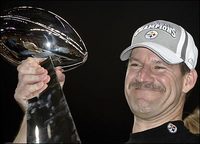 Bill Cowher, who has spent the last 15 years as head coach of the Pittsburgh Steelers, will announce his resignation today at a press conference at the Steelers headquarters, the AP reports. Steelers fans will hope that their source turns out to be Jamil Hussein, but in this case the AP likely has their story straight:
Bill Cowher is returning to the Pittsburgh Steelers - to say goodbye. The Steelers will begin a coaching search Friday to replace the departing Cowher, a person familiar with Cowher's status said Thursday night. Cowher called owner Dan Rooney on Thursday to tell him of his decision, and the team announced a Friday news conference not long after that. Cowher is expected to attend.The 49-year-old Cowher, one of the NFL's most recognizable faces and most successful coaches for 15 seasons, has weighed resigning since shortly after the Steelers finally won the Super Bowl in February following numerous near misses.
Cowher has talked of wanting to spend more time with his family, especially now that they are living in a new home in Raleigh, N.C., where he and wife Kaye attended North Carolina State. Cowher's two oldest daughters are at Princeton and the youngest has only 2 1/2 years of high school remaining, time Cowher apparently doesn't want to spend away from her.
While Cowher would be resigning with one season left on his contract, there is no indication he would retire from pro football. He said recently he is not close to being burned out, and still likes coaching and dealing with players.
As a lifelong Steeler fan, this comes as an expected but still tough blow. Cowher embodied the Steelers persona: tough, tenacious, and smart. Few coaches fit their teams as well as Cowher did, which is why he lasted 15 years after getting the job when most coaches are still carrying Gatorade bottles for the players.
At 49, he's much too young to hang up his clipboard. He wants to spend time with his family before time runs out, and he's close to being too late for that. No one could blame him; the head coaching position has become a 24/7/365 job during the time Cowher has coached the Steelers. After 15 years of that kind of grind, a couple of years as a sabbatical seems reasonable enough.
I expect that Cowher will not retreat from football entirely, though. He will probably find work as an analyst with one of the networks, a job that will take significantly less of his time. He will need to stay connected if he plans to return to coaching at some point, and given his consistent success in Pittsburgh and his youth, that seems assured. It probably won't be with Pittsburgh, though, unless Cowher's replacement bombs -- and you can bet that whoever succeeds him will feel that pressure from the fans, the players, and the head office.
This fan will miss The Jaw on Sunday afternoons, stalking the sidelines. I'll miss the passion that Cowher always has for the game, and the obvious joy he took in it. Thanks for 15 great seasons, Mr. Cowher, and we hope you enjoy the time off.
January 4, 2007
Kim Testing Again?
ABC News is reporting tonight that Kim Jong-Il has prepared for a new nuclear test. According to their sources, North Korea has "everything in place":
North Korea appears to have made preparations for another nuclear test, according to U.S. defense officials."We think they've put everything in place to conduct a test without any notice or warning," a senior U.S. defense official told ABC News.
The official cautions that the intelligence is inconclusive as to whether North Korea will actually go ahead with another test but said the preparations are similar to the steps taken by Pyongyang before it shocked the world by conducting its first nuclear test last Oct. 9.
Two other senior defense officials confirmed that recent intelligence suggested that the North Koreans appear to be ready to test a nuclear weapon again, but the intelligence community divides over whether another test is likely.
The equipment apparently has gone to the same region as their nuclear test in October, P'onggye. Analysts have seen some of the same activity in the area and are convinced that Kim could conduct another nuclear test within the next 60-90 days. Whether he intends to do so remains a point of contention, even among ABC's sources.
Kim and China had better be prepared to reap the whirlwind if he does. The UN will not be able to contain the counterreaction to another Pyongyang nuclear test. Japan will tilt further towards militarization and nuclearization, and the US relationship with Taiwan will get re-evaluated in light of the Korean threat. Even South Korea, with its inclination towards appeasement, has already begun to acknowledge the threat Kim poses, and will be forced to do so even further.
China may wind up with no choice but to consider its options for Kim's removal. Kim undoubtedly knows this. We'll see what happens.
Not Just Diplomats After All
When the US announced that they had found and detained high-ranking Iranian intelligence officers in Iraq, working with Shi'ite factions in an attempt to influence the Iraqi government, leading Iraqis protested that the men had received diplomatic invitations to Iraq. The US released the men to the Iraqis, who let them leave the country, and many criticized the US for provoking an international incident for no good reason. Now, however, the BBC reports that the Iranians were indeed spies on a mission to undermine Iraqi self-governance:
Five Iranians detained by US forces in Baghdad last month were senior intelligence officers engaged in a covert political mission to influence the Iraqi government, the BBC said."There were five senior officers in various intelligence organisations... It was a very significant meeting... These people have been collared, relatively speaking, up to no good," one unnamed British official told the broadcaster.
US forces detained 10 people on December 21 on suspicion of weapons smuggling after finding what they said were documents, maps, photographs and videos in a raid at pro-Iranian Shiite leader Abdul Aziz al-Hakim's compound.
Military commanders said the 10, two of whom were Iranian, were linked to "illegal activities," including potential attacks on coalition forces.
Three Iranian diplomats were detained in a vehicle in Baghdad the previous day but later released.
It seems that the story has changed a bit since the last dismissive reports. In fact, the Iranians took an inordinate amount of interest in plans for ministerial posts if Nouri al-Maliki stepped down from the Prime Minister post. They worked with the various Shi'ite political factions to get a good run-down on all the power players.
The US wants the men designated as personae non grata, which would strip them of any diplomatic immunity if they return to Iraq. So far, the Iraqis seem unwilling to do so, but they may need to answer why they want Iranian spies as participants in their political strategy sessions.
Oh, You Mean That Jamil Hussein!
I haven't blogged much about this, but it has been quite a cause in the blogosphere over the last few weeks. Bloggers have researched reporting by the Associated Press in Iraq and found 61 single-sourced stories regarding some of the most violent atrocities of the insurgencies in Iraq. When pressed for more information on their named source, the AP proved less than forthcoming, and the game was afoot. Several bloggers accused the AP of manufacturing the source, especially when both the Iraqi interior ministry and the US military could not locate a Jamil Hussein, and the AP has steadfastly insisted that Hussein, supposedly a captain in the Iraqi police, did exist.
Today, after several weeks, someone finally found Jamil Hussein -- and the Iraqis claimed that they would arrest him for speaking to reporters:
The Interior Ministry acknowledged Thursday that an Iraqi police officer whose existence had been denied by the Iraqis and the U.S. military is in fact an active member of the force, and said he now faces arrest for speaking to the media.Ministry spokesman Brig. Abdul-Karim Khalaf, who had previously denied there was any such police employee as Capt. Jamil Hussein, said in an interview that Hussein is an officer assigned to the Khadra police station, as had been reported by The Associated Press.
The captain, whose full name is Jamil Gholaiem Hussein, was one of the sources for an AP story in late November about the burning and shooting of six people during a sectarian attack at a Sunni mosque.
The U.S. military and the Iraqi Interior Ministry raised the doubts about Hussein in questioning the veracity of the AP's initial reporting on the incident, and the Iraqi ministry suggested that many news organization were giving a distorted, exaggerated picture of the conflict in Iraq. Some Internet bloggers spread and amplified these doubts, accusing the AP of having made up Hussein's identity in order to disseminate false news about the war.
This certainly tends to discredit the blogospheric attacks on AP if true, as well as the US and Iraqi protestations. However, it doesn't remove all of the questions about Jamil Hussein and the stories he supposedly sourced, and the first problem is the story that started the entire problem. Neither the AP nor any other news source has independently verified the story of the November burning and shooting death of six in the mosque. In fact, no one can confirm that a fire occurred at a mosque that day, other than the elusive Captain Hussein.
And then there's the question about the Iraqi intent to arrest Hussein. Why would they want to arrest him if he told the truth to the AP? Certainly crime is a matter of public record, and if his dozens of tips to the AP accurately describe real incidents, then they should have no real problem with his interaction with journalists. However, if he acted as a disseminator of disinformation for the purpose of undermining the Iraqi government and the American alliance, then they may have grounds for an arrest. Otherwise, simply relating actual incidents to a reporter should garner no more than a termination, and given the need for police in Iraq, it's doubtful it would amount to even that.
Whether Jamil Hussein actually exists is really a secondary issue. The fact that the AP used a single source for dozens of inflammatory stories about atrocities in Iraq that still have yet to find any confirmation is almost as disturbing as making the source up.
UPDATE: Curt from Flopping Aces responds to the AP:
As far as the burning bodies story goes we already know that all we have to prove that this incident happened are three unnamed witnesses. One Imam who quickly retracted the story. And one police officer named Jamil Hussein.That's it.
No names of the victims. No family members of the victims have been identified. No one know where the bodies are. No photographic evidence of a burning. Nothing other then the word of three unnamed witnesses and a police officer. In fact other residents denied this happened.
He's got a roundup of the other blogospheric reactions. This is Curt's story, so I won't bother to add another roundup -- just go to Curt's and read the whole thing. (via Hot Air)
UPDATE II: Er, it's Curt's and Michelle's. Be sure to read her roundup as well, and her take on this development. Neither Curt nor Michelle plan on cancelling their trip to Iraq; they're going to do some research on the stories that used Jamil Hussein as a single source to either confirm or discredit the reports, which is what the real issue has always been.
UPDATE III: People are saying that I'm applying "American law" to the notion of Captain Hussein's arrest above. Okay, fair enough, but does anyone have any examples of the Iraqis arresting police captains for discussing actual crimes? Even one? And if that's the case, then why did the AP use his name in dozens of these stories when it would have risked his arrest?
Is This A Franchise?
The UN has announced yet another investigation into yet another series of allegations of sexual abuse of refugees under the protection of UN peacekeepers. The London Telegraph had earlier reported on the systemic abuse of children in Sudan, and Turtle Bay has once again promised a full and open probe, blah, blah, blah:
The United Nations said last night that it was launching an investigation into allegations reported in The Daily Telegraph that its peacekeepers and staff have abused children in southern Sudan. ...The Daily Telegraph yesterday reported allegations of blue berets paying children as young as 12 for sex in the mission in southern Sudan, known as UNMIS. The abuse allegedly began two years ago when the mission moved in to help rebuild the region after a 23-year civil war.
The UN has up to 10,000 military personnel in the region, of all nationalities, and the allegations involve peacekeepers, military police and civilian staff.
The Daily Telegraph has learned of more than 20 victims' accounts claiming that some peacekeeping and civilian staff based in Juba regularly pick up young children in their UN vehicles and force them to have sex.
It is thought that hundreds may have been abused.
This has been going on since May 2004, when the Independent first reported the systemic sexual abuse of women and children in the UN mission for the Congo. In the 31 months since then, we have seen no effort to end the abuses; instead, we have discovered more and more examples of massive atrocities committed by both the component troops of peacekeeping missions and UN personnel. The UN flag seems to serve as a warning to hide the women and children than for hope of peace and stability.
Where else has this happened? A report from the Washington Post in March 2005 showed that similar abuses occurred on a systemic basis around the world. This was the UN response to this report almost two years ago:
The United Nations is facing new allegations of sexual misconduct by U.N. personnel in Burundi, Haiti, Liberia and elsewhere, which is complicating the organization's efforts to contain a sexual abuse scandal that has tarnished its Nobel Prize-winning peacekeepers in Congo.The allegations indicate that a series of measures the United Nations has taken in recent years have failed to eliminate a culture of sexual permissiveness that has plagued its far-flung peacekeeping operations over the last 12 years. But senior U.N. officials say they have signaled their seriousness by imposing new reforms and forcing senior U.N. military commanders and officials to step down if they do not curb such practices.
A report by Refugees International at the time emphasized that the problem existed in every UN mission. The reason was because the UN lacked accountability, transparency, and discipline. The UN promised to start reforming itself immediately at the time.
Here we are, almost two years later, and we see that they have done nothing -- and they still have no accountability, transparency, and discipline.
At some point in time, we have to ask ourselves whether we want to remain complict in the UN's chronic atrocities. After all, our money funds these missions, and that gives us a measure of responsibility for these crimes. If the UN refuses to take any real and effective action to stop these abuses and to ensure that they do not occur again, we should pull our funding for the UN on that basis alone. Let the entire corrupt organization collapse of its own moral rot, and work towards replacing it with an organization that has accountability and discipline built into its operations.
What You Don't Know About The Federal Minimum Wage
Nancy Pelosi and the Democrats have placed a significant minimum-wage increase at the top of their agenda for the 110th Congress. President Bush has signaled his willingness to approve it, using the increase as a lever for tax relief on small businesses. One would imagine that this show of bipartisanship springs from a national crisis, but George Will explains that the effort will benefit only a few, and not even the few that the politicos assume:
Democrats consider the minimum-wage increase a signature issue. So, consider what it says about them:Most of the working poor earn more than the minimum wage, and most of the 0.6 percent (479,000 in 2005) of America's wage workers earning the minimum wage are not poor. Only one in five workers earning the federal minimum lives in families with earnings below the poverty line. Sixty percent work part time, and their average household income is well over $40,000. (The average and median household incomes are $63,344 and $46,326, respectively.)
Forty percent of American workers are salaried. Of the 75.6 million paid by the hour, 1.9 million earn the federal minimum or less, and of these, more than half are under 25 and more than a quarter are between ages 16 and 19. Many are students or other part-time workers. Sixty percent of those earning the federal minimum or less work in restaurants and bars and earn tips -- often untaxed, perhaps -- in addition to wages. Two-thirds of those earning the federal minimum today will, a year from now, have been promoted and be earning 10 percent more. Raising the minimum wage predictably makes work more attractive relative to school for some teenagers and raises the dropout rate. Two scholars report that in states that allow people to leave school before 18, a 10 percent increase in the state minimum wage caused teenage school enrollment to drop 2 percent.
Will makes a point which many on both sides have missed, which is that the Bush administration's spending spree makes it politically difficult for them to oppose the increase. After all, Bush signed the pork-filled farm bill in 2002 that benefitted the large farmers more than anyone else, and he signed a highway bill in 2005 that notoriously contained over six thousand earmarks. If the government wants to give away money, why not to the poor?
But that's precisely the problem. They aren't giving away money, not from their checkbook, at any rate. They're distorting a market for a short-term political benefit that will do nothing to raise the standard of living for the people they supposedly want to help. Arbitrarily raising the prices of services and goods in a marketplace causes inflation, not an increase in real value. They're forcing consumers of labor to pay more for the same service, from which they will get no increased benefit -- and that means that they will have to pass the costs along to the consumers of their goods and services, all through the distribution chain.
Whose money is getting given away? Yours and mine, and all 479,000 minimum-wage workers, that's who. i can absorb the incremental loss of buying power, but the people at the bottom rungs cannot. If they're lucky, all that will happen is that their buying power will remain the same as it was after a short period of adjustment. More likely, some of their jobs will get eliminated as businesses have to support the cost increase in some other fashion than price hikes.
And it's not even the working poor that gets helped in the increase. The working poor may have started at minimum wage, but they move up as they progress in their jobs. It is an absolute fallacy to argue that minimum-wage workers have not gotten a raise since the last federal increase of the minimum wage; they get raises as they increase their value to their employer, not from Uncle Sam. Anyone who has worked at the minimum wage since 1997 is either switching jobs too often to get a raise or is not very productive. The people making minimum wage are by and large temporary workers and people who make most of their living through tips, the latter comprising three out of every five minimum-wage workers. It's not an accurate reflection of their standard of living.
Will has it right -- the minimum wage should be zero. Unfortunately, the politicians don't get re-elected when they tell Americans that they can't solve their problems, and so we get these splashy systemic solutions to issues that either don't exist at all or only affect a narrow slice of the nation. The rest of us get to pay for it, and the people with the least ability to withstand the economic consequences pay the most for it.
Perhaps we should insist on an increase in the minimum common sense of Washington officials.
Tears, Tears For Old Notre Dame
In the end, the prognosticators got this one correct. Notre Dame didn't have the speed or the strength to match up against LSU, although they made it interesting in the first half:
JaMarcus Russell thoroughly outplayed Brady Quinn and made a compelling case that the mammoth quarterback's next pass should come in the NFL.As for Notre Dame, it was a familiar meltdown at bowl time.
The Sugar Bowl returned to New Orleans with a Cajun-style party put on by No. 4 LSU, which dominated college football's most storied program in a 41-14 rout Wednesday night that had the Superdome rockin'.
It also gave the 11th-ranked Fighting Irish a most unwanted spot in the record book.
The school of Touchdown Jesus and Knute Rockne now has a more ignominious distinction: nine straight bowl losses, breaking a tie with South Carolina and West Virginia for the most in NCAA history. And this was like most of the others, a double-digit blowout that showed Notre Dame still has work to do if it wants to compete with the nation's best.
Once again, it seemed like Brady Quinn had to shoulder too much of the offense, only tonight the running game worked for as long as Charlie Weis went to it. Darius Walker had over 100 yards in the first half, but the Irish kept challenging the speedy secondary of LSU -- and it turned out to be a poor choice, as the O-line had trouble all night long with LSU's blitzing schemes.
Notre Dame has some serious work to do to bolster its program. Weis is the right coach, but they need better recruiting and a deeper, faster team. Either that, or they need to return to the kind of physically imposing teams that won them national championships in years past. What they cannot be is both slow and light, and that's what they looked like tonight against the Tigers. They also looked like that in their two lopsided losses to Top 10 teams this season.
They showed some heart, though, in bouncing back from a bad start tonight. At the half, it looked like they had figured out LSU, having controlled the ball for much of the first two quarters and running up some yardage. All of that disappeared when LSU had a chance to make some changes at the break, and the Irish never got back in the game.
Here's to next year. I'll put the Irish jerseys aside and save them for the 2007 season. Thanks for a season of hard work and memories, guys.
Abuse Of Power, Revisited
Some people question whether the charges against Richard Nixon regarding his abuses of power in office had more to do with politics than with real abuses. CNN reports on newly-released information that demonstrates Nixon's abuse, although its report focuses on another incident with much less import:
The former president's darker side was further revealed on Wednesday by newly released FBI files which show the agency ran criminal background checks on Senate witnesses critical of William Rehnquist's nomination to the Supreme Court in 1971 at the request of the Nixon administration. The disclosures were among 1,561 pages released by the bureau under the Freedom of Information Act.
The New York Sun picks the story up as well, although they also relegate it to a minor position:
The files also describe the FBI's efforts in 1971 to support Rehnquist's nomination as an associate justice. The bureau conducted background checks on two Phoenix, Ariz., residents expected to testify against Rehnquist, Legal Times said.The files also detail a scandal surrounding the FBI's interviews of other potential Rehnquist critics, including a Harvard Law School professor, Laurence Tribe.
The Nixon administration found out the names of two people who would testify to the Senate against Rehnquist's confirmation to the bench, and they had the FBI -- the federal law-enforcement agency -- go out and try to dig up dirt on them. The White House wanted to find some way to discredit them from speaking against their Supreme Court nominee. That's an abuse of power, and the people who ordered that deserved to be prosecuted for it. However, who would have investigated it -- the FBI? Hoover had already implicated the agency in the crime, which for Hoover was simply part of his own modus operandi anyway.
Both news agencies miss the real story here. CNN talks about Nixon's animosity towards the State Department's diplomatic corps and his intention to tear it down and build another. The Sun reports on the FBI investigation into Rehnquist's painkiller addiction that took place during his confirmation hearings for the Chief Justice slot in the mid-1980s. Both stories have splashy and salacious details, but both miss the larger threat to the nation that Nixon represented.
When the law-enforcement agencies have their missions perverted to serve the political purposes of politicians, it presents a dual threat to our civil liberties. Not only can those forces be used to intimidate people from the exercise of their political choices, it leaves no one to investigate the corrupt politicians pulling the strings. That's true at every level of government, but when a President and/or his administration commits these acts and uses the FBI as his tool, the power the executive wields becomes almost unchallengeable, and it warps the balance of government in very dangerous ways. And Nixon's administration, for all of its successes, became a very dangerous organization -- and this is but one example of why Nixon had to go.
A Strange Change
John Negroponte has given up his Cabinet-level position in order to work for Condoleezza Rice at State. Replacing him will be another retired military officer, which may revive some of the concerns regarding military control of the intelligence community:
John D. Negroponte, whom President Bush installed less than two years ago as the first director of national intelligence, will soon leave his post to become the State Department’s second-ranking official, administration officials said Wednesday.Mr. Negroponte will fill a critical job that has been vacant for months, and he is expected to play a leading role in shaping policy in Iraq.
But his transfer is another blow to an intelligence community that has seen little continuity at the top since the departure of George J. Tenet in 2004 as director of central intelligence. ...
On paper, the director of national intelligence outranks the deputy secretary of state, raising questions about why the White House would seek — and why Mr. Negroponte would agree — to the shift.
Bush administration officials from two different agencies said Wednesday that the leading candidate for intelligence chief is J. Michael McConnell, a retired vice admiral who led the National Security Agency from 1992 to 1996. Admiral McConnell was head of intelligence for the Joint Chiefs of Staff under Gen. Colin L. Powell during the first Persian Gulf war, in 1991.
Negroponte will fill Robert Zoellick's slot at State, dealing with critical policy issues and serving as Rice's deputy. The position carries a high profile and arguably has more influence on policy formulation, but it still represents a step down and a move out of the Oval Office inner circle. The change reflects a possible loss of confidence in Negroponte, especially given his proximity to the President and the obvious opportunity to influence his decisions on policy on a whole range of issues.
Congress appears taken aback by the change. Susan Collins, a Republican who pushed hard for the 9/11 Commission recommendations that created the DNI post, expressed her disappointment at Negroponte's resignation. Jane Harman, who would have been the new House Intel chair had Nancy Pelosi not fumbled the assignment after the election, also objected, making the criticism bipartisan.
With the available information, it looks like Negroponte got shuffled downward as part of the review finishing up on Iraq and the war on terror. The quality of intelligence coming from Iraq has come under some fire over the last couple of years, and eventually that responsibility rests with Negroponte. Alternatively, it could be that Negroponte's experience in Iraq was necessary for Rice to push through Bush's new strategies for Iraq and the Middle East. Negroponte was the first American emissary to Iraq, and with the resignation of Zalmay Khalilzad, Bush may have wanted the most experienced hands focusing directly on Iraq.
It's a puzzlement, without a doubt. I don't recall any recent moves where a Cabinet officer resigned to take a deputy post for another Cabinet officer.
Get ready for more questions about Negroponte's replacement. Congress expressed some uneasiness when Bush nominated General Michael Hayden to head the CIA; they were reluctant to put a command officer in the military in charge of an agency that had mostly had civilian leadership. Part of the reason Congress shrugged off those concerns was that a civilian served as DNI. Now that Bush wants to put a retired admiral with strong ties to the Pentagon's intel structure, that may come up again as a concern for lawmakers.
First, though, they will want to ask what led to Negroponte's resignation, a question that seems as though it would produce some interesting answers.
Belarus To Russia: Game On
After Belarus caved on New Year's Eve to Russian demands for a rate hike on gas supplies as well as a piece of Belarus' action on pipeline service to the West, the dispute looked over. Belarus, however, just declared a new round in the battle:
Belarus has imposed big taxes on Russian oil pumped through its pipelines to customers in Europe.The move comes three days after Belarus reluctantly agreed to demands by the Russian state energy giant, Gazprom, to a doubling of gas prices.
Belarus says it will charge Russia $45 (£23) per tonne of oil.
Analysts said the move was unlikely to affect world oil prices but could cause short-term disruption to refiners in countries like Germany.
Every day Russia transports around a fifth of its oil exports - or one million barrels - through Belarus, mainly to refiners in Poland and Germany.
This will prove interesting. The Belarus tax could make the gas so expensive that Russia's customers might find it more appealing to look elsewhere for supplies. Of course, considering the efforts of Vladimir Putin to consolidate energy companies into his control, it's not a bad idea anyway -- but Belarus's tax may force their hand.
Putin probably didn't foresee this as a potential outcome. He needs the flow of hard currency from the West to continue, and his little power play with Alexander Lukashenko may have jeopardized that. It looks like Belarus may have the last word on the price war after all.
UPDATE: One effect that the Belarussian move has is to make Norway a more economically viable alternative to Russian imports:
It is estimated that one-fourth of the world's oil and natural gas reserves lie hidden away in the Arctic. Some of them lie beneath the ocean floor, in the Barents Sea. At the end of this year, the Norwegian energy concern Statoil wants to begin extracting natural gas in the area.Getting the resource from the ice desert to central Europe by pipeline would be too expensive. Pipelines more than 3,000 kilometers (1,864 miles) long aren't worth the cost, and the Barents Sea is simply too far away. That's why Europe's first major facility for the liquification of natural gas is now being built on the island off the port of Hammerfest. Once the natural gas has been liquified, it can be shipped all over the world by sea.
The production of so-called "liquified natural gas" (LNG) -- a clear, colorless, non-toxic liquid -- is becoming increasingly important in the energy business. LNG already accounts for a quarter of the global natural gas trade. Qatar, the country in the Persian Gulf that has the world's third-largest reserves, is investing massively in liquification technology, and Algeria, Indonesia and Malaysia are fast following suit. The entire market is expected to grow by about 8 percent a year until 2025 -- much faster growth than is expected from the pipeline business.
Until recently, Western European countries like Germany paid little attention to the trend. But ever since the Russian-Ukrainian dispute over natural gas prices in early 2006 and the more recent rift between Russian gas monopoly Gazprom and Belarus, concern has been growing in Berlin that Germany's dependence on Siberian natural gas reserves has become too great. Now LNG shipments could become one of the most important alternative sources of natural gas.
It may have more than strictly economic attractions, especially if Norway can break Gazprom's grip on the European market. It could interrupt the guaranteed currency pipeline that Putin needs for his consolidation of power in Russia.
About That Eid Thing ... Never Mind
Remember how critics of the execution of Saddam Hussein expressed their outrage that the Iraqis had profaned the Eid celebrations? Recall how people argued that Muslim celebrations of this holiday are marked by a suspension of all hostilities and a focus on unity and peace? Perhaps some Muslims didn't get the memo:
Outraged in-laws slashed the nose and ears of a Pakistani college student who married a woman without the consent of her higher-caste family, and then fractured his legs with blows from an ax, police and the victim said.Mohammed Iqbal told The Associated Press on Wednesday about 30 male relatives of his wife stormed into his mother's village home during the Islamic festival of Eid al-Adha, demanding vengeance for the "dishonor" the marriage had brought to their family.
"You have mixed our honor with dirt," Iqbal, 22, speaking from his hospital bed, recounted the attackers chanting as they assaulted him with a dagger and ax on Monday night. They also slit his brother's ears and shot his mother in the thigh, he said.
Police officer Manzoor Ahmed in the city of Multan, where the three victims are recuperating, said seven men suspected of involvement in the attack in Inayatpur Mahota village, Punjab province, have been arrested and police were hunting for 22 other suspects.
Once again, the cute notions of Islam as a religion of peace rather than a religion of submission show more Westomorphism rather than reality. Muslims may indeed value peace and a suspension of hostilities during Eid, but it hardly keeps them from taking care of business when necessary.
The execution of Saddam Hussein had its share of problems, and certainly some of the criticisms of it are perfectly valid. The Iraqi government should have taken its time and planned it better, and they should have ensured that it would not turn into a Moqtada al-Sadr rally. Saddam would be just as dead either way, but the Iraqi government suffered damage it didn't need to take. However, let's quit pretending that Muslims find violence in service of their agendas unacceptable during Eid, and let's stop with the political correctness that assumes Western values where they don't apply.
January 3, 2007
David Geffen, Call Patterico
Holllywood and music mogul David Geffen recently offered $2 billion to the Tribune Company for the Los Angeles Times. Tribune has put him off for a while as they want to sell the entire company and not just its components, but perhaps Geffen should reconsider the bid. If you read Patterico, it's obvious that the LA Times is overpriced:
It is time for this blog’s fourth annual review of the performance of the Los Angeles Times, which long-time Patterico readers know as the Los Angeles Dog Trainer. The first annual review was posted here. The second annual review was posted in two parts, here and here. The third annual review was posted here.This year’s installment covers a number of topics, including the Michael Hiltzik sock-puppetry controversy; the alleged Ramadi airstrike; the paper’s decision to reveal the Swift counterterror program; the firing of the paper’s editor and publisher; the Iraq war and the war on terror; the paper’s shilling for Democrats during the 2006 election; and my decision to cancel the paper — among many others.
This post summarizes an entire year’s worth of work documenting omissions, distortions, and misrepresentations by this newspaper. I have made an effort to document my arguments that this paper is a regular practitioner of liberal bias. As with my previous posts, the proof is voluminous. As a consequence, don’t feel that you need to read the entire post in one sitting. Feel free to bookmark it and return to it in the coming days, browsing through the categories as they interest you.
If this post was the newspaper, it would be the Sunday edition. If it was a prizefight, the corner would have thrown in the towel. Read the whole thing, and someone get Geffen an emergency lunch with Patterico.
The Push In The New Direction
Michael Ledeen covered the latest news from Iraq yesterday, which Eli Lake reported for the New York Sun. New intelligence has produced evidence of Iranian support for both the Shia and the Sunni insurgencies, a feat that completely undermines the ISG's notion that Iran has no interest in chaos in Iraq:
Iran is supporting both Sunni and Shiite terrorists in the Iraqi civil war, according to secret Iranian documents captured by Americans in Iraq.The news that American forces had captured Iranians in Iraq was widely reported last month, but less well known is that the Iranians were carrying documents that offered Americans insight into Iranian activities in Iraq.
An American intelligence official said the new material, which has been authenticated within the intelligence community, confirms "that Iran is working closely with both the Shiite militias and Sunni Jihadist groups." The source was careful to stress that the Iranian plans do not extend to cooperation with Baathist groups fighting the government in Baghdad, and said the documents rather show how the Quds Force — the arm of Iran's revolutionary guard that supports Shiite Hezbollah, Sunni Hamas, and Shiite death squads — is working with individuals affiliated with Al Qaeda in Iraq and Ansar al-Sunna.
In other words, Iran has played both sides against the middle in order to ensure the destabilization of the democratic government in Iraq. They have had a good deal of success so far, with the rise of the Mahdi Army and the tenacity of the al-Qaeda-affiliated terrorists both sourced from Teheran. That new information has caused a great deal of consternation, Ledeen reports, with the people who have to calculate a new strategy for Iraq and beyond:
I am told that this information has reached the president, and that it is part of the body of information he is digesting in order to formulate his strategy for Iraq. If he sees clearly what is going on, he must realize that there can be no winning strategy for Iraq alone, since a lot of ‘Iraqi’ activity—not just lethal materiel such as the latest generation of explosive devices, now powerful enough to penetrate the armor of most of our vehicles—is actually Iranian in origin. We cannot ‘solve’ the Iraqi problem without regime change in Iran.Those of you who have borne with me for the last few years will not be surprised to hear this; what’s new is the apparently irrefutable evidence that has now providentially fallen into our hands. The policy makers will not like this evidence, because it drives them in a direction they do not wish to go. I am told that, at first, there was a concerted effort, primarily but by no means exclusively from the intel crowd, to sit on the evidence, to prevent it from reaching the highest levels. But the information was too explosive, and it is now circulating throughout the bureaucracy.
I have little sympathy for those who have avoided the obvious necessity of confronting Iran, however I do understand the concerns of military leaders, such as General Abizaid, who are doing everything in their considerable power to avoid a two-front war. But I do not think we need massive military power to bring down the mullahs, and in any event we now have a three-front war: within Iraq, and with both Iran and Syria. So General Abizaid’s objection is beside the point. We are in a big war, and we cannot fight it by playing defense in Iraq. That is a sucker’s game. And I hope the president realizes this at last, and that he finds himself some generals who also realize it, and finally demands a strategy for victory.
When we finally realized after 9/11 that we had been in a war against radical Islamist terrorists for several years, the need to address Iran was obvious. However, we have mostly tried to convince ourselves that we could compartmentalize the war on terror to specific battlefields: Afghanistan and Iraq. It's not going to be that simple, and in truth it never was.
We have to face the fact that we are already in a big war, a World War of its own kind. Does that mean we stage a massive attack against Iran? No, but it does mean that we have to at least recognize them as the enemy behind most of the terrorists we fight, and quit fooling ourselves into thinking that they have a stake in a peaceful democratic world. Be sure to read all of Ledeen's excellent piece.
Quick Hits
I'm waiting for the opening kickoff of the Sugar Bowl after having worn my Notre Dame sports shirt all day today. They LSU Tigers just won the coin flip and will let the Fighting Irish get the ball first, so we should see some fireworks from Brady Quinn shortly. While that goes on, I have a few stories I want to note ...
First, let's offer our best wishes and prayers to Michelle Malkin and Curt from Flopping Aces in their upcoming trip to Iraq. Eason Jordan has proven as good as his word, in this instance at least, in honoring his offer to Michelle and extending it to Curt to search for the elusive Captain Jamil Hussein, the AP source that the wire service still insists is legitimate.
Michelle and Curt plan to do more than poke around for the suddenly-missing AP source. They're also going to embed with the Army to check out the training for the Iraqis. It's not an easy assignment.
Speaking of embeds, Bill Ardolino continues to blog from Anbar. Today he has a report from Fallujah, and earlier he did a two-part interview with an Iraqi police officer. Both embeds can use some reader support, so be generous and help extend the reach of citizen journalism.
Mitt Romney declared his candidacy today, and his web site is now up and running. They'll be offering multimedia presentations, so keep checking back. The Romney campaign made a smart hire with Stephen Smith, who did a great job as liaison to the New Media for Bill Frist. I'm going to stay neutral until the primaries, and I look forward to working with Stephen.
And speaking of New Media liaisons, my blog-friend Jon Henke accepted that position with Mitch McConnell and the Senate Republican Caucus. George Allen's staff brought him in a little too late in the 2006 re-election campaign, and it's good to see that McConnell has him on board at the start of what will be a very tough session.
Keith Ellison started off the new session with a brilliant political move. Answering Dennis Prager's misdirected criticism, Ellison will borrow a Qur'an for his ceremonial oath of office ... from Thomas Jefferson. To me, this is a non-issue, but it shows that Ellison is no neophyte. The GOP had better pick its battles better in the future.
Neither, apparently, is Cindy Sheehan. Just when the Democrats had finally gotten their unity in full swing for the start of the 110th Congress, Sheehan arrives to disrupt their press conference. She and her allies on the Left made it clear that they have no intention of allowing the Democrats to settle into their new leadership roles before cutting off all funding for the Iraq war and starting impeachment hearings. Suppose she'll get the same warm welcome she got in 2005? Look for Sheehan to get very lonely whenever Hugo Chavez is out of town.
Sheehan would be a good choice for Knucklehead of the Year, but unfortunately the Lifetime Achievement Award winner had too good of a year in 2006 for Sheehan to surpass him.
And it looks like I may do more blogging than I initially thought, as the Irish are getting their butts kicked in the first quarter already ...
The Nature Of Youthful Indiscretions
... is that they should be handled discreetly. However, the tabloidesque nature of national politics over the last generation has eliminated discretion, and it appears the next example of this will be Barack Obama. The Washington Post manages to both raise Obama's youthful choices on drugs and then question their applicability to a man two decades past their use:
Long before the national media spotlight began to shine on every twist and turn of his life's journey, Barack Obama had this to say about himself: "Junkie. Pothead. That's where I'd been headed: the final, fatal role of the young would-be black man. . . . I got high [to] push questions of who I was out of my mind."The Democratic senator from Illinois and likely presidential candidate offered the confession in a memoir written 11 years ago, not long after he graduated from law school and well before he contemplated life on the national stage. At the time, 20,000 copies were printed and the book seemed destined for the remainders stacks.
Today, Obama, 45, is near the top of polls on potential Democratic presidential contenders, and "Dreams From My Father: A Story of Race and Inheritance" has regularly been on the bestseller lists, with 800,000 copies in print. Taken along with his latest bestseller, "The Audacity of Hope: Thoughts on Reclaiming the American Dream," Obama has become a genuine publishing phenomenon.
Obama's revelations were not an issue during his Senate campaign two years ago. But now his open narrative of early, bad choices, including drug use starting in high school and ending in college, as well as his tortured search for racial identity, are sure to receive new scrutiny.
I'm not sure why. I suppose I could, as Democratic political consultant Anita Dunn says, "cast the first stone" if I were so inclined. I'm one of the few of my generation (which includes Obama) who never tried pot or other illegal substances. Since that makes me "sinless" in this context -- and in this context only -- I guess I have the moral authority to proclaim him disqualified.
Instead, though, I wonder what purpose that serves. Are we to argue that anyone who used pot in high school and college will forever be banned from high public office? (Stop snickering -- you know what I mean.) No one goes through life without making mistakes, after all, and the mistakes Obama describes have been made by plenty of people in my generation, regardless of skin color, economic strata, or location. It would make a big difference if Obama or anyone else was still making these mistakes, but it looks like those issues are twenty years past or more -- hardly indicative of the man he his now, or the value of his talents to his constituents.
George Bush went through the same thing during his presidential campaigns, with his history of hard drinking and references to other abuses that never got confirmation. Despite the lunacy of some on the Left -- Martin Sheen once referred to Bush as a "white-knuckle drunk" without benefit of having ever met the man -- he has handled himself perfectly well in office. Bill Clinton, who famously "didn't inhale", didn't get stoned in the Oval Office; his mid-life indiscretions were of an entirely different nature, and that particular quality was well known before he got elected in 1992. People make mistakes, and certainly we're entitled to consider them -- but this seems like a strange line to draw, and a disqualification that would include a large percentage of people born after World War II.
I'm no fan of Barack Obama, but once again, I have to think that we have better grounds on which to oppose him than whether he smoked pot in the late 1970s. If not, perhaps I am the only person qualified to be President -- and that should really scare the hell out of you. (via Memeorandum)
A Challenge To The New Congress
On the eve of the transition in Congress, George Bush has written a rare opinion piece in today's Wall Street Journal. In it he challenges the Democrats to working in a bipartisan manner on national security and fiscal responsibility, but the Democrats may have their own ideas on both subjects:
In the days ahead, I will be addressing our nation about a new strategy to help the Iraqi people gain control of the security situation and hasten the day when the Iraqi government gains full control over its affairs. Ultimately, Iraqis must resolve the most pressing issues facing them. We can't do it for them.But we can help Iraq defeat the extremists inside and outside of Iraq--and we can help provide the necessary breathing space for this young government to meet its responsibilities. If democracy fails and the extremists prevail in Iraq, America's enemies will be stronger, more lethal, and emboldened by our defeat. Leaders in both parties understand the stakes in this struggle. We now have the opportunity to build a bipartisan consensus to fight and win the war.
America's priorities also include keeping our economy strong. The elections have not reversed the laws of economics. It is a fact that economies do best when you reward hard work by allowing people to keep more of what they have earned. And we have seen that businesses can expand and hire more workers when they have more money to invest--and since August 2003, America's employers have added more than seven million new jobs.
It is also a fact that our tax cuts have fueled robust economic growth and record revenues. Because revenues have grown and we've done a better job of holding the line on domestic spending, we met our goal of cutting the deficit in half three years ahead of schedule. By continuing these policies, we can balance the federal budget by 2012 while funding our priorities and making the tax cuts permanent. In early February, I will submit a budget that does exactly that. The bottom line is tax relief and spending restraint are good for the American worker, good for the American taxpayer, and good for the federal budget. Now is not the time to raise taxes on the American people.
By balancing the budget through pro-growth economic policies and spending restraint, we are better positioned to tackle the longer term fiscal challenge facing our country: reforming entitlements--Social Security, Medicare and Medicaid--so future generations can benefit from these vital programs without bankrupting our country.
Considering that the Democrats believe that they won the election by criticizing those policies that Bush outlines in the WSJ, I'd say the prospects for cooperation on this basis look pretty thin. The new Congressional leadership believes that they have a mandate to reverse both the Bush tax cuts and the Iraq War, and they will not rest easy until they have made significant strides towards doing so. This will put them on a collision course with the White House, regardless of whatever Bush pens for the press during the next two years.
Bush offers little new in his essay, which he acknowledges in his statement, "My principles are no secret." Bush will rely on the fact that he also won a couple of elections as an argument to continue pursuing his own policy preferences. In fact, there doesn't appear to be a lot of common ground in the article, despite its tone of reconciliation. He uses the Patriot Act as an example of bipartisan effort, which it was at the time -- but most Democrats would probably vote to repeal it now, or to gut its most effective counter-terror provisions. He also offers the No Child Left Behind Act as another example, but that might be a better example of bipartisanship in the fact that neither party much likes it now.
He makes his position clear at the end about his role over the next two years:
Our Founders believed in the wisdom of the American people to choose their leaders and provided for the concept of divided and effective government. The majority party in Congress gets to pass the bills it wants. The minority party, especially where the margins are close, has a strong say in the form bills take. And the Constitution leaves it to the president to use his judgment whether they should be signed into law.
The last sentence barely veils his reminder that he has veto power over anything Congress manages to produce -- even though one could have reasonably concluded over the last six spending-soaked years that he had an allergy to using it. He will probably get a lot more practice at vetoing legislation over the next two years now that he has no Republican majority to protect. This may not make much difference to the Democrats, who will probably have a very difficult time passing any kind of legislation, thanks to the weakness and character of their majority. They only can stand to shed a handful of votes on any bill, and the Blue Dogs outweigh that margin by at least a factor of two. Party unanimity will only last a short time; freshmen from formerly Republican districts will not risk their re-election chances by going the full Pelosi. If they do, the two-seat Democratic majority in the Senate will probably not be sufficient to push the bills through any kind of concerted Republican effort to stop them. Bush may not have an opportunity to sign or veto much, outside of normal appropriations bills.
The Democrats know this, and they will concentrate their efforts elsewhere -- such as investigations and House rules changes, where their power runs free of the executive. I suspect we will see a return of the Do-Nothings in terms of legislation, but a long, tiresome slog of probes into every nook and cranny of the White House in order to dig up any dirt that can be used in 2008 on the GOP.
It may be all niceties now, but that will dissipate quickly. Within a few months, we'll be begging for 2008 to arrive.
The Point Of No Return (Update and Bump)
With all of the assaults on free political speech that have come as a result of the McCain-Feingold Act (or the BCRA), one has to wonder how much farther we can go before reversing the damage becomes impossible. Mark Tapscott shows us just how far this law reaches by relating how the BCRA affected a NASCAR racing team. No, I'm not kidding:
How does one know when the critical point in a Republic's loss of its basic liberties like freedom of speech has been passed? A Dec. 22 notice from the Federal Election Commission looks very much like that point for America.The notice concerned a complaint the FEC received from one Sydnor Thompson that Kirk Shelmerdine had improperly committed an independent expenditure on behalf of the Bush-Cheney re-election campaign during the 2004 race.
Do you want to know what that "independent expenditure" was? Shelmerdine put a Bush-Cheney bumper sticker on his racing car. It stood out because Shelmerdine had no significant sponsorship, not even the President's re-election campaign. He put the bumper sticker on his car just to generate a little publicity for himself. Instead, Sydnor Thompson filed an FEC complaint against him.
Guess who Sydnor likes to support? John Edwards, Erskine Bowles, and other Democrats. Sydnor may have wanted to generate a little of his own publicity, as he apparently has a book to flog. The North Carolina attorney apparently takes great delight in telling anecdotes where colleagues compare him to Jesus, among other incidents related to this "pilgrim".
The FEC, in its infinite wisdom, decided to take pity on Shlemerdine and only drop an "admonishment" on his head for the dastardly violation of attaching a bumper sticker to his car. Given Shelmerdine's ranking in NASCAR, more people would have seen it on the 494 during a Minnesota rush hour, but the FEC decided that he had given Bush free advertising and therefore made some sort of in-kind contribution that required regulation.
As Tapscott notes, how long before all drivers who slap a bumper sticker on their car are determined to have given an in-kind contribution? In fact, how long before all political speech is regulated for its monetary value to a campaign? For me and other bloggers, this is no academic point. When we exercise our First Amendment rights and thousands of people read or hear our speech, it becomes a focus for the "reformers" who insist that the government set limits on campaigns and political speech.
When a bumper sticker inspires the federal government to admonish a private citizen for their political speech, that point of no return appears a hell of a lot closer than ever before.
UPDATE and BUMP, 1/3: CQ reader Mr. Michael has a link to the complaint, which has a low-quality reproduction of the car. The ad in question is obviously much larger than a traditional bumper sticker, which shows that Shelmerdine indeed did not have much credibility as a racer for attracting advertisers. It also, according to Mr. Michael, makes a difference regarding the regulation of speech.
Does the size of the ad make a difference? Not to me. I have a "Blogs for Bush" graphic on my sidebar, and I wouldn't want to get in a tussle over its size to determine the FEC's authority to regulate my speech. Once again, if we start making those distinctions about speech, then we leave it to the federal government to enforce them -- which eventually makes them the approving agency for all of our political speech.
If Shelmerdine wanted to use up prime advertising space on his vehicle to support Bush or Kerry, that's his right. It only makes a difference in our current system because we've created a behemoth of an oversight system that forces a series of artificial categories for contributions and spending, all of it hypocritical and most of it an offense to the notion of free speech and free political activity. What's next -- do we start figuring out the value of celebrities endorsing their candidates on talk shows as in-kind contributions, too? I guarantee that the value will be higher than the ad on Shelmerdine's vehicle. It's not just a slippery slope we're on here, but an abrupt drop towards government-regulated politics, and in many ways we're already falling.
Favoritism Shown For Clinton Pal?
Here's a story that managed to fly under the radar during Christmastime. Suzanne Magaziner, the wife of Clinton friend and organizer Ira Magaziner and herself a major activist with ties to the new Governor in Massachusetts, got her drunk-driving charges mysteriously dismissed despite failing a Breathalyzer and field sobriety tests (via Newsbeat1):
A politically wired campaign fund-raiser with ties to Gov.-elect Deval Patrick and former President Clinton has been cleared of drunken driving charges, despite allegedly failing sobriety tests and blowing over the legal limit on a Breathalyzer.Suzanne Magaziner, a Patrick campaign organizer married to ex-Clinton adviser Ira Magaziner, was busted April 4 in Mansfield after a trucker spotted her swerving on Interstate 95, the Sun Chronicle of Attleboro reported.
State police who pulled over Magaziner, 54, said she had bloodshot eyes, alcohol on her breath and failed sobriety tests. She also reportedly blew a .12 on a breath-alcohol test, which is above the state’s legal limit of .08.
But the case was tossed out of Attleboro District Court on Friday at the request of a prosecutor from Bristol District Attorney Paul F. Walsh Jr.’s Office. The prosecutor, Roger Ferris, told the Sun Chronicle the case was dismissed at the request of his superiors.
In case CQ readers don't recognize the name, Ira Magaziner served as Hillary Clinton's chief advisor on the universal health-care debacle in the opening days of her husband's administration. Afterwards, instead of retiring, Magaziner stuck around as Clinton's "Internet Czar" Deval Patrick, who just took office as Governor of Massachusetts, worked in the Clinton Department of Justice. Suzanne just got done working on Patrick's election, raising funds and organizing on behalf of the Clinton protege.
In this case, it might be a whodunit as to which of Ferris' superiors got Magaziner off the hook, but there's no mistaking why. The Boston Herald talked to state trooper Brian McKenna about the traffic stop and the reasons Magaziner found herself under arrest:
* She failed the ‘Touch the Tip of the Pen’ Test: “Failed to touch the tip of the pen with index finger as instructed. Repeatedly reached out to touch the tip of the pen before being told to do so.”* She failed the ‘Horizontal Gaze’ Test: “Failed to keep head still numerous times as instructed.”
* She failed the ‘Nine Step Walk and Turn’ Test: “Failed to touch heel to toe on all 9 steps out and 4 of 9 steps back”; “Stopped while walking”; “Stepped off the line”; “Used arms for balance”* She failed the ‘One Leg Stand’ Test: “Put foot down on count of 3 on first attempt” and second attempt; “Failed to complete the test”
They didn't release her for her model cooperation, either. McKenna says that she repeatedly asked to be let go, and then refused to enter the cell when she was brought to the station for booking. Magaziner then, ironically, lectured McKenna about abuse of power.
And then the district attorney or his bosses forced the prosecutor to drop the charges against Patrick's fundraiser and the friend of the Clintons.
No, nothing to see here ... just move along, people.
UPDATE: Welcome, Instapundit readers!
In Mogadishu, It's Miller Time
The end of the radical Islamist grip on Somalia has had many words written about it, but the images and sounds coming from the nightclubs of Mogadishu cement the reality of freedom for young Somalians. Playing music that would have been banned by the Union of Islamic Courts and showing dance moves that would have brought beatings or worse from the Islamist moral enforcers, Somalians danced in celebration and defiance:
There was not a hijab or niqab in sight as clubbers at the Global Dance Hall worked up a sweat to gangsta rap and Kenyan hip-hop. Instead, women shook their hair and stole glances at the men lining the wall.Quite what Mogadishu’s Union of Islamic Courts would have made of the occasional flash of ankle beneath the long dresses is anyone’s guess. But no one cared as they celebrated their new freedom.
For six months this liberal northern corner of Somalia’s capital had been under the rule of one of the city’s most conservative Sharia courts. Cinemas were shut and music had to be played discreetly. “Even booty [flirting] was banned,” said Suad, 20, giggling before she rushed back to the dancefloor. Little more than a week ago the city was under attack from Ethiopian warplanes. Today Mogadishu is in the hands of the country’s two-year-old interim Government. As their Prime Minister announced the end of engagements, the young celebrated their freedom.
“People were scared, isolated before,” said Jamilla, a human-rights worker. “I would not be able to speak to you as a woman to a man.”
Not all is peaceful yet in the Somalian capital. Armed men in trucks still make occasional appearances, reminding Mogadishu residents that a few remnants of the Islamists may remain in the city. The Ethiopian Army sits at critical parts of the city, and a bad move on their part could result in a flash of violence that could easily get out of hand. The new transitional government has to establish its authority and its ability to keep order before Somalians can believe that 15 years of civil war, chaos, and radical Islamist tyranny have come to an end.
However, their joy at liberation cannot be easily contained, either. It took less than a fortnight after the Islamists fled Mogadishu for the inhabitants to exercise their new-found freedoms. They do not appear to want a return to chaos, but instead want the ability to think and act for themselves. Somalians, at least, do not think that their options have to be limited to chaos or tyranny.
We saw something similar when the Taliban had to flee Kabul and most of Afghanistan. The supposed order of the radical Islamists got exposed for the tyranny and oppression that it was, as women felt free to remove the burqas and men shaved their beards. Music and dancing, the primal expressions of joy and freedom of human beings since Antiquity, returned to a people starved of all of that.
We can question where Somalia will go next, and who will take power in a vacuum, should one be left for too long. We cannot dispute the joy that Somalians have demonstrated at their liberation from the oppression of radical Islam, nor should we forget it.
Ban Puts Saddam Death Penalty In Perspective
This change promises a return to common sense at Turtle Bay, and will likely drive Kofi Annan fans up the nearest wall. Newly-inducted UN Secretary-General Ban Ki Moon defended Iraq's imposition of the death penalty as a question of sovereignty and reminded protestors around the world about the nature of the man whose death they lament:
U.N. Secretary General Ban Ki Moon said Tuesday that Iraq and other countries have the right to impose the death penalty, adding that the world should never forget Saddam Hussein's "heinous crimes."Ban's first public reaction to Hussein's execution signaled a sharp break from his predecessor, Kofi Annan, an ardent death-penalty critic who opposed U.N. participation in the Iraqi war crimes tribunal that sentenced Hussein to die. Human rights advocates expressed concern that Ban's comments lend credibility to what they see as a flawed trial of the former Iraqi leader, and complained that he could set back efforts to abolish the death penalty.
The remarks suggest that the former South Korean foreign minister, who began a five- year term on Monday, would defer to the United Nations' 192 member states on some of the day's most controversial and unsettled issues. Nearly 70 countries, including the United States and South Korea, retain the death penalty.
"Saddam Hussein was responsible for committing heinous crimes and unspeakable atrocities against the Iraqi people," Ban said in his first news conference as secretary general. "The issue of capital punishment is for each and every member state to decide."
I'm no fan of the death penalty, but I am a proponent of national sovereignty over governance through the UN. This statement from Ban suggests that he has the same outlook, and it should serve as a reversal of thought among Turtle Bay power elites. For too long, the UN bureaucracy and leadership have taken for granted the notion that the UN represents some sort of supergovernment rather than a diplomatic venue, and Annan was among the worst at using his position to meddle in sovereign affairs of member states.
Iraq has a representative government elected by its people. If they want to abolish the death penalty, then they will elect representatives who will do so. Right now it appears to be popular among Iraqis, but that may well change after Saddam's execution. I don't think anyone believes it was handled properly, and the sectarian triumphalism apparent at the execution may well give some momentum to President Talabani's opposition to capital punishment in Iraq.
Annan would have taken the opportunity to scold the Iraqis and to tell them how to run their country. Ban quite appropriately has decided that internal Iraqi political decisions, freely chosen by their elected representatives, has no bearing on the UN or its mission. If we're lucky, this will presage a period of modesty from the United Nations that, given its own track record of corruption and incompetence, is long overdue.
UPDATE: Corrected use of surname, which is Ban and not Moon. Thanks to Jim L for the note.
Russia Uses Energy To Spread Tentacles
The state-owned Russian energy corporation Gazprom succeeded in its quest to capture a half-interest in the pipeline through Belarus as well as getting the price hikes it wanted from the former Soviet republic. As Der Spiegel notes, this latest power play by Vladimir Putin puts Europe in a difficult position:
Natural resources juggernaut Gazprom has scored yet another victory in its gas pricing war, gaining 50 percent of the Belarusian pipeline network. The deal demonstrates Gazprom's ruthlessness in securing power over neighboring former Soviet satellite states and raises questions about how reliable the Russian company is as an energy supplier to western Europe.It was deja vu all over again. Just as Moscow twisted the valve on the pipeline carrying natural gas from Russia to Ukraine one year ago, it threatened to cut off supplies to Belarus on New Year's Day. In the end, however, Minsk averted disaster by agreeing to double the bargain price it pays for natural gas from Kremlin-controlled Gazprom. Now, Belarus will pay $100 per 1,000 cubic meters of gas -- still far cheaper than the price of $290 typically paid in Western Europe.
The tangle in Minsk highlights Belarus's energy dependence on neighboring Russia. A sudden halt to cheap gas from Gazprom would deal a crippling blow to the country's economy.
It wouldn't cripple Belarus alone. The Russians now control all of the pipelines up to the borders of the West, and it might not be long before Gazprom comes knocking on European doors to demand the same kind of ownership stake there. If the Europeans balk, they can expect at least the same level of toughness from Putin as he showed his supposed friends in Belarus.
Belarus got a worse deal than DS reports. They got $5 less per cubic feet than the Russians demanded, but it's a temporary victory. They had to agree to a series of price hikes over the next two years that will eventually quadruple what they pay for energy now, the supposed "friend prices" that Belarus has enjoyed by remaining within the Russian sphere of influence. That kind of increase will cripple the Belarussian economy, making them more dependent on Russia for aid -- which they will not get from the West as long as Alexander Lukashenko remains as dictator.
Putin cares about more than just the energy prices he can squeeze from Minsk or other points further west. He wants it clearly understood that Western energy supplies come from his personal good graces -- and that he has no problem threatening to cut off those supplies if not kept very happy. That will weigh heavily on European resolve in the coming days when dealing with Russian positions on Iran, as well as their relations with West-leaning Ukraine and any thoughts of NATO expansion into the former Soviet republics.
Putin's consolidation of the Russian energy sector was no accident. The West, especially Europe, is about to get the bill. Once again, we see that energy independence for the West has strategic implications, not just economic implications, and it behooves us to start developing it as soon as possible.
Interestingly, only the New York Times editorial board seems to see the issues here:
There was no global outcry this time. President Aleksandr Lukashenko, the utterly Soviet boss of Belarus, has no friends in the West. But this latest squeeze is another warning that the Kremlin will let nothing — personal loyalty, contracts, the law — halt its drive to reimpose state control on Russia’s energy sector. It is also another reminder that the West, a big consumer of Russian energy, remains vulnerable to President Vladimir Putin’s whims.The Belarus deal came less than two weeks after Royal Dutch Shell gave in to the Kremlin’s pressure and sold a controlling share in the Sakhalin-2 oil and gas project to Gazprom, Russia’s state gas monopoly. Moscow is now leaning on the British-Russian joint venture, TNK-BP, to give Gazprom a large and possibly controlling stake.
Their proposals for Europe make sense, too. The EU needs to start negotiating with Gazprom as a bloc instead of as individual states that Putin can play off one another. The EU and the US both need to send another message to Putin that the G-8 can shortly revert to the G-7 and the aid spigot can close as quickly as we see fit. The real key, however, remains finding alternate sources of energy that will leave the Russian monopoly empty-handed.
January 2, 2007
Canadians Among The UIC
A handful of radical Islamists fleeing the collapse of their grip on Somalia have fallen into Kenyan custody as they attempted to cross the border. Two of the ten captured carried Canadian passports, the CBC reports:
As many as two Somali Islamic fighters who claim to be Canadian were among 10 fighters arrested by Kenyan police, according to separate reports Tuesday.The 10 were arrested on Monday at the Liboi border crossing in Kenya as they tried to flee Somalia, the Kenya Daily Nation reported.
Two were reportedly carrying Canadian passports, while the remaining eight were said to have Eritrean passports. According to the newspaper, all 10 militants were being detained in the Kenyan town of Garissa. It is not known whether they have been charged.
Canada Press reported just one of the men held a Canadian passport. Still, Canadian authorities have to wonder how many more of the UIC troops routed out of Somalia by the Ethiopians might wind up back in Canada rather than in a Somalian jail. The US might be asking the same question.
UPDATE: Maybe Canadian documents are too easily exploited, as JiHymas notes in the comments. I doubt that the UIC has the same political connections as the Israelis -- or at least I'd hope not.
CQ On The Air Tonight
I'll be appearing on Jack Riccardi's Into The Night radio talk show at 8:20 pm CT this evening. Jack broadcasts to San Antonio out of KTSA, and he's been kind enough to have me on once before. You can catch us on his Internet stream here. It should be fun; we're going to discuss the upcoming Congress and the stumbles on ethics we've seen at the beginning. Hope you can join us!
UPDATE: I hope some CQ readers got a chance to listen to the segment. Jack's a good guy, and San Antonio is lucky to have him. Hopefully it will get released as a podcast on the site.
Remove Conyers
With the new Democratic majority sounding off about cleaning up Congress, one might think they would consider their own proposed leadership first. After trying to push Alcee Hastings and John Murtha into the upper echelons of the House, Nancy Pelosi now has to consider the newly-admonished House Judiciary chair's future. If Pelosi is serious about cleaning up Congress, the Examiner says that John Conyers must go:
Rep. John Conyers, D-Mich., is scheduled to become chairman of the House Judiciary Committee, but only because he agreed when Pelosi previously made clear that she intended him not to waste time on impeachment proceedings against President Bush. But now we learn that Conyers has his own problems with obeying the law.There is so much wrong with the Conyers situation that Pelosi shouldn’t have to think twice about nixing Conyers’ chairmanship. ...
Pelosi should withdraw Conyers’ appointment as chairman of the House Judiciary Committee because he is unfit for the position and because the ethics mess simply cannot be cleaned up with such an individual leading the House committee most directly concerned with upholding the majesty of the law.
The House Ethics Committee released its report on Conyers on New Years Eve, a move apparently timed to slide under everyone's radar. It scolded Conyers for using official staff to work on his re-election campaigns and to perform personal chores for him. The latter is a breach of ethics, but the former is a violation of election law. It's a big problem, especially for the man who would run the House committee on law enforcement.
Does Pelosi really want to clean up Congress, or does she just want to use ethics as a partisan bludgeon? The answer will be seen in her action against Conyers now that this report has been made public. If he takes the gavel, then the Democrats simply want to use ethics as a dodge to get themselves elected. Call Pelosi to tell her what you think at her DC offices.
Post Vs Post
It's not often that a newspaper columnist uses his platform to attack the news division at his own paper, but Richard Cohen uses his first appearance of the year to do just that. Without naming the reporter, Cohen blasts the Post for its insulting and capricious coverage of Monica Lewinsky's master's degree from the London School of Economics:
In the various books I've read about the Bill Clinton impeachment scandal -- a scandal because of what was done and a scandal because the president was impeached for it -- the same story is told over and over again. When the prosecutors or lawyers or whoever finally got to meet the storied Monica Lewinsky, they were floored by her. She was smart, personable and -- as the record makes clear -- dignified. This is more than can be said about some of the people who write about her.I will not name names. But in recent days, Lewinsky has been back in the news. In December she graduated with a master's degree in social psychology from the London School of Economics. Her thesis was titled "In Search of the Impartial Juror: An Exploration of the Third Person Effect and Pre-Trial Publicity." Her thesis might well have been called "In Search of the Impartial Journalist," because she was immediately the subject of more poke-in-the-ribs stories about you know what. The Post, a better paper than it was that day, called her "dumb-but-smart." It was more than could be said for that piece.
It does not take a Freudian to appreciate why Lewinsky chose the topic she did. She is a victim of publicity, and her life has been a trial -- enough to floor almost anyone. But in Lewinsky's case, she took a bad situation and made something good of it. That hardly makes her "dumb-but-smart," but rather once young -- and now older and incomparably wiser. An approximation of this befalls us all, but before we got to become wise and prudent in all things we were probably irresponsible, outrageous and wild -- in other words, young.
Perhaps Cohen doesn't want to name names, but I covered this when it first appeared on Christmas Eve. Libby Copeland wrote the piece that raised Cohen's ire, and he is absolutely correct in his disgust. Here's Copeland's sneering, condescending take on Monica 2006:
Lewinsky, 33, is known more for her audacious coquetry than for her intellectual heft, and the notion of her earning a master of science degree in social psychology at the prestigious London university is jarring, akin to finding a rip in the time-space continuum, or discovering that Kim Jong Il is a natural blond. Even more staggering, the same bubbly gal who once described the act of flashing her thong at the president as a "small, subtle, flirtatious gesture" has now written a lofty-sounding thesis. Its title, according to Reuters: "In Search of the Impartial Juror: An Exploration of the Third Person Effect and Pre-Trial Publicity."Monica! We hardly knew ye!
A revelation on this order suggests Lewinsky belongs to a fascinating subspecies, dumb-but-smart. Dumb-but-smart folks defy our low expectations. They appear dull or ditzy but possess unpredictable pockets of intelligence.
I wrote at the time that Copeland had embarrassed the Post much more than Lewinsky in her snide and snooty article. Now even the Post's own house columnist has taken Copeland to the woodshed, although Cohen for some reason feels the need to refrain from reporting the name of the reporter. Instead, he aims at the entire profession about Monica's treatment at their hands, which may have some truth to it. It seems a little like overkill to blame the entire profession and not name the specific violators, and it shows that professional courtesy can sometimes lead even the most well-intentioned into unnecessary hyperbole. (It's not the only hyperbolic part of the piece; the passage where he keens over Monica's love life is particularly hilarious.)
Kudos, though, to Cohen for calling this one straight, and to the shame-faced Post for allowing this unusual version of self-criticism to appear on its pages today.
This Is Not Your Father's Democratic Majority
With their newly-minted majority just hours away from inauguration, the Democrats have made many plans on how they will run Congress over the next two years. However, the New York Times reminds us that the new majority has some fractious potential thanks to the large percentage who have never served in the majority -- and thanks to another factor the Times neglects to mention:
Those divergent outlooks over how best to fulfill the Democratic promise to clean up the House are just one illustration of a friction that could develop in the new Congress as the party takes control after 12 years in exile. While most attention will be focused on the divide between Republicans and Democrats, members of the new majority have their own differing perspectives, corresponding largely to length of service, that could ultimately prove more crucial to their success or failure.Of 233 Democrats who will be sworn in on Thursday, 147 — 63 percent — have been elected since Republicans won control of the House in 1994, and have never served in the majority. Those whose service predates the 1994 revolution, on the other hand, number only 86, or 37 percent. But it is this core of senior Democrats, Mr. Dingell among them, who will lead 20 of the 21 major committees and so exercise concentrated legislative power.
The differences in tenure tend to manifest themselves geographically as well. The makeup of the senior membership has a more urban flavor, while those more recently elected tend to come from the suburbs and exurbs. These newer members have faced tougher electoral opposition than their older counterparts, who in many cases represent overwhelmingly safe Democratic districts; a majority of new chairmen have traditional liberal roots.
The issue at hand in this Carl Hulse analysis is ethics reform, but it may just as well be universal health care, energy policy, or any of a number of policy questions facing the Democrats after twelve years in the wilderness, at least legislatively. In order to win control of the House, the Democrats had to moderate their message across a wide front to win suburban voters disillusioned, at least momentarily, by the GOP. As a result, their new profile reflects the center more than the traditional pillars of liberalism, such as labor and urban concerns, and their constituents care more about fiscal responsibility than in funding massive programs.
Of course, the Democrats could choose to ignore that and stuff their programs down the throats of the freshmen. In doing so, they would kiss 2008 goodbye and in all likelihood would gain nothing from it. That comes from two uncomfortable facts, both of which Hulse mostly misses. The first and most obvious fact is that the Republicans still control the White House, and George Bush will probably spend the next two years giving full vent to his veto power. The second and more subtle is that the Democrats do not have the numbers to beat a presidential veto or a minority filibuster in the Senate, and that will put an end to any notion of remaking government.
The Democrats will, if they're smart, spend the next two years making a case for one-party government after spending the last six complaining about it. They need either much bigger majorities or the White House, and preferably both. If they hope to accomplish that, they will need to consolidate their gains in this last election, and the surest way to fail at that will be to start massive government programs that will infuriate the suburban voters who just gave the keys to the Democrats for a test drive.
Democrats have to focus on the issues which they can change on their own, without having to worry about vetoes or filibusters, and that means two areas: rules and investigations. Now that they have subpoena power, they can stage as many investigations as they like, and they will give full rein to this impulse. They can also adapt House rules as they like, and so they have the power to actually accomplish some real reform. However, they have already blown that issue through Nancy Pelosi's insistence on championing such paragons of virtue as Alcee Hastings and John Murtha for key leadership positions.
Expect, then, to see earmark reform and clean government to take a back seat to subpoenas and hearings. The Democrats will be unable to unite long enough to do much of anything else, and this Congress will do less legislatively than any in recent memory.
UPDATE: EJ Dionne notes the absolute need for Democrats to focus on reform:
The Democrats who take power in Congress on Thursday have been given an opportunity that has not come their party's way for a half-century: They can remake their own image -- and Congress's -- and they can begin to restore public confidence in government. ...If Democrats don't seize this rare opportunity, their party will pay for a long time. Not only will they disillusion their own supporters, but, more important, the angry centrists of the Ross Perot stripe who voted the Republicans out last year will either go back to the GOP or seek other options.
The first opportunity in the House will come on the very first day, when a package of reforms comes up for a vote. The Senate will take its own steps soon after. At stake initially are new ethics and lobbying rules. Over time House and Senate leaders will have to prove their commitment to bringing more democracy to the way Congress is run. A country that claims a mission to democracy and transparent government in the rest of the world needs to get its own institutions in order.
Some of these reforms look pretty good. They ban House members from accepting lobbyist-paid travel and company planes as well as gifts of any stripe from lobbyists. They are also considering a disclosure system for earmarks that would force lobbyists to claim responsibility for each specific earmark proposed as well as naming the House member that sponsored it. The latter has already been accomplished by the GOP on their way out of Congress, but anything that would strengthen the rule and further connect earmarks to the interests pushing them would be a significant improvement. However, the value of these reforms lie in the details, as Dionne notes. If they allow Representatives to bypass these restrictions based on the meaning of the word 'is', then expect the voters to be less than impressed.
Dionne thinks that reform is the most critical issue for Democrats hoping to make their majority a habit. Unfortunately, I'm not so sure that the Democratic leadership agrees -- as the aborted promotion of Hastings and Murtha demonstrates.
Thats Why They Play The Games
Michigan and its fans spent a lot of time over the last few weeks arguing that they should have gone to the BCS championship game against Ohio State. Instead, they faced off against the two-loss Trojans of USC in the Rose Bowl, ranked five places below the Wolverines. Instead of making the case that the BCS stiffed them, Michigan played like stiffs in losing the Rose Bowl to USC:
There were no Heismans or national titles up for grabs for Southern California in this one. Given the way Dwayne Jarrett, John David Booty and that suffocating USC defense played, it was hard to tell.Jarrett, the sensational USC receiver, caught 11 passes for 205 yards and two touchdowns to help the eighth-ranked Trojans finish their season with a statement Monday in a 32-18 Rose Bowl romp over Michigan.
Booty threw for 391 yards and four scores to land himself on the early short list of next season's Heisman favorites. Jarrett could be there, too, if he decides to come back. Linebacker Brian Cushing had 2 1/2 sacks and defensive end Lawrence Jackson came up with two turnovers - a fumble recovery and an interception - on a day when USC allowed only 321 yards.
Michigan would never have had an argument at all had USC played this well against UCLA in its season finale. The Trojans looked inept against their crosstown rivals in losing their second game of the season, and it ruined the dream matchup of the 2005 runner-up and the season-long #1 in 2006. Michigan argued that their one-loss season should have given them priority over Florida, considering that they played a tougher schedule and had only lost to the Buckeyes, and that by only three points in a shootout.
That wasn't the only team exposed in the bowl games, either. Penn State did a nice job of embarrassing Tennessee, which must have considered the unranked Nittany Lions an easy mark for a year-end celebration. Instead, the 17th-ranked Volunteers ran out of gas against PSU, allowing Joe Paterno's team to score 10 points in the final quarter, the final margin of victory.
Or, for those who stayed up late to watch it, take one of the greatest football bowl games in recent memory. Boise State, from the lowly WAC, went undefeated as did Ohio State, but because of the discounting done by sports writers and football coaches could not play for the national championship. They got matched up against Oklahoma and most expected them to lose. Instead, the gutsy team from Idaho outplayed and outcoached the Sooners and beat them in a thrilling overtime win:
Boise State proved it belonged in the BCS and started another lively college football debate. The ninth-ranked Broncos completed a perfect season with an exhilarating 43-42 overtime victory over No. 7 Oklahoma in the Fiesta Bowl Monday night, leaving Boise State and top-ranked Ohio State as the only teams with perfect records.The Buckeyes will play No. 2 Florida for the BCS national championship on the same field Jan. 8, but the Broncos (13-0) believe they belong in that game.
And why not? Boise State showed plenty of heart and resilience in edging the Sooners (11-3) in one of the more amazing games in recent memory.
Did they ever. They ran up an 18-point lead before Oklahoma began a tough comeback in the second half, and twice rallied back from seven-point deficits afterwards. When their quarterback threw an interception that went back for a touchdown with a minute left, the game looked over to everyone but BSU, who scored a touchdown with seven seconds left. On OT, rather than kick an extra point to tie after Oklahoma scored on its possession, they ran a two-point conversion and succeeded on a counter play. It showed that the undefeated team that won no respect from the experts had the heart and the talent to play with the top tier of college football.
So what does all of this mean? It means, as many of us have argued for the last few years, that the BCS has done nothing to establish a national champion. Until we get a real playoff, just as the lower NCAA divisions use for football, we never will have a real national champion. However, we do have a system that allows us to continue arguing about it -- so perhaps it has its advantages.
Addendum: Do CQ readers think Notre Dame beats LSU in Wednesday's Sugar Bowl?
French Toast For The New Year
The French have spent their New Year in much the same manner they have spent the last few that preceded it -- by the glow of the fires of their vehicles. In a disturbing new tradition, residents of the Muslim banlieus have set fire to over 300 vehicles:
A car burns after a huge police operation involving 25,000 officers failed to quell one of the most entrenched new year rituals in France, with vandals — many of them children — setting on fire 313 vehicles throughout the country. The worst-hit region was Alsace, where 106 vehicles were set ablaze, including 28 in Strasbourg.The attacks are seen as a product of tension on the suburban estates that are home to the bulk of France’s five-million-strong immigrant community. Most of the cars were burnt in areas with unemployment rates of up to 40 per cent. The national average is 8.7 per cent.
In the Seine-Saint-Denis département — one of the most troubled areas — officers detained three children aged between 10 and 12 carrying petrol cans. In Élancourt a car was driven into a children’s leisure centre and set on fire.
This is success; the massive police presence actually lowered the number of torched cars from 425 to 313, a 25% reduction. It's remarkable, however, that with that level of police involvement, that 313 cars still got lit up -- and that this arson problem continues for at least two years after its eruption.
Lufthansa Bars Air Marshals From Flights
Note: This post originally ran during the Christmas holiday, and is being repeated for those who may have missed it.
If you're flying betwen the US and Europe, you may want to avoid flying Lufthansa. According to Der Spiegel, the German airliner has begun denying Germany's air marshals the expensive seats near the cockpit where they can protect the flight crew -- and often refuses to give them any tickets at all:
The officer swore an oath of secrecy on becoming a sky marshal, so his name can't be revealed -- in fact no sky marshal has spoken about his work since the German government created the jobs in October 2001, shortly after 9/11. "Inspektion 6," the sky-marshal unit of the Federal Police Authority at Frankfurt airport, is the most secretive German police organization next to the elite GSG9 force.But the situation for sky marshals has never been as depressing as it is now, says the officer and a one of his colleagues. Official figures claim that 200 police officers travel constantly on German passenger jets to prevent 9/11-style attacks with civilian aircraft. In fact, there are only 112 (as of Nov. 1 2006) -- and they aren't flying as much as they used to, according to the two officers.
The men say Lufthansa keeps cancelling first- or business-class tickets that would put them close to the cockpit -- and sometimes bumps them off flights entirely. "They don't want to give out expensive seats anymore," complains one of the officers.
The head of Germany's police union, Konrad Freiberg, finds the notion alarming. "If the price of a ticket is more important than a central security task, then the balance has shifted in the wrong direction," he said.
Der Spiegel's source is apparently the first German air marshal to give an interview to any publication, as they consider themselves an elite force dedicated to the clandestine protection of travelers against terrorism. However, they have increasingly found that the airlines themselves -- most particularly Lufthansa, the largest airline -- have tired of the revenue lost to the air marshals. Five years after 9/11, the lack of a repeat episode has convinced them that the risk is lower than the cost of the increased security.
Amazingly, the most common flights for cancellations are Lufthansa's intercontinental flights. Despite the obvious focus that terrorists would have on these flights, especially to the Middle East and North America, Lufthansa has refused to issue tickets to the marshals unless they cannot sell out the flight, which forces the marshals to wait until the last moment to make their flight choices, if they get on at all. That means that Lufthansa flights from the US, especially the heavily-traveled routes, will almost certainly have no extra security on board.
And if that's not bad enough, Der Spiegel says another major airliner refuses to allow any air marshals on board any of its flights. DS refused to name the carrier for "obvious security reasons".
Lufthansa denies that they have been uncooperative with German air marshals. DS has more than one source in the program, though, and even an anonymous Lufthansa pilot that confirms the story. It seems that Lufthansa may be less that fully forthcoming about its relationship with the German air marshal service.
Perhaps people should rethink their travel plans and use another airliner other than Lufthansa. If enough travelers opt for Lufthansa's competitors after getting commitments to full cooperation with air marshals, then Lufthansa will have plenty of available seating for the men who would protect Germans and Americans from another terrorist attack on the airline industry.
Iran Pays For Kassam Attacks In Israel
Note: This post originally ran during the Christmas holiday, and is being repeated for those who may have missed it.
The Iranian proxy terrorist group Hezbollah transfers thousands of dollars for every Kassam rocket attack launched by Palestinian terrorists from Fatah and Islamic Jihad, the Jerusalem Post reports. The scale escalates if the attack kills or wounds Israelis, and the money originates in Iran:
According to Israeli intelligence information, Hizbullah is smuggling cash into the Gaza Strip and paying "a number of unknown local splinter groups" for each attack.Shin Bet (Israel Security Agency) sources said the Islamist organization paid several thousand dollars for each attack, with the amount dependent on the number of Israelis killed or wounded. ...
According to the officials, while Islamic Jihad was behind most recent rocket attacks - including the one on Tuesday night that critically wounded 14-year-old Adir Basad in Sderot - several splinter terrorists groups are also involved and have received direct funding from Hizbullah. ... Islamic Jihad gets the money via its headquarters in Damascus while Fatah's Tanzim terror group and the Popular Resistance Committees receive payment from Hizbullah in Lebanon.
All of the money originated in Iran, the officials said.
Once again, Iran shows why negotiations on any kind of security arrangements for Iraq or anywhere else in the Middle East will prove fruitless. Iran occupies the central position for terrorism throughout the region; it assists the militias in Iraq, it supports the Hezbollah push to overthrow the Lebanese government, and now we see that it directly funds the Palestinian terror attacks on Israeli citizens. It even funds Fatah terror groups while Ehud Olmert insists on propping up their leader with a hundred million in cash.
Olmert, meanwhile, has implemented a policy that hopes to maintain a cease-fire that doesn't really exist. While the missile attacks continue from the PA areas supposedly participating in this cease-fire, Olmert has freed the IDF to attack only "pinpoint" locations where the Kassams originate. Olmert insists that the cease-fire has great strategic importance, because -- get this -- Israel's restraint had earned it "a lot of understanding and appreciation" around the world. Not only that, but the cease-fire had given Israel some undefined future "leeway".
Leeway to do what? Stop abiding by a phony cease-fire? I must have missed all the "appreciation" thrown Israel's way for its restraint. Israel has shown restraint for years in not giving the Palestinians the total war that for which they have voted and for which they have given ample provocation, and it has bought them nothing from the global community except criticism even from their friends, who sometimes seem to prefer Israel as victim rather than as victor.
I'm all for peaceful solutions, but that takes two sides that want peace. Israel clearly wants peace with the Palestinians, while the Palestinians want Israel and nothing less. And one of the reasons why that remains so is because of Iranian funding for the extremists and terrorists who get richer with every terrorist action. The ISG got it backwards; only when we convince the other states in the region that their support for terrorism carries an existential threat to their regimes will there be peace in the Holy Land, and not the other way around.
Unable Danger?
Note: This post originally ran during the Christmas holiday, and is being repeated for those who may have missed it.
The Able Danger story has come to an end, at least for the moment, as the Senate Select Committee on Intelligence has dismissed claims made by former Rep. Curt Weldon and members of the AD team about their data before 9/11. The SSIC says that the claim that the AD effort had identified Mohammed Atta resulted from a confusion of names and that the effort actually identified none of the 9/11 attackers not already known to intelligence agencies (h/t CQ reader LEJ):
The Senate Intelligence Committee has rejected as untrue one of the most disturbing claims about the Sept. 11 terrorist strikes — a congressman's contention that a team of military analysts identified Mohamed Atta or other hijackers before the attacks — according to a summary of the panel's investigation obtained by The Times.The conclusion contradicts assertions by Rep. Curt Weldon (R-Pa.) and a few military officers that U.S. national security officials ignored startling intelligence available in early 2001 that might have helped to prevent the attacks.
In particular, Weldon and other officials have repeatedly claimed that the military analysts' effort, known as Able Danger, produced a chart that included a picture of Atta and identified him as being tied to an Al Qaeda cell in Brooklyn, N.Y. Weldon has also said that the chart was shared with White House officials, including Stephen J. Hadley, then deputy national security advisor.
But after a 16-month investigation, the Intelligence Committee has concluded that those assertions are unfounded.
"Able Danger did not identify Mohammed Atta or any other 9/11 hijacker at any time prior to Sept. 11, 2001," the committee determined, according to an eight-page letter sent last week to panel members by the top Republican and Democrat on the committee.
I and many others have documented the efforts of Weldon and AD team members Tony Shaffer and Scott Philpott. The latter two men put their military careers on the line with their statements that positively asserted Atta had been identified prior to 9/11. It is difficult to see how they would have benefitted from becoming whistleblowers by insisting on this point even after Shaffer essentially got fired from his job by losing his security clearance. Philpott and Shaffer both insisted that they had discussed this with the 9/11 Commission, which the panel at first denied and then retracted, claiming that the program had little significance to their efforts.
So what does the SSIC say happened? The AD unit made charts of known AQ members, one of which bore a superficial resemblance to Atta. The profusion of names and aliases, along with the usual confusion of transliterating Arabic names, led to even more confusion on the point. Essentially, the SSIC says that Able Danger did not produce anything not already known to the intelligence community, and that Weldon is wrong about Hadley seeing Atta's name on the chart after 9/11.
This still leaves plenty of questions. Why did the House Intelligence Committee meet with Able Danger lead analyst Dr. Eileen Preisser a month after the 9/11 attacks, a meeting that apparently is still classified? What happened to Shaffer's materials between his initial contact with Philip Zelikow and his subsequent attempt to inform the 9/11 Commission? None of these issues get adequately addressed by the "confusion" answer. Either Shaffer is a fool or a liar, and that makes Philpott one of the two as well -- and no one has ever come up with a convincing argument for the latter choice.
Hopefully, the full report will be declassified to determine how the SSIC reached its conclusions.
January 1, 2007
Mugabe Shutting Down Newspapers
The political situation continues to deteriorate in Zimbabwe, even as it improves in Somalia. Dictator Robert Mugabe has ordered the closure of a newspaper opposed to his rule by stripping its publisher of his Zimbabwean citizenship:
Robert Mugabe's government has moved to close Zimbabwe's remaining independent press by stripping newspaper owner Trevor Ncube of his citizenship.The action against the publisher comes as Mr Mugabe, 82 and president for 26 years, pushes for an extension to his term of office by a further two years. Frustrated by unprecedented resistance from within his Zanu-PF party, he appears to be trying to silence all of his critics.
Yesterday an outspoken opponent, Lovemore Madhuku, accused the police of failing to investigate a fire at his home, which he said was arson. "It is very clear that the government is trying to silence all critical voices, including Trevor Ncube and his newspapers, and me. We are all opposed to Mugabe's attempts to extend his rule to 2010," said Madhuku, a law lecturer at the University of Zimbabwe.
Yesterday, when I spoke about aid to Africa, I warned about supporting oppressive regimes through the indiscriminate use of aid funds. When I spoke with Bono and Bob Geldof in a conference call for Live Aid 8. they assured me and everyone else on the call that Mugabe wouldn't see a dime from it, and this is the reason for that concern.
This seems even more ridiculous than usual. Stripping a man of his citizenship to silence his newspaper takes oppression of free speech to a ridiculous low. Mugabe claims that because Ncube's father was Zambian, Ncube does not qualify as a Zimbabwean. However, Ncube was born in Zimbabwe and has never lived elsewhere, making his citizenship very clear to all but the worst of African tyrants. Ncube's father was a citizen of Zimbabwe by the time Ncube was born, in any case.
Ncube runs the only two independent newspapers left in Zimbabwe. He alone reported that Mugabe's own party voted against his latest attempt to hold power. Mugabe has to find a way to shut them down in order to keep his thumb on Zimbabwe and extend his rule, which has already lasted for more than a quarter-century. If the citizenship dodge doesn't work, Mugabe will no doubt use extrajudicial manners in which to silence one of the few people with any ability to oppose him.
Islamists Bug Out Of Somalia
Radical Islamists have given up their last stronghold in Somalia, chased out by the Ethiopian Army that has spent the last two weeks crushing them. The Ethiopians and the Somialian transitional government liberated Kismayo as the Islamists beat a hasty retreat towards Kenya:
Somali government troops backed by Ethiopian tanks and fighter jets captured the last major stronghold of a militant Islamic movement Monday, while hundreds of Islamic fighters — many of them Arabs and South Asians — fled the town.To cheering and waving crowds, well-armed troops drove into Kismayo after clearing roads laced with land mines that had been left by an estimated 3,000 hard-line Islamic fighters fleeing a 13-day military onslaught by government troops backed by Ethiopian tanks and MiG fighter jets.
"We have entered and captured the city," Maj. Gen. Ahmed Musa told The Associated Press while riding aboard a truck into Kismayo, where the Islamic fighters had vowed to make a last stand but melted away under artillery fire.
Hundreds of gunmen, who apparently deserted from the Islamic movement, began looting warehouses where the Council of Islamic Courts had stored supplies, including weapons and ammunition.
Prime Minister Ali Mohammed Gedi proclaimed the victory as an end to the warlord era in Somalia, and offered an olive branch to the Islamist fighters. He offered them amnesty, but did not include the leaders of the UIC as part of that offer. Gedi wants to disarm Somalis as a way to end the chaos and division of the past 15 years, and finding paths to reconciliation will be an absolute necessity.
Gedi wants some backup, and he will likely receive it. Besides the Ethiopian troops that helped him recapture Somalia from the Islamists, Gedi has requested troops from the African Union. Uganda has responded with a pledge of 1,000 troops, and more may come from other neighbors of Somalia tired of its chaos.
The Islamists can expect no peace, however. The Ethiopian air force scoured the coast for Islamists attempting to reach the harbors of Kenya, specifically Ras Kamboni, where they have a center of operations. The collapse of their hold in Somalia has punctured the myth of invincibility of these supposed holy warriors and exposed as lies their pledges to fight to the death to hold the ummah. Now that they have shown their true colors, the armies of Kenya and Ethiopia will have little trouble wiping up what's left of the terrorist and tyrranous Arab and South Asian militias.
Once again, this shows the West how to properly square off against Islamist forces. Only by conducting a true war with massive, overwhelming force will these terrorists be destroyed.
Broncos CB Dies In New Year's Drive-By
Too often, the world of crime intrudes on the world of sports, and this time it's even more of a tragedy. Darrent Williams, who hours earlier had a sack and a forced fumble as a cornerback in Denver's loss to San Francisco, died in a hail of bullets, a victim of a drive-by shooting:
Denver Broncos cornerback Darrent Williams was killed in a drive-by shooting early Monday morning in downtown Denver.Denver Broncos spokesman Jim Saccomano confirmed the fatal shooting and said that police called the Broncos organization at 3 a.m. and told them that Williams had died. ...
Williams, 24, was riding in a stretch Hummer limousine on Speer Boulevard near 11th Avenue just after 2 a.m., when the shooting occurred. The shots came from another vehicle and two other people in the limo -- a man and a woman -- were also hit. Their conditions were not known. ...
The limo ran off the road near the intersection and had police tape around it shortly after the shooting. Bullet holes could plainly be seen in several of the limo doors.
What a tragedy. Williams had just completed his second year in the NFL and had a promising career in front of him. Instead, he will be most known for his last moments in life as a victim of violence at the start of the new year.
Our prayers go to the Williams family and to the Broncos organization.
UPDATE: How's this for bitter irony? Williams wanted to volunteer his time to talk kids out of joining gangs:
Anthony Criss, Williams' high school football coach in Fort Worth, Texas, spoke with the cornerback often, and as recently as two weeks ago."When he was younger, he always gravitated to the wrong crowd," Criss said. "I remember he went to church and the minister was talking to him about needing to pray and stop hanging around with the wrong people, and he started straightening up and doing the right thing."
Williams matured at Oklahoma State, turning his eye toward pro football, Criss said.
"I visited him his junior year, and he was grown," Criss said. "Everything was, `Yes, sir. No, sir.'"
In December, Williams spoke of returning to his hometown this offseason to talk to youngsters about staying out of gangs. Williams, who has two young children in the Fort Worth area, recently talked to Criss about establishing a free football camp for youth players.
What a tragedy -- and how pointless it all is.
Too Far?
The London Telegraph reports on a new series of requirements for travelers from Europe to the US which appear to push the boundaries of privacy further than ever. An agreement with Brussels will now require all European carriers to make passenger credit accounts and other information available to American security officials before the passengers can get clearance to enter the US:
Britons flying to America could have their credit card and email accounts inspected by the United States authorities following a deal struck by Brussels and Washington.By using a credit card to book a flight, passengers face having other transactions on the card inspected by the American authorities. Providing an email address to an airline could also lead to scrutiny of other messages sent or received on that account.
The extent of the demands were disclosed in "undertakings" given by the US Department of Homeland Security to the European Union and published by the Department for Transport after a Freedom of Information request.
About four million Britons travel to America each year and the released document shows that the US has demanded access to far more data than previously realised.
This information would not get limited to homeland-security investigations. The agreement with Brussels allows the US to use the information for other "serious crimes". It does not appear that the US has committed to reciprocity, either; we only agreed to "encourage" American carriers flying to Europe to give the EU the same kind of access.
I don't know about you, but this seems a little much. I can understand needing the no-show history of a passenger, but the credit-card transactions make less sense. If the government believes that a passenger constitutes a threat, they should bar them from traveling and get the court orders to investigate their credit history. In fact, I'm not sure what purpose this serves except to emphasize the need for terrorists to use cash, a habit they already have. Only an idiot would leave a paper trail through credit cards while attempting a crimial conspiracy.
Let's talk about reciprocity. Would you like to give over all the transactions for your credit card to, say, France as a requirement of traveling to Paris? I'm not sure what use they would make of the record, but I'd be less than thrilled -- especially since it appears to have no real value in terms of securing either side of the pond against terrorists. It sounds like something from an old wish list that got dusted off after 9/11.
The NSA surveillance program makes more sense than this. In that case, the NSA needed the flexibility to listen to conversations from already-suspected international numbers without having to wait for a court order, a wait that would mean missing potentially critical information in telephone calls during the interim. In this case, we should have hours or days to run a check on a much smaller pool of targets, and the data they seek would likely have no bearing on an attack. This seems like one imposition that is ill-considered -- and should be reconsidered.
December 31, 2006
Happy New Year!
Happy New Year to all of my friends at CQ! I hope you celebrate with people you love, and get home safely.
For us, we've just spent the weekend at a suite at the Radisson Plaza hotel in the city for a change of pace, so tonight we took it easy. We did some shopping around the Gaviidae Commons and Nicollet Mall, and we had dinner at M&S Grille. We both tried the blue marlin and loved it, and we split a serving of excellent key lime pie. We noticed several buses parked across the street at the Marriott along with police protection, and we finally assumed that the St. Louis Rams must have stayed there before the game today -- and they must have enjoyed it, because the Rams dismantled the Minnesota Vikings in the season closer.
Tomorrow we'll relax around the house and hopefully do dinner with our family, but I will be blogging ... so keep checking back at CQ.
UPDATE: Power Line has discovered my secret!
Cowher's Last Bow?
The longtime head coach of the Pittsburgh Steelers will reportedly consider leaving his job after 15 seasons, the longest current tenure in the NFL. If he has coached his last game for the Steelers, he made it count by knocking division rival Cincinatti out of the playoffs in a thrilling overtime win:
Joey Porter tried to end the suspense and get an answer for the question that all of Pittsburgh is asking. A few minutes after the Steelers knocked the Cincinnati Bengals out of playoff contention with a 23-17 victory in overtime Sunday, the emotional linebacker cornered his head coach — the one he kissed after a victory early in the season — and asked if he was staying."Today was the first time anybody put him on the spot," Porter said. "I asked him. He said he doesn't know. We love the guy regardless." ...
While the Steelers waited for an answer, the Bengals (8-8) were already deep into hindsight about a season gone horribly wrong.
They were first in line for a wild-card playoff berth with three weeks , but wound up shut out of the playoffs by an 0-3 finish. A week ago in Denver, a bad snap on an extra-point attempt with 46 seconds to play prevented them from clinching a spot.
There were more mistakes galore against the Steelers (8-8), who beat them in the playoffs last season. Shayne Graham was wide right on a 39-yard field goal try with 8 seconds left in regulation.
On the third play in overtime, Ben Roethlisberger threw a pass to Santonio Holmes, who eluded three defenders and dived the final few yards into the end zone, completing a 67-yard touchdown play.
Nothing could be sweeter than going on the road against division rivals and taking away their playoff hopes, especially after having lost an earlier game against the Bengals and finishing out of the running. The defending Super Bowl champs will not get a chance to defend their championship this year, which would make a Cowher exit bittersweet. Cowher won the one last season and had the Steelers close on several occasions, including a tough loss to the Dallas Cowboys a few years back.
The Bengals really knocked themselves out of the playoffs. They had the Steelers reeling from a beating by Baltimore which ended their own thin playoff hopes, they had the home-field advantage, and most of all the Bengals had the game-winning field goal opportunity at the end of the game. Champions make the most of those opportunities, and the Bengals showed that they have not yet risen to that level.
Will Cowher really leave his job? Even he says he's not burned out and would like to coach again, but he has helmed the Steelers for a very long time now. Given the demands of the job, it's natural that he might want a sabbatical of a year, maybe two, to connect with his family and recharge the batteries. He would likely get a plum analyst position with one of the networks; he's articulate and colorful. However, the Steelers will probably try like hell to keep him on the field. They have consistently backed Cowher even after some tough seasons, and an organization with only two head coaches in 35 years obviously values loyalty.
I'm hoping Bill sticks around. I can't think of a coach and a team that fit each other better than Cowher and the Steelers.
Ed Koch's Hero
Ed Koch has apparently agreed to start blogging for the Jerusalem Post, and his first entry covers the man he considers his hero. To the readers of JPost's blog it may come as a surprise, but not to people who have followed Hizzoner for the past few years:
President George W. Bush, vilified by many, supported by some, is a hero to me.Why do I say that? It's not because I agree with the President's domestic agenda. It's not because I think he's done a perfect job in the White House.
George Bush is a hero to me because he has courage. The President does what he believes to be in the best interest of the United States. He sticks with his beliefs, no matter how intense the criticism and invective that are directed against him every day.
The enormous defeat President Bush suffered with the loss of both Houses of Congress has not caused him to retreat from his position that the US alone now stands between a radical Islamic takeover of many of the world's governments in the next 30 or more years. If that takeover occurs, we will suffer an enslavement that will threaten our personal freedoms and take much of the world back into the Dark Ages.
This doesn't surprise me at all. I have linked to several of Koch's statements in support of Bush, all of which emphasize his differences on domestic policy but argue that his foreign policy outweighs those concerns during a time of war. In fact, here's what Koch had to say in an interview we had with him at the 2004 national convention:
But I said, all of the issues are trumped by standing up to and dealing with international terrorism. That is the Bush doctrine, which he enunciated when he came before Congress, that he would go after the terrorists and the countries that harbor them. ... Now, the Democrats don't have the stomach for this. It's regrettable, because I'm a Democrat. I believe I represent more Democrats than Senator Kennedy or a whole host of other people like him. ... He's done good things in his life, but he doesn't represent the heart and soul of the Democratic party ... [Senator Kennedy] is an arch ultra-liberal! ... The party has been taken over by the Deaniacs, which is what the media called them, not me ...
Koch has remained consistent in his support of Bush, and he has started his blogging enterprise with that support. I suspect it will not get too much attention here in the US.
Note: I really posted this to give CQ commenter Monkei an opportunity to post his "waste of skin" comment that he apparently finds so clever. Why not give him one last opportunity to get it out of his system in 2006?
An Overlooked Legacy?
The Washington Post notes an overlooked part of the George Bush presidency, one that gets almost no attention despite the constant focus on the region. Under Bush, the US has tripled aid to Africa, with even more increases proposed for the next two years:
President Bush's legacy is sure to be defined by his wielding of U.S. military power in Afghanistan and Iraq, but there is another, much softer and less-noticed effort by his administration in foreign affairs: a dramatic increase in U.S. aid to Africa.The president has tripled direct humanitarian and development aid to the world's most impoverished continent since taking office and recently vowed to double that increased amount by 2010 -- to nearly $9 billion.
The moves have surprised -- and pleased -- longtime supporters of assistance for Africa, who note that because Bush has received little support from African American voters, he has little obvious political incentive for his interest. ...
Although some activists criticize Bush for not doing more to end the ongoing genocide in the Darfur region of Sudan, others credit him for playing a role in ending deadly conflicts in Liberia, the Congo and other parts of Sudan. Meanwhile, Bush has overseen a steady rise in U.S. trade with Africa, which has doubled since 2001.
I'm not a big fan of traditional aid programs. They tend to go to areas ruled incompetently by autocratic or oppressive regimes suffering from chronic, self-inflicted problems. The aid usually winds up propping up the governments that cause the problems, exacerbating them and making it more difficult to solve the real underlying issues.
In the case of the Bush aid, it has focused on supporting nations that already have reformed their political processes, making the aid both a real benefit to the people of the country and an incentive for other nations to reform themselves. Of course, it is precisely this strategy that attracts the only criticism in the article, this time from Africa Action, an advocacy group in DC. They complain about the requirement for privatization, a requirement that introduces the kind of market forces that will avoid famines in the future, rather than funding and endorsing the kind of government-run debacles that have killed millions of Africans from neglect or deliberate starvation.
And guess who the Post credits with the President's resolve on this issue? Evangelicals, who have been demonized by the mainstream media ever since they helped elect Bush in 2000 and re-elect him in 2004. It turns out that all of those so-called "Christianists" want to do what they can to save Africa from its famines and pandemics and to stop the slaughter of African children from both. They have put their Christianity into action in a manner that has also gone mostly unnoticed by the American media.
Bush has another reason to prioritize African aid, which we have seen in the Horn region. The instability of Africa and its inability to feed itself has allowed radical Islamists to gain a toehold on the continent. Just like any parasitic infection, the weak state of African nations allow the radical Islamists to gain support by blaming everyone but themselves for their sorry state. Eliminating hunger and pandemics will help stabilize the continents, and the clearest manner in which to gain both is to promote market economics, private property rights, and representative democracy, all of which Africa has lacked.
Will it take ten years for people to appreciate this part of the Bush legacy? Perhaps it might take longer than that, if we have to rely on our own media. Kudos to the Post for noticing.
An Unseemly Eulogy
The New York Times gives its readers a blow-by-blow description of Saddam Hussein's final moments, which seems especially helpful now that the bootleg video of the execution has hit the viral network. However, the tone of this piece is more suited to the valediction of a national hero than a genocidal dictator, and it makes the Times look as though they are mourning the loss of Saddam Here are a few of the relevant points in the prose:
Saddam Hussein never bowed his head, until his neck snapped. ...His executioners wore black ski masks, but Mr. Hussein could still see their deep brown skin and hear their dialects, distinct to the Shiite southern part of the country, where he had so brutally repressed two separate uprisings. ...
When he rose to be led back to the execution room at 6 a.m., he looked strong, confident and calm. Whatever apprehension he may have had only minutes earlier had faded. ...
Mr. Hussein was led up to the gallows without a struggle. His hands were unbound, put behind his back, then fastened again. He showed no remorse. He held his head high.
And so on. If you watch either video, this bears little resemblance to the images seen on television screens or computer monitors. Saddam hardly marched in with his head held high; instead, he looked somewhat nonplussed and nervous, understandably so, as he approached the platform. The entire piece reads like a radical Sunni insurgent history book, circa 2008, and the editors of the Times should have recognized it. Saddam may have faced his execution without tears or begging, but any review of the video shows the descriptions here to be propaganda.
However, the translations of the arguments are certainly worthwhile. The shock at hearing Moqtada al-Sadr's name can be seen in the bootleg, and also the heated nature of the exchanges afterward. The Iraqi prosecutor's efforts to stop the argument should have taken the form of pre-execution instructions to the witnesses. The execution took place in a facility Saddam set up to torture members of the Dawa party, of which Prime Minister Nouri al-Maliki is a member. The taunting reduced the execution's impact from an orderly imposition of the death penalty to a Sadr rally -- a mistake for which the Iraqi government will suffer some damage, and rightly so.
Without a doubt, all sides will attempt to create their own legends and propaganda from Saddam's execution. It's too bad that the New York Times has decided to join in the effort.
Saddam Buried, But Lives Again (Briefly) On Video
The Iraqi government gave the corpse of Saddam Hussein to tribal leaders in Tikrit, and he has been buried near his sons in his homeland. However, like a spectre, he haunts the Internet after his death thanks to a bootleg video of his entire execution taken by a cell phone (via Hot Air, Vince, Curt, and Jawa Report):
Former Iraqi President Saddam Hussein, hanged for crimes against humanity on Saturday, has been buried in the village where he was born 69 years ago.In a sparsely attended ceremony in Awja, in the Tikrit region north of the capital, the former Iraqi leader was laid to rest in a family plot.
His sons Uday and Qusay, killed by US troops in 2003, are also buried there.
In this case, the US acted as a courier. We flew the body to Tikrit and apparently made the arrangements for the handover. Saddam had built the graveyard during his regime, and apparently had moved his family plots to it at some point. One might worry that this location and the public knowledge of his resting place would allow Saddamites to use it as a rallying point, but the US and the Iraqi government think that the cult of Saddam has exhausted itself.
The video will not get exhausted so quickly. It started making the rounds less than 24 hours after the trap door swung wide to end the dictator's life, and it has the grainy, shaky quality that will capture the imagination of viewers worldwide. Unlike the quiet edited version released by the Iraqis a few hours after the execution, this features loud voices taunting Saddam as his executioners place the noose around his neck. The videographer had to hide his efforts at two points, but we can clearly see Saddam drop from the platform, and later we see his dead eyes staring up. It's not for the faint-hearted.
Has the Saddam cult run its course? We'll soon see. I think it was a mistake to allow Saddam to be buried in Tikrit, of all places, but certainly even the Sunni insurgents had already moved past the notion of Saddam's restoration towards a more religious dictatorship of the gun and the IED. Some, though, will insist on seeing Saddam as a martyr for Iraqi nationalism, a strange remembrance for a man who killed more Iraqis than anyone else and who fostered the kind of sectarian divide we see now through his genocidal attacks on Kurds, Shi'ites, and Marsh Arabs. (some links via Memeorandum)
Can We Endure Free Speech?
George Will lends his considerable talent for derision to the effort to "reform" political speech, which met its latest setback in federal court two weeks ago. He notes that the effort to reform political speech has finally received recognition -- albeit small -- that it tends to violate the First Amendment:
A three-judge federal court recently tugged a thread that may begin the unraveling of the fabric of murky laws and regulations that traduce the First Amendment by suppressing political speech. Divided 2 to 1, the court held -- unremarkably, you might think -- that issue advocacy ads can run during an election campaign, when they matter most. This decision will strike zealous (there is no other kind) advocates of ever-tighter regulation of political speech (campaign finance "reformers") as ominous. Why? Because it partially emancipates millions of Americans who incorporate thousands of groups to advocate their causes, groups such as the American Civil Liberties Union and the National Rifle Association.And Wisconsin Right to Life. It is another organization by which people assemble (see the First Amendment) to speak (see it again) in order to seek redress of grievances (the amendment, one more time). In 2004 Wisconsin Right to Life was distressed because Wisconsin's senators, Russ Feingold and Herb Kohl, were helping to block confirmation votes on some of President Bush's judicial nominees. It wanted to run ads urging people to "contact Senators Feingold and Kohl and tell them to oppose the filibuster."
But Feingold was running for reelection, and the McCain-Feingold "reform" makes it a crime for entities such as Wisconsin Right to Life to use their corporate funds to broadcast an "electioneering communication" within 30 days of a primary or 60 days of a general election. An "electioneering communication" is one that "refers to" a candidate for federal office.
As Will notes, this reversal runs more tepid than hot, as it hinges more on technical applications of the Bipartisan Campaign Reform Act (BCRA), better known as McCain-Feingold. It also produced a split decision. The dissenting jurist in this case wanted to establish a series of tests for political speech that should shock Americans; he wanted to allow evaluation of ads for intent and context, both of which would open the door to inspection of e-mails and other private correspondence before an ad could find approval to air.
Imagine, if you will, the Founding Fathers who wrote and established this amendment. The young Republic had failed in its first incarnation under the Articles of Confederation and had just created a Constitution that gave far greater powers to the federal government. The Bill of Rights came in reaction to that increase in power, and first and foremost came the protection for speech and religion in order to counter the power of federal officials. Do you suppose for a moment that they intended the federal government to act as an approving agent for political speech -- or do you think they intended free speech to check federal power?
The fact that a sitting jurist could calculate such a reversal of the intent and meaning of the First Amendment should shake Americans to their core, if we hadn't already been inured to the sight of judges arrogating powers to themselves and the bureaucracy. However, it does point out the erosive effect of the BCRA and how the "reformers" would eventually send us into an autocracy where the very act of writing this blog could be construed as illegal.
The zeal of reformers has proven uniquely dangerous throughout history. All one has to do is turn the pages through the various reform movements to see the abuses that inevitably come. Think Robespierre in the French Revolution, or Oliver Cromwell in England. Consider our own Prohibition, which had a fatally flawed concept of reform from the beginning. Free political speech does not require reform, and it is not incumbent on the citizenry of the United States to bind its freedoms simply because some politicians engage in corruption.
The only problem with campaign finances is a lack of disclosure. We have to eliminate the false categories of money by removing the limits of contributions and the dodges that have to be created to accommodate them. Make politicians for federal office declare all campaign contributions electronically within 72 hours, and force the parties to do the same for soft money. Eliminate the tax-exempt status of the 527s and they will disappear, which will allow the monies to flow to the candidates and the parties, for which they will bear the responsibility and accountability.

captain*at*captainsquartersblog.com


My Other Blog!
E-Mail/Comment/Trackback Policy
Comment Moderation Policy - Please Read!
Skin The Site







Hugh Hewitt
Captain's Quarters
Fraters Libertas
Lileks
Power Line
SCSU Scholars
Shot In The Dark
Northern Alliance Radio Network
Northern Alliance Live Streaming!






Des Moines Register
International Herald Tribune
The Weekly Standard
Drudge Report
Reason
The New Republic
AP News (Yahoo! Headlines)
Washington Post
Guardian Unlimited (UK)
New York Times
Los Angeles Times
OpinionJournal
Pioneer Press
Minneapolis Star-Tribune
MS-NBC
Fox News
CNN

Design & Skinning by:
m2 web studios
blog advertising

- dave on Another National Health Care System Horror Story
- brooklyn on Hillary Not Hsu Happy
- rbj on Hillary Not Hsu Happy
- Robin S on Requiem For A Betrayed Hero
- Ken on Hillary Not Hsu Happy
- Robin S. on Requiem For A Betrayed Hero
- RBMN on Hillary Not Hsu Happy
- NoDonkey on Another National Health Care System Horror Story
- Robin Munn on Fred Thompson Interview Transcript
- filistro on When Exactly Did Art Die?