« July 22, 2007 - July 28, 2007 | August 5, 2007 - August 11, 2007 »
July 29, 2007
Undermining American Credibility
David Ignatius makes a few mistakes in his column today on the history of American warfare, but he gets his overall point correct. The loud and strident calls for an American withdrawal from Iraq continue to undermine our ability to limit the damage resulting from that retreat when it happens. In fact, the critics have made it much more likely that a full-blown, genocidal civil war will erupt in its wake:
Try to imagine what was running through the mind of Hassan Kazemi Qomi, Iran's ambassador to Baghdad, as he sat across the negotiating table from his American counterpart, Ryan Crocker, last week. While the U.S. diplomat delivered his stern warning against Iranian meddling in Iraq, Qomi must have wondered: Why should I listen to this guy? Congress is going to start pulling U.S. troops out soon, no matter what he says.That's the difficulty for Crocker and Gen. David Petraeus as they try to manage a stable transition in Iraq while Congress chants ever more loudly: "Troops out! Troops out!" It's hard for anyone to take American power seriously when prominent members of Congress are declaring the war already lost. ...
Try for a moment to put yourself in the place of the Iraqi Shiite warlord Moqtada al-Sadr. The American representatives in Baghdad, Crocker and Petraeus, keep calling on him to disarm his Mahdi Army militia and defuse Iraq's sectarian war. But Sadr can read the stories coming out of Washington. He sees the daily clamor for American troops to come home, and he knows that in the brutal reality of Iraq, this is the time to stockpile weapons for his militia, not disband it.
Even the good news that people have been touting in Iraq -- the new willingness of Sunni tribal leaders in Anbar province to ally with the United States against al-Qaeda -- is in part a warm-up for the civil war that's coming. The Sunni leaders are working with the Americans so that they, too, can stockpile arms for the coming conflict. We are, in effect, arming both sides for this sectarian battle. And not for the first time, either -- recall U.S. military support to both Iraq and Iran during their brutal war in the 1980s.
It's a real conundrum, because the reductio ad absurdum argument that dissent hurts America should be rejected by everyone who believes in democracy and free speech. Even the somewhat less reduced argument that dissent during wartime should be actively discouraged is objectionable on the same grounds; are we to assume that every war in which we engage will be a good idea? And how would we push back against those wars if we demand no criticism during wartime?
Yet we cannot shade our eyes and pretend that this strident and hysterical debate has not had an effect on our ability to prevail in Iraq and to shape the outcome through negotiations. In a conference call with the commander in Ninewah on Friday, we heard that the calls from Congress for immediate withdrawal has "absolutely" damaged the Army's HUMINT efforts and made the populace more fearful of abandonment by the US to the Shi'ite militias and the terrorists. Frightened populations look for those who will protect them -- and Arab cultures in particular are known for this, which is why they produce so many strongmen and no democrats.
The protests of MoveOn, International ANSWER, and Code Pink make little difference to the Iraqis in the street. It's the irresponsible rhetoric coming from Congress that creates the problems in American credibility in Iraq, and it's pushing the Iraqis away from the central government that we helped nurture into existence. Congressional leaders need to act more responsibly and stop pandering to the excesses of these fringe protest groups.
America can prevail in Iraq, if we stop trying to rush to declare defeat, as Harry Reid did. Despite the asinine idea that by losing 3500 troops in four years of war amounts to the worst defeat in American history, we actually have done a good job with the limited deployment we have in both keeping a real civil war from breaking out and winning a hearts-and-minds battle, especially since the beginning of this year. We're only losing it because the American public has decided we're losing it, and it's killing our credibility.
And this is where Ignatius gets it wrong, at least historically. He quotes retired Air Force General Chuck Boyd as saying that we have never won a war that lasted longer than four years, with the exception of the Revolutionary War, when we were the insurgents. That's simply not true. In fact, we won the first war we fought in the Middle East, in the so-called Barbary Pirates war. It took us eighteen years to force submission from the radical Islamists in North Africa. It took us several years of Reconstruction (overly brutal years) to subdue the South after four years of civil war, which in large part was a counterinsurgency campaign. We prevailed in both Korea and Vietnam, although in the latter a Democratic Congress betrayed an agreement to support the South Vietnamese after we agreed to defend them if Hanoi violated the peace accord in 1973.
And we won the Cold War, which lasted 45 years, and we did that just 17 years ago.
Americans can show fortitude when needed. We need to do so now, or the result of our withdrawal will be a disgrace that will make Rwanda and Srebrenica look like schoolyard fistfights, in a region where we have critical national interests.
Posted by Ed Morrissey on July 29, 2007 7:38 AM | Comments (31) | TrackBacks (2)

War In Waziristan
Pervez Musharraf, who has just concluded a political alliance with moderates and reformers in Pakistan led by Benazir Bhutto, has opted for war in Waziristan. Now convinced after the Red Mosque incident that the radical Islamists want to "Talibanize" Pakistan, he has started to move his army into Waziristan -- and the radicals are screaming for a civil war:
President Pervez Musharraf sees it as the centre of a campaign to “Talibanise” Pakistan. Spurred on by Washington, he has abandoned a truce with Waziristan’s Islamist guerrillas and ordered his army to root them out.There are believed to be about 8,000 gunmen – a mix of foreign Al-Qaeda volunteers, Afghan Taliban, Pakistani Islamists and local Waziris whose families have for centuries fought off any attempt to impose outside rule on this area. In modern times, even map-makers have been shot to hide the region’s mysteries from the outside world.
Last week soldiers sealed all the roads into Miran Shah, the provincial capital, occupied the hills around it and fired the first artillery salvo in what Musharraf’s many critics have called a war on his own people.
On Friday morning the army moved into parts of Miran Shah itself after militants blew up government buildings overnight. Most of the 60,000 townspeople are feared trapped, but hundreds of families have fled their mud homes in villages nearby and headed east for the sanctuary of Bannu, a town in the neighbouring North West Frontier province.
The news will delight US and NATO forces in Afghanistan, which have suffered the brunt of the consequences of Musharraf's truce with Waziri tribal leaders. The lack of pressure from the Pakistani military has allowed the Taliban and al-Qaeda to reorganize and gain strength in their hideouts on the Pakistani frontier. Until the US took command in Afghanistan, the Taliban had pushed across the border and took control of villages almost with impunity.
The Islamists have called for a general uprising against Musharraf in Pakistan as a result. However, after their performances at the Red Mosque, they may have lost what little draw they had with the Pakistani populace. The radicals have sympathy with only about 10% of Pakistanis under normal circumstances, but their attempts to Talibanize the community surrounding the Red Mosque through hostaging and terror opened eyes, and not just in the military.
The military, though, has had enough and sees a fight as their only option. The Times of London quoted their sources in the army as saying, "There is no other option. It’s bad, but we have to fight.” Taliban leaders warn about the wrath of Allah coming down on Musharraf, but it's more likely they're worried about the wrath of the US. If Pakistan starts conducting full-blown military operations in Waziristan, the US will have an opportunity to conduct their own operations from the other end of the area, perhaps clandestinely enough to confuse the radicals about who is coming from where. The resultant chaos will force the Islamists out in the open to flee -- and at that point it will be easy enough to severely reduce them.
With his political flank secured, Musharraf has an option for total war in Waziristan. Let's hope he makes better decisions this time around.
Posted by Ed Morrissey on July 29, 2007 8:20 AM | Comments (6) | TrackBacks (0)
Abe On The Way Out?
Japan's new prime minister may become the old PM in a short period of time. Shinzo Abe may have to resign after a drubbing at the polls this weekend and the loss of the upper chamber of Parliament:
Japan is set for a political crisis as the ruling coalition of Shinzo Abe, the prime minister, looks to have suffered heavy losses in elections for the Upper House of parliament.Exit polls suggest that the conservative ruling camp has lost its majority, which would leave Mr Abe still in government but with a seriously reduced ability to pass legislation, despite the coalition's two-thirds majority in the more powerful House of Representatives.
The prime minister's allies have said that he would not need to step down in the event of a loss of majority, but many commentators think it would make his resignation inevitable after only 10 months in office.
That could prove uncomfortable for the US. Abe has been a strong ally in several ways. He has remained firm against Kim Jong-Il even after South Korea had gone a little squishy at times. He also has given logistical support to the war in Afghanistan, with the Japanese navy assisting us in the Indian Ocean.
Interestingly, these policies do not appear to have caused his unpopularity. The Telegraph reports that widespread dissatisfaction on economic issues undermined his party at the polls. Japan has just turned around its economy, and now voters seem more concerned over issues of pension equality and consistent regional investment -- the kinds of issues that usually trip up leaders after a much longer period of time.
Abe insists he'll stay on, but he may find himself hobbled in the legislature to the point where he can no longer be effective. Who will take his place -- and will it complicate our efforts in North Korea and the Middle East?
Posted by Ed Morrissey on July 29, 2007 9:48 AM | Comments (5) | TrackBacks (0)
Able Danger, Alberto Gonzales, And The Senate (Update: Who Leaked It?)
Two years ago, the tantalizing story of Able Danger came to light as three of its team went public with information on the cutting-edge data-mining program. Coincidentally, as the AD story got fitfully reported over the succeeding months, the New York Times revealed an NSA surveillance plan that monitored communications on suspected terrorist lines and cell phones from points abroad into the US without a wiretap. Now it looks like the two may have more in common than first thought, at least conceptually, and that may prove that Alberto Gonzales told the truth in testimony this week in the Senate:
A fierce dispute within the Bush administration in early 2004 over a National Security Agency warrantless surveillance program was related to concerns about the NSA's searches of huge computer databases, the New York Times reported today.The agency's data mining was also linked to a dramatic chain of events in March 2004, including threats of resignation from senior Justice Department officials and an unusual nighttime visit by White House aides to the hospital bedside of then-Attorney General John D. Ashcroft, the Times reported, citing current and former officials briefed on the program.
Attorney General Alberto R. Gonzales, one of the aides who went to the hospital, was questioned closely about that episode during a contentious Senate hearing on Tuesday. Gonzales characterized the internal debate as centering on "other intelligence activities" than the NSA's warrantless surveillance program, whose existence President Bush confirmed in December 2005.
FBI Director Robert S. Mueller III contradicted Gonzales, his boss, two days later, testifying before the House Judiciary Committee that the disagreement involved "an NSA program that has been much discussed." ...
The report of a data mining component to the dispute suggests that Gonzales's testimony could be correct. A group of Senate Democrats, including two who have been privy to classified briefings about the NSA program, called last week for a special prosecutor to consider perjury charges against Gonzales.
The report also provides further evidence that the NSA surveillance operation was far more extensive than has been acknowledged by the Bush administration, which has consistently sought to describe the program in narrow terms and to emphasize that the effort was legal.
This may be good news for Gonzales, but will likely prompt more questions about the NSA's surveillance program. The AD program got shut down in a hurry before 9/11, in some tellings because it got a little too indiscriminate with its connections between Clinton administration officials and potential enemies, but more likely because of its potential to cross lines separating military intelligence and domestic privacy laws. If the Pentagon's lawyers got a case of the shakes around AD, the Department of Justice could easily have felt the same way about a similar program centered at the NSA.
Would a data-mining effort be so closely attached to the terrorist-surveillance program (TSP) that the Senate would consider them one and the same? It seems unlikely -- which benefits Gonzales. The NSA would not need to "data mine" communications they have already intercepted; they would know exactly what was in them. To the extent they created databases for these intercepts, mining them would cause no great issue for the DoJ. If the intercepts were themselves illegal, that would be its own issue, not mining them for connections to other intercepts.
If, however, the NSA employed data-mining on publicly-available databases in the same manner that Able Danger did, one could see why the Congressional delegation would have objected. The NSA is supposed to be more outward-directed, analogous to the CIA. Conducting domestic surveillance should be a brief for the FBI, which has more controls over how they can access domestic data. An NSA data-mining program that utilized domestic data could trip the same alarm warnings that Able Danger did, implying a great deal less control over domestic spying than Congress demanded in its FISA legislation.
Given that the data used in AD was publicly available, the mechanics of the data-mining of a similar program at NSA may not have created any legal problems. However, if the NSA ran the program, that might have been enough to get strenuous objections from Congress and the Department of Justice -- which should have been in charge of a program like that, through the FBI. The threats of resignations and the uproar from the Congressional oversight delegation would have sent Gonzales to John Ashcroft's hospital room for approval for the data-mining program ... which Ashcroft apparently refused.
So, in terms of Gonzales, this appears to answer questions of perjury erupting from the Senate Judiciary Committee, and also explain why Gonzales wanted to answer the questions in camera. However, it opens up a whole new can of worms for both the White House and Congress on whether continuing an Able Danger-like program through the NSA was appropriate, if in fact that's what this was. And it could go a long way to explaining why both Congress and the White House did their best to tube the probe into Able Danger.
UPDATE AND BUMP: In the comments, Lightwave makes a couple of statements, one of which I have to disagree. He says that "Able Danger was made public to try to hurt Bush", and that the Senate's tempest with Gonzales was an attempt to get this data-mining project exposed.
I don't believe that exposing Able Danger had anything to do with George Bush at all, since the program had been shuttered before his election. The people who came forward to tell about Able Danger and the association it allegedly made with Mohammed Atta and other AQ terrorists wanted to defend the intel community -- especially those who actually gather and analyze data. The 9/11 Commission put almost the entire blame for 9/11 on these people for not connecting dots -- and this was intended to show that the bureaucrats kept them from being able to do so.
It's also a little farfetched to think that the Senate needed to conduct these hearings to leak the NSA's data-mining activities. Anyone in the Congressional oversight delegation could have done so years ago, especially in December 2005 when the Able Danger story was still hot and the Times uncovered the TSP. I'm more inclined to agree with Glenn Greenwald on this point: someone in the administration probably leaked this to protect Alberto Gonzales from accusations of perjury. One has to ask who benefits most from this leak -- and it isn't the Democrats in the Senate.
UPDATE II: I've changed "assistance" to "approval for the data-mining program" in response to Starfleet Dude's comment, too. It points out a couple of dots I neglected to connect completely in the main post.
If all of this is true, the DoJ would have seen the NSA data-mining program as within its authority and not that of the NSA. The Congressional objections would have been along those lines, which would have forced the program to abide by Justice's guidelines on civil liberties and had much more oversight on its operation. That would explain why several high-ranking DoJ officials threatened to resign after the program came to light at Justice -- and why Attorney General Ashcroft would have refused to sign off on it when then-White House counsel Alberto Gonzales came calling at the hospital. Ashcroft would have seen this as a jurisdictional issue.
UPDATE III: Rick Moran connects a few dots at Right Wing Nut House, too.
UPDATE IV: Marty at Balkinization has a detailed legal analysis of what may have caused the objections at DoJ.
Posted by Ed Morrissey on July 29, 2007 9:56 AM | Comments (15) | TrackBacks (1)
The Naivete Sweepstakes
Barack Obama and Hillary Clinton have finally broken out into an extended debate with each other over a substantive issue, and the Democratic primary race finally looks interesting as a result. Unfortunately for the rookie, the debate favors his opponent. Obama wants to communicate a change in direction for American foreign policy that evokes Kennedy, but most everyone else understands he's evoking Carter instead:
Senator Barack Obama, who has spent the first six months of his presidential campaign focusing on his own attributes, has found a new anecdote in his quest to convince Democrats that he is a fresh voice of change: his foreign policy dust-up with Senator Hillary Rodham Clinton. ....The quarrel emerged from this week’s debate in South Carolina, when Mrs. Clinton said she would not meet with foreign leaders, including those of Iran and North Korea, without preconditions. She later criticized Mr. Obama’s response as “irresponsible and, frankly, naïve.”
Those four words touched off the most direct confrontation yet in the fight for the Democratic nomination. And Mr. Obama worked to keep the distinction alive during a weekend trip to Iowa, turning the disagreement into an example of how he would lead the country differently.
“Our standing in the world has diminished so much because people think that the United States wants to dictate across the world instead of cooperate across the world,” Mr. Obama said Saturday. “When we start sending a signal that we are ready to engage in serious diplomacy, then we’ve got the opportunity to stand before the world and say: We’re back. America is back.”
America has never gone away, Senator. In fact, we have engaged in serious diplomacy where diplomacy has application, including with North Korea. What we have not done is to call summit meetings between heads of state without having any foundation for progress on our national priorities as well as whatever the dictator du jour has in mind.
Obama wants to use John Kennedy and even Ronald Reagan as his examples, but neither of these Presidents rushed to meet with the nation's enemies. Reagan disliked summit meetings entirely, and only engaged in them when the Soviets needed something bad enough that they would acquiesce to American demands to get it. Kennedy seems like an even sillier example; he tried to have Fidel Castro assassinated, and never attempted to get a tete-a-tete with the island dictator.
In order to conduct successful diplomacy, both parties have to be prepared to negotiate in good faith. That has to be established with lower-level and indirect contacts before heads of state go traipsing off to summit meetings with oppressive banana-republic thugs or Islamist theocrats. Only one President in recent memory failed to understand this, and as a result, has done more than any ex-President and most serving Presidents to undermine American national security. That's Jimmy Carter, whose private diplomacy with Kim Jong-Il in the 1990s should serve as a how-not-to manual for meeting with nations without proper foundation.
That's not to say Hillary Clinton is much better, although she certainly will milk this dispute for all that it's worth. She has also castigated Bush for not meeting with the same roster of kleptocrats and enemies of the US, even though as the New York Post points out today, neither did her husband during his eight years in office. She has scolded Bush for not meeting directly with Iran's leaders, and issued the tired proverb that Obama also uses to defend his position -- "you don't make peace with your friends - you have to do the hard work of dealing with people you don't agree with."
There is a large difference between dealing with nations over disagreements, and meeting directly with leaders conducting low-level war against the US. Bill Clinton, at least, understood the distinction. Perhaps he can explain it to his wife.
UPDATE: Dependable CQ commenter Brooklyn correctly notes that Bill Clinton didn't understand it well enough to keep Yasser Arafat from visiting the White House on several occasions, and then proving why Obama's naivete is so dangerous. Great point, and one I had forgotten.
Posted by Ed Morrissey on July 29, 2007 10:41 AM | Comments (13) | TrackBacks (0)
A Proposal To CNN
The Republican reluctance to engage in the scheduled September YouTube debate has created a fierce debate in the blogosphere, including something of a civil war at Hugh Hewitt's Townhall blog. Hugh himself has adamantly insisted that Republican candidates eschew the substanceless spectacle of the YouTube/CNN enterprise as a media setup. Patrick Ruffini, his co-blogger, insists that a refusal will show an unwillingness to engage directly with citizens. I argued that the YouTube debate amounted to a political equivalent of the game show Let's Make A Deal, while Rick Moran casts it as a test of political courage. Michelle Malkin and Mark Steyn agree with Rick, while Jasmius at Heading Right says the whole thing is a tempest in a teapot.
Clearly, though, we have competing interests here and everyone has something right in this debate. The Republicans have to do better in reaching out directly to voters. In fact, given the real and/or perceived hostility of the national media towards the GOP, it behooves the Republicans to find ways around the media filter. The question is whether the CNN/YouTube structure allows them to do it.
The flaw in pursuing the debate as it CNN structured it for the Democrats is that CNN chose the questions. Even Joe Biden complained about that selection during the debate, calling the final question -- a demand for each candidate to say one thing good and one thing bad about the candidate to their left -- a "ridiculous exercise" as he answered it. A review of the transcript shows that the actual questions held little substance and gave little information to voters about the candidates or their positions.
So what's the solution? How can we engage voters in a national forum through the New Media, while keeping the debate substantive and serious? I have a simple solution: have CNN cede the editorial/selection process to the New Media, in the form of the blogosphere.
CNN would ask bloggers to form a committee to review the YouTube entries. Since this debate is a Republican primary event, the bloggers should probably represent that segment of the electorate -- primarily Republicans, but perhaps with independent/centrist representation as well. The committee would review all of the YouTube entries and narrow them down to around 20, through whatever process and criteria to which these bloggers agree. They would also agree to the order in which the questions would be asked.
How does this solve the argument? It removes CNN from any responsibility for the question selection, shielding them from bias allegations. It puts the onus on the New Media to act responsibly in its question selection. This mechanism truly would make the candidates accountable directly to the people who will vote for them in the primary races. The candidates would have no excuses to avoid this debate, either.
CNN has engaged the blogosphere in innovative ways before. If CNN and YouTube agree to this process, I would find the result fascinating -- and expect full participation from Republican candidates.
UPDATE: Some interesting reactions around the blogosphere. Allah says that CNN wouldn't believe that Republican bloggers would allow tough questions -- but even a cursory read around the blogosphere should be instructive to that point. We spend a lot of our effort ripping the existing candidates on various policies, and I don't think we'd see a lot of softballs, at least not in a primary debate.
Dan Riehl says, who needs CNN? Why not just conduct an on-line debate? Jimmy at Sundries Shack has a similar idea, with more details. John Cole predicts what the questions would be.
Jim at bRight & Early points me to Bill Hennessy, who suggests a blog-off. The rules are hilarious, as is the prize. Be sure to read the post.
Posted by Ed Morrissey on July 29, 2007 12:17 PM | Comments (58) | TrackBacks (4)
July 30, 2007
Bhutto: Musharraf Must Resign From Army
Former Pakistan Prime Minister Benazir Bhutto says she's prepared to share power with Pervez Musharraf, but only if he resigns from the military and becomes a civilian. That may complicate a tenuous deal Musharraf made with Bhutto that strengthened his hand against the radical Islamists, and it may leave him out of power entirely within months:
Pakistan's exiled opposition leader, Benazir Bhutto, has said she can share power with President Pervez Musharraf, but only if he quits as army chief.Ms Bhutto's comments, in a television interview, followed a secret meeting with General Musharraf on Friday in the United Arab Emirates. Confirmation of the encounter by a cabinet minister intensified media speculation on the future of Pakistan's troubled government. "Deal done, sealed," said one newspaper headline.
But there was little hard information about what transpired in the meeting, which followed months of quiet negotiations. The sticking point appears to be whether Gen Musharraf can retain his dual role as president and head of the army. In an interview with the local KTN station late on Saturday, Ms Bhutto said: "We do not accept President Musharraf in uniform. Our stand is that, and I stick to my stand."
In theory, a deal would make sense for both leaders. Gen Musharraf, who took power in a bloodless coup in 1999, wants to remain as president after elections due within the next six months. But after a series of political bungles and rising Islamist violence, he is unpopular and isolated.
Musharraf finds himself caught in a catch-22. Had he decided to back democracy al recently as a couple of years ago, he may have been able to get himself elected to the presidency without having to build an alliance with Bhutto at all. His popularity has descended rapidly, though, and now he needs to entice the democrats into this alliance to keep his head above water. They want a return to civilian government above all, and he has little choice but to acquiesce.
Don't expect the PPP to budge on this issue, either. They don't want the military to think that they can get away with coups d'etat. The precedent must be expunged, and the PPP can't do that if they accept Musharraf as legitimate while wearing both hats. It's a deal-killer, and everyone understands it.
That leaves Musharraf with few options for the future. He will not win an election for president now or six months from now. If he gives up control of the military, he will quickly lose all ties to power. If he wants to remain in control of the military, he would have to resign the presidency immediately, rather than wait the six months to the election, and that could create a number of problems in Pakistan in the resultant political vacuum.
If the alliance is to hold, the two sides need to resolve the conundrum quickly. The Islamists remain on the march, and the longer it takes to form the political front to fight them, the weaker it becomes. Their terrorist attacks create a reality on the ground that vacillation and delay only intensifies.
Posted by Ed Morrissey on July 30, 2007 5:41 AM | Comments (2) | TrackBacks (1)
There's Something Missing From This Picture
The Iranian check list for civilian nuclear power has something significant missing, as the Guardian noticed on a tour of its facilities. Uranium? Check. Centrifuge cascade for enrichment? Check. National will to face down the global community to produce nuclear fuel? Apparently in spades. How about a nuclear plant in which to use the fuel for civilian power?
Oops:
Before the Isfahan tour, a promotion film was screened showing the production of the first UF6 at the plant in 2004. The Iranian government also claims to have mastered the next step in the process, the engineering feat involved in spinning the UF6 in a high-speed centrifuge and separating out a variant, or isotope, of uranium, that is highly fissile - uranium-235. The work is being done at a centrifuge plant being built in Natanz, to the northeast of Isfahan.Spinning the UF6 gas until it is up to 5% rich in U-235 produces nuclear fuel. Keep spinning until it is 90% enriched and you have the makings of a bomb.
That - combined with the fact that Iran omitted to tell the IAEA about Natanz until its existence was revealed by an opposition group in 2002 - lie at the roots of the global scepticism over Iran's programme.
But there is another huge question mark hanging over Isfahan and Natanz: why is the government in such a rush to enrich fuel, when it has no nuclear power plants in which to use it?
The Iranians have not built a nuclear power plant for this fuel type in the several years that they have claimed to have been working towards peaceful energy production. They hid the program for years, and as the Guardian notes, only revealed it after the MEK blew their cover in 2002. One would expect the Iranians to have invested in the production of power plants in parallel with the development of the fuel it requires so as to use the fuel immediately after it reaches the proper refinement level.
But Iran has done nothing along those lines. The only uranium-based power plant that Iran has started to build is the Russian-backed reactor at Bushehr -- and the Russians insisted on supplying the nuclear fuel for that facility. The Russians stopped construction on Bushehr over some payment disputes, which appear more to be face-saving manuevers to discourage Iranian intransigence over their nuclear program. Iran has broken no new ground for any nuclear power plants in the meantime.
So what will Iran do with its enriched uranium? If civilian energy production really concerned the Iranians -- a nation with vast stores of petroleum -- why wouldn't they be building power plants to create the electricity they claim they need? It's worth noting that while the Iranians seem reluctant to build the power plants, they have had little reluctance to building Shahab missiles with increasing range. Those appear to provide the final checklist item for Iran's nuclear program. (via Hot Air)
Posted by Ed Morrissey on July 30, 2007 5:58 AM | Comments (6) | TrackBacks (1)
Iran Objects To Its Isolation
The proposed multibillion-dollar arms sale to Saudi Arabia has raised the hackles of Congress, which objects to arming the Saudis as long as they tolerate extremism. Tom Lantos (D-CA), Anthony Weiner (D-NY), and Robert Wexler (D-FL), and seven other Democratic co-sponsors will propose a resolution to block the deals once Congress has officially been notified of the sale. The Democrats, as it turns out, are not the only ones to object, but to be fair, Iran actually understands the geopolitical goals of the sale:
Iran's foreign ministry spokesman on Monday criticized a U.S. plan to sell state-of-the-art weapons to Saudi Arabia, saying it would undermine security in the Middle East, the state broadcasting company reported. ...."What the Persian Gulf region needs is stability and security," Hosseini was quoted as saying on the Web site of the state broadcasting company. "Americans have been trying to disturb it by selling weapons to the region."
Administration officials have also said the U.S. will extend additional aid to other friendly nations in the Middle East, including Israel and Egypt.
Iran sees a disturbance in the balance of power, not in stability and certainly not in security. The Iranians have spent a fortune developing nuclear weapons which they still do not have. Their goal has been to establish themselves as the regional superpower and to dominate the Arab, primarily Sunni states of the Middle East. They also want to wipe Israel off the map, a desire made explicitly by its president, Mahmoud Ahmadinejad.
However, Iran does not have the resources to bolster its conventional forces, in large part because of their nuclear program. American arms sales to Saudi Arabia and Egypt make it possible for those nations to prepare a deterrent to Iranian adventurism. If the US doesn't want to conduct a war against the Iranians -- and we have plenty of reasons to avoid one -- we can rely on our friends in the region to present Iran with a mini-MAD doctrine with real teeth that will keep them from gaining enough military confidence to put their plans into play.
Israel understands the stakes involved. Ehud Olmert told his Cabinet that the US has made the right decision:
In a break from traditional Israeli opposition to U.S. arms sales to Saudi Arabia, Prime Minister Ehud Olmert said Sunday that his country understood Washington's plan to supply state-of-the-art weapons to Riyadh as a counterweight to Iranian influence.Aware of Israel's sensitivity about arms sales in the region, the United States is also offering a sharp increase in military aid to Israel and has assured it that it will retain a fighting edge over its neighbors, he added.
"We understand the need of the United States to support the Arab moderate states, and there is a need for a united front between the U.S. and us regarding Iran," Olmert said at a weekly Cabinet meeting.
Israel and the moderate Arab states (which only arguably includes Saudi Arabia) know where the real threat to stability and security lies. While small percentages of the people in the Arab nations support extremism and jihad, the entire Iranian government funds and promotes them. The Iranians contribute greatly to the extremism in these nations, either directly by providing support for groups dedicated to jihad or by example with their support for Hezbollah, Islamic Jihad, and reportedly Hamas as well.
Arming the Saudis entails some risk. The large and sprawling royal family has an uncomfortable diversity of belief, which includes radical jihadist impulses. The ruling clique has kept those princes at the margins, but that doesn't mean they'll remain there forever. Part of the American effort has been to bolster the moderates in the royal family by trading with them and providing arms to strengthen them militarily -- and so far, they have remained moderate in their foreign policy, even willing to engage Israel under certain circumstances.
Until liberal democracies rise in the Middle East, we have to deal with the least egregious regimes there in order to contain our real enemies. It's worth noting that our efforts in Iraq intended us to have better choices in the region, and that those who appear uncomfortable with diplomatic and military engagement with the Saudis might be more supportive of those efforts.
Posted by Ed Morrissey on July 30, 2007 6:22 AM | Comments (7) | TrackBacks (1)
UN Decries Rape In The Congo (No, Really)
The misery of the Congolese continues. The agency bringing this news, unfortunately, has contributed to it mightily in the recent past:
A UN human rights expert has said she is shocked at the scale and brutality of sexual violence in eastern Democratic Republic of Congo.Yakin Erturk said the situation in South Kivu province was the worst she had seen in four years as special UN investigator on violence against women.
She said women had been tortured, forced to eat human flesh and men had been forced to rape relatives.
She said rebels, soldiers and police were responsible.
Ms. Erturk is a little too modest about this. It's not just the rebels, soldiers, and police, but also her own parent organization that has perpetrated these war crimes. Three years ago, the Independent exposed the UN's peacekeeping forces in the Congo as rapists and pimps, with the UN's own personnel as enablers at the least. Ever since then, the UN has continued to have its peacekeeping forces in Africa plagued by these disgusting allegations.
The UN observer noticed something else consistent with UN peacekeepers as well. Despite the presence of 16,000 blue-helmeted peacekeepers, the UN has done nothing to intercede on behalf of the victims of these genocidal war crimes. They have done nothing to restrain the security forces from victimizing entire communities, and unfortunately for the Congolese, they have demonstrated fairness to the rebls by doing nothing about their atrocities, either. The peacekeepers have done nothing at all, which is reminiscent of almost every deployment of UN peacekeepers over the last generation when they don't include Western troops.
Why does this continue to happen, especially in Africa? Two reasons come immediately to mind. The UN is not an organization that can handle military deployments. It has no sovereign interests, and it has none of the organizational accountability necessary for military discipline. The UN cannot issue action orders to its peacekeepers and expect reliable obedience. The second reason is even more simple, and even Ms. Erturk notes it in her report. This kind of violence is "perceived by large sectors of society to be normal".
That may explain why the combination of the UN and African forces leads to such disasters as the plague of exploitation in recent peacekeeping missions on the continent. It also consigns the women and girls of Africa to a life of gross victimization as no one appears willing or able to end the exploitation. Lacking any sort of organizational discipline and employing troops from military commands unlikely to see the practice as a priority for intervention, the UN actually shields the perpetrators from any chance of accountability.
UPDATE: Bruce Kesler has more at Democracy Project and Gateway Pundit.
Posted by Ed Morrissey on July 30, 2007 6:55 AM | Comments (6) | TrackBacks (0)
They've Got To Admit, It's Getting Better
Michael O'Hanlon and Kenneth Pollack of the center-left Brookings Institution take to the pages of the solidly-left New York Times with an unusual mission. The pair have recently returned from Iraq to study the military effort by the US, and they have some bad news for the Gray Lady's readers. We really have turned the corner in Iraq:
Here is the most important thing Americans need to understand: We are finally getting somewhere in Iraq, at least in military terms. As two analysts who have harshly criticized the Bush administration’s miserable handling of Iraq, we were surprised by the gains we saw and the potential to produce not necessarily “victory” but a sustainable stability that both we and the Iraqis could live with.After the furnace-like heat, the first thing you notice when you land in Baghdad is the morale of our troops. In previous trips to Iraq we often found American troops angry and frustrated — many sensed they had the wrong strategy, were using the wrong tactics and were risking their lives in pursuit of an approach that could not work.
Today, morale is high. The soldiers and marines told us they feel that they now have a superb commander in Gen. David Petraeus; they are confident in his strategy, they see real results, and they feel now they have the numbers needed to make a real difference.
Everywhere, Army and Marine units were focused on securing the Iraqi population, working with Iraqi security units, creating new political and economic arrangements at the local level and providing basic services — electricity, fuel, clean water and sanitation — to the people. Yet in each place, operations had been appropriately tailored to the specific needs of the community. As a result, civilian fatality rates are down roughly a third since the surge began — though they remain very high, underscoring how much more still needs to be done.
O'Hanlon and Brookings point out the differences that created the shift in fortunes. The chief change comes at the top. General David Petraeus has transformed the mission, the strategy, and the tactics, which has transformed morale and set the US on track to building the Iraqi nation from the bottom up, instead of the top down. The men and women on the ground understand and appreciate the difference, and they have responded with enthusiasm.
The Iraqi Army has also greatly improved. While a few units remain "useless", the authors found this to be the exception rather than the rule, as they observed before. It also has integrated to a far greater degree. During previous visits, the armed forces were almost exclusively Kurdish, but now represents the rough proportions of the Iraqi nation. They operate much more effectively, as do the Americans, who have learned how to interact with the local populace and to guide the Iraqi security forces.
They also note the effectiveness of the EPRTs, which came up in our conference call on Friday. Col. Stephen Twitty called them a "great asset", and these authors agree. When fully staffed, these reconstruction teams coordinate with local Iraqis to restart their community economies effectively. This will have to happen quickly in order to put Iraqis back to work and give them a real stake in success -- and the administration should ensure that the EPRTs remain fully staffed.
In fact, O'Hanlon and Pollack recommend that Congress stop talking about withdrawal. They conclude with a near-heresy: they recommend sustaining the current effort until 2008. Now that we have found a formula for success, have brought the Iraqis on board with our focus on their worst enemy, and have figured out the nation-building process, it would be a tragedy to throw all of this success away.
Posted by Ed Morrissey on July 30, 2007 7:30 AM | Comments (54) | TrackBacks (0)
Survey On Surveillance Says -- Bring It On
ABC News has published a fascinating poll on the use of public surveillance systems for law enforcement, and the results will surprise many, especially civil libertarians. Over 70% of Americans support British-style CCTV systems in the US, and that support crosses all demographic boundaries.
At Heading Right, I take a look at the internals of the poll, which show a unanimity seldom seen in these partisan times. I also look at the privacy argument and debate what expectations of privacy anyone should have for actions taken in public. (via Memeorandum)
Posted by Ed Morrissey on July 30, 2007 8:39 AM | Comments (22) | TrackBacks (1)
As The Meme Turns
When the media began to portray Senator John McCain as the presumptive front-runner for the Republican presidential nomination, many in the blogosphere scratched our heads and wondered what brand the punditry had been drinking. Later, as McCain's numbers started to drop during the immigration debate, the media published a series of political obituaries for McCain, even though he raised nearly as much money as Mitt Romney in Q2 and outperformed John Edwards. Some predicted that the media would shortly begin to write comeback stories, painting McCain as a courageous underdog, sometime in the fall.
Those predictions turned out to be incorrect -- in their timing:
John McCain has been campaigning in New Hampshire for months, but when he took the stage last week at a town-hall meeting in Keene, it felt like a reunion tour. Journey's "Don't Stop Believin'" pumped on the sound system, and when the onetime GOP presidential front runner arrived, many of the 200 people packed in the room leapt to their feet, cheering. McCain railed against partisanship in Washington and attacked the free-spending ways of his own party. "It's getting harder to do the work of the Lord in the city of Satan," he said, prompting laugher and applause. A few feet away, a handmade campaign sign hung on the wall: THE MAC IS BACK! ...A friend, who declined to be named while discussing private conversations, says the senator is in "better spirits than I have seen in months." The scrappy war vet was never very convincing as the Anointed One anyway. Now he's reverting to the formula that helped him win New Hampshire in 2000: a lean, insurgent candidacy heavy on retail politics and promises to take on Washington. (It's the same underdog storyline the media, which McCain used to call "his base," once found so appealing.) He's left the pricey Straight Talk Express bus at home. And when he flies, he's going commercial. "I'm starting from scratch," McCain tells NEWSWEEK. "But I believe we can do what we were able to do in 2000."
McCain never left. As Mark Twain once remarked, rumors of his demise have been greatly exaggerated. Without doubt, his campaign has more than its share of problems, but the media managed to explode them into a catastrophe that lacked only McCain's ignominious withdrawal to cap the meme. And when that was not forthcoming, some pundits questioned his sanity.
They should question their own sanity. The life, death, and rebirth of McCain's presidential campaign has been almost entirely a media delusion. McCain had serious obstacles to the nomination at the beginning, and while Rudy Giuliani's resonance with the GOP base is surprising, no one expected McCain to gain the trust of the party without serious struggles. Those intensified during the immigration debate, and will remain with McCain throughout the rest of the primary campaign -- and no one knows that better than McCain himself.
However, he still holds a significant place in the polls, and he still can raise funds His $11.2 million in Q2 put him behind only organizational juggernaut Mitt Romney and Giuliani, the former by less than $3 million. His 16% puts him third in most polling, while Romney only garners half of that. He outraises and outperforms John Edwards, the #3 candidate for the Democrats, who has not had the political death watch applied to him.
And now, the media apparently has started its new meme, although one which McCain's campaign will welcome enthusiastically. Instead of trying to provide overarching narratives, perhaps the media should take a deep breath, gain some perspective, and leave the rest for retrospectives in 2009.
Posted by Ed Morrissey on July 30, 2007 9:45 AM | Comments (13) | TrackBacks (0)
CQ Radio: NRCC Chair Tom Cole

Today on CQ Radio (at the special time of 1 pm CT), we'll have Representive Tom Cole, chair of the National Republican Congressional Caucus, to discuss candidate recruitment and the 2008 campaign. The GOP has more hope of recapturing a majority in the House than the Senate, and we'll talk about the differences. We'll also review the new NRCC website, and their other effort, The Real Democratic Story.
At the bottom of hour, we'll welcome Rick Moran of Right Wing Nut House to debate the YouTube debate and whether the GOP should participate. We'll definitely want your calls on this topic, so call 646-652-4889 to join the conversation!
Did you know that you can listen to CQ Radio through your TiVo service? Click here for the instructions. Also, you can subscribe to CQ Radio through iTunes now by clicking this link:

Posted by Ed Morrissey on July 30, 2007 12:21 PM | Comments (2) | TrackBacks (0)
Senate Ethics Bill Falls Short
The Senate has agreed on the language of its ethics bill, and the 107-page behemoth will move to the floor shortly. According to sources on Capitol Hill, the bill signals a retreat on earmark reform in several ways. Section 521 has had the following changes made since its initial adoption in January:
1. The new bill allows the Majority Leader, not the Senate parliamentarian, to unilaterally decide whether or not a bill or conference report complies with the earmark disclosure requirements. In other words, Harry Reid makes the decision whether legislation he brings to the floor complies with the new standard. How ... convenient.
2. The new bill eliminates the requirement that earmark lists be searchable. It's easier to hide in a crowd, isn't it?
3. The original version prohibited the inclusion of earmarks that benefitted its sponsor Now that prohibition has been restricted to earmarks that only benefit its sponsor -- which means that an earmark that raises the value of a member's property is OK if it raises someone else's property value, too. It makes the prohibition almost meaningless.
So much for the reform Democrats promised in 2006. They can't even deliver what they promised in January.
UPDATE & BUMP: Lots of reaction now to this news. NZ Bear has posted the text to the bill. Mark Tapscott has a chart up of the changes, and comments:
Some of my Senate sources have gotten a copy of the 107 page "ethics and earmark reform" bill crafted by Senate Majority Leader Harry Reid and House Speaker Nancy Pelosi.What they are finding in it confirms what I've suspected for months - Reid and Pelosi are for the most gutting concrete earmark and ethics reform while preserving just enough of the appearance of reform to be able to claim to have fulfilled their 2006 campaign promises.
Only to those who pay no attention to the issue ....
Posted by Ed Morrissey on July 30, 2007 2:25 PM | Comments (10) | TrackBacks (1)
Classless
This weekend, the Minnesota open-borders contingent turned themselves into the equivalent of Fred Phelps when they decided to picket the home of Senator Norm Coleman -- as he and his family prepared to bury his father, Norm Coleman, Sr. Coleman's presumed opponent for the 2008 Senate Race, Al Franken, couldn't breathe a word of sympathy for Coleman, and some -- not all -- of the liberal bloggers here in the state followed his lead:
A few hundred protesters crowded together briefly Sunday afternoon on the sidewalk and in the street in front of U.S. Sen. Norm Coleman's St. Paul home, shouting for an end to immigration policies and enforcement practices that the demonstrators say unfairly divide families.The rally -- during which participants first gathered at Summit Avenue and North Lexington Parkway and then marched about a mile to Coleman's house on Osceola Avenue -- came a day before today's burial of Coleman's father, Norman Coleman Sr., at Arlington National Cemetery. He died Thursday of bladder cancer at 82.
Protest organizers discussed whether to change their plans in reaction to the elder Coleman's death, said Alondra Espejel, with the Minnesota Immigrant Freedom Network.
Seeing parallels in the grief felt by Sen. Coleman and that of children who have had parents deported, organizers decided to go ahead.
That's a load of horse hockey, and it's the same thought process used by Phelps and his gang of heartless idiots when they stage homophobic protests during the funerals of American service members. Deportation is not death, no matter what one thinks of American immigration policy. The MIFN saw an opportunity to exploit the death of Coleman's father and afflict the Coleman family during their mourning -- and to grab some headlines. The MIFN and every person at that protest are nothing but ghouls.
In comparison, Al Franken is merely classless. Given the chance to show some humanity and either acknowledge Coleman's loss or focus on other topics, Franken did neither. It speaks volumes about Franken and his lack of taste, as well as his singular focus on himself. At least Franken had the sense to stay off of Coleman's sidewalk.
However, we should acknowledge those who did show class. Liberal bloggers and Coleman opponents MNPublius and Centrisity had the class to acknowledge the personal loss of our state's Senator. This shouldn't surprise anyone who follows these two blogs. Others ... didn't, and that shouldn't surprise anyone, either.
Posted by Ed Morrissey on July 30, 2007 2:37 PM | Comments (14) | TrackBacks (0)
Fred Flop Or First Fruits?
Apparently, three million dollars doesn't go as far as it used to go. According to The Politico, that's how much money Thompson raised in his first month as an official non-candidate. The number comes a little south of expectations, which has some people in panic mode prematurely:
Fred Thompson plans to announce Tuesday that his committee to test the waters for a Republican presidential campaign raised slightly more than $3 million in June, substantially less than some backers had hoped, according to Republican sources.Thompson plans to make the disclosure in a filing with the Internal Revenue Service, as he continues to operate his prospective campaign as a political organization that does not require disclosure to the Federal Election Commission. ...
Some are already saying a prospective Thompson run is a flop. “I just don’t see it anymore,” said a key Republican who had been extremely enthusiastic about a Thompson candidacy.
"That number is really underwhelming. There were indications it could be double that. They've been saying that people were waiting for Fred, and the money was going to pour in. He looks like he's already losing momentum."
The situation needs a little historical context, the Thompson campaign insists. They sent around a response just a few minutes ago, pointing out that Thompson did pretty well -- compared to the exploratory fundraising of the current frontrunners. Rudy Giuliani only raised $258,660 in his first 30 days, and John McCain pulled in $1,130,351 in his first month. They also point out that Mitt Romney loaned his campaign $850,000 during the exploratory phase.
Exploratory candidates have somewhat ambiguous limits on the total funds they can raise as well. The FEC rules stipulate that they have to stay within "what could reasonably be expected to be used for exploratory activities”, a clause that the folks at DailyKos accused Thompson of violating. The Fred team points out that The Politico just covered that story about three weeks ago.
I recall hearing that the expectation out of the gate was $5 million, which would have been a substantial number for a non-candidate. That number may not have come from the Fred campaign itself but political analysts gauging what Fred would need for a running start. In that sense, three million would be disappointing, but that's only if one buys that analysis. Given his status and the limitations of his fundraising activities, this is not a bad number.
We already know the Q2 fundraising for the current candidates. Extrapolating his fundraising to a full quarter, Fred would have raised $9 million as a non-candidate. That's what John Edwards raised in Q2 as a top-tier Democratic candidate, and only $2 million below John McCain. Had he met the $5 million goal, he would have outraised Romney and come just below Giuliani.
I think that Fred has no reason to panic. In fact, I'm a little suspicious of these themes of impending disaster halfway through the year before the primaries, especially for candidates and non-candidates who draft double-digit support in national polling.
UPDATE: Mark Tapscott concurs:
There is also a technical term for a supposedly high-ranking GOP operative who would so quickly conclude that $3 million raised in 26 days for an unannounced candidate is evidence of "a flop." That technical term is "unvarnished garbage." No truly experienced national political operative would make such a claim, unless he was talking to a reporter looking for a quote that serves somebody's agenda.
Posted by Ed Morrissey on July 30, 2007 4:04 PM | Comments (26) | TrackBacks (1)
Does The NAACP Endorse Dogfighting?
Michael Vick had a bad day in court, as one of his co-defendants apparently flipped and will cooperate with federal authorities. However, Vick got some public support from the NAACP -- which accused the government of "piling on" in prosecuting Vick:
The president of the Atlanta chapter of the NAACP criticized the prosecution of Vick at a news conference Monday morning. Dr. R.L. White, Jr., accused the government of "piling on.""There's a penalty in football for piling on," White told reporters. "After a player has been tackled and somebody piles on, they're penalized for unnecessary roughness. Today, the NAACP blows the whistle and warns the powers that be that you are piling on."
Will the NAACP clarify this statement? Are they now endorsing dogfighting and opposing the prosecution of those who allegedly stage these events and slaughter dogs who don't perform? Filing charges in court when grand juries hand down indictments does not qualify as "piling on" -- unless one wants to argue that the alleged activity should go unprosecuted completely.
Vick could be innocent of the charges, but that will be the jury's decision. In the meantime, the NAACP just take a 5-yard penalty for offsides, and perhaps keep their mouths shut until after the trial. Something tells me that Vick can afford better representation than Dr. White.
Posted by Ed Morrissey on July 30, 2007 5:19 PM | Comments (22) | TrackBacks (0)
Which Party Is The Most Partisan In Congress?
Both parties like to blame the other for failing to exercise independence in Congress. Their supporters blame the members of the opposite side for excessive partisanship which keeps Washington DC from accomplishing anything for the people. The Washington Post decided to take a look at the 110th Congress to see which party exercises the most partisanship -- and the Democrats win the prize.
In fact, the Democrats take nine of the top ten partisan spots, as well as scoring 8 points higher in partisanship as a party. The lone Republican ties for first, though:
100% - Charlie Norwood (R-GA)
100% - Nancy Pelosi (D-CA)
99.7% - Nita Lowey (D-NY)
99.4% - Juanita Millender-McDonald (D-CA)
99.1% - Carolyn Maloney (D-NY)
98.9% - Xavier Bacerra (D-CA)
98.7% - Diana DeGetter (D-CO)
98.6% - Gary Ackerman (D-NY)
98.6% - Hilda Solis (D-CA)
98.6% - Ellen Tauscher (D-CA)
98.6% - Al Wynn (D-MD)
Of course, Norwood is dead, and has been since February (h/t: The Anchoress). After Norwood, the next Republican comes in at 94.8%. JoAnn Davis (R-VA) has only cast 134 votes, however, as she has missed significant time while fighting a recurrence of breast cancer. She comes in at #174 on the list of partisans -- which means that Democrats occupy all of the previous 173 slots, of those among the living, anyway.
In comparison, Republicans occupy all of the ten positions for the least partisan Representatives. The percentage of party votes for these range between 68%-78.4%. The first Democrat at that end of the spectrum comes in at #18.
If people want to know which party better puts bipartisanship into practice, and which holds the top living 173 slots for partisanship in Congress, the Post has the information for them. (via The Moderate Voice)
UPDATE: Hey, what do you know? The Democrats win in the Senate, too! The Republicans make it a little closer, being less partisan by only six percentage points this time (88.5%-82.3%), but the Democrats sweep the Top Ten Partisans again:
97.8% - Dick Durbin (D-IL)
97.1% - Ben Cardin (D-MD)
97.1% - Daniel Inouye (D-HI)
97.1% - Frank Lautenberg (D-NJ)
97.0% - Joe Biden (D-DE)
97.0% - Sherrod Brown (D-OH)
96.7% - Jack Reed (D-RI)
96.7% - Sheldon Whitehouse (D-RI)
96.6% - Hillary Clinton (D-NY)
96.6% - Chuck Schumer (D-NY)
The most partisan Republican in the Senate is the newly-seated John Barasso of Wyoming, at #13 on the list but with only 51 votes. Of Republicans who have served more than a few weeks, Johnny Isakson (R-GA) is tops ... at #28. Republicans take the top 14 spots of the most bipartisan Senators, with Lousiana's Mary Landrieu breaking the Democratic jinx.
Democrats -- They put the party in partisanship!
Posted by Ed Morrissey on July 30, 2007 7:51 PM | Comments (28) | TrackBacks (4)
July 31, 2007
I've Been YouTubed On The YouTube Debate
Yesterday on CQ Radio, I spoke with Rep. Tom Cole of the NRCC on a wide variety of topics relating to the Republican caucus in the House. However, I decided to ask Rep. Cole his opinion on the YouTube debate towards the end of the interview. I thought he might demur, given his focus on Congress rather than the presidential race, but instead he gave a rather impassioned plea for Republicans to engage in the debate.
CQ Radio listener TechRepublican put together an excellent YouTube presentation:
Oh, the irony! It's excellent, and it serves as a reminder that one can find something newsworthy at CQ Radio every day.
Posted by Ed Morrissey on July 31, 2007 5:36 AM | Comments (5) | TrackBacks (0)
Ellison: Progress Is Being Made
When Michael O'Hanlon and Kenneth Pollack of the Brookings Institution wrote in yesterday's New York Times that Congress should give General David Petraeus more time in Iraq to expand on the progress he has already made since the beginning of the surge, critics reacted by painting them as stooges of the Bush administration. What will they do when Democratic Representatives Keith Ellison and Jerry McInerney talk about the progress Petraeus is making? McInerney even spoke of adjusting his demand for a withdrawal deadline:
Ellison said that local leaders in Ramadi told him of how they partnered with U.S. and Iraqi military officials to virtually rid al-Qaeda from the city. Although the lawmakers had to travel in flak vests and helmets, "we did see people walking around the streets of Ramadi, going back and forth to the market."There have been fewer anti-U.S. sermons as the violence has been reduced, Ellison said, and religious leaders meet regularly with U.S. military officials.
"The success in Ramadi is not just because of bombs and bullets, but because the U.S. and Iraqi military and the Iraqi police are partnering with the tribal leadership and the religious leadership," he said. "So they're not trying to just bomb people into submission. What they're doing is respecting the people, giving the people some control over their own lives." ...
McNerney, the California congressman, also said he saw signs of progress in Ramadi and was impressed by Petraeus, who argued in favor of giving President Bush's troop surge strategy time to work.
McNerney said he still favors a timeline to get troops out of Iraq — something House leaders may bring to the floor again this week as part of a defense spending bill — but is open to crafting it in a way more favorable to generals' wishes.
This demonstrates the dilemma for Democrats as the surge presses forward over the next few months. Even war critics now acknowledge that progress has been made by Petraeus and that the new war strategy has created hope for Iraqis -- and that the alternative will be a catastrophe. Ellison spoke about how he "cared" for the Iraqis as well as the troops, and having said that, he will find it hard to care for them by watching them disappear in the rear-view mirror.
The return of normality for the Iraqis that he met in Ramadi came through the offices of the American military, and a precipitate withdrawal would end it, probably immediately. The reduction of anti-American rhetoric from the mosques comes not because we left those parts of Iraq, but because we stayed and drove out the terrorists. The nation-building of our alliances with tribal leaders, and our adherence to their customs, comes from having made mistakes and learned tough lessons in the first years of the war -- and applying those lessons properly and to good effect now.
Democrats seemed in a big hurry to pass retreat demands ahead of the September reporting deadline, and now we can see why. As Petraeus makes more progress and pacifies more of the nation, the Democrats will see themselves marginalized by all the shrieking that took place before. By the end of September, Petraeus will have extensive improvements to report, and the national attention on his successes will paint the Democrats as a party of surrender in a region we cannot afford to lose.
Posted by Ed Morrissey on July 31, 2007 6:02 AM | Comments (22) | TrackBacks (0)
High Noon For The AG
Do not forsake me, oh my darlin' ...
The Senate Judiciary Committee has reached an agreement with the White House to produce a letter to "clarify" the testimony of Alberto Gonzales on his midnight meeting at the hospital with John Ashcroft. The letter must arrive by noon today, and the committee will release it immediately to the news media. At that point, they will determine whether to recommend an investigation into perjury charges against the Attorney General (via Memeorandum):
The Senate Judiciary Committee’s ranking Republican, Arlen Specter (Pa.), emerged from a crucial Monday briefing and gave the Bush administration 18 hours to resolve the controversy over apparent contradictions in Attorney General Alberto Gonzales’s congressional testimony.Gonzales took issue last week with former Deputy Attorney General James Comey’s description of internal dissent in 2004 over the legal authority for the National Security Agency’s (NSA) warrantless eavesdropping program. Frustrated Democrats called for a special prosecutor to investigate Gonzales for perjury, noting that several officials have publicly echoed Comey’s account. Those calls prompted Specter to request a classified briefing to clear up the dispute.
Specter aides released a statement late Monday that suggested a bombshell to come on Tuesday afternoon.
“Given the difficulty of discussing classified matters in public, I think it is preferable to have a letter addressing that question [of Gonzales’ veracity] from the administration … by noon tomorrow, which will be made available to the news media,” Specter wrote in the statement. “The administration has committed to producing such a letter.”
Whatever the letter says, the perjury issue will likely die off, as even Ruth Marcus notes in her Washington Post column today. No fan of the AG, Marcus argues that Gonzales didn't commit perjury, and that the Senate would be foolish to argue otherwise:
As the Times put it, "If the dispute chiefly involved data mining, rather than eavesdropping, Mr. Gonzales' defenders may maintain that his narrowly crafted answers, while legalistic, were technically correct."Congress deserves better than technically correct linguistic parsing. So the bipartisan fury at Gonzales is understandable. Lawmakers are in full Howard Beale mode, mad as hell at Gonzales and not wanting to take it anymore.
But perjury is a crime that demands parsing: To be convicted, the person must have "willfully" stated a "material matter which he does not believe to be true."
The Supreme Court could have been writing about Gonzales when it ruled that "the perjury statute is not to be loosely construed, nor the statute invoked simply because a wily witness succeeds in derailing the questioner -- so long as the witness speaks the literal truth" -- even if the answers "were not guileless but were shrewdly calculated to evade."
In other words, the Senate Judiciary Committee did a lousy job of asking the right questions. In fact, Gonzales tried to tell them that during the interrogation, which I watched as it happened. The committee members should have easily read Gonzales' desire to go into private session to clarify his answers at that moment, but they either were too caught up in themselves to notice or deliberately ignored it. He obviously wanted to give them a more complete answer but could not do so in open testimony, due to the nature of the counterterrorism activity.
Marcus is right in another respect, which is that Congress has taken this badgering too far. These programs over which they have attempted to trip Gonzales are not new, and Congress has been aware of them for almost six years. Regardless of whether the data-mining efforts qualify as a separate program or not, the entire effort has been overseen by Congressional delegations since 2001, and kept in check by them and the DoJ since. If the Senate thinks that it has moved outside of the legal boundaries established in 2001 and adjusted at the insistence of Congress and the DoJ in 2004, then ask about that -- but quit playing games and exposing confidential national-security efforts just to harangue Gonzales out of office.
I say this as no fan of the AG, as CQ readers know. My friends at Power Line have an excellent post up about why they feel the need to defend Gonzales. They see him as strong on the war (agreed) and able to stand up to the Democrats in Congress. I disagree, both on his ability and the requirement of the latter. His appearances before Congress have been disasters in which he has argued that he has little knowledge of what his aides do at his own department, even to the extent of firing high-profile presidential appointments without any guidance from him.
The AG, in a perfect world, should be fairly independent and minimize the politicization of the Justice Department in order to maintain confidence in the fairness of prosecutions and the implementation of policy. It's when this office seems excessively partisan that we get the plague of independent prosecutors that run roughshod over justice. This administration is not the first to have a politicized DoJ, but it's not something we should encourage.
Gonzales should have resigned months ago, but the Senate has now made that almost impossible with their hysterics over a perjury that never happened. We'll see which side backs down at High Noon today. Unfortunately, we're woefully short of Gary Coopers these days.
Posted by Ed Morrissey on July 31, 2007 6:33 AM | Comments (16) | TrackBacks (0)
Unclear On The Concept
A sixteen-year-old boy got arrested on "soft drug" charges in Germany, and got remanded to a children's home for observation and care. He kept testing positive for marijuana even though he couldn't leave the home. They checked his pockets and found a packet of pot -- a care package from his mother:
A mother regularly sent her 16-year son packets of cannabis into the children's home where he had been placed in care, German police said."She apparently didn't want her son to feel bad," Detlev Kaldinski, spokesman for the police in Rotenburg, central Germany, told SPIEGEL ONLINE.
The 39-year-old single mother now faces a charge of breaching German drug laws. Her son had been committed to the home for abuse of soft drugs.
She had sent her son pot five times since his entry to the home. Apparently, Mummy didn't want to see her son suffer, so she decided to send the hair of the dog as a comfort while he was supposed to be rehabbing. It appears that German authorities may have discovered the real problem at the boy's home.
Still, we know how the boy got the pot, but how did he get away with lighting up? Pot has a distinctive aroma, one which notoriously lingers. The police and the community may wonder what the facility management is doing at the children's home -- and what else may be happening behind their backs.
Posted by Ed Morrissey on July 31, 2007 7:13 AM | Comments (18) | TrackBacks (0)
Lieberman On Offense On Iran, Iraq
The Hill interviewed Senator Joe Lieberman about his unique position in the upper chamber, and how he sees the debate on Iraq and Iran. Lieberman castigated his former colleagues in the Democratic caucus as excessively partisan and unwilling to meet the threats posed by America's enemies:
Lieberman, the Democrats’ 2000 vice presidential nominee, insists he is not actively considering joining the Republican Party. But he is keeping that possibility wide open as his disenchantment grows with Democratic leaders. The main sticking points are their attempts to end the war in Iraq and their hesitation to take a harder line against Iran.“I think either [Democrats] are, in my opinion, respectfully, naïve in thinking we can somehow defeat this enemy with talk, or they’re simply hesitant to use American power, including military power,” Lieberman said in a wide-ranging interview with The Hill.
“There is a very strong group within the party that I think doesn’t take the threat of Islamist terrorism seriously enough.” ...
As Lieberman sees it, however, the Democratic Party has slipped away from its “most important and successful times” of the middle of last century, where it was tough on Communism and progressive on domestic policy.
Lieberman may see himself as the last of the Scoop Jackson Democrats. He would probably find more company with the Blue Dog Democrats in the House, but for now he has to settle for the company of Republicans. He has increased his attacks on Democratic insistence on retreat and appeasement, almost defying them to cast him out of the caucus and potentially unsettle the leadership composition of the Senate.
They have started to do so, in small measures. While Lieberman opposes the caucus on Iraq and Iran, he works with the Democrats on domestic policy, and he serves as chair of the Homeland Security and Governmental Affairs committee. When Harry Reid celebrated a legislative victory on a new Homeland Security bill, Lieberman didn't get an invite to the press conference, which mystified Lieberman, given his efforts for that win.
Lieberman knows he could lose that chair if the Democrats expand their majority in the 2008 election, a good possibility given the imbalance in Republican seats at risk. He has already endorsed one Republican for re-election in defiance of Chuck Schumer's DSCC, Susan Collins. He will likely endorse the Republican candidate for President, since none of the Democrats in this cycle's crop of contenders will demonstrate any kind of strength or tenacity on Iraq or Iran. Nevertheless, he won't switch parties; he wants to remain an independent.
I think that's wise. As such, Lieberman has the most potential to assist in keeping the Senate from declaring a surrender on the Beltway beachhead. We can expect Lieberman to get even more vocal when Petraeus reports in September, especially if the surge keeps producing more success.
Posted by Ed Morrissey on July 31, 2007 7:23 AM | Comments (13) | TrackBacks (1)
Are They Looking For Frozen Pork?
The FBI and the IRS raided the newly-renovated home of Senator Ted Stevens in Alaska, looking for evidence of political corruption in an investigation that has already corralled his son and one of his closest political backers. Bill Allen, the CEO of oil-services firm VECO, got convicted of bribing state legislators earlier this year, and now the FBI and IRS want to see what Allen may have given the Republican Senator in exchange for millions of contracts in earmarks:
Agents from the FBI and the Internal Revenue Service raided the Alaska home of Sen. Ted Stevens (R) yesterday as part of a broad federal investigation of political corruption in the state that has also swept up his son and one of his closest financial backers, officials said.Stevens, the longest-serving Republican senator in history, is under scrutiny from the Justice Department for his ties to an Alaska energy services company, Veco, whose chief executive pleaded guilty in early May to a bribery scheme involving state lawmakers.
Contractors have told a federal grand jury that in 2000, Veco executives oversaw a lavish remodeling of Stevens's house in Girdwood, an exclusive ski resort area 40 miles from Anchorage, according to statements by the contractors. ...
(AP) Stevens, 83, is under a federal investigation for his connections to Bill Allen, founder of VECO Corp., an Alaska-based oil field services and engineering company that has reaped tens of millions of dollars in federal contracts.
These are the wages of pork. Allowing earmarks gives lawmakers far too easy a path to reward constituents who reward the lawmakers. It's bad enough when they buy political contributions through earmarks to protect their incumbencies, but we've seen Duke Cunningham and William Jefferson shake down special interests for their own personal enrichment.
Stevens has not yet been charged with a crime, and judgment should be held until we at least see an indictment. Given that Stevens has been one of the more ridiculous figures in Washington in protecting his pork, though, he brings these character questions on himself. Hysterical defenses of $200 million projects to benefit a few dozen residents of an island practically begs people to question who gets the money and how that benefits Stevens.
We should keep a close eye on this investigation and the companion probe into Stevens' Alaskan colleague in the House, Don Young. Both have connections to VECO, and both have insisted that earmarks are their own money to do with what they see fit. Until we end that facility by which our elected representatives can raid the taxpayers' treasury to bestow favors and line their own pockets, we will continue to see embarrassing corruption probes into the activities of members of both parties. This, unfortunately, is where partisanship ends in Washington. (via Michelle Malkin)
Posted by Ed Morrissey on July 31, 2007 7:47 AM | Comments (33) | TrackBacks (1)
Why Not Increase Revenue Through Growth Rather Than Punishment?
Phil Kerpen criticized the tax-first impulse of the current Congress, as demonstrated by the recent notion of increasing tax penalties on equity partnerships. In yesterday's Wall Street Journal, he makes the case that Congress itself has caused much of the problem it seeks to correct through the Sarbanes-Oxley regulation -- and uses the AMT to remind people what happens when Congress uses taxes to moderate the market:
Not content to merely spend the record influx of cash coming into the federal treasury, some members of Congress are pushing to hike the capital-gains tax on so-called "carried interest" -- the share of partnership profits, typically 20%, that hedge-fund and private-equity investment managers have not sold to their outside investors. This would be nothing more than a punitive tax on those the congressmen perceive to be making too much money.This is the same kind of thinking that led Congress in 1969 to enact the Alternative Minimum Tax. An effort to "soak the rich," the AMT was supposed to fall on the 155 households that, because their income was mostly dividends from municipal bonds, paid no federal income taxes. But, because lawmakers conveniently forgot to index the AMT for inflation, it now hits an increasingly large portion of upper middle income folks, especially those in "Blue States" such as New York, New Jersey and California, who write off large state and local income taxes on their federal tax returns. ...
Under current law, individual partners in an investment partnership such as a hedge fund or private equity fund are taxed based on what the underlying partnership income is; if the income comes from a capital gain, it is taxed at the capital gains rate. Ordinary income is taxed at ordinary income tax rates. This tax treatment is consistent with the rationale for a lower capital gains tax rate -- to alleviate the double taxation of corporate-source income and to encourage risk taking, entrepreneurship and capital formation.
The legislation Congress is considering ends those protections, saying in effect that it doesn't matter if the income is a clear-cut capital gain, such as proceeds from the sale of corporate stock. What matters is who receives the income, in this case politically unpopular rich guys.
All investors should be on notice that if the capital gains tax is considered a loophole for investment partnerships, it can't be long before the capital gains tax is raised for everyone else. Some leading Democrats, including Oregon Sen. Ron Wyden and presidential candidate John Edwards, are already calling to do just that.
Well, some might say, so what? Why treat one kind of income differently than another? Isn't that unfair, and doesn't it just amount to a dodge to allow rich people to pay less than their share?
Not all income is equal in terms of its benefit to the economy. Investment carries risks that need to be rewarded in a "progressive" tax scheme. Otherwise, capital would increasingly get locked up in corporations with a steady and predictable return, rather than in the new ventures that create jobs and growth for the economy. If a system doesn't recognize the value of the risk, fewer investors will spend their money on new ventures -- and the economy will lose its engine for growth.
Now, in this case, advocates of the tax hike point out that they would only be bringing the equity-partnership tax to the same level as the corporate capital-gains tax, which is now at 35%. Kerpen answers that by advocating a drop in that rate to the same level as the existing equity-partnership rate. If Congress wants to make up for the loss of revenue that will occur when they restrict or eliminate the AMT, then they should open up more risk-reward in the current tax system to create more growth. That would allow investors to take more risks and to get rewarded for it.
Kerpen notes that two-thirds of all voters are now investors. Congress should give them a break and allow them to reap the rewards of investment and keep America competitive.
UPDATE: Phil Kerpen is also the head of Americans for Prosperity, and he wrote at length about the proper strategy for capital-gains tax policy. He includes this chart to show the effect of capital-gains tax cuts and tax increases over a three-year period:
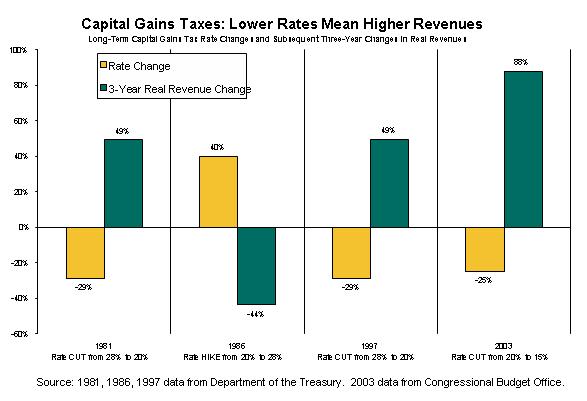
Posted by Ed Morrissey on July 31, 2007 11:38 AM | Comments (26) | TrackBacks (0)
CQ Radio: Private Equity And Public Health
Today on CQ Radio (2 pm CT), we'll have two great guests on two important policy issues. First, Phil Kerpen from Americans for Prosperity will join us to discuss the new tax increase floated by the Democrats. Kerpen will explain why this proposal will damage the American economy -- and how targeted tax cuts could generate the revenue that Congress seeks. In the second part of the hour, Dr. Scott Atlas joins us to discuss his participation on Rudy Giuliani's health-care policy team. Rudy's efforts on this are in the news today, as he pushes for private enterprise solutions rather than socialized medicine.
Call 646-652-4889 to join the conversation!
Did you know that you can listen to CQ Radio through your TiVo service? Click here for the instructions. Also, you can subscribe to CQ Radio through iTunes now by clicking this link:
Posted by Ed Morrissey on July 31, 2007 12:19 PM | Comments (0) | TrackBacks (0)
Why Democrats Are Different
The Wall Street Journal reports on what the Democrats have on their agenda before Congress takes its August vacation this year -- and it's not how they can reduce expenses. Instead, the Democrats have a raft of new and increased taxes for the American public, a few of which threatens to return us to the marginal rates of the Carter administration:
With a new Democratic majority, the agenda on Capitol Hill has shifted abruptly this year, and no more so than on taxes. For a decade the focus in Congress was which taxes to cut. Now everywhere you look someone running the Congress, or running for President, is proposing to raise taxes on some industry or group of Americans. ...It's all the more remarkable given that federal tax revenues as a share of GDP are currently above their modern historical level. The latest budget estimate is that fiscal 2007 revenues will reach 18.8% of GDP, compared to the 40-year historical average of 18.3%. Tax revenues this year are rising by nearly 8%, following increases of 11.8% in 2006 and 14.6% in 2005. The budget deficit is down to 1.5% of GDP, and falling. But apparently Democrats still think Americans are undertaxed.
It's quite a list, too. On CQ Radio today, Phil Kerpen deconstructed the capital-gains tax increase for hedge funds and private equity from 15% to 35%, the top marginal rate for personal income tax. Like most other capital gains, this income has already been taxed through the partnerships. However, despite the populist rhetoric coming from the Democrats on this topic, the primary investors that this tax will affect will be the limited partners who will wind up with smaller returns as the general partners absorb more of the revenue to cover the increased taxes. Those limited partners are in large part pension funds for teachers, police, and firefighters, as well as other unions and public employees.
But that's not where the Democrats stop with new taxes. As the WSJ points out, that's merely where it starts:
Elections have consequences, and the last one has large consequences for the American economy. Taxing foreign companies at a higher rate will have the effect of discouraging the expansion of foreign investment here in the US. For American workers, that means more outsourcing of jobs and a higher trade imbalance. How does that make America more competitive?
The higher taxation of oil leases seems especially backward at this moment. We're hearing nothing but "energy independence" from the Democratic presidential candidates. How do they think we'll accomplish that -- by discouraging domestic production? Now the workers who lose jobs when foreign companies pull out of the US can pay higher gas prices, too.
So far, the Democratic Congress has delivered on its promise to return to the economic policies of a previous Democratic administration. They just didn't mention that they meant the Carter administration.
Posted by Ed Morrissey on July 31, 2007 3:11 PM | Comments (30) | TrackBacks (0)
But They're Low In Tar!
Smokers have spent the last few years exiled to the outdoors in order to service their addiction during working hours. A new study in Australia might give them some company -- laser printers and copiers:
The office printer causes frustration when it isn’t working but it may be posing as much danger to staff as smoking a cigarette when it is, scientists in Australia said.An investigation into 62 laser printers revealed that 17 of them -- almost 30 per cent -- released high amounts of minute toner particles into the air.
Professor Lidia Morawska from the Queensland University of Technology, who led the research, said: “Ultra-fine particles are of most concern because they can penetrate deep into the lungs where they can pose a significant health threat. ...
The study, conducted in a large open-plan office in central Brisbane, showed that particles increased five-fold during working hours.
Emissions were worst when new cartridges were used, and when graphics and images which required larger quantities of toner were being printed.
The American Chemical Society's journal, Environmental Science and Technology, will publish the study later this week. It will reportedly include a list of popular printer brands with an index of emissions for each model. It will allow employers to select the lowest-emission choices for the work environment, as well as launch a million lawsuits around the world.
How did the researchers stumble on this gold mine for the legal profession? They actually wanted to test ventilation systems in offices to see how well they kept outdoor pollutants from nearby roads. When they began testing office environments, they didn't find disturbing levels of outdoor pollutants, but were surprised to see the printer particle levels reach levels "far higher" than anything from outside.
The researchers said that workers who spent months and years exposed to these high particulate levels could be at high risk for pulmonary diseases. Determination of the potential for Laserjet Lung will have to be conducted in further studies. However, don't be terribly surprised to see commercials soon that ask, "Have you worked near a laser printer for more than a few months? You may be owed compensation! Dial 800-SUE-HAPI for more information!"
Posted by Ed Morrissey on July 31, 2007 5:20 PM | Comments (13) | TrackBacks (0)
Senate GOP Caucus Caving On Earmarks?
The British newspaper The Guardian reports that the watered-down version of ethics reform will apparently get Republican backing after all in the Senate. Despite removing requirements for certification by chamber parliamentarians for earmark compliance, the elimination of searchability, and the restriction of the definition of personal benefit to an impossibility for enforcement, the Minority Leader and the Republican Whip both indicated that they would press the caucus to pass the bill:
Sen. Tom Coburn, R-Okla., said he will fight the bill because it ``guts key earmark reforms.'' He noted that, unlike a previously adopted version, it would allow the majority party's leaders - not the Senate parliamentarian- to rule on whether earmark disclosure requirements have been met in bills reaching the Senate floor.Dissident senators would not be able to challenge the ruling, but they could try to strike an unreported earmark by offering an amendment.
Senate Minority Whip Trent Lott, R-Miss., said some Republicans think a nonpartisan ``third party or parliamentarian'' should rule on such disclosure matters, but he stopped short of saying he would oppose the bill. ...
Senate Minority Leader Mitch McConnell, R-Ky., declined to say whether he would support the bill. He noted that an objection from Republican Sen. Jim DeMint of South Carolina - who shares some of Coburn's concerns - prevented House and Senate negotiators from working on a final draft in conference.
``As a result of that, none of our people were involved in the final product,'' McConnell told reporters Tuesday. ``But in a sense, we made it difficult on ourselves because one of our members prevented us from going to conference.''
So with the biggest Republican porker in the Senate answering search warrants from both the FBI and the IRS today, the GOP chooses today to shrug off the dilution of key earmark reforms? What's left on earmarks is almost useless, and earmarks have been at the heart of almost every major public corruption case over the last few Congresses.
That's not to say that the bill doesn't have other good points. It puts more pressure for disclosure of "bundling" contributions from lobbyists to political campaigns, for example, and it does require the reporting of earmarks 48 hours before a vote. However, it doesn't require that for conference reports, and it fails to provide the easy accountability that the previous version did -- the version that Democrats used to congratulate themselves on their new direction on ethics in January.
Mitch McConnell has done an especially good job as Minority Leader so far in this session. He must believe that opposing the bill in its current form would allow the Democrats to paint the GOP as opposed to reform. We need to demonstrate that we need real earmark reform, not another coat of varnish on the existing system -- and that fighting for real reform will win the confidence of voters in the long run.
Posted by Ed Morrissey on July 31, 2007 5:43 PM | Comments (20) | TrackBacks (0)
August 1, 2007
The Only Test Should Be Citizenship
Jonah Goldberg has a good sense of humor, and it comes across in his posts at The Corner, which tend to display his wry wit. That's why, when I read his column for yesterday's Los Angeles Times, I suspected he may have been kidding about competency tests for voting. If not, then Jonah has forgotten some painful civil-rights history:
Can you name all three branches of government? Can you name even one? Do you know who your congressman is? Your senators? Do you even know how many senators each state gets? If you know the answers to these questions (and you probably do because you're a newspaper reader), you're in the minority.In fact, the data have long been settled. A very high percentage of the U.S. electorate isn't very well qualified to vote, if by "qualified" you mean having a basic understanding of our government, its functions and its challenges. Almost half of the American public doesn't know that each state gets two senators. More than two-thirds can't explain the gist of what the Food and Drug Administration does.
Well, so far, so good. Jonah's point isn't that Americans are stupid, but that they are ignorant by choice about politics. Despite having instilled a love of democracy as a secular religious belief, the truth is that Americans don't go to the Church of Democracy as often as they could. They find politics boring, especially what the FDA does with its time -- until a medicine starts killing people, of course -- and consider politicians all alike.
Jonah also does a good job of skewering the notion that everyone should vote. In the first place, it wouldn't make that much difference. If one samples 50% of a population in a survey, the chances are that the other 50% will produce similar results -- and if that weren't true, then pollsters would be out of a job. Everyone should take more of an interest in self-government, inform themselves, and then vote, but as Jonah points out, they should follow that process in that order.
However, nothing should stop them from being able to cast that vote if they want, and this is where Jonah goes wrong. He suggests that states set up a comprehension test for the right to the franchise:
Instead of making it easier to vote, maybe we should be making it harder. Why not test people about the basic functions of government? Immigrants have to pass a test to vote; why not all citizens?A voting test would point the arrow of civic engagement up, instead of down, sending the signal that becoming an informed citizen is a valued accomplishment. And if that's not a good enough reason, maybe this is: If you threaten to take the vote away from the certifiably uninformed, voter turnout will almost certainly get a boost.
The answer to that is that we've done that in the past. In the wake of Reconstruction, several Southern states, with at least the acquiescence of the North, imposed "educational" requirements along with poll taxes to disenfranchise free blacks. Advocates of these policies argued that citizens should have to demonstrate literacy and a clear comprehension of the state constitution and government. In reality, both were used to deny blacks access to the ballot box, thanks to very flexible standards of what constituted a clear comprehension of the issues.
That doesn't mean that Jonah wants that used for the same purpose now. However, when government has the power to license the vote, it ceases being a right for citizens. When those in power decide to do evil, they can manipulate that licensing authority to strengthen their grip on power, and the citizens no longer have any means to purge them from office.
It's an idea that sounds good on the surface, but has terrible consequences. Even if Jonah wrote this with tongue in cheek, others have offered it seriously. It's an idea that shouldn't be lightly tossed aside -- it should be thrown out with great force (apologies to Dorothy Parker).
Posted by Ed Morrissey on August 1, 2007 6:11 AM | Comments (27) | TrackBacks (0)
Democrats To Wait Until September For Surrender Bill
Apparently the Democrats have resolved to wait until September to offer a withdrawal bill -- and John Murtha stomped off the floor when he learned about their plans. He had planned to offer a bill which would have required withdrawal to start within 60 days but not demand an end date, and the anti-war faction balked:
A proposal by Rep. John Murtha (D-Pa.) for the House to vote on withdrawal from Iraq without a timetable has been nixed, several lawmakers and aides said.The opposition of the Progressive Caucus also apparently doomed a proposal by Reps. Neil Abercrombie (D-Hawaii) and John Tanner (D-Tenn.) demanding a redeployment plan from President Bush. The measure will not get a vote this week.
Progressive Caucus lawmakers met Tuesday morning and agreed they would not support any Iraq measure that does not include a firm timetable for withdrawal. ...
“We don’t want to see any retreat,” a Progressive Caucus member, Rep. Jan Schakowsky (D-Ill.), said.
That kicks the withdrawal debate ahead to September, when Gen. David Petraeus is to issue a report on the success of President Bush’s “surge” plan. Many Republican lawmakers have said they will re-evaluate their support of Bush’s strategy based on the report.
They don't want to see any retreat? Oh, the irony. They want no surrender on their plans for a full and unconditional surrender on the battlefield. Does the Progressive Caucus take lessons in cluelessness?
The Democrats simply don't have the votes to proceed with the full-surrender plan, not even to get a majority in the House. They certainly don't have the votes in the Senate to get past a cloture test, and that means neither chamber could override a veto. It would only be another in a series of wasted efforts that keep Congress from accomplishing anything else, which the Democratic leadership has belatedly recognized as a problem in the 110th.
Moreover, their support for a complete bug-out has lessened, as the New York Times poll showed last week. Disapproval for the war dropped 10 points over the last two months. A majority still says we should have left Iraq alone, but it's down to 51% now -- and if the change in tactics and improvement in Iraq continues, those numbers may drop lower still.
The split in the Democratic caucus appears to have left them with little choice but to wait for the report from David Petraeus and the Iraqi command in September as first planned. If Petraeus shows real progress in securing Iraq and building a ground-up unity in Baghdad and the western provinces, they may have little choice but to give him even more time than that.
Posted by Ed Morrissey on August 1, 2007 6:46 AM | Comments (30) | TrackBacks (0)
Spectators At The Genocide
The UN will finally intervene in Darfur, thanks to a unanimous Security Council vote last night, but it will have a restricted mandate that will essentially do nothing. Up to 26,000 troops, primarily African, will deploy to Sudan over the next several months under the command of the UN, but will only have authority to use force while not "usurping" the Sudanese government:
The full force, the largest authorized by the U.N., will take about a year to muster and could cost $2 billion, said peacekeeping chief Jean-Marie Guehenno. He added that a substantial number of troops will arrive before year's end.Secretary-General Ban Ki-moon called the resolution "historic and unprecedented" and said it would help "improve the lives of the people of the region and close this tragic chapter in Sudan's history."
The resolution is the culmination of a 9-month-long fight with the Khartoum government over sending troops to Darfur, where Arab militias known as janjaweed have systematically attacked civilians and rival tribes since a rebel uprising began there in 2003. The government is accused of arming the militias, but it denies any links to the groups. ....
The final resolution narrowed the circumstances under which the troops can use force: to protect themselves, aid workers and civilians. It also pledged that the force would not usurp the responsibilities of the Sudanese government.
In addition, there was no mention of sanctions in the event Sudan did not comply, and the resolution said that the force could monitor illegal weapons present in Darfur, but not disarm rebels or pro-government militias, as originally drafted.
The problems in this agreement should be readily apparent to anyone who has paid attention to UN deployments in the past. They have suffered from an unwillingness to take action even when not restricted by these kinds of engagement limitations. Leaving the rebels and the militias armed and unmolested means that the UN forces will get dropped into a hot zone, where they have traditionally done more damage than good, as the remaining residents of Srebrenica can attest.
And let's not forget the track record of using African troops as peacekeepers under the UN banner. Almost every deployment has resulted in allegations of rape and molestation, with troops turning local women into prostitutes in exchange for protection and basic food and water. The UN has promised action to end this disgraceful performance for over three years. Will they keep the troops in line in Darfur? Or will this turn into another Congo, or for that matter, Burundi, Haiti, Liberia, and a host of other perverted debacles?
The new force will replace the current deployment by the African Union of 7,000 soldiers, who have gone unpaid for months. They have done little to slow down the genocide, but considering the lack of support, that may not be terribly surprising. The rules of engagement for the AU were even more restrictive than the UN's mission now. Neither mission looks terribly well suited for stopping a genocidal civil war, and given the Janjaweed's affiliation with the Sudanese government and their jihadist nature, the UN force will almost certainly be no more effective.
This agreement is a Band-Aid for Western sensibilities. It allows us to think that we're doing something significant, providing cover for the Sudanese government to continue their policies of genocide. We've just become spectators at the gruesome event. Some may argue that this is a first step, but it looks a lot like a meaningless gesture.
Posted by Ed Morrissey on August 1, 2007 7:15 AM | Comments (8) | TrackBacks (0)
Will Democrats Move On FISA Changes?
Democrats have decided that they have to support changes requested by the White House to the FISA law in order to protect vital national-security programs, the New York Times reports. They fear leaving themselves open to charges of being weak on terrorism as well as impeding vital signal intelligence efforts to keep the nation safe from another attack (via Memeorandum):
Under pressure from President Bush, Democratic leaders in Congress are scrambling to pass legislation this week to expand the government’s electronic wiretapping powers.Democratic leaders have expressed a new willingness to work with the White House to amend the Foreign Intelligence Surveillance Act to make it easier for the National Security Agency to eavesdrop on some purely foreign telephone calls and e-mail. Such a step now requires court approval. ...
In the past few days, Mr. Bush and Mike McConnell, director of national intelligence, have publicly called on Congress to make the change before its August recess, which could begin this weekend. Democrats appear to be worried that if they block such legislation, the White House will depict them as being weak on terrorism.
The Bush administration didn't just start calling for movement in the last few days. They agreed to place these efforts back under the supervision of the FISA court in January on the promise that the Democratic-controlled Congress would take action on these requests months ago. Instead, the Democratic leadership put them on the back burner while taking 108 days to authorize funding for the troops in Iraq and spending hundreds of hours on oversight hearings.
Now that the August recess approaches, the White House and the Directorate of National Intelligence wants some action. They have pressed Congress hard to take care of the nation's business sometime in between hysterical committee hearings and strategizing for surrender in Iraq. Given that this has been sitting on their desks for seven months with no action at all, the impatience seems particularly justified, especially considering the recent news of a serious uptick in terrorist communications.
The ACLU and other groups oppose the change in FISA, but all it does is rectify a technical problem that keeps the NSA from its core mission of monitoring foreign communications. Thanks to globalization and the power of American technology, carriers in the US now handle traffic that neither originates or destinates in the US. Unfortunately, current law requires the NSA to get a search warrant for traffic that passes through American switches regardless of origin or destination -- legislation crafted when American switches handled only American traffic. It will allow the NSA to operate more quickly to find and decode foreign traffic that passes through our systems, but not change the requirements for American traffic at all.
That seems like a very reasonable request, and one that should not take seven months to understand and process, especially in a time of war. It's hard to connect dots when Congress won't let the NSA find them.
Posted by Ed Morrissey on August 1, 2007 7:42 AM | Comments (4) | TrackBacks (2)
Sudan Vs Iraq?
Earlier, I pointed out the folly of the new UN mission to Sudan. The force is too small, the mission too narrow, and the rules of engagement too restrictive to accomplish anything other than provide a sideshow for the genocide. Also, the history of UN peacekeeping forces in that region more than suggests that the troops themselves will perpetuate some of the unsavory practices on the victims that the UN wants to end.
Putting those issues to one side for a moment, the UN and the advocates of this intervention have for the most part railed against the American presence in Iraq. At Heading Right, I look at the prevailing arguments for the futility of our mission in Iraq and for complete withdrawal there, and compare it to the situation in Darfur. Which mission has the best chance for success?
Posted by Ed Morrissey on August 1, 2007 8:42 AM | Comments (0) | TrackBacks (0)
Now They Tell Us
Last year at this time, the world watched as Israel tried to drive Hezbollah out of the sub-Litani region in a large but tentative invasion of Lebanon. Leaders from the UN and the West worked tirelessly to restrain Israel, finally brokering a truce to end the fighting. According to a Hezbollah officer, it came just in time to save the Iranian-backed terrorists from a complete collapse:
"The cease-fire acted as a life jacket for the organization [at the end of the Second Lebanon War]," a Hizbullah officer said in an interview aired by Channel 10 on Tuesday.In the interview, the unnamed officer said Hizbullah gunmen would have surrendered if the fighting last summer had continued for another 10 days. ...
The officer shown on Channel 10 said the organization's gunmen had been running low on food and water and facing rapidly diminishing arms supplies.
It turns out that Hezbollah miscalculated the ability of the Israeli military to react to rocket fire. The act of launching a rocket almost always resulted in the destruction of the launchers -- which prompted Hezbollah to relocate to civilian areas. In that way, the Hezbollah officer said, they knew that the Israelis would hesitate to return fire for fear of the civilian casualties it would create.
This shows the folly of both the IDF's initial limited incursions and the global meddling that followed. Had the Israelis hit the sub-Litani region with everything it had once the decision to make war had been made, Hezbollah would not have had those ten extra days at the end. The vacillation apparent through most of the operation would have given way to lightning-fast gains and the elimination of vast swaths of Hezbollah operations in the south -- and likely to their destruction as a political force in Lebanon.
Once the Israelis finally let loose, however, the world should have allowed them to finish the job. Only the most dense refuse to recognize that Hezbollah acts as a proxy for Iran and Syria. Their destruction would have stripped both regimes of a crucial tool in their efforts to dominate the region and provoke war with Israel, as happened in this instance. Instead, the kibbitzing let Hezbollah off of the ground and gave Iran and Syria an important strategic victory from a tactical disaster.
The next time they provoke a war on the Lebanon border -- and it will likely come soon -- neither Hezbollah nor its sponsors will make the same mistakes again. This was an opportunity lost.
Posted by Ed Morrissey on August 1, 2007 10:29 AM | Comments (6) | TrackBacks (0)
McConnell To Force Consideration Of Southwick
A source on Capitol Hill tells me that Senate Minority Leader Mitch McConnell plans to force consideration of Judge Leslie Southwick's nomination to the appellate court in the next few minutes. Stay tuned!
UPDATE: It looks like the debate on this has already started. Pat Leahy is arguing that the Republicans have not asked him to put Southwick's nomination on the agenda, but that he has done so for tomorrow anyway. He says Republicans "pocket vetoed" 61 Clinton administration appointees, and used one of them -- unnamed -- to accuse them of racism.
UPDATE II: McConnell introduced an amendment asking for the sense of the Senate on Southwick's nomination. McConnell apparently wants to show that Southwick would gain a majority for his confirmation on the Senate floor.
Posted by Ed Morrissey on August 1, 2007 11:06 AM | Comments (7) | TrackBacks (0)
Happy Anniversary, Rush
The man who helped create the market for conservative talk radio celebrates 19 years in the business today. Rush Limbaugh has changed broadcast radio history and continues to produce the most popular political talk show in America after all these years. He's opened up doors for conservatives that had been shut tight before he appeared on the scene and transformed talk radio.
Besides that, he's a good friend and a great guy. Thanks again, Rush, for all you do. Happy anniversary, and many more ahead, we hope. (via The Corner)
Posted by Ed Morrissey on August 1, 2007 11:21 AM | Comments (10) | TrackBacks (0)
Obama: Let's Pull Out Of Iraq And Invade Pakistan (Update: Obama's Website Emphasizes Punitive Invasion)
Democrats have been demanding a withdrawal from Iraq for the past two years, and Barack Obama knows exactly what he'll do with the troops once they withdraw. He'll send them on an invasion of Pakistan:
In a strikingly bold speech about terrorism scheduled for this morning, Democratic presidential candidate Illinois Sen. Barack Obama will call not only for a withdrawal of U.S. troops from Iraq, but a redeployment of troops into Afghanistan and even Pakistan -- with or without the permission of Pakistan President Pervez Musharraf."I understand that President Musharraf has his own challenges," Obama will say, according to speech excerpts provided to ABC News by his campaign, "but let me make this clear. There are terrorists holed up in those mountains who murdered 3,000 Americans. They are plotting to strike again. It was a terrible mistake to fail to act when we had a chance to take out an al Qaeda leadership meeting in 2005. If we have actionable intelligence about high-value terrorist targets and President Musharraf won't act, we will." ...
In many ways, the speech is counterintuitive; Obama, one of the more liberal candidates in the race, is proposing a geopolitical posture that is more aggressive than that of President Bush. It comes at a time in Obama's campaign when the freshman senator is drawing more financial support from more voters than any other candidate, though he has yet to vault from his second-place position in the polls. One of the reasons for that is that the Democratic front-runner, New York Sen. Hillary Clinton, is seen as more experienced and in some ways stronger, a perspective Obama wishes to change.
One would hope that this would mark the end of Barack Obama's credibility as a presidential candidate. Given the other options available in the campaign, it probably won't. Too bad -- because of all the war plans floated by the Democrats in this primary campaign, this is easily the stupidest of all, and that includes Joe Biden's "Three Iraqs" policy.
One of the reasons that Democrats insist that the war in Iraq was a mistake was because it unnecessarily radicalized Iraqis into jihadists. What does Obama think an invasion of Pakistan will do to its population? And if the former was a mistake, consider that Pakistan has a population of over 160 million people. How does Obama think they will react to a military invasion by a putative ally?
Those are just the political considerations. If we march across the border of a sovereign nation without their permission, that's an act of overt war. Pakistan has nuclear weapons, and would be likely to use them in a last extreme. They could certainly shoot tactical nukes at our Navy ships that would have to support an invasion force. They may also be inclined to use them against our new ally, India, in the case of an invasion.
Not to demean Obama's vast military expertise, either, but has he looked at a map of Pakistan? It's shaped like a wedge, with the base on the Arabian Sea and the Waziristan region almost the farthest point from the water. How does Obama propose to create lines of communication for an invasion? Right now we rely on Pakistan for overflight to Afghanistan to supply our troops for the fight against the Taliban there. General Obama would eliminate those lines of communication overnight, leaving the invasion force critically isolated -- unless he thinks we can start resupplying Afghanistan through Iran.
Only an idiot would invade Pakistan from the north, if at all. Any war against Pakistan would have to seize the Arabian Sea ports first, and then roll through the center of Pakistan -- where all of the formerly moderate Pakistanis would have lived -- to get to a mountainous region that Pakistan itself has hesitated to engage.
And did we mention that Pakistan has a potential mobilization of 39 million troops?
Frankly, the only idea worse than invading Iran is invading Pakistan. One might expect a serious presidential candidate to avoid looking like an idiot while provoking an ally that still helps more than he hurts in that region. Obama seems determined to prove himself unserious.
UPDATE: Michelle Malkin has some reaction to Obama's saber-rattling.
UPDATE II and BUMP: To those insisting that this is nothing different than what Bush and Rumsfeld proposed -- using covert teams to infiltrate across the border -- let me quote directly from the news report that the Obama campaign chose to highlight on its website:
The Illinois senator warned Pakistani President Gen. Pervez Musharraf that he must do more to shut down terrorist operations in his country and evict foreign fighters under an Obama presidency, or Pakistan will risk a U.S. troop invasion and losing hundreds of millions of dollars in U.S. military aid.
That's definitely not the same as what Rumsfeld considered and rejected in 2005. It's a declaration of war, pure and simple.
Posted by Ed Morrissey on August 1, 2007 11:59 AM | Comments (123) | TrackBacks (4)
CQ Radio: Energy Independence, Michael Mannske
Today on CQ Radio (2 pm CT), we have two excellent guests. In the first half, we'll talk with Sara Banaszak, API's senior economist, about the proposed taxes on oil licenses in the Gulf of Mexico and how that will affect gas prices and the efforts for energy independence -- as well as any questions you may have. In the second half, author Michael Mannske joins us to talk about his new novel, Foreign and Domestic: Campaign II--Battle for the Middle States
UPDATE: I'll also ask Ms. Banaszak about Rolling Stone's explosive article on ethanol. It's interesting; I'll blog about it later tonight.
Call 646-652-4889 to join the conversation!
Did you know that you can listen to CQ Radio through your TiVo service? Click here for the instructions. Also, you can subscribe to CQ Radio through iTunes now by clicking this link:
Posted by Ed Morrissey on August 1, 2007 12:12 PM | Comments (2) | TrackBacks (0)
I Obviously Needed More Coffee Today
Apparently, I miscoded something on my CQ Radio post which made everything else fail out. I've fixed the problem, and the rest of the site should be accessible now. I apologize for the inconvenience.
Posted by Ed Morrissey on August 1, 2007 1:36 PM | Comments (4) | TrackBacks (0)
Free Speech Vs Prior Restraint
The Muslim special-interest group CAIR has attempted to intimidate the Young America's Foundation into cancelling a speaker at their conference this week. Reacting to frequent CAIR critic Robert Spencer's invitation to address their National Conservative Student Conference, CAIR's attorney demanded that the event get shut down:
You should be aware that Mr Spencer, a well-known purveyor of hatred and bigotry against Muslims, has a history of false and defamatory statements. Several of those statements have falsely accused CAIR of activity that would constitute a federal criminal offense.
Interestingly, the attorney (Joseph E. Sandler) never actually produces the supposedly false statements, nor indicates when or where Spencer supposedly made them. Nevertheless, Sandler demands that Spencer be silenced:
For those reasons, we demand that YAF cancel the subject session, or else take steps to ensure that false and defamatory statements are not disseminated at that session.
This seems to be the main strategy of CAIR -- to sue people into silence. Let's not forget that CAIR also supported the Flying Imams and their efforts to sue the people who complained about their suspicious behavior to airline and security personnel here at Minneapolis-St. Paul International Airport. Now they want to threaten legal action against their critics in order to intimidate them.
If Spencer has slandered CAIR or its members, then why hasn't Sandler already sued Spencer? Could it be that CAIR might have more to fear from airing these issues in court and under oath than Spencer? It certainly looks that way. This letter is the typical bluster one would expect from a frightened bully with enough scratch to hire an attorney with a laser printer.
Instead of using these tactics of intimidation, CAIR could have simply asked to have time to rebut Spencer at the YAF event. That way, they could address Spencer's supposed untruths in real time, and would have engaged young conservatives in a positive manner. A group that believes in freedom and liberty would have used their freedom of speech to enlighten the attendees, instead of attempting a prior restraint of speech that silences the normal and healthy voices of criticism in a free society.
YAF has reassured Spencer that his invitation to speak remains open. At least they understand the value of free speech.
Posted by Ed Morrissey on August 1, 2007 3:37 PM | Comments (16) | TrackBacks (1)
Pray For The Twin Cities
One of the most-traveled freeways in the Twin Cities -- a span over the Mississippi River -- collapsed about an hour ago. At the time, the highway had bumper-to-bumper traffic in the middle of rush hour, and dozens of cars have gone into the river or been caught in the rubble:
The Interstate Hwy. 35W bridge over the Mississippi River collapsed during the evening rush hour Wednesday, dumping at least eight cars and a truck into the water and onto the land below, creating a horrific scene of damage, fire, smoke, injuries, frantic rescuers and terrified motorists.It was not clear how many people might be hurt or killed, but witnesses said at least 20 cars were involved.
The crumpled green wreckage of the bridge lay on the east bank of the river, and a huge section of concrete roadway lay on the west bank. Down below in the river gorge, rescue workers scrambled to help people on the roadway that now lay in the gorge. Fires burned and black smoke rose billowed the wreckage.
I have spent the last half-hour finding my son, daughter-in-law, and granddaughter. They're OK, and now we have to wait to see who isn't. I'll be updating this as more details become available.
7:18 PM CT: No fatalities yet, but some of the injured have gone to Hennepin County Meical Center.
7:25 - A safety engineer who had no involvement in the bridge noted that it had some minor cracking in 2001, but it had been given a clean bill of health both then and in 2006. The state had been doing some work on the deck, but nothing that should have disturbed the structure of the bridge.
7:29 - A school bus for a youth group is on the bridge. The word is that some of them were injured, but that all of them made it out of the bus. The bus is adjacent to a truck whose cab is obviously crushed, and that looks very bad indeed.
KSTP reports that the people on the bridge who were uninjured did not run off the bridge -- they went from car to car to look for the injured and give them assistance.
7:40 - At WCCO, a witness says that there are "quite a few deceased," which doesn't surprise me, considering the extent of the collapse. The link takes you to a slideshow of the collapse; I'm not sure of the source.
7:45 - John Hinderaker notes that he's been on that bridge hundreds if not thousands of times. I've been on it dozens of times myself; if you drive through Minneapolis, you can hardly avoid it. Michelle Malkin also notes that the Department of Transportation will have a press conference at 8:40 local time.
I agree with John on another point -- bridges like these don't collapse in the US, especially when they're only 40 years old. It's hard to say what could have brought it down, but hopefully the DoT will have more information.
7:53 - The choppers have been ordered out of the area; we're going to get severe thunderstorms blowing through the city, right over the collapse. The timing could not possibly be worse. Rescue workers cannot operate in the river while lightning remains a danger.
8:01 - HCMC is about to hold a press conference in a few moments. It sounds like they will have some word on injuries, and perhaps on fatalities, too. CNN apparently is reporting three deaths so far.
8:07 - US Internet has unlocked their Wi-Fi in the Minneapolis area so that people can contact their families. Kudos to them for their community spirit.
8:14 - One confirmed fatality at HCMC, six critical cases out of sixteen brought there. The one death was a drowning.
8:19 - One thing that people need to keep in mind about the Twin Cities is how small they are, comparatively speaking to other major cities. Combined, the two cities only have a population of 650,000, and the entire metro area is only 2.5 million people. Given the likely number of people injured and perhaps killed in this tragedy, this will touch many, many families here in this area.
8:30 - The DHS says they have no indication at all that this could be terrorism:
The U.S. Department of Homeland Security in Washington said there was no indication of terrorism in the disaster."There is no indication of a nexus to terrorism at this time," department spokesman Russ Knocke said.
I didn't think it was. No one mentioned any explosions, and we've heard plenty from witnesses. I'd almost wonder if we had some sort of earthquake, or whether a barge hit one of the supports in the river.
8:36 - Noah at Blanked Out was there; the bridge was right by his house. He said the bridge went down "so very slowly". Glad Noah's OK.
9:01 - Still waiting for a DoT briefing. Our friends at the University of Minnesota Medical Center, where the First Mate has had three transplants, handled 33 patients with no fatalities, and most were walk-ins. So far, we've only heard one confirmed drowning, but with the number of cars in the river, I think we can expect more drownings.
Also, Senator Norm Coleman spoke with the Secretary of Transportation, who says the last federal inspection of the bridge was in 2004. This bridge formed part of Interstate 35W, which means that the federal government has oversight over bridge maintenance as well.
9:12 - Mayor R.T. Rybak told WCCO that six people have died. That number is still not confirmed, nor is anyone thinking it will be final.
9:15 - Here is the abstract from the March 2001 report on the bridge, which can be seen here in its original state; note that the bridge did not have river supports, so the barge theory would not be applicable here (h/t CQ commenter LifeTrek). Interesting excerpt:
Researchers monitored the strain gages while trucks with known axle weights crossed the bridge under normal traffic. Researchers then developed two-and three-dimensional finite-element models of the bridge, and used the models to calculate the stress ranges throughout the deck truss. The bridge's deck truss has not experienced fatigue cracking, but it has many poor fatigue details on the main truss and floor truss system. The research helped determine that the fatigue cracking of the deck truss is not likely, which means that the bridge should not have any problems with fatigue cracking in the foreseeable future. As a result, Mn/DOT does not need to prematurely replace this bridge because of fatigue cracking, avoiding the high costs associated with such a large project.
One construction worker remains unaccounted, WCCO reports now.
9:34 - James Lileks is keeping an eye on the updates as well, and contributing his own unique voice to the coverage. Best point: "Sixty children on the bus. Sixty children alive. There’s chance, and there’s miracles. Take your choice."
9:36 - Did I tell you how I first found out about this? My father called me from California, where he caught the breaking news bulletin. That set off a round of frantic calls, trying to find my son and his family, who live nearby and use that bridge often. It took a very long half-hour to find them, but it ended well for us. We're praying for those who won't be as lucky.
9:38 - One more point about the construction work that was being done -- it's very routine stuff for the Twin Cities. We joke out here that we have two seaons, winter and Road Construction. The ravages of ice, snow, gravel, and salt have to be remedied on a regular basis. That kind of work would almost certainly not have created the kind of failure we saw today.
10:08 - Norm Coleman's on KSTP now. As soon as he found out about it, he started reaching out to the DoT and NTSB, and making arrangements to come out here. He wants to see a "full forensic review" into the collapse immediately. He confirmed that the 2004 inspection showed no problems, and that the annual reviews since raised no red flags. The NTSB will handle the federal review; it's the same agency that investigates airplane crashes.
10:27 - The first responder press conference is going on now. Nothing unexpected; they have a lot of resources applied to the crisis, and gave out a number of ways to access it. They still think they can find survivors, but "the likelihood is getting slim". They also have to watch that debris floating downriver doesn't damage other bridges that do have supports in the water.
10:34 - Seven people confirmed dead so far, and they expect that number to increase. KSTP has a former transportation secretary saying that 40-50% of the bridges here in Minnesota have significant deficiencies. On that happy note, I'll call it a night.
Posted by Ed Morrissey on August 1, 2007 7:02 PM | Comments (54) | TrackBacks (9)
August 2, 2007
Death Toll To 9 As We Wait For Sunrise
The morning after the bridge collapse in Minneapolis, authorities await sunrise to continue their efforts to search the wreckage for any unaccounted victims. By this time, most expect this to be a recovery rather than a rescue effort, and the death toll has risen to nine, and twenty people are known to be missing:
Nine people were confirmed dead as of 4 a.m. today. Sixty were taken to hospitals and 20 people were still missing this morning. Authorities said they expected the death toll to rise.Hennepin County Sheriff Rich Stanek told the Associated Press at about 1 a.m. today that all search efforts had been called off for the night and that searchers did not expect to find any survivors.
"It's dark, it's not safe with the currents in the water and the concrete and rebar," he said. "At this point it is a recovery effort."
The "missing" figure may underestimate the people left to be found in this collapse. Bridge collapses differ from some other catastrophes in that no manifest exists. The missing only get identified by people expecting to hear from family or friends. It means we will not know the extent of the human tragedy until later, perhaps days from now. It's more like a tornado in that sense.
Minneapolis-area residents face a more mundane issue as well: how do they get to work today? The 35W freeway is the major artery going through the center of Minneapolis. There are ways around it but nothing that has the same capacity. It will take years to replace this bridge, especially given the investigation that will have to take place to determine why it collapsed after only 40 years of service.
And yet, knowing this town like I do, I know that few people will complain about any of it. No one has any thoughts for anything but the victims right now. No matter what inconveniences lay ahead, every single one of us who have driven on that bridge will know we could have been on it when it went down. A detour or two, even for the long time they will be necessary, will pale in comparison to the losses of our friends and neighbors.
Posted by Ed Morrissey on August 2, 2007 5:55 AM | Comments (2) | TrackBacks (0)
Was The Bridge Deficient?
Normally, in the wake of a catastrophe, the details become clear only slowly and fitfully. Last night we heard that the 35W bridge had passed all of its inspections and that the collapse completely surprised everyone. Today, the Pioneer Press reports that inspectors had warned of a problem with this particular bridge, although the state overall had done an excellent job in bridge maintenance:
Bridge inspectors had noted structural problems over the years in the Interstate 35W bridge over the Mississippi River that collapsed Wednesday evening, but it was unclear whether obvious warning signs had been ignored. ...In 2005, inspectors from the Minnesota Department of Transportation deemed the bridge "structurally deficient," in data submitted to the Federal Highway Administration's National Bridge Inventory.
Inspectors gave the bridge a sufficiency rating of 50 percent on a scale of 0 to 100 percent. A rating of 50 percent or lower means the bridge might need to be replaced.
The condition of I-beams, girders and other components called "structural members" was rated four on a scale of 0 to nine. A rating of 0 means failed, nine means excellent. Inspectors look at these for signs of distress such as cracking, deterioration, section loss and malfunction and misalignment of bearings. The deck received a rating of five and the substructure rating was six.
The design of this particular bridge made its inspection an even greater necessity. It had a span of almost 500 feet with no struts. When it was built, the city did not want to impede river traffic; barges still carry agricultural goods south on the Mississippi River. Viewers of the television coverage will see that the newer bridge that paralleled the collapsed section had a different design, with a support in the center of the river, and one would expect the replacement to mimic that.
That long span relied more heavily on the engineering of the steel supports, and for 40 years, it worked. Yet the 2001 study by the University of Minnesota noted "many poor fatigue details on the main truss and floor truss system", the very portions on which the entire bridge rested. The same study also said that Minnesota probably would not have to replace the bridge in the near future. The Pioneer Press report suggests that later inspections reached a different conclusion, or at least gave a stronger warning of problems.
State legislators expressed surprise at that news. Rep. Melissa Hortman (DFL-Brooklyn Park) noted that Minnesota's Department of Transportation (MnDOT) never mentioned that to the state legislature. If MnDOT knew of a poor rating on this bridge, they apparently never considered it a high enough priority to ask for special funding for repairs.
It's a bit ironic, as Minnesota has a good record for bridge maintenance. The US Department of Transportation rated only 3% of Minnesota's bridges as "structurally deficient", which put us as the eleventh-best state in that efforts. Rhode Island, in contrast, has 23% of its bridges rated structurally deficient, and seventeen percent of Michigan's bridges have that rating.
More details will come in the days and weeks ahead. If someone ignored a warning on this, expect Minnesotans to demand some housecleaning.
Posted by Ed Morrissey on August 2, 2007 6:27 AM | Comments (6) | TrackBacks (2)
Bridge Collapse Caught On Security Video
UPDATE: Here's the video (via Hot Air):
CNN has the video from a security camera near the 35W bridge that catches the collapse. It shows it in the typical four-frames-per-second style of security video, but it quite clearly catches the sequence of the collapse.
The bridge appears to break, as one might guess from the pattern of the rubble, not in the center but as the span goes over the water of the river. The center section drops straight down, and the video briefly shows the cars that went down with it. A few seconds later, that first third of the bridge follows it down. In that first couple of frames, the steel structure buckles dramatically.
One point to note: it does not show the entire span of the bridge. The collapse could have started on the right of the camera, which is not shown. That would be the south end of the bridge; the video looks north across the river. So far, this has not been YouTubed, but if it does I'll post it here.
UPDATE: Here's MnDOT's picture at the edge of the collapse:
UPDATE III: Paul from Wizbang correctly notes that the video looks south, not north, which can he determined by the 10th Street bridge in the view.
Posted by Ed Morrissey on August 2, 2007 6:55 AM | Comments (21) | TrackBacks (3)
Pawlenty: Experts Did Not Warn Of Collapse
Tim Pawlenty just appeared on KSTP to answer questions about the bridge collapse yesterday afternoon. As I noted earlier, the Pioneer Press and other local news outlets have begun to report that the bridge had been rated as "structurally deficient", which would normally have flagged it for higher-priority maintenance or possibly replacement. Governor Pawlenty told KSTP that the experts had not recommended either:
Q: I understand that you're waiting to hear from President Bush. What kind of federal help do you expect to receive?A: We've received offers of help from the federal government, and I'm sure that will take the form of cash, assistance, and personnel. We have federal officials already on site, and more coming. But we just want everybody to know across the country and across Minnesota that our thoughts and prayers are first and foremost with the families who have lost a loved one, somebody that was injured; we want them to know that we are thinking of them. We're also proud of the first responders, bystanders, and good samaritans that helped out in the minutes and hours after this event. It was an amazing response. ...
[skipping silly exchange on personal impact of the images]
Q: From your briefings with public safety officials, do they know yet -- do they have a handle on the number of missing? We keep hearing 20, Mayor Rybak said it's 20. What are you hearing?
A: Well, we don't know for sure. The best estimates we're getting are -- originally, we heard that it may be 20 to 50, now we're hearing that it may be closer to 20. We don't know for sure, it''s probably at least 20. It could be somewhat higher than that, Tom.
Q: They've also lowered the confirmed death toll from 7 to 4. Are you aware of that, and if so, do you know why they've done that?
A: I was just informed of that, but I was somewhat perplexed, because just last night, they had certified, or I should say confirmed, seven fatalities. I can't explain why it would be reduced overnight. ....
A: We had this bridge inspected in 2005 and 2006, and while there were some deficiencies noted, they did not call for closing or replacing the bridge immediately. This is a situation where had the engineers done that, obviously the bridge would have been closed. But that's not the case. The designation that this bridge has is shared by 80,000 other bridges in the country, and some bridges even have a worse designation. These deficiencies did not rise to a level of closing the bridge or repairing or replacing it immediately, in the eyes of the experts who looked at it in the inspections.
Obviously the contents of those inspections and the recommendations made will be the center of the focus for this investigation. If the inspectors missed the structural degradation that caused this collapse, then the state and federal DoTs will come under heavy fire. If the reports recommended action that did not get taken, the political leadership of both parties in Minnesota will be answering angry questions from their constituents. It sounds as though the lines are already being drawn.
Governor Pawlenty warned in the interview that it would take quite a while to remove the debris from the river and to get a new bridge designed and approved. It will take longer than a year to replace the collapsed structure, which will mean long delays and heavy frustration with traffic here in the Twin Cities. Today, though, it looks like many people have opted to take a day off to give the state some time to adjust.
Posted by Ed Morrissey on August 2, 2007 7:28 AM | Comments (20) | TrackBacks (2)
Bush: Federal Response Will Be "Robust"
President Bush made an obviously impromptu appearance just now to make a statement about the bridge collapse. He promised a "robust" federal response, not just in the recovery and investigation, but also in rebuilding the bridge. He didn't spend much time talking about details, other than to say that the Secretary of Transportation has flown to Minneapolis to ensure the best possible coordination with state officials already on the ground.
This shouldn't require a huge effort in those regards. This hardly compares to Hurricane Katrina, after all. It's a localized and comparatively small tragedy. It won't require FEMA, but it will require the resources of the NTSB for the investigation, and that has to be coordinated now.
Bush's statement did emphasize one point that has understandably been missed while we focus on rescue and recovery, although my clear-thinking radio partner Mitch Berg has already blogged about it. This section of the 35W freeway is very significant to the businesses in Minneapolis, and the Mississippi River has almost as much economic significance. We need to be careful to build the replacement bridge properly, but it needs to get rebuilt quickly. Some estimates put the replacement out to 3-5 years, which would create a harsh impact on jobs and small businesses located in the city.
Mayor Rybak is making a statement too, and he says, "Thank God this wasn't worse." Minnesotans are starting to finally grasp how bad this could have been -- and how bad it might have been, had Minnesotans not kept themselves from panicking in those first few minutes.
UPDATE: DoT Secretary Mary Peters is making a statement now. She praised the actions of the first responders and good samaritans, and pledged her efforts to support and coordinate the efforts to recover from the catastrophe. Peters also said that she has brought out highway-construction experts already to review what happened, and emphasized the need to replace the bridge quickly. She authorized the release of $5 million in emergency funds to Minnesota to address the traffic issues.
Posted by Ed Morrissey on August 2, 2007 9:51 AM | Comments (31) | TrackBacks (0)
To Dream The Impossible Dream
The Senate takes up ethics reform on the floor this morning, and given the overwhelming vote in the House yesterday, it seems certain to pass. The roll-call vote will take place this afternoon:
The Senate debated Thursday whether to make lawmakers disclose more about their efforts to fund pet projects and raise money from lobbyists, a move that reform groups say is overdue.Senate leaders said they hoped to win a showdown vote later in the day to end debate and ready the bill for final passage. A two-thirds majority is needed to end debate because the bill would change Senate rules, but a simple majority would suffice on final passage.
The measure "is the most sweeping reform bill since Watergate," Sen. Dianne Feinstein, D-Calif., said as the debate began Thursday morning.
That may be damning with faint praise. It had real teeth in its earlier version, especially on earmarks, but the conference process apparently did a lot of extraction on the upper and lower jaws. At Heading Right, I note that three Republicans plan on conducting a Quixotic attempt to derail the bill, and analyze what their chances are for success.
Posted by Ed Morrissey on August 2, 2007 10:41 AM | Comments (7) | TrackBacks (0)
It Shouldn't Happen Anywhere
National Review extended a kind invitation for an essay about the Minneapolis bridge collapse, and they have already published it on their web site. "Into The River" looks at the dynamics of the collapse here in Minnesota and looks at the road ahead:
Nevertheless, Minnesotans already want to know how the unthinkable happened to one of its most critical traffic structures. The power of the Digital Age started showing itself in the first hours of the tragedy. News organizations found reports on prior bridge inspections on the Internet, one of which noted the bridge “has many poor fatigue details on the main truss and floor truss system.” Other reports came to light shortly afterwards, including more recent inspections that classified the bridge as “structurally deficient.”State officials quickly clarified that engineers didn’t recommend any immediate action as part of those inspections, but the issue will not disappear quietly. Minnesotans have had a long-running debate over infrastructure funding. Two former Minnesota transportation officials appeared on local television to decry the neglect towards these systems over the last few years. The debate had mostly remained in the hallways of the capital, but we can expect a big political fight over this now, one that will involve tax policy and budget control as well.
As I wrote, this debate has mostly confined itself to the political class in Minnesota, but watch for a big debate about it now -- and not just here. With 80,000 American bridges classified as structurally deficient, as was the one that collapsed here, every state will have to answer for its infrastructure maintenance ... and Minnesota actually was better than most in that regard before this catastrophe.
Please read the entire essay, and let National Review know what you think.
UPDATE: Let's get some links going to local bloggers today:
Posted by Ed Morrissey on August 2, 2007 11:33 AM | Comments (19) | TrackBacks (0)
CQ Radio: Stephen Hayes on Dick Cheney
Today on CQ Radio (2 pm CT), Stephen Hayes joins us to talk about his new book, Cheney: The Untold Story of America's Most Powerful and Controversial Vice President
Call 646-652-4889 to join the conversation!
Did you know that you can listen to CQ Radio through your TiVo service? Click here for the instructions. Also, you can subscribe to CQ Radio through iTunes now by clicking this link:
Posted by Ed Morrissey on August 2, 2007 1:00 PM | Comments (0) | TrackBacks (0)
Who Was On Bush's List For VP Candidates?
If you missed today's CQ Radio show with Stephen Hayes, you missed a great piece of fascinating history. Hayes, author of Cheney: The Untold Story of America's Most Powerful and Controversial Vice President, talked at length about the selection process that put Cheney on the ticket with George Bush in 2000. Cheney had not told Stephen who else had been considered for the position while Cheney headed the search committee prior to his own selection, but the biographer managed to find out through other channels -- and in an inadvertent exclusive, Hayes told me that one of the names was ... Chuck Hagel.
If you listen to the interview, Stephen puts it into good context. Hagel has a long history of conservative votes, and at the time was considered a comer in the GOP. Imagine the ways in which history may have changed -- and how that would have affected the 2008 primary race for the Republican nomination. Be sure to catch that exchange in the show's podcast, as well as the rest of the show with Stephen.
Posted by Ed Morrissey on August 2, 2007 3:00 PM | Comments (4) | TrackBacks (0)
Recovery Suspended; Inspections Ordered
The fast-moving waters of the Mississippi River have hampered the recovery efforts at the collapsed bridge in the center of Minneapolis, and the operations have been suspended. Also, Governor Tim Pawlenty ordered fresh inspections of all state bridges with similar construction:
Divers were pulled from the murky and fast-moving waters of the Mississippi River Thursday afternoon before any bodies could be recovered from the wreckage of Wednesday's I-35W bridge collapse.At about the same time, Gov. Tim Pawlenty ordered an immediate inspection of all Minnesota bridges that have a design like the one that collapsed Wednesday in Minneapolis. Pawlenty said he did not know how many bridges have that design. ...
The U.S. Army Corps of Engineers lowered the water level of the Mississippi by about 1 foot today in an attempt to give emergency workers better access to vehicles at the site of the bridge. The initial plan called for divers to approach four submerged cars that were clear of the ruined bridge. But the current and debris didn’t allow divers to get close to those cars.
The water level was adjusted by opening some of the roller gates downstream at the Ford dam, said Shannon Bauer, a Corps spokesperson. The dam controls the amount of water -- called a pool -- in the stretch of river where the bridge fell.
The drawdown began to create some turbulence at the rescue site, so it was temporarily suspended. In the early afternoon, they continued to lower the water level by one more foot.
Actually, the Mississippi River has a lower level than normal anyway, thanks to a bit of a drought in the Upper Midwest. That won't last, though; we're expecting thunderstorms and steady rain this weekend, starting tomorrow night. If the rain comes down in sufficient volume and force, it could mean big problems for the recovery efforts in the river.
The Congressional delegation which returned to Minnesota overnight has pledged to gain funding for a quick rebuilding effort. The bridge formed part of the federal interstate system, and the state's representatives united to request more than $100 million in emergency construction funds to get a fast start. Norm Coleman still warns that, even with emergency funding, it could take two years to replace the bridge and restore service to the core of the city.
While the number of confirmed dead remains at four, the number of injured has increased to 79. Police warn that a number of dead remain in the river, so we can expect bad news over the next few days. The number of missing has increased to 30, which sounds rather ominous, as that predicts what the final number of dead will be.
Until they can figure out how to beat the current, though, nothing can be determined. The normal current gets amplified as it passes through the debris, and it also creates eddies and patterns that put the divers in peril. They may have to raise some of the debris before the divers can get to the cars, but that will create all sorts of other dangers.
I'll have more as it develops.
UPDATE: Rep. Jim Oberstar (D-MN) will introduce a bill tomorrow authorizing $250 million for the construction of a replacement bridge. (via The Corner)
Posted by Ed Morrissey on August 2, 2007 3:52 PM | Comments (8) | TrackBacks (0)
Interviews Upcoming With Romney, Huckabee (Update: Audio Added)
Earlier today, NZ Bear from the Victory Caucus joined me in two interviews today with Republican presidential candidates. First, we had Mitt Romney for about ten minutes to discuss his new Surge of Support for military personnel and families. While I had him available, I asked him about Barack Obama's contention that he would send American troops into Pakistan if Pervez Musharraf didn't shape up. Romney laughed at Obama's bluster:
ROMNEY: I think Barack Obama has been demonstrating through his statements over the past several weeks a very limited understanding of the nature of conflict and diplomacy. Hillary Clinton, whom I rarely agree with, said that he's showing a naivete that is quite alarming I think naive is the right word in this case.
He had a few choice words for Obama's pledge to visit Fidel Castro, among others. Be sure to catch this interview later today.
Also, Mike Huckabee joined us immediately after we spoke with Governor Romney. The Arkansas Governor decried the "game show" aspects of all the debates, but offered this wisdom on the YouTube debate for the GOP:
HUCKABEE: [The YouTube debate] was in some ways more illuminating than some of the other ones that were supposedly serious, and here's why. If a person can handle themself when you have no idea what's coming, and you can think on your feet and respond without looking like the deer in the headlights, it shows some qualities that you really look for in a President. ... I've always felt that you can hit your best long ball off of a fast pitch.
Governor Huckabee, by the way, is a great interview precisely because he is so relaxed and confident while speaking extemporaneously. He had no problem indulging a sense of humor; you have to listen to the entire interview to find out why we broke out into a lighthearted discussion of the cultural meaning of the film Billy Jack, and why NZ needs some enlightenment.
I'll post both later today once I've finished editing them. Be sure to check back.
UPDATE and BUMP: We've decided to post the audio from the Romney interview at the Victory Caucus. It makes more sense in the context of the interview, and besides, it makes for a good reason to give the site a good look. Be sure to listen to the entire interview while you're there; it's only about 12 minutes.
The audio for Governor Huckabee can be downloaded here. It runs about 20 minutes, and the Governor shows why he remains one of the great undiscovered treasures of the presidential race. He has insight, humor, and an ability to communicate his conservative philosophy in an open and positive manner, as well as a refreshing no-BS style. Governor Huckabee knows how to have a little fun with his interviewers, as you will soon hear.
Posted by Ed Morrissey on August 2, 2007 4:21 PM | Comments (5) | TrackBacks (0)
Southwick Nomination Reported To Full Senate
The Senate Judiciary Committee finally voted to recommend confirmation of Judge Leslie Southwick to the appellate court this afternoon, on a 10-9 vote where Dianne Feinstein crossed the party line. Mitch McConnell's office sent out the following statement:
“With today’s vote to send Judge Southwick’s nomination to the Fifth Circuit Court of Appeals to the full Senate, the Judiciary Committee took a step forward in ensuring we are able to confirm qualified judges to our nation’s courts. Judge Southwick is an outstanding jurist, and a bi-partisan majority judged him on his record of service.“Judge Southwick, an Iraq war veteran, is superbly fit to continue serving his country, this time on the Fifth Circuit. His colleagues know this, as do his home-state senators. The American Bar Association knows this; it has twice given him its highest rating, ‘well-qualified.’ Even Democrats on the Judiciary Committee know this; just last fall all of them—again, all of them—looked at his record and approved him for a lifetime position on the federal bench. With today’s bi-partisan committee vote for Judge Southwick’s nomination, the full Senate should now move forward to his consideration on the Senate floor.”
Southwick can thank McConnell for this progress. Frustrated at the way Democrats reneged on their promise to move judicial nominations, McConnell took the unusual step of offering a sense-of-the-Senate resolution on Southwick's nomination, in order to embarrass Pat Leahy and show that he has majority support in the full Senate. Leahy added Southwick to the agenda, not without a lot of grumbling about McConnell's parliamentary tactics.
This is a rare bit of good news for the Bush administration. Southwick has defended his country and served well on the bench, and deserves confirmation. Thankfully, the Senate can get at least this much accomplished.
UPDATE: Be sure to read this post by the Generalissimo, Duane Patterson. Apparently, Chuck Schumer almost swallowed his face. He also points out that if Harry Reid tries to stuff the confirmation vote, he'll find comity at a microscopic level.
Posted by Ed Morrissey on August 2, 2007 5:22 PM | Comments (7) | TrackBacks (0)
CQ Media Alerts
I'll be making two appearances on radio shows this evening to discuss the Minneapolis bridge collapse story. First, I'll join Hugh Hewitt at 6:40 pm CT. Hugh will probably run with this story for most of his show.
At 9:35 pm CT, I'll be on The World Tonight with Rob Breakenridge on Calgary's CHQR.
Posted by Ed Morrissey on August 2, 2007 5:42 PM | Comments (0) | TrackBacks (0)
This Could Have Waited
It's not that I completely disagree with Nick Coleman in today's Star Trribune. In some ways, I agree with what he has to say. But was this the time to say this?
The death bridge was "structurally deficient," we now learn, and had a rating of just 50 percent, the threshold for replacement. But no one appears to have erred on the side of public safety. The errors were all the other way.Would you drive your kids or let your spouse drive over a bridge that had a sign saying, "CAUTION: Fifty-Percent Bridge Ahead"?
No, you wouldn't. But there wasn't any warning on the Half Chance Bridge. There was nothing that told you that you might be sitting in your over-heated car, bumper to bumper, on a hot summer day, thinking of dinner with your wife or of going to see the Twins game or taking your kids for a walk to Dairy Queen later when, in a rumble and a roar, the world you knew would pancake into the river.
No, it wasn't. First, we don't even know what caused the collapse. It might be better to wait on finger-pointing until we know where to point. What if the problem wasn't maintenance but design and overloading? That combination may be the problem, or it could be something else entirely.
And wouldn't it be better to wait until the bodies are out of the water to start screeching at the public officials who should be concentrating on the rescue and recovery efforts? I'd prefer to have MnDOT, Tim Pawlenty, and the NTSB focused on the job at hand, not answering a lot of questions about the meaning of "structural deficiencies" at the moment. There will be plenty of time for that later.
I actually agree with Coleman on a couple of points. The state and the cities should not be spending hundreds of millions of dollars on stadiums for the professional sports teams. That money should either get returned to the taxpayers or spent on legitimate government responsibilities. There is no doubt that infrastructure maintenance is a legitimate government function, and bridge maintenance should be one of the higher priorities in that arena.
But we can talk about all of this later, when the bodies are recovered and we know why the bridge fell. Screeching at the top of our lungs in support of our favorite hobby horses is not only counterproductive, it's a cynical exploitation of human tragedy. The Strib should be ashamed.
Posted by Ed Morrissey on August 2, 2007 6:37 PM | Comments (23) | TrackBacks (1)
August 3, 2007
King Of Pork Wins Again
The undisputed king of pork in the House has another championship trophy for his wall. Despite a game effort by Rep. Bill Young (R-FL), who actually got more earmarks into the upcoming defense appropriation bill, John Murtha outscored him on total dollars spent on protecting his incumbency. The King spent $150 million of our money on his pet projects:
Rep. John Murtha (D-Pa.), chairman of the House Appropriations defense panel, has secured the most earmarked dollars in the 2008 military spending bill, followed closely by the panel’s ranking member Rep. Bill Young (R-Fla.).Even though Young secured 52 earmarks, worth $117.2 million — and co-sponsored at least $27 million worth of others — Murtha’s 48 earmarks amount to a total of $150.5 million, according to a database compiled by the watchdog organization Taxpayers for Common Sense (TCS).
The House is expected to take up the $459.6 billion defense appropriations bill Friday. It contains 1,337 earmarks, costing $3.07 billion, which is less than half the number and value of earmarks in last year’s bill.
Ah, they don't really think that they can fool a Porkbuster, do they? The Democrats claimed that they had stripped all of the earmarks out of an earlier appropriation in the first weeks of the 110th, too. It turned out that they just wrote letters pressuring the agencies to spend the money on legislator's pet projects as if the earmarks existed in the bill.
The former chair of the Appropriations bill, Jerry Lewis (R-CA) won the Bronze Medal this time around. He has $95 million in earmarks, which qualifies him to be Murtha Lite -- all the arrogance with just two-thirds of the pork. The rest of Congress managed to get their share of the spoils as well; Nancy Pelosi has $37 million in earmarks, Steny Hoyer $26 million, and Norm Dicks (D-WA) got $44 million.
The King may have won another championship, but in this game, all the players win, regardless of party. It's a beautiful thing, baby .... unless you're a taxpayer. We're the only losers here.
UPDATE: Thanks to CQ commenter filistro for noticing that F-FL should have been R-FL.
Posted by Ed Morrissey on August 3, 2007 5:13 AM | Comments (6) | TrackBacks (0)
HP Responds To QUT Laser Printer Study
On Tuesday, I linked to a report from Australian researchers that found laser-printer particulates in high amounts in offices. The report suggested that laser printers could present a health hazard with such high levels in areas where people work long hours. I suggested that it sounded more like a great new market for personal-injury litigation.
Hewlett-Packard contacted me late yesterday and asked to respond publicly to the study here at Captain's Quarters. The statement comes from Tuan Tran, HP's Vice President of marketing for supplies:
After a preliminary review of the Queensland University of Technology research on particle emission characteristics of office printers, HP does not agree with its conclusion or some of the bold claims the authors have made recently in press reports.
HP stands behind the safety of its products. Testing of ultrafine particles is a very new scientific discipline. There are no indications that ultrafine particle (UFP) emissions from laser printing systems are associated with special health risks. Currently, the nature and chemical composition of such particles – whether from a laser printer or from a toaster – cannot be accurately characterized by analytical technology. However, many experts believe that many of the UFPs found in common household and office products are not discrete solid particles, but may be condensation products or small droplets created during thermal processes.
HP agrees more testing in this area is needed, which is why we’ve been active with two of the world’s leading independent authorities on this subject: Air Quality Sciences in the United States and the Wilhelm-Klauditz Institute in Germany.
Vigorous tests are an integral part of HP’s research and development and its strict quality-control procedures. HP LaserJet printing systems, original HP print cartridges and papers are tested for dust release and possible material emissions and are compliant with all applicable international health and safety requirements. In addition to meeting or exceeding these guidelines, HP’s design criteria for its laser printing systems incorporate guidelines from both the Blue Angel program in Germany and the Greenguard program in the United States.
Based on our own testing, HP knows that many variables can affect the outcome of tests for ultrafine particle emissions. Although HP is not aware of all of the specific methodologies used in the Queensland study, based on what we’ve seen in the report – as well as our own work in this area – we do not believe there is a link between printer emissions and any public health risk. Specifically, HP does not see an association between printer use by customers and negative health effects for volatile organic compounds, ozone or dust. While we recognize ultrafine, fine, and coarse particles are emitted from printing systems, these levels are consistently below recognized occupational exposure limits.
HP hopes to learn more from the study authors about how products were chosen for the study, how ranges were determined given no standards exist, and many other factors that could have influenced the results.
Posted by Ed Morrissey on August 3, 2007 5:29 AM | Comments (14) | TrackBacks (0)
Doesn't Sound Like A Funding Issue
MnDOT officials had concerns about the I-35W bridge over the Mississippi River last winter, focusing on the same fatigue and potential cracking that has grabbed the focus of the post-collapse coverage. Engineers debated whether to apply patches to the more worrisome points of fatigue, but in the end, opted to continue inspections instead:
Structural deficiencies in the Interstate 35W bridge that collapsed Wednesday were so serious that the Minnesota Department of Transportation last winter considered bolting steel plates to its supports to prevent cracking in fatigued metal, according to documents and interviews with agency officials.The department went so far as to ask contractors for advice on the best way to approach such a task, which could have been opened for bids later this year.
MnDOT considered the steel plating at the recommendation of consulting engineers who told the agency that there were two ways to keep the bridge safe: Make repairs throughout the 40-year-old steel arched bridge or inspect it closely enough to find flaws that might become cracks and then bolt the steel plating only on those sections.
Fears about bridge safety fueled emotional debate within the agency, according to a construction industry source. But on the I-35W bridge, transportation officials opted against making the repairs.
Officials were concerned that drilling thousands of tiny bolt holes would weaken the bridge. Instead, MnDOT launched an inspection that was interrupted this summer by unrelated work on the bridge's concrete driving surface.
In the rush to point fingers, we have heard from experts on local and national television about the neglect of our infrastructure. Our local crank at the Strib decided to write a column blaming everyone from Tim Pawlenty to David Strom for killing the victims of the collapse. Instead, it looks like the engineers at MnDOT simply decided that the bridge did not appear to have sufficient problems for immediate intervention.
That was not a question of money. MnDOT officials, according to the Strib, acknowledged that they had the money in the budget to pay for the suggested repairs. In fact, MnDOT was the agency that made the determination that the I-35W bridge would not need an overhaul or replacement until 2020. Those recommendations were forwarded to the state government, which didn't have any reason to reject the evaluations supplied by the MnDOT engineers.
This could explain why Pawlenty has decided to outsource the new bridge inspections. He announced yesterday that all Minnesota bridges would undergo an extra and immediate round of inspections. At the same time, he also announced that the state had hired a consultant firm to review the inspection process and to conduct inspections themselves.
Some still insist that it must have been all about money, but MnDOT itself insists that was not the issue. They did not want to risk the bridge structure by drilling the necessary holes in the girders that would have allowed them to rivet repair plates in place. They felt the situation was not critical and that the repair could have made the structure even more unstable.
It doesn't appear that money or neglect played a part in this collapse. It looks instead that MnDOT either didn't evaluate the bridge properly, or that the fatigue it noted didn't have anything to do with the collapse.
Posted by Ed Morrissey on August 3, 2007 7:11 AM | Comments (31) | TrackBacks (3)
Erasing History At The House (Update: Video Added)
The bitter partisanship in Congress will apparently get a lot worse after some shenanigans by Democratic leadership in the House last night. According to the Politico, the Democrats have not only attempted a revote after an embarrassing loss on an agriculture bill, but they've changed the records to expunge any mention of the vote they lost:
In a massive flare-up of partisan tensions, Republicans walked out on a House vote late Thursday night to protest what they believed to be Democratic maneuvers to reverse an unfavorable outcome for them.The flap represents a complete breakdown in parliamentary procedure and an unprecedented low for the sometimes bitterly divided chamber.
The rancor erupted shortly before 11 p.m. as Rep. Michael R. McNulty (D-N.Y.) gaveled close the vote on a standard procedural measure with the outcome still in doubt.
Details remain fuzzy, but numerous Republicans argued afterward that they had secured a 215-213 win on their motion to bar undocumented immigrants from receiving any federal funds apportioned in the agricultural spending bill for employment or rental assistance. Democrats, however, argued the measure was deadlocked at 214-214 and failed, members and aides on both sides of the aisle said afterward.
One GOP aide saw McNulty gavel the vote to a close after receiving a signal from his leaders – but before reading the official tally. And votes continued to shift even after he closed the roll call - a strange development in itself.
The rules exist for a reason -- to make sure that the House functions regardless of the rancor between its members. Once a vote has been gaveled closed, it becomes part of the record and should become official. Votes should not be changed after that point, nor should the entire record of the vote get expunged.
Democrats won the last election and have the responsibility to run the House according to the parliamentary rules established long beforehand. Even beyond that, they should feel some responsibility to act like adults. Removing a vote from the record after it has been taken should remind us of Josef Stalin and his attempts to rewrite history. Their actions undermine the very concept of democracy and parliamentary procedure.
Even the party in charge has to be bound by the rules. Democrats like to blather at length about how George Bush abuses his power and attacks freedom and liberty. This episode shows who the real totalitarians are.
UPDATE: Rep. Eric Cantor's response to the Democrats' wan "mistakes were made" apology:
Posted by Ed Morrissey on August 3, 2007 7:53 AM | Comments (45) | TrackBacks (4)
Another Do-As-I-Say Moment For Edwards
The man who decries the "Two Americas" while building a 28,000-square-foot mansion strikes again. John Edwards' presidential campaign has become so desperate that he has started running against Rupert Murdoch, who isn't running for office. He now demands that all of his opponents for the Democratic nomination pinky-swear that they will snub Murdoch and Fox News -- after Edwards took close to a million dollars from the man (via Memeorandum):
John Edwards, who yesterday demanded Democratic candidates return any campaign donations from Rupert Murdoch and News Corp., himself earned at least $800,000 for a book published by one of the media mogul's companies.The Edwards campaign said the multimillionaire trial lawyer would not return the hefty payout from Murdoch for the book titled "Home: The Blueprints of Our Lives."
The campaign didn't respond to a question from The Post about whether it was hypocritical for Edwards to take money from News Corp. while calling for other candidates not to.
In addition to a $500,000 advance from HarperCollins, which is owned by News Corp., Edwards also was cut a check for $300,000 for expenses.
Edwards now claims that he gave the proceeds of the book to charity. However, he hasn't produced any receipts to support that claim, and as the Murdoch-owned Post points out, that kind of donation would give Edwards some hefty tax benefits. His spokesman only says that the Edwards were happy to give Murdoch's money to the needy -- but that's hardly the same thing as refusing it in the first place.
Instead, he excoriated Democratic front-runner Hillary Clinton for accepting $20,000 in donations from Fox executives. While these donations would appear to provide evidence that Fox is not necessarily a bastion of right-wing activism as Edwards' paranoia would have it, Edwards somehow concluded that it meant Hillary was "trying to be friends with the very people trying to demonize the Democratic Party." Edwards pledged to return all similar donations, which in his case, amounted to less than $1000.
This shrieking only hopes to cover up a glaring hypocrisy on the part of Edwards. He had no trouble working with Murdoch's publishing empire when they dangled $800,000 in front of him. Had he found Murdoch so offensive, he could have taken his book elsewhere; it's not like another publisher would have hesitated to get the book. Edwards simply took the best offer and didn't care who wrote the check.
Edwards has transformed himself from an ambulance chaser to a substanceless suit, and now to a classless hypocrite. Even Ann Coulter can't save this embarrassment.
Posted by Ed Morrissey on August 3, 2007 9:11 AM | Comments (22) | TrackBacks (1)
A Day Out Of The House, Courtesy Of Comcast
I'm enjoying the relaxations of our local Panera restaurant and its free wi-fi service, courtesy of an area-wide disruption of service at Comcast. Today marks the first full month that I've had with Comcast's Triple Play, and until about 6:30 this morning, I was pretty satisfied with the switch.
Comcast had a couple of advantages. It could provide much faster Internet access and it saved me $60 a month over my combined Qwest and DirectTV bills. The picture isn't quite as crisp as with DirectTV, but I love the free on-demand video. The internet speed went from 500K to 6M, and it allowed me to finally start streaming video on my computer. (Before that, YouTube was a rare indulgence.)
Unfortunately, when something goes wrong, it really goes wrong with Comcast. The only problem before today was a bad TV box, which they replaced in two days with no fuss. Today, though, both the phone and the Internet service has gone completely out -- and that means I can't work from home, not even using my cell-phone backup for Internet access.
There's nothing wrong with an occasional day out of the office. However, I'm hoping that it remains occasional.
UPDATE 11:21 AM: Back home and the outage has been repaired. No word on the cause, but it may flake out again. If so, I already have a backup plan for today's CQ Radio show.
Posted by Ed Morrissey on August 3, 2007 9:37 AM | Comments (4) | TrackBacks (0)
Appellate Court Upholds Congressional Privilege In Reasonable Ruling
The DC federal appellate circuit has ruled a part of the FBI's raid on William Jefferson's Congressional offices unconstitutional. The three-judge panel ordered the FBI to return certain seized documents to Jefferson without accessing them. The Department of Justice warned that the ruling could put public corruption out of the reach of law enforcement, but a close look shows that the court made a specific and reasoned ruling that actually supports most of their position:
The FBI violated the Constitution when agents raided U.S. Rep. William Jefferson's office last year and viewed legislative documents, a federal appeals court ruled Friday.The court ordered the Justice Department to return any privileged documents it seized from the Louisiana Democrat's office on Capitol Hill. The court did not order the return of all the documents seized in the raid.
Jefferson argued that the raid trampled on congressional independence. The Justice Department said that declaring the search unconstitutional would essentially prohibit the FBI from ever looking at a lawmaker's documents.
It's a tough question. The executive branch has little business rummaging through Congressional documentation, just as Congress has little business demanding access to Presidential advisors. The balance of power rests on each branch's ability to clean their own house, and in this case, the House appeared incapable of doing so.
Still, one cannot fathom the concept of allowing Capitol Hill to become a safe house for corruption. Not even the court appears to have endorsed the concept that Jefferson's office itself was off limits. The ruling specifies only a portion of the evidence removed from Jefferson's digs, only those documents that the court itself has ruled "privileged".
That's why these disputes go to the courts for review. This appears, at least on its face, to be a reasoned and reasonable distinction by the DC circuit court. The raid itself has been upheld, and only the infringement on Congressional privilege has been rejected. We'll see if the Department of Justice decides to press its luck with the Supreme Court.
Posted by Ed Morrissey on August 3, 2007 10:00 AM | Comments (8) | TrackBacks (1)
Have You Seen My Wife, Mr. Jones?
Our community suffered a terrible blow this week when the I-35W bridge over the Mississippi collapsed on Wednesday afternoon. So far, we know of six people who have died, and the latest count of the missing portends at least another eight deaths. Dozens were injured, some critically, and the healing process will take years.
One of the comforts we have taken from the tragedy has been the remarkable heroism of our first responders -- police, fire, and paramedics -- as well as the ordinary citizens who risked their lives to rescue others when every instinct told them to run away. Their example has helped unify our community and exemplify the American impulse of individual effort and volunteerism. On the heels of that comes word that these heroes carried an additional burden -- taking the last words of the dying to their families:
The first moments after the Interstate 35W bridge collapse were harrowing - both for the victims and for those trying desperately to rescue them."There's people pinned, severely injured. We couldn't move them," said Minneapolis Police Chief Tim Dolan. "It was an obviously dangerous situation, (with) stuff still falling.
"The decision was made to leave them."
Some were trapped and dying - and little could be done, Dolan said.
"In one case, someone with serious injuries was able to say goodbye to his family," he said, and rescue workers promised to take the message back to loved ones.
It happened more than once, said Dave Hildebrandt, a paramedic supervisor from Hennepin County Medical Center who was at the scene.
"Some of the medics did witness people that died in front of them, a lot of children crying, a lot of chaos, a lot of disbelief," he said.
It's yet another heartbreaking episode in a tragedy that has left us raw here in the Twin Cities. We know about their valiant efforts to find the living and bring them to safety. Now we know that they had to do that as well as minister to those whom they could not rescue, who had to be left behind to die alone in the river.
It's absolutely heartbreaking. Not only for the families who lost their loved ones, but it's heartbreaking for the men and women who fought like hell to save everyone they could. Those last moments will haunt them, probably for the rest of their lives, despite laying their lives on the line like they did. This community will need to rally around them for the long haul.
Note: The title of this post refers to the first line of the chorus in the Bee Gees song, "New York Mining Disaster 1941", which appears to capture this moment better than anything else I know.
Posted by Ed Morrissey on August 3, 2007 10:21 AM | Comments (4) | TrackBacks (0)
Bridge Was In Bottom 100 Heavy-Use Bridges In US
The bridge that collapsed on the Mississippi ranked in the worst 100 heavy-use bridges in the US -- but still was deemed fit enough for full service The Pioneer Press reports on the apparent contradiction, which calls into question the assumptions on which bridge inspections are based:
The Interstate 35W bridge that collapsed Wednesday was not just "structurally deficient," it was among the 100 worst heavily used bridges in the country.It was also deemed perfectly safe.
How this bridge could have both labels at the same time seems to defy logic. But the contradiction goes to the heart of a complicated national bridge inspection program meant to ensure we can safely drive across the country's 709,000 bridges every day. ...
The I-35W bridge was in particular need of attention. In a comparison with about 4,000 similar bridges nationwide - those carrying more than 100,000 cars per day for a major highway, regardless of age - the I-35W bridge, as well as the Interstate 35E bridge over Cayuga Street in St. Paul, are in the bottom 3 percent in terms of their sufficiency rating, according to the U.S. DOT's National Bridge Inventory. ...
Dan Dorgan, state bridge engineer for the Minnesota Department of Transportation, said Thursday that the I-35W bridge's low sufficiency rating was mainly because of corrosion in the bearings, corrosion of the steel end joints and fatigue cracks. More recent inspections in 2005 and 2006 showed no evidence the cracks had grown or that more cracks had formed, Dorgan said. At that time, engineers characterized the bridge as "fit for service," Dorgan said.
This contributes to the sense of mystery as to why the bridge failed so completely. Engineers had last inspected the bridge on May 2nd to look at "minor concerns" about weld joints. No problems were found in that inspection, and MnDOT planned more inspections in the fall. Given the close looks in 2005 and 2006, it doesn't seem like MnDOT took its eyes off the ball, but they must have missed something.
An outside consulting firm, URS, apparently bolstered MnDOT's decision to opt for more aggressive inspections rather than repairs. Last summer it offered that as one of three options; the others were to install reinforcing plates or to combine inspections with the retrofits. The Pioneer Press indicates that aesthetics may have played a role in that decision, although it gives no actual source quotes for it.
Redundancy has also come up as a focal point in the debate. In 1967, when this span was finished, bridge design did not always include redundancy, and this bridge was no exception. Since its design was fairly unique -- with no center support in the river -- the inspections became all the more critical. Newer bridges do have redundancies in their design to prevent catastrophic failure from a single breach. This indicates that design may have more to do with the collapse than first thought.
The news that the bridge was among the 100 worst heavy-use bridges in America will shock Minnesotans, and it won't be limited to us, either. That list should be made public immediately so that action can be taken to prevent another collapse.
Posted by Ed Morrissey on August 3, 2007 11:25 AM | Comments (26) | TrackBacks (1)
CQ Radio: Duane "Generalissimo" Patterson
Today on CQ Radio (2 pm CT), Duane "Generalissimo" Patterson from the Hugh Hewitt show joins us to review the week's top stories. We'll talk about the bridge collapse here in Minneapolis, as well as the other hot stories this week, including last night's power grab by the Democrats in the House. I'll go over a couple of moments from my interview with Governor Mike Huckabee, too!
Call 646-652-4889 to join the conversation!
Did you know that you can listen to CQ Radio through your TiVo service? Click here for the instructions. Also, you can subscribe to CQ Radio through iTunes now by clicking this link:
Posted by Ed Morrissey on August 3, 2007 11:49 AM | Comments (0) | TrackBacks (0)
The Process Of Living
Now that the first couple of days have passed since the collapse of the I-35W bridge, and even while the recovery of victims remains incomplete, Minneapolis begins its adjustment to the loss of its major traffic artery. The loss will start impacting the community in unexpected ways. For instance, electric service may be disrupted to a good section of the area:
Xcel Energy has two cables in the area around the collapsed bridge and they serve the West Bank areas. Those two cables are operational now, Nystuen said, and the company has a contingency plan in place should they fail.The utility is also going to reroute cables away from the bridge area so that they will not be a factor in reconstruction. ...
The University of Minnesota has asked students and staff on the campus' West Bank to limit electricity use today and through the weekend as Xcel Energy works to respond to the collapse of the Interstate 35W bridge.
That's something that did not occur to me after the collapse. It makes sense for those services to run close to the bridges, even if just for easy demarcation. With all of the work needed to clear the debris, the cables could get cut and create new hazards for the recovery workers.
Traffic will be a major problem for the next couple of years until a replacement bridge can be built. Minneapolis city leaders have begun the process of determining how to increase the bandwidth of transportation options in the affected area. Business leaders will have to find ways to contribute to the solution. Where possible, employers should encourage virtual officing to decrease the traffic through the area. They can also encourage public transportation, but that may not buy much for employees who live farther away.
The new highway-turned-freeway, the 280, has already generated some controversy. Civic leaders do not care much for the solution reached by MnDOT -- closing some intersections and allowing for green lights all the way to the 36. I've driven this quite a few times (my son lives in that area) and it's not the most elegant choice, but MnDOT doesn't have many options. When traffic levels really start returning to the pre-collapse norm, MnDOT may have a big, insoluble problem with the 280.
Unfortunately, after tragedies come the vultures. The FBI wants to warn people about those now:
The FBI is cautioning people about responding to appeals for monetary contributions for a charitable organizations that come via e-mail.After large scale events such as Sept. 11, hurricanes Katrina and Rita, and the shootings at Virginia Tech University, several individuals with a criminal intent have used e-mails to ostensively collect money for charitable organizations, the FBI said.
After these kinds of catastrophes, people want to reach out and help, and often they can do that by donating money to organizations that help the victims. Too often, though, those good people become victims themselves of scam artists who exploit those good intentions for the scammers' personal profit. That also harms the original victims, who lose out on the generosity intended to assist them.
The article lists a number of ways in which to avoid being scammed, most of which comes down to this: do NOT trust e-mail solicitations. Check out any organization carefully before sending money. It may be better to trust established organizations like the Red Cross or Catholic Charities rather than unknown groups with little history and less transparency.
Minneapolis and Minnesota will face some difficult issues over the next couple of years. We will have to remain flexible and open-minded as we search for both short- and long-term solutions.
UPDATE: Be sure to check out CathyF's wise counsel on charitable giving in the comments.
Posted by Ed Morrissey on August 3, 2007 3:52 PM | Comments (4) | TrackBacks (0)
Not A Lack Of Funds, Part II
People have made a lot of assumptions in the wake of the bridge collapse here in Minneapolis. Without waiting to find out the actual cause of the collapse, politicians and pundits have assumed that governments on state and federal levels failed to properly fund infrastructure maintenance. One of the memes that has popped up has been that the war in Iraq has somehow drained funds from these responsibilities, offered in this instance by our freshman Senator, Amy Klobuchar:
U.S. Senator Amy Klobuchar, a Minnesota Democrat, suggested Bush administration spending on the Iraq war may have crimped funding for domestic projects such as road and bridge construction, and for such infrastructure projects as new levees for New Orleans."We've spent $500 billion (250 billion pounds) in Iraq and we have bridges falling down in this country," Klobuchar told MSNBC. "I see a connection between messed-up priorities."
Someone had "messed-up priorities" by exploiting this tragedy for her anti-war policies, certainly. Power Line punctures this meme and Klobuchar's idiocy by actually doing a little research. It turns out that the Bush administration and Congress increased federal highway aid to Minnesota by 46% in 2005, for the four-year period through 2009:
U.S. President George Bush signed a $286.4 billion six-year transportation reauthorization bill Aug. 10, 2005 that covers federal fiscal years 2004-09.Although the details of the reauthorization package are still being reviewed, Minnesota state and local governments can expect to receive about $3.5 billion in federal transportation funding through 2009, an increase of about 46 percent (or about $1.1 billion) over the previous six-year bill.
So where did this increase in funding go? 79% went to highway programs, the exact function that would have included maintenance of the I-35W span that collapsed. Had MnDOT wanted to repair or even replace that bridge, the federal funding given to them would easily have covered the cost. They could have built almost three of them with just the increase over the previous six-year funding that originated from the Clinton administration.
The funding for defense has not impacted the federal spending on highway infrastructure. One can argue whether we should increase it further, but we haven't cut the funding in the last few years. The cause of the bridge collapse was not a mythical funding cut or the Iraq war. Politicians and pundits should wait for the actual cause of the collapse before coming up with solutions, and they should focus those solutions on the problem at hand.
Posted by Ed Morrissey on August 3, 2007 5:10 PM | Comments (43) | TrackBacks (2)
August 4, 2007
And Now It's Oberstar's Turn
Yesterday, Senator Amy Klobuchar blamed the collapse of the I-35W bridge on a lack of highway funds -- even though the 2005 highway bill increased federal funding to Minnesota by 46% over its five-year span. Apparently realizing that line of argument wouldn't hold, Rep. James Oberstar accused MnDOT of being too cheap to use advanced technology for bridge inspections. He left out of his accusation that the technology hasn't proven itself for that purpose:
On the House floor Friday, U.S. Rep. Jim Oberstar, D-Minn., accused MnDOT of turning down an opportunity to use a $200,000 high-tech inspection technology on the bridge that might have detected a fatal flaw. ..."Technology can discover microscopic cracks not visible to the naked eye and then measure their propagation and do the same with bridges," he said on the House floor. "The Minnesota Department of Transportation was offered the opportunity to use that technology and I am disappointed that the state rejected the opportunity to use that technology to test the structural integrity of the bridge that collapsed." ...
John Schadl, Oberstar's spokesman, said the congressman mentioned the incident because he is frustrated by the lack of investment in new technologies, at both the federal and state levels. But Oberstar does not know whether the company's system would have detected any fatal flaws in the bridge.
"Nobody knows if this technology would have prevented this tragedy," Schadl said.
Precisely. And do you know why nobody knows it? Because we don't know why the bridge failed yet. We don't know whether this system works as promised, either. Why can't our Democrats in this state wait to find out what actually happened before leaping to conclusions as to what could have prevented it -- especially on the floor of Congress?
We certainly know that the $200,000 price tag would not have busted the MnDOT highway budget, considering that Minnesota is receiving $3.5 billion from 2005 to 2009. MnDOT says they haven't even heard about this new system. If they had, the money exists for its use, assuming it actually works. Then we'd have to assume it would have identified the reason the bridge failed -- a reason we have not yet determined.
The rest of the story gets more detailed about the issue of MnDOT's decision to use aggressive inspections and spot repairs rather than installing steel plates on the support girders. The Strib insists that the decision was made on the basis of cost MnDOT still says that they had concerns about whether the drilling necessary for the comprehensive steel-plate installation would weaken the bridge too much, and repeats that although cost-benefit analyses are always a part of their decision-making processes, that wasn't the basis for this decision.
Even if they had decided to install steel plates, though, they wouldn't have started the project until next year. They would have spent this year designing that project and conducting the spot investigations until they were ready to move forward with it. Why? No one thought the bridge was in trouble; everyone believed it just needed more attention.
We need to have a clear understanding of why this bridge failed. When we do, then we can conduct whatever finger-pointing is supportable from the conclusion of a scientific process. If it becomes a political process, everyone will play CYA instead of determining the truth. Oberstar and Klobuchar are interfering with that determination, and Minnesotans need to tell them to pipe down until the NTSB can complete its investigation.
UPDATE: John Cole at Balloon Juice asks a great question -- "Since when is cost efficiency a bad thing?" Read the whole post.
Posted by Ed Morrissey on August 4, 2007 8:02 AM | Comments (27) | TrackBacks (1)
Senate Agrees To White House FISA Changes
The Senate voted to approve the White House-backed changes to the FISA law after failing to muster any significant support for the Democratic alternative. Sixteen Democrats joined all of the Republicans and Joe Lieberman in passing the legislation, giving the Bush administration a rare victory -- but a temporary one:
The Senate bowed to White House pressure last night and passed a Republican plan for overhauling the federal government's terrorist surveillance laws, approving changes that would temporarily give U.S. spy agencies expanded power to eavesdrop on foreign suspects without a court order.The 60 to 28 vote, which was quickly denounced by civil rights and privacy advocates, came after Democrats in the House failed to win support for more modest changes that would have required closer court supervision of government surveillance. Earlier in the day, President Bush threatened to hold Congress in session into its scheduled summer recess if it did not approve the changes he wanted.
The legislation, which is expected to go before the House today, would expand the government's authority to intercept without a court order the phone calls and e-mails of people in the United States who are communicating with people overseas.
The bill creates a legal haven for the Terrorist Surveillance Program, the NSA effort outed by the New York Times in December 2005. Bush placed the program under the control of the FISA court in January of this year as a temporary measure while Congress debated how to address it. Democrats wanted to keep more judicial oversight, while the intel community wants immediate flexibility with which warrant requests arguably interfere.
However, there are a couple of important distinctions. First, the FISA law requires any intercept within the US to require a warrant, which this law changes. When FISA was first written, the use of American switches was almost exclusively limited to domestic calls, and the legislation made sense. With the leaps in technology and globalization over the past thirty years, though, American switches handle large numbers of strictly foreign calls. If someone calls fro Hamburg to Yemen, that call could route through an American switch. The NSA should be able to monitor that call without getting a warrant.
The second distinction may present more trouble. In the TSP program as explained repeatedly by the Bush administration, they monitored communications that had one terminus outside of the US -- either someone here calling abroad or receiving a call from abroad. The NSA and the White House assured us that those calls only got monitored without warrants when they had some evidence that terrorist suspects were involved, usually because of a phone number found by previous investigations and intelligence.
This bill does not include that limitation. It gives the NSA carte blanche to monitor all international communications going in and out of the US regardless of whether any probable cause, or any cause, exists to suspect that the communication relates to terrorism. It's a subtle but significant expansion of the NSA's ability to operate without judicial oversight.
We are at war, and at war with a foe that operates exclusively through infiltration and espionage. We need to protect ourselves against that enemy using the best technology and intelligence we can muster. However, at the same time, we had better be cognizant of the parameters of the authority we grant to the executive branch -- and take care to ensure that the power does not get abused, as it has in the past. Forcing a review in six months is a good idea in this case.
Posted by Ed Morrissey on August 4, 2007 8:51 AM | Comments (5) | TrackBacks (1)
Trophy Wife Or Machiavellia?
The press can't get enough of Jeri Thompson, it appears. They also can't quite get their minds settled on a narrative for her, either. They either consider her a trophy wife, or some sort of manipulative harridan, as this latest non-story from Michael Cooper and Marc Santora proves:
One Friday afternoon last month, Jeri Kehn Thompson took attendance at the testing-the-waters presidential campaign headquarters of her husband, Fred D. Thompson. Mrs. Thompson checked to see which staff members were working at their desks, said a Republican close to the campaign, and went on to chide those who were A.W.O.L.The spot-check is just one of many indications that Mrs. Thompson, a former political consultant herself, is taking an active, hands-on role in the effort to propel Mr. Thompson, a former Tennessee senator, into a presidential candidacy.
Admirers say the role makes sense, not only because of her background working in political campaigns but also because there were things that were not being done properly that needed to be corrected. Detractors say that her role has caused friction within the campaign and that she was the reason several top aides resigned last week.
Wow. The nerve of her, checking to see if people were doing their jobs. It might almost indicate that Fred Thompson considers his wife a real partner in his campaign to be elected President -- and that she might be doing that job so that her husband doesn't have to be his own hatchetman.
The hook for this story is the reassignment of Tom Collamore, which is itself a non-story. Supposedly her efforts to assist her husband created so much friction that Collamore had to step down as the campaign's leader. The only problem with that is that Collamore was never going to run the national campaign. Collamore doesn't have that kind of experience, and Fred had always intended on finding someone with a national reputation for that role.
In any event, the trophy wife-cum-distaff Svengali rollercoaster is amusing, but completely ridiculous. Jeri Thompson has experience in national politics and is a natural asset to her husband's campaign. He'd be a fool to ignore that, and Fred is no fool. Perhaps one of these days, the media will actually give us a balanced look at Jeri Kehn Thompson. Until then, why not just focus on her husband -- you know, the one actually running for office?
Posted by Ed Morrissey on August 4, 2007 9:59 AM | Comments (23) | TrackBacks (0)
Britain Faces Agricultural Emergency
An eruption of foot-and-mouth disease among Guilford cattle could portend economic disaster for the UK. Six years ago, a similar eruption ruined the livestock markets in Britain and Ireland and even impacted the tourist trade:
Britain is facing the prospect of a new foot and mouth epidemic after a case of the disease was confirmed for the first time since the disastrous outbreak of 2001.The Government launched emergency measures after cattle at a farm near Guildford, Surrey, tested positive. All 60 cattle on the farm will be culled.
A nationwide ban on the movement of livestock, including cattle and pigs, was imposed immediately.
In the summer of 2001, our family traveled to Ireland at the height of the last epidemic. Mild travel restrictions had been imposed in the Republic, but in Northern Ireland and Britain (where we did not go), the governments had tougher rules on access, especially in the farmlands. The virus which causes the disease can travel on shoes and clothes, and officials on both sides of the Atlantic feared its spread.
The British consider the 2001 handling an "unmitigated disaster," and for good reason. The British government reacted too slowly to isolate the sick animals. (The Republic of Ireland didn't make that mistake and contained the outbreak effectively.) Over 10 million animals had to be slaughtered, an economic disaster for the British, and their livestock exports got banned in Europe and around the world. Many of those animals were perfectly healthy, but were too close to sick animals to take any chances.
This time, the British have reacted quickly, placing a quarantine for miles around Guilford and stopping all shipments immediately. Their scientists have already started to isolate the particular strain of virus in hope of a vaccine, which the farmers association says their members will fully support. Unfortunately, they still have not confirmed whether the source of the outbreak is within the containment zone, and until they do, British farmers will be holding their collective breath.
Posted by Ed Morrissey on August 4, 2007 10:56 AM | Comments (4) | TrackBacks (0)
NARN, The Finger-Pointing Edition
The Northern Alliance Radio Network will be on the air today, with our six-hour-long broadcast schedule starting at 11 am CT. The first two hours features Power Line's John Hinderaker and Chad and Brian from Fraters Libertas. Mitch and I hit the airwaves for the second shift from 1-3 pm CT, and King Banaian and Michael Broadkorb have The Final Word from 3-5. If you're in the Twin Cities, you can hear us on AM 1280 The Patriot, or on the station's Internet stream if you're outside of the broadcast area.
Today, Mitch and I will be talking about the bridge collapse for most of the first hour, I imagine. In the second hour, we will welcome Stephen Hayes, the author of Cheney: The Untold Story of America's Most Powerful and Controversial Vice President
Be sure to call 651-289-4488 to join the conversation!
Posted by Ed Morrissey on August 4, 2007 11:13 AM | Comments (1) | TrackBacks (0)
House To Investigate Itself (Update: Replay Confirms Cheating)
Faced with a clear example of vote fraud, the House has agreed to investigate .. itself. The day after Democratic leadership in the House attempted to nullify a completed floor vote, the Majority Leader had to issue an apology and agree to an extraordinary bipartisan panel to probe the actions of House leadership:
The House last night unanimously agreed to create a special select committee, with subpoena powers, to investigate Republican allegations that Democratic leaders had stolen a victory from the House GOP on a parliamentary vote late Thursday night.The move capped a remarkable day that started with Republicans marching out of the House in protest near midnight Thursday, was punctuated by partisan bickering, and ended with Democratic hopes for a final legislative rush fading. Even a temporary blackout of the House chamber's vote tally board led to suspicions and accusations of skullduggery.
While Democratic leaders hoped to leave for their August recess on a wave of legislative successes, the House instead slowed to an acrimonious crawl that threatened to stretch the legislative session into next week.
The agreement to form a special committee was extraordinary. Such powerful investigative committees are usually reserved for issues such as the Watergate scandal and the funneling of profits from Iranian arms sales to the Nicaraguan contras in the 1980s.
"I don't know when something like this has happened before," said House deputy historian Fred W. Beuttler. He called the decision "incredible."
It started when Democrats gaveled a vote to a close on a bill that would have prevented federal aid going to illegal immigrants. The Democrats insisted that the vote had been a tie, 214-214, but C-SPAN showed the vote as 215-213 for the Republicans. The Democrats tried to keep the vote from the record, and then belatedly reported it as a 216-212 loss for the GOP.
Republicans erupted in outrage. Democrats had earlier in this session changed the previous rules allowing votes to remain open at the discretion of the president of the session, a practice they called unfair while in the minority. Instead, Republicans charged, they simply disregarded the result of a vote and replaced it with their own desires -- a highly dangerous precedent that creates dictatorial rule by the majority leadership. If allowed to stand, the incident would eliminate any requirement to actually vote at all in the House.
The panel will consist of three Republicans and three Democrats. They have a deadline for an interim report of September 30th of this year, with the final report due a year later -- just before the next elections. In the meantime, the GOP wants the vote to return to its gavelled result. If they do not get that, the Republicans will likely embark on a series of parliamentary manuevers that will keep House leadership from accomplishing any of their top agenda items. After all, the Republicans have nothing to lose as long as Nancy Pelosi disregards the results of legitimate votes and rules by decree instead.
UPDATE: Congressional Quarterly has already accomplished most of the duties of the panel:
The floor confusion arose when, with the tally tied at 214-214, two politically vulnerable Democrats, Nick Lampson of Texas and Harry E. Mitchell of Arizona, went to the well of the chamber to switch their votes to “no.” The buddy system would prevent Democrats who voted “no” from being targeted as the deciding vote in future campaign ads. Moments later, three Cuban-American Republicans from south Florida, Ileana Ros-Lehtinen, Lincoln Diaz-Balart and Mario Diaz-Balart, moved to change their votes to “aye.”The five vote switches were called out by the House reading clerk. The two Democratic changes put the tally at 212-216. Ros-Lehtinen’s switch made it 213-215. Lincoln Diaz-Balart evened it at 214-214, but a tie vote fails. As the reading clerk called out Mario Diaz-Balart’s new vote, the Speaker Pro Tempore, Rep. Michael R. McNulty, D-N.Y., banged the gavel, apparently unaware that the second Diaz-Balart’s vote had yet to be counted.
McNulty had his eyes on the electronic scoreboard, which still read 214-214. But almost as soon as the gavel came down, the scoreboard registered Mario Diaz-Balart’s vote, pushing the tally to 215-213. The scoreboard showed those numbers and the word “FINAL.”
Within a minute or so, a flurry of post-gavel vote switches by Reps. Zack Space of Ohio, Kirsten Gillibrand of New York and Jerry McNerney of California — resulted in an official outcome of 212-216. Boehner was observed switching his vote — a common way to preserve the right to seek reconsideration, and an aide confirmed that the tally board at that point should have read 211-217.
As the Influence Peddler notes, Congressional Quarterly has no partisan axe to grind, and this analysis appears devastating to the Democrats' defense. Clearly, the measure passed, and the Democrats stole the vote, perhaps inadvertently at first but certainly deliberately later. So what good will this panel do, and why will it take a year to do it?
Addendum: I'd also note that this shows what happens when both sides try to play games with vote casting. If both Democrats and Republicans hadn't tried to be too cute by half, this never would have happened. The vote-switching, ass-covering, and sandbagging should be roundly condemned by all.
Posted by Ed Morrissey on August 4, 2007 11:23 AM | Comments (61) | TrackBacks (3)
About
Captain Ed is a father and grandfather living in the Twin Cities area of Minnesota, a native Californian who moved to the North Star State because of the weather. He lives with his wife Marcia, also known as the First Mate, their two dogs, and frequently watch their granddaughter Kayla, whom Captain Ed calls The Little Admiral.
My Other Blog

The Crows Nest
House To Investigate Itself (Update: Replay Confirms Cheating)
Faced with a clear example of vote fraud, the House has agreed to investigate .. itself. The day after Democratic leadership in the House attempted to nullify a completed floor vote, the Majority Leader had to issue an apology and agree to an extraordinary bipartisan panel to probe the actions of House leadership:
The House last night unanimously agreed to create a special select committee, with subpoena powers, to investigate Republican allegations that Democratic leaders had stolen a victory from the House GOP on a parliamentary vote late Thursday night.The move capped a remarkable day that started with Republicans marching out of the House in protest near midnight Thursday, was punctuated by partisan bickering, and ended with Democratic hopes for a final legislative rush fading. Even a temporary blackout of the House chamber's vote tally board led to suspicions and accusations of skullduggery.
While Democratic leaders hoped to leave for their August recess on a wave of legislative successes, the House instead slowed to an acrimonious crawl that threatened to stretch the legislative session into next week.
The agreement to form a special committee was extraordinary. Such powerful investigative committees are usually reserved for issues such as the Watergate scandal and the funneling of profits from Iranian arms sales to the Nicaraguan contras in the 1980s.
"I don't know when something like this has happened before," said House deputy historian Fred W. Beuttler. He called the decision "incredible."
It started when Democrats gaveled a vote to a close on a bill that would have prevented federal aid going to illegal immigrants. The Democrats insisted that the vote had been a tie, 214-214, but C-SPAN showed the vote as 215-213 for the Republicans. The Democrats tried to keep the vote from the record, and then belatedly reported it as a 216-212 loss for the GOP.
Republicans erupted in outrage. Democrats had earlier in this session changed the previous rules allowing votes to remain open at the discretion of the president of the session, a practice they called unfair while in the minority. Instead, Republicans charged, they simply disregarded the result of a vote and replaced it with their own desires -- a highly dangerous precedent that creates dictatorial rule by the majority leadership. If allowed to stand, the incident would eliminate any requirement to actually vote at all in the House.
The panel will consist of three Republicans and three Democrats. They have a deadline for an interim report of September 30th of this year, with the final report due a year later -- just before the next elections. In the meantime, the GOP wants the vote to return to its gavelled result. If they do not get that, the Republicans will likely embark on a series of parliamentary manuevers that will keep House leadership from accomplishing any of their top agenda items. After all, the Republicans have nothing to lose as long as Nancy Pelosi disregards the results of legitimate votes and rules by decree instead.
UPDATE: Congressional Quarterly has already accomplished most of the duties of the panel:
The floor confusion arose when, with the tally tied at 214-214, two politically vulnerable Democrats, Nick Lampson of Texas and Harry E. Mitchell of Arizona, went to the well of the chamber to switch their votes to “no.” The buddy system would prevent Democrats who voted “no” from being targeted as the deciding vote in future campaign ads. Moments later, three Cuban-American Republicans from south Florida, Ileana Ros-Lehtinen, Lincoln Diaz-Balart and Mario Diaz-Balart, moved to change their votes to “aye.”The five vote switches were called out by the House reading clerk. The two Democratic changes put the tally at 212-216. Ros-Lehtinen’s switch made it 213-215. Lincoln Diaz-Balart evened it at 214-214, but a tie vote fails. As the reading clerk called out Mario Diaz-Balart’s new vote, the Speaker Pro Tempore, Rep. Michael R. McNulty, D-N.Y., banged the gavel, apparently unaware that the second Diaz-Balart’s vote had yet to be counted.
McNulty had his eyes on the electronic scoreboard, which still read 214-214. But almost as soon as the gavel came down, the scoreboard registered Mario Diaz-Balart’s vote, pushing the tally to 215-213. The scoreboard showed those numbers and the word “FINAL.”
Within a minute or so, a flurry of post-gavel vote switches by Reps. Zack Space of Ohio, Kirsten Gillibrand of New York and Jerry McNerney of California — resulted in an official outcome of 212-216. Boehner was observed switching his vote — a common way to preserve the right to seek reconsideration, and an aide confirmed that the tally board at that point should have read 211-217.
As the Influence Peddler notes, Congressional Quarterly has no partisan axe to grind, and this analysis appears devastating to the Democrats' defense. Clearly, the measure passed, and the Democrats stole the vote, perhaps inadvertently at first but certainly deliberately later. So what good will this panel do, and why will it take a year to do it?
Addendum: I'd also note that this shows what happens when both sides try to play games with vote casting. If both Democrats and Republicans hadn't tried to be too cute by half, this never would have happened. The vote-switching, ass-covering, and sandbagging should be roundly condemned by all.
NARN, The Finger-Pointing Edition
The Northern Alliance Radio Network will be on the air today, with our six-hour-long broadcast schedule starting at 11 am CT. The first two hours features Power Line's John Hinderaker and Chad and Brian from Fraters Libertas. Mitch and I hit the airwaves for the second shift from 1-3 pm CT, and King Banaian and Michael Broadkorb have The Final Word from 3-5. If you're in the Twin Cities, you can hear us on AM 1280 The Patriot, or on the station's Internet stream if you're outside of the broadcast area.
Today, Mitch and I will be talking about the bridge collapse for most of the first hour, I imagine. In the second hour, we will welcome Stephen Hayes, the author of Cheney: The Untold Story of America's Most Powerful and Controversial Vice President
Be sure to call 651-289-4488 to join the conversation!
Britain Faces Agricultural Emergency
An eruption of foot-and-mouth disease among Guilford cattle could portend economic disaster for the UK. Six years ago, a similar eruption ruined the livestock markets in Britain and Ireland and even impacted the tourist trade:
Britain is facing the prospect of a new foot and mouth epidemic after a case of the disease was confirmed for the first time since the disastrous outbreak of 2001.The Government launched emergency measures after cattle at a farm near Guildford, Surrey, tested positive. All 60 cattle on the farm will be culled.
A nationwide ban on the movement of livestock, including cattle and pigs, was imposed immediately.
In the summer of 2001, our family traveled to Ireland at the height of the last epidemic. Mild travel restrictions had been imposed in the Republic, but in Northern Ireland and Britain (where we did not go), the governments had tougher rules on access, especially in the farmlands. The virus which causes the disease can travel on shoes and clothes, and officials on both sides of the Atlantic feared its spread.
The British consider the 2001 handling an "unmitigated disaster," and for good reason. The British government reacted too slowly to isolate the sick animals. (The Republic of Ireland didn't make that mistake and contained the outbreak effectively.) Over 10 million animals had to be slaughtered, an economic disaster for the British, and their livestock exports got banned in Europe and around the world. Many of those animals were perfectly healthy, but were too close to sick animals to take any chances.
This time, the British have reacted quickly, placing a quarantine for miles around Guilford and stopping all shipments immediately. Their scientists have already started to isolate the particular strain of virus in hope of a vaccine, which the farmers association says their members will fully support. Unfortunately, they still have not confirmed whether the source of the outbreak is within the containment zone, and until they do, British farmers will be holding their collective breath.
Trophy Wife Or Machiavellia?
The press can't get enough of Jeri Thompson, it appears. They also can't quite get their minds settled on a narrative for her, either. They either consider her a trophy wife, or some sort of manipulative harridan, as this latest non-story from Michael Cooper and Marc Santora proves:
One Friday afternoon last month, Jeri Kehn Thompson took attendance at the testing-the-waters presidential campaign headquarters of her husband, Fred D. Thompson. Mrs. Thompson checked to see which staff members were working at their desks, said a Republican close to the campaign, and went on to chide those who were A.W.O.L.The spot-check is just one of many indications that Mrs. Thompson, a former political consultant herself, is taking an active, hands-on role in the effort to propel Mr. Thompson, a former Tennessee senator, into a presidential candidacy.
Admirers say the role makes sense, not only because of her background working in political campaigns but also because there were things that were not being done properly that needed to be corrected. Detractors say that her role has caused friction within the campaign and that she was the reason several top aides resigned last week.
Wow. The nerve of her, checking to see if people were doing their jobs. It might almost indicate that Fred Thompson considers his wife a real partner in his campaign to be elected President -- and that she might be doing that job so that her husband doesn't have to be his own hatchetman.
The hook for this story is the reassignment of Tom Collamore, which is itself a non-story. Supposedly her efforts to assist her husband created so much friction that Collamore had to step down as the campaign's leader. The only problem with that is that Collamore was never going to run the national campaign. Collamore doesn't have that kind of experience, and Fred had always intended on finding someone with a national reputation for that role.
In any event, the trophy wife-cum-distaff Svengali rollercoaster is amusing, but completely ridiculous. Jeri Thompson has experience in national politics and is a natural asset to her husband's campaign. He'd be a fool to ignore that, and Fred is no fool. Perhaps one of these days, the media will actually give us a balanced look at Jeri Kehn Thompson. Until then, why not just focus on her husband -- you know, the one actually running for office?
Senate Agrees To White House FISA Changes
The Senate voted to approve the White House-backed changes to the FISA law after failing to muster any significant support for the Democratic alternative. Sixteen Democrats joined all of the Republicans and Joe Lieberman in passing the legislation, giving the Bush administration a rare victory -- but a temporary one:
The Senate bowed to White House pressure last night and passed a Republican plan for overhauling the federal government's terrorist surveillance laws, approving changes that would temporarily give U.S. spy agencies expanded power to eavesdrop on foreign suspects without a court order.The 60 to 28 vote, which was quickly denounced by civil rights and privacy advocates, came after Democrats in the House failed to win support for more modest changes that would have required closer court supervision of government surveillance. Earlier in the day, President Bush threatened to hold Congress in session into its scheduled summer recess if it did not approve the changes he wanted.
The legislation, which is expected to go before the House today, would expand the government's authority to intercept without a court order the phone calls and e-mails of people in the United States who are communicating with people overseas.
The bill creates a legal haven for the Terrorist Surveillance Program, the NSA effort outed by the New York Times in December 2005. Bush placed the program under the control of the FISA court in January of this year as a temporary measure while Congress debated how to address it. Democrats wanted to keep more judicial oversight, while the intel community wants immediate flexibility with which warrant requests arguably interfere.
However, there are a couple of important distinctions. First, the FISA law requires any intercept within the US to require a warrant, which this law changes. When FISA was first written, the use of American switches was almost exclusively limited to domestic calls, and the legislation made sense. With the leaps in technology and globalization over the past thirty years, though, American switches handle large numbers of strictly foreign calls. If someone calls fro Hamburg to Yemen, that call could route through an American switch. The NSA should be able to monitor that call without getting a warrant.
The second distinction may present more trouble. In the TSP program as explained repeatedly by the Bush administration, they monitored communications that had one terminus outside of the US -- either someone here calling abroad or receiving a call from abroad. The NSA and the White House assured us that those calls only got monitored without warrants when they had some evidence that terrorist suspects were involved, usually because of a phone number found by previous investigations and intelligence.
This bill does not include that limitation. It gives the NSA carte blanche to monitor all international communications going in and out of the US regardless of whether any probable cause, or any cause, exists to suspect that the communication relates to terrorism. It's a subtle but significant expansion of the NSA's ability to operate without judicial oversight.
We are at war, and at war with a foe that operates exclusively through infiltration and espionage. We need to protect ourselves against that enemy using the best technology and intelligence we can muster. However, at the same time, we had better be cognizant of the parameters of the authority we grant to the executive branch -- and take care to ensure that the power does not get abused, as it has in the past. Forcing a review in six months is a good idea in this case.
And Now It's Oberstar's Turn
Yesterday, Senator Amy Klobuchar blamed the collapse of the I-35W bridge on a lack of highway funds -- even though the 2005 highway bill increased federal funding to Minnesota by 46% over its five-year span. Apparently realizing that line of argument wouldn't hold, Rep. James Oberstar accused MnDOT of being too cheap to use advanced technology for bridge inspections. He left out of his accusation that the technology hasn't proven itself for that purpose:
On the House floor Friday, U.S. Rep. Jim Oberstar, D-Minn., accused MnDOT of turning down an opportunity to use a $200,000 high-tech inspection technology on the bridge that might have detected a fatal flaw. ..."Technology can discover microscopic cracks not visible to the naked eye and then measure their propagation and do the same with bridges," he said on the House floor. "The Minnesota Department of Transportation was offered the opportunity to use that technology and I am disappointed that the state rejected the opportunity to use that technology to test the structural integrity of the bridge that collapsed." ...
John Schadl, Oberstar's spokesman, said the congressman mentioned the incident because he is frustrated by the lack of investment in new technologies, at both the federal and state levels. But Oberstar does not know whether the company's system would have detected any fatal flaws in the bridge.
"Nobody knows if this technology would have prevented this tragedy," Schadl said.
Precisely. And do you know why nobody knows it? Because we don't know why the bridge failed yet. We don't know whether this system works as promised, either. Why can't our Democrats in this state wait to find out what actually happened before leaping to conclusions as to what could have prevented it -- especially on the floor of Congress?
We certainly know that the $200,000 price tag would not have busted the MnDOT highway budget, considering that Minnesota is receiving $3.5 billion from 2005 to 2009. MnDOT says they haven't even heard about this new system. If they had, the money exists for its use, assuming it actually works. Then we'd have to assume it would have identified the reason the bridge failed -- a reason we have not yet determined.
The rest of the story gets more detailed about the issue of MnDOT's decision to use aggressive inspections and spot repairs rather than installing steel plates on the support girders. The Strib insists that the decision was made on the basis of cost MnDOT still says that they had concerns about whether the drilling necessary for the comprehensive steel-plate installation would weaken the bridge too much, and repeats that although cost-benefit analyses are always a part of their decision-making processes, that wasn't the basis for this decision.
Even if they had decided to install steel plates, though, they wouldn't have started the project until next year. They would have spent this year designing that project and conducting the spot investigations until they were ready to move forward with it. Why? No one thought the bridge was in trouble; everyone believed it just needed more attention.
We need to have a clear understanding of why this bridge failed. When we do, then we can conduct whatever finger-pointing is supportable from the conclusion of a scientific process. If it becomes a political process, everyone will play CYA instead of determining the truth. Oberstar and Klobuchar are interfering with that determination, and Minnesotans need to tell them to pipe down until the NTSB can complete its investigation.
UPDATE: John Cole at Balloon Juice asks a great question -- "Since when is cost efficiency a bad thing?" Read the whole post.
Not A Lack Of Funds, Part II
People have made a lot of assumptions in the wake of the bridge collapse here in Minneapolis. Without waiting to find out the actual cause of the collapse, politicians and pundits have assumed that governments on state and federal levels failed to properly fund infrastructure maintenance. One of the memes that has popped up has been that the war in Iraq has somehow drained funds from these responsibilities, offered in this instance by our freshman Senator, Amy Klobuchar:
U.S. Senator Amy Klobuchar, a Minnesota Democrat, suggested Bush administration spending on the Iraq war may have crimped funding for domestic projects such as road and bridge construction, and for such infrastructure projects as new levees for New Orleans."We've spent $500 billion (250 billion pounds) in Iraq and we have bridges falling down in this country," Klobuchar told MSNBC. "I see a connection between messed-up priorities."
Someone had "messed-up priorities" by exploiting this tragedy for her anti-war policies, certainly. Power Line punctures this meme and Klobuchar's idiocy by actually doing a little research. It turns out that the Bush administration and Congress increased federal highway aid to Minnesota by 46% in 2005, for the four-year period through 2009:
U.S. President George Bush signed a $286.4 billion six-year transportation reauthorization bill Aug. 10, 2005 that covers federal fiscal years 2004-09.Although the details of the reauthorization package are still being reviewed, Minnesota state and local governments can expect to receive about $3.5 billion in federal transportation funding through 2009, an increase of about 46 percent (or about $1.1 billion) over the previous six-year bill.
So where did this increase in funding go? 79% went to highway programs, the exact function that would have included maintenance of the I-35W span that collapsed. Had MnDOT wanted to repair or even replace that bridge, the federal funding given to them would easily have covered the cost. They could have built almost three of them with just the increase over the previous six-year funding that originated from the Clinton administration.
The funding for defense has not impacted the federal spending on highway infrastructure. One can argue whether we should increase it further, but we haven't cut the funding in the last few years. The cause of the bridge collapse was not a mythical funding cut or the Iraq war. Politicians and pundits should wait for the actual cause of the collapse before coming up with solutions, and they should focus those solutions on the problem at hand.
The Process Of Living
Now that the first couple of days have passed since the collapse of the I-35W bridge, and even while the recovery of victims remains incomplete, Minneapolis begins its adjustment to the loss of its major traffic artery. The loss will start impacting the community in unexpected ways. For instance, electric service may be disrupted to a good section of the area:
Xcel Energy has two cables in the area around the collapsed bridge and they serve the West Bank areas. Those two cables are operational now, Nystuen said, and the company has a contingency plan in place should they fail.The utility is also going to reroute cables away from the bridge area so that they will not be a factor in reconstruction. ...
The University of Minnesota has asked students and staff on the campus' West Bank to limit electricity use today and through the weekend as Xcel Energy works to respond to the collapse of the Interstate 35W bridge.
That's something that did not occur to me after the collapse. It makes sense for those services to run close to the bridges, even if just for easy demarcation. With all of the work needed to clear the debris, the cables could get cut and create new hazards for the recovery workers.
Traffic will be a major problem for the next couple of years until a replacement bridge can be built. Minneapolis city leaders have begun the process of determining how to increase the bandwidth of transportation options in the affected area. Business leaders will have to find ways to contribute to the solution. Where possible, employers should encourage virtual officing to decrease the traffic through the area. They can also encourage public transportation, but that may not buy much for employees who live farther away.
The new highway-turned-freeway, the 280, has already generated some controversy. Civic leaders do not care much for the solution reached by MnDOT -- closing some intersections and allowing for green lights all the way to the 36. I've driven this quite a few times (my son lives in that area) and it's not the most elegant choice, but MnDOT doesn't have many options. When traffic levels really start returning to the pre-collapse norm, MnDOT may have a big, insoluble problem with the 280.
Unfortunately, after tragedies come the vultures. The FBI wants to warn people about those now:
The FBI is cautioning people about responding to appeals for monetary contributions for a charitable organizations that come via e-mail.After large scale events such as Sept. 11, hurricanes Katrina and Rita, and the shootings at Virginia Tech University, several individuals with a criminal intent have used e-mails to ostensively collect money for charitable organizations, the FBI said.
After these kinds of catastrophes, people want to reach out and help, and often they can do that by donating money to organizations that help the victims. Too often, though, those good people become victims themselves of scam artists who exploit those good intentions for the scammers' personal profit. That also harms the original victims, who lose out on the generosity intended to assist them.
The article lists a number of ways in which to avoid being scammed, most of which comes down to this: do NOT trust e-mail solicitations. Check out any organization carefully before sending money. It may be better to trust established organizations like the Red Cross or Catholic Charities rather than unknown groups with little history and less transparency.
Minneapolis and Minnesota will face some difficult issues over the next couple of years. We will have to remain flexible and open-minded as we search for both short- and long-term solutions.
UPDATE: Be sure to check out CathyF's wise counsel on charitable giving in the comments.
CQ Radio: Duane "Generalissimo" Patterson
Today on CQ Radio (2 pm CT), Duane "Generalissimo" Patterson from the Hugh Hewitt show joins us to review the week's top stories. We'll talk about the bridge collapse here in Minneapolis, as well as the other hot stories this week, including last night's power grab by the Democrats in the House. I'll go over a couple of moments from my interview with Governor Mike Huckabee, too!
Call 646-652-4889 to join the conversation!
Did you know that you can listen to CQ Radio through your TiVo service? Click here for the instructions. Also, you can subscribe to CQ Radio through iTunes now by clicking this link:
Bridge Was In Bottom 100 Heavy-Use Bridges In US
The bridge that collapsed on the Mississippi ranked in the worst 100 heavy-use bridges in the US -- but still was deemed fit enough for full service The Pioneer Press reports on the apparent contradiction, which calls into question the assumptions on which bridge inspections are based:
The Interstate 35W bridge that collapsed Wednesday was not just "structurally deficient," it was among the 100 worst heavily used bridges in the country.It was also deemed perfectly safe.
How this bridge could have both labels at the same time seems to defy logic. But the contradiction goes to the heart of a complicated national bridge inspection program meant to ensure we can safely drive across the country's 709,000 bridges every day. ...
The I-35W bridge was in particular need of attention. In a comparison with about 4,000 similar bridges nationwide - those carrying more than 100,000 cars per day for a major highway, regardless of age - the I-35W bridge, as well as the Interstate 35E bridge over Cayuga Street in St. Paul, are in the bottom 3 percent in terms of their sufficiency rating, according to the U.S. DOT's National Bridge Inventory. ...
Dan Dorgan, state bridge engineer for the Minnesota Department of Transportation, said Thursday that the I-35W bridge's low sufficiency rating was mainly because of corrosion in the bearings, corrosion of the steel end joints and fatigue cracks. More recent inspections in 2005 and 2006 showed no evidence the cracks had grown or that more cracks had formed, Dorgan said. At that time, engineers characterized the bridge as "fit for service," Dorgan said.
This contributes to the sense of mystery as to why the bridge failed so completely. Engineers had last inspected the bridge on May 2nd to look at "minor concerns" about weld joints. No problems were found in that inspection, and MnDOT planned more inspections in the fall. Given the close looks in 2005 and 2006, it doesn't seem like MnDOT took its eyes off the ball, but they must have missed something.
An outside consulting firm, URS, apparently bolstered MnDOT's decision to opt for more aggressive inspections rather than repairs. Last summer it offered that as one of three options; the others were to install reinforcing plates or to combine inspections with the retrofits. The Pioneer Press indicates that aesthetics may have played a role in that decision, although it gives no actual source quotes for it.
Redundancy has also come up as a focal point in the debate. In 1967, when this span was finished, bridge design did not always include redundancy, and this bridge was no exception. Since its design was fairly unique -- with no center support in the river -- the inspections became all the more critical. Newer bridges do have redundancies in their design to prevent catastrophic failure from a single breach. This indicates that design may have more to do with the collapse than first thought.
The news that the bridge was among the 100 worst heavy-use bridges in America will shock Minnesotans, and it won't be limited to us, either. That list should be made public immediately so that action can be taken to prevent another collapse.
Have You Seen My Wife, Mr. Jones?
Our community suffered a terrible blow this week when the I-35W bridge over the Mississippi collapsed on Wednesday afternoon. So far, we know of six people who have died, and the latest count of the missing portends at least another eight deaths. Dozens were injured, some critically, and the healing process will take years.
One of the comforts we have taken from the tragedy has been the remarkable heroism of our first responders -- police, fire, and paramedics -- as well as the ordinary citizens who risked their lives to rescue others when every instinct told them to run away. Their example has helped unify our community and exemplify the American impulse of individual effort and volunteerism. On the heels of that comes word that these heroes carried an additional burden -- taking the last words of the dying to their families:
The first moments after the Interstate 35W bridge collapse were harrowing - both for the victims and for those trying desperately to rescue them."There's people pinned, severely injured. We couldn't move them," said Minneapolis Police Chief Tim Dolan. "It was an obviously dangerous situation, (with) stuff still falling.
"The decision was made to leave them."
Some were trapped and dying - and little could be done, Dolan said.
"In one case, someone with serious injuries was able to say goodbye to his family," he said, and rescue workers promised to take the message back to loved ones.
It happened more than once, said Dave Hildebrandt, a paramedic supervisor from Hennepin County Medical Center who was at the scene.
"Some of the medics did witness people that died in front of them, a lot of children crying, a lot of chaos, a lot of disbelief," he said.
It's yet another heartbreaking episode in a tragedy that has left us raw here in the Twin Cities. We know about their valiant efforts to find the living and bring them to safety. Now we know that they had to do that as well as minister to those whom they could not rescue, who had to be left behind to die alone in the river.
It's absolutely heartbreaking. Not only for the families who lost their loved ones, but it's heartbreaking for the men and women who fought like hell to save everyone they could. Those last moments will haunt them, probably for the rest of their lives, despite laying their lives on the line like they did. This community will need to rally around them for the long haul.
Note: The title of this post refers to the first line of the chorus in the Bee Gees song, "New York Mining Disaster 1941", which appears to capture this moment better than anything else I know.
Appellate Court Upholds Congressional Privilege In Reasonable Ruling
The DC federal appellate circuit has ruled a part of the FBI's raid on William Jefferson's Congressional offices unconstitutional. The three-judge panel ordered the FBI to return certain seized documents to Jefferson without accessing them. The Department of Justice warned that the ruling could put public corruption out of the reach of law enforcement, but a close look shows that the court made a specific and reasoned ruling that actually supports most of their position:
The FBI violated the Constitution when agents raided U.S. Rep. William Jefferson's office last year and viewed legislative documents, a federal appeals court ruled Friday.The court ordered the Justice Department to return any privileged documents it seized from the Louisiana Democrat's office on Capitol Hill. The court did not order the return of all the documents seized in the raid.
Jefferson argued that the raid trampled on congressional independence. The Justice Department said that declaring the search unconstitutional would essentially prohibit the FBI from ever looking at a lawmaker's documents.
It's a tough question. The executive branch has little business rummaging through Congressional documentation, just as Congress has little business demanding access to Presidential advisors. The balance of power rests on each branch's ability to clean their own house, and in this case, the House appeared incapable of doing so.
Still, one cannot fathom the concept of allowing Capitol Hill to become a safe house for corruption. Not even the court appears to have endorsed the concept that Jefferson's office itself was off limits. The ruling specifies only a portion of the evidence removed from Jefferson's digs, only those documents that the court itself has ruled "privileged".
That's why these disputes go to the courts for review. This appears, at least on its face, to be a reasoned and reasonable distinction by the DC circuit court. The raid itself has been upheld, and only the infringement on Congressional privilege has been rejected. We'll see if the Department of Justice decides to press its luck with the Supreme Court.
A Day Out Of The House, Courtesy Of Comcast
I'm enjoying the relaxations of our local Panera restaurant and its free wi-fi service, courtesy of an area-wide disruption of service at Comcast. Today marks the first full month that I've had with Comcast's Triple Play, and until about 6:30 this morning, I was pretty satisfied with the switch.
Comcast had a couple of advantages. It could provide much faster Internet access and it saved me $60 a month over my combined Qwest and DirectTV bills. The picture isn't quite as crisp as with DirectTV, but I love the free on-demand video. The internet speed went from 500K to 6M, and it allowed me to finally start streaming video on my computer. (Before that, YouTube was a rare indulgence.)
Unfortunately, when something goes wrong, it really goes wrong with Comcast. The only problem before today was a bad TV box, which they replaced in two days with no fuss. Today, though, both the phone and the Internet service has gone completely out -- and that means I can't work from home, not even using my cell-phone backup for Internet access.
There's nothing wrong with an occasional day out of the office. However, I'm hoping that it remains occasional.
UPDATE 11:21 AM: Back home and the outage has been repaired. No word on the cause, but it may flake out again. If so, I already have a backup plan for today's CQ Radio show.
Another Do-As-I-Say Moment For Edwards
The man who decries the "Two Americas" while building a 28,000-square-foot mansion strikes again. John Edwards' presidential campaign has become so desperate that he has started running against Rupert Murdoch, who isn't running for office. He now demands that all of his opponents for the Democratic nomination pinky-swear that they will snub Murdoch and Fox News -- after Edwards took close to a million dollars from the man (via Memeorandum):
John Edwards, who yesterday demanded Democratic candidates return any campaign donations from Rupert Murdoch and News Corp., himself earned at least $800,000 for a book published by one of the media mogul's companies.The Edwards campaign said the multimillionaire trial lawyer would not return the hefty payout from Murdoch for the book titled "Home: The Blueprints of Our Lives."
The campaign didn't respond to a question from The Post about whether it was hypocritical for Edwards to take money from News Corp. while calling for other candidates not to.
In addition to a $500,000 advance from HarperCollins, which is owned by News Corp., Edwards also was cut a check for $300,000 for expenses.
Edwards now claims that he gave the proceeds of the book to charity. However, he hasn't produced any receipts to support that claim, and as the Murdoch-owned Post points out, that kind of donation would give Edwards some hefty tax benefits. His spokesman only says that the Edwards were happy to give Murdoch's money to the needy -- but that's hardly the same thing as refusing it in the first place.
Instead, he excoriated Democratic front-runner Hillary Clinton for accepting $20,000 in donations from Fox executives. While these donations would appear to provide evidence that Fox is not necessarily a bastion of right-wing activism as Edwards' paranoia would have it, Edwards somehow concluded that it meant Hillary was "trying to be friends with the very people trying to demonize the Democratic Party." Edwards pledged to return all similar donations, which in his case, amounted to less than $1000.
This shrieking only hopes to cover up a glaring hypocrisy on the part of Edwards. He had no trouble working with Murdoch's publishing empire when they dangled $800,000 in front of him. Had he found Murdoch so offensive, he could have taken his book elsewhere; it's not like another publisher would have hesitated to get the book. Edwards simply took the best offer and didn't care who wrote the check.
Edwards has transformed himself from an ambulance chaser to a substanceless suit, and now to a classless hypocrite. Even Ann Coulter can't save this embarrassment.
Erasing History At The House (Update: Video Added)
The bitter partisanship in Congress will apparently get a lot worse after some shenanigans by Democratic leadership in the House last night. According to the Politico, the Democrats have not only attempted a revote after an embarrassing loss on an agriculture bill, but they've changed the records to expunge any mention of the vote they lost:
In a massive flare-up of partisan tensions, Republicans walked out on a House vote late Thursday night to protest what they believed to be Democratic maneuvers to reverse an unfavorable outcome for them.The flap represents a complete breakdown in parliamentary procedure and an unprecedented low for the sometimes bitterly divided chamber.
The rancor erupted shortly before 11 p.m. as Rep. Michael R. McNulty (D-N.Y.) gaveled close the vote on a standard procedural measure with the outcome still in doubt.
Details remain fuzzy, but numerous Republicans argued afterward that they had secured a 215-213 win on their motion to bar undocumented immigrants from receiving any federal funds apportioned in the agricultural spending bill for employment or rental assistance. Democrats, however, argued the measure was deadlocked at 214-214 and failed, members and aides on both sides of the aisle said afterward.
One GOP aide saw McNulty gavel the vote to a close after receiving a signal from his leaders – but before reading the official tally. And votes continued to shift even after he closed the roll call - a strange development in itself.
The rules exist for a reason -- to make sure that the House functions regardless of the rancor between its members. Once a vote has been gaveled closed, it becomes part of the record and should become official. Votes should not be changed after that point, nor should the entire record of the vote get expunged.
Democrats won the last election and have the responsibility to run the House according to the parliamentary rules established long beforehand. Even beyond that, they should feel some responsibility to act like adults. Removing a vote from the record after it has been taken should remind us of Josef Stalin and his attempts to rewrite history. Their actions undermine the very concept of democracy and parliamentary procedure.
Even the party in charge has to be bound by the rules. Democrats like to blather at length about how George Bush abuses his power and attacks freedom and liberty. This episode shows who the real totalitarians are.
UPDATE: Rep. Eric Cantor's response to the Democrats' wan "mistakes were made" apology:
Archives

Search
Blogroll
Captain's Quarters features an authoritative blogroll, listing many websites that feature the top political thinking on the Internet. In order to make the list easire to navigate, it has been divided into a number of sections.
Click on the section title to expand the list.
Northern Alliance
Hugh HewittCaptain's Quarters
Fraters Libertas
Lileks
Power Line
SCSU Scholars
Shot In The Dark
Northern Alliance Radio Network