« July 29, 2007 - August 4, 2007 | August 12, 2007 - August 18, 2007 »
August 5, 2007
British Outbreak Came From Lab
The outbreak of the devastating foot-and-mouth disease in Britain apparently came from a laboratory. The Pirbright facility in Surrey, three miles from the outbreak, is the only laboratory licensed to study the viruses that cause FAM, and the strain discovered in the cattle is not normally found in nature:
A biosecurity failure at a research laboratory has been pinpointed as the likeliest source of Britain's foot and mouth outbreak.An inquiry by scientists is centring on fears that the virus escaped from the Pirbright laboratory site in Surrey, the only centre licensed to work with the foot and mouth virus. It is feared that the virus, carried on the wind, infected cattle grazing in a field three miles away.
A private pharmaceuticals company, Merial Animal Health, which has been developing a foot and mouth vaccine, shares the Pirbright site with the government-funded Institute for Animal Health, which holds 5,000 strains of the virus. Officials have not ruled out the possibility that such a release of the virus was deliberate. Both centres, however, pride themselves on their tight security record.
Last night, the Department for Environment, Food and Rural Affairs (Defra) confirmed that the strain found on the infected farm was not one that would normally infect animals. A spokesman said the strain was similar to a virus known as 01 BFS67, which was isolated in the 1967 foot and mouth outbreak.
The good news is that the strain is less virulent than the 2001 strain that led to the slaughter of 10 million animals. The laboratory acknowledged that the strain in Guildford has been used for vaccine tests by a firm jointly owned by Merck and Sanofi-Aventis. Merial suspended operations on the vaccine now that the virus has escaped, but it's a bit like locking the proverbial barn door. In fact, the vaccine may be more important now than ever.
Britain has already felt the effects of the new outbreak. Livestock shows have been cancelled throughout the nation and transit of animals has been restricted. Europe has indicated that a months-long ban may get slapped on British exports on beef and lamb. That could cost the UK more than £70 million, which could just be the down payment on a large economic catastrophe. The last FAM outbreak cost the UK over £8.5 billion in 2001.
If this turns out to be caused by a breach in lab security, heads will roll. If it gets bad enough, the new Brown government may find itself in deep sheep dip indeed.
Posted by Ed Morrissey on August 5, 2007 7:00 AM | Comments (4) | TrackBacks (0)

Blue Dogs Pass FISA Changes While The YKos Plays On
The big story this week for the blogosphere has been the YearlyKos convention, a highly visible amplification of the reach of a blog community into a political force. Presidential and Congressional candidates have spoken to the attendees, and at least to some extent ratified the hard-Left political direction of the YKos crowd among Democratic politicians. Unfortunately, the Democrats in office apparently don't intend to do much more than pander, as the leadership in both chambers of Congress essentially surrendered to the White House on FISA:
The Democratic-controlled House last night approved legislation President Bush's intelligence advisers wrote to enhance their ability to intercept the electronic communications of foreigners without a court order.The 227 to 183 House vote capped a high-pressure campaign by the White House to change the nation's wiretap law, in which the administration capitalized on Democrats' fears of being branded weak on terrorism and on Congress's desire to act on the issue before its August recess.
The Senate had passed the legislation Friday night after House Democrats failed to win enough votes to pass a narrower revision of a statute known as the Foreign Intelligence Surveillance Act. The original statute was enacted after the revelation of CIA abuses in the 1970s, and it required judicial oversight for most federal wiretapping conducted in the United States.
The new majority has proven a little too difficult to manage, especially for Nancy Pelosi. The Blue Dogs have actually made the party less reliably Leftist. The Washington Post notes that this group of mostly freshman Democrats from conservative districts helped give the White House its 44-vote margin of victory. Forty-one Democrats crossed the aisle to support the bill, and nine didn't bother to vote at all.
When push comes to shove, especially on war-related issues, the Democrats have failed almost every time to fulfill their campaign promises. The FISA legislation should enrage the Democratic base. The action by Congress this weekend essentially ratifies the NSA's warrantless wiretap program. After its exposure in December 2005, the DKos community and the rest of the Left that propelled the Democrats to power insisted that the TSP was one of the leading examples of the Bush administration's attack on freedom and liberty. The Senate promised to hold investigations into its operation and to even perhaps impeach George Bush for violating the Constitution.
And what did they do? They endorsed the TSP instead. It serves as a big, ugly admission that the Democrats never took the hard Left seriously, but pandered to them instead for political contributions and to buy a noise machine. Attendees at the YKos conference -- which I do consider a marvel of organization by Markos Moulitsas and a genuine accomplishment by their community -- may want to remember this when they assess their impact on actual policy.
In the meantime, Congress did the right thing, especially in insisting on six-month reviews of these changes. The NSA can properly monitor truly international calls that route through American switches. I would have preferred that the restriction remained on calls with one terminus in the US for some evidence of suspicion for a particular phone number, as the TSP operated before, but perhaps Congress can reapply that in six months.
Posted by Ed Morrissey on August 5, 2007 8:14 AM | Comments (28) | TrackBacks (0)
Inspection Techniques Under The Microscope
Bridge inspections have come under scrutiny after the collapse of the I-35W bridge over Mississippi, with Minnesotans wondering how a bridge that passed an inspection in May could collapse less than three months later. The technology involved in bridge inspections may surprise some, as they still rely on hammers, steel chains, and eyeballs for most of the analysis. Also, the design itself may have been the major contributing factor, according to a former New York City bridge safety engineer:
As canoeists paddled below, state bridge inspector Eric Evens stood in a cherry picker next to the two-lane steel bridge over the St. Croix River near Scandia on Friday, eyeballing rust, cracks, bolts and rivets.Computer-aided design and other innovations have changed the way structures are built, but bridge inspections haven't changed much over the years. In this high-tech era, the trained eye and the rap of a hammer to listen for the sound of bad metal are still considered among the best ways to examine bridges.
Many inspectors insist that the great majority of bridges are safe and that their work is thorough. But others say the failure to predict last week's catastrophe in Minneapolis points to flaws in the system and the need for better technology to detect problems.
It turns out that bridge inspections are more art than science. The inspectors listen to the sounds that bridges return from hammer taps and chains dragged across girders more than using high-tech measurements of density and corrosion. Most of the normal routines rely on visual inspections -- eyeballing for corrosion, cracks, and fatigue.
How effective is that? In 2001, the Federal Highway Administration decided to test inspectors on a subtle but significant flaw in a bridge. Only 4% found it.
Technology may be a limited solution, however. The Admiral Emeritus spent years in the space program in quality engineering. He held the highest level of expertise in non-destructive testing, which was used on the Shuttle program to test support structures for engines and the like. That kind of testing was difficult enough in a hangar designed for access to the spacecraft's interior, but would be much more difficult to apply to bridge inspections in the field, especially when inspecting a bridge like the St. Anthony Bridge that collapsed last week.
The Star Trribune points out another issue that led to the collapse. The bridge's design and construction in the 1960s is a potentially critical factor, not for its age but for the philosophy of design at the time. Samuel Schwartz, who closed his share of bridges in New York City, explains that bridges built before and after that period have redundancies designed into them. Not so with the post-war period going into the 1960s, however, when American builders and government officials felt that bridges had been overdesigned and excesively costly. After a number of collapses in the 1970s, the designs went back to redundancies -- but apparently no one thought to add to the existing bridges, even those high-traffic structures like the I-35W bridge.
Another change from the time of the design also may have been a factor. As late as the 1960s, rail traffic handled much of the transportation of goods to market, and trucks were used for mostly local distribution. That has changed in the 40 years since, and heavy vehicles make up a larger percentage of highway traffic. The assumptions for use made in the 1960s stopped baing valid two decades or more ago. The heavier traffic going across the bridge would accelerate fatigue and bring failure even closer.
With all of that, though, the question still remains why the inspections did not catch whatever caused the failure. That question cannot be answered until we know what specifically did cause the collapse, and that may take months to learn. Until then, we have to consider what to do with bridges of similar design and age, and figure out how to inspect them properly.
Posted by Ed Morrissey on August 5, 2007 8:57 AM | Comments (4) | TrackBacks (0)
Did Pork Pull Down The St. Anthony Bridge?
John McCain blamed Congress and the pork in the 2005 transportation bill for the collapse of the I-35W bridge here in Minneapolis. He spoke to a crowd in Ankeny, Iowa, about his anger over the lost opportunity for pork-barrel reform in the ethics bill that just passed, and used the tragedy as an example of potential real-world consequences:
Republican John McCain said Saturday that Congress could share in the blame for the Minnesota bridge collapse because lawmakers diverted billions of dollars in transportation money from road work to pet projects."I think perhaps you can make the argument that part of the responsibility lies with the Congress of the United States," the Arizona senator said.
McCain said Congress spent roughly $20 billion on special-interest projects when it approved a new highway bill, signed into law by President Bush.
"We spent approximately $20 billion of that money on pork barrel, earmark projects," said McCain. "Maybe if we had done it right, maybe some of that money would have gone to inspect those bridges and other bridges around the country. Maybe the 200,000 people who cross that bridge every day would have been safer than spending $233 million of your tax dollars on a bridge in Alaska to an island with 50 people on it."
Well, I hate pork as much as anyone else, but I'm a little perplexed by this statement. Even without the pork, Minnesota got a 46% increase in transportation funds from that bill. That amounted to a $1.1 billion windfall over five years -- certainly plenty of money to conduct inspections. In fact, as I've noted before, we could have replaced that bridge almost three full times with that increase.
Also, the bridge just got inspected in May, less than three months before its collapse. No one skipped inspecting the bridge, and pork barrel projects didn't interfere with the inspection schedule. There is no correlation between earmarking and this particular collapse. While it makes a rather stinging rebuttal to those who claim that a lack of tax increases caused the collapse, neither actually is true and neither advances our efforts to find the truth.
Just as I criticized Amy Klobuchar and James Oberstar for exploiting the tragedy for their political hobby horses, we need to ask Senator McCain to have a care how he uses the dead in our community. I fully support his efforts to end earmarks and push towards legislative reform, but let's stick to the real consequences of earmark abuse. Those consequences are bad enough -- elected representatives selling out the American taxpayer to pad their own bank accounts and protect their incumbencies, while dragging more and more of our treasure out of our homes and businesses to fuel their thirst for power. (via Instapundit)
UPDATE: Welcome, Instapundit readers. For more of my posts on the bridge collapse, you can go to the category I created for the topic.
Posted by Ed Morrissey on August 5, 2007 9:23 AM | Comments (23) | TrackBacks (1)
Another Story About Jeri Thompson Hits The Front Page
Today, the Washington Post joins the New York Times in its passion to write exposés about Jeri Thompson, the wife of presidential candidate Fred Thompson. With two glaring exceptions, the piece actually appears rather balanced and fair, although it appears that Republican wives get a lot more critical attention than Democratic wives in this cycle:
In the nascent Thompson campaign -- anticipated with high hopes by many conservatives unsatisfied with the current crop of GOP candidates -- Jeri Thompson plays a role arguably as influential as those of two better-known spouses of Democratic candidates, Bill Clinton and Elizabeth Edwards. She helps shape her husband's conservative message and image, has been a strong voice urging him to run and recently helped instigate a shake-up that pushed aside Thompson's first campaign manager and his research director. ...The current GOP presidential field provides two examples of the political perils of a controversial spouse. In 1999, in the midst of Sen. John McCain's first presidential campaign, his wife, Cindy, addressed her previous addiction to painkillers, which eventually led her to steal drugs from her nonprofit medical group. Rudolph W. Giuliani's third wife, Judith, has endured stories about her previous marriages and her penchant for expensive shopping.
Even before her husband's campaign is official, Jeri Thompson has had her share of publicity. She has had to fend off insinuations about her age and good looks -- including a New York Times reference to her as a "trophy wife." And some advisers inside the Thompson campaign have anonymously criticized the strong hand she has taken in running it.
So what are the two glaring exceptions? John Solomon and Alec MacGillis decided to focus on Jeri's credit history and previous boyfriend for most of the middle part of this article. The judgments and wage garnishments on petty debts are part of the public record, but I don't recall hearing much about Michelle Obama's credit history, nor did the mainstream media talk much about Elizabeth Edwards' debts before her marriage. They do, however, manage to work in gossip about Judith Giuliani and rehash Cindy McCain's battle with painkillers.
As far as the ex-boyfriend is concerned, it's difficult to tell why he matters at all. Again, Jeri isn't running for president, and whether she had a live-in boyfriend in her 20s hardly seems relevant or anyone else's business. Bernard Alvey gets to have his financial woes splashed across the Washington Post for no other reason that his ex-girlfriend married someone famous. Exactly when will the Post start recounting the sexual history of Michelle Obama, Elizabeth Edwards, and Tipper Gore?
Apart from this, the article isn't half-bad -- because half of it is all we have left after this irrelevance. It's an interesting look into Jeri Thompson's political experience and her growth into a focused person capable of strong support for her husband. It's too bad that Solomon and MacGillis couldn't have resisted the temptation to troll for mud.
Posted by Ed Morrissey on August 5, 2007 11:26 AM | Comments (24) | TrackBacks (1)
Starve For Mother Gaia
According to Dominic Kennedy at the Times of London, taking a walk to local shops increases global warming more than taking a car there. In fact, the diesel locomotives used for mass transit do more damage than the individual cars of those who eschew public transit do, and food production is the biggest culprit of all. Starving for Mother Gaia may be the only option left (via Memeorandum):
Walking does more than driving to cause global warming, a leading environmentalist has calculated.Food production is now so energy-intensive that more carbon is emitted providing a person with enough calories to walk to the shops than a car would emit over the same distance. The climate could benefit if people avoided exercise, ate less and became couch potatoes. Provided, of course, they remembered to switch off the TV rather than leaving it on standby.
The sums were done by Chris Goodall, campaigning author of How to Live a Low-Carbon Life, based on the greenhouse gases created by intensive beef production. “Driving a typical UK car for 3 miles [4.8km] adds about 0.9 kg [2lb] of CO2 to the atmosphere,” he said, a calculation based on the Government’s official fuel emission figures. “If you walked instead, it would use about 180 calories. You’d need about 100g of beef to replace those calories, resulting in 3.6kg of emissions, or four times as much as driving.
“The troubling fact is that taking a lot of exercise and then eating a bit more food is not good for the global atmosphere. Eating less and driving to save energy would be better.”
I'd like to form a new environmental group -- Couch Potatoes To Save The Earth! The CPSE would insist that people do their part by relaxing on weekends instead of attempting to go shopping at malls, mow lawns, or do anything that requires any expenditure of excess energy. That way, we can get by while eating less, and therefore battle global warming.
Members of the CPSE would mostly consist of husbands and teenagers. We will insist that this is a coincidence.
These calculations do have a serious point, however. They demonstrate the folly of insisting on particular solutions without thinking the energy equations all the way through. One recent example is the electric car. Environmental activists insisted that consumers should start buying electrical cars, and that the government should subsidize them. They seemed to forget that electricity generally comes from coal in this country, and that the much-maligned internal combustion engine actually burns gasoline much more efficiently than most electrical plants burn coal. The disposal of the batteries also never got much attention, but that was a different environmental problem.
Kennedy focuses mostly on food production in this column. Food production uses a tremendous amount of energy, but what's the alternative? He quotes experts as advising people to "avoid supermarkets" and to reject frozen foods and meals as especially wasteful. It would be better to have fewer choices, less nutrition and balance, and more starvation, according to this worldview. Kennedy admits that only a vegan would choose to live this way, and even then, they'd have to drive their cars hungry to the organic grocers every other day to buy and keep their food fresh enough to eat without freezing or long-term refrigeration.
Oh, but I forgot -- organic agriculture wastes even more energy than the industrialized version.
Posted by Ed Morrissey on August 5, 2007 12:05 PM | Comments (30) | TrackBacks (0)
A Primer On Non-Destructive Testing
Earlier today, I noted that one focus of the collapse of the St. Anthony Bridge will be the methods used to inspect the bridges in Minnesota and across the nation. The latest inspection, less than three months before the collapse, never indicated that the bridge was in imminent danger of collapse, but the Star Tribune reports that the inspections mainly rely on eyeballs and ears as the highest-tech devices to find structural deficiencies. The technology of bridge inspections remains largely what it has been for the last several decades.
My father, Ed Morrissey (Sr), spent 29 years working on the space program, most specifically on the kind of non-destructive testing technology that would replace those eyes and ears on the bridges. He held a high certification level -- high enough to have a successful post-retirement career as a consultant at the same company from which he retired. I asked him to give us a primer on non-destructive testing techniques, their applications, and their limitations -- and he responded quickly.
Non-Destructive TestingThere are problems with testing structures for cracks. Some of these problems are: surface rust, paint, build-up of grime and also the way the structure is designed. Assuming there are no inherent flaws, you would be testing for deep pockets of corrosion and cracking.
There are a number of methods available to search and locate flaws. First it would be necessary to identify the areas in which cracking or corrosion would cause catastrophic failure. Then you may use one or more of the non-destructive testing procedures such as:
penetrant inspection, magnetic particle inspection, ultrasonic inspection, radiographic inspection, eddy current inspection, acoustic emission inspection, and even thermal measuring techniques.Each of the above methods has the ability to detect certain types of flaws:
Penetrant inspection will detect cracks that are open to the surface, but you must have a clean surface to apply it to get satisfactory results.
Magnetic particle inspection may be used to look for cracks which may be under a painted surface; however, the material which is inspected must be ferromagnetic (magnetizable steel).
Ultrasonic inspection will detect surface and subsurface flaws by sound reflecting off the surface of a crack and also detecting deep pockets of corrosion by sound absorption. Radiographic inspection (x-ray and gamma ray) will detect large pockets of corrosion but no small surface cracks. The cracks have to be large and parallel the path of the x-ray or gamma ray when passing through the tested material. Eddy current may be applied to test the metallic structure to detect small cracks. However, since bridges are constructed with magnetic steel for the most part, one has to eliminate the response of the magnetic field. Acoustic emission testing measures the noise created by stress on the structure parts under test to identify those specific sounds emanating from a crack. Thermal testing is performed by applying heat to the structural point and accurately mapping the heat dissipation for anomalies caused by crack or other flaws. Each of the above methods has its own advantage in the detection of flaws, but they may only be of use under certain conditions. It requires a high degree of training and experience to apply these methods. Therefore most of this type of testing is performed by materials testing companies who specialize in these techniques.
The Admiral Emeritus offered a few more salient points in a follow-up call. In order to do this kind of testing, one has to already have identified the structural elements that would have the most likely fatigue or failure points. None of these tests could be easily conducted on an entire bridge structure; they're costly and not intended for 100% review. Inspectors would have to develop procedures and standards for the tests, and they'd likely have to do that for every bridge that they inspect.
Some of these tests do get performed for transportation system inspections. Railroad track inspections use NDT techniques, for instance, when they suspect a problem exists. The equipment could get positioned in place using cherry pickers and other lifts if used for bridges, but it would be slow and expensive to do.
Keep a link to this post handy. When more comes out about the limitations of the current inspection regimes and NDT techniques get discussed, it will make a good reference. Perhaps my father will expand on this technology in between rounds of golf as the story develops.
Posted by Ed Morrissey on August 5, 2007 1:47 PM | Comments (19) | TrackBacks (0)
Access Denied!
Have you been having trouble accessing some of your favorite blogs? So have the bloggers that run them. Hosting Matters has had issues this afternoon, so it's not your imagination or some grand conspiracy. (At least, I hope it's not some grand conspiracy.) I'm not sure what the problem was, but it's apparently been resolved.
Posted by Ed Morrissey on August 5, 2007 6:54 PM | Comments (5) | TrackBacks (1)
August 6, 2007
Shots Across The DMZ
Seoul confirms that the two Korean armies exchanged short bursts of gunshots across the DMZ, one day before disarmament talks expected to set the procedure for permanently disabling the Yongbyon nuclear plant. The exchange could mean that Kim Jong-Il wants a way out of his agreement, or it could have more implications for the role of the DPRK military in the disarmament:
North and South Korea briefly exchanged gunshots on Monday in the first such skirmish on their heavily armed border in just over a year, a military official said.There were no reports of any casualties.
"A few shots were fired from the North, and a few warning shots were fired (back) from this side," the official with the office of the South Korean Joint Chiefs of Staff told Reuters.
The shooting came a day before the start of working level talks among regional powers, including the two Koreas, in the South Korean side of the buffer zone that has divided the peninsula for more than half a century.
The talks are part of a wider international effort to persuade North Korea to end its nuclear weapons programme in exchange for aid.
South Korea says it has detected no changes in the readiness posture of the North after the shooting, which means that Kim wasn't looking to pick a fight. After all, it could have been an accident, or a case of one soldier losing control of himself. This could just be a bad coincidence.
If not, Reuters suggests that the exchange could have been intended to keep the DPRK's troops focused and disciplined. The agreement to disarm comes as a blow to the North, which had celebrated its nuclear test as a major achievement for the nation. Now that the Kim regime has agreed in principle to abandon the program, morale in the military rank and file could be dangerously low. A non-lethal exchange across the DMZ may give them something on which to focus.
Like everything else involving Kim Jong-Il, it's mystifying. Will it portend a reversal on the agreement? We should find out tomorrow, but it wouldn't be the first time Kim staged something like this to give himself an excuse to walk out of the talks.
Posted by Ed Morrissey on August 6, 2007 6:04 AM | Comments (3) | TrackBacks (1)
Clean-Up, Traffic Snarl To Start This Week
Minneapolis will take its first tentative steps this week towards normal business after the collapse of the St. Anthony Bridge last week. The city will work with the NTSB to clear the debris of the collapse from the Mississippi River, while MnDOT will open the last of the operable exits of the I-35W on either end of the collapse:
Recovery crews using cranes and barges will start pulling cars and other vehicles from the Mississippi River by midweek as part of a $15 million debris-removal plan, Minnesota Department of Transportation officials said Sunday.Meanwhile, the FBI's dive team soon will arrive in the Twin Cities to assist local divers who have been searching for bodies. As of Sunday night, divers had searched several submerged vehicles but had not recovered any bodies in the water.
Workers from Carl Bolander and Sons, of St. Paul, will begin moving heavy equipment to the Interstate 35W collapse site today. They expect to use at least four cranes and possibly two barges to clear the debris, a process that could take months because of the ongoing investigation.
The NTSB will need to inspect each piece of debris as Bolander hauls it onto the barge, noting its location in the debris field and presumably cataloguing it in some manner. This will keep the process slow and deliberate. It will also impact the rebuilding schedule, as no work on a replacement bridge can take place until the debris field gets completely cleared.
MnDOT wants to tackle the rebuilding project immediately -- but they may have some issues even apart from the clean-up. They stated yesterday that this project may cause them to delay other projects around the state as well as shift funds away from them. The $250 million in federal dollars for the rebuild did not get addressed in this analysis, but the first off-the-cuff estimates for replacement were around $400 million, leaving MnDOT $150 million to contribute from state funds.
Taking a page from California's recovery after the Northridge earthquake, MnDOT says they will want to offer an incentive-based contract to the builder to expedite the bridge's replacement. They calculated that they could finish the project by the end of next year, but that financial incentives could speed the process even further. The legislature appeared less than thrilled with MnDOT's speed in working towards a mid-September contract assignment, however. DFL Senate Majority Leader Larry Pogemiller warned MnDOT to wait for direction from the legislature before "narrowing things down," a strange request considering that this is MnDOT's entire reason for existing at all.
Meanwhile, traffic is expected to return to pre-collapse levels, which will start testing the patience of area residents:
Will free bus rides, a temporary freeway and the reopening of two closed sections of Interstate 35W help smooth the way into downtown Minneapolis this morning?Today's commuting times will begin to answer that question. ... The I-35W bridge collapse severed a major artery for the 520,000 daily trips in and out of downtown. Cars and trucks make up almost three-quarters of those trips.
It will only get worse. The University of Minnesota has one of the largest campuses in the US, and it surrounds the area of the bridge collapse. Many students, such as my son, live nearby and do not need to use the detours, but they will find a much higher level of street traffic when school starts in four weeks. That will provide the acid test for traffic management in Minneapolis, and given the traffic performance in road construction areas, we can expect a lot of frustration and delay.
The city wants to expand the use of buses, and they have started to offer some park-and-ride services for free in the collapse area. This makes sense as a stop-gap measure, but it will be interesting to see if anyone takes advantage of it. It could be more efficient overall but less so on an individual basis.
One change that the University could make would be to offer classes at lower-traffic times. Like most schools, they offer the bulk of their classes during business hours. They could change that to offer more classes at night, or on weekends. A significant change in their schedule could have a beneficial impact on traffic, lowering frustrations not just for businesses but also for students and professors. Have they considered it? Not so far as anyone has announced, but it's worth a look.
The best solution is to replace the bridge as quickly as possible. Hopefully, MnDOT does not have to deal with an inordinate amount of political interference to achieve that goal.
Posted by Ed Morrissey on August 6, 2007 6:28 AM | Comments (10) | TrackBacks (1)
Paving Material On Bridge Is Not News
Last night, Drudge carried a headline that linked nowhere for hours, announcing that "tons" of paving material had been on the St. Anthony Bridge before its collapse. This morning, the headline finally linked to the New York Times, which published a brief article outlining the obvious:
Trucks carrying tens of thousands of pounds of crushed stone were parked on the Interstate 35W bridge, and more stone was sitting on the deck when the bridge collapsed, investigators said Sunday, raising suspicions that the added weight of materials intended for repairs may have played a role in the bridge failure.The chairman of the National Transportation Safety Board, Mark V. Rosenker, said investigators had questioned employees of Progressive Contractors Inc., which was doing work on the bridge deck, regarding quantities of various materials, specific equipment they had put on the bridge, and where the materials and equipment were on the bridge. The weight and location will be entered into a computer program, Mr. Rosenker said, to calculate the stresses generated on each girder and other bridge components.
We knew this on Wednesday night. The first news reports included the fact that the bridge deck had been under construction. The first images of the collapse showed the heavy equipment of the construction effort, including large trucks holding the paving material.
From the moments after the collapse, questions arose as to whether the construction work caused the failure. Yesterday's statement by the NTSB even as the New York Times reports it doesn't consist of any great revelation. Whenever road work involves regrading, the source materials have to be nearby. That will have to get factored into the collapse, but no one seriously believes that having that material on the bridge was some sort of violation or anomaly. Normal bridges handle that kind of load without a creak or a popped rivet.
It seems a silly item to tease for hours, unless someone had warned the construction company that it would threaten the collapse of the bridge, which no one expected at all. At least it's more germane than gas-tax policy, despite the foaming at the mouth of one local nutcase columnist. Let's try to remain calm and rational while the NTSB conducts its investigation into what really went wrong with the St. Anthony Bridge.
Posted by Ed Morrissey on August 6, 2007 6:58 AM | Comments (13) | TrackBacks (0)
Alter: I Hate Democracy
It's almost impossible to keep one's jaw in place while reading Jonathan Alter under the best of circumstances, but his column today requires a bungee cord wrapped around one's head to avoid serious TMJ. Alter endorses "mischief" by state officials attempting to make end-runs around the Electoral College as long as it reflects the "popular will" -- but when Republicans actually offer a referendum to the people for ending the winner-take-all assignment of EC votes, Alter accuses the GOP of trying to steal the next election:
Our way of electing presidents has always been fer-tile [sic] ground for mischief. But there's sensible mischief—toying with existing laws and the Constitution to reflect popular will—and then there's the other kind, which tries to rig admission to the Electoral College for strictly partisan purposes. Mischief-makers in California (Republicans) and North Carolina (Democrats) are at work on changes that would subvert the system for momentary advantage and—in ways the political world is only beginning to understand—dramatically increase the odds that a Republican will be elected president in 2008.Right now, every state except Nebraska and Maine awards all of its electoral votes to the popular-vote winner in that state. So in mammoth California, John Kerry beat George W. Bush and won all 55 electoral votes, more than one fifth of the 270 necessary for election.
Instead of laboring in vain to turn California Red, a clever lawyer for the state Republican Party thought of a gimmicky shortcut. Thomas Hiltachk, who specializes in ballot referenda that try to fool people in the titles and fine print, is sponsoring a ballot initiative for the June 3, 2008, California primary (which now falls four months after the state's presidential primary). The Presidential Election Reform Act would award the state's electoral votes based on who wins each congressional district. Had this idea been in effect in 2004, Bush would have won 22 electoral votes from California, about the same number awarded the winners of states like Illinois or Pennsylvania. In practical terms, adopting the initiative would mean that the Democratic candidate would likely have to win both Ohio and Florida in 2008 (instead of one or the other) to be elected.
This is a great example of why the Left has democracy backwards. In the aftermath of the 2000 election, where Gore won the overall popular vote but lost in the Electoral College, all sorts of shenanigans got suggested to make presidential elections follow the popular vote. One scheme endorsed by the Left involved state compacts that would have hijacked the popular vote within each state. These states would have made agreements to ignore the will of their own residents by changing their EC votes to automatically support the candidate with the highest national vote tally.
Alter calls this "reflecting the popular will," and has no problem with state officials bargaining away their electorate's wishes. That, Alter claims, is good mischief. He has no problem with rigging elections without even checking with the voters to determine whether they agree with that or not.
However, Alter has a huge problem with offering a direct-democracy vote on ending the winner-take-all EC assignment in California. Why? Is it because it "toys with existing laws"? Not at all. It asks Californians to consider a change to a law, one of the basic elements of democracy and self-government. Does it dismantle the Constitution? Absolutely not. In fact, by keeping presidential elections on a state-by-state basis, it adheres more closely to the Constitution than these oddball state compacts do.
No, Alter dislikes it because it will hurt Democrats, at least in the short run. California's EC delegation has been a slam-dunk for Democrats for the last 15 years or longer. Any plan that removes the winner-take-all format that 48 of the 50 states use will make it tougher for Democrats to be elected President. Alter points out that they would lose the equivalent of Florida in a Congressional district allocation.
So let's recap: Alter loves it when Californian acts to undermine the Electoral College without even considering whether the voters wish to allow the state to disregard the results of actual voting in the state for presidents. Alter hates it when California voters get to choose for themselves whether to change the allocation of its EC votes.
In other words, Alter hates democracy, but loves autocracy. At least he's in the right party.
UPDATE: Jonathan Alter replied to me by e-mail:
Hey, captain...what the hell are you talking about? those in both parties who favor the direct election of presidents--the candidate with the most popular votes wins--are by definition more pro-democracy than those who do not. i favor a constitutional amendment to abolish the electoral college, but short of that, state compacts to achieve the same result. you oppose both and obviously favor the status quo--where had President Bush lost a few thousand votes in Ohio in 2004 he would not be president today, notwithstanding having won more popular votes than kerry.So who is more pro-democracy? you or me? the answer is obvious. you are the one who wants to play stupid partisan games instead of just directly electing the president. go ahead and make an argument for that, but don't try to make it the most pro-democracy position. best, jonathan alter
My reply, sent by e-mail:
You're the one arguing for backroom deals to get around the Constitution, and oppose a democratic referendum for the voters to decide on the allocation of EC votes. How does that enhance democracy or the Constitution? You argue for that because you know that most states would never agree to abolish the EC, and so the ends justify the means, as your first paragraph states.
I don't consider the Electoral College a "stupid partisan game", but part of the Constitution that protects the influence of smaller states. Is it the most democratic method of electing a President? No, but if California moved away from its winner-take-call formula, it would at least be closer to that ideal, as it would with every state.
Let's also acknowledge that a disparity between the EC and the popular vote has occurred twice in 124 years. It's not a pressing issue in American history, and the obsession over the Electoral College has a lot more to do with "stupid partisan games" than any deep interest in democracy -- as Alter's attack on a referendum demonstrates.
Posted by Ed Morrissey on August 6, 2007 7:15 AM | Comments (36) | TrackBacks (1)
Is AOL Mail Failing?
I'd like to find out if an e-mail problem I'm seeing is a widespread issue. Most e-mail I send out to AOL customers has been bouncing back for the last several weeks. It comes back with a message from the AOL server that states:
Delay reason: SMTP error from remote mail server after end of data: host mailin-01.mx.aol.com [64.12.137.249]: 421-: (DNS:NR) http://postmaster.info.aol.com/errors/421dnsnr.html 421 SERVICE NOT AVAILABLE
My e-mail service tells me it will retry, and the failure messages continue for 72 hours until the system gives up entirely. Is this happening across the Internet and is AOL's mail service failing, or is this something more localized? I'd like to hear from CQ readers if they have had any of these difficulties.
And if you use AOL and have been expecting replies from me, you may not get them until the problem gets resolved one way or another.
UPDATE: The problem appears to have been partly resolved with a DNS refresh by my hosting service. I'll update this if more problems appear.
Posted by Ed Morrissey on August 6, 2007 8:28 AM | Comments (19) | TrackBacks (0)
Huckabee In Motion?
The Politico reports that Iowans have warmed up to a second-tier candidate in the Republican presidential primary race, one with executive experience and conservative bona fides. Governor Mike Huckabee has pulled into a fourth-place tie with John McCain among likely caucus voters, perhaps signaling a move from the pack to the frontrunners:
Going into Sunday's Republican presidential debate, most of the Iowans noshing on English muffins in the sun room of the neon-bedecked Drake Diner had never heard of Mike Huckabee, or knew very little about the ex-preacher and former governor of Arkansas.But by the debate’s end, they knew a lot more — and liked what they saw. ....
Fetters and Holland were among 29 GOP voters from the Des Moines area assembled here by Frank Luntz, a Republican pollster and political consultant, and by Fox News.
“Huckabee is hitting it out of the park with these people,” Luntz, a Fox contributor, said as he listened to comments from this small but influential group of voters, whose reactions will be featured on Fox News.
Interestingly, Governor Huckabee mentioned Luntz in our interview on Thursday. The transcript appears at Heading Right this morning, and he talked about how the debates have helped his visibility:
GH: Unfortunately the only thing that has been the criteria, up until now, has been money raised. I think the bigger issue is how money has been spent; what we’ve done with it. I think we’ve have done more with less which is, frankly what people would like to see out of their government. But what has happened is the debates clearly put me in a position that folks were able to see that I have a message that I could articulate it. That really was a huge boost and I think that every analyst who viewed the debates felt that I helped myself the most. Frank Luntz, in fact, tested that with an audience and actually was able to quantify that for Fox News Network and that’s been good for us.
Huckabee's upward momentum in Iowa comes as a surprise. The Romney campaign has worked hard and spent a lot of money in Iowa to maintain a lead over Rudy Giuliani, but as the Post reports, that lead isn't bolstered by a great deal of enthusiasm. Only 41% of his votes feel very committed to Mitt at the moment. Rudy is only a point ahead of Fred Thompson in the race, and both McCain and Huckabee come five points behind Fred.
For Huckabee, this looks like the first step of a breakout from the second-tier pack. His experience as Governor made him the most likely candidate to stretch towards the front-runners, and his gentle manner and conservative philosophy makes him an attractive candidate. Huckabee could make himself the conservative alternative, especially if Fred takes too long to get started and McCain can't turn his campaign around.
Make sure you read the transcript at Heading Right. He gives a clear-headed view of the war and its scope and consequences, and still feels comfortable enough to tease his interviewers about Billy Jack as a response to Barack Obama's Pakistan statements. It's easy to see why he may be making a breakout.
Posted by Ed Morrissey on August 6, 2007 9:16 AM | Comments (19) | TrackBacks (0)
A Union For Owners?
Bloggers on the port side of the 'sphere have suggested a new way to organize the chaos that is the blogging community. They propose a union for bloggers, which has some labor organizers salivating but a good number of us scratching our heads. Since when have owners (outside of sports leagues) needed to organize?
In a move that might make some people scratch their heads, a loosely formed coalition of left-leaning bloggers are trying to band together to form a labor union they hope will help them receive health insurance, conduct collective bargaining or even set professional standards.The effort is an extension of the blogosphere's growing power and presence, especially within the political realm, and for many, evokes memories of the early labor organization of freelance writers in the early 1980s.
Organizers hope a bloggers' labor group will not only showcase the growing professionalism of the Web-based writers, but also the importance of their roles in candidates' campaigns. ...
In a world as diverse, vocal and unwieldy as the blogosphere, there's no consensus about what type of organization is needed and who should be included. Some argue for a free-standing association for activist bloggers while others suggest a guild open to any blogger—from knitting fans to video gamers—that could be created within established labor groups.
Others see a blogger coalition as a way to find health insurance discounts, fight for press credentials or even establish guidelines for dealing with advertising and presenting data on page views.
Advocates argue that bloggers work long hours, monitoring news agencies and developing contacts, and that union protections are necessary. I can confirm the long hours, and so can my wife. When I worked as a call-center manager, blogging amounted to another full-time job -- and in some ways, it still does. The effort that goes into blogging can surpass that necessary for wage earners at their primary job, depending on how seriously they take both their job and their blogging.
But this is the point; blogging, with only a few exceptions, isn't a job at all. The blog writers own their own publishing, which is the entire point of blogging. In essence, the suggestions by Susie Madrak and Kirsten Burgard amount to a call to organize owners, not labor. From whom will the union protect us -- ourselves? Will we have to have a union steward to make sure we pay ourselves overtime?
Some might argue that a union would give us an opportunity to impose more professionalism on the blogosphere. That would tend to look more like a guild, but it still makes no sense. Guilds functioned by denying work to non-guild operators in an era where all economics remained local. One could say that a blogger guild would drive traffic away from non-guild blogs, but that seems very unlikely. The Internet gives equal access to all, and a non-guild writer has access to the same audience as a guild blogger could reach, which then again puts the market in charge of rewarding the better bloggers.
There is no escaping the marketplace for bloggers, and it works much better than unions or guilds. Blogs earn their readership with good writing, good insight, and superior marketing. That gives the power to the segment where it belongs -- the audience/consumer. Unions and guilds would put power in the hands of a self-appointed few who would dictate terms to people who blog to escape that kind of editorial control, no matter how beneficent the dictates may seem to those who make them.
The National Writers Union seems very interested in representing us. I'd like to know how they can structure a deal to get more from myself than I'm already paying me. If they can explain how they can get me more than 100% of my own self-generated income, I'd love to hear it. If the guildsters can explain how their editorial control benefits me more than my own, I'd be all ears. In the meantime, I'll just rely on my own executive decisions and overwork myself to my heart's content. In the case of the blogosphere, the workers have taken over the means of production -- and the Marxists still aren't satisfied. (via The Moderate Voice)
Posted by Ed Morrissey on August 6, 2007 9:41 AM | Comments (24) | TrackBacks (0)
A Diversity Issue At YKos?
The Washington Post and Rick Moran agree on one thing: the YearlyKos convention looked monochromatic for a multicultural movement. With few exceptions, the gathering could have used Procul Harum's "Whiter Shade of Pale" as its theme song, according to these reports:
It's Sunday, day 4 of Yearly Kos, the major conference for progressive bloggers, and Gina Cooper, the confab's organizer-in-chief, surveys the ballroom of the massive McCormick Place Convention Center. A few hundred remaining conventioneers are having brunch, dining on eggs, bagels and sausage.Seven of the eight Democratic presidential candidates have paid their respects this weekend, and some 200 members of the credentialed press have filed their stories. A mere curiosity just two years ago, the progressive blogosphere has gone mainstream. But Cooper sees a problem.
"It's mostly white. More male than female," says the former high school math and science teacher turned activist. "It's not very diverse."
There goes the open secret of the netroots, or those who make up the community of the Internet grass-roots movement.
Rick noticed this too, although he left it out of his Pajamas Media reports:
One observation I would never have dared put in a piece for PJ Media or anywhere else I write is that for a movement and party that prides itself on inclusion, the gathering appeared very white. There were definitely more people of color than there would be at a conservative or Republican event. But as I scanned the faces of attendees to the Presidential Leadership Forum where almost all YKos was gathered, my rough estimate was 75% white; perhaps larger.I read nothing untoward into this figure. The conference had no control over the color of those signing up (unlike the Democratic convention that mandates racial diversity in precise amounts to the decimal point). And it can hardly be called hypocritical when attendance was voluntary. I'm also sure they didn't turn anyone away because of race.
Of course not. Neither do Republicans. That's the point.
Matt Stoller pointed out that the black and Latino political movements have long had their own organizations for political activism, and that they prefer so far to stick with them. Also, blog readers tend to overwhelmingly be white, male, and middle class, even at DailyKos. These conditions make it understandable that the YKos attendance mainly repressents that readership demographic.
I don't think for a moment that the YKos organizers deliberately kept people of color from attending in large numbers. In fact, I'm sure they want more diverse attendance at their functions, as long as that attendance comes from an attraction to their core philosophies and not as a result of pandering on policies that YKos does not support. That desire would make complete sense to me.
It also makes sense for CPAC and other conservative gatherings, and I hope that the various people who note that no one got turned away from YKos on the basis of color notes the same when conservatives meet for political purposes as well. We get plenty of this color-testing at our functions, and a lot less graciousness from our critics.
UPDATE: La Shawn Barber gives her own perspective on diversity, and a history lesson from the Harlem blogger conference with Bill Clinton.
UPDATE II: Jane Hamsher at FDL objects to the Post's portrayal:
I spoke with the author, Jose Vargas, at length prior to its publication but what I had to say doesn’t seem to be the story he wanted to write and there were many other non-bloggers willing to validate his point and that’s what made it into print. From my perspective, while there may have been a socioeconomic bias that may have made it easier for white male non-bloggers to attend Yearly Kos, there is diversity in the blogosphere and more than that a tremendous willingness to embrace more.
Again, I have no trouble believing any of that, and Jane blogs at length to support these arguments. I just wish that people would also acknowledge the same about conservative conferences. No one in either group wants to exclude women or people of color.
UPDATE III: Procul Harum, not Harem. Thanks to several e-mailers/commenters who reminded me of that.
Posted by Ed Morrissey on August 6, 2007 10:29 AM | Comments (20) | TrackBacks (1)
What Constituted A High Priority For Transportation Funding?
Accusations have flown over funding priorities almost from the moment of the St. Anthony Bridge collapse last Wednesday. Despite the fact that federal transportation funding increased in 2005 by 46% to Minnesota, some still insist that the bridge collapsed because of a lack of funds for proper maintenance.
Perhaps this roster of earmarks for Minnesota projects in that 2005 transportation bill will show what our Congressional delegation considered priorities. In this list, I-35W only gets mentioned twice in 147 separate line items, neither of which had anything to do with the bridge that collapsed. None of them mention the Lafayette Bridge either, which MnDOT considered more problematic than the St. Anthony Bridge before its collapse.
So what did get prioritized?
Those are just the earmarks that went to actual transportation projects. We also had the following funded as high priorities in the monies provided by the federal highway bill:
All of these monies fell outside the control of MnDOT prioritization, thanks to the earmarks made by our Congressional delegation. In total, this amounted to $478 million, roughly one-seventh of the state's federal highway funds for the five-year spending plan. Most of the earmarks have nothing to do with federal interstates but with rural roads maintained by the state and local governments.
Clearly, Minnesota did not lack for funds to repair or replace the bridge. However, it appears that the priorities set by our representatives managed to hamstring state priorities for those funds to some extent. Before we start raising taxes that will undoubtedly create more opportunities for earmarking and meddlesome politicking, let's (a) find out why the bridge collapsed, and (b) start demanding better control and prioritization of the funds we already get.
Posted by Ed Morrissey on August 6, 2007 11:54 AM | Comments (17) | TrackBacks (1)
CQ Radio: Rick Moran Reports After YKos Convention

Today on CQ Radio (2 pm CT), we'll talk about the Yearly Kos convention with one of its attendees, Rick Moran of Right Wing Nut House. La Shawn Barber will join us half-way through to discuss the diversity issue on which the Washington Post reported today. BlogTalkRadio's CEO, Alan Levy, may also join us to talk about his experiences there. Don't miss this roundtable!
Call 646-652-4889 to join the conversation!
Did you know that you can listen to CQ Radio through your TiVo service? Click here for the instructions. Also, you can subscribe to CQ Radio through iTunes now by clicking this link:

Posted by Ed Morrissey on August 6, 2007 12:40 PM | Comments (0) | TrackBacks (0)
Support For Iraq War Growing
I suppose one could say that it had almost nowhere to go but up, but this is the second national poll to show support for the war in Iraq increasing. USA Today has a teaser on the poll today, and will offer the details tomorrow. Like all polls, sampling will be key, but a subtle shift can be seen:
USA TODAY's Susan Page reports that President Bush is making some headway in arguing that the increase in U.S. troops in Iraq is showing military progress.In the latest USA TODAY/Gallup Poll, taken Friday through Sunday, the proportion of those who said the additional troops are "making the situation better" rose to 31% from 22% a month ago. Those who said it was "not making much difference" dropped to 41% from 51%.
About the same number said it was making things worse: 24% now, 25% a month ago.
It's not a dramatic shift, at least not yet. More people believe that we're making things better than those who believe we're making ut worse, which is good, and fewer people believe it to be a wash. However, two-thirds of the respondents want a pullout before next April 1st, and a majority still call the war a mistake, although both numbers have declined.
This follows a similar result from a New York Times poll two weeks ago. At the time, war opponents called it an anomaly. It looks like a trend now, one prompted by good news from the surge. If the news continues to improve, the Democrats may find it difficult to insist on the withdrawal in September.
Posted by Ed Morrissey on August 6, 2007 3:09 PM | Comments (42) | TrackBacks (3)
A Miracle From Tragedy (Update: And Recognition For A Hero)
According to ABC, one miracle from the tragic collapse of the St. Anthony Bridge has given a family a new member they thought might have been lost. Doctors delivered a child from an expectant mother in critical condition via Caesarian section, and the baby is doing well:
A 34-year-old pregnant woman who was severely injured in the disaster, has given birth to a healthy baby boy, ABC News has been told.Rushed to Hennepin County Medical Center, the woman, whom hospital officials have not identified, underwent an emergency Caesarean section and doctors delivered a healthy baby boy, according to hospital records examined by ABC News. The woman was still in critical condition as of Friday, hospital sources say. ...
On her first day at the hospital, she was listed as a Jane Doe because emergency personnel were unable to locate any identification on her, say hospital sources. Doctors eventually were able to identify her and her family was notified. Because of patient privacy regulations, the hospital was unable to provide her name or her son's name.
The hospital has not released the name of the child or his mother, and she remains in critical condition. In essence, this is two miracles -- that the baby survived the collapse, and that the mother survived the surgery. We'll pray that the two are united in health as soon as possible.
UPDATE: Mitch caught this story earlier. Jeremy Hernandez, who helped rescue the children from the school bus, was on it because he could not afford to attend school for auto mechanics. Now Dunwoody -- a technical college in Minneapolis -- has offered Jeremy a full scholarship:
If school bus evacuator Jeremy Hernandez wants to resume learning auto mechanics at Dunwoody College of Technology, he can do so without charge.The Minneapolis school made that offer to Hernandez’s family Saturday.
Hernandez drew national attention when he played a lead role in the evacuation of 61 kids and staff from a school bus caught up in last week’s Interstate 35W bridge collapse. ...
In news coverage afterward, Hernandez said that he was working as a youth worker at Waite House after he’d been forced to drop out of Dunwoody for lack of money. The school’s tuition and fees typically run $15,000 annually.
That's a mighty generous offer, and it's appropriate for a mighty generous man. Perhaps people could contribute to Dunwoody's scholarship program in Jeremy's name to support Dunwoody's support for one of the heroes of the bridge collapse. They already have a special category set up for it on their on-line contribution form.
Posted by Ed Morrissey on August 6, 2007 3:20 PM | Comments (1) | TrackBacks (0)
The Tax Argument
Earlier today, I reported on the earmarks from the 2005 federal transportation bill in answer to the argument that Minnesota didn't have the money to properly maintain the St. Anthony Bridge from collapsing as it did last Wednesday. That bill, despite its almost $500 million in earmarks for everything but the I-35W bridge, still provides Minnesota with nearly $3 billion in unearmarked federal funds for transportation, the vast majority of which gets spent on highways.
What about state funds? In the wake of the tragedy, many have called for an increase in the gas tax from its present rate of 20 cents per gallon. That has not changed in 19 years -- but that doesn't mean revenues have remained static. For almost every year after 1988, gas tax revenue increases have been "stellar" -- and in the one year they weren't, an interesting phenomenon kept revenue flat:
But by no longer buying gasoline for his 12-year-old Chevy, Dawson is no longer a contributor through the state gasoline tax to the state highway trust fund. That's the big pot of money that pays for a good share of road and bridge building in Minnesota.And here's the irony.
Unlike Matt Dawson, most Minnesotans are driving more, not less. So, one would expect gas tax revenues to be higher. But the vehicles are slightly more fuel efficient, and a small but increasing number of them burn fuels that aren't taxed or are taxed at a lower rate.
The result is that in 2005, for the first time in nearly a quarter of a century, Minnesota's gasoline tax revenue declined. Lawmakers can no longer count on year after year of stellar increases in gas tax revenue.
The 20-cent tax had fed fuel-tax revenue increases for many years without raising the tax rate itself. Why? More people moved to Minnesota, and more people drove more miles. Until gas prices started to rise, people had no problem buying gas for their cars. After prices became an issue, people bought more efficient vehicles and bought fewer gallons of gasoline. In other words, higher prices led to less fuel bought. What do gas-tax increase advocates think will happen when the state artificially increases prices again?
In any case, the numbers remained well over $600 million per year in revenue, or almost as much as the federal highway funds, after a 46% increase in the latter over the last six-year period. But that's not the only source for highway funds here in Minnesota. City and county governments spend their property-tax revenues on streets and highways.
Even more significantly, vehicle registration fees go to highways as well. In FY2006, that accounted for $484 million in revenue. According to the Minnesota legislature, 31% of that goes to highways, 23% to transit alternatives -- and 46% goes to the general fund. That adds roughly $150 million to the state's highway funding, which in 2006 meant around $780 million, apart from the federal funds available.
But wait -- there's more! A percentage of motor vehicle sales taxes also go to highway funds. In the last three years, that has mean an additional $500 million. Adding the 2006 portion to the other funding, we now have about $940 million in state revenues going to highways in that year. After this year, though, the percentage of MVST revenues for highway funding changes ... by going up. Instead of 30%, it will go up to 38% in 2007, 46% in 2008, and beginning in 2012, 60%.
Between state and federal tax revenues, MnDOT had around $1.6 billion dollars, some of it earmarked, for highways in FY 2006, and probably has more this year. That could have paid for at least three new bridges to replace the St Anthony Bridge, if necessary, just in 2006 alone.
I'd say the notion that we don't collect enough revenue to make our bridges safe is at least premature.
Addendum: Oh, and let's not forget that we have a $2 billion surplus over the next three years. Why not use that instead of a tax increase? We're already overcollecting as it is.
UPDATE: Here's a chart showing the budget for MnDOT since 2000:
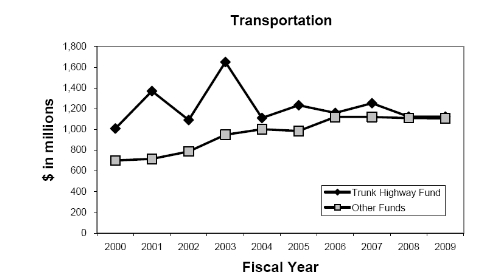
This comes from the state's budget report, drafted last November. This clearly shows trendlines that confirm increased budgeting for MnDOT, and an annual budget of around $2 billion in 2006 and projected at the same level for the next several years. Except for 2003 when Minnesota had a spike in its Trunk Highway funds, that represents a steady funding level for the last few years.
That doesn't prove we don't need more -- but before we start talking about new taxes, let's find out whether additional funds would have prevented the bridge collapse and where the money MnDOT gets now goes.
UPDATE II: In the next budget, transportation gets over $3 billion for two years in state funds (not including the $1.4 billion from the federal transportation bill), and comprises 8.7% of all state spending. It's the third largest category, with Health and Human Services (38.4%) and K-12 education (27.4%) being the only functions with larger shares of the state budget. Public safety only gets 3.9%.
Posted by Ed Morrissey on August 6, 2007 5:15 PM | Comments (15) | TrackBacks (1)
Media Alert: Bill Bennett
Tomorrow morning, I will appear on the Bill Bennett radio show at 6:30 am ET. We'll be talking about the bridge collapse here in Minneapolis and the latest Republican debate. Be sure to set your alarm clocks -- I know I will!
Posted by Ed Morrissey on August 6, 2007 8:55 PM | Comments (4) | TrackBacks (0)
August 7, 2007
Georgia: Russia Attacked Us
Georgian officials claim that Russian jets invaded their airspace last night and fired a missile, which turned out to be a dud. The incident appears to be an escalation of Russian hostility towards its former republic and NATO aspirant:
Russia has been accused of launching an airstrike in an "act of aggression" against neighbouring Georgia.Russia, which has a long history of tense relations with the former Soviet state, has denied the claim.
Georgian officials said that two Russian jet fighters violated its airspace and fired a missile which did not explode.
A Georgian government spokesman said that the intrusion took place on Monday night when the aircraft entered Georgia's airspace over the northeastern Gori region and fired a missile which fell near the village of Tsitelubani, around 40 miles west of the capital, Tbilisi.
This puts a rather interesting twist on Georgia's relationship with NATO. They have made no secret about their desire for membership, but NATO has hesitated to provoke Russia with an offer. Russia has made clear that they would see NATO membership for either Ukraine or Georgia as a provocation, having drawn a diplomatic line in the sand last month on that issue.
However, Georgian independence should matter to the West, and an attack on Georgia should not go unanswered by NATO. The last thing we need in the Caucasus is another flashpoint for border wars. Violating Georgian air space and firing a missile constitutes two acts of war, especially the latter, and Georgia has to give some response to that provocation. Likely that will be a diplomatic response. Georgia doesn't have the resources to make good on a military attack, and it would probably give Vladimir Putin an excuse to invade Georgia.
Do you suppose Putin is embarrassed over the dud? Had the missile exploded, it might have been harder to prove that the attack came from Russia. If Georgia has the missile intact, though, it will show that Russia attacked Georgia, and that Russian armament leaves a lot to be desired.
Russia under Vladimir Putin seems intent on remaking its empire through any means necessary. If we value Georgian independence as a check on Russian imperial ambitions, and we should, we had better make clear to Putin that we find this unacceptable, and offer a few consequences of our own. That NATO membership application could be dusted off at any time.
Posted by Ed Morrissey on August 7, 2007 4:59 AM | Comments (10) | TrackBacks (0)
Britain Discovers Its Retreatist Foreign Minister
When Gordon Brown picked former Kofi Annan deputy Lord Malloch-Brown to handle Foreign Office management of the UN, Africa, and Asia, Americans groaned at the message that the appointment made towards appeasement and unaccountable internationalism. Americans knew Mark Malloch-Brown from his attack on American free speech last year, and his insistence in 2005 that despite a plague of sexual exploitation scandals and the Oil-For-Food scandal that the UN was "not in the mood for more wholesale change".
Now the British can get to know Malloch-Brown as the man who wants to give away the British veto power at the United Nations -- to the EU:
The United Kingdom should lose its independent voice at the United Nations and hand over its seat on the Security Council to the EU, according to the new Foreign Office Minister, Lord Malloch-Brown.Last October, when Lord Malloch-Brown was the UN's deputy secretary general, he told EU diplomats in Brussels that the EU was heading towards one single seat within the UN institutions. "I think it will go in stages. We are going to see a growing spread of it institution by institution," he was reported as saying.
Lord Malloch-Brown said he hoped it would happen "as quickly as possible. I'm a huge fan of it."
He's a huge fan of it, or at least he was, the Brown government insists. Apparently the Annan acolyte suddenly decided to eschew his internationalist ambitions, or at least that's what 10 Downing Street wants Britain to believe. The Foreign Office put out a statement that explained that Malloch-Brown had said that before becoming a government minister.
No kidding. It was a few months before taking the job; everyone can read the calendar. It wasn't a "youthful indiscretion" but a rather clear statement of his philosophy. How did Malloch-Brown go from being a "huge fan" of giving up British sovereignty and rank to becoming a staunch defender of the UK's privilege at the UN?
The Conservatives have rightly raised an alarm about the direction Malloch-Brown will take the UK in his current assignment. However, it could be worse. They should take heart -- he could have been put in charge of the BBC, or perhaps Defence Minister.
UPDATE: David Miliband is Foreign Minister, as CQ commenter Anthony in Los Angeles reminds me. Malloch-Brown is Minister for Africa, Asia and the UN, which is bad enough, but not quite as bad as I wrote in error earlier.
Posted by Ed Morrissey on August 7, 2007 6:06 AM | Comments (17) | TrackBacks (0)
Insert Your Pun Here
Before I begin this post in earnest, I have to tell readers that I struggled mightily not to write about this local story. I know it has no resonance to overarching policy or national issues, or to anything remotely substantial. Like Allie Shah at the Star Tribune, though, it's impossible to let pass without at least some comment. Police in St. Paul are on the lookout for missing testicles and the men who stole them:
A St. Paul man, complaining of chronic pain, wanted to have his testicles removed. When conventional medical staff refused to do the job, he hired other "professionals" to take off his testicles, according to a search warrant affidavit filed Monday in Ramsey County District Court.Two or three people operated on the man, Russell Daniel Angus, 62, a couple weeks ago at his home in St. Paul. He was unconscious during the surgery, and when he woke up, his testicles had been removed.
And the "professionals" were gone.
Believe it or not, the story gets stranger from here. After nearly bleeding to death, he called his daughter, who called the police. Angus went to the hospital, where they stopped the bleeding and patched him up the best that they could. Angus won't tell the police who did the operation, though, because he doesn't want to get them in trouble.
One might think that the man's family might have more sense than Angus, but apparently not. His daughter would not allow the police to search the home for evidence of the transaction. They had to get a search warrant in order to continue their investigation, and of course they had to specifically list the items they sought. Shah writes (emphasis mine):
Police searched the home in the 600 block of York Avenue on July 28, looking for a list of items including blood, medical instruments, fingerprints, documents discussing medical procedures, computers, and testicles. Court documents show they seized three specimen jars, medical supplies, a camera, a computer CPU, and other items.
What do you suppose the judge thought when he reviewed that search warrant?
Police believe that Angus arranged for the castration over the Internet. They want to find these quacks before they really do kill someone, regardless of whether the Angus family wants to cooperate. And at this point, I'll stop before really giving in to temptation and writing a series of puns that we all will regret -- but feel free to offer your own in the comments.
Posted by Ed Morrissey on August 7, 2007 6:25 AM | Comments (43) | TrackBacks (0)
List Of Bridge Suspects Expands To Pigeons -- And Minnesotans
The inspections of the St. Anthony Bridge were difficult and dangerous affairs, according to a Star Tribune report. Spiders thrived on the support girders, and pigeons occupied the steel box sections where fatigue would have caused catastrophic failure. Those dangers don't compare, however, to the treatment inspectors got from passing drivers when lanes had to close to conduct the inspections:
Three experts familiar with the bridge said Monday that the impediments faced by inspectors included piles of pigeon guano, poor lighting, road rage and spider webs that could be mistaken for metal cracks.A former MnDOT inspection supervisor told the Star Tribune that even the best inspectors had difficulty making a thorough evaluation of the I-35W bridge. Its sheer length, nearly 2,000 feet, was part of the problem, they said. ..
State traffic engineers would close lanes on the bridge for the inspections, and most of the time the lane closures were from 9 a.m. to 3 p.m. The snooper arms could operate from 10 a.m. to 2 p.m. That put inspectors under continual pressure to finish work before the evening rush hour, said one of three experts.
When the lanes were closed, it was not uncommon for inspectors to be the target of insults -- even thrown objects -- from inconvenienced motorists.
The length of the bridge and its position high over the water made it impossible to conduct inspections from below. The only possible way to complete them was to work as fast as possible for four hours straight, hanging over the edge while getting taunted and abused by the driving public. That's four hours for a 2,000-foot structure, of which 500 feet were over the Mississippi River.
One inspector called it a "balancing act of bridge safety and the driving public". Minnesotans should ask themselves why those two should be in opposition to each other. Those inspections were intended to keep those very people from falling into the river. It might be something to remember when driving over other bridges.
Pigeons may also have contributed to the collapse, and even bats as well. They nested in the junctions of the girders, and they left "piles" of guano on the very parts of the bridge that most concerned inspectors. The droppings both covered the areas where inspectors needed to check for fatigue and also corroded the metal over a long period of time. MnDOT tried installing screens to keep the pigeons out, but to no avail. The 2006 inspection report complained of "severe pigeon debris" in the box members.
Tim Pawlenty has already demanded a "stem to stern" re-evaluation of the bridge inspection process, which clearly is needed. We Minnesotans need to examine our own attitudes towards those who repair and maintain our roads and bridges. When we chase bridge inspectors away from their work, we shouldn't be surprised when structures fail later.
UPDATE: Earlier this morning, a friend sent me a series of photographs taken just after the St Anthony Bridge collapse. I've assembled them into a slideshow for easier viewing and hosted it at YouTube. These give a little more intimate look at the immediate aftermath -- and show some of the heroic rescue work that followed.
Posted by Ed Morrissey on August 7, 2007 6:41 AM | Comments (19) | TrackBacks (0)
Ethics Bill Short On Enforcement
The Washington Post finally realizes that the new ethics bill passed by Congress has little chance of actually enforcing better standards of ethics. Their somewhat belated observation comes on page A11 of today's paper, where they note that the Democratic leadership not only didn't provide any new resources for enforcement, they put most of the onus for compliance on the lobbyists:
Government watchdogs and ethics lawyers generally agree that the bill would shed new light on the Washington influence game but wonder how those who don't play ball would be found and punished. Without an effective bureaucracy for managing the flow of new disclosures provided by the law, they say, the legislation won't mean much."This law will put a significant new burden on the ethics committees and the public disclosure offices in the House and Senate. They have to do more than sticking the reports in a filing cabinet," said Kenneth Gross, an ethics lawyer at the law firm Skadden, Arps.
Violations of the law would be prosecuted by the Justice Department, but "they rely on referrals," Gross said. The new legislation expands the jurisdiction of federal prosecutors beyond violations of lobbying laws to breaches of the gift ban and other provisions, imposing civil and, for the first time, criminal penalties.
Without a way to manage disclosure information, "the enforcement process will be weakened at its base," Gross said.
These enforcement issues come as a piece of the dilution of earmark reform. Instead of keeping the tough language initially included in January, the bill stripped away requirements to make earmarks searchable in bills, weakened enforcement in conference reports, and created a ridiculously narrow definition of personal benefit. Removing those and other provisions of earmark reform showed that Democratic leadership had more interest in press releases than actual reform.
Elizabeth Williamson finds more clues. The requirement to pre-approve all Congressional trips sounds like a tough review, but those trips run into the hundreds, if not thousands. How does Congress propose to do any substantive review of these junkets? The bill also requires that lobbying reports need to go online -- a step in the right direction, to be sure -- but doesn't put anyone or any entity in charge of the database.
Nancy Pelosi promised that a panel on ethics reform would return a plan to improve ethics enforcement in the House by May 1st. Three months later, the House has gone on vacation, and so has ethics enforcement, apparently. Ethics rules without enforcement mean that there will be more rule-breaking with no consequences.
The Democrats started this session going in the right direction on ethics reform. They have consistently traveled backwards ever since, and this version of "reform" may leave us worse off than before. It provides a cover for leadership to shrug off their promise to "drain the swamp" while posing as reformers.
Posted by Ed Morrissey on August 7, 2007 8:34 AM | Comments (8) | TrackBacks (0)
The Obligatory Beauchamp Post (Update: Reconsideration)
UPDATE VII: A couple of thoughts that I want to put to the top. First, McQ from QandO spoke about the issue on my CQ Radio show with King Banaian and me (at the 45-minute mark), and I found his argument -- and those of most of the commenters here -- compelling. I think I was more dismissive than I meant to be in the post below. I think this is a real story, and I'm glad that the milbloggers went after it, but as I told McQ, it seems like going after a squirrel with a bazooka. McQ rightly pointed out that it deters other squirrels from appearing!
However, a few people have implied that I'm a hypocrite for sticking with the bridge collapse story. As many as thirteen people died in that collapse, and the infrastructure debate has policy and tax implications for the entire nation over the next several years. I'd also ask those people to think about how many people will know Scott Beauchamp's name in 30 days -- or how many outside the blogosphere know it now. How many people will recall the bridge collapse and still be debating the meaning and the prevention of a collapse on a bridge near them in that same amount of time?
Hell, for that matter, how many people know about The New Republic?
Original post follows ....
I have not written about the Scott Beauchamp/New Republic story for a couple of reasons. First, I do not have any personal knowledge of the specifics of Beauchamp's claims; the milbloggers have handled that aspect of the story well. Second and more important, it seemed to me that the pushback on this story was out of proportion to Beauchamp's significance (and for that matter, TNR's as well). Weekly Standard's Michael Goldfarb and Confederate Yankee's Bob Owens have been keeping the closest eye on the story, which appears to have hit its apex:
THE WEEKLY STANDARD has learned from a military source close to the investigation that Pvt. Scott Thomas Beauchamp--author of the much-disputed "Shock Troops" article in the New Republic's July 23 issue as well as two previous "Baghdad Diarist" columns--signed a sworn statement admitting that all three articles he published in the New Republic were exaggerations and falsehoods--fabrications containing only "a smidgen of truth," in the words of our source.Separately, we received this statement from Major Steven F. Lamb, the deputy Public Affairs Officer for Multi National Division-Baghdad:
An investigation has been completed and the allegations made by PVT Beauchamp were found to be false. His platoon and company were interviewed and no one could substantiate the claims.According to the military source, Beauchamp's recantation was volunteered on the first day of the military's investigation. So as Beauchamp was in Iraq signing an affidavit denying the truth of his stories, the New Republic was publishing a statement from him on its website on July 26, in which Beauchamp said, "I'm willing to stand by the entirety of my articles for the New Republic using my real name."
Don't get me wrong. If Beauchamp fabricated these stories, then he deserves his obloquy. The editors at TNR have to face some tough questions about their standards for publication in the aftermath of this collapse. They have damaged their credibility and the bloggers have rightly called them out for a retraction.
Still, there is something of an overkill about this story that bothers me. It's not as if we can argue that cruelty doesn't occur in war. Of course it does; when it happens, our military investigates and punishes it. Baldilocks talked about this at length earlier in the story, and she's right. That's what separates us from our enemies. We prosecute cruelty, while they encourage it.
Rick Moran warns the Right that this doesn't mean the war is won in Iraq. I don't think that was the issue at all, though. This blogswarm was born of frustration over what the Right sees as slanted coverage of the Iraq effort. We're not claiming that the war has been won, but we're saying that the media has slanted their coverage to make it appear lost when it isn't. Scott Beauchamp and TNR gave the blogosphere an example of clear journalistic malpractice -- and it pounced, in droves.
But the two are really small potatoes in that argument. TNR doesn't have the influence it once had, and the stories that Beauchamp told really amounted to petty mischief more than war crimes. The Nation had a much more damaging piece regarding the experiences of fifty Iraq War veterans who now oppose the effort. While I don't believe those anecdotes can be extrapolated to make the argument that our military has gone off the rails, they are more substantial than anything published by Beauchamp and TNR.
Those bloggers who stayed on this story deserve a round of applause for doing the work that TNR's editors should have done from the beginning. However, we need to keep some perspective on this story, which never amounted to much more than gossip and innuendo at any point.
UPDATE: I'll be talking about this story in the second half of my BlogTalkRadio show today. Be sure to join the debate by calling 646-652-4889 between 2:30-3 pm CT.
UPDATE II: Be sure to read Shane's post at Heading Right, who takes a much different position than I do. Also, Anthony at Public Secrets has a good read on this. Most commenters disagree with me on this, and they make very good arguments -- but for the one who thinks I'm an apologist for the New Republic, I suggest re-reading my post. Hint: TNR does not qualify as mainstream media, and barely qualifies these days as anything more than a blog -- and not a very good one at that.
UPDATE III: Is this a coincidence?
Somewhere in Kalamazoo, Elvis weeps: The Weekly World News is folding.The Weekly World News was not one of those sleazy tabloids that cover tawdry celebrity scandals. It was a sleazy tabloid that covered events that seemed to occur in a parallel universe, a fevered dream world where pop culture mixed with urban legends, conspiracy theories and hallucinations. Maybe WWN played fast and loose with the facts, but somehow it captured the spirit of the age -- and did it in headlines as perfect as haiku ....
Reporters loved the Weekly World News. Many fantasized about working for it and casting aside the tired old conventions of journalism, such as printing facts.
Apparently, Franklin Foer has one less employment opportunity awaiting him after his probably-upcoming departure from TNR.
UPDATE IV: Bill at INDC Journal has some thoughts on proportion as well.
UPDATE V: Two must-read posts from Bryan Preston and McQ about their reasons for going after this story so hard echo a few of the comments here.
UPDATE VI: Op-For weighs in on the latest two-step at TNR.
Posted by Ed Morrissey on August 7, 2007 8:54 AM | Comments (94) | TrackBacks (2)
The Firewall Of Sanity Crumbles In Face Of Irrelevancy
Two years ago, the New York Times provided on-line readers with a strong disincentive to read their columnists. TimesSelect, which I called the Firewall of Sanity, charged $50 per year for people who just couldn't get enough of Maureen Dowd, Paul Krugman, Bob Herbert, and Frank Rich. Now the New York Post reports that Pinch Sulzberger has finally realized that he has marginalized his own columnists in an on-line universe (via Memeorandum):
The New York Times is poised to stop charging readers for online access to its Op-Ed columnists and other content, The Post has learned.After much internal debate, Times executives - including publisher Arthur Sulzberger Jr. - made the decision to end the subscription-only TimesSelect service but have yet to make an official announcement, according to a source briefed on the matter. ...
In July, The Post reported that insiders were lobbying to shut down the service. After two years, however, the move to do away with TimesSelect may have more to do with growth than grumbling inside the paper.
The number of Web-only subscribers who pay $7.95 a month or $49.95 a year fell to just over 221,000 in June, down from more than 224,000 in April.
TimesSelect belongs to a bygone era of gatekeeping that had become obsolete even before Pinch pinched off readership of his star columnists. It practically served as a monument to the Times' sclerotic management. Hiding these columnists behind the Firewall of Sanity may have served a noble purpose in elevating the debate, but irrelevance became the chief consequence of the service. Without access to the opinion columns, no one cared any longer what the Times' writers had to say.
Now they want to free their stable of columnists from irrelevance. Perhaps it will help generate more readership for these writers, but I suspect that most people have found other columnists to put on their regular-read list. The Times will have to work pretty hard -- and spend lots of money -- to market these columnists to on-line readers who passed on paying $50 two years ago.
When will the Sulzberger family trust start to rethink the Pinch regime, anyway?
Posted by Ed Morrissey on August 7, 2007 9:54 AM | Comments (26) | TrackBacks (0)
CQ Radio: Dr. Ken Thorpe, Chronic Disease
Today on CQ Radio (2 pm CT), we'll welcome Dr Ken Thorpe of the Partnership to Fight Chronic Disease. Dr. Thorpe served as Deputy Assistant Secretary for Health Policy in the Clinton administration, and his partner Mark McClellan ran the Medicare and Medicaid programs in the Bush White House. Together they believe that a serious effort at preventing and curing chronic disease will save over a hundred billion dollars a year in federal spending -- enough to solve the problem of the uninsured in America. I've posted links to coverage of this effort at Heading Right this morning -- be sure to read the background.
In the second half of the show, we'll talk with my friend King Banaian of SCSU Scholars about the economics of the bridge collapse and MnDOT funding. As the country begins to debate infrastructure maintenance and funding, it helps to have St. Cloud State's chair of economics on the story ....
Call 646-652-4889 to join the conversation!
Did you know that you can listen to CQ Radio through your TiVo service? Click here for the instructions. Also, you can subscribe to CQ Radio through iTunes now by clicking this link:
Posted by Ed Morrissey on August 7, 2007 10:31 AM | Comments (2) | TrackBacks (0)
Podcast: Bill Bennett Appearance
Earlier this morning, I got the chance to appear on Bill Bennett's national radio show. Many of you may have missed this since it came at 6:30 AM ET, but the show's producer was kind enough to send me an MP3 file of the segment. I've podcasted it here, and I hope you enjoy it as much as I did.
Posted by Ed Morrissey on August 7, 2007 3:47 PM | Comments (4) | TrackBacks (0)
Not A Funding Issue, Part III
Once again, the media has brought up the issue of transportation funding as a cause of the bridge collapse in Minneapolis, and once again the article itself contradicts the theme. The New York Times tries to paint the cause as a refusal to raise taxes -- but acknowledges that funding on transportation has hit all-time highs. Decisions on spending priorities and a desire to force change on an unwilling public has more to do with infrastructure maintenance:
Even as the cause of the bridge disaster here remains under investigation, the collapse is changing a lot of minds about spending priorities. It has focused national attention on the crumbling condition of America’s roadways and bridges — and on the financial and political neglect they have received in Washington and many state capitals.Despite historic highs in transportation spending, the political muscle of lawmakers, rather than dire need, has typically driven where much of the money goes. That has often meant construction of new, politically popular roads and transit projects rather than the mundane work of maintaining the worn-out ones.
Further, transportation and engineering experts said, lawmakers have financed a boom in rail construction that, while politically popular, has resulted in expensive transit systems that are not used by a vast majority of American commuters.
And now we get to the core of the issue on infrastructure maintenance. The drive for light rail has shifted monies away from roads and bridges that people use to mass-transit systems they don't. Politicians want to build new systems in order to "cut a ribbon", as Chuck Schumer put it, to aggrandize themselves. Bridge maintenance doesn't make for many photo ops.
But it's more than that. Light rail in Minnesota consists of one line between the Mall of America and downtown. The state spent a half-billion dollars on this train that could have been spent on expanding and maintaining the actual roads that people choose to use. The Northstar, also known as the Ventura Trolley, came into being because our elected representatives thought that we should be forced to change our transportation patterns for our own good.
The Times also points out that this project is ongoing, and still eating up our transportation dollars. Minnesota recently received $12 million in transportation funding from this session's transportation and housing appropriations bill, an addition to the five-year funding bill passed in 2005. Of that money, $10 million is already earmarked for the existing point-to-point Northstar. The balance goes to bike and walking paths, a particular bone on which Rep. Jim Oberstar chews on an annual basis.
So what's the solution? More calls for gas-tax increases. We've heard it here in Minnesota, and now the Times reports that the National Conference of State Legislatures wants a 3-cent per gallon federal tax increase -- in order to send more funds back to the states in which the gasoline was bought. That's even less courageous than demanding state increases in taxes hours after a bridge collapse that has yet to be analyzed for the particular failure, in a state that already spends $2.2 billion on transportation.
What part of "historic highs in transportation spending" don't people understand? The problem here is not funding but prioritization. Instead of conducting social experiments like the Northstar, perhaps the money should go to fixing our infrastructure -- if that was even the cause of the St. Anthony Bridge collapse, which no one has established. Raising revenues for the same bad prioritization processes just means more money will get wasted and the same people will continue to make those bad decisions.
UPDATE: Slightly different topic, but the people of Stillwater aren't thrilled with their bridge, either:
Minnesota Department of Transportation officials on Monday rushed to assure St. Croix River Valley residents that the Stillwater Lift Bridge is safe.The Pioneer Press and other media reported over the weekend that the lift bridge had a sufficiency rating of 2.8 on a scale of 100 - the second-lowest rating in the state. But MnDOT officials said the bridge was rated 42.8 during an inspection in May.
The higher number reflects $5 million of work that was done to repair the bridge in late 2005, said MnDOT's Nick Thompson. ...
Drivers should feel safe crossing the lift bridge, Thompson said. He said MnDOT wants to replace the bridge over the St. Croix River because it can't handle current traffic demands and will continue to need maintenance in order to keep it operating.
Well, 42.8 certainly represents an improvement over 2.8, but Stillwater residents recall that the St. Anthony Bridge had a rating of 50. I don't think MnDOT assurances on this score will relieve the concern of bridge travelers.
Posted by Ed Morrissey on August 7, 2007 4:38 PM | Comments (2) | TrackBacks (0)
Darfur Intervention On Shaky Ground
The UN announced its deal to intervene in the Darfur a week ago, with the Security Council authorizing an anemic force of 26,000 troops with equally anemic rules of engagement. Now it looks like the force may get weaker yet or fail to coalesce at all. The UN cannot find 26,000 African troops, and the Sudanese government refuses to allow any other nations to contribute to the force:
Sudan will have to accept non-African troops in a U.N.-authorized peacekeeping force for Darfur or face the prospect of new United Nations sanctions, a senior U.S. official said Tuesday.Although efforts will be made to ensure that Africa contributes a large percentage of the 26,000-strong mission, the continent does not have enough trained soldiers to fully staff the force and Sudan will be penalized unless it drops objections to non-African participation, said Andrew Natsios, the U.S. special envoy for Sudan. ...
The Sudanese government is adamantly opposed to non-Africans playing any major role in the hybrid U.N.-African Union operation that was authorized by the U.N. Security Council on July 31 and will be made up of 20,000 peacekeepers and 6,000 civilian police.
Disagreements over the composition of the mission were a major reason the authorization was delayed for months despite mounting pressure on Khartoum to accept it to help end nearly four years of internal conflict in which more than 200,000 people have died and 2.5 million have been displaced.
As I noted last week, UN troops from African nations have a history of sexually exploiting the women and children under their protection. One could understand if Sudan refused to admit those troops -- but why object to non-African troops? They do not want to incur the wrath of their janjaweed militias, which is why the UN has scrambled to find troops from Muslim nations instead.
That, however, will create more problems. The non-Muslims in Darfur have suffered at the hands of radical Islamists and will likely not see non-African Muslim troops as their saviors. In fact, they're more likely to think that the troops might have more sympathy with their tormentors than their wards.
It looks like this mission is doomed. If Sudan is so insistent on an all-African corps, and there aren't enough troops even for the small force authorized by the UN, then it would take an invasion to place UN troops in Darfur. And if the UN can't scrape up 26,000 troops for a peacekeeping mission, how likely will it be that they will find enough for an invasion?
Posted by Ed Morrissey on August 7, 2007 6:39 PM | Comments (15) | TrackBacks (0)
August 8, 2007
Why Aaron Is King
Barry Bonds broke the career home-run record held for 33 years by Henry Aaron last night, jolting number 756 out of the park at home in San Francisco. Bonds took a 3-2 pitch into the stands 435 feet away -- and extended a controversy as to whether he deserves the record:
The ball exploded off Barry Bonds' bat, a small white sphere streaking through the dark San Francisco sky, headed for the right-center field seats and a hallowed place in baseball history.It was 8:51 Tuesday, a night no one in the sellout crowd of 43,154 at AT&T Park would ever forget, a night to be lived and relived by word of mouth, digital camera and endless reels of highlight tape.
On a 3-and-2 pitch from Washington Nationals left-hander Mike Bacsik, Bonds, in his second game after tying Hank Aaron's career home run mark of 755, belted No. 756.
In this, his 23rd season in the major leagues, his 16th in a Giants uniform, the holder of the single-season home run record with 73 in 2001 and a record seven most-valuable player awards, Bonds added the final jewel to his home run crown.
If Hammerin' Hank had his doubts about the steroid-fueled capture of his mark in baseball history, he had too much class to make that argument last night. Aaron, who pointedly refused to attend Bonds' games in objection to Bonds' alleged use of steroids, did the next-best thing:
Willie Mays, Bonds' godfather, the first Giants' icon in San Francisco, emerged from the dugout. The two men stood arm in arm, 1,416 home runs between them, first and fourth on the all-time list.And then Bonds turned, Mays turned, we all turned to the enormous video board behind center field. There was Aaron, suddenly second on the all-time list, larger than life and appropriately so.
"I would like to offer my congratulations to Barry Bonds on becoming baseball's career home run leader," Aaron said. "It is a great accomplishment which requires longevity and determination. Throughout the past century, the home run has held a special place in baseball, and I have been privileged to hold this record for 33 of those years.
"I move over now and offer my best wishes to Barry and his family on this historical achievement. My hope today, as it was on that April evening in 1974, is that the achievement of this record will inspire others to chase their own dreams."
Everyone knows that Bonds has used steroids in his efforts to improve his baseball game. It's been part of courtroom testimony, and it's been pretty obvious to those who have watched Bonds bulk up over the years. His 73 home runs in a single season -- at 37! -- made it more obvious than even Mark McGwire's bulking up on androstenidione to hit 70 shortly before that. Sammy Sosa also allegedly bolstered his natural performance, as did Jason Giambi, Jose Conseco, and plenty of others.
But that's part of the problem with putting a big, fat asterisk on Bonds' record. We may want to do that to show the difference between Hank Aaron and Barry Bonds, but both played in different conditions. If Bonds bulked up, so did plenty of other players, including the pitchers he faced. It's the Steroids Era, and Bonds excelled in it.
If anyone deserved the asterisk -- that despicable appendix with which Ford Frick cursed Roger Maris -- it's Babe Ruth. I'm not saying that Ruth took performance enhancing drugs; he usually handicapped himself with excessive drinking and eating. Ruth, however, played in an era that excluded some of the best talent in baseball because of segregation. He never had to face the excellent players in the Negro League, while Maris and Aaron played against a level field in their careers. Ruth hit 714 home runs (and set many other records as well) against a whites-only league. It's not his fault -- he didn't make the rules -- but it's the one era in baseball which limited competition and talent, and all records set in that era have to be taken with a grain of salt.
So who really deserves the asterisk? Peter Ueberroth, Fay Vincent, and Bud Selig. They did nothing while steroids flourished, because owners liked what it did to the game. It resulted in more homers, and more spectacular homers at that. It generated interest in baseball during some rocky times and led to the silly Home Run Derbys before All-Star Games. The owners marketed on steroids and they depended on them just as much as the players who used them -- and these commissioners didn't lift a finger to stop it until Congress asserted what little authority it had to embarrass MLB. Only then did Selig start pushing against the Steroids Era.
So let's not put all the blame on Bonds -- but let's recognize the man who earned that record without drugging himself, playing in an era where high mounds and wider strike zones made it one of the most difficult periods for hitters. Hammerin' Hank had to play baseball and fight bigots to get to 755. In my mind, he and Roger Maris will always be the home-run kings of baseball.
Posted by Ed Morrissey on August 8, 2007 6:18 AM | Comments (70) | TrackBacks (2)
Inspection Reports Show Pier Changes
Inspection reports on the St. Anthony Bridge show one of the pier supports had shifted in 1996, and made numerous observations of cracks and fatigue in the approach spans in the years since. MnDOT repaired most of these, but the bridge continued to show more significant problems in the years approaching its devastating collapse:
State bridge inspectors warned for nearly a decade before its collapse that the Interstate 35W bridge had "severe" and "extensive" corrosion of its beams and trusses, "widespread cracking" in spans and missing or broken bolts.Not only was the superstructure in poor condition, but certain components were "beyond tolerable limits," and one of the bridge's piers had "tilted to the north," they reported.
By 2000, the inspectors wrote that "eventual replacement of the entire structure would be preferable" to redecking the bridge. They added: "If bridge replacement is significantly delayed, the bridge should be re-decked."
That recommendation was repeated in every report afterward, but it never happened.
If the inspectors recommended replacement of the bridge, that recommendation did not make it out of MnDOT. Governor Tim Pawlenty insists that MnDOT has consistently recommended replacement in 2020, and that he, former Governor Jesse Ventura, and state legislatures over the last several years relied on MnDOT's decisions in this arena. MnDOT, which did not send anyone to answer questions at the various press conferences, insist that they made repairs to specific areas of concern of the inspectors, and that replacement did not get considered because the main truss spans did not show any fatigue or cracking.
This could be true, and the bridge still could have failed. As I noted before, the design lacked redundancy, something that apparently did not get calculated into the recommendations from MnDOT. The bridge could have suffered a failure somewhere away from those main truss spans and still have brought about a collapse. Newer and older bridges have redundant supports that would prevent this, but bridges built in the post-WWII era to around 1970 did not.
One point will certainly cause some curiosity. The main truss spans connected to the piers on either end of the bridge. If one of those piers began to tilt in 1996, how could that not have affected the main truss spans? In a bridge with no redundant support structures and no center piers, wouldn't that have been a red flag?
In the meantime, plans for a replacement bridge have begun -- and have expanded beyond replacement:
Calling for a 10-lane bridge that would meet the growing demands of Twin Cities commuters, political leaders on Tuesday described a replacement for the collapsed Interstate 35W span that would be built swiftly, "right and safe."The successor to the eight-lane bridge will be two spans with five lanes in each direction, including a transit option, Gov. Tim Pawlenty and Minneapolis Mayor R.T. Rybak said as the state moved to have eligible design-build teams for the new bridge construction in place by the end of the week.
It makes sense to build a wider bridge now rather than wait for later. The traffic over this bridge would have called for an expansion soon anyway -- at which point perhaps the flaws of the previous bridge would have become obvious -- and it will cost less to start now. An expansion will put pressure on Minnesota to expand the I-35W corridor in the southern approach, however, and there is not much room to do so. Will Minnesota have to start using eminent domain to knock down the residential neighborhoods on either side of the freeway? I-35W only has six lanes of traffic for most of the southern approach.
Also, the transit option looks like another way to siphon money out of highway-maintenance funds. We should put the light-rail pet projects aside for a while and spend our money on fixing the rest of our bridges, or replacing them if necessary. So far, Northstar has been nothing but a boondoggle serving few Minnesotans and distracting from the maintenance of highway systems that get far more use.
Posted by Ed Morrissey on August 8, 2007 6:55 AM | Comments (18) | TrackBacks (0)
Gomery Retires
John Gomery, the jurist whose investigation into the Sponsorship Programme eventually brought down the man who appointed him to it, has decided to retire. Tomorrow he will celebrate his 75th birthday by riding off into the Canadian sunset, capping a long and illustrious career with a new commitment to clean government -- even if he took a rather authoritarian tone in doing so (via Newsbeat1):
When John Gomery was named by Paul Martin to head the Adscam sponsorship inquiry in 2004, we were skeptical about how much he would accomplish. Under Jean Chretien, the Liberals became ex-pert at covering their tracks, and we feared that the pattern would continue under Mr. Martin.But that didn't happen. To Mr. Martin's great credit -- this fact is too often omitted when people dismiss the man's short prime ministerial tenure as a failure -- he gave Judge Gomery broad powers to get to the bottom of Adscam. And the judge delivered: His inquiry made for a riveting spectacle, with a steady parade of witnesses providing not only the expected excuses and stonewalling, but also ground-breaking new information and astonishing confessions. At the height of the inquiry, no fewer than 200,000 Quebecers were watching it on TV.
By the time the dust had settled, related criminal trials had put key Adscam players behind bars. Sponsorship-program architects such as Alfonso Gagliano fell into political disgrace. And an array of new rules were created to ensure that federal apparatchiks and their PMO overseers would never again have such unfettered discretion to rain millions of dollars from untendered contracts on friends and supporters of the ruling party.
Martin had plenty of reason to regret his choice; Gomery proved to be too good at his job. Martin had little choice but to find an independent and high-profile jurist by that time, of course. Adscam had already blossomed into a big enough scandal that appointing an apparatchik to sweep it under the rug had not been an option. Martin was never implicated in the illegality, but the obviously widespread Liberal corruption eventually toppled his government and made Stephen Harper the Prime Minister.
However, one point has to be scored against Gomery in this instance. He imposed the notorious publication ban on testimony at the public hearings he held when three key witnesses testified. The publication ban, which is perfectly legal in Canada, meant that reporters could attend the public hearing but could not report on any specifics of the testimony. Gomery did not put the proceedings in camera; government officials attending the trial could hear everything, but Canadian citizens were barred from hearing about the inner workings of the scandal that stole hundreds of millions of dollars from them.
As most of you know, that's where CQ comes into the story. Working with a source at the trial, I published detailed recaps of the testimony -- and welcomed a flood of Canadian visitors to my site. After a few days, Gomery relented and lifted the publication ban. The heightened secrecy worked wonders on Canadian curiosity. After the publication ban, Canadians couldn't get enough of the Gomery inquiry.
In the end, though, it was Gomery's professional work and tenacity that exposed the Liberals and brought down their government. Clean-government activists around the world owe Gomery a debt, even if free-speech activists might not hold quite as much regard for him. He deserves a splendid retirement and the gratitude of many, and not just Canadians.
Posted by Ed Morrissey on August 8, 2007 7:35 AM | Comments (5) | TrackBacks (0)
A Split On The Left?
The Democratic failures to end the war in Iraq and to move against the Bush administration has opened a split on the Left, according to The Hill. Calling the leftist group MoveOn a shill for the Democratic Party, antiwar and other leftist activists have split from the group. They plan to lead attacks against Democrats in Congress in 2008:
Congress’s failure to secure a timetable for withdrawing American troops from Iraq has split anti-war activists on the tactical question of whether to attack Democrats, who now control Capitol Hill.The split has also underlined accusations among some activists that MoveOn has abandoned its credentials as an issue-based advocacy group and now instead provides cover for Democratic Party leaders.
Anti-war activists throughout the country are united in spending August pressing lawmakers to bring U.S. troops home. But tensions within the movement have been bubbling for months over tactics and whether their fire should be aimed exclusively at Republicans.
The divisions underscore the tough position Democrats are in — short of the 60 votes needed in the Senate to pass binding restrictions on the war and far shy of the two-thirds majority in both chambers required to override a presidential veto.
The sixty-vote threshold argument may have worked until last weekend. When the Bush administration pushed for its controversial FISA rewrite -- which gave some conservatives pause -- they didn't use the 60-vote threshold to their advantage to block it. Instead, sixteen Democrats crossed the aisle to give Republicans 60 votes to pass it. In effect, a substantial number of Democrats endorsed and legitimized a program that they decried as unconstitutional in the last elections, on the way to a majority that was supposed to end that program.
Now the hard Left feels betrayed, and they should. MoveOn, however, has continued to engage in the kind of enabling one needs to hang onto a majority in Congress. They have revealed themselves to be an annex of the Democratic Party rather than any kind of issues-based political action group. Despite the obvious failures of their majority to deliver on their hysterical and unrealistic election promises, MoveOn keeps prescribing the hair of the dog as the path to those goals.
Quite obviously, the Democrats have decided that they cannot win the next election on the platform of United for Peace and Justice, or Code Pink, or Voices for Creative Non-Violence. They represent the fringe of American political thought, and that path takes the Democrats right back to 1995. That's why they can't vote to defund the troops in Iraq, and why they couldn't stand up to the supposedly-irrelevant George Bush on FISA. In short, they want to take the money from the fringe-Left groups, but they won't deliver on their agendas -- for which we should all be grateful indeed.
That sets up an interesting dynamic for 2008. If the Democrats lose the fringe-Left to Ralph Nader again, with MoveOn losing that edge in financing for its more mainstream veneer, they could find themselves unable to hold the House as these groups target conservative Democrats. It could even endanger what should be an advantage for them in next year's Presidential race. This is what happens when political parties and groups overpromise and underdeliver -- which the Republicans found out in 2006.
UPDATE: From the port side of the blogosphere, Jazz warns about the dangers of ignoring the center at Middle Earth Journal.
Posted by Ed Morrissey on August 8, 2007 8:36 AM | Comments (34) | TrackBacks (0)
Isn't That 72 In Blog Years?
Glenn Reynolds, one of the true pioneers in the blogosphere, celebrates the 6th anniversary of Instapundit today. Glenn launched this indispensable site just five weeks before 9/11, which puts his enormous influence today in an amazing context. He's made himself almost into a public utility in the blogosphere, which I'm almost certain may be more of a curse than a blessing for Glenn.
HIs success inspired many of us to follow. Early in my blogging career, I struggled to find my own style, and someone suggested that I emulate Glenn. (If you go back to my first month of blogging, you'll see this pretty clearly.) In a very short period, I learned the error of that approach, and it reminds me of a scene from one of my favorite movies, Rudy. Robert Prosky, playing Father Cavanaugh, says, "Son, in 35 years of religious study, I have only come up with two hard incontrovertible facts: there is a God, and I'm not Him."
In the blogosphere, there are two hard incontrovertible facts: there is an Instapundit, and only Glenn Reynolds is it. Congratulations, Glenn.
UPDATE: Did Glenn use steroids? I don't think so; if anything, he's slimmed down, not bulked up, since his launch. No asterisk for Instapundit!
Posted by Ed Morrissey on August 8, 2007 8:54 AM | Comments (6) | TrackBacks (1)
New York Times Delivers Coup De Grace To TNR
Despite the oddly-worded non-denial denial from the New Republic yesterday, the Army did determine that allegations made in its magazine by Scott Beauchamp were false. The New York Times reports this morning that their investigation showed no substantiation for Beauchamp's stories of petty mischief and ghoulish behavior on the part of his fellow soldiers:
An Army investigation into the Baghdad Diarist, a soldier in Iraq who wrote anonymous columns for The New Republic, has concluded that the sometimes shockingly cruel reports were false.“We are not going into the details of the investigation,” Maj. Steven F. Lamb, deputy public affairs officer in Baghdad, wrote in an e-mail message. “The allegations are false, his platoon and company were interviewed, and no one could substantiate the claims he made.” ...
Yesterday, The New Republic posted another note on its Web site saying its editors had spoken to Major Lamb and asked whether Private Beauchamp had indeed signed a statement admitting to fabrications. “He told us, ‘I have no knowledge of that.’ He added, ‘If someone is speaking anonymously [to The Weekly Standard], they are on their own.’ When we pressed Lamb for details on the Army investigation, he told us, ‘We don’t go into the details of how we conduct our investigations.’
That rather slender reed provided TNR with the core of their non-denial denial. They focused on the claim made by the Weekly Standard that Beauchamp had recanted under oath and in writing. They skipped completely over the fact that with or without that recantation, the Army had interviewed everyone who could have been involved in these supposed violations and had found no evidence of them at all.
Franklin Foer has a lot of explaining to do for several examples of journalistic malpractice. First, the allegations made by Beauchamp hardly rose to a level of "news" at all. The misdeeds he recounted didn't even qualify as a satire on Abu Ghraib, even if they would have violated Army regulations. TNR's only purpose in repeating them would have been to pass along salacious gossip -- which leads us to his next bit of malpractice. The only point at which TNR apparently tried to verify these stories were after they were published. And third, TNR never revealed the relationship between the anonymous soldier and their staffer, which speaks to why they didn't attempt to verify his allegations with better and on-the-record sourcing.
Foer forgot one standard: extraordinary claims require extraordinary proof. Foer had to understand that Beauchamp's allegations would reflect poorly on the men and women who serve in Iraq, just by their extraordinarily weird and gruesome details. Rather than act like a journalist, Foer acted like a third-rank blogger and transparent anti-war activist.
Michelle Malkin has a terrific round-up of links on this story today. And Bob Owens has some bullet points for Foer.
Posted by Ed Morrissey on August 8, 2007 9:18 AM | Comments (66) | TrackBacks (2)
No Free Lunches
Yesterday, I interviewed Dr. Ken Thorpe from the Partnership to Fight Chronic Disease on CQ Radio about the PFCD's efforts to fund preventive health care initiatives as a long-term cost saving initiative for Medicare and private insurance providers. The New York Times throws a dash of cold water on the underlying assumptions of the PFCD's claims today, claiming that preventive intervention will cost more in both the short and long run (via Memeorandum):
The current health care system doesn’t pay hospitals, doctors and nurses to keep people healthy; it pays for tests, surgeries and drugs. So Americans often get expensive invasive care of dubious medical benefit while missing out on sensible basic care. Millions of other people go without any care for chronic illnesses like heart disease and diabetes. If Medicare and private insurers paid for more preventive care, Americans would be healthier than they are today and live longer.But the current presidential candidates go one step further. They don’t merely argue that preventive care delivers good bang for the buck. They argue that it delivers good bang for no bucks whatsoever. And this is where the candidates are overreaching.
No one really knows whether preventive medicine will save money in the long run, let alone free up the billions of dollars a year needed to help pay for universal health insurance. In fact, studies have shown that preventive care — be it cancer screening, smoking cessation or plain old checkups — usually ends up costing money. It makes people healthier, but it’s not free.
“It’s a nice thing to think, and it seems like it should be true, but I don’t know of any evidence that preventive care actually saves money,” said Jonathan Gruber, an M.I.T. economist who helped design the universal-coverage plan in Massachusetts.
This may be true -- as far as it goes. Even Dr Thorpe acknowledged that the plan relies on Americans to change their habits and take preventive steps themselves, even outside of medical supervision. Diabetics need to practice better dietary and exercise control, for instance, and all of the maintenance visits in the world won't help until they take those steps themselves -- and meanwhile, the maintenance visits cost more money.
The real solution to that problem is to expose the laggards to the costs of their decisions. Government-funded systems actually do this a little better than private insurance, which tends towards small co-pays, although that should encourage better use of preventive medicine. Unfortunately, how can a system be structured so that the costs of poor decisions gets borne by the decision-maker without making it seem punitive?
The best way to do that would be to encourage free-market health care rather than top-down management. In a free market, those decisions would lead directly to cost penalties or benefits. Insurance companies in a competitive market could structure costs based on the use of and adherence to preventive maintenance, and consumers could switch to insurers or providers that offered the best deal for the lifestyle they choose. It certainly would have less Big Brother implications than the government dictating cost for degrees of obesity, as an example.
Of course, others disagree. Our neighbor, Wisconsin, has decided to try the top-down method instead, and John Stossel warns taxpayers there of the consequences (via McQ at QandO):
The Wall Street Journal editorial-page editors are upset that Wisconsin's state Senate passed "Healthy Wisconsin", which will give health insurance to every person in the state. Of course, the Journal editors are right in saying that the plan is "openly hostile to market incentives that contain costs" and that the "Cheesehead nation could expect to attract health-care free-riders while losing productive workers who leave for less-taxing climes."In addition, as the Journal put it, "Wow, is 'free' health care expensive. The plan would cost an estimated $15.2 billion, or $3 billion more than the state currently collects in all income, sales and corporate income taxes." ...
Does it never occur to the progressives that the legislature's intrusion into private contracts is one reason health care and health insurance are expensive now? The average annual health-insurance premium for a family in Wisconsin is $4,462 partly because Wisconsin imposes 29 mandates on health insurers: Every policy must cover chiropractors, dentists, genetic testing, etc. Think chiropractors are quacks? Too bad. You still must pay them to treat people in your state.
Stossel's last point underscores what I wrote above. When government interferes in private markets through mandates, price-fixing, and/or competition with private enterprise, consumers pay more and get less. It also creates artificial shortages and distorts supply-demand equations in ways that create gaps for consumers. One of Dr. Thorpe's points was that primary-care physicians are underpaid and we have a shortage of care at that level. In a free market, rates would rise to correct the imbalance -- but because Medicare shortchanges primary-care efforts and that comprises a significant part of the compensation available, physicians tend to specialize to get better compensation.
I wish Wisconsin the best of luck -- and hope that their experiment ends at the St. Croix River.
Posted by Ed Morrissey on August 8, 2007 10:15 AM | Comments (15) | TrackBacks (0)
Claiming Reagan's Mantle?
Fred Thompson took another step in readying his campaign for its long-awaited launch on September 5th. He appointed Bill Lacy, a former Reagan advisor, to be "committee manager" and take full operational control over the campaign. Lacy has the long-term connections to the GOP that Tom Collamore lacked, some good history with Fred, and he also has the connections to the Republican Party's secular saint that Thompson needs:
Bill Lacy, a former strategist for Ronald Reagan, Bob Dole and Republican National Committee, will run day-to-day operations of Thompson's committee to "test the waters" for a presidential run."He turned around my campaign for Senate in 1994 and, as I move toward a decision on whether to run for president, I am confident he will take our operations to the next level," Thompson, the former Tennessee senator and "Law & Order" actor, said in a statement.
"I'm here for the long haul," Lacy said in an interview from the committee's headquarters in a Virginia suburb. He said he has taken a leave of absence from his current post as the director of the Dole Institute of Politics at the University of Kansas in Lawrence, Kan.
Both articles refer to Collamore's demotion as some kind of setback, but Collamore was never going to be Fred's gametime campaign manager. He led the exploratory committee as a preliminary effort while Thompson looked for more seasoned and credible veterans to take charge. Had Fred appointed Collamore as a national campaign manager, the pundits would have eaten him alive for failing to tap more experienced leadership.
Lacy looks like a better fit, in more ways than one. First, Lacy knows Thompson, having run his Senatorial campaign in 1994. He helped Thompson win his one re-election battle in Tennessee, a very successful victory during the Republican revolution that captured Congress. His networking ability and record of success will undoubtedly bring other veterans into the Thompson campaign as well.
Better yet, Lacy provides Fred with a link to the Reagan administration. Rudy Giuliani has members of Reagan's team on his policy boards, but no one confuses Rudy and his social policies with Ronald Reagan. With Lacy in charge of his campaign, Fred can argue that his team will provide Republicans with the best chance to extend the Reagan legacy -- an argument that Republicans make, but often fail to offer convincingly.
Posted by Ed Morrissey on August 8, 2007 10:54 AM | Comments (10) | TrackBacks (0)
Divestment For Thee ...
ABC News reports that a major benefactor to both Hillary Clinton and Barack Obama has ties to companies doing business with the Sudanese government currently committing genocide in Darfur. Despite Hillary's prescription for "moving quickly on divestment" to spur an end to the conflict in Darfur, Warren Buffet has no intention of selling his stock:
Democratic presidential hopefuls Barack Obama and Hillary Clinton have taken tough, conscientious stances against the genocidal Sudanese government and the companies which help fund it. Billionaire investor Warren Buffett, America's second richest man, has not.In what activists are calling "a definite contradiction," Buffett -- whose estimated $3 billion in Sudan-linked holdings have been disparaged by anti-genocide watchdogs -- is helping raise hundreds of thousands of dollars for the White House aspirants.
Over the past several years, the Sudanese government has been widely accused of sponsoring the killing of more than 400,000 of its own people and displacing more than two million more, in what has been called one of the worst humanitarian crises of the new century.
Buffett, the legendary 76-year-old investor, has turned away pleas from shareholders and activists to sell his firm's massive stake in PetroChina, a public subsidiary of China's national petroleum company, which watchdogs have tagged a "chief corporate sponsor" of the Sudanese government. Buffett's company, Berkshire Hathaway, reportedly owns the majority of publicly-traded stock in PetroChina.
Obviously, Hillary and Obama can't force Buffet to divest. However, it seems more than just a little contradictory for them to offer that as a prescription to other investors while the super-rich Buffet -- who could afford to take a little loss on the transaction -- continues to both fund PetroChina and their campaigns. Some of those proceeds arguably go into those donations.
In fact, both Senators have sponsored a bill to push states into divesting from these same companies that do business with the Sudanese. That may or may not be good policy on its own. Divestment doesn't have that much of an effect on international governments; it just opens the markets to other companies with less exposure to American investment. It would be difficult to convince these states to comply while the bill's co-sponsors take major contributions from an investor in these same companies -- and who could profit by purchasing stock at cheaper prices on the basis of this divestment policy.
If Hillary and Obama want to be taken seriously, they should refuse Buffett's contributions. The likelihood of that happening is about the same as the chances of success for the UN peacekeeping mission that has just been approved, and which can't get staffed. If they don't, they're taking money that they demand others to eschew, a rather rank form of hypocrisy.
Posted by Ed Morrissey on August 8, 2007 11:51 AM | Comments (18) | TrackBacks (0)
Imagine There's No Headlines
Imagine, if you will, that two young Muslim men got arrested for carrying explosives in their car. Imagine that they got arrested within a few miles of a military base where terrorism detainees are being held. Imagine that their neighbors told reporters about deliveries of oxygen bottles with an unusual level of comings and goings for a couple of single men on their own.
At Heading Right, I try to imagine why this very real incident isn't making national headlines. Don Surber has more as well.
Posted by Ed Morrissey on August 8, 2007 12:10 PM | Comments (34) | TrackBacks (2)
CQ Radio: Bill Paxon, Rob Bluey
Today on CQ Radio (2 pm CT), we have two great guests. First we'll talk to Bill Paxon, advisor to the Giuliani campaign, about Rudy's effort to adoption and "quality of life" for children. These policy efforts hope to answer concerns from conservatives about Rudy's more liberal position on abortion. If you have questions about that, call and ask them! In the second half, we'll welcome back my friend Rob Bluey of the Heritage Foundation, who will talk about the new FISA legislation.
Call 646-652-4889 to join the conversation!
Did you know that you can listen to CQ Radio through your TiVo service? Click here for the instructions. Also, you can subscribe to CQ Radio through iTunes now by clicking this link:
UPDATE: Don't miss my appearance on Fausta's show from Monday!
UPDATE II: Wildly off-topic, but congratulations to Michael van der Galien, who proposed in romantic Instanbul (no, really) -- and got the answer he wanted. By the way, be sure to add Michael to your blogroll. Michael has a unique voice in the blogosphere -- a European liberal in the classic sense who understands the intersection between classic liberalism and modern conservatism. A great read on any topic.
UPDATE III: Since I'm already off-topic, I'll note here that The Politico has added me to their Map Of The Blogosphere. I'm on Reagan's Belt, along with Instapundit, The Shot, Power Line, Town Hall, Barone Blog, PA Watercooler, and Little Green Footballs. That's pretty good company!
Posted by Ed Morrissey on August 8, 2007 12:18 PM | Comments (3) | TrackBacks (1)
Georgia Ups The Ante
Georgia continues to press its claim that Russia violated its airspace and fired a missile that failed to explode. They now demand an emergency meeting of the Security Council, and they claim they can bring proof -- including the remnants of the missile:
The Georgian Foreign Ministry said Wednesday that radar records compatible with NATO standards showed that a Russian Su-24 jet had flown from Russia into Georgia and launched a missile, which did not explode.Investigators identified the weapon as the Russian-made Raduga Kh-58 missile designed to hit radars, the ministry said. The missile, code-named by NATO as AS-11, carried a warhead of over 300 pounds of TNT, it said. Russia's air force has flatly denied that its planes had crossed into Georgia's airspace. ...
The Gori region, where the missile was dropped, is next to South Ossetia. Gen. Marat Kulakhmetov, commander of Russian peacekeepers patrolling South Ossetia, said an unidentified aircraft dropped the missile after flying over South Ossetia and coming under fire from the ground.
The missile itself can be seen here, and it doesn't appear to have merely fallen off an airplane by accident.

Georgian officials claim their radar records will prove that the jets that violated their airspace were Su-24s, which Georgia does not have in its own air force. They have identified the missile as a Russian-made Kh58, which Georgia insists they do not own. It's designed as an anti-radar missile, and the impact point is near a radar facility that tracks the portion of airspace around the disputed territory of South Ossetia.
Russia has denied all of the allegations, but that may be hard to maintain. Even their own commander saw something fly over South Ossetia and into Georgia. One look at a map indicates that would be difficult to do without the flight originating in Russia.
The UN almost has to meet to review the evidence and the claim by Georgia. Russia will use its veto power to keep anything uncomfortable from happening there, but the claim will have to be made public, along with the evidence. If Georgia is correct, then Russia has apparently decided to play rough in the Caucasus -- and play incompetently at that.
Posted by Ed Morrissey on August 8, 2007 4:13 PM | Comments (32) | TrackBacks (0)
Media Alert
I'm just going on air at A Newt One with John and Jimmy Z, another BlogTalkRadio show. Join us at 646-652-2670!
Posted by Ed Morrissey on August 8, 2007 6:02 PM | Comments (1) | TrackBacks (0)
Prosecuting The Victim?
I hope that the AP somehow got this story wrong, because if they have it correct, the Air Force has some explaining to do. A woman who filed rape charges now faces related charges -- and the Air Force has given immunity to her attackers:
A female airman says she faces a court-martial next month because she refused to testify against three male airmen she accused of rape.The woman is charged with one count of committing indecent acts and one count of consuming alcohol as a minor. The defense says the charges involve the same men she accused of raping her. ...
The men received nonjudicial punishments and have been granted immunity for their testimony in the woman's trial, according to documents the defense provided.
Can the Air Force really be this tone-deaf and clueless? If the woman consumed alcohol illegally, it pales in comparison to the alleged attack on her. If she lied about the attack, then why not charge her with that as well -- and why did the other three men get non-judicial punishments? The lack of a perjury charge and the need for immunity seems to indicate that the Air Force believes the three men to have committed a substantial violation of some kind.
Giving them immunity for their testimony is simply appalling. Immunity for what? The charges against her hardly amount to treason or dereliction of duty under fire. They want to give three accused sexual offenders immunity so that the Air Force can win a court-martial on underage drinking?
I have to believe that the AP left out something from this story. Otherwise, someone at the Pentagon had better step in and straighten this out ASAP. Good luck on getting anyone to report sexual assaults in the military after this.
UPDATE and BUMP: Thanks to TMac in the comments, we have more of the story -- and it makes the Air Force look even worse:
Hernandez said she decided not to testify because she was emotionally traumatized and wanted to move on with her life.But then the three airmen and Hernandez were all referred for nonjudicial punishment on charges that they willingly participated in indecent acts.
The three other airmen accepted the Article 15, but Hernandez declined the Article 15 because, she said, she did not want to admit to indecent acts when, in fact, she was raped.
She instead requested trial by court martial.
And at that point, they offered immunity to the alleged attackers. It reminds me of the shari'a courts that prosecute raped women for indecency when the victims lack four witnesses to the rape. Maybe the Air Force should think about that comparison for a while.
UPDATE II: Long discussion in the comments, and a good one. Let me make a little more clear what doesn't add up for me. The three men have admitted to the same crime that the Air Force has charged her with. They took the Article 15 and accepted their punishment. If they are telling the truth, they don't need immunity, because they've already pled out and received their punishment. If the Air Force sees a need to grant them immunity, it could only be for other, more serious crimes than what they've charged the woman with.
It's the grant of immunity to the three men that they will use as their star witnesses that smells. If they told the truth, why do they need immunity from a charge that they've already pled guilty to? And if the Air Force prosecutors grant that immunity, they have to believe that a more serious charge could be leveled against them -- and in that case, why prosecute the woman?
Posted by Ed Morrissey on August 8, 2007 6:29 PM | Comments (92) | TrackBacks (1)
August 9, 2007
Musharraf: No State Of Emergency
Rumors swirled yesterday that Pervez Musharraf would declare a state of emergency, postponing upcoming elections and ruling even further by decree to deal with the rise of radicalism in Pakistan. Agence France-Presse now reports that Musharraf has decided against that declaration, despite pressure from key aides to do so:
Embattled President Pervez Musharraf on Thursday decided against imposing a state of emergency in Pakistan to cope with growing security and stability concerns, a senior government official told AFP.The military ruler, facing the greatest challenge to his leadership since he seized power in a 1999 coup, decided against the move -- which would have postponed next year's elections -- after conferring with aides, he said.
"The president has rejected the suggestions to declare a state of emergency as proposed by his political allies," the official said, speaking on condition of anonymity.
Musharraf had been working towards a deal with former Prime Minister Benazir Bhutto, now in exile, to ally with her and the moderate democrats. Musharraf needs that power base to oppose the radical Islamists that he once courted. However, Bhutto and the moderates have insisted that Musharraf has to resign as either Army leader or as head of state. Given his popularity at the moment, he's unlikely to be re-elected to power, and if he resigns from the Army, he will lose all power.
An emergence decree would also be seen as an extension of his attempt to oust a leading jurist -- a bid for tighter control that already has backfired on him. Iftikhar Muhammad Chaudry was handling the application for a return from exile for another former PM, Nawaz Sharif, when Musharraf tried to sack him. Sharif wants to participate in the upcoming elections that Musharraf's declaration would have canceled, and clearly Musharraf wants the conservative Sharif, who head the Muslim League, out of the way.
Now, though, Musharraf says that he will not delay elections as an emergency decree would have mandated. He will not give his rivals that kind of edge in their next campaigns, which would have to come at some point, and which would have ended Musharraf's power in any case. It looks like Musharraf wants to start building a case for his re-election now and has accepted that as his only long-term chance at legitimately remaining in power. It's also the only chance of forming a large enough coalition to beat the radical Islamists looking to kill him at the first opportunity.
Posted by Ed Morrissey on August 9, 2007 6:12 AM | Comments (1) | TrackBacks (0)
The Raid Hotline In Southern California
Illegal immigrants are mad as hell, and they're not going to take it any more. Claiming that the government "terrorizes" illegal by arresting them, activists have set up a hotline in my old stomping grounds of Orange County, California to tip off illegals when and where the ICE will conduct raids on employers (h/t CQ reader Stoo):
Responding to a refusal by city leaders to declare the city a sanctuary for illegal immigrants, more than a dozen people gathered outside City Hall on Monday night to denounce recent immigration raids, accusing federal officials of "terrorizing" immigrant communities and breaking up families.A coalition of local immigrant rights groups, including the Orange County Alliance for Immigrants Rights and the Front Against the Raids, announced a planned program to create a hot line that will notify people where and when immigration raids will take place. The program would also coordinate a support system for the families of deportee targets.
"We want to have a more organized effort to counter these attacks," said Jaime Conteras, a 20-year-old Filipino immigrant who now lives in Santa Ana. "We cannot let people trample on our rights."
During five days of raids in June, 175 people in Orange County were arrested on suspected immigration violations. The raids arrested 27 suspected criminals, including a man wanted for murder and a convicted child molester. Santa Ana was one of the targeted cities.
Out of 175 suspected illegals, a seventh of them turned out to be wanted on other criminal charges, including murder and child molestation. And this is bad ... how?
Conteras needs a little more instruction on what constitutes rights. People who enter the country illegally have the right to due process on deportation, but they do not have the right to not be arrested for breaking the law. People who break the law get arrested when and where they are found, and it is not "terrorism" to arrest them at home, despite what immigration "activist" Khang Tran believes. If parents want to protect their "small children" from feeling fear, they should not come into the country illegally.
Now these same activists want to warn people of impending raids by setting up a hotline and trolling for tips. That should constitute interference with law enforcement, but the Orange County Register -- which helpfully includes the phone number -- doesn't mention that in its report. If someone set up a hotline to tip off criminals about an ATF or DEA raid, you can bet your bottom dollar that it would get the attention of the local US Attorney lickety-split -- and this should be no different.
UPDATE: Of course, Michelle wrote about this yesterday! Be sure to read her excellent post.
Posted by Ed Morrissey on August 9, 2007 6:41 AM | Comments (24) | TrackBacks (1)
Another Outbreak At Pirbright Laboratory?
Investigators have focused on the Institute of Animal Health at Pirbright as the suspected source of the foot-and-mouth outbreak this month in the UK. Now it appears that the lax security that infected animals in the area has allowed something more deadly to escape, and this time humans could be at risk:
A reported case of Legionnaires' Disease with alleged links to the Institute of Animal Health at Pirbright is being investigated by officials.The research centre is one of several locations being routinely assessed under national guidance which says every place a patient has visited in the days before falling ill should be investigated, the Health Protection Agency said.
Environmental health inspectors have taken water samples from the Institute of Animal Health (IAH) after it was discovered a worker contracted the disease, the Guardian reported.
Legionnaire's Disease kills people, not animals, and can be difficult to treat. I remember the first outbreak in Philadelphia in 1976. It frightened the entire nation, because no one had seen the disease before it struct an American Legion convention at a hotel. The hotel had to be quarantined, and 34 people died. It took months before the CDC could figure out what had caused the disease.
Even with the known cause and the treatment identified, Legionellosis (as it's now called) still kills -- and the UK knows this first-hand. Just five years ago, Barrow-in-Furness had a nasty outbreak of Legionellosis. Six people died and 172 others had to be treated for the disease, which had germinated in an art centre cooling tower. The town council got charged with corporate manslaughter, but got acquitted of criminal responsibility for the breaches of health and safety regulations that led to the outbreak.
Now the government's own lab appears to have let loose the Legionellosis bacteria. What the hell is going on at the IAH in Pirbright?
Posted by Ed Morrissey on August 9, 2007 7:01 AM | Comments (7) | TrackBacks (0)
Gusset Plates And Heavy Weights
The investigation into the collapse of the St. Anthony Bridge has taken an intriguing and somewhat unexpected turn. The NTSB has issued an alert based on a potential design flaw that could have caused the catastrophic collapse -- and that no inspection would likely have caught:
Federal officials investigating the Interstate 35W bridge disaster said Wednesday that they are looking at a possible design flaw in some of the steel plates under the bridge and issued an alert that added weight from construction work may have been a factor in its collapse.Opening a new window into last week's fatal bridge collapse, the National Transportation Safety Board (NTSB) said that one of its areas of inquiry involves the design of steel connecting plates known as gusset plates; the material makeup of those plates; and the loads and stresses they bore.
Hours later, Secretary of Transportation Mary Peters said the NTSB indicated that the stress on the bridge's gusset plates may have been a factor in the bridge collapse and that one possible stress may have been the weight of construction equipment and materials on the bridge.
Peters issued the first national alert to stem from the disaster, telling bridge engineers nationwide to "carefully consider the additional weight placed on bridges during construction or repair projects." An NTSB official stressed again that the probe is in its early stages and that the design of the gusset plates is just one of many areas of inquiry.
From the beginning, people wondered whether the construction activity on the bridge contributed to its failure. The work had nothing to do with the underlying structure of the bridge, however, and that appeared to be merely a coincidence. The NTSB apparently doesn't believe in coincidences.
So far, though, the construction team doesn't appear to have done anything unusual. In resurfacing projects, it's not unusual to have the raw materials dumped nearby for easier access by the crews. As the Star Tribune notes later in the story, that same material would have been mixed as concrete later and applied to 1/16th of the bridge surface, which would have only distributed the weight somewhat more broadly. Even if the material weighed 100 tons, it would not have been as heavy as three fully-loaded semis, which travel over that bridge constantly.
The gusset plates also came under suspicion yesterday. The NTSB observed a "design issue" on one in the wreckage, but refused to specify the issue or location. The paper reports that investigators believe the plates were too thin for the loads they had to handle. The bridge managed to stay up for 40 years, but increasing traffic and heavier loads may have caused one to fail -- and since the bridge had no redundant support systems, one failure in the right place could have caused the catastrophic collapse.
Would inspections have caught this problem? If it was a design flaw, one would suspect that all of the gusset plates would have had the same problem and may not have shown signs of failure until one actually broke. The New York Times reported that a consultant hired by MnDOT after the collapse identified the problem, but MnDOT says that they have no such report. Earlier reports and consultant recommendations did not focus as much on the gusset plates as they did on other parts of the metal, especially the girders themselves.
If the collapse came from a gusset plate failure, especially one where no inspection revealed any problem, then increased inspections probably would not have helped. It seems more likely that the design of this bridge had more to do with its early failure, and that other bridges of the same or similar design should have immediate attention.
Posted by Ed Morrissey on August 9, 2007 7:22 AM | Comments (13) | TrackBacks (1)
Poll: No New Gas Tax
It didn't take long for people to demand higher gas taxes after the collapse of the St. Anthony Bridge. One local crank managed to hold his water for an entire six hours before blaming Governor Tim Pawlenty and tax-restraint activists for killing people on the "death bridge" in the pages of the Star Tribune. It seems that old cranks are in the minority in Minnesota, however, as KSTP's new poll discovered (via Mitch and Freedom Dogs):
Many politicians have called for the gas tax increase to shore up aging highways and bridges."This is really a call to action and this is a duty that we need to fulfill on behalf of the memory of people who've lost their lives," House Speaker Margaret Anderson Kelliher said.
But so far, it appears most Minnesotans don't agree. Fifty-seven percent of people surveyed say the state should not increase the state gas tax. Only 38 percent say it should go up.
As always, the internals are even more interesting. Large majorities credit Governor Tim Pawlenty for his handling of the disaster. Only among Hispanics does he get less than a majority of favorable opinion. Otherwise, he ranks high in every demographic, including 70% of Democrats and 63% of self-identified liberals on his way to 75% approval overall.
Interestingly, Minnesotans approve of George Bush's handling of the disaster as well. He gets a 65% rating overall, but less strength in the demographics. Forty-six percent of Democrats approve and 49% disapprove, but he gets 63% from independents, and 65% overall.
But the internals on a tax increase should make the state's political class take notice. As KSTP reported, 57% oppose new tax increases at all, compared to 38% who want some increase. That majority holds in every single demographic in the poll, except for people 55 and older. Eighty-nine percent of blacks and 90% of Hispanics oppose it. More Democrats and independents oppose it than Republicans. Liberals oppose it 60%-36%. More women than men oppose it. And every region opposes it as well, especially the more liberal northeast, where 71% said no to higher gas taxes.
And that's not the end of the surprises. KSTP asked whether any increase in taxes should be used solely for roads and bridges, or whether it should fund mass-transit options. Two-thirds of Minnesotans rejected the mass-transit option, with majorities in every demographic except among blacks. Democrats stood 57% opposed to funding mass transit, and self-described liberals opposed it 52%-46%.
If the government of Minnesota is listening, the message is no new taxes. Let's find out what caused the bridge collapse -- and then let's find out what Minnesota did with its $2.2 billion annual MnDOT budget instead of automatically assuming we need to demand even more money from taxpayers.
UPDATE: Let's get some links to local bloggers on the story:
UPDATE II: I really fouled up the last paragraph, as James Hymas points out in the comments. Of course we need to replace the bridge. This is what happens when one edits and forgets to re-check. Thanks, James, for pointing it out.
Posted by Ed Morrissey on August 9, 2007 7:47 AM | Comments (35) | TrackBacks (1)
The Christmas Caucus?
The race for states to gain more influence in the primaries has intensified in South Carolina. In a decision that may give a 2007 start to the 2008 primary race, the state has bumped the Republican primary to January 19th, which may set off a domino effect that could push the Iowa caucus into the Christmas season.
At Heading Right, I look at the reasons why this move will almost certainly force a December 2007 start to the 2008 primary race. What can we do to stop these games? We can ask the RNC and DNC to follow their rules and start punishing states who play them -- and we all know the best way to send that message.
Posted by Ed Morrissey on August 9, 2007 9:48 AM | Comments (16) | TrackBacks (0)
CQ Radio: Tiresome Smear Campaigns & More!
Today on CQ Radio (2 pm CT), we'll discuss the latest hit job on Fred Thompson. Not satisfied with the way the media have gone after Fred's wife, Santa Monica attorney Henry Reynolds bought a domain name similar to the campaign's -- and posted several links to the KKK and white supremacists. Fausta will join us to talk about this, and afterwards (or maybe simultaneously), Jim Geraghty of National Review's Campaign Spot will join us to discuss this tiresome false-flag ploy.
Call 646-652-4889 to join the conversation!
Did you know that you can listen to CQ Radio through your TiVo service? Click here for the instructions. Also, you can subscribe to CQ Radio through iTunes now by clicking this link:
Posted by Ed Morrissey on August 9, 2007 12:47 PM | Comments (1) | TrackBacks (0)
Do As I Say, v2.0
The naivete sweepstakes continue in the Democratic presidential primary campaign. Hillary Clinton rightly scolded Barack Obama for effectively negating our nuclear deterrent by proclaiming them "off the table" earlier this month. While the Hillary campaign used that to show how inept Obama is at foreign policy, Fox News did a little digging (via Hot Air):
Her views expressed while she was gearing up for a presidential run stand in conflict with her comments this month regarding Obama, who faced heavy criticism from leaders of both parties, including Clinton, after saying it would be "a profound mistake" to deploy nuclear weapons in Afghanistan and Pakistan."There's been no discussion of nuclear weapons. That's not on the table," he said.
Clinton, who has tried to cast her rival as too inexperienced for the job of commander in chief, said of Obama's stance on Pakistan: "I don't believe that any president should make any blanket statements with respect to the use or non-use of nuclear weapons."
Hilary is exactly correct on that point. In fact, she's so on point that she should chastise every candidate who issues blanket stand-downs like Obama's. She should start, however, with herself:
But that's exactly what she did in an interview with Bloomberg Television in April 2006. The New York senator, a member of the Armed Services committee, was asked about reports that the Bush administration was considering military intervention — possibly even a nuclear strike — to prevent Iran from escalating its nuclear program."I have said publicly no option should be off the table, but I would certainly take nuclear weapons off the table," Clinton said. "This administration has been very willing to talk about using nuclear weapons in a way we haven't seen since the dawn of a nuclear age. I think that's a terrible mistake."
Her excuse? Obama was talking about a "broad hypothetical". Hillary was asked about a specific situation involving Iran.
Oh, I get it. If we're not talking about a specific and real enemy for which we need a nuclear deterrent, then we should never give that deterrent away. If, on the other hand, we're talking about a country that has conducting a low-level war against us, sponsored terrorism around the world, and is currently trying to produce nuclear weapons -- then it's OK to eliminate our nuclear deterrent.
Yeah, that's just the kind of thinking we need in the White House! I thought Barack Obama had the Naivete Sweepstakes sewn up, but Hillary's extra dollop of hypocrisy may have put her ahead by a nose -- or the other end of the horse.
Posted by Ed Morrissey on August 9, 2007 3:45 PM | Comments (9) | TrackBacks (0)
Progressive For Racist Smears? (Update: Progressive Wises Up A Little Late)
Note: the site in question is now Not Safe for Work or family viewing. See Update III. 5:15 -- Now safe; see update IV.
It doesn't take long for provocateurs to crawl out of the woodwork to attack candidates, especially in stealth attacks. With Fred Thompson, they've apparently started before he officially enters the race -- and in one case, race is the operative word. Apparently hoping to confuse web surfers looking for Fred's website at www.imwithfred.com, a new site has appeared at www.imwithfred2008.com -- only this site welcomes people to the Ku Klux Klan, "Bringing a Message of Hope and Deliverance to White Christian America!" It includes links to a variety of disgusting racist sites.
Who would post something like this as a smear on Fred Thompson? Someone a little too stupid to cover his tracks, possibly? A DNS search gives us an answer. The domain name, registered through GoDaddy (no great shock there), belongs to:
Henry Reynolds
500 California Ave. #5
Santa Monica, California 90403
United States
The phone number listed on the domain record, which I won't post here, goes to an answering machine for the "law offices of Henry Reynolds". I left a message asking for comment on this website, and then decided to take a look through OpenSecrets and the FEC to see if Mr. Reynolds has a history of supporting Fred Thompson, or even the KKK. Actually, it turns out that a Mr. Henry Reynolds in the same zip code working as an attorney has a small record of political donations -- but in another direction:
4/6/2005 - $500, MoveOn.org 9/22/2004 - $500, DNC Services 4/5/2004 - $250, John Kerry
FEC receipts for these donations can be found here, here, and here. They have the same address as the domain registration.
So why is a Santa Monica attorney and contributor to the Democrats and MoveOn hosting a website with links to the KKK and white supremacists? Perhaps he'll call back with an interesting explanation -- but it looks like he's conducting underhanded smear tactics in his spare time. Will MoveOn and the DNC reject the politics of character assassination and give back the money Reynolds donated?
UPDATE AND BUMP: Apparently, we got Henry Reynolds' attention. He has had GoDaddy change the domain registration information to list the owner as DomainsbyProxy of Scottsdale, AZ. Too bad I decided to cache the domain registration here earlier, as well as the website.
UPDATE II: Henry's real website can be found here. And guess where Henry's domain now goes? To the John Edwards campaign site! Is John with Fred, too?
UPDATE III and BUMP (5:00 pm CT): It appears Henry has gotten a little angry about all of the attention. The site now features a rather disgusting picture of ... well, I won't describe it, but let's say it represents Henry and his activities very well and very graphically. It is VERY MUCH not safe for work or family viewing. In fact, I wonder if Henry sold this off today to a hard-core porno company as a way to get out from underneath it. No cigar, Henry. Your name is still associated with this. Goat sex, indeed.
UPDATE IV, 5:15 pm: Heck, this is almost like live-blogging. Now the site redirects to a Wikipedia entry for Frederic Jameson, the Marxist literary critic. I guess this is Henry's hero. It beats the last redirect we got from him. I wonder what's next?
UPDATE V: I want to caution people about equating Henry "Goatse" Reynolds to all liberals. Our friends Jazz and Ron at Middle Earth Journal have a good post about this scamster, along with a great tongue-in-cheek "explanation" of the original website that made me laugh out loud. I've also changed the title to show the singular rather than the plural, for fairness' sake.
Posted by Ed Morrissey on August 9, 2007 5:00 PM | Comments (148) | TrackBacks (19)
The 2007 RePork Card
As fascinating as Henry "Goatsie" Reynolds is, we should get back to actual policy -- and thankfully, the Club for Growth has given us a good reason to do so. Earlier today, they released their RePork Card for Congress, evaluating the members based on their votes on anti-pork legislation. Overall, both parties failed, but one failed spectacularly. Want to guess which one?
Even though the Democratic majority vowed to return Congress to a path of fiscal responsibility, the 2008 appropriations bills were stuffed with wasteful pork projects. While Representatives John Campbell, Jeff Flake, Jeb Hensarling, Scott Garrett, and David Obey (1 amendment) offered 50 amendments to strip outrageous pork projects from the appropriations bills, only one amendment, offered by Rep. Jeff Flake, passed.The Club for Growth has compiled a RePORK Card of all members' votes on all 50 anti-pork amendments (see below). "Taxpayers have a right to know which congressmen stand up for them and which stand up for the special interests," said Club for Growth President Pat Toomey. "Unfortunately, the Club for Growth RePORK Card shows that most congressmen care more about lining their buddies' pockets than they care about protecting American taxpayers."
Some interesting numbers to consider:
* Sixteen congressmen scored a perfect 100%, voting for all 50 anti-pork amendments. They are all Republicans.
* The average Republican score was 43%. The average Democratic score was 2%.
* The average score for appropriators was 4%. The average score for non-appropriators was 25%.
* Kudos to Rep. Jim Cooper (D-TN) who scored an admirable 98%-the only Democrat to score above 20%.
* Rep. David Obey (D-WI) did not vote for his own amendment to strike all earmarks in the Labor-HHS appropriations bill. Rep. Obey scored an embarrassing 0% overall.
* 105 congressmen scored an embarrassing 0%, voting against every single amendment. The Pork Hall of Shame includes 81 Democrats and 24 Republicans.
* The Democratic Freshmen scored an abysmal average score of 2%. Their Republican counterparts scored an average score of 78%.
Which party do you think got the message in 2006? It wasn't the Democrats, whose freshman class couldn't wait to get in and start protecting their incumbencies. While the Republicans failed overall, at least the few GOP freshmen got a B-.
Check out how long one has to scroll down the list before getting to the second-best Democrat on pork. It's Hastings of Washington, at 22%[see update below]. (By the way, Ron Paul only scores 11 places above Hastings, at 29%.) John Kline, my Congressman, scored 100%, voting against pork 50 out of 50 times. The former Marine has hung tough against pork, and his constituents appreciate it.
Kudos to the Club for staying in the fight, too. This will help identify the pork addicts, even if it isn't shaming them yet.
UPDATE: I was wrong about the second-best Democrat. Hastings is actually a Republican; the second-best Democrat is Barrow of Georgia, four places below Hastings at 20%. Thanks to CQ reader Roger M for the correction.
UPDATE II: Forgot to hat-tip Gregg at Impacted Wisdom Truth for letting me know about by missing bold tag.
Posted by Ed Morrissey on August 9, 2007 5:22 PM | Comments (13) | TrackBacks (0)
August 10, 2007
Russian Military Bragging About Overflights
The Russian government continues its strange game of imperial ambitions, this time bragging about using Soviet-era bombers to overfly American-patrolled airspace. Moscow says it's reviving a grand tradition of Russian audacity by eyeballing American pilots. Americans say that Moscow is reviving a grand tradition of Russian baloney:
Russian bombers are reported to have buzzed an American military base for the first time since the Cold War when they flew over the Pacific island of Guam.Moscow said that US fighter jets were scrambled to intercept the two Tupolev-95 warplanes as they resumed the Cold War era practice of flying over Western offshore military installations in a mission on Wednesday. ...
"It was always the tradition of our long-range aviation to fly far into the ocean, to meet (US) aircraft carriers and greet (US) pilots visually," Maj Gen Pavel Androsov, the head of long-range aviation in the Russian air force, told a press conference in Moscow.
"Yesterday we revived this tradition."
The Tu-95 can carry nuclear weapons, so such a sortie would be no joke. Only a gang of idiots would want to provoke an American military response, especially since we're currently keeping a close eye on North Korea and their paranoid dictator. At the least, they'd be inviting a buzz over the Siberian coast from American planes far more capable than the lumbering Tu-95s.
As it turns out, they would have had to have Superman's eyeballs to greet the US pilots visually, since they didn't get within 300 miles of them:
Today the American fleet commander in the Pacific poured cold water on the claims, however, insisting the Russian bombers never got within 300 miles of Guam."US planes went to an orbit point in preparation for an intercept that never occurred because the Bears didn't get close enough," said Admiral Robert F. Willard, employing a slang term for the Russian planes.
This does, however, lend a lot more credence to Georgia's claim that Russian jets invaded their airspace. The Russians have tested the British much closer to home as well, and Georgia is much more of a thorn in their side. Whether they dropped the missile or fired it at the radar station after passing over South Ossetia remains to be seen, but given the Russian braggadocio over its provocative manuevers, it's almost certain the Georgians at least have the airspace violations correct.
Why has Vladimir Putin decided to revive the more foolish aspects of the Soviet military posture? Does he want a war to break out, or does he want to just make the claim that he can strike fear into the West? Russian nuclear weapons certainly require us to treat Russia as a world power without all of the nonsense of obsolete bombers making runs over Western airspace, or planting flags under the North Pole.
Clearly, Putin has ceased being an ally and has decided to become an opponent. The West should show the consequences of that action by removing Russia from the G-8. When the nonsense stops, he can have access to Western financial systems again, but until then, he can find out what all of his Tu-95 games has bought the Russian people.
Posted by Ed Morrissey on August 10, 2007 6:12 AM | Comments (25) | TrackBacks (0)
At What Price Unity?
Stu Bykofsky thinks he knows what ails America, and he's got the cure. What America needs most, Bykofsky writes in the Philadelphia Daily News, is unity -- as provided by our friends in al-Qaeda:
ONE MONTH from The Anniversary, I'm thinking another 9/11 would help America.What kind of a sick bastard would write such a thing?
A bastard so sick of how splintered we are politically - thanks mainly to our ineptitude in Iraq - that we have forgotten who the enemy is.
It is not Bush and it is not Hillary and it is not Daily Kos or Bill O'Reilly or Giuliani or Barack. It is global terrorists who use Islam to justify their hideous sins, including blowing up women and children.
Iraq has fractured the U.S. into jigsaw pieces of competing interests that encourage our enemies. We are deeply divided and division is weakness.
Not only does he actually pine for another terrorist attack on America, he actually offers a few targets for AQ to consider:
What would sew us back together? Another 9/11 attack.The Golden Gate Bridge. Mount Rushmore. Chicago's Wrigley Field. The Philadelphia subway system. The U.S. is a target-rich environment for al Qaeda.
Not only does Bykofsky have the wrong prescription, he has the wrong diagnosis. The problem isn't a lack of unity in America; when have we ever been entirely of one mind? Americans thrive on diversity of thought and political opinion, on finding the best way forward by hashing out all of the options. It's a strength and not a weakness.
The problem that Bykofsky just misses in this piece -- and not by much -- is the nature of a terrorist conflict. Americans simply haven't shown the fortitude needed to fight one to the end, at least not since our attention spans shrunk from overexposure to cathode-ray tubes. We fought the Barbary Pirates for decades just after the nation's birth, and we fought the Native Americans for decades before and after the Civil War (with little honor). Another attack on America would simply repeat the dynamic of 9/11, which would be that we commit to a fight for a couple of years, until everyone started complaining about costs and casualties to the point that Congress started demanding withdrawal.
The attack of 9/11 called for a long-term strategy to change the power base of the terrorists in order to give them barren ground from which to operate. We needed to isolate and destroy the sponsors of terror and attempt to end the radicalizing elements of the Middle East. In order to do that effectively, we needed to resolve the Iraq standoff, which had tens of thousands of our military pinned down in a failing sanctions regime. Liberating both Afghanistan and Iraq would isolate Iran and cut off vital transit routes for al-Qaeda and other terrorist groups.
Americans thus far have shown that long-term strategies don't work, not because we can't accomplish those missions, but because Americans have little patience for them. Another 9/11 won't solve that problem, but it will kill a lot more Americans. The Daily News should ask itself whether it wants to be associated with a columnist that fantasizes about unity through mass murder, for little point at all. (via The Moderate Voice)
UPDATE: Shaun Mullen at TMV points out that this was the Daily News, not the Inquirer.
Posted by Ed Morrissey on August 10, 2007 6:34 AM | Comments (22) | TrackBacks (1)
Choosy News Consumers Mistrust Media
Pew Research has released its latest poll on media credibility, and newsrooms should take notice of the results. The industry has its lowest marks from its most sophisticated customers, but at least they have better credibility than Congress and the President. No, really:
The American public continues to fault news organizations for a number of perceived failures, with solid majorities criticizing them for political bias, inaccuracy and failing to acknowledge mistakes. But some of the harshest indictments of the press now come from the growing segment that relies on the internet as its main source for national and international news.The internet news audience – roughly a quarter of all Americans – tends to be younger and better educated than the public as a whole. People who rely on the internet as their main news source express relatively unfavorable opinions of mainstream news sources and are among the most critical of press performance. As many as 38% of those who rely mostly on the internet for news say they have an unfavorable opinion of cable news networks such as CNN, Fox News Channel and MSNBC, compared with 25% of the public overall, and just 17% of television news viewers.
The internet news audience is particularly likely to criticize news organizations for their lack of empathy, their failure to "stand up for America," and political bias. Roughly two-thirds (68%) of those who get most of their news from the internet say that news organizations do not care about the people they report on, and 53% believe that news organizations are too critical of America. By comparison, smaller percentages of the general public fault the press for not caring about people they report on (53%), and being too critical of America (43%).
Let's turn those numbers around for comparison. Even among Internet-savvy news consumers, all media segments get approval numbers for which politicians would kill, or at least heavily earmark. None of the market segments falls below 60% favorable ratings with Internet users. Local TV news gets a 68% favorable rating, and the local paper gets 71%. That doesn't sound bad at all.
However, the trend lines look less rosy for the media. Since Pew began conducting these polls in 1985, those favorability ratings have dropped for all segments (overall), but primarily for cable-TV news and major national newspapers. The decline has a definite partisan trend as well. While all three categories (Democrat, independent, and Republican) lost confidence in market segments over that period of time, the gaps between them became more pronounced. Over the 22 years of this polling effort, the favorability gap between Democrats and Republicans increased from 4 to 28 points for network news, and from 6 to 38 points for national newspapers. Independents stayed almost exactly between the two.
Trends on accuracy and bias look equally disturbing. Republicans and independents who believe that the press is politically biased both increased significantly over 22 years (21 and 17 points respectively) and now represent majorities of both, while Democrats declined by 4 points. The same is true with perceived inaccuracy, with Republicans and independents increasing to majorities (26 and 21 points) and even Democrats increasing by 11 points to 43%.
So what does this tell us? The media still has enough goodwill among all groups to start making some changes to keep that goodwill from eroding any further. It also needs to act fast to do so. While Democrats mostly believe the press to be fair and accurate, two-thirds of the rest of the country increasingly believe them to be biased, inaccurate, and damaging democracy. That tension will eventually bring those favorability numbers to a point where advertisers will find other places to go.
Posted by Ed Morrissey on August 10, 2007 6:58 AM | Comments (12) | TrackBacks (3)
Thanks, Cindy
Nancy Pelosi has a challenger for her seat in Congress. Using a picture of her son on the podium, Cindy Sheehan announced her candidacy for Congress yesterday in San Francisco:
Antiwar activist Cindy Sheehan, who gained international fame by camping outside President Bush's Texas ranch to protest the war in Iraq, announced Thursday that she would challenge House Speaker Nancy Pelosi for her seat in Congress."The country is ripe for a change," said Sheehan, citing her son's death in Iraq in 2004 as inspiration for her long-shot bid to unseat the first female speaker in history. ...
Sheehan admitted she has no funds for a campaign, but planned to immediately get started raising money. Without giving further specifics, Sheehan said she wouldn't accept money from corporations and would run on a platform of universal health care. Sheehan said she also wants to make college affordable and improve ethics in the legislative and executive branches.
Strange events occur in politics, but it seems highly unlikely that Sheehan will prove to be anything more than a gadfly to Pelosi in the 2008 race. Even with the support of Daniel Ellsberg, who accompanied Sheehan yesterday, San Francisco voters are not likely to toss away Pelosi's powerful leadership position to support someone who plays kissy-face with Hugo Chavez. Frisco has its nuts, but they're not that crazy.
On the off chance that they are, though, the Democrats will have to spend a little more money in the Bay area to protect Pelosi. That certainly helps Republicans in other parts of California. Sheehan may wind up assisting the GOP in some small way to push harder in the few contestable Congressional districts in the Golden State, a rather ironic twist on Sheehan's effort.
Posted by Ed Morrissey on August 10, 2007 7:38 AM | Comments (25) | TrackBacks (3)
Foreshadowing Of Disaster In Cleveland?
Yesterday, I wrote about the NTSB's new interest in the gusset plates that held the St. Anthony Bridge's girders together as a possible cause of its collapse. The Cleveland Plain Dealer reports today on a near-collapse of an Ohio bridge that started with construction work and ended with failed gusset plates eleven years ago (h/t: CQ commenter Mike):
Two failed bridges. Two scarily similar scenarios.Last week, the Interstate 35W span over the Mississippi River in Minneapolis collapsed under the weight of rush-hour traffic and construction crews. Federal investigators now wonder whether the design of steel plates joining beams is to blame.
Eleven years earlier, the eastbound I-90 bridge over the Grand River in Lake County failed. The reason: the same steel plates, called gussets. They had corroded, then buckled after crews blasted them during painting preparations. ...
The spans are Warren truss bridges, made of diagonal compression members joined by gussets. Both bridges are nonredundant, meaning that if one part fractures, the whole structure can fall down. At the time of the failures, both bridges had work crews and equipment weighing them down.
Was this a missed warning sign? It's hard to know for sure. The NTSB apparently didn't think so at the time, and they had some good reason for that conclusion. The Ohio bridge incident differed in some particulars. For one, it wasn't rated for the kind of heavy construction equipment that the crew had parked on it during the work. Secondly, they used steel shot to blast away corrosion from the superstructure during the work, which seriously degraded the integrity of the gusset plates. Nothing like that had been done to the St. Anthony Bridge before its collapse.
Still, the similarities seem rather compelling. Once the Ohio bridge had one gusset plate fail, a number of them bowed outward. No one seems to know why the entire bridge didn't fail, but it did sink three inches and had to be closed for almost six months. It calls into question whether the NTSB should have reconsidered the Warren truss design and warned states of potential issues with the thickness of gusset plates on similar bridges, such as the St. Anthony Bridge in Minneapolis. Ohio focused more of their inspection on these plates after the 1996 incident, but the word did not appear to get to other states.
There are no national specifications for gusset plates, either. Designing support structures is part science and part art, as designers have to assume many variables for use, traffic weight, age, and corrosive elements in the environment. However, the St. Anthony Bridge had a uniquely long span over the river with no center supports. As the Plain Dealer notes, there are no charts for correct specifications on gusset plates.
In other news, divers retrieved three bodies from the river yesterday, including a mother and he baby and a man who died trying to save others:
Peter Hausmann, a father of four from Rosemount, survived the collapse and escaped from his van into the murky, turbulent waters, according to a source involved with the investigation. In the resulting chaos, he apparently swam toward victims in another vehicle in an attempt to render assistance, the source said. ...Hausmann spent about three years doing missionary work in Kenya and maintained ties to Africa, working on AIDS projects and building a church. If he was trying to rescue someone, it would be typical of Hausmann's selflessness, his friends and co-workers said. "Pete is the type of guy who would do anything to help someone," said Jeff Olejnik, Hausmann's boss at Assurity River Group in St. Paul.
Another friend echoed that sentiment. "That would be Pete," said Gerry Fisher, a friend and former co-worker of Hausmann. "If there was a last act of Pete on this Earth, that certainly would be consistent [with who he was]."
The other two victims identified were Somali immigrant Sadiya Sahal and her 22-month old daughter Hana. The Star-Tribune has a heartbreaking photo of Sadiya and Hana, and published a portion of a letter Sadiya wrote about how excited she was to come to America for a better life. Both stories put the tragedy in stark personal terms, and reminds us how many people will need healing and support from this community.
UPDATE: Numerous commenters and e-mailers point out the obvious, which is that the salt water mentioned in the article would have come from road salt during the winter, which is also true here in Minneapolis. I took out that "difference" from the paragraph above. Also, the other gusset plates bowed outward, not "blowed".
Posted by Ed Morrissey on August 10, 2007 8:00 AM | Comments (14) | TrackBacks (0)
Project Letters From Home
Jim Cannon at Thinking Right has a new project and could use a lot of help -- and the best part is that the more we help, the more we support the troops. Picking up where Blackfive left off, Jim has decided to organize a letter-writing campaign to keep up morale in our fine fighting forces in the 1st Battalion, 1st Marine Regiment. He wants to make sure every Marine in that battalion gets a personal letter from an American expressing our gratitude for the service he or she provides us.
Jim has the contact information at his site, and perhaps we'll get Jim on today's CQ Radio show to discuss the project further. In the meantime, help Jim reach his goal of 1000 e-mails to those Marines.
Posted by Ed Morrissey on August 10, 2007 9:06 AM | Comments (2) | TrackBacks (1)
Day 2: Henry Reynolds Still Silent
After yesterday's story about Santa Monica attorney Henry Reynolds and his Klan-promoting website, many people wondered whether Henry himself would ever contact me. As I wrote, I did call and leave a message at his law office, asking for comment on the story -- and I would have gladly included it in the original post. Instead, we heard nothing but silence as the MoveOn and DNC contributor changed his Fred Thompson smear site from a white-supremacist linkfest to a John Edwards donor plea, and then to a disgusting pornography portal, and finally to a Wiki homage to his old professor, Frederic Jameson, who taught at Reynolds' alma mater UC Santa Cruz.
So far, I have not heard anything from Henry, and I doubt that I will. The frantic content switches and DNS registration changes tells me that Reynolds wants to distance himself from this fiasco at light speed. However, it's fun to speculate what he could offer as a response to his bizarre smear tactics. In that spirit, I offer CQ readers a chance to vote on the most likely response. Vote early and check back often (or if you're from Santa Monica, switch those around)!
Posted by Ed Morrissey on August 10, 2007 9:33 AM | Comments (18) | TrackBacks (1)
Dionne On The Democratic Capitulation
I enjoy E.J. Dionne’s columns in the Washington Post, even though he and I rarely agree. Besides giving great insight into the opposite side of the political divide, Dionne is just a good writer. In today’s column, he both deliberately and subconsciously reviews the surrender of the Democrats on FISA legislation. Not only does he correctly analyze the depth of the capitulation, he inadvertently shows its cause.
At Heading Right, I dissect Dionne's narrative and analysis and look at the underlying problem with the Democrats in Congress. Why did they cave and legitimize a program they called an "abuse" in the 2006 election, and then put Alberto Gonzales in charge of it? There are only two answers for that, and neither reflect well on the modern Democratic Party.
Posted by Ed Morrissey on August 10, 2007 10:42 AM | Comments (2) | TrackBacks (1)
Why Is Ellen Goodman Whining?
Some may see this post title as unnecessarily provocative, but it fits the Ellen Goodman column that the Boston Globe approved for print today. Goodman decries what she sees as an overabundance of Y chromosomes in the blogosphere, and pale Ys at that. She joins the voices of criticism that have arisen after the Yearly Kos convention about the lack of diversity among the attendees, and levels the same charges against the blogosphere as a whole:
Last week, these progressive political bloggers not only attracted 1,200 to Chicago for the Yearly Kos convention, but made it a designated stop for seven out of the eight Democratic candidates.Nevertheless, there is another, less flattering way in which broadband has followed broadcast and the liberal political bloggers mimic the conservative talk-show hosts. The chief messengers are overwhelmingly men -- white men, even angry white men.
I began tracking the maleness of this media last spring while I was a visiting fellow at Harvard's Shorenstein Center on the Press, Politics, and Public Policy. An intrepid graduate student created a spreadsheet of the top 90 political blogs. A full 42 percent were edited and written by men only, while 7 percent were by women only. Another 45 percent were edited or authored by both men and women, though the "coed" mix was overwhelmingly male. And, not surprisingly, most male bloggers linked to male bloggers.
Yes, this is the kettle of the MSM -- mainstream media -- calling the pot of the netroots male. In fairness, half of all 96 million blogs are written by women. But in the smaller political sphere, what is touted as a fresh force for change looks an awful lot like a new boy network.
Perhaps this escaped Goodman's notice, but blogging is almost entirely an avocation. Only a tiny number of political bloggers get paid for their efforts as a salaried position (this includes me). The composition of the blogosphere reflects those who find it interesting as a hobby, much the same as the universe of Dungeons & Dragons roleplayers or ham-radio enthusiasts. Those populations skew decidedly male, and yet no one talks about the "new boy network".
Of course, the political blogosphere has more influence than D&D players, for which we can all show gratitude, and that's what has Goodman cheesed off. She sees the imbalance in numbers as reflecting an imbalance in influence that directly relates to gender-based issues -- or at least that seems to be her point, if she has one. If women get passionate about gender-based issues, their voices will likely carry more influence on those topics. They will also likely attend conferences for which they have an interest, which should come as no surprise to anyone. Should YKos have allocated tickets based on gender? Race?
As she notes herself, half of the overall blogs in Technorati are owned by women -- but apparently they have less interest in political blogging than men do, at least at the moment. Political blog audiences are comprised mainly of men, and the composition of political bloggers reflects the audience. If more women get interested in political blogs as readers, their numbers will increase as writers as well. And numbers do not always equal influence, as a number of excellent female bloggers on the Right and Left have demonstrated. Influence comes from building an audience, networking, and above all compelling writing and argument, and women do not have any disadvantages for any of these qualities.
As for the imbalance, what exactly can Goodman complain about? Anyone can blog for almost no investment at all. There are no barriers to entry on the basis of gender, and few on the basis of economics. No one has to be hired to blog, so there is no institutional discrimination occurring either.
Instead of actually acknowledging the blogosphere as an open market, Goodman tries to imply that the "new boy" network keeps women out through intimidation. "Who knows how many women are scared silent," she writes after describing two cases of harassment, only one of which actually chased the blogger out of political commentary. Does Goodman ever ask the obvious question of whether harassment happens to men as well? No. Nor does she reveal any evidence that either of these two cases have any link to a conspiracy by The Man to keep women in their place.
Bloggers get harassed all of the time, with threats and insults and name-calling. Michelle Malkin gets a particularly vicious strain of it, although Goodman somehow missed that in her superficial investigation into blogospheric discrimination. It comes in proportion to the willingness to engage in the debate. Bloggers either develop thick skin or they quit, and that applies to men and women equally.
In short, Goodman wants to have something to fear, and also to emphasize that "diversity" is an end in itself, even in senseless applications of the word. Women have all the access necessary to this market to join and excel, if they want to do so. That should be the limit of the concern over diversity in the blogosphere.
UPDATE: See Ann Althouse's excellent response to Goodman.
Posted by Ed Morrissey on August 10, 2007 11:02 AM | Comments (38) | TrackBacks (7)
CQ Radio: Mystery Guest!
Today on CQ Radio (2 pm CT) ... someone will join me to talk about the week in review. It could be Duane "Generalissimo" Patterson from the Hugh Hewitt show as usual, but he's traveling to Philly to toss out the first pitch in tonight's Phillies game. It could be NZ Bear of the Victory Caucus, to talk about the war effort and developments this week. It could be Jim Cannon of Thinking Right to talk about his new project for the Marines in the war zone.
Or heck, it could be you! Call 646-652-4889 to join the conversation!
UPDATE: Also joining us was Chris Muir, the artist behind Day by Day, and Gary Gross on John Murtha -- don't miss the podcast...
Did you know that you can listen to CQ Radio through your TiVo service? Click here for the instructions. Also, you can subscribe to CQ Radio through iTunes now by clicking this link:
Posted by Ed Morrissey on August 10, 2007 12:33 PM | Comments (0) | TrackBacks (0)
Bush To Congress: Prioritize Better
Perhaps George Bush reads the polls over at KSTP. Yesterday he told Reps. James Oberstar (D-MN) and Don Young (R-AK) that he would veto any gas-tax increase Congress passes until it reforms the way it appropriates money for transportation:
President Bush said Thursday that he would be opposed to any steps by Congress to increasing the gasoline tax to raise revenues for national bridge repairs in the wake of Minneapolis' bridge collapse."Before we raise taxes, which could affect economic growth, I would strongly urge the Congress to examine how they set priorities," Bush said, accusing lawmakers of focusing on their own parochial concerns above such national concerns as bridge conditions. ...
The president's comments came in response to an idea proposed by Rep. Don Young, R-Alaska, a member of the House Transportation and Infrastructure Committee, who said the country has as many as 500 bridges of the same design as the one that collapsed in Minneapolis.
It wasn't just Young. Oberstar, whose pork projects on transportation tend to focus on bike paths, also has called for a tax increase to address potentially failing bridges. Young mentions 500 of these as critical, having the same design as the St. Anthony Bridge. Neither of them nor their colleagues had any concern over this issue in 2005, when they larded down the transportation bill with 6,300 earmarks, including 147 for Minnesota alone -- and none of them apparently addressing failing bridges.
In fact, we can now take a look to see how these two Congressmen voted on anti-pork measures. Oberstar does better than 105 Representatives who got a zero on this RePork Card (84 of them Democrats), with a whopping 2%. Forty-nine times out of 50, Oberstar voted to keep earmarks viable and secret, the exact kind of poor prioritization of which Bush speaks. Don Young didn't do much better, coming in at 6% on anti-pork legislation.
Minnesota has a $2.2 billion annual budget for transportation. We still don't know why the bridge failed. We can't very well start spending money on solutions if we don't understand the cause, and we can't tell whether we allocate enough money for transportation until we know what would have prevented this collapse. We should inspect all of the Warren truss bridges immediately to see if we find any problems, but we don't need a 5-cent gas-tax increase to do $5 million worth of inspections -- and that's doubling the $5,000 average rate for bridge inspections in Minnesota. Let's quit demanding more money for a bad appropriation process until we know what really happened.
UPDATE: Five hundred bridge inspection at $10,000 each is $5 million. Another case of editing through a couple lines of thought and winding up with drivel. Thanks to Bryan for pointing out one of the series of goofs that led to the wrong number.
Posted by Ed Morrissey on August 10, 2007 3:13 PM | Comments (19) | TrackBacks (1)
25 Years Ago Today
I've been reading The Reagan Diaries

For instance, take a look at the entry for August 10, 1982, to see what's changed and what's pretty much stayed the same:
Things continue to look better in the Middle East [Israel had invaded Lebanon that summer].Met with Israeli opposition leader Shimon Peres of the Labor party. He's quite a contrast to Begin and believes once the P.L.O. leaves Beirut Israel should leave Lebanon. Believes we must also resolve the Palestinian problem. Surprisingly, he wants us to continue befriending the Arabs and wants Jordan brought into the peace process ...
Plus ça change, plus c'est la même chose, non?
Speaking of which, those with e-mail will get a kick from Reagan's last part of the same entry:
Rcv'd. letter from Richard Viguerie with copy of Conservative Digest. He tried to write in sorrow, not in anger about my betrayal of the conservative cause. He used crocodile tears for ink.
This is the same Richard Viguerie who created the Conservatives Betrayed website and now posts an entire appendix of quotes from Ronald Reagan. According to the index, that's the last mention of Viguerie in Reagan's diaries. For those who receive Viguerie's e-mail essays by e-mail, it provides a small bit of context.
Posted by Ed Morrissey on August 10, 2007 3:47 PM | Comments (3) | TrackBacks (0)
Dirty Bomb Threat In New York
New York City has deployed radiological detectors throughout the subway system and at bridges and tunnels tonight in response to a threatened terrorist attack. The city has not raised its alert status yet, but the attack was specific for tonight (via One Jerusalem):
New York city police increased security throughout Manhattan on Friday and at bridges and tunnels in response to what they called an "unverified radiological threat," but said the city's alert status remained unchanged.The New York Police Department said in a statement it has increased the deployment of radiological sensors on vehicles, boats and helicopters and had set up vehicle checkpoints in lower Manhattan and at bridges and tunnels.
Police confirmed the increased security was in response to receiving information that a dirty bomb may go off around 34th street in Manhattan on Friday evening.
The Empire State Building, New York City's tallest building, Madison Square Garden and Macy's department store are in the 34th Street neighborhood.
A spokesman for the Department of Homeland Security in Washington said they assessed the radiological threat to New York as "unsubstantiated" and there was "no credible information telling us there is an imminent threat to the homeland at this time."
Tomorrow is August 11th, and al-Qaeda has a penchant for symbolic timing. It could also be a feint to test our systems. It could also be a joker with nothing better to do with his life than to see us spend millions of dollars in a wild goose chase.
Unfortunately, we have to prepare for the worst. More details will certainly follow.
UPDATE 11:01 PM CT: Authorities are playing this down as simply a precaution after a threat on an Internet web site (same link as above):
"Earlier this evening, the NYPD began taking several public precautionary measures visible to New Yorkers to guard against an unverified threat that was found on the Internet," [Mayor Michael Bloomberg] said."These actions are like those that the NYPD takes every day -- precautions against potential but unconfirmed threats that may never materialize," Bloomberg said.
One Jerusalem says in an update that an Israeli terrorist watchdog group picked up the chatter on a jihadist website.
UPDATE II, 11:52 PM: Dan Riehl has more on the source of the threat. It came from a DEBKA translation of chatter on a jihadist website:
The al Qaeda communications accuse the Americans of the grave error of failing to take seriously the videotape released by the American al Qaeda spokesman Adam Gaddahn last week. “They will soon realize their mistake when American cities are hit by quality operations,” said one message.Another said the attacks would be carried out “by means of trucks loaded with radio-active material against America’s biggest city and financial nerve center.”
A third message mentioned New York, Los Angeles and Miami as targets. It drew the answer: “The attack, with Allah’s help, will cause an economic meltdown, many dead, and a financial crisis on a scale that compels the United States to pull its military forces out of many parts of the world, including Iraq, for lack of any other way of cutting down costs.”
DEBKA is hit-and-miss, but I'm sure that intel checked it out for themselves first.
Posted by Ed Morrissey on August 10, 2007 10:28 PM | Comments (22) | TrackBacks (6)
August 11, 2007
Me And My Big Mouth
Last night, the First Mate and I went to dinner with old friends of ours from Marriage Encounter, longtime Minnesota residents who moved to Florida a couple of years ago. As Minnesotans often do, we started discussing the weather differences between here and there, and they told us that they live in a part of Florida that rarely gets hit by hurricanes, although they get strong winds from them as they dissipate. I remarked that we hadn't seen any damaging straight-line wind storms here in the Twin Cities since they'd left, knocking on the wood table for luck.
Well, we didn't get it. Mere hours later, around 3:15 this morning, we woke up to a pounding at the house -- a real, honest-to-goodness Midwestern thunderstorm, complete with lightning and torrential winds and rain. Storm alarms rang all through the city, so we went downstairs to the basement and watched the television (and thank goodness we switched away from satellite service, which would have been useless). The storm lasted for a couple of hours, but the worst of it passed in 30 minutes or so. We went to bed, and I wondered what we'd find in the morning.
 As you can see, we didn't come through completely unscathed, but this was the worst of it. We lost a few shingles off the roof, too, but the real damage is the loss of this fine tree. It provided shade for our deck and, ironically, some screening for the back of the house during thunderstorms. It'll have to go, as it's split all the way to the trunk.
Still, it could have been worse. Reports have lines down throughout the metro, and word is that Bloomington got hit pretty hard by the storm. My tree will only be one of dozens or hundreds that will have been lost. Power is out to 45,000 homes this morning. Fortunately, we didn't get any tornadoes spawned from it.
Blogging may be a little sparse today as we clean up, and count a few blessings while we're at it. In the future, I think I'll hold my dinner conversation to the Twins.
Posted by Ed Morrissey on August 11, 2007 7:31 AM | Comments (4) | TrackBacks (0)
Feds Abandon ML King Hospital, State Kills It
Martin Luther King Hospital in Los Angeles has one of the worst reputations in the nation among major metropolitan hospitals. In 2004, the Los Angeles Times ran a devastating exposé on the hospital, showing how federal funds went to waste in a mismanaged muddle that spent far more per patient than any other hospital in the area. Yesterday, the federal funding disappeared -- and so will MLK Hospital:
Martin Luther King Jr.-Harbor Hospital shut down its emergency room Friday night and will close entirely within two weeks, a startlingly swift reaction to a federal decision to revoke $200 million in annual funding because of ongoing lapses in care.The extraordinary developments mark an end to nearly four years of failed attempts to reform the historic institution, treasured by many African Americans as a symbol of hope and progress after the 1965 Watts riots.
Los Angeles County health services director Dr. Bruce Chernof announced the closure plan Friday afternoon, hours after the hospital learned that it had failed its final test, a top-to-bottom review by the U.S. Centers for Medicare and Medicaid Services. The hospital, formerly known as King/Drew, has shown itself unable to meet minimum standards for patient care since January 2004, according to the regulators.
This is a catastrophe for that area of Los Angeles, and an entirely avoidable catastrophe at that. California and LA knew of the decline of care and management at that facility for many years but felt powerless to intervene, thanks to an explosive political environment in the area. The hospital literally could not even clean its equipment correctly, despite numerous citations, and the level of care was so poor that keeping its doors open represented a grave risk to the community.
Supporters of the hospital used to insist that the state and federal governments purposely underfunded King, but the Times exploded that myth in 2004. It spent more per patient than 75% of the public and teaching hospitals in the state -- $685 more per patient than County/USC, which also operates in a tough neighborhood but with much better performance. King had a $342 million budget in 2002 compared to Harbor-UCLA's $372 million, but Harbor-UCLA is a much larger facility 10 miles from King. Harbor admitted 91% more patients and treated 61% more in its emergency room, and also performed more chronic-care treatments like transplants and cardiac surgery.
So where did the money go? Here are some examples from the 2004 article:
• In the last five years, King/Drew has spent nearly $34 million on employee injuries — 53% more than Harbor-UCLA and more than any of the University of California medical centers, some of which are double or triple King/Drew's size. Employees make claims for such things as damage to their "psyche," assaults by their colleagues and a variety of freak accidents, according to a Times review of workers' compensation claims.• Last year, King/Drew employees billed for 299,804 hours of overtime, costing the hospital nearly $9.9 million. That's 61% more than the sum spent by Harbor-UCLA, which has about 400 more workers. Fourteen King/Drew employees pulled in more than $50,000 each in overtime. At Harbor-UCLA, there was one.
• Some employees habitually fail to show up, logging weeks, even months, of unexcused absences each year. And those who do come to work often don't do their jobs, causing one consultant in 2002 to remark that they had "retired in place." Others are distracted or impaired. County Civil Service Commission filings tell of staff members grabbing and clawing each other's necks; inspection reports tell of patients literally dying of neglect.
• King/Drew pays its ranking doctors lavishly. Some draw twice what their counterparts make at other public hospitals — often for doing less. Eighteen King/Drew physicians earned more than $250,000 in the last fiscal year, including their academic stipends. Harbor-UCLA had nine.
It's a disgrace, and the 2004 report should have changed things at King. Obviously, they did not. The new Medicare report lists some egregious failures, such as:
* A failure to clean bronchoscopes after examinations, which allowed the transfer of pulmonary infections
* Failure to respond properly to pediatric emergencies, including an inability to locate their equipment
* Leaving a psychiatric patient unattended with access to a scalpel, with predictable but non-fatal results
Last year, in an incident that clearly showed the facility's commitment to the health and welfare of its patients, a 43-year-old woman died after writhing in pain on the emergency room lobby floor for 45 minutes. Did any of the hospital staff come to her assistance? No, but the janitor dutifully mopped up the blood she was vomiting the entire time.
The decision to close King comes as no surprise, not even to the governments that funded and managed it. The only surprise was that it took this long to stop putting more money into a clear danger to the health of the community. The county now wants to see if a private-market group can be found to reopen King, but they haven't found one yet -- and it seems unlikely that they ever will.
Posted by Ed Morrissey on August 11, 2007 7:51 AM | Comments (37) | TrackBacks (2)
Shocker: UN Troops Corrupt (Again)!
Well, the United Nations peacekeeping efforts have one undeniable quality: consistency. The Pakistani peacekeepers in the Democratic Republic of the Congo have moonlighted as security for gold smugglers. They also traded arms to one of the more notorious African militias to get their share (via Instapundit):
The BBC has obtained an internal UN report examining allegations of gold smuggling by Pakistani peacekeepers in the Democratic Republic of Congo.It concluded that Pakistani officers provided armed escorts, hospitality and food to gold smugglers in east Congo. ...
The Pakistani battalion at the centre of the claims was based in and around the mining town of Mongbwalu, in the north-east of the country, in 2005.
They helped bring peace to an area that had previously seen bitter fighting between the Lendu and Hema ethnic groups.
But witnesses claimed Pakistani officers also supplied weapons to notorious FNI militia commanders in return for gold.
It didn't stop there, either. After trading with the FNI, the UN peacekeepers expanded the franchise. They involved Congolese army personnel, and even decided to overlook historical rivalries by partnering with Indian traders from Kenya.
Maybe they wanted to focus on Kashmir for their peacekeeping?
The report actually whitewashes a number of allegations that have not risen to public prominence yet. Human Rights Watch believes that the Pakistani peacekeepers have become brokers in a "Mafia like operation" that aims to control access to gold mining operations in DR Congo. Witnesses say that the Pakistanis provide cover for their travel at UN facilities, even driving smugglers in UN vehicles and inviting their co-conspirators to dinner in the UN officer's mess.
The confidential report makes something else clear, though -- no one has been arrested for this activity. No one has been held to account. The UN has only come up with a recommendation that Pakistan initiate disciplinary action against its troops, but has done nothing to eject them from DR Congo or strip them of their status as UN peacekeepers. If the UN's pattern with accusations of sexual abuse gives us any guide, we can expect the UN effort at accountability to consist of a strongly worded memo to someone ... somewhere.
Posted by Ed Morrissey on August 11, 2007 8:24 AM | Comments (4) | TrackBacks (0)
Layers Of Editors, Part 37B
I believe it was sometime during the Rathergate debacle that mainstream media apologists insisted that blogs could never compete with newspapers in terms of quality because of the "layers of editors and fact-checkers" that bloggers didn't have. This guaranteed better quality, we were told -- and have been reminded of that ever since. That's why many of us will not hesitate for a moment to jump on Jon Henke's bandwagon at QandO this morning, as he discovers that Managing Editors need some extra layers in Cincinnati:
During a debate among GOP presidential candidates on Sunday, Fred Thompson, though officially undeclared as a candidate, declared war on breast cancer. Thompson, a cancer survivor himself, drew on his family's experience to remind everyone of cancer's reach and our nation's need to fight to win."My mother-in-law died of breast cancer, my mother. My wife has breast cancer. My young daughter has breast cancer," he said. " I don't think I was supportive enough, and that's why I'm vowing right now to end breast cancer by the year 2015 for all the women in America."
Here's some fact-checking that Mark Neikirk, the Cincinnati Post's managing editor, didn't bother to do:
1. Fred Thompson did not appear at the debate on Sunday. In fact, Fred Thompson hasn't appeared at any debate, as anyone who has followed the Republican primaries knows.
2. The one who offered that compelling life story was former Wisconsin Governor Tommy Thompson -- who is an officially declared candidate and has been for months, although it may be understandble is Neikirk couldn't tell.
It's important to get facts straight, even in op-ed pieces, especially those written by the Managing Editor. Let's hope Neikirk does a better job in the future with those layers of editors and fact-checkers.
HOIST UPON MY OWN PETARD: I misspelled Cincinnati. Thanks to commenter NCC for the correction and the tweak, although in my defense, I never claimed to have multiple layers of proofreaders. Also, I should answer Bryan to say that no, I didn't contact Neikirk -- but this is already out in the print version, and the Post doesn't pay me to do their fact-checking for them.
Posted by Ed Morrissey on August 11, 2007 8:38 AM | Comments (25) | TrackBacks (0)
Deficit Drops, Revenues Up, Just In Time For Congress To Blow It
This probably won't get much attention in the media today, but new budget numbers show that George Bush's sunny deficit predictions were off the mark. It turns out that revenues are better and the deficit is smaller than predicted, and will likely balance much more quickly. That is, it would have until the Democrats decided to reverse the tax cuts that fueled the increased revenues:
The federal deficit so far this budget year is running sharply lower, driven by record revenues pouring into government coffers.The Treasury Department reported on Friday that the government produced a deficit of $157.3 billion for the budget year that began last Oct. 1. That's a substantial improvement from the red ink figure of $239.6 billion produced for the corresponding 10-month period last year. ...
The White House predicts that the deficit this year drop to $205 billion.
But the nonpartisan Congressional Budget Office predicts the government will produce even less red ink this year. It recently said the deficit will be "toward the lower end" of a $150 billion to $200 billion range.
The deficit would be even smaller than that, and it should be, given the record $2.12 trillion in tax revenues collected this year. However, we also set a record for spending, at $2.27 trillion. Thanks to the new Congress, we'll be spending even more next year, even adjusted for inflation -- and if the Democrats capture the White House, it may go even higher.
Revenues continue to rise dramatically -- and ahead of expectations -- because of the tax cuts that have fueled steady growth for four years. As the economy grows, so does revenue to the federal government. It comes from better income tax revenues as more jobs get created, federal excise taxes, corporate taxes, capital gains, and any number of other sources. The tax increases on which the Democrats based their budget projections will take capital out of the markets and cost jobs -- and the revenue will fall off, creating bigger deficits to go with their increased spending.
So where does the Washington Post place this great economic news? On the front page? Perhaps just a link on their main web page? Nope. If you didn't catch the RSS feed from their national news, you won't find this article easily on the Post's site, at least not at 10:50 am CT. You won't find it on the New York Times' front page, either, nor on the Chicago Tribune's main web page, either.
Gee ... wasn't the ballooning deficit a major issue in the last couple of elections?
Posted by Ed Morrissey on August 11, 2007 10:37 AM | Comments (15) | TrackBacks (4)
TSP Cut By 75% In Earlier FISA Ruling
Now we know why the Democrats caved on the FISA adjustment earlier this month that allowed the warrantless surveillance to proceed at the NSA on international communications. The same reporters that blew the program's cover in December 2005 now report that a FISA decision earlier this year forced the NSA to get warrants on purely international calls that happened to pass through American telephony switches. That reduced surveilled traffic by 75%, which forced Congress to act:
The prelude to approval of the plan occurred in January, when the administration agreed to put the wiretapping program under the oversight of the Foreign Intelligence Surveillance Court. The court is charged with guarding against governmental spying abuses. Officials say one judge issued a ruling in January that allowed the administration to continue the program under the court’s supervision.A ruling a month or two later — the judge who made it and its exact timing are not clear — restricted the government’s ability to intercept foreign-to-foreign communications passing through telecommunication “switches” on American soil.
The security agency was newly required to seek warrants to monitor at least some of those phone calls and e-mail messages. As a result, the ability to intercept foreign-based communications “kept getting ratcheted down,” said a senior intelligence official who insisted on anonymity because the account involved classified material. “ We were to a point where we were not effectively operating.”
Mr. McConnell, lead negotiator for the administration in lobbying for the bill, said in an interview that the court’s restrictions had made his job much more difficult.
“It was crazy, because I’m sitting here signing out warrants on known Al Qaeda operatives that are killing Americans, doing foreign communications,” he said. “And the only reason I’m signing that warrant is because it touches the U.S. communications infrastructure. That’s what we fixed.”
The FISA court ruling relied on the legislation created thirty years ago, when no purely international calls went through American switches. That started changing after the breakup of ATT and the globalization of the telecommunications industry. Now calls that start in one foreign country and end in another get routinely routed through switching equipment located in the US, even though those calls were never meant to be protected under the original FISA legislation.
Needless to say, those would provide the easiest intercepts for the NSA, and potentially the most valuable. Since Congress had never updated FISA to cover the changing role of American switching equipment, the law forbade the NSA from surveilling it without a wiretap -- even though no US terminus existing on the communication. The judge ruled correctly on the letter of the law, which conservatives might wryly note is an example of judicial restraint and modesty championed by the Right on other issues.
Congress had a duty to act to rectify this problem. Yet, according to James Risen and Eric Lichtblau, they stalled, even after being told of an increasing intelligence gap. Even as late as early July, when the DNI started getting very specific about the gap, Democrats wanted to put off any work on FISA until mid-September. Only after the White House went public with its concerns and demanding some sort of action on the bill did Democrats finally and resentfully agree to get it done before the August recess.
And immediately after that, Democrats accused the White House of "playing the fear card," an asinine allegation. Democrats have castigated this administration of deceiving them and bullying them in order to get themselves off the hook with their base, but in the end, these complaints amount to an admission that Democratic leadership is populated with fools and wimps who can't stand up for their beliefs, whatever they profess their beliefs to be.
It took four months for this Congress to act to fix a deepening intelligence gap that everyone saw developing. If they had addressed it immediately, they could have set the tone for the debate and passed FISA legislation they liked better. Instead, they dithered with it like they dithered with the Iraq war funding appropriation, and got stuck in a position with no power to negotiate. If anything confirms the vapidity of Democratic leadership, this session and these two specific narratives reveal it completely.
Posted by Ed Morrissey on August 11, 2007 10:59 AM | Comments (17) | TrackBacks (1)
NARN, The Blow-Hard Edition
The Northern Alliance Radio Network will be on the air today, with our six-hour-long broadcast schedule starting at 11 am CT. The first two hours features Power Line's John Hinderaker and Chad and Brian from Fraters Libertas. Mitch and I hit the airwaves for the second shift from 1-3 pm CT, and King Banaian and Michael Broadkorb have The Final Word from 3-5. If you're in the Twin Cities, you can hear us on AM 1280 The Patriot, or on the station's Internet stream if you're outside of the broadcast area.
Today, Mitch and I will review the week's stories. However, I want to note that Ron Paul's wife has had to go to the hospital in Iowa this morning during the Ames straw poll event. CQ readers know I'm not a big fan of Rep. Paul as a politician, but we should all pray for his wife to recover quickly and completely from whatever ails her today, and pray for comfort for Rep. Paul.
Be sure to call 651-289-4488 to join the conversation!
Posted by Ed Morrissey on August 11, 2007 11:30 AM | Comments (0) | TrackBacks (0)
About
Captain Ed is a father and grandfather living in the Twin Cities area of Minnesota, a native Californian who moved to the North Star State because of the weather. He lives with his wife Marcia, also known as the First Mate, their two dogs, and frequently watch their granddaughter Kayla, whom Captain Ed calls The Little Admiral.
My Other Blog

The Crows Nest
NARN, The Blow-Hard Edition
The Northern Alliance Radio Network will be on the air today, with our six-hour-long broadcast schedule starting at 11 am CT. The first two hours features Power Line's John Hinderaker and Chad and Brian from Fraters Libertas. Mitch and I hit the airwaves for the second shift from 1-3 pm CT, and King Banaian and Michael Broadkorb have The Final Word from 3-5. If you're in the Twin Cities, you can hear us on AM 1280 The Patriot, or on the station's Internet stream if you're outside of the broadcast area.
Today, Mitch and I will review the week's stories. However, I want to note that Ron Paul's wife has had to go to the hospital in Iowa this morning during the Ames straw poll event. CQ readers know I'm not a big fan of Rep. Paul as a politician, but we should all pray for his wife to recover quickly and completely from whatever ails her today, and pray for comfort for Rep. Paul.
Be sure to call 651-289-4488 to join the conversation!
TSP Cut By 75% In Earlier FISA Ruling
Now we know why the Democrats caved on the FISA adjustment earlier this month that allowed the warrantless surveillance to proceed at the NSA on international communications. The same reporters that blew the program's cover in December 2005 now report that a FISA decision earlier this year forced the NSA to get warrants on purely international calls that happened to pass through American telephony switches. That reduced surveilled traffic by 75%, which forced Congress to act:
The prelude to approval of the plan occurred in January, when the administration agreed to put the wiretapping program under the oversight of the Foreign Intelligence Surveillance Court. The court is charged with guarding against governmental spying abuses. Officials say one judge issued a ruling in January that allowed the administration to continue the program under the court’s supervision.A ruling a month or two later — the judge who made it and its exact timing are not clear — restricted the government’s ability to intercept foreign-to-foreign communications passing through telecommunication “switches” on American soil.
The security agency was newly required to seek warrants to monitor at least some of those phone calls and e-mail messages. As a result, the ability to intercept foreign-based communications “kept getting ratcheted down,” said a senior intelligence official who insisted on anonymity because the account involved classified material. “ We were to a point where we were not effectively operating.”
Mr. McConnell, lead negotiator for the administration in lobbying for the bill, said in an interview that the court’s restrictions had made his job much more difficult.
“It was crazy, because I’m sitting here signing out warrants on known Al Qaeda operatives that are killing Americans, doing foreign communications,” he said. “And the only reason I’m signing that warrant is because it touches the U.S. communications infrastructure. That’s what we fixed.”
The FISA court ruling relied on the legislation created thirty years ago, when no purely international calls went through American switches. That started changing after the breakup of ATT and the globalization of the telecommunications industry. Now calls that start in one foreign country and end in another get routinely routed through switching equipment located in the US, even though those calls were never meant to be protected under the original FISA legislation.
Needless to say, those would provide the easiest intercepts for the NSA, and potentially the most valuable. Since Congress had never updated FISA to cover the changing role of American switching equipment, the law forbade the NSA from surveilling it without a wiretap -- even though no US terminus existing on the communication. The judge ruled correctly on the letter of the law, which conservatives might wryly note is an example of judicial restraint and modesty championed by the Right on other issues.
Congress had a duty to act to rectify this problem. Yet, according to James Risen and Eric Lichtblau, they stalled, even after being told of an increasing intelligence gap. Even as late as early July, when the DNI started getting very specific about the gap, Democrats wanted to put off any work on FISA until mid-September. Only after the White House went public with its concerns and demanding some sort of action on the bill did Democrats finally and resentfully agree to get it done before the August recess.
And immediately after that, Democrats accused the White House of "playing the fear card," an asinine allegation. Democrats have castigated this administration of deceiving them and bullying them in order to get themselves off the hook with their base, but in the end, these complaints amount to an admission that Democratic leadership is populated with fools and wimps who can't stand up for their beliefs, whatever they profess their beliefs to be.
It took four months for this Congress to act to fix a deepening intelligence gap that everyone saw developing. If they had addressed it immediately, they could have set the tone for the debate and passed FISA legislation they liked better. Instead, they dithered with it like they dithered with the Iraq war funding appropriation, and got stuck in a position with no power to negotiate. If anything confirms the vapidity of Democratic leadership, this session and these two specific narratives reveal it completely.
Deficit Drops, Revenues Up, Just In Time For Congress To Blow It
This probably won't get much attention in the media today, but new budget numbers show that George Bush's sunny deficit predictions were off the mark. It turns out that revenues are better and the deficit is smaller than predicted, and will likely balance much more quickly. That is, it would have until the Democrats decided to reverse the tax cuts that fueled the increased revenues:
The federal deficit so far this budget year is running sharply lower, driven by record revenues pouring into government coffers.The Treasury Department reported on Friday that the government produced a deficit of $157.3 billion for the budget year that began last Oct. 1. That's a substantial improvement from the red ink figure of $239.6 billion produced for the corresponding 10-month period last year. ...
The White House predicts that the deficit this year drop to $205 billion.
But the nonpartisan Congressional Budget Office predicts the government will produce even less red ink this year. It recently said the deficit will be "toward the lower end" of a $150 billion to $200 billion range.
The deficit would be even smaller than that, and it should be, given the record $2.12 trillion in tax revenues collected this year. However, we also set a record for spending, at $2.27 trillion. Thanks to the new Congress, we'll be spending even more next year, even adjusted for inflation -- and if the Democrats capture the White House, it may go even higher.
Revenues continue to rise dramatically -- and ahead of expectations -- because of the tax cuts that have fueled steady growth for four years. As the economy grows, so does revenue to the federal government. It comes from better income tax revenues as more jobs get created, federal excise taxes, corporate taxes, capital gains, and any number of other sources. The tax increases on which the Democrats based their budget projections will take capital out of the markets and cost jobs -- and the revenue will fall off, creating bigger deficits to go with their increased spending.
So where does the Washington Post place this great economic news? On the front page? Perhaps just a link on their main web page? Nope. If you didn't catch the RSS feed from their national news, you won't find this article easily on the Post's site, at least not at 10:50 am CT. You won't find it on the New York Times' front page, either, nor on the Chicago Tribune's main web page, either.
Gee ... wasn't the ballooning deficit a major issue in the last couple of elections?
Layers Of Editors, Part 37B
I believe it was sometime during the Rathergate debacle that mainstream media apologists insisted that blogs could never compete with newspapers in terms of quality because of the "layers of editors and fact-checkers" that bloggers didn't have. This guaranteed better quality, we were told -- and have been reminded of that ever since. That's why many of us will not hesitate for a moment to jump on Jon Henke's bandwagon at QandO this morning, as he discovers that Managing Editors need some extra layers in Cincinnati:
During a debate among GOP presidential candidates on Sunday, Fred Thompson, though officially undeclared as a candidate, declared war on breast cancer. Thompson, a cancer survivor himself, drew on his family's experience to remind everyone of cancer's reach and our nation's need to fight to win."My mother-in-law died of breast cancer, my mother. My wife has breast cancer. My young daughter has breast cancer," he said. " I don't think I was supportive enough, and that's why I'm vowing right now to end breast cancer by the year 2015 for all the women in America."
Here's some fact-checking that Mark Neikirk, the Cincinnati Post's managing editor, didn't bother to do:
1. Fred Thompson did not appear at the debate on Sunday. In fact, Fred Thompson hasn't appeared at any debate, as anyone who has followed the Republican primaries knows.
2. The one who offered that compelling life story was former Wisconsin Governor Tommy Thompson -- who is an officially declared candidate and has been for months, although it may be understandble is Neikirk couldn't tell.
It's important to get facts straight, even in op-ed pieces, especially those written by the Managing Editor. Let's hope Neikirk does a better job in the future with those layers of editors and fact-checkers.
HOIST UPON MY OWN PETARD: I misspelled Cincinnati. Thanks to commenter NCC for the correction and the tweak, although in my defense, I never claimed to have multiple layers of proofreaders. Also, I should answer Bryan to say that no, I didn't contact Neikirk -- but this is already out in the print version, and the Post doesn't pay me to do their fact-checking for them.
Shocker: UN Troops Corrupt (Again)!
Well, the United Nations peacekeeping efforts have one undeniable quality: consistency. The Pakistani peacekeepers in the Democratic Republic of the Congo have moonlighted as security for gold smugglers. They also traded arms to one of the more notorious African militias to get their share (via Instapundit):
The BBC has obtained an internal UN report examining allegations of gold smuggling by Pakistani peacekeepers in the Democratic Republic of Congo.It concluded that Pakistani officers provided armed escorts, hospitality and food to gold smugglers in east Congo. ...
The Pakistani battalion at the centre of the claims was based in and around the mining town of Mongbwalu, in the north-east of the country, in 2005.
They helped bring peace to an area that had previously seen bitter fighting between the Lendu and Hema ethnic groups.
But witnesses claimed Pakistani officers also supplied weapons to notorious FNI militia commanders in return for gold.
It didn't stop there, either. After trading with the FNI, the UN peacekeepers expanded the franchise. They involved Congolese army personnel, and even decided to overlook historical rivalries by partnering with Indian traders from Kenya.
Maybe they wanted to focus on Kashmir for their peacekeeping?
The report actually whitewashes a number of allegations that have not risen to public prominence yet. Human Rights Watch believes that the Pakistani peacekeepers have become brokers in a "Mafia like operation" that aims to control access to gold mining operations in DR Congo. Witnesses say that the Pakistanis provide cover for their travel at UN facilities, even driving smugglers in UN vehicles and inviting their co-conspirators to dinner in the UN officer's mess.
The confidential report makes something else clear, though -- no one has been arrested for this activity. No one has been held to account. The UN has only come up with a recommendation that Pakistan initiate disciplinary action against its troops, but has done nothing to eject them from DR Congo or strip them of their status as UN peacekeepers. If the UN's pattern with accusations of sexual abuse gives us any guide, we can expect the UN effort at accountability to consist of a strongly worded memo to someone ... somewhere.
Feds Abandon ML King Hospital, State Kills It
Martin Luther King Hospital in Los Angeles has one of the worst reputations in the nation among major metropolitan hospitals. In 2004, the Los Angeles Times ran a devastating exposé on the hospital, showing how federal funds went to waste in a mismanaged muddle that spent far more per patient than any other hospital in the area. Yesterday, the federal funding disappeared -- and so will MLK Hospital:
Martin Luther King Jr.-Harbor Hospital shut down its emergency room Friday night and will close entirely within two weeks, a startlingly swift reaction to a federal decision to revoke $200 million in annual funding because of ongoing lapses in care.The extraordinary developments mark an end to nearly four years of failed attempts to reform the historic institution, treasured by many African Americans as a symbol of hope and progress after the 1965 Watts riots.
Los Angeles County health services director Dr. Bruce Chernof announced the closure plan Friday afternoon, hours after the hospital learned that it had failed its final test, a top-to-bottom review by the U.S. Centers for Medicare and Medicaid Services. The hospital, formerly known as King/Drew, has shown itself unable to meet minimum standards for patient care since January 2004, according to the regulators.
This is a catastrophe for that area of Los Angeles, and an entirely avoidable catastrophe at that. California and LA knew of the decline of care and management at that facility for many years but felt powerless to intervene, thanks to an explosive political environment in the area. The hospital literally could not even clean its equipment correctly, despite numerous citations, and the level of care was so poor that keeping its doors open represented a grave risk to the community.
Supporters of the hospital used to insist that the state and federal governments purposely underfunded King, but the Times exploded that myth in 2004. It spent more per patient than 75% of the public and teaching hospitals in the state -- $685 more per patient than County/USC, which also operates in a tough neighborhood but with much better performance. King had a $342 million budget in 2002 compared to Harbor-UCLA's $372 million, but Harbor-UCLA is a much larger facility 10 miles from King. Harbor admitted 91% more patients and treated 61% more in its emergency room, and also performed more chronic-care treatments like transplants and cardiac surgery.
So where did the money go? Here are some examples from the 2004 article:
• In the last five years, King/Drew has spent nearly $34 million on employee injuries — 53% more than Harbor-UCLA and more than any of the University of California medical centers, some of which are double or triple King/Drew's size. Employees make claims for such things as damage to their "psyche," assaults by their colleagues and a variety of freak accidents, according to a Times review of workers' compensation claims.• Last year, King/Drew employees billed for 299,804 hours of overtime, costing the hospital nearly $9.9 million. That's 61% more than the sum spent by Harbor-UCLA, which has about 400 more workers. Fourteen King/Drew employees pulled in more than $50,000 each in overtime. At Harbor-UCLA, there was one.
• Some employees habitually fail to show up, logging weeks, even months, of unexcused absences each year. And those who do come to work often don't do their jobs, causing one consultant in 2002 to remark that they had "retired in place." Others are distracted or impaired. County Civil Service Commission filings tell of staff members grabbing and clawing each other's necks; inspection reports tell of patients literally dying of neglect.
• King/Drew pays its ranking doctors lavishly. Some draw twice what their counterparts make at other public hospitals — often for doing less. Eighteen King/Drew physicians earned more than $250,000 in the last fiscal year, including their academic stipends. Harbor-UCLA had nine.
It's a disgrace, and the 2004 report should have changed things at King. Obviously, they did not. The new Medicare report lists some egregious failures, such as:
* A failure to clean bronchoscopes after examinations, which allowed the transfer of pulmonary infections
* Failure to respond properly to pediatric emergencies, including an inability to locate their equipment
* Leaving a psychiatric patient unattended with access to a scalpel, with predictable but non-fatal results
Last year, in an incident that clearly showed the facility's commitment to the health and welfare of its patients, a 43-year-old woman died after writhing in pain on the emergency room lobby floor for 45 minutes. Did any of the hospital staff come to her assistance? No, but the janitor dutifully mopped up the blood she was vomiting the entire time.
The decision to close King comes as no surprise, not even to the governments that funded and managed it. The only surprise was that it took this long to stop putting more money into a clear danger to the health of the community. The county now wants to see if a private-market group can be found to reopen King, but they haven't found one yet -- and it seems unlikely that they ever will.
Me And My Big Mouth
Last night, the First Mate and I went to dinner with old friends of ours from Marriage Encounter, longtime Minnesota residents who moved to Florida a couple of years ago. As Minnesotans often do, we started discussing the weather differences between here and there, and they told us that they live in a part of Florida that rarely gets hit by hurricanes, although they get strong winds from them as they dissipate. I remarked that we hadn't seen any damaging straight-line wind storms here in the Twin Cities since they'd left, knocking on the wood table for luck.
Well, we didn't get it. Mere hours later, around 3:15 this morning, we woke up to a pounding at the house -- a real, honest-to-goodness Midwestern thunderstorm, complete with lightning and torrential winds and rain. Storm alarms rang all through the city, so we went downstairs to the basement and watched the television (and thank goodness we switched away from satellite service, which would have been useless). The storm lasted for a couple of hours, but the worst of it passed in 30 minutes or so. We went to bed, and I wondered what we'd find in the morning.
As you can see, we didn't come through completely unscathed, but this was the worst of it. We lost a few shingles off the roof, too, but the real damage is the loss of this fine tree. It provided shade for our deck and, ironically, some screening for the back of the house during thunderstorms. It'll have to go, as it's split all the way to the trunk.
Still, it could have been worse. Reports have lines down throughout the metro, and word is that Bloomington got hit pretty hard by the storm. My tree will only be one of dozens or hundreds that will have been lost. Power is out to 45,000 homes this morning. Fortunately, we didn't get any tornadoes spawned from it.
Blogging may be a little sparse today as we clean up, and count a few blessings while we're at it. In the future, I think I'll hold my dinner conversation to the Twins.
Dirty Bomb Threat In New York
New York City has deployed radiological detectors throughout the subway system and at bridges and tunnels tonight in response to a threatened terrorist attack. The city has not raised its alert status yet, but the attack was specific for tonight (via One Jerusalem):
New York city police increased security throughout Manhattan on Friday and at bridges and tunnels in response to what they called an "unverified radiological threat," but said the city's alert status remained unchanged.The New York Police Department said in a statement it has increased the deployment of radiological sensors on vehicles, boats and helicopters and had set up vehicle checkpoints in lower Manhattan and at bridges and tunnels.
Police confirmed the increased security was in response to receiving information that a dirty bomb may go off around 34th street in Manhattan on Friday evening.
The Empire State Building, New York City's tallest building, Madison Square Garden and Macy's department store are in the 34th Street neighborhood.
A spokesman for the Department of Homeland Security in Washington said they assessed the radiological threat to New York as "unsubstantiated" and there was "no credible information telling us there is an imminent threat to the homeland at this time."
Tomorrow is August 11th, and al-Qaeda has a penchant for symbolic timing. It could also be a feint to test our systems. It could also be a joker with nothing better to do with his life than to see us spend millions of dollars in a wild goose chase.
Unfortunately, we have to prepare for the worst. More details will certainly follow.
UPDATE 11:01 PM CT: Authorities are playing this down as simply a precaution after a threat on an Internet web site (same link as above):
"Earlier this evening, the NYPD began taking several public precautionary measures visible to New Yorkers to guard against an unverified threat that was found on the Internet," [Mayor Michael Bloomberg] said."These actions are like those that the NYPD takes every day -- precautions against potential but unconfirmed threats that may never materialize," Bloomberg said.
One Jerusalem says in an update that an Israeli terrorist watchdog group picked up the chatter on a jihadist website.
UPDATE II, 11:52 PM: Dan Riehl has more on the source of the threat. It came from a DEBKA translation of chatter on a jihadist website:
The al Qaeda communications accuse the Americans of the grave error of failing to take seriously the videotape released by the American al Qaeda spokesman Adam Gaddahn last week. “They will soon realize their mistake when American cities are hit by quality operations,” said one message.Another said the attacks would be carried out “by means of trucks loaded with radio-active material against America’s biggest city and financial nerve center.”
A third message mentioned New York, Los Angeles and Miami as targets. It drew the answer: “The attack, with Allah’s help, will cause an economic meltdown, many dead, and a financial crisis on a scale that compels the United States to pull its military forces out of many parts of the world, including Iraq, for lack of any other way of cutting down costs.”
DEBKA is hit-and-miss, but I'm sure that intel checked it out for themselves first.
25 Years Ago Today
I've been reading The Reagan Diaries
For instance, take a look at the entry for August 10, 1982, to see what's changed and what's pretty much stayed the same:
Things continue to look better in the Middle East [Israel had invaded Lebanon that summer].Met with Israeli opposition leader Shimon Peres of the Labor party. He's quite a contrast to Begin and believes once the P.L.O. leaves Beirut Israel should leave Lebanon. Believes we must also resolve the Palestinian problem. Surprisingly, he wants us to continue befriending the Arabs and wants Jordan brought into the peace process ...
Plus ça change, plus c'est la même chose, non?
Speaking of which, those with e-mail will get a kick from Reagan's last part of the same entry:
Rcv'd. letter from Richard Viguerie with copy of Conservative Digest. He tried to write in sorrow, not in anger about my betrayal of the conservative cause. He used crocodile tears for ink.
This is the same Richard Viguerie who created the Conservatives Betrayed website and now posts an entire appendix of quotes from Ronald Reagan. According to the index, that's the last mention of Viguerie in Reagan's diaries. For those who receive Viguerie's e-mail essays by e-mail, it provides a small bit of context.
Bush To Congress: Prioritize Better
Perhaps George Bush reads the polls over at KSTP. Yesterday he told Reps. James Oberstar (D-MN) and Don Young (R-AK) that he would veto any gas-tax increase Congress passes until it reforms the way it appropriates money for transportation:
President Bush said Thursday that he would be opposed to any steps by Congress to increasing the gasoline tax to raise revenues for national bridge repairs in the wake of Minneapolis' bridge collapse."Before we raise taxes, which could affect economic growth, I would strongly urge the Congress to examine how they set priorities," Bush said, accusing lawmakers of focusing on their own parochial concerns above such national concerns as bridge conditions. ...
The president's comments came in response to an idea proposed by Rep. Don Young, R-Alaska, a member of the House Transportation and Infrastructure Committee, who said the country has as many as 500 bridges of the same design as the one that collapsed in Minneapolis.
It wasn't just Young. Oberstar, whose pork projects on transportation tend to focus on bike paths, also has called for a tax increase to address potentially failing bridges. Young mentions 500 of these as critical, having the same design as the St. Anthony Bridge. Neither of them nor their colleagues had any concern over this issue in 2005, when they larded down the transportation bill with 6,300 earmarks, including 147 for Minnesota alone -- and none of them apparently addressing failing bridges.
In fact, we can now take a look to see how these two Congressmen voted on anti-pork measures. Oberstar does better than 105 Representatives who got a zero on this RePork Card (84 of them Democrats), with a whopping 2%. Forty-nine times out of 50, Oberstar voted to keep earmarks viable and secret, the exact kind of poor prioritization of which Bush speaks. Don Young didn't do much better, coming in at 6% on anti-pork legislation.
Minnesota has a $2.2 billion annual budget for transportation. We still don't know why the bridge failed. We can't very well start spending money on solutions if we don't understand the cause, and we can't tell whether we allocate enough money for transportation until we know what would have prevented this collapse. We should inspect all of the Warren truss bridges immediately to see if we find any problems, but we don't need a 5-cent gas-tax increase to do $5 million worth of inspections -- and that's doubling the $5,000 average rate for bridge inspections in Minnesota. Let's quit demanding more money for a bad appropriation process until we know what really happened.
UPDATE: Five hundred bridge inspection at $10,000 each is $5 million. Another case of editing through a couple lines of thought and winding up with drivel. Thanks to Bryan for pointing out one of the series of goofs that led to the wrong number.
CQ Radio: Mystery Guest!
Today on CQ Radio (2 pm CT) ... someone will join me to talk about the week in review. It could be Duane "Generalissimo" Patterson from the Hugh Hewitt show as usual, but he's traveling to Philly to toss out the first pitch in tonight's Phillies game. It could be NZ Bear of the Victory Caucus, to talk about the war effort and developments this week. It could be Jim Cannon of Thinking Right to talk about his new project for the Marines in the war zone.
Or heck, it could be you! Call 646-652-4889 to join the conversation!
UPDATE: Also joining us was Chris Muir, the artist behind Day by Day, and Gary Gross on John Murtha -- don't miss the podcast...
Did you know that you can listen to CQ Radio through your TiVo service? Click here for the instructions. Also, you can subscribe to CQ Radio through iTunes now by clicking this link:
Why Is Ellen Goodman Whining?
Some may see this post title as unnecessarily provocative, but it fits the Ellen Goodman column that the Boston Globe approved for print today. Goodman decries what she sees as an overabundance of Y chromosomes in the blogosphere, and pale Ys at that. She joins the voices of criticism that have arisen after the Yearly Kos convention about the lack of diversity among the attendees, and levels the same charges against the blogosphere as a whole:
Last week, these progressive political bloggers not only attracted 1,200 to Chicago for the Yearly Kos convention, but made it a designated stop for seven out of the eight Democratic candidates.Nevertheless, there is another, less flattering way in which broadband has followed broadcast and the liberal political bloggers mimic the conservative talk-show hosts. The chief messengers are overwhelmingly men -- white men, even angry white men.
I began tracking the maleness of this media last spring while I was a visiting fellow at Harvard's Shorenstein Center on the Press, Politics, and Public Policy. An intrepid graduate student created a spreadsheet of the top 90 political blogs. A full 42 percent were edited and written by men only, while 7 percent were by women only. Another 45 percent were edited or authored by both men and women, though the "coed" mix was overwhelmingly male. And, not surprisingly, most male bloggers linked to male bloggers.
Yes, this is the kettle of the MSM -- mainstream media -- calling the pot of the netroots male. In fairness, half of all 96 million blogs are written by women. But in the smaller political sphere, what is touted as a fresh force for change looks an awful lot like a new boy network.
Perhaps this escaped Goodman's notice, but blogging is almost entirely an avocation. Only a tiny number of political bloggers get paid for their efforts as a salaried position (this includes me). The composition of the blogosphere reflects those who find it interesting as a hobby, much the same as the universe of Dungeons & Dragons roleplayers or ham-radio enthusiasts. Those populations skew decidedly male, and yet no one talks about the "new boy network".
Of course, the political blogosphere has more influence than D&D players, for which we can all show gratitude, and that's what has Goodman cheesed off. She sees the imbalance in numbers as reflecting an imbalance in influence that directly relates to gender-based issues -- or at least that seems to be her point, if she has one. If women get passionate about gender-based issues, their voices will likely carry more influence on those topics. They will also likely attend conferences for which they have an interest, which should come as no surprise to anyone. Should YKos have allocated tickets based on gender? Race?
As she notes herself, half of the overall blogs in Technorati are owned by women -- but apparently they have less interest in political blogging than men do, at least at the moment. Political blog audiences are comprised mainly of men, and the composition of political bloggers reflects the audience. If more women get interested in political blogs as readers, their numbers will increase as writers as well. And numbers do not always equal influence, as a number of excellent female bloggers on the Right and Left have demonstrated. Influence comes from building an audience, networking, and above all compelling writing and argument, and women do not have any disadvantages for any of these qualities.
As for the imbalance, what exactly can Goodman complain about? Anyone can blog for almost no investment at all. There are no barriers to entry on the basis of gender, and few on the basis of economics. No one has to be hired to blog, so there is no institutional discrimination occurring either.
Instead of actually acknowledging the blogosphere as an open market, Goodman tries to imply that the "new boy" network keeps women out through intimidation. "Who knows how many women are scared silent," she writes after describing two cases of harassment, only one of which actually chased the blogger out of political commentary. Does Goodman ever ask the obvious question of whether harassment happens to men as well? No. Nor does she reveal any evidence that either of these two cases have any link to a conspiracy by The Man to keep women in their place.
Bloggers get harassed all of the time, with threats and insults and name-calling. Michelle Malkin gets a particularly vicious strain of it, although Goodman somehow missed that in her superficial investigation into blogospheric discrimination. It comes in proportion to the willingness to engage in the debate. Bloggers either develop thick skin or they quit, and that applies to men and women equally.
In short, Goodman wants to have something to fear, and also to emphasize that "diversity" is an end in itself, even in senseless applications of the word. Women have all the access necessary to this market to join and excel, if they want to do so. That should be the limit of the concern over diversity in the blogosphere.
UPDATE: See Ann Althouse's excellent response to Goodman.
Dionne On The Democratic Capitulation
I enjoy E.J. Dionne’s columns in the Washington Post, even though he and I rarely agree. Besides giving great insight into the opposite side of the political divide, Dionne is just a good writer. In today’s column, he both deliberately and subconsciously reviews the surrender of the Democrats on FISA legislation. Not only does he correctly analyze the depth of the capitulation, he inadvertently shows its cause.
At Heading Right, I dissect Dionne's narrative and analysis and look at the underlying problem with the Democrats in Congress. Why did they cave and legitimize a program they called an "abuse" in the 2006 election, and then put Alberto Gonzales in charge of it? There are only two answers for that, and neither reflect well on the modern Democratic Party.
Day 2: Henry Reynolds Still Silent
After yesterday's story about Santa Monica attorney Henry Reynolds and his Klan-promoting website, many people wondered whether Henry himself would ever contact me. As I wrote, I did call and leave a message at his law office, asking for comment on the story -- and I would have gladly included it in the original post. Instead, we heard nothing but silence as the MoveOn and DNC contributor changed his Fred Thompson smear site from a white-supremacist linkfest to a John Edwards donor plea, and then to a disgusting pornography portal, and finally to a Wiki homage to his old professor, Frederic Jameson, who taught at Reynolds' alma mater UC Santa Cruz.
So far, I have not heard anything from Henry, and I doubt that I will. The frantic content switches and DNS registration changes tells me that Reynolds wants to distance himself from this fiasco at light speed. However, it's fun to speculate what he could offer as a response to his bizarre smear tactics. In that spirit, I offer CQ readers a chance to vote on the most likely response. Vote early and check back often (or if you're from Santa Monica, switch those around)!
Project Letters From Home
Jim Cannon at Thinking Right has a new project and could use a lot of help -- and the best part is that the more we help, the more we support the troops. Picking up where Blackfive left off, Jim has decided to organize a letter-writing campaign to keep up morale in our fine fighting forces in the 1st Battalion, 1st Marine Regiment. He wants to make sure every Marine in that battalion gets a personal letter from an American expressing our gratitude for the service he or she provides us.
Jim has the contact information at his site, and perhaps we'll get Jim on today's CQ Radio show to discuss the project further. In the meantime, help Jim reach his goal of 1000 e-mails to those Marines.
Archives

Search
Blogroll
Captain's Quarters features an authoritative blogroll, listing many websites that feature the top political thinking on the Internet. In order to make the list easire to navigate, it has been divided into a number of sections.
Click on the section title to expand the list.
Northern Alliance
Hugh HewittCaptain's Quarters
Fraters Libertas
Lileks
Power Line
SCSU Scholars
Shot In The Dark
Northern Alliance Radio Network