Dafydd: That Ain't the Half of It
I'm On Vacation
The Poll That No One Reported (Updated)
Sandra Day O'Connor Says Goodbye
The Next Generation Of Republican Leaders
Palestinian Security Forces Inadequate And Mostly AWOL
Saudi Columnist: We Owe America For Our Development
Reuters' Anti-American Bias Shows Again
Dafydd: The Garza Trip
Dafydd: Why I Don't Write "Islamofascist"
Gitmo Papers Show Inmates Initiating Violence
Democrats Go On Offensive, In All Senses Of The Word
Live 8 Starts Slow, Picks Up Speed
Brother, Can You Spare Your Personal Carbon Allowance?
Creepy Liar Strikes Again
Dafydd: If It's Rove...
Living It Up In The Nation's Capital
CU Escapes The Peter Principle
Would A Little More Hate Make Things Right?
Gray Lady Of Two Minds On Africa
A Soldier Says Farewell To His Family
The Leftist View Of SCOTUS: More Politicians, Please
Guardian Shifts The Live-8 Goalposts
Red On Red In Iraq
A Fourth For Remembrance
An Independence Day To Remember, Part I
Continue reading "An Independence Day To Remember, Part I" »
End The One Party State: National Post
Pelosi Still Has More Trips To Disclose
Al-Qaeda Diplomacy
Book Review: 100 People Who Are Screwing Up America
Dafydd: It Ain't Even the Quarter
Bernard Goldberg Interview Summary
Bernard Goldberg Interview, Part I: Liberalism's Damage
Bernard Goldberg Interview, Part II: Not Just The Famous
Heritage Foundation Event Coming Up!
Schumer: Go To The Mattresses No Matter Who It Is
Democrats: We Get To Define 'Consultation'
ACLU Still Wants To Define Warfare As Criminal Investigations
DC Blogger Get-Together Tonight!
Dafydd: Future Shock & Awe
The Secret Life Of Gray Lady Editors
Al Qaeda Bombs London
We Are All Britons Today
Saddam's Lawyers Quits, Supports Terrorists
AQ Executes Egyptian Hostage
Dafydd: Calling London
Dafydd: The Battle of London
Gomery Financial Analysis: Corruption Includes The RCMP And Privy Office
Newsweek Does Not Protect Its Sources, Either
Strib Still Not Quite Getting It Again
London's Muslims Feel The Pressure
More Progress In Afghanistan You're Likely To Have Missed
Heritage Foundation Event Recap
Another Democratic Cornerstone Goes Shopping
Dafydd: Hip Deep in the Big Muddy of SDP
Continue reading "Dafydd: Hip Deep in the Big Muddy of SDP" »
Dafydd: Come One, Come All, and Have a Ball!
Bombings Boomerang On Islamofascists
Spielberg To Exploit Black September In Iraqi War Protest Film?
A Big Thank You To Michelle And Jesse
Reid To Bush: Pick An Activist, Any Activist
North Korea Returns To The Table
Sensenbrenner To Push Voting-Rights Renewal Legislation
Thin Reed On Rove
Dafydd: Weep, Wail!
Dafydd: If It's Rove... Part Deux
Dafydd: Point of Order For CQ Readers
Back From Vacation
Javier Solana's Fantasy World
Klein's Chickens Come Home To Roost
Cadman's Death Presents Liberal Conundrum
Hillary's Latest Insanity, And It Ain't Mad
CQ Media Notes
Dafydd: Hillary Will Never Be the Presidential Nominee
Dafydd: Bride of "If It's Rove"...
Reparations: The New Ransom
FEC Still Considering Blogger Exemption
Hawaiians Want Race-Based Public Policy Too
A Mystery That They Could Solve Today
Bombers Died, Arrest Made: London Investigation Continues
Podhoretz On Rove: I Told You So
Dafydd: Abbott and Costello Meet "If It's Rove"...
Hamas: Israel's Days Are Numbered, Agreement Or No
'I Can't Feel For You Because You're An Unbeliever'
Unprecedented Consultation Not Enough; Schumer Wants A 'Summit'
Bolton Now Will Accept A Recess Appointment
US Aid Brings Democracy ... Now
The Laffer Curve Strikes Again
Only Three Violations Of Rules At Gitmo
The Priorities Of The National Education Association
The Mad World Of CQ!
Minneapolis Airport Terminal Evacuated On Possible Bomb Threat
Santorum Shoots His Mouth Off ... Again
CQ On ... CBS?
Sunnis Campaign For Democracy, Participation
The Breakfast Club Wants A Sequel
Prayers Needed For Fellow Blogger
Le Tipping Point?
Did Abortion Waiting Period Save 2,000 Babies In 2004?
US Captures Terrorist Executioner Of Egyptian Diplomat
Dafydd: Cold Water On Hot Blood
Osama Fades As Democracy Gains
The Latest Gitmo Stupidity: Islamists May Mistreat US Soldiers
London Bombers Were The B-Team
Dafydd: Associated Press Chooses Up
Senatorial Slapfight
'Arabic Assassin' Rapper Worked In Airport Security
The Only Tactic They Know
Novak Told Rove About Plame
Catching The Chemist
No Delay For Iraqi Constitution
Federal Appeals Court Confirms Kollar-Kotelly
Military Tribunals Upheld
Spaniards With Convictions Fight Terrorists
A Primer On The Credibility Of Joseph Wilson
Dafydd: Who's Your Daddy?
Dafydd: WHO are YOU?
A Note About E-Mails
Why Can't The Gray Lady Read?
Abbas No Match For Hamas In Gaza
Europe Undermining African Debt Relief?
SDA Nails CBC Investigation Into Grewal 'Donations'
Northern Alliance Radio Today
More Democratic Fantasyland On 9/11
Dafydd: Why Do the Bombings Continue?
Democrats And Their Kool-Aid
Busy Days
Cooper: Rove Didn't Call Me, Didn't Mention Name Or Status Of Plame
Will Someone Please Teach Godwin's Law To Congress?
Book Review: Harry Potter And The Half-Blood Prince
The New Hallmark Moment: Cheating
LA Times Still Can't Get Plame Facts Correct
Strib Still Confuses Judiciary With Legislature
French Lies Sink British Ties
Broder Can't Read, Either
Tancredo Fouls The Water (Updated)
Dafydd: Bear Flag League Reception and Hootenanny
Continue reading "Dafydd: Bear Flag League Reception and Hootenanny" »
Dafydd: Hugh's Got a Point, For Once
The Group Attack On Justices
Why The Law Enforcement Approach To Terrorism Doesn't Work
Mr. Harper Goes To Washington
Look Who (Used To) Read Government Reports
Zarqawi Starts Targeting Sunnis
Tories Still Polling Badly In Canada
Bush To Announce End To Plame Debate At 9 PM EDT (Updated!)
Dafydd: The New Antisemitism
ABC: It's John Roberts
Editorial Response To Roberts Nomination: Stunned And Cautious
Report: Donnie Deutsch Sandbagged Bernard Goldberg
Media Fickle On Anonymous Sources
The Timing Of Roberts' Nomination
The Largest Battle Of The Roberts Confirmation War
Warp Speed, And Godspeed, Mr. Scott
Joyfulness On Roberts Nomination Not Universal On The Right
Democrats Signal Filibuster Unlikely
Donnybrook (Updates)
London Bombers Got Long-Distance Pep Talk?
Osama's Ambassador Loses Diplomatic Immunity In Britain
Dafydd: Either/Or
Putin Tries New Method To Retain Power -- Acquisition
Gray Lady Wants A Shield, But For What?
Close Call For London's Round Two
Maybe He Just Knows The Secret Handshake
Nothing On Roberts? Go For The Wife
The Secret S
Dafydd: A Pro-Christian Jewish Agnostic Speaks Out
Continue reading "Dafydd: A Pro-Christian Jewish Agnostic Speaks Out" »
Guess Who Wrote This?
Goldberg Goes For Number Nine
Shooting In The Tube
SchumerTo Use Estradification Ploy
Zarqawi Continues To Alienate Muslims
Let Me Revise -- Attack The Wife And The Kids
Returning From Obscurity To Issue Inanities
Rallies For Oppression Shockingly Disappoint
The Canadian Underground
AQ Kills Muslims In Egypt, Belies Iraq As Cause
Sometimes And Whenever
Collateral Damage
The Left Ignores North Korean Tyranny
Dafydd: Word War III
Alliance Of People For Dishonesty
Back To The Encounter
Key Democratic Pillar Crumbles
Souter's Neighbors Not Entirely Unsympathetic To New Hotel
Roberts Papers Will Not Get Extorted
Leftist Vandals Attack Family Of Slain Soldier
More Hate-Crime Stupidity
Spammers Use Blogger
Why India?
'Army People Are Respected'
The Gray Lady Impersonates Kos
Ten Million Strong ... And Growing
Dafydd: The Tancredo Threat
Steyn: Don't Excuse London Police
Pointing To A Failed State
Dafydd: ab Hugh's Universal Rules of Intelligence
Democrats Offer (Non) Social Security Option
Iraq Issues Ultimatum To Syria
Roe Open For Reversal: AG Gonzales
Egypt Got Tip On Bombing
Air America Took Money From Poor Kids & Alzheimer Patients
IRA To Renounce Violence
75,000 Isn't Enough
Independent? Really?
A Lack Of Commitment
Pincus Still Has Truth Issues
Stupid Republican Tricks
Egypt Starts Looking Inward For Answers
Dafydd: Stupid Republican Tricks II (Update from Captain Ed)
Further Collapse Of AQ Bombing Cell
The Latest Roberts Hysteria
Stop Me Before I Violate Godwin's Law!
Air America Dodges Responsibility
Roberts No Activist, Says Senate Dem
AQ Religious Firebrand Gets 75 Years
Was Menezes In Britain Illegally?
Dafydd: A Climate Pact Even I Can Applaud
Continue reading "Dafydd: A Climate Pact Even I Can Applaud" »
Durbin Inspires Hatred Of America
Democrats Eat Crow Over Lame Duck Claims
Sloppy Work At State
Disengagement From Reality
Poland's Pressure Gets To Belarus
Senate Democrats Demand Abortion Litmus Test
Shots And Explosions Heard In London Raid (Updates: Captures!)
Air America Rethinks Its Position
An Odd Lesson In Ethics
UN Undersecretary Scored Big Commercial Gains From OFF
Armstrong Williams: Many Apologies, Light On Remorse
Passing A Test In Uzbekistan
Energy Bill Caps Powerful Legislative Session For GOP
Blowing The Federalist Society Question
Jimmy Insults American Military On Foreign Soil
Leftists Stage Backlash While Air America Admits Its Theft
Rethinking Saint Colin
Scotsman: Sham Iranian President Heralds Military Junta Against Liberals
Roberts Papers Reveal The Conservative Within
Mark Kennedy, Northern Alliance, And A Troll
Conclusion Jumping At CQ
Iran Calls Europe's Hand
Dafydd: Flipper the Duck
London Arrests Seven More As Bombing Cell Collapses
About
Ed Morrissey has blogged at Captain's Quarters since 2003, and has a daily radio show at BlogTalkRadio, where he serves as Political Director. Called "Captain Ed" by his readers, Ed is a father and grandfather living in the Twin Cities area of Minnesota, a native Californian who moved to the North Star State because of the weather.
My Other Blog

The Crows Nest
London Arrests Seven More As Bombing Cell Collapses
British investigators captured another seven suspects in a raid earlier today connected to the July 21 bombing attempts. Even though Britain and Italy feel that they have all four would-be bombers in custody, they continue to raid locations and make arrests, indicating that their earlier captures may have resulted in a wealth of new intelligence:
Police arrested seven people Sunday during a raid on an apartment in southern England, bringing to 21 the number in custody in the relentless hunt for accomplices in the failed July 21 transit bombings.Investigators determined to prevent further attacks also were probing possible ties between two of the bombing suspects and Saudi Arabia, British newspapers reported. Police were searching for anyone who may have recruited and directed the attackers and built the explosives.
Police arrested the six men and one woman during a search of two buildings in Brighton, on the southern coast, said a Metropolitan Police spokeswoman, speaking on condition of anonymity because her department does not allow her to give her name. So far, 18 people have been arrested in Britain and three in Italy.
She said police believed there were more people at large who were involved in the July 21 attacks, in which four bombs partly exploded, and the deadly July 7 suicide bombings.
Police have discovered several connections between the bombings and Saudi Arabia, which seems certain to reignite the debate about the role the Saudis have in fomenting and promoting Wahhabist terrorism. One suspect called Saudi Arabia shortly before his arrest, and another spent a month there in 2003 receiving what he told his friends was "training". That may or may not have happened before May 2003, when al-Qaeda first attacked the Saudis themselves and forced the desert kingdom to confront the Islamist terrorism it had harbored, either deliberately or through its own neglect.
Italian investigators also arrested two brothers of the bombing suspect it captured a few days ago, Osman Hussain. It turns out that Hussain gave the Brits a false name and passport when he emigrated to Italy. His real name is Hamdi Isaac and he comes from Ethiopia, not Somalia. He lied in order to get political asylum in Britain. His brothers Fati and Remzi had allegedly harbored him after the abortive bombing attempt, which is how his true identity apparently became known.
He has told Italian authorities that the July 21 bombers had no affiliation with al-Qaeda and did not intend on killing anyone. The entire stunt was designed as a protest about Britain's involvement in Iraq, he now claims. That seems rather unlikely; why go to all the effort to fake a passport, claim asylum under the fake identity, and then pull a stunt like the July 21 bombing attempts for a mere political protest? Further, Isaac and his Italian attorney also claim that the bombing conspiracy came together at the last moment. That also seems unlikely, as the bomb technology reportedly matches what AQ uses and would have to have taken some time to develop independently of any terrorist support groups.
Isaac plans on fighting extradition to the nation for which he created a false identity to enter. He will need better arguments for that to succeed than his assertion that the failed July 21 attacks amounted to nothing but a benign statement of dissent.
Dafydd: Flipper the Duck
Patterico has noticed an astonishing claim by Howard Dean -- no, I mean astonishing even on the Dean Scale -- a few days ago (I can't find the exact date).
Here comes Mr. Chairman:
The president and his right-wing Supreme Court think it is "okay" to have the government take your house if they feel like putting a hotel where your house is.
Let us all ponder this audacious argument. My old dictionary defines "chutzpah" as Lizzie Borden pleading for mercy from the judge on grounds that she's an orphan. But next year's edition will eschew written examples in favor of a photo of Chairman Dean.
What Dean has done, of course, is simply to flip the political identity of the justices on the Court; in Dean's world, it was the "right-wing" caucus on the Court -- Stevens, Breyer, Ginsburg, Souter, and Kennedy -- that ruled in favor of the city of New London, CT, in the Kelo case; while the "left-wingers" (Scalia, Thomas, Rehnquist, and O'Connor) desperately tried to stick up for the little guy. It's Howard Dean through the looking glass!
Patterico has also noticed the thundering sound of a million crickets chirping in the MSM auditorium; or as Paul Simon (the successful singer, not the lefty senator) wrote, the "sounds of silence." It's hard to imagine so many quiet noises if it had been Bill Frist or Tom DeLay who casually flipped left and right; Dana Milbank in particular would have gotten at least four op-eds out of it.
In honor of Howard "Flipper" Dean, herewith, offered for your approval:
They call him Flipper, Flipper, quick to the cameras,
No-one you've seen, spins faster than Dean,
And we know Flipper, lives in a media bubble,
Truth lies in rubble, watch Howard preen!
MSM loves the king of the twist,
Tripe that he shoves they cannot resist,
Tricks he will do when cameras appear,
Sneer, smirk, slither, and smear!
He's a hot tipper, Flipper, makes the news fright'ning,
Giddy they seem with "I Have a Scream,"
They know their Flipper feeds them the soundbites to plotz for,
Cheap dirty shots whore, he's on their team!
Iran Calls Europe's Hand
The mullahs of Iran moved today to push the nuclear nonproliferation talks into further crisis after a unilateral deadline they set for a European proposal expired. Iran announced that they will once again begin processing uranium ore, a step that likely will bring an end to the EU-3's efforts to reach accommodation with Teheran:
Iran has announced it will resume its controversial nuclear programme imminently in the face of a European Union appeal to wait for talks.Officials said they would inform UN nuclear inspectors of the move on Monday and then begin converting raw uranium at a plant in Isfahan.
The UK, which is leading EU attempts to negotiate a compromise, said the move would make further talks difficult.
In fact, diplomats tell the BBC that offering any new proposals while Iran processes uranium will be pointless, and they expect Europe to defer to the IAEA instead. That will force the agency to find Iran in noncompliance with the nonproliferation pact to which Teheran is a signatory and prompt the United Nations Security Council to review the dispute. This means that the US now can take the lead on pressing for further economic sanctions on Iran, a step long desired by the Bush administration in order to curtail Iran's involvement in terrorist operations.
The UNSC will probably see a tremendous fight over this issue, one which will look very similar to the debate on Iraq. Again, France, Russia, and China all have commercial and military ties to the Islamic republic and have vested business interests in keeping sanctions off of Teheran. However, they can hardly recommend no action at all for Iranian instransigence on nonproliferation; to do so would send a green light for other nations so inclined to start arming themselves with nuclear weaponry. Russia hardly wants to see the Central Asian republics that formerly comprised the Soviet Union to get ideas about countering Iranian nuclear power. For that matter, neither would China.
So what will happen, if Iran does not back down and Europe pulls out? I suspect that France, Russia, and China will agree to some form of economic sanctions only after referring the matter back to the IAEA once for renegotiation while Iran continues working on the bomb. After that, they will work once again to undermine the sanctions and keep their commercial interests alive in Iran, just as they did with Iraq.
The one wild card will be the Anglo-American partnership that took matters into their own hands in Iraq after the UNSC refused to act after sixteen formal demands for Iraqi compliance on their cease-fire agreement. The three other veto-wielding UNSC members will recall that their obtuseness led to a war despite their best efforts to prop up their last client state. It might convince them to put enough pressure on the Iranian mullahcracy to reconsider their position. It probably won't work, but they will certainly want to try.
Conclusion Jumping At CQ
On July 25th, I wrote that leftist vandals piled flags from the yard of a family mourning the loss of a son-in-law who died serving his country in Iraq. An arsonist had piled all twenty flags adorning the yard of the Wessel home under their daughter's car and set them on fire, totaling the vehicle and narrowly avoiding setting their house on fire. I had assumed that only someone who wanted to stage a protest to the war would do something that stupid and dangerous to make a point.
Well, I was wrong. It turned out to be pointless after all:
Two teenage boys were charged Thursday with burning 20 small American flags set up in honor of a soldier who died from injuries suffered in the Iraq war.Police said the boys apparently did not know the significance of the flags they took from the yard and set afire under a car belonging to the soldier's sister-in-law. The vehicle was destroyed.
To be honest, I'm not sure what's worse -- being wrong, or knowing that teenage boys consider the flag only suitable for kindling. It still sounds suspicious to me, as it hardly takes all twenty flags to set a car on fire. Like Glenn Reynolds, I think that the fact that every single one of the flags went into the flames meant something, even if it turns out that the Wessel home was just one stop on a night of destruction and debauchery for these two unsupervised morons.
Libby says that a simple sorry from bloggers such as myself would suffice to correct the conclusion-jumping of last week. She's right, and I am sorry for reaching that conclusion before all of the facts came in. I blew this one, and I do apologize.
Mark Kennedy, Northern Alliance, And A Troll
The Northern Alliance broadcast yesterday from the first Patriot Picnic, a listener-appreciation event from AM 1280 The Patriot. John Hinderaker has already posted a couple of pictures from the event from his first-hour appearance. He had to leave to join his family for a vacation, but he did get a chance to listen while we -- lovingly -- skewered him for his partial defense of the Kelo decision. (John, we can tell you apart from Karl Marx and Fidel Castro, even if our listeners can't. You're the one without the beard.)

As you might sense, we had a terrific time at Staring Lake Park yesterday for our live show, and we had a great crowd on hand. In our second hour, Rep. Mark Kennedy dropped in for an interview, and he sounded fit and ready to take on the Senate race to replace Mark Dayton next year. Kennedy gave our listeners a taste of his passion and encyclopedic grasp of the issues facing Congress, and turned in what I felt was his most impressive media performance of his career.
This free picnic had its share of comedy outside of the NARN, too. One of the local trolls decided to come out of the woodwork. He decided to cleverly disguise himself in garb that he apparently thought would help him blend into the Patriot's crowd:
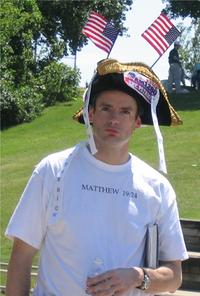
This clown actually rented this tricorner hat from a costume shop, a fact he revealed to Brian "Saint Paul" Ward when he got up to ask Kennedy a question. Anyone at the picnic not wearing a tricorner hat (IOW, all the rest of the humans there) could see that he appeared one musket short of a Minuteman, and when he attempted to harangue Kennedy, he removed all doubt. Of course, the streamers he attached to his hat tipped us off -- one says "TAX CUTS FOR THE RICH", another says "TORTURE", and the third says "TREASON".
Kennedy, unsurprisingly, issued a smack-down on the three-part question that Mr. Troll had obviously prepared. Brian even let him ask a follow-up question, something we don't normally do, but Mr. Troll refused to leave the stage for at least fifteen minutes afterwards. I'm sure he went off and told his friends that we SILENCED HIM AND DENIED HIS FIRST AMENDMENT RIGHTS TO FREE SPEECH. The last we saw of Mr. Troll, he followed in Kennedy's wake as he left the amphitheater.
All in all, we had a great time and enjoyed hanging out with our many friends from The Patriot, as well as the terrific food from Three Sons Catering. We were even happy to help the local costume industry get a bit more business as well as relieve a local lefty of cash that could have gone to International ANSWER or MoveOn. A fine success!
Roberts Papers Reveal The Conservative Within
Today's Washington Post editorial on John Roberts, "Young Lawyer Roberts", reviews the documentation released so far by the Bush White House on their Supreme Court Nominee -- and finds that (surprise!) Roberts will not transform into the second coming of David Souter. However, beyond branding Roberts as an unabashed conservative, the Post doesn't do much except excerpt passages from long-passed legal debates within the Reagan administration, passages that hardly show him as the reactionary that Democrats desperately want people to believe:
While it's dangerous to make judgments based on a quick and necessarily spotty reading of quarter-century-old documents, the picture that emerges from the first wave of papers, including a huge batch unveiled from Judge Roberts's tenure as an adviser to President Ronald Reagan's attorney general, shows a lawyer fully in tune with the staunchly conservative legal views of the administration he was serving -- and indeed, at times to the right of some of its leading conservative lawyers.Those who fear or hope, depending on their political positions, that Judge Roberts might be a stealth nominee in the mold of Justice David H. Souter -- a supposed conservative whose performance on the bench turned out to be far more moderate than predicted -- will find no support for such predictions in the papers that have emerged so far.
It doesn't take long for the Post to try to gin up a bogeyman, however, as it describes Roberts as "expressing hostility to affirmative action programs and to a broad application of the Voting Rights Act." Expressing hostility? That's editorial-speak for opposing interpretations of both not grounded in the law. The use of emotional language in describing Roberts' position doesn't appear accidental. The next sentence states that Congress should craft legislation that outlawed practices that did actual harm to minority voters in the proposed VRA instead of creating an amorphous, subjective standard of judging the "effect" of policies that would give courts wide latitude in arbitrarily creating new law through precedent. In short, he wanted Congress to write the law intelligently and clearly so that its interpretation and application could objectively apply regardless of which court ruled on it.
That doesn't sound like hostility; it sounds like common sense.
Another point which disturbs the Post was Roberts' objection to state prisoners using federal habeas corpus to file lawsuits. In 1981, that effort had tied up federal courts with a slew of ridiculous and inane court actions from inmates who literally had nothing better to do with their time than appear in court. It got them out of the prison yard and extra time at their facilities to prepare their cases. They mostly represented themselves or got pro bono representation, so it cost them nothing. Roberts made sensible arguments for curtailing the access, something the Post even acknowledges was needed -- but then blames Roberts for "the high court and Congress hav[ing] since gone too far."
So Roberts got Congress and the Supreme Court to go too far just by writing this one little memo? Is that what the Post wants us to believe?
The Post needs to rethink its approach to judicial criticism and quit issuing hysterical rants based on advisory memos, especially by applying emotional language where it doesn't belong to juice up an exceedingly weak case. It should take heart in Roberts' assistance to Sandra Day O'Connor in her confirmation process instead of treating it as an indication of some latent dishonesty, especially since the media has spent the last few weeks extolling O'Connor as a judicial saint. It won't make any difference in the confirmation of John Roberts, but getting a grip would have a salutory effect on the Post's credibility.
Scotsman: Sham Iranian President Heralds Military Junta Against Liberals
In a rare moment for European media, the Scotsman published a powerful article today about the "sham" election of Mahmoud Ahmadinejad as Iranian president and the effect it will have on liberating influences on the Islamic Republic. The first fruits of this election, swayed by an increasingly powerful Revolutionary Guard, showed themselves in the execution of political prisoners this week:
Mahmoud Ahmadinejad, the incoming Iranian "elected" president, will assume his post next month, but his presence is already felt in the political circles and on the streets of Tehran. Since his election, under the banner of a renewed Islamic revolution, the clerical regime hanged six people and sentenced another to death in the space of seven days. ...Indeed, the real story of this election is the metamorphosis of the Guards Corps from an ideological army to an omnipresent political/military powerhouse. With Ahmadinejad's win, the IRGC is now able to spread it wings over all key centres of power in Iran. This may account for the most major power realignment within the ruling theocracy since Ayatollah Khomenei's death in 1989.
The first success of the IRGC's resurgence took place during national municipal elections in 2003. Then, in the February 2004 parliamentary elections, at least 40 former IRGC commanders won seats. Shortly after, Khamenei appointed a top IRGC general as head of Iran's national broadcasting.
Ahmadinejad's election has triggered more than just these executions. The new national chief of police has ties to the IRGC. Supreme Leader Ali Khameini has also put the intelligence/terror services under the control of the IRGC, and their nuclear weapons program has also ome under their direction. The Governing Council even put IRGC leaders in charge of newspapers and other Iranian media, as well as municipal councils and the like.
For a nation flirting with nuclear weapons, the establishment of a military junta with such extreme ideological philosophies does not bode well for peace in the region. It looks like Iran may have decided to prepare for total war, if these accounts are accurate. They rigged an election to ensure that a hardliner would be their point man while the Governing Council consolidates power through the use of their military in all domestic areas of Iranian life. Student protests have increased as a result, and some consider this hopeful as it might finally wake Iranians to the threat of military dictatorship in the name of Islam, finally dropping the illusion of democracy from their eyes. By the time that happens, however, it may be too late to stop Iran from going to war.
What enemy awaits the creation of Fortress Iran? The mullahcracy probably thinks the US plans to attack it as part of the war on terror. Certainly Iran qualifies, as a big supporter and host of Islamofascist terrorists. They may decide to press the issue themselves by attacking Israel and holding Europe hostage through its Shahab rockets, which could deliver nuclear warheads to the capitals of the Continent now.
One thing is certain. Military juntas do not make these kind of preparations without an end goal in sight. The mullahcracy plans on doing something with its military control over Iran. We need to find out what it is and stop it while we can.
Rethinking Saint Colin
Today's Washington Post contains a glowing profile of Secretary of State Condoleezza Rice and the changes she has made in the nation's foreign-policy arena. Robin Wright and Glenn Kessler note her many substantial and subtle changes at a department often seen as an obstacle to carrying out George Bush's foreign policy goals. In doing so, an undercurrent of unspoken criticism of Rice's predecessor seems apparent:
Now six months on the job, Rice has clearly wrested control of U.S. foreign policy. The once heavy-handed Defense Department still weighs in, but Rice wins most battles -- in strong contrast to her predecessor, Colin L. Powell. White House staff is consulted, but Rice designed the distinctive framework for the administration's second-term foreign policy.In short order, she has demonstrated a willingness to bend on tactics to accommodate the concerns of allies without ceding on broad principles, what she calls "practical idealism." She also conducts a more aggressive personal diplomacy, breaking State Department records for foreign travel and setting up diplomatic tag teams with top staff on urgent issues. ...
In the interview, Rice said she discovered on her first European trip that, particularly on the Iran issue, "somehow we'd gotten into a position where it was the United States that was the problem . . . that was not a good place to be." So she formulated action that put the onus back on Iran and, later, North Korea.
"Sometimes the power of diplomacy is not just saying no, but figuring out a way to protect your interests and principles to help the other guy -- or in this case the other countries -- move forward as well," Undersecretary of State R. Nicholas Burns said. "It is the kind of diplomacy some of our critics had felt we were no longer capable of, that we were a kind of superpower saying 'yes' or 'no' but not anywhere in between."
When Rice first got nominated to this position, Democrats and editorialists expounded on the dangers of the president eliminating dissent from his Cabinet. They held Colin Powell as the last person of stature that would keep honest debate on policy occurring at the highest levels of the administration. Rice, by comparison, represented an attempt to surround the President with "yes men", so to speak, that would simply do his bidding without argument. The results in Rice's case, these experts predicted, would be further isolation and withdrawal of cooperation from allies around the world.
This started towards the end of Powell's reign at State. Media organization love Colin Powell, and for good reason: he looks and sounds impressive, he served his country honorably for decades in and out of the military, and he communicates his clear and precise thinking with a moderation and gravitas that undoubtedly attracts attention. The media decided that Powell, who they had earlier derided for not airing his personal and policy differences with Bush publicly, was the Oracle of all wisdom on foreign policy and repeatedly featured him in article after article during Rice's confirmation period and for a short time thereafter.
Now, however, the Post appears to have changed its mind, although one would have to have some familiarity with their previous coverage of Powell to recognize it. First, the article states several examples of Rice acting what many suppose Bush's policies demand. She initiated one-on-one contact with North Korea in order to get the multilateral talks back on line. She overrules Donald Rumsfeld on foreign-policy efforts. Rice reinvented the policy on Iran, working with Europe to set a slate of incentives that the US would back in exchange for a verifiable cessation of their nuclear program. She even found a formulation that the Bush administration would not veto at the UN which allowed the International Criminal Court to investigate war crimes in the Sudan.
Rice did all of this in six months. Powell, for all his gravitas and supposed opposition to Bush, could not do this in four years, a fact only obliquely referenced by Wright and Kessler on the fact that Powell couldn't get the Bush administration to even drop the "axis of evil" connotation for Iran. The Post also notes with a heavy helping of snark that Rice may "break ... State Department records for foreign travel[.]" Certainly the notoriously home-bound Powell never threatened to do that in his tenure at State.
Once again, the media has "misunderestimated" George Bush. First, Powell may never have provided the dissent that his aides proclaimed through anonymous leaks to journalists. If he did, he certainly didn't dissent very effectively. Second, this calls into question whether these positions that Rice has reversed ever were Bush's policies or Powell's. If Bush insisted on them, Rice certainly has changed his mind -- something that Democrats and the media tried to convince Americans that could never happen without Powell at the helm at State.
The Post appears to have decided that Condi Rice has the right stuff to lead State, and even gets Senator Joe Biden, one of her critics during her confirmation, to grudgingly agree. They also seem to realize that Rice's spectacular success calls into question all of the fawning coverage given to Colin Powell, especially towards the end of his time at State. They don't have the courage to do this re-evaluation overtly, but they leave enough subtle clues to make this conclusion quite easily reached.
Leftists Stage Backlash While Air America Admits Its Theft
Brian Maloney has the latest installment of the Air America disgrace that revealed the liberal radio netlet's misuse of government funds under founder Evan Cohen's direction. Leftist bloggers have begun their inevitable backlash defending Air America, calling the story "phony" and irrelevant to Air America by trying to distingush between AA and its original owner, Progress Media -- which only had the one asset and whose chief executive sat on the board of the non-profit it helped to bankrupt through this "loan".
Well, the Left simply hasn't caught up to reality. Air America said in its second press release on this matter that it planned to pay back the money, a very strange thing to do if it didn't take it in the first place. As I pointed out yesterday, it's also a very convenient position to take -- considering that Gloria Wise has gone bankrupt and closed its doors. Apparently that little detail didn't go unnoticed by Air America's other critics, and the netlet's spokesperson told Fox News this:
"We're committed to paying this money and the terms are being worked out... We are awaiting direction from the investigation into how to proceed."
That certainly indicates that AA believes it took the money improperly, and also that it has had contact with the investigation into Gloria Wise's collapse and possible malfeasance with its grant monies. We know that Air America has had problems finding competent management (and an audience), but I doubt they'd be anxious to cough up $480,000 for no reason, especially in their present financial condition. It hardly sounds like a "phony" story to me.
Barbara O'Brien claims that the story is so obscure that she had difficulty tracking it down. On that point, she may be right. I wonder why that may be. Can anyone here at CQ come up with a reason that the Exempt Media might be disinclined to report on a story that shows Air America misusing government funds and taking money from poor kids and Alzheimers patients? Anyone at all?
Oh, let's not see the same hands ...
UPDATE: Brian Maloney, not Mulroney. I'm suffering from Canadian withdrawals at the moment. (h/t: Tory, GOPinion's editor) Also, the Politburo Diktat explains Google to Barbara O'Brien.
Jimmy Insults American Military On Foreign Soil
At one time, people considered Jimmy Carter the most successful ex-president, building a far better reputation through his philanthropical work than he ever did in his single term in the White House. However, over the past ten to fifteen years, his meddling in foreign policy and continuous left-wing stridency has dimmed the luster of his charitable efforts. Despite being out of office at the time, he may wind up most responsible for North Korea having nuclear weapons.
One would think that would give him a legacy unmatched in recent times. Today he did what most of us thought impossible -- he actually made his reputation worse. Carter took an opportunity to castigate the American military for its treatment of terrorist detainees while traveling overseas ona visit to our most strategic ally:
Former President Carter said Saturday the detention of terror suspects at the Guantanamo Bay Naval base was an embarrassment and had given extremists an excuse to attack the United States.Carter also criticized the U.S.-led war in Iraq as "unnecessary and unjust."
"I think what's going on in Guantanamo Bay and other places is a disgrace to the U.S.A.," he told a news conference at the Baptist World Alliance's centenary conference in Birmingham, England. "I wouldn't say it's the cause of terrorism, but it has given impetus and excuses to potential terrorists to lash out at our country and justify their despicable acts."
I have covered the Guantanamo Bay dispute for the past several weeks, even before Dick Durbin attacked the joint task force of our military at Gitmo and their administration of the camp and treatment of its prisoners. Over and over again, the notion that Gitmo has done anything to "embarrass" the United States has been thoroughly debunked. The only people with egg on their faces are the politicians like Durbin and Ted Kennedy who bloviate about abuses in order to puff up their political credentials. An independent investigation confirmed that only three violations of American law and Geneva Convention standards had occurred at Gitmo in the thousands of interrogations that have taken place and the hundreds of detentions.
Carter's second notion, that Gitmo has given terrorists a reason to kill, disputes not only common sense but history as well. Gitmo didn't take in detainees until after the Afghanistan operation collected terrorists by the dozen in the field of battle. Before that had happened, Islamofascist terrorists had attacked the World Trade Center twice (1993 and 2001), Khobar Towers, two of our African embassies, and the USS Cole. Since we opened Gitmo, how many times have AQ terrorists attacked US assets, at home or abroad? And how does Gitmo explain attacks on Madrid, Istanbul, Morocco, and now London? The British should have laughed him off their island.
But even beyond the folly of Carter's assertions, the fact that he decided to attack the military and the American administration while abroad marks him as particularly despicable. He went to the soil of our strongest ally and attempted to undermine their support for the war effort in Iraq. If he succeeds, then American soldiers will wind up facing even more danger in the country at a time when we hope to be readying the Iraqis to stand on their own. No American should do such a thing during wartime, especially an ex-President -- even one as relentlessly clueless as Jimmy Carter.
Carter has long shredded his charitable reputation by reminding us how inept his grasp of foreign policy was and is. Now he has revealed himself as a man of low character and relative loyalty. That may surprise few at this point of his post-office career, but the extent of his perfidy still disappoints nonetheless.
Blowing The Federalist Society Question
Today's Washington Post reviews the issue of the possible membership of John Roberts in the Federalist Society and what it could mean for his Supreme Court Nomination. Mostly, however, Michael Fletcher attempts to explain what the Federalist Society is to a nation whose only knowledge of the group paints it as a murky, subversive, and secretive cabal -- an image the White House inadvertently underscored in the days after announcing Roberts' nomination:
Launched 23 years ago by a group of conservative students who felt embattled by liberals on the campuses of some of the nation's most elite law schools, the Federalist Society for Law and Public Policy Studies has grown into one of the nation's most influential legal organizations. The group claims more than 35,000 members, an increasing number of whom work in the highest councils of the federal government. Many Justice Department lawyers, White House attorneys, Supreme Court clerks and judges are affiliated with the group. Supreme Court Justice Antonin Scalia was a close adviser to the organization while he was a University of Chicago law professor.Not only has the Federalist Society become a source of legal talent for Republican administrations, but through its frequent on-campus seminars and forums for practicing lawyers, the group is also credited with popularizing methods of legal analysis now widely advocated by many conservatives and employed by an increasing number of judges. Theories such as originalism, which holds that the Constitution has a fixed and knowable meaning rather than an evolving meaning that should adapt to contemporary times, is an idea put forward by many Federalist members. Using that standard, some judges have challenged previous court rulings allowing broad federal control over states on regulatory and civil rights issues, and maintaining the legal wall separating church and state.
In one of the more prosaic examples of truth in advertising, the Federalist Society advocates a return to the Federalist model of government. That model empahsizes local and state control over public policy and funds, giving more freedom to Americans to shape the way government affects their lives. It also espouses a literal reading of the Constitution, which puts the responsibility for creating laws and policy on the Legislature -- the branch representing the people -- where it belongs. As one member says in the article, Federalists want courts to rule on the basis of what the law says, and not what they want the law to be.
So what's so subversive about this? Not much, even if Fletcher goes out of his way to include the Left's favorite bogeyman, Richard Mellon Scaife, in his article. That begs the question as to why the White House distanced Roberts from the Federalists at Warp Eight early after the announcement:
The eagerness of the White House to distance Roberts from the Federalist Society baffled many conservatives. They believe the reaction fed a false perception that membership in the organization -- an important pillar of the conservative legal movement -- was something nefarious that would damage Roberts's chances of confirmation."Are you now or have you ever been a member of the Federalist Society?" asked Roger Pilon, a vice president at the libertarian Cato Institute, mocking the suspicion that swirls around the group.
Put simply, the White House reaction was a mistake. It added to the notion that membership in the Federalist Society should concern American voters. Even if Roberts didn't belong, the next nominees to the bench might, and then the White House will have left the Democrats a handy, catchy-sounding club with which to rhetorically beat them. It would have reflected so much better on the Bush administration had they insisted that Federalist Society membership represented a long and honorable school of thought in American legal circles, one that had far too little representation until like-minded legal scholars formed the group in the 1980s.
Instead, as Pilon notes, their reaction gives the Federalists the same kind of emotional reaction that one gives the Masons or the Communists. That is a big mistake, and one which the Bush administration will regret not just with Roberts but with all of their succeeding judicial nominations.
Energy Bill Caps Powerful Legislative Session For GOP
What a difference a few weeks make! Less than two months after the Washington Post wrote off the second Bush term as moribund and Bush himself as a lame duck, the Post now joins the New York Times and AP in recognizing that rumors of Bush's political death are just a wee bit premature:
After years of partisan impasses and legislative failures, Congress in a matter of hours yesterday passed or advanced three far-reaching bills that will allocate billions of dollars and set new policies for guns, roads and energy.The measures sent to President Bush for his signature will grant $14.5 billion in tax breaks for energy-related matters and devote $286 billion to transportation programs, including 6,000 local projects, often called "pork barrel" spending. The Senate also passed a bill to protect firearms manufacturers and dealers from various lawsuits. The House is poised to pass it this fall.
Combined with the Central American Free Trade Agreement that Congress approved Thursday, the measures constitute significant victories for Bush and GOP congressional leaders, who have been frustrated by Democrats in some areas such as Social Security. As senators cast vote after vote in order to start their August recess, Bush applauded Congress, saying the energy bill "will help secure our energy future and reduce our dependence on foreign sources of energy."
To be sure, the GOP did not get everything they wanted. Trent Lott complained that the stripped-down energy bill had lost a lot of its meat. John McCain, predictably (and in this case correctly), complained that the highway bill had picked up far too much meat -- pork, to be precise. ANWR drilling disappeared from the energy policy, to be addressed separately after the break.
However, for the first time since Bush's election, Congress finally passed an energy bill. It passed a highway bill that took months of wrangling. The Senate extended key provisions of the Patriot Act. It also approved protections from class-action lawsuits against gun manufacturers, who looked to be the next target for trial attorneys after having picked the tobacco industry clean. Congress sent CAFTA, a key part of our Latin American strategy to boost economies and relieve economic pressure forcing migration, to the White House over one of the toughest coordinated efforts yet seen on legislation during the Bush term.
And Bush won all of these legislative victories while having the lowest approval ratings of his presidency.
The Post notes that the GOP controls both houses of Congress as well as the White House, and that these victories should be seen in that light. True enough. However, that has not stopped the Democrats from blocking most of this legislation in the past, especially the energy bill and the Patriot Act extensions. The Democrats assumed that with his poll numbers falling and their legislative stall tactics working, Bush would fold his tent and retreat.
That's what the Post expected, too, at the end of May. Now they realize that they too "misunderestimated" George Bush, to their embarrassment.
Passing A Test In Uzbekistan
One of the most important military bases operated by the US sits in Uzbekistan, which borders on Afghanistan. It provides strategic access to the northern part of Afghanistan, with good roads to Mazar-i-Sharif, plus long runways for heavy-load military flights. It opened shortly after the 9/11 attacks on New York and Washington and has been considered essential to our operations.
Unfortunately, that base will no longer remain in our control, as the Uzbeks have delivered an eviction notice to the US:
Uzbekistan formally evicted the United States yesterday from a military base that has served as a hub for combat and humanitarian missions to Afghanistan since shortly after the attacks of Sept. 11, 2001, Pentagon and State Department officials said yesterday.In a highly unusual move, the notice of eviction from Karshi-Khanabad air base, known as K2, was delivered by a courier from the Uzbek Foreign Ministry to the U.S. Embassy in Tashkent, said a senior U.S. administration official involved in Central Asia policy. The message did not give a reason. Uzbekistan will give the United States 180 days to move aircraft, personnel and equipment, U.S. officials said.
If Uzbekistan follows through, as Washington expects, the United States will face several logistical problems for its operations in Afghanistan. Scores of flights have used K2 monthly. It has been a landing base to transfer humanitarian goods that then are taken by road into northern Afghanistan, particularly to Mazar-e Sharif -- with no alternative for a region difficult to reach in the winter. K2 is also a refueling base with a runway long enough for large military aircraft. The alternative is much costlier midair refueling.
We have other bases in the Central Asia region supporting our Afghanistan operations, notably Tajikistan and Kyrgyzstan, but neither country has the same strategic access as Uzbekistan. Kyrgyzstan doesn't even border Afghanistan, making land access a moot point, and we only use the Tajik base in emergencies. The loss of this base will create a harsh impact on our efforts in the northern regions of Afghanistan.
So what went wrong?
Uzbekistan remains under the control of Islam Karimov, one of the Central Asian strongmen running former Soviet republics. For a while, his interests coincided with ours. Karimov didn't want Islamists to foment a bloody revolution and chase him from power, and he didn't mind the millions of dollars the US paid for use of the base, either. However, with the American push for democratization, the Uzbeks began to start demanding more and more freedoms, which made the Karimov regime start to question his American ties.
All of this came to a head earlier this year, when a massive pro-democracy protest turned bloody. Karimov's security forces opened fire on unarmed Uzbek demonstrators, killing 500 people in the Andijan province. The US demanded an independent investigation into the massacre, and planned on pressing Karimov for political reforms. So far, Karimov has not agreed to either, and the final straw apparently came when the US asked Kyrgyzstan to block extradition of 439 Uzbek political refugees.
The loss of such a strategic base is undeniably a blow for the US and its effort in Afghanistan. Yet this should be viewed as a triumph for the US. It demonstrates the Bush administration's commitment to democratization, even among our allies, and shows that we will not tolerate oppression and mass murder as a prop for power, not even among our friends. It shows that his overall strategy for this war is to create democracies as a bulwark against the radicalism that creates terror -- and that will, in the end, prove many times more beneficial than the Uzbek base we just lost.
The senior official quoted by the Washington Post noted that Bush could have saved the base simply by remaining silent about the refugees and democracy. Bush and his administration just passed an important test by choosing decency and democracy over the convenience of the moment. We will find other ways to support our efforts in Afghanistan, means that don't undermine our overall strategic goals of freeing as many people as possible throughout Southwest Asia and the world.
Armstrong Williams: Many Apologies, Light On Remorse
The Hill reports today that Armstrong Williams has positioned himself for a comeback after a disastrous fall from grace at the beginning of this year. When USA Today discovered that Williams had taken $241,000 to promote the No Child Left Behind program from the Department of Education without ever disclosing his relationship with the program, his credibility took a well-deserved beating. Williams lost his broadcast jobs and his syndicated column, and his business fortunes looked bleak.
Now the Hill reports that Williams has rebuilt his column and landed a new radio show in New York. He feels good about his comeback and wants people to know that he learned from the experience. However, he holds a grudge against conservatives who joined in the fierce criticism of his actions:
The 45-year-old commentator admitted he made a huge error in accepting Department of Education contracts to promote President Bush’s No Child Left Behind initiative. But a bitterness lingers about how he was treated by the media and fellow conservatives.Before the federal-contract flap, Williams said, “I had put everything on the line, defending the right, supporting the right. … None of the conservative [groups] came to my rescue. I was alone.”
Williams admitted that he should have disclosed the existence of the Education Department contracts in his weekly column. But he notes that there was a disclaimer about federal funding in the television and radio spots that touted No Child Left Behind.
“The media didn’t care about that,” he said. “[Reporters] can opt not to write things in order to make their stories worthy of the attention they’re giving it. I was used.”
It doesn't sound like Williams learned too much in the intervening time, except how to shift blame. Perhaps his commercials noted that some federal funding had gone into the spots, but his columns never revealed that he had joined the DoEd as a consultant. The amount of money he received -- almost a quarter-million dollars -- indicates that the relationship involved much more than a bit of funding for a couple of TV and radio spots.
Williams damaged the Bush administration and the credibility of conservative commentators while pocketing a substantial amount of cash. In that effort, he received plenty of help from the rocket scientists at DoEd who came up with the plan, of course. However, no one forced Williams to take the money or to keep it a secret from his readers, who assumed they read an independent assessment of NCLB instead of a paid PR campaign. The marketplace wondered how many others had gotten payola for their support of conservative causes, a backlash that hurt us all.
So please spare us the lingering resentment, as Bob Cusack notes Williams retains. Personally, I prefer a reinvigorated Williams than a sidelined Williams, as long as he remains credible and out of the reach of hidden funding. I can't abide a Williams who blames the conservatives for his woes -- the conservatives he stuck in the back for a fistful of taxpayer dollars. If he expected us to defend him for taking payoffs and committing flackery, then he still hasn't learned anything at all.
UN Undersecretary Scored Big Commercial Gains From OFF
The intrepid Claudia Rosett uncovers yet another sordid connection between United Nations executives and the corruption in the Oil-For-Food program. This time, she focuses on the former French ambassador to the UN Jean-Bernard Merimee, who served as Kofi Annan's special advisor during the OFF period with a rank of Undersecretary:
The 68-year-old Merimee, one of several individuals now under investigation in France for alleged involvement in Saddam Hussein’s Oil-for-Food scams, is well known for his role in the early 1990s as French ambassador to the United Nations. What investigators have not so far highlighted is that during the period Merimee is alleged to have come into commercial contact with Saddam’s regime, starting in December 2001, he was working not for the French government, but as a special adviser to U.N. Secretary-General Kofi Annan. ...On these lists, the apparent mention of Jean-Bernard Merimee, transliterated from Arabic as “Mr. Jan Mirami [French]” turned up three times, noted as having been allocated 4 million barrels of oil during the last three of the U.N. program’s 13 six-month phases — a stretch beginning Dec. 1, 2001 and truncated in March 2003 when the U.S.-led coalition invaded Iraq and toppled Saddam. ...
According to the Duelfer report, the allocations linked to Merimee’s name were “not performed.” The Duelfer report does show the Merimee allocations linked to an oil trading company, French-based Aredio Petroleum, which also appears in the report as the alleged intermediary for a number of deals with other parties, in which oil was lifted. These include oil allocations to the Iraqi-French Friendship Society, as well as a Jordanian businessman, Fawaz Zurequat, sometime business partner of British parliamentarian George Galloway — whose name also appears on the Al Mada and Duelfer lists, but who has denied receiving any oil allocations from Iraq.
It certainly seems that a number of people around Annan got wealthy from this program. His son Kojo got a nice if unspectacular stipend long after he supposedly stopped working for Cotecna. Iraqi documents show Benon Sevan, the head of OFF and an Annan crony, got millions of dollars in oil allocations. Canadian Maurice Strong, yet another "special advisor", had to leave the UN after his ties to South Korean businessman and Saddam beneficiary Tongsun Park came to light.
Now we have Merimee, and oddly enough, no one really knows when he stopped working for the UN. His name appeared in the directories until this year. However, when asked, the UN insisted that he had left Turtle Bay three years ago and his continued listing was an oversight. No announcements of his resignation or termination can be found, either in 2002 since -- highly unusual for such a high-ranking advisor at the UN.
Merimee has proven a puzzlement. If so, then we are fortunate indeed to have Claudia Rosett on the case. Read the whole thing. (via Instapundit)
Archives
blog advertising
Blogroll
Captain's Quarters features an authoritative blogroll, listing many websites that feature the top political thinking on the Internet. In order to make the list easier to navigate, it has been divided into a number of sections.
Click on the section title to expand the list.
Northern Alliance
Hugh HewittCaptain's Quarters
Fraters Libertas
Lileks
Power Line
SCSU Scholars
Shot In The Dark
Northern Alliance Radio Network
101st Fighting Keyboardist
Blogs for Bush
Sister Ships
Recent Comments
- Carol Herman on Heading Right Radio: Kenneth Timmerman, Shadow Warriors
- Frank on Can We Afford To Engage Sadr? Can We Afford Not To?
- Scrapiron on Can We Afford To Engage Sadr? Can We Afford Not To?
- danny on Can We Afford To Engage Sadr? Can We Afford Not To?
- Ron Hellesvig on New Comment System
- unclesmrgol on New Comment System
- Loren on New Comment System
- Dennis Lawler on US Navy Protects All Shipping From Piracy, Even Our Enemies'
- Jeremy on Another Step Towards Reconciliation?
- Qwinn on Another Puzzling Endorsement